



Abstract
While current federal programs for broadband have invested heavily in rural infrastructure, significant disparities in Internet use remain in urban areas, where broadband networks are available. The success of the national broadband plan and federal policy require understanding barriers to Internet adoption, including persistent inequalities in urban areas. Analysis of a random sample telephone survey in the city of Chicago merged with census tract–level data finds that neighborhood-level factors such as segregation and concentrated poverty influence the reasons why residents do not have home Internet access, as well as individual-level factors. Interactions demonstrate differential effects of age across racial and ethnic groups, and the amplification of disparities in access in segregated neighborhoods, especially for Latinos in gateway immigrant neighborhoods. Place effects need to be taken into account in further research and theory on technology inequality, and in public policy as well.
Introduction
National programs under the Obama administration have focused renewed attention on disparities in technology access and use, popularly known as the “digital divide.” Despite the growth in technology use throughout society, systemic inequalities remain. The latest data from the U.S. Census reports that while 63% of American households currently have broadband access at home, only 45% of African-Americans and 40% of Latinos have broadband at home (NTIA 2010). Thus nearly 4 in 10 American households don’t have sufficient access, as well as majorities of Blacks and Latinos.
The American Recovery and Reinvestment Act (ARRA) included a total of $7.2 billion for broadband, but that was spent primarily for infrastructure in rural areas. 1 American cities were overlooked by federal policy. Smaller amounts of the ARRA funding have supported public access and training that is targeted in poor city neighborhoods, but urban infrastructure proposals that would have provided affordable Internet access in high-poverty communities were not funded. 2
The success of national policy depends on more than laying fiber or constructing wireless networks, but also on whether it is affecting barriers to Internet use. While broadband service is generally available in most cities, urban residents in some neighborhoods also lag far behind in technology use (Mossberger and Tolbert 2009). What are the challenges they face, beyond availability? To what extent do urban residents experience “neighborhood effects” that might compound individual barriers such as poverty or limited education? How should policy address urban technology disparities?
A large body of urban policy research indicates that place effects such as segregation and concentrated poverty within inner-city neighborhoods affect experiences and opportunities for the poor, especially African-Americans and Latinos (e.g., Wilson 1987; Jargowsky 1997; Massey and Denton 1993; Wilson 1996). Some recent research suggests that place factors such as “geo-ethnicity” (Kim, Jung, and Ball-Rokeach 2007) or metropolitan segregation influence technology use (Fong and Cao 2008). One study using multilevel statistical models has shown that while community characteristics matter across racial and ethnic lines, they in fact explain the gap in technology use between African-Americans and Whites–it is poor African-Americans living in high-poverty communities that are affected by technology disparities rather than African-Americans as a whole. For Latinos, place effects are significant, but do not entirely explain the inequalities (Mossberger, Tolbert, and Gilbert 2006). This raises questions such as whether high-poverty or segregated communities present particular barriers to adoption and whether or how this might differ across poor neighborhoods.
In this article, we first examine national data on barriers to technology use and follow this with an analysis of a unique Chicago survey merged with neighborhood-level contextual data. The analysis uses a 2008 random-sample telephone survey of 3,453 Chicago residents to explore differences in home access by neighborhood characteristics as well as differences across individuals. We estimate barriers to Internet use across Chicago’s census tracts and the 77 official community areas of the city. The Chicago study offers an unusual opportunity to explore differences based on neighborhood, especially in high-poverty and segregated areas. The study shows that barriers to Internet use vary by neighborhood as well as by individual demographic characteristics. Barriers to home access also vary by race/ethnicity and by age.
Chicago has large populations of both African-Americans and Latinos, and offers a good view of the contrasts between these groups. In addition, many of the Chicago neighborhoods with high percentages of African-American and Latino residents are areas of concentrated poverty, which have been depicted in the urban policy literature as areas of structural disadvantage and social exclusion (see Jargowsky 1997; Massey and Denton 1993; Wilson 1987, 1996: Wilson and Briggs 2005). With comparisons to previous research on technology use and place, we use the Chicago study to suggest more general patterns of need in poor urban neighborhoods, and for diverse populations.
We first review prior research on why high-speed home Internet access matters, potential barriers for adoption, and how neighborhood effects could influence these barriers. After describing the survey and methods, we present evidence on barriers for home Internet use. The article closes with a discussion of the need to consider diverse populations and place factors (neighborhood context) in theory and research on information technology, as well as in shaping public policy solutions.
The Policy Context
According to the National Broadband Plan released by the Federal Communications Commission in 2010, “Not having access to broadband applications limits an individual’s ability to participate in 21st century American life” (FCC 2010, 10). Research indicates that Internet use enables both political and economic participation in a number of ways, and that exclusion from this technology can exacerbate existing inequalities experienced in low-income urban communities, acting to further detach individuals from the mainstream of society (Giddens 1998, 104). Controlling for other factors, technology use is associated with higher levels of voter turnout (Bimber 2003; Tolbert and McNeal 2003) and other forms of political participation (Bimber 2003; Kenski and Stroud 2006), as well as civic engagement (Mossberger, Tolbert, and McNeal 2008). Thus, technology exclusion widens existing inequalities in political participation and representation (Schlozman, Verba, and Brady 2010). The ability to use information technology on the job is increasingly important in the workforce, as technology applications grow throughout the economy, including in “old economy” sectors (Litan and Rivlin 2002). Taking into account other variables that affect wages, the wage premium for Internet use at work is more than $100 per week, even for lower-skilled workers with a high school education or less (Mossberger, Tolbert, and McNeal 2008). Those who lack technology skills are therefore less likely to move into better-paying jobs, even within less skilled occupations. Other costs of digital exclusion are visible through the efforts of individuals to find help. Government services and information have moved increasingly online, and libraries in poor communities are often strained to assist patrons trying to access government services (Bertot et al. 2006). According to a report by the American Library Association, “classified job ads have gone the way of the mimeograph—nearly obsolete. Nearly three-quarters of job seekers now use the Internet to seek employment, in part because this is the only way to apply for many job opportunities” (ALA Office for Research and Statistics 2010, 1).
In this study, we focus on barriers to home Internet access, because home access and high-speed connections encourage “digital citizenship,” or the regular and effective use of digital technologies needed to participate in society online (Mossberger, Tolbert, and McNeal 2008). It is an oversimplification to define a binary “digital divide” based on home access. Studies of low-income communities show that there are many less connected Internet users who go online at least occasionally without having home access (Mossberger, Kaplan, and Gilbert 2008; Dailey et al. 2010). Yet home access affords the frequent use that is related to skill acquisition, and to the benefits of digital participation (Mossberger, Tolbert, and McNeal 2008). Longitudinal studies show that acquisition of home Internet access is related to increased wages (DiMaggio and Bonikowski 2008). Home access is related to a broader range of activities online (Howard, Rainie, and Jones 2001), including information-seeking activities that can enhance individual opportunity—for jobs, health, transportation, education, and political participation among them (Hargittai 2002). Home access is strongly associated with these human capital–enhancing activities, controlling for other factors (Hassani 2006). Compared with other venues such as public access or the workplace, home access allows for more autonomy, convenience, flexibility, and time (DiMaggio et al. 2004; Hargittai and Hinnant 2008) to explore a range of uses and to gain experience. The higher speeds and capabilities of broadband convey even more advantages, facilitating a greater range of online activities, as well as experience, frequency of use, and skill (Horrigan 2004).
With the growth of mobile phone use, popular headlines and conventional wisdom have portrayed this as a solution to disparities in access (see Wortham 2009). In 2012, 46% of American adults owned Internet-enabled “smartphones,” with comparable rates for African-Americans, Latinos, and non-Hispanic Whites (Smith 2012). Mobile phones can replace landlines, and they represent a smaller upfront investment than laptops or desktop computers (Kang 2011). Legal scholar Susan Crawford (2011) has referred to this, however, as a second-class form of access. As Horrigan (2012) has observed, smartphones supplement home broadband for most; those who rely upon cell phones as their primary means of Internet access cannot perform all of the tasks that they can on a laptop or personal computer, such as filling out resumes and job applications. For this reason, only 4% of the U.S. population accessed the Internet on a cell phone but did not have home Internet access in 2009, according to a Federal Communications Commission survey (Horrigan 2010).
Another possible limitation to focusing on home access is the availability of public access. Libraries and community technology centers are important for technology use in poor communities (Dailey et al. 2010), not only because they provide public access to the Internet but also because they offer training and technical support. Libraries increasingly offer assistance with resumes, job applications, income taxes, and applications for unemployment, social security, and Medicare (Becker et al. 2010). Public access sites are certainly a critical part of the ecology of Internet use in low-income communities (Dailey et al. 2010), but they cannot provide the same convenience or 24-hour availability as home access, even under the best of circumstances. And conditions are far from ideal. Nationally, 7 of 10 libraries report that they do not have enough computers to meet demand, and 6 of 10 say they do not have enough staff (ALA 2011).
Analysis of national data show that those who are “less connected,” relying on mobile phones and public access, engage in fewer activities online and have less knowledge about the Internet (Mossberger, Tolbert, and Franko, forthcoming). Despite mobile Internet and public access, only a little more than 60% of Americans would quality as digital citizens with home broadband according to the latest 2010 U.S. Census data. Nationally, then, almost 40% of the population were either offline entirely or less connected. Comparatively, the U.S. lags behind many other developed countries in terms of Internet adoption, affordability, and speed. According to the Organization for Economic Cooperation and Development (OECD), the United States ranked 15th in broadband subscribers per 100 inhabitants in 2010 (OECD 2011). Because digital citizenship increasingly equates with economic opportunity and participation in a democratic society, we explore the contours of these disparities.
Previous Research
Why is it that some people do not go online at all, or are less connected, without home access? Research on spatially concentrated poverty indicates that neighborhood environment may be one factor, shaping opportunities and constraints for technology use. 3 Racial and ethnic segregation, combined with concentrated poverty, have been regarded as an urban problem, with African-Americans most likely to live in such conditions, although it is common for Latinos as well (Jargowsky 1997; Massey and Denton 1993). In recent years, there has been an increase in high-poverty neighborhoods that serve as immigrant gateways and that have high percentages of Latinos (Federal Reserve and Brookings Institution 2008). Scholars have portrayed the geographic concentration of poverty as responsible for a number of problems, such as crime, drug use, single-parent families, and isolation from mainstream values (Wilson 1987; Jargowsky 1997). With little commercial investment, areas of concentrated poverty suffer from higher prices and lower-quality goods and services (Caplovitz 1967; Federal Reserve and Brookings Institution 2008). They are characterized by poor-quality education (Orfield and Lee 2005; Stone et al. 2001, 10-11; Joassart-Marcelli, Musso, and Wolch 2005) and isolation from labor market networks (Granovetter 1973). Concentrated poverty represents a “double burden” for the poor who live in very poor areas (Federal Reserve and Brookings Institution 2008, 5)
Urban poverty may influence technology use in ways that are different from rural poverty. While public access technology may be more available in urban areas, disparities in education and in the labor market may still present hurdles for gaining skill or for affording high-speed access at home. Survey research in three Northeast Ohio communities (East Cleveland, Youngstown, and Shaker Heights) revealed higher percentages of residents in poor, African-American neighborhoods who used the Internet occasionally but did not have home access. Neighborhood-level factors predicted using the Internet without easy access: living in a predominantly African-American neighborhood was associated with a higher probability of use without home access, controlling for other factors (Mossberger, Kaplan, and Gilbert 2008). 4 These neighborhood patterns reflect economic constraints.
Individual attributes obviously matter as well for the acceptance or adoption of new technologies. According to the theory of planned behavior (Ajzen 1991), technology adoption is driven by several factors. Beliefs and attitudes include perceived usefulness of the technology and perception of fit between the technology and the individual’s needs. Perceived behavior control involves individual perceptions about whether the individual has adequate resources to adopt the technology. In addition, the social context matters, according to Ajzen (1991). Subjective norms that influence Internet use refer to peer pressures, opinions within social networks, and community norms. The next section reviews possible barriers to home access, discussing how the environment of poor urban neighborhoods might magnify the effects of individual-level constraints.
Explanations for Barriers to Internet Use
Individual Attitudes and Subjective Norms—Interest
Causes for a lack of interest in home Internet access could be varied: a lack of awareness of the uses and potential benefits of the technology, perceived lack of relevance or fit (Selwyn, Gorard, and Furlong 2005), or rejection of the technology. Nonadopters may also avoid technology because of fears about unintended consequences, such as privacy and security threats. Recent survey data demonstrate that such fears are higher among those who have little or no experience with the technology (Horrigan 2010). In addition, those who are less educated, or have limited Internet use within their social circles, including residents of poor communities, may not as readily learn about the potential uses of the web (Warschauer 2003; DiMaggio et al. 2004; Hargittai 2003). Low rates of Internet use among Latino immigrants may be influenced by lack of experience with technology in their personal networks (Ono and Zavodny 2008).
Selwyn (2003) cautions that lack of interest cannot always be attributed to knowledge deficits. Some individuals make a conscious choice not to go online in the same way that others choose to avoid television. This ideological refusal (Selwyn 2003) may be a form of opposition to mainstream culture. Resistance to change and innovation may be another factor, especially among the elderly (Haddon 2000).
Do poor and segregated neighborhoods have values or attitudes that downplay the utility of the Internet because of social isolation or opposition to mainstream culture? The literature on concentrated poverty in American cities suggests that segregation and the prevalence of poverty can breed different attitudes and values among residents of such communities (Wilson 1987). Yet, in one national study that oversampled in high-poverty census tracts, African-Americans were more likely than similarly situated Whites to express positive attitudes toward Internet use. African-Americans, in particular, associated the information found online with economic opportunity across a range of questions—getting a job, getting a promotion, and starting a business. Latinos were significantly more likely than non-Hispanic Whites to believe that you need the Internet to keep up with the times. Apathy may not be as prevalent in these groups, among nonadopters (Mossberger, Tolbert, and Stansbury 2003; Lenhart 2003), and this is further underscored by higher rates of public-access Internet use among minorities (Gant et al. 2010).
Resources—Cost
Hardware, software, and monthly service costs could be expected to affect Internet access. Information technology can require a substantial up-front investment, despite falling prices for computers in recent years. Internet services require a monthly payment, and this may be a greater hardship for low-income consumers than the initial costs, forcing monthly decisions about competing priorities. Historically, disparities have been greater in telephone use than in radio and television, which required one-time purchases (Schement and Forbes 2000). The price of high-speed access has not decreased, as the price of computers has (Van Dijk 2008; Greenstein and McDevitt 2010), and prices are higher in the United States than in many other countries (OECD 2011). Income has been found to be a consistent predictor of home access, and cost could be expected to pose a barrier for low-income populations (Fairlie 2004; Mossberger, Tolbert, and McNeal 2008; Katz and Rice 2002). Immigrants cite costs as a barrier at twice the rates of native-born individuals (Ono and Zavodny 2008), which may be a result of lower incomes or different priorities.
While urban areas generally have infrastructure for broadband Internet, costs may be higher in poor communities because of a lack of competition (monopolies) or the type of high-speed Internet access that is available. 5 One study in the Washington, D.C., region has shown that speeds are slower in poor communities and that prices per megabit are therefore higher (Dunbar 2011). Currently, efforts are being made to track the number of providers by census block through federal broadband mapping initiatives, and this may provide more information about competition in the future. 6
There are other ways in which costs within poor neighborhoods may influence adoption of the Internet. The availability and prices of goods and services tend to be worse in poor neighborhoods, and financing and credit are less available in low-income areas (Caplovitz 1967; Federal Reserve and Brookings Institution 2008). Higher prices or lack of credit may impose extra burdens for acquiring the hardware, software, or monthly service needed for home broadband. In addition, higher prices for food and other necessities in poor neighborhoods may limit investments in competing goods such as the Internet. Finally, cost barriers may be higher in poor communities because residents lack good consumer information within their social networks, especially about unexpected costs such as installation, or the lapse of introductory prices (Dailey et al. 2010).
Resources–Skill
Frustration or anxiety about using technology could be expected to discourage home adoption. Difficulty using the Internet may be a matter of educational competencies, self-confidence, experience, or physical disabilities. Technology use requires a variety of skills or literacies (Warschauer 2003; Van Dijk 2005, 2008). Technical competence is needed, as well as online information literacy. The latter involves the ability to find, evaluate, and use information in a web-based environment, and educational disparities can be expected to inhibit such skills (Mossberger, Tolbert, and Stansbury 2003). Lack of confidence or fear of technology may be a barrier for some individuals. Self-efficacy, self-image, and locus of control influence attitudes toward computer and technology use (Katz 1994; Ellen, Bearden, and Sharma 1991; Todman and Monaghan 1994). Difficulties with technology may be physical as well as cognitive or attitudinal. Physical disabilities, especially those that affect eyesight or fine motor skills, can make it difficult to use screens or keyboards, and such individuals are less likely to be online. Many individuals with disabilities also have low incomes, making it difficult to afford the adaptive technologies that could accommodate these needs (Dobransky and Hargittai 2006).
Difficulty using technology is associated with older and less educated individuals (Van Dijk 2008), although income, race, and ethnicity have also been found to be significant predictors for technical competence and information literacy (Mossberger, Tolbert, and Stansbury 2003). In studies that have observed actual performance, women tended to report lower levels of technology skill, yet observations revealed no differences in actual skill based on gender, controlling for other factors (Hargittai and Shafer 2006; Van Deursen and van Dijk 2009a, 2009b).
There may be a spatial dimension to skill acquisition, in areas where there is little exposure to technology at work, in the neighborhood, and in personal social networks. Individuals living in neighborhoods with high unemployment are less likely to use the Internet for their jobs, according to a study in one metropolitan area (Kaplan and Mossberger, 2012). Residents of poor neighborhoods may have fewer educational competencies to navigate the web and to learn about technology. Unequal educational opportunities in poor communities (Jargowsky and El Komi 2011) have effects that persist well into adulthood (Holloway and Mulherin 2004).
Language may be another barrier at the individual and community levels. National surveys show large gaps in technology use between English-speaking and Spanish-speaking Latinos in the United States (Fox 2009). In fact, surveys that include only English-speaking Latinos often find few disparities with non-Hispanic Whites. 7 There are different possible explanations for these results. National surveys have found that for Latinos living in the United States, it is English ability rather than reading ability in any language that is related to Internet use (Livingston, Parker, and Fox 2009). Predominantly Spanish-speaking Latinos may be more recent immigrants with little previous exposure to the Internet (Kim, Jung, and Ball-Rokeach 2007). While the exact reasons are unclear, Spanish-dominant Latinos lag behind in Internet use and home access in the United States (Horrigan 2010; Fairlie 2007). Neighborhood effects may also be visible in gateway communities where recent immigrants who are less educated and poor cluster together in high-poverty neighborhoods.
This review of the literature demonstrates that there are myriad reasons to expect that place can affect barriers to home Internet access. It is difficult, however, to disentangle the causal mechanisms underlying potential place effects. Indeed, causes for neighborhood effects are complex and not easily addressed in the research (Federal Reserve and Brookings Institution 2008; Sampson, Morenoff, and Gannon-Rowley 2002).
Trends in National and Chicago Survey Data
Drawing on a unique telephone survey of 3,453 Chicago residents commissioned for this study, Internet use in the City of Chicago looks remarkably like the rest of the nation. Chicago as a whole parallels national averages, but as a diverse city, it also reflects the gaps in Internet use that persist nationwide. As of summer 2008, 8 61% of the city’s population had a broadband connection at home, in comparison with 63.5% of households nationally in 2009 (NTIA 2010). Overall, 25% of Chicago residents were completely offline, another 6% used the Internet at times but lacked home access, and 8% had more limited and slow dial-up connections rather than high-speed broadband. Approximately 60% of Chicago residents had adequate access, but nearly 40% had limited or no Internet access, as in the nation overall.
The Chicago survey included a question asking why respondents did not use the Internet at home. Respondents were asked to choose any and all reasons for not using the Internet at home, and then asked to select the most important reason for not going online at home, as reported in Table 1. 9 In this way, we could better understand whether respondents who said that they cannot afford the Internet might simply be uninterested as well, and therefore not motivated to spend money on a computer or a monthly Internet bill. Table 1 shows that lack of interest, affordability, and skill stand out as the most important main reasons for not having a home connection in Chicago. 10 When respondents are allowed to give multiple answers, issues such as privacy and danger emerge as secondary reasons for many, even though few residents cite them as the main reason for not having the Internet at home. Difficulty is also more important as a secondary reason—people who do not have home access may not choose this as the only reason for not investing in the Internet, but they are less confident of their skills. 11
Reasons for No Internet at Home, Chicago, 2008: Respondents Who Do Not Use the Internet at Home (n = 1,011)

There is considerable variation by race and ethnicity in the main reason for not having access as seen in Table 2. A lack of interest is the number one reason cited by White non-Hispanics for lacking the Internet, with more than 40% giving this reason. African-Americans and Latinos are more likely to cite cost than White non-Hispanics. Thirty percent of African-Americans and almost 40% of Latinos without home access in Chicago state that affordability is the primary barrier. 12 Cost and lack of interest are nearly tied for African-Americans in this sample, but in comparison with Whites, a much lower percentage of African-Americans say they are not interested. Latinos are the group most likely to say that difficulty using the Internet is the main barrier.
Main Reason for No Internet at Home by Race and Ethnicity, Chicago, 2008: Respondents Who Do Not Use the Internet at Home (n = 1,011)

How does Chicago compare to national trends? During the same general time period as the Chicago study, the National Telecommunications and Information Administration (NTIA) documented the main reasons that households did not have high-speed (broadband) Internet access at home in a 2010 report drawn from the 2009 Current Population Survey (CPS) of 129,000 respondents. Questions on reasons for no home access were asked of people with no Internet access of any kind as well as the small percentage of Americans with home dial-up.
In both cities and the nation, common reasons for not having broadband at home are lack of interest, cost, and lack of a home computer (or adequate computer). Nationally, lack of interest is the most cited reason at 38%, and affordability is second at 26%. It is difficult to interpret the third place “no computer” response at 18%, because this begs the question of why the household does not have a home computer. Is this because of cost, skill, or lack of interest? Only 3% nationally cite a lack of skill, in comparison with 9% in the Chicago study.
Most telling for the Chicago analysis are data on race and ethnicity for principal city residents. As in Chicago, both African-Americans and Latinos are significantly less likely than non-Hispanic Whites to say they were not interested as the reason for no home broadband, and are more likely to cite cost and lack of a computer. Compared to 42% of Whites without home broadband, only 30% of African-Americans and 27% of Latinos are not interested, for principal city residents. Only 23% of the non-Hispanic Whites who lack broadband said it is primarily because of the expense, whereas 34% and 36% of African-Americans and Latinos cited this reason. Similarly, Latinos (at 24%) are most likely to say they lack a home computer or that their computer is inadequate for broadband, whereas 21% of African-Americans and 17% of Whites in principal cities cite this reason. Barriers cited in the Chicago study are comparable to those in other cities, nationally. 13 But, the Chicago study offers an unusual opportunity to explore neighborhood-level factors.
How do geographic and demographic factors combine to explain these variations in barriers to home access?
Barriers for the Less Connected in Chicago: Research Expectations
We are interested in understanding barriers to home Internet use at both the individual level and by place or neighborhood. Common responses in both the Chicago survey and national CPS were lack of interest, cost, and difficulty using the technology. Our analyses therefore concentrate on these three reasons for lacking home Internet access. Based on the literature, we would expect that at the individual level, those who are less interested in technology will be older, less educated, and White. African-Americans and Latinos will be less likely than non-Hispanic Whites without home Internet access to say they are uninterested. Based on the national results, those who cite costs are more likely to be African-American, Latino, and low-income, but this may be especially true for Latinos. Those who cite difficulty with technology are more likely to be older and less educated. Latinos may also be in this group, given lower levels of education.
Further, we hypothesize that residents of low-income minority neighborhoods are more likely to cite cost or difficulty with technology (but not lack of interest). Most of the potential neighborhood effects indicate reasons why costs may be higher in poor neighborhoods, or why residents of such areas may experience more skill deficits. On the basis of the high rates of public access use in poor communities, we believe that lack of interest is not likely to be grounded in the neighborhood context.
Finally, we explore interactive effects. Age is an important factor in digital inequality, and the national data show strong relationships between age and barriers such as lack of interest and skill. We expect that age has differential effects on home adoption for African-Americans, Latinos, and non-Hispanic Whites, just as we expect differences in general between these groups. Older minorities are among those who are most isolated from technology. Understanding whether barriers are similar for all older individuals can yield better information for addressing disparities among older African-Americans and Latinos, in Chicago and other cities.
The final set of interactions we investigate are related to segregation and concentrated poverty. We expect that African-Americans and Latinos living in a neighborhood with a high percentage of minorities will be more likely to experience the barriers that are prominent for these groups nationally, such as cost and difficulty. If neighborhood matters for digital exclusion, these individuals may be, to use Wilson’s (1987) term, truly disadvantaged.
Data and Methods
The random sample telephone survey of Chicago residents with 3,453 respondents was designed by the authors and carried out in summer 2008 by the University of Iowa Hawkeye Poll. 14 The survey was conducted in Spanish and English, and the cooperation rate was 27%, which is typical for telephone surveys. 15 The survey instrument took 12 minutes to complete (see appendix C for survey questionnaire). The sample of residents 18 years and older was fairly representative of Chicago’s population. Of survey respondents, 45% were White non-Hispanic, 31% were African-American, 3% Asian-American, 19% Latino, and 3% other or mixed race. According to the American Community Survey, in 2008, 42% of Chicago residents were White, 35% were Black, 28% were Hispanic (of all races), and 5% were Asian. 16 The survey was merged with census tract–level data measuring neighborhood racial and ethnic context, educational attainment, and relative affluence or poverty. The results are presented first using only the individual-level survey data and then using a series of statistical models controlling for neighborhood-level factors. We conclude by examining interactions between race/ethnicity and age, and cross-level interactions of the race/ethnicity of the respondent by the minority population of the neighborhood.
Results
Predicting Barriers to Internet Access at the Individual Level
To sort out differences among Chicago residents in reasons for not having home access, we conducted multivariate logistic regression. The most frequently cited answers were “I don’t need it/not interested,” “the cost is too high,” “It’s too difficult to use.” The dependent variables in the following logistic regression models are these three reasons for not having home Internet coded 1 for giving that reason and 0 for not mentioning that reason. 17 We model those who report they are not interested as a reason for being offline, who report cost as a barrier, and who report a lack of skills for using computers and the Internet. Primary explanatory variables measure demographic factors paralleling previous research on digital inequality (Norris 2001; Mossberger, Tolbert, and Stansbury 2003; Fairlie 2004). 18 This first layer of the analysis focuses exclusively on individual-level predictors as explanatory factors.
Because logistic regression coefficients are difficult to interpret in terms of substantive magnitude, we convert the logit coefficients in Appendix A to predicted probabilities shown in Table 3. We hold constant all other explanatory variables in the model at their mean/modal values, and then vary the explanatory variables to understand the substantive effect of age, for example, on reasons for being offline. Table 3 shows diversity in the barriers individuals face in lacking access at home. Older individuals and those with more income are more likely to say they are not interested as reasons for being unconnected, controlling for other factors. These individuals are making conscious choices to stay offline, and some may be resistant to new technology or see it as simply irrelevant (Selwyn 2003). However, the poor, Latinos, females and those with lower education are significantly more likely to cite affordability as the main reason for being offline. A lack of skill is a barrier for older residents and Latinos. Notably, African-Americans and those with higher education are significantly less likely than other groups to mention a lack of skill as a reason for not having home access. Higher rates of public access use by African-Americans may have some positive effects on confidence in skills.
Probability of Citing Reasons for a Lack of Home Internet among Chicago Residents (From models reported in Appendix A)

Note: Predicted probabilities from the logistic regression models reported in Appendix A. Probabilities estimated with control variables set at mean or modal values. Standard errors of the probability estimate in parentheses. Modal/mean values are a female, White non-Hispanic Chicago resident with no children and average age, income, and education.
Table 3 shows that compared to younger respondents, older individuals are 24% more likely to cite a lack of interest as the reason they lack home access; a 31-year-old (1 standard deviation below the mean) has only a 32% probability of saying he or she is not interested, compared to an older individual (67 years, 1 standard deviation above the mean), who has a 56% probability of citing this reason. Higher-income residents are also more likely to cite a lack of interest in home access. Non-adopters with annual family incomes between $75,000 and $100,000 are 15% more likely to cite lack of interest than respondents with incomes between $10,000 and $20,000. In comparison, education makes a smaller difference than age and income. Residents with a high school diploma are 9% more likely than college graduates to say they are not interested in the Internet. African-Americans are 7% less likely than Whites to cite a lack of interest in having the Internet at home.
Not surprisingly, residents citing cost are in fact low-income (see column 2 of Table 3). However, Latinos (not African-Americans) emerge as the ethnic group most likely to mention affordability as the reason for not having home access, once we control for factors such as income. The poor (with incomes between $10,000 and $20,000) are 30% more likely to perceive cost as a barrier to home access than the affluent (incomes between $75,000 and $100,000), all else equal. Poor Chicago residents have a 60% probability of citing cost barriers, compared to higher-income residents, who have less than a 30% chance of saying this. Holding other factors constant, Latinos were 15% more likely than non-Hispanics to say cost is a problem for Internet access. African-Americans, in contrast, were only 3% more likely than Whites to say cost is an issue for home access, controlling for other factors. This difference was not statistically significant. The differences between African-Americans and Whites in sensitivity to cost (apparent in the descriptive statistics) may therefore be due to higher levels of poverty rather than race per se. We explore this in more detail below. Interestingly, women were 15% more likely than men to mention cost as a reason for not having home access, all else equal.
The last column of Table 3 shows that less educated, older, and Latino respondents are more likely to say that they have difficulty using the Internet. Older respondents were 30% more likely to cite skill barriers, compared to the young. This is not surprising, given the prior research on digital inequality. A lack of formal education also corresponds with a lack of skills. Respondents with only a high school degree were 15% more likely than those with a college degree to say the Internet is “too difficult to use.” Latinos are 14% more likely than White non-Hispanics to cite a lack of skills or difficulty going online as a barrier to home access, again indicating greater disparities for Latinos. In contrast, African-Americans are 7% less likely to cite skills as a barrier, compared to Whites who do not have home access. This may reflect Internet use outside the home among African-Americans.
Predicting Barriers to Internet Access Controlling for Neighborhood Context
As a second layer to our analysis, we use geocoding to merge our survey data with geographic information from the respondent’s (1) community area or (2) census tract from the 2000 U.S. Census. Chicago is divided into 77 community areas or neighborhoods, with demographic characteristics of community areas defined by aggregating census tract information. These two different measures of context are presented side by side to create the most complete picture of neighborhood effects in shaping digital inequalities. Census tracts have the advantage of a smaller geographic area, but the community areas are often used by the city and others for planning and policy initiatives. Results are similar for the two geographic measures of context.
Previous research shows context matters for Internet access (see Mossberger, Tolbert, and Gilbert 2006; Mossberger, Kaplan, and Gilbert 2008). In addition, scholars have found measurement error may occur unless researchers account for the political geography in which individuals reside (Primo, Jacobsmeier, and Milyo 2007). Chicago’s 77 community areas and census tracts vary dramatically in terms of affluence, education, and racial/ethnic composition. Geographic variables included in the models are the percentage of African-Americans, Latinos, Asian-Americans, high school graduates, and population living below poverty levels from the U.S. Census. 19 These variables correspond to the urban literature on segregation and concentrated poverty.
Tables 4 and 5 report logistic regression models predicting the three primary reasons for being offline at home: interest, cost, and skill, respectively, with clustered standard errors given the geographic data. 20 The dependent variables and individual-level explanatory variables are the same as reported in Table 3. This geographic analysis allows us to understand how context interacts with individual-level factors to predict technology access. Predicted probabilities from these multilevel models are used to understand the substantive effects of our explanatory variables, and to create estimates of the reasons for no home access for each of Chicago’s community areas, as shown in the maps. The precision of the maps is based on statistical models that combine neighborhood and individual characteristics.
Probability of Citing Not Interested or Cost Too High as a Reason for No Internet Access: Logistic Regression Estimates, Clustering by Census Tract or Chicago Community Area

Note: Unstandardized logistic regression coefficients with robust standard errors in parentheses. Probabilities based on two-tailed tests. Standard errors adjusted by clustering cases by geographic area (census tract or Chicago community area). Variables with a p value of 0.10 or lower are considered statistically significant with a 90% confidence interval; a p value of 0.05 or lower is considered statistically significant with a 95% confidence interval.
Probability of Citing Too Difficult as a Reason for No Home Internet: Logistic Regression Estimates, Clustering by Census Tract, or Chicago Community Area

Note: Unstandardized logistic regression coefficients with robust standard errors in parentheses. Standard errors adjusted by clustering cases by geographic area (census tract or Chicago community area). Probabilities based on two-tailed significance tests. Variables with a p value of 0.10 or lower are considered statistically significant with a 90% confidence interval; a p value of 0.05 or lower is considered statistically significant with a 95% confidence interval.
Lack of Interest
Table 4 columns 1 and 2 show few contextual predictors in citing a lack of interest as a reason for lacking home access. 21 Thus, the geographic variables do not add much value in predicting a lack of interest as a barrier to Internet use. The statistical model in column 2 can also be used to create geographic estimates or maps of the probability of citing a lack of interest as a barrier to home access. Appendix Table B1 shows residents of more affluent community areas without home Internet access are more likely to say that they are not interested in having the Internet at home. Those who are offline by choice tend to be more affluent and live in higher-income areas. The darkest shading in the map in Appendix Figure B1 indicates where lack of interest is highest in Chicago, and this follows community areas where Internet use is highest, including the affluent north lakefront, Beverly to the South, and the far north side.
Cost Too High
While at the individual level, African-Americans were not more likely than Whites to report cost as a reason for not having technology access at home (a 3% difference), the models reported in Table 4 columns 3 and 4 show that residents of communities with higher African-American populations are significantly more likely to state that cost is a main reason for not having the Internet at home. This is an example where using only the individual-level data may mask important variation in what we seek to explain. Similarly, residents in neighborhoods with high proportions of Latinos are also more likely to cite cost. These patterns suggest neighborhoods with high concentrations of African-Americans and Latinos are particularly sensitive to cost burdens or perceived costs. These are areas of concentrated poverty as well.
The statistical model in Table 4 column 4 can be used to generate the probability of citing affordability as a barrier, by Chicago community area. The map shown in Appendix Table B2 reveals darker-shaded community areas, where a high percentage of residents without home access cite costs. Such neighborhoods are largely on the south and west sides of the city, where there are greater concentrations of African-Americans, Latinos and areas of concentrated poverty. The probability of citing affordability as a barrier doubles, rising by more than 40 percentage points, as the Latino population increases from 20% to 80% in a neighborhood (see Figure 1). A more moderate, yet substantial increase occurs for the African-American population. The probability of citing affordability as a barrier rises by 20%, as the African-American population increases from 20% to 80% in a community (see Figure 1). Figure 1 even suggests that higher Asian-American populations in a community area are associated with barriers to home technology access based on cost. The figures and map provide strong evidence that place and context matter in predicting barriers to technology, even after controlling for individual-level factors. Segregated neighborhoods are disadvantaged in terms of technology access, and cost appears to be a primary explanation.

Probability of citing cost as a reason for no home Internet by neighborhood factors (from the models in Table 5)
Difficulty/Lack of Skill
Table 5 introduces neighborhood effects to predict a lack of skills as a barrier to home access. The results show individuals residing in higher-poverty census tracts are less likely to give a lack of skills as a reason for not having home access, controlling for other factors. Residents in poor neighborhoods, whether White, Latino, or African-American, are more likely to cite cost as a barrier rather than a lack of skills. In addition, residents in neighborhoods with a high percentage of African-Americans are more likely to mention difficulty in use (although at the individual level African-Americans are not). Figure 2 shows the probability of reporting a lack of skill as a barrier rises by more than 20 percentage points, as the African-American population increases from 20% to 80%. This may suggest some skill deficits or problems concentrated in these areas not captured by the other factors examined here, such as unequal educational opportunities not measured by formal educational attainment. Again, relying on individual-level survey data alone would hide this variation based on neighborhood racial variation. But how might these individual-level and neighborhood-level patterns interact in magnifying or diminishing the patterns we have shown so far?
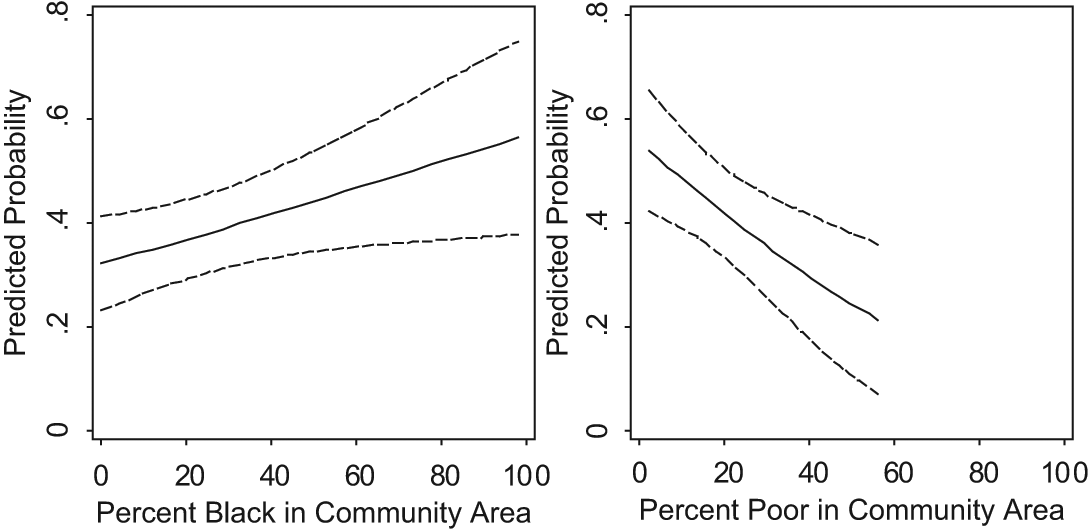
Probability of citing too difficult as reason for no home Internet by neighborhood factors (from the models in Table 6)
Conditional Effects: Age and Race/Ethnicity
One plausible avenue for research is the potential interaction of race/ethnicity and age in shaping barriers to technology. Age accounts for some of the largest gaps in access and use and is implicated in many of the barriers in prior research. So, it is worthwhile to understand whether the effects of age differ across racial and ethnic groups. Table 6 replicates the logit models reported in Tables 4 and 5 predicting the probability of citing a lack of interest (column 1), affordability (column 2), or a lack of skill (column 3), but including three interaction terms measuring the conditional relationship between race (African-American, Latino, or Asian-American) and age. Because the substantive effects of conditional models are difficult to interpret from the logit coefficients, predicted probabilities are reported in Figure 3, holding all other variables in the model constant. The top panel of graphs for Figure 3 reports the probability of citing interest, cost or difficulty for Latinos (solid black line) compared to non-Latinos (light grey line). The dashed lines represented the 95% confidence interval around the predicted values. The bottom three graphs report the same data for African-Americans (black line) compared to White non-Hispanics (light grey line).
Reasons for No Home Internet, Age and Race/Ethnicity Interactions

Note: Unstandardized logistic regression coefficients with robust standard errors in parentheses. Standard errors adjusted by clustering cases by census tract. Probabilities based on two-tailed significance tests.

Probability of citing a lack of interest, cost or skill as a reason for no home Internet access, for (A) Latinos and non-Latino and (B) Blacks and Whites by varying age (from the models in Table 7)
A striking pattern emerges for both Latinos and African-Americans, compared to White non-Hispanics. As non-Hispanic Whites become older, they are significantly less likely to give affordability as the reason for not having the Internet at home, as noted by the falling light grey lines. In contrast, as African-Americans and Latinos get older, they are significantly
Finally, the last panel in Figure 3 shows that Latinos are considerably more likely to mention a lack of skill than non-Hispanics across age cohorts. But the most dramatic gaps are for the young: Young Latinos are much more likely to cite “too difficult” as a barrier than young White non-Hispanics. This suggests a lack of educational opportunities, language barriers, or experience with technology in neighborhoods with concentrated Latino populations. These graphs are some of the first we are aware of to illustrate these intriguing interactive effects of race, ethnicity, and age in shaping the contours of digital exclusion. Interestingly, the effects of individual income for home access do not appear to vary by racial and ethnic groups (interactions not shown; results available from the authors).
Interaction Effects: Race/Ethnicity and Neighborhood Minority Populations
Table 7 tests a major theme of this research. Do individual characteristics and neighborhood effects interact to influence home connectivity? Table 7 reports three models identical to Table 6, but includes cross-level interactions of a Latino respondent multiplied by the percentage Latino in his or her neighborhood, as well as cross-level interactions for an African-American respondent multiplied by the percentage of African-Americans in his or her community area. That is, are Latinos and African-Americans relatively better off in terms of technology access when residing in more ethnically diverse neighborhoods, or when residing in heavily minority areas of Chicago that also are known for concentrated poverty?
Reasons for No Home Internet, Race/Ethnicity, and Percentage Minority in Neighborhood Interactions

Note: Unstandardized logistic regression coefficients with robust standard errors in parentheses. Standard errors adjusted by clustering cases by census tract. Probabilities based on two-tailed significance tests.
To understand the substantive results, again we turn to graphs of the predicted probabilities (see Figure 4) with all other variables in the model held constant. Following the previous presentation, Figure 4 presents the probability of reporting barriers of lack of interest (far left), affordability (center), and difficulty or a lack of skill (far right), as the percentage African-American or Latino population in the neighborhood increases. Probabilities for African-Americans and Latinos are shown in the same graph. For African-Americans (solid grey line), Whites (dotted grey line), and non-Hispanics (dotted black line), as the percentage minority population in a neighborhood increases, there is no measurable change in the probability of citing a lack of interest as a barrier. But for Latinos (solid black line), as the percentage Latino increases in the neighborhood, so does the probability of not being interested in technology. The effects are dramatic, increasing nearly 40 percentage points over the range of the variable measuring percentage Latino in Chicago neighborhoods. Latinos residing in heavily Latino neighborhoods lack home access, and have less interest in connecting at home. The results suggest that there are additional barriers for Latinos living in segregated Latino communities, including perhaps a lack of knowledge about technology.

Probability of citing a lack of interest, cost of skill as a reason for no home Internet, Latinos and the percentage Latino in their neighborhood, and for Blacks and the percentage Black in their neighborhood (from the models in Table 8).
The middle graph plots parallel information, but this time for the probability of citing affordability as the primary barrier. Again, the most dramatic effects are for Latinos. A Latino living in a neighborhood that is only 20% Latino has approximately a 40% probability of citing cost as a barrier. For the same Latino living in a neighborhood that is 80% Latino, the probability of citing cost rises to 70%; a 0.30 probability difference based on place alone. Thus, Latino segregation has an independent effect (apart from individual Latino ethnicity) in driving concerns about affordability of home Internet access. This pattern is significantly different than for non-Hispanics living in the same neighborhoods, who are much less likely to mention affordability concerns. Thus, Latino ethnicity and concentrated Latino populations combine to increase barriers to technology access.
While increased proportions of African-American residents in a neighborhood are associated with a higher probability of citing affordability as a barrier, the same pattern is found for both African-Americans and Whites living in African-American neighborhoods (the lines for both races are nearly identical). Thus, neighborhood effects are similar for Whites or African-Americans living in predominantly Black areas. This explains why the coefficient for African-Americans at the individual level was not statistically significant in the previous models.
Finally, the far right graph in Figure 4 shows that Latinos living in neighborhoods that are primarily Latino are significantly more likely to cite a lack of skills as a barrier, compared to Latinos living in more ethnically mixed neighborhoods or non-Hispanics living in the same areas. Interestingly, as the percentage African-American increases in a neighborhood, there is no change in the probability of Whites citing skill as a barrier, but African-Americans living in homogeneous African-American neighborhoods do face a higher probability of reported skill deficits.
Overall, the analysis provides strong evidence that place matters for digital exclusion in Chicago, and that there are independent effects of neighborhoods (percentage minority) and individual demographic factors (race/ethnicity, age) at work.
Conclusion: The Role of Place in Digital Inequalities
Theoretically, this atricle lends credence to the need for policy attention to urban technology disparities, including the role of neighborhood effects. By drawing on large-sample survey data, measures of neighborhood context, and multilevel models, our research provides a more nuanced analysis of barriers to technology access than prior national studies.
Income is a strong predictor of cost barriers at the individual level, suggesting the need to address affordability in public policy. Interaction models show that as Whites age, they are much more likely to report a lack of interest as the reason for not having home access, but the same is not true for older African-Americans and Latinos. Rather, it is older racial and ethnic minorities who are much more likely to cite cost as a barrier, compared to White non-Hispanics.
There is neighborhood variation, however, even controlling for income. Poor communities magnify individual disadvantage. Not all low-income neighborhoods are the same, however, as there are some differences between predominantly African-American and Latino communities. Latinos experience substantial and multiple barriers for home access, and low-income Latino neighborhoods may face the greatest technology challenges in the twenty-first century.
While individual-level models show that African-Americans are not significantly more likely than Whites to say that cost is a barrier, costs are more commonly cited in neighborhoods with high proportions of either African-Americans or Latinos, and these effects are the most dramatic for Latinos living in these ethnic neighborhoods. Racially and ethnically segregated neighborhoods correspond with some of the poorest areas of Chicago.
Self-reported skill barriers are less frequently mentioned as reasons for not having home access, but residence in a high-poverty neighborhood is correlated with such skill barriers. At the individual level, older, less educated, and Latino respondents were those most concerned with difficulties using technology. While African-Americans are not more likely to cite skill deficits at the individual level, Chicagoans in neighborhoods with high proportions of African-Americans are. Our data cannot determine whether this is due to a lesser stigma attached to a lack of skill in these communities, or actual differences in skill. Most importantly, Latinos residing in heavily Latino neighborhoods are the most likely to cite skill as a barrier to access. Individual-level ethnicity and context also interact for other barriers, with Latinos residing in heavily Latino neighborhoods the most likely to cite a lack of interest as the reason for no home Internet access.
Most of these relationships at the individual and neighborhood levels were in the expected direction, but high-poverty African-American and Latino neighborhoods appear to amplify disadvantages that are not as apparent at the individual level for these groups. The neighborhood effects apparent in technology use illustrate the double burden of being poor and residing in an area of concentrated poverty (Federal Reserve and Brookings Institution 2008). For public policy, they suggest that targeted programs may be useful but that approaches may need to differ across neighborhoods, especially for Latino communities.
Residents living in low-income urban neighborhoods suffer from many structural disadvantages that may affect barriers to technology use, including poor access to jobs and unequal educational opportunities (Wilson 1987, 1996; Jargowsky 1997; Massey and Denton 1993). Beyond poverty at the individual level, neighborhoods can serve to structure and reinforce inequality. Why exactly does neighborhood matter for cost? This may be a matter of perceived costs or how the Internet is valued in comparison with competing purchases within localized social networks. It is also possible that higher prices of other goods and services crowd out technology purchases, or the lack of competition among service providers may in fact make monthly prices higher. Neighborhood effects for skill deficits may reflect long-standing educational disparities in poor communities, limited access to jobs that can encourage skill development, or lack of exposure to technology within social networks (especially in areas with many new immigrants). Perhaps online social networks do not fit well with the offline personal networks and routines in immigrant neighborhoods. Future research might address some of these possible influences within the neighborhood context.
The evidence suggests that cost is an important source of urban inequalities in home broadband, although not the only one. Federal stimulus funding for broadband did not address cost barriers for urban populations. The lion’s share of investments went to rural infrastructure. Less than 10% of the federal funding benefited central city or metropolitan areas, with most spending for public computer centers or training programs. 22 These are necessary, but insufficient, to provide opportunities for meaningful participation online. Reforms to the Universal Service Fund that would subsidize home broadband for low-income households are being debated, and would be an important step forward. A private sector initiative to watch is Comcast’s Internet Essentials program, which offers basic broadband at $9.95 per month to households with schoolchildren enrolled in the free lunch program. Yet it is not clear how widely publicized the Internet Essentials program is, and the Universal Service Fund subsidies have traditionally included only a small percentage of those who are eligible (Rosen 2011).
Current inequalities in technology limit access to well-paying jobs, government services, educational opportunities, health information, and new modes of civic engagement (Bimber 2003; West 2005; Mossberger, Tolbert, and McNeal 2008; Schmeida and McNeal 2007). Effective policy must address urban disparities as well as rural infrastructure needs, if the goal of universal access set forth in the National Broadband Plan has any chance of being achieved.
Footnotes
Acknowledgements
We would also like to acknowledge the role of the City of Chicago in commissioning this study. The analysis and conclusions presented here, however, are solely the responsibility of the authors and do not represent the opinions or policies of the study sponsors.
Declaration of Conflicting Interests
The author(s) declared no potential conflicts of interest with respect to the research, authorship, and/or publication of this article.
Funding
The author(s) disclosed receipt of the following financial support for the research, authorship, and/or publication of this article: The authors are grateful to the John D. and Catherine T. MacArthur Foundation and the State of Illinois Department of Commerce and Economic Opportunity for funding this research.
Notes
Bios
References
Supplementary Material
Please find the following supplemental material available below.
For Open Access articles published under a Creative Commons License, all supplemental material carries the same license as the article it is associated with.
For non-Open Access articles published, all supplemental material carries a non-exclusive license, and permission requests for re-use of supplemental material or any part of supplemental material shall be sent directly to the copyright owner as specified in the copyright notice associated with the article.
