




Abstract
Building on the relevant international literature, as well as empirical research on urban cases, this article determines and discusses five core values of good urban governance: responsiveness, effectiveness, procedural justice, resilience, and counterbalance. The quest for good governance can take various forms. This article focuses on urban governance, and identifies four different shifts, with increased emphasis on the real decision makers or the ordinary citizens, with increased attention to selective choice or integrative deliberation as modes of urban governance. Urban governance and good urban governance are not synonymous. This article advocates critical reflection, moving beyond the performance bias that tends to accompany governance reform.
Keywords
Good Urban Governance Revisited
This article combines discussions about urban governance with discourse on good governance, taking the latter back into the urban realm. Contemporary urban cases are, thus, connected to the long-standing debate, in which the Italian town of Siena plays a pivotal role.
In the Siena town hall, we find the world-famous fourteenth-century paintings by Lorenzetti depicting the precepts and effects of good governance in the city. The painting Effeti del Buon Governo in Città shows citizens living peacefully together, engaging in transactions and alliances. Lorenzetti suggests that these good effects follow from “good governance,” illustrated by his Allegoria del Buon Governo in Città. This painting nicely exemplifies that good governance is more than “doing good things.” Good governance is about doing things in a sound institutional setup, characterized by effective checks and balances and countervailing powers—as we have subsequently come to call them in the wider framework of the democratic rule of law. As a medieval artist, Lorenzetti did, of course, not use these terms but worked with images. His allegory of good governance depicts a diversified institutional setting that knows no absolute power, but power checked by Lady Justice as well as a train of free citizens, and led by cardinal virtues such as prudence, temperance, magnanimity, and fortitude.
If we were to make a Buon Governo in Città for today’s urban areas, what should we highlight as essential? What qualities and characteristics of urban governance need to be stressed? In addressing this question—in social science language rather than painting—this article will link up with the relevant literature, which has gone through a much-discussed “shift from government to governance” (Bevir 2010; Kjaer 2004; Pierre 2000; Rhodes 1996, 2000) and appears to be witnessing a further shift from governance to “good governance” (Ahrens, Weingarth, and Caspers 2010; Bovaird and Löffler 2003; Mulgan 2006; Rothstein and Teorell 2008).
The aim of this article is not to present an exhaustive overview of all the literature on governance and good governance. The aim is, more modestly, to determine the essential elements and dimensions of urban governance and to develop a framework for understanding good urban governance. The relevant international literature constitutes a means to this end, in addition to empirical research into the quest for good governance (QGG) in a series of Dutch cities. 1
Although the terminology on governance has its shortcomings (more about this in the next section), it has two major advantages for present purposes. First of all, the governance concept calls our attention to the fact that governing in the urban realm involves more than “city hall” as a metaphor for monocentric government in the city. “Local government” is no more (and no less) than one constituent part of “urban governance.” Second, and perhaps more importantly, if we widen the concept of governance to “good governance,” this will encourage us to reflect more systematically on what quality is in the art of administration, opening the door to a rich and diversified understanding of administrative value(s). The urban realm is a suitable testing ground for doing so (Pierre 2005; Stoker 2000).
Urban Governance: Essential Features
As a theoretical construct, “governance” has all the characteristics of a container concept. It contains a lot, and it is hard to tell where it exactly begins and ends. In Public Administration, not the only discipline that works with the concept, governance usually refers to the steering of service domains or problem areas characterized by interdependence among various involved parties and organizations (Kjaer 2004; Rhodes 2007). The often invoked image in governance discourse is that of a hampered government system, characterized by limited steering capacity, far removed of a steering monopoly (Hajer and Wagenaar 2003; Pierre 2000; Swyndegouw 2005). Alternative steering models would be indispensable in the light of profound technological, economic, and social transformations (Rhodes 1997). This would drive the fundamental shift “from government to governance,” whereby the former is understood as vertical, monocentric, and unilateral steering, and the latter horizontal, pluricentric, and multilateral (Bevir 2010; Pierre 2000).
In the international literature, the general concept of “governance” has acquired a great many definitions, some of which do and some of which do not coincide (Rhodes 2000). All those definitions will not be reproduced here. The aim is the reduction, not the reproduction, of complexity. Here, the concept of—urban—governance refers to the more or less institutionalized working arrangements that shape productive and corrective capacities in dealing with—urban—steering issues involving multiple governmental and nongovernmental actors. The following subsections will give some further explication of the essential elements of this definition.
Working Arrangements, More or Less Institutionalized
Governance literature and practice show that working arrangements may be of very different kinds. Government does not always play a leading role in this. Sometimes government barely seems to matter: “governing without government” as Rhodes (1996) called this in a famous and controversial phrase (cf. Peters and Pierre 1998). In the urban realm, one might think of the residents’ associations that govern and manage certain neighborhoods in Los Angeles seemingly by themselves. Local government in the traditional sense seems to play a relatively modest role indeed, but even here it has not disappeared out of the picture altogether. Los Angeles Police Department (LAPD), to mention just one department, can still intervene, even when private security does a lot of the day-to-day surveillance.
“Governance without a lot of government” is by no means the only theoretical variant. Lowndes and Skelcher (1998), Pierre and Peters (2000), Kooiman (2003), Bovaird (2005), and others distinguished different “modes of governance,” which would include “networks,” “markets,” and “hierarchies.” These are three basic modalities that occur in various blends in existing urban governance models. In the Los Angeles blend of urban governance, the market mechanism and the mode of self-organization are comparatively more prominent than, for example, in the Dutch mixture of governance modalities, in which government and top-down planning remain relatively important (Hendriks and Musso 2004).
In a realistic approach to urban governance, government and hierarchy may be downplayed, as city hall is indeed not a city’s control center, but they cannot be defined away altogether (Stoker 2011). The idea that modern governance is a web of purely horizontal, nonhierarchical relations is an unrealistic one, as is the idea that working arrangements in dealing with public problems could be purely nonformal, without any official strings attached. Governance is a compound of both horizontal and vertical, both nonformal and formal arrangements that have structural significance for public issues, here in the urban realm (cf. Haus, Heinelt, and Stewart 2005; Peters and Pierre 1998; Stoker 1998).
To do something in a particular way, for a limited amount of time (ad hoc), does not yet amount to “governance.” This would require some regularity, a certain level of institutionalization. The working arrangements of urban governance can be understood as institutions in the sense of “rules in use” (E. Ostrom 2005).
Productive and Corrective Capacity in Multi-actor Settings
The focus is on working arrangements that shape productive and corrective capacity in dealing with—urban—issues by multiple (non)governmental parties. This involves, on one hand, the mobilization of organizing and performing abilities, and, on the other, the mobilization of controlling and counterbalancing abilities.
Contemporary literature on urban governance tends to focus mostly on productive capacity, on the working arrangements that are instrumental in the production of public goods and services, in getting things done in the urban realm. A good example is the urban regime approach by Stone (1989, 2006). With his seminal study on Atlanta, Stone (1989) cut right across the “community power debate” between elitists and pluralists. In Stone’s view, both these parties were too obsessed with power over (who was having power over whom), rather than with power to (how are things actually accomplished?). Flyvbjerg (1998), in his detailed study of Aalborg, Denmark, indeed observed that the heart of the matter was not so much “Who governs?” but more “How is the governing being done?” and how is power being executed in this.
Although just as important, the issue of how checks and balances and countervailing powers are institutionalized has received less attention in today’s urban governance literature. These issues are usually associated with national constitutions. Yet discourse on corrective capacity originated in highly polycentric urban domains. As highlighted in the introduction, the allegory Buon Governo in Città was all about the checks and balances provided by institutions and powers around the government of a city like Siena, comparable with cities like Florence, Genua, Venice, and other city-states (Finer 1999). One of the most spectacular examples of “multiactor governance” in a sprawling “urban field”’ manifested itself still earlier: Republican Rome (not to be confused with the latter-day Empire). 2
It is remarkable and a pity that, in the contemporary debate on urban governance, the framing of checks and balances is given less consideration than in the current discourse on corporate governance, in which the “constitutional” relations between CEOs, boards of directors, supervisory boards, assemblies of shareholders, and other stakeholders have been hotly debated (Pietrancosta 2009). In urban governance, there are many fragmented “offices” that can and should be understood in terms of countervailing forces: local councils, neighborhood councils, mayor and aldermen, urban district coordinators, higher level co-governments, civil service departments, ombudspersons, audit committees, housing corporations, welfare organizations, community work agencies, municipal advisory councils, chambers of commerce, residents’ organizations, neighborhood management companies, individual citizens, and so on. Their added value should be assessed not only in productive or instrumental terms but also in terms of corrective capacity (cf. V. Ostrom 1982).
Shifts in Urban Governance: Main Directions
One of the clichés of contemporary Public Administration is the so-called, and presumably relatively recent, “shift from government to governance.” Such a dichotomous “from A-to-B” scheme is a misrepresentation of reality. As said, ancient Rome and the city-states of Northern Italy already displayed a lot of governance. The same could be said of the equally polycentric urban field of the seventeenth-century Dutch Republic (Israel 1995). So, urban governance is far from new, although it is real, important, and constantly developing.
Another thing that we should be aware of is that, in today’s urban arena, there is still a substantial role cut out for government within the context of urban governance. City hall is not the city’s “cockpit” where all the steering comes from, but mayors, city councils, and other official actors, some of them supra-local, continue to play a role that often goes beyond the “shadow of hierarchy” metaphor coined by Scharpf (1997). The building of an urban ring road still needs public funding, the development of a new business park depends on zoning, and the weaker parties in the proverbial urban jungle still rely on government protection and support.
Rather than thinking in terms of a singular replacement of one thing by another, we should be thinking in terms of varied shifts in more or less institutionalized working arrangements, involving both new and old types of steering, both nonformal and formal rules, and both horizontal and vertical types of relationships.
Tracking Urban Governance: A Typology
Varied shifts in working arrangements were clearly visible in the Dutch QGG research, on which the argument here is partly based (see Note 1; Hendriks and Drosterij 2012). Dutch cases of urban governance, extensively analyzed in the QGG research, will serve to illustrate the typology of shifts in urban governance proposed in Figure 1, but this typology has heuristic value for tracing such shifts in urban fields elsewhere in the Western world. 3 Emerging modalities of urban governance in places like Berlin, Milan, Ghent, Dublin, Munich, and Melbourne can and will be linked to the ideal-typical patterns proposed below.
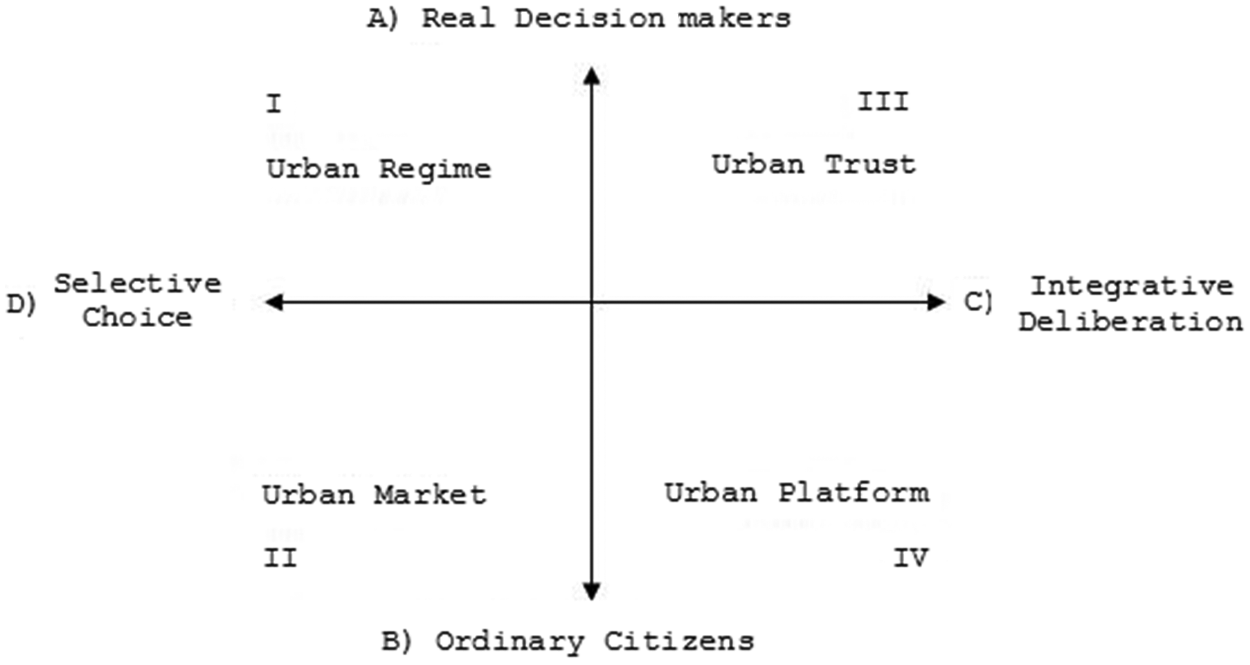
Shifts in urban governance.
To make sense of contemporary shifts in urban governance, Figure 1 distinguishes between four main directions in which such shifts can be traced:
There may be increased attention to and emphasis on “real decision makers”—social and economic elites—in the urban realm (A) or, conversely, on “ordinary citizens” in the various neighborhoods and districts (B).
There may be increased attention to and emphasis on “integrative deliberation” as a more communicative, comprehensive way of approaching alternatives and making collective decisions (C), or, conversely, on “selective choice” as a more competitive, exclusive mechanism for weeding out the options and getting to public choice (D).
Track A, emphasizing real decision makers, is founded on the idea that, if you really want to accomplish anything in the urban domain, you need to accost the business elites and other key figures in society and involve them in decision-making processes (cf. Hunter 1953; Lauria 1997; Stone 1989). Track B, stressing ordinary citizens, proceeds from the idea that democratic government should not only be for citizens but also by citizens and that the widespread tendency to govern while ignoring citizens themselves ought to be rectified as much as possible (Box 1998; Hoggart and Clark 2000; Swyndegouw 2005).
Track C, focusing on more integrative deliberation as a mode of coordination, is a response to the feeling that a DAD (Decide-Announce-Defend) type of rule is outmoded and that talking things through is a better response to complex issues; the round table is an apt metaphor here for a more deliberative, communicative, and comprehensive mode of decision making (Berry, Portney, and Thompson 1993; Goodin 2008; Uitermark and Duyvendak 2008). Track D, underlining more selective choice, could be captured in the metaphor of free nature, comprising the evolutionary logic of natural selection. It is founded on the conviction that it is better to have the free play of forces do the weeding-out than to expect loquacious conference rooms or integral planning cycles to do the work (cf. V. Ostrom 1973; Sunstein 2008; Surowiecki 2004).
Following and combining such tracks, urban governance in a particular area may distinguish itself from other areas, which is not to say that it will be completely distinctive. There are, for instance, almost always planners and other policy specialists active in urban governance, and there is bound to be a minimum of rules and regulations for urban planning almost everywhere. Figure 1 abstracts from these commonalities and focuses on the divergence in urban governance: comparatively strong tendencies to involve real decision makers or ordinary citizens, to rely on selective choice or integrative deliberation. Four ideal-typical combinations of such tendencies will be discussed below, but beforehand, it should be noted that these are indeed ideal types to which realities can be compared but never reduced. Some urban areas show not a lot of these tendencies—think about some French departments where official rule tends to dominate—while other areas display a great deal, possibly even a variety of types. But to detect such idiosyncrasies, we first need more analytical clarity.
The Urban Market
Combining a distinctive individual citizens orientation (B) with a marked leaning to a selective mode of choice (D) gives us, in Figure 1, the ideal type of the “urban market” (II). While market-like governance was surely boosted by Anglo-American New Public Management, which has gained a lot of ground over the past two decades, it cannot be simply reduced to it. Already in the early 1960s, well before the advent of New Public Management as we now know it, V. Ostrom demonstrated how metropolitan governance in the United States was strongly predicated on transactional relations between decentered suppliers of public goods on one hand and individualized choices of citizens on the other (V. Ostrom, Tiebout, and Warren 1961; cf. Keating 1991; Toonen 2010). Individual choices of this type are not free of socioeconomic pressures. The urban market tends to be selective rather than comprehensive (choices shall be made).
The contemporary customer choice arrangements described by Pierre (2000) connect to this variant, as do the many forms of comparative assessment in which public goods, services, policies, and providers are being rated, ranked—and, thus, indirectly steered—by citizens cum consumers. The public domain is viewed here as a marketplace, and the citizen is seen as the central, demanding actor vis-à-vis a scattered supply of public goods and services. The urban market hinges on direct consumer input and critical feedback related to delivered output.
In urban-market governance, citizens “vote” with their feet, hands, purses, Facebook likes, and other electronic thumbs-up or thumbs-down. The actors competing for these “votes” can not only be exogenous providers, but they can also be citizens themselves. An example is provided by the town of Dordrecht in the Netherlands with its participatory budgeting project Citizens Turn! This initiative allows ordinary citizens to submit proposals for their neighborhood, which are then trimmed down to just a few winning proposals in voting procedure that is competitive and exclusionary at the same time (Boluijt, Drosterij, and Hendriks 2012a). Boroughs in the city of Berlin provide similar choice mechanisms, embedded in a wider process of participatory budgeting (Franzke 2007).
Electronic “information markets” as described by Surowiecki (2004, pp. 79–83) and Sunstein (2008, pp. 103–45)—in which many individual “bets” are aggregated to a collective assessment—are not (yet) common in urban governance. In theory, they can help in predicting, for instance, the use of a new metro line, the cost of developing a new town square, or other urban developments about which people have dispersed independent and real bits of information.
The Urban Regime
The ideal type of the urban regime (I) combines a distinctive focus on real decision makers (A) with a selective way of making deals and taking decisions in the urban arena (D). In Stone’s version of an urban regime, the selection mechanism is highly implicit and quasi-evolutionary. Only a small selection of societal and political elites—the strongest parties with the most scarce and vital resources—“survive” the process of regime formation. They seek each other out and enter into a rather exclusive and long-standing joint venture, as the black political elite and the white business elite did in Atlanta. Not only their alliance but also their agenda was selective (Stone 1989). For a European example, we can look at the joint venture of “port barons” and political top dogs that drove the immense growth of the Port of Rotterdam in the postwar period (C. Wagenaar 1992).
In the Dutch QGG research, a version of an urban regime was found in the case of Brainport Eindhoven, with a select gathering of urban government officials and top dogs from major knowledge institutions and knowledge-intensive businesses (most notably Philips) collaborating to boost the knowledge economy in the Eindhoven area (Van Ostaaijen and Schaap 2012). The Brainport regime has a marked elitist and instrumentalist focus in common with the urban regime type found in places like Atlanta and Chicago (Stone 1989, 2006) but is explicitly “tripartite” where the American cases typically bring two different worlds together. The quasi-corporatist, tripartite twist to the urban regime is also visible in another European case: the Northern-Milan Development Agency working on the basis of a three-party agreement, forged in the 1990s, between state government, trade unions, and private-sector representatives (Gualini 2005).
An urban regime can be highly productive, but the social and political legitimation tends to be problematic, as Stone (1989) frankly acknowledged. There is little room for ordinary citizens, but this is not to say that the urban regime only serves the interests of the city’s top dogs; their connected power is not so much “power over” (controlling) but rather “power to” (productive), and this may well be in the citizen’s best interest—at least, according to urban regime theory (cf. DiGaetano and Klemanski 1993; Harding 1994; Lauria 1997; Stoker 1995; Stone 1989).
The Urban Trust
Combining a strong focus on a decision-making elite (A) with an emphasis on a more integrative and deliberative approach (C) produces the heuristic type of the urban trust (III). The urban trust brings “trustees” of a wider range of interested parties together in a more communicative and inclusive fashion than the urban regime. An apt illustration is the Let’s Make This Town Together initiative in the Dutch city of Zwolle (Boluijt, Drosterij, and Hendriks 2012b). The definition of “Together” accommodates a wide array of constituencies and institutions. One of these is the city library, an institution that would be an unlikely candidate for participation in an American-style urban regime. Citizens, however, remain in the background; much is expected from cooperating trustees.
The urban trust finds a good breeding ground in the constitutional setting of the European Rhineland, where consensualism, consociationalism, power-dispersal, and power-sharing are strongly institutionalized (Daalder 1987; Lijphart 1999). Another good illustration is the ROM (Ruimtelijke Ordening en Milieu) network developed in and around the Belgian city of Ghent (De Rynck and Voets 2005). This is typically a multilevel and multisectoral network, connecting not only leading figures of various levels of government with responsibilities in the canal area of Ghent but also many stakeholders with economic, environmental, and spatial interests. The name of the game is “integral planning,” and the approach is comparatively inclusive. The ROM initiative has won a number of prizes in spatial planning, and is generally perceived as a successful cooperative, but De Rynck and Voets (2005, pp. 177–82) also noted that citizens were far removed from the deliberations, which tended to “fly over their heads” at a high level of abstraction and technicality.
The urban trust model may find fertile soil in the European Rhineland, but it is not confined to it. The SPCs (Strategic Planning Committees) developed in a city like Dublin, Ireland, come remarkably close to its logic (Callahan 2005; Loughlin 2011). SPCs can work for various purposes (economic development, transport, housing, environmental and general services), but they are always composed of political representatives (two-thirds local councilors, 9–12 members) and representatives of various social interests (one-third societal stakeholders, 3–4 members). This governance model reaches out to civil society, but it does not come as close to the citizenry as the urban platform aspires to come (Noveck 2009; H. Wagenaar and Duiveman 2012).
The Urban Platform
In the ideal type of the urban platform (IV), a marked emphasis on integration and deliberation (C) is combined with a strong focus on ordinary citizens in neighborhoods and the city at large (B). The public realm is envisioned as a wide and open platform on which everyone—emphatically also the individual citizen—can have a say. The urban platform revolves around dialogue, not contest; it institutionalizes a comprehensive rather than exclusive approach to alternatives and collective decisions (cf. Box 1998; Fung 2004; Goodin 2008).
Dutch towns know many variations on this theme. A nice example from the QGG research is the Neighborhood Tables initiative in Breda, a citizen participation project involving residents, housing corporations, and the local council. Neighborhood Tables aim to draw policy makers and citizens closer together and to improve mutual understanding, general levels of knowledge, and mutual perceptions in neighborhoods where such Tables are held. The Neighborhood Tables initiative suits the increasing consideration given to “interactive communication” and “appreciative inquiry” in this town (Van Ostaaijen and Drosterij 2011). It can be viewed as an expression of the so-called “third generation of citizen participation,” which brings government officials and citizens together with an increasing emphasis on the latter (cf. H. Wagenaar and Duiveman 2012).
Neighborhood Tables are a smaller-scale alternative to the Neighborhood Councils that have developed in many cities, ranging from Portland and Los Angeles in the United States to Lille and Munich in Europe (Berry, Portney, and Thompson 1993; Cole 2011; Musso et al. 2006). Munich is an example of a city that has widely and consistently invested in the urban platform not only through its Neighborhood Councils but also through the “Munich Forum,” an open platform for deliberation about the entire city and its neighborhoods since 1968, when grassroots protest triggered the establishment of such an arrangement (Hendriks 1999a, pp. 169–72). More recently, Melbourne has developed a Planning Wiki, integrating new web-based technology and social media, in an attempt to generate wider public input and creativity in urban design (Noveck 2009).
Whether such shifts in governance actually manage to get any closer to good governance is, of course, another matter. The idea that governance is good in itself—and that, therefore, governance and good governance are practically synonymous—is a fallacy: Varieties of governance may work well in the urban domain but need not do so at all. This requires critical reflection, informed by essential quality standards.
Good Urban Governance: Core Values
The “goodness” of governance cannot be taken for granted but should time and again be assessed in connection to a solid frame of reference. This goes for the urban domain as well as for any other field of public concern (Ahrens, Weingarth, and Caspers 2010; Andrews 2010; Mulgan 2006).
The simplest definition of good governance is: governance that qualifies as good for some reason. An instance of urban governance could be qualified as good to the extent in which the pertaining working arrangements operate well with regard to essential quality standards. But what are these? Debates in public administration on this issue tend to be wide-ranging, mentioning a great many things, often in a not very systematic fashion. Here are just a few examples:
The United Nations (United Nations Development Programme [UNDP 1977]) have been using their own set of quality standards for quite some time: participation; strategic vision, rule of law; transparency; responsiveness; consensus orientation; equity building; accountability; effectiveness and efficiency.
The Council of Europe (2008) defined “Twelve Principles of Good Democratic Practice at Local Level” (comprising in fact more than 12 principles): fair conduct of elections, representation, and participation; responsiveness; efficiency and effectiveness; openness and transparency; rule of law; ethical conduct; competence and capacity; innovation and openness to change; sustainability and long-term orientation; sound financial management; human rights; cultural diversity and social cohesion; accountability.
The Dutch Ministry of the Interior and Kingdom Relations (Ministerie van BZK 2009) drafted a Good Governance Code, defining seven core qualities (which comprise, all in all, 11 standards): openness and integrity, good service provision, participation, goal-orientedness and efficiency, legitimacy and justice, self-correction and learning capacity, accountability.
Appreciating Good Governance: A Catalogue of Values
Here, a somewhat different approach is taken, informed by the Dutch QGG research (see Note 1; Hendriks and Drosterij 2012), in addition to academic debate on quality in democracy and the rule of law (Bovaird 2005; Drosterij 2008; Haus, Heinelt, and Stewart 2005; Heinelt, Sweeting, and Gemitis 2006; Hendriks 2010; Mulgan 2006; Pierre 2009; Rothstein and Teorell 2008). This has led to the construction of a good governance values catalogue, covering five core values: responsiveness, effectiveness, procedural justice, resilience, and counterbalance. Table 1 helps to clarify how these values interlock.
Good Governance Values Catalogue.
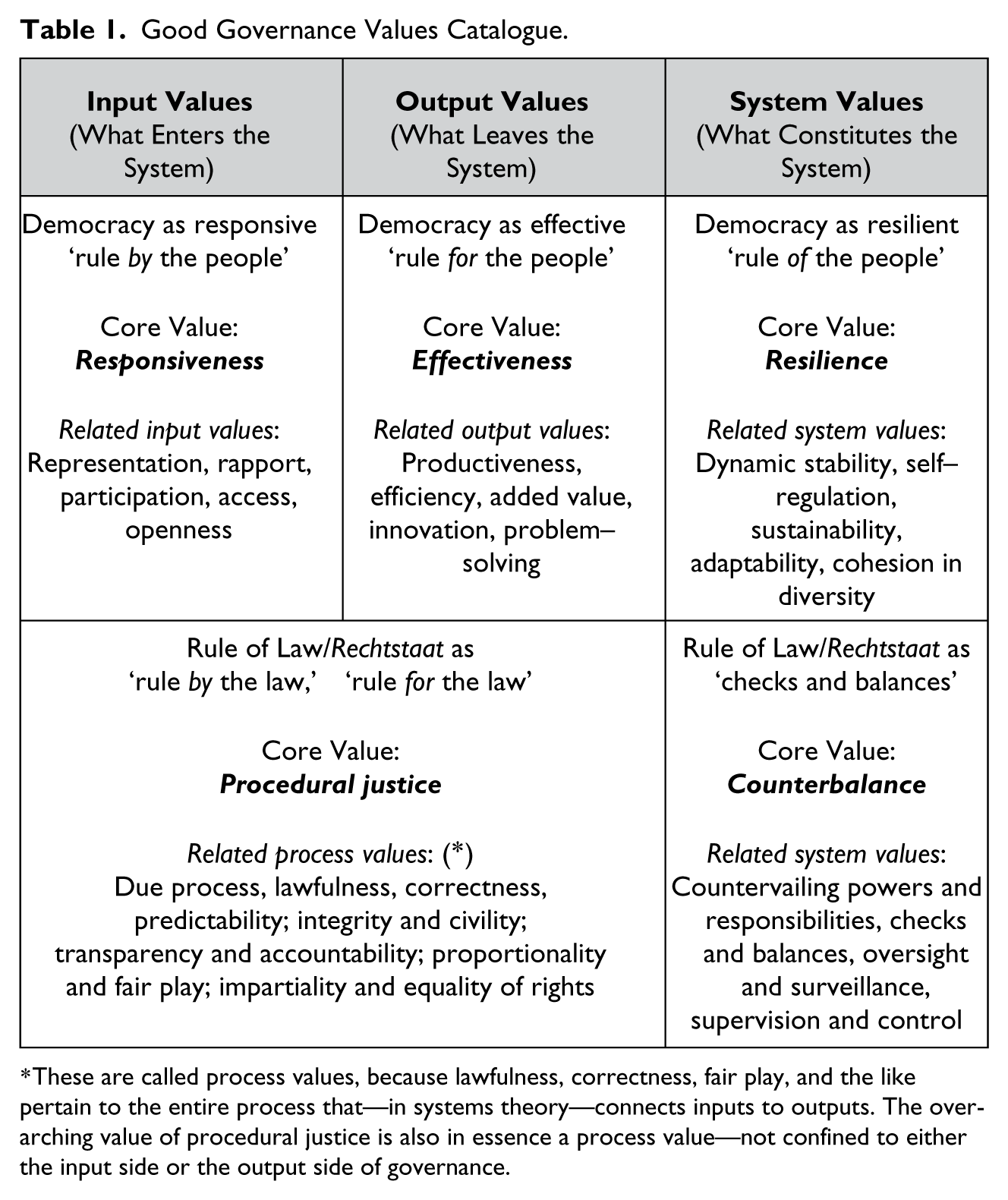
These are called process values, because lawfulness, correctness, fair play, and the like pertain to the entire process that—in systems theory—connects inputs to outputs. The overarching value of procedural justice is also in essence a process value—not confined to either the input side or the output side of governance.
The good governance values catalogue collapses many of the specific values mentioned above into fewer and more fundamental categories. This is done not only because the human mind can deal better with a smaller number of items but also and primarily because the good governance debate is in dire need of the second step in the evolutionary process of “variation and selection.” Besides a more systematic selection, this requires a consistent focus on values of good governance, not to be confused with values of good politics (cf. Hendriks 1999b; Mulgan 2006). Substantial values, such as freedom, equality, solidarity, physical and social security, poverty-redemption, peace-keeping, sustainability, and the like, are surely relevant to normative political debate, but good governance values pertain to something else. They are not so much about the “good life,” but rather about the “good order,” the sound setup and the proper ground rules of the operating system. 4
There are different ways of discussing the catalogue of values. We could follow the columns distinguishing between input, output, and system values. Alternatively, we could follow the rows distinguishing between values inspired by democratic theory (the upper half of the table), and by theories of the Rechtsstaat and the rule of law (the lower half). Below, the two routes are combined, aspiring to call due attention to
Responsiveness and effectiveness: the dominant values in contemporary thinking about good governance in terms of inputs and outputs (what goes in and what comes out); undeniably important, but there is more to good governance;
Procedural justice: a container concept for process values relating to the entire chain of actions connecting inputs and outputs in governance;
Resilience and counterbalance: classic system values, nowadays somewhat subdued, pertaining to the constitution of the system as such (independently of what goes in, comes out, or proceeds in between).
Responsiveness and Effectiveness
Democratic theory often refers to Lincoln, who in his famous Gettysburg Address of 1863 declared that democracy as rule of the people (the contraction of demos and kratos) ought to be rule by the people and rule for the people as well. Following this line of thinking, Scharpf (1997, 1999) observed that democratic governance, whether of a direct or indirect kind, must be prompted by the people so as to acquire “input legitimacy” and must produce added value for the people so as to acquire “output legitimacy.”
According to Putnam (1993), good democratic governance “not only considers the demands of its citizenry (that is, is responsive) but also acts efficaciously upon these demands (that is, is effective)” (p. 63). A governance model may be considered responsive to the degree and way in which it has organized representation, participation, accessibility, and openness. A model of governance may be considered effective to the degree and way in which it shows an ability to actually do things, solve problems, and deliver value for money. 5
In the urban domain, responsiveness and effectiveness are relevant values that are often pursued in programs aiming to further urban governance. One of the cases in the Dutch QGG research, the Eindhoven Brainport project, explicitly aimed to accomplish added (economic) value for the urban region (Van Ostaaijen and Schaap 2012). It was mostly focused on output legitimacy, and not so much on input legitimacy, just like the urban regime cum growth coalition was that Stone (1989) had witnessed in Atlanta. In the case of Breda, it was the other way around. There, Neighborhood Tables were established to improve openness and rapport with the citizens on the input side of the urban governance model. For the establishment of Neighborhood Councils in cities like Los Angeles and Lille, this was also the prime concern (Cole 2011; Musso et al. 2006; Van Ostaaijen and Drosterij 2012).
Procedural Justice
Good governance amounts to more than gratifying the citizenry, let alone a momentary majority of citizens. This is central to the idea of the Rechtsstaat or the “rule of law,” which complements the idea of democracy as the “rule of the people.” 6
Regarding process values, we may think of the officially-prescribed Algemene Beginselen van Behoorlijke Bestuur (General Principles of Appropriate Administration) in the Netherlands or similar process values (accountability, transparency, ethical conduct, human rights, rule of law) included in the good governance code issued by the Council of Europe (2008). The values catalogue presented in Table 1 lists the crucial ones under the umbrella term “procedural justice,” bringing together more legal (lawfulness, accountability, equal rights) and more interactionist (correctness, integrity, civility) types of values. Rothstein and Teorell (2008) considered one element out of this set—impartiality—as the essence of good governance. However important this element is in and of itself, relying on impartiality alone would undervalue other essential standards of procedural justice (cf. Esaiasson 2010; Tyler and Darley 2000; Tyler and Huo 2002).
Procedural justice is no less a core value for good governance in the urban domain than responsiveness or effectiveness. Those involved in urban governance have legitimate procedural expectations and rights, and they are fully entitled to demand respect to them, even if urban governance is said to be working by and for the demos at large. Especially where formal political rights and deeply-felt social norms concerning due process converge—as in principles such as fair play, equality, and proportionality—sensitivity to this dimension of good governance tends to be well developed among the citizenry. Against this background, it is remarkable that only one case out of the eight cases in the Dutch QGG study specifically prioritized process values in the attempts to improve urban governance. Only for the Neighborhood Tables, initiative in Breda was due process a top priority (Van Ostaaijen and Drosterij 2012).
Resilience and Counterbalance
Good governance is not only related to what goes in, comes out, or proceeds in between, but it is also, and essentially, related to the way in which the overarching system as such is constituted, and the way in which the constitutional whole of offices, organs, positions, and relations is assembled—robustly or not (cf. V. Ostrom 1982; Toonen 2010).
Some parts of democratic theory tend to stress the importance of resilience, more specifically, the self-supporting, dynamic stability of the democratic system. A resilient, dynamically-stable democracy invests systematically in its ability to remain standing when pressurized and to remain united when divided, “E Pluribus Unum” (Stassen 1942). In postwar Germany, for example, this was reflected in the notion of the wehrhafte Demokratie: the kind of democracy that would keep centrifugal forces in check with centripetal institutions (Almond and Verba 1980). Constitutional thinking about the Rechtsstaat in continental Europe and the rule of law in Anglo-American discourse tends to be more focused on systematic counterbalance and the separation of powers. Good governance, here, is all about the balancing of interests, the institutionalization of countervailing forces and responsibilities, of actors, offices, and organs keeping each other in check (Alexander 2001; Rosanvallon 2008).
System values, such as resilience and counterbalance, are often associated with the modern state while their true cradle is really the urban polity. As noted in earlier sections, the seeds of constitutional thinking about robust relations had been sown in Republican Rome and other European city-states many centuries before the advent of the modern state. In thinking about good urban governance today also, we should be paying close attention to system values. There is every reason to do so. Cleavages and tensions between different groups of people characterize the urban realm (Duyvendak, Hendriks, and van Niekerk 2009; Putnam 2007). The urban world is full of planning disasters and policy fiascos, demonstrating how the arrangement of proper checks and balances is debatable, to say the least (Flyvbjerg 2003; Hall 1982).
In the Dutch QGG study, only one out of eight cases gave top priority to system values; the Let’s Make This Town Together initiative in Zwolle was first and foremost dedicated to furthering resilience (in Dutch: veerkracht) of the urban governance system. Governance reforms in the cases of Almere and Dordrecht were only secondarily geared to system values; furthering practical performance—improving input and output legitimacy—was deemed more important here (Hendriks and Drosterij 2012).
The constitution of urban governance is impacted by the establishment of new regulatory powers, decentered offices, supervisory arrangements like urban audit offices, municipal ombudsmen, and the like. Issues of supervision and control are no less important for the urban arena than they are for the corporate world, where such issues are nowadays hotly debated under the title of “corporate governance” (Daily, Dalton, and Cannella 2003; Denis and McConnell 2003). Bringing the constitution back in—not only in conceptual discourse on good democratic governance but also in practical attempts to get closer to this in the urban realm—seems to be a challenge for years to come.
Conclusion: Bringing the Democratic Rule of Law Back In
If we were to paint a contemporary Buon Governo in Città, inspired by Lorenzetti’s famous panels in Siena, what should we highlight as essential? This article suggests the following answer: responsiveness, effectiveness, procedural justice, resilience, and counterbalance. These can be viewed as core values of good urban governance. (They could even be depicted by a creative artist. The murals and stained glass windows in some of the older European town halls might serve as sources of inspiration.)
An idealist might argue that urban governance should always strive for flawless performance on all the five core values of good urban governance. A more realistic approach, advocated in this article, would allow a situation-sensitive logic of “step-dancing” (Hood 1998), alternating heightened attention to particular values, in combination with a sense of “good enough governance” (Grindle 2007)—acceptable quality levels need to be observed all around, but not everything can be perfect all the time.
There are several ways of promoting good urban governance values or to attempt making improvements to some of them. Many arrangements are being tried and tested in practice, as the various cases mentioned in the previous sections testify. Varied shifts in urban governance, divergent movements on the conceptual map depicted in Figure 1, can be detected in the real world. Governance theory is supposed to be indifferent as to the specifics of governance reform: moving this way or that way, more or less citizen-oriented, more or less deliberative, in the theory of governance, it does not really matter—“if only things work well.”
Although the pragmatic philosophy accompanying governance theory appears to be refreshing, this article has also pointed out two problems with this approach. First, governance discourse does not always adhere to the maxim of pragmatism and ideological indifference, and often implicitly assumes that horizontal methods are better than vertical ones, and nonformal methods better than formal ones. It is not always acknowledged that “government” can be of crucial importance within “governance” or that networks often develop “in the shadow of hierarchy” (Scharpf 1997).
Second, “if only things work well” is often taken in a singular sense. Pierre (2000) was right to criticize the performance bias, the preoccupation with instrumental norms, and the coincident neglect of wider democratic values in thinking about governance. This is particularly noticeable in the urban realm, where down-to-earth concerns are never far away. The argument presented here concurs with Pierre’s appeal to “bring democracy back in,” provided that this is not limited to bringing the voice of the citizen back in. Surely, citizen-responsive governance is valuable, but there is more to good urban governance than that.
This article has made a case for bringing the democratic rule of law—broadly defined, with all the values attached—back into thinking about good (urban) governance. Only then can we provide a well-founded and advanced answer to the question if and how urban governance of whatever kind will also imply good governance.
Footnotes
Declaration of Conflicting Interests
The author(s) declared no potential conflicts of interest with respect to the research, authorship, and/or publication of this article.
Funding
The author(s) received no financial support for the authorship, and/or publication of this article. The underlying QGG research project was financed by Nicis Institute for Urban Research in the Netherlands.