



Abstract
This article aims to examine (1) what impact growth machine ideology has on historic conservation and vice versa, (2) how heritage conservation effort’s institutional arrangements affect the composition and operation of growth coalitions, and (3) the impact of public concern on manipulating the growth machine ideology. This study looks at the conservation of two cases in Hong Kong, both of which have extremely high land value, to examine the complex interplay between built heritage and growth machine politics. The study also reveals how growth coalitions extend beyond formal institutional arrangements and how public concerns also greatly shape and determine the role of heritage conservation in contributing to growth in urban politics. This study provides a deeper understanding of the shifting value of heritage in cities where the growth machine thesis is espoused and examines how it is reframed by different actors.
Introduction
A city as a growth machine centers growth as a fundamental imperative (Logan and Molotch 1987). As such, the balance between conservation and redevelopment has not always been easy to achieve (Delafons 1997; Hunter 1996). As land is limited, the most challenging conservation issue cities face is the land-use conflict between different users of space where historical sites are located (Graham 2002). Major cities in developing countries face similar issues of urban development and conservation, that is, high development pressures, rapid population growth, and a lack of concern for their cultural heritage (Binh 1998; Engelhardt 1998; Kong and Yeoh 1994; Sangachhe 1998; Steinberg 1996).
If a government designates a property as “heritage,” then its owners are subject to constraints on the projected value of the heritage property (Lichfield 1988). Heritage designation can also cause perceived economic harm to others who have an economic interest in the property concerned. The views of Henderson (2001), Teather and Chow (2003), and Ng (2008), which are persuasive, though they have no rigorous factual backing, are that properties with higher values do not stand much chance of being conserved.
However, other research claims that historical building conservation does not necessarily conflict with urban development (English Heritage 1999; Kearns and Philo 1993; While 2006). It is argued that heritage conservation and urban economic development can coexist and support each other (Amit-Cohen 2005; Yuen 2006). Heritage resources often incur a wide range of externalities rather than primarily consisting of the exchange value. These externalities contribute to the value of the lives and lifestyles of urban residents in districts (English Heritage 2000). Moreover, heritage places are increasingly used as places of consumption, such as shopping precincts. These economic and cultural uses also help create the images by which places are marketed in economic and cultural terms (Graham 2002). It is argued that, ironically, the economic commodification of a heritage resource is the reason for its existence (Graham 2002). In light of evolving trends of uses and management of heritage resource, the role of heritage in contributing to the growth machine ideology remains an argumentative issue. In particular, the coalitions of different parties are not clearly studied. With the rising importance of public participation in heritage conservation (ICOMOS 1999; Yuen 2006), the extent of which it affects the growth coalitions in the heritage regime is worthy of examination.
In Hong Kong, there is always immense tension between economic growth and conservation. Land value is extremely high due to a laissez-faire operation, a limited supply of land, and the need for more floor area for economic gain. Many historic buildings have been demolished to make way for new development. As such, the total number of declared monuments is relatively low 1 (Antiquities Monument Office [AMO] 2014). Is the small number of declared monuments the result of placing a high priority on economic growth?
This article aims to provide a better understanding of the relationship between historic conservation and progrowth politics. More specifically, the research questions examine (1) how the value of heritage has changed in a city where the growth machine ideology is espoused and (2) what roles different parties play in reframing the progrowth coalitions. To investigate these two questions, the institutional arrangements and the roles of the different parties and opposing community voices, which have formed an alliance to promote and/or prevent growth coalitions, are examined.
This study analyzes two historic sites in a prime urban area with extremely high land value and facing development pressures in Hong Kong. First, we examine the case of the former Marine Police Headquarters, situated in a popular tourist shopping location, which has been transformed into a high-end commercial precinct. Second is the Central Police Station (CPS) compound, which is located in the high-class central business commercial area in Hong Kong. The article is divided into five sections. It begins with the theoretical framework. The second section describes the methodology, followed by a summary of the background of each case study. The next section presents the process of conservation regarding the two case studies. The last section compares the two cases and includes a discussion highlighting the extent of growth coalition among different parties, the institutional arrangements, and the rising role of public participation in contributing to and altering the growth machine ideology in urban politics.
Urban Politics and the Growth Machine
Urban politics have long supported the ideology of the city as a “growth machine” in which “coalitions of land-based elites” seek to maximize exchange values, with growth driving up land values (Jonas and Wilson 1999, p. 3; Molotch 1976). Growth politics is a key determinant in the social production of urban space (Lefebvre 1991, 1996). Molotch (1976) claimed that urban development is not driven by supply and demand but rather by a coherent coalition of elites who benefit from local population growth. Molotch (1976, pp. 309–310) speculated that “the political and economic essence of virtually any given locality, is growth.” Logan and Molotch (1987) concluded that the key to the coalition’s hegemony is a city-wide political consensus for growth: “those who invest the most time and money in local affairs have most to lose or gain in land-use decisions” (Logan and Molotch 1987, p. 62). The growth machine thesis attempts to distinguish between the exchange value and the use value of urban space. Exchange value refers to the quantity of other commodities it will exchange for if traded. It is most often expressed as a money price (Smith 1776). As well, a commodity also contains use value, which refers to the utility obtained from using the good or commodity; for example, visiting a heritage building can enhance quality of life, social inclusion, sense of place, and identity (Pendlebury, Townshend, and Gilroy 2004; Tweed and Sutherland 2007). The powerful coalition of government officials and land-based elites united in the pursuit of economic development ensures that individuals and institutions in the growth machine profit from the intensification of land use (Jonas and Wilson 1999; Logan and Molotch 1987).
When considering growth ideology, has heritage conservation, particularly in urban cities, become an impediment to the development and growth regime? There is no absolute answer. Under the growth regime, developers often use place-making discourse and marketing techniques to purposely create a location with profit-making potential that will increase in exchange value in terms of land and real estate in the future (McKenzie 2005). In this way, capitalism and consumerism help increase land and real estate values, because as more shopping areas are built, the prices of properties and rentals usually surge (Harvey 1996). This is also increasingly apparent under the heritage regime. The growing use of heritage as a commodity for consumption, from the 1990s onward, is often seen in urban regeneration and tourist projects as resulting from demands of the global market economy.
However, the extent of growth and development cannot simply be analyzed within a growth and antigrowth dichotomy (Vogel and Swanson 1989). There are also other types of models, namely, the slow, moderate, and no-growth oppositions. However, focusing solely on use values often creates a romanticized image that is often pitted against the growth machine ideology. In fact, all progrowth coalitions use different forms and strategies to influence local politics and policies in different social, cultural, and political contexts. Gotham (2000) found that the strength and capacity/form of a local growth coalition largely depends on the institutional arrangements of local redevelopment and planning efforts.
Logan and Molotch argued that the notion of growth and development does not usually take into consideration community interest. Jonas and Wilson (1999) also raised the question of how public voices affect the outcome of the growth machine model; however, no empirical analysis has been made. The most argumentative area is perhaps the interplay between the elites’ power and the wider urban public in shaping the growth machines. In addition, Logan and Molotch (1987) also contended that the local media play a crucial part in offering political legitimacy to controversial development projects and growth coalition activities. In sum, the authors above question what roles different organizations of a conservation project, government organizational structures and regulations, and public voices play in affecting urban politics in heritage conservation.
How Does the Growth Machine Model Fit Hong Kong?
In Hong Kong, economic growth and property development have been the dominant ideology since the colonial period. Land-use planning in Hong Kong has tended to favor economic interests (Ng 1997). A laissez-faire operation, scarce supply of land, and population and gross domestic product (GDP) growth have pushed up land prices. As a result, the exchange value of land tends to be the primary, if not the only, driving force of the growth machine model and the supporting ideology. For example, the average land price for a Grade A office building in the Central district of Hong Kong was HK$222,349 (US$28,506)/m2 in 2010 (Rating and Valuation Department 2013). In light of these inflationary prices, it is claimed that Hong Kong’s economy is too dependent on land and property development (Hopkinson 2002). As a result, many prewar buildings with high historic value in urban areas have been redeveloped for maximization of the plot ratio under government provisions; the Government Post Office and the Kowloon-Canton Railway Terminus are cases in point. The government controls the land supply for development and regeneration. About 45% of the government’s annual fiscal income comes from land premiums (Brown and Loh 2002). For example, the estimated revenue for the financial year 2007–2008 from land sales was around 11.68% (US$36.8 million) of the total revenue (Tsang 2007). In this regard, the Hong Kong government, as the largest local landlord, and the big developers collaborate in the making of progrowth coalitions (Mollenkopf 1983). They mutually benefit by increasing property prices as a “unitary interest” to sustain the local economy and maintain a stable political environment (Conservancy Association 2003; Henderson 2001). Most recently, in the instance of the Queen’s Pier conservation campaign, the government emphasized that its responsibilities are not confined to the field of heritage and any decisions made regarding heritage conservation must take vital economic growth strategies into account. Clearly, the growth machine ideology fits urban politics in Hong Kong.
The Role of Art, Culture, and Heritage in Reshaping the Growth Ideology
Growth ideology has evolved over the last few decades worldwide. Purcell (2000) argued that there is a decline of the growth consensus, but not the growth machine itself. There have been alternative interpretation of “the use values, spatial and social justice, or environmental preservation rather than the land-for-profit vision of the growth machine” (Purcell 2000, p. 97). In light of the alternative views, the cultural and arts industry and heritage conservation have joined to support the urban growth regime.
First, the growth machine uses cultural means to legitimize growth: “Cultural power thus reinforces other aspects of growth machines durability” (Molotch 1993, pp. 31–34). Logan and Molotch (1987, pp. 62–62) asserted that “the growth machine avidly supports whatever cultural institutions can play a role in building locality . . . rentiers and their associates encourage activities that will connect feelings of community . . . to the goal of local growth.” It tends to place less emphasis on the connection between growth and exchange values and to reinforce the link between growth goals and better lives for the community. The role of arts, heritage, or other public amenities is meant to legitimize growth in the process of collective consumption (Castells 1983). Similarly, Zukin (1995, p. 1) stressed that “culture is a powerful means of controlling cities.” Urban culture is regarded as commercial goods and products or as lifestyles determined by economic status (Zukin 1991, 1995, 1998). As Zukin (1998, p. 828) argued, “cities are no longer seen as landscapes of production, but as landscapes of consumption.”
Second, Reichl (1997) argued that heritage preservation has become the glue holding together progrowth coalitions. The growing coalition of interest groups, including preservationists, developers, and politicians, marketing historic sites for combined profits have been seen as a sign of “heritage machines” (Barthel 1996). These heritage machines are being constructed in cities and towns, large and small. Academics, preservationists, developers, and politicians profit from the exploitation and sometimes the invention of local heritage. In this spectrum, heritage is seen as an economic resource with which to promote tourism, economic development, and urban regeneration (Graham 2002). Heritage has also been recognized as an important element of symbolic economy (Zukin 1995) by which “cultural strategies drive the production of commercialized urban space geared towards entertainment and tourism” (Reichl 1997, p. 515).
Historic preservation has served as a marketing tool for revalued redevelopment that has transformed use values into a source of exchange values (Reichl 1997), for example, through the creation of shopping villages and urban malls set in rehabilitated historic buildings. In particular, the advocacy of art and creative industry in utilizing heritage buildings and the associated image of higher income groups and higher taste are increasingly seen as an important ingredient in economic activities, which affect and contribute to the local community.
The Roles of Art and Culture and How They Are Incorporated in Heritage Conservation in Hong Kong
In Hong Kong, the roles that art and culture play in contributing to economic growth are also becoming increasingly significant in urban development, urban renewal, and heritage conservation. A number of large urban development projects are aimed at engendering the growth of cultural industries and promote Hong Kong’s image as an international metropolis with a vibrant cultural and arts landscape (Home Affairs Bureau HAB 2015). For example, the West Kowloon Cultural District development was endowed with $21.6 billion (US$2.77 billion), granted by the Government in 1998. In addition, the urban renewal regime also launched a strategic implementation framework for community culture and arts, aiming to integrate cultural and arts elements in urban renewal projects in August 2011. Furthermore, the adaptive reuse of historic buildings has illustrated the growing trend of transforming these buildings into art and cultural premises. The new uses of the CPS compound, the former Married Police Quarters, and the first public housing building are cases in point. In urban renewal projects, heritage reuse as art shops, restaurants, and places of consumption has attracted much criticism, because these places have driven up property prices in the immediate renewal districts. Nevertheless, it is clearly shown that culture and arts are increasingly playing a role in enhancing economic viability and growth in heritage conservation projects.
Evolution of Conservation of Built Heritage in Hong Kong
Hong Kong’s shifting attitude toward heritage value has been apparent during different periods of its history. Economic growth and property development were the dominant ideologies in Hong Kong, especially prior to 1997. During that era, many historic buildings with high heritage value were demolished. However, heritage conservation was advocated in Hong Kong in the mid-1970s and the government enacted the Antiquities and Monuments Ordinance in 1976. This ordinance divided cultural built heritage into two narrow categories: monuments and listed historic buildings. They were listed as being of mainly architectural value, historical value, social significance, and rarity (AMO 2014).
Since the change of sovereignty, heritage conservation has increasingly become the focus of public interest and government policy agenda. Different parties have played a role in shaping the shifting value of heritage conservation in Hong Kong. First, there have been unprecedented transformations in societal values and urbanization processes in the community (Lu 2009). From the 1960s, if not earlier, Hong Kong residents had begun to search for their identity (Henderson 2001; Ip 1997; Mathews 1997). Some argue that since the return of sovereignty, this search has intensified (Cheng 1996; Lu 2009), especially after the conservation campaigns for retaining historic buildings like the Queen’s Pier (Henderson 2008; Lu 2009; Yung and Chan 2011). Most notably, local concern groups and politicians have increasingly initiated campaigns and protests to express their views on the planning and development of the city of Hong Kong. In particular, this has included fighting against harbor reclamation, urban renewal for new development, and advocating heritage conservation (Yung and Chan 2011). In addition, the opposition against the hegemony of prime developers has also evolved within Hong Kong society and an antiovergrowth movement has been initiated by the public (Lu 2009). People generally fight for more quality public space.
Second, the government has shifted its position, pointing out that the ideology of making development a first priority is almost outdated (Lam 2007) and has, subsequently, initiated related policies. In particular, the government policies of 1998 and 1999 advocated more positive action on conservation matters, which had important implications for “defining, highlighting and safeguarding Hong Kong’s heritage in the context of intensive economic activity, population increase, political evolution, and cultural re-definitions” (Cody 2002, p. 193). The policies also detailed a new vision for heritage tourism, with the result that the Heritage Tourism Task Force was set up as part of the Hong Kong Tourist Association (HKTA) in late 1998. In 2000, a Cultural Heritage Commission (CHC) was formed, which advised that heritage should be of paramount importance in urban planning, historic buildings should be converted into cultural activity centers, and cultural tourism should be promoted. The Development Bureau was established in 2007 and the Commissioner for Heritage Office (CHO) of the Development Bureau was established in 2008 to look after the revitalization of heritage projects (Development Bureau 2014).
Method
Case Studies
This study focuses on two case studies: the former Police Marine Headquarters and the CPS compound. Findings are based on detailed analyses of local newspapers, Internet sources, journal papers, and government and consultants’ reports and archives. In addition, 13 in-depth interviews were conducted from May 2010 to August 2012. The interviewees selected were from the major parties involved in the two projects. They included conservation architects and the developer’s project manager (Table 1). The community groups that actively commented on and criticized the projects were also interviewed. They included conservationists in the academic field, critics in heritage conservation and urban design, representatives from nongovernmental organizations (NGOs), and Heritage and Conservation Committee members from a professional institute.
Interviewees’ Backgrounds.
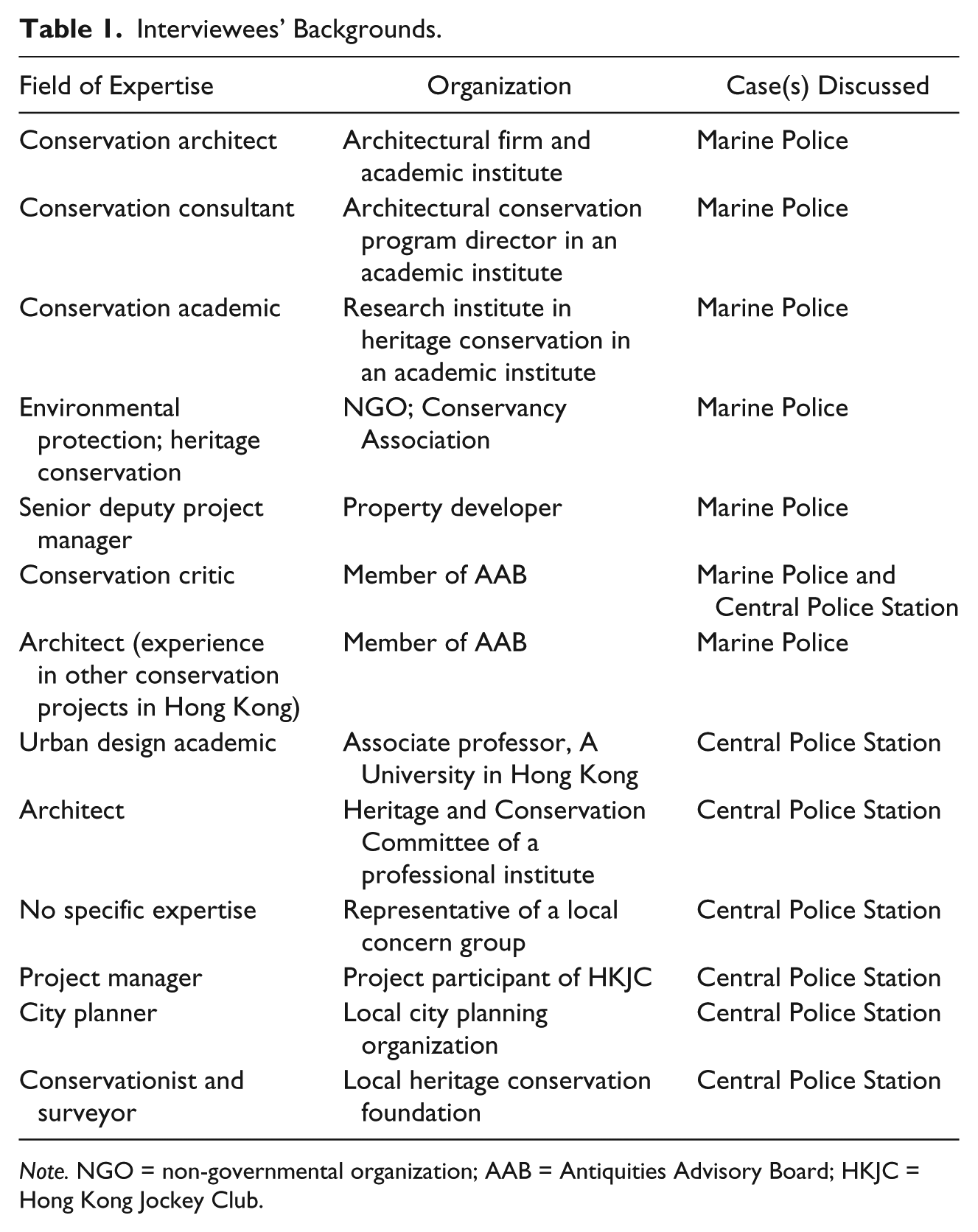
Note. NGO = non-governmental organization; AAB = Antiquities Advisory Board; HKJC = Hong Kong Jockey Club.
The Case Studies
Former Marine Police Headquarters: Rescued from Demolition, Conserved to Support Growth Coalitions and Legitimize Commercialization
The former Marine Police Headquarters building was erected in 1884 and was used almost exclusively as such, except during the period of the Japanese occupation. In 1979, the Conservancy Association and the Hong Kong Heritage Society urged the government to preserve the site as a park. The Town Planning Board rejected this motion, because it saw it as preventing desirable business development and interfering with the overall economy of Hong Kong (Conservancy Association 2008). However, many allied community groups succeeded in conserving the site. The Marine Police Headquarters, together with the back building of the former fire station, was declared a monument under the Antiquities and Monuments Ordinance in 1994. Since the relocation of the Marine Police to new headquarters in another location in 1996, the site has been vacant.
The building sits on top of a hill with a commanding view of the harbor within a well-established tourism district where hotels, shopping centers, restaurants, open space, piers, and cultural facilities are abundant. The reuse of the site was put out to private tender for conversion into a tourism-themed development in 2003, a project led by the Tourism Commission. The major developer, Cheung Kong (Holdings), won the 50-year land grant at a tendered price of HK$352.8 million (US$45.34 million) in May 2003. The site was transformed into a boutique hotel and an expansive shopping venue named “1881 Heritage” and opened in 2009. Conservation of the former Marine Police Headquarters has drawn much criticism, including concerns about the loss of authenticity and commercialization. Table 2 shows the major events that took place in transforming the heritage site from the former Marine Police Headquarters to the “1881 Heritage.”
Major Events that Took Place During the Conservation of the Former Marine Police Headquarters.
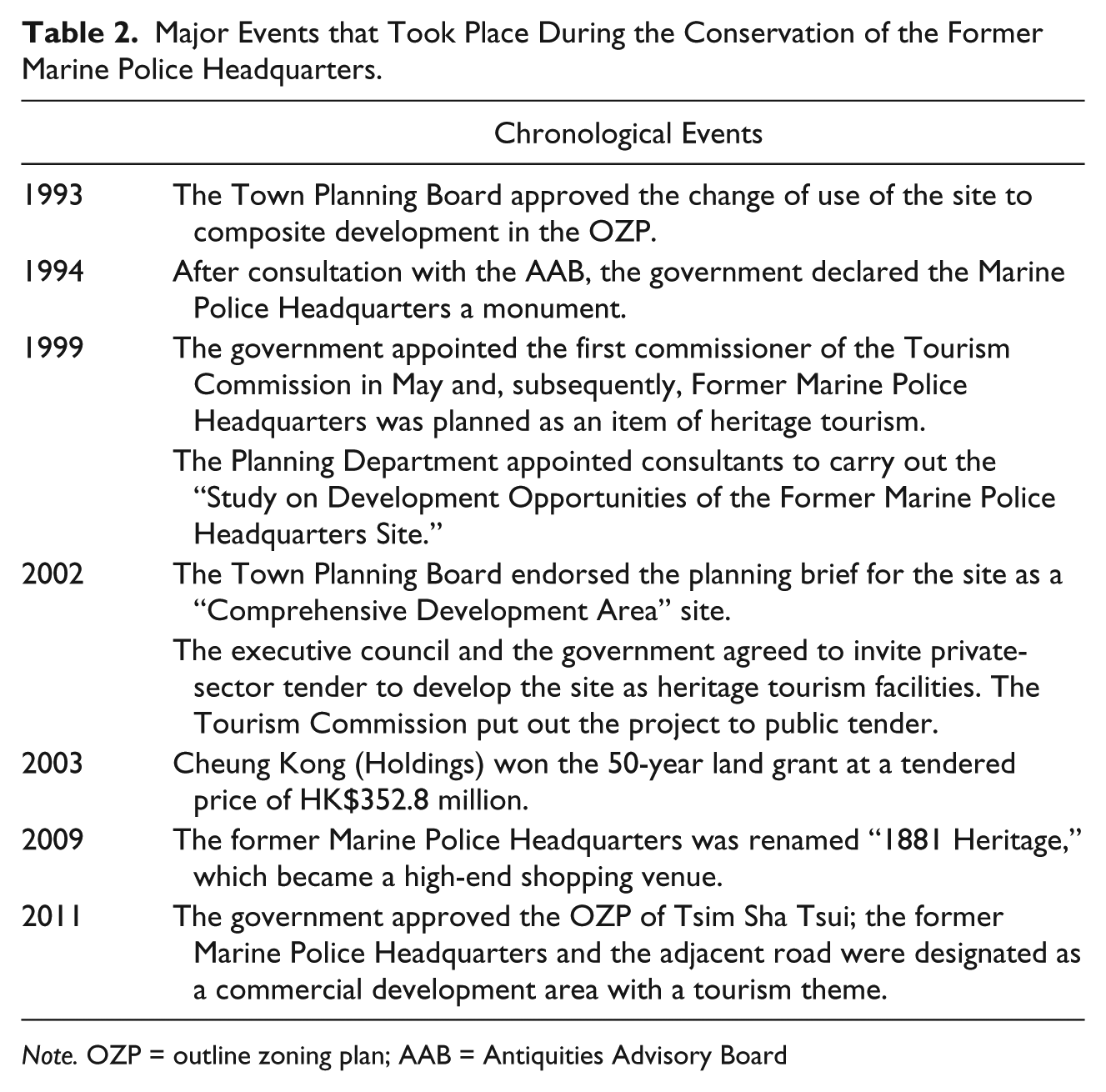
Note. OZP = outline zoning plan; AAB = Antiquities Advisory Board
CPS Compound: From Opposing Commercialization to Legitimizing Growth Through Cultural Economy and the Role of Civil Society
The CPS compound comprises three groups of magnificent buildings: the CPS, the former Central Magistracy, and Victoria Prison. The CPS buildings were erected between 1864 and 1919, whereas the former Central Magistracy and Victoria Prison were built in 1914 and 1841, respectively. The site was selected as the center for law and order, with the police station, magistracy, and prison located close together. The CPS compound illustrates the changes and profound effects of British rule, at the time of its colonization from 1841, on the development of Hong Kong’s law enforcement, judiciary, and penal systems. The buildings were declared monuments under the Antiquities and Monuments Ordinance in 1995.
The CPS compound is located in the Central and Western District of Hong Kong, an area known as the Mid-levels and is a popular tourist, shopping, and dining destination; it was surveyed as having the highest median monthly household income (Hong Kong Census and Statistics Department 2013) and the eighth highest population in 2011 in Hong Kong (Hong Kong Census Department 2011). The CPS project is one of the pioneer projects of the government’s Conserving Central Scheme that aims to connect the vicinity of two famous dining precincts. This may increase the overall attraction of the Central area, boost Hong Kong’s economy, the employment market, and enhance community development (Concern Group for the Preservation of Hong Kong’s Historical Buildings 2004).
The government invited private tender to undertake the revitalization of the CPS at the beginning of 2004; however, strong protests were held against it and the government postponed the tender. In July 2004, Sir Robert Hotung’s family, a wealthy family that forms the Hotung Group, 2 announced that it would donate HK$500 million (about US$64 million) to the government for the conservation of the project, with an emphasis on arts and culture, to be run by a nonprofit foundation or trust. The government eventually rejected the Hotung proposal on the grounds of competitive bidding and the Ho’s family desire to have ownership of the land.
In 2007, the government announced that the Hong Kong Jockey Club (HKJC) would undertake the conservation and revitalization of the CPS compound and make it into a cultural and heritage hub. The HKJC entered into a tenancy agreement of not less than 10 years with the government, during which time the HKJC would be responsible for all renovation costs and deficits for the first three years of operations. The HKJC Charities Trust (HKJCCT) was set up to fund the HK$1.8 billion capital cost of renovation and the $30 million initial operating costs, prior to the project becoming self-sustainable. The Trust, through the Jockey Club CPS Limited (JCCPS), which is a not-for-profit company supported by a Heritage Advisory Committee, would manage the project. The JCCPS would be responsible for guiding the development of the CPS site. Table 3 provides the major events that took place in the conservation of the CPS Compound.
Major Events that Took Place in the Conservation of the CPS Compound.
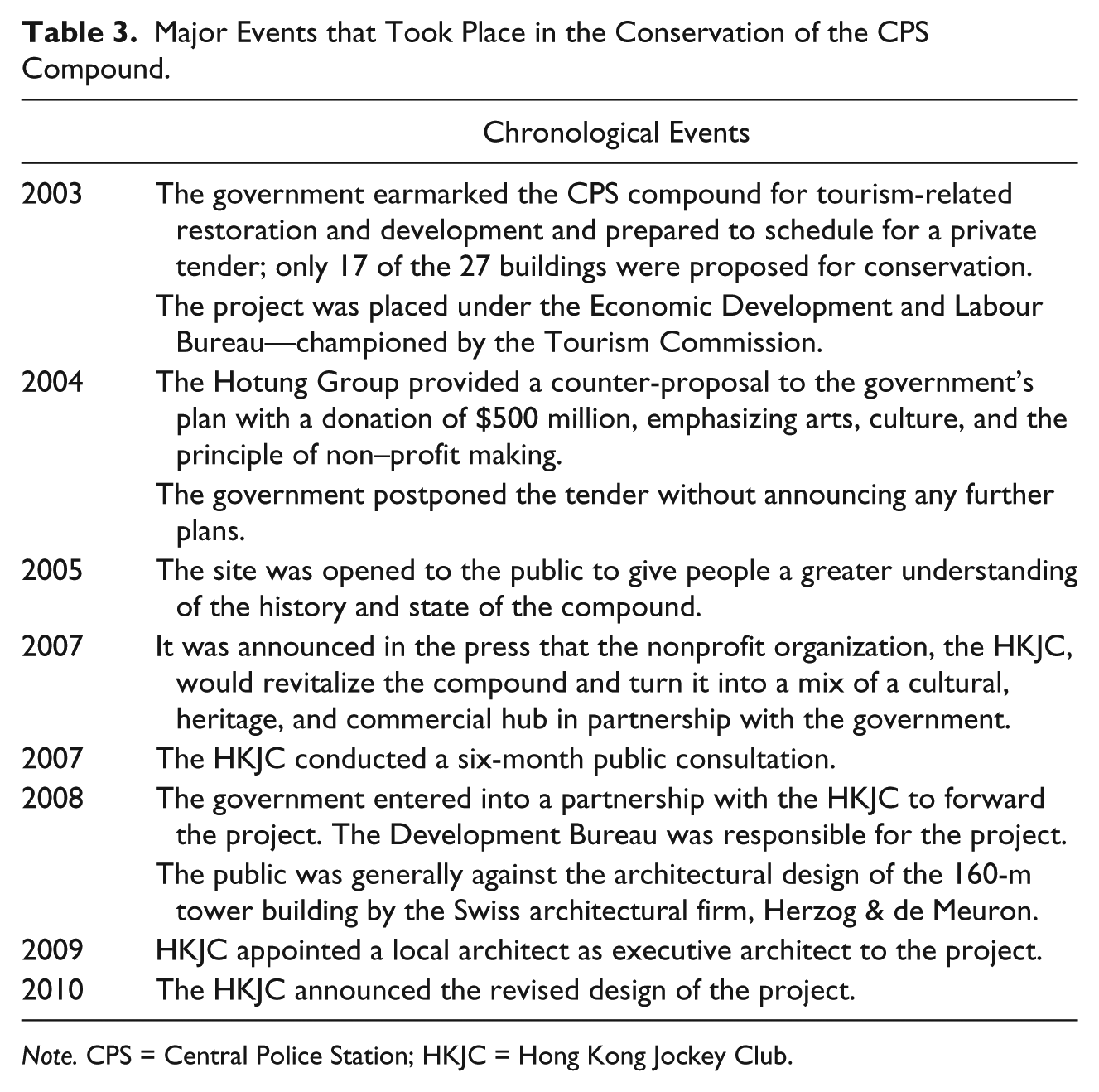
Note. CPS = Central Police Station; HKJC = Hong Kong Jockey Club.
Discussion
In general, a high land value generally implies a prime urban location, the least restrictive lease, and higher development potential. It has long been argued that a high land value is an impediment to the conservation of historic sites. According to this view, it is believed that the exchange value rather than the use value of an historic building site is emphasized, and this is thought to influence conservation decisions. Although there have been several well-known cases of demolition of historical buildings of high heritage value in Hong Kong, in particular prior to its return to China in 1997, these cases do not provide conclusive evidence that exchange value is valued over use value. In fact, the cases examined in the present study reveal the opposite. The estimated land values 3 for the two sites are extremely high (see Table 4). This leads to the following question: What force has contributed to conservation of the historical buildings? Or, what factor(s) has reshaped the heritage value of historic buildings?
Comparisons of the Two Cases.

Note. CDA = Comprehensive Development Area; HKJC = Hong Kong Jockey Club; NGO = nongovernmental organization; CPS = Central Police Station.
Table 4 summarizes the backgrounds of the two cases. It provides information on land value, the different institutional arrangements for the conservation and revitalization of the projects, and the influence of public concern on shaping the growth machine ideology.
1. How does heritage conservation contribute to the growth machine?
The two case studies shed light on the way progrowth ideology is being incorporated into preservation by reuse of historic sites to promote economic and tourism growth. There is also strong evidence that different parties play a role in reshaping the progrowth ideology.
The urban politics of promoting historic preservation as a place of consumption and using heritage as cultural capital to promote economic growth is increasingly becoming the norm in Hong Kong. The higher the capability of the building to channel joint consumption, the better its ability to sustain its economic viability, rather than being preserved intact but remaining dilapidated. In this sense, a designated historic building is more likely to continue its use value in the form of commercial use, tourist attraction, or as a cultural and arts resource.
In the case of the former Marine Police Station, the government, property developer, and tourism industry formed an alliance to promote economic development. The exchange value lies in the land value of the site and the revenues from the hotel, shops, and restaurants rents, as it is situated in a prime urban commercial location. In this case, the market-generated growth and financial return encouraged the government to place a high premium on the site. It represents part of the exchange value of historic sites that have extremely high land value, perhaps outweighing the use value acquired by people’s enjoyment in visiting it (Purcell 2008). Most importantly, it leads to driving up property values and rents in the immediate area after revitalization. The original hill setting had almost stopped the pedestrian from visiting the site, whereas the completed shopping precinct has drawn considerable pedestrians into it as the whole complex by providing an open space in the ground level. In addition, the use value of the site is enhanced because people are now able to access and use the site, which originally had restricted access, as a public space. As a result, the improved connectivity and vitality of the site after the conservation would have contributed to the change of land value.
As the shops and restaurants are high-class venues, it is not an area where the general public shops or dines, but it is at least a place to take photos. In this sense, whether the conservation and reuse of the site has created a sense of place and enhanced social inclusion is contended. The government invited private-sector bidding for the former Marine Police Station heritage site following a market model in 2002. The government conserved the heritage site without using any money from taxpayers. It is criticized that the assessment of the tender showed that the government wanted to make a profit and that in this situation the economic considerations outweighed heritage conservation (interview with a representative of the Conservancy Association in Sept. 2010, an architect in June 2011, and a conservation critic, May 2012).
In regard to the private developer, it is argued that the company remains pivotal in fostering growth machines, and this actually reflects the loopholes in the land-use planning mechanism. The developer saw the project as a profit-making opportunity, as the site is located in a prime tourist district, and he was granted a 50-year lease. To make the call for tenders more attractive, the government stated that there could be flexibility in how the hill setting and the underground tunnels constructed during World War II were dealt with. The existing hill was removed and many old trees were chopped down to make way for a commercial shopping mall that would accommodate 20 luxury shops. The project has since become increasingly more commercialized, as the 1881 Heritage has won numerous local and international commercial property awards. A conservationist in the field of academia pointed out, “The project has been very successful in terms of promoting tourism, creating landmarks and bringing business to the shopping mall, which are all the prime intention of the developer” (interview, March 2010). However, in response, the developer’s project manager has stressed that “we have compromised tremendously to comply with the heritage conservation requirement in the redevelopment” (interview, June 2011).
In regard to adjacent businesses and land owners, redevelopment has affected the rise of property prices in the entire area, termed the “1881 Effect” in the real estate field (Siu 2009). Since it has been transformed into an expensive commercial venue, the area has brought in around HK$1 billion tourism revenue per year. Clearly, the commercialization of the former Marine Police Headquarters has been an economic resource exploited as a complex strategy to promote tourism, economic development, and urban regeneration.
The local media and newspapers have also influenced local ideologies by propagating the revitalization project as stimulus for the wider good of the city and thus engendering pride and quality of life. As a result, they have strengthened the commercial aspects of the heritage. Overall, the coalition between different parties has allowed businesses, shop owners, and land and property owners to profit from the intensification of land use.
Similar to the former Marine Police Station, the growth coalition of the different parties is also evident in the case of the CPS. The government decided to develop the site into a tourism-themed heritage project and the land premium also weighted high in the entire evaluation of the private tender document. In response, a CPS concern group was established that complained, “The form of tendering process has seriously deprived the opportunity for non-government organizations to be awarded the tender” (interview, April 2010).
However, the business sector was vigorously in support of the government’s proposal, because it would benefit from the commercialization approach. Business people have increasingly recognized the economic advantages of heritage preservation and the arts. At the same time, the arts and heritage preservation community has also become increasingly skilled at furthering its own interests through development projects. As has been done in many cities worldwide, the planning and design of the CPS compound took into consideration marketing strategies. It was argued that using the well-known Swiss architectural firm of Herzog & de Meuron would attract worldwide attention, which in itself made it part of an advertisement/marketing strategy (Harvey 2008).
Although the HKJC proposed transforming the CPS into an arts and culture hub, it has been argued that the revitalization of the CPS has adopted a cultural economy approach that has looked at culture and space as a source of economic profit (Ku 2010), particularly in light of the worldwide expansion of the tourism industry, which has increasingly boosted the cultural economy. The revitalized site is expected to create a heritage tourism cluster comprising the nearby attractions and the Historical Trail, which will help diversify the tourism products offered by the city of Hong Kong, enhance the tourist experience, and generate business opportunities for nearby retail and dining facilities, thus contributing positively to the economic development of Hong Kong (Development Bureau 2010). In light of this socioeconomic impact, whether the heritage site will become a redevelopment project that centers on “place marketing” culture, entertainment, consumption, leisure, and tourism destinations (Leitner 1990; Strom 2008), and a product of commodification contributing to growth politics still remains uncertain. The representative of a local heritage concern group questioned, “With two-thirds of the conserved historic buildings which will be reused for commercial purposes, it is really uncertain whether it is a development project or a heritage project” (interview, May 2012), whereas a HKJC project participant argued, “The mix of commercial and cultural uses will ensure vibrancy of the vicinity area” (interview, Jan. 2013). This view was further elaborated on by a city planner who commented, “The hybrid of both cultural and commercial elements are needed to ensure the compound to be self-sustaining” (interview, June 2011).
Finally, the mass media have played an increasingly important role in boosting and romanticizing heritage as nostalgia and as a culture and arts entity that appeals to the middle-class and higher tastes. As such, the project is also expected to facilitate tourism and consumerism. This case poses a contended question of whether it is a heritage preservation or a choreographed cultural economy approach that implicitly propagates consumerism, economic growth, and the rise of the real estate market.
Overall, the two cases shed light on the way that both commercialization of heritage and the cultural and creative economy discourse have unwittingly contributed to the progrowth ideology, while transferring the financial burden of restoration, maintenance, and operation from the government to the private sector. This raises the next question: How do institutional arrangements facilitate or restrict the extent of the growth machine model in heritage conservation?
2. The ways that institutional arrangements affect the growth machine model.
The two cases showcase the impact of institutional arrangements on shaping the composition and extent of growth coalitions in different public–private partnership models. Figure 1 shows the different institutional arrangements that monitor the two heritage projects.
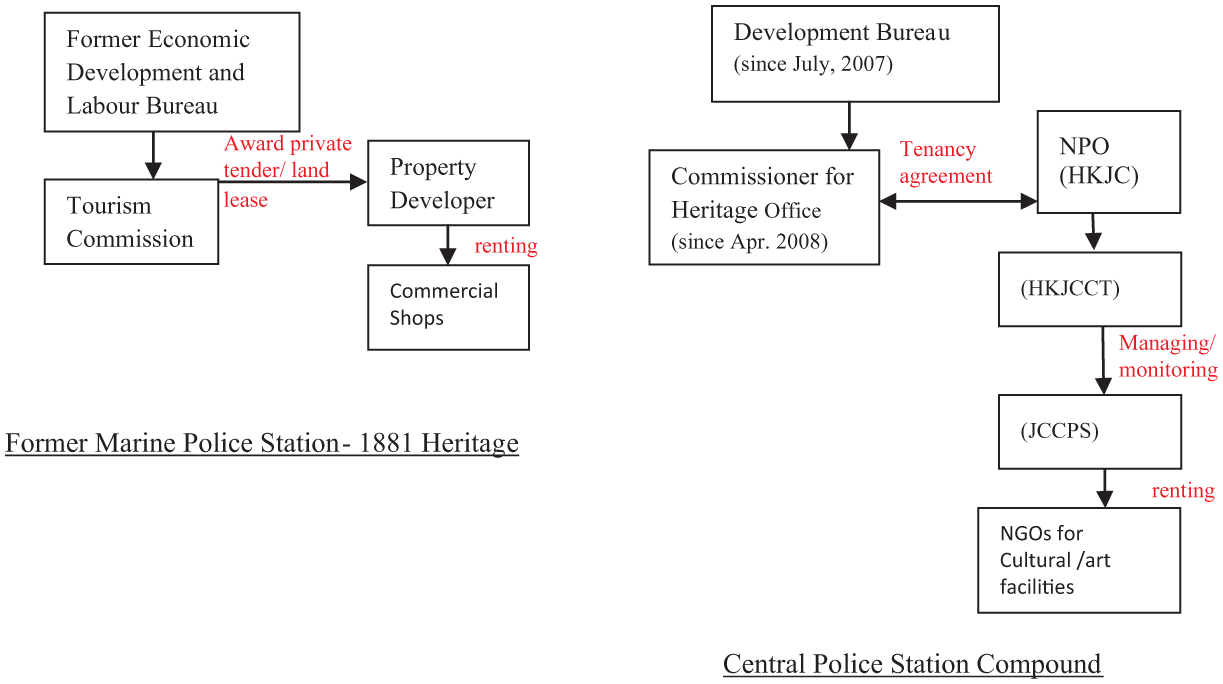
Institutional arrangements for the former Marine Police Station and the Central Police Station compound projects.
The former Marine Police Station has been promoted as a heritage tourism project under the implementation of the Tourism Commission of the former Economic Development and Labor Bureau since the early 1990s. The government organizational structure has influenced the legitimization of growth, particularly in the way it has implemented business entrepreneurship in the tender and future operation of the site. This has contributed highly to tourism economics and growth politics and supported the trend of commercialization of heritage and privatization of urban space.
The conditions for the implementation of the public–private partnership model in this case are as follows: The government needs to sell the land in the form of granting a lease to the property developer; the developer has the right of development and use of the land; and the developer needs to have the financial capability to pay for the land premium, the renovation costs, and the future operation costs. One way in which the government could have monitored the revitalization project is through the means of Comprehensive Development Area (CDA) zoning. This is because CDA is a development control tool that facilitates comprehensive design and layout of a site. However, the commercial aspect of the final project, rather than heritage conservation, would have been emphasized.
In the case of the CPS compound, the public–private partnership involves no selling of land and the government remains the owner. The non-profit making organization (NPO) entered into a tenancy agreement with the government and only the NPO has the right of use of the land. In regard to government institutions, the government sought to rezone the site as a “Historical Building Preserved for Cultural, Community and Commercial Uses” to boost tourism. At the same time, it is a means by which the government can set future adaptive reuse constraints. It is argued that, on one hand, the revised agency changing from the Economy Development and Labour Bureau—championed by the Tourism Commission—to the Development Bureau to monitor the heritage project has had very little influence on the whole process of heritage conservation and adaptive reuse. It has not contributed to the purported success of the NPO partnership nor affected the extent of progrowth coalitions. On the other hand, there has been criticism that the new setup of the Development Bureau to monitor heritage conservation projects allows development to override heritage conservation (Lai 2007). Thus, progrowth ideology and commercialism still prevails, but it provides a relatively less economically oriented goal than the Tourism Commission in the case of the former Marine Police Station.
The involvement of the NPO is an attempt to prevent the future use of land as primarily a profit maker. However, a fundamental prerequisite required for this type of partnership is the financial support of a strong charity trust. Without this support, it may not be able to sustain economic viability without commercial activities or government subsidies. Under this institutional arrangement, the public–private partnership in heritage conservation can affect and minimize the extent of progrowth coalitions.
In addition, under a partnership with the NPO, the invitation of NGOs as future operators of cultural and arts services provides a cornerstone by which the extent of commercialization of heritage and the alliance of land-based elites to intensify the growth machine regime are minimized.
In both cases, it can be seen that how land is regulated and transformed can have an effect on the extent of commodification of a heritage place. In the case of the public–private partnership relationship, it would be difficult and almost impossible for NGOs to afford the huge restoration costs and the initial operating costs. Thus, involving private enterprise and private capital in heritage conservation projects becomes vitally important if the government refuses to provide financial subsidies.
3. Role of public concerns in contributing/preventing the growth machine.
In both cases, local concern groups and the community have played a role in shaping the form and extent of progrowth coalitions. Interestingly, the role of public concerns and participation has evolved over the last decade under the shifting value of heritage conservation in the city. In the case of the former Marine Police Station, from the 1970s, local concerned groups put tremendous effort into protecting the historic building from demolition and redevelopment. Among their concerns were the demolition of the hill and the environmental impact of cutting down numerous trees. The privatization of space during renovation, the involvement of private enterprise in revitalization, and the future operation of the heritage site tended to favor progrowth coalitions and commercialization of heritage. Thus, the institutional arrangements have actually deprived the rights of the public to participate in the decision-making process, as the development right and the use right lie with the property developer.
The case of the CPS compound has showcased that advocates of democratic urban planning have increasingly affected the extent of growth of heritage conservation projects (Jonas and Wilson 1999). There were extensive activities and campaigns initiated by the civil society and community to oppose the private tender and government commercialism of preservation during the earlier stage of discussion, which forced the government to postpone the tender. The conservation campaigns seem to have gained a preliminary success in its intent to push for an anticommercialism regime and to prevent the site from being used as a primarily commercial venue. In this case, local concern groups, district councilors, and professional bodies actually intervened in the entire process of the redevelopment project. It is evident that public pressure to conserve all the buildings in the compound has also been successful. After the HKJC took over the project, six months of extensive public consultations and engagement activities were conducted. Later on, the public also influenced decisions regarding the new uses and designs of the additions on the site. A 160-m-high new structure was strongly opposed by concerned groups and local residents on the basis that it obstructed the view and increased development density. As a result of these pressures, the anticipated use of the CPS has changed from being a tourism communal project to a place that promotes culture and the arts. It can be argued that these events have demonstrated the impact of protests against the commercialization of the heritage resource and have consequently affected the extent of progrowth coalition alliances.
Implications of the Relationship Between Institutional Arrangements and Public Participation in Shaping Progrowth Coalitions
Figure 2 illustrates the tripartite relationship between progrowth coalitions, institutional arrangements, and public participation. It conveys that not only are government institutions, land, and business elites able to influence the extent to which the growth machine ideology is adopted in the context of heritage conservation, but the impact of public participation and propaganda can also directly influence the progrowth coalitions of the different groups and the institutional arrangement of the heritage conservation project, which is facing tremendous public debate.
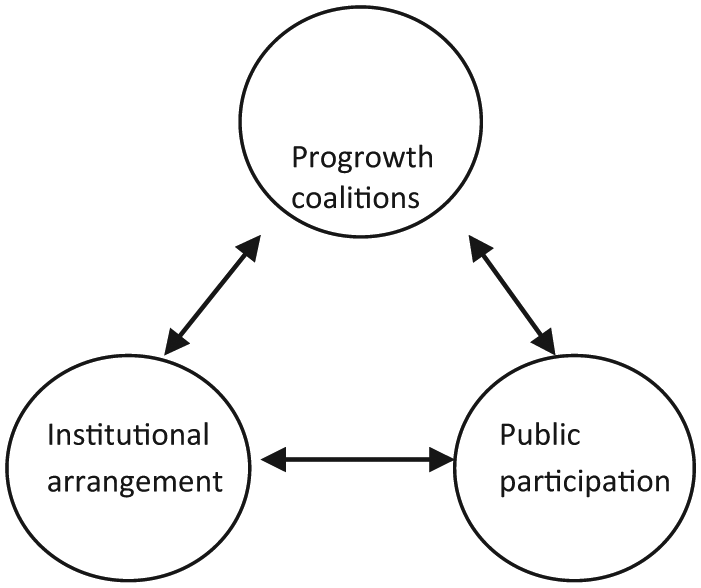
The tripartite relationship between progrowth coalitions, institutional arrangement, and public participation.
In light of this relationship, urban planning and development policies should take into consideration the public’s concerns regarding two issues. First is the public’s view on the balance between exchange value and use value of heritage conservation projects. The challenge lies in ensuring economic viability, while preserving the heritage and social value of an historic site. Second, it is important to provide public participation opportunities during the different stages of a project. This allows different views to be consolidated and taken into consideration in decision making. This can be facilitated by appropriate institutional arrangements.
In regard to the issue of commercialization, urban land can be less commodified through rent control and tenant rights mechanisms that ensure affordable rents for future operators. In addition, setting restrictive guidelines to preserve historic landmarks can prevent inappropriate commercial use, which can destroy the authenticity of a site. Furthermore, the trend of preserving heritage sites as public space can determine the form and intensity of progrowth politics. This is in line with the rising awareness of an alternative spatial vision, which stresses use values, social equity, and environmental conservation rather than using land to solely make a profit from heritage resources (Stone 1989). In this regard, public and institutional land ownership should be more widely adopted so that the public has the right to use the site and influence conservation decisions.
Conclusion
The growth machine ideology has evolved during times of social, economic, and political changes. The evolving trends and processes of urban planning convey the potentially significant contributions of heritage conservation in overall urban planning and economic and cultural development. This study provides a useful reference on the extent to which the progrowth coalition has shaped historic preservation, particularly in a context where land is treated as a commodity and the government land tenure system allows land development for high profit. The two cases shed light on the role that historic preservation plays in constructing contemporary progrowth coalitions in urban politics. The study also provides a logical explanation as to why high land value and great development potential have not hindered heritage conservation; on the contrary, it is found that the two can coexist and help each other under progrowth coalition politics. In this study, we also go further in analyzing how growth machines, progrowth coalitions, government institutions, and opposing community groups affect the growth outcome of heritage conservation.
In the case of the former Marine Police Station, there was a strong progrowth coalition whereby the property developer and tourism department, with the intention of profit making and economic growth, strove to address the issues of commercialization and privatization of heritage resources. Apart from institutional arrangements and land-use planning regulations implemented for development, public concern and participation was a dominant component in determining the form and intensity of the progrowth coalitions and has since become a factor in minimizing growth politics. Interestingly, the institutional arrangements also affect the extent of public involvement in projects and, hence, foster or limit the role public participation plays in the formulation of progrowth coalitions. Thus, this article argues that this component should be incorporated into the growth machine model to better understand urban politics. We propose a tripartite relationship that emphasizes that the growth machine ideology, institutional arrangements, and public participation are interrelated and affect each other. Relevant policy implications are also discussed.
This article also highlights the shifting value of heritage in cities where the growth machine thesis is favored and discusses how it has been reframed by different actors, including the government, institutions, and the general public. In fact, looking back at the general history of heritage conservation over the past few decades in Hong Kong, one can see the evolving trend in urban politics and heritage conservation. First, the growth machine ideology outweighed heritage conservation prior to the change of sovereignty. The exchange value rather than the use value was emphasized in considering whether a historical site should be conserved. Second, heritage conservation was used to support the growth machine model, and commodification took place. More recently, the proliferation of a cultural economy has increasingly been boosted in heritage conservation. The rising influence of local community groups is illustrated by their impact on conservation campaigns and their opposition to commercialization of heritage resources.
As Hong Kong is one of the most densely populated urban areas in the world, the findings of this study also provide significant insights for policy makers in other urban areas that face intense conflicts between development and conservation of historical buildings, particularly in the case of developing cities undergoing rapid development and land-value escalation. Many of the same situations and problems where heritage resources have been commercialized to promulgate economic growth are present in other cities. Obviously, the ways in which different public–private partnership institutional arrangements affect the extent of growth ideology provide insights for planners and policy makers when formulating conservation policies. In particular, the rise of public concerns regarding the support of or opposition to the heritage conservation regime and the ways in which it affects progrowth coalitions and politics also apply to other cities worldwide. Incorporation of public opinion should be effectively implemented during different stages of conservation projects.
Footnotes
Acknowledgements
The authors would like to thank all the anonymous referees for their valuable comments.
Declaration of Conflicting Interests
The author(s) declared no potential conflicts of interest with respect to the research, authorship, and/or publication of this article.
Funding
The author(s) disclosed receipt of the following financial support for the research, authorship, and/or publication of this article: The work described in this article was fully supported by a grant from the General Research Fund of the Hong Kong SAR Government (Project PolyU5407/11H).