



Abstract
Public-sector innovation and entrepreneurship usually refer to policies undertaken by public administrations or driven by urban regimes in view of furthering economic development. Some researchers study these processes from a management perspective; others critique them as vehicles of neoliberalization. However, scant attention has been paid to everyday technical and service innovation undertaken by municipal departments and employees. Although this innovation is usually not driven by markets, municipalities’ small size and geographic rootedness suggest it can be apprehended using concepts from firm-level studies. Our study of a municipal innovation competition in Quebec provides examples of everyday municipal innovation. We find that municipalities’ internal capacity determines their innovativeness, that learning occurs, and that the motivation and evaluation of everyday municipal innovation are not market-based. This calls into question the appropriation of the term urban entrepreneurship by urban political economists and invites students of cities to examine municipal entrepreneurial processes more closely.
Introduction
In the late 1970s, a small body of work emerged that took seriously the idea that municipalities could be innovative, not only in terms of policy and governance but also in terms of technology (Feller and Menzel 1978), products, 1 and processes (Bingham 1977; Bowman 1980). In keeping with then current research on firm-level innovation (Pred 1973), the focus was on innovation diffusion rather than on its generation.
Over the subsequent four decades, innovation has become almost synonymous with economic and social development. However, attention has shifted away from municipal innovation toward innovation in firms and toward policy innovation by state and federal administrations (Leyden and Link 2015; Schneider and Teske 1992). Municipalities are usually not considered to be initiators of innovation—particularly not in terms of technology, products, or processes (Mulgan 2007; Potts and Kastelle 2010): To the extent that municipalities are thought of as innovators, it is as policy innovators (Woodward, Ellig, and Burns 1994) or as adopters of technology developed in the private sector (Paroutis, Bennett, and Heracleous 2014).
Although technological, product, and process innovation is of concern to local governments by virtue of its association with local economic development, local governments are understood as facilitators of this type of innovation in the private sector. This facilitating role has grown in prominence as innovation policy has superseded industrial policy (Bibbee 2012; Brewis 1969; Todtling 1999) at the national and local (often urban) levels (Camagni and Capello 2013). As responsibility for local development shifted from central to local administrations, cities and municipalities became enablers of market-driven innovation processes (Cooke, Heidenreich, and Braczyk 2004; Harvey 1989). As a consequence, discussions of urban and municipal entrepreneurship among urban theorists have focused on normative questions relating to privatization and marketization of public assets and services (Merrifield 2014
Public administration and management research, which focuses on the mechanisms that underpin public-sector innovation and entrepreneurship, has also tended to emphasize the public sector as facilitator of private-sector innovation (Berry and Berry 2007; Leyden and Link 2015; Mulgan 2007; Potts and Kastelle 2010), not as an innovator in its own right (Leyden and Link 2015; Potts and Kastelle 2010). This is partly because public-sector innovation is assumed to be either imitative, adoptive, 3 or policy focused (i.e., not related to the development of new products, services, and processes), and partly because the public sector is not evolving in competitive markets, market competition often being considered a sine qua non of entrepreneurial innovation. We argue in this article that the first assumption does not hold for municipalities—they can be technological innovators in their own right—and that market competition is not a prerequisite for entrepreneurial innovation. By focusing on the applied and material dimensions of municipal innovation, and conceptualizing it as a Schumpeterian process, we reveal similarities and differences between municipalities and SMEs (Small and Medium Sized Enterprises) which increase our understanding of the municipal innovation process.
This article’s central argument is that municipalities, like SMEs, introduce incremental product, process, and service innovations, which we call everyday innovations as they are in response to issues that arise out of municipalities’ everyday service and management responsibilities. The idea that municipal departments and employees develop and introduce “material” innovations, a type of innovation usually associated with manufacturing and service SMEs evolving in competitive demand-driven markets, has not, to our knowledge, been explored: The invention and introduction of new products, services, and processes is not perceived as the public sector’s role. We suggest that this process of everyday municipal innovation can be understood as entrepreneurial, even though the motivation for innovation and the way innovation is evaluated are not associated with markets or the economy. The process of entrepreneurship in cities and municipalities, therefore, needs to be disassociated from neoliberalism, growth promotion, and markets, which are not essential features of entrepreneurialism. This nuances urban theorists’ critiques of urban entrepreneurship, which have tended to conceptualize entrepreneurship as necessarily market-oriented and which have used the term to qualify the political-economic orientations of urban governments rather than their everyday urban management activities.
The article proceeds as follows. In the following section, we first conceptualize innovation and entrepreneurship, establish that they are not necessarily market driven, and then discuss whether a comparison between innovation in SMEs and municipalities is tenable. After describing the information and data at our disposal, the empirical part of the article proceeds in two stages. We first provide examples of innovation introduced by municipalities in Quebec, illustrating its diversity, highlighting instances of product, service, and process innovation, and describing the variety of motivations behind it. We then perform an exploratory statistical analysis of some environmental (geographic) and internal (socioeconomic) determinants of municipal innovation, in particular testing the hypothesis that municipalities in more competitive metropolitan environments will be more innovative. The study is exploratory because of data limitations, but demonstrates the possibilities of the approach. We conclude by considering the study’s limitations, what the results reveal, and further avenues of investigation.
Innovation in Municipalities and SMEs: An Entrepreneurial Approach
Conceptualizing Entrepreneurial Municipal Innovation
A common starting point for understanding innovation is Schumpeter (Leyden and Link 2015; Malecki 1997). Schumpeter (1936), an early twentieth-century economist, conceptualized innovation as the process of transforming an idea into a product, process, or organizational form that finds a market and/or enhances firm productivity. The key actor in this process is the entrepreneur: a person “who perceives an opportunity heretofore unexpected and exploits it” (Leyden and Link 2015). The entrepreneur not only has vision but also possesses the skills, fundraising capacity, organizational acumen, and risk tolerance to turn a vision into an innovation.
Much emphasis has been put on the economic finality of Schumpeter’s entrepreneur (Potts and Kastelle 2010): This individual (or small organization) is primarily motivated by ambition to compete in markets. Competition—through the process of creative destruction—leads new technologies and organizational forms to take over from the old. Thus, when local government is labeled “entrepreneurial” (e.g., Harvey 1989; Merrifield 2014a), it is usually synonymous with “market-driven” and with “facilitating business growth.” Others have argued that public-sector entrepreneurs are driven by political gain (Wagner 1966)—but work on urban regimes, and the continued neoliberalization of urban politics, suggests the distinction is moot (Gilens 2012; Hankins 2015).
Leyden and Link (2015), who perhaps have gone the furthest in theorizing public-sector entrepreneurship, recognized that “the specific nature of the opportunities as well as the motivation of the public sector may, and in all likelihood will, differ [from the private sector]” (p. 2). However, this broadening of perspectives about entrepreneurial motivation is not fully carried through to the theoretical development in their second chapter, where they write that “in the public sector, the outcome of this same [as in the private sector] innovation process manifests itself through new public policies that alter the private sector’s rules of the game with the intent to improve overall economic performance” (p. 45). Whereas alternative motivations are initially acknowledged, their theory—and their empirical investigation of public-sector innovation policy—establishes economic development as the prime motivator. Of course, this is not identical to private gain for the entrepreneur—individual motivations differ between public and private entrepreneurial agents—but the end result of public-sector entrepreneurship remains private-sector growth (Harvey 1989; Merrifield 2014b).
However, there is no reason for Schumpeterian innovation processes to only be driven by market competition and growth. Until the end of the nineteenth century, “economic” implied “household management” and “thrift”: The effective management of finite resources—economic activity—can under this acceptation accommodate a wide array of motivations of which profit (or gross domestic product [GDP] increase) is just one. Mohr’s (1969, p. 112—cited in Franzel 2008) definition of innovation in organizations as “the successful introduction into an applied situation of means or ends that are new to the situation” suggests that an entrepreneur can be a person or organization that identifies an idea’s potential to further any number of practical applications, not necessarily with reference to a market. This is an important distinction: If innovation is understood as generating and applying new ideas to solve problems, the profit or growth motive is no longer central. For instance, developing and implementing a new service to help aging people maintain a healthy diet may be motivated by a sense of duty: There is no profit or economic gain involved—indeed, the service may involve costs in terms of volunteer time and effort—yet, clearly, such a new service is an innovation. While it may be possible, ex post, to calculate what the economic gains and losses are, these cannot be put forward as the driver of this entrepreneurship.
If innovation is understood in this way, then entrepreneurial local governments do not necessarily facilitate capital accumulation (Harvey 1989) or economic growth (Leyden and Link 2015), nor do they necessarily tailor public services to attract mobile population and capital in view of growth (Florida 2008; Tiebout 1956). They can also be adept at finding and applying practical solutions—innovative in the sense that they have not been applied in the same way before—to problems or aspirations identified in a variety of ways. Gibson-Graham, Cameron, and Healy (2013) and Conill et al. (2012) adopt this wider view of innovation and provide examples of local communities that have reappropriated the economy by formulating and applying innovative—often community oriented—ideas and processes. Innovation is not limited to this: It can also be prosaic and applied, a response to problems identified in local technical, engineering, or transport departments (Franzel 2008; Marsden et al. 2011). Although creative destruction occurs as the new replaces the old, the selection process—that is, which ideas are pursued and which prove successful—can be based on a variety of normative perspectives. If this argument is accepted, then everyday municipal innovation, far from being almost a contradiction in terms (see Kattel et al. 2013; Mulgan 2007, for discussions), is a topic that merits attention.
An important element of entrepreneurship is risk-taking (Leyden and Link 2015): The nature of risk taken by nonmarket innovators should be considered. In the case of municipal departments and employees developing everyday innovations, there is little personal financial risk. The risks are in terms of reputation, time, and possible waste of limited departmental resources: There is no guarantee that an idea developed to solve a problem or supply a new service will be successful, and the individuals or departments engaged in such innovation are putting resources (for which they are responsible) and their reputation on the line. Likewise, private entrepreneurs convince other people to back them financially: The principal risk for them is also, often, reputational (Shane and Cable 2002).
To sum up this section, municipal innovation, to the extent it is considered, is usually analyzed as a subset of innovation within public administrations (e.g., Leyden and Link 2015; Osborne and Brown 2011; Rosenblatt 2011): This work has expanded the way innovation is conceptualized, has recognized (albeit timidly) that it need not be market driven, and has explored processes that lead to, or inhibit, innovation in government agencies or departments. While some observations apply to municipalities, many are not directly transferable. Municipalities, by virtue of their small size, large number, geographic rootedness, and limited capacity to influence their environment, have as much—if not more—in common with SMEs than with other public administrations. Therefore, our discussion below of the municipal innovation process is couched in the management and economic geography literature focused on SMEs (Huizingh 2011; Shearmur 2011).
One reason for this is that the management and geographic literature on innovation in SMEs considers its geographic contextual determinants, determinants that have little bearing on provincial or national administrations coordinated across multiple locations from centralized ministries. Another reason is that a small number of researchers from the public administration tradition, such as Bingham (1977) and Franzel (2008), have already drawn parallels between SMEs and municipalities, which we wish to pursue. A final reason is that there are many municipalities: Intermunicipal competition may be a driver of municipal innovation (Tiebout 1956), notwithstanding the fact that competition is not essential to the idea of entrepreneurship and innovation. Our approach, however, is not normative—We are not arguing that municipalities should be conceptualized as SMEs, rather, we suggest that municipalities can usefully be apprehended (at least with respect to some aspects of their innovation process) as if they were SMEs.
Innovation in Municipalities and SMEs: Parallels and Pitfalls
Innovation in SMEs is an open process (Chesborough 2003; Huizingh 2011). It rests upon gathering information and know-how from interlocutors outside the firm: These can be university departments, clients, suppliers, government research institutes, and even competitors. Interactions with competitors may be collaborative, may occur if norms and shared platforms are being discussed, or can occur informally in social settings and at conferences and fairs (Bathelt 2011). These interactions lead to synergies and learning (Healy and Morgan 2012).
A body of literature has developed—particularly in geography—emphasizing the importance that an establishment’s immediate environment can have on its innovative capacity (Cooke, Heidenreich, and Braczyk 2004). For SMEs, this environment has primarily been interpreted as the municipal or (small) regional scale: However, the question of scale remains unresolved (Doloreux and Parto 2005) and is loosely understood as the area within which SMEs’ daily operations take place (Shearmur 2011). Dense and varied environments—metropolitan areas in particular—stimulate innovation for a variety of reasons, of which four will be mentioned. First, they provide SMEs with a variety of specialized (Porter 2003) and nonspecialized (Jacobs 1969) interlocutors with whom to exchange information and from whom to learn. Second, metropolitan areas often house public bodies—such as universities and colleges—which gather and disseminate information and technological know-how (Florida 1995). Third, the environment can house formal and informal institutions—such as local government, and also local ways of doing, chambers of commerce, and so on—that facilitate the sharing of information and the testing of new ideas (Cooke, Heidenreich, and Braczyk 2004). Finally, the environment, large urban areas in particular, can also enhance motivation to emulate innovative behavior (Porter 2003).
It is not necessarily the local environment that plays a role, however. Interactions important to innovation can take place over distance (Bathelt 2011; Torre and Rallet 2005). Innovators travel to conferences, and strategically identify interlocutors, irrespective of location, to learn from and/or to engage in collaboration. A growing number of researchers are investigating how different types of nongeographic proximity—such as social, cultural, and organizational—contribute to innovation (Amin and Roberts 2008; Boschma 2005). Geographic proximity may support other types of proximity but is not always a factor explaining innovation-related exchanges between SMEs.
Innovation also depends upon SMEs’ internal capacities, which allow them to absorb information and know-how from outside, learn, and develop innovations (Lichtenthaler and Lichtenthaler 2009; Spithoven, Clarysse, and Knockaert 2011). An SME’s internal capacities are often related to its size: The larger the establishment, the more resources it can devote to innovation processes. Beyond size, though, the nature of internal resources is important: Human capital, in the form of technicians and university graduates; investments in capital equipment and software; and human resource management that emphasizes knowledge sharing and exchange, are all associated with an SME’s ability to absorb external information and know-how. Another internal capacity is experience and learning: New knowledge is understood and exploited within the context of existing procedures, processes, and acquired knowledge.
To what extent are these factors relevant to municipalities? Most SMEs are single location establishments. Hence, an SME—like a municipality—is generally rooted in one place, and views the outside world from this vantage. Likewise, SMEs and municipalities—unlike larger multinational corporations and provincial or federal bodies—have little capacity to influence the environment or to engage in geographic arbitrage: In Canada, municipalities are seen as “creatures of the provinces” (Magnusson 2005), subject to constraining laws, rules, and regulations. Like SMEs, municipalities have a set of internal capacities—population, local resources, employees, the administration itself—and openness to the outside, both by way of localized interactions and collaborations (with neighboring municipalities, for instance) and by way of participation in larger, aspatial, networks (Clarke 2012).
The stress put on external information and know-how gathering for SMEs parallels the growing importance of policy transfer between and among governments—local governments in particular (Marsden et al. 2011). McCann and Ward (2011) link external information gathering with imitative or adoptive innovation: As waves of innovation arrive more frequently, a concordant churning has been identified in urban policy, with new ideas and initiatives replacing old with increasing regularity . . . Contemporary policy-making, at all scales, therefore involves the constant scanning . . . of the policy landscape, via professional publications and reports, the media, Web sites, blogs, professional contacts and word-of-mouth for ready-made, off-the-shelf policies that can be quickly applied locally. (p. xiv)
Another overlap between SMEs and municipalities is the outcome of innovation processes: It is often assumed that innovation in public administrations will be either organizational, policy-related, or will concern the adoption (rather than the development) of technology (Berry and Berry 2007; Brudney and Coleman 1995; Hansen 2011; McCann and Ward 2011; Osborne and Brown 2011; Paroutis, Bennett, and Heracleous 2014). However, municipalities, more so than many other jurisdictions, are closely connected to the material world of construction, waste processing, traffic management, and service delivery: There is, therefore, no reason to suppose that municipalities will not identify and solve technological—that is, product- and process-related—and service-related problems similar to SMEs (Bingham 1977; Feller and Menzel 1978; Franzel 2008).
Given these similarities, it is not unreasonable to approach everyday municipal innovation using some of the tools and concepts derived from the study of innovation in SMEs (Franzel 2008). The idea that municipal innovation can be influenced both by internal capacity and by the external environment is worth investigating, and has already been outlined, for policy innovation, at the scale of U.S. states by Berry and Berry (2007): There are two principal forms of explanation for the adoption of a new program by a state: internal determinants and diffusion models . . . Internal determinants models posit that the factors leading a jurisdiction to innovate are political, economic, or social characteristics internal to the state. In these models, states are not conceived as being influenced by the actions of other states. In contrast, diffusion models are inherently intergovernmental; they view state adoptions of policies as emulations of previous adoptions by other states. (p. 224)
Key differences remain between innovation in municipalities and SMEs. First, notwithstanding the policy mobilities literature (which highlights the spread of neoliberal policies and critiques urban entrepreneurship; Peck and Theodore 2010), there is no necessary connection between policy sharing and neoliberalism (Clarke 2012). Policy unconnected with markets and marketization can also be transferred and adapted (Conill et al. 2012; Gibson-Graham et al. 2013; Marsden et al. 2011), and while it is possible that municipalities’ innovation is associated with competition between them (Tiebout 1956), it can also be driven by internal demands and requirements. 4
The second, and related, point is that in the realm of municipal policy, imitation is a form of innovation. Despite well-documented antecedents—Godin (2008) emphasizes that until the 1960s innovation and imitation were almost synonymous, and Edgerton (2006) shows that everyday problem solving is an important type of innovation—it is not commonly recognized today that imitation can be a form of innovation. Today, innovation is associated with the radically new and with major impacts. However, for many—if not most—SMEs, radically new innovation is out of reach: For SMEs, just as for municipalities, innovation often corresponds to the adoption of processes or to marginal product improvements (Bhaskaran 2006; Edgerton 2006). Nevertheless, imitation often incorporates elements of radical novelty: Local governments adapt and customize policies and products, thereby creating new versions (Berry and Berry 2007; Marsden et al. 2011; Peck and Theodore 2010).
A third area of difference is that public administration has a duty to citizens: The desire to innovate must be tempered by conservatism as experimentation in areas such as service provision or waste treatment can impact people’s lives (Osborne and Brown 2011). This speaks to the motivation for innovating: Whereas it is understood that SMEs innovate to maintain or increase market share and profits, municipalities have a complex array of motives (Kattel et al. 2013; Marsden et al. 2011; Nahlinder 2013; Rosenblatt 2011). In democratic institutions—such as municipalities—identifying problems ultimately rests in the hands of residents, for whom filled potholes, pleasant parks, or helping the elderly, for example, may be important irrespective of market competition. Furthermore, municipalities are both political and administrative entities: The administration—that is, the departments and people actually carrying out everyday material functions—is able to identify and find solutions to everyday problems that may have little political repercussion. The nature and variety of municipal goals and motivations differentiates them from SMEs. It should be acknowledged, though, that a pervasive goal of municipal entrepreneurialism is economic growth (Evans 2009; Harvey 1989; Leyden and Link 2015) and that there are calls for public administrations to mimic the private sector (Hansen 2011; Osborne and Brown 2011 5 ; Potts and Kastelle 2010): Critiques of municipal entrepreneurialism are leveled at this market-driven focus, a focus maybe contingent upon wider scale political-economic processes but which, we argue, is not inherent to entrepreneurship or to innovation (Clarke 2012; Conill et al. 2012; Gibson-Graham, Cameron, and Healy 2013).
Given the similarities between SMEs and municipalities, and while acknowledging the differences, we now turn to an empirical analysis of applied innovation in municipalities in the province of Quebec, Canada. We proceed in two stages. First, and after describing the data, we present examples of innovation: These show that municipal innovation is varied; is not limited to policy, organization, imitation or adoption; and is usually unconnected with market processes. Second, we conduct an exploratory analysis to address two questions: (1) What characterizes municipalities that participate in UMQ’s (Union des Municipalités du Québec) innovation competition? and (2) What characterizes municipalities that win innovation awards? Both of these questions are framed by the idea that innovative behavior will be associated with external (proxied by location relative to dense metropolitan areas) and internal (proxied by size and socioeconomic profile) factors. We expect larger municipalities (those with more internal resources), those within metropolitan areas (i.e., with access to more external resources and subject to more competitive pressure), and those with a population of higher socioeconomic status (i.e., with more internal demand for, and means to introduce, innovation) will be more innovative.
The UMQ Innovation Competition, Data, and Method
Every year since 2005, the UMQ—a membership organization that represents the interests of about 300 of Quebec’s 1,000 municipalities—holds an innovation competition, called Mérite-Ovation. Its purpose is to reward municipalities which, whatever their size, their population or their geographic location, have distinguished themselves in an original fashion by their accomplishments and efforts to innovate, create or develop an activity, a program or a project in view of improving their citizen’s quality of life. (UMQ 2015)
The competition is organized in three stages. First, it is announced in autumn on the website, in UMQ newsletters, and by word-of-mouth. In earlier iterations of the competition, municipalities could present their innovation as they wished, but the submission process has become increasingly formalized: Today, the process resembles a grant application, with page limits, the need for an abstract, and limits on the amount and size of support material. There have typically been 50 to 60 innovations presented each year, and about 40 participating municipalities—Multiple submissions are permitted.
At the second stage, 15 to 20 submissions are short-listed by a panel of five to seven experts (depending on the year), including professors in the areas of public administration, management and/or planning, a representative of the Quebec ministry of municipal affairs, and two or three private consultants with experience in municipal government. The criteria are: originality of the undertaking and of results (38%), transfer potential (28%), effects in the locality (17%), and optimization of internal and external resource use (17%).
The competition’s final stage is in May, when the UMQ holds its annual conference and gala. Part of the conference center’s exhibition hall is given over to short-listed innovators, who each have a stand at which they showcase their submission. The panel of experts, at a predetermined time, visits each stand. The people presenting the innovation—typically the individuals who developed and implemented it, very rarely politicians or managers unless they are directly involved—have 10 minutes, five to present the innovation and five to answer questions from the panel.
The panel retires and discusses each short-listed innovation. If, in a particular category, no project is considered innovative, then no winner is selected. Deliberations seek consensus based upon the material provided with the application and upon the presentations and questions at each municipality’s stand: If consensus is not reached, a majority vote is held—hence the uneven number of panelists. 6
Our analysis rests upon information about participating municipalities and prizewinners. The first part consists in providing some examples of municipal innovation. This shows that municipal innovation extends beyond policy and organization to, on one hand, the development of new technology and, on the other, to new service provision and design. It also illustrates the everyday nature of municipal innovation.
The second part compares the 117 participating municipalities to the population of 327 municipalities that have been UMQ members at least once since 2005. It does so in two stages. The first question addressed is “What type of municipality participates in the innovation competition?” Participation is indicative of belief, by the municipality, that it has introduced an innovation, combined with the municipality’s desire (and ability) to enter the competition. The second question addressed is “Among the 117 participants, what distinguishes the 49 that have won at least one award?” We expect winning an award to indicate innovativeness: Without any market or technological criteria to assess innovation, the expert panel’s opinion is the best indicator available.
The data used are from two sources. Statistics Canada 2006 census data provide basic size and socioeconomic information about the 327 municipalities. Given confidentiality considerations associated with small area statistics, a limited array of indicators is available. Data from the UMQ provide information on the 117 participating municipalities and on prizewinners for the period 2005 to 2014. Data on participants are from UMQ records and are not publicly available. Information on short-listed projects is provided to conference participants (but was provided to us by the UMQ in tabulated form), and details of winning innovations can be found in the UMQ magazine, URBA. 7 We have referred to Volumes 26 to 35 (2005–2014). Each winning project—and on occasion projects that caught the panel’s attention without being category winners—is described in URBA, and the section “An Overview of Municipal Everyday Innovation” is based on a complete reading of this published material (i.e., details of 98 projects).
In the analyses, participation and winning are coded as dichotomous variables, and are introduced as dependent variables in logistic regressions of the following general form:

where I is a dichotomous variable for participation (yes/no) or win (yes/no).
Size: Classification of municipalities by population size (three classes) or log of population.
Zone: Each municipality is positioned relative to Quebec’s major cities, and four zones are defined:
Metropolitan—within 50 km of Montreal (3.8 million people), or within 30 km of Quebec City (800,000) or Ottawa-Hull (1.1 million).
Large city—within 40 km of Sherbrooke (170,000) or Trois-Rivières (120,000), or 50 km of Rimouski (50,000) and Saguenay (150,000).
Rural central—other municipalities within 100 km of Montreal, Quebec, or Ottawa-Hull.
Rural peripheral—other municipalities beyond 100 km from Montreal, Quebec, or Ottawa-Hull.
The distance criteria take into account the size of each urban agglomeration, and the number and size of surrounding municipalities (distances are calculated between centroids). Sensitivity analyses have been conducted on these distance thresholds (varying them by 10 km either way). The results remain essentially unchanged.
Income: Mean work income in the municipality (three classes).
Socioeconomic variables: Inequality (mean income/median income); population growth between 2006 and 2011; occupation rate (% of working age population with a job); working age population (percentage of people between 15 and 64 years of age); professional profile (three principal components drawn from a factor analysis of six occupational groups—see the appendix).
Number of submissions: When analyzing the 117 winners, municipalities are classified according to whether they have submitted just one innovation (over the course of 2005–2014), two to five entries, or more than five entries. Given the significance of this variable, it is analyzed in more detail in the last stages of the exploratory analysis.
One limitation of these data is that we have no information on administrations themselves—thus, we cannot comment on whether particular municipal practices, political orientations, or organizational factors have an impact on participation or winning. The main purpose of this analysis is exploratory, and combines two objectives: first, to establish the nature of municipal everyday innovation; and second, to explore whether an economic geographic framework can provide insight into this type of municipal innovation.
An Overview of Municipal Everyday Innovation
It is well documented that municipalities innovate by way of internal reorganization of their structures (Nelson and Svara 2011), by adapting technologies and policies that have been applied elsewhere (Franzel 2008; Hansen 2011; Kattel et al. 2013; Marsden et al. 2011; Walker 2006), and by introducing technologies developed in the private sector (Paroutis, Bennett, and Heracleous 2014). This type of innovation is present among the prizewinners. For instance, in 2005, a pilot project for introducing green vehicles was short-listed, as were the rolling out of high-speed Internet and a project to increase accessibility of local youth to cultural activities. More recently, social innovations—such as organizing readings in old people’s homes—have also been selected, as have a variety of participatory procedures and policies associated with sustainability and housing. While these activities are innovative for the municipalities involved, and many are not market driven, they are essentially imitative or adoptive, adapting existing ideas and technologies to local circumstances. The equivalent, for SMEs, would be organizational and management innovations.
Of more relevance to the argument that municipalities are not always imitators and, like SMEs, can introduce new products, services, and processes, are innovations that entail technological development or new types of service. In 2005, one project involved the development of software to assess the profitability of land development and to point planners toward optimal development choices. More recently, a 2014 project involved the design and implementation of software to optimize the routing and usage of snow clearing vehicles: This is not merely for tracking, but for route and capacity optimization. The jury noted that when the program was used in 2013, efficiency increased by 15% and CO2 emission went down by 18%. This innovation was designed and implemented by the municipality, primarily in response to citizens’ discontent with snow clearing operations—the economic benefits are real, but they are a secondary motivation.
Municipalities also undertake R&D (Research and Development) activities in view of implementing innovations. For instance, in 2011, a suburb of Montreal systematically tested—using a formal research protocol—organically derived, premarked, road paving materials. The motivation was to increase the sustainability of road-related public works: Not only did the organic paving material perform well, it also, by virtue of being premarked, did not need repainting after winter (an expensive undertaking for many Canadian municipalities). Another example of R&D is a municipality that partnered with a government research institute to breed and test new types of vegetation able to survive harsh Canadian winters in proximity to traffic while providing sound abatement.
Even if adaptive behaviors are often dismissed as being noninnovative, adaptation can require original thinking and technological innovation. For instance, in 2009, a municipality that had purchased some standard fire extinguishing equipment redesigned the way the fire retardant is stored to make it compatible with smaller vehicles. The redesign and testing were undertaken by the municipal firefighters themselves. These modifications have been copied by other municipalities using the same equipment.
These examples illustrate that municipal innovation can be similar to technological innovation in SMEs; but municipalities are also service providers, and some of their innovations concern the imagining—and introduction—of new types of service. An outer-suburban municipality found a solution to ensuring library access for its dispersed and motorized constituents by setting up antennae in gas stations. Borrowers reserve books, CDs, and other library items online, which are deposited when available and can be returned to the same place. A librarian suggested the idea after reading research showing that library use diminishes as distance to libraries increases.
A quintessentially Canadian service-related innovation is the implementation, in a large, wooded and remote municipality, of GPS (Global Positioning System) markers for seasonally empty chalets and huts. This seemingly minor innovation is important in a context where people can easily get lost (especially in winter), and often make it—in poor shape—to the nearest shelter they can find. The motivation for this innovation is that on a number of occasions, contact was made with victims unable to describe where they were: These GPS markers, together with a number of well-marked evacuation points in the remotest places, have reduced intervention times for emergency services.
One of the services offered by municipalities is planning. In 2010, an isolated municipality was recognized for its innovative approach to sorting out planning applications associated with wind farms, for which there existed no federal or provincial guidelines. The new regulations that emerged from consultation between power companies, the population, and municipal planners have enabled the construction of wind farms while minimizing local tensions.
A final example of service innovation is a taxi–bus service for young people organized in an outer suburb of Montreal. This service, implemented in consultation with young people themselves, allows them to travel to leisure and retail destinations within 20 km, using a trusted service and at affordable (municipally subsidized) rates. This innovation reduces the isolation and frustration of young people, and increases their autonomy while reassuring their parents.
These examples illustrate the diversity of everyday innovation observed in Quebec’s municipalities. While some innovation is, indeed, imitative—and examples of this have not been elaborated upon—some innovation is radical (in the sense that entirely new products or services are introduced). However, imitative innovation should not be dismissed in a municipal context: For residents, it is of little relevance that a particular social service or environmental solution has been implemented elsewhere, provided that it improves service delivery and/or municipal infrastructure locally.
What Sort of Municipality Innovates?
In this section, we present analyses describing the 117 participating municipalities (out of 327 UMQ members), and the 49 (out of 117 participants) that have won at least one prize.
Table 1 presents factors related to participation in the UMQ innovation competition. The choice to participate indicates a combination of two things: (1) the self-perceived introduction and completion of an innovation; and (2) the desire to publicize it, whether for internal reasons (e.g., morale boosting for employees) or external ones (e.g., recognition of achievement within the UMQ). This combination can be interpreted as innovative behavior, even if it does not provide external validation of the innovation. Table 2 presents factors related to winning at least one innovation prize. While victory is determined by a jury—that is, innovation is externally validated—it is also contingent upon who else is participating (the jury assesses a different pool of entries each year). It is, therefore, not clear whether having won at least one prize is indicative of being “more innovative” than nonwinners in other years.
Participation in the Mérite-Ovation Innovation Competition.
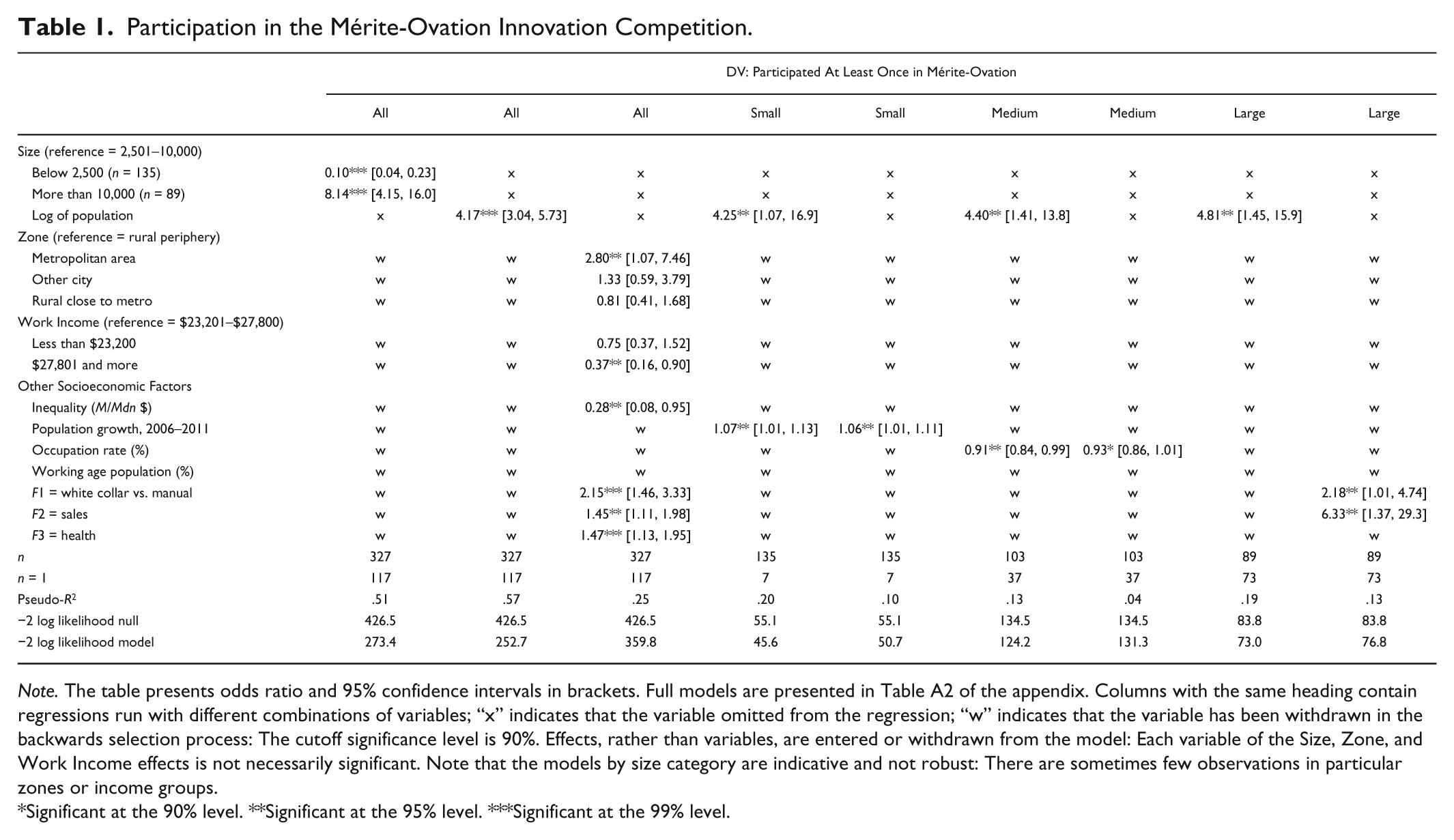
Note. The table presents odds ratio and 95% confidence intervals in brackets. Full models are presented in Table A2 of the appendix. Columns with the same heading contain regressions run with different combinations of variables; “x” indicates that the variable omitted from the regression; “w” indicates that the variable has been withdrawn in the backwards selection process: The cutoff significance level is 90%. Effects, rather than variables, are entered or withdrawn from the model: Each variable of the Size, Zone, and Work Income effects is not necessarily significant. Note that the models by size category are indicative and not robust: There are sometimes few observations in particular zones or income groups.
Significant at the 90% level. **Significant at the 95% level. ***Significant at the 99% level.
Prizewinners Among Participating Municipalities, and Factors Associated with High Participations Rates.

Note. See Table 1. Full models are presented in Table A3 of the appendix.
Significant at the 90% level. **Significant at the 95% level. ***Significant at the 99% level.
In Table 1, three sets of regressions are presented. 8 The first three columns, headed “All,” correspond to all 327 municipalities, whereas the columns headed “Small,” “Medium,” and “Large” gather, respectively, municipalities of less than 2,500, 2,501 to 10,000, and more than 10,000 people.
The effect of population size is overwhelming. Whether introduced as three size classes or as a continuous variable, size overrides almost all other explanatory factors: Larger municipalities have a higher propensity to participate. This provides insight into the Tiebout hypothesis (or, for geographers, the effect of context and metropolitan location) as it relates to everyday municipal innovation: There is no evidence that municipalities in competitive metropolitan contexts are more innovative. It is those with more internal resources—larger municipal apparatuses due to size, not to per capita resources—that participate in the innovation competition.
If size is excluded, insight is gained into factors that contribute to the size effect. Municipalities in a metropolitan context appear to be more innovative: This means that direct observation will corroborate the Tiebout hypothesis, while actually reflecting the larger size of metropolitan municipalities. It is municipalities with medium levels of income and lower levels of inequality that are more innovative. Finally, the population’s occupational profile is also associated with innovation: Municipalities with more white-collar workers (and fewer manual workers), more sales workers, and more health and social service workers are more innovative. However, it is important to bear in mind that these associations are all mediated by size: Size, a proxy for internal resources, is the key factor in understanding municipal innovative behavior.
Conclusions are similar if the sample is broken down by size category; although when size is dropped, few socioeconomic factors emerge. Thus, it is variation of socioeconomic factors across municipal size categories (and not within them) that contributes to the effect of size on innovation. The only differences with the full-sample results concern small municipalities—innovative behavior is associated with faster growth—and medium-sized municipalities—innovative behavior is associated with lower occupation rates.
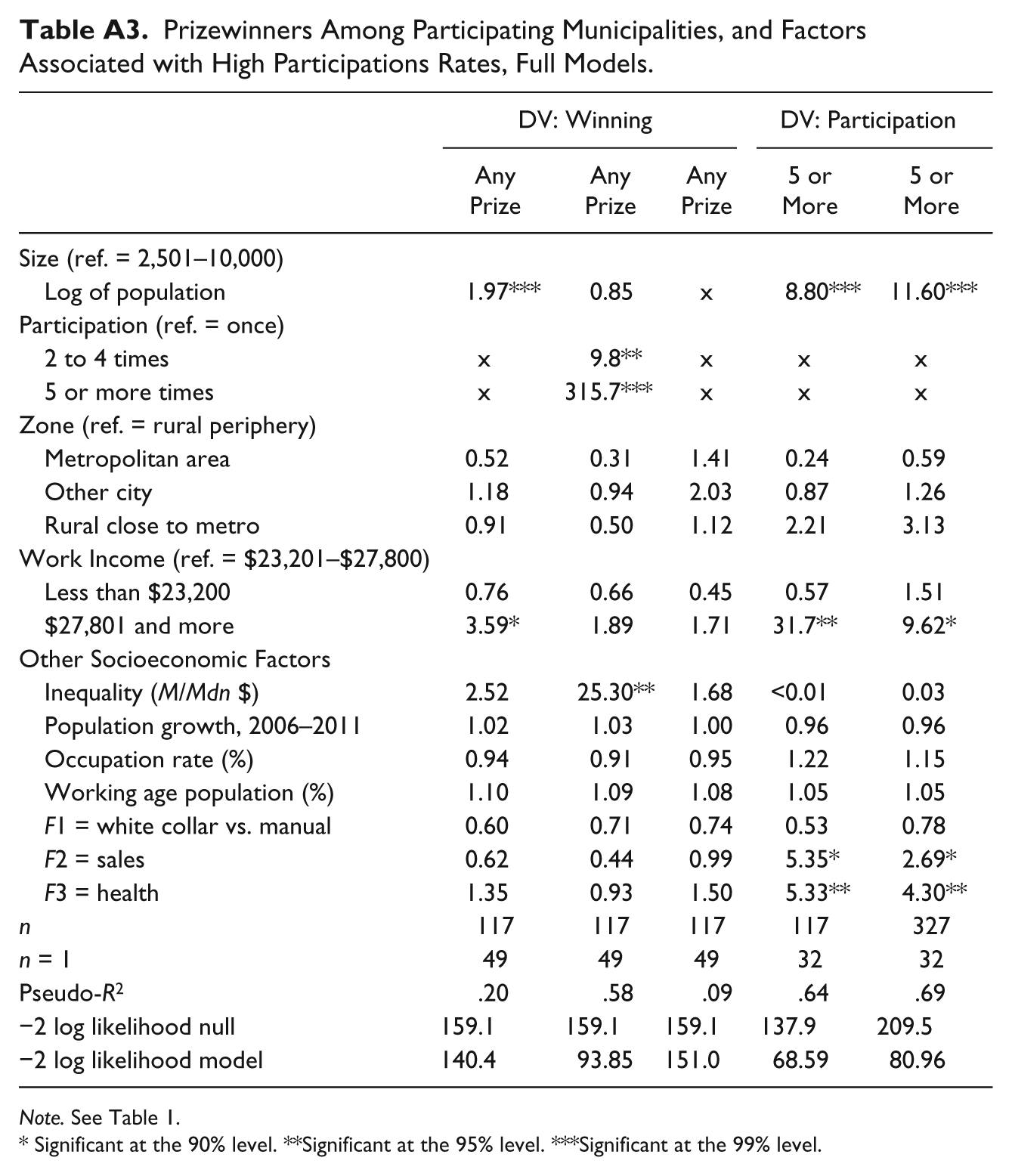
In Table 2, an almost identical model is used to explore which municipalities, among the 117 participants, have won a prize. The difference is the inclusion of a variable measuring the number of times a municipality has participated: Municipalities that participate more are, mechanically, more likely to win. This variable overwhelms the effect of size: It is, therefore, not municipalities with the most resources that win, nor those close to a metropolitan area, but simply those that have participated most, in particular five times or more.
What explains that a municipality has participated five times or more? The last two columns of Table 2 reveal that whereas larger municipalities participate more, other factors also explain this. Municipalities with lower internal inequality—accompanied perhaps by higher levels of overall income (see Table A3 of the appendix)—participate more often, as do those with higher occupation rates and with higher proportions of health and social service professionals. This suggests that somewhat better-off, socially cohesive, and service-oriented municipalities participate more, and this holds true whether the 117 participants or the entire population of 327 municipalities are analyzed. All municipalities that have participated five times or more have won at least one prize.
A final question, therefore, concerns the sequence of events: Does a learning process occur? As municipalities participate in the innovation competition, they may create networks, observe other winners, and learn how to present their projects: As learning progresses, the chances of winning may improve. An alternative explanation is that no learning occurs, and that these results reflect a random process—The chances of success increase the more submissions one has made.
Table 3 presents, for each of the nine years (2006–2014) and in total, the proportion of prizewinners with at least one prior participation (which we call experience). The year 2005 is excluded because, by definition, no municipality had experience that year. The table also accounts for the fact that each year, some municipalities present multiple entries.
Experience, Multiple Submissions, and Winning a Prize in the Year of Submission, 2006 to 2014.
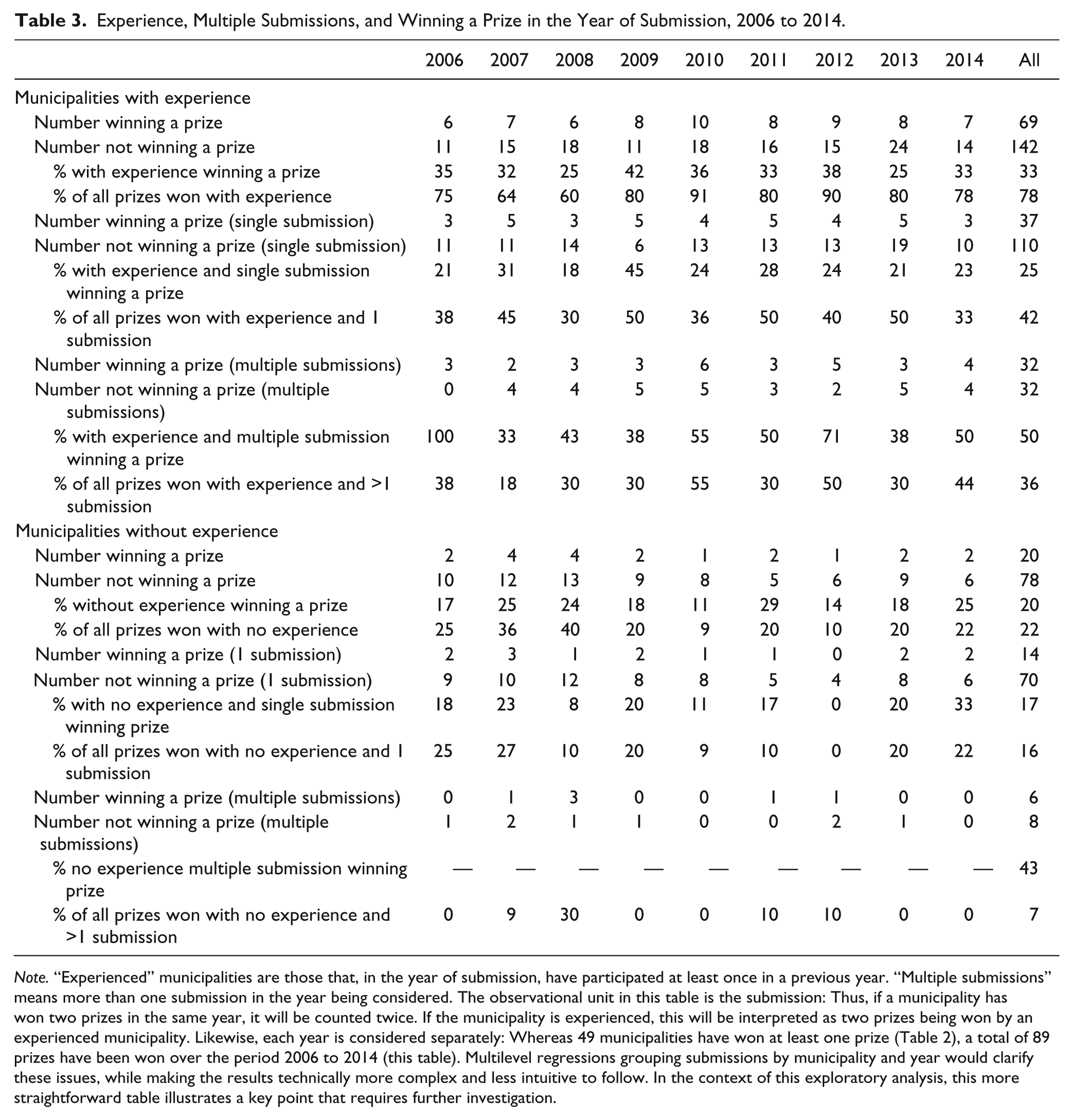
Note. “Experienced” municipalities are those that, in the year of submission, have participated at least once in a previous year. “Multiple submissions” means more than one submission in the year being considered. The observational unit in this table is the submission: Thus, if a municipality has won two prizes in the same year, it will be counted twice. If the municipality is experienced, this will be interpreted as two prizes being won by an experienced municipality. Likewise, each year is considered separately: Whereas 49 municipalities have won at least one prize (Table 2), a total of 89 prizes have been won over the period 2006 to 2014 (this table). Multilevel regressions grouping submissions by municipality and year would clarify these issues, while making the results technically more complex and less intuitive to follow. In the context of this exploratory analysis, this more straightforward table illustrates a key point that requires further investigation.
Overall, 78% of all prizes are won by municipalities with experience (of which 36% also made multiple submissions in the year that a prize was won). Only 7% of prizes are won by inexperienced municipalities making multiple submissions, whereas 42% of prizes are won by experienced municipalities making just one submission. Thus, it is primarily municipalities with experience (as opposed to those submitting multiple projects in any single year) that win a prize. Conversely, only 22% of prizes have been won by a municipality with no experience, and 16% by inexperienced municipalities making just one submission.
Having experience increases the probability that a municipality wins a prize from 20% to 33%, whereas submitting multiple innovations increases the probability from 22% to 49%. There are, however, fewer instances 9 of multiple submissions (78 over the nine-year period) than of experienced participants (211): Many municipalities participate in multiple years, and tend to win after failing at least once. Of the smaller number of municipalities with the capacity to make multiple submissions in a given year, a larger proportion tends to win a prize.
Both experience (which reflects a learning process) and multiple submissions (which could be a purely mechanical effect) are associated with winning a prize. There is no discernible trend over the nine years: The effect of experience and multiple submissions remains stable. These results suggest a way to further this investigation. They also contribute to its principal purpose—to establish the nature of everyday municipal innovation, and to illustrate how it can be apprehended using tools and concepts developed by economic geographers to study innovation in SMEs.
Discussion
The purpose of this article is to explore whether certain types of municipal innovation, which we call everyday innovation, can usefully be apprehended from the perspective of entrepreneurial SMEs as developed in the management and geography literatures. The rationale is that municipalities, unlike many other public administrations, are numerous, small, relatively independent, and anchored in geographic locations. Furthermore, municipalities, particularly those in dense metropolitan areas, are often understood to be competing with one another to attract population and economic activity (Tiebout 1956). Indeed, it is because municipal entrepreneurship is often directed at development and at creating competitive advantage for local economic interests (Evans 2009) that it has been criticized as contributing to the neoliberalization of local government (Hankins 2015; Harvey 1989; Merrifield 2014a). From another perspective, the concept of municipal competitiveness has been questioned partly because it is unclear who is defining the terms of competition (Shearmur 2008), and partly because there is conflicting empirical evidence about whether intermunicipal dynamics (migration in particular) conform to the competitive framework described by Tiebout (Banzhaf and Walsh 2008; Howell-Moroney 2008; Hoyt 1990).
However, markets and competition are not necessarily key factors driving everyday municipal innovation. In their role as territorial managers responsible for dealing with local problems (such as potholes, snow clearing, or bored teenagers) and local demand (such as requests for access to libraries, the need for sustainability), local administrations undertake innovation in an entrepreneurial fashion. The problems and/or demands that instigate innovation are not identified through market mechanisms but through local politics, interactions with civil society, and within departments or by employees who are dealing, on a day-to-day basis, with municipal services. Most innovations presented at Mérite-Ovation are the result of individual or team initiatives within municipal departments, as described by Marsden et al. (2011) in the context of city transport policy innovations, 10 not of action by political entrepreneurs as described by Leyden and Link (2015); Woodward, Ellig, and Burns (1994); and Schneider and Teske (1992). Although municipal politics is important, and no doubt creates a climate conducive to initiatives by employees and departments (something not studied in this analysis but which future studies should consider), the type of innovation highlighted in this article is practical and often incremental, a type that has been little studied within a public-sector or municipal context. In many ways, it resembles the sort of innovation introduced by SMEs.
A key difference between SME innovation and everyday municipal innovation is the way innovative ideas are identified and innovations validated. Whereas private-sector Schumpeterian entrepreneurs will ultimately be sanctioned by markets, there is no straightforward sanction for municipal innovation. The type of innovation discussed in this article—while not immune from manipulation by economic and other interests—is principally aimed at improving the way services are delivered, solving practical problems associated with material aspects of municipal responsibility, or developing new services to address problems identified by the municipality or its employees. The negative and exploitative connotations of municipal and urban entrepreneurship that pervade some of the urban literature, while maybe justified on their own political-economy terms, rest upon a particular view of what entrepreneurship is: Entrepreneurship in a wide sense—the identification of problems and the finding and implementation of innovative solutions—is not inherently political or capitalist (Conill et al. 2012; Graham-Gibson 2013; Marsden et al. 2011), notwithstanding the way the term has often been interpreted (Merrifield 2014b).
Most everyday municipal innovation is inward looking. Its modest scale and incremental nature mean that success is usually judged by whether or not the problem is solved and by how the local population receives it. This is reflected by the fact that location within a competitive environment (in dense metropolitan areas) has no effect: It is principally internal capacity that determines whether innovation is undertaken. To the extent that external interaction plays a role, our evidence suggests that it is by way of learning processes, in particular the Mérite-Ovation competition itself. This result requires further exploration, but is in keeping with both the policy transfer literature (Marsden et al. 2011) and with work by economic geographers on learning processes and innovation (Bathelt 2011; Healy and Morgan 2012).
Conclusion
Municipal innovation, writ large, comes in different guises: It is not always an outward looking quest by local administrations for markets, for world firsts, for new technologies, or to attract outsiders, but can be an inward looking quest for problem solving and service provision that will be judged by local businesses, residents, and civil society. Walker (2006), in his analysis of innovation diffusion across English local governments, comes to a similar conclusion (though placing more emphasis on competition, probably because he analyzes large, upper-tier authorities): The most likely explanation for the adoption of innovation . . . is to be found in a broad definition of competition that includes not just competitive pressures from outside organizations but embraces user voice. (p. 330)
Urban theorists have developed powerful political-economic critiques of urban entrepreneurship: In doing so, they have appropriated the term, making it difficult to discuss the process of small-scale, people-oriented, and nonmarket innovation undertaken by cities and municipalities. It is only by reappropriating the concept of entrepreneurship that the neglected area of everyday municipal innovation can be discussed, and parallels (and differences) with SMEs drawn out. If this is done, future research in the area could focus on the way problems or demands are identified in municipalities, and on the way innovation is evaluated. Another area of future study—identified by Potts and Kastelle (2010)—would be to focus on the motivations and barriers, within municipal organizations, for innovative behavior by individuals or departments: We plan to conduct detailed case studies of some of the UMQ participants to gain insight into these questions, and into the learning processes that contribute to municipal innovation.
The empirical part of this study is exploratory. In particular, no information is available to investigate the effect that municipal political climate, work culture, or administrative organization has on the propensity for employees and departments to take initiatives, and on the likelihood that these initiatives be submitted to the Mérite-Ovation competition. The article’s key contributions are threefold. First, we conceptualize the notion of everyday municipal innovation and show that it is not necessarily market driven. Second, we draw parallels between the process of innovation in municipalities and that in SMEs, while also highlighting the differences. Finally, our exploratory empirical analysis of innovation in municipalities validates the parallels established with SMEs.
Footnotes
Appendix
Prizewinners Among Participating Municipalities, and Factors Associated with High Participations Rates, Full Models.
| DV: Winning |
DV: Participation |
||||
|---|---|---|---|---|---|
| Any Prize | Any Prize | Any Prize | 5 or More | 5 or More | |
| Size (ref. = 2,501–10,000) | |||||
| Log of population | 1.97*** | 0.85 | x | 8.80*** | 11.60*** |
| Participation (ref. = once) | |||||
| 2 to 4 times | x | 9.8** | x | x | x |
| 5 or more times | x | 315.7*** | x | x | x |
| Zone (ref. = rural periphery) | |||||
| Metropolitan area | 0.52 | 0.31 | 1.41 | 0.24 | 0.59 |
| Other city | 1.18 | 0.94 | 2.03 | 0.87 | 1.26 |
| Rural close to metro | 0.91 | 0.50 | 1.12 | 2.21 | 3.13 |
| Work Income (ref. = $23,201–$27,800) | |||||
| Less than $23,200 | 0.76 | 0.66 | 0.45 | 0.57 | 1.51 |
| $27,801 and more | 3.59* | 1.89 | 1.71 | 31.7** | 9.62* |
| Other Socioeconomic Factors | |||||
| Inequality (M/Mdn $) | 2.52 | 25.30** | 1.68 | <0.01 | 0.03 |
| Population growth, 2006–2011 | 1.02 | 1.03 | 1.00 | 0.96 | 0.96 |
| Occupation rate (%) | 0.94 | 0.91 | 0.95 | 1.22 | 1.15 |
| Working age population (%) | 1.10 | 1.09 | 1.08 | 1.05 | 1.05 |
| F1 = white collar vs. manual | 0.60 | 0.71 | 0.74 | 0.53 | 0.78 |
| F2 = sales | 0.62 | 0.44 | 0.99 | 5.35* | 2.69* |
| F3 = health | 1.35 | 0.93 | 1.50 | 5.33** | 4.30** |
| n | 117 | 117 | 117 | 117 | 327 |
| n = 1 | 49 | 49 | 49 | 32 | 32 |
| Pseudo-R2 | .20 | .58 | .09 | .64 | .69 |
| −2 log likelihood null | 159.1 | 159.1 | 159.1 | 137.9 | 209.5 |
| −2 log likelihood model | 140.4 | 93.85 | 151.0 | 68.59 | 80.96 |
Note. See Table 1.
Significant at the 90% level. **Significant at the 95% level. ***Significant at the 99% level.
Acknowledgements
We would like to thank Gérard Beaudet for suggesting that the Union des Municipalités du Québec (UMQ) competition should be studied, the UMQ for providing information, for openly discussing the competition with us, and for allowing us to shadow the jury, and three anonymous reviewers for helping us refine our arguments and analysis.
Authors’ Note
We remain solely responsible for the contents of the article.
Declaration of Conflicting Interests
The author(s) declared no potential conflicts of interest with respect to the research, authorship, and/or publication of this article.
Funding
The author(s) received no financial support for the research, authorship, and/or publication of this article.