



Abstract
Using data collected in seven local Russian communities in 2011–2015, we discovered several kinds of relationships between legislative and executive branches of local government. In most cases, the executive branches clearly dominate over the legislative ones. The ratio of resources and the politics of federal and regional authorities allow us to consider this pattern of relationship as a norm, while other types of relationships are exceptions. Configurations of power resources and instruments of influence used to exercise control over the legislative bodies significantly vary and provide different variations of local government interactions: “domination based on coercion,” “bargaining from the position of strength,” “domination based on persuasion,” “domination under confrontation.” Alternative forms of relationships (“quasi-domination of local legislature,” “temporary parity under confrontation,” “alliance in the face of ‘external threat’”) occur when the executive bodies are headed by inadequate and/or inexperienced leaders unable to realize the high power potential of their position. This reflects the important role of personalism and the relative weakness of the institutional framework in Russia’s urban politics.
Introduction. Why Is the Interaction Between Legislative and Executive Bodies the Central Arena of Local Politics in Modern Russia?
Relationships between representative and executive bodies in local Russian communities are crucial for understanding both the machinery of local government and the entire political process at the subregional level. This is not just because they represent the two major legitimate public institutions responsible for the order and development of local communities but that their major role in local politics is embedded in history, traditions, structural, and institutional features of Russian society and its political system.
The public sector in Russia has traditionally dominated over the private sector both before the Bolshevik Revolution of 1917 and under the Communist regime. Its dominance continues nowadays with the construction of the “power vertical” 1 and the expansion of the state under Putin.
Explanations of the special role of public institutions in Russia vary from references to “historical experience,” “cultural matrix,” and “path dependence” preventing the formation of the civil society and the relative parity of public and private sectors, to explications of bureaucratic domination as the outcome of intentional efforts of the ruling elite (Gaman-Golutvina 2006; Krishtanovskaya 2005; Ledyaev 2008; Makarenko 2013, 2015; Oleinik 2010; Pivovarov 2014). Public-sector actors dominate not only on the federal level but also in urban decision making. In a particular sense, local politicians and public officials in Russia are even more influential than their counterparts in Europe whose role in local politics is, in turn, higher than in America where business actors often play leading roles (Harding 1999, pp. 673–98; Ledyaev 2012, pp. 393–417; Mossberger and Stoker 2001, pp. 810–35).
The political significance of the interactions between the local executive and legislative bodies is enhanced by the low power potential of parties, political organizations, and pressure groups in modern Russia. Strong authoritarian tendencies and weakness of the civil society significantly narrow the configuration of actors able to influence urban decision making. The politics of the ruling elite (especially after the events in Ukraine) is aimed at further limiting opportunities for autonomous citizens’ organization and political participation. Therefore, with the exception of the leadership of the local government, very few people (actors) have considerable power resources, namely, big business, management of the city-forming enterprises, criminal forces, and representatives of the regional and federal levels. But, quite often, they are not actively involved in the local political process. Thus, legislative and executive bodies are the most stable elements in the power structures of local Russian communities.
There is also a clear sociological dimension of the relationships between the executive and legislative branches of the local government in that they represent different strata of the local community and reflect social conflict. Local legislative bodies are often used by businessmen as a means of providing favorable conditions for their business (Sakayeva 2014, pp. 152–61), and vice versa: local councils, as we shall see later, oppose local administrations to further the interests of certain business groups.
Finally, over recent decades, there have been numerous attempts to reconfigure the local political space through the institutional reform and innovations in the local government system. The new local government legislation (2003, 2015) and the introduction of city-manager as a head of the local executive have significantly changed the institutional landscape and operational environment of the two major local public structures, thereby actualizing the question about the direction and dynamics of their interaction.
Interest in this issue within the Russian social sciences has come to the fore only in the last two decades. For obvious reasons, until the 1990s, there were no real opportunities to study power in Russia (Union of Soviet Socialist Republics; USSR). The nature of the relationship between the two branches of local government under the conditions of (post)totalitarian institutions and the power monopoly of the CPSU 2 was quite evident: the key role was played by the local party committees, who strictly followed the directives of the higher party authorities and, in fact, performed both legislative and executive functions while the power potential of both branches of the local government was strictly limited.
The situation substantially changed after the collapse of the Soviet Union. The 1993 Constitution mandated the institutional separation of local government from the state; abolition of the CPSU and the party control made local legislative and executive bodies de facto the major public institutions on the local level. From the very beginning, the executive institutions played the leading role in this tandem; mayors (heads of local administrations) elected by the public became the most powerful figures in local politics.
The role of local executive institutions has increased under Putin who initiated a policy of recentralization that implies the transformation of local government in the lowest link in the administrative pyramid known as the “executive power vertical” (Gel’man and Lankina 2008; Reddaway and Orttung 2004–2005). This approach was the basis for a new federal law on local government (2003), which obliged the regional authorities to form new institutional structures. The law offers three options for organizing the system of local government. 3 The main difference between them lies in (1) the status of the head of the local administration (he can be the elected head of the municipality or a municipal employee working on the contract) and (2) the presence or absence of the public election of the head of the town.
Although the formal selection of the model is the prerogative of local government, the Kremlin clearly prefers the model where the executive branch is headed by the city-manager. Inclusion of the city-manager in the political and administrative framework of the urban community was intended to promote a conflict-free coexistence of local and regional authorities and achieve a balance of interests between them. By being able to put into place their own city-manager, regional authorities insured themselves from uncertainty. Despite resistance in a number of municipalities, the process of implementation of this model has become “a steady trend, a particular plan orchestrated on the federal level and with all speed implemented by the heads of regions” (Vidrin 2010, pp. 67–68). In February 2015, amendments to the Federal Law N 131 introduced the possibility to elect the local head of the municipality by the deputies from the candidates selected by a special commission, which is also the head of the administration. This creates institutional bases for further consolidation of power at the municipal level.
Thus, over the past two decades, an actual research field with a clear subject of study has been formed. However, the topic is still poorly studied. In contrast to Europe and especially America, where the study of power and regimes in local communities has become one of the most advanced branches in social sciences (Harding 2009), Russian cities and towns are still waiting for political scientists and sociologists. During the past two decades, Russian scholars were actively involved in the study of power at the regional level (Chirikova 2010; Gel’man and Ryzhenkov 2011; Gel’man, Ryzhenkov, and Brie 2000; Lapina 1998; Lapina and Chirikova 1999; Oleinik 2010), and very few research projects directly studied power in urban communities (Gel’man et al. 2002; Ledyaev, Chirikova, and Seltser 2014; Mokhov 2012; Panov 2008; Podvintsev 2007; Ryabova and Vitkovskaya 2011; Seltser 2006; Tev 2006). Works especially focused on the relationships between the local executive and legislative bodies are virtually absent. Our study has been designed to fill this gap.
The key question that we will try to answer in this article relates to the phenomenon of stable domination of the local executive over the legislature. Specifically, we want to address several aspects. What factors determine the variability in the nature and forms of this domination? What elements account for the nontypical relationship in exceptional cases? What is the role of personality in these relationships? Why in some communities are they relatively symmetrical or even openly rival? The answers to these questions concern a number of controversial issues related to the consequences of the municipal reforms, the role of regional and federal authorities in local politics, and the degree and prospects of relative autonomy of local actors in the context of a general strengthening of authoritarian tendencies in Russian politics.
Relationships Between the Local Executive and Legislative Bodies: Key Features
Formally, the two branches of local government are equal and independent of each other. This is intended to represent various interests on the local level and prevent the concentration of power in the hands of one person and/or organization. However, local actors (like actors of regional and federal levels) have natural aspirations for leadership and power as it can increase their capacity to govern and implement social and/or corporate interests. Power (influence, control, domination) is usually the most effective tool for achieving the objectives of actors; therefore, formal institutional constraints often do not work while local political practice reflects the real inequalities between local government bodies.
The nature of interaction between the main local government institutions is diverse. International experience shows that the form of local government in a particular country may be described by its proximity to or distance from one of four ideal types: (1) the strong mayor form: the elected mayor overshadows the local council and is in full charge of all executive functions, while the appointed chief administrative officer (city-manager) oversees the administrative structure and serves at the mayor’s will (France, Spain, Italy); (2) the committee-leader form: one person is clearly “the political leader” of the municipality, with or without the title of mayor, but executive powers are shared with the elected heads of standing committees composed of elected politicians as well as with the city-manager (Denmark, Sweden, the United Kingdom before reforms starting in 2000); (3) cabinet/collective form: the decision center is one collegiate body consisting of a mayor and department heads; it controls all the executive functions and empowers the city-manager who tends to have moderate influence (the Netherlands, Belgium); and (4) the council-manager form: all executive functions are in the hands of a professional administrator, the city-manager, who is appointed by the council (Ireland, Norway, Finland). In reality, relationships between the main actors have a lot of nuances (Ejersbo and Svara 2012, pp. 157–59; Mouritzen and Svara 2002).
The Russian experience is less diverse. As mentioned above, throughout the history of Russia, the executives prevailed over the legislatures at all levels—federal, regional, and local. Heads of local administrations (usually) were able to influence the selection of local deputies and arrange the mode of relationships with them. However, there are significant differences in the relationship between the executive and legislative branches of the local government. The most important of them are as follows:
Who Dominates?
Usually the executive bodies are much more influential than legislative ones. However, other variations are possible. This was confirmed by our study.
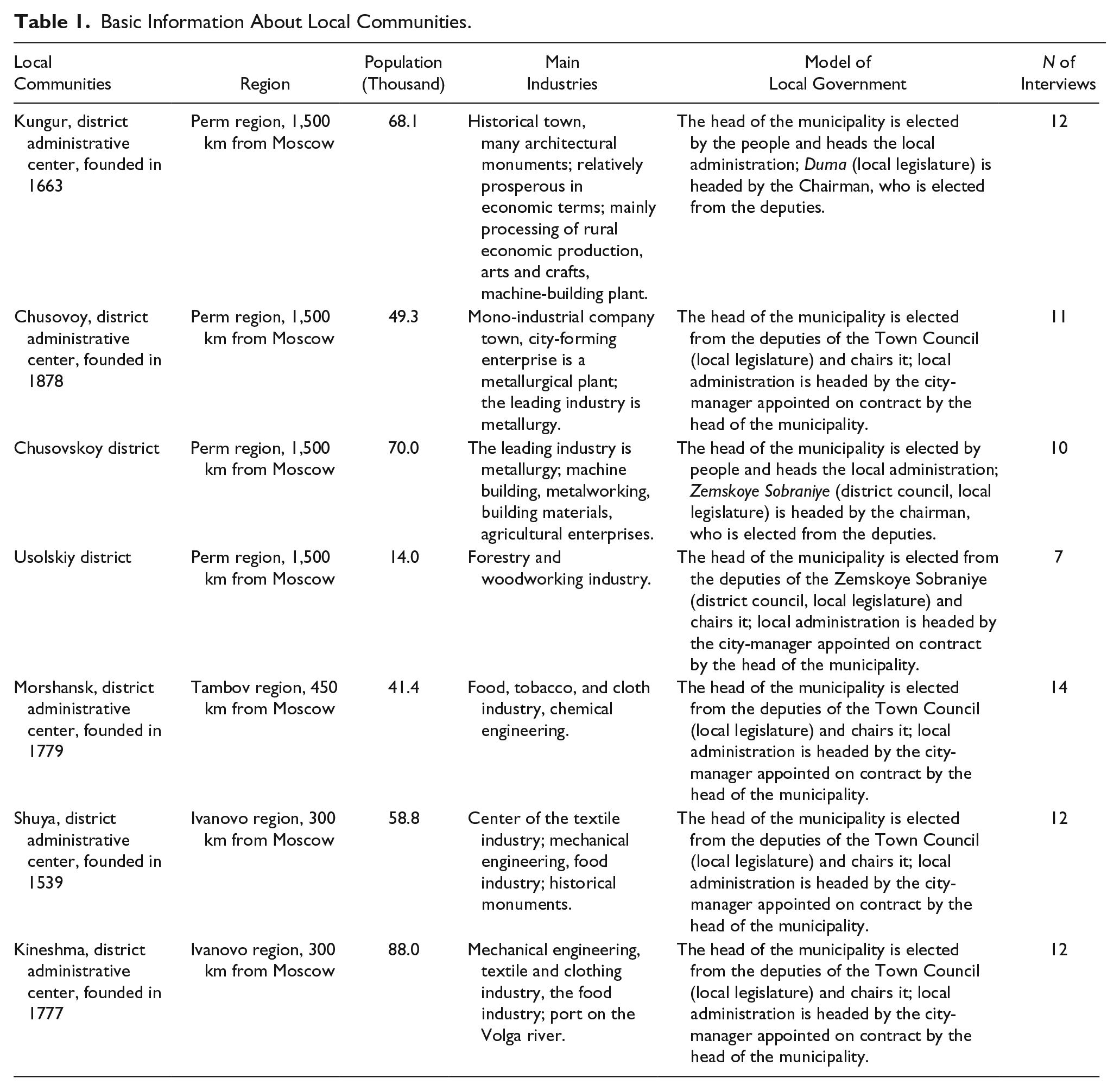
As both branches of municipal government are complex hierarchical organizations run by real people, their relationships to each other are built through personal communications. The executive power is usually represented either by city-managers (they headed five out of seven administrations of local communities chosen for our study), or heads of administrations elected by people. Local legislature (“Duma,” “Council,” or “Zemskoye Sobraniye”; see Table 1) traditionally acts as a subordinate, although, as we shall see, the influential head of the local council (but not the deputy corps as such) in some situations can lead the administration. Therefore, the analysis of relationships between branches of the local government is often discussed in terms of interpersonal interactions between their top influentials.
Basic Information About Local Communities.
Asymmetry and Balance in Power Relations
We accept the traditional (mainstream) concept of power as the ability of the power holder to impose his will on the subject (Hearn 2012, pp. 3–39; Ledyaev 1997, pp. 87–105; Lukes 2005; Scott 2001, pp. 1–16). In our study, the main actors constituting a power dyad are local legislatures and executive structures as such and/or their leaders. The power holder and the subject of power have different potentials for affecting each other. The degree of asymmetry and balance in power relations reflects this difference and can vary from cases of obvious (open) domination without any perceptible resistance from the part of the subject to the absence of domination and relative equilibrium.
Presence/Absence of Conflict and Its Nature
Both relative symmetry and domination of one of the parties are linked to the degree of conflict/consensus of interests between the parties and its manifestation. Domination can take both the form of open confrontation and external (observable) consensus of the parties. However, in the last case, the suppressed conflict may take place when one of the parties (usually the legislature) has no resources to resist and does not even try to change the situation, anticipating defeat and demonstrating loyalty and cooperation.
Bases of Power (Domination)
The nature of the relationship between the executive and representative bodies of local government is largely determined by a set of resources that are available to the parties and may be used for their positioning in relations with each other. Power has many forms from brute force and open coercion to “soft” techniques of influence and manipulations not recognized by the subject of power.
To explain the nature of the relationships between the two branches of the local government, we used the following concepts characterizing the forms of power:
In coercive power, the source of a subject’s compliance to the power holder’s command is a threat of negative sanctions for the refusal to comply. Coercion can be exercised both in an open and a hidden (invisible) manner; in the latter case, it often takes the form of the “rule of anticipated reactions” when the subject of power acts in accordance with a power holder’s will in fear of the repercussions for doing otherwise (Friedrich 1937, pp. 16–18).
Inducement is based on the ability of the power holder to provide the subject of power with the goods and services he needs; it is exercised in the process of bargaining between the parties in which one party (the power holder) achieves benefits in relations with the other (the subject of power).
In persuasion, the source of the subject’s submission lies in the rationale of arguments possessed by the power holder; the subject has the choice of accepting a power holder’s arguments, which is not restricted by positive or negative sanctions from the power holder.
Manipulation as a form of power is based on the power holder’s ability to exercise covert influence on the subject; it may exist without explicit commands or even in cases where the subject is unaware of the very existence of the power holder. In political practice, persuasion usually goes hand in hand with manipulation as these forms of power are congruent.
Legitimate authority is a power relation in which the power holder possesses an acknowledged right to command and the power subject an acknowledged obligation to obey. The source, rather than the content of any particular command, endows it with legitimacy and induces compliances on the part of the subject (for detailed analysis of power forms, see Ledyaev 1997, pp. 183–99; Wrong 2002, pp. 21–54).
In real political practice, the actors usually use combinations of resources and techniques. However, their configurations significantly vary: In some communities, overt and/or covert coercion were the predominant forms of power while persuasion, manipulation, and inducement played a more substantial role in the other communities.
Presence/Absence and the Role of External Forces
Relationships between the branches of local government take place in a particular context, which largely depends on the regional and federal actors involved in local politics. We discovered various forms of influence of regional authorities on the local political processes—from actual indifference and noninterference—to direct interventions and replacement of undesirable political figures.
These characteristics help to describe and explain the executive/legislature interactions in the communities we studied and structure the outcomes of the research.
Data and Method
The comparable-cases method, according to Arend Lijphart, leads “to no more than partial generalizations of universal scope and validity” due to the small number of cases. However, it “may be useful as a first step, and may be followed up by replications in different settings” (Lijphart 1975, p. 172). It helps to outline the problems, formulate hypotheses, adjust the tools, highlight the difficulties of research, and formulate preliminary conclusions. We understand that we cannot offer a more or less complete typology of patterns of relations between the branches of local government, because it requires research in a large number of local communities, as John Walton, Terry Clark, Clair Gilbert, and other scholars involved in the study of power in local communities did (Clark 1968; Gilbert 1968; Walton 1966). But this is just the first step that prepares the ground for possible large-scale (representative) research.
The basic material was obtained in the course of 88 in-depth face-to-face interviews with local politicians, public officials, businessmen, and local and regional experts in seven local communities in three different Russian regions. In our view, interviews with the direct participants in local politics can provide the most complete information about government practices, relations between actors, and mechanisms of interaction, which are usually hidden from the outside observer and cannot be obtained from other sources. Of course, we understand that participants’ evaluations are subjective. But we tried to neutralize the subjectivity of information by using special techniques to increase its reliability: using a system of provoking questions designed to recheck the information, establishing special emotional contact with the respondents, reducing their self-control, talking about politics as about the daily activities, and so on. Interviewees were the heads of legislative and executive bodies and their deputies (20), members of local legislatures (16), officials and officers of the executive and legislative branches of local government (16), heads of the local press and television (7), heads of industrial enterprises and entrepreneurs (15), leaders and activists of the local party and civil organizations (7), and experts (7).
To conduct the study, we chose seven local communities—five small towns and two administrative districts in Perm, Ivanovo, and Tambov regions. We deliberately selected these three regions. The Perm region (“Permskiy Krai”) is a developed industrial center, indicators of its economic and social development are above the average in Russia. Ivanovo and Tambov regions (“Ivanovskaya oblast” and “Tambovskaya oblast”) are typical medium-weak regions from an economic and financial point of view. All the communities are heavily dependent on regional and federal transfers, and this is typical for small Russian towns. Most communities are of comparable size (40,000–88,000 citizens, except Usolskiy district, which has 14,000 citizens); just one of them is a mono-industrial company town with a city-forming enterprise while others are quite typical from the economic point of view (see Table 1). All the towns are “old,” that is, they have a fairly long history and certain traditions; as towns, they were formed in the sixteenth to eighteenth centuries—long before the Bolshevik Revolution of 1917. In five out of seven communities (Chusovskoy and Usolskiy districts (Perm region); Shuya, Kineshma (Ivanovo region); Morshansk (Tambov region)), the executive branches were headed by city-managers while in the two other communities (Kungur and Chusovoy district (Perm region)), they were elected by citizens.
We deliberately opted for slightly atypical cases. As a result, we have chosen four typical small Russian towns (Kungur, Shuya, Kineshma, and Morshansk) and three quite specific local communities. We have chosen four local communities from one (Perm) region as this area is relatively more open to researchers in comparison with others; it is very important for obtaining high-quality information. The selection of a mono-industrial company town (Chusovoy) was driven by the desire to identify the role played by the city-forming enterprise in the interactions between the main branches of the local government. The choice of the two districts (not towns) as a subject of study reflects our desire to compare the two intersecting (town and district) systems of local government. In Russia, local government has a rather complex structure: Regions (provinces) are divided into districts (“rayons”) in which there are towns. Formally, the district administration is “higher” than the town administration, although there is no clear subordination between them. Finally, the choice of Usolskiy district as the subject of study with a relatively small population (even by the standards of a small town) was based on the received information about the atypical nature of relationships between the branches of local government, which seemed important to us to describe and analyze.
Outcomes of Study
The presentation and analysis of empirical cases consists of three sections. In the first section, we consider the most typical cases (Shuya, Kungur, Morshansk, and Chusovskoy district), where the executive branch dominated over the representative one. In the second section, we examine the case of Chusovoy, where the most influential actor in the local community represented the local council. The final section presents the situations where the apparent dominance of one of the parties has not been found (Kineshma, Usolskiy district).
Domination of the Executive Body over the Legislative One: A Typical Practice in Russian Local Communities?
In most cases, as we expected, the executive bodies dominate over the legislative ones: Their relative equilibrium in Kineshma and Usolskiy district was temporary while the top position of the head of the local council in Chusovoy was based mainly on his previous experience as a long-time leader of the executive body. According to our respondents, both experts and local officials, the dependence of the local representative institutions on the executive bodies is growing. “Today, the heads of administrations actually control the heads of towns (heads of local councils—V.L. and A.Ch.
Although, in all the communities, the power actors use roughly the same set of resources and instruments of influence, their configurations and accents significantly vary in that relationships between the parties are largely determined by the degree of asymmetry and the nature of conflict between them. Therefore, the nature and sources of the leading role of the executive structures in the local political system have both similarities and differences that allow us to distinguish several different variations within the traditional pattern of interaction between executive and legislative bodies. We denoted them as “domination based on coercion,” “bargaining from the position of strength,” “domination based on persuasion,” and “domination under confrontation.”
Shuya: Domination based on coercion
By our estimations, domination of the executive body over the legislative one in Shuya is the most evident in comparison with the other communities. The city-manager (in this case, the head of the town’s administration) controlled both the mayor (head of the town) and the deputies. Striking asymmetry in favor of the executive led to the absence of open conflict between the parties and a high degree of manageability of the local council.
“Strong city-manager versus weak head of town”—this configuration of the main public actors has been largely predetermined by the institutional advantages (biases) of the city-manager’s position. The city-manager of Shuya also possessed a solid set of personal resources (leadership skills, extensive professional experience, motivation, knowledge, and expertise, especially in the field of finance), had strong links with the representatives of the regional elite, and quite successfully provided external financing of the town. Her father was a well-known politician at the federal level.
The unquestionable leadership of the city-manager in the political space of the town has been recognized not only by our respondents and experts but also by the city-manager herself. The phrase from the interview with her is rather indicative: “Maybe I seem immodest, but now I am the most influential figure in the town . . . and I do not see anyone close to me. I think that power must be strong.”
On the contrary, the deputy corps is not in fact self-sustained; it is largely dependent on the leadership of the executive and has poor potential to determine the vector of local politics. This is primarily a consequence of the effective control of the administrative elite over the local representative institutions—legislature, party structures, and social organizations. Typical (not only for Shuya) domination of the “United Russia” party
4
in the local councils is the main channel for implementation of strategy and tactics of the executive. The former mayor of Shuya notes,
Today, all the branches of United Russia in the region are de facto controlled by the heads of administrations. Therefore, it is natural that they run all the representative bodies. United Russia has absolute majority in all the municipalities.
The strategy of the local administrative elite to form the optimal (for itself) composition of the Duma is largely based on the idea of deputies’ dependence on the executive body in promoting their everyday personal and corporate interests. This assumes that the deputy corps should consist of people who need support of the executive structures and tend to be loyal, conformist, and do what is required of them even at the expense of public interests.
The “obedient majority” in Shuya primarily consists of deputies-businessmen who use their status to protect business in the absence of the rule of law. State and municipal employees feel a natural concern for their jobs as they are well aware of what happens to those who dare to conflict with those in power: “Municipal employees can be removed from their positions without any explanation . . . there were dismissals of those who opposed the administration . . . and now they are nowhere,” notes one of our interviewees. Representatives of the local ethnic communities are also loyal to the administration as the deputy mandate enhances their status and prestige within the community.
Asymmetry and explicit resource inequality usually determine the nature and form of power. In this case, open and (more often) hidden coercion play an important role in the relationships between the parties. The ability to realize the threat of negative sanctions against the deputies in cases of disobedience largely determines the power potential of the city-manager in Shuya. Usually, the threats are not directly articulated but implied; thus, power is exercised in the form of “the rule of anticipated reactions.” Our respondents explain this in terms of “bureaucratic delays,” “information blockade,” “non-decisions in cases of disobedience,” and so on.
The city-manager tried to persuade us that she does not resort to direct pressure on the deputies: “I never press on deputies . . . I have a good head [of the town] who works directly with them.” She argues that the compliance of deputies is the outcome of the “established relations with them” and their “willingness to support her policy”:
I do not need any unlawful decisions . . . If I offer particular decisions, it means that they are vital . . . I have established relations with all the deputies, often informal . . . So I have no problems with this Duma. I just call the deputies and ask them to support. That’s it.
But no one doubts that the “established relations” rely heavily on the deputies’ adequate perception of their dependence on the executive body. A quotation from the interview is quite indicative: “Sometimes I come to the Duma hall to listen. The secretaries confess to me: ‘It is always so quiet when you come. And no one disputes!’”
In our opinion, the situation in Shuya completely fits into the overall plan of the local government reformers aimed at the actual inclusion of the local institutions (formally independent from the state) into the “power vertical.” This was demonstrated by the events that took place right after the study. Although the situation in the town and the very policy of the municipal elite in Shuya did not give any particular grounds for concern, the regional authorities decided to replace the city-manager. The reason was rather cynical: she was not loyal enough to the regional administration. “I can’t afford such a luxury—to have the head of the local administration, who does not respect the regional authorities. Moreover, I can’t accept this because it’s a big risk,” explained the regional vice-governor.
Thus, the role of the external factor in Shuya at some point has become decisive: The regional authorities not only got rid of the “opposition” but actually reconfigured the local political space in general and the relationship between the branches of the local government in particular.
Kungur: Bargaining from the position of strength
The situation in Kungur is somewhat different from Shuya. Domination of the head of the executive (who is the head of the town) over the local council is also unquestionable. However, the degree of asymmetry is less explicit and, thus, the “rule of anticipated reactions” is less efficient than in Shuya. Therefore, the head of the executive in Kungur has to be more active to build stable relations with the deputies.
Along with coercion, the main instruments of his power were inducement and bargaining. This configuration of power forms allows us to designate the relations between the local governmental bodies in Kungur “bargaining from the position of strength.” This pattern appears quite typical as coercion and inducement are congruent and complementary forms of power (Baldwin 1978, pp. 1229–42): When material incentives are supported by threats, hidden and/or open, the power can be effective and stable. The case of Kungur confirms it.
This combination of power forms corresponds to both resources available to the head of the executive and his personal abilities and skills. He never goes to an open confrontation with the Duma: “I have very special relationships with the Duma; they cannot be explained in terms of pressure. Rather, it is a compromise.” If his proposal diverges with the position of the deputies, he either refuses to advance the controversial decision or postpones its adoption: “I postpone the issue until it matures. I consult with the commissions and working groups, work individually with the deputies, look for the sources of disagreement, ready to compromise.”
This is confirmed by other respondents. The former mayor of the town argues that he “works with the Duma very carefully. He brings to the discussion only those decisions that are necessary and will be supported.” A former deputy chairman of the Duma continues:
He uses different methods to influence the deputies. He can put pressure on them, negotiate individually, bargain, and make concessions . . . As a former member of the Duma, he is well aware that a deputy may not always help but can always create troubles . . . What does he do? He bargains with them.
Of course, hidden coercion also takes place but to a lesser extent than in Shuya. “Deputies have no reason to quarrel with the head of the town. They are scared of being more actively involved in financing social programs,” one of the Duma deputies explains. However, both sides have pressure resources (although not equal) that make them go for bargaining and compromise: “The head can’t have other relations with the deputies than bargaining. But he always has a stick in reserve and can eventually use it,” notes one of the interviewees.
Owing to the effective policy of the head of the executive toward the deputies, the Duma appears submissive. The majority of the deputies are ready to support him: “The head has a ‘controlling stake’ in the Duma—10 to 12 deputies,” explains one of the deputies. This “controlling stake” did not arise by itself but was organized: “There is no secret in the fact that the head of the town was actively involved in the formation of the candidates list. He had a special team which controlled the process. Everything was done in advance.”
As a result, the open conflict between the head of the executive and the Duma is reduced to a minimum: He is patient and flexible, and the Duma does not dare to confront him.
The situation in Kungur shows that the stable dominant position of the local executive in the executive/legislature relationships is not an automatic consequence of the inequality of resources but, to a large extent, is the outcome of efficient politics. Another evident conclusion is that serious preliminary preparations are necessary to have a guaranteed base of support in the Duma. Despite the apparent ease of management of the Duma, effective bargaining and compromising with the deputies is a problem, so it is necessary to have a “safety cushion” in the form of a particular number of absolutely loyal deputies.
“Bargaining from the position of strength” seems to be quite a natural pattern of relationships between the executive and the representative bodies of local government, especially in those communities where the top executives have not enough resources or intention to achieve total domination over the local legislature.
Morshansk: Domination based on persuasion
Domination of the executive represented by the city-manager (head of the town administration) 5 in Morshansk is based mainly on a set of “soft” (noncoercive) resources of power and influence. Persuasion as a form of power plays a very important role in the town; therefore, the relationships between the branches of the local government look like a partnership in that they are more trustful and less conflictual than in Kungur. 6
This is largely due to the personal characteristics of the community leaders and the nature of their communication. The city-manager has extensive professional experience as he has been running the town administration for more than 10 years. Before that, he was a chairman of the town council, so he knows all the nuances and specifics of the legislature, its capabilities, and limitations.
This vast experience is not the only basis of the city-manager’s authority. Our respondents emphasize his high intellectual potential, ability to foresee the consequences of decisions, personal charm, and effective communication skills: The city-manager “is a really good negotiator. There is no compulsion on his part. He is an unusual man, a visionary; he does not use authoritarian methods,” notes one of the deputies with extensive experience.
Almost all the informants are very positive about the policy of the city-manager, including his leading opponent in the town council, the deputy head of the town: “We have a smart head of administration who can count seven moves ahead . . . He foresees the outcomes of his decisions. I highly appreciate and respect him. He is our real leader.”
Effective communication and partnership relations between the branches of the local government are supported by clear procedures of discussion and preparation of the problematic issues; all of them are thoroughly studied by the council committees. They are not necessarily resolved in favor of the city-manager but usually he is able to persuade the deputies to support his initiatives. For this, he often uses “face to face talks” and “time-outs” (postponement of meetings) that help to increase the time available to discuss controversial issues. It allows him to avoid sharp conflicts and gives a possibility for both sides to use rational arguments. During the time-outs and talks, there is no “arm-twisting” of those who disagree. “In most cases, the head is able to convince us. And we don’t want to create trouble for him,” notes our respondent.
Successful collaboration of the two branches of the local government would hardly be possible without strong personal ties between the city-manager and the chairman of the town council: They worked together in Komsomol 7 and in the town council where the current head of the council was a deputy head.
The head of the town council is a man of the city-manager. They worked together in the League, were deputies, supported each other. He initiated her appointment to the post of the chairman of the council. I think that in private, she can say a lot to the city-manager . . . But they always seek consensus,
notes the former deputy mayor, current chief of the public reception office in Morshansk.
We have an excellent chairman of the town council . . . She knows how to reach compromise, how to persuade people. The head of the council and the head of the administration [city-manager] often dispute, but only in private and they reach the common point of view,
explains the deputy head of the town administration.
Certainly, the bases of power in Morshansk, as in other communities, are not limited by “soft” forms as hidden coercion also contributes to the obedience of the deputies. About a half of them are state and municipal employees who are not inclined to be in conflict with the administrative elite.
There are issues where the head of the administration has a lot of power and his eloquence is not required . . . for example, tariffs . . . Doctors and teachers are dependent on the administration, and they are not always able to express their opinion,
explains the deputy chairman of the town council. Many of the deputies are protégés of the executive. “To select the desired city-manager the town council should be composed of people whom the head of the administration trusts and who trust the head of the administration,” argues the former deputy mayor.
Finally, a significant role in building the partnership between the branches of power, both direct and indirect, is played by the prosecutor’s office. The participation of the prosecutors in the town council meetings ensures the legality of decisions and blocks (actual and/or potential) corrupt deals: “The head of the town and the head of the administration do not take risks,” explains an experienced deputy.
Thus, the case of Morshansk shows that domination of the executive body over the legislative one can be based mainly on “soft” resources. But its practical implementations largely depend on a set of necessary preconditions, including the presence of adequate leaders, loyal deputies, and effective external control to maintain the rules of the game.
Chusovskoy district: Domination under confrontation
As in previous cases, the executive in Chusovskoy district dominates over the district council (“Zemskoye Sobraniye”). However, their relationships are more symmetrical than in the previous communities and include elements of open conflict.
The specifics of the political process in the district are characterized by two factors. First, the most influential figure in the district executive is not the head of the administration, but his deputy. The formal head of the local administration had poor leadership skills, actually lost power and authority within his team, and became dependent on it.
Second, in contrast to other cases, the legislature in Chusovskoy district was composed of two groups with practically equal numbers and resources—“plant” 8 and “district,” reflecting the key political division in the local community. Therefore, the asymmetry in the relationship between the main actors of the public sector and the dependence of the legislative body on the executive one in Chusovskoy district was not obvious as in the other communities.
Zemskoye Sobraniye in Chusovskoy district consists of 21 deputies. Of those, 10 clearly identify themselves with the plant, the others with the district authorities. To achieve the minimum majority of the “district” faction over the “plant” faction, the district administration promised one of the plant deputies a position of the head of the district council in exchange for loyalty. Thereby, the administration got a stable majority in the district assembly, which was able to overcome the resistance of the opposition. 9
To what extent is the local council opposed to the executive body? According to the deputy head of the district administration (the de facto leader of the administration), its oppositional impact is “a bit exaggerated” although the serious opposition of the plant really exists. A dependent position of the council’s chair, and the numerical superiority in the local council allow the head of the district administration to resolve the issues in his interests. However, the district council “pretends to be a real local actor in a local politics” while “the town council [in Chusovoy] is not a real actor at all.”
The dominant position of the executive body is supported by the traditional agenda of the district council focused mainly on the social issues: It is difficult for the deputies to oppose the head of the district administration in this area of local policy making. The head of the district administration notes,
Our activities lie primarily in the social sphere, that is, education, health, youth, and public safety. If the decision fails, I do not negotiate face to face. I just say to deputies: “When you raise your hands, don’t forget about those who elected you.”
However, the confrontation of the two groups in the council, partly open, partly covert, continues as it reflects the major political conflict in the political stratum and the community in general. Both sides—the district administrative elite and the deputies representing the plant—pretend to be “masters” in the community and dominate in the assembly. Declared efforts to achieve unity just soften the continuing confrontation that specifies the character of the relationships between the branches of government in Chusovskoy district and motivates all of them to pay special attention to the “cadre policy” to have a comfortable balance of “us” and “them” in the local legislature.
In the situation of a stable confrontation, it is really difficult to control the local representative body because the strategy of having “our protégé in the right place” requires sustained efforts and resources. From this point of view, politics in Chusovskoy district really matters, maybe more than in the previous communities.
The Head of the Legislative Body Is More Influential than the City-Manager: Exception to the Rule?
Chusovoy: Quasi-domination of local council
Chusovoy was the only local community where the most influential figure represented the local council. Therefore, the relationships between the branches of the local government differed from the previous cases.
We called them “quasi-domination of local council over the executive body.” Why quasi-domination? Because the role and the power potential of the local deputies, and the Duma in general, did not differ from what we have observed in other communities: They remained the subjects of power rather than the power holders. The executive branch was in fact controlled by the head of the Duma (but not by the Duma itself) who actually concentrated the major power resources of the executive body and ran both public institutions. Therefore, we cannot explain the situation as a case of a collective power of the Duma where all the individual actors make a real contribution to the subordination of the subject (Ledyaev 1997, pp. 201–10).
This nonstandard situation became possible as before the introduction of the position of the city-manager, the current head of the Duma was the mayor who combined both representative and executive positions and retained a large set of power resources (control over financial flows, close ties with the regional executive bodies, major role in making strategic decisions in the community, etc.) after the institutional reform. The appointed city-manager made no effort to change the situation. Without a serious political and administrative experience, he was actually dependent on the head of the Duma and had to coordinate his actions with him. He did not interfere in the work of the Duma and was not able to influence its decisions, giving all the reins of power to the head of the town.
“I have no ‘my’ people yet, I have to create my team,” is how the city-manager explains the situation. His subordinates were selected by the current leader of the Duma. They are still loyal to him, being thankful for the promotion and understanding who is still the real owner in the town.
Local elites are well aware of the real power hierarchy in Chusovoy.
Today, the head of the town [head of the Duma], according to law 131, is like a British queen. He has no power; power is in the hands of the head of the administration. However, in our town, and possibly not only in our town, the head of the administration [city-manager] obeys the head of the town,
notes one of the heads of the local television station. The director of the city-forming enterprise (possibly the most influential figure in Chusovoy) has many channels to influence the situation in the community but prefers to deal directly with the head of the town and does not perceive the Duma as an important political institution.
Thus, on one hand, the role of the city-manager in Chusovoy is in fact performed by the head of the Duma, thereby sustaining a nonstandard local power structure. On the other hand, all other typical local practices are retained.
Like other leaders in local communities, he tries to use all the opportunities and resources available to him. In our view, the specifics of the situation in Chusovoy are characterized by the widespread use of manipulation as a form of power. The political influence of the head of the Duma with the “expanded” (at the expense of the city-manager) powers relies on a strategy aimed at forming deputies’ (false) belief that they are involved in the solution of important issues, constitute an influential team, and are happy to act together. One of the interviewees notes,
He uses a subtle method of influencing the deputies. He says something like “Guys, there was no such team before!” The chief is a cunning politician able to direct the deputies and carry on a conversation in the desired direction. Some newspapers try to present the deputies as “puppets,” but he never does!
Elements of the “third dimension of power” (Lukes 1974, 2005) 10 help to create a relatively positive self-image of the deputies and thereby reduce the level of their opposition. When the head of the town needs to make an unpopular decision, he acts very carefully. He never initiates decisions that may cause protests of the deputies; rather, he postpones such decisions and returns to them only when people (and deputies) have become “accustomed” to them. Although the head of the town successfully presents his relationships with the deputies as conflict-free (which is largely the result of a successful manipulation), some conflicts and problems occur that compel him to use the elements of bargaining and coercion. But the latter are used flexibly, gently, and are congruent to manipulative techniques.
The situation in Chusovoy convincingly demonstrates a special role of the personal factor in Russian politics; it shows how experience, knowledge of people, faith in the power of persuasion, and importance of moral arguments often play a decisive role in local politics. 11 However, the leadership of the head of the local legislature (not the head of the executive) is, in our opinion, the exception rather than the rule: Power resources related to the position of the head of the executive substantially exceed the resources related to the position of the head of the representative body.
Temporarily, No One Dominates: How Is It Possible?
In the two final cases, Kineshma and Usolskiy district, we do not explain the situation in terms of domination of one branch of the local government over the other as for a considerable time, there has been a relative parity (balance of power) between them. In Kineshma, leaders of the executive body actively but unsuccessfully tried to make the local council “docile” while in the Usolskiy district, the two branches rallied in the face of the “external threat” (regional authorities). Both cases eventually ended in the “victory” of the new executive elites but the previous period was long enough to deserve a separate description and explanation.
Kineshma: Temporary parity under confrontation
For almost one and a half years, there has been a confrontation between the Duma and the town administration. This conflict within the urban political and administrative elite, on one hand, had a very strong personal component because all the respondents somehow linked the conflict with the personality of the chairman of the Duma, her manners, methods, lack of flexibility, and uncompromising stance. On the other hand, these personal squabbles, to a certain extent, reflect the conflict of social interests, which cannot be explained in terms of the internal affairs of local rulers. Unlike Chusovskoy district, where despite the opposition, the executive body dominated over the legislative one, in Kineshma, the local administration failed to establish control over the Duma without external interference. Finally, although the situation in Kineshma looks diametrically opposed to Shuya, where the absence of open conflict and the highest degree of asymmetry between the branches of local government have been observed, in both cases, the external factor played a decisive role in restoring the traditional domination of the executive body over the legislative one.
The sources and causes of the open confrontation between the parties are quite obvious. First, frequent changes of leadership in the executive branch (four different heads in three years) significantly weakened its position in relationships with the Duma; temporary, random figures without solid personal resources were not able to build adequate relationships with the deputies. Eventually, the chairman of the Duma who initially was ready to cooperate became able to resist the commands of the executive and even “started a counterattack.” However, she was well aware that the potential power resources of the two local governmental institutions were not comparable: “It would be naive to expect that power of the deputies will appear automatically, they should ‘strive for influence,’ but they are not always able and willing. Therefore, the administration is always stronger.”
Second, in contrast with other local councils, the Duma in Kineshma “was not properly selected” and included “wrong people.” Therefore, a solid faction of Communists and tensions in the faction of the United Russia did not allow the latter to have a stable majority. “We are talking about the ‘ungovernability of the Duma’ . . . we had to recruit people with firm convictions who never deviate from the course. But this didn’t happen. They have pushed in the Duma such people to calm everyone,” comments the press secretary of the Duma.
Finally, the main catalyst for the conflict was the nomination of the “woman from the factory” (as many respondents call her) for the leadership position in the Duma. The initial plan was to put a person into this position who would not create problems for the city-manager. This fits perfectly into the logic of integration of the local government in the “power vertical” where the main role was supposed to be played by the appointed city-manager. “Local authorities found a completely unprepared person and made her the head of the Duma. It’s not her fault, it’s her trouble. They wanted her not to interfere in the work of the city-manager,” explains the former mayor of Kineshma.
Initially, the scheme worked, but at some point started to falter mainly due to the overpowering nature of the head of the Duma. The attitudes of our respondents to this shift and their evaluations of the situation were quite different. Some of them had mostly negative connotations, 12 others considered her as an honest and principled politician, a “warrior,” and a “fighter against corruption.” 13
It seems that both sides are partly right. Even those who perceive her as a fighter against selfish aspirations of officials and businessmen admit that she made a lot of serious mistakes
14
while her straightforwardness led to strategic and tactical losses. In contrast, the analysis of the content of the conflicts shows that the head of the Duma really tried to resist granting certain preferences to businessmen affiliated with the administration. In the interview, she “complained” about constant lobbying of business interests at the expense of the urban community:
Conflicts within the elite are primarily concerned with the intersection of business and local government interests. In the small town, everybody knows each other . . . And they begin asking for help . . . But I always reply: “How can it help the town?” On this basis, I had clashes with the administration.
15
Therefore, we generally agree with one of our respondents, who believe that “the team of the former head of the administration clearly defended the interests of business, while she defended the interests of people.” He is sure that her “tough policy” was predetermined by the situation in the town, the high level of corruption, and the impossibility to compromise with those who were involved in the corrupt practices:
. . . blatant corruption in the administration. There was much talk about this in the town . . . Who and how much money brings to the administration . . . the cars and houses of the officials. She could negotiate with them but she did not want to do that.
However, sooner or later, the confrontation should have ended. When the new city-manager tried to smooth the conflict, aid came from the vice-governor (responsible for domestic policy) who was concerned about the situation in Kineshma:
The former head of the town [head of the Duma] can hardly be called a politician. We had to make the executive body in Kineshma much more effective. As soon as we nominated a sane city-manager, we began to solve the problem with the head of the town as the main irritant . . . We sent her to the regional assembly with honor and respect. We don’t need any scandals in the Duma or in the town.
It seems to us that such an end of the confrontation in Kineshma is quite natural as the conflict cannot be permanent at least because it does not suit regional authorities who are able to reconfigure any local patterns of power. Another conclusion is that the confrontation between the branches of local government becomes real only in cases with the weak and/or nonauthoritative city-manager; otherwise, the “rebellion” will be quickly suppressed.
Finally, even if the head of the town is really struggling with corruption in the administration, this does not mean that she will be necessarily supported by the local deputies as there are always people in the legislative body who protect the interests of the administration and business people affiliated with it. It is unlikely that they will always be in a minority, especially if the leaders of local councils make serious mistakes, thereby undermining their authority and credibility.
Usolskiy district: Alliance in the face of “external threat.”
Temporary parity between the two branches of local government has also been observed in Usolskiy district, but this is the only similarity between it and the Kineshma case. What distinguishes the Usolskiy situation is that for a certain period of time, there were no serious conflicts and no apparent asymmetry between the executive and the legislative bodies; the conflict with the regional authorities and the quarrels within the local political and administrative elite were suspended or moved to the background.
But this period only lasted for approximately three months. Before and after that, the relationships between the branches of local government were quite traditional. For a long period of time, the executive branch dominated over the legislative one; it was led by an experienced and highly influential head of the district administration who has built a stable power structure in the district with the local officials and deputies forming a single team.
The situation changed somewhat after he retired. Under the new relatively young and inexperienced city-manager (his protégé), the relationships between the local governmental bodies became more symmetrical. But, in general, the balance of power was quite typical.
The period under discussion started with the conflict over the “salt project” (mining and transportation of salt). The new city-manager was strongly against the project because it could lead to serious environmental problems (this was the conclusion of experts). 16 However, the project lobbied an influential company, which had close ties with powerful federal officials. The project was also publicly supported by the representative of the president in the region. Therefore, the district administration has decided to get the support of the population and began an active propaganda campaign to prepare and conduct a referendum on this issue.
However, the referendum did not take place because it was in fact banned by the regional authorities. 17 At the regional meeting of local politicians and public officials with the representative of the president, the district city-manager was harshly reprimanded and asked to leave his post. Regional authorities took the side of the company and the representative of the president and after that consistently opposed the city-manager (although prior to the meeting, they had verbally supported him).
This moment was the most significant in terms of demonstrating the reaction of both branches of the local government in Usolskiy district to external interference. Despite very strong pressure from above, district legislature twice refused to remove the city-manager from office. In this situation, both the deputies and the district officials acted as a team.
However, the end of the story was quite traditional: at the third attempt, the unwanted district city-manager was withdrawn.
How was this disobedience possible? Why did members of the district assembly, who were accustomed to voting “correctly,” suddenly rebel? Whom did they defend? The disgraced head of the district? Their dignity? The right to express their own opinion and interests of the population?
Explanations of our informants differ significantly. The most natural explanation was that the district assembly voted against the dismissal because the deputies were “worked up” by the representatives of the executive body. “Zemskoye Sobraniye [the district council] simply does not understand this game . . . It was the deputy head of the district administration who ‘worked’ with the deputies,” notes the former head of the district administration. Other respondents also emphasized that an important role in uniting the regional administrative and political elite was played by the deputy head of the administration who actively supported her boss. From this perspective, one can say that the members of the assembly were strongly influenced by the administration. But we consider this explanation to be not quite sufficient.
Another popular explanation is that the major district politicians and public officials—the deputies, the chairman of the assembly, the district city-manager—regarded themselves as a team because they were “properly selected” by the former head of the district administration. “The deputies were elected as a part of the team . . . So the process of the dismissal they interpret as a destruction of the team,” explains the chairman of the district assembly.
Finally, the resistance of the district political elite to the commands of the regional authorities can be explained as a protest against the violation of the rules of the game. People were outraged by the fact that the regional officials decided not to take them into account and violated the rules of communication with a legitimate public institution. The deputies fought not so much for their city-manager (the respondents’ attitudes to the personality and professional qualities of the district city-manager were rather negative than positive), but against the tyranny of the higher level officials.
Although the “rebellion” was short-lived, the events in Usolskiy district prove conclusively that the municipal structures of power should not be ignored even if local actors are inadequate and the legislature looks submissive. Otherwise, loyalty may be replaced by disobedience.
The case of Usolskiy district demonstrates how certain events make significant changes in the relatively stable relationships between the branches of the local government. In Usolskiy district, they led to cohesion and a temporary reduction of asymmetry in response to the outside interference. However, the other consequences are also possible.
Finally, this case proves that the system of local (self)government in Russia is not actually a separate and independent structure of public authority, as stated in the Constitution. Although the control of state and federal agencies may occasionally give failures, sooner or later, the status quo is restored.
Discussion
Thus, the seven cases demonstrated quite different relationships between the two branches of local government. However, they prove the existence of a prevailing pattern of local intergovernmental relationships and possible variations that do not (entirely) fit into it.
The dominant position of the executive branch identified in Shuya, Kungur, Morshansk, and Chusovskoy district seems quite natural: The ratio of resources, the politics of the federal and regional authorities, and established traditions allow us to consider this type of relationship as a norm, while the other types of relationship discovered in Chusovoy, Kineshma, and Usolskiy district are exceptions.
The most important instruments of power and influence of the administrative elite are financial resources, stable contacts with the higher level authorities, the “administrative resource,” and the personal authority of its leaders. These resources provide a political, financial, and personal dependence of the local deputies on the executive officials and assign the legislative branch the place of a “junior partner” in the local government structure. The presence of a dominant pattern is confirmed by the fact that the unusual relationships between the branches of local government, established in Kineshma and Usolskiy region, eventually resulted in the restoration of quite traditional dominance of executive power.
Within the dominant pattern of the local intergovernmental relationship, we discovered quite significant differences between the cases. They, as expected, were due primarily to the degree of asymmetry of power and configuration of the resources and techniques obtained and used by the heads of local executives.
The degree of asymmetry largely determines whether the legislature may or may not be oppositional to the executive and what chances it has to play an active and independent role in local politics. It is determined by both structural (institutional) and personal factors, and it is not clear which of them is more important. The composition of the local legislature is very important: If it is “properly selected” by the local administration (alone or together with the regional authorities) and, therefore, dependent on it (Shuya, Kungur), there is a high probability that the legislature will not try to seriously change its subordinate position in relation with the executive.
If the asymmetry is significant and well recognized by both sides, the absence of open conflict between them seems to be quite natural, and domination can take place without visible efforts. In this case, the main forms of power are likely to be hidden coercion (“the rule of anticipated reactions”). This is the case in Shuya.
Open conflicts may occur in cases where the executive bodies are headed by inadequate leaders and the local councils get a chance to achieve a real autonomy. However, the periods of open conflict cannot last too long because in this case, the likelihood of intervention of the regional elites is very high. The latter have enough power to reconfigure unacceptable local practices.
If the asymmetry is not very significant, the leaders of the executive have to more actively use their resources. A set of these resources and forms of their application is approximately the same and include coercion, bargaining, persuasion, and manipulation. However, their configurations in different local communities differ; that gives specifics to the domination of the executives in the studied cases. The proposed formulations—“domination based on coercion” (Shuya), “bargaining from the position of strength” (Kungur), “domination based on persuasion” (Morshansk), and “domination under confrontation” (Chusovskoy district)—reflect these specifics. As we mentioned earlier, it is hardly possible to speak about a more or less complete typology of relations between the branches of local government. However, we can assume that they can be quite typical, as they reflect different levels of asymmetry in the relationship between local administrations and legislatures.
The study shows that the structural advantages of the local executives, reinforced by the active imposition of the city-manager model, do not automatically lead to their domination over the legislatures. This is primarily because the personal factor plays an especially important role in Russian politics. All three atypical cases demonstrate that departure from the traditional model takes place when the leadership of the executive branch has no proper experience, authority, and/or necessary personal qualities.
The results of our study (in the cases of Kineshma and especially of Usolskiy district) also suggest that the deviation from the traditional model may be caused by some events that dramatically alter the context and/or configuration of actors.
The situation in the Usolskiy district is rare in Russia as the strong authoritarian component of Russian politics, and the weakness of legal institutions, create serious risks to those who dare to resist the arbitrary rule. Nevertheless, in the case of deepening economic crisis and growing dissatisfaction with the rule of Putin’s elite, such excesses are not excluded.
For the same reasons, it seems unlikely that stable and really equal (symmetrical) relations between the branches of local government can take place, at least on a more or less significant scale. However, the partnership is quite possible, especially if it is backed up by a strong personal component with the presence of adequate leaders and deputies. This is evidenced by the situation in Morshansk.
Due to the strong personal component of Russian politics, the different institutional environment of local communities has not become a decisive factor in determining the differences of real power practices. In all types of local government organization, the relationships between the two branches can be both traditional (domination of the executive branch) and allow a wide spectrum of deviations from this model. This largely explains why the institutional reforms and innovations do not always provide the realization of the goals of the reformers because informal resources and practice are often much more important and effective than formal rules in determining the relationship between the key actors of local politics. Therefore, despite the efforts made by the Russian elite to unify the local power structure, variation in local political practices persists.
Conclusion
Thus, the differences between the local political systems in the nature and forms of domination of the executive over the legislature are caused by the degree of asymmetry of power and the configuration of resources available to the leaders of the executive. The latter, in turn, is largely dependent on personal factors and reflects the relative weakness of the institutional framework and the prevalence of informal practices in Russian politics. The atypical cases of interaction between the branches of local government may take place only in cases where the executive leaders have no sufficient personal resources and/or failed to fit adequately into the local power network. Other factors (population, regional specificity, main industries, etc.) had no significant impact on the nature of the local government interactions.
The active implementation of the model with a high power potential of city-manager and recent (2015) amendments to the municipal legislation give grounds to assume the strengthening of the main pattern of relationship between the branches of local government; this seems to reduce the likelihood of an alternative relationship between them. Therefore, we agree with those scholars who predict further concentration of local power in the hands of the appointed city-managers, who are supposed to become obedient puppets in the hands of the regional governors (Vidrin 2010, p. 73).
However, it would be wrong to assert that domination will be carried out automatically and have a unified form. Rather, it will take more sophisticated forms and remain, to a large extent, dependent on subjective factors.
The effects of this course can be ambiguous and quite dangerous as legislatures can lose the last resources of influence and become solely decorative public bodies without serious impact on community affairs.
In our opinion, alterations of this trend are possible either with the change of the political regime in the country, or as a consequence of the economic crisis, which is difficult to predict. However, even in the case of the first (authoritarian) scenario, local politics, albeit in a truncated kind, will matter and require careful examination.
Footnotes
Acknowledgements
We are grateful to the editors and anonymous referees for comments and valuable suggestions.
Declaration of Conflicting Interests
The author(s) declared no potential conflicts of interest with respect to the research, authorship, and/or publication of this article.
Funding
The author(s) disclosed receipt of the following financial support for the research, authorship, and/or publication of this article: The research project “Power in the local Russian community” has been supported by the Russian Humanitarian Science Foundation (Grant N 14-03-00151) and the Scientific Foundation of the National Research University Higher School of Economics, Moscow, Russia.