




Abstract
This article explores how variations in provincial-state and city-level political cultures influence urban economic trajectory by mediating forces emerging out of global economic demand and a uniform national regulatory regime. The research shows how an integrated urban governance framework designed to analyze and compare governance modes of advanced capitalist cities through a fixed set of criteria (e.g., governing relations, governing logic, key decision makers, and political objectives) could be recalibrated through inclusion of additional parameters (e.g., local political culture and scalar location of power) so as to expand its applicability to an emerging economy, such as India, having a large, mostly poor, rural population and a high degree of internal sociocultural diversity. Competition between India’s regional elites to attract global information technology (IT)-enabled “business process outsourcing” economy investments, through land-use conversion of farmlands at the outer periphery of the metropolitan regions, forms the backdrop of the research.
Keywords
Introduction
This article explores how variations in provincial-state and city-level political cultures influence urban economic trajectory by mediating forces emerging out of global economic demand and a uniform national regulatory regime.
Researchers over the past two decades had sought to theorize the growing phenomenon of entrepreneurial activism by city governments (especially by global cities in advanced industrialized countries) from various vantage points. Harvey (1989); Jessop, Brenner, and Jones (2008); and Macleod and Goodwin (1999), for instance, argued that emergence of entrepreneurialism in urban governance is directly linked to the wider process of globalization and state restructuring. Pressure of economic competition between the cities and decentralization of power by the national state triggered the city governments to scale up their operations in the economic domain to attract new investments and generate job opportunities.
Research by Pierre (2005), Silva and Syrett (2006), Ramsay (1996), and others emphasized understanding sociocultural context of the place, within which the key decision makers of the urban governance regime operate and which, in turn, influence their economic policies. Studies by Logan and Molotch (1987), Stone (1993), and Shatkin (2007, 2011) highlight the importance of understanding the roles of the key local actors, especially the informal coalition between powerful business and political interests, in adopting pro-business policies at the city level, albeit to suit their own vested interests.
DiGaetano and Strom (2003) synthesized the above viewpoints into an integrated framework for comparative analysis of the governance characteristics of the cities in the Global North. In the framework suggested by them, structural factors, such as globalization or state rescaling, provide the overarching environment, but the local political agents, informed by a place-specific cultural milieu, also play important roles in guiding local growth processes—at least in federal political systems. Thus, local sociopolitical dynamics, actor relationships, and embedded social settings are contextualized within the broader processes of state restructuring induced by global forces.
To understand the character of the governing regime, DiGaetano and Strom (2003) suggested a set of four criteria. First, there are “governing relations” or the mode of interaction between government officials and private business interests. Second, there is “governing logic” or the manner in which political decisions are made. Third, there is the question of who the “key decision makers” are—that is, the various combinations of politicians, bureaucrats, civil society activists, and so on that comprise the inner core of the governing coalition. Fourth, what are the “political objectives” behind decision making—including direct, tangible, and nontangible benefits for the political elites.
Based on these four criteria, DiGaetano and Strom (2003) identified five modes of urban governance: clientelistic, corporatist, managerial, pluralist, and populist. Corporatist governance mode is characterized by broad consensus between the state establishment, top bureaucrats, politicians, business leaders, and the civil society in establishing a growth oriented ecosystem to effectively compete at the global scale. In contrast, governing logic in the clientelistic mode involves direct reciprocity, and governing relations are shaped by patron-client relationships between the politicians and the business groups. The distinctive feature of the “managerial” mode is authoritarian decision making by political elites, and its implementation through bureaucratic machinery. The hallmark of the “pluralist” mode is conflict management and accommodation of diverse interests into a broad coalition. In contrast, in “populist” mode, mobilization of mass support takes precedence.
Although entrepreneurialism in urban governance has also become increasingly evident in the recent decades in the transitional economies of Asia (Chien 2008; Kennedy 2007), there is still a dearth of theoretically grounded frameworks to compare their governance modes. Ataöv and Eraydin (2011) adopted a framework, which like DiGaetano and Strom’s, took into consideration the structural aspects, actor relationships, and local context for their comparative analysis of the governance modes of two large metropolitan regions of Turkey. They brought out the importance of the local variables, place-specific political culture and networks, and flows between the key state and nonstate actors in shaping the form of the urban governance functioning under the structural and regulatory environment of the Turkish state.
Shatkin (2016) proposed an alternative framework (based on his research on land commoditization in the peri-urban areas of Jakarta, Chongquing, and Kolkata) that hinges on two crucial variables. The first is the government’s ability to exert direct control over land markets, most importantly, through direct state land ownership. The second is the autonomy of state land-use planning authorities from influence of the real estate lobby and other nonstate actors. Shatkin’s (2016) framework makes it possible to rank cities based on the degree of state control of the land market and autonomy of the planning agencies.
As this research would also show, changing peri-urban landscape due to emergence of new economic spaces tied to global capital is perhaps the most visible marker of shifting economic geography within the Asian cities in the contemporary era. For instance, the production spaces of the Indian information technology (IT) industry, business parks, and IT-centric special economic zones (SEZ) are almost entirely located in the fringe areas of the metropolitan regions, not in the central business district (CBD) areas.
However, this article would argue that the political economy of peri-urbanization, land-use conversion, and its real estate dynamics—at least in Indian cities—is intrinsically linked to the networks and flows, including caste ties, between the key political actors. To understand that, we need to enlarge the focus of our analytical lens over a wider spectrum, at the state level, as opposed to the urban-metropolitan scale. Moreover, to compare the urban governance mode of a big country, such as India, having wide internal diversity, we require additional parameters, such as “key decision makers” and their “political objectives,” for deeper understanding.
Under the circumstances, this research has adopted DiGaetano and Strom’s Integrated Urban Governance framework (henceforth, DS-IUG framework) as the analytic lens—for a comparative analysis of the development of the IT clusters in three competing urban regions, located in three corners of India, having contrasting socioeconomic and political culture. By testing the framework, which was originally designed for cities in the Global North, as the analytical tool, this research demonstrated how and in what way the parameters of the framework require to be recalibrated, so as to expand its applicability to India—an emerging economy with a large, mostly poor, rural population and a high degree of internal sociocultural diversity. This, in turn, opens up possibilities of undertaking similar research and customization (if necessary) of the framework in the context of other developing countries.
India is a good example to explore the local–global interface in urban transformation, as it is a major transitional economy, and India’s urban centers have been undergoing dynamic changes since the beginning of economic reforms in the early 1990s. The changing nature of urban India and the rise in middle-class consumerism have drawn much global attention in recent years. Despite these changes, India, however, continues to grapple with a high degree of poverty in the rural areas, where 70% of the people live. These developmental dichotomies are sharply etched in the Indian political systems and play out most vividly in the context of land-use change in the fringe areas of the big cities to accommodate the spatial demands of the IT outsourcing industry.
The IT services sector provides a useful lens to explore the governance dynamics of Indian cities. Restricting the focus to a common economic environment of IT services allows us to control many regulatory variables that creep into more generalized comparisons of urban governance. The Indian IT sector, which predominantly consists of software development, call centers, and other knowledge-intensive back-office services (rather than electronic hardware manufacturing) outsourced from the Global North, was export oriented from its very inception and is seen as a prime exemplar of the “new economy” in the Indian context. Moreover, the downstream multiplier impact of the IT sector, which accounts for 38% of the corporate real estate market, is the most significant economic stimulator of the metro cities (Jones Lang LaSalle 2015).
However, at the same time, it also remains an “enclave” economy (D’Costa 2011). The employment generated by the IT sector is less than 2% compared with India’s total workforce, and, on the whole, the contemporary IT-driven Indian economy exemplifies the exclusionary “jobless growth” syndrome (Kundu 2011). Moreover, emergence of IT business parks, gated residential townships, and shopping malls at the outer periphery of Indian cities, beside the old rural habitats, has created a fragmented landscape filled with tensions and contradictions at multiple scales between people of contrasting lifestyle—the new urban middle class tied to the global information economy and the existing rural population tied to the local bazaar economies.
Looking through the DS-IUG framework, this article characterized governance modes of three metropolitan regions—Bangalore, Kolkata, and the Delhi National Capital Region (NCR) area with the help of the parameters under the DS-IUG framework. Because the IT clusters in the Delhi NCR belt are located across the administrative boundaries of three different states, this research focused on Gurgaon, the biggest and the most advanced IT cluster in that region. Research shows that the dominant characteristic of the governance mode in Bangalore is “corporatist” although there are strong undercurrents of “clientelistic” mode as well. In Gurgaon-NCR, it is “clientelistic.” In Kolkata, the “populist” mode predominates, but for brief periods, “managerial” and “pluralist” streaks could also be deciphered.
This research would suggest the inclusion of two additional parameters of “scaler location of power” and “political culture” in the DS-IUG framework. Understanding about shifts in scaler location of power, due to state restructuring, is especially important in unpacking the Indian political dynamics. Structural reforms since the early 1990s, including devolution of the national government’s regulatory power over industrial location, have substantially strengthened the role of the state governments in the economic domain. But reluctance of the state governments has come in the way of devolving urban planning functions to elected municipal governments—despite efforts of the national government (see Shivaramakrishnan 2011). Land-use planning activities are controlled by the state governments, through urban development authorities. Thus, the locus of power over urban economic policies rests at the state government level, not with the elected municipal governments. Competition between the cities that we see in India are, in effect, fought by the state chief ministers, not by the city mayors.
Consequently, state-specific “political culture,” and particularly its rural–urban dynamics, plays an important role in shaping the “governing logic” of the key decision makers. As in all major states, the rural areas hold considerable power in electoral terms, decisions over conversion of agricultural land into urban usage are often calibrated through negotiation between rural and urban interests, the composition of the governing coalitions, and the power relationships. Leveraging their power over the planning process, the key political actors may either facilitate or resist land-use changes for development of production and consumption spaces associated with the new economy.
The rest of the article is organized as follows. The next section provides a literature review about the role of urban governance in economic development. The section “Policy Environment for India’s IT Service Industry” provides an overview of the Indian IT services sector. The sections “Case Study I: Bangalore (Karnataka) IT Cluster,” “Case Study II: NCR IT Cluster,” and “Case Study III: Kolkata (West Bengal)” contain case studies of Bangalore, Gurgaon-NCR, and Kolkata. The section “Governance Modes and Planning Cultures of the Regional IT Clusters” synthesizes the case study findings and then maps the variations in regional political cultures with the help of the DS-IUG framework to understand the specificities of local processes shaping the regime characteristics. The section “Toward an Amended Framework” takes up the broad theoretical implications arising out of the research by interrogating the DS-IUG framework and then suggests certain amendments to it. The last section concludes the discussion.
Economic Entrepreneurialism and Forms of Governance
Harvey’s (1989) research about the entrepreneurial turn in urban governance in the cities of the Global North to attract investments in a competitive global era opened new lines of enquiry about the role of urban governments in shaping economic development. Goodwin and Painter (1996), Macleod and Goodwin (1999), and Brenner (2004) claim that the emergence of this entrepreneurial form of urban governance is a corollary to the wider process of state restructuring. Devolution of power from the national state has flowed down the spatial scale to strengthen the role of the city governments.
However, developmental pathways of the territorially competing regions, even under broadly similar market-driven economic environments, do not follow any set pattern. Brenner and Theodore (2002, p. 344) attribute this to institutional path dependencies, and observed, “the effects of neoliberalism must necessarily be understood in contextually specific ways: they hinge upon the path dependent interaction of neoliberal programs, with inherited institutional and social landscapes.” This emphasis on institutional path dependencies is, however, unable to account for differences among regions that operate under similar institutional environments (Ataöv and Eraydin 2011; DiGaetano and Strom 2003).
Moreover, institutional structures undergo changes, which in several instances emerge out of political compulsions of the governing elites over time, rather than due to external economic environment (Pemberton and Searle 2012). Such subversion of institutional norms and practices to suit partisan interests of those in power are especially common in many developing countries with weaker institutional legacies. Thus, the institutional framework by itself is inadequate as a basis for assessing economic trajectories.
Drawing on examples from the industrializing countries of Asia where historically the state has played a more direct role in steering growth than in the liberal market economies of the West, Leftwich attributes developmental outcomes to the political will of the influential actors to implement the policy, rather than the policy itself (Leftwich 2010). According to Leftwich (1995), the defining characteristics of these successful “developmental states” are the existence of a determined and powerful local “developmental” elite, close ties between private capital and state bureaucracy, a powerful and relatively autonomous economic bureaucracy, and a pliant civil society. The developmental elites are not static or monolithic entities, but rather a shifting coalition of diverse interests. While the structural configuration of the developmental coalitions ranges from institutionalized and formal to tacit and informal, they all tend to share a broad consensus on political goals and economic strategies. Politically motivated developmental strategies, crafted by these coalitions of state and nonstate elites, are, thus, central to understanding variations in economic development, rather than just the formal institutional rules of the game (Leftwich 2010). In this conceptualization, members of the elite coalitions are rational actors, whose shared economic agendas are essentially shaped by the political calculus. Motivated self-interest is the glue that binds the coalition together.
At the urban scale, coalitions between local politicians and business interests have for a long time been a feature of the city politics in the United States and have been studied under the rubrics of the “growth machine” (Logan and Molotch 1987) or “regime” theory (Stone 1993). Regime theory seeks to explain close synergies that exist between municipal (city hall) level politicians and local business interests (e.g., real estate, construction, retail, entertainment) and circumstances that almost inevitably necessitate their working in tandem (Stone 1993, 2004). They work closely through formal and informal channels to perpetuate governance arrangements in such a way as to prevent taxes, legislation, or any other hindrances from coming in the way of business profitability, in spite of “official” political change. Irrespective of the party in power, the “growth machine” of the local economy rolls on through the nexus between political and business interests that give short shrift to environmental and social concerns.
However, the rootedness of these theories in the American urban political context, centering on traditions of official contributions from local business toward electoral campaign financing, and the ideological similarity of the two major political parties, which leads to the formation of such coalitions or patronage networks, makes it difficult to apply the theories to other countries (Davies 2003; Pierre 2005). Nevertheless, partnerships and coalitions between political and business interests in a broader sense have become the dominant paradigm in contemporary economic development strategies under neoliberalism, although manifestations of such coalitions, degree of collaboration, or contestation are contextual. Rational choices of the individual actors in the partnerships and thereby the nature of their collective relationship are shaped by place-specific factors including degree of local autonomy, modes of raising revenues, the nature of public participation in governance, and differences in power relationships between the constituents of the coalition (Davies 2003; Kantor, Savitch, and Haddock 1997).
However, Ramsay (1996) and Caulfield and Wanna (1995) suggest that actions by the political actors are not purely based on rational choice but are also rooted in a socially embedded cultural milieu, values, norms, and traditions. Political actors seldom operate in isolation from these larger social processes and are also influenced by differential power relationships across the communities.
DiGaetano and Strom synthesized various analytical approaches discussed above into an integrated framework to compare modes of urban governance in cities of the Global North. In the integrated framework, DiGaetano and Strom (2003, p. 373) defined urban governance as “the process of coordinating political decision making,” which they construe as “a series of intermediations across the structural, cultural and agency levels of governance.” In this, they argued that more than the formal structure, the political institutions in the cities are linked by informal arrangements, which determine the modes of governance or characterize the regime type.
DiGaetano and Strom (2003) suggested that while the characteristics of urban governance matter in shaping the developing trajectories of the cities in a specific direction, they themselves are influenced by the dynamic interplay between the local contextual factors, including political culture, institutional milieu, and developmental priorities of the governing elite. To understand this dynamic interplay, they suggested a set of four basic criteria—governing relations, governing logic, key decision makers, and their political objectives as part of the IUG framework.
However, there is a dearth of similar, theoretically grounded research frameworks to compare the governance modes of the Indian cities, although entrepreneurial urbanism began in India from the mid-1990s onward. This could be attributed to the fact that most researchers sought to focus on issues of social equity and rising inequalities—how an elite driven, city building agenda is leading to gentrification of urban space (Benjamin 2008; Dupont 2011; Kennedy 2012).
While the above concerns are relevant, they do not take into account wide regional variations that exist between the capacities of the local political actors to follow such a neoliberal urban agenda. Moreover, the networks and flows that tie the local governing coalition differ substantially, even among the biggest cities. Looking through the developmental trajectory of IT clusters, this article provides a more nuanced understanding about the governance modes of three Indian cities. As noted previously, this research has adopted DiGaetano and Strom’s (2003) framework as the analytic lens.
But before that, we discuss the structural context of the Indian IT industry in the following section.
Policy Environment for India’s IT Services Industry
Since the mid-1990s onward, IT-enabled back-office services, outsourced from the West, have become the key driver of Indian economy. Availability of a large technical labor pool, which provides a 60% to 70% cost advantage over the developed countries, had allowed India to acquire a 55% share of the global back-office outsourcing market. Between 1998 and 1999 and 2014 and 2015, the IT business process outsourcing (BPO) sector’s contribution to India’s gross domestic product (GDP) has increased from 1.2% to 9.5%, and it accounts for 26% of the country’s foreign exchange earnings. Most IT firms cluster around the big cities that have high concentrations of people with technical and English language skills—as the industry was oriented toward export to English speaking countries from its very inception. In total, the seven big urban agglomerations of Bangalore, Hyderabad, Chennai, Mumbai, Pune, Kolkata, and the Delhi NCR together account for 92% of the export trade volume (National Association of Software and Service Companies [NASSCOM] and A. T. Kearney 2009). Jobs in the IT-BPO sector pay high salaries by Indian standards and are highly sought after. It is the largest organized sector employment generator of India—outside the government. More than 3.5 million people are directly and another 14 million people are indirectly employed by the IT-BPO industry (NASSCOM 2015).
Growth of the IT services industry has run parallel to the process of economic liberalization of India and has become closely intertwined with the imagination of a new India by the policy elites, reflecting the aspirations of a burgeoning middle class (Parthasarathy 2004). The national government initially provided 20 years of tax holiday under the Software Technology Parks of India scheme and then extended it for another 15 years under the SEZ Act of 2005.
A host of other incentives (e.g., exemptions from property registration fee/stamp duty, bonus Floor Area, etc.) are also available from the state governments, as there is a “race to the bottom” among the regional political elites to attract the industry to their own cities. However, the ability of the state governments to ensure supply of land in close proximity to the big cities having a large educated workforce has become the most important parameter guiding location decisions of the IT-BPO firms, emphasized by several top industry executives (Interview, February 1–3, 2012). All other incentive packages have become secondary.
To encourage new investments, the state governments are facilitating development of peripheral areas of their principal cities. The SEZ Act has added further impetus to the peri-urbanization of the industry. It is almost impossible to find a contiguous 10 hectares of land, the minimum area threshold required to meet the IT-SEZ criteria in congested Indian cities. However, displacements of the local rural population to accommodate such high-tech enclaves of private accumulation have become controversial (Nielsen 2010). Management of this urban transformation, balancing the needs of the IT industry and peri-urban livelihoods, has become a crucial challenge for the local political actors, as discussed below, through the examples of Bangalore, Gurgaon-NCR, and Kolkata. Table 1 provides a comparative overview of population and IT economy of the three metropolitan regions.
Comparison of Three Indian IT Clusters.
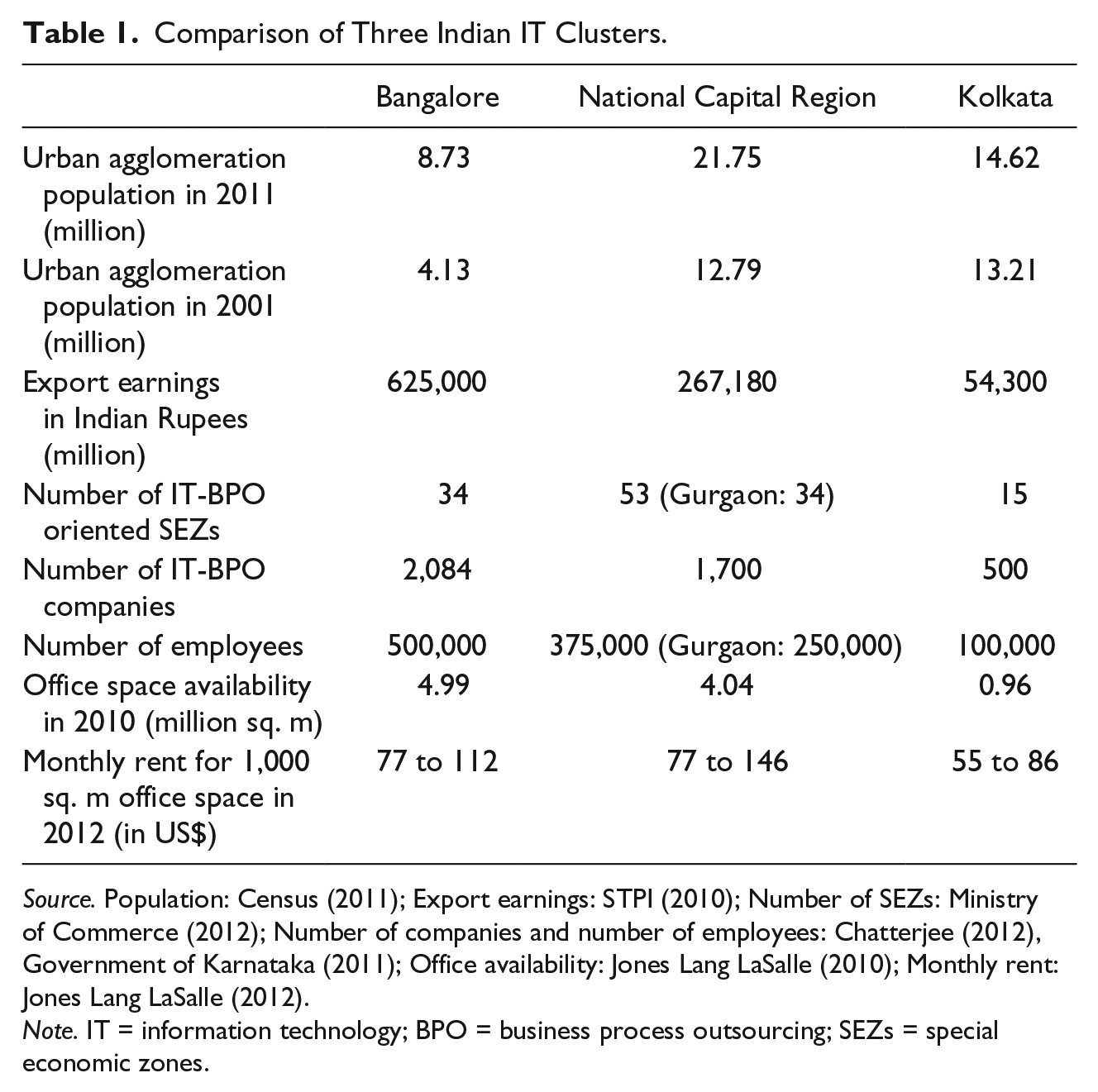
Source. Population: Census (2011); Export earnings: STPI (2010); Number of SEZs: Ministry of Commerce (2012); Number of companies and number of employees: Chatterjee (2012), Government of Karnataka (2011); Office availability: Jones Lang LaSalle (2010); Monthly rent: Jones Lang LaSalle (2012).
Note. IT = information technology; BPO = business process outsourcing; SEZs = special economic zones.
Case Study I: Bangalore (Karnataka) IT Cluster
The local governance regime played a prominent role in the “take-off” phase of Bangalore’s software export economy and is also acutely conscious about sustaining the city’s position as India’s Silicon Valley, through industry friendly policies—the characteristics that closely resonate with the “corporatist” governance mode under the DS-IUG framework. However, with the growing influence of the real estate lobby and crony capitalism synonymous with the “clientelistic” mode, Bangalore is tending toward a hybrid form of governance.
Political power in the state of Karnataka (of which Bangalore is the capital) had oscillated between centrist and right-of-center political parties. Along with party affiliation, caste equations play an important role in local politics, with vokkaligas and lingayats, two dominant farming castes, heading rival caste alliances in local elections. Political parties have accommodated the caste coalitions within their ranks, but this in turn had also increased the scope for corruption (Breeding 2011). Caste vote banks come with their sets of obligations and reciprocity. Leaders are expected to provide particularistic favors to their supporters, in exchange for support.
However, the nonideological nature of Karnataka politics had yielded much policy space to the bureaucratic elites compared with other states. The bureaucratic elites being key decision makers and broad political consensus have resulted in the state having “better crafted policies and more policy continuity,” including a long legacy of pursing a technology-led developmental agenda by prioritizing higher education and knowledge-intensive industries—which, in recent times, translated into pro-active support for the IT industry (Kadekodi, Kanbur, and Rao 2007).
The role of Karnataka’s key decision makers in pursuing consensual economic objectives for Bangalore closely resonates with the “corporatist” governance mode under the IUG framework (DiGaetano and Strom 2003). Karnataka was the first state to frame an IT policy to promote IT investments in 1997, which subsequently became the guiding template for other states. The latest policy asserts the state’s intention of retaining its front ranking position in the IT sector to further consolidate Bangalore’s position as a knowledge capital by encouraging high-tech investments by building close synergy with the industry, and expand the scope of IT outsourcing from non-English speaking countries by facilitating establishment of foreign trade missions in Bangalore (Government of Karnataka 2000). Karnataka also took the lead in liberalizing norms for establishment of private-sector engineering and management colleges, ensuring a steady stream of technical labor supply to the region’s knowledge economy (Parthasarathy 2004).
Bangalore’s approach toward urban infrastructure development by building public–private partnership also echoes with “corporatist” governing logic under the DS-IUG framework. Economic dynamism has contributed to the rapid spatial and demographic expansion of Bangalore. Administrative limits of the city have increased from 161 sq. km in 1979 to 741 sq. km in 2007 (Bangalore Development Authority 2005), and population has increased from 4.13 million in 1991 to 9.59 million in 2011 (Census 2011). But infrastructure development lagged behind, and the city started facing severe criticism from the IT-corporate sector over long traffic snarls and power cuts.
In response, the state government under different political parties adopted identical strategies: by forging a partnership between state agencies, the IT bio-tech corporate sector, and civil society elites (Benjamin 2010). First, Congress government formed the “Bangalore Agenda Task Force” (BATF) in 1999, under the leadership of the then CEO of software giant Infosys with wide ranging power—thus, institutionalizing involvement of nonstate actors in urban governance. It was a pioneering endeavor in the Indian context. Subsequently, the Bharatiya Janata Party (BJP) government followed suit in 2009, by constituting an “Agenda for Bengaluru Infrastructure and Development” (ABIDe), by drawing a similar set of people.
BATF and ABIDe both adopted a similar technocratic approach to improve functioning of the municipal agencies by introducing digital mapping and management information systems; and had stressed upon the need for expanding the city’s footprint to meet the needs of economic growth. BATF roped in a French consortium to formulate a City Development Plan. Likewise, ABIDe has prepared “Plan Bengaluru 2020”—a vision document that projects the emergence of Bangalore as a mega-urban region of 8,000 sq. km.
It is evident that urban policy framing in Bangalore largely revolves around the concerns of the technocratic elites and the middle class. Its position in the global knowledge economy has come to dominate the planner’s imagination of the city, who aspire to shape it as a “world-class” metropolis (Nair 2005). However, it is noteworthy that such purposive aspirations are being mediated through the local political terrain through co-option of the rural political elites—by means of what could be termed as clientelistic under the DS-IUG framework.
Acquisition of agricultural land by state agencies to meet Bangalore’s rapidly growing footprint had occasionally hit roadblocks due to the resistance of local farmers. Two iconic projects, synonymous with the new globalizing economy, Bangalore-Mysore Infrastructure Corridor and the new international airport, faced much opposition. However, despite occasional hindrances, land supply for the IT sector had continued unabated due to co-option of the rural elites into the new urban economy.
Properties on which the business parks are built and the engineering colleges, which produce the workforce for software companies, are mostly owned by such rural elites. Several civil society activists claimed during fieldwork that powerful political families and the caste chieftains own vast land tracts around the city, and often, zoning norms are modified to suit their rent seeking objectives (Interview, February 6–7, 2012). Thus, the process of augmenting land supply is yielding direct material gains for the political elites—an attribute of the “clientelistic” practice in the DS-IUG framework. However, the cast ties that bind the political decision makers and the rural elites turned peri-urban property developers cannot be accounted for under the DS-IUG framework.
The following section summarizes the main characteristics of Bangalore’s governance regime, through the DS-IUG framework.
Overall, the characteristics of the local governing regime may be termed as corporatist. But, at the same time, there are signs of it turning toward clientelistic—with the political elites increasingly benefiting from the land-related transactions. This hybrid nature of the governing regime is resulting in rapid expansion of Bangalore’s urban footprint through the planning machinery, which is ultimately leading toward hyper-urbanization at a regional scale requiring new governance arrangements.
Case Study II: NCR IT Cluster
IT clusters in the Delhi NCR metropolitan belt are mostly located in satellite towns outside the administrative limits of the core city. This article focuses on Gurgaon, which in two decades of hyper-dynamic growth has transformed from being a backward agricultural town into the region’s prime corporate hub; and characterizes its local governance mode as “clientelistic” under the DS-IUG framework.
Development of Gurgaon reflects the particular tensions of its geographic location, where economic growth is happening due to its close proximity to Delhi, but is mediated through the political culture of Haryana—the state within which it lies in administrative terms. Land-supply constraints in Delhi, caused by its restrictive planning regime, stirred the property markets of Gurgaon since the late 1990s, as corporate firms started moving in because of its proximity to Delhi airport and availability of high-quality office and residential properties in gated enclaves (Chatterji 2011). But the rentier-like attitude of the Chandigarh (state capital)-based Haryana political elites toward Gurgaon has led to a fragmented landscape, marked by acute infrastructure deficiencies and stark inequalities between the master planned complexes connected to global information economy and the messy, local bazaar economies.
Rapid growths of Gurgaon and other districts bordering Delhi have increased Haryana’s urban population percentage from 24% in 1991 to 35% in 2011, and have catapulted the state into one of India’s most urbanized. Prior to that, it was a prosperous but overwhelmingly rural state, with a strong caste dominated social structure—which still continues to wield substantial political influence. More than organized party structure, politics in Haryana are characterized by charismatic leaders who head political dynasties and caste lobbies (Jodhka and Dhar 2003). Jats, a conservative, land-owning farming community constituting 22% of the state’s population, dominate the political landscape. Successive political leadership of the state had sought to project their rustic, pro-farmer image (Jodhka and Dhar 2003).
In this rural-dominated political milieu, the “governing logic” of the elites had been guided by “personalized exchange” of profiting from speculative land transactions in Gurgaon, an atypical characteristic of the “clientelistic” mode of governance under the DS-IUG framework. Land policy of Gurgaon operates under two legislations (Joardar 2006). The Haryana Urban Development (HUD) Act of 1977 empowers the state agencies to acquire agricultural land for developing residential and industrial estates, and contracting out of subsequent development to private firms. Under the Haryana Development and Regulation of Urban Areas (HDRUA) Act of 1975–1976, licenses are awarded to big private developers to acquire, assemble, and develop a minimum contiguous 100 acres of land.
This enabling policy environment allowed big real estate firms to acquire large land parcels in the rural areas of Gurgaon, bordering Delhi. It is important to note here, that until 2008, except for a small inner core, almost the entire Gurgaon was classified as rural and did not even have a rudimentary municipal government, even though it had been growing rapidly since the mid-1990s. It is alleged this ambiguous governance structure helped the big private builders amass large land parcels and also benefited powerful political families (Debroy and Bhandari 2009). The governing logic, based on direct reciprocity between the political and business interests as seen here, conforms to the “clientelistic” governance style under the DS-IUG framework.
Understandably, this has produced a patchwork quilt land-use pattern. Although, in theory, Haryana Government’s Department of Town Planning (DTP) is entrusted with the responsibilities for ensuring development coordination between private and public agencies. But, in reality, land configurations and project phasing by the private developers had followed the logic of land assembly, rather than the phases prescribed by the DTP’s Master Plan, resulting in hindrances in delivery of trunk services (Joardar 2006).
“Land” is also the cornerstone of the Haryana’s IT policy. The IT-BPO sector gets preferential treatment in land allocation from the state, and procedures for conversion of industrial manufacturing land to IT business parks have been simplified (Government of Haryana 2000). This, in turn, had encouraged property developers to build high-quality office buildings, residential apartments, and associated amenities near the Delhi border to attract the IT-BPO sector investments. Analysis of the ownership pattern of the IT-SEZ properties shows that all 34 IT-SEZs in Gurgaon are owned by real estate developers, in contrast with Bangalore or Kolkata, where IT companies and parastatal agencies also own SEZ properties (Ministry of Commerce 2012). Unlike the activist bureaucracy of Bangalore, the property developers are the key players behind Gurgaon’s success as a prime IT-BPO destination.
However, Gurgaon’s development model had enabled large numbers of farmers to switch over to the tertiary economy. Fast rises in land values, declining agricultural productivity, increasing debt burdens, aspirations of the younger generations for an urban lifestyle, and the lure of easy money from the private developers had lured peri-urban farmers to sell their landholdings and invest the surplus into retail trade, transport, construction, or property dealership.
Yet, resentment is also increasing. Farmers complain of collusion between private developers and local administrative machinery, which artificially lowers land values. It was alleged that often, state agencies issue notices for land acquisition, and determine compensation rates. Then, private developers step in, offering proportionately higher prices, which most farmers accept as a better option under pressure of forced acquisition. The legal notices are withdrawn once the developers purchase a substantial amount of land (Interview, January 31, 2012). Thus, the farmers are deprived of “true” market prices. While this could be seen as yet another example of a governing logic based on “reciprocity” and crony capitalism under the DS-IUG framework, the social caste ties that underpin such arrangements cannot be easily explained under the DS-IUG framework.
However, the intensity of the rural protests in Gurgaon had been much more muted compared with Bangalore and Kolkata. Rapid urbanization and economic growth in the NCR area is gradually blurring the rural–urban divide, which once characterized Haryana’s polity, as farmers become stakeholders in urban economy. Consequently, the Gurgaon - model of city building has started drawing attention across the country. The following section identifies the main characteristics of Gurgaon’s local governance regime, using the DS-IUG framework.
Although local social factors of caste affiliation, inclusion, and exclusion cannot be fully explained through the DS-IUG framework, the overall characteristics of Gurgaon’s governing regime may be termed as clientelistic under the framework. This has resulted in a highly fragmented urban landscape, marked by deep social inequalities and huge infrastructure deficiencies. Yet, it makes no major dent in the electoral prospects of the governing regime.
Case Study III: Kolkata (West Bengal)
Kolkata (Calcutta), which was India’s leading center of economy and education until the 1950s, lags behind smaller cities, such as Bangalore, Hyderabad, or Gurgaon, in attracting IT-BPO investments, and continues to suffer a brain drain of the educated youth to economically more dynamic cities. On the basis of our analysis through the DS-IUG framework, we classify Kolkata’s governance regime as “populist” in nature. The attention of the ruling elites is focused on winning support from the rural poor, rather than achieving faster economic growth.
Port and industrial economy of Kolkata declined sharply between the 1940s and 1970s due to tumultuous events such as partition, refugee influx, and militant trade unionism (Raychaudhuri and Basu 2007). Long periods of socioeconomic upheavals had contributed to a charged political landscape in Bengal, characterized by rural–urban dichotomy, and sharp polarization along party lines between a Communist Party of India–Marxist (CPM) led Left Front and Trinamool Congress (TMC), which after breaking away from the centrist Congress party in 1998 defined its politics by championing the causes of urban and rural poor against forced evictions.
Cutting across party lines, the politics of the state are dominated by the educated middle-class Bhadralok community. With the spread of English language and ideas from the early nineteenth century among the Bengali upper castes, Bhadralok provided a head start to the community in white-collar service jobs, and subsequently got closely intertwined with their sociocultural identity. But the community, whose political ideologies were influenced by socialism, never came to control the economic reigns of the state, which after the departure of the British, were taken over by North Indian Marwari communities (Sinha 2005).
In this sociopolitical milieu, the governing logic of the ruling elites had veered between what could be termed as populist and managerial positions under the DS-IUG framework, without much opportunity for involvement of the nonstate actors in the decision-making process.
The Left Front, which was in power from 1977 to 2011, initially focused on consolidating its rural base by redistributing surplus agricultural land confiscated from the big farmers among the landless peasants. Meanwhile, in Kolkata, labor unions, with tacit political support, vigorously opposed computerization in banks and offices—which led to the flight of white-collar jobs during the 1980s, and subsequently delayed the growth of the IT outsourcing economy (Sen 2009).
The situation started to change after the Left Front adopted a pragmatic New Economic Policy in 1994 and started to court private investments. In a complete policy reversal, the IT-BPO sector, which was shunned earlier, was now designated as a critical infrastructure—to safeguard against industrial strikes. Strong governmental support, easy availability of an educated workforce, and cheaper rent contributed to impressive growth of the IT-BPO sector within a short time.
The state government sought to provide production spaces to the IT-BPO sector through its bureaucratic framework at Salt Lake and Rajarhat—two upmarket satellite towns near the airport at Kolkata’s eastern fringe. Land-use norms for Salt Lake’s Sector-V were relaxed to accommodate IT offices, and the area got saturated by 2008.
West Bengal Housing and Infrastructure Development Corporation (WBHIDCO), a state government agency, started developing the Rajarhat township from 1998 for a target population of 1 million. Acquisition of land, urban planning, and provision of trunk services were entirely handled by WBHIDCO. Additional spatial needs for IT-SEZs and business parks were accommodated in this newly built city. Thus, we see that even in its peak, the Bengal government’s support to the IT-BPO sector was state-led and “managerial” (and consequently subject to greater political pressure) under the DS-IUG framework and had not sought to embrace the corporate sector in the policy platform, the way Bangalore did.
Although the Left Front showcased the IT-BPO induced boom of Rajarhat as a major milestone in Kolkata’s economic resurgence during the 2011 elections, the project also courted controversies over land acquisition from the outset. Apart from compensation payment, WBHIDCO attempted to rehabilitate the land losers to form “syndicates” and become a building material supplier to the area’s booming construction industry—an inclusionary objective synonymous with “pluralist” governance under the DS-IUG framework. But the villagers alleged during fieldwork that the “syndicates” are in reality extortion rackets controlled by local politicians (Interview, January 21, 2012).
Land-related protests erupted in Bengal in a big way from 2006, when the Left Front kick-started the industrialization drive—which, in some cases, led to coercive acquisition. By closely associating with the anti–land acquisition movement, the state’s main opposition party TMC sharply augmented its popularity in rural Bengal and ended the Left Front’s 34-year rule in 2011 (Nielsen 2010; Shatkin 2016).
The TMC government’s policies are caught between rural–urban dichotomies, which could not be adequately explained under the DS-IUG framework. After assuming office, TMC stopped further land acquisition in the Rajarhat area and repealed the SEZ legislation—terming it as a mechanism for rural land grab—a decision that could be termed as populist under the DS-IUG framework, as it sought to gain support from the rural masses. However, conscious of the employment needs of its core middle-class support base, the TMC government sought to attract new IT-BPO investments—especially for start-up ventures—by revising the IT policy and offering additional fiscal incentives. To make a big-bang impact, the government sought to attract IT giants Wipro and Infosys by offering land at Rajarhat (acquired by the previous government) at a highly subsidized rate of Rs 1.5 crore per acre (about US$221,000)—approximately the price of two three-bedroom apartments in the same neighborhood (Business Standard 2013). But, conscious of its newly acquired popularity in the rural areas, the TMC government has shied away from accepting the demands to classify the new ventures as SEZs. The Infosys and Wipro projects are yet to materialize—although negotiations have been going on since 2011.
It may be noted here that governments in Karnataka and Haryana routinely concede demands to classify big projects as SEZ. Also, unlike Karnataka, where top bureaucrats have greater leverage in crafting the state policies and their implementation, in Kolkata, political elites take the lead, which in turn increases possibilities of partisan conflicts on the developmental pathway. The following section identifies the main characteristics of the local governance regime, using the DS-IUG framework.
Overall, the characteristics of the local governing regime may be termed as populist under the DS-IUG framework. However, between 2000 and 2010, it depicted a “managerial” streak. “Pluralist” tendencies were also visible, as the Left Front attempted to strike a balance between rural and urban interests in their attempt to rehabilitate land losers in the urban economy by forming syndicates. The TMC has also made similar attempts. But, in reality, pluralist and managerial streaks were short lived, although populist policies allowed the governing regimes to placate their support base in rural Bengal at the cost of retarding Kolkata’s progress in the market-driven global economy. Thus, despite having the advantage of a large supply of an educated workforce, Kolkata is unable to leverage its potential in the IT-BPO sector and continues to suffer a flight of the middle class to Bangalore, Gurgaon, and elsewhere. However, it may be noted that the DS-IUG framework cannot adequately explain the rural–urban, Kolkata versus Bengal dichotomy.
Governance Modes and Planning Cultures of the Regional IT Clusters
Place-specific political dynamics are contributing toward the emergence of a differentiated, regionally articulated landscape at the fringe areas of the globalizing Indian cities, even though these places are being produced by similar forces linked to global capital, and all operate under the same political context of the postliberalization Indian national state. Analysis of the “political objectives,” “governing logics” of the “key decision makers,” and their “governing relationships” through DiGaetano and Strom’s DS-IUG framework bring out that new economic spaces in globalizing Indian cities are being produced through distinct localized modes of governance.
Thus, a “corporatist” regime comprising of bureaucratic-political-IT-corporate-civil society elites is driving Bangalore’s global-city aspirations. But in Kolkata and Gurgaon, the roles of the IT sector and civil society are almost negligible in shaping urban policy. The real estate lobby with their patrons in Haryana politics, in a “clientelistic” relationship, are the key change makers in Gurgaon. On the other hand, in the “populist” regime of Kolkata, the power is overwhelmingly concentrated in the hands of the political leadership.
Table 2 synthesizes the findings from the three case studies. Based on case study findings, the following section then interrogates the DS-IUG framework so as to comment on its applicability in developing cities.
Comparative Analysis of the Governance Modes of Bangalore, Gurgaon-NCR, and Kolkata.
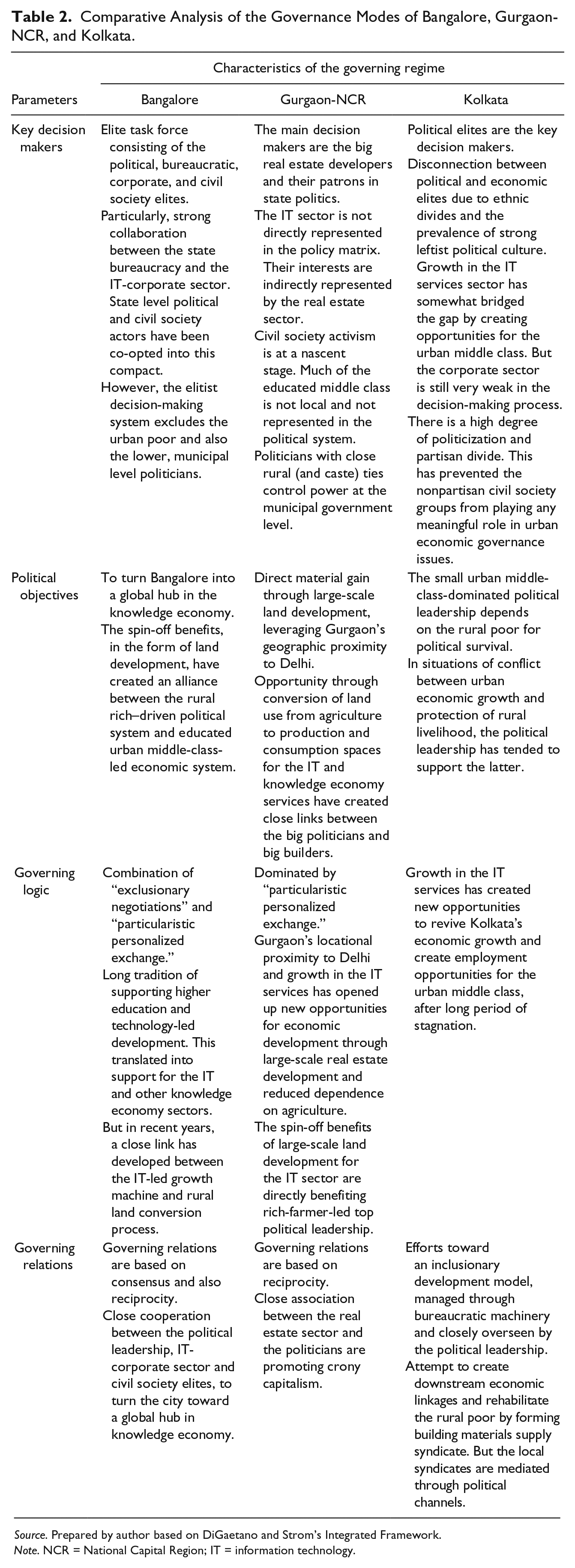
Source. Prepared by author based on DiGaetano and Strom’s Integrated Framework.
Note. NCR = National Capital Region; IT = information technology.
Interrogating the Framework
DiGaetano and Strom’s DS-IUG framework provides an integrated platform, combining structuralist, agential, and cultural standpoints in comparing urban governance.
As demonstrated in the preceding section, the four parameters of the DS-IUG framework—governing relations, governing logic, key decision makers, and political objectives—were useful in categorizing the economic governance modes of three Indian cities regarding the development of the IT-BPO sector. It is important to highlight two crucial points here. First, the basic features of India’s political-economic structure are in harmony with the foundational premises of the framework. India is a long functioning democracy, whose political institutions were modeled on liberal Anglo-Saxon democracies. Powers and responsibilities between multiple tiers of governance are clearly defined by the constitution. Second, economic reforms and state restructuring in recent years have more fully integrated the Indian economy with the external world in political-economic terms. There is increasing competition between Indian cities to attract global investments. The federal-democratic structure of India allowed necessary leeway to the regional power elites to pursue economic strategies in line with their political objectives.
However, the socioeconomic realities, caste and communal ties, and rural–urban ties of India are vastly different from the liberal democracies of the Global North, on which her formal institutional structures are modeled. And this led to certain difficulties in adopting DiGaetano and Strom’s framework in its present form. The following section examines each of the four parameters of the framework in this light.
Key Decision Makers Within the overarching structure of economic globalization and state restructuring, how a city’s urban policy is shaped is to a large extent decided by agential factors, including who constitutes the decision-making metric. The DS-IUG framework postulates that capital mobility due to economic globalization steered most cities in the Global North to adopt a “corporatist” mode of governance, which inter alia involves close cooperation between the high-level governmental, business, and community leaders in shaping urban policy. In India, compacts of similar kind between the government, the IT-BPO industry, and civil society elites could be observed only in Bangalore. The influences of civil society on urban issues are practically nonexistent at Gurgaon and Kolkata—even though the latter has a leftist legacy and a robust civil society active in various other spheres. More important, the IT-corporate sector does not have any direct influence over the urban policies—neither in Kolkata, nor in Gurgaon—even though the latter witnessed hyper-dynamic growth fueled by the IT-BPO investments. However, it is the construction and real estate sector that enjoys a patron-client relationship with the state’s rural-centric political leadership, and acts as the conduit for the IT-BPO investments. Similar trends are also becoming visible in Bangalore due to increasing commoditization of peri-urban land. Thus, growth in the IT-BPO sector, which is held in high esteem in India because of its global image and is equated with transparency and meritocracy, is in effect routed through crony capitalism—at least to a considerable context. These above anomalies cannot be easily explained through DiGaetano and Strom’s framework and require additional exploratory tools. The crucial point here is that unlike the cities of the Global North, the key decision makers on urban economic issues in India are not located at the level of city government, but rather at the state government level. The political constituency of these key governmental actors are spread out over the entire state. And the politics of rural–urban affiliations have a crucial influence in shaping urban developmental outcomes. Thus, scale is an important determinant in understanding the objectives of the key decision makers, which does not get adequate attention under the DS-IUG framework.
Political Objective According to the DS-IUG framework, political objectives in corporatist regimes are driven by the purpose of achieving high levels of economic growth and securing the city’s position in a competitive global setting. In contrast, the objective of direct material gain drives the leadership of the clientelistic regimes. For the populist regimes, the objectives are more symbolic. This article, however, showed the importance of additional factors, such as caste oriented political mobilization, in influencing the political objectives of the governing coalition and shaping economic outcomes. For example, in both Bangalore and Gurgaon, close ties between the interests of the dominant caste groups and the rural-centric political establishment facilitated land supply for the IT sector by creating greater opportunities through commoditization of peri-urban land. In contrast, disconnection between the urban elites and the rural land economy constrained the land-supply process in Kolkata’s IT cluster. Another crucial issue here is the socioeconomic characteristics of the constituents—which have a major bearing in channelizing the political objectives of the governing elites in a democratic environment. This research showed that the farmers in Bengal, extremely poor and having tiny land parcels, are resistant to give up land and move into the urban economy, whereas the more prosperous farmers of Haryana are more willing to commoditize land and move into Gurgaon’s thriving urban economy. Thus, the livelihood vulnerability of the rural poor guided the actions of Kolkata’s political elites toward the land-supply issue, just as opportunities for further growth propel Gurgaon’s urban expansion. The issues discussed above, politics of caste affiliations, rural–urban dichotomy, socioeconomic makeup, and conflicts between multiple scales of governance require widening of the analytical focus beyond DiGaetano and Strom’s framework.
Governance Relations According to DiGaetano and Strom, “corporatist” regimes characterize exclusionary negotiations between the elite state and economic actors, which privilege high growth oriented sectors, and promote pro-globalization policies. In contrast, inclusionary processes characterize more “populist” regimes. For “clientelistic” regimes, governance relations are marked by personalized exchanges. While agreeing with the above basic tenets, this article, however, demonstrates that governance relations are influenced by the political objectives of the key decision makers. Thus, even the corporatist regime in Bangalore derives its political strength from its ability to co-opt the rural political lobby in the urban growth machine. Moreover, the issue of governance relations, between the state, market, and community, is not purely horizontal, as envisaged in DiGaetano and Strom’s framework. The vertical relationships in multiple tiers of governance also influence governance relationships, and there are frequent possibilities of conflict. For example, both Bangalore and Kolkata showed the strong role of parastatal organizations (directly controlled by the state governments) in facilitating development of urban infrastructure for IT enclaves. In both these cities, the roles of local municipal leadership are minimal. But in Gurgaon, where a new elected city council has come up, it has generated conflict with the state leadership over the scope of infrastructure delivery. Thus, the issue of scale is important, and governance relationships need to be viewed in association with the political objectives of the key actors at multiple levels.
Governing Logic According to the DS-IUG framework, governing logic in “corporatist” regimes is characterized by consensus building among the key actors in state, market, and community sectors. However, clientelistic regimes demonstrate direct reciprocity. Mobilization of popular support is the governing logic for “populist” regimes. Research for this article shows that while “governing logic” as defined by the framework was a useful criterion for understanding governance modes of the Indian cities, the governing logics of the Indian cities were shaped by wider factors, including the political objectives of the key decision makers. For example, the political objective of gaining support from the poor rural peasants shaped the governing logic of Kolkata’s ruling alliance toward the land requirements of the IT sector. Similarly, the political objective of sustaining Bangalore’s leadership role in the knowledge economy spurred the state actors to build consensus with the business and civil society elites. Objectives of direct material gain through land transactions underpinned the real estate driven growth strategies of Gurgaon. Thus, the issue of governing logic, although vital, cannot be seen in isolation from the more important parameter—the political objective.
Toward an Amended Framework
Analysis of DiGaetano and Strom’s framework demonstrates that while the basic premises of the framework remain valid, the change in setting from advanced capitalist economies to a transitional economy and from overwhelmingly urbanized countries to the world’s largest rural country requires a major change in emphasis—and additional lenses to identify new influences. The following modifications are suggested.
First, this article established the need for understanding the scale at which the leadership of urban governance operates. The fact that in India, the locus of power about urban policies, including economic development and its spatial implications, is not located at the level of elected municipal governments, but with the state governments, made significant differences in how developmental trajectories shape up. As the rural population makes up a majority in all Indian states, city scale policies are in effect tied to the rural–urban power equations at this higher plane. This calls for an additional parameter—scalar location of power in urban governance.
Second, this article showed the necessity of understanding micro-level socioeconomic dynamics, which goes beyond the formal institutional arrangements. Specific local factors, such as caste networks, landholding patterns, and the existing level of opportunities in the urban economy, influenced the policy orientation of the political leadership to a significant extent. Thus, political leaders with ties to the caste networks of the rural elites were able to channelize land supply for the emerging new urban economy and thereby emerged as important agents of globalization. And the roles and objective of such local agents in the globalization process merit special consideration—and to understand that, it is necessary to include political culture of the region as a specific parameter.
Third, this research showed the roles of political leadership, elites, and the governance coalition are far more crucial in the arena of developmental policy in India. The local political leaders, as negotiators between competing interests, steer the direction of the developmental outcome. They can accommodate the rural (and caste) elites in a “mutually beneficial” coalition, which fuels the globalized IT services-driven real estate growth machine as in Bangalore and Gurgaon. Otherwise, they can also get stuck with internecine land conflicts as in Kolkata.
This inference is in line with earlier research on other Asian countries by Leftwich (2010) and Shatkin (2007, 2016). Both of them noted a similar high degree of intervention by local political elites on developmental issues to suit their own economic and political agendas, compared with countries of the Global North with stronger and more deeply rooted institutional structures. Thus, the political objective of the key decision makers in India (and other emerging economies in Asia) assumes a degree of importance not envisaged in DiGaetano and Strom’s framework. Considering all these aspects, this research would suggest a prioritization of the two parameters, “key decision maker” and “political objective,” over the other two. Thus, two other criteria, “governing relations” and “governing logic,” although crucial, are secondary, and dependent on the primary ones.
Therefore, this research would like to suggest an amended framework for comparative analysis of the urban governance modes for India, consisting of six parameters: key decision makers, political objectives of the key decision makers, scalar location of power in urban governance, political culture of the region, governing relations, and governing logic. In this expanded framework, the last two parameters may be considered as secondary to the first four.
Conclusion
By demonstrating how variations in subnational political cultures influence urban economic trajectory by mediating forces emerging out of global economic demand and a uniform national regulatory regime, this article provided a counterpoint to the conventional narrative on globalizing cities in India, which sought to emphasize the converging and homogenizing nature of the contemporary global processes.
The research brought out that although the structural context of market-driven economy and neoliberal political ideas have become the de facto norm, at the upper scales of governance, the issue of “last mile connectivity”—how such capitalist processes translate at the urban scale—depends to a considerable extent on the agencies of the local political actors and planning institutions.
Understanding the local agential factors is particularly crucial in unpacking the emerging urban economic geography of India due to centrality of the “land” question—as supply of land to develop new economic spaces, in close proximity to major population centers, has become a fundamental driver of change. Leveraging their power over the land-use planning instruments, the local actors may either facilitate or resist land-use change for development of production and consumption spaces associated with the new economy.
Urban transformations, under such circumstances, are to a large extent dependent on the composition of the local governing coalitions, their networks of inclusions and exclusions, their place-specific sociopolitical milieu, and the nature of their relationship with the global actors. Strategic choices of the members of such governing coalitions are not independent of global economic processes or national developmental priorities, but are rather maneuvered to maximize advantage for the coalition in the local political terrain. Tensions and contestations within such processes define the dynamics of urban transformation.
In other words, rather than being merely passive characters, the local governance regimes and institutional dynamics contribute significantly in steering developmental directions of the local economy in specific directions by filtering and mediating unitary forces of global capitalism and the national policy environment—at least in federal-democratic governance structure.
The research also made a modest attempt toward theorization by demonstrating how and in what way the parameters of a research framework sketched in the context of the Global North require to be recalibrated, so as to expand their applicability to India—a developing country with a large, mostly poor, rural population. This is, however, one test, which shows the model’s overall value. Similar exercises may be carried out in other developing countries, so as to further refine the framework, based on local specificities.
Footnotes
Declaration of Conflicting Interests
The author(s) declared no potential conflicts of interest with respect to the research, authorship, and/or publication of this article.
Funding
The author(s) received no financial support for the research, authorship, and/or publication of this article.