




Abstract
Low-income people of color in urban communities have been found to suffer from high levels of political inequality and poor political representation. To make policy more responsive and accountable, neighborhood organizations are often solicited to serve as informal community representatives in local decision-making processes. Given this reliance on nonelected representatives, we ask, Do community residents believe neighborhood organizations are legitimate representatives of their interests? Using survey data from residents of the South Side of Chicago, this article demonstrates that residents’ trust in organizations as representatives varies significantly by organizational type. Specifically, community organizations, religious congregations, and schools are rated as more trustworthy to speak on behalf of the community than local elected officials. These findings hold relatively constant across a variety of individual- and community-level differences, implying that this preference is widespread and may extend to other vulnerable urban communities in the United States.
Class-based political inequality has increased over time in the United States, and many studies find that the poor are systematically underrepresented in the American political system (Jacobs and Skocpol 2005; Schattschneider 1960; Verba, Schlozman, and Brady 1995). To address this underrepresentation among low-income Americans, state and local governments have pursued a plethora of strategies to increase citizen participation in local decision-making processes (Bingham, Nabatchi, and O’Leary 2005; Irvin and Stansbury 2004). Engaging community residents in those participatory processes has proven to be extremely challenging for two reasons. First, such processes often place huge time demands on local residents. Second, and perhaps most importantly, meaningful participation often demands smaller groups where deliberation can take place, but the logistics of smaller size defy widespread community participation (Gutmann and Thompson 2012). The challenge then is how to select participants who will represent the broader community.
One common solution to this problem is to invite leaders of neighborhood organizations, such as community organizations, religious congregations, and schools, to act as representatives of the disadvantaged populations and neighborhoods they serve (Berry and Arons 2003). Leaders of these organizations are often assumed to be legitimate representatives based on several rationales: First, they may have unique experiential knowledge about the community’s needs; second, they come from mission-driven organizations ostensibly operating in the community’s best interests; and, third, they are often seen as having obtained community members’ trust through ongoing relationships with them (Berry and Arons 2003; LeRoux and Goerdel 2009).
Despite these beliefs in the representational potential of neighborhood organizations, and the widespread practice of using them as representatives in participatory processes, only a limited number of studies have explored whether residents themselves regard local neighborhood organizations as legitimate representatives to speak on their behalf (Guo and Musso 2007; Mosley and Grogan 2013). Knowing more about residents’ beliefs is crucial to determine whether this type of representation is truly able to reduce political inequities in poor urban communities. In contrast to the extant literature, we interrogate the underlying assumption of legitimacy by examining two linked research questions:
We compare residents’ perceptions of three different neighborhood organization types—community organizations, 1 religious congregations, and schools—as well as perceptions about local elected officials (their alderman). Because residents have an opportunity to elect their local alderman, we examine whether beliefs in the nonelected local organizations’ capacity to represent the community are higher or lower than local officials granted formal representational authority.
Because this research focuses on a particular geographic area—the South Side of Chicago—we begin by providing contextual background about the limitations of formal representation in segregated low-income urban communities like the ones we study, relevant political dynamics, and why this context provides hope in the potential of neighborhood organizations to provide a voice for local residents.
Limitations of Formal Political Representation in Low-Income Communities
A core assumption of representative democracy is that the election process holds representatives accountable to the needs and concerns of their constituency (Pitkin 1967). Unfortunately, many studies point to important failures in formal representative democracy where the opinions of the wealthy often carry more weight than those of the poor (Jacobs and Skocpol 2005; Schattschneider 1960). This happens for many reasons. First, the poor and those with low levels of educational attainment are significantly less likely to vote in elections—whether federal, state, or local (Hays 2001). In addition to their lack of resources (e.g., money, time, transportation), numerous institutional constraints—including felon disenfranchisement policies, state-level voter registration systems, and workday voting arrangements—make it more difficult for poor minority citizens to actively participate in the formal political process (Freeman 2004). Second, compared with more highly educated and wealthy Americans, the poor are significantly less likely to volunteer for (or to be recruited to join) civic organizations—such as professional associations, homeowners associations, or school boards—thought to be important avenues to develop civic skills, build networks, and formulate preferences collectively (Jacobs and Skocpol 2005; Putnam 2001; Verba, Schlozman, and Brady 1995). Finally, although there is a consistent network of organizations who lobby on behalf of the poor, they only account for less than 1% of all interest group organizations in Washington, D.C. (Hays 2001).
This lack of representation matters for policy outcomes because the policy preferences of low-income populations are different than those of more affluent populations (Verba, Schlozman, and Brady 1995). The Vanishing Voter Project found that when asked what to do with a federal budget surplus, voting citizens were more likely to prefer channeling funds into tax cuts, debt reduction, or strengthening social security, whereas nonvoting citizens were more likely to prefer spending on domestic health, education, and welfare programs (Patterson 2002). As a result, “over-representation” of wealthy Americans translates into policy outcomes that run counter to the stated preferences of the poor such as a very regressive development of the American welfare state (Grogan 2015; Mettler and Soss 2004).
Political Representation on Chicago’s South Side
The South Side of Chicago is emblematic of many of these issues, as Chicago aldermanic politics has long been thought to significantly underrepresent the interests of low-income racial minority communities (Gierzynski, Kleppner, and Lewis 1998). Chicago has maintained a long history of one party machine politics. After the Democratic Party took control of the city during the New Deal era, not one Republican has been elected mayor. Although the worst of Chicago’s infamous machine politics has dissolved somewhat over the years, the city is still known for its ward-level patronage politics. Indeed, Chicago’s ward system from the 1930s—with 50 municipal legislative districts—remains intact, and the gerrymandered ward boundaries strategically run through culturally and historically defined community boundaries (Gierzynski, Kleppner, and Lewis 1998; Zhang 2011). Aldermen have a package of privileges, which enable them to maintain reciprocal relationships with the mayor, the Democratic Party, and community patrons. Based on the Democratic Party’s influential endorsement of incumbents and the interlocked relationship with the mayor, aldermen have built entrenched patronage relationships to maintain their own political regimes (Krebs 2001).
While projects that have the most potential to revitalize local communities often require working across political ward boundaries and creating collaborations with multiple elected officials, the mismatch between ward and community boundaries works against this collaborative logic. There is no incentive for aldermen to allocate their limited discretionary spending and political power across political boundaries, especially when such actions might undermine their power base (Zhang 2011). In short, ward-level politics discourage aldermen from investing in projects that could benefit the most vulnerable ward residents. The result has been a serious disintegration and displacement of individuals living in dominant ethnic enclaves and vulnerable communities.
It is also likely that it is at least partially responsible for low political participation. In the 2003, 2007, and 2015 mayoral and aldermanic elections, only about a third of registered voters cast their ballots (Chicago Board of Election 2015). 2 Within such a low turnout environment, incumbent aldermen assume tremendous advantage over challengers, and they tend to support policies and programs that benefit particular supporting subgroups rather than policies that benefit the average ward or community resident. Based on Chicago’s political history, it seems reasonable to assume that local residents may welcome alternative political agents advocating on their behalf. Given the lack of representation that emerges from ward politics, are neighborhood organizations perceived as a viable alternative?
Alternative Nonelected Representatives and Trust
In response to growing political inequality generally, as well as local underrepresentation, such as is seen in Chicago, there has been a growth in alternative forms of political participation and representation at the state and local level. To improve community representation, local governments often invite diverse local institutions with contextual knowledge to speak on behalf of local residents (Bingham, Nabatchi, and O’Leary 2005; Irvin and Stansbury 2004). This trend takes on particular significance in low-income communities, where the formal political process falls short on many dimensions (Marwell 2007). Although these politically active local organizations are expected to connect and represent residents of vulnerable neighborhoods to the larger environments, scholars find little evidence of participatory processes in local organizational governance (Lelieveldt et al. 2009). In addition, because these organizations are not elected by nor accountable to the communities they ostensibly represent, it remains unclear whether the residents view leaders of neighborhood organizations as legitimate community representatives (Montanaro 2012).
In attempts to understand how legitimacy might be assessed, scholars have pointed to the positive relationship between the level of trust in an organization and the organization’s ability to legitimately represent the community (Guo and Musso 2007; Mosley and Grogan 2013). Social capital theorists argue, for example, that trust is a central element in voluntary civic engagement and reciprocal social activities, which provide the basis for a strong democracy (Fukuyama 1995; Putnam 2001). Due to the clear power differentials, and feelings of political disenfranchisement, securing trust is particularly important for organizations that advocate on behalf of politically underrepresented citizens (Hirschman 1971).
Unfortunately, given the importance of trust, most research finds that distrust is common among poor and historically marginalized groups, particularly African-Americans (Smith 2007). In her in-depth qualitative study, Levine (2013) documented the extent of distrust among women in low-income racial minority-dominant Chicago communities. Despite aspirations for stable social relationships and financial well-being, poor African-American women were distrustful of others across multiple formal and informal settings in their lives. Due to repeated interactions and experiences with institutions and individuals where their trust was violated, these women grew to distrust all people with power and authority, even those who were supposed to help them, including welfare caseworkers, employers, and elected officials. This raises an important, as yet unaddressed, question about the role of neighborhood organizations in vulnerable communities: Are all types of potential representatives viewed as equally (un)trustworthy?
Representational Potential Among Diverse Organizational Types
There are reasons to believe that residents will not view all organizations as equally trustworthy, and, therefore, not as equally legitimate to speak on their behalf. Studies have suggested that the way organizations can gain trust with residents is by paying attention to how they interact with residents (the process) and by providing tangible benefits (or outcomes) to residents (Mosley and Grogan 2013). In regard to process, neighborhood organizations may strengthen their trustworthiness when they pursue frequent and responsive communication with community residents. In regard to outcomes, Marwell (2007) and Small (2009) found that community organizations that collaborate with other organizations and serve as a broker for resources for the community are viewed as more trustworthy (because the organization is viewed as following through with claims made).
Different organizational types are likely to be seen by residents as being better or worse on those two dimensions. For example, community organizations provide clear, concrete benefits but may have few opportunities for meaningful engagement beyond receipt of services. Schools provide benefits to families and opportunities for engagement to parents, but are invisible to many others. Religious congregations have strong engagement with congregation members and high levels of moral authority, but perhaps less emphasis on concrete benefits to the community. Residents may experience each of these organizations’ efforts to represent them quite differently. Residents may also respond differently to organizations with a narrow versus more general scope, in that it may be easier to generally “trust” an organization that is only representing residents on a single known issue. In that case, schools may be more trusted than community organizations, which are theoretically broader in scope. In this research, we explore how three neighborhood organization types—community organizations, religious congregations, and schools—might (or might not) be perceived as trustworthy and legitimate community representatives by residents.
Community Organizations
Local community organizations are often active political advocates on multiple issues (Berry and Arons 2003; Mosley 2010). The widespread growth of dependence on government contracts has led to social service organizations being active participants in both self-directed advocacy (often focused on maintaining government funding streams) and in various collaborative governance networks (Mosley 2012). They are also in an advantageous position to gain community trust through frequent engagement with local residents in the process of providing needed services (Watkins-Hayes 2009).
However, as community organizations become larger, more professionalized, and dependent on government funding, local residents may experience fewer opportunities to participate in organizational governance, making them less transparent to residents (Cnaan 1991). In addition, community organizations residing in the South Side of Chicago are often financially and structurally strained, limiting their ability to provide the concrete benefits residents desire. For example, employment development agencies in these poor, segregated, Chicago neighborhoods are often overwhelmed by the influx of ex-offenders out of the prison system, and local labor markets’ unwillingness to assume ex-offenders as potential employees (Peck and Theodore 2008). Residents may view community organizations as untrustworthy if those organizations cannot provide responsive services or produce tangible benefits for community residents due to limited resources—a frequent problem for this organizational type (Hasenfeld 2010; Mosley and Grogan 2013).
Religious Congregations
Religious congregations are another potential source of representation for residents in poor and vulnerable communities. Some scholars argue that faith-based organizations are particularly adept at helping citizens cultivate civic knowledge and organizing skills critical for voting and other forms of political activities (Verba, Schlozman, and Brady 1995). In African-American communities, churches have long been a “first responder” in meeting community needs and have played a key role in political mobilization, particularly after the Great Migration of the 1920s, and are often the last remaining institutions in poor Black neighborhoods (Livezey 2000).
Despite this rich history, the capacity of religious congregations to play a representative role in poor African-American communities may have diminished, partially because of high out-migration of many working- and middle-class African-Americans for better living conditions and employment opportunities (Wilson 1987). Although many of these out-migrants continue to travel back to churches in the city on Sunday mornings, when the congregation does not reside in the same place as the church itself, it can sometimes disrupt community cohesiveness, leading local residents to distrust local religious congregations (McRoberts 2003).
An ethnographic study by Livezey (2000) conducted on Black churches across the Chicago metropolitan area revealed very limited interactions between middle-class church members and poor community residents. Furthermore, community residents had limited participation in church affairs or religious services. Overall, although the Black church has long been perceived as an important institution creating political mobilization in African-American communities, class stratification may lead residents of poor communities to distrust local religious congregations (Cohen 1999; Livezey 2000; McRoberts 2003).
Schools
Although less studied as potential representatives, schools are also looked at to speak on behalf of community interests and needs. School settings encourage and require frequent and durable interactions among resident parents and school staff and connect parents to community resources outside of the educational domain (Small 2009). Schools are known for creating participatory processes, encouraging students and parents to become involved in the school and the community. For example, as part the 1988 Chicago School Reform Act, Local School Councils were created for every Chicago public school (Chicago Public Schools 2015). The council is comprised of six parents, two community members, two teachers, a principal, a nonteacher staff, and a student representative, and generally has the authority to approve the allocation of a discretionary budget, supervise reform plans, and hire and fire the school’s principal. These councils ostensibly give communities some oversight over local school affairs.
However, residents’ trust in schools may have diminished in recent years, in part due to the increasing influence of central office officials (Henig and Rich 2004). The 1995 Chicago School Reform Act allowed the Mayor to appoint a Chief Executive Officer (equivalent to superintendent) and members of the Chicago Board of Education. As a result, the power of underperforming schools’ Local School Councils was greatly limited and could not avoid the mass school closures that took place in 2013, which disproportionately affected vulnerable African-American students (Chicago Public Schools 2015). Some studies suggest that residents do not feel properly represented by the mayor-appointed school boards and leaders, especially when these elite professionals come from outside the school community (Meier 2004).
Individual- and Community-Level Factors that May Influence Residents’ Perceptions
Although the dynamics of how different organizational types operate in communities mean that some may be more trusted than others, it is also possible that beliefs about which organizational types are most trustworthy vary by individual demographic factors and neighborhood characteristics, as well. In this study, we control for a variety of individual and neighborhood characteristics to see whether certain organizational types are trusted more than others generally, or whether that trust varies by these more idiosyncratic factors.
The individual characteristics we assess in this study are length of residence, age, education, gender, number of children, and perceived health status. 3 First, length of residence and age are well-studied and important proxies of individuals’ neighborhood attachment, interpersonal trust, and accumulated interactions with neighborhood organizations (Sampson 1988). Second, research has also shown that individuals with higher education levels tend to be more civically engaged and have higher levels of general trust (Putnam 2001). Next, participation in some organizations is gendered. For example, studies have found that females have higher levels of attachment to religious institutions (McRoberts 2003; Putnam 2001), and mothers are typically more involved in schools than fathers (Shumow and Miller 2001). Based on this, we predict women will report greater trust than men in religious congregations and schools. Finally, we expect that increased number of children in the household and a worse self-reported health status may be associated with increased trust in schools and community organizations, respectively, because of expected higher levels of engagement in those types of organizations (Kwak, Shah, and Holbert 2004; Watkins-Hayes 2009).
In regard to community-level factors that may influence trust, we assess the contribution of poverty rate, violent crime rate, organizational density, and community size. 4 First, although the cause and influence of the relationship is heavily debated, communities with high poverty rates tend to express lower trust overall (Putnam 2001). Second, research has shown that high crime levels discourage community engagement, which may lead to lower levels of trust for individuals who live in those communities (Putnam 2001; Sampson 1988). Finally, a greater number of organizations within communities may increase trust in those organization types because residents would likely have greater exposure to and interaction with them (LeRoux and Goerdel 2009). To control for any effects associated with community size, we include a logged number of community residents.
In sum, based on Chicago’s political history and lack of representation from ward politics, it seems reasonable to assume that local residents may welcome alternative political agents advocating on their behalf. Thus, we investigate whether community organizations are perceived as viable alternative representatives with the following hypotheses:
Data and Method
This article focuses on eight Chicago South Side communities: Douglas, Oakland, Grand Boulevard, Kenwood, Washington Park, Woodlawn, Roseland, and Pullman. The residents of these communities are primarily African-American (87.4%) with an average poverty rate of 29% and unemployment rate of 22% (U.S. Census Bureau 2015). To address our research questions, we drew data from multiple sources. To understand residents’ views in economically and politically vulnerable communities, we use data from a 2010 telephone survey (N = 153) of residents of the eight communities. To obtain information about organizational presence, we drew from a census of all nonresidential organizations in the eight communities. Other community-level variables are drawn from the 2008–2012 American Community Survey (ACS) five-year Estimates and the Chicago Data Portal. We discuss the data sources and key variables in more detail below.
Residential Telephone Survey Data
In this representative survey of South Side community area residents (N = 153), an address-based probability sample was drawn from the above-listed community areas, with a single individual in each household selected to participate. The mean number of respondents from each community was 19 but ranged from five respondents from Oakland to 61 respondents from Roseland. The distribution of respondents across the eight communities was significantly correlated with the community size and population (r = .83) (see Table A1 of the appendix for details on the distribution).
Surveys lasted approximately 20 minutes and were conducted either over the phone or occasionally in person (for respondents who were not able to be reached by phone). The response rate was 51%; this survey was intended to reach “hard to contact” individuals, and many survey respondents did not have a phone and required multiple field visits to contact. Goals of the survey as a whole, unrelated to this project, required female and older residents to be oversampled. Despite the rare opportunity to learn from the marginalized community members, the cross-sectional nature of this survey prohibits more rigorous investigations into causal associations between residents’ changing views and individual or environmental conditions. We recognize this as an important limitation of these data.
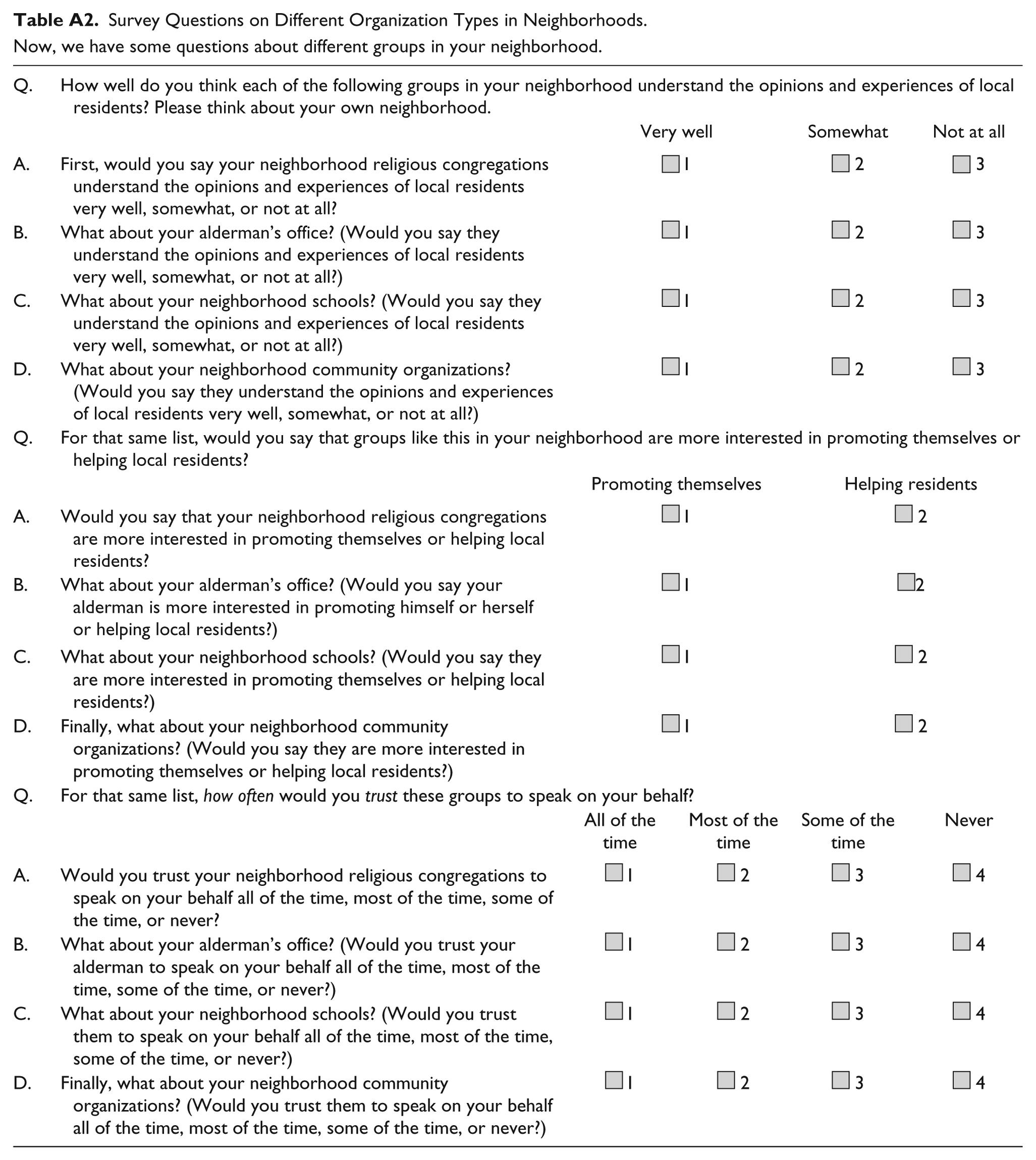
In the survey, respondents’ views were solicited on the capacity of four different potential representatives—community organizations, religious congregations, schools, and aldermen. Specifically, the survey asked to what extent respondents think each organization type “understands the opinions and experiences of local residents” (understand), is “more interested in promoting themselves or helping local residents” (promote), and how often they “trust these groups speak on your behalf” (trust) (see Table A2 of the appendix for the survey questions). We used these measures as the dependent variables in regression analyses assessing variations in trust and the influence of individual- and community-level attributes.
Other individual-level factors, serving as independent variables in that analysis, are drawn from the same self-reported survey, including age, gender, years of education, and length of residence. Health status was also self-reported using a 5-point scale, ranging from poor (1) to excellent (5). We used survey questions about household composition to calculate the number of children under 19 in the household.
Organizational Census
To find out the number of each organizational type within community boundaries, we used 2013 geographic data from an intensive resource mapping project carried out by the South Side Health and Vitality Studies at the University of Chicago (Makelarski et al. 2010). Starting with secondary data on organizational contact and location information, trained teams of field-workers walked all block faces in each community area, coding each nonresidential unit or building into one of 16 categories. To match the organizational types of interest, we pulled the number of organizations in four categories 5 : (1) community organizations (mostly social service and advocacy organizations such as job training centers, food pantries, and community advocacy groups); (2) nonresidential religious congregations (e.g., church, mosque, synagogue); (3) K-12 schools; and (4) aldermanic offices. These four categories capture 20% (Pullman) to 57% (Oakland) of the total nonresidential organization population in the eight communities. In the analysis, we control for the density of neighborhood organizations, measured by the number of organizations per 1,000 residents (see Table A1 of the appendix for more details on organizational density).
Community-Level Data
Economic and social well-being information for the eight communities was drawn from the 2008–2012 ACS five-year Estimates and the Chicago Data Portal. The U.S. Census Bureau (2015) hosted the census tract-level ACS estimates; the eight communities of interest overlaid three to 15 census tracts. In Chicago, established community boundaries match up exactly with census tracts. Therefore, these communities’ poverty rate is the weighted average of census tract estimates based on population within census tract and community boundaries. The average monthly violent crime rate is calculated by using the police crime reports filed between 2008 and 2012, publicly available through the administrative data sharing initiative of the city, the Chicago Data Portal. Violent crime includes assaults, battery, homicide, robbery, and sexual assaults.
Analytical Strategy
To answer the research questions, we applied mixed-effects ordinal logistic regression models. By treating variations in individual perspectives as random effects, this approach identifies overall respondents’ perception of different neighborhood organization types, while controlling for individuals’ views on other organization types (Gelman and Hill 2006). Thus, for instance, we can investigate whether the overall sample views community organizations as more representative than other organization types, after controlling for each respondent’s perspective on religious congregations, schools, and aldermen. For the first question, we run simple mixed-effects models over three measures of interest, understand, promote, and trust with a dummy variable for organizational type (using community organizations as a reference group).
To answer the second question, we introduce individual- and community-level variables (including organizational density variables) as fixed effects to the earlier mixed-effects ordinal logistic regression on residents’ perceived trust. This approach singles out overall respondents’ views on different organizational types, controlling for both individuals’ trust levels on other organization types and the average effects of individual and community factors.
The regression analyses presented below use the question regarding trust as the outcome variable of interest. Previous research based on cognitive interviews with residents of these same communities identified that while understanding the community and helping others over promoting yourself measure important qualities of legitimate representation in the eyes of community members, trusting them to speak on your behalf provides the most complete understanding of what legitimate representation means (Mosley and Grogan 2013). As a precaution, we also ran mixed-effects models with the understand and promote variables; these produced results that were almost identical to the analyses using the trust question.
Results
Descriptive statistics for individual and neighborhood characteristics can be found in Table 1. The majority of survey respondents were female, with an average age of 52. On average, length of residence was slightly more than 10 years, but there was wide variation, with some having just moved to the community and one person having lived in their community for more than 50 years. The mean level of education was 14 years, and the average self-reported health status was moderate (3.2) on the scale between poor (1) and excellent (5). About two-thirds of respondents had a child under 19, and more than half of those had more than one child.
Descriptive Statistics of Individual- and Community-Level Factors.

City of Chicago average is 22.1%.
City of Chicago average is 3.24.
Although some degree of variation exists, these communities have high poverty and crime rates compared with other communities in Chicago. A little less than 30% of these neighborhood residents lived under the poverty line, compared with Chicago’s average of 22%. Regarding safety, residents of these South Side communities were almost twice as likely to experience violent crimes than average Chicagoans (5.8 monthly violent crimes per 1,000 residents vs. 3.2).
Regarding organizational density, on average, about 0.9 community organizations, 1.8 religious congregations, and 0.6 schools are located in each community per 1,000 residents. There is only one aldermanic office per district. Across the eight communities, general social service organizations accounted for the majority of community organizations. Christian churches and public schools were the dominant type of religious congregation and school in all communities (see Table A1 of the appendix). Washington Park proved to be an outlier on several community-level variables, including poverty rate, violent crime rate, and religious organizations per 1,000 residents. To control for potential bias, we ran the regression analyses with and without respondents from Washington Park.
Residents’ Views on Organizational Representational Capacities
Table 2 shows the raw percentages of survey respondents reporting that they believe organizations of a given type understand the community, work to help local residents over promoting their own interests over helping local residents, or can be trusted to speak on the residents’ behalf. For the first question, how well each group understands the opinions and experiences of local residents, 39% of residents reported believing that community organizations understand the community very well, with 34% reporting that religious congregations do, and 38% reporting that schools do. Only 26%, however, believe that the alderman understands the community “very well.” Also, 22% of residents believed that the alderman did not understand their community “at all.” The percentage reporting “not at all” was relatively lower for community organizations, schools, and religious congregations (17%, 12%, and 14%, respectively).
Residents’ Perceptions of Neighborhood Organizations.
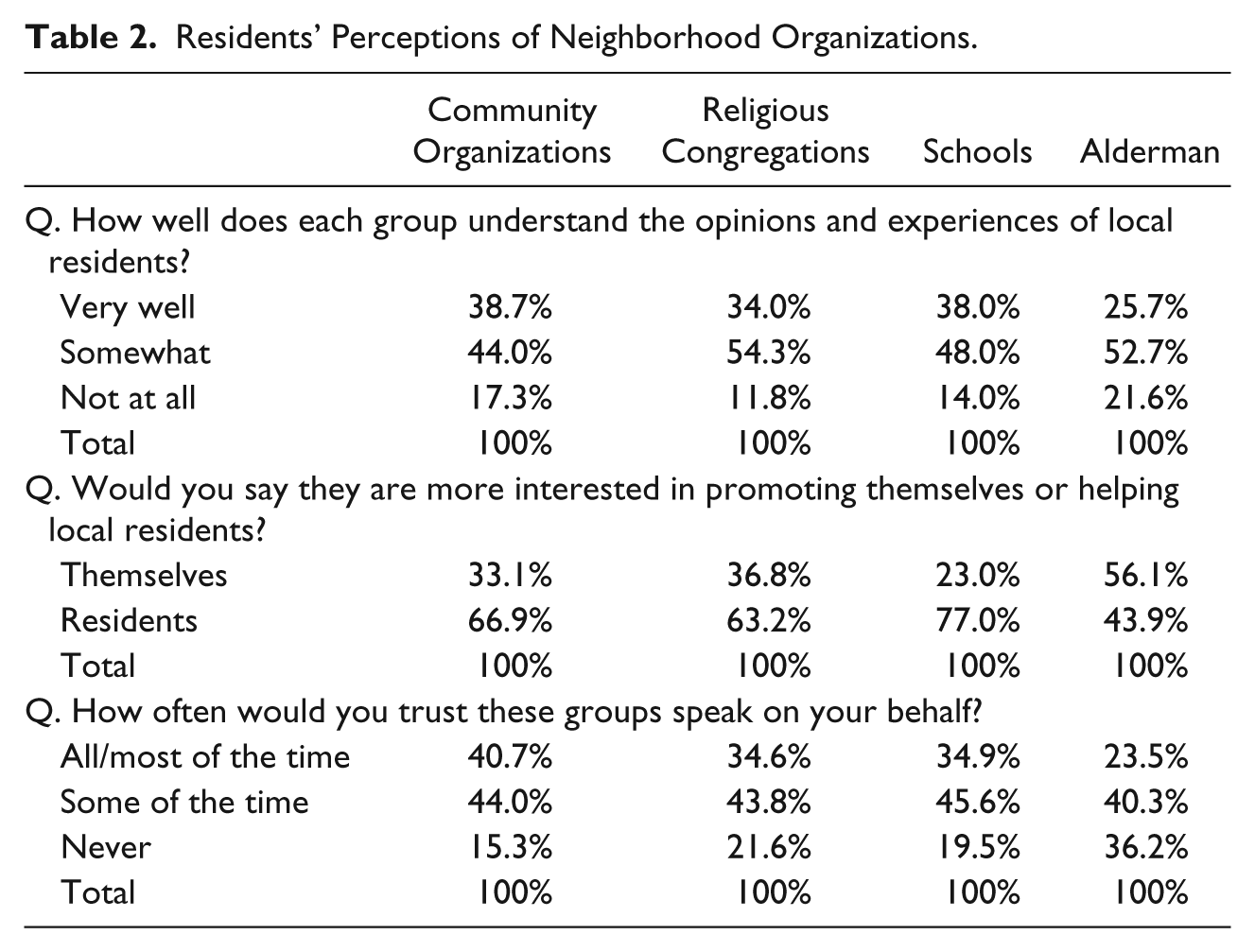
For the second question, “Would you say they are more interested in promoting themselves or helping local residents?” 56% of residents reported that aldermen mostly promote themselves. In comparison, many fewer residents believed that about community organizations, schools, and religious congregations (31%, 37%, and 23%, respectively).
Finally, we find that these differences between organizational types were particularly pronounced when we asked respondents’ how often they trusted each organizational type to speak on their behalf. Over a third of respondents (40%, 35%, and 35%, respectively) say that community organizations, religious congregations, and schools can be trusted to speak on their behalf all or most of the time, whereas this response is flipped for aldermen—36% of residents report that their alderman can never be trusted to speak on their behalf.
The results of the mixed-effects ordinal logistic regressions shown in Table 3 reveal that these perceptions regarding the representative legitimacy of these different types of neighborhood organizations do vary significantly by organizational type (see “Subject variance” row). In this analysis, each organizational type was systematically compared with community organizations, as the default category. Compared with the three different neighborhood organization types, respondents reported a significantly more negative perception of their alderman’s representational potential across all three questions, supporting concerns in literature about declining trust in politicians and formal electoral politics. Not shown previously in the literature, however, is our finding that residents viewed nonelected neighborhood organizations as potentially much better suited to play a representative role.
Perceptions of the Representational Potential of Neighborhood Organizations: Mixed-Effects Ordinal Logistic Regression Model Estimates (and Standard Errors).

p ≤ .05. **p ≤ .01. ***p ≤ .001.
There were no significant differences between perceptions of community organizations, religious congregations, and schools in their ability to “understand community needs.” However, residents perceived schools as being slightly more likely to “promote resident’s interests,” as compared with community organizations. On the question of trust, respondents were slightly less likely to trust religious congregations to speak on their behalf compared with community organizations.
Factors Influencing Residents’ Trust in Organizations to Speak on Their Behalf
The next set of analyses explores whether these findings regarding trust in different organizational types hold true after controlling for individual- and community-level factors. Using two regression model specifications—one with all eight communities and one without Washington Park, which may be an outlier skewing the analysis—the main finding holds: Respondents are significantly less trusting of aldermen to speak on their behalf compared with the other three types of organizations (see Table 4, Columns 1 and 2). In addition, respondents perceived community organizations as the type of organization they most frequently would trust to speak on their behalf.
Perceived Trust in Potential Neighborhood Representatives: Mixed-Effects Ordinal Logistic Regression Model Estimates (and Standard Errors).
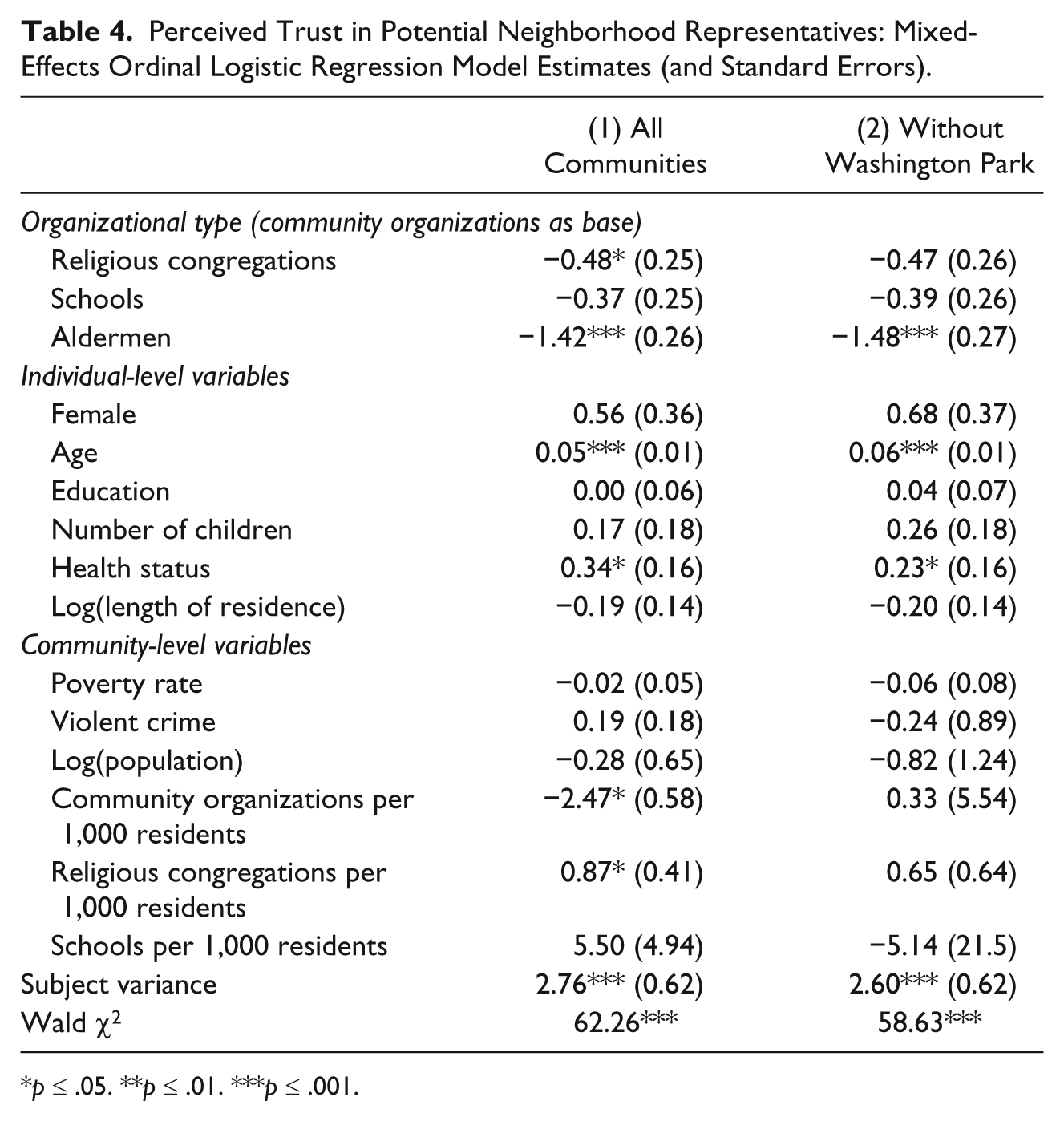
p ≤ .05. **p ≤ .01. ***p ≤ .001.
Only two individual factors are significantly associated with variations in respondents’ trust in community organizations: age and health status. Compared with young respondents, older residents tended to greater trust in neighborhood organizations to speak on their behalf, and there is also a positive association between health status and trust in community organizations. Both of these individual factors may be rooted in experience and knowledge about local organizations; that is, as one ages, you have more experience engaging with organizations in your community, and individuals with a good self-reported health status (compared with those who report lower levels of health) are more likely to have the time and capacity to engage with community organizations.
Interestingly, the community-level factors we explored do not help explain the relationship between residents and trust (see Table 4). In other words, despite varying levels of poverty and violent crime rates, residents in different neighborhoods are equally as likely to have low trust in aldermen to speak on their behalf and higher trust in community organizations and schools. While in the overall model it appears that the density of organizations may have a negative relationship with trust in community organizations (Column 1), once Washington Park is excluded from the analysis this effect is erased. As seen in Table 1, Washington Park has an extremely high number of religious congregations and is an outlier on that variable. Once it is removed, the density of organizations is no longer significant, and neither is the slightly lower degree of trust in religious communities. It appears that in this, the most troubled of the neighborhoods we studied, there are more congregations but residents trust them less.
Discussion
This research investigated differences in how residents of low-income communities view local organizations’ potential to serve representative roles and the factors influencing their perspectives. We found that residents viewed nonelected neighborhood organizations as understanding their experiences and promoting the interests of their community better than their elected officials. Residents also viewed those alternative representatives—especially community organizations and schools—as more trustworthy to speak on their behalf, and this is true even after controlling for individual- and community-level factors. By including those control variables, and finding those variables do not significantly influence the relative levels of trust in neighborhood organizations to serve as representatives, we see that differences in expectations are widely held without systemic bias. As a result, we conclude that expanding ways to include neighborhood organizations in local and regional decision making may be one method of mediating known political inequality in urban, low-income communities of color.
These implications are notable for those concerned about the well-being of urban governance. While recent studies have raised questions about the legitimacy and accountability of nonelected community representatives (Montanaro 2012; Swindell 2000), this study provides evidence that, at least in some marginalized communities, neighborhood organizations may be seen as more legitimate representatives than elected officials. We see this as practically important information for designers of participatory processes as they go about recruiting potential organizational representatives. The voices of these organizational representatives can be taken seriously, and their concerns should be weighed carefully by decision makers, and not placed on a second tier of influence compared with elected officials.
That said, while this research points to significant potential for neighborhood organizations to strengthen democratic processes in these communities, much more thought needs to go into how this can be done to achieve authentic voice for residents. The fact that many residents trust community organizations to speak on their behalf is important, but trust can be abused and “over-interpreted” to mean carte blanche discretion. This might be exactly what residents are rejecting from their elected officials. Although there is no single universal remedy for leveraging residents’ trust and strengthening representative roles, scholars have emphasized the need for organizations to communicate with and empower affected constituencies through collaborative and participatory processes (Guo and Musso 2007; Hardina 2005; Montanaro 2012; Mosley and Grogan 2013). Without frequent and meaningful communication and understanding of the everyday difficulties of community residents, their representation can be skewed toward the opinions of a few community elites or self-selected informants (McQuarrie 2013). To maximize democratic potential, organizations with clear, established links to residents should be preferred.
These findings also leave open the question of whether residents believe certain organization types are appropriate to speak on their behalf for particular types of issues, but not all issues. For example, would a social service organization be trusted to speak on a wide range of issues on behalf of the community, or only those related to social problems? This will be an important question for future research, but to achieve accountable and responsive representation on a variety of issues and concerns, a diverse group of neighborhood organizations should be sought to provide representative input into matters of local concern.
On that point, this article also points to opportunities for leaders of community organizations, religious congregations, and schools in marginalized communities. Despite the fact that trust in these organizations is higher than trust in local elected officials, it is still not as strong as it might be. Although these organizations are often considered an important voice for the poor and segregated urban communities they serve, less than half (35%−41%, depending on organizational type) of residents trust them most or all of the time, and there may be very good reasons for this. Research has been mixed regarding the degree to which community-based organizations (CBOs) advocate on the same issues their constituents care about (Jun and Musso 2013; Swindell 2000). In addition, with limited and stagnating resources, human service organizations often focus on delivering services, rather than nurturing low-income residents’ civic skills and engagement (Bolduc 1980; Cnaan 1991; LeRoux and Goerdel 2009); the membership of churches in these communities often does not include current community residents, which undermines the churches’ attachment to the community and residents’ trust (McRoberts 2003; Taub et al. 1977); and schools are frequently perceived to be unduly politically influenced (Henig and Rich 2004). Participatory measures may be considered as threats to efficiency, financial sustainability, or managerial controls in the short term. However, participatory processes may actually strengthen organizations’ competitiveness and improve the chance for organizational survival (Guo and Saxton 2010). CBOs that have ongoing communication with residents may be able to identify challenges in the local environment earlier and by advocating for residents’ interests may strengthen their legitimacy with funders and constituencies.
Although we contribute important new primary data on how representation is thought about in underrepresented communities, this study has limitations. First, this project is limited in its geographic scope, and our data did not allow us to include some important individual-level variables, like income and organizational usage, in the analyses. Second, more detailed querying of residents’ views is required to understand why they may prefer some organization types over others, and on what issues. Although there are some preliminary studies that examine such criteria (Chung, Grogan, and Mosley 2012), larger scale studies are needed. Third, we also lack the ability to distinguish between more fine-grained subgroupings of organizations (e.g., public vs. private schools, advocacy organizations vs. mental health clinics, etc.) or to understand other qualities of neighborhood organizations (e.g., size, popularity, effectiveness, etc.). Last, the cross-sectional nature of the survey data also limits our ability to determine the causal direction of the findings. Considering the long-term process required for building trust, our data are too limited to interrogate potential reverse causalities or to capture the potentially dynamic relationship between trust and individual- and community-level factors over time.
Nonetheless, this research should be viewed as an important first step in understanding the representational potential of local organizations in vulnerable communities. Using community organizations, religious congregations, and schools as a proxy for community members’ views would be preferable to the residents in this study as opposed to relying on local elected officials. Providing opportunities for these organizations to become involved in participatory processes may help address the problem of political inequality, because residents believe these organizations understand their views and trust them to speak on their behalf. With formal representation channels viewed as untrustworthy, residents in marginalized communities may rely on community organizations to leverage their representative role to reduce political inequality.
Footnotes
Appendix
Survey Questions on Different Organization Types in Neighborhoods.
Now, we have some questions about different groups in your neighborhood.
| Q. | How well do you think each of the following groups in your neighborhood understand the opinions and experiences of local residents? Please think about your own neighborhood. | ||||
| Very well | Somewhat | Not at all | |||
| A. | First, would you say your neighborhood religious congregations understand the opinions and experiences of local residents very well, somewhat, or not at all? | 1 | 2 | 3 | |
| B. | What about your alderman’s office? (Would you say they understand the opinions and experiences of local residents very well, somewhat, or not at all?) | 1 | 2 | 3 | |
| C. | What about your neighborhood schools? (Would you say they understand the opinions and experiences of local residents very well, somewhat, or not at all?) | 1 | 2 | 3 | |
| D. | What about your neighborhood community organizations? (Would you say they understand the opinions and experiences of local residents very well, somewhat, or not at all?) | 1 | 2 | 3 | |
| Q. | For that same list, would you say that groups like this in your neighborhood are more interested in promoting themselves or helping local residents? | ||||
| Promoting themselves | Helping residents | ||||
| A. | Would you say that your neighborhood religious congregations are more interested in promoting themselves or helping local residents? | 1 | 2 | ||
| B. | What about your alderman’s office? (Would you say your alderman is more interested in promoting himself or herself or helping local residents?) | 1 | 2 | ||
| C. | What about your neighborhood schools? (Would you say they are more interested in promoting themselves or helping local residents?) | 1 | 2 | ||
| D. | Finally, what about your neighborhood community organizations? (Would you say they are more interested in promoting themselves or helping local residents?) | 1 | 2 | ||
| Q. | For that same list, how often would you trust these groups to speak on your behalf? | ||||
| All of the time | Most of the time | Some of the time | Never | ||
| A. | Would you trust your neighborhood religious congregations to speak on your behalf all of the time, most of the time, some of the time, or never? | 1 | 2 | 3 | 4 |
| B. | What about your alderman’s office? (Would you trust your alderman to speak on your behalf all of the time, most of the time, some of the time, or never?) | 1 | 2 | 3 | 4 |
| C. | What about your neighborhood schools? (Would you trust them to speak on your behalf all of the time, most of the time, some of the time, or never?) | 1 | 2 | 3 | 4 |
| D. | Finally, what about your neighborhood community organizations? (Would you trust them to speak on your behalf all of the time, most of the time, some of the time, or never?) | 1 | 2 | 3 | 4 |
Declaration of Conflicting Interests
The author(s) declared no potential conflicts of interest with respect to the research, authorship, and/or publication of this article.
Funding
The author(s) disclosed receipt of the following financial support for the research, authorship, and/or publication of this article: The authors gratefully acknowledge financial support from the Center for Health Administration Studies at the University of Chicago.