



Abstract
Many studies on energy generation have focused on large-scale systems. But as the search for alternative sources of clean energy becomes imperative, there is the need to examine how local governments leverage their authority on land use to permit small-scale energy facilities. This study examines various factors shaping policy adoption on distributed renewable energy generation through the lens of transaction-cost politics. It deviates from existing land-use perspectives, which usually highlight competition between traditional land-use forces to capture the gains from policy. Policy adoption here implies that actors in their exchanges have been able to identify and reduce the transaction costs that would otherwise have prevented citizens from harvesting renewable energy at their place of residence. These actors minimize transaction costs by making use of the transaction resources available to them in the political market. These resources could ease barriers to political contracting and enable actors to shape policy. They include green firms, network memberships, dedicated staff for the sustainability effort, forms of government, and educated populace, which the study found significant in shaping the adoption of zoning codes that permit distributed renewable energy generation.
Keywords
Introduction
Local governments are institutionalizing distributed renewable energy generation by leveraging their authority on land use to permit and promote small-scale energy systems located at customer site. This is a policy innovation as it is a novel idea and practice for many local governments adopting it. It is novel as this goes against the conventional notion of energy generation from large-scale systems represented by big power plants and expansive transmission and distribution networks. It also redefines the role of local government in advancing the sustainability agenda—one that does not deal mainly with traditional and powerful players in the energy market, such as federal and state governments, energy companies, electric utilities, and regional organizations, but, more importantly, with residents, homeowners associations, or local communities, who are playing an important part as producers and end-users of energy.
Distributed renewable energy generation is still at its nascent stage. Its relevance, however, to the discourse on sustainability is becoming apparent as both government and private sectors are finding ways to promote clean energy and mitigate climate change. Energy generation in the United States comes largely from fossil fuels with petroleum imports added to the mix to meet overall consumption. Energy consumption for 2011 reveals that renewable energy constitutes only 9% of the total. Petroleum tops the list at 36%, followed by natural gas at 26%, coal at 20%, and nuclear electric power at 8% (U.S. Energy Information Administration 2012). Of the total energy generated, electric power consumes 40% largely using coal and natural gas. In an inventory of greenhouse gas emissions and sinks from all U.S. anthropogenic sources between 1990 and 2009, electricity generation is ranked highest in terms of net emissions beating all other sectors including transportation, industry, agriculture, commercial, and residential (U.S. Environmental Protection Agency 2011). In other words, electricity consumption supported by large-scale nonrenewable energy systems leaves a huge environmental footprint.
There are contending views about the appropriate type of policies for renewable energy generation. There are those raising questions about the economic wisdom of technology mandates and government subsidies such as pollution standards, preferential tax treatments, feed-in-tariffs, and Renewable Portfolio Standards (e.g., Borenstein 2012; Schmalensee 2012). They recognize the idiosyncratic nature of renewable energy generation and propose alternative ways to estimate costs and efficiency outcomes to evaluate policies. And there are those who see sustainability and climate change as a complex public good issue that requires multilevel governance with state and local governments taking an active role (e.g., Betsill and Rabe 2009; Portney 2003; Rabe 2008; Rowlands 2010). In many of these studies, the focus is on large-scale energy systems and distributed renewable energy generation is treated, at best, as a peripheral issue. But as the search for viable solutions continues, it is worthwhile to examine this initiative at the local level and raise questions as to the following: What would explain the variance in local response to challenges in land use and energy demands? Why are some local governments adopting the policy of distributed renewable energy generation whereas others are not? What are shaping policy adoption?
This study answers these questions through the lens of transaction-cost politics. Policy adoption implies that political actors in their various exchanges have been able to identify and reduce the transaction costs that would otherwise have prevented citizens from harvesting renewable resources at their place of residence. To facilitate their exchanges, these actors devise a contractual arrangement in the form of a land-use policy. Like any contract, a policy is incomplete as actors have bounded rationality to foresee all future contingencies, which give rise to uncertainty and opportunistic behavior among actors. The ex ante difficulty in designing such policy and the ex post uncertainty in enforcement represent transaction costs that have to be overcome if the policy is to be adopted. This study teases out the political exchanges and the attendant transaction costs arising from a policy on distributed renewable energy generation. It examines these transaction costs as barriers to policy adoption and identifies the transaction resources that enable actors to overcome these barriers.
The next section discusses the political market of land use. It presents existing perspectives on land-use transactions and adopts the view that land-use policy is a form of political contract. The section also presents the nexus between land use and sustainability. This is followed by an overview of large-scale and distributed renewable energy systems. It includes a discussion of the issues associated with adopting these systems. Next is an analysis of the transaction costs involved in distributed renewable energy generation and the transaction resources available to players to minimize these costs. The data and measures for testing hypotheses are then presented. The study concludes by summarizing the findings and providing some directions for future research.
Political Market of Land Use
Existing Perspectives on Land-Use Transactions
Land-use transactions have been examined in various ways. They have been framed mainly in terms of competition between land-use forces to capture the gains from policy. The classic Tiebout model is one example. Tiebout (1956) viewed the transactions between local governments in terms of competition for growth and development. Local governments provide bundle of goods and services to satisfy consumer-voters’ preferences. Citizens register their preferences by “voting with their feet,” that is, choosing and residing in communities that best satisfy their preferences for public goods (Tiebout 1956). Local governments thus pursue the optimum and stable size for their communities. They compete with other local governments by attracting residents that will enhance local development to achieve this optimum size. “Proper zoning laws, implicit agreements among realtors” are mechanisms by which this is achieved (Tiebout 1956, p. 420). Extending the Teibout model, Peterson (1981) proposed a functional division of policy arenas between national and local governments—that is, development policies for local governments, redistributive policies for national government, and allocational policies for both. He argues that cities have unitary interest, that is, to maximize their tax base. Local governments are concerned about providing for the needs of their residents and competing for growth to attract residents with high tax potential. They are more concerned about economic productivity and operational efficiency than redistributive goals (Peterson 1981).
Interest group models also see policy as the outcome of power play between competing groups, but predict that those groups with political resources dominate the competition. In examining efforts at reforms in municipal government, urban education, and civil rights, Miller (1985) found policy reforms to be reflections of the preferences of high-demand groups or those with the capacity to induce change based on their preferences. These policies are decided not by the median voter but by the institutional preferences of particular groups such as those in high socioeconomic status (Feiock 2006; Miller 1985). The interest group model of local politics predicts that policies would likely favor groups that are able to deliver political resources to local officials (Lubell, Feiock, and Ramirez de la Cruz 2009). This means that the bargaining dynamics is defined by the political powers of the demanders and the inclination of local authorities to supply policies to favor particular interests (Feiock 2006).
Growth machine politics predicts that development interests would mobilize and articulate their demands to capture the concentrated benefits from land-use policies (Lubell, Feiock, and Handy 2009; Molotch 1976). Land is a “market commodity providing wealth and power,” and those “who have most to gain or lose in land use decisions” take particular interest in it (Molotch 1976, pp. 309, 314). Because they are well-organized, well-financed, and closely allied to politicians, development interests are likely to edge out the competition (Lee and Feiock 2011; Molotch 1976). Local governments become the arena where land-based interests “compete for public money and attempt to mold those decisions which will determine the land-use outcomes” (Molotch 1976, p. 312). Growth machine politics benefits only a few and has negative consequences such as pollution, traffic congestion, and natural resource degradation (Molotch 1976). The political nature of growth controls, such as zoning, can also be exclusionary to the effect that low-income residents are prevented from living in certain neighborhoods (Charles 1999).
Environmental politics has ushered in the sustainability movement, which brings into focus the interdependence of human and natural systems and the integration of environmental health, quality of life, sustainable communities, and national and local governance into the development equation. Smart growth then became an important concept to pursue local growth and sustainability. Generally, it involves land-use policies that tie economic growth to the quality of community life (Portney 2003). For planners, it means “promoting denser development and protecting agricultural and wild land from developments” (O’Connell 2009). Sprawling development or “urban sprawl” is anathema to smart growth. Various policy instruments have been implemented to manage growth and contain urban sprawl, including land preservation, inner city redevelopment, urban service boundaries, incentive zoning, smart growth zoning, density bonuses, development impact fees, and transfer of development rights (Feiock, Tavares, and Lubell 2008; O’Connell 2009; Ramirez de la Cruz 2009). Thus, along with the agenda of sustainability and smart growth came the formation of constituencies for the environment. With environmental issues gaining currency, citizens and interest groups advocating for the environment have grown over the years. They are proving to be a counterforce to builders, realtors, and other development interests in shaping policy outcomes. They have strong preference for measures advancing sustainability. The activism of these groups can be a factor to induce local governments to enact sustainable land-use policies. The supply of environmental goods in the political market is contingent on how proenvironment groups can counter development interests and provide electoral victory to local politicians.
The political market framework has also been used to examine the transactions among land-use interests represented by demanders and suppliers (Feiock 2006; Lee and Feiock 2011; Lubell, Feiock, and Ramirez de la Cruz 2009). The demanders (e.g., businessmen, realtors, environmental groups, and other private interests) exert political pressure to advance policies that favor them, and the suppliers (e.g., politicians and other government authorities) provide public goods and services in response to these demands. Beneficial exchanges are impeded by transaction costs—such as those associated with the difficulty in reaching agreements, contradictory goals among constituencies, and uncertainty in securing commitments from legislators and implementers—which can affect policy adoption and enforcement (Feiock 2006; Feiock, Tavares, and Lubell 2008; Horn 1995). Transactions can lead to a policy choice or decision. Institutions play an important part as they mediate the transactions of political and economic forces and, thus, influence the policy process and outcome (Feiock 2006; Kwon and Feiock 2010; Kwon, Lee, and Feiock 2010; North 1990). They either constrain or incentivize behaviors of both demanders and suppliers.
Land-Use Plan and Policy as Political Contract
This study situates land-use transactions in the political market. However, it frames these transactions not mainly as competition between traditional land-use forces but more in terms of political contracting between individuals and groups, who are finding ways to adopt a policy. There are attendant hazards in forging a contract in the political market. These hazards are transaction costs, which can serve as barriers to political contracting. There are ways to mitigate them and this study identifies transaction resources as policy levers to advance a land-use plan or policy.
A land-use plan is a “collective contract between various land use interests and the local government” (Dawkins 2000, p. 511). It is intended to secure cooperation among various parties by stipulating required future actions and the rewards and penalties for compliance and noncompliance (Maser 1998). Collective action is facilitated through the joint rationality of participants who see benefits accruing to all concerned following compliance. Future land uses are delineated and safeguards are devised to mitigate uncertainties. These uncertainties represent transaction costs that arise from participants’ behavior, implementation, context, and other unforeseen events. Thus, a land-use plan emerges when “landowners face transaction cost impediments to establishing credible voluntary land use commitments” (Dawkins 2000, p. 511). It reduces uncertainties by binding participants to specified development patterns and acceptable behavior. Like a contract, it defines long-term relations by stipulating ways to deal with potential problems and contingencies. It serves as constraint for socially disadvantageous land-use practices.
A land-use plan provides the blueprint for development. It is much like a constitution, which, as Dixit (1999) noted, does not specify all the rules and procedures that have to be followed for every contingency and is interpreted and applied as context shifts. Land-use plan changes as local governments redefine the character of development they envision for their communities. It is realized through land-use policies by way of regulations and incentives. Traditionally, these policies are intended to delineate and maintain suitable land uses, control sprawl, and preserve critical landscapes. Smart growth policies have been applied in the recent past to guide urban development by managing change in how people use land and pursue growth. So apart from zoning regulations, the policy toolkits have expanded to include other measures like density bonuses and the transfer of development rights.
Land-use planning and policy making are not mere technical exercises that occur in a vacuum. They are subject to political contracting between those who have a stake in the plan or policy such as government, local community, and organized interests. There are costs in carrying out transactions in the political market and in negotiating and implementing contracts. They can pose as barriers to policy adoption and can determine policy outcome. Adopting this perspective calls for identifying the stakeholders or the demanders and suppliers, teasing out the transactions between them, identifying the transaction costs involved, determining who bears the costs, finding ways to mitigate these costs so beneficial transactions can be realized, and understanding how institutions and context affect political contracting. Local government structures, legislative representations, administrative arrangements, socioeconomic conditions, for example, have been found to affect land-use policies and outcome (Feiock 2004; Feiock, Tavares, and Lubell 2008; Lubell, Feiock, and Ramirez de la Cruz 2009; Ramirez de la Cruz 2009). Once enacted, land-use plan and policies create constituencies, rules, and relationships, which may be costly to reverse. Existing land-use framework can inhibit change or may not be amenable to sustainability goals and objectives. As Dixit (1999, p. 25) noted, policies have long-lasting effects as “they create facts, institutions, and expectations that have their own momentum and acquire at least some of the same durability as a change in the constitution itself.”
Land Use and Sustainability
Land use is inextricably linked to sustainability. Land-use patterns and land-cover change affect the environment and have an impact on local communities across jurisdictions. Greenhouse gas (GHG) emissions can be traced to buildings, suburban sprawl, and dwindling forest reserves. It is estimated that about 85% of GHG emissions in the United States are carbon dioxide where “much of which is caused by the buildings and land use patterns that local land use plans and regulations create, regulate, and approve” (Nolon 2013, p. 274). More and more of the pollution affecting communities is traceable not only to point sources that are easily identifiable, such as factory smokestacks, but also to nonpoint sources that come from multiple locations and are, therefore, difficult to monitor and control. This has highlighted the relevance of land-use plan and policies to mitigate nonpoint pollution sources, thereby, localizing environment and climate change issues that have, for the most part, occupied federal and state regulations. Thus, land-use mechanisms—such as zoning ordinances, site planning, building codes, transportation planning, infrastructure investments, resource management, environmental review—have increasingly become an important part of the sustainability agenda. They have brought local governments at the forefront of the discourse with their authority over land use and their knowledge of local conditions.
A component of sustainability is renewable energy. Land use has a critical role to play in facilitating or impeding renewable energy generation. The siting of renewable energy plants is location specific and land intensive. The operation of wind and solar farms, hydroelectric and, to a large extent, biomass plants is dependent on the availability of natural resources in the area where these can be harvested to produce electricity. In contrast, a coal-powered plant can operate by importing coal from distant places or even from foreign lands; that is, renewable energy is tied to the land’s unique characteristics. Furthermore, renewable energy plants are often sited away from urban areas where the requisite infrastructure to produce and deliver electricity, such as transmission lines and water resources, is not readily available (Powers 2013; Outka 2011). They are also land intensive where the installation of these plants can encroach on existing land cover and land uses, which could have unintended effects. The food–fuel debate, for instance, highlights the conflict between sustainable energy and food security objectives as seen in the conversion of arable lands to biofuel production. Another issue is “energy sprawl” where land-use requirements of existing technologies for future energy demands are estimated to have negative ecological consequences (McDonald et al. 2009). The impact of renewable energy facilities on species protected under the Endangered Species Act presents another siting challenge (Powers 2013). These land-related constraints can limit siting options and generate resistance to renewable energy. Thus, plans and policies relating to land use and energy, or the absence thereof, can further or frustrate the sustainability agenda.
Land, as input to development and sustainability, can be a contentious issue in light of the competing and conflicting claims of its use. Installing renewable energy systems, whether large or small, can impose costs on others or result in negative externalities. A local community, for instance, would likely oppose renewable energy projects that could downgrade property values. Issues concerning turbine noise, shadow flicker, ice throw, and safety threats from collapsing turbines have been raised against wind devices installed in neighborhoods. The siting of wind farms has also been a popular subject of local opposition because of issues ranging from noise pollution, spoiled scenery to the danger these farms pose to birds and bats. Glare from photovoltaic (PV) solar panels has been raised as well, especially by residents in dense neighborhoods. The right to install these solar panels and enjoy unimpeded solar access has been fought over by neighbors, even brought to the courts, litigated, and subjected to public policy (see, for example, Rogers 2008a, 2008b). Energy generation is a land-use issue as siting, land requirements, compatibility with existing and adjacent land uses, public welfare and safety, and aesthetics commonly arise because of the competing claims on land and the externalities associated with exercising property rights.
Renewable Energy Generation
Large-Scale Renewable Energy Systems
Land-use issues concerning energy generation are varied and can be specific to the type of energy systems adopted or planned for installation, that is, whether large scale or distributed and small scale. Energy systems are usually classified as either large or small scale by the amount of energy produced (Fuller 2008). Large-scale systems generate electricity either at a utility scale (e.g., producing about 5–50 megawatts) or a commercial scale (e.g., producing about 1–4 megawatts). Small-scale facilities can have a capacity of up to 2,000 kW or 2 megawatts and can be off-grid or grid-tied systems (Pitt 2008).
Many large-scale energy systems are powered by fossil fuel and they have siting advantage over renewable power plants (Kahn 2000). They are located near urban areas and industrial zones, whereas renewable energy systems—for example, wind and solar farms, biomass, hydroelectric, geothermal power plants—are often sited in remote, rural areas or in open spaces where resources abound but are far from electrical transmission lines and basic infrastructure such as roads, water supply, drainage, and sewer connection (Kahn 2000; Powers 2013). The capacity of existing electricity grid to accommodate intermittent renewable energy supply remains an issue. Existing transmission capacity is limited and has been underfunded by vertically integrated utilities, whereas the costs of acquiring transmission right-of-ways are steep. Often sited far away from urban centers, renewable energy systems also have to deal with stringent environmental laws protecting plant species, endangered animals and their habitat. Furthermore, these facilities seem to be at a disadvantage when selecting the venue for permitting. Because fossil fuel power plants enjoy a certain amount of flexibility when it comes to siting, project sponsors could choose the lead agency to approve their permits and, oftentimes, state regulatory agencies are the likely option because of one-stop shops, centralized state reviews, and experienced civil servants (Kahn 2000). This is not always the case with large-scale renewable energy systems, which have geographic constraints and statutory exemptions to deal with. Their project sponsors often have to do business with federal and local governments and they would relatively have a harder time getting approval because of hurdles from national laws, for example, National Environment Policy Act, and the uncertainty of local politics and regulations (Kahn 2000).
Despite the general support for the environment, local opposition to large-scale renewable energy systems is common. Public safety, aesthetics, spoilt scenery, and avian and bat mortality are issues often raised. Opposition arises because of people’s unfamiliarity with the technology and the lack of consultation to get local support. The need to communicate the direct benefits of these projects to affected communities—for example, new sources of income and employment to communities undergoing depopulation and economic decline—and to get them involved in the project development process can be crucial in winning stakeholders’ buy-in (Walker et al. 2007).
Distributed Renewable Energy Generation
Distributed renewable energy generation is small-scale, decentralized applications of clean renewable technologies, such as solar PVs and small wind turbines, which are commonly sited at the customers’ home or place of work (Ackermann, Andersson, and Soder 2001; Carley 2009; Pepermans et al. 2003; Pitt 2008). The scalability of renewable system technologies makes the adoption of a policy that promotes their use at the local level feasible. Local governments have used residential zoning codes to permit generation of, say, 4 to 100 kW, to power homes and small buildings.
Distributed renewable energy systems enjoy some advantages over large-scale facilities. For instance, they could easily be deployed given the right policy environment and a conducive permitting process at the local level. They are also not land intensive and could, therefore, curb energy sprawl. They require only a small spot of land and the permission to install in existing property. Unlike wind and solar farms, they are not high profile, thereby attracting less political attention from special interest groups and organized landowners and developers (Pursley and Wiseman 2011). They could be an important addition to the portfolio of initiatives directed toward increasing efficiency in electricity generation, transmission, and distribution; that is, they could entice communities to find alternative use to existing but otherwise untapped resources, such as rooftops and vacant lot, to generate electricity (Wang, Green, and Davis 2011). They could be a means to avoid systemic losses from long-distance transmission, mitigate market power held by utilities and consolidated power sellers, lower electricity cost to consumers, and promote consumer control over distribution (Calfee and Weissman 2012).
With the authority to regulate land use, local governments hold the key to distributed energy systems. The responsibility to oversee the siting, installation, and deployment of small-scale energy systems and to formulate the necessary rules falls under the purview of local governments. Federal and state governments are mainly responsible for large-scale facilities and have enacted various regulations and incentives accordingly. With distributed renewable energy, local governments are in the driver’s seat. They are being thrust into the sustainability discourse as renewable energy technologies are finding their way to individual households and communities, as nonpoint pollution sources are increasingly posing a threat, and as proximity to and knowledge of local conditions are becoming more salient to inform policy. But the deployment of distributed renewable energy technologies has yet to be institutionalized in land-use policies. Many local governments have yet to issue the rules to define and clarify their use. Pursley and Wiseman (2011, p. 915) found that most local governments of large cities have municipal codes that
barely acknowledge the existence of distributed renewable. Their buildings codes do not contain minimum standards for the construction or installation of these technologies. They do not describe how solar panels are to be mounted on roofs, for example, or minimum cable strengths required to hold up wind turbines. Their zoning codes also generally fail to include wind turbines or solar panels within permitted accessory uses or to place minimum setback or maximum height requirements on wind turbines.
The absence of rules on land use and distributed renewable energy could not have been simply an oversight. Distributed renewable energy systems have been viewed as locally undesirable land uses (LULUs) and have been historically opposed by landowners and homeowners alike (Rule 2010). Resistance arises from “fears that the devices could diminish neighborhood aesthetics, disturb nearby landowners, or threaten property values” (Rule 2010, p. 1236); that is, there is a perception that these devices could impose local costs that could far outweigh their local benefits. Policies promoting distributed renewable energy would likely attract opposition from local communities, which may not necessarily be the case with other sustainability policies, such as smart growth that restricts growth or real property development, or energy efficiency involving improvements inside a house or building such as installing energy-efficient appliances, weather proofing a house, or greening a building. It has been argued that local opposition to policies promoting distributed renewable energy might even be stronger than large-scale systems. That is,
[a]n ordinance that invites distributed renewables into a municipality can arguably create greater uncertainty for local voters than an ordinance authorizing the siting of a single waste disposal site or power plant. Unlike large-scale, concentrated LULUs, distributed renewables are typically installed at unpredictable locations throughout host communities over time. Individual voters considering whether their town should host a large LULU often already know where it would be sited and thus may have greater certainty about how it could impact them. In contrast, distributed renewables-friendly ordinances create the risk that any resident could ultimately see a small wind turbine or unsightly solar panel array installed next door. (Rule 2010, p. 1236)
Existing regulations are also serving as barriers to the deployment of distributed renewable energy systems. Height restrictions in zoning ordinances—say, not allowing structures to be taller than 35 ft, which is a height too low for wind power according to experts—have prevented small wind turbines from being installed. These restrictions have been imposed for decades “to promote fire safety, and to preserve light, air, and a rural ambiance” (Rule 2010, pp. 1238–39). There are also zoning regulations and private property restrictions that prohibit renewable energy devices or have stringent application requirements and review procedures. Some building codes and homeowners’ association covenants, for example, prohibit solar panels to be mounted on rooftops or do not provide guidelines on the right of access to sunlight or trees causing shading constraints. Like solar PV systems, the installation of wind turbines would require electricity and building permits, and often would also need planning and zoning permits because they have more potential impact on the environment and surrounding land uses (Pitt 2008).
Where there are no rules to guide property rights in local communities or where existing regulations are posing as barriers, deployment of distributed renewable energy systems would be impeded. They create uncertainties, which could serve as disincentives for individuals and households to go through the process of application and permitting. Setting the appropriate land-use rules concerning distributed renewable energy systems could obviate these uncertainties. Local governments could, therefore, use their land-use authority through zoning to permit distributed renewable systems. Zoning is a land-use tool “to determine what kinds of development activities can take place” and “to delineate areas for special environmental protection” (Portney 2003, p. 112). It stipulates the land uses allowed within a designated boundary ensuring that all real properties in the area conform to the same set of rules (Fuller 2008).
With residential zoning codes that permit or allow on-site electricity generation through renewable resources, permitting procedures, standards for the use of the technologies (e.g., setback and height provisions, noise and aesthetic controls, safety standards, color, design), and other requirements are clarified and managed. The presence of such code can result in more simplified and streamlined procedures, where applications can be approved over-the-counter without rigorous review process. A zone has a “permitted” use designation when renewable energy application is allowed outright for as long as it complies with regulations, design standards, and other requirements (Pitt 2008). A “conditional” use zone, however, would require detailed application for a “conditional use permit” from local zoning authority and would entail a rigorous review process including, in most cases, the conduct of public hearings (Pitt 2008). The process can be time consuming, litigious, and costly. The requirements attached to these conditional or special use permits can be so stringent so as to dissuade residents from pursuing the project. Permitted use, however, implies the establishment of renewable energy overlay zones that “give[s] pre-approval for siting of renewable energy generation in designated geographical locations . . . [and] offers the opportunity for a thorough assessment of available resources, and the impacts on natural and human inhabitants of the area” (Pitt 2008, p. xiii). It implies that local governments would have conducted a study to assess available renewable energy resources in the area—for example, the wind patterns or solar power resources in a community over time—and the impact of the technologies on landscapes, views, endangered species, and the environment in general. It could also reduce expenditures inasmuch as a case-to-case determination of applications for exemptions and conditional use permits and the conduct of hearings and reviews can have cost implications for both government and residents (Greaney 2011).
Notwithstanding the land-use authority of local governments and the salience they attached to sustainability issues, question remains why local governments advance environment-friendly policies; that is, why do some local governments enact residential zoning codes that permit distributed renewable energy generation whereas others do not? Viewed from a transaction-cost perspective, these local governments are likely to adopt such policies because resources are available to minimize transaction costs and facilitate policy adoption.
Transaction Costs and Resources
As discussed above, existing perspectives on land-use transactions highlight competition between countervailing forces. Competition arises as policy adoption has distributional consequences for players vying for concentrated benefits and avoiding concentrated costs. Growth machine politics, for instance, predicts that development interests would capture the gains from land-use transactions. The rise of environmental constituencies, however, is seen as a growing force to counter development interests. The Tiebout model sees competition between local governments in attracting residents with high tax potential. Competition between these forces, however, is muted in the case of distributed renewable energy generation because these large land-use interests do not have much stake in the policy process. Political contracting is mostly confined between local governments and residents, homeowner associations, or local communities in their efforts to adopt a land-use policy, which overlays a zone over residential areas and permits installation of clean energy technologies.
But like any political contracting in land use, the hazards of incomplete contracts are present. These hazards create uncertainties in transactions. The costs of these uncertainties could be prohibitive as to prevent beneficial exchanges from occurring. The conventional response to deal with transactions costs is to look for alternative institutional arrangements and governance structures—for example, formalizing property rights (North 1990), or vertically integrating the firm (Coase 1937; Williamson 2000), or assigning the transactions to appropriate public bureaucracies (Frant 1996; Horn 1995). This study looks instead into transaction resources that are available to players in the political market to minimize transaction costs. These resources could ease barriers to political contracting and enable players to shape policy adoption.
Heckathorn and Maser (1987, 1990) proposed a transaction resource space that defines the context for contractual relations. The transaction resource space has a resource frontier beyond which players in the political market would not be able to cover transaction costs with their endogenous resources and would tend to seek third-party support. Third-party intervention becomes necessary to provide exogenous resources so that players would be able to address any of the search, bargaining, and enforcement costs arising from the problems of coordination, division, and defection in contractual relations (Heckathorn and Maser 1987, 1990). For instance, if communication channels and enforcement mechanisms are lacking, a third party is called for to provide supplemental resources, say, coalition building or policing services. Transaction resources thus become a determining factor in contractual relations and provide a rationale for government regulation. In the words of Heckathorn and Maser (1987, pp. 71–72),
Abundant and cheap resources facilitate contracting. Even contracting problems which are quite complex and difficult can be solved endogenously. By contrast, if internal transaction resources are absent or costly, even simple contracting problems cannot be solved endogenously. That sets the stage for third-party intervention—in other words, regulation.
Taking cue from Heckathorn and Maser (1987), this study also underlines the relevance of transaction resources. In applying the political market perspective, however, it treats local governments as active players in the contracting process and views them not as an outside entity that gets involved in the process only when third-party support is needed. Transaction resources constitute the stock of resources that players are able to access to minimize contract and enforcement costs. They include fiscal resources, administrative capacity, communication channels, governance structures, political support, stakeholders’ buy-in, and enabling technology. Transaction resources also make up the resources found in the political market context that mediate or facilitate exchanges such as institutional arrangements, political ideology, community characteristics, housing stock, and electricity costs. These resources are able to minimize transaction costs by providing safeguards and certain degree of certainty to contractual relations; that is, the hazards to political contracting are addressed so that players collectively pursue the mutual gains that can be derived in forging a contract and in maintaining contractual relations.
The following section discusses the transaction costs involved in adopting a policy on distributed renewable energy and the transaction resources available to mitigate barriers to policy adoption.
Search Costs and Information Resources
In adopting a policy on distributed renewable generation, residents wanting to install new technologies, such as PV solar panels and wind turbines, have to deal with search and information costs. They would have to spend time and resources to discover if products and services are available, accessible, and affordable. Search and information costs would be steep for those not familiar with the technologies and this is particularly so when firms and contractors providing the products and services are absent or few. The slow diffusion of distributed renewable energy technologies has been traced to the lack of easily accessible and credible information and to high upfront costs, especially for PVs and wind turbines, which are capital intensive (Noll, Dawes, and Rai 2014). Poor information about cost and energy use could, in fact, hamper the efficient operation of the market for renewable energy technologies (Gillingham and Sweeney 2012). The amount of time and capital needed to acquire these new technologies could be substantial so as to disincentivize consumers to pursue transactions in the market.
The presence of a market with numerous green firms could be a resource to mitigate this type of transaction costs. It will not only bring down the upfront costs of installing the technologies but also the information and search costs that can pose as barrier for residents and homeowners to make informed decisions. The Lawrence Berkeley National Laboratory, for instance, has found that larger and more mature PV markets can be one of the underlying drivers that can “facilitate lower prices through greater competition and efficiency, more extensive bulk purchasing, and better access to low-cost products” (Barbose et al. 2013, p. 26). Other drivers include the characteristics of systems installed, sales tax rates, and administrative and regulatory compliance costs related to permitting and inspection processes, interconnection, and incentive applications (Barbose et al. 2013). The growth of green businesses and jobs has been attributed to many factors, which have been categorized according to the following: economic development, public finance, political environment, labor market, knowledge stock, Renewable Portfolio Standard, and other related policies (Bowen, Park, and Elvery 2013; Yi 2014). Thus, a large market for distributed renewable technologies can facilitate information search, can mean a conducive policy environment, and can build the confidence among consumers to try to adopt an innovation despite high upfront costs.
Minimizing search and information costs are critical for residents who bear, in large part, the cost of the transactions. They shoulder the initial cost of searching the right information for decision making. They are the main constituencies for the policy on distributed renewable energy generation. Local governments will likely adopt this policy if the support infrastructure supplied by green firms and contractors exists to serve local demands.
Involvement in sustainability or climate change networks can provide cobenefits for local governments. These networks are, in a way, similar to professional networks where knowledge is diffused among members and informal networks of weak ties with other organizations are created (Granovetter 1973; Newell and Swan 1995). Through these networks, local governments can keep abreast of environmental issues, best practices, and available tools. This means that the costs for searching and acquiring information about clean energy technologies, permitting procedures and fees, industry standards, human resource requirements, and skills training could be reduced through contacts among network members. Thus, these networks can serve as a valuable resource for information gathering and problem solving for local governments pushing the sustainability agenda in their jurisdictions. Memberships in these networks, however, are no guarantee that climate change policies would be enacted. Local governments need to overcome a number of obstacles to go beyond rhetorical commitment such as having a political champion within the local authority, access to financial resources, jurisdiction over emission-producing activities, technical expertise, and political will, among other things (Betsill and Rabe 2009).
Two climate change networks are considered in the study, namely, the U.S. Conference of Mayors and the ICLEI–Local Governments for Sustainability (founded as International Council for Local Environmental Initiatives). The U.S. Conference of Mayors tackles broad policy interests, such as national urban/suburban policy, federal-city relationships, urban planning and management, as well as environmental issues. In 2005, its members signed a Climate Protection Agreement to advance the goals of the Kyoto Protocol—that is, reduce GHG emissions by 7% below 1990 levels—and to advocate for climate protection in state and federal governments (Krause 2010; Sharp, Daley, and Lynch 2011). ICLEI, however, focuses on local sustainability providing local governments, that is, both cities and counties, with technical assistance and tools to inventory and reduce GHG emissions. These tools provide a means to measure performance of local governments in climate protection efforts and, thereby, differentiate those engaged in rhetoric or symbolic policy from those implementing concrete actions (Sharp, Daley, and Lynch 2011). Although membership in these networks does not necessarily translate into effective sustainability policies and programs, these networks can provide cobenefits for local governments in terms of shared information and evidence of innovations actually occurring in other parts of the network, which could reduce policy or program uncertainty and, thus, pave the way for replication and adaptation.
Permitting Costs and Administrative Resources
Permitting costs can deter efforts to install on-site clean energy technologies. There are costs involved in complying with documentation requirements, application procedures, inspection processes, and, of course, in paying the necessary fees, which contribute to an already steep installed prices of distributed renewable energy technologies. The complex and, oftentimes, unclear procedures and requirements in many jurisdictions also do not help in reducing these permitting costs. For example,
[i]nstalling a PV system generally requires, at minimum, an electrical permit from the local building department and an interconnection permit or agreement with the local utility. A building permit may also be required, particularly if the project will alter the building structure or if the solar installation will not be flush with the roof. In some cases a zoning, design review, or other type of planning permit may be required to approve the PV installation as a “use” on the property. (Pitt 2008, pp. 16–17)
A case in point is that of former Vice President Al Gore, who was not allowed to install solar PVs on the roof of his home in 2007 because of “local zoning rules that required all power generating equipment to be placed at the ground level” (Pitt 2008, p. 7). In hurricane-prone areas, such as Florida, there are wind-loading requirements for PV installation with which contractors need to comply whereas in some jurisdictions there is a design review process for the public or the neighbors to raise aesthetic concerns about proposed projects and applications (Pitt 2008). All these add up to permitting costs. One estimate places administrative expenses associated with siting and permitting requirements and fees from 13% to 30% of total solar project costs whereas another estimate places these nonhardware or “soft” costs between 50% and 60% (Greaney 2011; Tong 2013; Wiser and Dong 2013). The wide range in estimates may be due to the variations in regulatory requirements of multiple authorities from one jurisdiction to the next. The estimates, however, show that permitting costs constitute a substantial portion of total cost. It has also been found that “city-level permitting processes have a substantial and statistically significant effect on average installation prices and project development times” (Wiser and Dong 2013, p. iv).
In the case of small wind turbines, the lack of applicable guidelines is an issue. Many jurisdictions are evaluating small turbines using the permitting processes for large wind turbines or similar energy infrastructure (Pitt 2008). Others are deciding applications on a case-to-case basis where the determination is left to a local authority like the zoning or planning board. Barriers arise because of excessive zoning requirements (e.g., height restrictions, setback requirements, state certification), conduct of public hearings and judicial reviews (e.g., by local planning body), ill-defined approval processes, and lack of support from regulatory boards (Pitt 2008). A town in Vermont, for example, treated a 10-kW, on-grid wind turbine like an electric power plant that has to get approval not only from the local zoning board but also from the State Public Service Board (Green and Sagrillo 2005). In studying the zoning regulations of municipalities in New York State, Fuller (2008) found that some jurisdictions do not have zoning regulations for wind turbines at any scale. Therefore, there is no institutionalized procedure to process and evaluate applications. Residents would have to apply for a variance where a code enforcement officer or the local zoning board determines whether to allow the variance and issue building permit. In other jurisdictions, existing restrictions are applied such as height restrictions of, say, 35 ft, and setbacks from roads and property lines that are twice the height of the tower to be built. Another barrier is the stringent reviews usually conducted to ensure that small wind power projects meet various criteria, such as public safety; siting and installation; nuisance impacts, for example, sound and electromagnetic interference; environmental impacts, such as bird and bat mortality, soil erosion; and visual impacts (Pitt 2008). Often, different local authorities, including surrounding jurisdictions, are involved in these reviews. At times, state-certified engineers are called upon to conduct independent inspections to augment the lack of experience of local inspectors and permitting authorities on renewable energy systems, which further contribute to project delays (Pitt 2008). All these add up to permitting costs and confound the already complicated requirements that residents and contractors have to hurdle.
Permitting costs could be resolved internally within local governments. To minimize permitting costs, local governments would have to harness their administrative resources such as exercising political will, improving system processes, and developing capacity. Committing and making these resources available could minimize permitting costs and facilitate the adoption of a land-use policy on distributed renewable energy. They signal the willingness and capacity of government to deal with barriers to policy adoption.
Local governments have adopted various measures on sustainability. Different sets of indicators have been proposed to gauge local sustainability efforts (e.g., Portney 2003; Lubell, Feoick, and Handy 2009; Zeemering 2009). These indicators encompass the triple bottom line of sustainability—that is, environment, economy, and equity. Portney (2003), for instance, has come up with an index to measure whether cities are taking sustainability seriously. The index includes 34 indicators categorized according to the following elements: sustainable indicators project; smart growth activities; land-use planning programs, policies, and zoning; transportation planning programs and policies; pollution prevention and reduction efforts; energy and conservation/initiatives; and organization/administration/management/coordination/governance (Portney 2003). Local governments have enacted a number of policies and programs promoting sustainable land use and development such as the following: land conservation program, residential zoning codes permitting higher densities, zoning codes encouraging mixed development, incentives for new commercial development that are Leadership in Energy and Environmental Design certified, and reduction of fees for environmentally friendly development (International City/County Management Association [ICMA] 2010).
The presence of these indicators shows the level of commitment in pursuing sustainable goals. Having them in place could mean that the local governments have introduced and clarified issues, set standards and procedures, and sought public consultations. These indicators can serve as benchmarks for monitoring, an internal management tool to measure performance, or a means to mobilize and engage the public (Portney 2003). Their mere presence, however, does not automatically lead to sustainability outcomes as, like policy, they are not self-enforcing. Thus, supporting mechanisms are necessary such as a plan of action, resources, implementation capacity, and information and technology.
This study uses sustainability measures adopted by local governments for their internal operations as proxy for these administrative resources, namely, sustainability budget and dedicated staff. Budget resources allocated to the sustainability agenda signals the seriousness of local governments to the effort. They increase the capacity of local government to promote the agenda and implement projects. They can be used for improving system processes, developing human resources—such as the personnel tasked to grant permits for solar PV and small wind turbines—and educating local government workforce about sustainability in general and distributed renewable energy in particular. They provide concrete evidence of local governments’ support for clean energy technologies, which can be institutionalized through a land-use policy.
One of the indicators listed by Portney (2003) under the organization/management/coordination/governance element is the designation of a single government or nonprofit agency responsible for implementing sustainability. Krause, Feiock, and Hawkins (2016) also argued that the assignment of bureaucratic responsibility has implications for how sustainability program is prioritized, how much resources are made available, and which type of interests is given access. They found that the choices of local governments on where to assign the program and how to structure the responsible organization are shaped by the scope of the policy efforts, government capacity, community and interest group support, and political institutions. In local governments, sustainability encompasses various elements that concern different departments and offices such as planning, transportation, administrative services, community welfare, park management, office of the mayor, city manager, county executives, and administrators. One option is to assign sustainability effort to one of these departments, but this might compete with ongoing priorities as each one has its respective mandates and functions. An alternative is to spread out the effort to two or more offices, which, however, might result in fragmentation and coordination problems. In a study of Florida cities, Outka and Feiock (2012) found that most cities have assigned the development of energy and climate change policy to an existing department, that is, the planning department. They found that these cities are less likely to have climate change plans. Designating a unified office and dedicated staff signals the seriousness of the local governments in dealing with the issue and its intention to give the effort high priority. Coordination and implementation problems are attenuated with a unified authority taking the helm of the sustainability effort.
Bargaining Costs and Political Resources
Bargaining costs are another set of transaction costs that are likely to pose barriers to policy adoption. These involve the costs in negotiating details of the contract, the changes needed once the contract has been approved, as well as the costs in monitoring performance and in implementing preagreed resolution mechanisms (Weimer and Vining 2005). Local governments would have to win the support and compliance of residents and homeowner associations to proceed with the adoption and implementation of residential zoning codes for renewable energy generation.
There may be general consensus on the benefits of clean air from renewable energy. However, renewable energy technologies devices are green LULUs and installing them within one’s neighborhood may attract opposition from other residents who may raise issues about safety, aesthetics, and property rights. The Not-in-My-Backyard syndrome has been observed not only between community and industries but also between neighbors. For example, the right to grow trees in one’s backyard may conflict with the right to harvest solar energy in another. A seemingly innocuous case happened in California when a resident filed a legal suit—after failed efforts at mediation—against his neighbor whose redwood trees were casting a shadow on his solar panels (Rogers 2008a). The court ruled in favor of the solar panels and resulted in the cutting of the redwood trees to comply with the Solar Shade Control Act, a law in California that is rarely used (Rogers 2008a, 2008b). In response to this solar panel versus redwood tree case, a law was then passed in 2008 that “guarantees if California property owners plant a tree before a neighbor installs solar panels on their roof, then the neighbor can’t require the tree to be cut or trimmed, even if it grows to cast shade on the panels” (Rogers 2008b). Persuading neighbors to allow renewable energy technologies installed, such as solar PVs, can be a messy affair with various concerns being raised from lowering property values, blinding glare from solar panels, worsening a water runoff problem, to the destruction of ecosystem of birds and animals (Johnson and ClimateWire 2012). The same is true for small wind turbines. Negative perceptions on the impact of wind turbines persist. Most residents are concerned about sound and visual impacts and potential bird fatalities, which are found to be negligible for small wind turbines based on studies done by the American Wind Energy Association (Pitt 2008).
Another bargaining hurdle is the existing private covenant restrictions imposed by homeowner associations. A restrictive covenant is a
promise made by one property owner to limit the use of his or her realty (land, buildings, or vegetation) so as to benefit other parties. Restrictive covenants are commonly used by planned communities to ensure that all units adhere to a common design theme, and to prevent activities deemed to be undesirable by the community at large. [They] enhance and protect the investment of homeowners and developers by taking the uncertainty out of the nature, extent and “look” of future development within a planned community. (Starrs, Nelson, and Zalcman, n.d., p. 12)
Restrictions are many, especially with regard to architecture, design, and development. Many of the objections against small-scale renewable energy devices are raised on grounds of aesthetics, especially if these devices are viewed as having a negative effect on local home values. There are 10 states with laws in place prohibiting covenant restrictions from banning solar PVs in communities, but compliance has been wanting (Pitt 2008). One of these states is Florida, where existing statutes prevent any governing body from issuing an ordinance, including deed restrictions and covenants that prohibit the installation of renewable energy devices. The statutes, however, may not be effective in practice in light of “redundancies, inconsistencies, and delays in the electrical or other permitting processes at the local level” and the lack of enforcement mechanisms (Outka 2011, p. 1080).
Unsupportive local regulatory bodies reviewing applications for small wind turbines also present serious bargaining hurdle. That is,
[e]ven if a proposal appears to meet all legal requirements, winning approval from the local planning commission, board of zoning appeals, or other applicable agencies may be difficult. This is due largely to a lack of understanding about the impacts of wind facilities and a general unwillingness to approve projects that are new or unfamiliar to the community. (Pitt 2008, p. 42)
Review process would be doubly difficult if placed in the hands of the elected body, which “often defer to the objections of neighboring landowners rather than judge the applications strictly on the established permitting requirements” (Pitt 2008, p. 43). For example, a resident in Bourne, Massachusetts, who planned to install a 132-ft windmill in her backyard, was disapproved twice by the planning board “citing safety concerns and predicting an adverse effect on the character of the neighborhood” (Goodnough 2009). After putting up a fight for two years and investing $40,000 for a 10-kW wind turbine and legal fees, the resident had to abandon the project when a Superior Court made a final ruling in July 2009 upholding the planning board’s decision (Goodnough 2009).
Local government structures can shape policy adoption. Different forms of local government have been shown to yield a certain pattern of policy outcomes pertaining to land use and climate change (e.g., Lubell, Feiock, and Ramirez de la Cruz 2009; Outka and Feiock 2012; Ramirez de la Cruz 2009). They mediate the transactions in the political market such as those involving residents who are in favor and against installing renewable energy technologies in their communities. The structure of the local executive and legislature—which has evolved in various forms since the Progressive reform movement of the early twentieth century—embodies the rule-making processes that shape policy choices and outcomes at the local level (Feiock 2006). It could either amplify or mute the ability of local actors to influence land-use decisions and patterns of urban growth (Feiock 2006; Lubell, Feiock, and Ramirez de la Cruz 2009). This condition creates incentives for local actors to behave in certain ways to influence the amount and nature of change in land use (Feiock 2006; Lubell, Feiock, and Ramirez de la Cruz 2009).
There are various forms of municipalities in the United States, but the two major types are the mayor-council and the council-manager form, or the political cities and administrative cities as Frederickson and Johnson (2001) call them, respectively, in their pure forms. The former draws a clear functional line between the executive and the legislature with a full-time, directly elected mayor, who is responsible for the implementation of policies promulgated by the legislative council and for the overall operations of the city government. In the latter, both the legislative and executive functions are vested in the council, which hires a professional manager to oversee day-to-day operations. The council-manager form is part of the efforts of the Progressive reform movement to increase professionalism in local governments and to insulate public decisions from partisan politics (Lee and Feiock 2011; Morgan 1997; Svara 1998). Over time, both government forms would adapt features from each other (Frederickson and Johnson 2001). Thus, a council-manager form may have an elected mayor who serves as presiding officer of the council and the ceremonial head of government. Or, a mayor-council form may assign a professional administrator to assist the mayor in running city hall. But, essentially, the two forms have been the dominant structure of U.S. municipalities such as in cities, townships, boroughs, and villages.
Local government managers are commonly associated with promoting efficiency and economic development as a means to advance their professional reputation and career (Lee and Feiock 2011; Lubell, Feiock, and Ramirez de la Cruz 2009; Ruhil et al. 1999). It has also been proposed that managers can be effective agents of the sustainability agenda. Professional socialization becomes salient, which sensitizes managers to the value of planning and long-term goals making them more sensitive to environmental concerns (Lee and Feiock 2011; Ramirez de la Cruz 2009). Their educational training and memberships in associations expose them to professional norms, best practices, and allow them to develop the skills to plan for durable projects with long-term benefits and to provide citizens with environmental amenities (Lee and Feiock 2011). Studies have also shown that city managers are more concerned about the expectations of their professional associations than the demands of electoral politics and that they are more willing to adopt innovative policies and practices (Carr 2015).
Research suggests that residents belonging to high socioeconomic status—especially those that are educated—are normally the ones more receptive to environmental issues and are able to articulate the demands for sustainability and better quality of life (Dunlap et al. 2000; Feiock, Tavares, and Lubell 2008; Lubell, Feiock, and Ramirez de la Cruz 2009). They are more likely to participate in civic groups and organizations and engage in environmental activism (O’Connell 2009). In a community with high proportion of educated population, local governments are more likely to pursue the sustainability agenda given the goal congruence between the government and the community and the ability of the latter to seek out information about innovations and support green initiatives. This particular segment of the population is believed to have the capacity to promote distributed renewable energy generation.
Data and Measures
The adoption of distributed energy generation, as the dependent variable, is defined as the adoption of “residential zoning codes that permit solar installations, wind power, or other renewable energy production” (ICMA 2010). This is taken from the 2010 survey of International City/County Management Association (ICMA) on local government sustainability policies and programs. ICMA did the survey with inputs from other research organizations such as the Center for Urban Innovation, Arizona University’s Global Institute of Global Sustainability, and the Alliance for Innovation. Survey questionnaires were sent to 8,569 local governments, that is, cities and counties, and 2,176 or 25.4% responded. Of those that responded, 452 or 20.8% indicated that they have adopted residential zoning codes for renewable energy. Those jurisdictions with population not less than 5,000 in 2010—that is, 1,465 cities and 294 counties—were considered in the study given data availability. For the analysis, cities were the only ones included inasmuch as the theoretical bases for the hypotheses proposed above were largely based on studies about cities and, thus, significant findings were found for these jurisdictions.
The 2010 ICMA sustainability survey was also used for two other variables, namely, dedicated staff and budget for sustainability. These variables are part of the options in the survey regarding the actions taken by local governments on “sustainability, energy conservation, resilience, climate change, emissions reductions, or similar concerns” in the community, which are stated as follows: “dedicated staff to the sustainability effort” and “provided a budget specifically for the sustainability effort.”
Green firms were identified based on the categories defined by the U.S. Conference of Mayors as providing green jobs and related renewable energy services (United States Conference of Mayors 2008). The study includes all categories except for those that have little or nothing to do with distributed renewable energy generation such as corn farming, gluten feed and meal, forest and reforestation services, and timber cruising, estimating, and valuation services. These green firms were matched with all establishments classified in the North American Industry Classification System Codes 21 through 813990 in the 2007 U.S. Economic Survey, which was released in 2009–2010. The figures were then transformed using the common logarithm. Total establishments in cities were included in the analysis as the control variable and the figures were transformed using binary logarithm. There were 47 observations in the sample with missing values for total establishments, which were then excluded from the analysis, bringing the total sample to 1,418.
For the network memberships, official websites for the two sustainability networks were used. In 2013, the U.S. Conference of Mayors had a membership of 1,060 and ICLEI had 523. Of the 1,418 cities included in the study, 286 are members of the U.S. Conference of Mayors and 191 are ICLEI members. There are 118 respondents who are members of both networks. Membership in either one or both of these networks was coded 1, and 0, if otherwise; that is, 359 cities were coded 1 and the rest, 0. This coding scheme takes memberships in any of the two networks as a resource, which can provide cobenefits for local governments whether in terms of information and knowledge sharing or technical advice.
The data for the form of government were based on the integrated database of the Local Governance Laboratory of the Florida State University (Local Governance Laboratory 2015). This database has a complete list of municipalities and their forms of government, which was compiled from various ICMA Surveys, Municipal Yearbooks, and city websites. The forms of government for cities are categorized according to mayor-council, council-manager, commission, town meeting, and representative town meeting. Comparing the population figures for forms of government with that of the study sample reveals significant differences. 1 This means that weight adjustments would have to be introduced for each observation to account for these differences. 2 The regression model was implemented in the Survey package of R to incorporate these sampling weights (Lumley 2004, 2014). To test Hypothesis 5 relating to council-manager form of government, a dummy variable was generated where cities with council-manager form of government were coded 1 and the rest, 0.
Demographic data were collected from the U.S. Census Bureau. Figures for total population and education in 2010 were collected from the American Community Survey (ACS). Education figures were based on population aged 25 years and older with associate’s or bachelor’s degree. Land area was also collected from the U.S. Census Bureau converted into square miles. Population figures and land area were transformed using binary logarithm. Table 1 presents the summary statistics for the different variables, which were estimated applying the sampling weights.
Summary Statistics (n = 1,418).

Findings
The study ran the logistic regression model using R statistical packages (e.g., R Core Team 2014; “car” package of Fox and Weisberg [2011]; Lumley 2014). The regression results are shown in Table 2 with the coefficient estimates in log odds and odds ratios, including the standard error and p value.
Logistic Regression Results (n = 1,418).
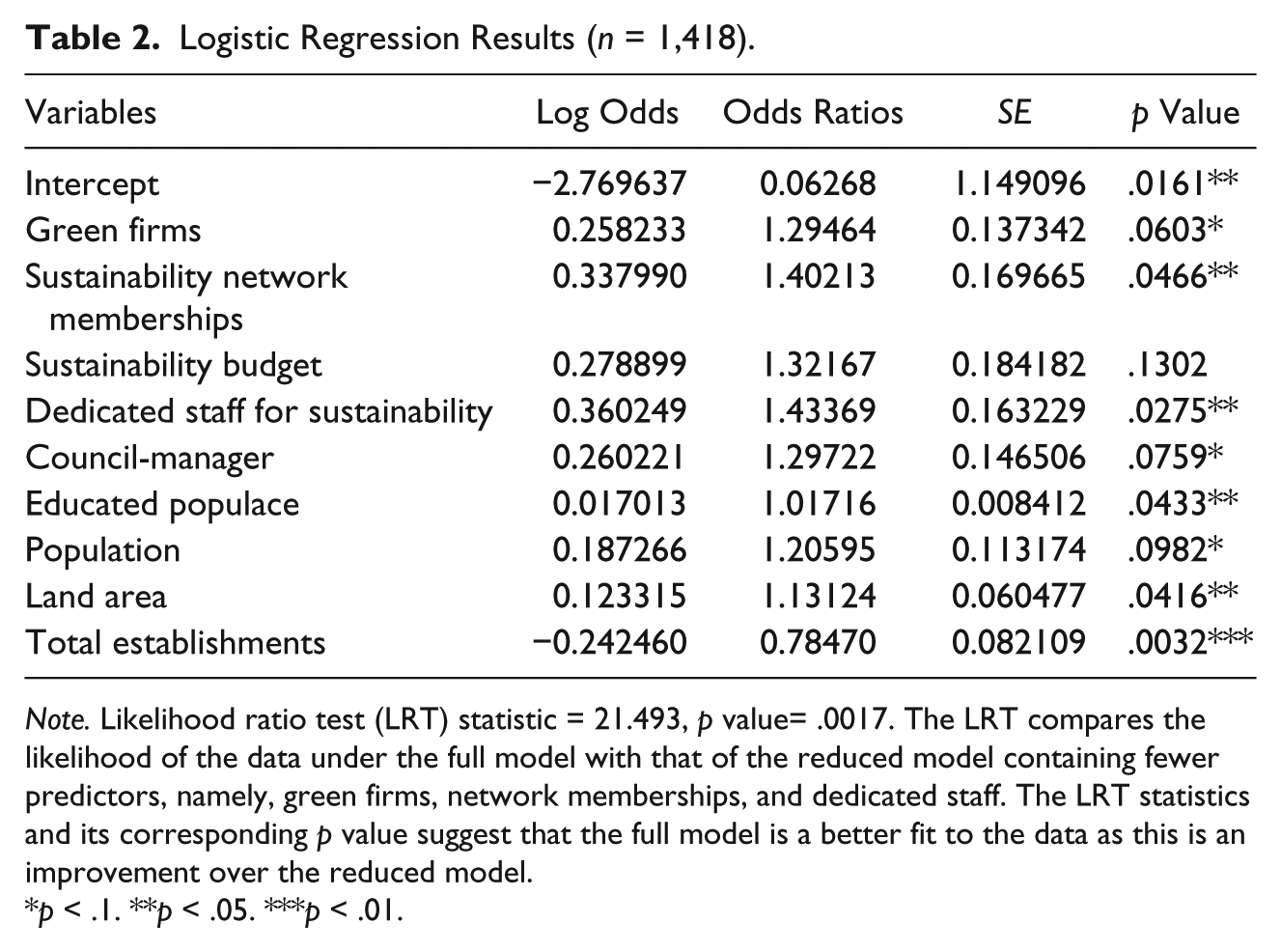
Note. Likelihood ratio test (LRT) statistic = 21.493, p value= .0017. The LRT compares the likelihood of the data under the full model with that of the reduced model containing fewer predictors, namely, green firms, network memberships, and dedicated staff. The LRT statistics and its corresponding p value suggest that the full model is a better fit to the data as this is an improvement over the reduced model.
p < .1. **p < .05. ***p < .01.
The regression results show that all of the variables in the model except the sustainability budget are statistically significant. The transaction resources have significant variables shaping policy adoption of local governments. As predicted in Hypothesis 1, the presence of green firms would have a positive effect on the adoption of distributed renewable energy. The more green firms available, the better is the provision of information, products, and services needed by residents and local communities to invest in clean energy technologies. They minimize the transaction costs that residents would incur in searching for information on new technologies. They help residents make informed decisions and also provide the required support system for maintenance, upgrade, and other related services. The regression results indicate that green firms increase the odds for local governments to adopt the policy on distributed renewable energy. A 10-fold increase in green firms could raise the odds of policy adoption by around 29%.
Another information resource that is significant is the membership of local governments in sustainability networks. This supported Hypothesis 2, which proposes that local governments that are members of sustainability networks are more likely to adopt the policy than those who are nonmembers. This is so because these networks can serve as a resource for information and venue for learning and problem solving, which can bring down information and search costs. As the regression results show, local governments that are members of either ICLEI or U.S. Conference of Mayors or both have 40% greater odds of adopting residential zoning codes on renewable energy generation than nonmembers, controlling for all other variables.
To deal with permitting costs, local governments would have to rely on and harness their administrative resources to streamline permitting procedures and develop personnel capacity. Of the two variables for administrative resources identified in the model, only dedicated staff is statistically significant. Local governments with dedicated staff are more likely to adopt the policy on distributed renewable energy, as predicted in Hypothesis 4. A dedicated staff under a unified office for sustainability could indicate the seriousness of local governments in advancing the sustainability agenda. It could minimize coordination and implementation problems. The regression results indicate that the odds are 43% higher for cities to adopt the policy when they have in place the necessary staff complement to support the sustainability effort.
Bargaining costs can pose barriers to policy adoption. Institutions and government structures can either facilitate or frustrate the bargaining process. Hypothesis 5 predicted that cities with council-manager forms of government are more likely to adopt zoning codes that permit distributed renewable energy. This was predicated on the assumption that managers can be effective agents of sustainability given the right training, incentives, and exposure to professional norms and best practices. Traditionally, efficiency and economic development have been the standards against which performance of managers is assessed. With the broadening of the definition of development to encompass sustainable growth, managers are becoming more aware of the need to provide local communities with environmental goods to improve quality of life. This is proven in the regression results that show that form of government is relevant and statistically significant; that is, cities with council-manager forms of government have 30% greater odds of adopting a policy on distributed renewable energy than cities with other forms of government, holding other variables constant.
Hypothesis 6 predicted that an educated populace can be a political resource, which can provide support for green policies and initiatives, mobilize resources, and articulate preferences for environmental goods. This variable is predicted to have a positive effect on policy adoption and is found to be statistically significant. This means that for a percent point increase in the proportion of educated populace, the odds for local governments adopting the policy increase by about 2%, controlling for other variables.
Overall, the regression results show that transaction resources are critical for policy adoption. Information, administrative, and political resources can be used by local governments to facilitate transactions and promote the sustainability agenda. They can increase the probability of local governments adopting zoning codes that permit distributed renewable energy generation in their communities. Looking into the regression model, it can be predicted that there is a 30% probability that cities with memberships in sustainability networks, with dedicated staff and budget for sustainability, and with council-manager forms of government, would adopt the policy, setting all other variables, including green firms and educated populace, at their means.
Conclusion
Issues concerning the availability, access, use, distribution, and control of land have always been high on the agenda of local governments. Studies have been undertaken to understand the political economy surrounding these issues and the choices local governments make. As issues evolved, so did the focus of these studies—from growth machine politics, growth management, to smart growth, and now to renewable energy. In recent years, local governments have been confronted with demands to deal with issues on sustainability and climate change. The adoption of renewable energy technologies to mitigate climate change has again placed land at the center of local governance as most of these technologies are land based—such as wind, solar, biomass, biofuel, and geothermal—which could affect land-use patterns and encroach on protected land cover.
This study examines one such policy, that is, a land-use policy permitting small-scale renewable energy systems through residential zoning codes. This local initiative has brought to the fore not only the role of local governments but also that of citizens in renewable energy discourse. More than just being treated as passive recipients of electricity load, residents become active players in the use and generation of clean energy. Examining this local initiative thus requires a refocusing of perspective. Existing perspectives on land-use transactions have been dominated by land-use interests represented by development interests, environmental groups, and local and state governments, laying claim on the right to own and use the land. These perspectives have provided useful templates for understanding transactions between these land-use interests but may not help in unraveling the transactions at the level of local governments, residents, and local communities as the case of distributed renewable energy. This study thus refocuses the lens by looking into the transaction costs impeding policy adoption and the resources available to these players to minimize barriers to political contracting.
In this study, transaction resources come in the form of information, administrative, and political resources. Variables were identified for these transaction resources and the following were found to be statistically significant: green firms and sustainability network memberships as information resources, dedicated staff for the sustainability effort as an administrative resource, forms of government and educated populace as political resources. If data are available, other variables can be used in future studies to improve model specification and measurements such as the indicators for community characteristics and support, the geographic features and built-in environment, the attributes of homeowner associations and local communities, the prevalence or stringency of private covenants, the bargaining mechanisms at the community level, and other transaction resources available to residents and local governments. The differential effects of the predictors as moderated by institutions can also be investigated. The study, however, is limited by the lack of data on distributed renewable energy. There is a possibility that variables not included in the model may not only be related to the response variable but also to the predictors, which could be corrected and validated with available data. As distributed renewable energy becomes salient to local governments, the study hopes that relevant data will be collected over time and analyzed for future studies. Furthermore, renewable energy generation is scalable and examining the politics of large-scale energy systems operating in different policy environments is an important topic for future research, which can complement this study. Understanding the behavior of citizens as consumers of electricity is another critical concern as various demand-side management programs of electric utilities are being implemented to increase energy efficiency and the demand for clean energy, albeit with varying levels of performance.
Footnotes
Declaration of Conflicting Interests
The author(s) declared no potential conflicts of interest with respect to the research, authorship, and/or publication of this article.
Funding
The author(s) received no financial support for the research, authorship, and/or publication of this article.