



Abstract
This article assesses the claim that sanctuary cities—defined as cities that expressly forbid city officials or police departments from inquiring into an individual’s immigration status—are associated with post hoc increases in crime. We employ a causal inference matching strategy to compare similarly situated cities where key variables are the same across the cities except the sanctuary status of the city. We find no statistically discernible difference in violent crime, rape, or property crime rates across the cities. Our findings provide evidence that sanctuary policies have no effect on crime rates, despite narratives to the contrary. The potential benefits of sanctuary cities, such as better incorporation of the undocumented community and cooperation with police, thus have little cost for the cities in question in terms of crime.
Introduction
On June 7, 1983, the Madison, Wisconsin, city council passed Resolution 39,105, officially commending churches in the city that were offering sanctuary to Central American refugees, many (if not most) of whom had arrived illegally. The Madison city council followed this with Resolution 41,075 on March 5, 1985, officially declaring the entire city a sanctuary for Central Americans fleeing violence in El Salvador and Guatemala. Since then, more than a 100 cities nationwide have passed similar laws limiting the participation of local officials in the enforcement of federal immigration law, formally becoming “sanctuary cities.” In this article, we define a sanctuary city as a city or police department that has passed a resolution or ordinance expressly forbidding city or law enforcement officials from inquiring into immigration status and/or cooperation with Immigration and Customs Enforcement (ICE). While sanctuary policies have received increasing attention over the last year, there has been little academic inquiry into this phenomenon and up until recently they received relatively little attention from mainstream media or politicians in the United States.
However, on July 1, 2015, Kathryn Steinle was shot and killed in San Francisco by Juan Francisco Lopez-Sanchez, an undocumented immigrant who had been convicted of seven felonies and deported seven times (Littlefield 2014). In March 2015, Lopez-Sanchez had been arrested for an outstanding drug warrant and briefly was in jail in San Francisco where ICE filed a detainer asking that he be released into their custody for deportation. Because of its status as a sanctuary city, the detainer was not honored and instead Lopez-Sanchez was released, as he was not a violent criminal and the city had declined to prosecute the marijuana-possession charge he was being held for (Littlefield 2014). The shooting of Steinle ignited a firestorm over San Francisco’s sanctuary policy, with then-Republican presidential candidate Donald Trump making opposition to sanctuary policies a major part of his campaign in the fall of 2015. Trump had previously argued, “When Mexico sends its people, it’s not sending their best. They’re sending people who have a lot of problems . . . They’re bringing drugs. They’re bringing crime. They’re rapists. And some, I assume, are good people.” Trump seized on Steinle’s shooting as proof for this statement and a further justification for the border wall his campaign had promised to build if he was elected. On the heels of Trump’s statement and the Steinle shooting, nearly all of the Republican presidential candidates included opposition to sanctuary policy in their platforms.
Five days after his inauguration, Donald Trump signed an executive order titled “Enhancing Public Safety in the Interior of the United States,” which followed through on his campaign promise to strip federal funds from sanctuary cities. The order stated that any jurisdiction that did not comply with federal immigration policy would be ineligible to receive federal grants, and left the designation of a “sanctuary” jurisdiction to the discretion of the Secretary of Homeland Security. 1 These actions were based, according to the executive order, on the “ . . . immeasurable harm to the American people and to the very fabric of our Republic” that were the result of sanctuary policies. Despite providing little in way of actual evidence, President Trump has continued to cite increases in crime as a direct result of sanctuary policies, claiming in a February 5 interview with Bill O’Reilly that sanctuary cities “breed crime.” 2
Yet, it remains unclear whether sanctuary policies actually lead to increases in crime, as their opponents argue, or if they increase Latino incorporation and cooperation with police in cities like San Francisco, as their supporters counter. 3 As undocumented immigrants face deportation in addition to criminal charges, it is logical that they would avoid breaking the law to a greater extent than the native-born population. Indeed, initial evidence suggests little generalizable support for the claim that sanctuary cities cause increases in crime. In 2013, Lyons, Ve’lez, and Santoro found that those cities with sanctuary policies had lower robbery and homicide rates in neighborhoods with high concentrations of immigrants, suggesting that sanctuary policies are actually associated with lower crime rates. Similarly, Wong (2017) found that when sanctuary and nonsanctuary counties were compared using a matching technique that controlled for population size, percentage foreign-born, and percentage Latino, counties with sanctuary policies had lower crime rates than similar nonsanctuary counties.
While Lyons, Ve’lez, and Santoro (2013) and Wong (2017) inform our analyses and expectations, we employ a different analytic approach and have a different hypothesis when it comes to the effect of sanctuary cities on crime. First, we analyze the city as opposed to the Census tract or county. We are interested in this unit of analysis because political claims and complaints about sanctuary cities are launched at the city level (e.g., Donald Trump and other high profile Republicans talking about San Francisco). Second, although Wong (2017) uses a similar matching strategy, he does not employ multivariate regression as we do. Finally, instead of employing a hierarchical linear model with instrumental variables as Lyons, Ve’lez, and Santoro (2013) do—which is regression based in its orientation—we take a causal inference approach that allows us to isolate the effects of the sanctuary city policy itself. 4
In this article, we look to build upon the findings of Lyons, Ve’lez, and Santoro (2013) and Wong (2017) by analyzing the effects of sanctuary policies on different types of crime while also matching cities based on variables like population, the size of the Latino community, economic criteria, and other racial criteria. We also argue that rather than a decrease in crime, we expect to see no statistically significant difference between sanctuary and nonsanctuary cities. Sanctuary policies could lead to a decrease in crime, but it is unlikely to be large enough to be statistically significant, as this would presume a large, and consistent, effect across cities. Instead, we believe it is much more likely that sanctuary policies have no effect on crime rates.
Because most studies have shown that undocumented immigrants tend to commit less crime than the native born (Lee, Martinez, and Rosenfeld 2001; Lyons, Ve’lez, and Santoro 2013; Ousey and Kubrin 2009; Wadsworth 2010; Wong 2017), we see two possible explanations for why sanctuary cities might result in lower crime rates. First, the main antecedent to seeing a decrease in city crime as a function of sanctuary policy would be the movement of undocumented immigrants into sanctuary cities post passage. If this in fact was the case, it would suggest that sanctuary cities could have lower homicide rates if there was net in-migration of undocumented citizens into a city after it “became” a sanctuary. We evaluate this possibility and find no difference in in-migration post passage in our data across the sanctuary/nonsanctuary conditions. Second, some sanctuary policies are premised on the idea that the policy will lead to greater cooperation with the police and incorporation of the existing undocumented population. The latter is expected to decrease crime as a result of greater opportunities, as Lyons, Ve’lez, and Santoro (2013) found in their study. This is a real possibility; however, we think this is more of a long-term possibility and unlikely to have a large enough effect to be significant, as we mentioned earlier. Any potential decrease in crime may also be counterbalanced by an increase in crime reporting precisely because of increased cooperation, which is often cited as one reason to enact sanctuary policies.
The other possibility—as President Trump has claimed—is that sanctuary cities by virtue of their unique status contribute to increases in crime. This claim rests on two possibilities. First—like the hypothesis anticipating less crime—this argument might be true if undocumented immigrants do commit more crime and then move into sanctuary cities post passage. The first premise does not hold because, as just stated, there does not appear to be a significant difference in in-migration into sanctuary cities relative to similarly situated nonsanctuary cities. In addition, the premise does not square with the extant literature that undocumented immigrants commit less crime than the native-born population. Second, we might see more crime as a result of sanctuary policy if undocumented residents already living in a city begin to commit more crime or report more crime because they feel more secure. Again, this premise holds little weight as the vast majority of research on this issue indicates that the foreign-born commit less crime than the native born or that no difference exists (see, for example, Miles and Cox, 2014, who examined the rates of homicide, rape, robbery, and aggravated assault in counties as Secure Communities was rolled out between 2008 and 2012 and found no statistically significant decrease in crime rates as a result of the implementation or intensity of Secure Communities.). 5 However, given the design and motivation of most sanctuary policies, it is possible that greater cooperation between city officials and undocumented immigrants could emerge. This could lead to an increase in crime-reporting, not an increase in crime per se.
Based on the evidence so far, we believe that a statistical examination of sanctuary policy will show that these policies do not lead to either net increases or decreases in crime even when cities are matched to isolate the effect that sanctuary status has. In our analysis, we isolate the effects of sanctuary policy itself not its antecedents—therefore, we control for the size of the Latino population as well as the Latino noncitizen population (i.e., those most likely to be undocumented immigrants). Thus, our matching procedure allows us to compare similarly situated cities on the aforementioned variables. In this analysis, sanctuary cities—on average—will not have more undocumented immigrants in them compared with their matched city, so the above logic that cities with larger shares of undocumented residents should experience lower crime rates is not applicable. 6 Instead, we think there should be no net effect on crime as an outcome from a sanctuary city policy.
Most of the literature to date on sanctuary cities has largely focused on the faith-based movements of the 1980s and 1990s on which many sanctuary policies were based. This article will focus on sanctuary policies post 9/11, though some of these, like San Francisco’s sanctuary policy, have roots that can be traced back to the faith-based movement of the 1980s. To understand sanctuary policies today, it is necessary to know a little about the movement that many of them initially drew upon for inspiration and which enjoyed a brief rebirth on the heels of 9/11.
Thus, this article proceeds as follows: First, we define what we mean by a sanctuary city. Next, we trace the origins of sanctuary cities in the United States. This is followed by a critique of the supposed link between criminality and immigration. We then place these cities into contemporary political context and lay out the claims as to why they are bad or good policy. This leads to a set of hypotheses that we then test in the rest of the article. We review our data and methods employed to answer the questions posed. Finally, we present our results and finish with a discussion of these results.
Defining the Sanctuary City
One initial difficulty inherent in the study of sanctuary cities is that there is no concrete definition of how exactly to define what a sanctuary city is. For instance, the Ohio Jobs & Justice PAC, which maintains a list of sanctuary cities online, also includes “informal” sanctuary cities in their definition. Informal sanctuary cities are where there is no resolution or policy on paper but instead where their classification is based on observed actions, such as lack of enforcement. 7 However, this classification seems open to subjective, and biased, interpretations of who is illegal and what counts as lack of enforcement.
For those cities with formal policies in place, there is a gradation of sanctuary policies. Some cities or police departments only forbid law enforcement from making immigration inquiries, 8 while others forbid local officials from doing so in the dispensation of city-level benefits. Some jurisdictions, like San Francisco, take this a step further by refusing to honor detainers by ICE for nonviolent offenders. Some cities also include direct ideological statements affirming the rights of immigrants or criticisms of federal immigration enforcement and policy. For example, Berkeley’s Resolution 63,711-N.S. states, “Whereas, the spirit and intent of Berkeley’s refuge Resolutions would be violated if City funds, facilities or staff were utilized to assist the Federal government’s inhumane immigration policies and practices.” 9 In cities like Berkeley, sanctuary is declared not just for practical reasons but also as a way of protesting federal immigration policies. Yet not all policies that could be construed as “sanctuary” policies include this ideological aspect or have as their goal protecting the rights of immigrants themselves. As previously stated, we define a sanctuary city as a city or police department that has passed a resolution or ordinance expressly forbidding city or law enforcement officials from inquiring into immigration status and/or cooperation with ICE, thus incorporating both ideological and nonideological cities for the purpose of this analysis. In future work, we may return to this to see if there are identifiable differences in effect between the two different “types” of sanctuary cities.
A number of scholars have recently begun an examination of subfederal immigration policies like Arizona’s SB1070, which would have allowed police to ask for proof of citizenship during routine traffic stops (Gulasekaram and Ramakrishnan 2015; Newton 2012; Ramakrishnan and Gulasekaram 2012; Vasanyi et al. 2012). In addition, scholars have examined the expansion of local enforcement and cooperation (e.g., see Capps et al. 2011), as well as the process of integration (Mollenkopf and Pastor 2016). Related to the normative implications of some of this research, sanctuary policies can be thought of as the “other side of the coin” to policies like Arizona’s SB1070. Subfederal immigration policies like SB1070 have often rested on claims that the federal government is not doing enough, which therefore justifies state or local intervention in immigration policy, leading to what Vasanyi et al. (2012) call a “multilayered jurisdictional patchwork.” While sanctuary policies rest on the opposite claim that the federal government is being far too aggressive with immigration enforcement for justification, they also represent a subfederal level of policy making when it comes to immigration (Gulasekaram 2009). Similarly, they also face some of the same critiques that can be leveled at policies like SB1070, particularly to charges that they are driven by ideological considerations rather than negative effects on local immigrant communities or police departments from participation in the enforcement of federal immigration policy (Gulasekaram and Karthick Ramakrishnan 2015; Ramakrishnan and Gulasekaram 2012). Yet, it is unclear if sanctuary policies have negative effects that could justify their repeal, while other subfederal policies like SB1070 have been shown to have very real negative impacts in terms of the potential for racial profiling and trust between the Latino community and local officials (Waslin 2010).
The Birth and Growth of Sanctuary Cities
To gain an intuition for why sanctuary policies might actually promote incorporation as opposed to crime, it is important to understand their birth and development. The Central American Sanctuary Movement of the 1980s is the ideological precursor to modern sanctuary policy and was motivated by the deportation of those fleeing political violence in El Salvador and Guatemala. The Central American Sanctuary Movement would provide safe harbor to many of these immigrants via a network of churches and synagogues spread across the nation, despite the potential consequences of this open defiance of U.S. immigration policy through the blatant harboring of undocumented immigrants. The Sanctuary Movement encompassed a number of religious and faith-based groups around the country, with additional support coming from university campuses, civil rights organizations, lawyers, and a host of other concerned parties (Golden and MacConnell 1986). The Sanctuary Movement grew into a nationwide phenomenon, and its members did not shy from the public eye despite the illegality of their actions. Rose Cruz Villazor cites some astounding figures in relation to the number of individuals involved with the Sanctuary Movement. She notes, “At the height of the sanctuary movement, an estimated 20,000 to 30,000 church members and more than 100 churches and synagogues participated in the sanctuary movement, making the conflict between the church and state inevitable” (Villazor 2008, 141). In addition, the movement had tremendous public support according to Villazor, including governmental support from 47 members of Congress.
This was followed by the New Sanctuary Movement that came into existence following the September 11 attacks and the passage of the Patriot Act. The New Sanctuary Movement drew on Central American Sanctuary Movement for inspiration for its resistance to more aggressive immigration enforcement on the part of ICE that often led to the separation of families (Freeland 2010). Both were founded by church and faith-based groups and sought to address what was perceived to be inequities in the enforcement of U.S. immigration policy. Most sanctuary policies were based on the intentions behind these faith-based interventions on behalf of undocumented immigrants and refugees though some, like Los Angeles’s Special Order 40 which was passed in 1979, were based simply on fostering greater cooperation with authorities on the part of the Latino community.
The U.S. Patriot Act, the Clear Law Enforcement for Criminal Alien Removal (CLEAR) Act, and the Homeland Security and Enhancement (HSEA) Act that came on the heels of September 11 led many cities to adopt sanctuary policies in response to what they believed were the abuses inherent in this legislation and the burden it imposed on local law enforcement by having them enforce federal immigration law. While these policies were based on the sanctuary legislation passed during the Central American refugee crisis in the 1980s, they differed significantly in the group they were meant to protect. While refugees fleeing political violence elicited some sympathy, modern sanctuary cities protected an oft-demonized group: undocumented immigrants. It is those cities who passed sanctuary policies in the wake of 9/11 that this article will focus on because of their place in the larger debate about undocumented immigration. With nearly 12 million undocumented immigrants currently in the United States and a regular scapegoating of this group as job-stealing criminals who refuse to assimilate (and speak English) the existence of sanctuary cities is argued to drive up crime, increase unemployment rates, and encourage further undocumented immigration.
Besides having passed sanctuary ordinances, sanctuary cities vary from one another on many socioeconomic variables—including population size, noncitizen Latino population, partisanship, and poverty levels. For instance, two sanctuary cities Gaston, Oregon, and New York City, New York, vary considerably. Gaston is about 45 minutes (by car) outside of Portland and is essentially a farming community. In the year 2000, Gaston had just 600 people; whereas New York City recorded over eight million people and is the cultural and financial capital of the United States. As of 2000, the percentage of the population that was noncitizen Latino in New York was roughly 7% but the overall Latino percentage was about 21%. In Gaston, the percentage of noncitizen Latinos was about 4% with a total Latino population of about 15%. Likewise, the areas vary on partisanship; in the 2000 election, Gaston resided in a swing county (50% of Washington County voted in favor of Republican George W. Bush), whereas New York went over 74% for Democrat Al Gore. Thus, not all sanctuary cities are simply liberal enclaves with large noncitizen populations. Finally, Census records indicate that 1999 poverty levels for individuals 18 years and older in Gaston was 5.9%, and over 18.4% in New York. Clearly, sanctuary cities are not uniform.
Despite sharing sanctuary status, each of these cities passed slightly different ordinances at slightly different times. According to the National Immigration Law Center (NILC), in April 2002, Gaston’s City Council Resolution No. 03-01 made “detecting or apprehending persons of foreign citizenship based only on violation of federal immigration law” illegal for city employees and departments. 10 Similarly, while New York City long had sanctuary policies favorable to undocumented immigrants, the city reasserted its support for sanctuaries with Executive Order 41. Passed in August 2003, the order “prohibits city officers or employees from disclosing confidential information, including information concerning immigration status” in all but the most extreme situations where the individual is either wanted for nonimmigration crimes or is a known terrorist. 11
The Myth of Immigrant Criminality and Sanctuary Policy
The idea that sanctuary policies drive up crime rates is premised to a large extent on the notion that undocumented immigrants tend to offend at higher rates, something that has been disproven time and again. In fact, many studies find an inverse relationship between immigration, undocumented or otherwise, and crime rates. One of the earliest examples of this was the 1931 report by the Wickersham Commission on crime and the foreign born, which specially examined the relationship between Mexican immigration and crime. The commission found that the native born offended at higher rates in most instances than did Mexican immigrants (National Commission on Law Observance and Enforcement 1931). Even in those cities where Mexicans were found to offend at higher rates than the native born, the offense was often cultural rather than criminal. Indeed, many of the arrests were for violations of Prohibition laws, which makes sense as alcohol consumption was legal in Mexico at the time.
Despite these findings by the Wickersham Commission, criminalization has been the default response of the federal government to the “problem” of undocumented immigration. In 1929, undocumented entry was formally made a criminal offense, with illegal entry deemed a misdemeanor and reentry after deportation a felony under Senate bill 5094. Its passage helped to define how the federal government would respond to undocumented entry in the decades to come by linking the long-standing rhetoric of immigrant criminality to the formal legal treatment of the undocumented for the first time (Gonzalez O’Brien 2018). The 1996 Illegal Immigrant Reform and Immigrant Responsibility Act (IIRIRA) furthered these linkages by increasing the militarization of the southern border and focusing on crime-control tactics as the primary response to undocumented immigration, which would only be exacerbated on the heels of September 11. This program of criminalization has helped to turn Latino immigrants into a racialized threat, justifying more and more extreme measures to control them, leading to programs like Donald Trump’s proposed border wall with Mexico and, in the eyes of some, justifying his comments about Mexican immigrants (Provine and Doty 2011). Criminalization has proven to be ineffective at actually reducing undocumented immigration, but like “broken windows” policing, it is a popular response because its failure can simply be sold as a result of a need for greater enforcement and militarization. If a triple fence is not working, for instance, build a wall; if deportation is not dissuading people from entering unlawfully, threaten to charge them as criminals.
While criminalization has largely been the default federal response, studies have found no support for the idea that immigrants are responsible for more crime. In 2001, Lee, Martinez, and Rosenfeld (2001) examined homicide rates in three border cities with large immigrant communities and high levels of immigration between 1985 and 1995. Examining 352 neighborhood census tracts in Miami, El Paso, and San Diego, the authors found that the percentage of new immigrants in these tracts had no relationship to homicide rates, with the exception of El Paso, where there was an inverse relationship between the two. Rather than immigration, the only consistent predictor of homicide in the three cities was, unsurprisingly, poverty. In a longitudinal study of homicides in San Diego from 1980 to 2000, Martinez, Stowell, and Lee (2010) found that neighborhood homicide rates in San Diego were, as was the case in El Paso, negatively associated with the percentage of foreign born who were present in the community. In 2010, Tim Wadsworth expanded on these studies by drawing on homicide and robbery data for 459 cities nationwide and using a pooled cross-sectional time series model, which allowed him to examine the effect that changes in immigration had on crime rates between 1990 and 2000. Wadsworth (2010) found that the size of the new immigrant population, defined as those who had been in the United States five years or less, had an inverse relationship to rates of both robbery and homicide.
Indeed, if anything, undocumented immigrants may be more likely to be victims of crime, rather than perpetrators of crime (Kittrie 2006). This is because, regardless of legal formalities, many undocumented immigrants may fear that turning to local police will result in deportation. For example, undocumented women have been shown to be reluctant to call the police in cases of domestic violence due to fear that either they or their partner will be deported (Crenshaw 1995; Menjivar and Bejarano 2004; Menjivar and Salcido 2002). In addition, the immigrant population—especially the undocumented—may experience cultural and language problems interacting with the state, leading some to remain in the shadows as victims (Davis and Erez 1998). Indeed, research shows that non-Hispanic Whites are less likely than Anglos, Blacks, American Indians, and Asians to report violent crime perpetrated against them (Rennison 2007).
These studies suggest that immigrants tend to offend at lower rates than the native-born population, which we would expect to apply to the undocumented community as well. Sanctuary policies could help with incorporation, which Lyons et al. argue could lead to lower crime rates in sanctuary cities. However, the positive benefits associated with greater Latino incorporation could be hidden insofar as crime rate is concerned, as cooperation could lead to a concomitant rise in crime reporting—regardless of actual changes to crime levels. Moreover, the data suggest that an increase in the size of the immigrant population in a city should decrease crime even if incorporation is not assisted by sanctuary policies. Because the presence of immigrants seems to be positively related to lower crime rates, we would expect that unless sanctuary cities draw in a larger number of immigrants, there would be no relationship between sanctuary policies and crime. As mentioned earlier, we did evaluate the in-migration in both sanctuary and nonsanctuary cities in our study and did not find a significant difference. As sanctuary policies do not seem to increase the number of immigrants in a city, we would expect them to have little effect on the crime rate.
However, the record on sanctuary cities remains very unclear. Although there are a number of blogs and websites such as that maintained by the Ohio Jobs & Justice PAC that cite examples of immigrant criminality, the potential effect sanctuary policies could have on labor, and other issues, there is little statistical evidence for this thus far. The examinations of crime in sanctuary cities thus far have found the exact opposite in fact. For instance, Josh Harkinson (2015) notes that San Francisco’s crime rate has been falling despite its status as a sanctuary city and that when compared with similar, nonsanctuary cities, San Francisco actually has a lower crime rate. Lyons et al. found that crime rates in neighborhoods in cities designated as sanctuaries were lower than in nonsanctuary cities when they looked at 89 cities nationally with a population of more than 100,000.
These findings suggest that sanctuary cities may reduce crime rates or, at the very least, not lead to the increases their opponents claim they do on the heels of tragedies like the Kathryn Steinle shooting. However, in the case of the Mother Jones piece, all the author did was compare crime rates between San Francisco and cities of similar size that are not sanctuaries, which really only provide anecdotal evidence.
Expectations and Hypothesis
Given the above logic and that explicated in the introduction, we evaluate the following hypothesis: Compared with other similarly situated cities, we find it unlikely that sanctuary cities will have more crime—be it violent, property, or rape, as claimed by some political candidates and opponents of sanctuary cities. However, again, in comparison with similarly situated cities, we doubt that undocumented immigrants move to cities because of that city’s sanctuary status thereby reducing the crime rate. Many costs are associated with moving even for later immigrants (Amundsen 1985; Carrington, Detragiache, and Vishwanath 1996), and it is unclear whether undocumented immigrants or the public, more generally, are broadly aware of the sanctuary status of a city. In examining the in-migration of Latinos, we found no difference in matched sanctuary/nonsanctuary cities, and thus, we would not expect any population effect on crime rates based on sanctuary status alone.
Data and Method
To evaluate our hypotheses, we conduct two types of analyses. The first analysis is a simple difference of means t test at the individual sanctuary-city level. Taking crime data from all 55 cities in our dataset that passed sanctuary city laws post 9/11, we compare crime rate in the year following implementation of a sanctuary policy with the crime rate in the year preceding the implementation of a sanctuary policy. We do this for the following types of crime: violent crime, property crime, and rape crime.
The second analysis is more involved. We employ a matching causal inference strategy to test the claim that sanctuary cities are associated with more crime than are nonsanctuary cities. This approach lets us control for—and thereby rule out—a variety of confounding factors that might lead to the making of a sanctuary city in the first place. Because we want to know the effects of a sanctuary city as policy, we want to compare similarly situated cities (treatment = sanctuary; control = nonsanctuary) where everything is the same across the cities prior to the enactment of the sanctuary policy. Differences between the treatment and control in crime rates following the enactment can then be attributed to the policy—as opposed to economic conditions, differences in the size of the Latino population, and other characteristics that might predict why a city may initially invoke sanctuary policies.
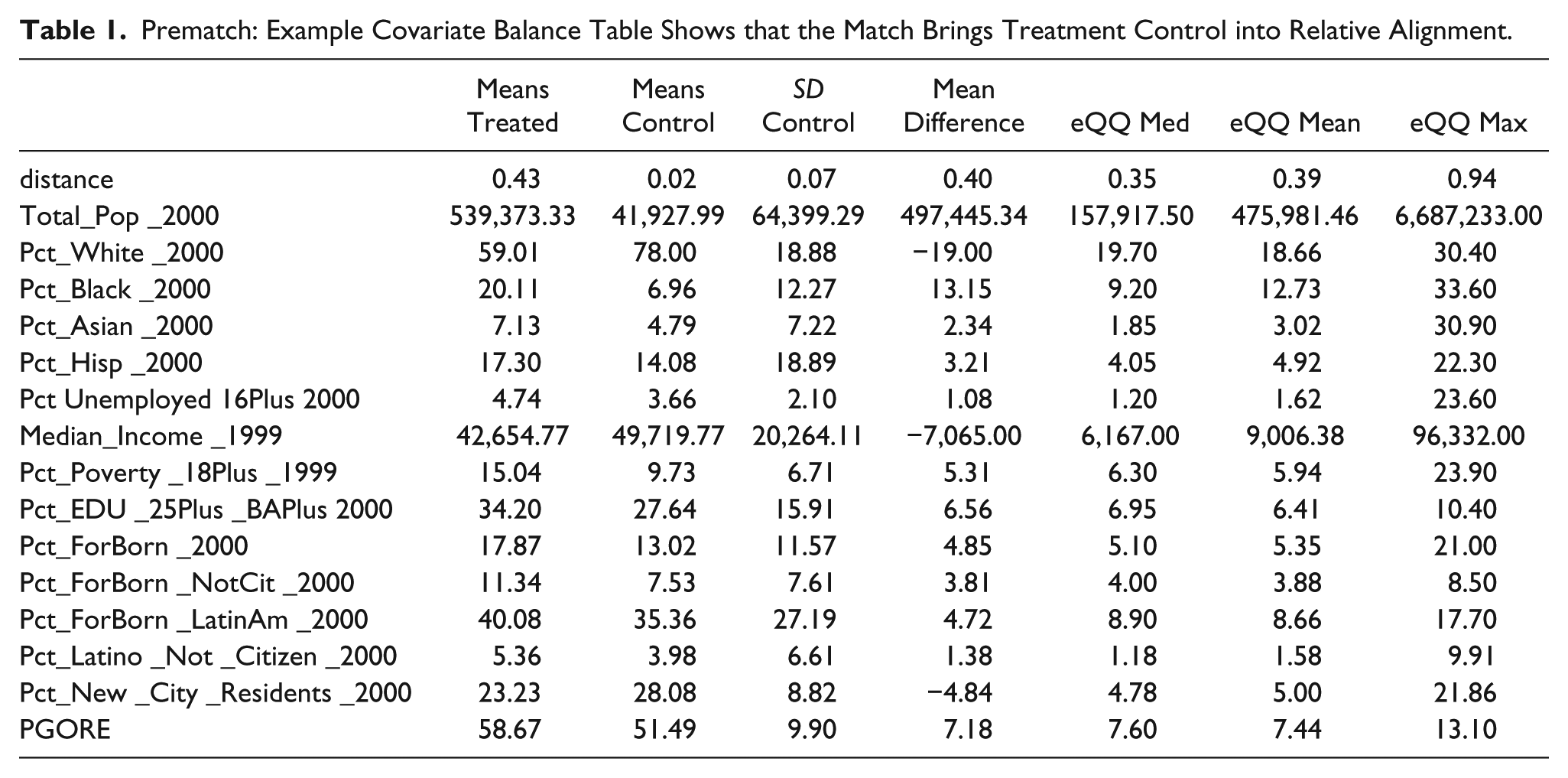
This approach is sensible because sanctuary cities—on their face—are quite distinct from nonsanctuary cities (which are most cities). Indeed, Table 1 indicates that sanctuary cities—compared with nonsanctuary cities—are larger, less White, more racially and ethnically diverse, have lower median incomes, have higher levels of poverty, have larger foreign-born populations, and are more Democratic. Specifically, in our data, the Latino population in sanctuary cities as of the year 2000 was 17.3%, whereas in nonsanctuary cities, it was 14.08%. And among the foreign-born population in sanctuary cities, 40.08% were from Latin America, whereas in nonsanctuary cities, this percentage was 35.36%. The percentage of the noncitizen Latino population was also a bit higher in sanctuary cities than nonsanctuary cities, but overall, the numbers are small. Thus, a simple comparison of sanctuary cities with nonsanctuary cities is unbalanced. Any resulting difference in crime might be associated with underlying socioeconomic differences between city types as opposed to sanctuary policies, specifically.
Prematch: Example Covariate Balance Table Shows that the Match Brings Treatment Control into Relative Alignment.
We base our list of sanctuary cities on data provided by the NILC. 12 All sanctuary cities included in the study passed sanctuary laws after or during the year 2002. We time-bound our analysis for a variety of reasons. First, 9/11 quite possibly changed the tenor and nature of immigration-related politics, such that a sanctuary city pre/post 9/11 might well have different motivations. In addition, some cities that became sanctuary cities prior to 9/11 were often responding to different crises (i.e., those in Central America) and received far less publicity and negative attention than did cities post 9/11. ICE was created as part of the Department of Homeland Security on the heels of 9/11 and has generally been much more aggressive in enforcement via workplace and neighborhood raids than its precursor Immigration and Naturalization Services (INS). The effect of sanctuary policy may have differed under the INS, and thus, we confine our analysis to those cities whose policies were specifically created in reaction to ICE in the post-9/11 period.
Because we look at a variety of data by year (across time), the total number of sanctuary cities vary depending on the availability of crime data from the Federal Bureau of Investigations (FBI). On an independent basis, city police departments provide the FBI with annual crime reports for most or all categories of crime. Therefore, due to incomplete, missing, or inaccurate data, matching analysis of crime between sanctuary and nonsanctuary cities was conducted on an annual basis by crime type to maximize the amount of observations per year. Only those cities that had crime data listed before and after passing sanctuary city legislation were used for our analysis in each year, to accurately test the before and after effects of sanctuary legislation.
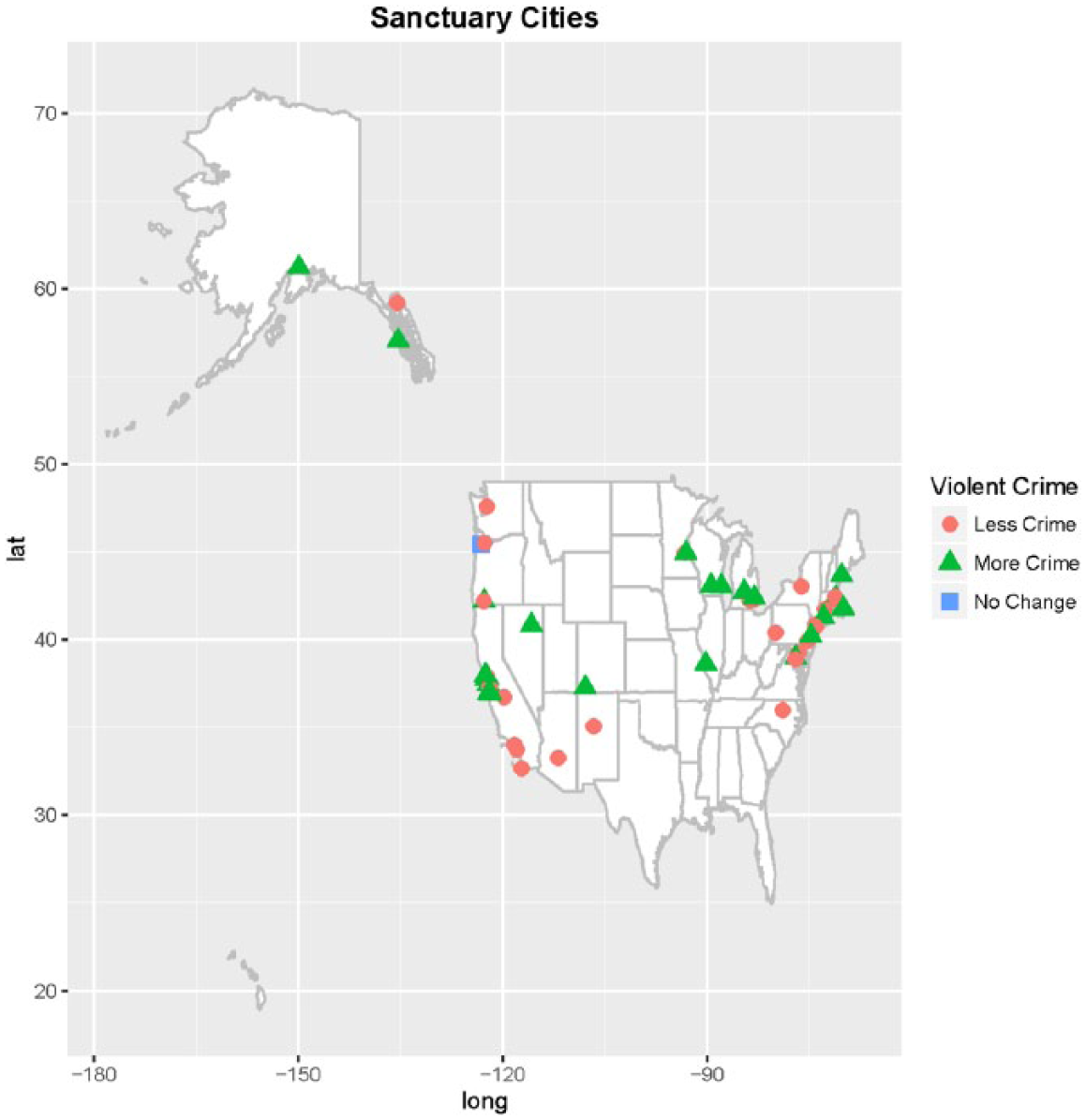
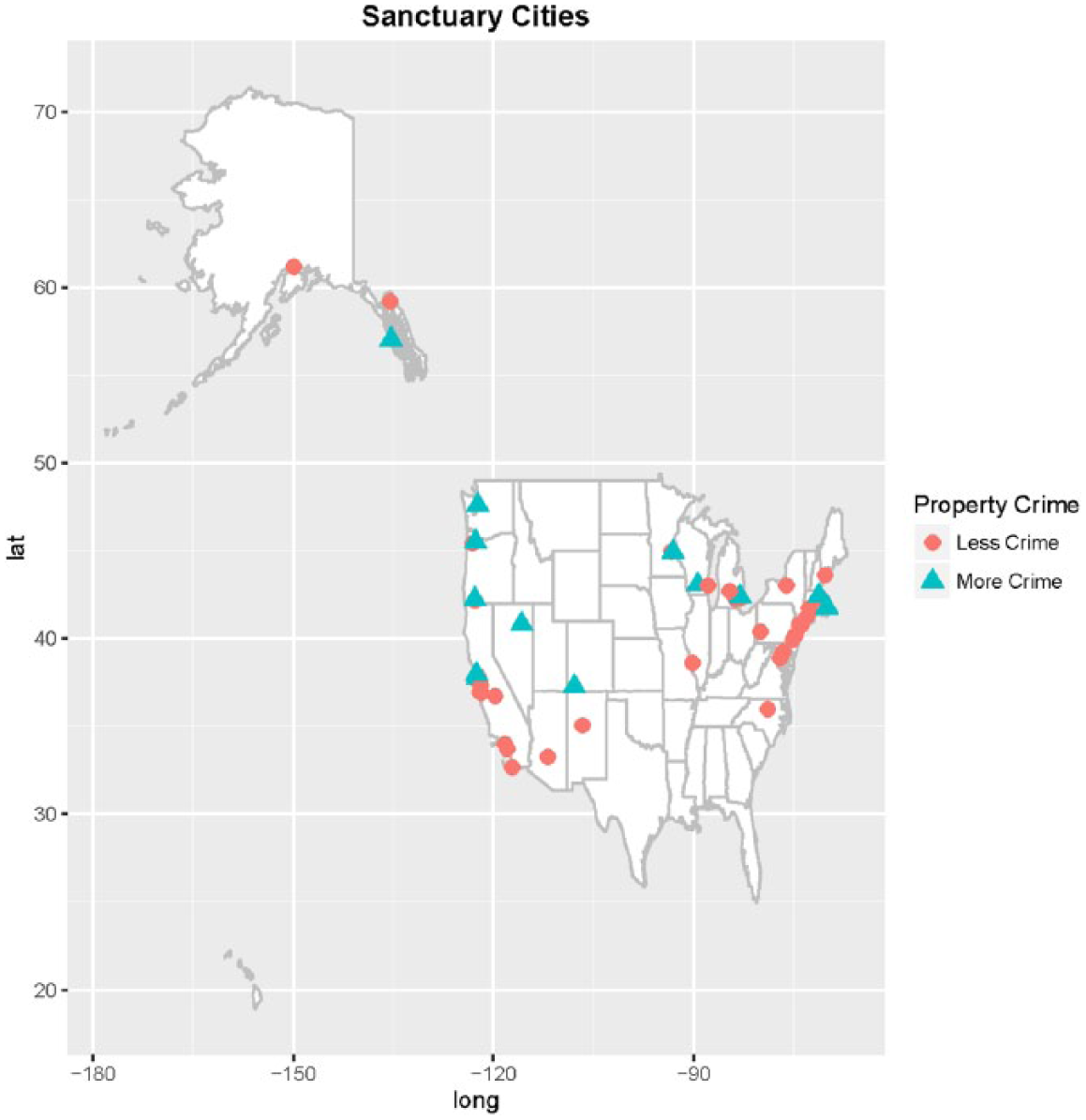
Given the aforementioned restrictions, analysis of crime data was maximized between 48 and 55 sanctuary city observations annually. In total, we matched the sanctuary cities against roughly 4,000 nonsanctuary cities across 20 states and the District of Columbia. Figure 1 maps out the geographic location of the sanctuary cities that we analyze. The geographical distribution of cities reveals that most are clustered in specific regions, including the Northeast to Mid-Atlantic corridor, around the Great Lakes, and along the West Coast. However, there are also a few cities in the Southwest and in Alaska deemed as sanctuaries.
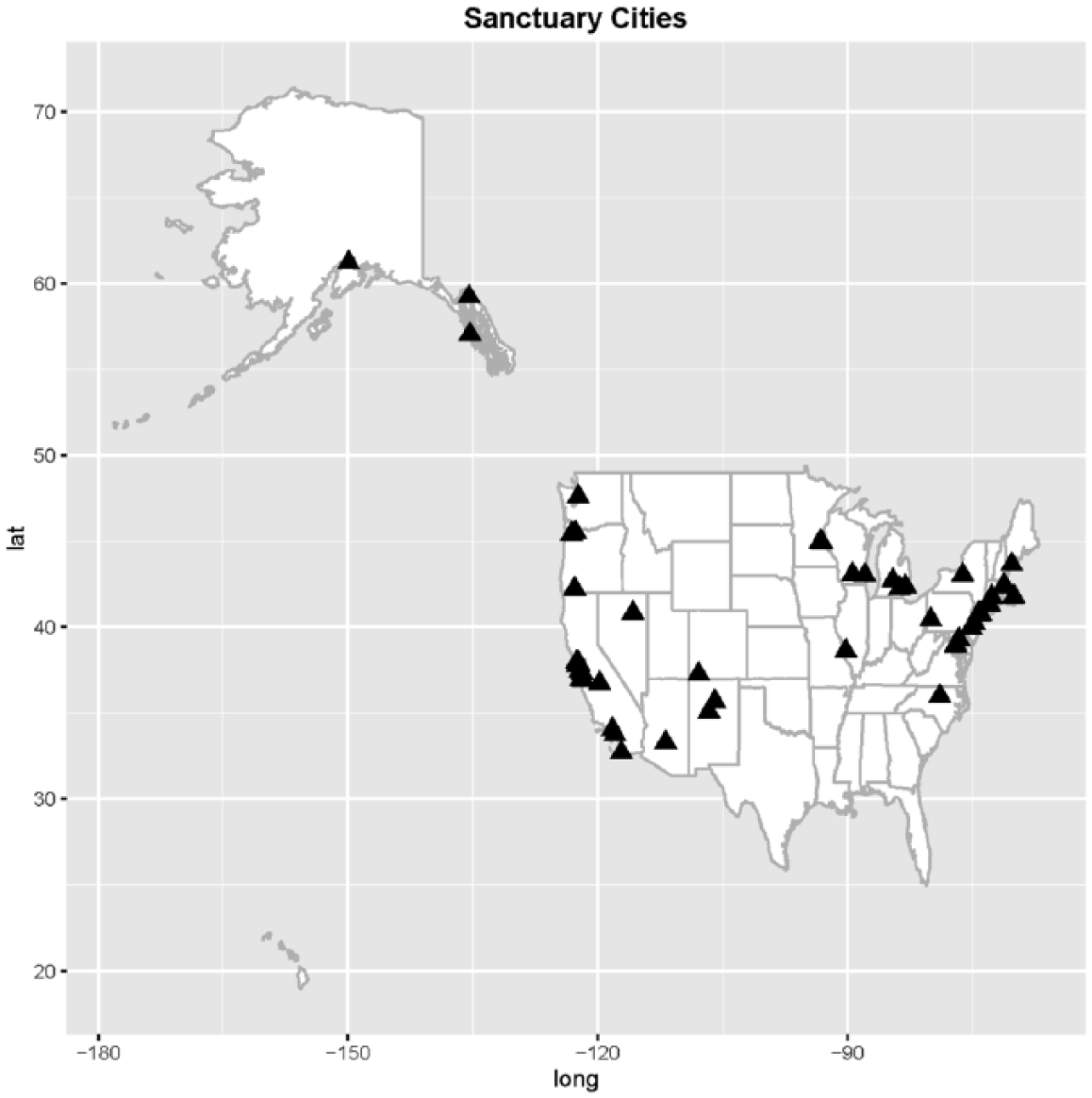
The geographical distribution of sanctuary cities in our dataset reveals that most cities are clustered in specific regions, including the Northeast to Mid-Atlantic corridor, around the Great Lakes, and along the West Coast.
For our crime data match, we also gather data on all other cities in these 20 states and the District of Columbia, so that we can compare cities in similarly situated locations. We use the genetic matching algorithm from the MatchIt package as specified in Ho et al. (2007). This algorithm matches treatment to control using a series of propensity scores and weights to find the most similar control city to the treatment city. 13
With our list of cities and key variables outlined, we built up the dataset with relevant Census data. Because we are interested in examining all cities post 2002, we use data from the 2000 Census as our baseline comparison. The variables included in the match are total population, percentage White, percentage Black, percentage Asian, percentage Hispanic, percentage unemployed, median household income, percentage poverty, percentage college degree (25 years old plus), percentage foreign born, percentage foreign born not citizen, percentage foreign born from Latin America, percentage Latino noncitizen, and percentage new city residents (mobility). On total population, larger cities are substantively different than smaller localities so it is important to take these qualitative differences into account in the matching process. For instance, San Francisco, a city of nearly 900,000 people, could have similar percentage estimates for a variety of demographic and economic indicators as a small town of 10,000, but it stretches credulity to say these cities are comparable. Race/ethnicity is important to account for in the match because racial characteristics may influence cities to implement sanctuary policies. Likewise, economic indicators, such as median household income, unemployment, and poverty, are all important control variables (Cantor and Land 1985). While we do not control for age and gender in the match, we do control for that in the post match regression, because these variables should be more important to predicting crime than predicting sanctuary city status. That is, places with lots of young males may be more predisposed to higher crime (Farrington 1986; Hirschi and Gottfredson 1983). Finally, a measure of latent ideology (the percent of votes for Al Gore in the general election of 2000) is included to guard against the possibility that more Democratic cities may be more prone to passing sanctuary laws. The appendix includes our coding procedure for the aforementioned variables.
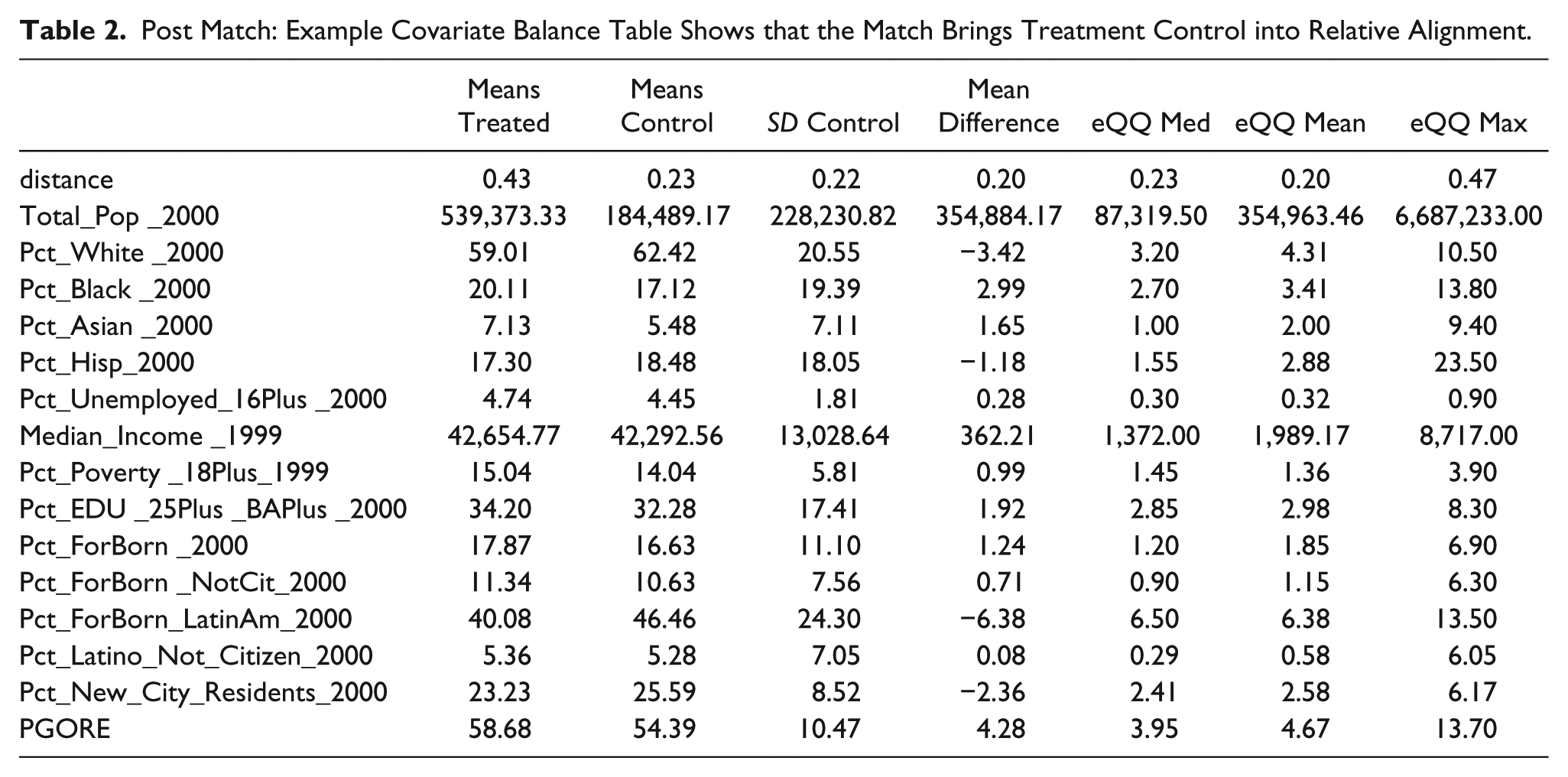
Tables 1 and 2 show the balance improvement across the match control variables. All variables show a dramatic increase in balance post match. But the balance is not perfect, which is why after our analysis with matched data, we also complete a regression analysis to control for small imbalances across treatment and control.
Post Match: Example Covariate Balance Table Shows that the Match Brings Treatment Control into Relative Alignment.
Our main outcome variables of interest are the various indicators of crime. With respect to this, we gathered the following available data from the FBI: violent crime rate, property crime, and rape between the years 2000 and 2014. These data are gathered by year so we can assess whether there is any change in crime over time, possibly because the effects of a sanctuary policy may be delayed. In addition, sanctuary cities come into being at different points in time across our spectrum of analysis. Again, the motivation behind gathering these data is that they are statistics that opponents of sanctuary cities purport to be caused by sanctuary policies.
The next section discusses our results, where we employ mean comparisons and regression analysis. Both indicate little difference on our outcomes of interest by treatment (sanctuary) or control (nonsanctuary) condition.
Results
As specified in the “Data and Method” section, we analyze the crime data in two ways—first at the individual-city level by observing whether crime rates change in the year following the implementation of a sanctuary policy within the city. Our second method is to conduct a match between sanctuary cities and similarly situated cities that do not have sanctuary policies, then examine whether crime is different across the two groups.
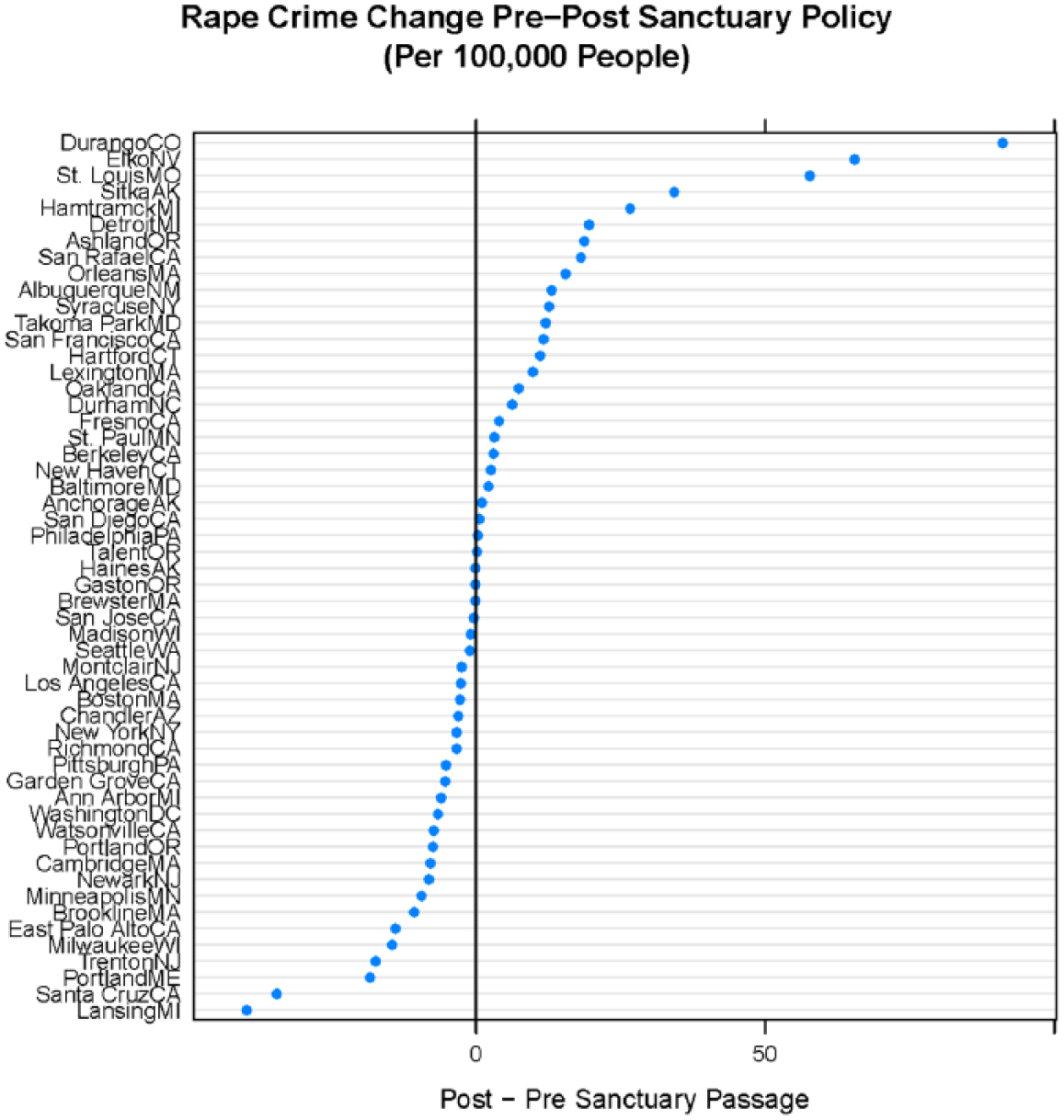
Beginning with our pre–post city-level analysis, recall that our hypothesis is that there are no systematic differences on crime rates following the passage of a sanctuary policy within a city. If we are correct, we will observe two possible sets of outcomes: (1) There will be no change whatsoever at the city level, or (2) there will be some change post sanctuary implementation but some cities will experience higher crime, other cities lower crime. To test this, Figures 2, 3, and 4 plot each city’s change in crime rate (violent, property, rape) following adoption of a city sanctuary policy. 14 For instance, if a city passed a sanctuary ordinance in 2006, our measure subtracts that city’s crime rate in 2005 from that city’s crime rate in 2007. Dots that are to the right of 0 show increases in crime, whereas dots to the left of 0 show decreases in crime following implementation of a sanctuary policy.
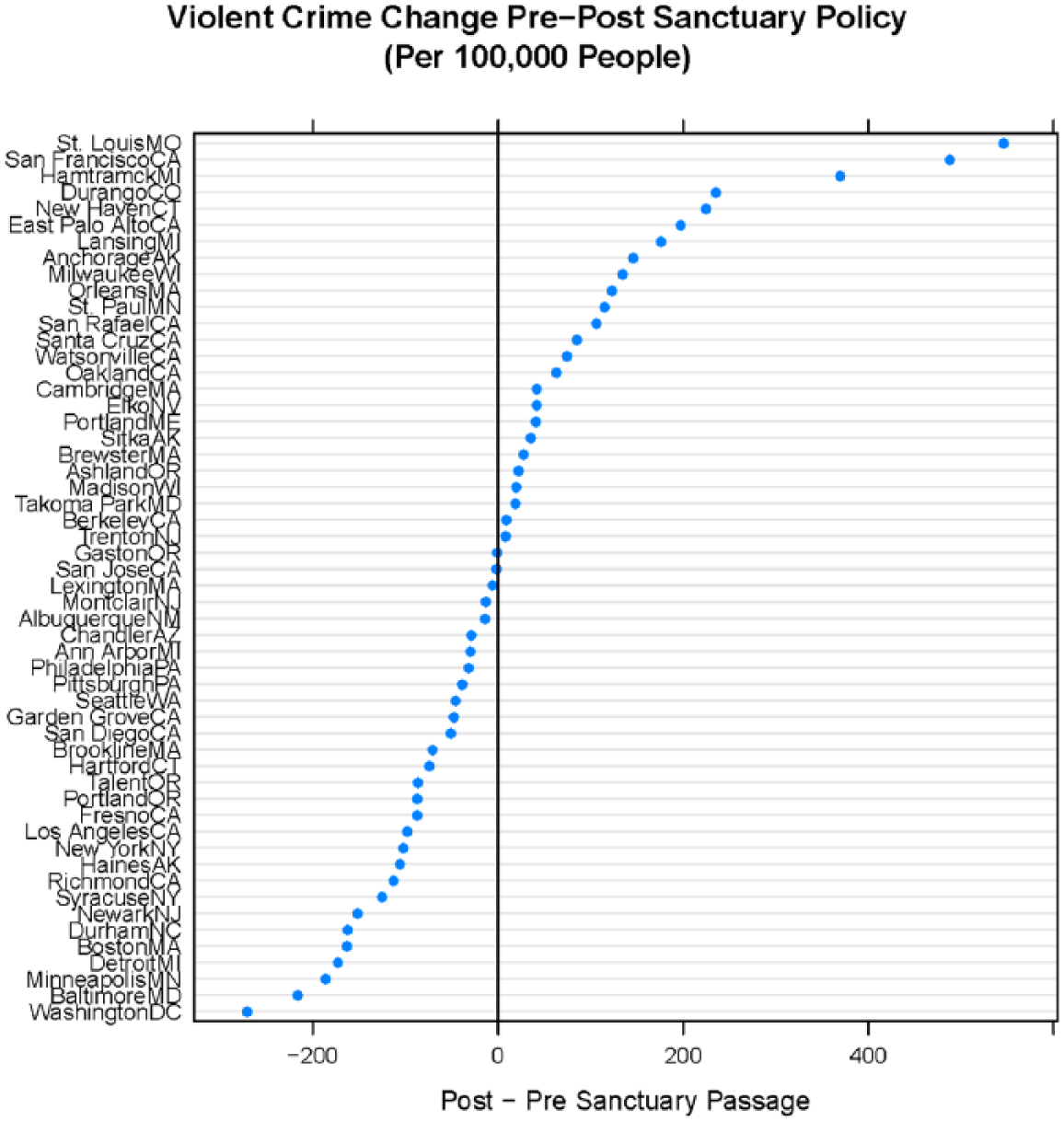
City-level violent crime pre/post passage of post 9/11 sanctuary policy.
City-level property crime pre/post passage of post 9/11 sanctuary policy.

City-level rape crime pre/post passage of post 9/11 sanctuary policy.
The geographical distribution of sanctuary cities with indication as to the change in rate of violent crime (per city) after passing sanctuary city legislation.
The geographical distribution of individual sanctuary cities with indication as to the change in rate of property crime (per city) after passing sanctuary city legislation.
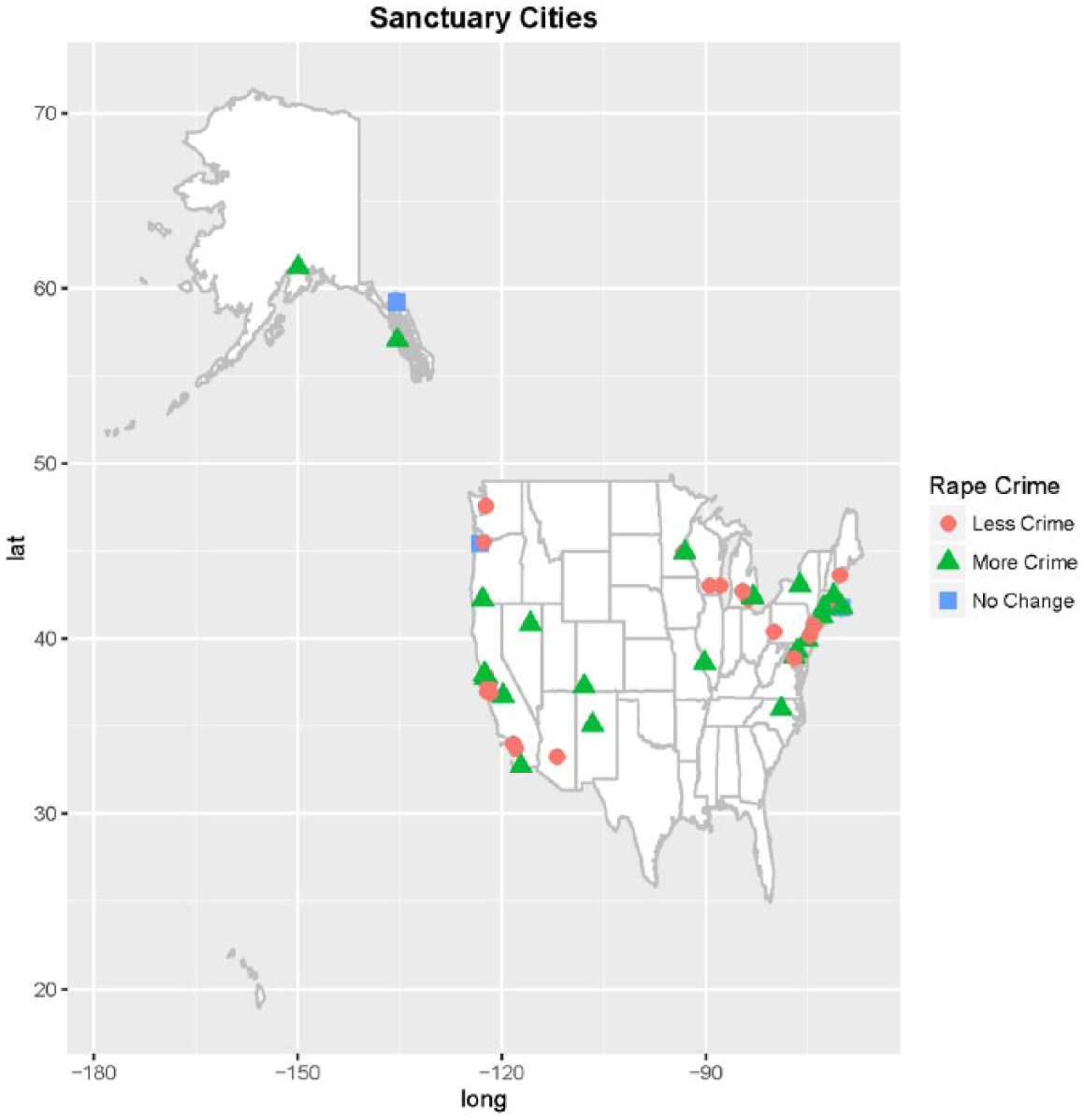
The geographical distribution of sanctuary cities with indication as to the change in rate of rape crime (per city) after passing sanctuary city legislation.
The plots clearly reveal that some cities experience mild increases in various assortments of crime, whereas other cities experience drops in crime. There is no clear generalizable pattern based on these graphs—but what is clear is that the individual-city-level plots are supportive of our hypothesis that sanctuary policy as a rule does not lead to more crime.
To buttress these findings, we also conducted a difference of means t test where one group is all city crime rates before sanctuary implementation, and the other group is all city crime rates post implementation. The results of the t test show that for violent crime (t stat = −0.133, p value = .894), property crime (t-stat = 0.996, p value = .321), and rape crime (t-stat = −0.733, p value = .465), there is no statistical difference across the two groups. Indeed, the mean difference for violent crime and for rape are very near to zero.
We begin our second analysis with an examination of crime data by year. Recall that in contradistinction to public claims that sanctuary cities cause crime to increase, our hypotheses suggest no such effects. If we are correct, then there will be no statistically significant evidence that sanctuary cities look different than nonsanctuary cities in crime-related statistics after the sanctuary policy has been implemented. Based on previous research and existing data, we believe undocumented immigrants are less likely to commit crime because they do not want to be deported. Thus, to the extent that sanctuary cities may draw in more undocumented immigrants precisely because of their sanctuary policies, if anything, crime rates should drop. However, we doubt such movement occurs as the process of intercity moving can be taxing, and people tend to follow jobs as the primary motivator for moving (however, we do control for mobility). In addition, as we noted earlier, we find no difference in noncitizen Latino immigration rates between matched sanctuary and nonsanctuary cities, providing evidence that sanctuary cities in and of themselves do not attract undocumented immigrants.
We conducted a series of difference of means t tests between our matched treatment groups. Figures 8, 9, and 10 largely confirm our hypotheses. The first plot shows the difference in violent crime rate between nonsanctuary and sanctuary cities. If the two lines for each year cross each other at any point, then the relationship between violent crime and city-type is not statistically significant. While there is a mild tendency to have slightly more crime in sanctuary cities, these effects are very small, and are not statistically significant. In general, the crime rate per 100,000 people differs between 100 and 200 incidents a year; however, again, these effects remain statistically insignificant.
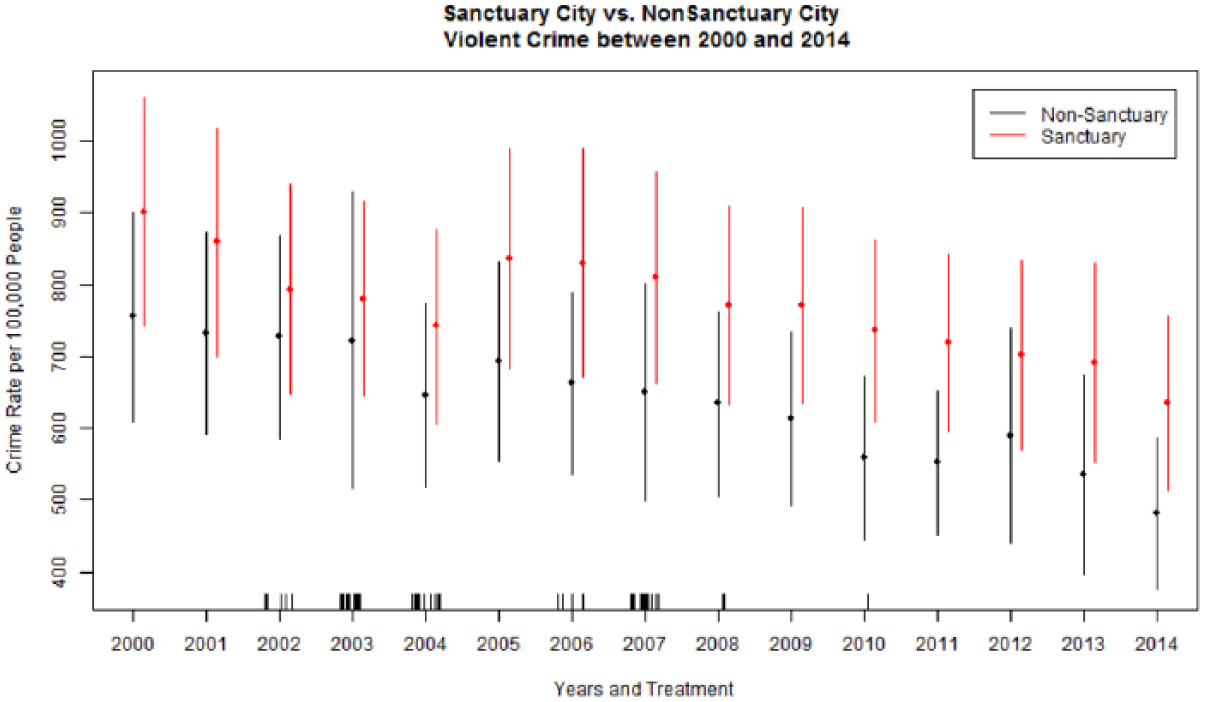
Violent crime rate by sanctuary and nonsanctuary city.

Property crime rate by sanctuary and nonsanctuary city.
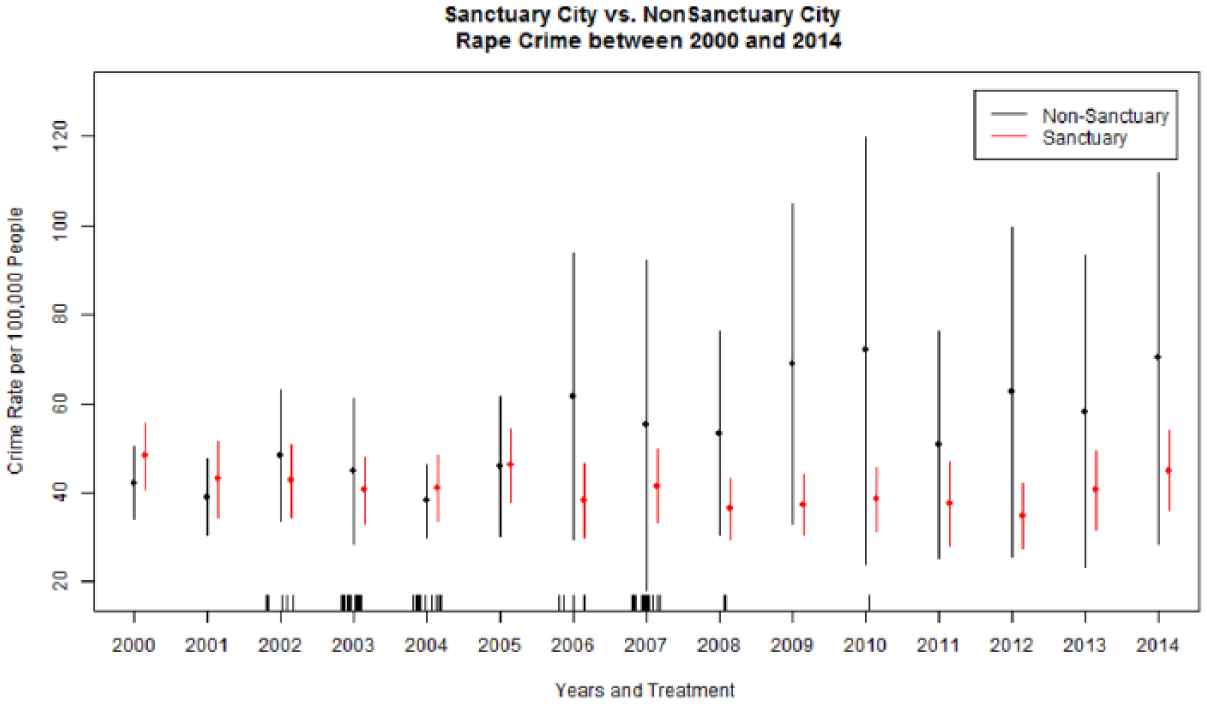
Rape crime rate by sanctuary and nonsanctuary city.
On property crime, we see a very similar pattern. In general, sanctuary cities tend to have slightly less property crime, but there is no statistical confidence in such a claim as most of the point estimates are relatively close to the 0 line and in no case do the error bars not cross the line. These results corroborate findings from violent crime, and support our central hypotheses. Sanctuary cities are no different from nonsanctuary cities on property crime during the years that we analyzed.
Finally, we evaluate whether rape is higher in sanctuary cities, as some political figures have claimed. Recall, the argument that has been advanced by some is that sanctuary cities have become a haven for criminals and rapists. In this scenario, the implicit causal mechanism is that would-be rapists are more likely to congregate or attack in these cities because they think their chances of getting away with an act are higher. To us, this logic seems fanciful; 15 we argue that sanctuary cities and nonsanctuary cities should witness similar incidents of rapes because the only difference between these cities—in general—is the policy itself.
Similar to Figures 8 and 9, our data reveal no significant relationship between sanctuary cities and rape (see Figure 10). In terms of point estimates for rape, it would seem that sanctuary cities generally experience less crime. However, once again, no statistically significant relationship between sanctuary city and rape emerge. These findings support our hypothesis—that there are no differences on crime rates.
Thus far, we have shown no difference by treatment on violent crime, property crime, and rape, which are collectively supportive of our hypothesis. Sanctuary policy thus has no demonstrable effect on crime rates, in terms of either increasing or reducing them. Again, this runs counter to the current narrative by some in the Republican Party that sanctuary policies lead to increased crime. We find no support for this regardless of whether we are looking at violent crime, property crimes, or rape.
However, while the match is designed to control for differences between treatment cities on variables that may induce sanctuary status, the post match balance table (Table 2) shows that our two treatment groups are not perfectly balanced. This is a clear limitation of matching—that is, the matching procedure and balancing process is never perfect, and there are possibly unobservable differences between our treatment and nontreatment cities. Following Ho et al. (2007), one way to improve the confidence in our results, though, is to conduct a multivariate regression analysis post match. Theoretically, multivariate regression will hold constant any unbalanced variables emerging from the match, letting us get an even more accurate test of our hypotheses. Therefore, we also conducted a regression analysis of our matched data on our three dependent variables. Table 3 presents results for this analysis for crime rates in 2012. If our hypotheses are correct, similar to our t-test analyses, we should not see a statistically significant coefficient for our treatment variable. This is precisely what we find for violent crime, property crime, and rape crime, respectively. 16 We also interacted our treatment measure by variables that might contribute to sanctuary status a priori: percentage foreign born without citizenship, percentage foreign born Latin American, and Latino noncitizen. In each case, the product term is statistically insignificant (results are shown in the appendix).
Regression Analysis Post Match, Modeling Various Types of Crime for Year 2012.

Note. Findings corroborate the earlier findings, there is no evidence for an effect for sanctuary city policy.
p < .1. **p < .05. ***p < .01.
Moreover, these results hold control for a plethora of variables that may theoretically affect both sanctuary city adoption and crime rate. These controls are important to the assessment of sanctuary policy because, fitting with other literature, compositions of cities tend to contribute to variation in crime rate as opposed to sanctuary status. Fitting with expectations, poverty is associated with higher rates of violent crime but not necessarily property crime. Unemployment rates actually have the opposite effect, as places with higher levels of unemployment have more property crime but actually a bit less violent crime. These results make sense because poverty tends to be more long-term and endemic leading to greater violence. At the same time, these areas are places with relatively low property values. Race is also related to crime but not necessarily in ways fitting with popular expectations. Once we control for a host of factors, places with increasing amounts of Whites, Blacks, and Hispanics tend toward slightly lower rates of violent, property, and rape crime. Interestingly, the only significant and positive predictor is percentage Asian and property crime. This makes sense when we consider that an increasing number of Asian Americans live in higher income neighbors. In the end, though, our main concern and result is that sanctuary policies themselves appear to have no effect on subsequent crime rates.
Discussion and Conclusion
Our findings suggest that sanctuary policies themselves do not affect crime rates, which contradicts the primary narrative for their repeal. The positive benefits of sanctuary policy for immigrant incorporation could disappear based on little more than fear-mongering if Congress does manage to pass a bill like the Enforce the Law for Sanctuary Cities Act, which cleared the House before dying in committee in the Senate. This bill would have stripped federal law enforcement funds from cities with sanctuary policies, endangering the trust these policies can help to create between undocumented immigrants and city officials. 17 The justification for the Enforce the Law for Sanctuary Cities Act relied heavily on the narrative of criminality despite having no empirical support for claims that sanctuary cities increased crime and our findings suggest that the reason for this lack of supporting evidence is simply because it does not exist. Similarly, Trump’s executive order 13768 which orders that sanctuary jurisdictions be stripped of federal funding also relies heavily on the narrative of undocumented criminality.
Sanctuary cities were initially designed to provide aid to and then incorporate people into American life from war-torn Central American countries. The policies have a strong basis in empathy, often with the backing of churches and local aid organizations. Thus, the policies are designed to assist people in extremely vulnerable positions in the United States in navigating their way to a life that is as safe and healthy as possible. However, in recent years, a few high-profile incidents where undocumented immigrants have committed horrific crimes have led some political candidates—generally on the right—and other actors to make sweeping negative claims about the deleterious effects of sanctuary cities. The argument is that sanctuary cities bring crime: Undocumented immigrants, who are by definition criminals, go to these cities to commit their crimes because they know their chances of deportation are much lower. Despite evidence to the contrary (i.e., Lyons, Ve’lez, and Santoro 2013 or Ridgley 2008), these voices argue that sanctuary policies lead to more crime and general destabilization.
We found these claims highly dubious on their face given evidence beginning in the 1930s and continuing until today that immigrant populations tend to produce less crime because these populations are more concerned with deportation and running afoul of the law relative to the native-born population. While other research certainly indicates that relative to other cities, sanctuary cities, on average, produce less crime or no crime, we felt compelled to re-examine this question taking a different analytical approach. We did this in part because we want to evaluate the sanctuary policy definitively. Given the political saliency of the issue, we found it necessary to assess sanctuary cities using a causal inference method, in this case, matching. This approach lets us isolate the direct effect of a sanctuary policy on a variety of outcome variables, while controlling for several confounding variables.
To test these claims, we collected city-level data from the U.S. Census, including population size, age, gender, education, income, ethnicity, and citizenship status. These are all variables thought to either influence criminal activity or weigh on the selection decision by a city to become a sanctuary city. That is, we control for both confounding variables as well as rule out possible selection effects. We then used a genetic match, which allows us to compare each sanctuary city in our data against another sanctuary city within the same state. Once we controlled for these variables, the difference between our sanctuary cities and nonsanctuary cities on the matching variables reduced to essentially zero. The result indicates that there is no discernible difference on each type of crime we measured between sanctuary and nonsanctuary cities. Thus, when it comes to crime, we conclude that sanctuary cities have essentially no impact one way or the other.
Our findings have clear normative democratic implications. Sanctuary policies in terms of leading to crime do not appear to be a problem. In fact, as we pointed out in our earlier review of the literature, almost all research that assesses links between immigration and criminality find an inverse relationship. The argument advanced by some politicians that immigration—namely, “illegal” immigration—is somehow linked to crime in any sort of meaningful way is simply not true. Our findings, in addition to findings from others (e.g., Lyons, Ve’lez, and Santoro 2013), suggest that sanctuary policies do not, on their face, lead to increase in crime. To the contrary, sanctuary cities as a policy should be enhanced—they can act as what Sidanius and Pratto (2001) call hierarchy attenuating structures. In general, these policies help aid and protect people in often very precarious situations. Indeed, the long-run impact of sanctuary policy may increase Latino and other immigrant incorporation leading to a more democratic polity.
While our main goal here was to assess whether sanctuary cities lead to crime, future research should move beyond this dependent variable to examine more in-depth the myriad aspects of Latino incorporation. Especially as the number of sanctuary cities and perhaps counties expand, we can begin to examine—over the long run—whether foreign-born Latinos in sanctuary cities become U.S. citizens, register, and vote at higher rates than similarly situated Latinos in other cities. While some literature might suggest otherwise (see Pantoja, Ramirez, and Segura 2001, who show that Latino political participation surged in California in the 1990s in response to Republican Pete Wilson and his support for the anti-immigrant Proposition 187), it is also quite plausible that sanctuaries are viewed as more welcoming, which, in the long run, leads to greater political and civic participation (Pedraza 2014).
We must also note that things have been changing rapidly as a result of Trump’s hardline approach to undocumented immigration and his desire to punish sanctuary cities in some way for refusing to cooperate with federal officials. Some cities have restated their commitment to their sanctuary policies in the face of these threats, with Seattle Mayor Ed Murray stating, “This city will not be bullied by this administration into abandoning our core values,” while also directing city departments to reprioritize their budgets to prepare for possible cuts (Beekman, Gutman, and Shapiro 2017). Other localities have responded by dropping their sanctuary protections, as was the case with Miami-Dade County (Mazzei and Hanks 2017). Even after the president’s executive order, cities have continued to pass sanctuary policies, though because of concerns with the sanctuary label, they have become sanctuary cities in all but name, in hopes of remaining below the administration’s radar. The next few years will, unfortunately, provide a ripe area of research to see how cities respond to threats from the administration, what actions they take if federal grants are affected, and whether sanctuary policies can survive if implementing the policies results in a loss of federal funding. The effect that changes have on immigrant communities in these areas is also a potential area of research, as there could be a number of effects from an out-migration of Latino immigrants to a reduction in trust between these communities and police.
Footnotes
Appendix
Regression Analysis Post Match, Including Interaction Terms, Modeling Various Types of Crime for Year 2012.

| Crime Type |
|||
|---|---|---|---|
| Violent | Property | Rape | |
| Sanctuary (Treatment) | −117.276 (136.164) | −1,714.174 (1,580.048) | −32.557 (32.387) |
| Population size | −11.264 (24.620) | 645.511** (288.802) | 2.279 (5.810) |
| % White | 1.158 (2.258) | 74.271*** (26.992) | 0.396 (0.529) |
| % Black | −0.280 (15.404) | −112.564 (190.691) | 1.220 (3.825) |
| % Asian | −0.0001* (0.00003) | −0.001 (0.0004) | −0.00000 (0.00001) |
| % Hispanic | −18.390*** (2.940) | −15.614 (36.583) | −7.022*** (0.680) |
| % unemployed | −10.594*** (3.239) | −108.854*** (39.436) | −7.029*** (0.762) |
| Median income | −8.499 (7.518) | 246.535*** (84.087) | −5.587*** (1.699) |
| Poverty (over 18) | −10.486** (4.527) | −67.906 (54.824) | −4.593*** (1.050) |
| BA or greater (25+) | −47.689*** (14.925) | 1,914.488*** (168.807) | −3.534 (3.315) |
| % foreign born | −0.002 (0.005) | −0.116** (0.053) | −0.0003 (0.001) |
| % foreign born without citizenship | 26.666** (11.056) | −475.379*** (135.589) | 1.252 (2.646) |
| % foreign born Latin American | −3.471 (3.767) | 99.794** (39.583) | 0.580 (0.872) |
| Latino not citizen | −13.046 (14.291) | −533.242*** (162.456) | −3.653 (3.287) |
| Mobility | −17.054*** (5.035) | −231.112*** (57.585) | −1.870 (1.187) |
| Gore vote (2000) | 3.839 (3.111) | 87.678** (35.070) | −0.338 (0.703) |
| % male 15–19 | 61.122* (33.212) | −825.786** (333.362) | −4.125 (7.641) |
| % male 20–24 | −32.163 (20.552) | 512.550*** (193.362) | 2.984 (4.281) |
| % male 25–29 | 42.567 (35.856) | −279.722 (361.526) | −5.828 (7.304) |
| % male 30–34 | 30.425 (43.728) | −194.144 (460.400) | 8.096 (9.728) |
| Treatment × Percent Foreign Born Without Citizenship | 9.415 (11.807) | 142.555 (141.878) | 0.769 (2.871) |
| Treatment × Percent Foreign Born Latin American | 2.901 (2.821) | −8.640 (32.013) | 0.724 (0.664) |
| Treatment × Latino Not Citizen | −2.317 (17.192) | −57.714 (200.643) | −2.019 (4.058) |
| Constant | 1,913.363*** (576.204) | 12,454.410* (6,857.810) | 770.239*** (131.686) |
| Observations | 110 | 110 | 110 |
| R 2 | .787 | .729 | .726 |
| Adjusted R2 | .729 | .657 | .653 |
| Residual SE (df = 86) | 257.473 | 2,881.179 | 58.192 |
| F statistic (df = 23; 86) | 13.776*** | 10.066*** | 9.904*** |
Note. Findings corroborate the earlier findings; there is no evidence for an effect for sanctuary city policy.
p < .1. **p < .05. ***p < .01.
Acknowledgements
We wish to thank Karla Ruiz Torres for her assistance with some of the data collection.
Declaration of Conflicting Interests
The author(s) declared no potential conflicts of interest with respect to the research, authorship, and/or publication of this article.
Funding
The author(s) received no financial support for the research, authorship, and/or publication of this article.