



Abstract
Recent research shows that increasing the minimum wage does not result in significant job losses. Yet, there is still uncertainty as to how higher labor standards may reshape employment practices within firms. This article directly examines employer responses to higher labor standards through a qualitative case comparison of the full-service restaurant industry across two fundamentally different institutional settings: San Francisco—with the nation’s highest minimum wage and related mandates—and North Carolina’s Research Triangle region. Evidence shows that higher labor standards led to wage compression even while some employers offered higher benefits to reduce turnover. San Francisco employers seek higher-skilled, more professional workers, rather than invest in formal in-house training, and find better matches. Yet, higher-wage mandates have exacerbated the wage gap between occupations, and some employers have responded by radically restructuring industry compensation practices by adding service charges and eliminating tipping.
Introduction
The restaurant industry, which employs more than 9.9 million workers, epitomizes the trend of relatively high growth and low job quality and is arguably the sector most impacted by recent minimum wage increases. 1 As efforts to increase the minimum wage stall at the federal level, many large cities including Seattle, Los Angeles, San Francisco, and Chicago have passed or are considering local increases that will bring the minimum wage up to $15 per hour or higher. The pace and scale of recent wage increases—spurred by an organizing drive by fast-food workers in the “Fight for $15” movement—leave policy makers and analysts wondering about their eventual impacts (Holzer 2015). Recently, the issue of job quality in the restaurant industry has garnered national attention, as evidenced by the media coverage of a series of fast-food worker strikes and the high-profile research and advocacy of the Restaurant Opportunities Centers (ROC) United. However, these recent efforts to increase wages and benefits follow two decades of attempts to improve labor standards through passage of a host of minimum wage, living wage, and related legislation at the city and state levels (see Reich, Jacobs, and Dietz 2014). In addition, there are efforts underway in several states to pass other labor standards, such as raising the wage paid to tipped workers, or mandating paid sick leave. While the impact of publicly mandated labor standards on employment and other labor outcomes is well studied and continues to be debated among economists and policy makers, there are still important missing pieces in our understanding of how labor standards enacted at the urban scale may have deeper impacts not only on the potential for job losses but also on the way employment relationships are structured within firms. In addition, the impact of policies seeking to raise labor standards at the local scale has important implications for the literature on urban politics, which has long been fascinated with the question of how far cities can go in enacting progressive economic policies without scaring away mobile capital (Peterson 1981; Rast 2005; Savitch and Kantor 2002). Recent work in this vein has pointed out that local progressive coalitions can be successful—under certain circumstances—in passing pro-worker legislation at both the city and state levels (William 2014; Doussard and Gamal 2016). Specifically, understanding how local labor standards can not only affect the level of employment but also potentially reshape job quality is critical for local economic development officials who typically seek to provide access to good jobs through recruitment of outside firms in high-wage industries, rather than local upgrading.
While the empirical literature on minimum-wage and living-wage laws is vast and has been evolving since the 1970s, the majority of this research focuses on only one aspect of their impact—namely on employment. The majority of this work is highly quantitative and relies on aggregate data sources, including the Quarterly Census of Employment and Wages (QCEW) or the Current Population Survey (CPS), to analyze policy impacts at a national or state level (see Adams and Neumark 2004; Dube, Lester, and Reich 2010; Neumark and Wascher 2006). 2 As a result, researchers must use estimated employment elasticities from industry-wide data or from defined demographic groups to make inferences about firm behavior. However, in many ways, the behavior of actual firms remains a “black box” for researchers in the field. In addition, there are many ways, beyond just the level of employment, that raising labor standards could impact the employment relationship. These other employment outcomes may include changes to the rate of turnover, productivity, training, tenure, industry-specific norms, and performance expectations.
This article directly addresses the question of how firms adjust to higher local labor standards such as minimum-wage increases and mandated healthcare spending. To do so, this article employs a mixed-methods comparative case design that analyzes employment practices across the restaurant industry in two institutionally divergent urban labor markets: San Francisco, which has the nation’s strongest local labor standards, and North Carolina’s Research Triangle, which has no locally mandated regulations. These institutional differences result in extreme differences in the mandated wage and benefit levels that employers must offer. Ultimately, this article finds that higher labor standards—including a high minimum wage with no tip-credit, mandated healthcare contributions, and paid sick leave—led to wage compression both within firms and across the restaurant industry in San Francisco. Yet, there is also evidence that some employers in San Francisco still offer compensation above the mandated minimum to attract workers. In addition, employers in San Francisco exhibit greater investment in finding better matches and seeking higher-skilled, more professional workers, rather than investing in formal in-house training. However, the findings about professionalization cannot be uniquely tied to higher labor standards. Finally, higher wage mandates have exacerbated the wage gap between front-of-house and back-of-house occupations—a division of labor that correlates strongly with existing racial and ethnic divisions. Initial evidence shows that some employers have responded by radically restructuring industry compensation practices by adding service charges and in some cases, eliminating tipping. Collectively, these findings provide empirical support for institutional accounts of firm behavior in local labor markets, which should be accounted for in any prospective analysis of labor standards considered at the urban scale. As the federal government remains increasingly hostile to expanding labor standards, cities, counties, and states are likely to remain the key arenas for policies such as living- and minimum-wage laws, paid sick leave, and scheduling regulations. Therefore, this article offers insights not only for theories of how local labor markets function under different policy contexts, but also practical implications for the impact of such standards on businesses and workers. Last, these findings imply that local economic development policy options for providing better quality employment opportunities for local residents should not be limited to chasing mobile capital, but should also include endogenous upgrading of labor standards.
Theoretical Context and Previous Research
Current theories about how labor markets operate differ widely across disciplines within the social sciences. On one hand, the economics profession is still dominated by the neoclassical viewpoint that treats the market for labor much like the market for other goods in the economy—with firms as relatively passive price-takers and workers moving freely between jobs to maximize their utility. In this view, the labor market is constantly in equilibrium, and any attempt to raise standards through public policy (e.g., the minimum wage) will result in job losses. Since the mid-1990s, however, economists have begun to propose an alternative model of the labor market based on the theory of monopsony, which implies that firms have some degree of market power that leads to latitude in setting wage levels to allow them to choose from a variety of human resource practices to match their competitive strategy (Boal and Ransom 1997; Burdett and Mortensen 1998; Manning 2003). The dynamic monopsony model posits that, due to “frictions” in the labor market (i.e., the cost of searching for a new job, geographic constraints, the cost of turnover, etc.), we can expect to see variation in firm practices even within the same industry as some employers attempt to hold on to their workforce by paying higher wages and/or benefits, and others may choose a “low-road” strategy of low wages and high turnover. Beyond the field of labor economics, the implications of this theoretical approach are important to urban policy makers not only because the models can explain the empirical finding that raising labor standards does not automatically result in job losses, but also because local mandates may have the potential to alter other aspects of the employment relationship and change industry practices in a positive way.
Explaining Local Labor Standard Impacts
Interest in empirically detecting the existence of monopsony power was sparked by the work of Card and Krueger (1995), who were the first to show that minimum wage increases could lead to wage increases without disemployment effects. Focusing specifically on the restaurant industry and using data from the Quarterly Workforce Indicators (QWI), Dube, Lester, and Reich (2016) directly tested the impact of minimum wage increases on labor market flows, finding sharp declines in turnover rates without significant changes in employment levels. While this work provides convincing empirical support for the monopsonistic view of the labor market, there is still uncertainty as to how such mandates shape broader aspects of employment practices within firms. Recently, some empirical work has focused on a wider range of adjustment mechanisms that firms may use to respond to wage mandates. For example, Hirsch, Kaufman, and Zelenska (2015) compared fast-food restaurants from the same chain in Georgia and Alabama before and after a federal minimum wage increase and found that establishments more intensely impacted by the 2007–2009 federal increase showed no significant changes in employment or hours, yet reduced turnover and demanded performance increases (i.e., higher productivity) from their workers. In addition, recent empirical work has shown that minimum wage increases have significant “ripple effects” higher up the wage distribution (Autor, Manning, and Smith 2016; Wicks-Lim 2008).
The reliance on monopsony models to explain the basic finding of small or insignificant disemployment effects in empirical research on the impact of minimum wage is also theoretically consistent with nonorthodox labor market theories based on the work of institutional economists and geographers. Beginning with work by scholars including Doeringer and Piore (1971) and Kotz, McDonough, and Reich (1994) and others that presented a descriptive model of the labor market (e.g., dual labor markets, labor market segmentation), they sought to explain structural inequalities such as persistent racial discrimination and job quality differences across and within industries through an analysis of institutions rather than individual agents. Consistent across all of these institutional accounts of the labor market is the observation that social norms and contexts matter and that employers have considerable power over wage-setting and structuring the core aspects of the employment relationship (Tilly and Tilly 1998; see also Peck 1996). The institutional approach is also used by scholars who document variation in labor practices and restructuring within certain industries and locales (Appelbaum and Batt 1994; Carré and Tilly 2008; Luce and Fujita 2012). Collectively, these scholars have consistently documented the existence of “high-road” employment practices—often associated with higher wages, benefits, training, and greater full-time employment—alongside a set of employers who pursue a “low-road” strategy aimed solely at lowering labor costs. This article also relies on these institutional perspectives in developing hypotheses of how employers in the restaurant industry are likely to adapt to raising labor standards in their local labor markets.
Last, this article directly addresses the ongoing scholarly debates over the prospects and impacts of local living wage and other labor standards on local economies; key pieces of which were published in this journal (Martin 2001). Dating back to the early 2000s, researchers began to measure the empirical impact of living wage laws (which applied only to government contractors or narrow segments of the urban economy). Bartik (2004) outlined the broad theoretical mechanisms through which living-wage laws could impact an urban economy, emphasizing indirect institutional impacts as a key avenue. Adams and Neumark (2004) found negative impacts on employment using a time-series analysis of 100 living-wage cities. However, this study was criticized by other scholars for relying on CPS data to detect city-level impacts (Brenner, Wicks-Lim, and Pollin 2002, 2008), and was contradicted by time-series evidence using more detailed data (William 2011; William 2012). This article moves beyond the narrow impacts of previous studies to explore how municipal labor standards have an impact on employer behavior and reshape employment outcomes broadly.
Existing Research on Employment Practices in the Restaurant Industry
The restaurant industry is the most intensely scrutinized industry by scholars interested in the impact of labor standards. Not only does this industry employ the largest share of low-wage workers, but the restaurant industry itself is often the most vocal opponent to minimum-wage laws and has consistently supported and highlighted research that shows negative impacts. Contrasted with this work, advocacy organizations such as the ROC United have produced detailed reports documenting the low-pay and poor working conditions in the restaurant sector. In 2011, ROC released a study conducted in eight large metropolitan regions that consisted of surveys and interviews with both employees and employers that documented the prevalence of low wages, lack of access to health benefits, and sick leave, and persistent occupational segmentation by race (Restaurant Opportunities Centers United 2011). More recently, Batt, Lee, and Lakhani (2014) presented results based on a national employer survey across 33 large metropolitan areas focused on variation in human resource practices across restaurant market segments. They found a clear link between higher-quality human resource (HR) practices and lower turnover. In a related study, Batt (2012) highlighted case studies of restaurants that pursue what they call “high-road” practices, which include higher relative wages, more full-time work, and more investment in training. This work is critical because it highlights the possibility that multiple HR strategies are possible in the same industry and that while “low-road” strategies are clearly profitable by keeping wages low, “high road” strategies can also be profitable as well.
While this growing body of research is crucial for better understanding the nature of employment in the restaurant industry, it does not explicitly analyze the role of labor standard mandates on outcomes. This article complements this work by concentrating employer surveys and interviews on two cases that vary widely in the scope and magnitude of labor standards.
Hypothesis Building: How Labor Standards Might Alter the Employment Relationship
Before turning to a discussion of the research methods, it is important to note how theories of monopsony and related institutional research on labor markets would explain the impact of raising labor standards on employment outcomes. These theoretical implications form the basic hypotheses that will be explored in the empirical analysis proposed below.
First, by raising wage floors, minimum-wage and living-wage mandates are predicted to compress the distribution of wages offered within the industry. Thus, a key implication of this compression is the hypothesis that in the absence of high labor standards, firms in North Carolina’s Research Triangle Park (RTP) region—where there are no locally enacted labor standards—will engage in a wider variety of employment practices with starker contrasts between low-road employers that are very low (e.g., low wages, high turnover) and some high-road employers that can truly have their pick of the available workforce. We would expect the opposite to be true in San Francisco where a higher wage floor is predicted to result in the convergence of employment practices. In the latter environment, it is still possible that firms find nonwage outcomes with which to compete for workers. This is an area of inquiry that is best explored in detail through interviews.
Second, the (dynamic) monopsony model implies that as wages and other benefits rise through mandates, turnover falls accordingly. The implications of this at the level of an individual restaurant are that for firms in San Francisco, lower turnover results in more workers staying on the job longer and conversely, a higher share of new-to-the industry workers hired in RTP. Thus, I expect that firms will require more industry-specific experience when hiring in San Francisco, compared with RTP, and a parallel finding of large differences in turnover. This hypothesis is explored directly through a survey of and interviews with restaurant managers who were asked to describe their recruitment strategy, how they seek their “ideal” candidates, and how they address challenges in finding skilled workers in each occupational category. This qualitative approach will also provide insight on differences in the norms and expectations employers have of their workforce and highlight how skills are framed and sought after in the hiring decision. More significantly, we can see how employers articulate their expectations about worker productivity and the potential for this to lead to a greater “professionalization” in what is often considered a low-skill, low-wage industry.
Third, by reducing turnover and by extension, raising average tenure levels within each firm, higher labor standards may also have an impact on the incentive to offer additional training to new workers, and perhaps, to create formal or informal, internal job ladders. Because a higher hourly wage raises the marginal cost of each additional worker, an employer may have a stronger incentive to extract productivity from each new worker and thus, has an incentive to provide more training (Arulampalam, Booth, and Bryan 2004). In particular, when the wage rate is high, the potential productivity gap between a new worker and the rest of a more experienced workforce is higher. A corollary to this hypothesis is that employers in a labor market with high labor standards will make less frequent use of part-time shifts as part-time workers require a longer period of time to gain experience and ultimately achieve higher productivity. However, there is ambiguity in the literature about the effect of higher minimum wage levels on training, as Rosen (1972) pointed out, firms may attempt to offset higher labor costs by cutting back on formal training programs. This article uses qualitative data gleaned from interviews with restaurant managers to shed light on the training strategies selected by employers and to highlight the potential nonmonetary costs of training.
Methodology
As noted above, this study uses a primarily qualitative research design of the restaurant industry across two fundamentally different institutional settings. In San Francisco, employers face the nation’s highest minimum wage ($10.74 per hour rising to $15 by 2018), a pay-or-play healthcare mandate (up to $2.33 per hour), and paid sick leave requirements. In addition, tipped workers must be paid the full minimum wage. In the RTP region, 3 there are no locally enacted labor standards. Thus, the effective wage in San Francisco is more than $13.00 per hour (Reich, Jacobs and Deitz 2014) during the study period of January through October 2014. 4 Conversely, firms in the RTP region are bound only by the federal standards of a $7.25 minimum wage and $2.13 per hour for tipped workers, with no paid sick leave or healthcare spending mandate.
The analysis focuses on the full-service restaurant sector only. This sample restriction is applied for several reasons. First, limited service (i.e., fast-food) establishments are more likely to have less flexibility in adapting to labor mandates as they tend to be less labor intensive, thus, leaving less variation to observe. In addition, a key difference in wage regulations between the comparative cases is in the tipped minimum wage, resulting in more potentially observable treatment effects among full-service restaurants. Last, fast-food establishments are more likely to be part of corporate franchise chains than full-service establishments. Because many HR practices are influenced at a corporate level, it would be harder to attribute observed differences in fast-food establishments to local labor mandates rather than exogenous corporate policy. For these reasons, this article focuses on full-service restaurants.
While the regional labor markets of these two cases differ on a number of dimensions beyond the strength of local labor standards, there are a number of similarities that make this comparison plausible for detecting causal effects of labor standards. While finding a perfect control region that differs from San Francisco only in the depth of locally mandated labor standards is difficult, the choice of North Carolina’s RTP region was made for several reasons. First, the region is home to both the RTP, which since its founding in the 1960s, has attracted a set of thriving high-tech industries with strengths in software and biotechnology, as well as a thriving start-up economy centered in downtown Durham. While the size of the tech sector in the Triangle—as measured by venture capital investments or employment—is smaller than San Francisco or the Bay Area as a whole, it nonetheless proxies for the kind of bifurcated regional economy in both places. Next, both regions exhibited comparably tight labor markets overall, with the unemployment rate in RTP being 4.9% in 2014 compared with 4.4% in San Francisco.
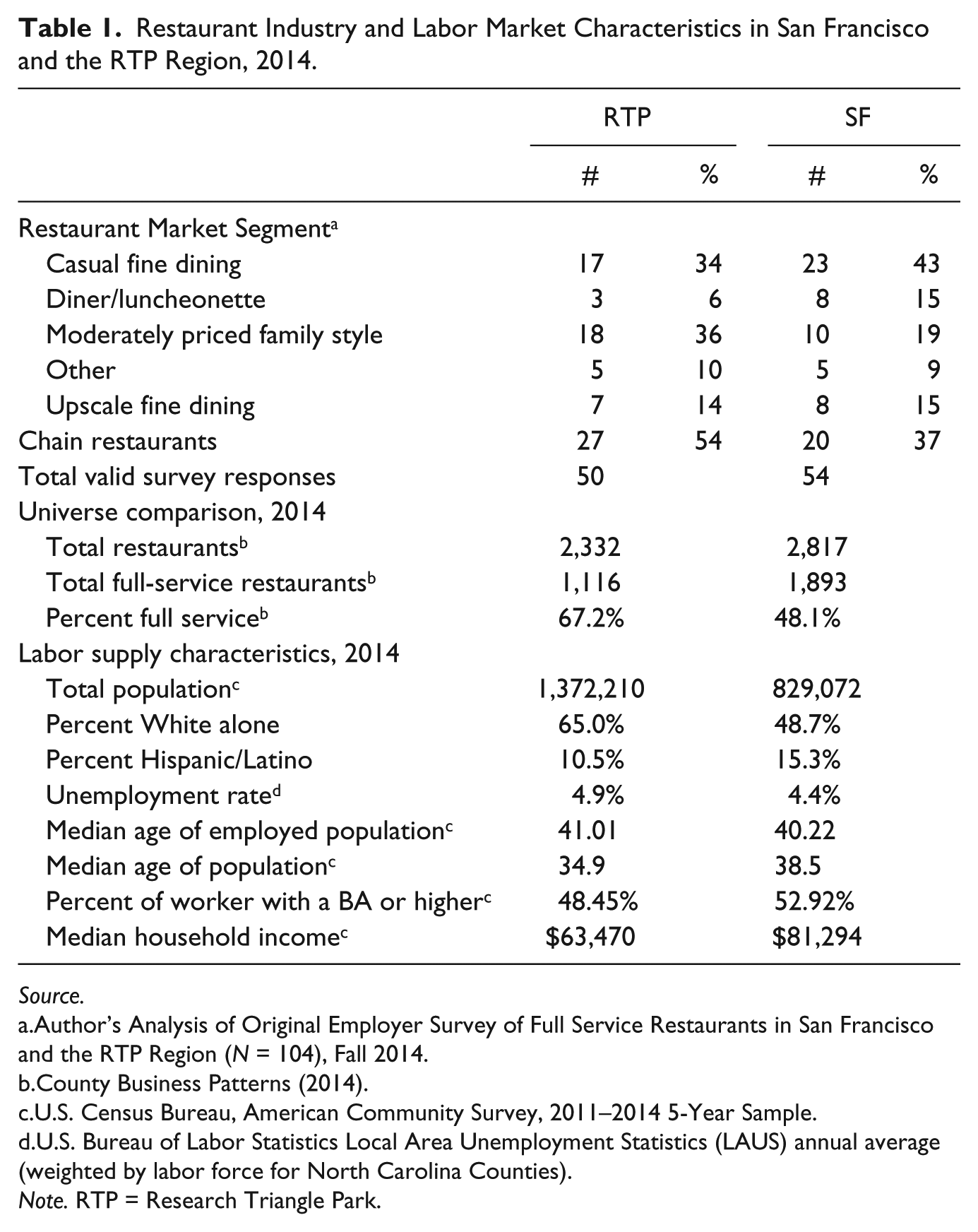
When comparing the overall universe of restaurants in each city, some figures make the comparison between San Francisco and the RTP region straightforward while others may present some limitations. Table 1 presents descriptive statistics on the restaurant industry and overall labor market conditions in both cases. First, the overall size of the restaurant sector is relatively similar with 1,116 total full-service establishments in the Triangle and 1,893 in San Francisco. The higher number of restaurants in San Francisco despite its lower population may reflect a higher overall level of disposable income as well as a difference in market share of limited-service restaurants in the Triangle (58% vs. 33%). Within the full-service sector, however, the distribution between type of restaurant by price and service level is quite similar, with Triangle area restaurants slightly more skewed toward moderately priced establishments. While there are several similarities in overall demographic characteristics between the two cases, with a similar unemployment rate, age of workforce, and high levels of educational attainment, San Francisco has a much higher median income ($81,294 vs. $63,470) and an older overall population. In addition, the population of the RTP area is relatively more White (65% vs. 48.7%) and contained fewer Latino residents (10.5% vs. 15.3%). These demographic characteristics may not directly influence the labor supply characteristics, but may indicate a wealthier and more diverse consumer base in San Francisco.
Restaurant Industry and Labor Market Characteristics in San Francisco and the RTP Region, 2014.
Source.
Author’s Analysis of Original Employer Survey of Full Service Restaurants in San Francisco and the RTP Region (N = 104), Fall 2014.
County Business Patterns (2014).
U.S. Census Bureau, American Community Survey, 2011–2014 5-Year Sample.
U.S. Bureau of Labor Statistics Local Area Unemployment Statistics (LAUS) annual average (weighted by labor force for North Carolina Counties).
Note. RTP = Research Triangle Park.
One factor that limits the comparability in the research design is the degree to which restaurants in each region are stand-alone establishments versus part of a multi-restaurant chain. The survey (described below) estimates that 54% of full-service restaurants in the Triangle region are part of a chain compared with 37% in San Francisco. While the difference in ownership structure may influence the degree to which local managers can adjust to labor standards, interview participants in the Triangle who were part of large corporations indicated they did, indeed, have control over key staffing decisions including hiring, levels, as well as prices. While I do not believe this difference biases the results derived from interview participants, it is nonetheless a limitation that should be noted. Another key difference between the sites can roughly be described as a difference in food culture. San Francisco is widely viewed as a “foodie” city, meaning that it is a highly competitive market with highly knowledgeable consumers who demand quality ingredients and value innovative restaurants. The restaurant sector of the RTP region, while increasing its stature on the national food scene, is not viewed as sophisticated as San Francisco. A recent blogpost ranked San Francisco the number 1 “foodie” city, while Raleigh ranked 82nd. 5 While it is uncertain how the difference in food culture will impact the results, it is worth noting here. Given this difference, the findings on professionalization described below are offered with caution in terms of causality.
There are two main data collection methods used for this project; a web-based employer survey and a set of semistructured interviews with approximately 15 employers in each case. The interview subjects were restaurant owners, general managers, or other key staff who have direct control or influence over the firm’s HR strategy. Participants were solicited from and represent all major restaurant market segments (e.g., family style, casual fine dining, and fine dining), offering a range of observations according to price point and revenue. Interview participants were initially solicited via a web-based survey (described below) inquiring about the willingness of survey participants to participate in a 45-minute interview. Additional interview participants were solicited through phone calls and in-person requests by the investigator and a graduate student researcher during business hours such that interviews were conducted with managers from all segments of the full-service restaurant industry in each case. All interviews were recorded on digital media and transcribed for subsequent analysis. The employer survey was conducted between July 1 and August 31, 2014 and collected a total of 104 valid responses. The universe of respondents was derived from the Reference USA business listing service, which consists of a near census of all establishments in both cases. The initial list contained 2,349 restaurants in San Francisco and 1,703 in the Triangle. However, this list erroneously included many establishments that were actually fast food, and many restaurants did not have a valid e-mail address listed. After data cleaning and eliminating closed restaurants, the survey was sent out to a total of 1,483 e-mail addresses. 6 The survey consisted of 15 questions and was intended to gather detailed information on wage levels by occupation, training provided, skill requirements, and educational attainment of workers. In addition, the survey gathered background information on each restaurant such as market segment, average entrée price level, and number of seats available. The survey instrument is available as an online appendix.
Findings
Taking Away the Low Road and Shifting the High Road Higher
One of the key predictions of the monopsony model is that raising the minimum wage will reduce existing wage variation within a given labor market as some employers who, without such a wage floor, would offer a lower wage and accept higher turnover while others would offer a higher wage and face lower quit rates. As such, a high and binding minimum wage and related labor standards would lead to wage compression and a general convergence of employer practices. Thus, raising labor standards can be interpreted as “taking away the low-road.” This claim is directly observed from the survey data. Figure 1 below illustrates that wage variation for servers is, indeed, greater in the RTP region than San Francisco.
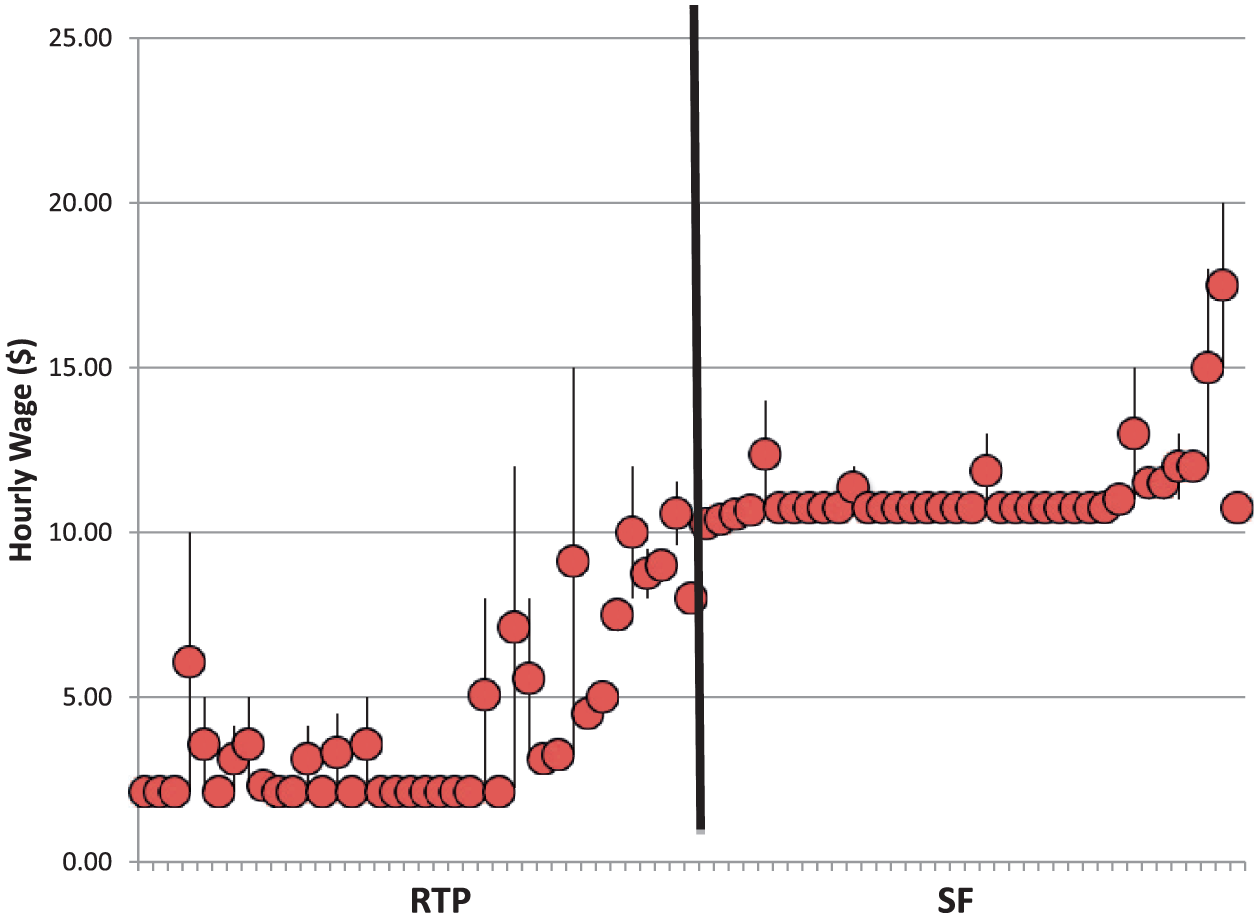
High, low, and average wage rates for servers in full-service restaurants in the RTP region and San Francisco.
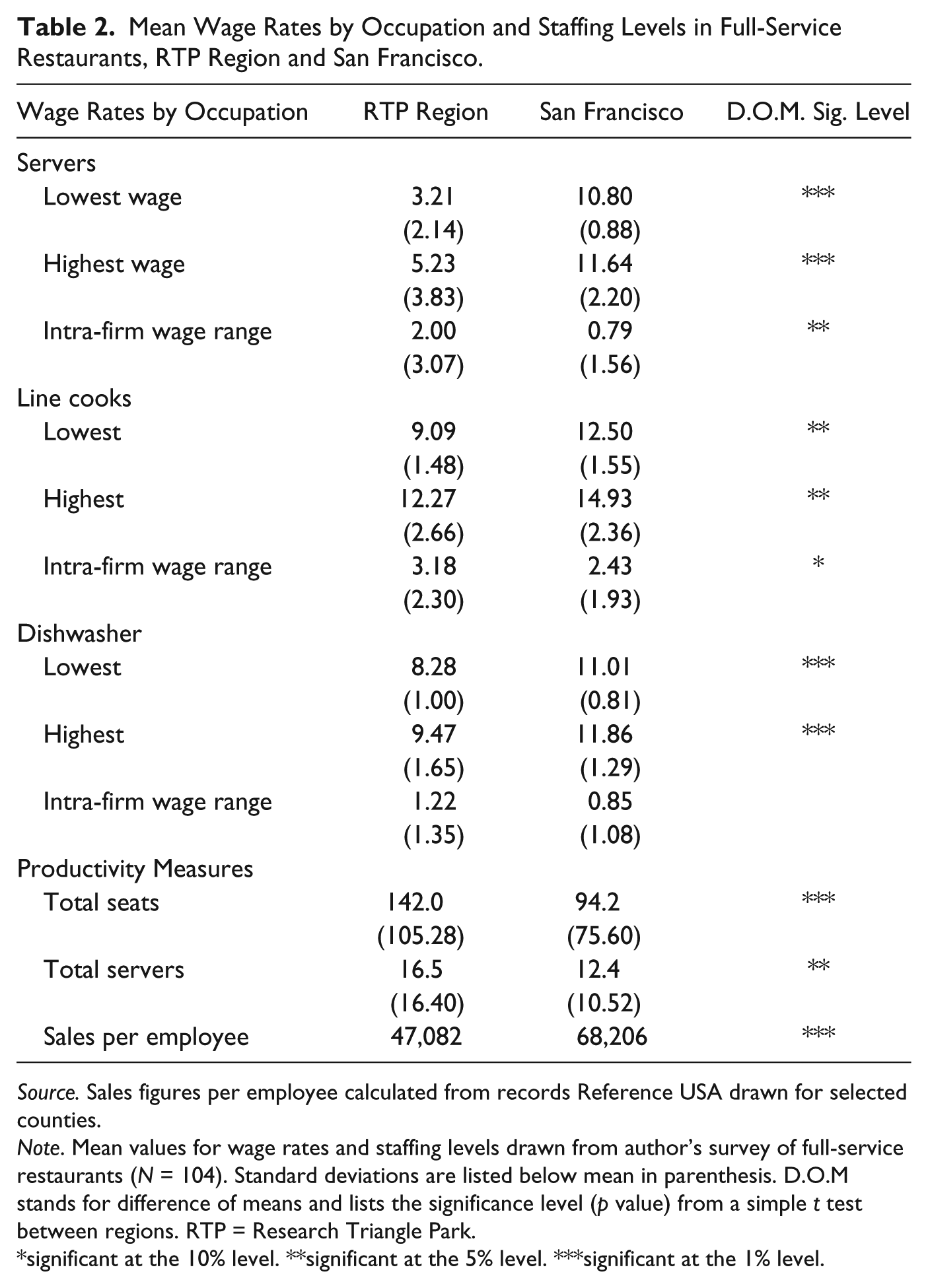
A visual comparison of the wage distributions above reveals that while most establishments pay servers the respective mandated minimums of $2.13 per hour in RTP and $10.74 per hour in San Francisco, there is considerably more variation in the RTP cases. Specifically, 57% of respondents in RTP reported paying at least one of their servers a wage above $2.13 per hour, compared with just 38% paying above the minimum legal rate in San Francisco. Because the survey asked about the wages offered to the lowest-paid (i.e., newly hired) worker as well as the highest-paid workers, we can compute the same comparison of wage offer rates for new workers. In RTP, 32% of employers offered a starting wage for servers above the mandated minimum, compared with only 21% of restaurants in San Francisco. Table 2 summarizes the wages offered by various occupations and presents the overall level of variance both across and within firms for each region. Overall, the wage variation is greater for RTP in nearly all occupations, as indicated by the standard deviation listed below each mean value. For example, the standard deviation was $2.14 for servers’ starting wage in RTP versus $0.88 for San Francisco. While these statistics capture the degree of wage variation measured across the industry as a whole, we can also observe the within-firm wage variation by calculating the difference between the highest- and lowest-paid worker in each occupational category. Consistent with the industry-wide figures, employers in RTP offered a wider range of wages to their workers compared with employers in San Francisco. 7 This difference in intra-firm wage variation was statistically significant for servers and line cooks. This survey evidence suggests that labor mandates—particularly, the high and binding local minimum wage—are associated with less wage variation both within and across firms in the full-service restaurant industry. Thus, local mandates seem to “take away the low-road” by limiting the room that employers have to offer low wages and build the resulting higher turnover into their business strategy.
Mean Wage Rates by Occupation and Staffing Levels in Full-Service Restaurants, RTP Region and San Francisco.
Source. Sales figures per employee calculated from records Reference USA drawn for selected counties.
Note. Mean values for wage rates and staffing levels drawn from author’s survey of full-service restaurants (N = 104). Standard deviations are listed below mean in parenthesis. D.O.M stands for difference of means and lists the significance level (p value) from a simple t test between regions. RTP = Research Triangle Park.
significant at the 10% level. **significant at the 5% level. ***significant at the 1% level.
While the differences in wage variation between the RTP region and San Francisco—both within firms and across the industry—support the claim that labor standards are effective in raising standards in the low end of the labor market, interview data reveal evidence that such standards also push some employers to go above the new standards. This is particularly evident in how some employers reacted to the enactment of San Francisco’s pay-or-play healthcare mandate. Rather than requiring employers to provide insurance directly to workers, the San Francisco Healthy Families Act of 2007 requires employers to pay up to $2.33 per hour worked for each employee. These payments can go either directly to the county health system—where resident workers can receive low-cost care—or into a separate healthcare spending account set up for each worker. This mandate involves a significant but uniform cost increase for all employers in the industry. However, in the face of this mandate, some employers decided to spend more than the mandated minimum to provide actual employer subsidized health insurance to all workers, a benefit that is extremely rare in the industry (Batt, Lee and Lakhani, 2014) As one employer described, This year for example, we did employee health insurance for everyone . . . Now everyone has real insurance, not just the city thing. We think and hope it will help retain employees.—Midscale convention center, restaurant manager
Another employer echoed the logic of providing full employers’ sponsored health insurance, rather than simply paying the lower-cost option of a per-hour fee to the City of San Francisco. The manager of one neighborhood-based fine-dining restaurant explained, Part of our decision to offer healthcare goes beyond a simple cost-benefit—what’s another thousand dollars if you already have to spend a certain amount of money? There is a kind of revolutionary like revolt thing happening in that I’m not going to just sign a check over to the city. I’m going to actually give it to my employees. And then the other part is it becomes part of your hiring and your attraction is that you say, hey, we offer full benefits.—Neighborhood fine dining manager
Although this manager’s initial sentiment reflects animosity toward the City for enacting the Healthy Families law in the first place, the employer’s actual behavior in paying more for full insurance indicates how the labor standard induced the employer to go above the minimum and embrace the potential retention and morale benefits for their workforce.
Beyond direct wage and benefit offers, we can observe how employers in San Francisco reshape other aspects of the employment relationship in an effort to differentiate themselves from other employers in the market and to ultimately retain valued employees. Several interview participants discussed how they attempt to create a unique work “culture” that is “exciting,” “fun,” or offers indirect benefits to workers, even in cases where employers cannot raise wages beyond the mandated level. For example, one employer described their efforts to retain key workers in lower-paid occupations through the use of in-kind compensation that is matched to the specific needs of the individual worker: Through working with everyone on a daily basis we try to keep everyone happy and in a good mood, you know. [For example,] we just started doing an employee of the month program but not in a traditional McDonald’s kind of way. Our dishwasher that’s been with us for five years and we never want to lose him. He’s from Mexico and his family’s all back there so we bought him—and we did a presentation in front of all the staff and gave him calling cards so he can call his family more frequently, whenever he wants. And we actually just gave [a back waiter] the employee of the month today and since his daughter is having a quinceañera party coming up, we offered to host all of the alcohol for that party and have it here.—Midscale convention center restaurant manager
While these may seem like relatively minor gestures on the part of some employers, these forms of nonwage compensation represent additional ways in which we can observe the tendency for employers to differentiate themselves to retain workers. In the face of strong, binding labor standards that effectively limit the degree to which this differentiation takes place via the wage (i.e., “taking away the low-road”), we still observe differentiation in how employers structure the employment relationship. In these two examples, we observe restaurateurs who—perhaps implicitly—are adopting some of the same progressive HR practices typically associated only within high-skill industries or occupations. Specifically, they are recognizing and seeking to accommodate the individual needs of each worker, whether that relates to the worker’s need for outside income through catering or in-kind support of family obligations.
Stronger Matches and the Rise of Professional Norms
The greater degree of wage variation observed in the restaurant industry in the RTP region compared with San Francisco is broadly consistent with the narrative explanation offered by theories of how higher labor standards impact the labor market. Parallel to this observation, we also find evidence that higher labor standards lead to stronger, longer-lasting matches between employers and workers. This finding is borne out by evidence from a variety of sources, including publicly available employment statistics on labor turnover, original survey results on employer hiring expectations and requirements, as well as interviews with employers themselves. Beyond the direct finding that raising wages and benefit standards reduces turnover, the qualitative evidence drawn from employers indicates that higher labor standards may have deeper impacts on the prevailing norms and expectations in the restaurant industry. Specifically, employers in San Francisco readily describe their ideal employees in language that describes worker traits and behaviors that are typically used to describe professionals—meaning workers who have recognizable industry-specific skills, typically work full time, and invest in their own training. It is important to note that the findings on professional norms must be viewed with caution in interpretation. While the evidence of lower turnover and hiring of more experienced workers can more readily be tied causally to higher labor standards, norms of professionalism and expectations of employers in San Francisco may also be associated with its more established reputation as a “foodie city” (as noted above).
The rate of turnover for the overall full-service restaurant industry in San Francisco was 15.9% in 2012, according to official statistics from the QWI program. This compares with 31.1% in the RTP region. However, as seen in Figure 2 below, this stark contrast in turnover is largely due to the relatively high rate of short-term workers who enter and exit employment at a given firm within the same quarter. The difference in turnover rate for “stable” jobs—meaning jobs that last more than one quarter—is much lower (12.9% vs. 15.8%). This means that the full-service restaurant sector in RTP features a significantly higher number of unsuccessful, or weaker, matches than San Francisco’s restaurant sector.
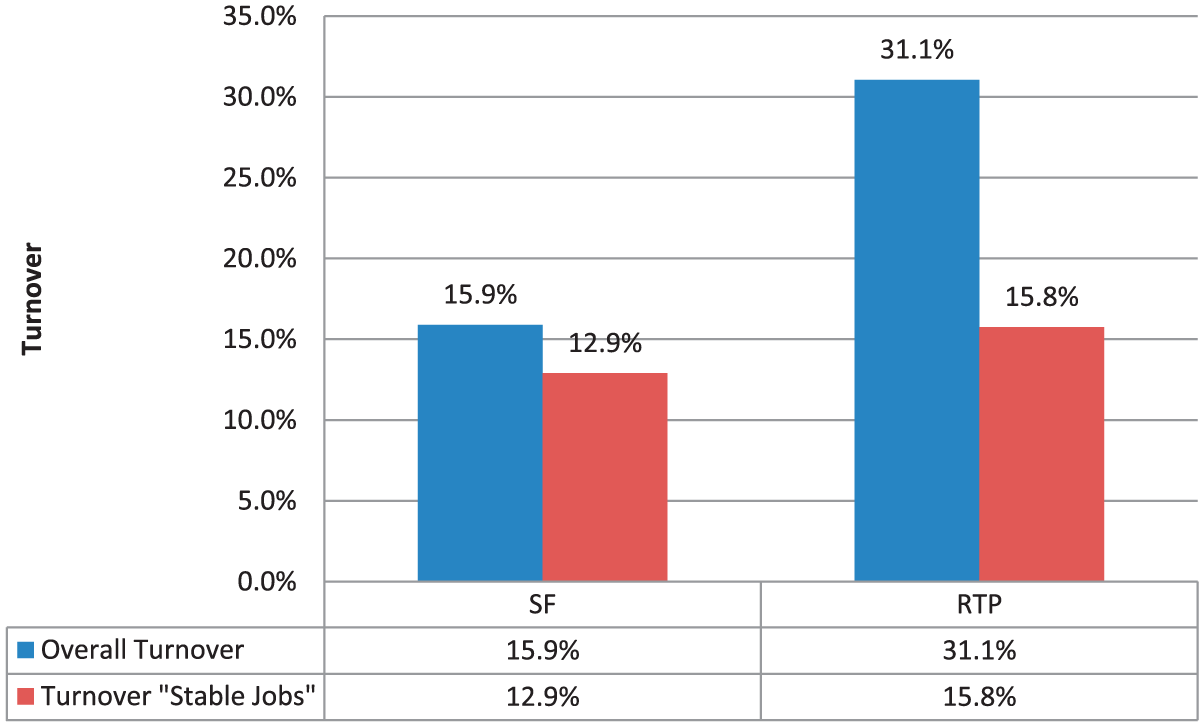
Labor turnover rate for stable jobs and overall jobs in the full-service restaurant industry in San Francisco and the RTP Region, 2012.
These very short-term jobs—lasting less than one quarter—are often described by labor economists and other observers as evidence of bad matches between employee and employer (Barlevy 2002; Gautier, Teulings, and van Vuuren 2010). The prevalence of these low-quality matches are indicative of labor market conditions in the restaurant industry that feature a large number of potential workers flowing into and out of employment. While the QWI data do not allow us to observe exactly why a worker left a job, the most common mechanisms include (1) quitting to take a better job in the industry or similar industry, (2) quitting a job and exiting the labor market, or (3) being fired by the employer. In a low-wage labor market without binding labor standards, we would expect all of these exit mechanisms to be more pronounced as the wider wage variation would induce workers to change jobs more frequently, and as the relatively low industry-wide wage would be closer to more workers’ reservation wage. Finally, as I argue below, lower-wage labor markets without binding standards engender weaker expectations of worker quality on the part of employers, which leads to a lower bar for entry and ultimately more firing of low-quality workers.
To address these explanations of contrasting labor market conditions between regulated (San Francisco) and unregulated labor markets (RTP), we need to move beyond the high-level snapshot provided by the turnover figures. Specifically, we need to directly examine the kinds of matches that occur in the restaurant labor market and search strategies that employers use to generate them. First, the restaurant industry in RTP tends to hire younger workers with a lower level of formal education. Specifically, 49.5% of workers in RTP are under age 24 or have less than a high school education, compared with 38.9% in San Francisco. Conversely, 40.6% of workers in San Francisco have some college or a bachelor’s degree or higher, compared with 29.7% in RTP. 8 While these differences could reflect differences in labor supply available in these two settings, they are greater than the overall differences in educational attainment across the entire labor market. While there are many colleges and universities in the RTP region, the two cases actually have a very similar number of people currently enrolled in higher education. 9
In addition to hiring an older and more educated workforce, San Francisco employers generally engage in more careful searches, which lead to overall better matches. First, employers in San Francisco report higher experience requirements for new hires across the occupational spectrum. As seen in Figure 3, only 2% of survey respondents in San Francisco reported that new servers could be hired without any previous experience in the restaurant industry, compared with 35% in RTP. Also, a larger proportion of the San Francisco employers reported experience requirements of more than one year—64% in San Francisco, compared with 26% in RTP. The lower bar for entry into employment is also confirmed in employer interviews. For example, one RTP manager explained what he looks for in a new front-of-house worker as follows: Basically, we require [that a server] can work a four shift minimum per week and go an entire shift, an entire eight-hour shift without smoking a cigarette and [without] any facial piercings or anything. Beyond that, just come in with a smile on your face.—Neighborhood bistro manager in Raleigh
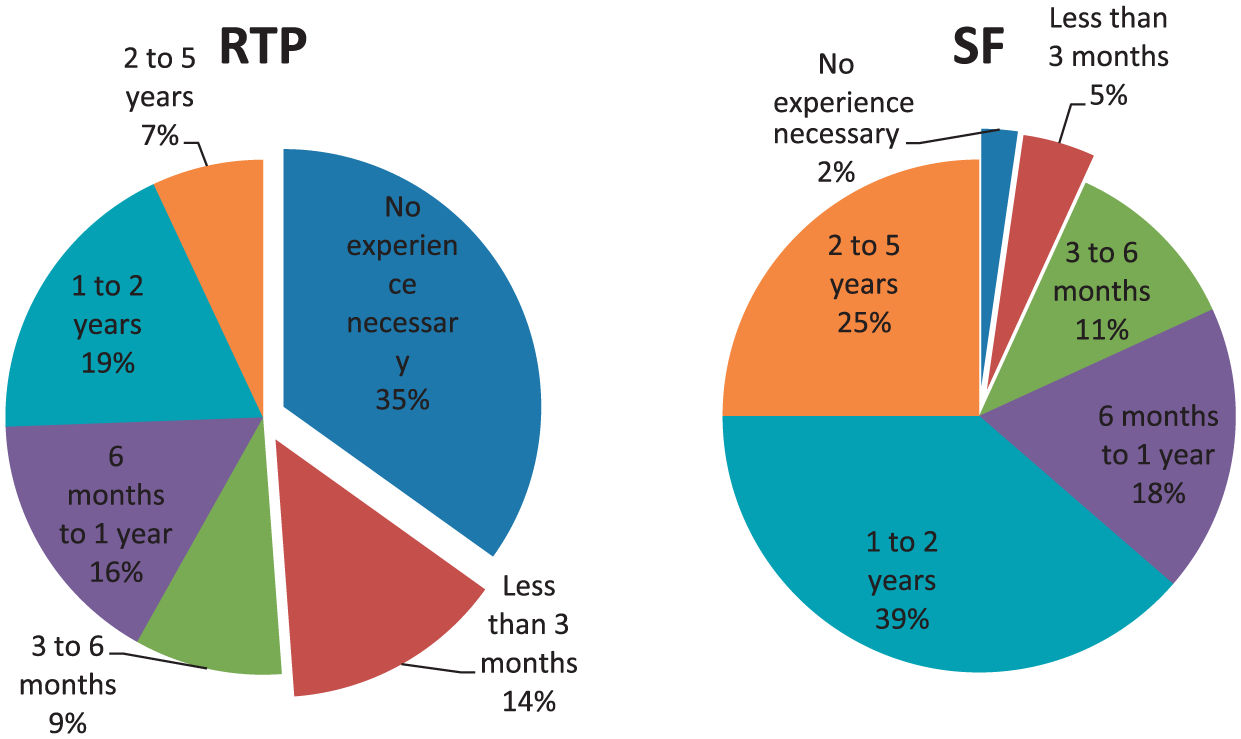
Minimum experience required for servers in the RTP and San Francisco full-service restaurant industry.
Survey and interview data indicate that employers in RTP place less value on industry-specific experience. Yet, even in firms that do prefer experienced workers, managers and owners did not articulate how experience matters or which specific skills or demonstrated industry-specific knowledge they require. As one manager describes, We look for at least one year’s experience, but the biggest thing we look for is we look for the person. We don’t look for the skill. I could teach anybody how [to] wait tables [and] pour drinks. I can teach anybody how to cook steaks. What I can’t teach is how to be a good person.—Upscale bar and grille manager in Raleigh
Employers in San Francisco discussed the minimum level of experience needed to work in front-of-house positions in a distinctly different tone. Rather than viewing servers as essentially interchangeable laborers who can be trained quickly and easily if they possess a modicum of personal hygiene and a friendly personality, employers in San Francisco exhibited a clear description of what a “professional server” was and the explicit and implicit skills required. One employer described her front-of-house staff as follows: We have a lot of people who have made it a career and they’re investing in the knowledge of the product and learning their trade or already know their trade because they’ve done it for years.—Midscale restaurant manager in San Francisco
Another San Francisco owner described the level and nature of experience needed to fill a server position in his neighborhood bistro: Realistically, to work here, I would say [a server needs] five years of experience, because there’s a wine knowledge level that I expect that you really just couldn’t get any other way. . . . If you have 10 years of experience at Applebee’s, that doesn’t do anything for me.—Neighborhood bistro owner
The fact that this employer is seeking a candidate not just with time on the job at any restaurant, but rather a similar kind of full-service restaurant is a point that was echoed by many employers. Thus, employers care not only about how much time a worker has spent on the job, but where that job took place, and how much time was spent there. As one manager put it, “I look also at loyalty. How long were they at a certain place? So if they worked at a good restaurant, and they were there three years, they must be doing something right.” Many employers also stressed the importance of working in restaurants in San Francisco or other cities with a well-known restaurant culture (e.g., New York). Ultimately, these responses indicate that employers are looking carefully down each candidates’ résumé and approaching the hiring process with a set of expectations about the nature of work, the skills (e.g., how to manage a customer’s dining experience rather than take orders), and industry-specific knowledge needed to perform at a high level. Compared with employers in RTP, these San Francisco employers tend to view their employees—front-of-house more so than back-of-house—as professionals rather than basic labor inputs. Again, this may not be due solely to higher labor standards.
This rise of professional norms—or the exhibited expectations of employers for certain worker traits that are typically associated with highly trained professionals—can also be seen in the unexpected finding on employer-provided training. One of the key implications from the work of labor market theorists who argue that employer practices are malleable rather than rigid is that high-road employers will spend more resources on training. Their low-road counterparts expect their low-wage workers to quit, and their low-wage workers seem easily replaceable. This makes sense in industries such as manufacturing where this insight was first observed (Appelbaum 2000). However, this research finds that, in fact, the opposite is true. San Francisco employers reported spending less time offering formal training periods for both front-of-house and back-of-house staff. Instead, they seek out and expect to find workers who already possess a high level of skills in the industry.
One San Francisco employer remarked, “I have to invest too much. To bring you even from an experienced waiter into being one of our waiters costs me too much money to work with people that aren’t going to be around for a while.” This response not only indicates an employment screening process that seeks workers who want to work full time and do not have competing demands on their time (e.g., school enrollment), but also a high degree of firm-specific knowledge that must be gained only by on-the-job training.
In contrast, more employers in RTP discussed a recruitment and training model that was more likely to involve formal screening mechanisms for a high volume of applications and a longer, more formal training period for new hires (particularly for front-of-house workers). These training strategies are maintained to deal with the high level of labor turnover and the reliance on relatively less-skilled workers. For example, the manager of a large sports bar and grill in RTP explained the recruitment and training process as follows: [We have a front-of-house staff of 75 to 80 at any one time.] You know, a lot of recruiting we do online through Craig’s List. We do all of our applications online. When people come in, we don’t physically hand them a piece of paper. We hand them a card. It tells them what website to go on. They go ahead and take an assessment. The assessment is scored, and then we get all those almost instantly. This web-based system pulls all the information up on a Manpower Plan, it tells us what they’ve applied for, where they’ve worked. Gives us a resume, and then it gives us a score on the assessment . . . Training is a huge investment for us and it is constant. We’re going to have a training class here, in a minute. Since it happens every Tuesday from 3:30 to 4:30. Training days depend on the position. Bartending training is 10 days and servers require eight.—Neighborhood family dining manager
In RTP, even at higher-end restaurants, employers have built an HR system that accepts a high rate of turnover. As one employer explains, Well, we try to stay ahead of the game so that we’re always hiring, we’re always interviewing, but hopefully it’s not desperation hires. Hopefully—and we try to—so we have between 25 to 40 servers at any point. And we try to have a mix of needs like people who need full time, who can work lunches and brunches and all of that, to servers who really want very part time so that you can kind of overstaff on busy shifts and then there’s always someone that wants to go home. There’s always a student that would like a Saturday night off.—Casual fine dining manager in Raleigh
Rather than engaging in formal training programs during work hours, the overall higher level of expectation on the part of San Francisco employers that their workers have “professional norms” translates into efforts to support continuous skill upgrading and quasi-professional development activities that are integrated into the jobs themselves. For example, one employer described that in addition to limited initial training on their internal systems for servers, the restaurant has designed a system to support ongoing knowledge development: Sometimes we’ll assign different topics like rum to one person and then they come back and they’re responsible for training everyone else, doing kind of an in service just to keep it interesting, keep them motivated to learn. If they’re having to present it to someone else, they’re going to want to know the product. It’s sort of a team approach, you would use the whole team to train the rest of the team. Next week, somebody gets vodka, next week, somebody gets some small winery up in Napa. And we don’t just do products, sometimes we’ll do a certain vegetable, they have to find out the history of it.—Casual fine dining restaurant manager
Another San Francisco employer explained that the opportunity to learn on the job actually becomes a recruiting and retention tool for his staff: The attraction of working here is that they get to taste a lot of wines. It’s a big wine list. They can kind of flex their wine muscles a little bit and be like kind of like mini-sommeliers on the floor. They don’t hand over all the wine sales decisions to me or someone else. They handle it themselves. . . . We’ve had no turnover for two years.—Neighborhood bistro owner
Overall, compared with respondents in RTP, San Francisco employers were less likely to report lengthy formal training periods for either front-of-house or back-of-house workers. Instead, there is an overall higher level of skill expectation and—as is the case for many professions—workers are expected to acquire and exhibit industry specific knowledge on their own. While it is difficult to ascribe the divergence in employer norms to higher labor standards alone, efficiency wage theory suggests that as labor costs increase, employers have a greater incentive to extract more productivity from each worker. Instead of manifesting itself in work intensification or greater scrutiny on the part of managers, San Francisco employers seem to be seeking out better trained, more experienced workers and expecting more from them.
Labor Standards and the Restructuring of Work: Limitations and Innovations
The previous sections of this article documented the differences between the employment practices in the RTP region and San Francisco regarding the overall wage distribution, workforce characteristics, and professional norms and expectations, and tied those findings to the distinct institutional environments. It is also important to understand both the potential limitations of labor mandates in addressing ongoing racial inequality in the industry and how some employers have adapted by fundamentally altering the compensation model.
Race and Ethnic Segmentation
An important caveat to the claim that higher labor standards have engendered greater professional norms in the industry is that these norms and expectations are more prevalent for front-of-house workers than back-of-house workers. Employers in San Francisco increasingly treat servers as “professionals” and rely on résumés and demonstrable knowledge and previous local experience when hiring. Notably, these “front-of-house” workers are more likely to be White in both regions, although employers did not explicitly use racial terms in describing front-of-house staff. Conversely, employers in both the RTP region and San Francisco still view back-of-house workers (line cooks, prep cooks, dishwashers) in a less formal, more racialized frame. For example, the manager of a corporate chain restaurant in Chapel Hill—who also previously managed several independent restaurants in the region—described the large Latino workforce in kitchens as follows: The Latino workforce . . . now these guys know how to work. They’ve been typically cooking in their own kitchens for large extended families. This is how they typically grew up. They’re cooking three meals a day or whatever it is, for their extended family or for many people in the household. I think that’s where a lot of those skills come into it just based on how they grew up. Compared to those workers with formal culinary education, I’ve probably kicked more people out of my kitchen who had a formal education, because they think they know everything now.—Moderately priced chain restaurant manager
The stated preference for Latino workers as prep cooks and line cooks undermines the utility of formal credentialing programs and codified skills that can be marketed across firms. The connection between ethnic background and perceived work ethic can lead to an assumption that Latino workers are monolithic and interchangeable. This ultimately limits the opportunities for individual workers to move up the pay scale. Furthermore, a large proportion of hiring is done through highly localized social networks that are dependent on the employers’ own knowledge of other firms in the local industry. As one Durham restaurant owner—who previously cooked in a well-known area restaurant—explained, Everybody that we started with, our key players in the kitchen came from people that we knew from [a well-known Durham restaurant] that were leaving at the same time we did . . . When we needed extra help in the kitchen, we hired our line cook’s wife . . . our food runner is another cook’s cousin’s girlfriend . . . They’re mostly Hispanic, [new workers would come in and say:] “this is where I’ve cooked. You know so and so. That’s why I’m here because she sent me here to talk to you.”—Neighborhood fast casual restaurant manager in Durham
In San Francisco, employers also offered a view of back-of-house workers that emphasized ethnic stereotypes rather than formal skills or credentials: You know, a line cook position, I hate to say it, most of them are my people, most of them are Mexican. . . . And you know, you try to stay away from anyone who went to serious cooking school, went to a culinary academy, or has an AA in culinary kitchen skills . . . [Mexicans] are just a better quality cook, they really are. I hate to say it. They might not have—they might not know what sous vide is . . . but if you teach them once how to braise something, how to do it correctly, they’ll do it better than the guy who went to school. It’s just innate.—Neighborhood ethnic restaurant manager
The equation of ethnic status with work ethic or “innate” ability may, on one hand, lower barriers to entry for new workers to enter a back-of-house occupation. On the other hand, the way employers frame skill through an ethnic lens reinforces the barrier between front-of-house and back-of-house workers. This finding is consistent with the extensive literature in sociology and geography that describes how employers use race and gender as a tool to segment the labor market or outright discriminate against workers (Kirschenman and Neckerman 1991; Peck 1996; Reid and Rubin 2003). This barrier is important, not only because it limits access to better paid server positions, but also because, as the minimum wage increases, this wage differential grows, because in California where there is no tip-credit, servers receive the same wage increase and still earn the same tips. Coupled with the findings of wage compression noted above, this could make it harder for back-of-house workers to receive raises. There is a language barrier that may limit the ability for some workers to make the transition to the front-of-house positions, but employer views also reinforce the barrier. As several San Francisco respondents explained, That whole support staff, porters, dishwashers, all that, it’s all Latin. I’ve never seen a White guy walk in here for that job, ever, in any restaurant I’ve been in 10, in 11, 12 years.—Neighborhood fine dining owner We have a lot of English-as-a-second-language staff members, and they’re just not proficient enough to work on the floor—Neighborhood casual restaurant manager I don’t think there’s a desire to move into—I don’t think our folks have a desire to move into that position [server]. I think it’s more of a, this may be isolated to us, but I feel like those folks are typically more introverted and would rather be the workforce behind the scenes.—Convention center restaurant manager
The barriers between back-of-house and front-of-house occupations is an observation that nearly all respondents in San Francisco and RTP brought up in response to direct questions about how they reacted or would react to rising minimum wage and other labor standards. In particular, employers claim that higher labor standards exacerbate the difficulty they have in finding and retaining high-quality line cooks and prep workers. In their view, because the mandates require them to give raises across the board, including tipped workers whose total hourly income already exceeds the new mandate, they have less financial flexibility to offer higher wages to nontipped workers. As one manager describes, From the back of the house and particularly cooking the line, somebody that needs some, not quite chef caliber but somebody who’s just on production putting stuff out, that’s super hard to find and mandates is a big reason for that because their pay scale hasn’t risen in the same, can’t rise in the same way that others have and it puts that strain on keeping them. So you’re really looking for people that are capable but not quite as polished . . . And those folks are in short supply and there’s a lot of competitive people looking for them. If you can cook the line well for under 15 bucks an hour, then there’s a lot of people that want you.—Neighborhood casual restaurant manager
While this reaction was common among San Francisco employers, it is not clear that without the mandate, they would have paid their back-of-house workers more, or if the (market-based) competition for quality line cooks would result in rising wages because skills are viewed in very informal way. Despite the pressure that mandates put on employers, many still find a way to adapt by seeking productivity improvements, cross-training of front-of-house staff, and raising prices.
Restructuring Restaurant Work
There are a variety of ways that employers reported seeking higher productivity from staff including asking servers to do more “side work” such as cleaning, preparing for service for the next shift, restocking supplies, and similar nondirect-to-customer interactions. Some employers discussed creating a tip-pool system that encourages all servers to provide service to all tables, rather than just their own. One employer in Raleigh described how the differential base-pay rate translates into greater work effort on the part of front-of-house staff: I think that when you’re getting $10 an hour versus $2.13, you can ask for a lot more from a server. You know, I’ve had the $2.13 thing thrown in my face lots of times. It’s slow. We’re asking you to clean something. Somebody that’s new to restaurants is like, “I’m only getting 2.13 an hour, I shouldn’t have to do that” . . . If they were paid $10 per hour, that argument goes out the window . . . If the restaurant’s paying you $10 an hour, they can pretty much ask me to do whatever, and I have to do it.—Casual fine dining manager in downtown Raleigh
A far more common reaction to higher labor standards has been to raise prices. Often, employers use a variety of mechanisms to hide price increases from customers by raising the price of common beverages, or appetizers. One employer in Raleigh explained how he would adjust to a higher minimum wage in the following manner: I mean, we give a pretty high level of service here. We’re not going to put less people on the floor, because if you put less people on the floor and think you’re going to grow sales, you’re freaking crazy. [Raising the minimum wage to $10.10 per hour] would mean, off the top of my head, another three and a half to four percent on the labor line. So we would dig into where we could find that three and a half percent just to keep our margins the same. [Here’s an example of how we could do it.] We got a little bit of a niche on our beer. We sell Miller Lite for $5.50. That’s a pint. You can go next door right now and get a 30 ounce bumper of Miller Lite for two bucks. The reason we do sell Miller Lite for $5.50 is because we’ll sell Chimay at $7.00. We would find a way to adjust to the 3 or 4% overall increase in labor costs by doing some kind of cross-subsidy like this. Take it out of high-margin items.—Manager at chain themed restaurant
While the response above indicates the level of flexibility some restaurants have in adapting to a higher minimum wage through clever price increases, in the case of San Francisco and other highly competitive markets, raising menu prices has its limits. Instead, some employers have responded to mandates by adding surcharges to bills. The practice in San Francisco of adding surcharges—typically ranging from 2% to 4%—began after the 2006 San Francisco Healthy Families law took effect and was described by some respondents as a way of protesting the City’s mandate. However, the practice quickly spread throughout the industry. Based on our employer survey, 50% (23/46 valid responses) of full-service restaurants reported adding a surcharge, and 82% of these respondents (19/23) indicated that adding a surcharge did not change the typical amount that customers tipped. This indicates a willingness of customers—at least in San Francisco—to pay more when they know the added cost is going to workers.
The last and potentially most interesting way in which employers in the full-service restaurant industry are responding to higher labor standards is through a radical restructuring of the compensation practices throughout the restaurant. Specifically, some employers are eliminating tipping and applying an across-the-board service charge (e.g., 18% or 20%) to redistribute income between front-of-house and back-of-house positions. The elimination of tips is a relatively rare business model in the U.S. restaurant sector but there have been a number of recent, high-profile examples that have accelerated the pace of change. For example, the nationally recognized restaurateur Danny Meyer, who owns several upscale restaurants in New York City (e.g., Gramercy Tavern, Union Square Café), announced that all of his New York-based restaurants would go “hospitality included” within a year. He specifically cited the need to rebalance the pay scale for kitchen staff after the recent increase in minimum wage for restaurant workers in New York (Gordimer 2015). The practice of including service either in the menu prices themselves or through a surcharge, while rare in the United States, is the industry standard in many other countries including France. Some interview respondents in San Francisco gave unprompted support for this compensation model. The manager for multiple fine dining restaurants explained, If I opened a new restaurant tomorrow . . . I would 100% put everybody on salary. I would charge a flat percentage surcharge, and I would, I’d put everybody on salary. . . . direct to customer employees probably start at $65,000 dollars a year and they cap out at $110,000 and nondirect to customer employees probably start at $45,000 and also would likely cap out at $110,000. And, you know, you’re eligible for raises annually based on performance, and then two bonus structures a year.—Fine dining manager
While the ability to raise prices or add significant surcharges to eliminate tipping may be limited to higher-priced restaurants, or very profitable establishments, it is clear that rising labor standards in cities such as San Francisco and New York are accelerating this trend. One barrier to a more widespread adoption of this approach is the way payroll taxes are assessed. If a service charge is collected by the employer—rather than the employee in the case of tips—and paid to workers in salary or higher hourly wages, then the employer must pay additional payroll taxes into the unemployment system. Two additional interview subjects cited this added cost as a minor barrier to moving to a tipless model. What is interesting about this recent restructuring of compensation practices is not that it will be immediately adopted throughout the industry, but that it illustrates that alternative business models are possible, including ones that focus on evening the playing field between front-of-house and back-of-house workers.
Conclusion
The full-service restaurant sector added 811,700 jobs nationally between June 2009—the official end of the Great Recession—and October 2015. This growth outpaced overall private-sector job growth (18.1% vs. 11.4%), and this trend is expected to continue as jobs in food-service occupations are projected to grow faster than the overall labor market through 2030. Thus, the restaurant sector is in many ways a useful harbinger for the predominant labor market conditions that policy makers can expect in the emerging service economy in the twenty-first century—namely, the proliferation of low-wage jobs in place-bound service industries. Since the Great Recession, the most important policy response to this problem has been efforts to raise the minimum wage and other labor standards at the state and local level. Therefore, understanding how labor standards not only impact the pace of job creation, but also more general aspects of the employment relationship is critical. This research attempted to shed light on this question through an extreme case comparison of two labor markets that have starkly different labor standards and thus, institutional environments. Rather than offering definitive causal evidence on their disemployment effects or strict bounds on a particular point estimate, the research offers a primarily qualitative narrative explanation of how local labor mandates influence employer behavior, realign incentives, and restructure job roles and expectations. As such, this article makes key contributions, not only for the theoretical and empirical literature, but also for urban policy makers and economic development professionals.
First, the findings of this article—borne out of original survey data and employer interviews—are broadly consistent with both the monopsonistic and institutional models of how local labor markets operate. Specifically, we found that the labor standards in San Francisco were associated with greater wage compression within occupations. Furthermore, workers were paid at the higher wage floor and employers had less “wiggle” room to offer slightly higher wages to attract workers and reduce turnover. Conversely, the restaurant industry in the RTP region offered a wider range of wages—as some employers chose to pursue a low-road strategy while others offered wages above the mandated minimum. This finding also held within the firm as intra-firm wage differentiation was also greater in the RTP region. However, the tendency for some employers to differentiate themselves to attract and retain workers was also evident in San Francisco, although it was pursued in nonwage aspects of the employment relationship. Thus, mandates can be interpreted as both taking away the low road and pushing the high road higher. This finding would not make sense under the neoclassical theoretical viewpoint where firms are simply price-takers on the wage for undifferentiated labor inputs.
Second, the empirical analysis suggests that higher labor standards have reshaped the employment relationship by (1) inducing employers to conduct more careful searches, and (2) making it more worthwhile for workers to stay longer in the positions they end up finding. This is borne out by the lower turnover figures—especially for jobs held less than one quarter—and by survey data showing required experience levels for key occupations. Beyond these figures, the interviews illustrate that employers in San Francisco tend to use language that describes their front-of-house workers as professionals, thus, reinforcing norms of worker skills and expectations that are not seen to the same degree in the RTP region. This finding must be viewed carefully in terms of causation due to San Francisco’s unique restaurant culture. A longitudinal analysis of changes in professional norms would be needed to better associate professionalism with labor standards. The greater attachment between workers and firms in the restaurant industry under an institutional environment with higher labor standards can begin to produce some of the positive externalities of “high-road” labor practices described in other industries. Specifically, workers may become more productive—mastering firm-specific skills and having more experience—which may increase sales for owners and ultimately create better dining experiences for customers through better service.
The evidence produced in this two-case comparison is potentially limited in several ways. First, a number of conclusions are based on direct interviews with employers. While most of the conclusions are valid in comparing intended behavior across these labor market settings, it does not directly measure actual outcomes. It could be that employers claim to be doing one behavior, and then act in a divergent way. Although this does not invalidate the comparisons made across cases, it does call for additional research that focuses directly on worker outcomes. Thus, additional research could not only benefit from looking at employment practices in other locales, it is important to follow up with a similar qualitative analysis of workers themselves. Despite these limitations, this research strongly suggests that restaurant jobs are not in and of themselves a fixed category and that key aspects of the employment relationship and ultimately, the structure of work within firms is malleable and adaptable in the face of raising labor standards.
This final point about the malleability of job quality and the variety of employer practices in the same labor market is especially important for policy makers at the local scale. All too often, economic development officials and local elected officials seek to attract footloose businesses to cities through the use of financial incentives or by lowering regulatory barriers (Warner and Zheng 2013) on the justification that such “deals” increase job opportunities for residents. However, this research shows that efforts to upgrade job quality in place-bound service-sector industries may present an equally attractive option for policy makers. The fact that jobs in the restaurant industry—which are often written off by regional economists as a simply “residentiary” sector afterthought stimulated by export-driven economic development—can be upgraded into better paying, more professionalized opportunities should be highlighted. Moreover, this, and related research, underscores the wider point that our categorization of jobs as either “good” or “bad” is both socially and historically contingent, which can change over time and through concerted action on the part of both workers—as Cobble (1991) eloquently showed in her illustrated history of waitresses unions in the early twentieth century.
While this research shows that urban labor market regulations may have the potential to fundamentally alter aspects of job quality in low-wage labor markets, they cannot, by themselves, solve every problem. It is important to underscore that deep inequalities are still present in the restaurant labor market; particularly, the racialized gap between front-of-house and back-of-house workforces highlighted here. In addition, this research suggests that as standards increase and employers seek more experienced workers, it may be more difficult for younger workers and some minorities to gain access. Additional interventions such as targeted training programs, affirmative action, or organizing campaigns may be more successful here than citywide regulations.
Supplemental Material
Supplimentary_Figure_1 – Supplemental material for Restructuring Restaurant Work: Employer Responses to Local Labor Standards in the Full-Service Restaurant Industry
Supplemental material, Supplimentary_Figure_1 for Restructuring Restaurant Work: Employer Responses to Local Labor Standards in the Full-Service Restaurant Industry by T. William Lester in Urban Affairs Review
Footnotes
Declaration of Conflicting Interests
The author(s) declared no potential conflicts of interest with respect to the research, authorship, and/or publication of this article.
Funding
The author(s) received no financial support for the research, authorship, and/or publication of this article.

Supplemental Material
Supplemental material for this article is available online.
Notes
Author Biography
References
Supplementary Material
Please find the following supplemental material available below.
For Open Access articles published under a Creative Commons License, all supplemental material carries the same license as the article it is associated with.
For non-Open Access articles published, all supplemental material carries a non-exclusive license, and permission requests for re-use of supplemental material or any part of supplemental material shall be sent directly to the copyright owner as specified in the copyright notice associated with the article.
