



Abstract
Recovery experiences of public housing residents in the Rockaways, Queens (New York City (NYC)), after Superstorm Sandy suggest that living in NYC Housing Authority (NYCHA) properties creates circumscribed opportunities for local political participation, what I call a “differentiated state.” This differentiated state is constructed from four interconnected sociospatial features: (1) tenants’ stigmatized identities, (2) U.S. Department of Housing and Urban Development (HUD) regulations, (3) NYCHA’s “para-governmental” status, and (4) spatial concentration of the developments. I empirically demonstrate this “differentiated state” based on a grounded case study of disparities in disaster recovery participation in Rockaway. This analysis offers a new spatial lens to the scholarship on policy feedbacks and delivers a new synthesis of the limits to tenants’ political participation in conventional public housing developments in the United States, home to more than two million people.
Superstorm Sandy struck New York City (NYC) on October 29, 2012, arriving near the end of former Mayor Michael Bloomberg’s three terms, an era characterized by rising income inequality and gentrification (NYU Furman Center 2016). With the devastating aftermath of Sandy as a backdrop, in 2013, progressive Public Advocate Bill de Blasio successfully campaigned for mayor by promising to reduce inequality. The de Blasio administration emphasizes three key values in policy making: sustainability, resiliency, and equity. A “core principle” in the City’s OneNYC plan is “empowerment,” summarized as “Civic engagement and resident-centered government are priorities and have resources to succeed.” 1 Although this commitment to equity is new, the city’s uneasy balancing of climate change adaptation with planning for long-term population growth is unchanged from the Bloomberg years. Fears of gentrification, thus, trouble communities undergoing Sandy recovery efforts.
One particularly hard-hit region of the city was the Rockaway peninsula in southeast Queens County. Rockaway is a barrier island, delicately extending 11 miles west from the Long Island border between the Atlantic Ocean and Jamaica Bay. It has a varied history as a recreational seaside destination for city residents, a source of inexpensive land for public housing and other institutional properties, and a tight-knit waterfront community for generations of Irish-American, Jewish, and Black families. Home to Rockaway Beach, one of the largest urban public beaches in the United States, Rockaway endured storm surges in excess of nine feet from Sandy, extensive fires that destroyed more than 130 homes across the peninsula, the destruction of the area’s treasured Rockaway Beach boardwalk, and the erasure of more than one million cubic yards of sand from the shore. Rockaway’s power outages lasted longer than the rest of the city (Colangelo 2013; Hakim, McGeehan, and Moss 2012). Power failures impacted the almost 10,000 residents of public housing in Rockaway, leaving them without operating elevators and heat and hot water in the high-rise buildings. The NYC Housing Authority (NYCHA) was ill- prepared for Sandy’s impacts and aftermath, despite 45% of its portfolio sitting in “low-lying evacuation zones” (Lipton and Moss 2012), and was widely criticized for its lack of preparedness for and overwhelmed response to Sandy (Alliance for a Just Rebuilding 2014; Neuhauser 2012).
The peninsula’s prestorm physical and psychological isolation from Manhattan intensified after Sandy, with a sense of abandonment spurring angry questions about recovery across the peninsula. Residents’ shared anger belied the geographic and socioeconomic boundaries that pattern the Rockaways, creating two widely recognized areas: a Whiter, more politically conservative “West End” of mostly single-family homes to the west of the Cross Bay Bridge that connects Rockaway to mainland Queens, and a working-class, Democratic, and majority African-American “East End” of large, multifamily developments. All of the peninsula’s public housing units, approximately 4,000, are on the East End. Given these divisions, Sandy’s impacts in Rockaway created a natural laboratory for social scientists investigating how recovery efforts will impact urban inequality, especially the demonstrated risk that government rebuilding policies will increase inequity and enable gentrification (Gotham 2008; Graham 2012; Graham, Debucquoy, and Anguelovski 2016; Peck 2006). Rockaway is an excellent site for understanding variation in recovery participation, especially the sociospatial structures that differentiate participation for property owners and public housing residents, two sizable populations of impacted residents. I entered Rockaway after Sandy to understand community perceptions of recovery efforts, government responsiveness to postdisaster needs, and civic engagement in the recovery process. I was particularly interested in how factors such as race, ethnicity, and class influenced civic engagement.
After 10 months of attending local public meetings, I began to identify residential stratification in civic engagement, especially the absence of public housing residents from public dialogue despite their concentration in Rockaway. Building on and integrating extensive research on the factors that shape political participation for public housing residents, I introduce a new theory here about the “differentiated state” under which public housing residents live, constructed from four interconnected sociospatial and symbolic “boundaries” (Lamont and Molnár 2002): stigmatized identities, federal rules and regulations, NYCHA’s “para-governmental” structure (Bach and Waters 2014), and spatial concentration.
Taken together, these interlocking psychosocial, institutional, and spatial constraints establish a qualitatively different governing arrangement for NYC public housing residents. I will show empirically through a case study of recovery planning in Rockaway in the first two years after Sandy how the activism of public housing resident leadership is constrained within this differentiated state and channeled and redirected back to NYCHA and away from mainstream political channels, including elected officials and recovery agencies who hear disproportionately from politically engaged property owners and privileged renters. The redirection occurs despite public housing residents’ common concerns about local recovery and their shared characteristics with local property owners, especially their stability of residence in Rockaway, which McCabe (2016) demonstrated is essential in motivating local community engagement.
This analysis makes multiple contributions to the urban politics literature. It offers a new, empirically tested synthesis of the politics of public housing, bringing together previously disconnected strands of research and enhancing our understanding of how public housing tenants are excluded from neighborhood politics. It contributes an urban, spatial lens to our understanding of policy feedbacks. Finally, it contributes to the literature on disaster recovery outcomes through a grounded case study of an underexplored region of NYC that offers important insights for increasing the political participation of marginalized communities.
In my analysis, I first describe my research design, data, and method, followed by a literature review. I then detail my findings on the differentiated state, followed by a discussion of how these findings contribute to the urban politics literature. I conclude with recommendations for additional research exploring this theoretical framework.
Research Design
This is a case study (Yin 1994) of community recovery on the Rockaway peninsula in Queens, NYC, after Hurricane Sandy. A case study approach works well for the iterative study of events and complex phenomena, such as the long-term community recovery period following a disaster. It is suitable when the researcher has a good understanding of the context and phenomena observed; I also draw on the naturalistic paradigm of participant-observation (Erlandson 1993; see Graham 2007 for a similar approach).
Community District 14: Rockaway and Broad Channel
NYC is organized into 59 community planning districts. Queens Community District 14 (CD14) is comprised of the Rockaway peninsula and Broad Channel, a small neighborhood built over Jamaica Bay. In Figure 1, the peninsula’s East End contains the neighborhoods from Far Rockaway to Arverne. The West End includes Broad Channel (unnamed, over Jamaica Bay), and the neighborhoods from Rockaway Beach (Seaside) west to Breezy Point.
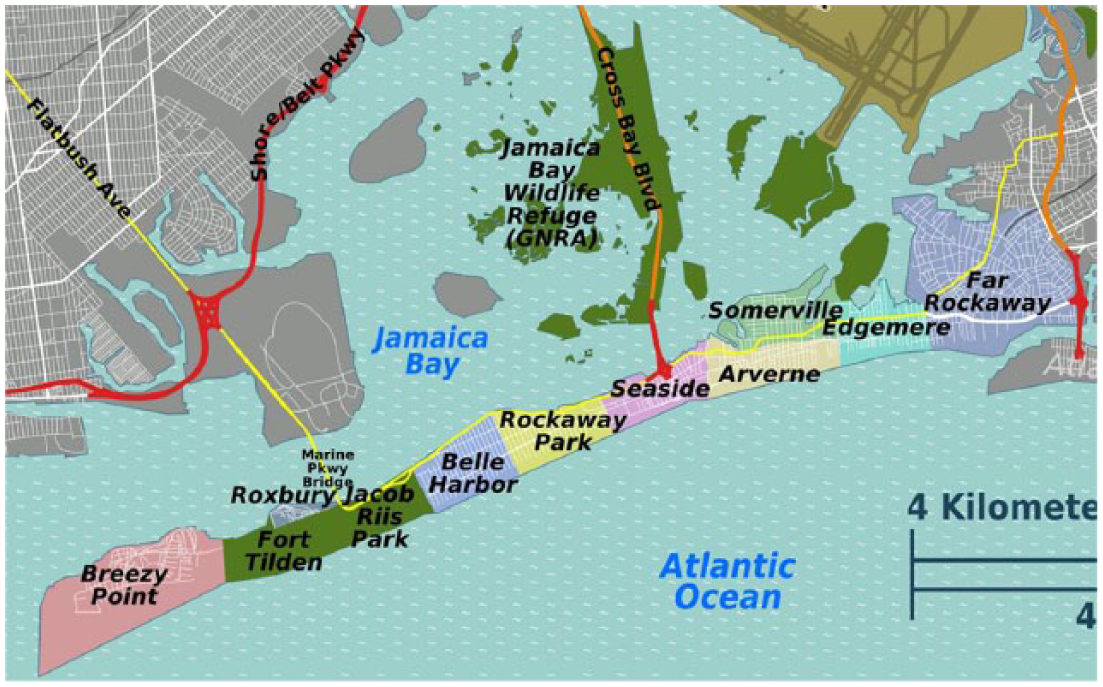
The neighborhoods of the Rockaway Peninsula, Community District 14, New York City.
CD14 had a population of 116,033 when Sandy hit. 2 According to NYU Furman Center (2014) data, 3 at the time of Sandy, CD14 was one of the least-dense districts in NYC, with one of the lowest public transportation utilization rates. It is among the top 10 most racially diverse districts in NYC, with higher proportions of White and Black residents than the citywide average, but one of the lowest ratios of foreign-born residents in the city. Rockaway is a “melting pot” (Lobo, Flores, and Salvo 2002), where at least three racial/ethnic groups comprise at least 20% of the population, yet racial and economic stratification are evident at the neighborhood level.
The NYC Department of City Planning lists three neighborhood tabulation areas (NTA) in the district: Far Rockaway (population: 50,314) and Arverne (36,255), both on the East End, and the West End (29,464). The majority of residents (74%) live on the East End. The West End is overwhelmingly White (78%), with two-thirds of residents owning mostly single-family homes. 4 Far Rockaway is a melting pot, with a plurality of Black residents and 26% White and 26% Hispanic residents. Arverne is what Lobo et al. might call Black-Hispanic, with more than 50% Black residents and one-quarter Hispanic residents. Fewer than 20% of residents are White. Five public housing developments are in Arverne. The majority of residents on the East End are renters (71%); high-rises abound here. Approximately one in five East End families lives in poverty. Figure 2 summarizes select demographic, housing, and economic data for the district.

Comparative racial groups, renters, and poverty rates, CD14, New York City.
NYC built extensive public housing along its waterfront throughout the twentieth century (Mahler 2012). Rockaway’s marginal location created an affordable landscape for building public housing, with beach bungalows torn down as slum clearance to make way for the modernist superblock developments between 1951 and 1973. Queens County is the second largest borough in NYC by population, but has only 9% of the city’s total public housing stock. However, 23% of Queens’ public housing is in Rockaway, versus only 5% of the county population. CD14 has some of the highest percentages of income-restricted properties in NYC, incorporating almost one in three rental units (NYU Furman Center 2013). NYCHA residents comprise about 8% of the peninsula’s population 5 .
Since 1975, community districts have been governed by community boards: resident advisory bodies for land-use planning and provision of community services. The borough president appoints half the community board members; the remainder is recommended by local elected officials or applies to serve. Residents skew older and tend to serve for long periods of time (Kilgannon 2016). Their input is nonbinding, but sophisticated community boards can successfully influence policy makers away from locally unwanted land uses.
At the time of data collection, Queens Community Board 14 (CB14) had 49 members. A total of 81% were property owners or lived in intergenerational family properties. Of the nine renters on the board, only one lived in public housing. CB14’s website lists 32 neighborhood- or housing development-based civic associations in the district, including the six public housing Tenant Advisory Councils, elected bodies of resident leaders mandated by U.S. Housing and Urban Development (HUD) regulations. These 32 associations are frequently shorthanded as “the civics” in CB14 meetings when summarizing community concerns. Figure 3 compares the population distribution of the three NTAs represented (1) on CB14, (2) by the 32 civics, including public housing Tenant Advisory Councils, and (3) among those 26 associations that are not public housing resident councils. The Black-Hispanic Arverne neighborhood is underrepresented on CB14, and the five public housing resident councils in Arverne raise its civic representation by more than 20%. Conversely, West End residents are overrepresented on CB14, and overrepresented by civic associations as well.
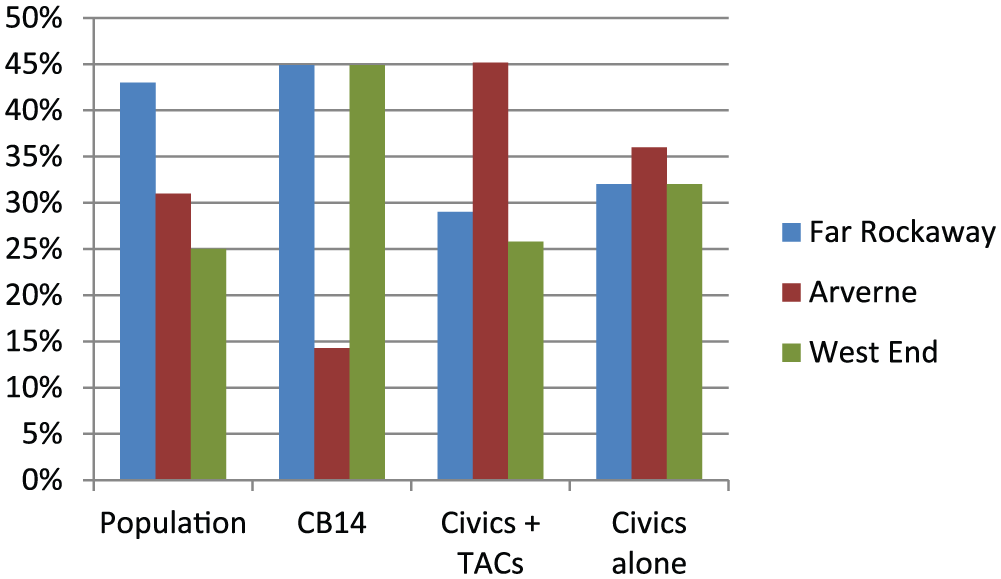
Comparative population distribution across CB14, civic associations including public housing Tenant Advisory Councils (TACs), and civic associations alone.
Data and Method
I began my research in Rockaway in January 2013, less than three months after Sandy. I attended monthly meetings of CB14, through which government agencies and nonprofits would shepherd post-Sandy recovery proposals and projects, and other relevant recovery planning meetings such as the New York (NY) Rising Community Reconstruction planning process funded by the NY State Governor’s Office of Storm Recovery; the planning process for the NYC Department of Parks & Recreation’s Rockaway Parks Conceptual Plan; Rebuild by Design and Build it Back meetings; and others. My research team attended public meetings through June 2014. Beginning in October 2013, near the first anniversary of the storm, I began interviewing residents and practitioners across the peninsula.
Because community boards are an official node of community participation in NYC, I chose a snowball sample for civic leaders originating with CB14. I conducted 48 in-depth, semi-structured interviews across the peninsula, asking residents and practitioners about experiences with government recovery programs, and their visions for the peninsula as recovery dollars began to flow into the region. (A detailed description of the sample and networks of civic engagement in Rockaway are available by request from the author.) I reached out to NYCHA directly for tenant leaders’ information; no civic leaders recommended we contact them. Interviews lasted from 45 minutes to two hours and took place in interviewees’ homes, offices, or community settings. Interviews were subsequently recorded, transcribed, and analyzed for key themes. The Appendix includes summary data on interviewees.
Public housing residents—seven women and two men—constitute 23% of our sample. They are all Black/African-American and a range of ages, although more than half are older adults. The eight elected tenant leaders varied in the number of years in their elected positions, with one serving for 18 years at the time of our interview and another newly elected after Sandy. To illustrate the concept of the differentiated state, I draw from my interviews with these nine public housing tenants and two comparative, overlapping cohorts, CB14 members (10) and the leadership of “the civics” (nine). This offers an additional 13 individuals—10 homeowners and three renters—who are civically engaged in Rockaway recovery, but may experience qualitatively different outcomes due to their tenure as property owners or civic leadership roles. These 13 individuals include seven men and six women; six are White, five are Black, one is Latino, and one is Filipino.
Spatial, Institutional, and Identity Factors Stratify Civic Engagement
Neighborhoods are “foundational political units” (Chaskin, Khare, and Joseph 2012), through which residents offer insights to guide planning processes, believing their right to be heard means that their input will actually inform. Concerns over “representation, process and capacity” (Chaskin, Khare, and Joseph 2012) may arise, in part, because political participation is broadly correlated with socioeconomic status. Individuals with greater education and material resources are more likely to vote and participate in the political process (Lawless and Fox 2001; Su 2012; Verba, Schlozman, and Brady 1995; Weaver and Lerman 2010), privileging homeowners and the affluent (Berry, Portney, and Thomson 1993; Chaskin, Khare, and Joseph 2012). Low-income residents typically lack the needed material resources shown to help with political participation: time, money, networks, and civic skills.
Although Lawless and Fox (2001) and Hays and Kogl (2007) found that involvement in formal neighborhood organizations and programs increases political engagement, McCabe (2016) argued that homeowners are disproportionately more likely to participate in neighborhood groups, vote, and attend public meetings than renters. He showed that homeowners are motivated by their desire to protect property values and engage in a politics of exclusion that undermines renters’ legitimacy. Troublingly, Cohen and Dawson (1993) showed that organizations in high-poverty neighborhoods are often isolated, and Lawless and Fox argued that advocacy organizations may be insufficient to represent low-income constituents’ interests.
Nonetheless, some studies show that low-income households possess characteristics that increase their political participation. Desmond and An (2015) demonstrated that low-income households with network ties to middle-class households are more likely to participate in the political process. McCabe (2016, p. 83) found that residential stability, versus homeownership, “uniformly increases political participation.” However, homeowners tend to live in neighborhoods for longer than renters, obscuring this distinction. This is important, as many tenants of NYC public housing are long-term residents of their communities. Lawless and Fox (2001) studied intragroup differences among low-income Bronx residents’ political participation. The profile they found more likely to participate politically—older, Black women with some political knowledge, associational membership, and experience with hardship—is the typical profile of NYCHA resident leadership that populates the elected tenant councils in the developments.
Isolation and lack of material resources are not the only obstacles to political engagement of the urban poor. Interactions with state institutions shape political participation and civic identity. Public policies provide feedback that influences people’s sense of citizenship by creating and stratifying groups, reducing or increasing inequality, or restructuring dependence (Mettler and Soss 2004, p. 60). There are two kinds of feedback: resource effects are the material outcomes and incentives from policies (e.g., income from social security) that shape benefits and costs of future political action (Mettler and Soss 2004; Pierson 1993). Interpretative effects are the information and meaning generated by policies that shape participation by influencing attitudes, sense of efficacy, and ideas of citizenship (Mettler and Soss 2004)—what Weaver and Lerman (2010) called “civic identity.” Research on public assistance shows strong negative political impacts, what Soss (2005) described as “stigma consciousness.”
Individuals’ perception of the just nature of interactions and bureaucrats’ competence and respect toward clients also matters. Policies’ “administrative arrangements” can structure political relationships by conferring authority to government agencies over groups of citizens (Mettler and Soss 2004). For example, Bronx residents described the welfare system as “intrusive” and full of “bureaucratic hurdles”: “like being a hostage to a very complicated government” (Lawless and Fox 2001, p. 375). Experiences with government agencies may shape people’s worldviews about the role of the state (Lawless and Fox 2001; Soss 2005).
Finally, De Souza Briggs, Popkin, and Goering (2010) argued that public housing tenants are the iconic “undeserving poor” since welfare reform in 1996. The deteriorated condition of many developments and their spatial isolation within cities stigmatize residents, reinforcing racial stereotypes of disorganization, criminality, and “ghetto” behaviors. Building on the work of Goffman ([1963] 2009), Bartz, Joseph, and Chaskin (2011, p. 3) showed in their study of public housing residents’ stigmatized identities in mixed-income housing that stigma works to uphold power hierarchies. This stigmatization is an outcome of U.S. housing policy, which “positions ownership as the natural and correct tenure, and public housing as abnormal and . . . inferior” (Ruming, Mee, and McGuirk 2004, p. 235).
It is important to understand for the differentiated state model that stigma, like neighborhood and policy feedbacks, establishes social boundaries for public housing residents. It begins at the “symbolic” or “conceptual” level (Lamont and Molnár 2002) with how we cognitively confer inferior status on disadvantaged tenants compared with their private-market neighbors. Stigma, thus, rationalizes inequality by communicating social value and justifying unequal treatment and impacts (Bartz, Joseph, and Chaskin 2011; Hunt 2009; Khare, Joseph, and Chaskin 2014). It is through this categorization process embedded in social relations that a symbolic boundary becomes a material, social boundary (Lamont and Molnár 2002) between tenants and their neighbors.
Stigma is relational (Crocker, Major, and Steele 1998); physical proximity, social interactions (Goffman [1963] 2009), and historical and institutional context matter (Khare, Joseph, and Chaskin 2014). In Khare, Joseph, and Chaskin’s (2014, p. 12) study of public housing transformation in Chicago, Black public housing residents see their race as central to how others understand and treat them, and experience stigmatization related to their “perceived values, culture, and behavior.” This is compounded by the intersectionality of race with other identity categories, including class, status as public housing resident, and gender. Residents frequently described the formal and informal regulation of their behavior. Black homeowners or market-rate renters experienced some of this racial bias and sanctioning, but also advanced beliefs about “ghetto” behavior of public housing residents and engaged in similar regulating actions (Khare, Joseph, and Chaskin 2014; see also Pattillo 2008).
The Differentiated State: Recovery Politics, Private Property, and Public Housing
To understand how public housing residents are rerouted and isolated from mainstream political participation in Rockaway, it is helpful to first summarize the recovery experiences of private-property owners and civic leaders who do not live in public housing. Drawing on interviews with 10 Rockaway homeowners or co-op residents 6 and three private-market renters who are also civic leaders, I offer a portrait of civic activists with a robust sense of political efficacy and a strong civic identity based on material and interpretative feedback from recovery policies and programs designed primarily for homeowners.
The Recovery Experiences of Property Owners and Privileged Civic Leaders
Homeowners and privileged renters articulate a sense of individual and collective efficacy from their political engagement, whether organizing other residents, membership in civic and organizational networks, or outreach to and collaboration with elected officials. One locally renowned civic leader from Broad Channel explained a September 2013 response to Federal Emergency Management Agency (FEMA) flood maps revisions: We held the first rally with a thousand people here in Broad Channel, from Rockaway, Howard Beach, all over, that was the first major rally of Stop FEMA Now . . . and the largest . . . That started the turnaround . . . We went to [U.S. Senators Schumer and Gillibrand about the federal Biggert-Waters Act legislating flood insurance], “You’re in trouble. You are in trouble.” They had no choice but to overturn this thing, because for their constituents, how can they be so stupid?
I interviewed a West End couple, renters. The husband is considered one of the most active civic leaders in the community, holding multiple appointed and elected positions, and described by a Parks Dept. official as hosting “the biggest email blast in the community . . . so everybody is always reaching out to” him. The couple described several rallies they held in 2013 and 2014 to keep the temporary ferry from the West End to Lower Manhattan, meant to supplement modified train service after Sandy (Norris 2014): We did a rally in August, great turn out, people came out for it and then [the mayor] . . . made his decision to extend it for three months. We had a rally planned in May, the day before we got a call from both [New York State Assemblyman] Phil [Goldfeder] and [Queens Borough President] Melinda Katz. Conference call to this house first, it was great . . . We got a three month extension . . . We felt like that was a win.
Although one public housing tenant leader also described taking part in a citywide rally in 2014 at City Hall concerning mold in NYCHA developments, organized by the nonprofit Community Voices Heard (CVH), her characterization was much more negative: . . . we were on the steps of city hall today. I’m tired. I’m sick and tired having to come in the same spot to fight the same fight. It’s crazy that as public housing residents, we have to go through what we have to go through just for a decent place to live.
The ability to organize successful rallies also speaks to civic leaders’ organizational and network ties on the peninsula, what Graham, Debucquoy and Anguelovski (2016) described as a “civic infrastructure.” Peers and public officials referenced rallies as evidence of positive civic engagement, and the money often followed. As one community board member and youth leader told me, The summer prior to Sandy . . . We did a big rally around [gun violence], the Stop the Madness march . . . we did all of this with barely any resources. So when we had the opportunity to actually speak to the foundation world [after Sandy] we were just able to just refer to old newspaper articles and say, “Well, we were doing this with nothing, how about you support us and we can show you what we’re capable of doing?”
Property owners and civic leaders described their involvement as local board members as important avenues for making a difference via their connections. One East End renter was appointed in 2004 to the community board, where she holds an elected position, by a former New York State (NYS) Assembly member with whom she sat on a local nonprofit board. She described her reputation as “very outspoken” and “[speaking] up for the people.” As the only woman of color to hold an elected position, one of the few renters on the board, and an Arverne resident, she uses her position to advocate for overlooked issues: One of the things that people found annoying, from me, was why a lot of people want to talk about the beach, the beach, the beach, the beach, and what happened on the West End . . . But guess what, on the East End we also have Jamaica Bay . . . They got devastated, too . . . That’s why they’re sick of me. Because I don’t let them forget about the bay . . . I try to bring it up every time I can . . . I think there’s a little prejudice. When it comes to talking about coastal protection. And what you get done, and whose area is going to get done first.
Another community board member of about two decades, appointed by a former city council member, who sits on multiple nonprofit boards and is a homeowner from the East End, described her post-Sandy experience, including a successful battle to expand the only federally qualified health center on the peninsula: What helped me out is I am very involved in the community. Everybody knows me . . . With elected officials, I help them out . . . I don’t ask anybody for anything personal, but for my community. My community had a lot of needs. Addabbo Health Center took all of [Peninsula Hospital’s] patients [after Sandy]. That means we’re bursting at the seams . . . with me pushing, we finally got [the NYC Economic Development Corp.] to agree to sell us [an adjacent lot] to build a building there . . . All this stuff, being involved and being with the elected officials and knowing them . . . I’m able to get them to push stuff.
These last three civic leaders are all Black residents of the East End. All spoke of experiencing racism or class bias from the West End. The older women, similar to Black middle-class homeowners or residents in other research (Khare, Joseph, and Chaskin 2014; Pattillo 2008) also stigmatized Rockaway public housing residents using familiar stereotypes of being dependent on the state. Nonetheless, these civic leaders enjoyed ongoing incorporation in local politics, actively engaging on behalf of the whole peninsula or as legitimate competitors for resources for their end of Rockaway. Unlike public housing residents, they have strong organizational ties on the East End, allowing for continued civic engagement when feelings of apathy or exclusion arose in other settings.
Property owners and networked renters also derive a strong civic identity and sense of political efficacy from direct engagement with elected officials and municipal leaders, and from the feedback they get from recovery programs designed for them. The president of the community board described their relationship with elected officials as unusually collaborative. She attributes this to the relative isolation of Rockaway, where elected officials “rely tremendously on the community board” to help them with constituent needs and issues. In return, “when we need them to step in and help, when [the District Manager] can’t do it, he reaches out to the electeds [sic].” She described the community board as having “the power to push our elected officials to fight” for local recovery priorities, such as in a meeting organized by the Queens borough president with FEMA, the U.S. Small Business Administration, and city staff to discuss residents’ problems with Build it Back, a homeowner recovery program. The activist West End couple described the borough president (whose Hurricane Sandy Recovery coordinator is from Rockaway and attends CB14 meetings, sitting with its members) as “very instrumental,” checking in with phone calls “to see how we’re doing.” They attribute this to Rockaway votes having “pushed her over” the finish line to win the election.
The West End and Broad Channel civic leaders repeatedly described in detail pulling different public and private stakeholders together to align policy priorities. The venerable civic leader from Broad Channel described needing to guide elected officials toward workable plans that met constituent needs, the importance of getting everyone together in a room for accountability and problem-solving, and acting as a broker between residents and elected officials. He described knowing U.S. Senator Chuck Schumer personally, with his son on the phone with Schumer’s office weekly since the storm. Following weeks of civic leaders’ sustained contact and activism to jumpstart Build it Back after de Blasio’s election, the mayor chose Rockaway as the site for his press conference to introduce and orient his new recovery commissioner, Amy Peterson. This civic leader described more than 50 years of honing his effectiveness on behalf of his neighborhood: When you navigate your way through City government year, after year, after year, you understand how it works, and you understand how to get around the challenges that are there for you. That’s something that we in this community have become very good at.
Less prominent civic leaders also felt they had the ear of city agencies and elected officials. A West End civic association board member said that city agencies meet with local civic associations in addition to CB14.
This area’s very active that way. We have a lot of little community groups. So that’s one thing that’s good and bad, because it sort of dilutes our voice in some ways, because there’s so many little groups. But it’s good in that there’s a lot of active people. We do work with them.
The city council member and the NYS assemblyman from the West End district were frequently praised as “a blessing,” as “out there,” “at the forefront,” responsive to post-Sandy issues in the community.
Property owners discussed Build it Back; surprisingly quick and generous FEMA reimbursements; an innovative city-run home repair program, Rapid Repairs; and the state’s NY Rising community planning initiative, for which many of our West End and East End interviewees were selected.
7
The public housing residents we interviewed were ineligible for or not selected for these programs. Despite property owners’ frustrations with the recovery programs, they nonetheless conferred priority status on homeowners in the aftermath of Sandy. Although coastal protection was a widespread source of concern for property owners and civic leaders, many prioritized making individual homeowners whole before any other recovery investments, as described by a community board member from Breezy Point: I would really like to see before anything is done or considered that everybody be put back in their house . . . After that, I don’t know. I guess the secondary thing should be dunes to protect the people in Rockaway but not only on the ocean side but on the bay side because if you only clog up one hole and not the other hole, what’s the purpose of spending all that money on one side?
The Four Dimensions of a Differentiated State for NYCHA Tenants
This prioritization of property owners dovetailed with CB14’s emphasis on coastal protection and boardwalk reconstruction. CB14 is racially and ethnically diverse, but older adults, homeowners, and West Enders are overrepresented. Rockaway Beach boardwalk reconstruction issues dominated board meetings after Sandy. As one recently appointed member of CB14 put it, reflecting on her civic engagement in Rockaway, “Why do we come to these three-hour meetings once a month, and sit here until 10:30 at night? To hear people talk about sand.” The speaker, a young Black woman, is a college student living in public housing who became politically active through a local youth group. She was appointed to CB14 by City Councilman Donovan Richards, who represents the East End.
This speaker is by far the youngest member of CB14, and a rare public housing member. When asked whether the needs of public housing residents after Sandy are being addressed, she stressed that it was the general responsibility of tenants to engage with their elected tenant councils, and for councils to engage with the community board and elected officials, to ensure tenant needs are addressed. Yet, these processes of participation were noticeably lacking in Rockaway public housing after Sandy. In interviews with tenant leaders and agency and nonprofit staff, residents were characterized as apathetic or disengaged; absent at tenant council meetings, failing to vote in council elections, infrequent participators in advocacy surveys about post-Sandy needs, and generally absent from broader public discussions about post-Sandy reconstruction. Furthermore, the limited activism of resident council leadership was channeled toward Councilman Richards’ office, citywide organizing groups representing public housing residents such as CVH, and especially toward NYCHA. Notably, resident council leadership did not participate visibly or by their own accounts in CB14 meetings, at which some described not feeling unwelcome.
This section details the complex, interlocking psychosocial, institutional, and spatial structures that reroute and separate public housing tenants’ political participation from these mainstream channels. The theoretical framework of a “differentiated state” for public housing residents rests on four pillars:
Stigmatized identities of tenant households, which are predominantly female-headed, Black households, with elderly, disabled, and youth residents overrepresented.
Federal governance: HUD rules and regulations organize tenants’ lives and political participation, especially their opportunities for resident engagement and management of the developments.
NYCHA’s “para-governmental” apparatus (Bach and Waters 2014), and the tensions embedded in NYCHA’s dual role as property manager and landlord.
Spatial concentration of the developments; the six housing developments range in size from 174 to 1,395 units, and are built in the traditional superblock model.
Stigmatized Identities
Tenants in public housing are stigmatized along intersecting identity categories: race, gender, age, and ability. As predominantly poor Black women, they face systemic discrimination over the life course. Furthermore, there is stigma from living in public housing, which has psychological and material implications for residents’ political activism. Resident leaders I interviewed repeatedly talked about their need to monitor their health to avoid illness, and their exhaustion—sometimes requiring hospitalization—from activist efforts to get NYCHA to improve post-Sandy living conditions. One tenant leader involved with CVH emphasized the stigma and alienation residents experience: We’re not bad people . . . just because I’m living in public housing that makes me lazy and all the other derogatory things that people say about us, it’s not true. I’m so tired . . . People are tired and they’re giving up hope. And so how can you expect people to want to be involved in something or want to do something? . . . And I was telling people, “Let’s come together. Let’s do this together and then we could force them to change the windows or at least put it on the budget or the list or something.” . . . Don’t nobody want to get involved . . . people are so despondent . . . Why should we have to keep fighting for a decent place to live or to be respected?
Resident leaders are active in local politics, but have difficulty recruiting other tenants due to substantial political apathy. A 2010 survey of public housing residents by CVH found (Villano and Youdelman 2010),
>100 of 334 public housing developments had no tenant leadership.
<20% of residents participated in tenant councils.
<one-third knew their development had a tenant council.
“Older, African-American women with long-term residency” were most likely to be involved in tenant governance.
This apathy was manifest in Rockaway. One tenant council president, a young man running to unseat an older African-American woman who had served for 22 years, won election by two votes of 68 votes cast; the development has 604 apartments. Similarly, tenant leaders had difficulty getting residents to participate in a survey to document post-Sandy conditions in public housing. Only 113 people across the six developments completed the survey despite months of recruitment efforts. “We could have gotten more than 600 people surveyed if people had faith or had hope or believed that something’s going to come of it,” one tenant council officer said.
Resident leaders described offering incentives for resident engagement. One council president described people making use of the council’s resources for job searches, who “come to the meetings, volunteer and help out” for a few months and then disappear. “As soon as they get to the job, they’re gone.” After describing a collapse from exhaustion, she continued, With over 2,000 registered voters . . . you’re going to tell me only one person from this development would go to the meetings that they’re having around the Rockaways . . .? That made no sense whatsoever . . . Anything for free, they can find their way there, but when it came time for them to go and voice their opinion, and give their vote for what they want done with the funds that’s coming into the Rockaways, and give input, none of them went. I was relying on them.
This apathy exists alongside external antipathy about public housing, illustrated by remarks from an outspoken White West End board member, an activist for coastal protection and beach restoration: All the housing projects . . . Rockaway has its burden and we have its share and it also kind of diminishes our ability to be politically active. It’s putting more people on us, diluting our ability to be strong with these guys like [Assemblyman] Phil [Goldfeder] and everybody else.
This person, like many other civic leaders, especially from the West End, referred to Rockaway’s reputation as a “dumping ground” for unwanted public and institutional uses, including nursing homes, single-room occupancy (SRO) hotels, and public housing. One elected officer from CB14 implicitly framed public housing as city services, in a conversation that pivoted from public housing to single-room occupancy buildings to the need for CB14 to take a “not in my backyard” stance toward unwanted services and facilities.
Tenant leaders articulated community resistance or indifference to their civic engagement. When asked whether public housing resident leaders attend local NYPD Precinct Community Council Meetings, cited by their non–public housing neighbors as an important channel for civic engagement, a leader from one tenant council replied, . . . they’re more geared to the people that live like I say in the homes . . . because we have gone to community council meetings and people actually have not wanted to sit next to us. Yes, they do not want to sit next to us.
Similarly, CB14 is viewed as not for public housing, that’s not where their interest lies . . . It’s basically about homeowners so there’s really no interest in there for us to really work with them . . . We feel like we don’t fit in.
A tenant leader from another development who could not come to many meetings due to health issues lamented that no one reached out to get her input or reviewed the sign-in sheets at community meetings and realized, “the representative from [her development] has never been. And I waited, and I waited.” As one tenant leader summed up, “what do we really have to do for people to actually see that there are human beings living over here?” This civic isolation and alienation reinforces tenant leadership’s focus on NYCHA management and operations, given their right to political activism within the development and pressing need for repairs and improvements to their homes after Sandy.
Federal Governance: HUD Rules and Regulations Organize Tenants’ Lives and Political Participation
Part 964, Title 24, “Tenant Participation and Tenant Opportunities in Public Housing” is a resident “bill of rights” (Bach and Waters 2014) in HUD’s regulations that defines and funds democratic participation in public housing. It covers everything from a right to organize to elections to residential involvement in policy making, operations, and budgeting in developments. Part 964 also details resident council procedures and mandates free working space, tenant services funds, Technical Assistance opportunities, and redress via HUD should authorities resist resident engagement. HUD underwrites this participation by providing Tenant Participation Funds: $25 per occupied unit in a development.
Residents frequently cited 964 as the source of their formal political empowerment, demonstrated by one resident council leader outlining her responsibilities and interests: “. . . the 964 in NYCHA rules are what I’m to do.” She continued, “. . . I have five [board members] . . . the guidelines for HUD, you need five . . . Each development gets their own board.” Bach and Waters (2014) found that many public housing resident councils strategically engage with NYCHA due in part to their insulation from surrounding communities. “Mother NYCHA” (personal communication, October 4, 2017) becomes an important source of information and power for residents, for instance, to seek clarification on budgetary spending, to register complaints about living conditions, to publicly respond to NYCHA’s Annual Plan, and to make funding decisions for community programs. As one tenant council president said, . . . if you’re not getting heat and you’re calling that seven’s number, and they still aren’t coming or nothing, then you give me a call, because all resident leaders, we have backup numbers, where we can circumvent and go around, and speak to supervisors, or speak to directors. We can get it done for you . . . because somewhere down the line, they’re going to need our vote for something or they are going to need us to go to Washington and raise hell for something for them. So one hand washes the other.
Another tenant leader told me, “In 2000 when we started having problems at [Building #] 7115, and there was no help anywhere, the president at the time said to me she didn’t want to ruffle any feathers” regarding contacting NYCHA. Another resident leader described past council officers as “really there for namesake. They didn’t care, as long as they got their little kickbacks. They didn’t care about anything else.”
Since Sandy, resident leaders struggled to hold NYCHA and HUD accountable. Leadership from only one tenant council of the five we interviewed described NYCHA as responsive and informative. This development sustained the least damage from Sandy, as measured by the per-acre site cost of NYCHA’s Sandy Recovery Program, as well as by the council leadership’s own descriptions. In contrast, another development’s tenant council officers described these struggles in detail. “The money they spend is crazy, and they’re exempt from the housing laws. Most landlords, they would be fined, for egregious penalties and whatnot, not NYCHA,” one explained. Her colleague said that before Sandy, they had given their Tenant Participation Funds (TPA) to an NYCHA division called “Community Operations” to fund a community center. The officer reported that that division “went away,” necessitating new funding sources to keep the center open. The tenant council leaders explained they have since “pleaded with HUD to really put in more oversight,” but that “the federal government has said, instead of blaming NYCHA for the mess up that we’re living in, they’re blaming us.”
The main government agencies overseeing Sandy recovery in the Rockaways included the NYC Department of Parks & Recreation, which operates Rockaway Beach; the NYC Economic Development Corporation, which led the Rockaway Beach boardwalk reconstruction; and the U.S. Army Corps of Engineers, which has jurisdiction over beach replenishment. Yet, the vast majority of public housing residents’ political energy is focused on NYCHA’s management and operations as filtered through HUD rules and regulations. Outreach to local elected officials and advocacy organizations overwhelmingly focused on improving NYCHA management and responsiveness, if direct communication to NYCHA was deemed insufficient. For example, tenants asked Mayor de Blasio’s administration to “really look into” NYCHA’s practices, but heard from a mayor’s staffer that tenant leaders should help “get the word out about the Build it Back program.” Tenant leaders had mixed experiences with their city council member, who toured the developments with the new NYCHA chairwoman after her appointment. One tenant council president said, We love Donovan [Richards] . . . We know him for awhile . . . He’s came in and he’s made them clean up around here a lot. He got us $1.1 million for cameras, security cameras . . . He’s been real good and [City Council Member] James Sanders before him was a good person to us.
One tenant resident believes the tour “opened his eyes to the extreme problems that some [developments] have.” Yet, other leaders, including one who toured with Richards, described him as nonresponsive.
NYCHA’s “Para-governmental” Apparatus
Bach and Waters (2014) from NYC’s Community Service Society, the venerable antipoverty organization, laid out how NYCHA’s independent, para-governmental structure is opaque and unaccountable to tenants, NYC, and NYS. NYCHA is funded almost entirely by HUD. It is exempt from reporting to NYS’s Authorities Budget Office. The mayor’s influence is channeled through chair and board appointments. The NY City Council holds budget and oversight hearings but has no formal budget approval over NYCHA. Bach and Waters found that this independence from the City and State helped obscure NYCHA’s deteriorating fiscal and operational health until the New York Daily News’ 2012 exposure of a critical maintenance backlog of 338,000 requests (Smith 2012).
NYCHA’s structure restricted tenant options for redress for operational problems. For example, NYC has a 311 call center that NYC residents can use to register complaints. However, when public housing residents dial 311, their calls are rerouted to a NYCHA call center, which does not make public any call data. NYCHA code violations are also not publicly recorded. Residents in my interviews and in Bach and Waters’ study explain that multiple calls were needed for a complete repair (e.g., one to patch a wall, one to paint the repaired wall), and that repairs are subject to street-level bureaucratic discretion. Unlike private rental market residents, who may report negligent landlords to NYC’s Housing and Preservation Department or the Department of Buildings, NYCHA tenants’ only redress is to take NYCHA to housing court.
A tenant leader expressed having little recourse over NYCHA’s operational and managerial failings: [NYCHA has] a capital budget committee . . . and if . . . something happens they consider an emergency, they will take your capital . . . we had a meeting right here, and . . . I forgot the man’s name that was in charge then, he say, “Unfortunately, we have an emergency. We have to take the capital money that’s slated for your building and we have to put it in another development. But you’re going to be next on the list.”
Her colleague picked up the thread: . . . They purchase windows . . . the lowest bidder, people done hurt their fingers and smash their fingers. They slam down. They fall. . . . We’ve complained about it. Done nothing . . . So I decided I’m going to take them to court. So I took pictures because in the wintertime . . . the cold comes in so much there’s ice that forms on the inside of the apartment, on the inside. So I took the pictures to court. I said, “Your honor, this is what I’ve had to live with.”
The second tenant leader, a longtime activist with CVH, represented herself and won. Unfortunately, her individual political success has not translated into collective action in her development.
NYCHA’s reputation in the community is also poor. An East End faith-based leader described providing emergency assistance to residents, “right at the end of the block we have Redfern houses, that’s a public housing development. You would think that NYCHA would have been self-contained but they clearly were not able to. Again that’s another failure of government type.” Another East End civic leader mentioned NYCHA explicitly when discussing the City’s failure to hold agencies accountable. A third told me, “If it’s bad, it’s NYCHA. If it’s the fix, it’s NYCHA. And if it’s the repair, it’s NYCHA.”
Mayor Bill de Blasio was elected in 2013, one year after Sandy, and his transition occurred while I was conducting my interviews. Residents and I discussed his new NYCHA chair, Shola Olatoye, a well-regarded leader in affordable housing and community development. Yet residents sought NYCHA leadership that reflected the experiences of public housing residents. A tenant council president, in describing a meeting with NYCHA, said, We had a few key people from NYCHA and the first question that I asked was, “Who lives in public housing?” Me and my vice president raised our hands. So then I asked, “Why are you all making these rules? You don’t live here but you are making the rules for people that do live here.”
As one tenant president described, NYCHA is hiring people that have never lived in public housing, they haven’t done their homework or studied the history of public housing except for maybe six months before they get the job . . . Where are the people that used to be here who had our best interests at heart?
This lack of personal connection to life in public housing reinforces NYCHA’s role as a landlord, described by one tenant council vice president: NYCHA popped up the day after Sandy, they walked around and my biggest issue was, they was worried about the property and not the people . . . You came in here with your clipboards . . . counting the [air conditioners] ACs . . . Checking for sinkholes . . . You never went inside and said, “Is anybody in here trapped?” . . . it looked like it was more important for the property than the people.
Spatial Concentration
An economic development practitioner in Far Rockaway described the limited potential for what local residents described as the burgeoning “hipster economy” to extend east: I think about neighborhoods. . . . downtown Far Rockaway and surrounding areas, you have a lot of public housing. They might not connect with that. The hipsters might not be comfortable with that . . . what I saw on Rockaway Beach Boulevard, I just saw this little niche . . . having two surf beaches right there just fit right in . . . if you just think about where the public housing is concentrated: Redfern, Ocean Bay, Beach 41st, Carlton Manor, Hammels between this end and the low 80s.
The spatial concentration of public housing presents a specific set of environmental challenges that amplify the unique demands of living in the developments. The Rockaway developments were among the last of NYCHA developments to have their power and heat and hot water restored, almost three weeks after Sandy. Sandy shrunk the livable footprint by damaging playgrounds that were closed indefinitely, killing trees that were removed but not replaced, requiring building repairs that led to scaffolding and other physical barriers to public space, and necessitating the external siting of temporary boilers for an estimated two to three years following the storm. Sandy also worsened preexisting problems of mold and mildew and caused sporadic heat and hot water concerns, especially on upper floors of high-rises. Flooding damaged building roofs, pipes, walls, heating systems, and whole units at ground level—including those converted to tenant council offices and resident meeting places. Residents described cracks spreading inside their apartments, sediment in the water, odd-smelling water, limited heat from temporary boilers, no heat for days, and sleeping in coats.
Overall, the spatial boundaries of public housing, and Sandy’s amplification of them, circumscribed life in public housing in Rockaway. The closure of playgrounds and meeting places accelerated a prestorm trend of the loss of open and community space. Residents described community centers now stretched in trying to provide services to families, often operating without heat or with limited hours. One tenant council president told me, The playgrounds been closed down for going on two years and kids have no place to play . . . for two years the children have been playing in the buildings . . . We have a community center with a gym. The floor got messed up two years . . . The stove got messed up. The children had to eat cold lunch through the winter . . . Here, we lost a lot of furniture and for two years we didn’t get anything . . . They just say the money is coming . . . Every time we ask, “The money is coming.”
Residents identified loss of usable space for youth as a major concern. The loss of the boardwalk and its limited use by public housing youth due to turf wars between the developments compounded the sense of restricted movement and safe places for young people. One tenant council president remarked of the teens in her development, They don’t have recreation . . . Where they built the YMCA at, the guys down here can’t go down there because they have a, what do you call it, “beef,” with the guys from down there. So it’s like, there’s nothing for them to do down here and especially we don’t have a boardwalk. They used to go up to the boardwalk, but they can’t even do that now.
A tenant council officer in a different development described difficult trade-offs given compromised facilities, There is no place already for the kids to play. When the sprinkler is on, it’s all jacked up. When they turn it on, the pressure in the building goes so low, we don’t have water. So it’s a toss-up. Do we let the kids play or do we drink water and wash.
Adding to the heightened sense of spatial enclosure and lack of mobility is what residents perceive as overpolicing of the developments. As one tenant leader described the first change he desired, “I’d like to see is us having the freedoms to just go about walking around the development. [The NYPD says] that if a person goes from their building to another building they’re trespassing.” Similarly, another tenant council leader noted, We’ve got older guys that hang around in the building now. At night they used to go there and play basketball. They can’t do that now, so they hang around the buildings, writing on the walls, getting into mischief and getting tickets for loitering, but where do they have to go?
This spatial isolation and the environmental impacts in public housing further account for why tenant leadership is so focused on NYCHA management and operations after Sandy, as opposed to engaging in broader debates about Rockaway Beach boardwalk reconstruction and the recovery of the peninsula. Even when other issues aligned with resident concerns, as in the role of the boardwalk as publicly accessible open space, residents rarely made those connections in their emphases on improving NYCHA living conditions, oversight, and maintenance.
Learning from NYC: Urban Policy Feedbacks and the Politics of Public Housing
In the aftermath of Sandy, in their “city within a city,” as NYCHA is colloquially referred in NYC, NYCHA tenants in Rockaway felt disempowered to advocate for their collective needs and unable to align their environmental, social, and economic concerns with those of their neighbors. I showed in the previous section that this symbolic and spatial isolation of public housing is due to four interlocking factors that suggest tenants live under a “differentiated state.” In this section, I discuss two contributions to the study of urban politics from this Rockaway case: the addition of a spatial lens to the study of policy feedbacks, and a new synthesis for understanding public housing residents’ exclusion from neighborhood politics.
Public Housing, Policy Feedbacks, and Spatial Inequality
This analysis extends the policy feedbacks literature by examining another government program—public housing—that impacts low-income people, delivering “stigma consciousness,” weakening their political efficacy, and damaging their civic identity. The distinct value of the “differentiated state” framework is its addition of a spatial lens into the literature on policy feedbacks and democratic outcomes. A spatial analysis is an underdeveloped area in comparative frameworks, and is essential for understanding urban inequality. The concept of the carceral state is analogous here. The carceral state is the policy and governance architecture of the criminal justice system that disproportionately puts Black and Latino communities under state authority and control (Gottschalk 2008; Stone 2017; Weaver and Lerman 2010). Weaver and Lerman (2010, p. 818) argued that the criminal justice system is “a primary site of civic education,” but in a punitive and demoralizing way that triggers individuals’ retreat from political and civic life. Being under criminal justice supervision breeds distrust of “political institutions and a weakened attachment to the political process.”
Like the carceral state (see Stone 2017), the policy apparatus of public housing has a distinctly urban impact. Public housing shelters more than two million people in the United States, and is a visible and symbolic fixture in thousands of urban communities across the country. Its deterioration due to federal funding cuts and figurative presence in cities as criminal and troubled restricts the material and interpretative resources available to its residents. The criminal justice system and public housing developments are similarly spatially, racially, and economically segregated—and in many urban neighborhoods ensnare the same populations—creating a distinct “architecture of community life” for public housing tenants (Weaver and Lerman 2010, p. 817; on NYC, see Fagan, West, and Holland 2003; on Rockaway, see Goodman 2015).
After Sandy, Rockaway public housing tenants lost easy access to their polling places, suffered closure of community gathering spaces and Tenant Advisory Council offices, and felt NYCHA’s workforce development efforts were insufficient to connect residents with post-Sandy reconstruction opportunities. They perceived they were unwelcome at local community meetings, and policy priorities named in recovery debates—Build it Back, the reconstruction of the Rockaway Boardwalk—were mostly irrelevant to them in the aftermath of the storm. Residents experienced reduced capacity to vote in local elections; to gather and share information with one another; to pursue meaningful, accessible work; and internalized stigma from their political and spatial isolation as public housing residents on the peninsula.
NYCHA constitutes approximately 16% of all public housing units in the United States, and is more than twice as large as the next largest authority. Yet, this case offers generalizable themes for scholars of urban inequality. The spatial isolation, racial segregation, and symbolic boundaries surrounding public housing establish inequalities in political participation and access to power. The multiple constraints imposed by public housing on tenants have a cumulative impact, where lack of resources compounds the shame and stigma of living in “the projects” and generates an apathy that dampens the likelihood of future political participation. These impacts are racially disparate, given the demographic composition of public housing residents. Like the carceral state, large concentrations of public housing in cities create “pervasive disadvantage” and “political disability” for tenants (Stone 2017, p. 19).
There are multiple “state” frameworks in American political scholarship, including the carceral state, the submerged state (Mettler 2011), and the shadow state (Wolch 1989). All point to how policies structure power and inequality by conferring sociosymbolic benefits to some groups over others. Each state does so through an obscured apparatus of rules, practices, and customs not easily visible or understood by the public (Mettler 2011; Wolch 1989). Disparities in knowledge and capacity for action create an uneven playing field for political engagement and damage democracy (Mettler 2011). I present this new framework as an entry point for urban politics scholars to identify similar “state” structures that stratify political participation, with an additional spatial construct to enhance theoretical and normative understanding.
A “state” framework enables scholars of urban politics to look beyond regime arrangements, or the structural features of a capitalist political economy, or the agency of movement building in progressive politics (Stone 2017), instead offering a complex portrait of how structural and institutional features shape and are shaped by elite and disadvantaged populations’ agency, within a spatially bound site that creates specific environmental conditions. From a normative perspective, it also enables scholars and urban activists to meet people where they are, in their communities and within their regulatory environments, so that rules like Section 964 are understood when crafting mobilization strategies or engaging in municipal policy advocacy.
From NYC, a New Synthesis of Public Housing Political Participation
This new, empirically tested synthesis of the politics of public housing brings together previously disconnected strands of research and enhances our understanding of how public housing tenants are excluded from neighborhood politics. It does so through a grounded case study of disaster recovery outcomes in an underexplored region of NYC. By weaving together a comprehensive range of factors including stigma and housing policy, agency/administrative effects, and race and class disparities at the confluence of neighborhood geography, I introduce a deeper, more complex understanding of the interlocking barriers to the participation of public housing residents in local politics. This new synthesis is rooted in the specificities of NYC but nonetheless has import for the study of urban inequality.
First, the rich scholarship on the contemporary exclusion of public housing tenants in local politics is disproportionately (if understandably) drawn from the decades-long deconcentration policy experiment, HOPE VI (see Fraser et al. 2013 for a review). Although I incorporate the findings of how associational politics of mixed-income housing developments prioritize homeowners and marginalize public housing tenants, there are limits to this comparison. The main limit is that public housing demolition has been highly variable from city to city (Goetz 2011). In many cities, including NYC, large public housing developments continue to serve thousands of low-income and working-class families. In fact, NYC is an exceptional environment in its commitment to public housing, the size of its public housing portfolio, and its broader assertive housing policy that protects low- and middle-income New Yorkers (Bloom 2014; Goetz 2011; Van Ryzin, Kaestner, and Main 2003; Wyly and DeFilippis 2010). The particularities of this NYC case matter for urban scholars interested in enhancing the democratic potential of enduring public housing communities in cities. As Wyly and DeFillippis (2010, p. 62) argued, “understanding the context and contingency of these communities is crucial . . . to build alliances and public support for . . . the right to housing and affordable shelter.”
In the Rockaways, the six public housing developments are formally included as civic associations and recognized as distinct communities in a district that the former Housing Subcommittee cochair of CB14 (Hevesi 2003) described as a different neighborhood every ten blocks. And it’s only a slight exaggeration to say that they each have their own name, their own political club, civic association, agenda, income category and ethnic mix. And they are all very jealous of their little fiefdoms.
In Rockaway, civic networks evolve from the primacy of property owner and neighborhood associations on the West End to the centrality of faith-based and nonprofit leadership on the East End. Although East End leaders speak knowledgeably about the racial disparities and socioeconomic disadvantage of the East End, they are more likely to see NYCHA residents as constituents and clients than as civic leaders or voters. In Rockaway, public housing tenants are dismissed by property-owning neighbors as a drag on the neighborhood but are also assumed to have their own political economic environment living under NYCHA, which may be in “the fix” with the City in its highly sophisticated and fraught affordable housing landscape, as one East End homeowner alleged. This case shows that the residential stability of NYCHA tenants, demonstrated as critical to activism by McCabe (2016) and Conway and Hachen (2005) in their study of Boston’s public housing, is undermined by their exclusion from local civic networks. The push factors to increase local public housing participation through NYCHA’s and HUD’s rules and regulations are also weak, given that Section 964 prioritizes participatory processes in the developments, and NYCHA operates as a “city within a city.”
If NYCHA is unaccountable to tenants, HUD rules and regulations are insufficient to empower tenant activism, tenants have grown apathetic due to marginalized status in communities, and tenants’ spatial conditions are qualitatively different than surrounding environments, how and where do they begin to build alliances to advocate for better housing and neighborhood conditions and opportunities? These questions are just as pertinent for tenants and allies in cities like Miami or Cleveland, where public housing stocks have not been substantially reduced. The framework of the differentiated state deployed here enables empirical testing of the political circumstances and possibilities for the more than one million residents of public housing in other U.S. cities. As our understandings of the transformation of former public housing communities in Atlanta, Chicago, New Orleans, and other demolition sites has gotten more robust, we risk overlooking the enduring realities of public housing tenants who have not been displaced in the deconcentration frenzy of the past 25 years.
Conclusion
Positive changes are underway in Rockaway since Sandy hit in 2012. With hundreds of millions of recovery and reconstruction dollars flowing onto the peninsula, the “hipster economy” is resurgent, and the Rockaways may be one of the City’s “next hot neighborhoods” (Higgins 2016). There is reason to think Sandy has put Rockaway “on the map,” as residents hoped. Public housing tenants expressed cautious optimism for Olatoye’s appointment as NYCHA chair. Under her direction, NYCHA has substantially shrunk the maintenance backlog, undergone several operational reforms to improve and modernize service, restructured its governing board to increase residential leadership, and received an unprecedented $3 billion FEMA grant for Sandy repairs. Ocean Bay-Oceanside in Rockaway was the first of 33 developments citywide to break ground in June 2016. All of these changes point to a critical opportunity to examine whether urban revitalization in Rockaway since Sandy is boosting public housing resident civic engagement and through which political forums and channels (e.g., community boards).
The leadership of the six public housing developments in Rockaway meet monthly. Some tenant leaders feel they have collaborated with City Councilman Richards on such goals as a vocational school on the peninsula. As one council president described their opportunity, “If you look at it, Rockaway was built into six communities with presidents. If we all come together and say, ‘We got all these registered voters here. What are you going to do for us?’” Another leader saw similar power: “There’s enough people in NYCHA alone, in Rockaway, to overturn an election. I tell them . . . ‘We all stand together. You can do anything you want.’” Rockaway public housing residents have at least one new, distinct channel to amplify their positive group identity and to take action for social change. CVH opened a “Rockaway Hub” to organize residents locally around climate change activism and link them to citywide organizing efforts, a decision motivated in part by the activism of one development’s leadership. Thus, is a “civic infrastructure” (Graham, Debucquoy, and Anguelovski 2016) in development that can connect public housing tenants to neighborhood politics and planning? What does Rockaway’s economic resurgence, improved public housing, and emerging activism mean for residents? These questions point to the opportunity for follow-up research in Rockaway, and also comparative research with public housing tenants in other cities.
This article offers a new theoretical framework, the “differentiated state,” to explain the separate governance form that structures the lives and political power of public housing tenants in NYC. I argue that four key features create this differentiated state: HUD rules and regulations, NYCHA’s para-governmental status, spatial concentration, and tenants’ stigmatized identities, and provide empirical evidence from a small sample in the Rockaways after Sandy. Given the limited sample size of the analysis and the theoretical proposition at the heart of this analysis, I call for additional tests of the concept of a differentiated state by scholars of urban politics. Opportunities exist among public housing tenants in other cities, as well as possible analogous settings such as among immigrant communities (Baker et al. 2016), individuals living under the carceral state, and low-income people in neighborhoods of concentrated poverty (such as those profiled by Desmond 2017). This scholarship can contribute to more informed policies and practice for incorporating marginalized populations into neighborhood and municipal planning efforts. Research can offer insights into best practices for mainstreaming vulnerable groups or for integrating feedback from parallel engagement processes that allow for greater incorporation of difference and address uneven political access and opportunity within cities. Given declining federal support for public housing and urban community development coupled with resurgent political activism at the local level, questions of political inclusion for marginalized urban communities are more important than ever.
Footnotes
Appendix
Descriptive Data on Interviewees.

| Category | # | % of Sample | % of Residents Interviewed |
|---|---|---|---|
| Total Interviews | 48 | ||
| Key Groups | |||
| CD14 Residents | 40 | 83 | |
| CB14 Members | 10 | 25 | |
| NYCHA Residents | 9 | 23 | |
| Gender | |||
| Women | 22 | 46 | |
| Men | 26 | 54 | |
| Race/Ethnicity | |||
| White Non-Hispanic | 23 | 48 | |
| Black/African-American | 21 | 44 | |
| Other Race/Ethnicity | 4 | ||
| Life course a | |||
| Youth (15–24) | 3 | 6 | |
| Emerging Leaders (25–34) | 8 | 17 | |
| Midlife (45–54) | 16 | 33 | |
| Older Adults (55+) | 17 | 35 | |
| Civic Engagement | |||
| “The Civics” Leadership | 9 | 23 | |
| Nonprofit/Faith-Based Leadership | 13 | 27 | |
| Public Sector | 7 | 15 | |
| Other | Media (2), Developer (1) | ||
| Housing Tenure | |||
| Property Owner | 26 | 65 | |
| Renter | 13 | 33 | |
| Census NTA | |||
| Far Rockaway | 8 | 20 | |
| Arverne | 15 | 38 | |
| West End | 17 | 43 | |
Note. CD = Community District; CB = Community Board; NYCHA = New York City Housing Authority; NTA = neighborhood tabulation area.
No one between ages 35–44.
Acknowledgements
The author would like to thank the people of Rockaway who participated in this research. The author also thanks David Imbroscio for organizing the colloquium at the 2015 Urban Affairs Association Conference where this theory was first proposed, and Alex Schafran and Mara Sidney for their support, which helped push this framework forward. Finally, the author thanks the anonymous reviewers whose feedback helped sharpen and refine the analysis.
Declaration of Conflicting Interests
The author(s) declared no potential conflicts of interest with respect to the research, authorship, and/or publication of this article.
Funding
The author(s) disclosed receipt of the following financial support for the research, authorship, and/or publication of this article: This research was supported by a Professional Staff Congress (PSC)-City University of New York (CUNY) Award (#66567-00 44), by a grant from the Office for the Advancement of Research’s Emergency Fund Program at John Jay College of Criminal Justice, and by a Junior Faculty Award from the Gittell Urban Studies Collective at CUNY.
