




Abstract
Cities face numerous environmental challenges. Local governments need the public’s support to tackle these problems, and scholars and practitioners have suggested that framing initiatives around resilience, as opposed to sustainability, reducing vulnerability, or adaptation, may increase public support for local action. Resilience, they argue, has a better social connotation, is more positive, and less polarizing than related concepts. Empirical evidence supporting these claims is lacking. In three online survey experiments, we test whether the public is more likely to support policies when they are framed in terms of “resilience.” We also examine public conceptualizations of these different terms and whether resilience has a more positive connotation. We find significant differences in policy support, perceived importance, and interpretations of the concepts. The study confirms that framing affects policy support, but complicates claims that resilience is inherently more appealing. These findings have implications for urban research and policymaking.
Introduction
Cities face mounting environmental threats such as increasingly intense and frequent storms, sea-level rise, higher temperatures, and air pollution (Jabareen 2013). Meeting these challenges will require ambitious policies and major long-term investments. For example, one recent report estimated that just the sea walls needed to protect public infrastructure from sea-level rise in the contiguous United States by 2040 would cost $416 billion (Leroy et al. 2019). Much of this burden falls on local governments, especially in the United States where federal support for climate change action has been limited (Sharp, Daley, and Lynch 2011). Cities are increasingly developing plans and policies aimed at addressing environmental shocks and stressors, but the implementation of these initiatives hinges on policy makers’ and citizens’ support (Wang, Hawkins, and Berman 2014). Local government policies are driven by the demands of interest groups and citizens (Lubell, Feiock, and Ramirez 2005), and thus if the goal is more environmental action, it is critical that policy makers frame policies in ways that garner widespread public support (Wang, Hawkins, and Berman 2014; Whittemore 2013).
City officials can be strategic in the terms they use to describe environmental policies so that they will resonate with constituents (Whittemore and BenDor 2018a). A large literature spanning the fields of political science, psychology, communication studies, planning, and other related disciplines has shown that even subtle differences in how policies and initiatives are framed can lead to substantial changes in public opinion (e.g., Chong and Druckman 2007; Lawrence, Stoker, and Wolman 2010; Whittemore and BenDor 2018a). Thus, the terms used to describe local policies matter, especially if these terms are differentially polarizing or make different sets of considerations salient among the public.
Policies related to coping with environmental change have long been framed in different ways: as building sustainability, reducing vulnerability, or adaptation, but more recently the focus has shifted to resilience (Béné et al. 2018; Davoudi et al. 2012). This so-called “resilience renaissance” (Bahadur, Ibrahim, and Tanner 2010) is evidenced by the exponential increase in academic publications on resilience and the proliferation of high-profile policy initiatives and funding opportunities—like the Rockefeller Foundation’s 100 Resilient Cities program or the United Nations Office for Disaster Risk Reduction’s Making Cities Resilient campaign—that focus on building local resilience (Leitner et al. 2018; Woodruff et al. 2018). In 2013, Time Magazine even declared resilience the “environmental buzzword” of the year (Walsh 2013), and the ubiquity of the term has only increased in the years since.
Beyond merely recognizing the growing popularity of resilience, many scholars have argued that it may be more effective to frame environmental policies around resilience, rather than sustainability, adaptation, and vulnerability. They claim that resilience has a better social connotation and is more positive than alternative frames such as vulnerability or adaptation (McEvoy, Fünfgeld, and Bosomworth 2013; Shaw and Maythorne 2012; Sudmeier-Rieux 2014). These positive associations are thought to help broaden support for associated plans and policies (de Bruijn et al. 2017). Resilience is also seen as resonating across political or partisan divides (Moser et al. 2019), and political opposition has been a major barrier to environmental action (Hamin, Gurran, and Emlinger 2014). Studies from both the United States and United Kingdom have shown that practitioners believe resilience is a more palatable frame for addressing climate change (Porter, Demeritt, and Dessai 2015; Stults and Meerow 2017). Thus, policy makers believe that if they relabel policies as efforts to build resilience, rather than adaptation, for example, it may increase public demand for those policies. In turn, higher public demand should increase the likelihood of policy change (Lubell, Feiock, and Ramirez 2005). Yet there seems to be little empirical evidence supporting these assertions that resilience is a more effective frame (Weichselgartner and Kelman 2015). Very few studies have actually tested the implications of applying a resilience frame versus other related concepts (MacInnis et al. 2015; Wong-Parodi, Fischhoff, and Strauss 2015). This article sets out to address this gap by conducting three online survey experiments of U.S. adults that test this claim that framing actions in terms of building local resilience—as opposed to frames invoking the terms sustainability, adaptation, or vulnerability—increases support for these actions and makes people perceive them as more important. To provide additional leverage to understand how these frames might affect public opinion, this article also unpacks differences in how the public conceptualizes these terms.
In the next section, we begin by reviewing the concept of framing and how research suggests that policy makers can strategically use different frames to shape public opinion. Then we introduce the concepts of resilience, sustainability, vulnerability, and adaptation in the context of environmental change, and what the literature suggests about the concepts’ relative popularity. Drawing on this literature, we develop hypotheses about how framing local action in terms of resilience vis-à-vis other terms affects public support. We then introduce the three survey experiments we developed to test these hypotheses. Our results are divided into two sections. First, we discuss the differences in how respondents defined the terms resilience, sustainability, vulnerability, and adaptation, showing that they elicit different considerations. Second, we compare levels of support and perceived importance across the four frames. We conclude with a synthesis of the results and implications for research and practice.
Framing Urban Environmental Policies
Research suggests that implementation of local environmental policies depends on public support (Laurian and Crawford 2016) and that gaining this support requires customizing the message to appeal to different cultures, priorities, and political contexts (Foss 2018; Zeemering 2009). As Lawrence et al. (2010, p. 413) note, federal politicians recognize the need to “frame and target urban policies to broaden their appeal.” At the city level, recent research by Whittemore and BenDor (2018a, 2018b) highlights the importance of policy framing in urban planning, providing evidence that practicing planners strategically frame policies to increase public support for change and experimentally demonstrating that the way policies are framed can affect public opinion.
While research on the effects of framing in urban planning is limited, extensive research in communication studies and political science shows that subtle changes in how policies are communicated can have significant impacts on public opinion (see, for example, Chong and Druckman 2007; Nelson, Clawson, and Oxley 1997). These literatures show that usage of different yet similar terms can be consequential for public attitudes, which in turn are likely to change the parameters of the public debate surrounding these issues as well as the set of policy solutions (Goetz 2008). There is substantial evidence that frames can heighten the salience of some considerations by either making certain beliefs more accessible in memory or by increasing the relevance that people place on those considerations for the attitude in question (see, for example, Nelson, Clawson, and Oxley 1997). In the next section, we will introduce four different terms that practitioners and policy makers have used to frame cities’ efforts to cope with environmental changes. The question that thus arises is whether these terms—resilience, sustainability, vulnerability, and adaptation—lead people to think about different considerations when asked about whether they support local environmental action or how important they believe the need for such action to be. Changes in the considerations that are either on the top of people’s minds or that they deem relevant for the question at hand can then, subsequently, lead to differences in opinion.
Research has shown that frames can elicit different considerations, which not only changes which thoughts respondents draw on when considering the issue at hand but also the valence of those thoughts (Lecheler and de Vreese 2010). Hence, when these considerations elicit positive connotations, we would expect support to increase, whereas it would decrease when negative associations are elicited. The most prominent parallel for this study comes from the framing research on climate change communication, which has shown that the framing of climate change action is consequential. For example, the frame used in climate change communications can change how people perceive the problem, and public opinion is seen as an important determinant of whether policies are enacted around climate change (Spence and Pidgeon 2010; Wiest, Raymond and Clawson 2015). Yet despite research showing that climate change frames matter, Moser (2014, p. 341) argues that “most often, alternative terms are used based on little more than hunches or personal preferences in a trial-and-error mode, a practice generally not recommended by communication experts.”
Alternative Frames for Urban Challenges: Sustainability, Resilience, Vulnerability, and Adaptation
Climate change is one of the many social, environmental, and technical challenges that cities face, including volatile economies, demographic shifts, natural hazards, and security risks (McPhearson et al. 2016). Research and policies have long focused on improving the capacity of communities to cope with these complex issues, but the way in which these efforts are framed varies (MacInnis et al. 2015). The terms sustainability, resilience, vulnerability, and adaptation are all commonly used, and indeed, the Intergovernmental Panel on Climate Change (IPCC 2014) defines all four terms in their glossary. Sustainability is defined as “a dynamic process that guarantees the persistence of natural and human systems in an equitable manner.” The IPCC conceptualizes adaptation as the process of adjustment to actual or expected climate and its effects. In human systems, adaptation seeks to moderate or avoid harm or exploit beneficial opportunities. In some natural systems, human intervention may facilitate adjustment to expected climate and its effects.
Vulnerability is defined as “the propensity or predisposition to be adversely affected. Vulnerability encompasses a variety of concepts and elements including sensitivity or susceptibility to harm and lack of capacity to cope and adapt” (IPCC 2014). Resilience is the capacity of social, economic and environmental systems to cope with a hazardous event or trend or disturbance, responding or reorganizing in ways that maintain their essential function, identity and structure, while also maintaining the capacity for adaptation, learning and transformation. (IPCC 2014)
These terms are clearly related, since, for example, both the definition of vulnerability and resilience mention “adapt.” The correct conceptualization, intellectual roots, and relative merits of these terms continue to be debated in the literature, but they are all commonly used in the context of environmental change (Anderies et al. 2013; Vogel et al. 2007).
The relative popularity of these terms in urban discourse changes over time. The term sustainability is often traced back to the 1987 Brundtland Report, which famously defined sustainable development as “development that meets the needs of the present without compromising the ability of future generations to meet their own needs” (World Commission on Environment and Development [WCED] 1987, p. 41). In urban planning and policy, sustainability means balancing competing economic, equity, and environmental goals, and it has been a focus of research and policy for decades (Campbell 1996; Zeemering 2009).
The concept of resilience is most commonly traced back to ecologist Holling (1973), who defined resilience as the amount of change a system could absorb without changing to a new state, but urban resilience has only become popular in recent years (Leitner et al. 2018; Meerow, Newell, and Stults 2016). Many researchers have argued that in the last decade, resilience has begun to replace sustainability as the primary frame for considering urban futures (Campbell 2016; Davoudi et al. 2012), and that resilience is being used instead of vulnerability or adaptation (Cannon and Müller-Mahn 2010). For example, many cities are now developing resilience plans and hiring Chief Resilience Officers (Woodruff et al. 2018). Despite the growing popularity of the concept, the definition of resilience remains contested in the academic literature (Meerow, Newell, and Stults 2016), among U.S. local government practitioners (Meerow and Stults 2016), between scholarly and media discourse (Leitch and Bohensky 2014), and among members of the Australian public (Boschetti et al. 2017), yet little is known about how the U.S. public perceives this term.
While academics may disagree about the relative merits of this resilience renaissance, they all acknowledge that it is happening. Moreover, many suggest that resilience is gaining popularity because the term has a more positive connotation and is more politically appealing than alternative terms such as sustainability, vulnerability, or adaptation. A number of quotes from the literature illustrating this common belief of resilience’s positive connotation are presented in Table 1. These quotes suggest a link between the positive nature of the resilience term and policy appeal. Practitioners have also claimed that resilience has a broader appeal (Porter, Demeritt, and Dessai 2015). Building on the framing literature introduced above, the core idea is that if policy makers use the term resilience, it will evoke more positive considerations, which, in turn, will heighten support for, and thus the likelihood of, action.
Illustrative Quotes from the Literature on the Positive Connotation and Appeal of Resilience.

However, despite the numerous assertions in the literature that resilience is more positive or appealing than other concepts, very few studies examine the implications of resilience framing empirically. As Weichselgartner and Kelman (2015, p. 258) write, The use of the term ‘resilience’ to reframe the same challenges that have previously been discussed as ‘disaster risk reduction’ and ‘vulnerability’ – among many other terms – is suggested as being a positive framing to encourage people to move forward and to seek positive approaches . . . However, empirical evidence is almost never presented to affirm or rebut that assertion, beyond the comfortable assumption that it is better to be resilient.
Similarly, Moser (2014, p. 340) observes that in the context of climate change communication, adaptation may carry value connotations that are unacceptable or simply not motivational to different audiences. Other terms, such as reducing vulnerability or increasing resilience (often used in ways that are equally disconnected from the respective scientific discourses) or preparedness may evoke in some cases more desirable in other cases equally contested values.
She then goes on to argue that “few studies have explicitly tested how adaptation is perceived or understood, which of the alternative terms or phrases are most resonant and why, and which are more or less well understood.”
In fact, our literature search yielded only two articles that test the implications of resilience framing vis-à-vis alternatives. One of these is a study by Wong-Parodi, Fischhoff, and Strauss (2015), but they only compare resilience with adaptation, and in the context of coastal flooding risk perception. Their research does not test other commonly used concepts such as vulnerability or sustainability, nor does it examine positive or negative associations more generally. Wong-Parodi and colleagues find that the resilience frame increases concern about a threat, but is associated with a lower desire to take action than adaptation. The second identified study, by MacInnis and colleagues (2015), uses a survey experiment to test whether public support for climate preparation increases when it is framed as “increase readiness,” “increase preparedness,” “reduce risk,” “reduce vulnerability,” “prevent maladaptation,” and “increase resilience.” This was only one manipulation within a larger experiment, as opposed to the focus of the study, and they do not compare resilience and sustainability frames. The only marginally significant difference they find is higher support for preparedness than resilience.
In short, despite sweeping claims in the broader literature (Table 1), the limited empirical evidence suggests that resilience frames may not be more appealing or persuasive than related concepts, yet clearly more research is needed. We thus set out to test whether the terms local officials and practitioners use when advocating for investment in programs and initiatives to address environmental shocks and stressors matter for building public support. In so doing, we also examine how people interpret these different terms and examine lessons for communicating environmental policies.
Research Questions and Hypotheses
The preceding discussion makes clear that more work is needed to unpack the public’s understanding of resilience and related concepts, and that the claim of resilience’s broader appeal and positive connotation should be empirically tested. With more cities and communities shifting from an emphasis on sustainability or even adaptation or vulnerability to resilience in policy and planning discourse (Davoudi et al. 2012; Woodruff et al. 2018), it is important to examine how this change might be perceived by local residents and impact public support for initiatives.
First, we are interested in the general question of how the public understands the concepts of resilience, sustainability, vulnerability, and adaptation. To the extent that these terms elicit different reactions, examining people’s understandings of the terms may provide insight into potential framing effects by highlighting the types of associations they elicit in the public. Thus, we examine the following research questions:
If these terms do end up invoking different considerations, then the framing research suggests that it is possible that these differences in framing also influence people’s opinion. Based on the claims in the extant literature on the rise of the resilience frame, we would expect that resilience frames would be more popular. Stated differently, our first hypothesis is as follows:
Relatedly, the reason proposed for these suggested differences is resilience’s presumed more positive connotation, leading to an additional hypothesis:
As noted, we are interested in the different conceptualizations that these terms evoke as these considerations might be driving framing effects. Based on evidence from the first study (discussed below), we also test the effect of explicitly priming environmental considerations:
We test these hypotheses in three survey experiments. In the next section, we introduce the designs of the three experiments, our outcome variables, as well as the samples used. We then report results in two empirical sections focusing on public understandings of the terms and effects of the different frames on public support.
Data and Methods
Study Designs and Experimental Treatments
The three experiments follow a similar pattern so we begin by outlining the basic premise underlying the experimental setup before discussing the minor tweaks between the studies. We provide a basic overview of the three studies in Table 2. The core manipulation across the three studies is that we randomly assign respondents to one of four terms used to describe efforts to improve capacity to deal with challenges. Specifically, we test four terms that are commonly used in the literature: “more resilient,” “less vulnerable,” “more adaptive,” and “more sustainable.”
Overview of Studies.
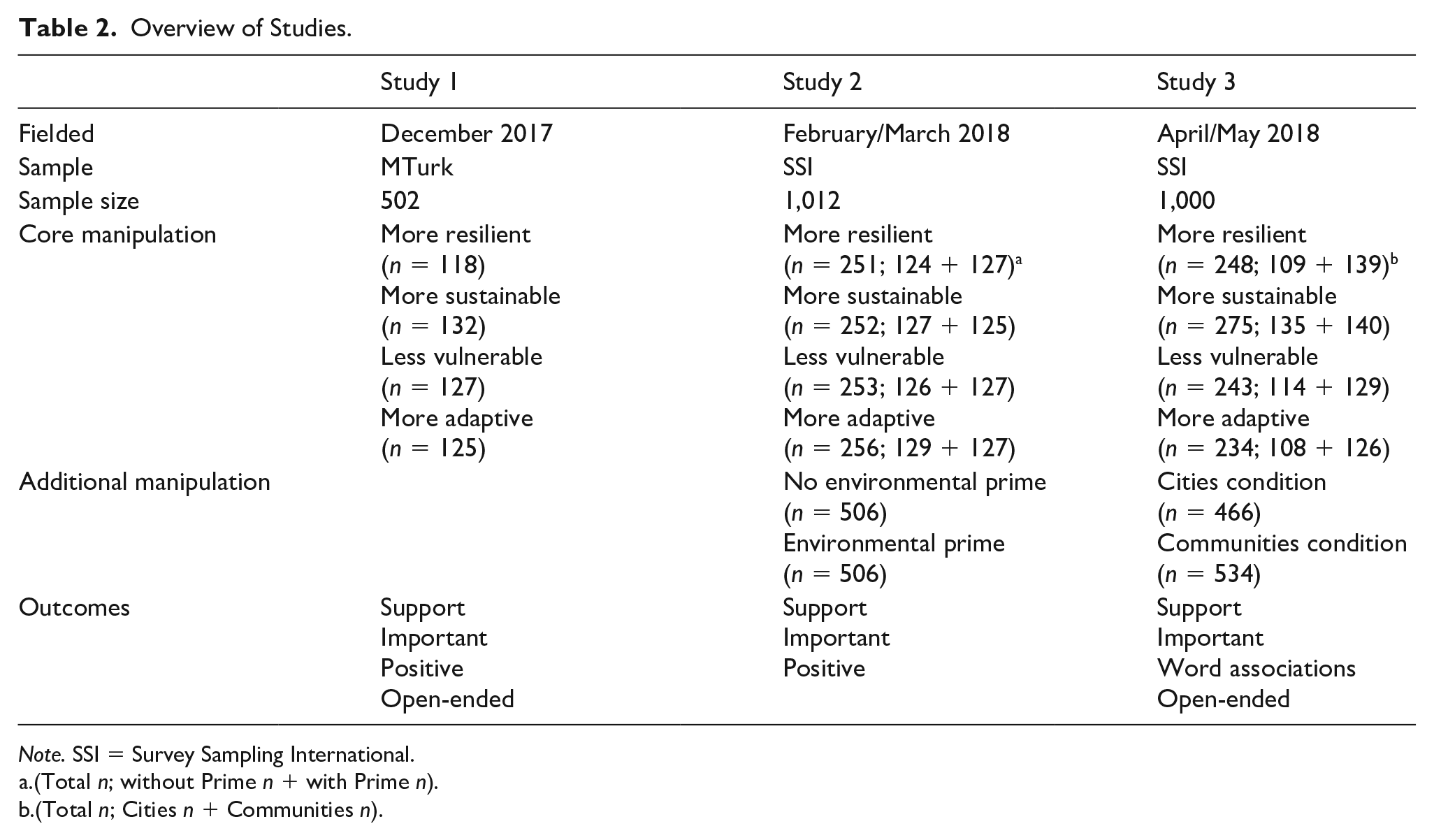
Note. SSI = Survey Sampling International.
(Total n; without Prime n + with Prime n).
(Total n; Cities n + Communities n).
The basic experimental manipulation allows us to test whether there is a causal effect of the frames on public attitudes. For instance, in study 1, the basic introduction to the questions about local action is as follows: Cities today face a variety of challenges. Therefore, local governments are investing resources to make their cities [more resilient / more sustainable / more adaptive / less vulnerable].
1
Here it should be noted that while the resiliency, adaptation, and sustainability frames include the positive word “more,” the vulnerability frame includes the negative word “less.” This obviously creates a potential confound as we are not simply changing the term but also the prefix. However, we suggest that in practice, a vulnerability frame inevitably includes language about decreasing vulnerability and thus the negativity is part of the frame, as the term vulnerable will co-occur with negative terms (see, for example, the manipulation in MacInnis et al. 2015). Importantly, while this does not affect comparisons between the terms sustainability, adaptation, or resilience, we acknowledge that our vulnerability treatment consists of both the term “vulnerable” and the term “less” and thus for comparisons involving that condition, we cannot disentangle the constitutive effects of these two terms.
In studies 2 and 3, this basic experimental protocol is augmented in subtle ways. After analyzing study 1 open-ended responses providing definitions of the different terms, we observed that sustainability was much more commonly associated with environmental concerns, despite all four terms being commonly applied in academic and policy discourse to environmental change. In study 2, we therefore test whether the terms differentially prime environmental considerations for the public, eliciting different reactions. Thus, instead of assigning respondents to one of four treatment conditions, here respondents were randomly assigned to one of eight experimental conditions. The first four of these conditions are identical to the ones described above. In contrast, the four new conditions added text (see bolded text below) that made it clear that the subsequent questions were related to environmental challenges: Cities today face a variety of
In study 3, we seek to make the findings more generalizable, recognizing that rural, or even suburban residents, may not see themselves as living in a “city” and therefore believe city challenges and actions would not impact them directly. Prior studies of climate change framing have also shown that more local frames can increase support for action (Wiest, Raymond, and Clawson 2015). Moreover, recent evidence suggests that rural residents may be resentful of cities (Cramer 2016) or less likely to support policies targeting cities (Lawrence, Stoker, and Wolman 2010) and thus the term cities may be invoking negative considerations for some respondents, thereby depressing support. Therefore, we test whether it makes a difference if these efforts are framed as concerning cities or communities. Here, the key difference was that we manipulated the reference group for the described actions such that they were either described as pertaining to “cities” or to “communities.” We do this to address any concerns that the differences we uncovered are specific to the urban context and to increase the generalizability of our inquiry.
Today, [cities / communities] face a variety of challenges. Therefore, local governments are investing resources to make their [cities / communities] [more resilient / more sustainable / more adaptive / less vulnerable].
Outcome Measures
In all three studies, following the experimental treatment, we first asked respondents, “In general, do you support or oppose efforts to make cities 2 [more resilient / more sustainable / more adaptive / less vulnerable]?” with response options on a 5-point scale ranging from strongly oppose to strongly support. Second, we asked respondents, “How important do you think such efforts are?” with response options on a 5-point scale ranging from not at all important to extremely important. The answers to these questions are rescaled to run from 0 to 1. 3 Answers to these two questions will be used to test whether the different frames influence policy support. It is worth acknowledging that the “Support” variable may be affected by acquiescence bias or a general tendency to support an action that seems desirable without any clear negative consequences and thus we caution against overinterpreting levels of support. We note that these concerns may be lessened for the “Importance” variable as its empirical distribution is less skewed.
Understanding of Term and Considerations
In studies 1 and 3, we included additional questions to measure respondents’ understandings of the terms they were assigned to as well as the types of considerations these terms elicit. In both studies 1 and 3, we asked respondents: Please take a moment to tell us what you think it means for [cities / communities] to become [more resilient / more sustainable / more adaptive / less vulnerable]?
In study 1, we included two additional open-ended questions. Specifically, we asked, “In your opinion, what are the most important characteristics that make a city [more resilient / more sustainable / more adaptive / less vulnerable]?” as well as “What do you think are the biggest challenges facing cities today?” Responses to these questions help provide insight into whether these different terms elicit different considerations that may be driving any experimental effects we uncover.
In study 3, to more systematically unpack the kinds of associations survey respondents have with the four terms under investigation, we also included an additional closed-ended question. Specifically, we asked, “When you think about making [cities / communities] [more resilient / more sustainable / more adaptive / less vulnerable], which of these terms come to mind. Please choose three.” Respondents were presented with 12 terms that we drew from previous open-ended study responses and the broader literature on these four terms: resources, natural disasters, climate change, infrastructure, economy, crime, security, transportation, renewable energy, environment, technology, and livability. The aim of this question is to empirically test the conjecture that the different terms will elicit different associations and, in particular, that sustainability will be more clearly associated with environmental issues (especially when compared with resilience).
Finally, at the end of studies 1 and 2, we also included a question to directly measure respondents’ perceptions of how positive the term they were assigned to is. Specifically, we asked respondents, On a scale from 0 to 100, where 0 means extremely negative and 100 means extremely positive, how negative or positive would you rate the phrase [“more resilient” / “more sustainable” / “less vulnerable” / “more adaptive”]? Please use the slider to provide your answer.
This question is used to assess hypothesis 2. The answers to this question were rescaled to run from 0 to 1 to allow comparability with the two other dependent variables. 4 At the conclusion of all three surveys participants were debriefed about the aim of the study.
Samples
The three experiments were embedded in three separate online surveys. The first experiment was embedded in an online survey fielded on a convenience sample (n = 502) of U.S.-based adults in December 2017. We used Amazon’s Mechanical Turk (MTurk) crowdsourcing platform to collect the data. This platform allows researchers to post survey tasks that registered users can complete for compensation. This process yielded a sample that was 50% female and 78% White. The mean age in the sample was 36 years, 62% of respondents reported having obtained a college degree, and 32% of respondents reported living in an urban environment (49% suburban and 19% rural). While it is important to note that samples collected through MTurk are convenience samples and not representative of the general population (in general respondents are younger and more liberal), previous research has validated this subject pool (e.g., Berinsky, Huber, and Lenz 2012), and it has been shown that the experimental effects uncovered in MTurk samples are similar to those conducted on representative samples (Coppock 2019).
For the second and third experiments, we contracted with Survey Sampling International (SSI) to provide nonprobability samples of U.S. adults that were balanced by sex, age, ethnicity, and census region. SSI maintains a panel of respondents who complete online surveys for which they are compensated with points which can later be redeemed for rewards. In contrast to the MTurk convenience sample, SSI maintains a diverse national panel to which subjects were recruited through a variety of means, thus alleviating some of the concerns associated with MTurk samples. The second experiment was fielded in late February and early March 2018 and yielded 1,012 respondents. This sample was 51% female and 73% White, had a mean age of 44 years, 32% of respondents reported having obtained a college degree, and 31% of respondents reported living in an urban area (47% suburban and 22% rural). The third experiment was fielded in late April and early May 2018 and yielded a sample of 1,000 respondents. The sample was 52% female, 66% White with a mean age of 42 years, and 33% of respondents reported living in a city (47% suburban and 20% rural). The SSI analyses are unweighted as recruitment is based on quotas and SSI does not provide weights (cf. Franco et al. 2017). 5
Public Understanding of the Terms
Before examining whether framing local action using the terms resilience, sustainability, vulnerability, or adaptation affects support, we examine how respondents conceptualize these terms and what considerations these terms evoke. Given the nature of our samples, we do not consider these results as a definitive overview of how the population conceptualizes the various terms. Rather, we consider them illustrative of the types of considerations bearing on respondents’ minds in our samples, thus highlighting how the various frames could affect public opinion by making different considerations more salient.
We first turn to the open-ended definitions provided by respondents in study 1. Figure 1 provides an initial visualization of these results in the form of a comparison word cloud, plotting the words that participants used in their open-ended responses that are both most frequent and most distinguishing for each group, where the word placement and coloring indicates which term the word is associated with (i.e., blue for resilience, red for sustainable, green for vulnerable, and yellow for adaptive). It thus visualizes the difference in word usage between the groups. The size of a given word is the result of the frequency of that term and how strongly it is associated with the frame, meaning that larger words are more frequently associated with the respective frame. Hence, we see that respondents are more likely to mention infrastructure or disasters in their definitions of resilience whereas renewable energy, recycling, or waste are associated with sustainability. Vulnerability is more frequently associated with nonenvironmental hazards such as crime and/or safety issues and adaptation is generally associated with broader changes surrounding issues such as technology and transportation. Responses for the two other open-ended questions mirror these considerations (see Supplemental Figures A1 and A2).

Comparison cloud of definitions (study 1).
To examine these differences in more depth, we also hand-coded the open-ended responses. First, we were interested in how familiar respondents were with the four terms as previous research on public perceptions of resilience in Australia found that just over half of respondents indicated not knowing what the term meant (Boschetti et al. 2017). However, across the four terms, only 5% of respondents explicitly stated that they were unsure of what the term they were assigned to meant and an additional 4% of respondents provided either no response or responses that did not seek to answer the question. 6 These rates were relatively stable across the four terms and the only significant differences (at p < .05) were that respondents were significantly more likely to say they were not sure what making a city “more adaptive” meant compared with “more sustainable” and that they were less likely to provide a meaningful answer to the “more adaptive” question than the “less vulnerable” question. Overall, the vast majority of respondents provided some semblance of a coherent answer.
We coded each response for the types of considerations it raised. Initially, we took an inductive approach, reading over all responses (blinded to condition) and word clouds identifying common themes and terms. These were used to develop a codebook (Supplemental Table A5), and then all responses were deductively coded for presence or absence of these codes. Differences between conditions discussed below are significant at p < .05 (see Supplemental Table A6 for prevalence of all topics and Table A7 for prevalence broken down by experimental group).
The results help to further substantiate the associations highlighted in the word cloud (Figure 1). Respondents clearly associate resilience with bouncing back or recovering from disasters. Around 36% of resilience definitions were categorized as doing so compared with only 0% to 6% among the other terms. For example, responses to the meaning of more resilient include statements like “Better built buildings that are more capable of handling adverse weather conditions” and “When a tragedy strikes like a hurricane or tornado, the city is able to quickly restore everything. This includes roads, buildings, and basic needs.”
In contrast, the sustainability frame clearly evokes environmental considerations. Indeed, 55% of responses in the sustainable condition mentioned concerns related to the environment or pro-environmental behavior such as recycling or renewable energy, compared with only about 1% to 9% in the other conditions. To illustrate, one respondent notes that it would mean that “They use more fuel efficient practices, they recycle, and practice methods of improving the environment,” another “adding solar power, wind energy.” In addition, 19% of sustainability definitions touched on the theme of cities becoming more self-sufficient compared with only 2% to 8% of other definitions.
The vulnerability framing primarily elicits considerations about security and safety. While 66% of vulnerability definitions discuss such concerns, it only appears in 18% of resilience definitions and 2% to 3% of sustainability/adaptation definitions. Illustrative definitions include being “less susceptible to crime,” “have a bigger police presence. Make sure the roads are safe,” “more secure and safer,” or “something like crime/terrorism.”
Finally, when asked to define more adaptive, many survey responses included statements such as “it means to be up to date with technology and new innovations” or “the ability to change for a changing demographic or socio-economic status.” Indeed, 18% of responses in the adaptive condition touched on technological changes whereas this theme only emerged in 0% to 3% of responses in the other conditions. Moreover, while 35% of respondents mentioned coping with change in this condition, the corresponding number in the resilience condition was 12%, and in the sustainable/vulnerable conditions, it was only 0% to 1%.
We replicate and extend these findings with data from the third study. First, in the supplemental appendix, we present a word cloud that replicates Figure 1 (see Supplemental Figure A3). Second, while open-ended responses provide an unprimed insight into the types of considerations that the terms elicit, it is possible that people still associate the different frames with a wider set of conceptualizations when directly prompted about them. Indeed, thus far we have shown that respondents’ unprimed associations of the four terms differ in meaningful ways. To more systematically examine differences in conceptualizations that do not rely on open-ended responses, in study 3, we also tested these associations using a closed-ended question. Recall that respondents were provided with a list of 12 terms and asked to choose three terms they believed where associated with the phrase they were assigned to. In Figure 2, we plot the percentage of respondents in each experimental condition who associated a given term with their phrase.

Word associations (study 3).
The results in Figure 2 corroborate the findings from the open-ended questions by showing that the phrases more resilient, more sustainable, less vulnerable, and more adaptive elicit different associations. In 10 of the 12 panels, there is at least one significant difference (at p < .05) and in all but three of these cases, there are multiple significant differences. For instance, respondents in the sustainability condition are significantly more likely than respondents in the resilience condition to associate the term with climate change, renewable energy, resources, or the environment but significantly less likely to associate it with natural disasters. Moreover, framing efforts around resilience and vulnerability elicits significantly higher associations with “security” and “crime.” The associations of these latter two terms with vulnerability show that this framing taps into an understanding that has a rather distinct focus.
In summary, this section highlights that the different frames that policy makers and practitioners use to describe local action to address environmental shocks and stressors elicit distinct considerations, which could be consequential for public support. Importantly, the responses to the open-ended questions suggest that these terms differentially prompt thoughts about the environment.
Framing Effects: Does Resilience Really Increase Support?
While the preceding section shows that the terms resilience, sustainable, vulnerable, and adaptive elicit different considerations in our samples, our central aim is to test whether they lead to differences in support and perceived importance of local action. We discuss results from the three studies in turn.
Study 1
In Figure 3, we plot mean levels of the Support, Important, and Positive variables by experimental condition along with 95% confidence intervals. Note that for all studies, when discussing differences in means between conditions, we consider differences at p < .05 as statistically significant. As differences between two means can be statistically significant at p < .05 even when their respective 95% confidence intervals overlap (Schenker and Gentleman 2001), in the text we also report formal assessments of statistical significance based on regression-based comparisons (see Supplemental Tables A1–A3).
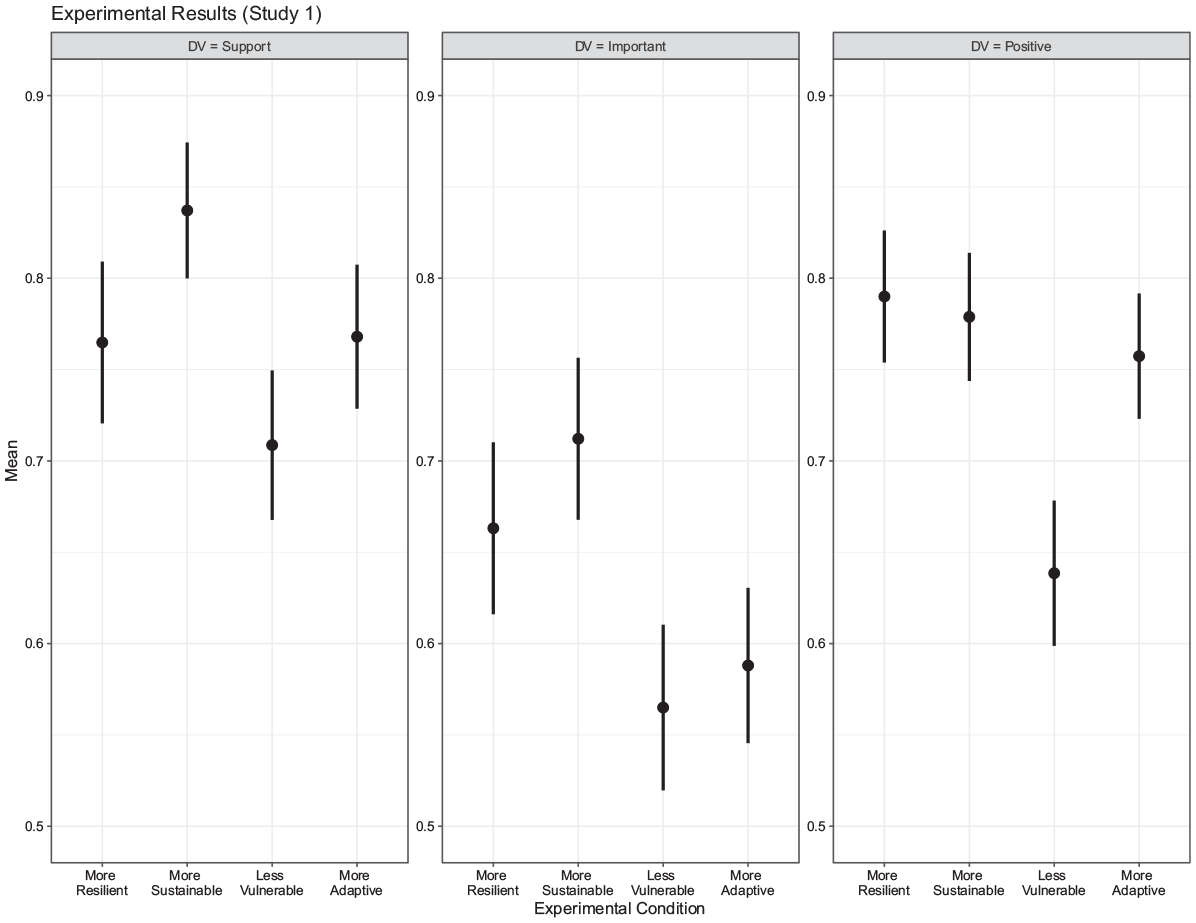
Experimental results in study 1.
The left panel in Figure 3 suggests that framing does matter for public support. Recall that our first hypothesis stated that support would be higher in the resilience condition. But rather than a resilience frame increasing support, it is respondents in the sustainability condition who are most supportive. Indeed, support is significantly higher in the sustainability condition (M = .84; SD = .22) than in the resilience (M = .76; SD = .24), adaptive (M = .77; SD = .22), and vulnerable (M = .71; SD = .23) conditions. Apart from the sustainability frame increasing support for local action, there are no significant differences between the other conditions. This first test therefore provides no support for hypothesis 1 that a resilience frame would increase support.
The middle panel in Figure 3 provides more mixed results regarding hypothesis 1. On one hand, there is no difference in perceived importance between the resilience condition (M = .66; SD = .26) and the sustainability condition (M = .71; SD = .26). On the other hand, perceived importance in both the resilience and sustainability conditions is higher than in the vulnerable (M = .56; SD = .26) and adaptive (M = .59; SD = .24) conditions. Thus, actions framed around reducing vulnerability or increasing adaptiveness is perceived as significantly less important than actions framed in terms of resilience or sustainability.
We regard the Support and Important variables as two substantive measures tapping into public attitudes toward local action. However, we also explicitly measured how positive respondents perceived these terms to be to more directly test the claim made in the extant literature that the concept of resilience is perceived as more positive than related terms. Recall, that this variable was measured on a 100-point scale from 0 (extremely negative) to 100 (extremely positive) and that we recoded this to run from 0 to 1. The results in the third panel of Figure 3 show that there are no significant differences in perceived positivity between the phrases “more resilient” (M = .79; SD = .20), “more sustainable” (M = .78; SD = .20), and “more adaptive” (M = .76; SD = .19). However, all three phrases are considered significantly more positive than “less vulnerable” (M = .64; SD = .23). As noted previously, we cannot disentangle to what extent this effect is driven by the term “vulnerable” or the fact that in the context of local action, cities talk about reducing or lessening vulnerability whereas they increase resilience, sustainability, and adaptive capacity.
One rationale suggested for the shift toward resilience in public discourse is that it may be a less polarizing and more politically tractable frame (Moser et al. 2019; Mulligan et al. 2016). Therefore, we also examined whether there are heterogeneous treatment effects on Support and Important by key respondent-level characteristics. Here we focus on whether partisanship, concern about climate change, or a respondent’s location (urban, rural, or suburban) moderate the above treatment effects. First, we find limited heterogeneity by partisanship with the only significant difference (at p < .05) being that Republican respondents are less supportive of action when framed in terms of adaptation than resilience. Second, we do find that concern about climate change is a key moderator. Specifically, respondents with the lowest and highest levels of concern about climate change did not differ significantly in terms of Support and Important when assigned to the resilience or the vulnerability condition. In contrast, the attitudes of these two groups polarized among those respondents assigned to the sustainability and adaptation conditions. This lends evidence to the conjecture that sustainability and adaptation prime environmental considerations such that respondents then bring their attitudes about climate change to bear. Finally, we find no heterogeneity in effects based on whether a respondent lives in a city, in the suburbs, or in a rural area.
In summary, the results from the first study do not support the conjecture that actions framed around building resilience will garner higher support than actions framed using other terms. Indeed, if anything, the sustainability frame increases support.
Study 2
The results of the second study are presented in Figure 4. As above, we plot mean levels of the Support, Important, and Positive variables by experimental condition along with 95% confidence intervals. In addition, we break out the results by whether respondents received the environmental prime (black estimates) or not (gray estimates). Thus, the gray estimates provide an exact replication of Figure 3.
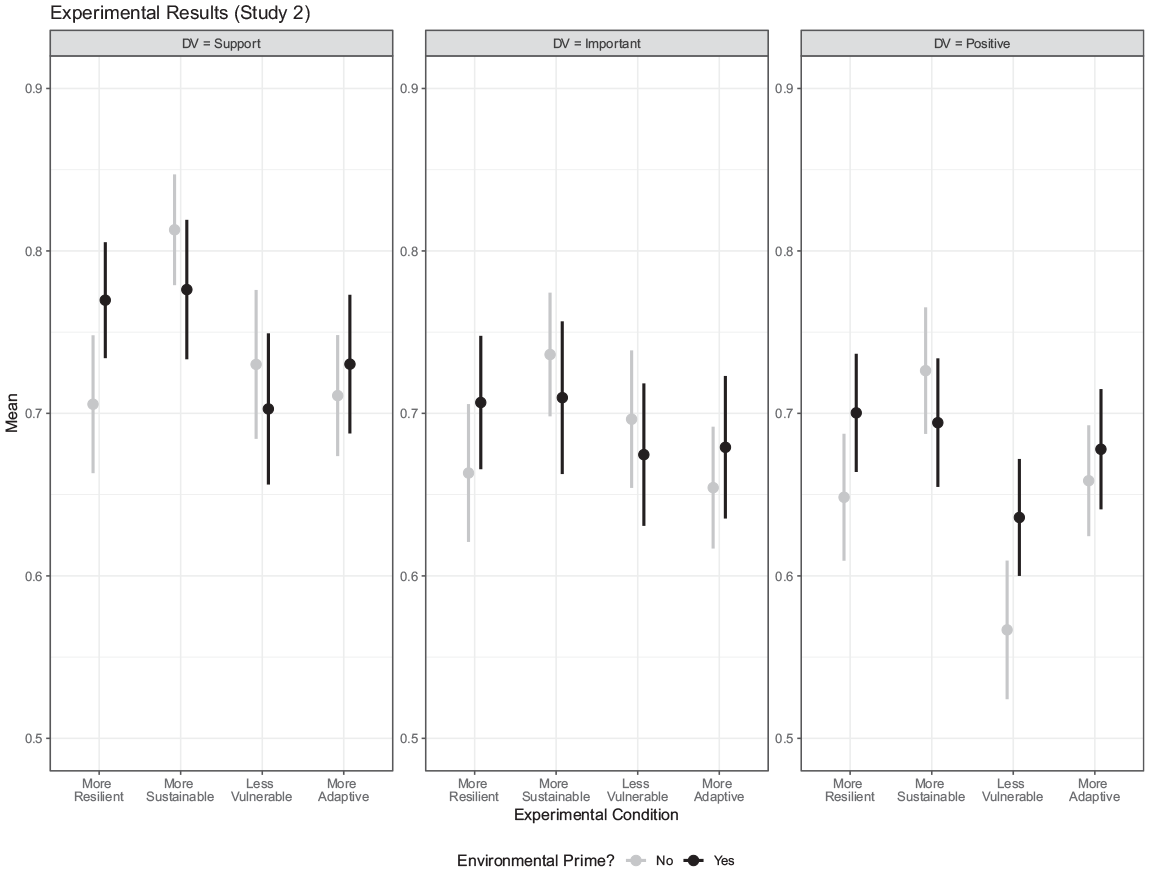
Experimental results in study 2.
Looking first at respondents who received no environmental prime, we see the same pattern that we observed in study 1: Respondents in the sustainability condition are more supportive, believe the issue is more important, and perceive the term as more positive when compared with respondents in the other three treatment conditions. 7 For instance, the left panel shows that support is significantly higher for respondents in the sustainability condition (M = .81; SD = .19) than for respondents in the resilience (M = .71; SD = .24), adaptive (M = .71; SD = .21), and vulnerable (M = .73; SD = .26) conditions, which are all indistinguishable from one another. This result is largely mirrored for the Important variable (middle panel). Here, respondents deemed action more important in the sustainable condition (M = .74; SD = .22) than in the resilience (M = .66; SD = .24) and adaptive (M = .65; SD = .22) conditions. Similarly, respondents perceive the phrase “more sustainable” (M = .73; SD = .22) as more positive than the phrases “more resilient” (M = .65; SD = .22) and “more adaptive” (M = .66; SD = .20). Moreover, all three are perceived as more positive than the phrase “less vulnerable” (M = .57; SD = .24), but we again caution against interpreting this latter result too strongly given the fact that the treatment combines both the term “vulnerable” and the signifier “less.”
What happens when we explicitly prime environmental concerns? These results are plotted as the black estimates. First, we can examine whether the environmental prime significantly shifts responses within each of the four framing conditions. Here, there are two significant results (at p < .05): Support is higher in the resilience condition when the environment is explicitly mentioned (M = .77; SD = .20) than when it is not (M = .71; SD = .24), and the phrase “less vulnerable” is perceived as more positive in the presence of an environmental prime (M = .64; SD = .20) than when there is no prime (M = .57; SD = .24). It should be acknowledged that, across all three dependent variables, the estimates in the sustainability conditions are lower when the environmental prime is present whereas in the adaptive conditions the estimates are higher—although none of these differences are statistically significant (at p < .05).
We can then examine whether the above shifts also affect differences between conditions. Indeed, the differences across all three dependent variables that emerged between the resilience frame and the sustainability frame disappear when respondents are explicitly told that the challenges that need to be tackled are environmental ones. Here, there are only significant differences when we compare responses in the vulnerability condition with responses in the sustainability and resilience conditions.
Turning to potential heterogeneity in explaining the effects on Support and Important variables, there were no significant interactions between the framing conditions and respondents’ partisanship, concern about climate change, or urban/rural status. 8
Taken together, the results of the second study once again fail to support the hypothesis that a resilience frame will lead to higher support. Moreover, this experiment showed that the sustainability frame led to increased support and perceptions of importance. These differences, however, largely disappeared when respondents were provided with an environmental prime, thereby lending support to the conjecture that the previously observed differences may be attributable to the fact that the term sustainability evokes more environmental considerations than the other terms.
Study 3
We present the results for the third study in Figure 5. Recall that we did not measure the Positive variable in this study, so only means (and 95% confidence intervals) for the Support and Important variables are plotted. The gray estimates are for respondents in the “Cities” condition (thus an exact replication of study 1) whereas the black estimates are for respondents who were told that the local action pertained to “Communities.” As noted previously, we included this manipulation to increase the generalizability of the results beyond cities and to examine whether levels of support and importance are depressed because rural residents may be less supportive when it is explicitly mentioned that policies target cities.
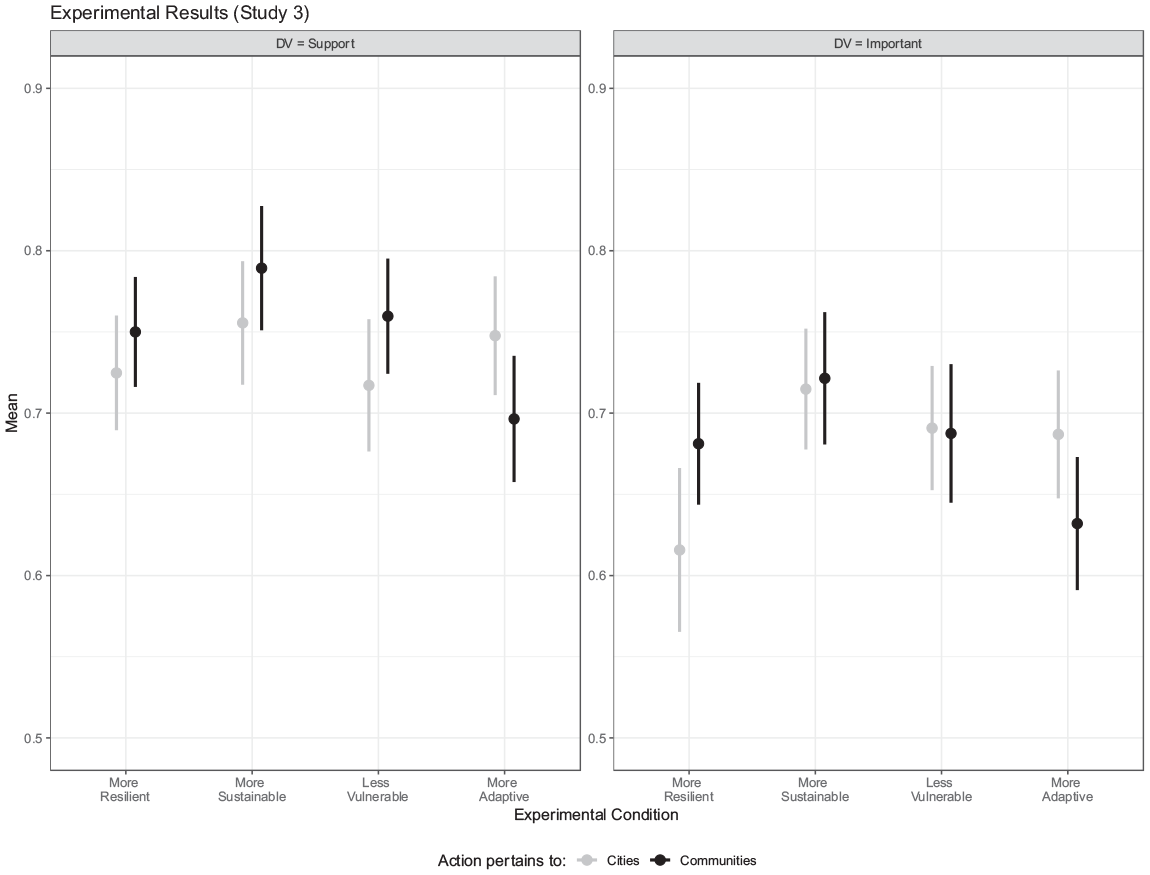
Experimental results in study 3.
Looking first at the gray estimates for respondents who read about the proposal framed as actions for cities, there is once again no evidence in support of hypothesis 1. Examining the left panel in Figure 5, the mean levels of support are statistically indistinguishable (at p < .05) across conditions, ranging from .72 (SD = .22) in the vulnerability condition to .76 (SD = .22) in the sustainability condition. Turning to the Important variable (right panel), we witness a novel pattern such that actions framed in terms of resilience are deemed significantly less important (M = .62; SD = .27) than actions framed in terms of sustainability (M = .71; SD = .22), vulnerability (M = .69; SD = .21), and adaptation (M = .69; SD = .21). It should be noted here that these results are driven by uncharacteristically low perceived importance among respondents in the resilience condition and given this deviation from the first two studies, we caution against overinterpreting this finding.
Turning to the black estimates (Figure 5) for respondents who read about these actions in the context of communities rather than cities, we once again find limited support for the conjecture that the resilience frame will increase support or increase perceptions of importance. The only significant differences are that support in the adaptation condition (M = .70; SD = .22) is lower than in the resilience (M = .75; SD = .20), sustainability (M = .79; SD = .23), and vulnerability (M = .76; SD = .20) conditions. Similarly, for the Important variable, perceived importance is lowest in the adaptation condition (M = .63; SD = .23) but this difference is only statistically significant (at p < .05) when compared with the sustainability condition (M = .72; SD = .24).
In sum, the results of study 3 provide additional evidence that a resilience frame does not increase support for local action or its perceived importance, irrespective of whether the action is framed as concerning cities or communities. It is also worth noting that the treatment effects in study 3 were not moderated by partisanship or a respondents’ location (i.e., urban, suburban, or rural). 9
Discussion
Overall, our three studies shed light on how resilience, sustainability, vulnerability, and adaptation frames are perceived by the U.S. public, contributing to the ongoing debate about the meaning and relative merits of different concepts that pertain to the governance of environmental change and adding an underexamined public opinion dimension. First and foremost, we find no evidence to support the common claim in the resilience literature that a resilience frame is innately more appealing, and if anything, a sustainability frame increases support. We also find that these frames elicit distinct considerations among respondents such that, for instance, sustainability makes people think of environmental concerns whereas resilience invokes ideas of bouncing back from natural disasters, and vulnerability is associated with crime and safety. It therefore does matter how local policies and plans are framed and it is rational that city officials would be strategic with the terms they use. This is an important finding, since according to Whittemore and BenDor (2018a) few studies have experimentally tested framing effects on urban planning-related issues.
In our first study, the only significant difference we find in terms of support is that the more sustainable frame appears to lead to more support than frames using the terms more resilient, less vulnerable, and more adaptive. When it comes to perceived importance, more resilient and more sustainable significantly increase perceived importance compared with less vulnerable and more adaptive.
Study 2 tested whether explicitly priming the environment changes these dynamics by ensuring that respondents are aware that local action seeks to address environmental changes. When we do not prime respondents to think specifically about environmental challenges—thereby giving them the identical prompt to study 1—we find that more sustainable elicits higher support and perceptions of importance and is seen as more positive than the term more resilient. We find no significant differences between the resilience, adaptation, and vulnerability frames in terms of importance and support, but the term less vulnerable is perceived as less positive than the others. However, when we do include an environmental prime, we find no difference between the sustainability, resilience, or adaptation frames. The only significant difference is that less vulnerable has slightly less support and is seen as less positive. These findings lend support to our hypothesis that the sustainability frame may be more appealing because of its association with the environment, whereas resilience does not have the same connotation. If resilience is going to become the predominant frame used for environmental policies and governance, more work needs to be done to communicate this to the U.S. public.
In study 3, we added a different treatment to the study 1 prompt to hone in on the concepts and avoid any bias related to a particular geographic scale or urban–rural divide. We randomized whether respondents saw a prompt about city or community efforts. In the city conditions, we find no difference in support between more resilient and the other frames, but find that all terms are perceived as more important than more resilient. This seems to be an outlier from the other studies. When we use communities, we find no significant difference between resilience, sustainability, or vulnerability frames in terms of importance; the only significant difference is that more adaptive is less supported than more resilient and more sustainable.
Conclusion
Effectively responding to growing environmental challenges will require major urban policy changes. Policy makers need the public’s support for these efforts, and one way to garner this support is to strategically frame policies in ways that appeal to constituents. Contrary to what we would expect from the literature, our three survey experiments suggest that resilience does not seem to lead to higher support and is not perceived as a more positive term than sustainability, and the findings are mixed with respect to adaptation and vulnerability. However, it is clear that framing matters and these terms evoke very different understandings of urban challenges and solutions.
While our studies do not support the most optimistic claims about the inherent appeal of resilience, the concept may still be valuable. We are focused on the general public, but resilience may indeed still serve an important function as a boundary object that brings together different academic disciplines, city departments, or policy agendas (Brand and Jax 2007). Siloed agencies and scholarly communities are widely recognized as a barrier to solving today’s wicked problems, thus any unifying concept that brings them together may be very valuable (Levin et al. 2012). More empirical research is needed to examine how and to what extent resilience does serve this function.
Importantly, policy discourses change and the framing that practitioners and policy makers use impacts which terms are used by the public. Thus, while the U.S. public may currently associate sustainability more with pro-environmental actions than resilience, it is entirely possible that public perceptions will change as policy makers use the term in environmental policy discourse. Sustainability has been central to city governance since the 1990s, resilience is a relative newcomer (Campbell 2016). While environmentalism seems to be an increasingly partisan issue, public support is a critical predictor of environmental policy implementation (Laurian and Crawford 2016). Thus, at a time when policy makers are looking for ways to make environmental policies more palatable to certain constituencies (Whittemore 2013), the fact that resilience is not inherently associated with environmental considerations may make it a more strategic frame.
Moving forward, our findings point to the need for more work that integrates the study of environmental change and public opinion. There are multiple avenues for future research. First, scholars could look at correlates of support for local action regardless of framing to uncover how individual characteristics affect support. Second, this study has tested whether frames affect public opinion, but future research will have to determine to what extent this public support ultimately influences policy makers’ actions and how many officials are actually using these frames strategically to increase public support for their environmental policies.
Supplemental Material
Online_Appendix – Supplemental material for Positively Resilient? How Framing Local Action Affects Public Opinion
Supplemental material, Online_Appendix for Positively Resilient? How Framing Local Action Affects Public Opinion by Sara Meerow and Fabian G. Neuner in Urban Affairs Review
Footnotes
Declaration of Conflicting Interests
The author(s) declared no potential conflicts of interest with respect to the research, authorship, and/or publication of this article.
Funding
The author(s) disclosed receipt of the following financial support for the research, authorship, and/or publication of this article:This research was supported in part with funding from a University of Michigan Rackham Graduate Student Research Grant.

Supplemental Material
Supplemental material for this article is available online.
Notes
Author Biographies
References
Supplementary Material
Please find the following supplemental material available below.
For Open Access articles published under a Creative Commons License, all supplemental material carries the same license as the article it is associated with.
For non-Open Access articles published, all supplemental material carries a non-exclusive license, and permission requests for re-use of supplemental material or any part of supplemental material shall be sent directly to the copyright owner as specified in the copyright notice associated with the article.
