



Abstract
Many scholars examine what role cities can play in addressing racial inequality. Yet existing research presents little direct evidence of local political elites’ perceptions of racial inequality and preferred strategies to address it. Which mayors perceive racial inequality to be a problem in their cities, and which mayors prefer substantive rather than symbolic solutions to this problem? To answer this question, we survey more than 100 mayors of large and mid-sized American cities. We find that, while a sizable proportion of mayors advocate for policy change, many others either deny that racial inequality exists, claim that they do not have control over racial inequality, or promote symbolic dialogues about race. Democratic mayors are substantially more likely to acknowledge racial inequality in a variety of domains. Non-White mayors and mayors of cities facing larger racial income inequality are also somewhat more aware of racial inequality, although the relationship is less consistent. Perceptual screens may prevent many mayors from pursuing vigorous policy solutions to racial inequality.
At the South by Southwest Conference in March 2018, panelists at the roundtable “America’s Mayors: Fighting for Racial Equity” discussed steps mayors could take to ameliorate racial inequality in their cities. Libby Schaff, the mayor of Oakland, California, urged mayors to try to eliminate “disparities based on race in all the measures of success.” Mayor Schaff also argued that, “We, as government, need to start holding ourselves accountable to outcomes, not just policies, not just intentions. Not just does a policy look fair, but is it actually creating a fair outcome” (Lusk 2018).
In this article, we ask, which mayors share Libby Schaff’s perspective? Which mayors believe that racial inequality exists, that they have the ability to do something about it, and that policy change is the best way forward? By examining these questions, this article takes a unique approach to the study of racial inequality in urban areas. Existing research, with important exceptions discussed below, tends to focus on external forces that limit the authority of mayors to address racial inequality. Although this line of inquiry has identified important constraints on mayoral authority, mayors still possess meaningful power, which they can use to tackle racial inequality. For example, municipal governments spend more than half a trillion dollars every year (U.S. Census Bureau 2007). Furthermore, as Trounstine (2016) observes, local governments “control the location of negative and positive externalities” such as polluting businesses and public parks. City governments also influence a wide range of additional outcomes, including who receives public goods (adequate sewers, parks, paved roads, and garbage collection), who receives appointments to local government, who receives social welfare spending, who is employed by city government, police hiring, and whether or not minority-owned businesses receive government contracts (Bauman 1992; Browning, Marshall, and Tabb 1984; Carlston and Smith 1996; Hopkins and McCabe 2012; Karnig and Welch 1980; Keller 1978; Nye, Rainer, and Stratmann 2010; Peterson 1981; Saltzstein 1989; Trounstine 2016).
City governments, then, can take important steps to address racial inequality. We contribute to the study of this topic by asking under what conditions they choose to do so. To answer this question, we analyze new data from surveys of U.S. mayors in large and mid-sized cities across the United States. This approach allows us to collect data directly from city leaders, providing unique insight into policy agendas and priorities. Specifically, we surveyed 94 mayors in 2016 and 115 mayors in 2017, all from cities of more than 75,000 people. We asked them a battery of questions to assess whether they perceive racial inequality, and whether they intend to take meaningful steps to address it. This approach contributes to a growing body of scholarship that uses elite interviews and surveys to explore local policy-making agendas (Farris and Holman 2015; Gerber 2013; Gerber, Henry, and Lubell 2013; Williamson 2018). It also builds on existing research assessing the importance of mayoral characteristics to policymaking (de Benedictis-Kessner and Warshaw 2016; Einstein and Glick 2018; Hopkins and McCabe 2012; Nelson 1992).
Our findings reveal wide variation in mayors’ attitudes about racial inequality. Some mayors are cognizant of racial inequality in their cities and can point to concrete policy changes that they have initiated to make progress on this issue. However, other mayors perceive this issue in ways likely to inhibit meaningful action. Substantial proportions of mayors deny that racial inequality in their cities exists in the first place. Others acknowledge that racial inequality exists but emphasize limitations on their power rather than speaking to the steps that they are able to take to address this issue. Finally, many mayors appear to prefer dialogues about race to policy change.
We also find that local elites’ prioritization of racial inequality is closely associated with mayors’ partisan affiliations, and sometimes with mayoral race and actual city-level racial inequality. It is only inconsistently connected with the racial composition of cities’ populations. As we discuss in the concluding section, these results have important implications for scholars’ understanding of the conditions under which city governments are likely to take meaningful action to combat racial inequality.
Why Study Mayoral Perceptions of Racial Inequality?
This study has two simple premises. The first is that policy outcomes in the metropolis depend in part on the actions of mayors. The second is that mayors are human beings whose actions are functions of their perceptions—perceptions which may or may not reflect the true state of the world. These premises are at odds with the approach of much existing research, which treats political elites as fully rational utility maximizers with complete information (see Sheffer et al. 2018 for a discussion). Yet scholarship placing elite psychology front and center has exploded in recent years. Perhaps of most direct relevance to the current study, Williamson (2018, p. 24) examined local officials’ views of immigrants, finding that “the overall picture suggests that they are relatively supportive of immigrants.” Farris and Holman (2015), meanwhile, surveyed sheriffs, finding that those sheriffs who subscribe to common blame-the-victim myths about domestic violence are less likely to support policies intended to reduce domestic violence. In a related vein, research documents that elite misperceptions about constituency opinion are widespread (Broockman and Skovron 2018; Miler 2009). Our approach is based on the insight emerging from this research that understanding elite perceptions is central to understanding elite action.
Indeed, scholarship across a variety of subfields observes the importance of perceptions of elites to political decision making. Lindblom’s (1959) model of incremental policy making illustrates the need for policy makers to simplify the world to make the decision-making process manageable. Segal and Cover’s (1989) well-known research about the Supreme Court argues for the importance of individual policy preferences to the behavior of Supreme Court justices. Finally, Fenno’s (1978) landmark study of legislative home style argues that members of Congress can only represent the constituencies they perceive. In a particularly striking passage, Fenno describes a Congressman riding in a car through a Black neighborhood in his own district, remarking “It’s like a Caribbean country,” to which his staffer replies, “It sure is a different country here.” Fenno argues that we cannot understand legislators’ behavior without gathering “perceptual data.” In this article, therefore, we gather and analyze such perceptual data: mayors’ views on racial inequality and the best means to address it.
Theorizing Mayors’ Perceptions of Racial Inequality
In our view, both contextual factors (characteristics of the city) and individual factors (characteristics of the mayor) determine whether, and the extent to which, mayors perceive racial inequality and discrimination (Farris and Holman 2017). Where mayors live and govern may shape their views on race and public policy. Racial inequality in cities has been well documented. While racial disparities vary from city to city, studies by economists, sociologists, political scientists, historians, journalists, and policy advocates highlight the stark differences in opportunity and public service quality between Whites and people of color in American cities (Chetty et al. 2014; Johnson et al. 2017; Kijakazi et al. 2016; Sugrue 2014; Trounstine 2016). Meanwhile, a plethora of studies reveal powerful evidence of enduring discrimination against people of color across a wide range of domains, including employment decisions (e.g., Quillian et al. 2017). Those mayors who are as well-informed about politics as many social scientists and political observers will be likely to recognize the depth of racial inequality and discrimination in American cities. It is likely, therefore, that mayors’ perceptions of racial inequality and racial discrimination will correlate with actual levels of inequality in their cities.
In addition, the diversity of a city’s population may affect mayors’ views on racial inequality. A wide body of research has documented stark racial gaps in perceptions of racial discrimination. A nationally representative survey commissioned by Pew found that 63% of White respondents reported that the police treat Blacks as fairly as Whites, 84% said Blacks are treated as fairly as Whites on the job, 85% said Blacks are treated as fairly as Whites in local public schools, and 86% said Blacks are treated as fairly as Whites when getting health care (Pew Research Center 2013; for similar findings, see also Krysan and Moberg 2016; Morin 2001; Morin and Stepler 2016). As Bonilla-Silva (2017) wrote, “Nowadays [W]hites believe racism has all but been defeated.”
Indeed, one study analyzing a survey of a national sample of Whites concludes, “Whites now believe that anti-White bias is more prevalent than anti-Black bias”—such that White cultural values and norms, and Whites’ hold on material resources, are perceived to be under attack (Norton and Sommers 2011). Thus, another reason to understand perceptions of discrimination is to shed light on the underpinnings of much conservative discourse (e.g., “reverse racism”) in contemporary policy debates and recent court cases about such topics as affirmative action and equal access to education and employment (Savage 2017).
Some mayors, particularly those in White-majority cities, may know that acknowledging racial inequality is unappealing to a subset of White voters (Perry 1991; Schaffner, Macwilliams, and Nteta 2018), and may face electoral incentives to avoid recognition of racial inequality. In fact, White residents themselves may be more likely to perceive discrimination against their own group in cities with more non-Whites (Craig and Richeson 2018).
While these forces may have a stronger impact on the attitudes of the mass public—who, on average, is much less politically knowledgable than mayors—they could also shape mayoral views. Those mayors whose racial attitudes are similar to the rest of the mass public—and, in particular, the White mass public—may very well be unable or unwilling to acknowledge racial inequality and discrimination in America. Mayoral race, then, may be associated with perceptions of racial inequality. As Ravi K. Perry (2013, p. xxxviii) observed, “. . . Black, Latino, and Asian mayors often feel as though they owe more to their Black, Latino, and Asian constituents than deracialized leadership.”
As the above discussion suggests, it is likely that White mayors place a lower priority than Black mayors on addressing racial inequality; while some studies find little relationship between the race of the mayor and urban governance, others show important differences. For example, Eisinger (1982) found that Black mayors are more likely than White mayors to increase the proportion of Black municipal workers, and Nye, Rainer, and Stratmann (2010) found the same for the city’s overall workforce. As one prominent example, Marion Barry increased not only the share of the city workforce that was Black but also directed more city contracting to Blacks (Jaffe and Sherwood 1994). Additional case studies also identify important instances in which Black mayors’ actions have delivered important benefits to Black constituents, including Michael Coleman’s neighborhood revitalization and community development efforts in Columbus, Ohio (Chambers and Schreiber-Stainthorp 2013); Kevin Johnson’s attempts to improve public safety and the schools in Sacramento, California, with particular attention to racial inequality (Cook 2013); and Michael B. Hancock’s work to increase food aid and to protect homeless shelters in Denver, Colorado (Phoenix 2013). Similarly, both Saltzstein (1989) and Hopkins and McCabe (2012) found that Black mayors are more likely than White mayors to hire Black police officers. Hopkins and McCabe also uncover tentative evidence that Black mayors are more likely than White mayors to reduce both the share of city employees in the police department and the percentage of total payroll allocated to police salaries.
A final key factor that may influence mayoral beliefs about racial inequality is partisanship. Democratic mayors are likely to view racial inequality to be a higher priority than Republican mayors, either because they receive different information from their constituents (cf. Miler 2009) or because their personal preferences lead them to affiliate with the party with the more progressive racial agenda. Recent studies have uncovered strong relationships between mayoral partisanship and policy preferences and outcomes (de Benedictis-Kessner and Warshaw 2016; Einstein and Glick 2017, 2018).
Data and Methods
To measure mayors’ views on racial inequality, we use data from two novel surveys of mayors of large and mid-sized cities conducted in 2016 and 2017; most featured analyses rely on the 2017 data. In both years, we invited mayors of all U.S. cities with more than 75,000 residents to participate. We used a combination of email invitations and follow-up phone calls to schedule the conversations. Critically, we conducted virtually all of our surveys in person or over the phone to ensure that we are capturing the attitudes of the mayors themselves and not the attitudes of staffers. 1 A total of 94 mayors completed the survey in 2016, a response rate of 20%, while 115 mayors took the survey in 2017, a response rate of 25%. These response rates are on par with comparable surveys of political elites; Broockman and Skovron’s (2018) survey of state legislators and candidates for state legislative office obtained a response rate of 20.8%, while Farris and Holman’s (2015) survey of sheriffs yielded a response rate of 19.5%.
As questions about race are potentially susceptible to socially desirability pressures, we took a number of steps to minimize such possibilities here. First, mayors did not know there would be a race module before agreeing to take the survey. It is therefore unlikely that mayors selected into the survey because of a particular interest in racial issues or because of an exceptional comfort level in discussing these issues. Second, the surveys in both years featured questions on a wide variety of topics in addition to race and inequality. Third, and finally, mayors were informed that their responses to the survey are anonymous. We believe that anonymity was especially important when mayors answered sensitive questions related to race. When we reached the race module of the survey, many mayors paused and asked a variation of the question, “This is anonymous, right?” before offering their assessments of racial equality in their cities.
The mayors’ cities are similar to large and mid-sized cities in the country as a whole on a wide variety of dimensions. Table 1 compares the cities represented in the 2016 and 2017 surveys with 2016 American Community Survey five-year median demographic estimates for cities more than 75,000. We also present mayors’ partisanship, due to its importance in both local and national politics, especially on racial issues. Our sample’s partisan split is remarkably similar to that of large cities in the nation as a whole. In 2016, 70% of mayors taking the survey were Democrats, and 65% were Democrats in 2017. This is comparable with the finding in existing research that 67% of the nation’s mayors are Democrats (Gerber and Hopkins 2011). Finally, because institutional capacity may drive mayors’ views on appropriate policy responses, we also gathered data on whether or not a city is governed by a strong mayor system, finding that our sample’s cities are representative on this dimension as well.
In-Sample City Traits Versus the National Population.

Attitudes Toward Racial Inequality
To analyze mayors’ beliefs about racial inequality, we asked a series of closed-ended and open-ended questions in 2017. 2 Our first theoretical expectations center on whether mayors perceive unequal treatment across racial groups. We thus developed a series of questions that explore (1) which groups mayors believe face discrimination, (2) whether mayors perceive equal access to public and economic goods across different groups, and (3) whether mayors think that the quality of public services is equal across different groups. The distinction between access and quality is an important one. There may be more parks or buses in predominantly White areas, for example, or it may be that the parks are cleaner and the buses run smoother in predominantly White areas, or both. The exact question wording is as follows:
“How much discrimination do each of the following groups face in your city [in the United States]?” [Blacks, Christians, Disabled, Elderly, Gay and Lesbian, Immigrant, Jews, Muslims, Transgender, Whites, Women]
“How equitable is access to each of the following items, on average, for Whites when compared with people of color in your city?” [Treatment by the Courts, Education, Healthcare, Housing, Jobs, Police Treatment, Public Housing]
“How equitable is the quality of each of the following services for Whites when compared with people of color?” [Education, Mass Transit, Parks, Streets]
We present the distribution of responses to the racial discrimination question in Figure 1. 3 The responses tend to fall in the middle of the scale—that is, mayors tend to say that most groups experience “some” or “a little” discrimination rather than “none” or “a lot.” Still, there is substantial variation in mayoral perceptions of discrimination. For example, 23% of mayors say there is only a little discrimination against Black people in their city, and another 10% of mayors say there is no discrimination at all. Less than one-fifth of mayors say that Blacks face “a lot” of discrimination in their cities, and the remainder say that Blacks face “some” discrimination.
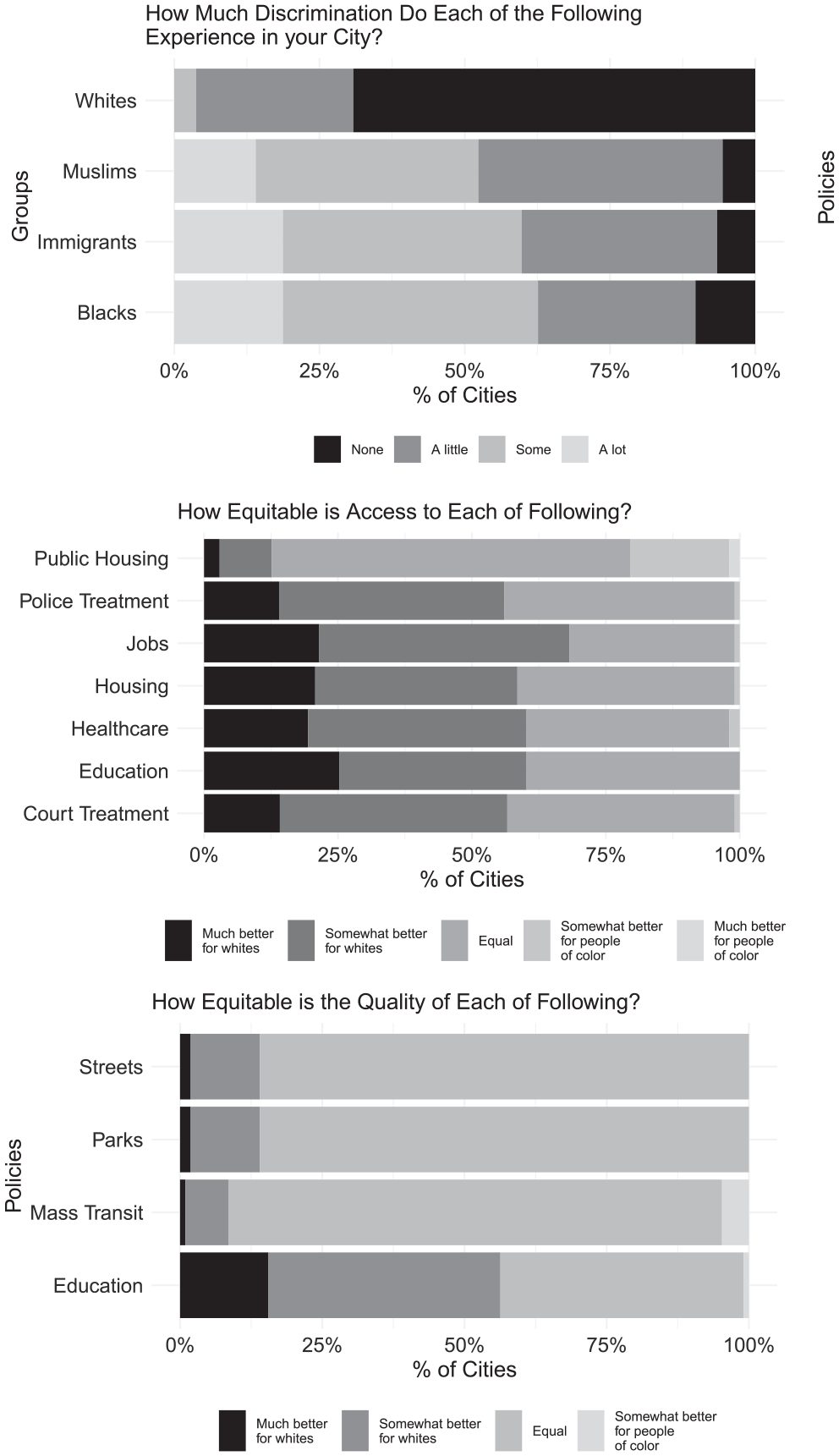
Discrimination and variation in access/quality by group.
Substantial proportions of mayors do not view discrimination against Black people as a serious problem in their cities. To be sure, the mayors are more likely to perceive discrimination against Black people than they are to perceive discrimination against other groups; more than half of mayors say that Blacks, Muslims, and immigrants face at least some discrimination in their cities, while fewer mayors perceive discrimination against Whites. And yet mayors tend to be comfortable suggesting that virtually any group experiences at least a little discrimination. Indeed, around 30% of mayors report that Whites faced a little or some discrimination in their cities.
When we asked mayors about racial disparities in access to public and economic goods, most acknowledged at least some inequality by race. More than half of mayors report that access is at least somewhat better for Whites than for people of color across a wide range of domains. Publicly subsidized housing is the outlier; two-thirds of mayors say that access to this good is equal. Indeed, mayors are more likely to say that access to publicly subsidized housing is better for people of color than it is for Whites. While majorities of mayors highlight inequality in access, between 30% and 45% of mayors say that treatment by the police, treatment by the courts, access to primary and secondary education, access to safe and affordable housing, and access to job opportunities are equal.
The picture is much different when we hone in on policies over which mayors have more control: the quality of local government services. We asked mayors to rate whether Whites and people of color have the same quality in their mass transit, street maintenance, primary and secondary education, and parks/recreation. In three of the four policy areas, mayors overwhelmingly report that the quality of public services is equal for Whites and people of color. The only area where mayors tend to perceive racial inequality is in primary/secondary education.
Open-ended elaborations 4 suggest that willingness to acknowledge discrimination in schools may be rooted in mayors’ (real or perceived) lack of control over the school system. 5 In most cities, schools are governed by separate and autonomous school boards, and mayors lament their inability to affect education policy. One mayor in the South said he tries to “be supportive of the local schools, [but it’s] largely out of our hands.” Another southern mayor emphasized that he has “no control” over the schools; the best he can do is to “work with the superintendent” on “after-school programs and vocational education.” A Northeastern mayor similarly viewed education as a state problem: “As a city, we don’t have any jurisdiction over the educational system. State issue. Totally state funded.” One southern mayor suggested that education is outside the purview of government altogether: “At the end of the day, education is the responsibility of the parents. The schools where the parents are not involved are not as good.” In contrast, mayors tend to believe that the quality of amenities over which they have more direct control—such as streets, parks, and mass transit—is equal for Whites and people of color.
Mayors’ Proposed Policy Solutions
We also asked a series of open-ended questions on the 2017 survey to better understand whether those mayors who perceive inequality support policy change to address it. The questions are as follows:
“You said that [INSERT GROUP] face discrimination in your city. What is the single best thing you have done, or are planning to do, to improve this group’s inclusion? Please be specific.”
“You said that [INSERT POLICY] is a specific area in which Whites and people of color are treated unequally. What is the single best thing you have done, or are planning to do, to improve this specific manifestation of inequity? Please be specific.”
We coded these answers in two ways. We first assessed whether an answer provided a specific policy program. If so, we then labeled whether or not the program was “dialogue-based,” meaning that the program was intended to spur conversation about race and do nothing more. This coding enables us to identify how common it is for those mayors proposing initiatives to redress racial inequality to favor softer policies over policies that require substantial structural changes. One mayor, for instance, said that he “started implementing dialogue on race in [my] departments.” Another mayor talked about his efforts to “make people sensitive to the fact that we have a lot of different cultures now in this community.” Still, another noted “the police [. . .] trying to be much more visible and friendly through engagement at schools and through food programs.” Such symbolic initiatives are not meaningless, but they are a far cry from policies that would require city governments to remedy racial disparities in municipal services, resource allocation, and treatment by police.
Of those mayors who believed that there was some racial discrimination, 78% identified policy solutions. Similarly, of those who believed that there was racial inequality in access/quality of services, 68% highlighted a specific policy solution. Thus, while a majority of mayors who believe racial discrimination/inequality is a problem in their cities offer potential policy solutions, a non-trivial minority of mayors do not propose specific policies addressing this problem.
Many of these policy solutions that mayors said they have pursued involve meaningful steps intended to address racial inequality. One western mayor highlighted his efforts to address infrastructural inequality: The other day I was asked about a road that was pretty bad. [There] was segregation in the 50s and 60s—only a certain area where [B]lacks could live. Road was patched all over the place. [We’re] redoing the street—trying to right a wrong from a long time ago.
Of course, fixing a single road is only a very small step toward a more racially egalitarian society, particularly when considered as the “single best thing” the mayor felt he had done. Still, it was a meaningful response that involved a commitment of resources.
In another case, a midwestern mayor highlighted Access to affordable healthcare. There is a perception that the healthcare system is a White male institution and no matter what healthcare providers say, they can’t shake that perception, especially among women of color. We are working with a nonprofit that helps build trust. We also have a program with a local barbershop, where we put a health professional in the barbershop and they provide information on healthcare as well as dental health. The city has been able to play a major role in oral health.
This statement is also counted as a specific policy response to racial inequality, as this mayor committed resources to address racial inequality by providing access to information about health. Yet we note that even as the mayor pointed to steps he had taken as “the single best thing” he had done to address racially unequal treatment, the mayor also recast the issue as a problem of perception rather than reality. This mayor had previously responded that people of color were treated unfairly in the domain of health care. But when the mayor was asked what the single best thing was that he had actually done about it, the mayor walked back the initial response, reframing the problem from racially unequal treatment to inaccurate perceptions held by people of color. This quotation is illustrative of a number of instances in which mayors acknowledged racially unequal treatment, but went on, in open-ended elaborations, to implicitly blame people of color when providing their policy solution to unequal treatment.
Many of the policy solutions that mayors said they had pursued were symbolic rather than substantive. A full 47% of mayors’ “single best policy solutions” centered on community dialogues rather than structural policy change. One western mayor described his dialogue-oriented efforts to create a more inclusive environment for Muslims: “There is a Muslim police officer. We bring him to all the community forums.” Another mayor tackled discrimination against Black people with a “compassion project that mimicked what the US Conference of Mayors did. We tried to help people understand the importance of racism where it is seeded.” Another mayor touted her “well known inclusivity statement that we reaffirm every year. [It’s] geared more toward people who are biased or not inclusive.” Here racism is viewed as an attribute of individuals rather than systems; as such, the appropriate remedy is thought to be conversations about race rather than policy change.
This disproportionate emphasis on dialogue-based programming is not inevitable. In 2016, we asked mayors to name the “single best thing” they could do for a variety of social groups as part of a general inclusion module. 6 We used the same coding scheme as in the open-ended questions above. Figure 2 displays these results. 7 The results show that mayors are disproportionately likely to reference dialogue-based policies when asked about racial or ethnic groups. In all, 45% of mayors mentioned dialogue when asked about Blacks, and 35% cited dialogue when asked about Latinos (33% highlighted dialogue when asked about immigrants). In contrast, policy solutions for the poor, those with criminal records, and young high school dropouts were considerably less likely to fall into this category, by a margin of at least 20 percentage points in all cases. Mayors were more likely, when discussing groups such as the poor or high school dropouts, to reference actual policy changes involving resource commitments. For instance, one mayor told us, “We have a program to bring kids back from dropout; a volunteer early childhood education program.” Another mayor referenced a city minimum wage increase.

Percentage of mayors who offer dialogue-based policies by group.
These results also point to some intriguing differences in mayors’ policy approaches toward Black and Latino people. Indeed, mayors were significantly more likely to offer dialogue-based programming for Blacks relative to Latinos by a margin of 10 percentage points. One western mayor in 2017 suggested that it was easier to come up with concrete, structural policies targeting discrimination of Latinos and immigrants 8 compared with Black people: “We are doing more about language barriers for Hispanics, Islanders, and immigrants. There’s less we can do about old fashioned racial attitudes towards [B]lacks.”
And yet even these proposals for community dialogue went farther than the initiatives of some mayors, whose solutions appeared to have nothing to do with race at all. One western mayor described a sign in his city: What we’ve done is something as simple as putting up a sign when you enter the city that says Welcome to [CITY NAME]. We are building an inclusive community. It sounds simple, but when I talk to people who have seen it, it makes a difference to them and it’s become my mantra that I bring with me and it’s become our ethos.
Among those mayors who did not identify a policy solution that they had pursued, many suggested that racial bias and inequality were outside of their control. Some mayors specifically highlighted their limited governing authority. One southern mayor asserted, “The city has no control over the courts,” in explaining why he could do little to redress his city’s criminal justice system’s unequal treatment of people of color. A western mayor similarly argued, “Transit is a completely autonomous agency,” suggesting that, at best, the agency could “partner” with the city to “provide low cost options.” A southern mayor wished that (s)he could try to “open more opportunities in the job market to minority kids. However, I can’t get the school system to change the way they do business.” Similarly, some mayors were fatalistic about their capacity to effect change given broader economic forces. A western mayor said, “Not much the city can do [about racial inequality.] It’s partly about local demographics of crime [and] county level [trends].” Another western mayor worried about “access to affordable healthcare,” but, when prompted to come up with a policy solution simply said “I’m sorry, but I don’t have an answer.” In some cases, these responses may well reflect important limitations on the power of the mayor’s office. Yet it is notable that in answer to a question about the single best thing the respondent had done or was planning to do, a common response was to emphasize powerlessness as a justification for doing very little. In contrast, in other similarly large-scale economic challenges—such as low economic opportunities for high school dropouts—mayors were relatively quick to point to specific policy changes they had made involving resource commitments.
Variations in Mayoral Perceptions of Racial Inequality
We now turn our attention to explaining variations in mayors’ perceptions of racial inequality and their policy responses to inequality. Figure 3 predicts mayoral perceptions of discrimination using a series of coefficient plots (full regression results are available in the appendix in Table A1). For each social group in our data, we estimated a series of ordinary least squares regressions 9 measuring the relationship between individual- and city-level variables and mayors’ perceptions of discrimination in their own cities. These variables include the mayors’ sex, partisanship, and race as well as the city’s institutional configuration, median housing value, population, and proportion White. 10 We also include two measures of racial income inequality: the Black–White income ratio and the Hispanic–White income ratio. For both ratios, as the number increases, it reflects higher minority income relative to that of Whites; given the nature of racial income disparities in most American cities—with White income substantially higher than that of people of color—higher values of the measure indicate greater racial equality. In all of the models below, we include the measure(s) of racial income inequality most relevant to the group in question, although all results are robust to inclusion of a full set of controls for racial income inequality. While, ideally, we would have also included measures of inequality in the provision of local government services, these data are not available systematically across cities nationally; indeed, the absence of these data may be one explanation for mayors’ belief that the quality of their cities’ services is equal across different racial and ethnic groups.
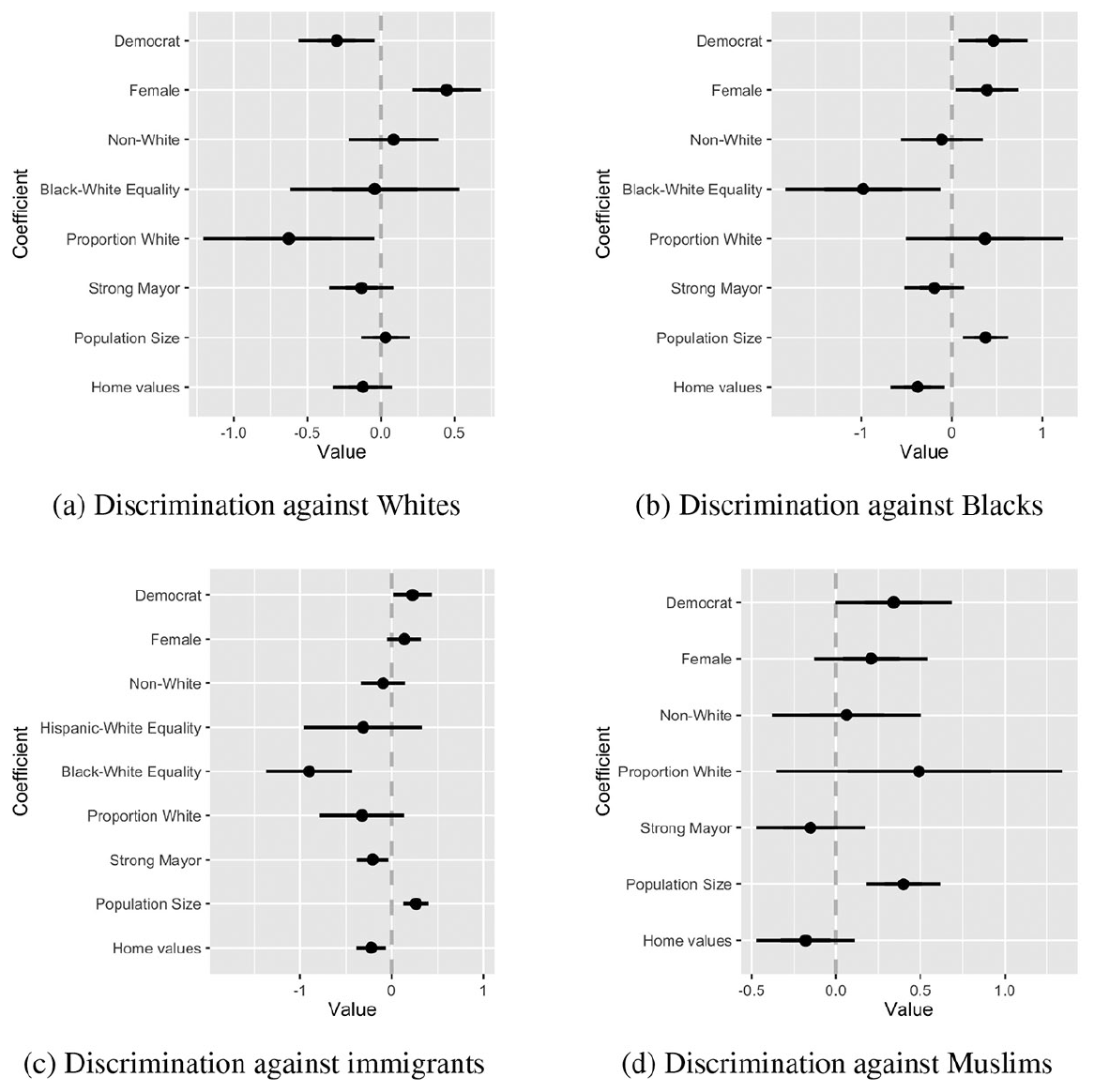
Relationship between individual and contextual characteristics and mayoral perceptions of discrimination.
Several patterns emerge in these data. Perhaps most strikingly, partisanship is a powerful predictor of mayors’ attitudes concerning discrimination—consistent with recent studies highlighting its importance to local politics (de Benedictis-Kessner and Warshaw 2016; Einstein and Glick 2018; Einstein and Kogan 2016; Tausanovitch and Warshaw 2014). Democrats are significantly more likely to perceive discrimination against Blacks and Muslims in their own cities, and significantly less likely to see discrimination against their cities’ White people, all else equal (the coefficient on partisanship in our immigration model is positive, but not statistically significant). Meanwhile, we do not find a consistent relationship between mayoral race and mayors’ attitudes toward discrimination, after holding other variables constant. This may be a consequence of the small number of non-White mayors both in our sample and nationally; only 15% of the mayors we spoke with were non-White.
Mayors appear to be somewhat responsive to the context of their communities. When the Black–White income ratio is higher—that is, Black median household income is closer to that of Whites—mayors perceive less discrimination against Black people. We observe similar results in our model exploring perceptions of discrimination against immigrants. Mayors of cities with greater income equality between Blacks and Whites are less likely to report discrimination against immigrants in their cities; the coefficient on the Hispanic–White income ratio is in the same direction, but its large standard errors make this estimate far less precise.
The city proportion White appears to only predict mayoral perceptions of discrimination against White people. In more White cities, mayors are less likely to perceive discrimination against Whites. Somewhat surprisingly given our expectations, there is no relationship between the diversity of a city’s population and mayoral perceptions of discrimination against Black people or immigrants.
Our control variables reveal intriguing patterns. Mayors of strong mayor cities are less likely to perceive discrimination against all groups, although these estimates are imprecise. Mayors of larger cities are consistently and significantly more likely to perceive discrimination in their cities against all groups save Whites, while mayors of more affluent cities are less likely to see discrimination against all groups, although this variable mostly falls short of conventional levels of statistical significance.
Figure 4 turns to variations in mayoral views on equality in access; it displays similar coefficient plots to those in Figure 3. The dependent variable in these models is mayors’ views about equity of access to various social, public, and economic goods for Whites when compared with people of color (positive values are coded as greater access for Whites). 11 Once again, partisanship is a powerful and consistent predictor of mayoral attitudes—in line with our theoretical predictions. Across virtually all arenas, Democratic mayors are more likely to believe that access is better for Whites than for people of color (partisanship is in the same direction but not statistically significant in our models exploring attitudes toward access for education and housing). Mayoral race also appears to matter, at least in some policies; in line with our predictions, non-White mayors are significantly more likely to perceive treatment by the police and access to jobs as better for White people relative to people of color.
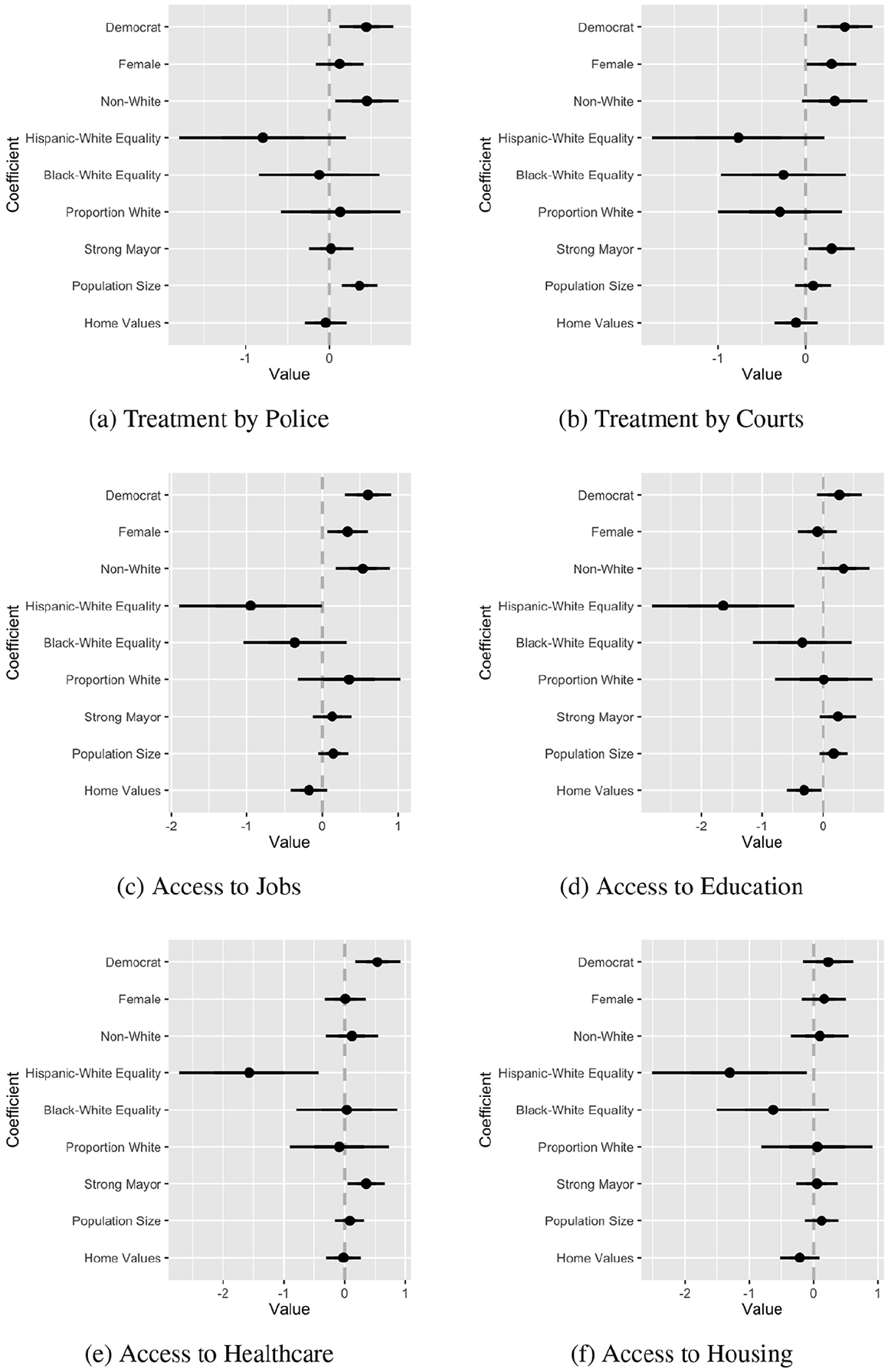
Relationship between individual and contextual characteristics and mayoral perceptions of inequity of access by race.
City context also predicts mayoral attitudes. Mayors of cities in which Hispanic and White income are more equal are significantly less likely to report inequality in access to jobs, education, health care, and housing; the Black–White income ratio also has a negative coefficient, although its large standard errors place it outside of standard bounds of statistical significance. Table A2 in the appendix shows the full regression results of these models.
Figure 5 illustrates the relationship between various individual- and city-level characteristics and mayors’ views on whether the quality of services is equitable. The coefficient plots here reveal largely null results. One potential explanation is the lack of variation in the dependent variable: mayors for the most part agreed that the quality of their services is equal for Whites and people of color. Even partisanship—the most consistent predictor in previous models—does not stand out in these models. Only the model for education displays significant coefficients for the Hispanic–White income ratio and mayoral race. As expected, mayors of cities with greater racial equality are less likely to perceive differences in the quality of education available to White people and people of color. Non-White mayors are significantly more likely to perceive the quality of access for education as better for White people relative to people of color. The full regression models are available in Table A3 in the appendix.
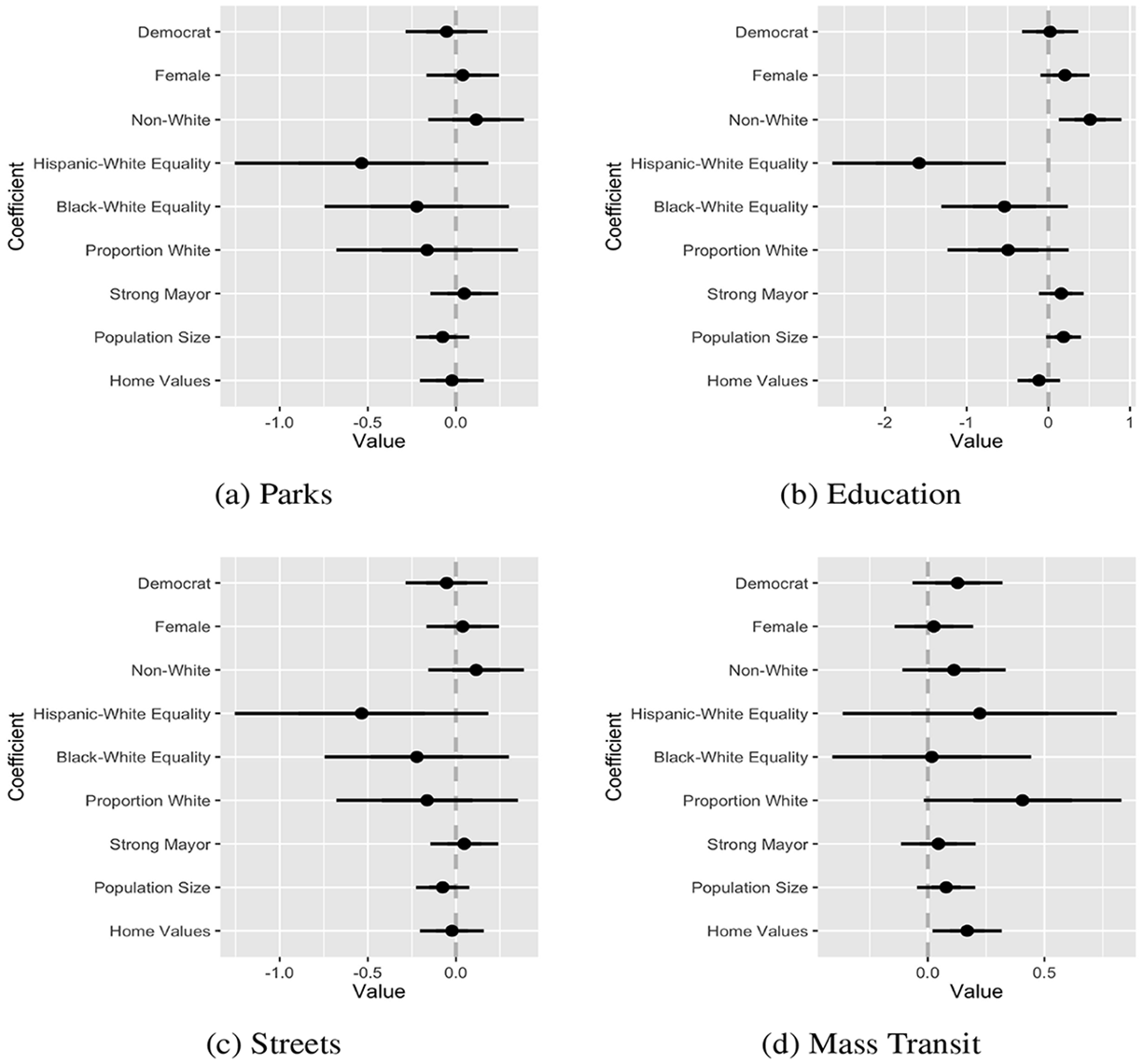
Relationship between individual and contextual characteristics and mayoral perceptions of inequity of quality by race.
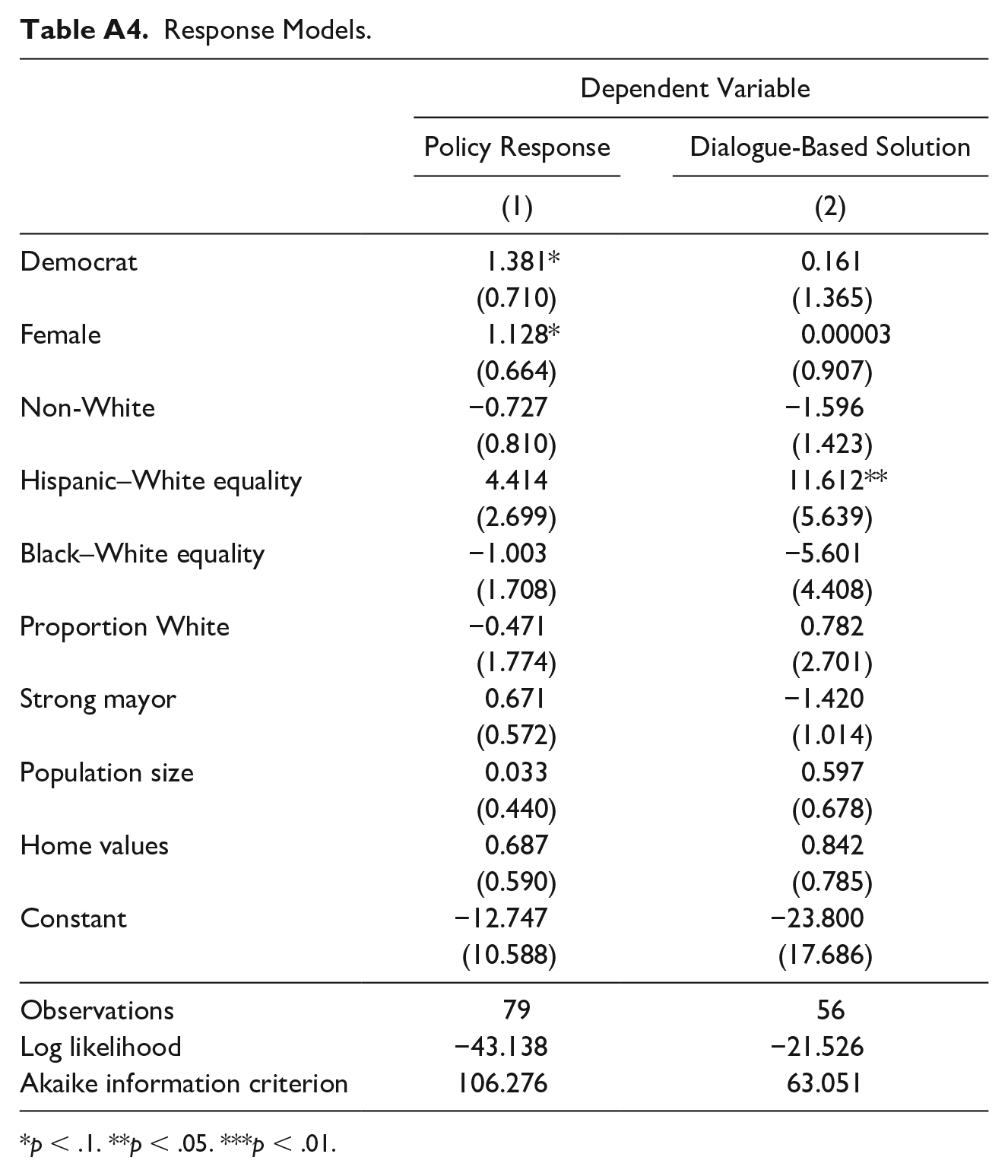
Our final set of coefficient plots in Figure 6 displays how individual and contextual characteristics predict (1) mayors’ likelihood of offering a specific policy response to racial inequality and (2) mayors’ likelihood of providing a dialogue-based response, conditional upon having provided a specific policy. Because the dependent variables are both dichotomous, these models display logit coefficients and their standard errors. Among those mayors who acknowledge racial discrimination, Democratic mayors appear more likely to provide a specific policy response to the problem, although partisanship is only significant here at the 0.10 level. Partisanship is not associated with mayors’ propensity to offer dialogue-based solutions. Within the population of mayors who offered a specific policy solution, only the Hispanic–White income ratio predicts mayoral support for dialogue-based polices; in cities where the Hispanic and White populations were more equal, mayors were significantly more likely to offer a dialogue-based policy, conditional on having provided a specific policy solution in the first place. Mayoral race and the diversity of the city’s population do not predict mayoral policy responses. The full regression models are available in Table A4 in the appendix.
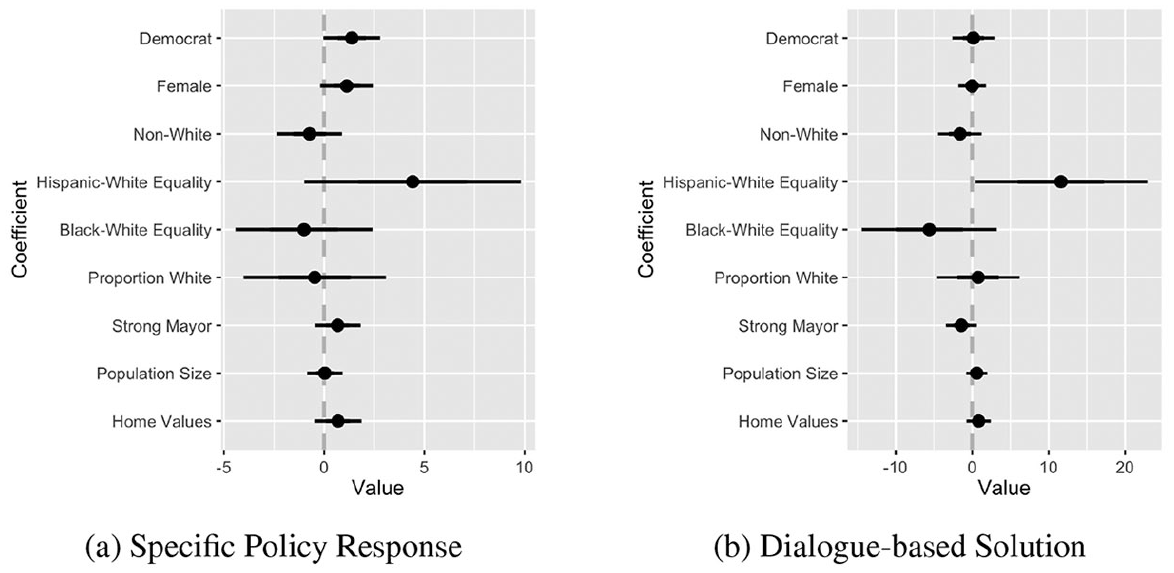
Relationship between individual and contextual characteristics and mayors’ stated policy responses to racial inequality.
Conclusion
By surveying mayors in a confidential and flexible environment, we have illuminated a range of understudied elite attitudes: whether mayors acknowledge racial inequality, what policy solutions to inequality mayors are willing to pursue, and which mayors are especially prone to downplay or ignore racial inequalities in their cities and policy solutions to them. The purpose of this endeavor has been to understand the conditions under which mayors pursue efforts to mitigate racial inequality in America’s largest cities. Whether the findings we have presented are optimistic or pessimistic depends on whether one tends to see the glass half-full or half-empty; while some mayors acknowledge racial inequality and can point to concrete steps they have taken to solve the problem, others deny the existence of racial inequality, claim powerlessness to address it, or favor symbolic half-measures. Finally, elite perceptions of racial inequality are systematic: correlated in predictable ways with mayoral and city-level characteristics.
We note that many other factors, beyond perceptions of racial inequality, influence whether mayors will be able to implement meaningful change in service of a more racially equal city, including electoral strategies (Phoenix 2013), leadership style (Chambers and Nelson 2014), and policy approaches (Perry and Owens-Jones 2013). Our findings complement this line of research; while existing work searches for the conditions under which mayors’ efforts to combat racial inequality are likely to be successful, here we have examined a likely precondition for these efforts—whether mayors perceive racial inequality in the first place.
A skeptic might respond that even if the perceptions of mayors change, a range of factors will limit their power to address racial inequality, including constituent pressures, segregation, organized business and the mobility of capital, urban sprawl, institutional rules in city government, and constraints placed on cities by state and national government (Bauman 1992; Hajnal 2007; Judd and Swanstrom 2014; Kaufmann 2004; Ladd and Yinger 1991; Nelson and Meranto 1977; Stone 1989; Trounstine 2016). We acknowledge that racial inequality is caused by a number of factors, many of which are outside of the control of metropolitan areas. The New Deal, for example, was a set of policies created by the federal government which created a largely White middle class while systematically discriminating against people of color in the domains of social welfare, labor, and housing reform (Katznelson 2005; Williams 2003). No single mayor could have eliminated racial discrimination in these policies, nor can any single mayor eliminate their contemporary, and racially unequal, reverberations.
We also acknowledge that even within the relatively narrow domain over which mayors do have authority, research in the tradition of the “hollow prize” thesis (Friesema 1969) has illuminated powerful external forces constraining metropolitan policy making. Cities are dependent on their residential and commercial population for revenue, yet many cities suffer from declining populations (including White flight), business fleeing to the suburbs, and declining incomes among those who remain (Kraus and Swanstrom 2001; Peterson 1981). Furthermore, the American political system is structured such that cities are creatures of the states (Briffault 1990), and many states ban sales taxes, prohibit minimum wage laws, limit municipal debt, and otherwise diminish mayors’ ability to determine policy (Nivola 1996). In some cities, the form of government is such that mayors have less power still, as a city manager makes many of the day-to-day decisions critical to the functioning of local government. Mayors may also inherit school districts that have been gerrymandered along racial lines, with different, vastly unequal, revenue streams (Gordon and Hayward 2016). These attributes of contemporary American politics, among others (including constituency pressures in White-majority cities and local political fragmentation), are especially constraining in highly racially unequal cities (Kraus and Swanstrom 2001; Nelson 1978). Thus, the ability of mayors to address racial inequality is most circumscribed in the places where it is most needed.
These limitations on mayoral authority notwithstanding, mayors do have substantial power to shape the cities they govern, and they can use this power for good or ill. After all, racial inequality today is in no small part an outcome of a long history of discrimination within city government itself, which excluded and discriminated against Black workers for generations (Frymer, Strolovitch, and Warren 2006). Recently, scholarly attention has been drawn to predatory systems of local government, in which cities depend on the police to levy fines and fees on “race-class subjugated populations” (Soss and Weaver 2017) to raise revenue. Historic decisions about land use—perhaps the most substantial power that cities and mayors wield—have consistently excluded people of color from neighborhoods and communities with the highest quality public goods (Rothstein 2017; Trounstine 2018). Mayors could make substantial improvements to American society merely by ceasing racially discriminatory practices within their own governments.
Thus, mayors could exercise what power they do have to allocate municipal resources in a more equitable way, even if they have less control over larger trends such as suburbanization, White flight, and deindustrialization. Finally, it should be noted that mayors can at times serve as a powerful force in national politics. Ogorzalek (2018) showed that mayors have played an instrumental role in the formation of cross-city alliances (as in the case of organizations such as the U.S. Conference of Mayors), leading cities to become a cohesive liberal bloc in national politics that has anchored progressive politics from the mid-twentieth century to the present day.
We concur with Libby Schaff, then, that there is much mayors can do about racial inequality, if they want to. Our findings show, however, that not all mayors share Libby Schaff’s perspective about ameliorating racial inequality in cities. While most mayors report awareness of some basic level of racial inequality, a non-trivial proportion of them are hesitant to acknowledge inequality within their cities. Even among those mayors who do recognize substantial racial inequality, many either minimize their political powers to address the issue, or propose symbolic and toothless dialogue-based initiatives rather than structural policy changes. We suspect that in many cities, the path to racial equality is cluttered with mayors’ perceptual obstacles.
Supplemental Material
mayorsracepaper_v15 – Supplemental material for The Pictures in Their Heads: How U.S. Mayors Think About Racial Inequality
Supplemental material, mayorsracepaper_v15 for The Pictures in Their Heads: How U.S. Mayors Think About Racial Inequality by Katherine Levine Einstein, Luisa Godinez Puig and Spencer Piston in Urban Affairs Review
Footnotes
Appendix
Response Models.
| Dependent Variable | ||
|---|---|---|
| Policy Response | Dialogue-Based Solution | |
| (1) | (2) | |
| Democrat | 1.381* | 0.161 |
| (0.710) | (1.365) | |
| Female | 1.128* | 0.00003 |
| (0.664) | (0.907) | |
| Non-White | −0.727 | −1.596 |
| (0.810) | (1.423) | |
| Hispanic–White equality | 4.414 | 11.612** |
| (2.699) | (5.639) | |
| Black–White equality | −1.003 | −5.601 |
| (1.708) | (4.408) | |
| Proportion White | −0.471 | 0.782 |
| (1.774) | (2.701) | |
| Strong mayor | 0.671 | −1.420 |
| (0.572) | (1.014) | |
| Population size | 0.033 | 0.597 |
| (0.440) | (0.678) | |
| Home values | 0.687 | 0.842 |
| (0.590) | (0.785) | |
| Constant | −12.747 | −23.800 |
| (10.588) | (17.686) | |
| Observations | 79 | 56 |
| Log likelihood | −43.138 | −21.526 |
| Akaike information criterion | 106.276 | 63.051 |
p < .1. **p < .05. ***p < .01.
Acknowledgements
We appreciate David Glick, Maxwell Palmer, Stacy Fox, Katharine Lusk, and Graham Wilson for their critical work on the design and implementation of the survey of mayors. The questions used in this analysis were developed in collaboration with the National League of Cities. An earlier version of this article was presented at the 2018 Annual Meeting of the Midwest Political Science Association, and the project benefited from the input of participants there, especially Bernard Fraga, Tyson King-Meadows, Eric Gonzalez Juenke, and our discussant, Mette Marie Staehr Harder. Finally, we are thankful to Elizabeth Burke, Jennifer Chudy, David Glick, Lida Maxwell, Maxwell Palmer, Tom Ogorzalek, Danielle Thomsen, Nicole Yadon, and this article’s anonymous peer reviewers for their helpful comments.
Declaration of Conflicting Interests
The author(s) declared no potential conflicts of interest with respect to the research, authorship, and/or publication of this article.
Funding
The author(s) received no financial support for the research, authorship, and/or publication of this article.
Authors’ Note
This title alludes to  classic book Public Opinion, in which he references the tenuous relationship between “The World Outside and the Pictures in Our Heads.” The Menino Survey of Mayors was conducted by Boston University’s Initiative on Cities and co-principal investigators Katherine Levine Einstein, David Glick, and Maxwell Palmer. It is supported by the Rockefeller Foundation and Citigroup. All errors are the responsibility of the authors.
Notes
Author Biographies
References
Supplementary Material
Please find the following supplemental material available below.
For Open Access articles published under a Creative Commons License, all supplemental material carries the same license as the article it is associated with.
For non-Open Access articles published, all supplemental material carries a non-exclusive license, and permission requests for re-use of supplemental material or any part of supplemental material shall be sent directly to the copyright owner as specified in the copyright notice associated with the article.
