




Abstract
Scholars and policymakers have long been interested in whether large-scale owners of rental properties have different management practices than smaller-scale owners and whether these differences matter for the housing stability of tenants. This is of particular concern among the 1- to 4-unit small rental properties that comprise half the nation’s rental housing stock. I conducted a nationwide survey supplemented with interviews to understand how owners (i) select their tenants and (ii) react to rent delinquencies. I find that larger-scale owners’ highly routinized property management systems make them much more likely to start the eviction process after a delinquency. However the tenant selection processes of professional owners also appear to result in a tenantry that has a somewhat higher delinquency rate, while the selection process for non-professional landlords raises fair housing concerns. I discuss how the link between the tenant selection and rent delinquency practices of landlords has a number of policy implications.
Introduction
Eviction is a major disruptive force for many low-income renters. Over a million households are evicted from their homes every year, and the impact of eviction, whether formal or informal, on households is profound (Desmond et al. 2018). Eviction has been found to cause job loss and mental and physical health declines (Desmond and Kimbro 2015). Eviction begets further housing instability, as past evictions can be discovered during tenant screening and cause tenants to be rejected from units (Desmond 2015). Much of the eviction crisis is driven by a lack of affordable units (Desmond 2018). Renters typically have little to no savings, and often pay half or more of their income for housing (Bhutta et al. 2020; Joint Center for Housing Studies 2020). This means that slight declines in income or increases in expenses can cause tenants to miss payments. Even a change in the timing of income can cause tenants to become delinquent in rent, which can lead to a cascade of late fees and penalties.
Whether rent delinquency leads to eviction is up to the rental property owner or manager. When the rent goes unpaid some owners and managers move quickly to file for eviction, but owners often use a range of other methods to get their tenants current, such as developing payment plans, forgiving back rent, or accepting services like property maintenance in lieu of rent (Balzarini and Boyd 2020). For some tenants the first missed payment starts a series of events that leads to them leaving their unit. For others, owners and managers provide leeway that sometimes allows them to stay in their unit.
Understanding the differences in how owners and managers deal with rent delinquencies can help policymakers and scholars develop methods to improve the housing stability of low- and moderate-income renters. But it requires grappling with a very diverse and hard-to-study group: the owners and managers themselves. This is particularly true in the stock of 1- to 4-unit small rental properties (SRPs) that, collectively, make up about half the nation’s rental housing stock (US Census Bureau 2020). Portfolio sizes among SRP owners are typically only one or two properties, but a portion of this stock is held by large-scale professionals with dozens or even hundreds of units.
There is some evidence that “mom and pop” landlords are less likely to evict their tenants, but it is possible that this difference is driven, not by how they deal with missed rent payments, but by who they choose to rent to. Scholars have found that larger landlords have higher eviction filing rates, particularly higher “serial filing” rates, where owners file for eviction multiple times on the same tenant (Garboden and Rosen 2019; Immergluck et al. 2019; Leung et al. 2020). However the usual cause for filing, rent delinquency, is typically unobserved. This raises the possibility that the reason larger owners file more often is because they are more likely to rent to tenants who go on to miss a rent payment in the first place, while “mom and pop” landlords are less willing to rent to a tenant who appears likely to miss a rent payment. Every landlord wants the rent to be paid in full and on time, but professional owners have systems and policies in place to deal with missed payments, while “mom and pop” landlords need to adjust their whole schedule to deal with a missed payment.
To better understand differences in what owners do when the rent is not paid and how this is linked to tenant selection, I surveyed and interviewed landlords of SRPs across the United States and asked how they approached tenant selection and rent non-payment. Using regressions from survey data and qualitative analysis of interviews, I find that, upon rent delinquency, larger portfolio owners are more likely to begin eviction procedures. However I also find a connection between owner’s tenant selection practices and eviction practices. Larger owners are more likely to rent to tenants who go on to miss a rent payment. These findings have a number of implications for programs and policies designed to improve the housing stability of low- and moderate-income renters.
Background
The underlying cause of most evictions is the dearth of affordable homes for low-income households. About 80 percent of evictions are for rent non-payment (Lerner 2017). Renter incomes have not kept up with rent growth for many years and thus historically high numbers of renter households now pay 30 percent or even half their income for housing (NLIHC 2020; Joint Center for Housing Studies 2020). This leaves little to no cushion for any decline in income or increase in expenses and places many households in constant danger of not being able to make rent.
When tenants miss a rent payment, landlords have a wide range of options of how to react. Typically, landlords simply want their rent, and eviction is often a means, not to remove the tenant, but to induce them to pay the back rent and often additional fees levied for missing rent (Garboden and Rosen 2019; Immergluck et al. 2019; Leung et al. 2020). This often leads landlords to start the eviction process multiple times for the same tenant over the course of a year, a practice referred to as serial filing. Conversely, many landlords faced with a rent delinquency eschew even starting the eviction process, instead working with tenants to establish payment plans, or allowing the tenant to catch up by providing services such as property maintenance, or even forgive the back rent (Balzarini and Boyd 2020). In other situations landlords simply want delinquent tenants to leave and use eviction or informal methods, such as paying tenants to leave, to achieve this end.
Some studies have found evidence that differences in how landlords deal with rent delinquencies is related to who the landlord is, particularly their level of professionalism. Property management firms and larger owners have been shown to engage in serial filing more frequently than smaller owners or the owners of properties that are not professionally managed (Garboden and Rosen 2019; Immergluck et al. 2019; Leung et al. 2020). Excluding serial filings, however Immergluck et al. (2019) found that larger multifamily owners were no more likely to file on their tenants than smaller owners. Among single-family rentals in Atlanta, Raymond et al. (2018) found that larger owners filed evictions more frequently than smaller owners (with some institutional owners filing at extremely high rates). The circumstances of the acquisition also appear to correlated with eviction filing behavior. Buyers of foreclosed homes were more likely to file for evictions than the owners who acquired their property through other means (Raymond et al. 2018). Similarly, Seymour and Akers (2019), examining Detroit, MI, found that the buyers of tax-foreclosed properties had higher eviction rates.
Differences in eviction behavior by portfolio size may be driven by the property management systems necessary to operate large portfolios. For the most part all owners primarily want their tenants to pay the agreed-upon amount for housing, and only want their tenant to leave when they see little chance of their tenant paying (Garboden and Rosen 2019). How eviction fits into this picture, however, depends in part on the scale of operations. Immergluck et al. (2019) suggest that with landlord scale comes an increasing rigidity of systems to deal with rent delinquency. Even in a strong economy rental portfolios of hundreds or thousands of units will see some rent delinquencies every month. Routine delinquencies call for a standard policy and, particularly in jurisdictions where evictions can take months to complete, this one-size-fits-all response could include initiating the eviction process. Speaking with larger property managers about their policies for rent delinquencies, Leung et al. (2020) describe them as “being at the mercy of their spreadsheets.” Routinizing delinquency response reduces costs, and can also increase revenue. Landlords often levy various fees on the tenant upon delinquency and these fees can often be a substantial revenue supplement (Leung et al. 2020).
Conversely, there is little to no advantage for an owner of one or two units to have a standardized response to rent delinquency and smaller owners have more to lose if they evict their tenants. These owners typically do not deal with delinquencies or file evictions every month, so if they can avoid filing there is an advantage to do so. In addition to the inconvenience of the process, smaller-scale owners are usually understood to be more averse to turnover in their units generally than larger-scale owners. Turnover usually incurs cleaning, painting, advertising costs, and some amount of vacancy loss, all of which are relatively more expensive (Downs 1983; Verbrugge and Gallin 2017). Speaking with landlords in Philadelphia, Balzarini and Boyd (2020) found that smaller-scale owners’ aversion to turnover factored into their reactions to rent delinquency, making them more likely to pursue actions other than eviction, such as rent payment plans and tenants providing services (generally property maintenance) in lieu of rent.
The association between acquisition method (specifically purchasing homes through foreclosure auction) and policies for dealing with delinquency is typically understood to be driven by owner’s business strategy, especially in markets with little appreciation potential. Seymour and Akers (2019), examining mostly low-end single-family neighborhoods in Detroit, find that tax foreclosure auctions in the city are a substantial source of properties for many of the area’s most notorious landlords. In weak markets such as Detroit, these owners employ a strategy of purchasing low-end properties at very low prices, spending as little as possible on maintenance and operational expenses (often not paying property taxes), and charging rents only slightly less than city averages with the expectation that tenants will frequently fall behind and be evicted. This strategy has been common in weak markets for decades. It was referred to as “bleeding” in the 1970s (Stegman 1972) and as “milking” more recently (Mallach 2007). Foreclosure auctions, whether tax foreclosure or mortgage foreclosure, provide a means to buy properties at low cost and often in bulk (Mallach 2014). It is unclear whether this mechanism can also explain Raymond et al.'s (2018) finding of elevated eviction rates in previously foreclosed properties in Atlanta. The city of Atlanta, in general, is a stronger market with better appreciation potential than the city of Detroit, though foreclosures were concentrated in older, more central neighborhoods (Immergluck 2018).
That professional landlords and the buyers of foreclosed properties might move faster to evict their tenants is particularly concerning in the context of small rental properties (SRPs). In stark contrast to multifamily rental ownership and management, the vast majority of the owners of SRPs are not real estate professionals. The median portfolio size of SRP owners is one or two units (Strochak 2017) and, according to the 2018 Rental Housing Finance Survey, over 70 percent of SRP units are held by individuals as opposed to a corporate entity. However there are signs that the ownership of the stock is professionalizing, both because of the conversion of millions of single-family homes from owner-occupancy to rental during the foreclosure crisis and because of the gradual professionalization of more traditional “mom and pop” owners (Lee 2017). The foreclosure crisis also produced a new kind of SRP owner, the institutional investors, with nationwide portfolios and access to the global capital markets (Mills et al. 2017). While these investors own only a very small portion of SRP units, they do show that professionalization of the owners of this stock is possible, particularly during housing crises.
Higher eviction filing rates among professional landlords is, however, complicated by differences in tenant selection practices between amateur and professional landlords. Historically larger-scale owners have proven to be less averse to renting to “riskier” tenants, because the cost difference between renting to a risky tenant versus a less-risky tenant is smaller for professional owners because of economies of scale (Stegman 1970; Miron 1990). Tenants can easily generate costs to the landlord beyond what landlords can recoup through a security deposit, and non-professional landlords typically have little time or extra resources to deal with the additional costs that tenants can generate. For this reason amateur SRP owners often go through a very thorough, though highly subjective, screening process for prospective tenants (Reosti 2020; Greif 2018).
The scholarship suggesting that the tenantry of professional landlords may be more prone to rent delinquency than the tenantry of amateur landlords is dated, but highlights an important gap in current knowledge. Stegman’s work on tenant selection (1970) is based on empirical findings from Baltimore in the late 1960s (described more fully in Stegman (1972)). Miron’s (1990) work was theoretical. Contemporary analysis of patterns of eviction filing has controlled for neighborhood differences of where evictions are filed, but not for the income of the tenants or whether tenants have become delinquent (Leung et al. 2020; Immergluck et al. 2019; Raymond et al. 2018; Seymour and Akers 2019). Studies based on interviews with landlords about their policies for rent delinquency provide a more direct look at differences in landlord policies, but have been focused on specific metros (Garboden and Rosen 2019; Balzarini and Boyd 2020) illuminating substantial differences in policies and practices by jurisdiction. This opens up the question of whether differences in eviction behavior between professional and amateur landlords are driven, at least in part, by the fact that professional landlords are more likely to rent to tenants who go on to miss rent payments.
Survey and Interview Data
To understand landlord policies for tenant selection and rent delinquency, I surveyed 53,000 owners of SRPs nationwide. The sample frame consisted of the private owners of 1- to 4-unit rental properties in the largest 149 U.S. metros. I created the sample in collaboration with Roofstock, an online marketplace for SRPs. Roofstock used ATTOM parcel data and provided an estimate of the portfolio size of the owners of SRPs that allowed me to over-sample larger portfolio owners. I included a very large proportion of all owners with more than twenty-five units in my sample, and also over-sampled owners with more than two units. Owners with one or two units still comprised about 20 percent of my sample. I solicited the survey by mail and conducted it online from March to August 2019. The total response rate for the survey, including partial completions, was approximately 2 percent. Although the low response rate raises the potential for non-response bias, comparisons between the survey respondents and nationally representative data suggest that the survey captured much of the diversity of SRPs nationally. When considered by portfolio size, the region of the country their properties are in, the type of property, and the type of legal entity that holds the property, the survey covered much of the diversity of owners. Residents landlords (owners of 2- to 4-unit buildings who live in the same building as their tenants) were not covered in the survey due to the sampling method, nor were institutional owners such as American Homes 4 Rent and Invitation Homes. See Technical Appendix A (https://doi.org/10.6078/D1DH52) for a detailed description of the survey and sampling and an analysis of potential bias.
I structured the survey to allow for three potential units of analysis. The first is the owner and their portfolio. The second is a specific, randomly selected property within their portfolio. The third, in the case of the owners of 2- to 4-unit buildings, was the rental property. When owners logged into the survey I presented them with the address of their randomly selected rental property and asked if they owned it and if it was a rental. In cases where the owner reported that their randomly selected property was a 2 to 4-unit building, the survey instructed them to select a single unit within that property when answering unit-specific questions. The regressions in this analysis use the randomly selected rental unit as the unit of analysis.
I solicited interviews in the online survey and conducted them via phone. I completed 161 interviews between April and October of 2019. Interviews lasted from 30 to 90 min and were semi-structured, covering basic information such as the owners’ portfolio size, the markets they operated in, their properties and tenants, and more detailed discussions of their acquisition, financing, rent setting, maintenance, and tenant selection strategies and screening procedures, and policies for rent delinquency. Interviews were recorded with the consent of the interviewee and transcribed. While some owners reported never having had a missed rent payment, most had. These portions of the interviews were coded using MaxQDA. The codebook was based on both inductive and deductive coding strategies. I ensured respondents that both their survey answers and interviews would be held and analyzed to make sure that their identity would not be revealed.
Analytical Approach
I use analysis from interviews and regressions from the survey to understand differences in tenant selection and rent delinquency policies. I model the correlation between owner characteristics and (i) whether an owner had experienced a rent delinquency within the past two years, and (ii) whether they began eviction procedures because of a recent delinquency. I hypothesize that more professional owners (with larger portfolio sizes, or who had acquired the property from a distressed sale, or used contracted property management), because they are less risk-averse, would be more willing to rent to tenants who later became delinquent. Upon delinquency I hypothesize that the more routinized systems that professionals use will lead them to file more quickly than their amateur counterparts. For the eviction model I restrict the sample to owners who reported a delinquency.
My models follow a form adapted from Leung et al. (2020). They examine correlations between a landlord behavior (in their case serial eviction filing) and (i) neighborhood characteristics, (ii) landlord characteristics, and (iii) the local policy environment. I use a similar framework, though I have much more detail about the owners and very little information on the policy environment. Leung et al. (2020) show that, while the presence or absence of specific eviction restrictions doesn’t appear to influence serial filing behavior, the cumulative effect of these policies does appear to be correlated with serial filing behavior. The extent to which this complicates the results of my model is a factor of the extent to which there is a correlation between the professionalism of SRP owners and the difficulty of eviction by jurisdiction.
Neighborhood characteristics have been found to be correlated with eviction filing. Desmond and Gershenson (2017) found that, controlling for tenant’s payment history, the block group’s eviction rate was correlated with the likelihood a household would be evicted, as did the block group’s crime rate. They theorized that these correlations arose because of the neighborhood’s impact on tenant behavior (tenants would be less likely to fight evictions to keep their home in a high-crime neighborhood) and landlord behavior (landlords with a property in a high-eviction neighborhood might see eviction as routine task). Leung et al. (2020) show an even stronger correlation between neighborhood characteristics and landlord serial filing behavior, though the mechanism of this connection is muddier. For example they find that serial eviction filing rates were correlated with tracts with high levels of female-headed renter households and renter households with children. Women renters and households with children have elevated eviction rates (Desmond 2015; Desmond et al. 2013), but in their analysis, as mine, these renter-household details are not observed directly. Aside from landlords evicting women and households with children at higher rates, correlations between neighborhood-level renter characteristics and landlord behaviors could be driven by landlords managing properties differently based on the neighborhood their property is in regardless of who is renting it. I include a range of neighborhood variables measured at the tract level for the rental property. These are taken from the 2015-2019 ACS.
Controlling for neighborhood characteristics also helps control for any market differences that might exist between the properties of amateur versus professional landlords. As far as I am aware, there has not been a recent analysis of whether there are differences in the kinds of markets or properties that larger-portfolio landlords own relative to smaller-portfolio owners. (The investment patterns of institutional owners have been studied, but these owners hold only about 2 percent of the SFR market (Strochak 2017).) My survey shows that the acquisition strategies of small and large-scale owners are very different, which could result in substantial differences in the properties and neighborhoods by portfolio size. For example small-scale owners often acquired their property to be their own home, and choose to rent it instead of selling it when they moved out. To measure differences in rent delinquency rates and evictions that is driven by acquisition strategy, as opposed to property management, I run models both with and without property and neighborhood level controls.
There are many different ways to operationalize the extent to which an owner is a “professional” or an “amateur.” Historically, it was common to refer to owners of small rental properties generically as non-professional, at least relative to the owners of multi-family properties (Gilderbloom et al. 2009). Özogul and Tasan-Kok (2020), examining the recent scholarly literature on classifications of rental property ownership, find that there are relatively few precisely defined means of categorizing owners and that the definitions that do exist are not standard. However, portfolio size (whether binned, logged, or untreated) is a common measure. In my models I use the natural log of the number of units held by the owner. Garboden and Rosen (2019) find that contracted property management is associated with more serial filing and Raymond et al. (2018); Immergluck et al. (2019); and Seymour and Akers (2019) all find an association between eviction filing (particularly serial filing) and properties purchased out of foreclosure. I examine both acquisition method and contracting for property management in my survey and interview data.
Participation in the Housing Choice Voucher Program (HCV or Section 8) is a potential confounder. Larger landlords might be expected to have a greater capacity to deal with the requirements of the HCV program, and in Illinois, smaller portfolio landlords saw the program as riskier and had more difficulty managing their relationship with the local housing authority (Greenlee 2014). Garboden et al. (2018) find that patterns of participation in the program by portfolio size are highly dependent on the local context, particularly the mix of large and small rental properties within a jurisdiction. Tenants with housing choice vouchers are mostly extremely low income and thus are likely at greater risk of missing rent payments, even though the voucher will make the landlord whole. To deal with the impact of participation in the program I include the owners’ response to the question “Under the current ownership have there EVER been tenants at this property whose rent was partially or completely paid with Section 8, Housing Choice, or other rental subsidy certificates or vouchers?” in my models.
A “rent delinquency” refers to a missed rent payment. The survey questions used in the regression analysis were “In the past 2 years were any tenants at the property delinquent in their rent payments?” and “In the past 2 years, in what ways have you dealt with tenants who are delinquent in their rent payments?” Interviews showed that, regardless of portfolio size, owners appeared to have a more-or-less standard definition of “delinquency.” I did not speak with any owners who did not have a set date (often the first of the month) when rent was due, though many also set a date a few days after the due date (often the fifth of the month) when rent would be considered “late,” at which point a late payment fee could be imposed or a formal notice to pay delivered. Whatever the due dates were, they were explicit and usually in writing, only 6 percent of respondents reported that they did not require a lease.
My survey also provides information on the owner’s impression of their tenant’s income, which I also include in the models. I asked owners “What best describes the household income of tenants at the property?” and provided the answers “Low income,” “Middle income,” or “Upper Income” to choose between. I hypothesize that this will be an important driver of delinquency and that owners may move more slowly to evict middle or upper income tenants.
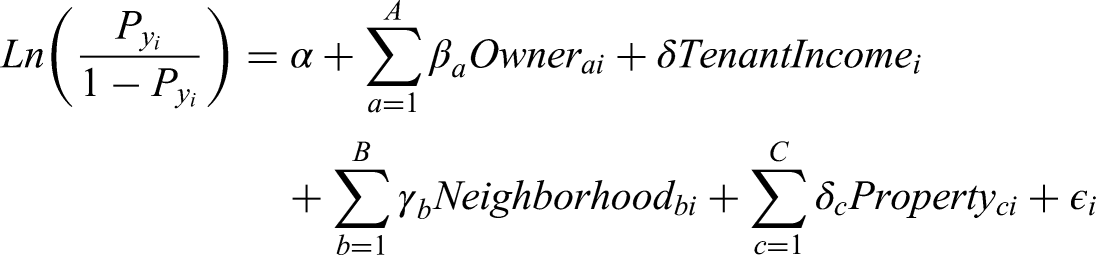
My models take the following form: a indexes the set of
Portfolio size, modeled as the natural log of the number of units held (survey) Acquisition method, particularly whether the unit was acquired from a distressed sale (e.g., foreclosure auction, or short sale) (survey) Use of a contracted property manager (survey) Whether the surveyed property ever had a voucher tenant under current ownership (survey) TenantIncome is the owner’s impression of the income of the tenant of unit b indexes the set of
The proportion of renter households in the tract who are Black (2015-2019 ACS) The proportion of renter households in the tract who are Hispanic (2015-2019 ACS) The proportion of renter households in the tract who are non-Hispanic White (2015-2019 ACS) The proportion of renter households in the tract that are female-headed (2015-2019 ACS) The proportion of renter households in the tract that include children under 18 years old (2015-2019 ACS) The log of the median income of the tract (2015-2019 ACS) The rental vacancy rate of the tract (2015-2019 ACS) Median gross rent of the tract, relative to the median metro rent (2015-2019 ACS) Total number of renter households in the tract (2015-2019 ACS) c indexes the set of
The year structure that unit The logged purchase price of the property that unit
Because the survey question about delinquency refers to the whole property, as opposed to a single unit, I add a control for the number of units in the property for the delinquency model. The eviction question was specific to the surveyed unit. Survey weights are used in the models to account for the stratified sample.
I also run a series of analyzes to examine whether the differences in property management by portfolio size could result in some tenants missing rent payment due to poor maintenance of the unit or more aggressive rent-setting. If larger owners have more poorly maintained properties or relatively higher rents, these differences could obscure the tenant selection differences that are the focus of this study. 1 To assess differences in maintenance I create logit models regressing the logged portfolio size of the owner on whether they performed twelve different kinds of routine maintenance and ten different capital improvements in their units in the past five years. I look at each kind of job individually and also run an OLS model regressing the total of number of different jobs performed on logged portfolio size. I also run a logit model of whether the owner chose to set rent $50 (another question asked in the survey) or more below market on logged portfolio size.
Results
Interview Analysis
The routinization of property management that came with scale was very apparent in interviews with landlords. Larger landlords, particularly those who started small, often spoke, unprompted, about the changes that came with scale, usually referring to the “systems” that they needed to put in place. Larger portfolio landlords typically agreed that with size came routinization in property management, including tenant selection and policies for rent delinquency. As the owner of 120 SRP units in North Carolina put it: When I started out five and a half years ago I was a small-time amateur. There’s kind of a step change in learning as you go from 10 to 50 and 50 to 100 [properties]. … There’s a couple of different things—[but] one thing is systems. You can’t do 120 the same way you did 6 … From a system standpoint there’s a learning curve and a kind of professionalization in your systems.
Contrasting his current approach to rent delinquencies to when he started out, and to smaller owners, now he said: I used to call tenants and say “hey you know you’re going to be late tomorrow and then there’s a late fee, you don’t want to pay the late fee.” Stop. Stop calling the tenants. … We read them the riot act on the front end and then that’s it. Because I see the small time guys … in court and say[ing] “Well, it’s June 19th, your Honor, and they owe me two and a half months rent.” And I’m saying “what the heck?” I’m in court on the 23rd of July because they haven’t paid July’s rent.
Tenant selection was similarly routinized. After a prospective tenant saw the property they were directed Straight to an online application. We review the application. As a small company when we started out—and even if you read [websites about managing SRPs]—people say ‘oh when somebody shows up to apply you need to look at their car and see whether they keep the car clean, how they present themselves or whether they smell’ and all this stuff. The truth is [if you do that you can be] accused of being discriminatory—you’re waiting to see what they look like. We’re not going there. We don’t go there. You apply and we’ve got mechanical criteria about whether somebody qualifies.
This professional’s impression of the non-professional’s practices found ample support in interviews with non-professionals. The tenant selection process of smaller-scale landlords often put great weight on information gained from in-person interactions and from the narrative the tenant told about themselves. Smaller scale landlords often employed many of the same tools and sources of information for tenant selection as the professional owners (such as credit checks and employer references), but the subjective assessments of in-person interactions and conversations with tenants were particularly important. The owner of three units in Tucson, AZ and Las Vegas, NV called previous landlords to ask about tenants interested in living in his units, but in the end made his decisions primarily on the information gathered from in-person interactions: I went more by the character of the people when I interviewed them … I could tell by the way they dress. I could tell by the stories they tell. I could tell by why are they moving, what happened with the last place they lived. I can tell by the questions they asked me, what their situation is in life. … Believe it or not [the most important information] more than anything [was] appearance: the way they dress, the way they talked, mannerisms. And their life story, what they’ve been doing, did they just go through a divorce, that they just had a kid. Did some major life event just happen and that’s why they’re moving. So I went more off instinct than anything else.
The subjective, personal approach to tenant selection of smaller-scale owners co-existed uncomfortably with fair housing rules. No owner of any scale who I spoke with stated that they would not rent to members of any of the protected classes. However many smaller owners discussed positive preferences either based on protected classes (such as one owner who stated that he preferred to rent to Muslims because “they put rugs down over the carpet”), or expressed hesitancy about renting to members of protected groups (some owners stated they were concerned that families with children and that Pacific Islanders caused more wear-and-tear to their units, for example). Small scale owners also expressed concern, unprompted, about state and local laws that limited their ability to consider various factors in tenant selection, particularly laws that prohibited them from asking if the tenant had a prior eviction or had been convicted of a felony. One owner expressed frustration that, because of the Americans with Disabilities Act, he was prohibited from discouraging prospective tenants who had difficulty climbing stairs from applying to live in his two-story houses.
Larger owners, in general, accepted fair housing and ADA rules, and constructed tenant selection systems that complied with these rules. Many larger owners felt that these systems were at least as effective as more hands-on methods and were dubious of the quality of information gained from in-person interactions. As the owner of ninety-six single-family rentals in Philadelphia said, You know years ago I used to [do in-person interviews] … but I would say a lesson I learned the hard way early on—we had somebody who applied and she seemed really put together. Showed up in a business suit and then turned out to be a nightmare and got evicted. The lesson I learned is you really can’t look at the people and the way they behave … you really need to kind of run their credit see that they have a history of paying their other bills on time.
Owners of all scales responded to delinquencies in a variety of ways. Typically, landlords would attempt to first get in touch with a tenant who had missed a rent payment. Of the eighty-two owners I spoke to whose tenants became delinquent, thirty-four owners reported that, before taking any more serious actions, they would talk with the tenant to understand the problem. Occasionally a conversation would be enough and the tenant would become current. Twelve described setting up payment plans to deal with delinquencies. Thirty-four owners described how they attempted to get the tenant to move by means other than formal eviction filing. Fifteen owners reported doing nothing upon rent delinquency, though this was often because the tenant had already vacated the unit.
However filing for eviction was the most common initial reaction, even as it was often paired with talking to the tenant. Fifty-three owners reporting filing for eviction as a first step to deal with rent delinquency. Often eviction was part of a process meant to get tenants to pay, though owners rarely described situations where they repeatedly began eviction proceedings against the same tenant. Twenty-two were explicit that they filed for eviction largely to induce their tenant to pay. There was a clear link between portfolio size and more rigid policies for dealing with delinquency among the interviewees, though this distinction was not absolute. Some smaller, non-professional owners saw filing as a first step to deal with rent delinquency. After running a business for 35 years, an interviewee from Northeast Ohio retired and used some of the funds from selling the business to buy a few small rental properties around his home. When I spoke to him he owned one single-family rental and a duplex. When his tenants were late with rent he stated: We’ll go over and post a three day notice on the door. You know you’ve been notified in three days we’re going to file an eviction notice. And usually that generates some pretty quick response and get back. And if it doesn’t then we post the eviction notice and then go down to the court and file and you know then the person gets jumpy and like “Whoa wait a minute I got this I got that.” And I said “You know what, no. We’re not we’re not playing this game. I’m not gonna, you know, I’m not going to chase you for rent money. You got money for cigarettes you got money for beer you better find the money for the rent because you know otherwise you might as well find a friend and move out.”
Conversely the owner of a portfolio of over 300 units of SRPs and larger apartment buildings in the Chicago metro stated: Someone doesn’t pay their rent. If this is someone who’s always paid their rent and they call me up and they say “I was out sick for a week at work and I’m hourly and I only get paid when I’m there and so I lost a week and I don’t have the money.” If they have a good history, I’ll take a chance with them. So we’ll just pay the next month’s rent and pay me this rent over time and we’ll do something. I’ll get them a little agreement and we will move on.
Interviews also showed the link between tenant selection and rent delinquency policy. When asked about tenant selection, owners would often, unprompted, describe their experiences with tenants they had had problems with in the past. An owner of two condo units in Tampa, FL metro was typical. When asked about her policy for tenant selection she described the features that made her comfortable with her current tenants, then moved on to the features that she saw as undesirable in tenants and her experience with rent delinquency: [My current tenants had] been preapproved for a mortgage and I get the first month’s rent upfront and a security deposit. So I feel pretty secure with that. I mean obviously if they drive up in a truck it looks like it’s going to drop dead any minute, and they’re not dressed very well I might start to question. … Not that I haven’t gotten stung. I had somebody—they gave me a sob story and I believed them and they dragged me on for two months. I got [cheated] out of two months rent.
There was no evidence in the interviews to support the theory that smaller landlords were more risk-averse than larger owners. Owners of all scales described, for the most part, thorough tenant selection processes, and the details of particularly difficult interactions with tenants who had missed rent payments. However because professional landlords were more likely to have objective, clearly defined policies, the link between the criteria to become a tenant and the criteria to remain a tenant was more explicit. One startling example came from a highly professionalized owner and manager of 150-200 SRP units in the Baltimore/DC metro area who described payroll deduction for rent payments as a criteria in tenant selection. If they’re employed they enroll in payroll deduction so the rent payment comes directly out of their paychecks from their employer. So that is the preferred method. And if the tenant isn’t interested in doing that. Well … they’re not going to rent from me. And generally for any tenant who’s not interested in doing that I don’t really want to rent to them because it’s a benefit for them. It saves them money and saves time. It saves headache. And if you’re not willing to do a deduction from payroll—and everybody can do payroll deductions these days—so if you say “no I’m going to just send you a check every month.” That tells me you’re not going to send me a check every month. Not to mention the fact that maybe it’s somebody who has a horrible credit history. If they’ve got good job stability and we’re doing payroll deductions, credit’s irrelevant.
Though the owner acknowledged that he couldn’t evict tenants for switching the method of payment, he also described how he did so: Well it is voluntary, so it is always possible for a tenant to cancel [payroll deductions for rent]. I mean I can’t force them—it is against the law for me to force them. But the moment they cancel it, I know about it and it gives me a heads up that I’m going to have a problem very shortly. So the moment they cancel it I file [for eviction]. Well the first thing I do is I have to pick up the phone and call and say “What’s up?” Every once in a while it’s something esoteric and we’ve moved past it. But for the most part somebody’s saying, “well I’ve got some other bills I got to pay.” Well if you have some other bills you have to pay and you can’t afford to pay your rent—you know it’s not going to come the first of the month. There’s no other reason to stop a payroll deduction. So we’re not even going to bother messing around with it.
This was the only owner I spoke to with this policy, but the justification of the policy was common among larger owners. This practice saved time in property management and it could be applied to all tenants.
Survey Regression Models
The logit models examine whether differences in portfolio size affect tenant selection and eviction policies in a generalizeable way. Tables 1 and 2 show the summary statistics for the delinquency and eviction models, respectively. Slightly over a quarter of owners reported a delinquency at the surveyed property in the past two years, and, among those owners, about a third began eviction procedures. The mean portfolio size for respondents in the delinquency model was about seven units. About 80 percent of respondents purchased the surveyed rental through traditional means. About 13 percent purchased their property through a distressed sale such as a foreclosure auction or short sale while the remainder acquired their homes through other means, such as an inheritance or by building the home. About a quarter of respondents contracted out property management, while the other three-quarters self-managed the surveyed property. About 17 percent of owners had had a housing choice voucher tenant in the surveyed unit at some point.
Summary Statistics for Delinquency Model.

Summary Statistics for Eviction Model.
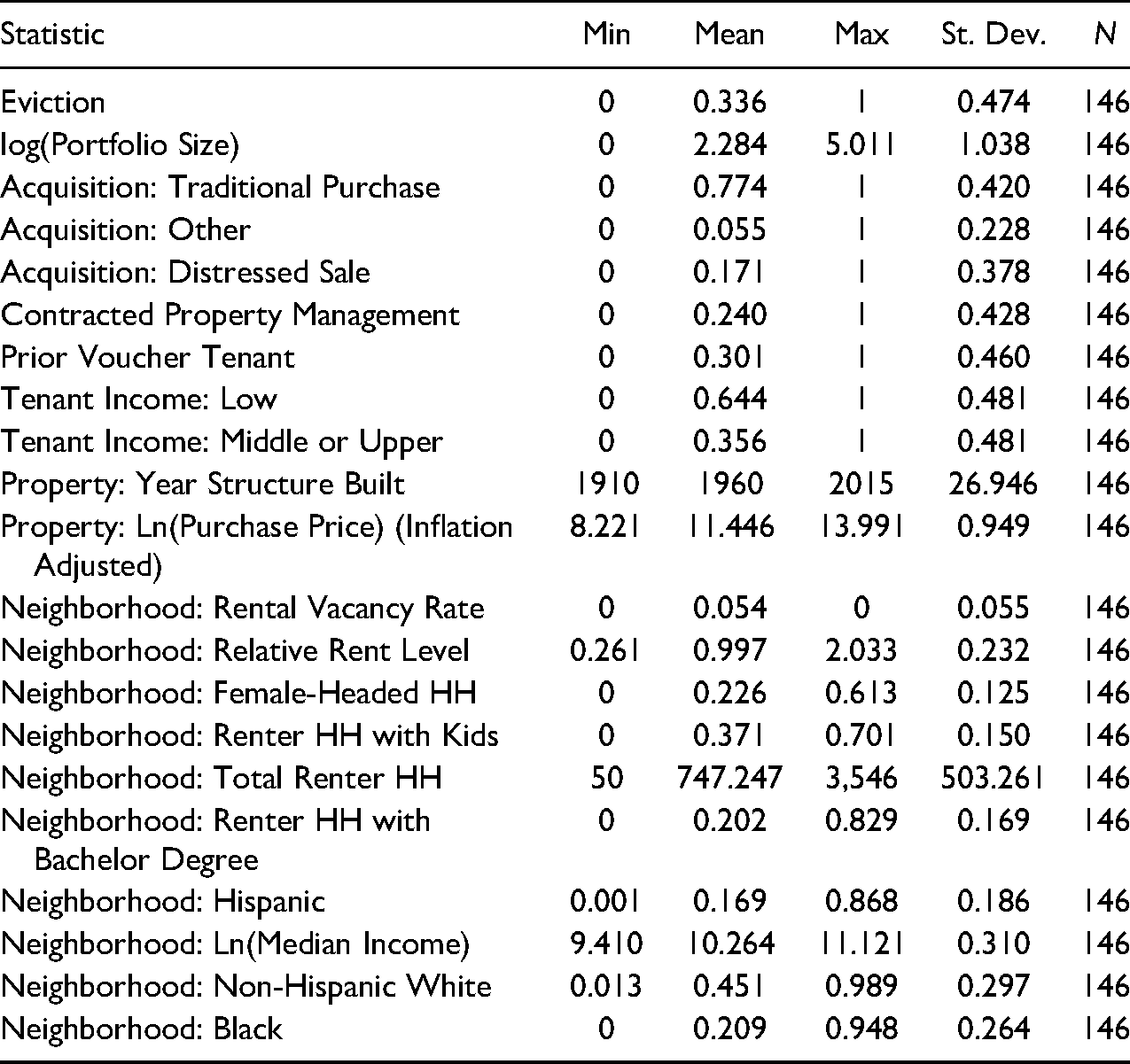
Owners of properties whose tenants had become delinquent (the sub-sample used in the evictions model), had slightly larger portfolios with an average of ten units. Tenants also tended to be lower income, though over a third of tenants who missed a rent payment were described as “middle” or “upper” income by the owner. Owners with a prior delinquency were also nearly twice as likely to have had a voucher tenant in the surveyed property. The neighborhood characteristics of the properties with a prior delinquency were not substantially different from the neighborhood characteristics of the full sample, differing by only a few percentage points for most statistics.
The models show that larger-portfolio owners were significantly more likely to evict tenants who fell behind on rent (Table 4), but also that their tenants were more likely to fall behind on rent in the first place (Table 3). These difference were driven in part by differences in acquisition strategies. The differences between the rental properties and the local markets of those properties varied by owner’s portfolio size, and that variation explains part of the difference in delinquency and eviction rates. But most of these differences appear to be due to differences in property management.
Logit Models of Delinquency.

Logit Models of Eviction.

Doubling the owner’s portfolio size was associated with a 32 percent increase in the chance that a tenant had missed a rent payment in the past two years. After controlling for neighborhood and property characteristics, however, this difference declined to 27 percent suggesting that some of the difference in tenantry was due to differences in the properties of smaller and larger owners. Most of the of the difference, however, appears to be driven by tenant selection, with larger-portfolio owners more likely to have selected tenants who went on to miss a rent payment.
The differences in how owners of different sizes dealt with missed rent payments were starker. Doubling the owner’s portfolio size doubled the chance that the owner filed for eviction when a tenant missed a rent payment. This difference declined slightly, to an 89 percent increase in the chance the owned filed, after controlling for neighborhood and property differences between owners.
The models show that differences in acquisition strategies by portfolio size were a major confounder, particularly for the chance that a tenant missed a rent payment. Larger portfolio owners were significantly more likely to have lower-end properties in lower-end neighborhoods, by a number of measures. Larger portfolios were correlated with properties that were older (
Participation in the Housing Choice Voucher Program was also strongly correlated with the portfolio size of the landlord. Only 9 percent of 1- and 2-unit portfolio owners had ever had a voucher holder in their surveyed property, while 34 percent of owners with 15 or more units had. Larger owners were also more likely to be willing to accept new voucher tenants for their surveyed property, with 50 percent of 1- and 2-unit portfolio owners saying they would accept voucher tenants relative to 66 percent of owners with fifteen or more units. (Owners who purchased their property in a distressed sale were also slightly more likely to participate in the section 8 program, though this difference was not statistically significant.)
There were no significant differences in delinquency or eviction rates between properties that were acquired through foreclosure or other means. Contracted property management appeared not to have an impact on delinquency rates, though, controlling for differences in properties and neighborhoods, it did substantially increase the chance that a missed rent payment led to an eviction filing. Participation in the housing choice voucher program did not have a measurable impact on either delinquency or filing rates. Unsurprisingly, the most powerful association with a recent missed rent payment was the income of the tenants, with middle and upper income tenants being 72 percent less likely to have missed a rent payment. Tenant income did not appear to significantly affect owner’s decision whether to begin eviction procedures upon a missed rent payment.
There was no evidence that the actions (or inaction) of larger landlords made tenants more likely to miss a rent payment. Property maintenance did not appear to vary by portfolio size. There was no association between portfolio size and the number of types of routine maintenance and capital improvements over the past five years (
Discussion
Scholars and policymakers have long been interested in whether differences in the professionalism of landlords, especially in the smaller rental stock, affect the housing stability of low- and moderate-income renters. In the 1960s and 1970s, Stegman (1970) and Sternlieb (1966) debated whether non-professional resident landlords or professional investors were in the best position to stabilize the “slums” of U.S. cities like Newark and Baltimore. Today, there is considerable interest in whether larger owners are more prone to evict tenants who fall behind on their rent, particularly due to the impact of the COVID-19 pandemic (Reina and Goldstein 2021; Reina et al. 2020; HIP n.d.). Work to date suggests that larger owners behave in more exploitative ways than smaller owners, undertaking serial filing more frequently (Immergluck et al. (2019), filing at higher rates in the SRP stock (Raymond et al. (2018), and using the tax foreclosure system in conjunction with evictions to churn tenants through low-quality properties (Akers and Seymour 2018). Smaller landlords, conversely, appear more likely to employ a range of methods other than eviction to resolve rent delinquencies (Balzarini and Boyd 2020).
This article in some ways reinforces those findings, but complicates them as well. Larger-scale owners do appear to exercise their option to evict delinquent tenants more frequently. These owners are not “at the mercy of their spreadsheets” like the apartment managers described by Leung et al. (2020). Larger-scale owners in the context of SRPs (with only a few exceptions) are still individuals, not agents of corporations, and make decisions about property management themselves. While they rarely have over one hundred units, once they have over a dozen or so, the ad hoc approach that they used to take with their properties breaks down and they often begin to implement systems to help them manage their portfolio. For example, they start to use spreadsheets. 40 percent of the typical owners of small rental properties, with one or two units, do not use spreadsheets to help them manage their properties, relative to only 13 percent of owners with over twenty-five units. This routinization of property management includes filing for eviction when tenants miss rent payments, even as these owners often also try to work with tenants to bring them current again.
However these more professionalized owners appear more likely to rent to tenants who then go on to miss rent payments. This is true even after controlling for the tenant’s income and the property and neighborhood characteristics of the rental. The most likely reason for this difference lies in the differences in the tenant selection processes between larger- and smaller-scale owners. Here, notably, the routinization of the larger holders is coupled with an increased awareness of fair housing laws. Larger-scale owners establish objective, measurable standards of tenant eligibility both because it provides a repeatable means of selecting tenants and because it shields them from accusations of discrimination. Smaller-scale owners, in general, have more subjective criteria and mention factors (such as the presence or behavior of prospective tenant’s children) that, while not discriminatory on their face, are close enough to the protected classes that larger owners purposefully do not consider them.
The result of these tenant selection differences is that tenants who go on to miss a rent payment are more likely to be selected to live in a property of a larger-scale owner. This suggests that the subjective tenant selection approach of the smaller-scale owners is, on average, slightly more effective at identifying tenants who will remain current on rent. This difference, however, does not translate into increased profitability for smaller-scale owners. Larger-scale owners were significantly more likely to report that their surveyed property was profitable.
These findings provide insight into two well-known problems in the rental housing market—evictions and the difficulty of finding rental housing. In the context of small rental properties more professional owners appear to evict tenants for non-payment at higher rates at least in part because it is a ready means to address the problem of rent non-payment. Owners with larger portfolios have little reason to not begin eviction proceedings upon rent non-payment, even as they work with tenants to become current. For smaller-scale owners eviction is a more onerous task and is worth delaying. The convenience to the owner of the eviction process appears to be behind the difference. Conversely the objective, standardized criteria used by more professional owners in tenant selection appear to increase the chance that tenants who may miss rent payments are selected for housing with these owners, relative to smaller-scale owners.
The findings also suggest that there is a connection between owners’ tenant selection methods and their methods for dealing with missed rent payment. Most obviously, owners consider their past experiences with tenants who missed rent payments when they evaluate prospective tenants. More profoundly, the property management systems put in place by larger-scale landlords at once make it slightly easier for tenants prone to miss payments to find housing while also making it much more likely that tenants who miss rent payments will then be filed upon for eviction. This link between finding housing and remaining in housing has implications for policy as well.
While this article is focused on differences in property management by owner scale, it is also clear that owner’s acquisition strategies are linked to the housing opportunity and stability outcomes of tenants. Owners are not randomly distributed among small rental properties. I find that larger-scale owners are significantly over-represented in lower-end markets. The implications of this difference are beyond the scope of this paper and are worth further study, but it seems clear that tenants who are looking for rental housing, particularly low-cost rental housing, face a different application process both because of the market conditions of where low-cost housing is and because the owners of low-cost small rental housing are more professionalized than SRP owners in general. A similar dynamic also appears to be present when tenants miss a rent payment, with these delinquencies being treated differently both because of the market a property is in and because of who the owners of those properties are.
Policy Implications
This study provides insight into policies that attempt to (i) stem evictions and (ii) improve the fairness and efficiency of the housing search for low- and moderate-income renters. Specifically, the link between filing for eviction and the routinization of property management that comes with scale suggests that eviction-prevention methods that fit into routinized management may have potential. The impact of scale on tenant selection is less pronounced, but highlights a long-standing problem: The tenants who are arguably in greatest need of stable housing (low-income, and with uneven income and expenses) often face a more difficult housing search. These tenants might benefit the most from the individualized policies that smaller-scale landlords have to deal with missed rent payments. However, from the vantage of the owners, it would be hard to make the case that smaller-scale owners should rent to tenants who are at greater risk of missing rent payments. Income supports such as vouchers are the clearest solution to this problem, but in the absence of such supports, providing non-professional owners with information may have some effect, particularly if it the information comes from a trusted source.
This study suggests that having an alternative to eviction available to landlords to resolve rent delinquencies could provide a major improvement to the housing stability of tenants. To be effective among more professionalized landlords, however, the alternative would need to be standardized and readily available. Universal housing vouchers are a commonly cited program to address the underlying problem of evictions (Desmond 2016). This proposal has been criticized for being expensive and having the potential to increase rents (Glaeser 2021), but is appealing because it directly addresses the central cause of most evictions—tenants’ inability to pay rent. Very low-income tenants need the monthly income supports to make rent that are provided by a voucher, but a large portion of renter households, including those in small rental properties, are usually able to make rent, but still live paycheck to paycheck and occasionally fall behind. A short-term subsidy program designed to cover periodic gaps in tenant income could be a much lower-cost solution to improve housing stability in this part of the market. Pandemic-related emergency rental assistance programs are a nation-wide example of this structure of assistance, though some similar local programs, such as New York City’s One Shot Deal program, have been in operation for decades (Furman Center n.d.). While the roll-out of pandemic assistance has been bumpy, larger-scale landlords of small rental properties have tapped the program at rates of 75 percent or higher (Decker 2021). In order to be an effective alternative to eviction filing, however, the program would need to provide payment quickly, with little to no risk of non-payment, and be available on-demand to landlords and tenants. While the particulars of the program could vary at the local level (as they do with evictions), a reliable, consistent program could provide owners with an attractive alternative to eviction as one of their early steps to deal with a missing rent payment.
From a tenant selection perspective, the relationship between owner professionalism and the owners’ approach to fair housing rules is concerning. Fair housing rules fit more naturally into the tenant selection systems of larger-scale owners. If tenants apply to units through a standardized process that generates a matrix of information that can be evaluated by a one-size-fits-all set of criteria, the system can provide owners with a protection against accusations of discrimination. If fair housing rules change, questions can be removed or adjusted to comply with these changes. But tenant selection for smaller-scale owners often involves extensive in-person interviews, and often even includes a visit by the prospective landlord to the prospective tenant’s current home. In these situations landlords, because of face-to-face interactions, know whether their prospective tenant is a member of one or more protected classes and then, to comply with fair housing laws, must actively turn a blind eye to those pieces of information. This appears to be particularly difficult for owners who have had a bad experience with a prior tenant who was a member of a protected class. The discomfort that non-professional owners have with fair housing rules seems to arise from the same factor that makes them slower to file for eviction when tenants missed rent payments—a more personal, less standardized, relationship with their tenants.
Ensuring that prospective tenants are evaluated fairly in tenant selection may require a different system based on the scale of landlord. Fair housing tests, for example, are a standard method of bringing suits under the Fair Housing Act, but this method of demonstrating discrimination makes little sense when some owners only have a vacancy every few years. Any enforcement action would be taken against landlords who typically, even at the very large end, have only a few dozen units. While improving awareness of fair housing rules may help, the reliance of non-professional landlords on in-person interaction and the use of subjective impressions opens up opportunities for discrimination that owners might even be unwilling to admit to themselves (Bertrand et al. 2005). Owners’ personal comfort with who prospective tenants appear to be is an important factor in many non-professional owners’ decision of who they will rent to. Reaching these smaller-scale owners with information is also challenging, as these owners, simply by virtue of scale, have fewer interactions with government. One potential method to address these challenges is to harness the trust that exists between landlords to impress the seriousness with which larger-scale owners typically take fair housing rules upon smaller-scale owners. In interviews small-scale owners were often interested to hear the experiences of other owners, particularly more professionalized owners. Using venues such as local landlord associations and similar groups could provide a means to both convey the importance of fair housing rules and tap the expertise of larger-scale owners in how to abide by them.
Lastly, there are limits to this study that are worth noting. This study provides insight into the range of portfolio sizes that are most commonly seen among small rental properties—the approximately 90 percent of units in small rental properties that are held by owners with between one and fifty units. The behavior of very large owners, particularly institutional owners, is not described in this analysis and there is little reason to think that exceptionally large-scale owners will follow the trends outlined in this article. Similarly, the analysis is limited to the approximately 50 percent of U.S. rental units that are in small rental properties. The trends among the owners of this stock may not apply to the owners of apartment buildings, even smaller apartment buildings with five to twenty-five units.
Footnotes
Acknowledgments
I am grateful to Fannie Mae for funding the survey of rental property owners. ATTOM provided the data for the survey sample, and Roofstock, Inc. performed additional identity resolution. Thanks to Brenda Amboy for her assistance on interview coding, and to the anonymous reviewers for their insightful comments.
Declaration of Conflicting Interests
The authors declared no potential conflicts of interest with respect to the research, authorship, and/or publication of this article.
Funding
The author received no financial support for the research, authorship, and/or publication of this article.
