



Abstract
City leaders easily recognize their local HEIs as economic anchors, often as part of an intentional “eds and meds” strategy. Universities have long been viewed by city governments as important arts and cultural patrons, presenters, and educators. However, it is not clear that local governments recognize HEIs as key players in arts and cultural economies to the fullest extent possible, nor that they see the possibilities for universities to act as arts and cultural anchors beyond their traditional roles. The local arts and cultural master plan is a key document in which we would expect to see city officials demonstrate this understanding and to advance strategies to capitalize on HEIs’ presence in their communities. Yet our analysis of these plans finds that they provide limited detail on and display a limited conceptualization of these institutions’ contributions to the city's arts scene and cultural economy, thereby missing important economic development opportunities.
Introduction
Higher education institutions (HEIs) in the US are urban economic engines as employers, landowners, workforce developers, and centers of innovation and knowledge transfer (Ehlenz 2019). As arts and cultural anchors, they are also “likely the single greatest patrons of the arts” in the United States, with estimated investments of more than 5 billion dollars to support capital and infrastructure projects, arts department funding, arts faculty development, artist commissions, and public art installations (Tepper and Arthurs 2013, no page number). Yet we know little about if and how cities and towns where HEIs are located conceptualize them as strategic arts economic development partners and assets.
HEIs, and the liberal arts in particular, are increasingly experimenting with new strategies driven by budgetary pressures (Seltzer 2019; Selingto 2018), political polarization and culture wars (Sprunt 2021), the COVID-19 pandemic (Denon 2021), increased expectations for workforce preparedness (Pimentel 2019; Busteed 2021), and pedagogical demands for interdisciplinary, integrative and experiential learning projects (Eyler 2009; Jaschik 2019; Seymour and Lopes 2015; Mintz 2021). In response, some leaders and institutions in liberal arts education and arts-discipline specific education are testing new structural models, career-focused degree granting programs, integrative collaborations to “animate the creative campus” (Tepper and Arthurs 2013, no page number), evaluative methods for proving career potential (SNAAP 2008), and new coalitions to highlight and market art research (History 2021). While this is not an exhaustive list, it does shed some light on the proliferation of new ways that HEIs are responding to external and internal pressures. While these new directions are innovative, they spur concerns about the neoliberalist direction of higher education (Cannella and Ljungberg 2017; del Cerro Santamaria 2019) and ‘disruptive’ innovation (Young 2020). While these trends and concerns are seen across HEIs, they are arguably particularly at play for liberal arts (and the arts in particular) (Ferguson Jr. 2019).
Looking at this expansion and diversification of HEIs’ roles from the perspective of the cities and towns in which they are located allows us to evaluate how much of this activity registers outside the university and how it does so. HEIs provide an opportunity to see how the general concept of the urban anchor institution can be applied to arts and cultural activity given their prominent role in the region's arts infrastructure or ecology (Birch, Perry and Louis Taylor 2013; Ashley and Durham 2021). Their “rootedness” or “sticky capital” makes them a particularly powerful arts organization in creative production and distribution (Howard 2014, no page number). Academic studies and public scholarship show and market how HEIs are working to support arts and cultural activity, but it is unclear if external institutions and organizations in the community see universities in these roles. Further, to truly capitalize on HEIs’ value as anchors in a time when HEIs are in flux and facing many pressures, city officials and arts leaders would also need to identify concrete ways that these anchors can support economic, community, and workforce development.
Arts and culture and economic and community development intersect specifically in municipal arts and cultural plans, which are topical documents that often supplement master plan, general plan, or comprehensive planning documents. Arts and cultural plans compile an inventory of arts and cultural assets, set goals, objectives, and strategies for local arts and cultural policy, direct public investment, and often act as marketing tools for the city (Grodach 2013; Markusen and Gadwa 2010). These documents give us a good sense of public priorities and serve as a record of the individuals and institutions that were involved in their creation. In this study of 64 municipal arts and cultural plans in US cities, we ask how they conceptualize the role of local universities, colleges, community colleges, arts schools, and technical schools as anchors and partners in the arts and cultural infrastructure of the community. We investigate whether these plans show an awareness of the many potential roles HEIs may play in the local creative economy, including arts programming, venues, artist workforce development, and location-based economic development, among others. We ask how if these plans are able to capitalize on the ways that the university anchors can potentially anchor these activities, partner with others, or facilitate the growth and development of arts and culture innovation and development at a variety of geographic scales.
There are a few ways in which arts and cultural plans may treat HEIs. First, they may not mention them at all. Second, they may mention HEIs, but not view them as anchors. Third, they may mention HEIs as anchors, but evince a limited view of the ways in which it contributes to the creative economy. Fourth, they may describe a fully realized understanding of the role of the university in the local creative economy and arts and cultural ecosystem. These different treatments of the role of HEIs could reflect difficulties in translating universities’ value to external constituencies or a lack of local officials’ understanding of HEIs’ potential role in the arts, cultural, and/or creative economies, or because the university's local presence is or has been problematic, and/or there is limited spillover of university activity into the community.
Our analysis of 64 municipal arts and cultural plans in the United States suggests that the third scenario described above is the most common: cities underutilize HEIs as anchors. We do not find much evidence to suggest that the cities do not want universities as partners: plans commonly included university stakeholders in their processes, many times as members of leadership teams. However, overall plans mention universities and colleges in their text without going into specifics about how these institutions and their sub-units contribute to the city's creative economy and arts and cultural scene. They often portray HEIs as place-specific neighborhood anchors, rather than as institutions with a wider range of influence. They also tend to take a more limited view of how HEIs contribute to arts and culture, emphasizing such features as the availability of performance space and arts education rather than their more holistic contribution to the city's creative economy. This may mean that either cities need to do a better job of reaching out to HEIs and/or that community colleges, 4-year colleges, universities, and arts/design focused schools need to do a better job of connecting to cities to share their value and to collaborate on strengthening the arts and cultural dynamics in their municipalities and regions. The timing seems particularly conducive to strengthening this relationship given that HEIs are generally robust arts producers, convenors, and distributors, and that cities are increasingly employing arts and culture to implement economic and community development goals.
Literature Review
We frame our research through three intersecting bodies of literature: HEIs as anchors, arts and cultural planning, and economic development. We are interested in how arts and cultural practitioners articulate the ways that universities can help grow and support the arts infrastructure in the city and region. As arts and culture increasingly are associated with economic and community development, it is useful to consider how arts and cultural practitioners can envision the university as an important arts cultural producer and consumer.
Higher Education Institutions as Anchors
Anchor institutions are those rooted organizations that hold significant assets and are likely to stay in one place, such as universities, hospitals, and some large nonprofit institutions (foundations, churches, cultural institutions, and sport teams) (Fulbright-Anderson, Auspos and Anderson 2001; Ehlenz 2017). While none of these institutions is guaranteed to endure forever, they have proved to be more reliable place-based economic anchors than many large corporations, which, starting in the 1980s, experienced waves of consolidation, relocation, and closure (Ehlenz 2017; Overview 2021). They represent a kind of “sticky capital” (Howard 2014), “social glue” (Cantor, Englot and Higgins 2013), or economic engine (Ashley and Durham 2021) and often have some kind of public facing mission even if they are private institutions (Cantor, Englot and Higgins 2013).
Universities, especially, serve as important economic development engines because they are often major employers with jobs at all income scales, they are significant landowners and developers, and they are centers of research, innovation, and entrepreneurship (Maurasse 2002). As “local stakeholders” with an “enlightened self-interest,” universities can choose to commit resources with varying degrees of aloofness or engagement and those choosing to pursue outreach activities have an opportunity to play a role in planning issues (Bromley 2006). Universities often also have a “social mission” which embeds them in their community and addresses issues in underserved communities, although researchers debate whether this social mission should be a persistent anchor attribute (Louis et al. 2013, 7; Ehlenz 2018), especially given recent legislative directives constraining universities’ teaching and work on diversity, equity, and inclusion (Asmelash 2021; Calvan 2021; McGee 2021). This combination of constancy and social mission makes universities powerful anchor institutions in their cities where they can potentially assemble diverse, mutually beneficial coalitions of innovation (Cantor, Englot and Higgins 2013).
As Ehlenz and Mawhorter (2022) note, anchor studies often tend to fall along a broad spectrum: either micro-level studies that focus on a singular institution as a monolithic actor, or as a part of larger macro-level system of economic development and innovation. Yet HEIs may be part of more regional or metropolitan networks of universities and other economic anchors (Addie 2020; Addie, Angrisani and De Falco 2018; Harrison, Smith and Kinton 2017; Uyarra 2010). Ehlenz and Mawhorter's (2022) meso-level approach of intra-urban networks identifies an “HEI sector” and differentiates different clusters. This approach considers the ways in which institutions may or may not collaborate in leveraging this anchor role and may also help shed some light on how the density of HEIs in different growing and contracting areas in the U.S. may affect their arts and cultural anchor role.
Cities and Their HEIs--Adversaries or Partners?
As significant actors in city economies and real estate markets, universities affect conditions in their immediate neighborhoods and in the larger city in complex ways. Universities benefited from public funding for new construction in both the New Deal era and the Urban Renewal era (Winling 2017). Often this expansion led to targeted clearance of minority neighborhoods surrounding the university and both the perception and the reality of the university as an elite gated community apart from its city, in places as geographically different as Hyde Park (University of Chicago), Morningside Heights (Columbia University), and Midtown Detroit (Wayne State University) (Thomas 1997; Winling 2017; Louis, Gavin Luter and Miller 2018; Saxon 2020; Sherman 2020). This separateness and implication of the university in demolition of mainly Black neighborhoods and active efforts to remove lower-income residents from university neighborhoods led many local residents to view universities with suspicion and think of them as bad neighbors, with good cause (Louis, Gavin Luter and Miller 2018). At the same time, however, the university extension movement saw a role for universities as good neighbors in both urban and rural areas that would contribute to local knowledge and build skills, especially in agriculture, home economics, and conservation (Ostrom 2020). However, the 1890 land grant universities were built on land appropriated from American Indian tribes, making the positive impact of the extension services a much more complicated story where dispossession (Nash 2019) and violence created these university systems (Ahtone and Lee 2020).
Beginning in the late 20th century, neoliberal economic policies at the federal and state levels forced many universities to look for new revenue sources and development partners. These efforts coincided with cities’ attempts to reinvent their economies amid patterns of public disinvestment, globalization, and deindustrialization. The most successful of these collaborations included “eds and meds” hubs where teaching hospitals became anchors for biomedical research and drug companies (for example, Pittsburgh) and high tech hubs anchored by universities such as Research Triangle Park in North Carolina (Neumann 2018; Cummings 2020). As part of the engaged university movement, universities and cities promoted an optimistic view of the university neighborhood as a place that would attract creative class residents, provide good jobs, and improve neighborhood amenities and conditions for residents of all income levels, producing “shared value for their host community” (Louis, Gavin Luter and Miller 2018, 11). Likewise, scholars of the extension services call for their expanded role in the engaged university, offering expertise in public participation (Ostrom 2020). However, a truly egalitarian neighborhood redevelopment strategy would require larger structural changes than most universities and cities are willing to carry out (Louis, Gavin Luter and Miller 2018).
Throughout the last century, then, universities have influenced their host neighborhoods and cities through investment, demolition, exclusion, and inclusion. They have provided direct education to city residents and contributed to the reinvention of the economy. All along, their role has been questioned and challenged by neighborhood residents affected by university policy and actions, leading to at least the goal of local university-community engagement.
Universities as arts and cultural anchors
In terms of arts and culture, colleges and universities may anchor arts and cultural districts, provide and partner on arts education and arts public participation, and provide significant arts infrastructure, but with a few exceptions there is little research specifically connecting universities’ roles as economic anchors and arts and cultural patrons (Johnson 2011; Birch, Perry and Louis Taylor 2013). Just as with the literature on town-gown relations, a similar spectrum of adversary and partner roles plays out when talking about the role of arts and culture in historical and contemporary terms. While there is limited peer reviewed research on this topic, broader critiques can be transferred when thinking about the HEIs and the communities where they are located or the city and region they are designed to support particularly for public and publicly funded institutions. For example, the rise of arts and cultural districts in places where there are HEIs may be a form of overt arts-led gentrification, or art-washing (Pritchard 2017). HEIs may also play a more hidden role as institutions performing acts of cultural exclusion in their approach to arts access and education, where what art and culture mean to the HEI may not be what art and culture mean to the surrounding community or communities (Garnham 2005, 18). These critiques ask us to examine the “degree of cultural hegemony” in which the university is implicated, along with other governmental actors at different scales (Mulcahy and Carsten 2003)
On the other hand, HEIs may also be doing work to support existing neighborhoods and organic arts activity (Ashley 2021), or in helping revitalize vacant or underutilized areas through a collaborative arts and cultural-focused process (Johnson 2011) or through new engagement models (Ehlenz 2020). Policymakers (National Governors Association, no date), scholars (Birch et al. 2014; Johnson 2011; Ashley 2021; Markusen and Gadwa 2010), and university leaders highlight some ways that universities can be good partners in metropolitan art and culture through a host of possibilities including workforce training, innovation and industrial development, community redevelopment, and more, but a more robust evaluation and assessment is needed to see if these visions and strategies are met and that also address the complicated relationships between the university, the community, and the region.
Most of the current research on HEIs and the arts focuses on curriculum innovation and workforce development as universities expand from discipline specific training to more integrated or interdisciplinary efforts with new kinds of production spaces and partners. As Tepper and Kuh (2011, no page number) note, arts degree programs “cultivate creativity” in ways that are valuable in an expanded set of fields and situations far beyond the traditional arts. Workforce development strategies could also include faculty and staff as well as students. Many colleges and universities now offer arts entrepreneurship (AE) degrees, which may either emphasize new venture creation (strongly linked to business curriculum) or student-career transitions/professional development (broader ways of integrating and translating skills) (Beckman 2007). Although there is no singular definition of arts entrepreneurship, and such programs may be offered in a wide range of institutions (art and design schools, liberal arts colleges, regional and research universities, community colleges, and vocational and technical schools), there is “some consensus about pedagogy” where the curriculum includes experiential learning whether its business development plans, competing in pitch competitions, participating in incubators or accelerators (Essig and Guevara 2016, p. 20–21). However, there are different interpretations and manifestations of cultural entrepreneurship in European higher education and arts entrepreneurship in U.S. higher education where the former focuses on an additional business school education with a focus on the creative economy (Kuhlke, Schramme and Kooyman 2015) and the latter is centered on an interest by arts disciplines to provide career readiness support (Essig 2017). Thus, Essig (2014) suggests that AE remains in the conceptual phase of development and argues that more applied research needs to be done on these curriculum paths to move towards a more theoretical phase where a more complete template or set of foundations can be identified.
There are also a variety of other new or new-ish degrees, certificates, pathways, one-off workshops that reinforce integration and interdisciplinary work with a focus on arts management and entrepreneurship, creative placemaking and art/cultural policy, and science/technology/engineering/arts/math (STEAM). Program evaluation is still underway to determine what is working and what needs to be changed as these move from an idea to evidence-based principles and practices (Essig 2017). There are a variety of advocacy organizations and coalitions that highlight these efforts, including Alliance for the Arts in Research Universities (a2ru). It's also unclear to what extent common, but older opportunities, like arts education or arts therapy are distinct from current ideas about curriculum innovation and integration or are separate and distinct from arts training in HEIs. We would argue that they are part of the evolving and expanding way of theorizing how the HEI acts as an arts and cultural anchor. These curriculum efforts align with ways of thinking about how the university is an arts and cultural anchor, but scholars argue it is important to consider a broader framework or conceptualization (Ashley and Durham 2021). Part of this is also understanding more about how HEIs are investing and supporting arts from the perspective of new pedagogical demands for interdisciplinary, integrative and experiential learning projects (Eyler 2009; Jaschik 2019; Seymour and Lopes 2015; Mintz 2021) to provide high-impact learning that may help students prepare for civic and career life, and also allow them to learn how to generate authentic partnerships with community entities in private, public, and nonprofit sectors.
There is thus a need for a more in-depth understanding of how universities’ dual roles as urban economic and arts and cultural anchors intersect, thinking more broadly about the anchor concept, especially given the pressures on both universities and cities to reinvent themselves to compete in the fast-moving and high-tech 21st century economy (see Wellmon 2015; Davidson 2017; Aoun 2017; Staley 2019 for discussions of challenges and opportunities for modern universities). As Tepper and Arthurs (2013, no page number) note, “university leaders should initiate conversations on their campuses to examine whether artistic resources can be better deployed” so that they can “rediscover the power of an asset that has, perhaps, been undervalued in the past.” Scholars suggest that today's urban and global challenges call for something other than “traditional, routine response” (Tepper and Kuh 2011, no page number; Ashley and Durham 2021). This also suggests the need to expand the traditional or common idea of the university arts anchor from solely the concept of a patron to a facilitator (Ashley and Durham 2021). Looking at municipal arts and cultural plans is a first step in scoping to see if municipal leaders and plan authors highlight the HEIs as a partner, adversary, or something in between.
Municipal Arts and Cultural Plans
Scholars in many disciplines such as sociology, political science, urban studies and planning, economics, and public policy contribute to the research landscape around cultural policy and planning (Markusen and Gadwa 2010). Possibly for this reason there is not a strong consensus about what cultural planning encapsulates or how it should be defined. Some researchers and practitioners treat cultural planning as synonymous with cultural policy (McVay 2014), framing it as a bucket term to mean anything that municipalities do that connects culture to programs, policies, initiatives, and documents. Others draw a narrower framework where cultural planning is a specific regulatory tool, a physical plan, designed to assess cultural infrastructure, protect existing assets, direct resources towards identified needs and priorities, and set future goals in a government entity (Rosenstein 2018; Ashley et al. 2022; Loh et al. 2022). Our research on arts and cultural plans centers on the narrower framework referenced above that is bounded by the plan. 1
Although focusing on plan documents alone doesn't give access to the discussion and priority-setting that led to their creation, plans themselves are consequential documents (Burby 2003). Plans may be influential because they serve as a strict blueprint for future investment and action (an implementation approach known as conformance) (Pressman and Wildavsky 1973; Laurian and Day 2004; Loh 2011). However, even plans that aren't implemented as strictly can influence their communities by spurring and focusing community-level conversations, creating a general vision for the future, and changing community perceptions of what is possible, (an implementation approach characterized as performance) (Alexander and Faludi 1989; Lyles and Berke 2016; Loh 2019).
Arts and cultural topical plans commonly supplement master plan, general plan, or comprehensive planning documents. These are a relatively new type of plan; as a result there is not a singular template in plan organization, participation, or structure. Nor is there a standardized approach in what governmental entity takes the lead (parks, arts and culture, planning, economic development). Stakeholders typically integral to the process include community residents from varying socio-economic and cultural backgrounds, artists, elected officials, culturally-related nonprofit and commercial arts sector representatives, university leaders, arts funders, and other private and public cultural philanthropists or commissioning agencies (Markusen and Gadwa 2010). Such plans are often facilitated, researched, and authored by entities with varying expertise and knowledge (local consultants, national consultants, volunteers, economic developers, planners, arts and cultural leaders). In addition, there are scholarly critiques that such plans do not have an “after-life” because they do not take into account local cultures or contexts (Markusen 2006), or because plan authors create overly generic plans (Ashley et al. 2022; Loh et al. 2022).
Communities conceptualize arts and culture in cultural plans in various ways and those conceptualizations have changed over time (McVay 2014; Borrup 2019). Typically, cultural plans focus on nonprofit visual and performing arts, their audiences and artists, arts education, public art, cultural facilities and subsidy funding of arts organizations and individuals (Borrup 2019). More recent plans may address cultural industries, economic development, or cultural tourism, or, less commonly, culinary arts, for-profit arts businesses, and local food production (Borrup 2019). Capitalizing on universities is often an explicit municipal economic development strategy that tries to tap into the creative economic energy and arts and cultural scene that universities generate (Ehlenz and Mawhorter 2022). Given traditionally low participation by community stakeholders in general planning efforts (Innes and Booher 2004), engaging university faculty and students has become more frequent, especially in neighborhoods experiencing decline or for communities that have been historically marginalized (Reardon 2006; Lambert-Pennington, Reardon and Robinson 2011; Neal et al. 2014; Wesley and Ainsworth 2018; Jackson, Holmes and McCreary 2020). Similarly, we would expect to see universities featured prominently in cultural plans and university leaders as valued participants in the planning process.
Commonly, these plans inventory arts and cultural assets, plan for investment, market the community as an arts and cultural hub (Ashley et al. 2022; Loh et al. 2022), and identify goals, strategies, and investments. Cultural planning can be seen as social, urban, economic, and arts planning combined (Stevenson 2004). We were curious if the authors of these arts and cultural plans understand or are informed of the role that universities play in the arts and cultural infrastructure of their community and if they are able to capitalize on the ways that the universities can potentially anchor these activities, partner with others, or facilitate the growth and development of arts and culture innovation at a variety of geographic scales. We wanted to know how the plan authors articulate how HEIs serve as arts organizations and anchors given the fact that they serve such an important economic and community development role.
Transparency of Plan Writing and Authorship
Comprehensive (or general, or master) plans may be written to solve a problem, to fulfill a mandate, to form a compromise, or to aspire to a better future (Chan and Protzen 2018; Cooper-McCann 2016; Hoch 2007). The motivation behind these plans influences their content and orientation (Evans 2001; Norton 2005) with, for example, many arts and cultural plans acting as a marketing tool rather than a balanced inventory of strengths and weaknesses (Grodach 2013). Plans are written under the auspices of local governments, potentially with the involvement of a coalition of stakeholders and consultants, and incorporate the views of participants to varying degrees (Burby 2003). Consultant involvement complicates our understanding of authorship. It is not always clear to what extent consultants write the entirety of plans; whether they fully understand and share the values of the community in which they have been hired; how engaged the arts and cultural community is in the process; what financial resources are provided for planning; and how the hiring entity shapes the scope of work and related expectations about the process and the plan deliverable (Borrup 2019; Loh and Norton 2015; Markusen and Gadwa 2010; Evans 2001). While this backstory is important, it is largely not discoverable in plan documents, which are the focus of this particular paper. In our work, we start by first understanding what is in the plan and who is involved in the participation process so that we can begin to unravel the role of HEIs. This approach sets the stage for later work to further investigate negotiations and writing that produced the deliverable and subsequent investment, through surveys and interviews.
Methodology
In this study, we investigated to what extent, in what ways, and under what circumstances municipal arts and cultural plans identify and adopt strategies to capitalize on universities as arts and cultural anchors. To do so we selected 64 case plans for review, developed a content analysis protocol, coded the plans, and conducted analysis using primarily descriptive statistics and t-tests to evaluate between-group differences. We analyzed the qualitative content and statistical analysis results and then determined findings and recommendations.
Case Selection
We focused on plans because they are fairly common publicly available documents that reveal community or organizational priorities around arts and culture. We chose to focus on the content of the plan documents themselves because their dates of adoption span from 1998 to 2019 and staff, volunteers, and consultants who were involved in plan writing have often moved on to different roles and/or different cities, making it difficult to track them down for interviews.
As there is no singular federal data source that collects information about which U.S. cities have municipal cultural plans (Rosenstein 2018), we used raw data from a survey of local arts agencies, conducted by the national arts advocacy group Americans for the Arts, to identify and gather plans from those who identified that they had authored municipal cultural plans. The list included 182 positive responses. We narrowed this list to 46 by only selecting municipal organizations, not regional or county entities, and only including comprehensive cultural plans, not public art or other domain-specific plans. We then conducted targeted google searches in 2019 and 2020 to identify existing plans that may have not been represented in the original national list. Key words or phrases used in the google search included cultural plan, municipal arts and culture, and city arts plan. Using this method we identified an additional 18 plans, bringing our case number to 64. Table 1 below presents descriptive statistics about the 64 cities. We acknowledge that additional cities have adopted arts and cultural plans since we compiled our list; however, we believe that it was a fairly comprehensive list at the time of the search.
Plan Cities’ Descriptive Statistics.
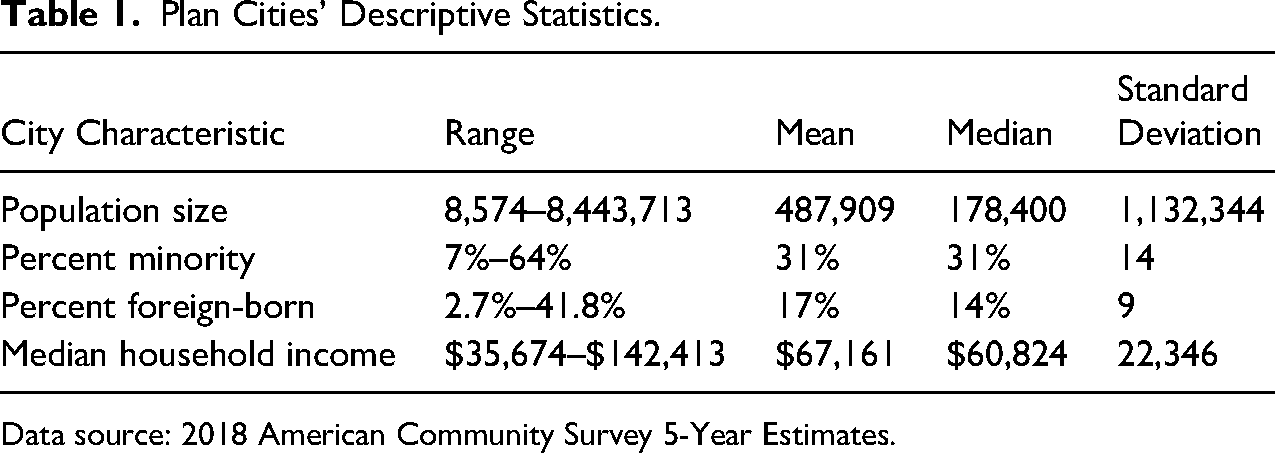
Data source: 2018 American Community Survey 5-Year Estimates.
Plan Evaluation
We first developed a plan content analysis protocol, which is a standard tool with which to assess planning documents (Berke et al. 2006; Loh and Kim 2020; Norton 2005). The questions in our protocol were based on our previous work on universities as anchors and on arts and cultural plans, the broader literature on artist workforce development, and the broader literature on the role of HEIs in cities. Our protocol asked questions about how members of university communities participated in the arts and cultural planning process, which types of colleges and universities the plans mentioned and in what contexts, and what strategies the plans recommended to capitalize on colleges and universities as arts and cultural anchors. Through these questions, we tried to capture every possible way an arts and cultural plan might mention HEIs and every possible role it might cast them in. We then conducted a detailed content analysis of 64 municipal arts and cultural plans from US cities. Two coders separately evaluated every plan, recording quotations and locations of relevant text, then two of the authors reconciled every instance of disagreement between coders. This process generated a rich dataset with both nominal and ordinal qualitative data that captured the wide range of ways plans included HEIs.
Data, Hypotheses, and Analysis
Plans exhibited a range of strategies that incorporated universities as leaders and partners in arts and cultural facility provision, programming, economic development, and education. We characterized these strategies along two dimensions, shown in Table 2.
Strategies Prevalence.

First, strategies could either be part of a traditional vision of the university as an arts and cultural anchor (focused) or an expanded vision in which the university plays a more multi-dimensional role in the local arts ecosystem and creative economy (expanded). These typologies are adapted from those developed for anchor institutions in general (Essig and Guevara 2016; Ashley and Durham 2021). A focused approach positions faculty, staff, students, and alumni as experts and creators of culture who welcome others to learn from them and consume products and experiences. Goals include exposure to the arts; appreciation of aesthetic practices and products; inclusion of non-university members into the university arts community as learner and consumer. This framework understands the arts primarily within the context of nonprofit cultural organizations, and trains a workforce oriented to those entities. An expanded approach positions faculty, staff, students, and alumni as collaborators with other communities, especially those in close proximity to the HEI. Goals include forming new relationships and partnerships; mutual problem-solving through aesthetic and community practice; empowerment of arts communities beyond the university to be active producers and sustain cultural practice. This framework understands the arts as animating the nonprofit, for profit, civic, and educational sectors and trains a workforce skilled in navigating among them. For example, universities have long provided performance venues for local residents to see local and traveling productions; they may now additionally provide rehearsal space for local performing arts groups or affordable maker spaces for local artists. It is important to note that expanded strategies are not better or that focused ones are no longer important; we characterize them this way to illustrate the most expansive conceptualization of ways in which universities can be local arts and cultural anchors.
Second, the impact of the strategy or activity may be felt largely within the university community itself (internal) or primarily within the city at large (external). Some strategies clearly equally impact the university community and the city at large; we categorized those as “both.” We also tabulated the total number of university-related strategies the plan includes.
We hypothesized that the plans would focus more on external than internal strategies because they are written from the perspective of cities rather than universities. Therefore the authors would be more likely to think about ways universities could reach out to the community and benefit the city as a whole rather than focusing on activities that primarily serve the university community. We also hypothesized that universities would adopt fewer expanded than focused strategies simply because these conceptualizations of the university's role are newer and not all municipalities or plan writers would have encountered them (Ashley and Durham 2021). Also, new strategies require investment from the university in the arts.
In times of declining state appropriations and an emphasis on STEM, not all university arts programs can make the changes that they may see elsewhere and/or desire. Finally, we thought that participation by university representatives in the planning process would matter and that we would see a larger number of university-related strategies the more people from the university were involved in creating the plan. We tabulated the results of our content analysis, which appear in the next section. We also conducted between-group t-tests of strategy type inclusion to test the hypotheses described above.
Results
We identified five key themes in our data, which we elaborate on further below. First, most plans (92 percent) mentioned colleges or universities particularly in the background or process section, but most did not provide a robust set of existing or potential strategies of how HEIs currently use or could use to support the region's arts and artist infrastructure. Second, many plans were able to talk about the ways that the university has traditionally performed as an anchor and patron with an emphasis on arts distribution (large/branded facilities, public art), arts production and training for enrolled students (arts curriculum in established traditional arts degrees or traditional interdisciplinary degrees), and arts education for K-lifelong learners. However, they were less often able to articulate an expanded set of anchor strategies or opportunities that universities pursue with interdisciplinary/integrated degrees (e.g. arts management, arts entrepreneurship, STEAM), and workforce development (helping students translate their skills to different careers in nonprofits, for-profits, or public sectors). In addition, the plans do not go into depth about the ways that faculty artists also contribute to local economies through their professional artistic work in ways that extend beyond the university.
Third, many of the plans highlighted the anchor attribute of arts-based neighborhood redevelopment and revitalization. This finding causes us to wonder if these kinds of place-based investments represent a new way of thinking about town-gown relationships as contributing to equitable development in contrast to common historical and contemporary critiques of universities as gentrifiers and gatekeepers, although we would need to investigate this further. This focus on place-based efforts makes sense given that cities and plans tend to focus on more of these external activities (spin-offs that happen outside of HEIs campuses), which also aligns with our data.
Fourth, “HEI” is a monolithic or blunt term and is often primarily seen through the lens of universities and 4-year colleges in the literature on anchor institutions. This obscures the distinctions among institution types such as those recognized by the Carnegie research classifications, liberal arts colleges, and community colleges, or those that have a variety of missions or public and private designations. It doesn't capture the way that HEI clusters or the presence of multiple HEIs work across a region. It also doesn't adequately capture the ways that independent units (schools, colleges, departments, programs) work. In other words, these plans look at the level of the whole institution while missing differences in the ways that programs, departments, and other sub-units function. In our analysis, arts and cultural plans (42 percent) commonly identified community colleges as important institutions particularly in workforce development with an emphasis on skills, hands-on training, and new career-based interdisciplinary degrees. We think this is an important area to continue to study because of the general mission of community colleges to provide an affordable and practical education.
Fifth, HEI representatives were prominent in the plan participation process. For those plans that detailed their process, there was a wide spectrum of involvement from staff, faculty, and administration across different disciplines, backgrounds, and university affiliations. However, this was not a barometer for determining what plans had greater depth about existing or future strategies.
It is important to note that HEIs may not always be the sticky anchor they are now given many of the pressures listed above as well as how the COVID-19 pandemic has affected HEI budgets and priorities now and for the future. We note that between when the plans were written and when we evaluated them in spring 2021, several for-profit art colleges and small faith-based schools closed (Souchek 2020; Hobson 2020). Losing such institutions can have outsized and lasting effects on the city's arts and cultural landscape, which makes it all the more important that cities identify, capitalize on, and support these critical anchors.
Extent of University-Related Strategies
The plans exhibited a wide range of emphasis on universities as arts and cultural anchors. Five cities (Broomfield, CO; Cary, NC; Eureka, WA; Mercer Island, WA; Mint Hill, NC) did not mention colleges or universities at all in their region; one city (Charlotte, NC) mentioned universities in the background material but did not include any university-related strategies. So, 92 percent of the municipal arts and cultural plans at least mentioned a college or university.
Beyond just listing HEIs, some cities described in more depth ways that the HEIs anchor economic and community development. The mean number of university-related strategies was four and the median was three. Three cities (Berkeley, Fort Worth, and Washington, D.C.) included 11 strategies, the highest number we recorded out of the 19 strategies we asked about. Overall, however, many plans did not present a particularly robust or multi-dimensional set of strategies to capitalize on local colleges and universities as arts anchors. And only three plans (5 percent) mentioned a university or college in the headline of one of the larger overarching goals as opposed to in an objective or implementation step. Unusually, Denver's plan contains three goals that mention higher education: “Strengthen the pathway to careers for Denver high school and college graduates in the city's arts, culture and creative employment sector;” “Increase partnerships between higher education, cultural organizations and arts entrepreneurs” (51); and “Support arts education for students at Denver-based elementary schools, middle schools, high schools, colleges and universities” (City of Denver 2020, 50, 51, 55). These goals cover the university's roles as an educational partner and an arts and cultural employment anchor.
University Types and Involvement
The types of universities the plans mentioned also varied, as shown in Table 3. Universities were the most common type of institution of higher education plans mentioned, while community colleges came in second. A few plans mentioned colleges and universities in general without specifying any particular institution. “Other” included such institutions as standalone medical schools. The range of HEIs mentioned was 0-7 and the mean was 2.56.
Types of Institutions Mentioned in Plans.

Plans also often mentioned that members of university faculties and/or leadership had taken part in the planning process. Half of the plans listed university participants; 75 percent of those that mentioned universities as participants identified one or more participants by name or role. Of those that listed university participants, 33 percent reported participation as a formal liaison, for example, on the steering committee; 5 percent in a smaller role, such as a subject matter expert; and in 13 percent of the plans we weren't able to tell how the person participated.
The median number of participants for plans that listed them was 6 and the mean was 3.41. However, there is not a significant correlation between the number of university participants and the total number of strategies. The mean number of university-related strategies included in plans with any university participant versus plans without such participants is higher, but only significant at the 0.1 level. So university participants in planning processes do not seem to drive a significantly higher emphasis on university-related arts and cultural strategies.
Strategy Types
We had hypothesized that plans would incorporate more focused than expanded strategies (See Table 2 for the list of strategies and their categories). Our data show support for this hypothesis. The average number of focused strategies is 2.17 and the average number of expanded strategies is 1.48. The difference between those means is statistically significant at the 0.05 level. This seems to indicate that there is room for many cities to possibly view universities as arts and cultural anchors in a more expansive way than they do now. It also suggests that HEIs have an opportunity to share more with their host cities about how they contribute to that broader set of anchor strategies. The landscape of local universities seems to matter as well. A higher number of HEIs mentioned in the plan is positively and significantly correlated with a higher emphasis on both focused (0.36**) and expanded (0.48***) strategies. However, the type of institution mentioned, four year institutions versus community colleges, seems to have a less straightforward effect: there is a significant (at the 0.1 level) difference in traditional strategies between those plans that mentioned community colleges and those that did not, while there is no significant difference in the number of contemporary strategies between places that mentioned community colleges and those that did not.
We had also hypothesized that the plans would focus more on external than internal strategies. Our data show support for this hypothesis. There were significantly more external strategies mentioned than internal strategies (which makes sense since the cities are writing these plans and thinking how the university can benefit the city as an arts and cultural anchor) (2.05 vs. 0.5***). Plans included significantly more “both” strategies than purely internal strategies (1.11 vs. 0.5***). And plans included significantly more external strategies than “both” strategies (2.05 vs. 1.11***).
Plans most often (55 percent) mentioned universities in the context of partners for K-12 education. Some of the most common arts and cultural education activities that appeared in plans included after school programs, arts teacher training, summer camps, and affordable arts centers with programming for young people. In most cases, the plans characterized the university as a partner with the city school district rather than as a leader in providing arts education and the university's activities as supplemental to the arts education the school district already provided. The exception to this was the few plans that mentioned a university-chartered or affiliated arts academy or magnet school, such as the Boston Arts Academy (City of Boston 2016). About a third of the plans also suggested the university as a partner for adult education, which could include such activities as master classes and partnerships with senior centers. For example, Edmonds Community College students participate in applied learning programs at the Edmonds Senior Center in Edmonds, WA (City of Edmonds 2014).
Not surprisingly, many of the plans (47 percent) also looked for ways the university could support arts activity in the surrounding neighborhood or in the city as a whole. Many plans mentioned public art on university campuses as a city asset, even though the art was on university property. For example, Chattanooga's plan recommends that the City “develop collaborative mechanisms between Public Art Chattanooga and the sculpture collection at Chattanooga State Community College to ensure greater visitation of all artworks outside the central core” (City of Chattanooga 2011, 27). Others mentioned university-centered arts districts as a focus of the city's arts and cultural scene. Some plans hoped to use the university to help fill vacant spaces with arts and cultural uses to spur revitalization in a downtown or other district, such as in downtown Reno (City of Reno 2011). Several plans mentioned using university expertise to help with community engagement around arts and culture. This conceptualization in many plans of the university as a positive actor within and collaborator with the city contrasts with the common critique of universities that they either hold themselves apart from the city or contribute to gentrification to the detriment of longtime city residents (Winling 2017). However, it wasn't always clear from the plans whether the HEIs were supporting activity in or just adjacent to their campuses, or if the plan embraced a more inclusive approach to these efforts.
The only other university-related strategy that appeared in 40 percent or more of plans was the university as a provider of performance or gallery space for the public to access as audience members. This is traditionally a crucial role for universities in their cities’ arts ecosystem and it continues to be important today. Interestingly, a few plans (Houston, New York City, Washington, D.C.) used the specific term “arts and cultural anchor” for universities.
We looked for a series of strategies that are linked to artist workforce development, which appear in Table 4. We included strategies that are more aligned with specific disciplines as well as a more expanded set of integrated elements that may include community members.
Strategies for Artist Workforce Development.
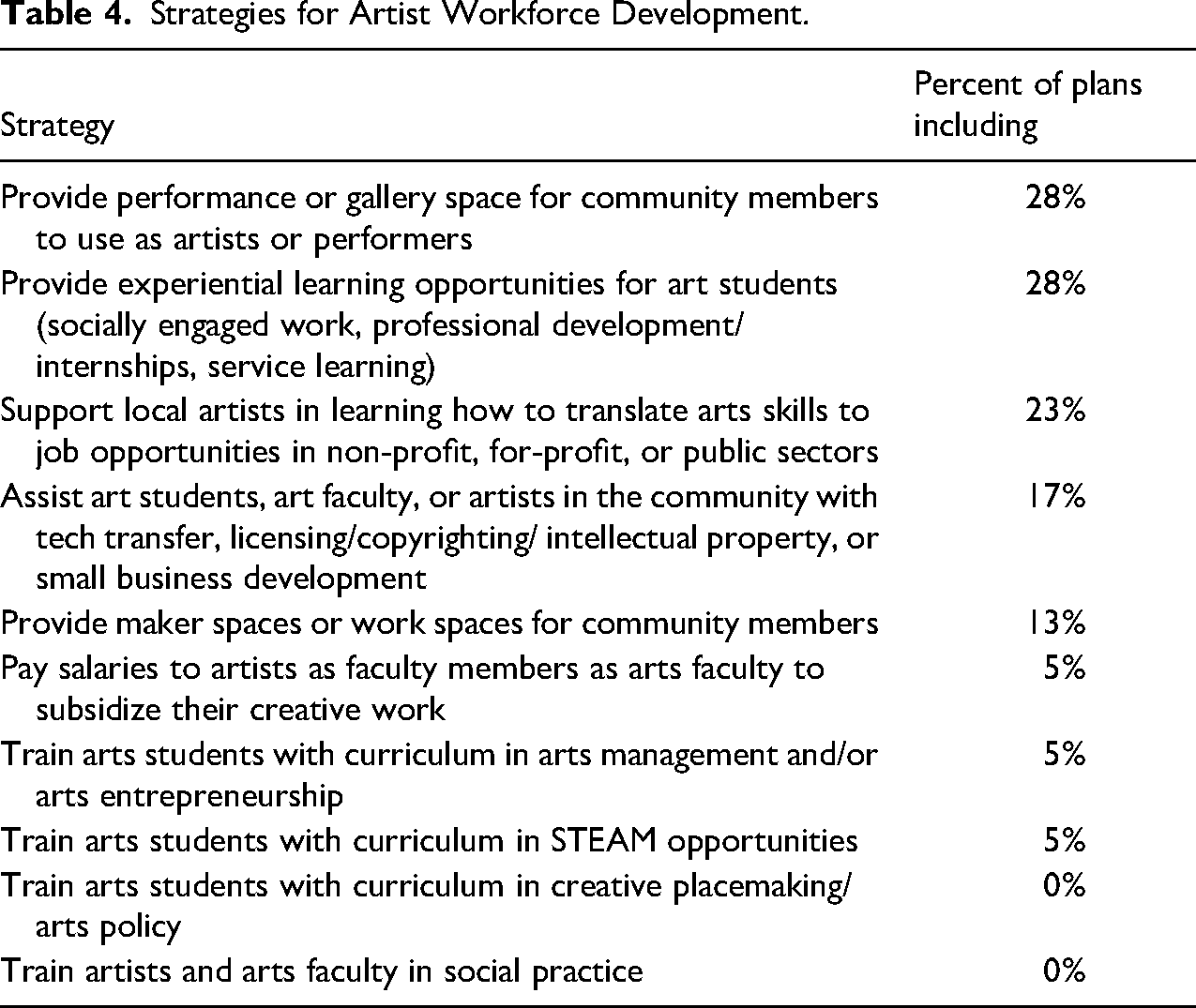
While only around a quarter of the plans recommended the three most popular strategies, that universities provide performance or gallery space for community members to use as artists or performers, provide experiential learning or internships, and support local artists in translating arts skills into job opportunities, 66 percent of plans adopted at least one of this set of strategies and 34 percent adopted two or more. So if we aggregate artist workforce development strategies, we find that cities are at least somewhat interested in them and view universities as important partners, but there is room to expand and consider a more robust set of ways that the universities can or should partner on artist workforce development The City of Chicago's plan calls for the creation of a “globally renowned art and creative industry accelerator center in collaboration with universities, the private sector, and the City focused on program development, products and patents, technology applications, and implementation models (City of Chicago 2012, 29). Houston's plan recommends that in concert with institutions and partners like the University of Houston's MA in Arts Leadership program, United Way of Greater Houston, Houston Arts Alliance and Mid-America Arts Alliance, the City could leverage its own resources by launching an initiative that works with leaders of specific organizations to: strengthen their core business model, invest staff development and design strategies for increasing their potential for earned revenue as a sustainability strategy (City of Houston 2015, 59).
But most plans did not provide this type of detail on how HEIs might train or help students, faculty, and community partners develop their skill sets.
Discussion
At the outset of this study, we considered four possibilities for how arts and cultural plans might portray HEIs as arts and cultural anchors. Plans might be silent on HEIs as arts and cultural anchors. Or they might mention them but not characterize them as anchors. These two treatments could be the result of either a poor track record of partnership between the university and the community or a lack of awareness of the HEI's possible role(s). Third, plans might mention HEIs as anchors, but indicate a limited view of the ways in which they could contribute to the creative economy. Finally, they might present a fully realized understanding of the role of the university in the local creative economy and arts and cultural ecosystem.
Overall, we find that most of these plans fell into the third category, in that they identified HEIs as anchors but presented a more limited or non-specific view of their potential roles. The authors of these municipal arts and cultural plans are aware of and mention universities as important cultural assets, at least in these public-facing documents giving little to no indication of strained relations. Almost all the plans listed and described local universities and colleges. Community colleges, especially, seem to play an outsized role in cities’ perceptions of HEIs’ potential roles in local arts and cultural economies, perhaps because of their practical emphasis and their accessibility to community members and non-traditional students. For example, in the City of Bellevue, WA's plan, Bellevue Community College appears as a partner in several goals and objectives, Boston's plan identifies local community colleges as potential partners in its Creative Industries workforce program, and Pineville, SC's plan suggests emulating Charleston's community college program where “traditional arts such as stonecutting and ironwork are being taught” (City of Bellevue 2004, City of Boston 2016, City of Pineville 2005, 13).
Another piece of evidence for relatively positive town-gown relationships is that many plans’ processes included representatives from colleges and universities, with quite a few serving on steering committees or in other leadership roles. However, this awareness and participation did not always translate into specific university-related arts and cultural development strategies or desired outcomes. This disconnect between process and content surprised us, given the importance of this connection in other work (Loh and Kim 2020). It is possible that university participants were included to check a box, but their actual involvement and influence was minimal. Alternatively, the process itself could have been relatively superficial, meant to produce a document that would make the city look attractive for marketing purposes (including its educational facilities), but with not much in-depth thought about the role of universities as arts anchors.
In particular, we found that plan authors could think more expansively about how universities’ roles as arts and cultural anchors and economic anchors could intersect to the city's benefit: we found few plans that showed evidence of having thought through the entire range of ways that universities can function as arts and cultural anchors. We characterized university-related arts and cultural strategies as either focused (having to do with the university's more traditional role as a provider of student arts training and as an arts presenter) or expanded (including an additional set of arts economic development roles for the university). Plans included significantly fewer expanded strategies than focused strategies. While focused strategies have been and remain critical to both the university and the city, an expanded view of what universities and cities might do together could benefit both. An expanded or integrated view works in two complementary ways for universities. From the perspective of university arts programs and departments, it embeds arts in partnerships with other disciplines, making arts integral and valuable to the university and shoring them up against budget or program cuts. From the student perspective, it builds skills that will open the door to an expanded set of employment opportunities in case they are not among the subset of artists who can fully support themselves doing art. Increasingly, there are calls to hold university arts programs accountable for making sure indebted students do not graduate without the types of skills they need to support themselves (Korn and Fuller 2021).
From the cities’ perspective, universities can be both people-based and place-based economic development contributors. Many cities are already thinking of universities as place-based anchors: from arts districts to downtown revitalization efforts, cities are strategizing about universities’ resources and drawing power. However, quite a few plans did not mention these types of strategies or didn't follow them up with specific enough recommendations and implementation steps. The bounded frames that plan authors have around the definitions of what arts and culture activities or assets are included in cultural planning documents may contribute to their failure to articulate the partnership potential or resources universities may offer to a cities’ arts ecosystem (Borrup 2019).
On the people side, university arts departments have a huge role to play for cities in local workforce training and retraining for jobs that are in high demand and that require a combination of creative and technical skills. They are also potential sites for entrepreneurial resources. Fewer of the cities whose plans we evaluated demonstrated this expanded view of the university as a people-based arts economic development driver. Thinking about universities’ roles in this way may in fact require an expanded way of thinking about “the arts.” One way to approach this broadened view would be for cities and universities to undertake full partnerships in the scope of the cultural planning processes to capitalize on the intellectual and financial resources that could be marshaled with an integrated academic and municipal practitioner or consultant approach to cultural planning. In any case, future planning processes should take care to consider the potential roles and benefits of local HEIs, with the participation of HEI partners, and discuss them in detail in the resulting plan documents. Otherwise, there is a lack of direction for future collaboration, investment, and programming.
Conclusion
In this study of 64 municipal arts and cultural plans, we investigated how their authors conceptualize the role that colleges and universities play in the arts and cultural infrastructure of their community. We found that most plans identified HEIs and that many plans included HEI representatives in the planning process. However, in many cases plans lacked specifics about the ways in which universities could contribute as arts and cultural and economic anchors. It doesn't appear that HEI involvement in the planning process affects how well integrated the HEIs are in plans, which contrasts with earlier work. We also found that while plans demonstrated an awareness of the university's traditional role as an arts educator and presenter, they exhibited less awareness of the expanded set of potential university-related strategies that combine arts and culture with economic development. This finding suggests to us that strengthening relationships between city arts leaders and university arts and cultural administrators and faculty could be important so that city leadership is aware of cross-disciplinary university initiatives that could benefit local place- and people-based economic development strategies. Plan authors can expand their perspectives of what constitutes the arts and culture ecosystem, recognizing the contributions HEIs are making in workforce development, placemaking, and cultural economy entrepreneurship.
In future work, we hope to investigate such partnerships further through more research that can help us understand how information flows between policymakers, city administrators, employers, local arts organizations and universities. This work will also help us better understand how these plans get made, with what aims, and by whom, as this study of plan documents does not allow us to fully do so. We also plan to focus on exploring how this work might shape town-gown relationships in helping HEIs think through their relationship to their community, in how the university can support the city and the region as well as in ways that go beyond place. All universities are local institutions and local anchors regardless of their national or global reach; it is important to consider how these universities, 4-year colleges, and community colleges work together to provide that anchor role. Given the pandemic, the fluidity of the political environment, and the changing funding dynamics of HEIs (Whitford 2021), it is a critical time to consider how to not only more clearly articulate the value of the university as an arts and cultural anchor, but to also the highlight the ways it could become a more visible anchor.
Footnotes
Declaration of Conflicting Interests
The author(s) declared no potential conflicts of interest with respect to the research, authorship, and/or publication of this article.
Funding
The author(s) disclosed receipt of the following financial support for the research, authorship, and/or publication of this article: This work was supported by the Boise State University School of Public Service Research Fund, Wayne State University College of Liberal Arts and Sciences.
