




Abstract
Innovation districts are hailed as the modern innovation landscapes led by privatized, local coalitions from the bottom-up. This discourse, however, conceals the influences of the multilevel governments and the territorial-power (re)configurations that are persistent and complex. In this article, we developed an Innovation Jurisdiction framework to unpack the different types of governance structures, power compositions, and their use of diverse policy mixes to shape the trajectories of innovation districts. Using the National Employment and Innovation Clusters in metropolitan Melbourne as case studies, we identified the dominance of the general-purpose (Type I) innovation jurisdictions despite the widely claimed local autonomy and power. Melbourne's cases are telling of the governance ambiguity of modern innovation landscapes and how task-specific jurisdictions (Type II) adaptive to place-based innovations are often fragmented and superimposed. Our study on the spatial-functional mismatch of the multi-level governance of innovation districts calls for more nuanced explorations at the intersections between innovation policy, public policy, and urban studies.
Keywords
Introduction
Innovation district (ID) is an umbrella concept that tries to define—and brand—clusters of economic activities located within today's multi-layered urban areas, a form of “place-based innovation system,” successor to a monolithic idea of science and industrial parks. The ID concept is said to incorporate many aspects of the innovation milieux (Castells and Hall 1996; Miao, Benneworth, and Phelps 2015), but also references the buzzy urban life and amenities of cities. In their widely-cited work, Katz and Wagner (2013, 2) define IDs, in a rather irreverent manner, as “the ultimate mash up of entrepreneurs and educational institutions, start-ups and schools, mixed-use development and medical innovations, bike-sharing and bankable investments—all connected by transit, powered by clean energy, wired for digital technology, and fuelled by caffeine.” Supposedly, these IDs rely on self-governance of local actors who leverage “beyond the state and the market to the individuals who can ignite urban development” (Kayanan 2022, 51). IDs, therefore, are the latest manifestation of neoliberal urban economic development strategies that rely on, and feed into, the new ideological visions of social and moral order in the city (Brenner and Theodore 2010), where self-governed and independent entrepreneurs are the vital engine for their success.
The actually existing governance structure of IDs is not, however, straightforward and well understood. While IDs are supposedly unfolded by individual entrepreneurs who create local coalitions and bypass governmental managerialism (Kayanan 2022), recent literature understands that these clusters also admit a more proactive role for the public sector (Miao 2020, 2024). State bureaucracy and policy are, inevitably, part of the equation. National industrial policies, regional master plans, and local planning schemes affect how infrastructures—here understood in a broader sense, encompassing social, economic, innovation, and physical infrastructures (Miao 2024)—are delivered to local clusters of innovation activities. Furthermore, public institutions, foreign firms, and public–private initiatives also compose the landscape of these districts, forming a tapestry of interests and jurisdictions.
Recent studies on IDs have focused on classifying and assessing their quality and designs (Adu-McVie et al. 2021, 2022; Yigitcanlar, Adu-McVie, and Erol 2020); framing a “mission-oriented” agenda that steers targeted economic and socio-technical development (Fastenrath et al. 2023); and inquiring about the level of community engagement (Esmaeilpoorarabi et al. 2020) and associated equality and gentrification issues (Kayanan 2022). While insightful, extant works downplay the complex role (and source) of policy in enabling or constraining these districts’ performance—an exception being Adu-McVie et al. (2022), whose framework indirectly acknowledges governmental impacts that derive from zoning, land-use regulations, and investment policies. Katz and Wagner (2013) also admit that local governments have a stake in the planning of IDs. But there is a multi-level component to the governance of IDs that is often absent in the extant literature. The coordination, or the absence of it, between various levels of government may set the stage for industry collaboration and trigger investment spillovers, but also curb grassroots activities and slow down innovation (Miao, Kim, and Phelps 2024). As Fastenrath et al. (2023, 10) note in a recent systematic review of the ID literature, “the connections of IDs in a multi-level governance (MLG) framework are rarely discussed.”
This article tries to fill this gap by mapping how multiple levels of government conceive, plan, and act upon these modern innovation landscapes. It asks two specific questions: how do innovation-related policies—at national, state, and local levels—integrate and shape the governance of IDs? And how do these policies—at the discourse level—see the role of different governments and stakeholders in the governance of IDs? To address these questions, we propose an innovation jurisdictions analytical framework, which embeds institutional systems and public policies in the innovation geography to contextualize the MLG of IDs. By doing this, our paper makes several important contributions. First, our study is timely when IDs are rapidly becoming the new fashion of innovation policy worldwide, yet few investigations unpack their governance structures and power dynamics (Mozaffarian, Zandiatashbar, and Reyes-Sanchez 2026). Second, our framework offers an adaptable framework to connect the macro-level literature on institutional systems (Fainshmidt et al. 2018) with those more grounded investigations of innovation dynamics. As such, it not only helps to better conceptualize the innovation dynamics inside these districts, but also across individual cases and sites as the geographical political thread connects them and conjuncturally shapes the innovation spaces (Peck 2024).
In what follows, we first lay down the innovation jurisdictions analytical framework and the two specific types: general-purpose and task-specific jurisdictions. We then use the case of Australia to illustrate this framework, where the persistent problems of coordination within its federal system have had a major bearing on the development of the nation and its constituent cities and regions (Phelps, Bush, and Hurlimann 2023). Upon describing the national and state-level antecedents in innovation and planning policies, we then explore in detail how an MLG framework came into being and operates in Greater Melbourne's National Employment and Innovation Clusters (NEICs). Our results indicate the fragmentation of innovation jurisdictions and highlight that ID governance may unfold spatially in a myriad of ways. Yet like many other IDs globally (Heaphy and Wiig 2020), the Australian NEICs also recorded a noticeable trend of being reconfigured into mixed-use, 24/7 hubs beyond their original function as an industry complex, hence elevating the general-purpose jurisdictions in ID governance. This leads to our conclusion of potential power recentralization in ID governance in particular, and the growing prominence of statism (Wright et al. 2021) and public assetization of place-based innovation systems in general.
Innovation Jurisdictions: The Manifestation of MLG of IDs
The combined effects of economic restructuring, globalization, decentralization, and austerity have called forth a place-based innovation system approach (Miao 2020) that not only focuses on the innovation dynamics and networking processes of firms but also the localization of innovation and planning policies and their positive impact on local development (Geels 2004). ID exemplifies this approach (Adu-McVie et al. 2021; Yigitcanlar, Adu-McVie, and Erol 2020). Different from the old “technology-park-campus” model that is dedicated to specialized manufacturing activities away from residential, commercial and leisure uses but linked to regional and global pipelines (Bathelt, Malmberg, and Maskell 2004) by the use of “infrastructural bypasses” (Graham and Marvin 2002), IDs are heralded as localized innovation complexes (Lawrence, Hogan, and Brown 2019) composed of economic, physical, and networking assets (Katz and Wagner 2013), co-located and connected through strong or weak ties. They connect local production and urban life to produce “open innovation ecosystems” (Katz and Wagner 2013) that take advantage of urban buzz and knowledge spillovers but also the “quality of place” (Florida 2019)—although the use of “eco” has been criticized as adding little to innovation studies (Oh et al. 2016) and is counterproductive to addressing the governance questions hence avoided in this paper. Recent ID studies have focused on the enablers of these districts (Adu-McVie et al. 2022; Bajada et al. 2022; Xu et al. 2023), highlighting additional social, spatial, and organizational features that may influence their types and levels of development (Adu-McVie et al. 2022). Despite the discourse on privatized self-governance (Kayanan 2022), many authors started to agree that the “success” of IDs does not rely solely on the self-governance of local innovation systems orchestrated by firms and private actors (Bugliarello 1996; Davidson et al. 2023; Katz and Wagner 2013), or the production side of innovation (Geels 2004). The public sector also plays a crucial role in planning and supporting innovation (Coenen and Morgan 2020; Davidson et al. 2023).
These extant critiques notwithstanding, we identified two further shortcomings in how current ID studies have understood the state and its institutions. First, there is scarce critical reflection on the complexity of what comprises governments and each of their attributes in the governance of innovation districts. Who is the government? And how is governance operationalised horizontally and vertically by governments along with non-state actors? Despite the long-standing evidence on the multi-scalar nature of innovation (Kaiser 2003; Kaiser and Prange 2004), current literature is still timid in dealing with this complexity—see Baily and Montalbano (2018) as an example. Second, extant literature treats the governance of IDs homogeneously throughout space. Do different levels of government and non-state actors have equal access to the spaces of innovation represented by IDs—in other words, are these spaces within their jurisdiction? If not, how is MLG actually configured to coincide or not with the spaces of ID? Here, no individual discipline is capable of offering a convincing answer, and the growing localism-statism debate only adds complexity.
Seeking answers at the interfaces between innovation, geography, public policy, and urban studies, we develop the “jurisdiction’’ conceptual framework from Hooghe and Marks (2003) to unpack the MLG of place-based innovation systems. Innovation jurisdictions, as we define them in this paper, refer to the formal or informal, spatial and/or functional boundaries within which actors have the authority and resources to influence the innovation process.
The spatial boundaries of innovation jurisdictions derive from the MLG structure, which refers to the “dispersion of authority within and beyond national states” (Hooghe, Marks, and Schakel 2020, 194). This may involve scaling policy up to transnational bodies, decentralizing power to sub-national governments, or delegating some responsibilities to locality-based actors in formulating, implementing, or managing policies (Hooghe, Marks, and Schakel 2020; Hooghe and Marks 2003; Stephenson 2013). On the one hand, MLG, corresponding to its spatial delineation, presupposes a polycentric policy landscape where stakeholders coordinate their actions to maximise their socio-economic utility (Hooghe, Marks, and Schakel 2020). On the other hand, MLG also encompasses “informal and disorderly” co-governance, which “relates to and overlays orderly and formal governance” (Bache 2008, 40). The exact structure, responsibility, and function of the MLG are shaped by various historical, institutional, and economic factors, which are in turn constantly evolving and contributing to a variegated landscape of urban entrepreneurism (Phelps and Miao 2019).
The functional boundaries of innovation jurisdictions are largely defined by the actions/inactions where actors would influence the direction of place-based innovation (Miao, Kim, and Phelps 2024). We have identified four primary actions that the governments could take to boost weak and strong ties between actors such as firms, universities, public agencies, suppliers, and customers, hence “rooting” random encounters and networking within and cross-systems. These include, firstly, the “eventifying systems” (Hauptfleisch 2007) of conferences, exhibitions, trading affairs, collaboration gatherings, mediating activities, and so on. Secondly, governments could invest in infrastructure (physical, social, and digital) to improve the mobility, connectivity, and feasibility of production and service provision. Thirdly, different government agencies plan the use of the land, enabling or restricting types of economic activities through zoning, planning schemes, building codes, and so on. Fourthly, the public sector often supports and advocates for localized innovation via tax breaks and grants, setting up advocacy and lobby groups, redirecting procurement, and so on, to tilt the playground for innovative companies (Mazzucato 2013). These diverse policies are not limited to one level of government (or a single agency within the government), nor could they be formulated and implemented solely as innovation policies.
The engagements of governments (and their agencies) in place-based innovation systems are therefore multiple. Here, we distinguish two types of jurisdictions that operate in place-based innovation systems: general-purpose and task-specific jurisdictions (Hooghe and Marks 2003). In the former (Type I), every stakeholder “is located in a Russian Doll set of nested jurisdictions, where there is one and only one relevant jurisdiction at any particular territorial scale” (Hooghe and Marks 2003, 236). Depending on how this jurisdiction is set out (e.g., federalism) and mapped onto territorial scales, sub-national actors may gain more formal authority in governing IDs. In the latter case (Type II), “governance is fragmented into functionally specific pieces” (Hooghe and Marks 2003, 236). The flexible design of task-specific jurisdictions impinges on intersecting and different “memberships” of, and the selective intervention in, spaces by involved stakeholders. The fact that a state wields Type I jurisdiction over an ID, for instance, does not result in a uniform functional jurisdiction (Type II), as it may selectively focus on specific areas with particular policies. Likewise, spaces may contain overlapping or competing jurisdictions. Vertically, a single ID may be formally juxtaposed with more than one local or state government (multiple Type Is), while horizontally, it may contain a combination of Type Is and/or Type IIs.
The spatialized competency of an ID, therefore, is likely to vary as the coordination and competition dynamics evolve between the general and task-specific jurisdictions, and along with jurisdictional-spatial boundaries that emerge out of the summative dynamics of each actor's autonomy, power, and interest to intervene in the spatial production of innovation. These interventions, employed by multi-scale coalitions (Cash et al. 2006), could then frame, and are framed by, policy mixes (Kern, Rogge, and Howlett 2019) and networks (Bache 2008). In the evolution of IDs, we argue that industrial, innovation, and planning policies (mixed with other policies) are the key policy mixes and are unevenly distributed according to the general purpose and task-specific jurisdictions that emerge out of the coordination/competition in the MLG (see Figure 1).
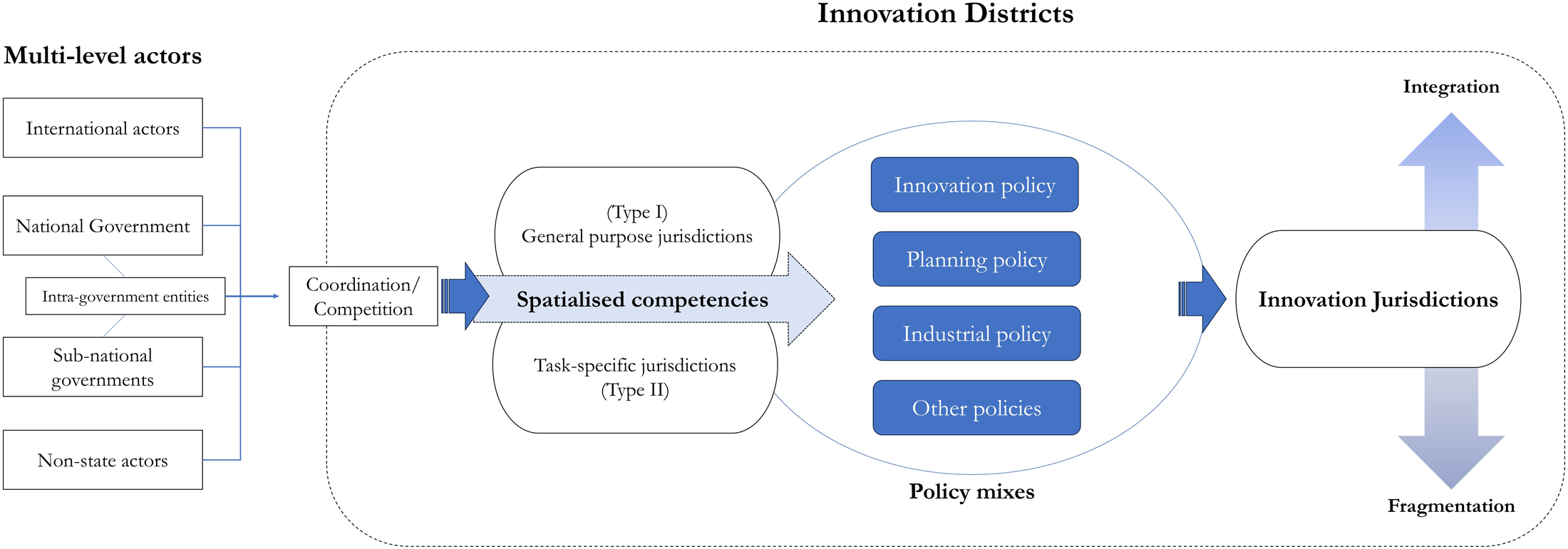
The multi-level governance of Innovation Districts: A conceptual framework.
At the jurisdictional level, hierarchies—or the division of authority—are largely defined, though there are experimentation (Coenen and Morgan 2020; Davidson et al. 2023) and competition along with the normalization of MLG frameworks through constant advocacy and engagement from actors outside. Current ID literature tends to assume a more functionalist approach to multi-level governance (Hooghe, Marks, and Schakel 2020), wherein jurisdictional outcomes derive from an optimal distribution of authority within districts, skewing towards the prevalence of local stakeholders and task-specific jurisdictions (Katz and Wagner 2013). Our framework nonetheless argues that these jurisdictional outcomes are the result of competition and coordination within multilevel governance arrangements alongside the “sociality” and political culture of stakeholders (Hooghe and Marks 2020). We do not deny that there is increased importance of private actors within these jurisdictions, but their size and influence vary considerably and depend on the “flexible gatekeeping” (Bache 1998) of interested public agencies and governments. This means that IDs will not develop uniformly throughout space. Rather, there is a tapestry of innovation jurisdictions that deeply and heterogeneously affect the innovation system.
As IDs evolve, their success might create “inter-regional externalities” (Hooghe, Marks, and Schakel 2020, 203) that consequently lead to pressures for re-scaling their governance. The scaling up of task-specific jurisdictions may clash with other formal or informal jurisdictions that have emerged out of the localized sociality of actors. The interplay of policy mixes and multi-level actors, consequently, has implications for the dynamics of innovation jurisdictions that swing on an integration/fragmentation spectrum. Fragmented innovation jurisdictions occur when district sub-units are siloed and governed without converging policies and supervising actors, for example, selective state action in some areas (dispersed functional jurisdiction) where local governments do minimal engagement, and there is no coordinating body to facilitate collaboration and co-evolution. Conversely, integrated innovation jurisdictions emerge where synergy among policies and stakeholders prevails, jurisdictions are co-governed and facilitated by coordinating bodies, multi-level stakeholders have clear, relevant roles, and competition is institutionalized. Identifying innovation jurisdictions—and their dynamics within the integration/fragmentation spectrum—helps us to grapple with the complexity of innovation districts by treating them not as black boxes, but rather as complex geographies where the production of innovation may not occur seamlessly in space.
Methods
To investigate how MLG and innovation jurisdictions unfold in IDs, this research employs a qualitative approach based on directed content (Hsieh and Shannon 2005) and discourse analysis (Bacchi 2000; Brown and Yule 1983; Gasper and Apthorpe 1996; Gill 2000). Different from previous literature on innovation districts, we are not assessing the performance of IDs or testing the effectiveness of place-based innovation policies, but rather uncovering what the policy discourse reveals in terms of the structures of the innovation jurisdictions surrounding IDs, highlighting, more specifically, the role delegated to the general-purpose and task-specific jurisdictions, the policy mixes, and how these affect the integration and segmentation of the ID governance. In this vein, qualitative content and discourse analysis of authoritative documents provide appropriate analytical tools to uncover meanings and values attached to the formal and informal distribution of authority in space.
We took Australia as the study context, where MLG remains a relatively new concept (Daniell and Kay 2017). Within Australia, Greater Melbourne and its NEICs were chosen as explorative sites (Figure 2), as Melbourne is the only Australian city that explicitly embraced the ID concept, with two NEICs (Monash and Parkville) officially named as members of the Global Institute of Innovation Districts. Their integration with the global ID practices also helps to transcend findings from this specific case to wider contexts.
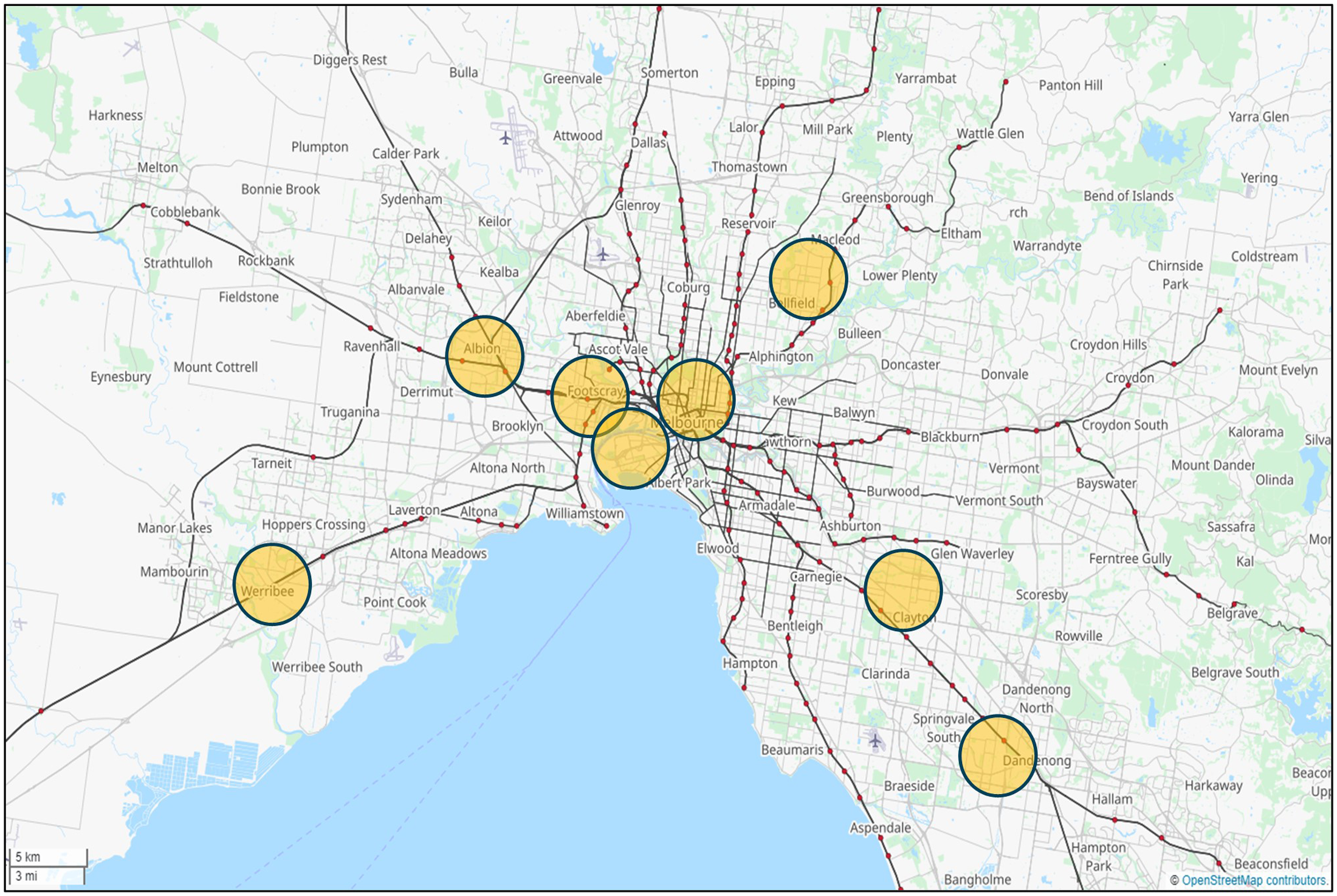
The location of greater Melbourne's national employment and innovation clusters (NEICs).
Official Documents were collected from the national, state, and local governments. These documents, spanning over four decades, were selected based on their relevance—historical and current—to the creation and governance of IDs, or NEICs, as they are known in Australia. A total of 18 national, 25 state, 24 local documents, as well as 10 task-specific documents (often across territorial boundaries), were selected. Consequently, we narrowed the scope of our analysis to three major policy areas that were deemed the most relevant to ID governance: innovation, industrial, and planning, in order to map the policy mixes and to unpack the formation of innovation jurisdictions. Following a directed approach in content analysis (Hsieh and Shannon 2005; Potter and Levine-Donnerstein 1999), these policy areas in each document were coded according to two major analytical categories, “Innovation focused” and “Place focused,” as we are interested in how IDs were landed in specific places. Within each category, coding was guided by specific analytical questions derived from relevant theories, including innovation systems and innovation districts, as laid down in Table 1. While we proceeded, it was noted that several discourse strategies were employed in these documents to demarcate stakeholders’ roles and responsibilities. Based on these, we were able to situate governments’ “policy narratives” and “framing” of innovation governance (Bacchi 2000; Gasper and Apthorpe 1996) for different IDs and at different times, hence capturing both the incremental changes and mutation of policy mobility (Peck 2011) in the Australian ID context.
Analytical Procedures and Questions Guiding Content and Discourse Analysis.
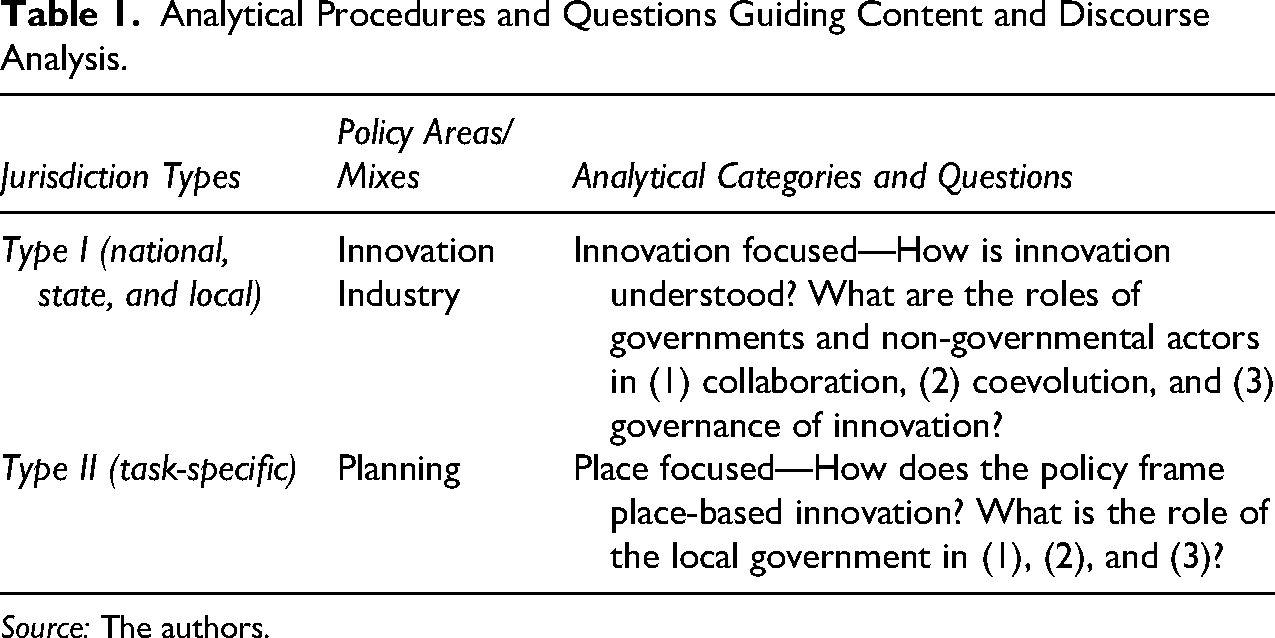
Source: The authors.
Unfolding the Governance Jurisdictions of Innovation Districts in Australia
Innovation Jurisdictions and Policy Mixes
A modern federalism structure (Type I jurisdictions) of Australia was not completed until 1989, although the broad division between the commonwealth and state governments was set in 1901, and their relative authorities and responsibilities were defined constitutionally. The powers of the central government are constrained to those of national significance, but its economic dominance, based on having the lion's share of tax revenues, provides the potential to have greater influence in place-based innovation systems. Yet, with a very few significant exceptions, the federal government has not done so in any systematic manner. The Department of Science (1985, 1) thus acknowledged that “the Australian Government performance in promoting national technological capability and industrial vitality through innovation can be seen as little more than tokenism.” Since then, more specifically, the federal government's efforts have been concentrated in (1) funding research and commercialization in strategic industries; (2) improving science-industry collaboration; and (3) encouraging and accelerating “critical” technologies through a productive regulatory framework (DEST 2004; DIIRST 2009; DIRS 2001, 2023). It focuses on a “whole-of-government” approach to strengthening the national innovation system, while hoping that states could tune in their policies in tandem with the national priorities, and the private sector performs a consultative role. Yet these top-down programs, as shown in the “Stocktake of government programs” (DIIS 2019), are mostly a-spatial and purposefully broad to encompass industry innovations throughout the national territory, although picking “winners” in their grants, tax schemes, and other programs could still influence local outcomes indirectly. Among the few exceptions, the federal government's direct investment in a “multifunction-polis” in partnership with Japan was widely regarded as a failure (Mandeville 1988), and its more recent “Statement of Principles for Australian Innovation Precincts” (DIRS 2018) is also shelfed with the transition of government, although the latter did lay down many plausible guidelines to enable locally based, task-specific jurisdictions, as we will discuss later.
It is at the state level that the powers and initiatives to plan, promote, and direct the development of spatialized innovation are concentrated in Australia (Tomlinson and Spiller 2018). Unlike the policy mixes adopted by the federal government that emphasize funding in industrial policies and commercialization in innovation policy, planning is a major lever of the state governments. Facilitating agglomeration with zoning and infrastructure provisions has always been a policy priority for the states, although the specific terminologies have changed in line with global fashion. These spatialized policy mixes, nonetheless, remain dominated by key industry sectors and technologies. Planning is largely ad hoc in recognizing existing clusters, and dedicated innovation policies are hard to find.
In the case of Victoria, the precedents to its NEICs were two overlapping designations: activity centers (Melbourne Metropolitan Board of Works 1981; Ministry for Planning and Environment 1987, 1989) and technology precincts (Blakely 1988; Boddy 2000; Ministry for Planning and Environment 1987). While the former were intended to support employment and commercial activities of metropolitan importance, the latter focused on clusters of manufacturing and high-tech companies, as indicated in “Shaping Melbourne's Future” (Ministry for Planning and Environment 1987). From the late 1980s and throughout the 1990s, “technology precincts and science parks” were the popular terms used in Victoria's planning and industry documents. “Activity centres” then became trendy, but the relevant policies evolved confusingly throughout the 2000s and 2010s with changing terminologies and territorial reconfigurations. Melbourne 2030 (State of Victoria 2002), for example, revamped industry precincts as “specialized activity centers” that focus on specialized economic functions and be locally based. Melbourne @ 5 million (Department of Planning and Community, Victoria Government 2008), nonetheless, foregrounded six regional activity centers, and distinguished them as Principal or Major Activity Centers shepherded by the State, which offered mixed uses and served a wider catchment for employment and economic development. Building on this, Plan Melbourne (Department of Transport, Planning and Local Infrastructure 2014) “established a new set of residential, commercial and industrial zones” and distinguished between the National Employment Clusters (NECs) “of state strategic significance,” and those Local Activity Centers delegated to councils to manage (Department of Transport, Planning and Local Infrastructure 2014). In 2017, these areas (NECs) further evolved into “National Innovation and Employment Clusters”—or NEICS (Department of Environment, Land, Water and Planning 2017). Further consolidating the spatial and foundational boundaries of different innovative jurisdictions, Innovation Victoria—the first innovation-focused policy released by the Victoria government (Department of Jobs, Precincts and Regions 2021)—outlined seven NEICs and four business precincts that were directly invested by the State, while acknowledging several sector-specific innovation precincts that were of local concerns.
This distinction in terminology across succeeding plans is not trivial, as it denoted a redistribution of power among Type I general-purpose jurisdictions, boosting the state's control over local innovation dynamics and reducing the stakes of local governments that previously had been acknowledged. Indeed, the fragmented and resource-poor local governments in Australia, not being mentioned in the constitution, have long been relegated to a subordinate role to the states (Tomlinson and Spiller 2018), although internationally it is often argued that this level of government is most sensitive to the diverse regional and local needs and interests. Lip service was sometimes paid to the role of local governments. Victoria's Living Suburbs: a policy for metropolitan Melbourne into the 21st century, for example, described: Local government will have an important part to play in developing and implementing the policy. […] They are well equipped to promote local economic and social development in association with business, research and community organisations. Councils will also influence Melbourne's future shape through local area planning and by facilitating cooperation between different providers of energy, water, drainage, sewerage and communications services. (Government of Victoria 1995, 70)
Often sponsored by these general-purpose jurisdictions, Type II innovation jurisdictions also mushroomed in Australia. Yet compared to their North American and European counterparts, Australia's task-specific jurisdictions have a stronger territorial fix, which derives from their sponsors and translates to the specific policy mixes and spatiality where they are able to execute power. As Fawcett and Marsh (2017) remarked, these sub-national governance structures are either discrete entities or in the shadow of federal–state relations. Among these, several notable entities sponsored by the federal government are the Office of Chief Economist, which published a national innovation system report from 2010 to 2017, and now still publishes economic analysis to inform industry and innovation policy development, and the Industry Innovation and Science Australia, which prepared the report on “Australia 2030: Prosperity through Innovation” that underpinned the 2015 National Innovation and Science Agenda (DIRS 2015) and the 2018 national Innovation Precincts Statement (DIRS 2018). The Statement itself, and its subsequent delivery, was supposed to be shepherded by a University Precincts Advisory Committee—an effort to nurture a triple-helix innovation model with universities playing a bigger societal role as in the United States (Etzkowitz 2008). Yet the Statement was discontinued almost immediately as it was released, and the committee went into abeyance.
Non-state actors—local partnerships, entrepreneurs, self-governance organizations, and so on, that are celebrated by Katz and Wagner (2013) as innovation boosters in IDs—are not prominent in Australia, even among its task-specific (Type II) jurisdictions. It is only more recently that the Federal government acknowledged the role played by local leaderships (DISR 2018), which was nonetheless retained narrowly in facilitating public consultations. At the same time, the federal government reserves the right to intervene in innovation development initiatives of private companies and other levels of government, depending on how critical and sensitive the technologies involved are for the nation (DIRS 2023). The widely broadcast case (Dziedzic and Willingham 2021) of the Commonwealth torpedoing Victoria's business deal with China under the Belt and Road Banner in 2021 is telling here.
At the sub-national level, Victoria State and its 11 departments shepherd 265 public agencies as of July 2025. Most of them are “civic communities” and “service providers” according to the categories identified by Eichenberger and Frey (2006), and were largely set up by state legislatures, while only a few by citizen petition. Flexible and often shouldering some coordination roles across jurisdictions, these agencies are fluid in the policy-making landscape, rendering the long-term commitment required of innovations. Among these, ID related jurisdictions include Breakthrough Victoria (impact investor); Economic Growth Victoria (A research agency led by the Commissioner for Economic Growth and Better Regulation); LaunchVIC (start-up agency); Small Business Commission (low-cost dispute resolution); Victorian Skills Authority and Skills Gateway (vocational education and training); Planning Panels (independently assess planning proposals and major projects); Planning for Victoria (a temporary taskforce to prepare the next long-term plan for the state); and Victoria Planning Authority (VPA).
The latter (VPA) presents a revealing case of how Type I and Type II jurisdictions in Australia are structured and power-entangled—a question that Hooghe and Marks (2003) failed to unpack. Originally set up in 2006 as the Growth Areas Authority to plan Melbourne's new suburbs in growth corridors, it was restructured into the Melbourne Metropolitan Planning Authority by the Plan Melbourne Strategy (Government of Victoria 2014), authorized to “plan state-significant sites and precincts; help to coordinate whole-of-government integrated land use; and provide oversight of the plan's delivery.” The State argued that the new agency “will be able to streamline planning,” while signaling a lack of trust, and/or unwillingness, to truly embrace “good governance” that creates “opportunities for local advocates and neighborhood-based participation, and strengthen social networks and bonds,” and where governments might need to “get out of the way so that the creativity and energy of the community has room to thrive” (Government of Victoria 2014, 11). The power of the Metropolitan Planning Authority was further centralized through a restructuring into the Victoria Planning Authority in 2016, enabling a statewide approach to managing growth, redevelopment, and regional development. From January 1, 2025, the Victorian Planning Authority was further centralized into the Department of Transport and Planning (DTP). All its Board Directors were dismissed and replaced by a sole Commissioner, the Secretary of DTP (Victorian Planning Authority 2025). This process indicates the vulnerability of Type II jurisdictions, albeit the claim that their flexibility, diversity, and lower operation costs might have challenged the monopolistic, territory-fixed, and nested government system (Casella and Weingast 1995) that feature the Type I jurisdictions. Context thus becomes important, and it is to this context-specific consideration that we turn our discussion to the Australian version of IDs in the next section.
Specialized Jurisdictions of National Employment and Innovation Clusters
Plan Melbourne 2017–2050 rebranded the NEC as National Employment and Innovation Clusters (NEICs) to highlight the importance of innovation in metropolitan development. It is within NEICs that innovation districts will be formally developed in Greater Melbourne. NEICs’ diverse composition and sectoral specialization demand localized governance frameworks, calling forth task-specific (Type II) jurisdictions. In practice, the State requested a Draft Framework Plan to be developed for each NEIC. These plans essentially composed the task-specific jurisdictions for the NEICs, nominating what and how state agencies, local councils, and other stakeholders would be involved in their development. As we can see in Table 2, these task-specific jurisdictions have interesting memberships and are cutting through many jurisdictional levels: it is not uncommon to have a NEIC overlaying more than one council. Many are also established near major universities and hospitals in Victoria and involve a myriad of industrial and commercial actors. This governance mosaic denies the simple assumption that IDs are led by private actors, highlighting instead, the multi-scalar relationships and power structures (Morgan and Marques 2019).
Greater Melbourne NEICs, Stakeholders, and Land Use.
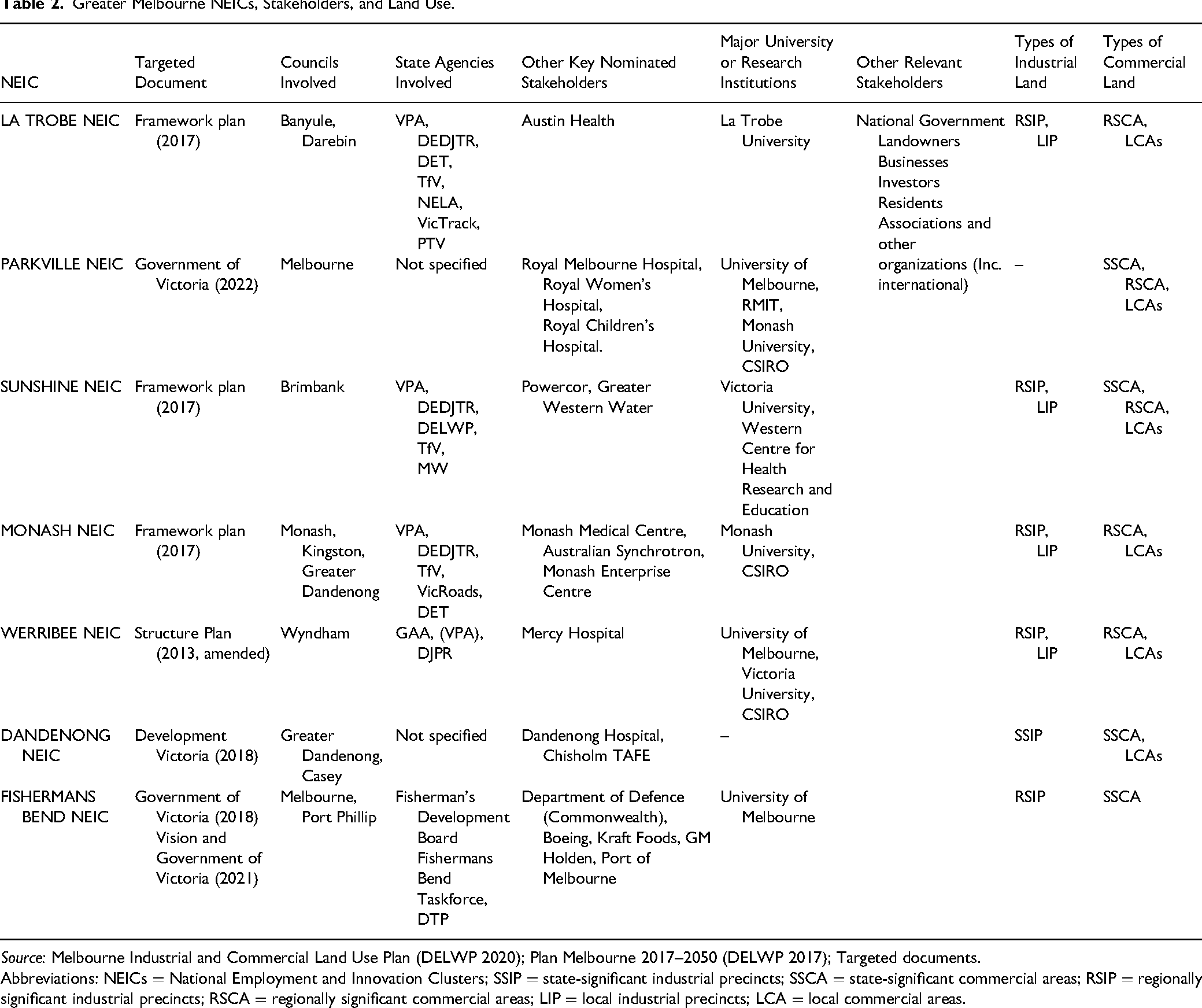
Source: Melbourne Industrial and Commercial Land Use Plan (DELWP 2020); Plan Melbourne 2017–2050 (DELWP 2017); Targeted documents.
Abbreviations: NEICs = National Employment and Innovation Clusters; SSIP = state-significant industrial precincts; SSCA = state-significant commercial areas; RSIP = regionally significant industrial precincts; RSCA = regionally significant commercial areas; LIP = local industrial precincts; LCA = local commercial areas.
In Australia, and reflecting the governance relations between Type I and Type II jurisdictions discussed above, these plans emphasize the governance of the NEICs as an integrated effort on discourse—a “whole-of-government” approach—involving the national, state, and local governments, in consultation with landowners, businesses, and other organizations. At the same time, since it is not a uniform policy, actors from different NEICs are ultimately competing for scarce resources and support from the national and state governments, corresponding to the functional overlapping and competing jurisdictions (FOCJ) described by Frey and Eichenberger (2001). It is also worth noting that not every NEIC has drafted the plan, which may signal a lack of competency and bargaining power from the local governments and/or a lack of interest from the state. Such a discourse-reality gap in policy implementation (Miao and Maclennan 2019) draws attention to the leadership lacuna and power imbalance at the interface between general purposed and task-specific jurisdictions.
Monash NEIC is illustrative of these features. Superposed by the Type I jurisdiction of the State Department of Jobs, Precincts and Regions (DJPR) on existing Monash Technology Precinct shepherded by Monash University, this NEIC is supposedly governed by a network of key stakeholders, including the Cities of Greater Dandenong, Kingston and Monash, Monash University, Australian Synchrotron, Commonwealth Scientific and Industrial Research Organisation (CSIRO), Monash Children's Hospital and Monash Medical Centre. Yet the dominance of Type I jurisdictions was pronounced in the Monash NEIC Framework Plan, as all targets were led by state and federal agencies (VPA 2017). For local governments such as the City of Monash, this NEIC was just another investment lever among its 72 Activity Centers (City of Monash 2025), and the City of Kingston only referred to it when bargaining for more transport investment from the state and federal governments (City of Kingston 2025). The major Type II jurisdictions, Australian Synchrotron and CSIRO, have helped to define the industrial specialization of this NEIC, but are obscure in its governance matters. Moreover, the strategic outcomes outlined in the Monash NEIC Framework has shown a striking similarity with the others: all aiming to enhancing growth in the health, education, and research industries; boosting jobs in new town centers; improving the transport network; and improving open space and built forms. This indicates cross-NEIC competitions not only in sector growth but also in amenities and infrastructures.
In terms of policy mixes, a variety of innovation, industrial, and planning policies have recently been announced by the state government, which offers the task-specific jurisdictions of each NEIC more leveraging tools to boost their performance. The more relevant ones are: Unlocking Enterprise in a Changing Economy (DLWP 2018), Melbourne Industrial and Commercial Land Use Plan (DELWP 2020), Local Government Act (DGS 2020), Innovation Victoria (DJPR 2021), and Made in Victoria 2030 (DJPR 2022). These documents establish new initiatives to boost innovation through collaboration and networking, grant schemes and start-up or entrepreneurial support, and a new set of land uses and zoning provisions that could better accommodate the mixed uses and amenity needs of innovation. Yet while boosting innovation is now a mandate for the local governments (DGS 2020), their agency is highly limited. The influence of non-government actors on IDs is even less pronounced. The release of the Melbourne Industrial and Commercial Land Use Plan (DELWP 2020) adds to this power asymmetry by establishing what can and cannot operate in each designated area. It reinforces Plan Melbourne's typology in contrasting state and local significant areas: Industrial clusters and commercial lands (or activity centers as they were known) are subdivided into three categories each: state-significant industrial precincts (SSIP) or commercial areas (SSCA); regionally significant industrial precincts (RSIP) or commercial areas (RSCA); and local industrial precincts (LIP) or commercial areas (LCA). Designating such land use hierarchies, as we argue, profoundly segments the NEICs (see Figure 3), unnecessarily re-centralizes the networked government structure, and potentially creates extra coordination costs. In practice, it means that, although the NEICs, as a whole, are nominally of state significance, more infrastructure investments and innovation-focused initiatives are likely to be directed towards specific sites within a single NEIC. By exclusion, those areas that are not designated as either state or regionally significant are left to the local governments.

The spatialized jurisdictions of greater Melbourne national employment and innovation clusters (NEICs).
Local councils recognize such fragmentation and lack of agency. None of the ten councils in Greater Melbourne where NEICs overlay their territories, for example, mentioned NEIC in their respective Council Plan, but rather referred to it in their economic strategies as part of an employment creation lever. In a vague manner, their goals include: “Attract and support innovation businesses, entrepreneurship, creative industries, and the tech start up ecosystem” (City of Darebin 2021, 63), “Build the entrepreneurial and innovation capacity” (City of Wyndham, 2022, 6), and “Provide coordinated support for Melbourne's innovation, entrepreneurship and startup ecosystem, including international enterprises, to encourage business development and capacity building” (City of Melbourne 2021, 19). Banyule council stressed: “Although cluster planning is a state-led initiative, Council has an opportunity to facilitate (and fast-track) the planning phase through advocacy efforts and can also ensure the municipality is positioned to maximise benefits as the precinct develops over time” (City of Banyule 2023, 35). Brimbank Council (2021, 23) summarized its role as: “lead and represent,” “partner and advocate,” “provide services,” “build and maintain,” “plan and regulate,” and “fund and resource.” The City of Casey (2021, 13) was even more explicit with its limited leadership: “benchmarked against other OECD countries, Australian local governments, including Casey, suffer from governance fragmentation and limited institution capacity for development.” The findings from a survey conducted by the council were telling: “Over half of respondents (61.25 per cent) were not aware that the City of Casey had an Economic Development team that supports businesses” (City of Casey, 2021, 22).
While cognizant of their lack of autonomy and power in the governance of the IDs, displaying themselves primarily as an advocacy body, some local councils are proactively competing for scarce resources and investments. They often lead partnerships with universities located within the NEIC and offer place-based grants, awards, and activation programs, such as the Monash Business Awards, the Fishermans Bend Innovation Challenge, the WYNnovation Festival, and Small Business Entrepreneurship & Innovation Fund (Wyndham), and the CUL-TI-VATE Initiative and IGNITE Program (Brimbank). Some councils even go beyond ad-hoc initiatives and directly establish permanent contact and support through, for instance, the Eastern Innovation Business Centre in Monash, SPARK Innovation Hub in Wyndham, and Prosperous Port Phillip Business Advisory Group. It will be interesting to trace the power dynamics in these more proactive local jurisdictions, although detailed discussion is beyond the scope of this paper. As a first attempt, we see the authority of local task-specific jurisdiction grow as the ID matures. In Victoria, for instance, both Monash and Parkville NEICs were built upon traditional concentrations of innovation since the 1980s. The state recognizes their importance with the official designation of a NEIC status, but does not see the necessity of strong engagement. This creates a leadership gap that has to be fulfilled by local actors, such as Monash City Council and Monash University. In Werribee NEIC, comparatively, the state government is pre-emptively denominating areas of state significance and actively promoting “priority areas” for future development, when the local innovation system is still embryonic. This shifting relationship between Type I and Type II innovation jurisdictions, as the upper-level government see fit, might help to internalize coordination costs at different stages of IDs, thus exemplifying the essence of what Phelps and Miao (2019) termed as state intrapreneurialism in urban governance.
Discussion and Conclusions
Miao, Benneworth, and Phelps (2015), in revisiting Technopoles of the World (Castells and Hall 1996), broached the importance of multi-level governance in the functioning of modern innovation landscapes. Recent writing and practice of IDs, nonetheless, have been rather oblivious to the complex web of actors and the intertwining formal and informal powers that define innovation districts. To their promoters, the rise of IDs has primarily been a local phenomenon, and “states have largely acted without focus or purpose” (Katz and Wagner 2013, 21). The neoliberal urban management narrative also underscores the entrepreneurial spirit of local leadership in the success of IDs (Kayanan 2022). Yet these statements only hold true to certain contexts and at certain times, even in the United States—the birthplace of the IDs as shown by Mozaffarian, Zandiatashbar, and Reyes-Sanchez (2026).
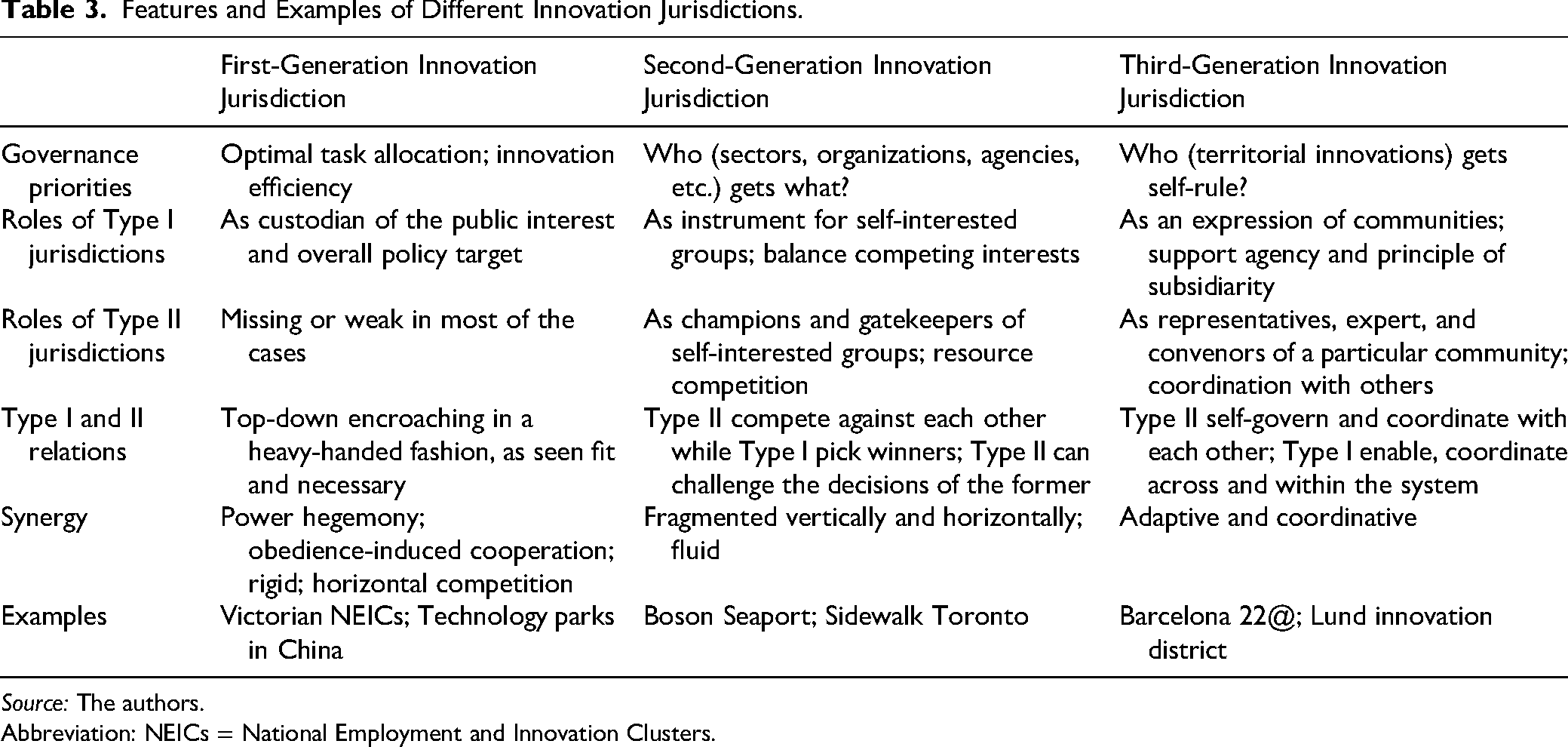
In this article, we developed the concept of innovation jurisdictions to offer a more nuanced understanding of innovation districts as complex geographies with internal governance diversity. Borrowing insights from public policy and urban studies, we distinguished between the general-purpose and task-specific jurisdictions, and identified potential policy mixes that could be employed by different jurisdictions in governing IDs. Properly delegated agency, power symmetry within and between the two types of jurisdictions, and effective design and implementation of policy mixes, would help enhance the integration of ID governance and leverage its competency, leading towards the “third generation” of MLG (Hooghe, Marks, and Schakel 2020, 203), where the government exists as “an expression of community” and mediate “functional pressures” and “group identities” of different IDs. Otherwise, the formal government hierarchy, as general-purpose jurisdictions might choose to intervene, even control, task-specific jurisdictions, presenting themselves as the custodian of the public interest (first generation multilevel governance) or as an instrument for self-interested actors (second generation multilevel governance). Depending on the goals, speed of actions, and priorities, these interventions might cause governance fragmentation of the IDs (see Table 3 for a summary).
Features and Examples of Different Innovation Jurisdictions.
Source: The authors.
Abbreviation: NEICs = National Employment and Innovation Clusters.
The Australian case presented in this article largely demonstrated the latter. There is a clear mismatch between the policy discourse and power distribution. The governance inertia noticed in Australia, especially regarding its nested Type I jurisdictions, was found to be particularly harmful to the dynamics of IDs: The state government has tangible control over planning to act as the real operator, whereas the federal government oversees industry strategies and hence exerts flexible gatekeeping (Bache 1998). Locally based Type II jurisdictions, which are supposed to be most sensitive to changing conditions and are proven to be resilient and accountable in other IDs (Gianoli and Henkes 2020), are fragile, decomposable, and often nested in and sponsored by the formal bureaucracy system in Australia. These jurisdictions are fluid and unevenly distributed with variant competencies, despite the policy discourse on a “whole-of-government” approach and decentralization. The rigid stipulation of local, regional, or state significance within one NEIC, compounded by the weak authority of local councils to finance and infrastructure provision, has resulted in a hierarchical distribution of competencies. Moreover, agencies within and across different innovation jurisdictions in the running of NEICs often do not coordinate actions among themselves and with non-public actors. This ignites competition and leads the Australian NEICs towards the fragmentation spectrum.
Our findings correspond to an important distinction Stephenson (2013) made between effective MLG and multi-level participation and consultation, the latter of which speaks to the growing statism worldwide and the prevalence of public assetization of spaces as a compromised solution to the fiscal austerity on the one hand and the blame of “selling the city's future” on the other (Weber 2010). The Victorian NEICs are more aligned to the second type, rendering them the “first generation” of decentralization, where the government is “a custodian of the public interest” and orchestrates the “optimal task allocation” by calculating the “costs and benefits of decentralization” (Hooghe, Marks, and Schakel 2020, 203).
A more effective ID governance, drawing on lessons from Australia and internationally (Morgan and Marques 2019), calls for nested jurisdictions converging into a cohesive governance framework, with no rigid distribution of competencies among state, council, and non-public actors inside particular innovation jurisdictions or in-between them. Local governments and non-public stakeholders would have more autonomy beyond advocacy and consultation. Such synergy would be represented by the intensity of coordination among companies and public actors, while also avoiding the dominance of a few anchor institutions as the ‘elephant in the room’. To move from fragmented to integrated innovation jurisdictions, or from a first to third generation MLG, calls for an “embedded autonomy” in governance restructuring, where “customised public inputs” (Juhász, Lane, and Rodrik 2023) substitute rigid, hierarchical distributions of competencies, and where the principle of subsidiarity (Bachtler et al. 2017) is respected. In the case of IDs, this would involve setting multi-level coalitions—legitimated, well-resourced, with shared objectives but specific tasks—that target local shortcomings and devise customized infrastructure provisions, bridging networks, and supporting cost-effective and affordable workplaces and residential units.
The competency of different jurisdictions and the position of an ID along the fragmentation and integration spectrum, as investigated in this article, might offer a fresh insight into the divergent performance within the global ID family on the aggregate level (Adu-McVie et al. 2022; Yigitcanlar, Adu-McVie, and Erol 2020). Future research attentive to such diversity is therefore highly desired to unpack, both theoretically and empirically, how the institutions of various jurisdictions (re)negotiate their relative autonomy and coordinate externalities associated with processes of innovation. Additionally, further studies could usefully inquire how, amid diverse innovation jurisdictions, actors design and accommodate policy mixes and memberships in order to grapple with the subsequent differentiation of the built environment, the innovation process, and the political and socio-economic consequences of innovation districts.
Footnotes

Funding
The authors disclosed receipt of the following financial support for the research, authorship, and/or publication of this article: This research was funded by the Australian Research Council Discovery Early Career Researcher Awards (project ID DE210100872)
Declaration of Conflicting Interests
The authors declared no potential conflicts of interest with respect to the research, authorship, and/or publication of this article.
Data Availability Statement
All documents are publicly available online.