



Abstract
The overwhelming number of male victims of clergy sexual abuse led to assumptions regarding sexual preference of clergy offenders. The present study examined 9,540 records (incidents) of alleged cleric sexual abuse in the United States between 1950 and 1999 to explore situational factors of the abuse by victim gender. No evidence was found to suggest that male victims were purposefully targeted more than female victims; rather, the abuse appeared to be more a function of opportunity. These findings support a situational framework of sexual abuse for the majority of clergy abuse and the assertion that abuse in church can be understood as not a crisis regarding homosexuality but as a social problem that must be examined in its context.
A series of focusing events in the 1990s and early 2000s led to the first wave of outrage and concern regarding sexual abuse in the Catholic Church. Highly publicized cases were followed by floods of reports from victims who had maintained silence regarding their abuse (Terry & Ackerman, 2008). Media accounts portrayed offenders in the clergy as a singular, highly predatory group who perpetrated acts of abuse on numerous children over many years (Mercado, Tallon, & Terry, 2008).
Of specific interest to the public and the church is concern over the sexual preference of these offenders. There seems to be an assumption that homosexuality is inextricably linked with cleric sexual abuse given that the majority of victims were male. This presents a need to examine whether the abuse stemmed from sexual preference or other factors, such as higher levels of opportunity to offend against male youths. The aim of this study is to explore situational factors of the abuse by victim gender to provide empirical data that elucidate the circumstances of abuse for both sexes. It is hypothesized that if boys were targeted, this will result in differences regarding the settings and circumstances of abuse.
Sexuality and Sexual Behavior
Public discourse regarding the abuse in the Catholic Church focused on themes of homosexuality, pedophilia, and targeted sexual abuse. In 2002, The Boston Globe ran a series of investigative articles after the highly publicized case of John Geoghan, a priest accused of multiple counts of sexual abuse that spanned over many years. It was this media coverage, as well as the growing number of reports nationally about priests who sexually abused minors, that led to the understanding that there was a sexual abuse “scandal” or “crisis” in the Catholic Church (John Jay College, 2010). High-profile cases of priests with multiple victims dominated the news and fueled the panic and anger of a concerned public. Jenkins (2001) asserts that this created an image of the “Pedophile Priest,” a highly specialized and methodical predator. The notion of the Pedophile Priest has energized controversies around religion, homosexuality, and child abuse (Plummer, 2003).
The overwhelming number of male victims (over 80%), led to assumptions about sexual preference. Notions of fixed sexuality, however, have been challenged. Sexuality and sexual preferences assume different forms; they are fluid and can be understood as partly arising from social interaction (Plummer, 2003). Sexual fluidity has been noted in other institutions, most notably homosexuality in prison (Sykes, 1958). Sexual preference, therefore, does not necessarily dictate sexual behavior. In some cases, sexual behavior can be understood as a result of opportunities presented in social settings. This nonessentialist view of sexuality can be found in the extant literature on sexual offending.
Theories of Sexual Offending: Dispositional and Situational Factors
Early theories of sexual offending conceptualized offenders as distinct types classified by motivational factors. For example, the fixated–regressed dichotomy (Groth, Hobson, & Gary, 1982) was based on whether the sexual offender’s sexual involvement with children represented a “fixation” or a “regression” in his sexual orientation (Johnston & Johnston, 1997). Similarly, the preferential–situational dichotomy developed by Dietz (1983) posited that preferential child molesters have sexual fantasies and active sexual behavior targeted towards children, whereas situational child molesters do not have a preference for children but target them due to low levels of self-esteem and poor social skills that make appropriate sexual relationships with adults difficult to cultivate (Davis, McShane, & Williams, 1995). These classification systems focused solely on the dispositional factors attributed to sexual offenders, with little mention of the social environment and opportunity structure of the offender.
Contemporary theories of sexual offending take a more integrated approach toward understanding sexual abuse. Rather than a fixed preference or simply a function of opportunity, sexual offending is recognized as a product of the interaction of individual dispositions and immediate situations (Marshall, Serran, & Marshall, 2006).
Dispositions can be stable or transitory in nature. Dispositional factors associated with sexual offending include attachment style or ability to be intimate with others (Burk & Burkhart, 2003; Marshall, Champagne, Brown, & Miller, 1997; Smallbone, 2005; Ward, Hudson, & Marshall, 1995, 1996), problems with emotional and self-regulation (Hanson, 2000; Ward & Hudson, 2000), issues with sexual regulation (Abel, Becker, Cunningham-Rathner, Mittelman, & Rouleau, 1988; Cortoni & Marshall, 2001; Marshall & Marshall, 2001), dysfunctional coping styles (Marshall, Serran, & Cortoni, 2000; Serran, 2004), cognitive distortions (Langton, 2004; Ward, Hudson, Johnston, & Marshall, 1997), and low self-esteem (Marshall, 1996a, 1996b; Marshall et al., 1997).
Situational factors play a key role in sexual offending. It has long been asserted that even if offenders desire to commit crimes, they cannot do so unless the opportunity to break the law is present (Cloward, 1959; Cullen, 1984: Lilly, Cullen, & Ball, 2006; Marshall & Barabee, 1990). Criminological theory has focused on how these opportunities to commit crime come to exist (Lilly et al. 2006). Routine activities theory (Cohen & Felson,1979) posited that crime consisted of three elements: a motivated offender, a suitable target, and a lack of a capable guardian. These elements must converge in time and space in order for a crime to occur.
More recent formulations of situational perspectives derive from research on behavioral, social, and environmental psychology, asserting that there is a subtle and intimate relationship between individuals and their immediate environments (Wortley & Smallbone, 2006). A situational perspective holds that behavior is not specific across situations and, in fact, may vary depending on the circumstances of that situation. An environment may precipitate crime in several ways. Situations can present cues that prompt an individual to perform criminal behavior, they can exert social pressure on the individual to offend, they can weaken moral constraints and permit offenders to engage in deviant acts, and they can produce emotional arousal that creates a criminal response (Wortley, 2001; Wortley & Smallbone, 2006).
Cornish and Clarke (2003) have developed a typology to explain the ways in which offenders respond to situations, based on the offender’s disposition and situational factors involved. They describe the antisocial, mundane, and provoked offender. Antisocial predators offend at high rates and are methodical and calculating. Mundane offenders are opportunists who engage in less frequent and lower level crimes. These offenders have some stake in conformity and utilize techniques of neutralization to free themselves to engage in deviant behavior (see Sykes & Matza, 1957). Lastly, provoked offenders react to a situation in which they have experienced emotional stressors and negative emotions. These crimes lack premeditation and occur as a result of a perceived wrong.
In terms of situations in which offenders maneuver, Wortley and Smallbone (2006) identify several environments or settings that can facilitate offending. These settings included domestic, institutional, and public. Institutional settings, like the Catholic Church, are places where children congregate outside of the home and are placed under the care and supervision of guardians for some formal purpose. These settings offer opportunities for abuse to occur—including locations to meet children, locations to abuse them, strategies for gaining access to children, and strategies for being alone with the children (see Smallbone & Wortley, 2000).
Clergy Abuse as Situational: A Bird’s Nest on the Ground
In terms of situational factors, the Catholic Church may have represented the proverbial “bird’s nest on the ground”—priests had access to children, locations to abuse them, and the trust and compliance of the victims and their families, all of which increased the ease and availability of sexual activity with children. Additionally, Wortley and Smallbone (2006) discussed the notion of permissibility or the ability of the offender to free himself from self-blame (also see Sykes & Matza, 1957). The institutional structure of the church may have engendered sexual abuse through the strategies used to deal with these offenders, such as moving them to another parish.
The literature thus far supports this notion of a situational framework for the majority of clergy abuse. Terry and Ackerman (2008) applied a situational model and found support for all seven of Wortley and Smallbone’s (2006) situational factors among priests (late onset of behavior, low incidence of chronic sexual offending, high incidence of previous nonsexual offenses, low incidence of stranger abuse, low incidence of networking among offenders, low incidence of child pornography use, and a low incidence of paraphilic interests). The authors also demonstrated an additional situational component to the sexual abuse. Most priests did not have multiple victims—in fact, the majority (55.7%) had only one allegation of abuse, meaning they were accused of abusing one victim (John Jay College, 2004). Regarding the high amount of male victims, it may be that rather than targeting males specifically, clergy offenders simply had more opportunities to abuse boys than girls due to the preponderance of young boys in church volunteering as altar servers.
Situational Aspects of the Abuse: Examining Gender Differences
This study will explore situational factors of the abuse by victim sex to provide empirical data on the circumstances of abuse for both male and female victims. Specifically, patterns will be analyzed to see if circumstances for male youth victims are the same or different from circumstances for female youth victims. Such a difference might suggest the possibility that male youth are being abused for different reasons or at least in different settings than female youth. If there are significant differences in these situational variables, it may suggest that abuse was targeted towards males, which could be indicative of a sexual preference for male victims. If no significant differences are found between male and females, it would suggest that the high number of male victims may have been a function of the greater opportunity to offend against males. Knowledge of such situational trends may serve to inform professionals, religious leaders, and general community members about what settings and activities may be risk factors for future abuse. The present study represents an attempt to explore these situational variables in greater detail to determine whether a situational framework can explain potential patterns in sexual victimization by clergy.
Method
The Data
The sample consists of 9,540 records (incidents) of alleged cleric sexual abuse in the United States between 1950 and 1999. Each incident corresponds to an individual victim; however, the frequency of abuse differed across all 9,540 victims such that some victims were abused only once compared to others who were abused multiple times. All alleged minor victims are male (n = 7,756) or female (n = 1,784) children or adolescents with ages ranging from 1 to 17.5 years old (M = 12.52, SD = 2.85). The data were collected from surveys that were distributed to dioceses (i.e., geographical regions under a particular bishop’s supervision) and religious communities throughout the United States. Data collection is summarized below. More detailed information is described in John Jay College’s 2004 Nature & Scope Report (John Jay College, 2004).
In 2002, The United States Conference of Catholic Bishops (USCCB) developed the Charter for the Protection of Children and Young People to address the issue of child sexual abuse in the Catholic Church community. As part of this effort, the USCCB commissioned John Jay College to undertake a study of the nature and scope of the problem, and each diocese was under mandate to comply with all study procedures. With USCCB’s guidance, a team of researchers at John Jay developed questionnaires that asked about individual instances of sexual abuse. These questions related to the victim of each case of abuse, the characteristics of the accused priest in each case, information about who made the initial allegation, and the financial effect of the allegation.
Questionnaires were sent to all 202 dioceses in the United States along with 140 religious institutes of men who then distributed the questionnaires to their respective provinces and communities. Instructions specified that questions be answered with information taken directly from Church records. Strict confidentiality procedures were undertaken to ensure that all potentially identifying information was stripped of each questionnaire before it arrived at John Jay College. Consequently, the research team was not aware of the particular diocese or community at which the questionnaire was completed; nor were they aware of any identifying information for the individual victims or accused priests.
The response rate was quite high (see Table 1). Reliability and consistency of the data were maximized by providing detailed instructions; anonymous support services including a website, telephone, and email services; and multiple measures of the same information for internal reliability. In total, 10,822 original questionnaires were submitted by American dioceses and religious communities based on records of individual accused Catholic priests or deacons. One hundred fifty-five files were deleted based on errors or inconsistencies in the age of the alleged victim or the date of alleged incidents, 1,031 cases were either missing the year the alleged abused occurred or the recorded year fell outside of the range of interest, and 96 cases were missing the sex of the victim, resulting in a total sample size of 9,540 individual incidents.
Questionnaire Response Rates.
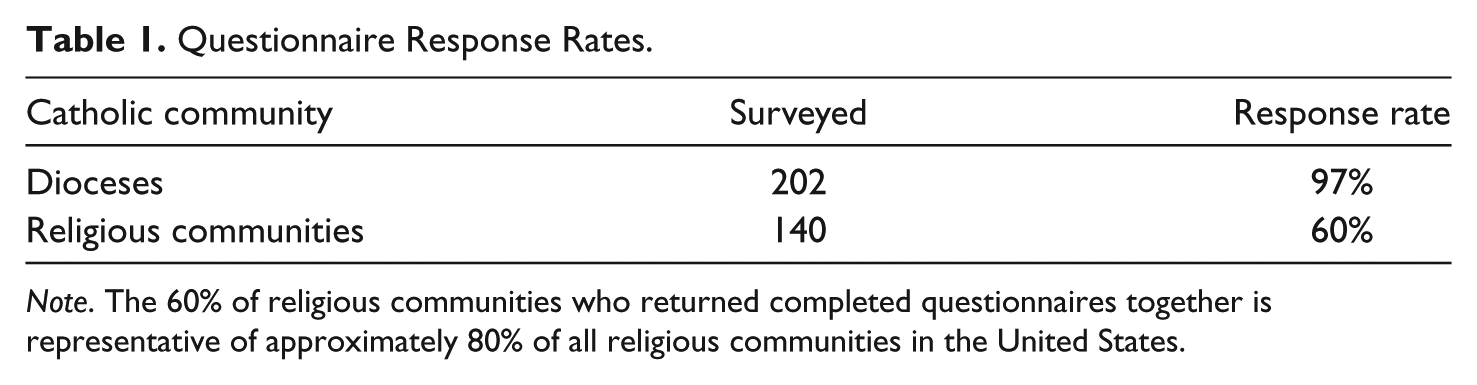
Note. The 60% of religious communities who returned completed questionnaires together is representative of approximately 80% of all religious communities in the United States.
Measurement
The questionnaire asked for information regarding the timing and location of the abuse as well as the nature of the alleged deviant sexual behavior. This information was then coded by trained research assistants at John Jay College and entered into an SPSS database at the individual victim level. All personal identifiers of both clergy and victims were redacted prior to arrival at John Jay College, ensuring that the data remained confidential and anonymous. Because this data set lacks information on sexual preference, situational variables of the abuse were used as a proxy measure of sexual preference based on the assumption that if males were targeted, there would be significant differences in terms of the situations of the abuse. The situational variables describe the location and timing of the alleged abuse, the accused cleric’s social involvement with the alleged victim’s family, how the alleged victim met the accused cleric, the accused cleric’s main role at the time of the alleged abuse, and alcohol and drug use at the time of the alleged abuse.
Analysis
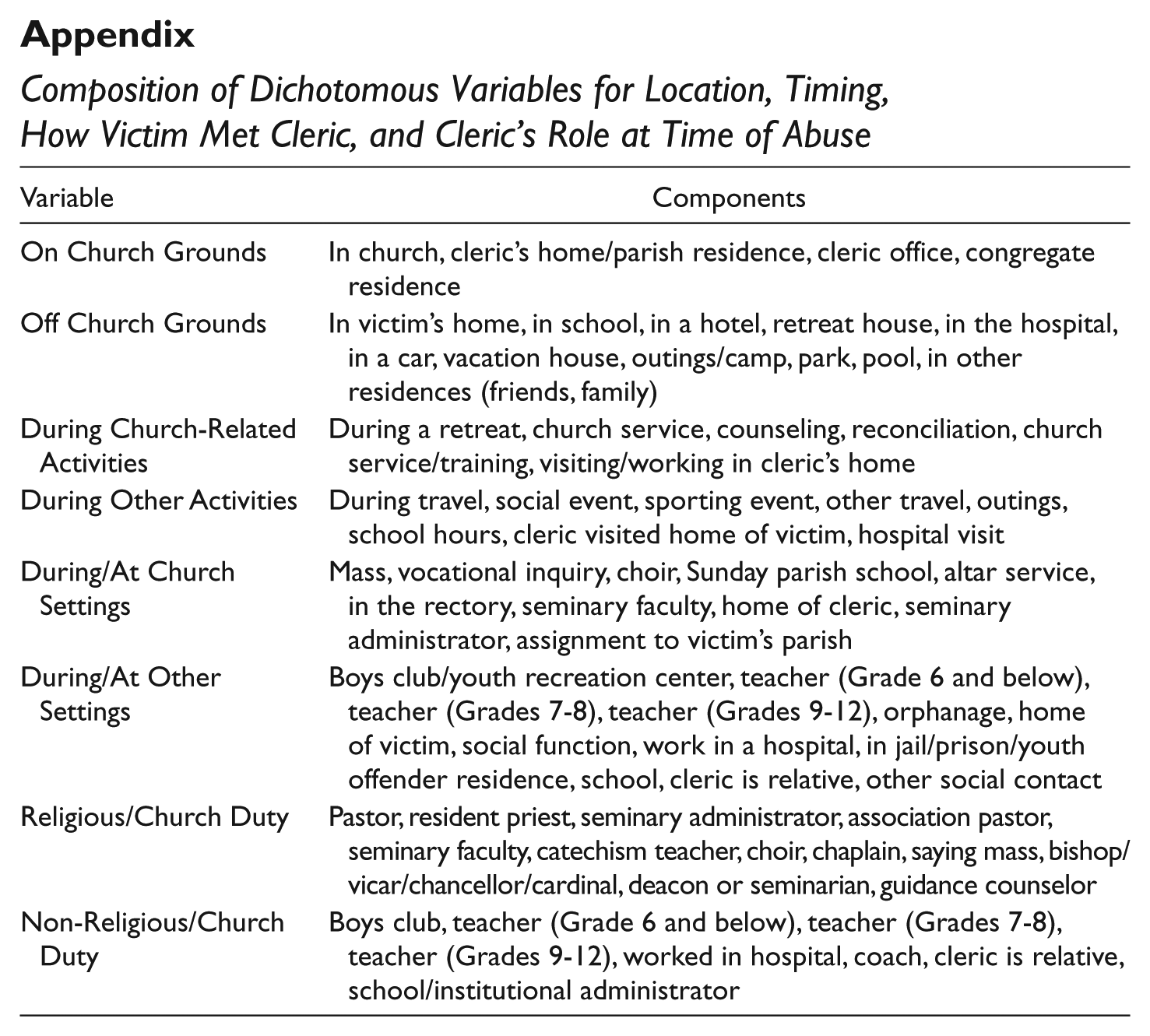
Descriptive statistics were examined to determine the distribution of situational factors by sex of alleged victim from 1950 to 1999. Dichotomous variables were created describing the location of abuse, timing of abuse, where the victim met the abusing cleric, and what the abusing cleric’s role was at the time of the alleged abuse to render these numerous categories more concise and appropriate for analysis (see the appendix). The location of abuse was separated into On Church Grounds and Off Church Grounds. Timing of abuse was divided into During Church-Related activities and During Non-Church-Related (Other) Activities. Where victim met abusing cleric was split into During/At Traditional Church Settings and During/At Other Settings. Lastly, the abusing cleric’s main role during alleged abuse was separated into Religious/Church Duty and Non-Religious/Church Duty.
Other situational variables included whether the abusing cleric was social with the victim’s family and whether the victim or the cleric was using drugs or alcohol during the abuse. These categories are not mutually exclusive, since a single case of alleged abuse could be recorded in multiple locations. As a result, percentages in the same category will often not sum to 100%. Binary logistic regression analyses were conducted with victim sex as the independent variable and the situational variables as dependent variables to test differences in prevalence of situational variables between male and female victims. Chi-square statistics were also used to determine the possible changes in these factors over time by 10-year increments (1950–1959, 1960–1969, 1970–1979, 1980–1989, and 1990–1999). This analysis was conducted because the incidence of sexual abuse cases differed over time.
Results
Overall, the sample consisted of 81.3% male victims and 18.7% female victims (see Figure 1). The 9,540 individual cases of abuse were perpetrated by 3,918 clerics (i.e., 3,918 clerics were responsible for abusing 9,540 male and female victims). Approximately three quarters (71.6%) of clerics abused only male victims, 24.3% abused only female victims, and 4.1% abused both male and female victims. The majority of abuse cases began in the 1960s, 1970s, or 1980s, with the 1970s representing the peak decade of abuse. During peak years of abuse, the proportion of male to female victims increased significantly (χ2 = 298.409, df = 4, p < .001). As discussed in more detail in the upcoming Causes and Context Study report (John Jay College, 2010), due to the fact that females were not allowed to be altar servers until the mid-1980s to early 1990s, this increase in the number of male victims during peak years of abuse may simply reflect the fact that male children and adolescents were more available in the church. The prevalence of female victims increased during the later decades, which supports this idea of availability because females would have become increasingly more available beginning in the 1980s as they began acting as altar servers in the church.

Victim sex distribution.
Despite the differences in the number of male and female victims, the situational factors do not differ greatly between male and female victims. Both males and females were slightly more likely to be abused on church grounds, during non-church-related activities, by clerics who had a traditional religious role and whom the victims met during a church-related activity (see Table 2). Additionally, in the majority of cases, the cleric had been social with the victim’s family. On closer inspection of the disaggregated data, the abuse most commonly occurred in the cleric’s residence, during non-religious social events, by clerics who were pastors or associate pastors. Victims met these clerics most commonly at Mass, and overwhelmingly, the most frequently reported location of social interaction between the cleric and the victim’s family was the family’s home (see John Jay College, n.d.).
Situational Variables for Male and Female Victims.
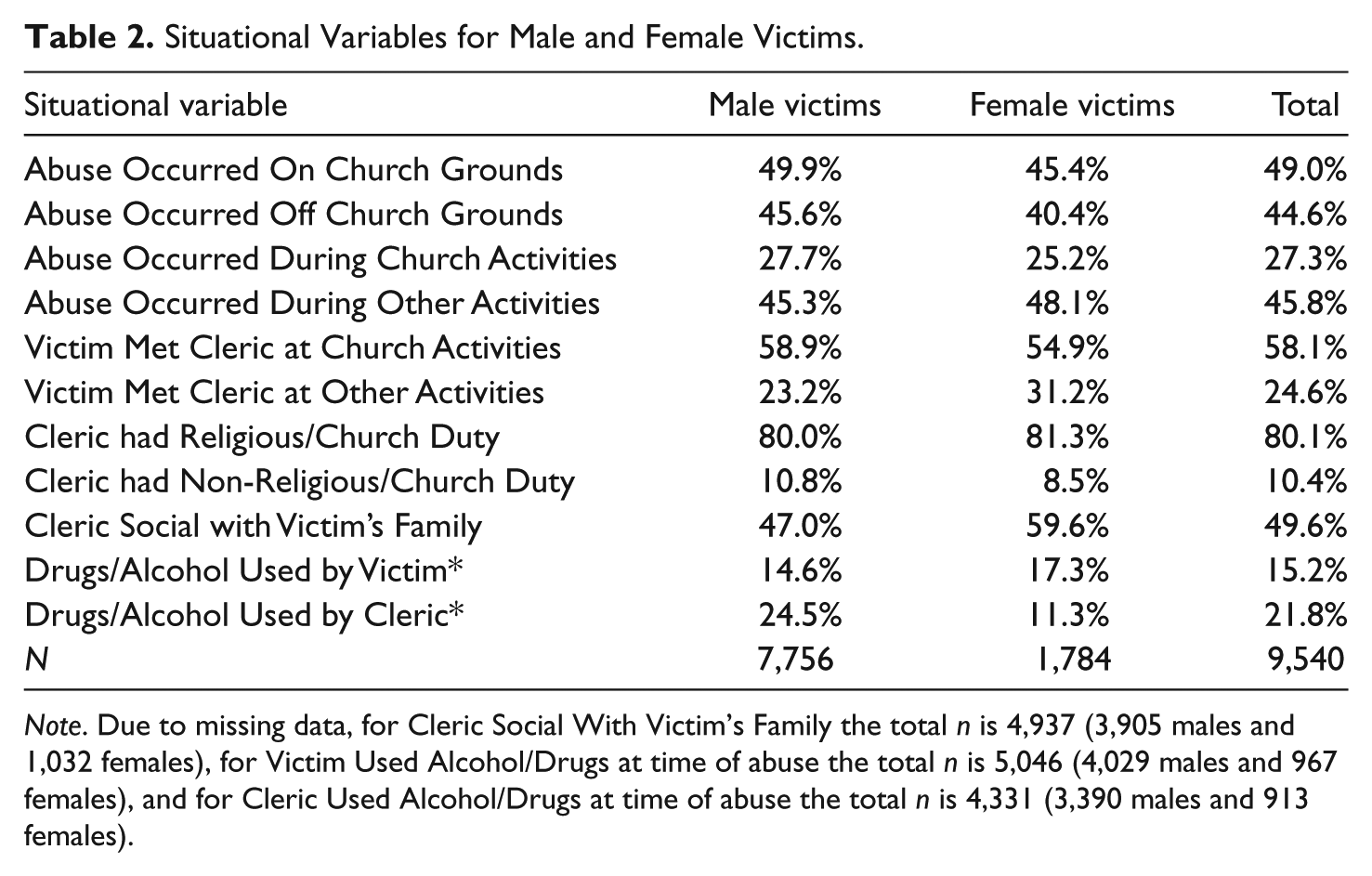
Note. Due to missing data, for Cleric Social With Victim’s Family the total n is 4,937 (3,905 males and 1,032 females), for Victim Used Alcohol/Drugs at time of abuse the total n is 5,046 (4,029 males and 967 females), and for Cleric Used Alcohol/Drugs at time of abuse the total n is 4,331 (3,390 males and 913 females).
Many statistically significant differences were found for both male and female victims in terms of changes in situational variables over time, but the combination of large numbers of cases and small effect means the differences have little substantive significance. These situational variables, therefore, appear to be relatively consistent and stable over time.
Whereas the majority of situational factors are consistent across victim type, substantive differences between male and female victims can be seen in the prevalence of victims who used drugs or alcohol during the abuse versus the prevalence of clerics who used drugs or alcohol during the abuse (see Table 2). For female victims, there were more instances of victims using drugs or alcohol during the abuse than clerics. For male victims, the opposite pattern emerged, with more instances of clerics using drugs or alcohol during the abuse than victims. Due to missing data, only 5,046 included data for Victim Used Alcohol/Drugs at time of abuse (4,029 males and 967 females), and only 4,331 for Cleric Used Alcohol/Drugs at time of abuse (3,390 males and 913 females).
Results of the binary logistic regression analyses revealed several significant differences for each of the situational variables (see Table 3). Male victims were 20% more likely to be abused on or off church grounds. Similarly, being a male victim resulted in a 10% increase in the chance that the victim was abused during church-related activities. Males were also 20% more likely to meet their abusing cleric at a church setting, and 30% more likely to have an abusing cleric who had a nonreligious role. Notably, males were over 150% more likely to have abusing clerics who had used drugs or alcohol at the time of abuse. This particular odds ratio (2.56) was by far the largest and most meaningful.
Binary Logistic Regression Results: Coefficients, Wald, and Odds Ratios for Victim Sex as Predictor Variable of Situational Variables.

Females, on the other hand, were more likely to be abused during non-church-related activities (i.e., being male is associated with a 10% reduction in the chances of abuse occurring during non-church-related activities), a conclusion that is reflected in the frequencies (48.1% of female victims were abused during non-church-related activities compared to 45.3% of male victims). Females were also more likely to be have met their abusing cleric at a non-church-related setting (males were 33% less likely to have met abusing cleric at a non-church-related setting), and have an abusing cleric with a traditional religious role (males were 8% less likely). Lastly, females were more likely to have an abusing cleric who was social with their family (being male associated with a 40% reduction in the chances), and were more likely to be using drugs and alcohol at the time of abuse (males were associated with an 18% reduction).
While significant, the magnitude of the majority of these odds ratios does not differ greatly from one, which represents the odds that any differences in situational factors between male and female victims occurred purely by chance. The most meaningful odds ratios are reflected in the following: that female victims were significantly more likely to have met their abusing clerics at a non-church-related setting, were more likely to have an abusing cleric who was social with their family, and were more likely to have used alcohol or drugs at the time of the abuse. Males, on the other hand, were more likely to have an abusing cleric with a non-church-related role and were also more likely to have an abusing cleric who was using drugs or alcohol at the time of the abuse.
Discussion
A Situational Framework of Sexual Abuse by Victim Gender
Location and timing of abuse
Both female and male victims were more likely to be abused on church grounds, by priests who had a religious/church role whom they met at a church-related activity. In our sample, it seems most likely that this would be the case, as the church served as the main commonality between the victim and offender. In terms of accessibility and opportunity, the church offered the setting for the initial encounter to occur and facilitated future interactions between the victim and offender. As Wortley and Smallbone (2006) assert, the locations of many offenses are fixed and self-evident, and the church is no exception.
Male victims were more likely to meet the offender during church-related activities and were more likely to be abused during church-related activities. This finding supports the notion that males were more involved in the church and more present than females. The timing of the abuse indicates greater access to male victims during both church- and non-church-related activities.
For females, there was a greater frequency of meeting outside of the church, although this finding is not statistically meaningful. Again, this finding may be a function of accessibility and opportunity. Until the 1990s, females did not participate in church services and did not spend time away from home with clergy (i.e., church retreats). It appears that the only way that priests would have had access to females was to meet outside of the church—at social events or in the homes of parishioners.
For both males and females the abuse was more likely to occur during non-church-related activities like social events. This finding is consistent with research that asserts that most professionals who are child molesters abuse children off grounds of the institution (Marshall et al., 2007). It would be far easier for a priest to offend against a victim when they were outside of formal church activities, such as giving a mass. The cleric would have more opportunity to abuse a child during a social or informal event where the number of capable guardians would be diminished.
Cleric’s level of sociability with victim’s family
The cleric was social with the victim’s family in approximately half of the cases, although clerics tended to be more social with the families of female victims than males, and social interaction was most often conducted in the homes of the victims. Again, this may have been the only way that offenders would have been introduced to female victims. A church service or mass would allow for greetings or brief interactions, but visits to the parishioner’s homes would allow access to females where the priest could begin to form relationships with the victim. This access would be fundamental to future incidents of abuse, and until the early 1990s visits to the home would have been one of the few means of gaining access to female victims. This finding is consistent with research by Smallbone and Wortley (2000) in which the authors found that strategies for gaining access to children involved visiting the home and socializing and interacting with family members.
Drug and alcohol use
Whereas prevalence rates are relatively low for drug or alcohol use by victims and clerics at the time of abuse, clerics were more likely than victims to use substances when abusing males but less likely to use substances when abusing females. There are several ways that this could be interpreted, both supportive of a situational framework. This may have represented normal “guy” behavior—drinking would have been seen as unsuspicious and more socially acceptable when done with males. Alcohol use may have loosened controls or inhibitions, which could have led to sexual behavior that may not have occurred when controls were in place. Additionally, alcohol use may have been purposeful in order to engage in the act, and perhaps overcome a lack of sexual attraction to males. This finding is consistent with this “deviancy avowal” or the use of alcohol to maintain a sense of normality when abusing children (McCaghy, 1968). It should be noted, however, that there was a substantial amount of missing data for this variable, and so the results should be interpreted with caution.
The clear lack of situational differences between males and females supports a situational framework of victim selection by offenders in the Catholic Church. The authors found no evidence to suggest that males were sought out or targeted. It appears that the higher numbers of male victims may have been a result of opportunity that was facilitated by the unique structure of the Catholic Church. Priests were trusted and revered men of God, who were charged with responsibilities that gave them access to youth and settings in which to abuse them. What is unique is that the capable guardians, who represent a key element in preventing offenses, were the parents and families who viewed these men as the personification of God on Earth. Opportunity and the implicit trusts of capable guardians allowed priests to abuse their roles and offend against the youth whom they were given to protect and guide.
Limitations/Future Research
Although this study represents an attempt to empirically examine the notion that sexual preference had little to do with the offending in the Catholic Church, situational variables were used as a proxy for sexual preference. For the present study, alack of situational differences was used to suggest evidence for a lack of sexual preference. In the future, research may be able to make direct connections without the use of proxy variables by linking stated sexual preference with victim characteristics.
Additionally, in terms of measurement, weighted averages may represent a better way to measure the differences among victims by gender, specifically because this method would allow for direct comparisons by taking into account the years that girls were not in the church as servants. This method may be able to better detect situational differences that the present study was unable to measure. Because the Nature & Scope data only go to 2002 (and the cases available for 1990–2002 are very small compared to the other decades) and because girls were only allowed as altar servers in the 1990s, this is something that is beyond the scope of this study (and this sample as a whole).
As Marshall, Serran, and Marshall (2006) assert, we need to examine not only the circumstances under which the offending takes place and how these circumstances may be created by offenders, but also the way in which offenders perceive these circumstances and how these perceptions change as a result of various internal and external influences on the offender. The present study was only able to explore the circumstances of the abuse, which leaves many unexamined factors. Crime, as Wolfgang (1957) noted, is a social interaction. Although an individual must have or create the opportunity to commit a crime, behavior is almost always a product of dispositional characteristics of the individual and the circumstances in which one finds oneself (Mischel, 1968). A comprehensive examination of sexual offending in the Catholic Church must attempt to account not only for the situational elements of the crime, but also for the interaction of individual and environment, and this was beyond the scope of these data. Future research employing an interactional model, perhaps utilizing Cornish and Clarke’s (2003) typology of offenders, would provide a more holistic view of the problem, as well as help to elucidate the reasons why only a small percentage of priests overall offended against children.
Additionally, to examine sexual abuse as an interaction, future inquiries should include qualitative accounts of the abuse from both the perspective of the victim and offender. This would provide better accounts of the dynamics of the relationship and the circumstances of the abuse. This information would be useful in examining the notion that sexuality is fluid and that the abuse occurred from social interaction that was not necessarily purposeful.
Although a situational framework is well suited to explain why individuals who are not necessarily attracted to one gender or perhaps even children commit child sexual abuse, what is distinct about the Catholic Church is the vow of celibacy that clergy take upon entering the priesthood. Future research should take this into account—how does this affect the application of traditional situational perspectives? Many priests report that they entered the seminary with the belief that their sexual problems would be cured (Marshall, Serran, & Marshall, 2007). Qualitative interviews with clerics would help to identify cognitive processes and distortions that helped to facilitate the abuse.
Additionally, a comparison of the abuse crisis in the church with other institutions that facilitate repressive sexual practices would provide for interesting data on how the structure of the institutions affects the risks of the members. Perhaps this information could be used to prevent future abuse.
The present study represented an attempt to examine the situational factors involved in sexual abuse for both male and female victims to empirically demonstrate that boys were not targeted victims of clergy abuse but were more readily available as victims, supporting a situational framework of victim selection. Perhaps one of the key differences between sexual offending in the general population and in the church involves structural factors that in turn affected the opportunities available to clergy offenders. Further investigation is necessary to support the assertion that the abuse in church can be understood as not a crisis regarding homosexuality but as a social problem that must be understood in its context.
Footnotes
Appendix
Composition of Dichotomous Variables for Location, Timing, How Victim Met Cleric, and Cleric’s Role at Time of Abuse
| Variable | Components |
|---|---|
| On Church Grounds | In church, cleric’s home/parish residence, cleric office, congregate residence |
| Off Church Grounds | In victim’s home, in school, in a hotel, retreat house, in the hospital, in a car, vacation house, outings/camp, park, pool, in other residences (friends, family) |
| During Church-Related Activities | During a retreat, church service, counseling, reconciliation, church service/training, visiting/working in cleric’s home |
| During Other Activities | During travel, social event, sporting event, other travel, outings, school hours, cleric visited home of victim, hospital visit |
| During/At Church Settings | Mass, vocational inquiry, choir, Sunday parish school, altar service, in the rectory, seminary faculty, home of cleric, seminary administrator, assignment to victim’s parish |
| During/At Other Settings | Boys club/youth recreation center, teacher (Grade 6 and below), teacher (Grades 7-8), teacher (Grades 9-12), orphanage, home of victim, social function, work in a hospital, in jail/prison/youth offender residence, school, cleric is relative, other social contact |
| Religious/Church Duty | Pastor, resident priest, seminary administrator, association pastor, seminary faculty, catechism teacher, choir, chaplain, saying mass, bishop/vicar/chancellor/cardinal, deacon or seminarian, guidance counselor |
| Non-Religious/Church Duty | Boys club, teacher (Grade 6 and below), teacher (Grades 7-8), teacher (Grades 9-12), worked in hospital, coach, cleric is relative, school/institutional administrator |
Declaration of Conflicting Interests
The author(s) declared no potential conflicts of interest with respect to the research, authorship, and/or publication of this article.
Funding
The author(s) received no financial support for the research, authorship, and/or publication of this article.