



Abstract
Little research has been conducted to examine paraphilic sexual interests in nonclinical samples. The little that exists suggests that atypical sexual interests are more common in men than in women, but the reasons for this difference are unknown. In this study, we explored the prevalence of paraphilic interests in a nonclinical sample of men and women. We expected that men would report greater arousal (or less repulsion) toward various paraphilic acts than women. We also examined putative correlates of paraphilias in an attempt to explain the sex difference. In all, 305 men and 710 women completed an online survey assessing sexual experiences, sexual interests, as well as indicators of neurodevelopmental stress, sex drive, mating effort, impulsivity, masculinity/femininity, and socially desirable responding. As expected, significant sex differences were found, with men reporting significantly less repulsion (or more arousal) to the majority of paraphilic acts than women. Using mediation analysis, sex drive was the only correlate to significantly and fully mediate the sex difference in paraphilic interests. In other words, sex drive fully accounted for the sex difference in paraphilic interests. The implications of these findings for understanding the etiology of atypical sexual interests are discussed.
A paraphilic interest is generally defined as a sexual interest in an atypical target (e.g., articles of clothing, children) or activity (e.g., hurting a partner, looking at an unsuspecting person); when this interest becomes long-standing, persistent, and necessary for sexual enjoyment, it is considered a paraphilia (e.g., fetishism, pedophilia, sadism, voyeurism). When the paraphilia results in significant distress or impairment of functioning, it is considered a paraphilic disorder (American Psychiatric Association, 2013). There is a paucity of research examining the prevalence of paraphilic interests in the general population. The little research that does exist primarily involves samples of men recruited in clinical or forensic settings (Abel, Becker, Cunningham-Rathner, Mittelman, & Rouleau, 1988; Bradford, Boulet, & Pawlak, 1992; Kafka & Hennen, 2002; Kafka & Prentky, 1992; Marsh et al., 2010) and case studies of women (Behrendt, Buhl, & Seidl, 2002; Fedoroff, Fishell, & Fedoroff, 1999; Travin, Cullen, & Protter, 1990).
Women are rarely seen in clinical and forensic settings for concerns pertaining to their sexual interests or misbehaviors (Statistics Canada, 1999), leading some to conclude that paraphilias are much more common among men than among women (Kafka, 2001; Wiederman, 2003). Several explanations for the sex difference in paraphilias have been offered (e.g., reporting bias, susceptibility to prenatal stressors), but few have been tested empirically. The aims of this study were to (a) explore the prevalence of paraphilic interests in a nonclinical and nonforensic sample of men and women, (b) examine further the presence and size of the sex difference, and (c) test explanations for the observed sex difference by examining whether the hypothesized factors mediate the sex difference in self-reported arousal to various paraphilic acts.
Prevalence of Paraphilic Interests in Men and Women
Both men and women report fantasies involving a variety of paraphilic activities (e.g., exhibitionism, sadism, masochism, transvestic fetishism, and voyeurism; Crépault, Abraham, Porto, & Couture, 1977; Crépault & Couture, 1980; Langevin, Lang, & Curnoe, 1998; O’Donohue, Letourneau, & Dowling, 1997; Rokach, 1988; Sierra, Ortega, & Zubeidat, 2006; Smith & Over, 1991; Wilson & Lang, 1981; Zurbriggen & Yost, 2004). There is a sex difference with regard to the content of these fantasies, such that a greater proportion of men report having fantasies involving sadism, exhibitionism, and fetishism compared with women, whereas a greater proportion of women report fantasies involving masochism (Rokach, 1988; Wilson & Lang, 1981; Zurbriggen & Yost, 2004). Studies of sexual offenders (mostly men) find that a large proportion of those who commit sexual offenses (e.g., exhibitionism and sexual abuse of children) also engage in sexual fantasies related to such activities (Abel & Blanchard, 1974; Evans, 1968; Marshall, Barbaree, & Eccles, 1991; McGuire, Carlisle, & Young, 1964; Rokach, 1988; reviewed in Seto, 2008).
Ahlers et al. (2011) found that 64% of a community male sample reported sexual interest in at least one paraphilic activity, with paraphilic fantasies (59%) being more commonly reported than behaviors (44%). Fantasies involving voyeurism (35%) and fetishism (30%) were reported most frequently, followed by sadism (22%), masochism (16%), and frotteurism (13%). The least commonly reported fantasies had to do with pedophilia (10%), transvestic fetishism (5%), and exhibitionism (4%). Unfortunately, due to a lack of research, it is unknown whether the relative prevalence of paraphilic fantasies and behaviors among women would mimic the pattern reported above. The data on fantasies and participation in sexual subcultures suggest that sexual masochism may be the most common paraphilic interest among women (Breslow, Evans, & Langley, 1985; Levitt, Moser, & Jamison, 1994; Wilson & Lang, 1981).
Population studies would provide the most conclusive evidence for a sex difference in paraphilic interests and paraphilias, but very few such studies have been conducted, and none has directly asked about interests. In a Swedish population study, Långström and Seto (2006) found that a small percentage of men and women reported at least one incident of being sexually aroused by exhibitionism (3%) and voyeurism (8%), with more men than women reporting that they had engaged in exhibitionistic (4% vs. 2%) and voyeuristic (12% vs. 4%) behaviors. From the same data set, Långström and Zucker (2005) reported a similar male-biased sex difference for engagement in transvestic fetishism (2.8% vs. 0.4%). In an Australian population study, Richters, de Visser, Rissel, Grulich, and Smith (2008) reported that men (2%) were slightly more likely than women (1%) to have been involved in sadomasochistic activity during the last year.
Correlates of Paraphilias
Men appear to report greater interest in paraphilic activities than do women (as measured by fantasy) and report engaging in paraphilic behaviors more often than do women, but it is unclear why this sex difference exists. The high degree of comorbidity among psychopathologies (e.g., anxiety and mood disorders) and paraphilias points to the possibility of a common and general causal mechanism, such as neurodevelopment or environmental stressors (Fedoroff et al., 1999; Kafka & Hennen, 2002; Kafka & Prentky, 1988). Men are 3 to 4 times more likely than women to be affected by stressful prenatal environments, leaving them susceptible to the development of psychopathologies including paraphilias (Cantor, 2012; Gualtieri & Hicks, 1985; Kraemer, 2000).
Handedness offers a glimpse into prenatal brain organization and early perturbations in development, with men being more likely to be non-right-handed than women (Papadatou-Pastou, Martin, Munafò, & Jones, 2008), and individuals who have neurological disorders being more likely to be non-right-handed (Lewin, Kohen, & Mathew, 1993). Rahman and Symeonides (2008) found that men who scored high on paraphilic fantasies also had higher incidence of non-right-handedness compared with men who scored low. Similarly, the odds of non-right-handedness are 3.5 times greater among male pedophiles (men who are attracted to children) than teleiophiles (men who are attracted to adults; Cantor et al., 2004; Cantor et al., 2005). Greater male fragility and sensitivity to stressful prenatal environments may explain why men are more likely than women to exhibit paraphilias.
Other factors associated more specifically with sexuality, such as sex drive and mating effort, may help explain the motivation to seek variety in sexual activities and partners. Sex drive refers to the strength of an individual’s sexual motivation (for a review, see Baumeister, Catanese, & Vohs, 2001), whereas mating effort refers to the energy expended locating, courting, and keeping sexual partners (Lalumière & Quinsey, 1999). Both sex drive and mating effort are on average higher in men than in women (Lippa, 2009). It is possible that a high sex drive (Kafka, 2001, 2009) and a strong preference for novelty precede or contribute to the development of paraphilias, such that some individuals habituate to conventional sexual partners and activities (Kafka, 2001)—habituation of sexual arousal is a very well-established process, especially in men (Dawson, Lalumière, Allen, Vasey, & Suschinsky, 2013; Dawson, Suschinsky, & Lalumière, 2013). Support for this notion comes from studies that have found that many men and women with paraphilias report a high number of sexual partners, as well as high rates of sexual behavior, and high sexual appetite and preoccupation (Kafka, 1994, 1997a, 2009; Kafka & Hennen, 2003; Långström & Hanson, 2006; Långström & Seto, 2006). Interestingly, the association between impersonal sex and paraphilias is equally strong for men and women (despite different base rates), suggesting that sexual motivation may be an important characteristic contributing to the development of paraphilias in both sexes (Långström & Hanson, 2006).
Engaging in paraphilic behaviors can involve the violation of social norms and laws. As confirmed by meta-analysis, men are more likely to be impulsive and to take risks compared with women, across a variety of settings (Byrnes, Miller, & Schafer, 1999). In line with some theories of sexual offending, an individual’s paraphilic behavior may be affected by his or her degree of impulsivity or proclivity for risk-taking (e.g., Lalumière, Harris, Quinsey, & Rice, 2005). Empirical support for the roles of impulsivity and risk-taking in the expression of paraphilias comes from population and forensic studies. Långström and Seto (2006) reported an association between indirect measures of risk-taking (e.g., alcohol and illicit drug use) and engaging in paraphilic behaviors among men and women. Kafka (1997b, 2001) and Marshall (2007) reported that men with paraphilias are more likely to have problems with impulsivity and sensation-seeking. Given that men are more likely than women to be impulsive and take risks, it is possible that the sex differences in paraphilias, especially those involving illegal activities, are a reflection of sex differences in impulsivity and risk-taking. In addition, impulsivity and risk-taking may lead individuals to try a variety of sexual activities, perhaps leading to the development of new sexual interests.
As the male-bias for most paraphilias suggests, the development of paraphilias may simply be associated with the development of a male gender role. Perhaps the cultures in which studies have been conducted sanction masculine individuals to develop paraphilic interests to a greater extent than feminine individuals, along with other sexual tendencies such as high mating effort, and nonsexual tendencies such as novelty seeking and risk-taking. If that is correct, indicators of masculine gender role should be related to paraphilias in both sexes. It is also possible that sex differences in paraphilias reflect or represent an exaggeration of accepted gender roles, such that men are more likely to display sadistic interests (representing proceptivity, strength, and control), and women are more likely to display masochistic interests (representing receptivity, weakness, and surrender). Once again, if this is correct, indicators of individual differences in masculinity and femininity should be related to particular paraphilias, and these indicators should mediate the sex difference.
Another and perhaps the most parsimonious possibility is that the observed sex difference is not caused by any particular causal process, but rather results from a sex difference in willingness to report sexual interests and behaviors in surveys and interviews. Men have more permissive sexual attitudes than women and are more willing to report honestly their sexual behaviors (Alexander & Fisher, 2003; Zanna & Pack, 1975). Alexander and Fisher found that sex differences in the reporting of sexual behaviors for men and women were attenuated when participants believed that lying could be detected. If this bias in reporting is also true for paraphilias, then accounting for the effects of social desirability or impression management (IM; that is, the propensity to respond in a favorable manner; Paulhus, 1991) may diminish the sex difference in paraphilic interest. The social desirability explanation does not easily account, however, for the large sex differences in detected sexual offenses.
Method
Participants
A total of 1,226 individuals were recruited (men n = 351, women n = 785, gender not identified n = 90) from a Canadian university using printed advertisements and by directly addressing students in second- and third-year psychology classes. Participants from the general population were also recruited using online advertising on social networking sites (i.e., Facebook and Twitter). The advertisements listed the study as investigating sexual experiences and behaviors.
Of the total sample recruited for the study, 305 men (Mage = 23.0, SD = 5.6) and 710 women (Mage = 21.5, SD = 4.7) were included in the analyses. Participants were excluded if they did not indicate their gender (n = 90) or did not complete the main dependent measure—the paraphilia scale (n = 106). All participants included in the final analyses stated that they were above the age of 18 and consented for their responses to be used in the study. The vast majority of men and women in the final sample were Caucasian (88% and 88%, respectively) students (75% and 88%) residing in Canada (88% and 99%). Most men and women self-identified as heterosexual (93% and 90%) with a slight majority in relationships (54% and 58%, respectively), while the remaining were single.
Procedure
Participants completed a questionnaire that was accessed online through the SurveyMonkey™ website. Participants first had the opportunity to read a letter of informed consent before accessing the survey. The different measures were administered in a pre-determined randomized order, the same order was used for all participants. At the completion of the survey, participants were redirected to a debriefing form that explained the purposes of the study and included the contact information of the researchers. Participants who were psychology students at the University of Lethbridge received 1% bonus credit for their participation; no other compensation was offered. The Human Subject Research Committee at the university reviewed and approved all procedures according to the ethical guidelines of the Canadian Tri-Council Policy Statement.
Measures
Paraphilias
Interest in paraphilic activities was assessed using a measure that has been used in previous research (Chivers, Roy, Grimbos, Cantor, & Seto, 2013; Seto, Lalumière, Harris, & Chivers, 2012). Participants rated 40 items in terms of how arousing they found the sexual activity on a 7-point scale ranging from very repulsive (−3) to indifferent (0) to very arousing (+3). Responses to 32 items were used in this study (those that clearly referred to paraphilic activities). Examples of items included “you are touching a material like rubber, PVC, or leather” and “you are being spanked, whipped, or beaten by someone.” Subscale scores pertaining to each of the paraphilias (see Table 1 and the appendix) were calculated by taking the mean rating for all of the items pertaining to that interest. For example, the Fetishism Arousal subscale included the mean arousal rating to the following items: “touching a material like rubber, PVC, or leather”; “kissing, fondling, and touching someone’s feet”; and “touching an object like shoes, gloves, or plush toys.” A Total Paraphilia Score was calculated by taking the average response to all 32 items. (See the appendix for the original measure and all subscales.)
Descriptions of the Paraphilias Examined in the Present Study.

Neurodevelopmental stress
Neurodevelopmental stress was assessed using three measures. Intellectual ability was assessed with a 10-Wordsum Vocabulary test used in the General Social Survey in the United States (Davis & Smith, 1987). Participants were instructed to select one of five words that best matched the meaning of the target word. Scores on this test are positively correlated with years of education and intelligence (Malhotra, Krosnick, & Haertel, 2007). A total score for the Wordsum Vocabulary test was created by summing the total number of correctly matched words.
Non-right-handedness is another marker of neurodevelopmental stress and was assessed using the Edinburgh Handedness Inventory (EHI; Oldfield, 1971). Participants indicated which hand they usually use (i.e., left, right, or both) for 10 different tasks (e.g., writing, throwing, using a spoon). This scale has high test–retest reliability after a 4-week interval (McFarland & Anderson, 1980). For the EHI, previous research has reported that some of the items (e.g., use of a broom) correlate poorly with all other items (McFarland & Anderson, 1980). We examined interclass correlations and also found that use of a broom was not highly correlated with the other items. We removed this item and created total scores for left-handedness (LHT) and right-handedness (RHT) by summing the scores for all remaining items, as well as a cumulative handedness score (CHS) by summing the LHT and RHT scores. We also created a difference handedness score (DHS) for handedness by subtracting the RHT from the LHT. Finally, to calculate an individual percentage of non-right-handedness we divided the DHS by the CHS and multiplied by 100. Negative scores are indicative of non-right-handedness (Oldfield, 1971).
The Susceptibility to Illness (SI) questionnaire is a measure of vulnerability to environmental stressors (Thornhill & Gangestad, 2006). Participants are asked to report the number of illnesses they have experienced in the past 3 years, along with four other questions to determine their resistance to diseases. Following Thornhill and Gangestad (2006), to reduce the influence of large values in the SI, the number of times during the last 3 years that a person was ill from respiratory infections and stomach flus was each truncated to 10. The number of days sick during the last 3 years from respiratory infections and stomach flus was each truncated to 100. We conducted a Principal Components Analysis (PCA) on the five items to create an overall SI score. The results of the PCA revealed a single factor that explained 45.3% of the variance in the scores. The values generated from this analysis were used to represent the total SI score for this measure.
Sex drive
The Total Sexual Outlet Inventory (TSOI; Kafka, 1997a), Rinehart’s Sexual Behavior and Desire Questionnaire (SBDQ; Rinehart & McCabe, 1998), and Kalichman’s Sexual Compulsivity Scale (SCS; Kalichman & Rompa, 1995) were used to assess sex drive. We modified the TSOI for the current study, focusing on the frequency of sexual urges, fantasies, and behaviors during the previous week. The modified TSOI also assessed the intensity of these urges/desires (1) as well as the absolute time spent (in minutes/hours) engaging in these behaviors (2). The total sexual outlet (TSO) score is the cumulative total number of orgasms experienced during a given week (3) and a typical week (4) for these types of sexual behaviors.
To avoid the undue effects of large numbers on the calculation of the TSO, the scores for two of the items (3 and 4) were truncated to 35. There was no well-established procedure for deriving a total score, and there were no psychometric properties available for this scale (Kafka, 1997a; Miner, Coleman, Center, Ross, & Rosser, 2007). Examination of our own data revealed the internal consistency for the four items to be poor, but excluding item (2) produced adequate internal consistency: for men α = .74 and women α = .76. We conducted a PCA on the remaining three items (1, 3, and 4) to create an overall TSO score. The results of the PCA revealed a single factor that explained 68.6% of the variance in the scores. The values generated from this analysis were used to represent the TSO score for this measure.
The SBDQ surveys sexual preoccupation by assessing the frequency (e.g., never to 50+ times/day) of engaging in masturbation, oral sex, sexual intercourse, pornography use, indecent phone calls, hiring prostitutes, exhibitionism, voyeurism, nonconsensual sexual intercourse, and intercourse with children. The questionnaire also assesses the frequency of desires to engage in these activities as well as the degree of satisfaction (e.g., extremely unsatisfied to extremely satisfied) after engaging in these acts. Individuals who score high on these items are considered to have excessive sexual preoccupations consistent with hypersexuality. There are no published psychometric properties for this scale; a reliability analysis on the six items that related to sex drive (e.g., percentage of the day you think about sex; if you ever have sexual fantasies; how often you masturbate, engage in oral sex, have sexual intercourse, and look at pornography), excluding those that were related to paraphilic interests, revealed an adequate internal consistency for men α = .67 and women α = .73. PCA was performed on these six items to create a score for this measure. The results indicated that there was one factor that explained 43.3% of the variance in the scores. The scores generated from this specific component were then used to represent the score for hypersexuality.
The SCS developed by Kalichman and Rompa (1995, 2001) is a 10-item scale assessing the impairment and distress resulting from an individual’s sexual needs (e.g., disruption to daily life). Based on use with nonclinical samples of men and women, this scale has strong internal consistency (α = .87), test–retest reliability(α = .80), and construct validity (Kalichman & Rompa, 1995). Participants respond to each of the 10 items using a Likert-type scale: not at all like me (1) to a lot like me (4). Examples of the items include “my sexual appetite has gotten in the way of my relationships” and “I have to struggle to control my sexual thoughts and behaviors.” Individuals who score high on this measure are considered to be sexually compulsive with greater distress and impairment. PCA revealed that the scale was unifactorial, with one factor accounting for 52.6% of the variance; following Kalichman and Rompa (1995), a SCS score was created by taking the mean of the 10 items.
Mating effort
Mating effort and a preference for short-term relationships were measured using the Sociosexuality Inventory (SOI; Simpson & Gangestad, 1991). The SOI is an efficient way of determining whether individuals are restricted or unrestricted in their sexual behavior and has adequate reliability (α = .73). Items include reporting “with how many different partners have you had sex with during the last year,” as well as rating degree of agreement to statements such as “sex without love is okay.” Responses demonstrate convergent validity (e.g., are related to engaging in sex earlier in relationships) and discriminant validity (e.g., do not correlate with frequency of sex or co-vary with unrelated constructs such as sexual guilt; Simpson & Gangestad, 1991). One item (7) of the SOI required reverse scoring. A score for the SOI was created following Simpson and Gangestad’s (1991) weighting method.
Impulsivity and sensation-seeking
Eysenck’s Impulsivity Inventory (EII; Eysenck, Pearson, Easting, & Allsopp, 1985) assessed participants’ participation in impulsive activities (e.g., Do you often buy things on impulse?) and long-term patterns of impulsive behavior (e.g., Do you often do things on the spur of the moment?) using 19 items that load onto a single impulsiveness factor. Test–retest reliabilities are r = .84 and r = .83 for men and women, respectively, for the impulsiveness factor (Eysenck et al., 1985). The EII had three items (5, 16, and 17) that required reverse score transformations. A score for EII was calculated by averaging responses on all of the items.
Zuckerman’s Brief Sensation-Seeking Scale (BSSS; Hoyle, Stephenson, Palmgreen, Lorch, & Donohew, 2002) assessed participants’ degree of sensation-seeking by asking them to indicate their agreement with eight statements (e.g., I would like to explore strange places) assessed on a 5-point scale: strongly disagree (1) to strongly agree (5). This scale has adequate internal consistency (α = .76; Hoyle et al., 2002). The BSSS score was calculated by averaging the scores on all of the items.
Masculinity/femininity
The Bem Sex-Role Inventory (BSRI; Bem, 1981) is a widely used measure of gender role perceptions using sex-type personality characteristics (Bem, 1974). Participants were asked to rate themselves on 60 items (e.g., self-reliant, yielding, helpful) assessed on a 7-point scale: almost never true (1) to almost always true (7). This scale has high internal consistency for masculinity (α = .86) and femininity (α = .82) and good test–retest reliability (r = .90 for masculinity and r = .90 for femininity; Bem, 1974). The BSRI score was calculated by subtracting the mean score for the masculinity items from the mean score for the femininity items.
Masculinity and femininity were also measured using Lippa’s Gender Diagnosticity (LGD) assessing gender-related occupational preferences (Lippa & Arad, 1997). Participants were asked to rate their interest in 10 different occupations (e.g., car mechanic, school teacher) on a 7-point scale: strongly dislike (1) to strongly like (7). Responses on these items demonstrate high reliability (α = .91; Lippa, 1991). The LGD score was calculated in the same way as the BSRI, where the mean score for masculinity items was subtracted from the mean score for the femininity items. Positive scores on these measures were indicative of greater degree of masculinity.
Social desirability
Paulhus’s (1991) Balanced Inventory of Desirable Responding (BIDR) was used to examine responding bias. Participants were asked to indicate their level of agreement to 40 items (e.g., I sometimes tell lies if I have to) on a 7-point scale: not true (1) to very true (7). These 40 items load onto two factors: self-deceptive positivity (SDP) and IM. This scale has strong internal consistency for the total measure (α = .83), SDP factor (α = .68-.80), and IM factor (α = .75-.86). Test–retest reliability over a 5-week period is good for SDP (r = .69) and for IM (r = .65). The BIDR demonstrates concurrent validity as a measure of socially desirable responding correlating with the Marlowe Crowne Social Desirability Scale (r = .71) and with the Multidimensional Social Desirability Inventory (r = .80). Following Paulhus (1991), 20 items were reverse scored. Participants who scored a 6 or 7 on any item were scored as 1, all other responses were scored as 0. Total scores for the two factors (SDP and IM) were created by summing all of the scores for all of the items that pertained to each factor (for a maximum of 20). Both these scores were used to assess social desirability.
Results
Sex Differences in Aversion/Arousal to Paraphilic Activities
Table 2 shows the correlations between self-reported aversion/arousal to the various paraphilic activities (based on subscales) for men and women. Due to nonnormality in some of the subscales, nonparametric Kendall Tau b correlations are reported. Responses to most paraphilic activities were low to moderately positively correlated with responses to other paraphilic activities for both sexes, with responses to sadistic and masochistic acts exhibiting the strongest association. There was no significant difference in the average “comorbidity” among men (average r = .26) compared with women (average r = .20), z = 0.92, p = .35.
Correlations Between Paraphilia Subscales for Men and Women.
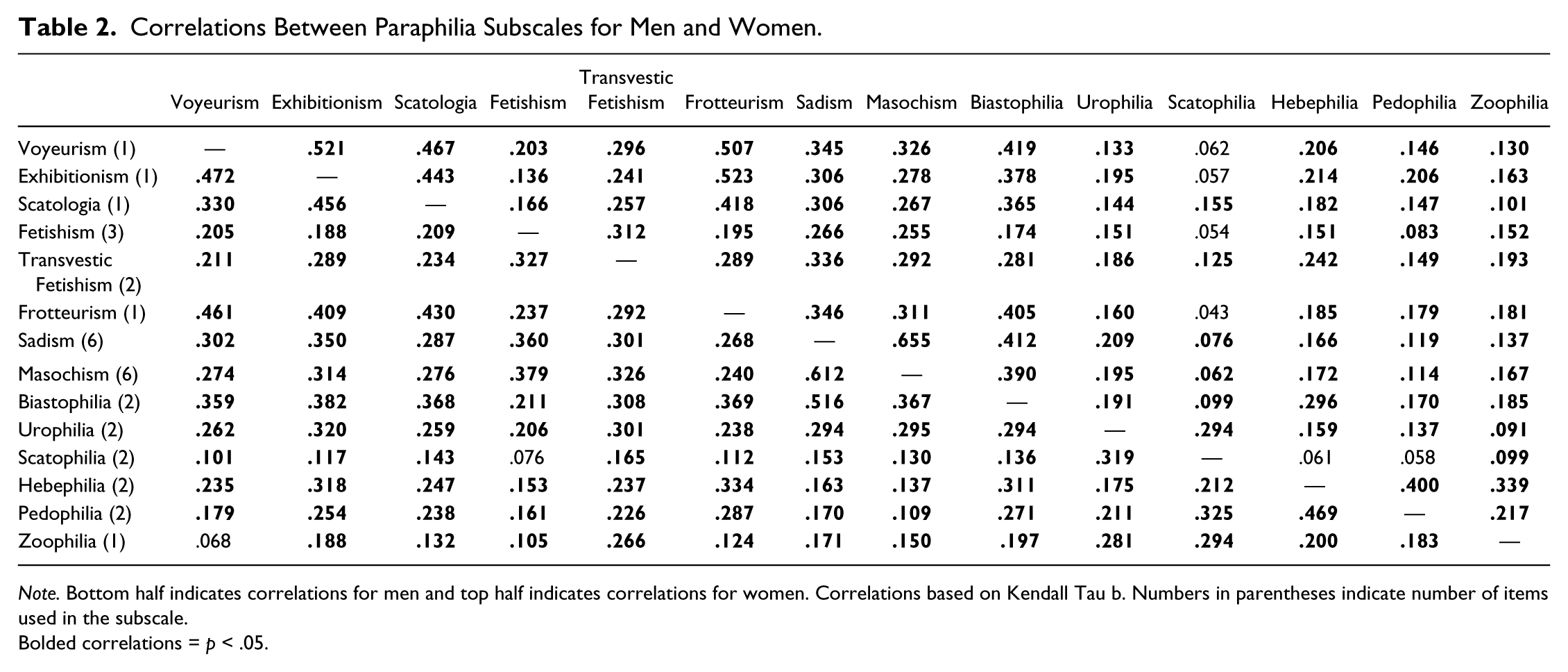
Note. Bottom half indicates correlations for men and top half indicates correlations for women. Correlations based on Kendall Tau b. Numbers in parentheses indicate number of items used in the subscale.
Bolded correlations = p < .05.
Examination of differences in mean ratings revealed several significant sex differences. The mean ratings for men and women can be seen in Table 3 with their accompanying Mann–Whitney U statistics, Z-values, statistical significances, and effect sizes. Given that the scale was ordinal in nature, nonparametric Mann–Whitney Us were used to examine differences between men and women for each subscale. The same pattern of results was found when using independent-samples t-tests. As can be seen in the table and in Figure 1, men reported significantly less repulsion than women to all paraphilic activities with the exception of masochism and transvestic fetishism where there were no significant sex differences.
Sex Differences in Self-Reported Aversion/Arousal.

Note. Numbers in parentheses indicate number of items used for that subscale. Response options ranged from very repulsed (−3) to indifferent (0) to very aroused (3).
p < .01. ***p < .001.
Table 4 reveals the percentage of men and women who reported arousal specifically (as indicated by a mean score greater than 0 for the subscale) to the various paraphilic activity subscales. Fisher’s exact test of proportions revealed that a significantly greater proportion of men reported arousal to activities related to voyeurism, fetishism, sadism, biastophilia, and urophilia compared with women (all ps < .05). A greater proportion of men were also more likely to endorse items related to frotteurism, hebephilia, and pedophilia compared with women (all ps > .05 and < .10). Similar proportions of men and women reported being aroused by activities involving exhibitionism, scatologia, transvestic fetishism, masochism, scatophilia, and zoophilia (all ps > .10).
Sex Differences in the Proportions of Men and Women Who Report Arousal (>0).
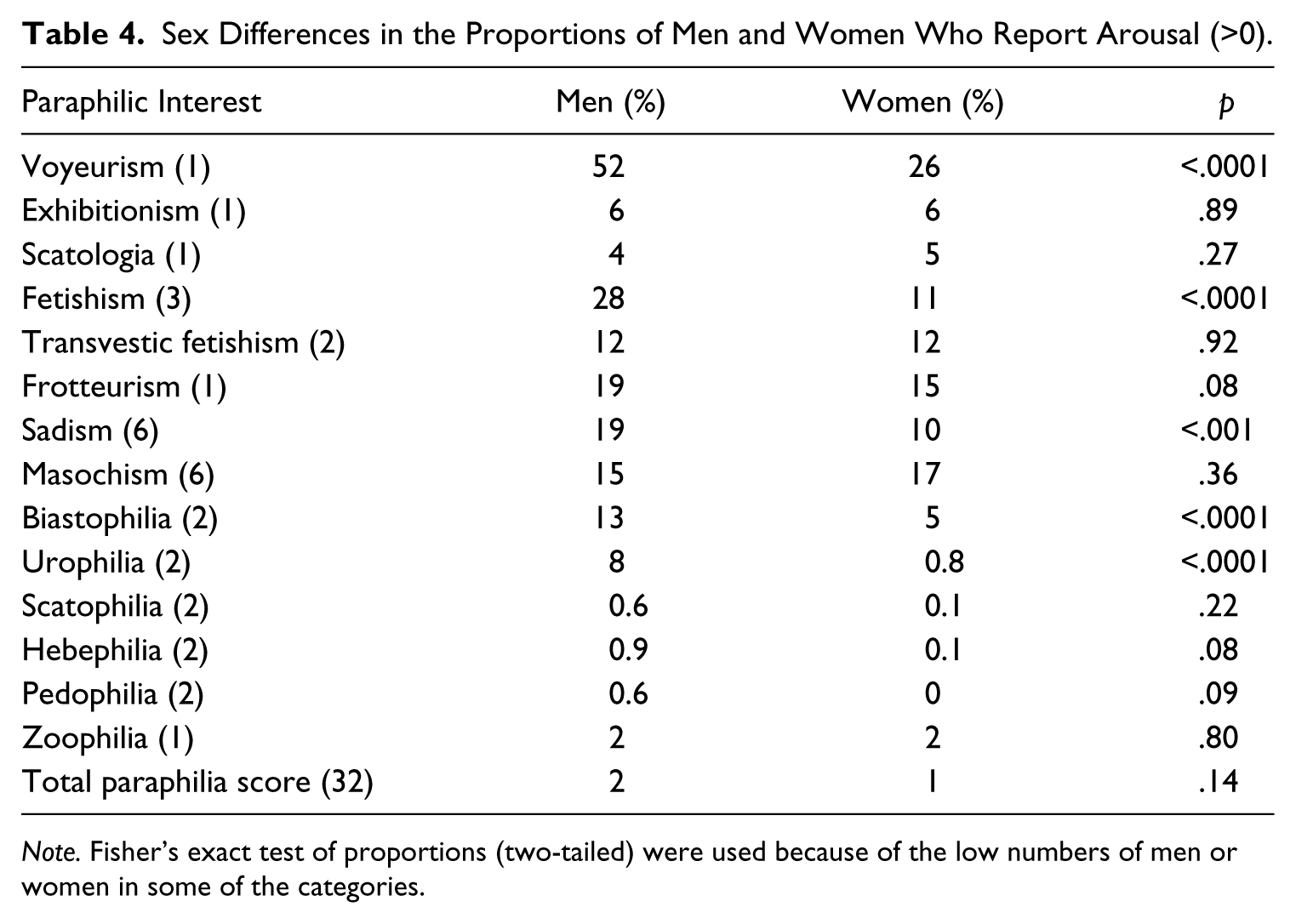
Note. Fisher’s exact test of proportions (two-tailed) were used because of the low numbers of men or women in some of the categories.
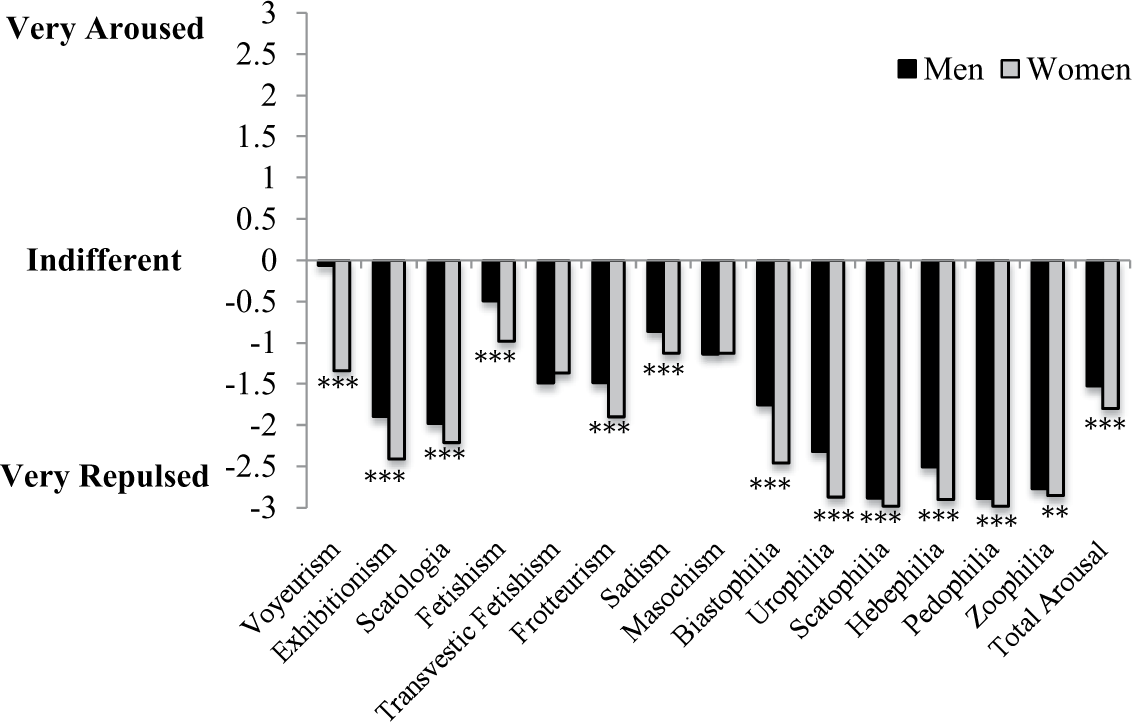
Self-Reported Aversion/Arousal to Paraphilic Activities (subscales) for men and women.
Mediators of the Sex Differences in Paraphilic Interests
Table 5 shows the correlations (Kendall Tau b) between the total paraphilia score (average of the 32 items) and the various correlates. As expected, the majority of variables were significantly correlated with the total paraphilia score for men and women. The only significant sex differences in the size of the correlations were for the two constructs assessing masculinity and femininity (BSRI and LGD). Greater masculinity was positively associated with greater paraphilic arousal in women only. To examine the effects of the correlates on the observed sex difference, we conducted mediated regressions with multiple mediators, using the Preacher and Hayes (2008) indirect bootstrapping approach with 5,000 sampling iterations (see Table 6). Only the variables indicating sex drive produced a full mediation effect: The confidence interval did not contain 0, indicating that these three variables significantly mediated the relationship between sex and paraphilic arousal, and the regression coefficient representing the effect of sex was no longer significant. Table 6 shows the results for all the mediation analyses. Neurodevelopment and social desirability did not significantly mediate the sex difference in paraphilic arousal, whereas impulsivity, masculinity, and mating effort each partially mediated this effect.
Correlations Between the Hypothesized Correlates and Total Paraphilia Score for Men and Women.

Note. Number of participants used in correlation appear in parentheses. Significant correlations and differences based on Fisher’s z-transformation are bolded.
Bootstrap Multiple Mediation Models Examining the Effect of Sex (IV) on Total Paraphilia Score (DV) as Mediated Through Individual Correlates (M).

Note. If the confidence interval includes 0, there is no indirect mediation effect between the IV and the DV. If the confidence interval does not include 0, there is a partial or full mediation. Sex was dummy coded (male = 0, female = 1). B = unstandardized coefficients; IV = independent variable; DV = dependent variable; SE = standard error; CI = confidence interval.
To examine the effects of sex drive on the paraphilia with the largest observed sex difference (voyeurism), we conducted mediated regressions with multiple mediators using the same approach. The bootstrapped result produced a value showing a partial mediation effect (−.43; 95% confidence interval [CI] = [−.57, −.30]), B = −.85(SE = .15), t(844) = −5.82, p < .001, when the three correlates assessing sex drive were included as mediators. When mating effort was used as a mediator, there was also a significant partial mediation effect (.08; 95% CI = [−.19, −.02]), B = −1.01 (SE = .16), t(689) = −6.23, p < .001. The remaining variables did not significantly mediate the sex difference in arousal to voyeurism: neurodevelopment (.003; 95% CI = [−.04, .05]), impulsivity (−.05; 95% CI = [−.10, .002]), masculinity (−.06; 95% CI = [−.27, .13]), and social desirability (−.04; 95% CI = [−.09, .01]).
Discussion
The present study extends previous work on paraphilias by assessing paraphilic interests in a large nonclinical sample of men and women using an online methodology. First, we found significant and widespread sex differences in arousal/repulsion to paraphilic activities, such that men reported less repulsion to the majority of paraphilic interests that were assessed, and more men than women reported being aroused by a variety of paraphilic acts. Second, we found evidence of comorbidity of paraphilic interests. Third, sex drive appears to provide the best explanation for the sex difference in paraphilic interests.
Replicating previous research, men reported significantly greater interest in (less repulsion to) the majority of paraphilic activities than women (Långström & Seto, 2006; Långström & Zucker, 2005; Richters et al., 2008). Women did not report lesser repulsion or greater arousal than men for any of the paraphilic acts. Given that our sample was large, differences were likely to be detected. Voyeurism, biastophilia, hebephilia, fetishism, and urophilia all produced medium effect sizes (ds = 0.48-0.66), while sadism, frotteurism, exhibitionism, pedophilia, and scatophilia exhibited small but still significant effect sizes (ds = 0.22-0.39). A similar male-biased sex difference was observed when comparing the proportions of men and women who reported being aroused by the various paraphilic activities.
Previous research has reported comorbidity among paraphilias in either general, clinical, or forensic samples (Abel et al., 1988; Bradford et al., 1992; Freund, Seto, & Kuban, 1997; Långström & Seto, 2006). The findings of the current study provide indirect support for comorbidity in paraphilias, in that many of the paraphilia subscales were highly correlated (e.g., sadism and masochism, exhibitionism and voyeurism). Freund et al. (1997) reported a similar comorbidity among male paraphiles with regard to the courtship disorders (e.g., exhibitionism and voyeurism). This comorbidity suggests the possibility of a common etiological factor contributing to interest in not one, but multiple paraphilias. Our results suggest that sex drive may be a strong candidate.
Measures associated with excessive or compulsive interests in sex as well as an unrestricted sociosexuality were most strongly correlated with paraphilic interests in both men and women. Greater degrees of impulsivity and sensation-seeking were also associated with greater paraphilic interest, suggesting that low levels of inhibition (in general) may lead to the development of atypical sexual interests. Interestingly, greater degree of masculinity (i.e., assertiveness and dominance) was significantly correlated with paraphilic interest in women only. This suggests that gender roles may be an important factor in the development of sexual interests in women.
We did not find a significant association between indicators of neurodevelopmental perturbations and atypical sexual preferences in men, as had been found in other studies (Cantor et al., 2004; Rahman & Symeonides, 2008). Non-right-handedness was weakly associated with paraphilic interests among women. Despite using the same measure as Cantor et al. (2004) to assess handedness, we did not replicate an association with pedophilic interests (Cantor et al., 2004) in men. There might not have been sufficient variation in pedophilic interest in this sample to detect such a correlation (only two men reported arousal to sex with children and the average arousal rating for pedophilia was very close to “very repulsive”). Furthermore, our study relied on self-report measurement of neurodevelopmental stressors and therefore may not have been sufficiently sensitive to detect these perturbations. Physiological measurement of fluctuating asymmetry and other developmental insults may have been better able to detect a relationship—if there was one—with paraphilic interests. Another possibility is that non-right-handedness and neurodevelopmental stress may only be related to paraphilias or paraphilic disorders, but not paraphilic interests.
This study is one of the first to attempt to elucidate the factors that influence the development of paraphilias and more specifically the sex differences thereof. Sex drive, comprised of measures assessing sexual compulsivity and hypersexuality, was found to significantly and fully mediate the sex difference in overall paraphilic scores. Studies have consistently found that men report a higher sex drive than women and are more motivated to pursue sexual opportunities (for a review, see Baumeister et al., 2001). Kafka (1994) proposed a subtype of sexual disorders—paraphilia-related disorders (PRDs)—that involve persistent and intensified sexual arousal and that are often comorbid with paraphilias. The finding that measures of sex drive and hypersexuality are related to paraphilic interests provides support for this notion and suggests that hypersexuality and paraphilias may stem from similar etiological origins. This finding replicates and extends previous work by demonstrating that sex drive is not only relevant for clinical samples of paraphiles (Kafka, 1997a, 2009; Kafka & Hennen, 2003) but also relevant for nonclinical samples (Långström & Hanson, 2006; Långström & Seto, 2006).
We theorize that because of sex differences in baseline levels of sex drive, men will present more often with paraphilias. People who have a low sex drive may expend their limited sexual energy toward their preferred sexual target and activity resulting in minimal interest in or motivation to pursue other sexual activities and fantasies, whereas people who have a high sex drive may choose to expend their vast energy toward not only their preferred targets and activities (which in most cases will be nonparaphilic), but also other targets and activities as well, including atypical ones. Baumeister and colleagues (2001) reported that sex drive motivates liking of various sexual practices. Similarly, individuals with high sex drives might habituate more readily to a particular sexual target and activity, motivating them to pursue novel targets and activities. Finally, high sex drive may also counteract the baseline sexual disgust and aversion that is associated with various sexual activities (see de Jong, van Overveld, & Borg, 2013). This theory could also explain why many paraphilias tend to co-occur, because high sex drive would produce a general effect on sexual arousal, behaviors, and fantasies.
Thus, the theory we propose is that a high sex drive motivates interest in atypical sexual activities and perhaps contributes to its development. This notion is somewhat at odds with Lippa’s (2006) finding that a high sex drive energizes attraction to one’s preferred gender only. Indeed, Lippa found that, in men, a higher sex drive is associated with self-reported attraction to their preferred gender (and not their nonpreferred gender); in women, a higher sex drive was associated with attraction to both genders. It is possible that this effect is specific to gender preferences. We found something very similar in this sample.
In our sample, TSO and hypersexuality were significantly and positively correlated with arousal to “having sex with an adult woman” (r = .14 and r = .23, respectively) among heterosexual men (n = 282), but not correlated with arousal to “having sex with an adult man” (r = .05, r = .03, respectively). Sexual compulsivity was not significantly associated with arousal to “having sex with an adult woman” or “having sex with an adult man” (r = .04 and r = .07, respectively). Among heterosexual women (n = 616), TSO, hypersexuality, and sexual compulsivity were each significantly and positively correlated with arousal to “having sex with an adult woman” (r = .20, r = .28, and r = .13, respectively) and “having sex with an adult man” (r = .17, r = .17, and r = .14, respectively).
Clearly, in our study, sex drive was not associated with greater specificity of interest (except for gender, in men, as found by Lippa, 2006), because it was associated with higher arousal ratings for most paraphilic activities, and arousal to various paraphilic activities was correlated. Nevertheless, we examined whether individuals with high sex drive who also report high arousal to nonparaphilic sex were to simultaneously report lower or higher arousal to paraphilic activities. We created a median split for each of the three sex drive measures. Heterosexual men who had high sex drive showed small but positive correlations between “having sex with an adult woman” and the total paraphilia score (r = .11, r = .14, and r = .12, respectively). It thus seems that Lippa’s (2006) notion that sex drive energizes interests in preferred targets is specific to gender rather than activity preferences, but much more work is required before concluding anything on this matter.
Limitations
The results of the current study may have been affected by the specific measures used to assess the constructs. While we aimed to use measures that were well-validated and designed to assess each construct, it is possible that some constructs were better measured than others and therefore had a greater chance to mediate the sex difference. Thus, the finding that sex drive mediated the sex difference in paraphilic interests may simply indicate that sex drive was the best-measured construct; however, this explanation is unlikely given that several other constructs (e.g., social desirability, masculinity, and mating effort) were assessed using measures that have been extensively validated in a variety of samples (Lippa & Arad, 1997; Paulhus, 1991; Simpson & Gangestad, 1991). Nevertheless, the findings should be replicated using other measures, including non-self-report measures. Also, other constructs should be considered as possible mediators (e.g., sexual aversion).
The measures used to assess sex drive in the current study were more reflective of pathological or dysregulated sex drive rather than general sexual desire (e.g., Sexual Desire Inventory [SDI]; Spector, Carey, & Steinberg, 1996). It is reasonable to predict that dysregulated sexuality might be highly correlated with paraphilic interests, especially if the two result from similar developmental processes. Perhaps indicators of unproblematic sex drive would not mediate the sex difference in paraphilic interest. There is recent evidence, however, suggesting that hypersexuality and sexual desire or sex drive lie on the same continuum (Walters, Knight, & Långström, 2011; Winters, Christoff, & Gorzalka, 2010). Nevertheless, that possibility should be examined in future research.
The current study relied entirely on self-report, which may have been affected by response biases other than social desirability. For instance, Catania, McDermott, and Pollack (1986) reported that the threat associated with disclosing information about one’s sexuality may elicit report bias. Given the sensitive nature of data collected in the current study, it is possible that participants did not report their sexual interests honestly or that their responses were subject to other biases. It is unclear whether there would be a sex difference in this pattern, and how this would (if at all) affect the current findings. A strength of the current study is its online methodology, in which participants likely felt greater anonymity (i.e., no identifying or personal information was collected) when reporting their sexual interests. Studies comparing online versus offline surveys report that online surveys elicit greater self-disclosure (Richman, Kiesler, Weisband, & Drasgow, 1999) and an increased willingness to answer questions of a sensitive nature (Tourangeau, 2004).
Although the current study boasts a large sample size, this sample was comprised mainly of university students. Younger individuals may be more prone to sexual experimentation (Herbenick et al., 2010), affecting their endorsement of paraphilia-related items. For these reasons, our findings may not be generalizable. Similarly, there is a self-selection bias in sexuality research, such that volunteers differ from nonvolunteers in their degrees of sexual openness and sexual experience (Strassberg & Lowe, 1995). Thus, the results of the current study may be specific only to persons who volunteer for sexuality studies. Future studies should aim to recruit a more diverse sample in terms of age, ethnicity, and occupation.
Finally, longitudinal studies are required to determine the causal status of sex drive, other factors in the development of paraphilic sexual interests, and the sex differences thereof. Implicit measures of sexual interest (e.g., looking time or gaze patterns) could be used to assess emerging paraphilic and nonparaphilic interests in children or adolescents, along with putative contributing factors. Such studies would be extremely informative.
Conclusion
Our results suggest a reliable and substantial sex difference in paraphilic interests, such that men report less repulsion to a variety of paraphilic acts than do women, and more men than women report being actually aroused by particular paraphilic activities. This study extends findings from clinical and forensic studies of paraphilias, providing evidence of relative prevalence and comorbidity for both sexes. The reported effect sizes for the sex difference suggest that the difference in paraphilias is real and important. Controlling for social desirability did not attenuate the sex difference in arousal, which eliminates this type of report bias as an explanation for why men report greater interest in paraphilias than women. These findings also point toward the role of sex drive in the development of paraphilic interests in both women and men. Future research is needed to better understand the role of other aspects of sexuality, for instance, general sexual inhibition and excitation, on the development of paraphilic interests.
Footnotes
Appendix
Acknowledgements
The authors wish to acknowledge the financial support of the University of Lethbridge and the useful comments provided by the following individuals: Katrina Bouchard, Meredith Chivers, Jackie Huberman, Lesleigh Pullman, Megan Sawatsky, Michael Seto, and Kelly Suschinsky.
Declaration of Conflicting Interests
The author(s) declared no potential conflicts of interest with respect to the research, authorship, and/or publication of this article.
Funding
The author(s) disclosed receipt of the following financial support for the research, authorship, and/or publication of this article: This study was supported by the University of Lethbridge.
References
Supplementary Material
Please find the following supplemental material available below.
For Open Access articles published under a Creative Commons License, all supplemental material carries the same license as the article it is associated with.
For non-Open Access articles published, all supplemental material carries a non-exclusive license, and permission requests for re-use of supplemental material or any part of supplemental material shall be sent directly to the copyright owner as specified in the copyright notice associated with the article.
