



Abstract
This study examined the demographic and background characteristic differences between those arrested for child pornography (CP) possession (only), or CP production/distribution, or an attempted or completed sexual exploitation of a minor (SEM) that involved the Internet in some capacity within the context of self-control theory using data from the second wave of the National Juvenile Online Victimization Study (N-JOV2). Results indicate few demographic similarities, which thereby suggest these are largely heterogeneous groupings of individuals. Results also indicate CP producers/distributers engaged in a greater number of behaviors indicative of low self-control compared with CP possessors. Specifically, offenders arrested for CP production/distribution were more likely to have (a) had problems with drugs/alcohol at the time of the crime and (b) been previously violent. In contrast, the only indicator of low self-control that reached statistical significance for CP possessors was the previous use of violence. Moreover, in contrast to CP producers/distributers, full-time employment and marital status may be important factors to consider in the likelihood of arrest for CP possessors, which is congruent with the tenets of self-control theory.
Keywords
Although the rapid advancement of technology has produced substantial benefits for society, these improvements are overshadowed by the opportunities provided to online sexual offenders to engage in exploitation of children—particularly child pornography (CP; Babchishin, Hanson, & Hermann, 2011; Bourke & Hernandez, 2009; Endrass et al., 2009; Gillespie, 2008). Due to the unregulated nature of the Internet, the ease of obtaining, sharing, and selling CP has increased (Bourke & Hernandez, 2009). Indeed, referred to as the “Triple-A-Engine,” the Internet is accessible, affordable, and largely anonymous (Cooper & Griffin-Shelley, 2002)—a potent combination for law enforcement combating online sexual offenders.
This popularity stems from the opportunity for child pornographers to amass substantial amounts of images and videos for their own personal collections, as well as enabling them to distribute and exchange those images with others widely. Although a dearth of information exists regarding online sexual offenders, research identifying the most prominent types of offenses has recently emerged. These offenses include (a) meeting victims online, (b) CP production, (c) CP possession and distribution, and (d) using technology for the sexual exploitation of children (Wolak, Finkelhor, & Mitchell, 2004, 2005, 2009, 2012a, 2012b). Offender typologies specific to CP have also emerged. Online sexual offenders may (a) access CP out of curiosity, (b) access CP to satisfy a sexual fantasy without actually engaging in a contact offense, (c) create and distribute CP for financial purposes, and (d) utilize the Internet as a medium to engage in a contact offense (Krone, 2004).
Unfortunately, despite these advancements, a dearth of information regarding differences among online sexual offenders is still present within the literature. An additional gap concerns the underutilization of criminological theories to frame analyses and findings regarding Internet pornography use (Buzzell, Foss, & Middleton, 2006). According to Higgins (2004), utilizing theoretical perspectives in empirical investigations is crucial for organizing and interpreting findings. As such, Higgins (2004) claims that empirical investigations absent of theoretical perspectives are merely just groupings of facts. Therefore, the goal of this exploratory research is to examine differences among online sexual offenders—with an emphasis placed on child pornographers—using Gottfredson and Hirschi’s (1990) self-control theory.
CP Possessors and Producers/Distributers
Despite recognition of CP as a serious social problem, empirical analyses are very limited due to various methodological challenges (e.g., small samples, reliance on convenience sampling, etc.). However, some characteristics have been relatively consistent across studies. For example, in one study focusing on arrested Internet child pornographers, offenders were typically 26 years old or above and non-Hispanic Caucasian (Wolak et al., 2012a, 2012b). These findings align with the experiences of Burke, Sowerbutts, Blundell, and Sherry (2002) who note that offenders who access CP on the Internet are typically between the ages of 25 and 50 years. Finally, in a comprehensive meta-analysis conducted by Babchishin et al. (2011), findings indicated that online offenders tended to be younger, Caucasian, have greater victim empathy, exhibit greater sexual deviancy, and engage in less impression management compared with offline offenders. This has led some to suggest the possibility that online sexual offenders represent a distinct type of offender: one who demonstrates a greater level of self-control compared with offline sex offenders (Babchishin et al., 2011).
As a result of the scant research investigating demographic and background characteristic variations among different types of child pornographers, laypersons often assume homogeneity among this offender group. Yet, several studies have uncovered information indicating that there are different subsets of child pornographers (Alexy, Burgess, & Baker, 2005). For example, some child pornographers may only view, collect, and/or trade images without actually ever engaging in a contact offense—essentially taking an inactive role 1 (Krone, 2004; Quayle & Taylor, 2002). In contrast, studies have also found that other child pornographers go well beyond simply “possessing” illicit material, and actively engage in the victimization and exploitation of children (Alexy et al., 2005; Bourke & Hernandez, 2009; Krone, 2004).
Although both types of child pornographers warrant attention from law enforcement, in a recent study focusing on arrested offenders, a greater majority of individuals possessed rather than produced CP (Mitchell, Jones, Finkelhor, & Wolak, 2011). Moreover, a relatively recent study investigating the overlap between possession and production found that merely consuming CP alone was not a risk factor for engaging in a contact offense (Endrass et al., 2009). These findings support the statement that CP possessors may collect illicit material out of curiosity, sexual arousal, or for other reasons (Wells, Finkelhor, Wolak, & Mitchell, 2007). Because the aforementioned pattern among CP possessors has only emerged relatively recently, scholars have yet to fully explore whether there are distinguishing characteristics between the two groups: CP possessors and CP producers/distributers. For example, virtually no studies have explored whether indicators of self-control can distinguish CP possessors from CP producers/distributers. The aforementioned topic is ripe for investigation as it can assist law enforcement, practitioners, and other scholars in understanding why some CP possessors view illicit material without engaging in a contact offense.
In contrast to CP possessors, CP producers typically utilize illicit material in combination with other behaviors (Merdian, Curtis, Thakker, Wilson, & Boer, 2013). Indeed, arrests of CP producers are on the rise and have more than doubled between 2006 and 2009 (Wolak et al., 2012b). This increase may be the due to the increase in attention to this topic. For example, in one noteworthy study on CP production, the implementation of specialized task forces, as well as increasing the number of sworn officers, led to an increase in investigations and arrests (Marcum, Higgins, Ricketts, & Freiburger). In addition, as more individuals were trained to conduct computer forensic investigations there was a corresponding increase in successful investigations and arrests (Marcum & Higgins, 2011).
In contrast, Wolak et al. (2012b) attribute the increase to a greater number of youth-produced sexual images, although the majority of those arrested were adults who had solicited the illicit material from victims. In reviewing cases involving adult-produced images, data indicate a greater proportion of CP producers were family members and were 26 years old or above (Wolak et al., 2012b). Although the aforementioned studies add to the overall dearth of information about CP, one area necessitating empirical attention is whether low self-control increases an offender’s likelihood of engaging in a contact offense (Babchishin et al., 2011). Our study contributes important information as to why some CP offenders possess illicit material, but stop short of engaging in a contact offense—perhaps due to their level of self-control.
Self-Control Theory
Understanding of cybercrime has greatly expanded throughout the years. Gottfredson and Hirschi’s (1990) self-control theory has successfully framed various types of cybercrime (e.g., [music piracy] Hinduja, 2012; [cyberdeviance] Holt, Bossler, & May, 2012; [computer crime] Moon, McCluskey, McCluskey, & Lee, 2013), yet the applicability to online sexual offenders remains largely unexplored and is sorely needed (Babchishin et al., 2011).
According to Gottfredson and Hirschi’s (1990), individuals lacking in self-control engage in crime due to the immediate benefits it provides. In other words, self-control theory assumes humans are rational creatures, and that individuals lacking in restraint may disregard the potential consequences of crime to achieve the momentary benefits it provides (Hirschi & Gottfredson, 1993). To test the theory, Hirschi and Gottfredson (1993) note that behaviors such as cautiousness, drug use, and temper are related to self-control, and “they too may be used as indicators of it” (p. 49).
Although there have been no studies (to the best of our knowledge) that have explored whether low self-control can assist law enforcement, practitioners, and other scholars in distinguishing CP possessors from CP producers/distributers, other studies have demonstrated that self-control is related to online pornography use as well as general cyberdeviance (Buzzell et al., 2006). Indeed, Buzzell et al. (2006) note that self-control theory is particularly applicable to studies involving pornography use, because consumption of this material has been associated with behaviors potentially indicative of a propensity toward deviance (e.g., sexual aggression). Despite the success in applying self-control theory to various cybercrimes, this perspective has also garnered criticisms from scholars—chief of which is the issue of tautology.
According to Geis (2000), self-control theory is frequently criticized as a tautological perspective of crime. In Akers’s (1991) words (p. 204), “They [crime and low self-control] are one and the same, and such assertions about them are true by definition.” Responding to this frequent criticism, Hirschi and Gottfredson (1993) assert that their framework does not equate to a “predisposition” to commit crime. Rather, self-control is a barrier that prevents individuals from engaging in crime and that the link between the two is not deterministic (Hirschi & Gottfredson, 1993). Further supporting their position, Hirschi and Gottfredson cite Akers’s statements advising scholars on how to avoid tautology in their utilization of self-control theory. Per Akers, tautology can be avoided by utilizing independent indicators of self-control such as: smoking and drinking, interpersonal relationship difficulties, and employment instability (indicators proposed by Hirschi & Gottfredson, 1993). Taking into account that none of the aforementioned are crimes, Hirschi and Gottfredson note that the relationship between the actions and crime is not a matter of definition, thereby dismissing the charges of tautology.
Statement of the Problem
In reviewing the literature, several gaps are readily apparent. First, there is an overall dearth of information regarding differences among various types of online sexual offenders. Specifically, little is known about what demographic/background similarities exist between offenders arrested for possessing CP and offenders arrested for producing/distributing CP. This knowledge would contribute important information to a persistent debate regarding whether CP possessors and CP producers/distributers comprise different types of offenders associated with different levels of risk. Second, despite the wide usage of self-control theory in other areas of cybercrime, there is a substantial lack of information regarding the applicability of this perspective in understanding online sexual offenders—particularly CP. Third, if self-control theory can assist law enforcement, practitioners, and other scholars in understanding differences among online sexual offenders, information regarding what specific indicators of low self-control are applicable is sorely needed. Therefore, our three research questions are as follows:
Method
Sample
This study utilized arrest record data from the second wave of the National Juvenile Online Victimization Study—collected through a nationally representative sample of law enforcement agencies (N-JOV2; Finkelhor et al., 2012 ). These data included arrest cases occurring during the 2006 calendar year, and were collected utilizing a complex sample design that consisted of two phases (Finkelhor et al., 2012). In the first phase, a mail survey was sent to 2,598 state, county, and local law enforcement agencies, which inquired about CP and sexual offense cases stemming from an initial online interaction (Finkelhor et al., 2012; Mitchell et al., 2009). In the second phase, individual agency interviews were conducted with those organizations that reported eligible cases through the mail surveys (N = 1,063; Finkelhor et al., 2012; Mitchell et al., 2009). After excluding duplicate cases (n = 12), a total of 1,051 arrest cases 2 remained for wave 2 (Mitchell et al., 2009). However, due to the amount of data lost through listwise deletion and our resulting inability to ensure that characteristics of the multivariate sample were consistent with the larger sample at the univariate and bivariate levels, we also removed cases with missing data on any measures resulting in an additional loss of 296 cases.
Analytical Strategy
Our study to investigate demographic and background differences (see Table 1) among arrested online sexual offenders (but primarily those arrested for CP possession vs. production/distribution) began by conducting a series of bivariate analyses. After the bivariate analyses, we estimated the multinomial logistic regression (MLR) modeling offenders’ characteristics and offense types. In these analyses, the reference category was offenders arrested as the result of an attempted or completed sexual exploitation of a minor (SEM) that involved the Internet in some capacity. 3 Apart from investigating demographic/background differences, an additional area of interest was determining which indicators of low self-control were applicable in each offense type.
Descriptive Statistics.
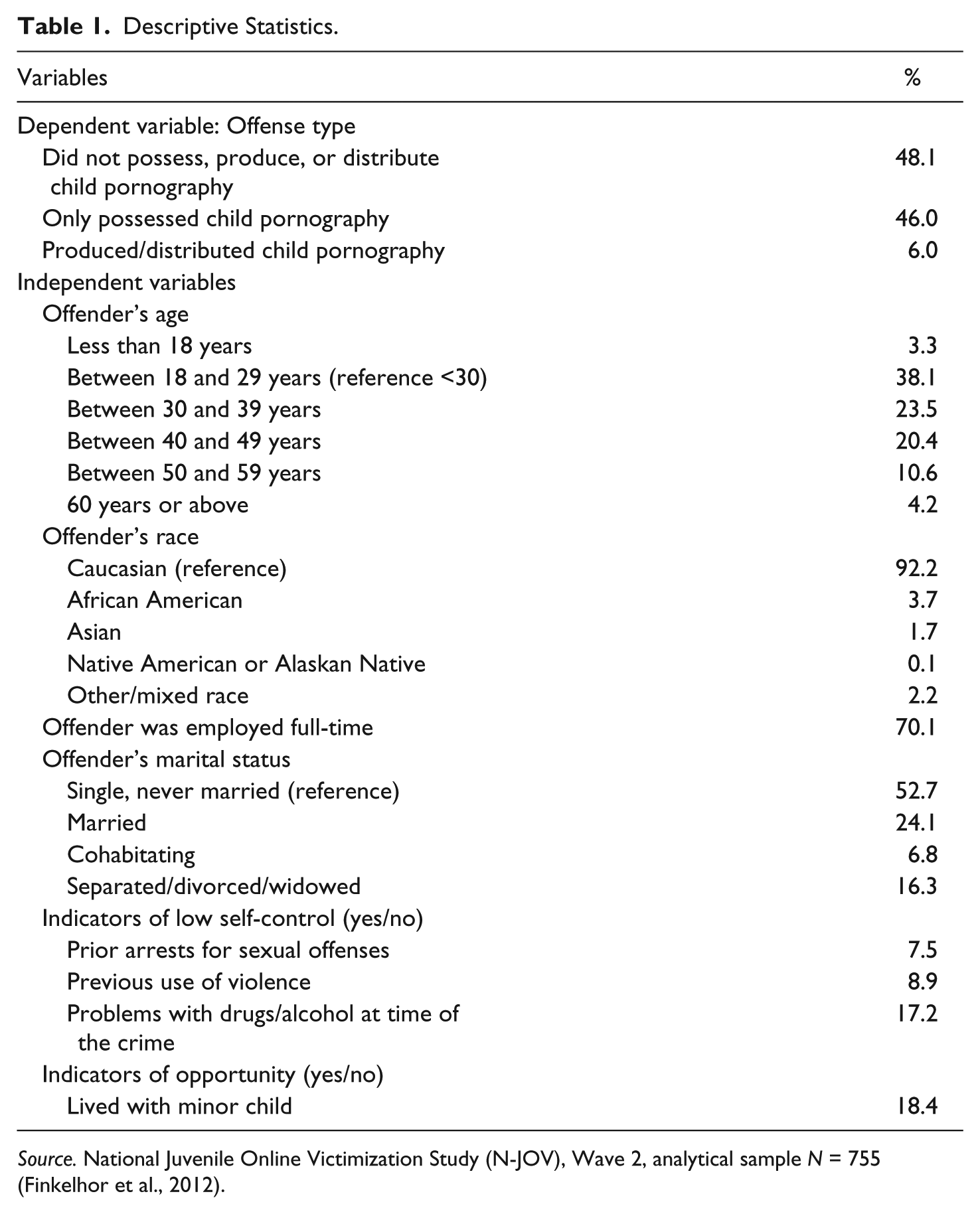
Source. National Juvenile Online Victimization Study (N-JOV), Wave 2, analytical sample N = 755 (Finkelhor et al., 2012).
Multivariate data analysis
This study utilized unconstrained MLR modeling as the dependent variable was comprised of three different outcomes with no natural ordering (Hamilton, 2013). Similar to odds ratios produced through binary logistic regression, relative risk ratios (RRRs) produced through MLR “describe the multiplicative effect of a unit increase in each predictor of the odds of one category versus the base category” (Hamilton, 2013, p. 274). In other words, RRRs indicate the favor of one outcome (e.g., being arrested for CP possession) relative to the comparison group (i.e., being arrested for an attempted or completed SEM that involved the Internet in some capacity) given the presence of a particular variable (e.g., previous use of violence; Hamilton, 2013).
Measures
Dependent variable
The dependent variable used in these analyses was comprised of three groups: offenders arrested as the result of an attempted or completed SEM (hereafter, “SEM offense”; 48%), offenders who possessed CP but did not produce/distribute (46%), and CP producers/distributers (6%).
Opportunity
In addition to low self-control, Hirschi and Gottfredson (1993) emphasize the role of opportunity to either engage in or experience crime. To measure opportunity, we included a question (yes/no) indicating whether offenders had access to minors through their living arrangements (yes = 18%).
Indicators of low self-control
The following variables (all yes/no) were included in this study as indicators of low self-control: offenders’ problems with drugs/alcohol at the time of the crime (yes = 17%), offenders’ prior arrest for sexual offending (yes = 8%), and offenders’ previous use of violence (yes = 9%). The indicators utilized in this study were selected taking into account Hirschi and Gottfredson’s (1993) recommendation that low self-control should ideally be assessed using behavioral scales that measure participation in various risky behaviors. Thus, when selecting indicators of low self-control for this study, the researchers paid particular attention to claims from Gottfredson and Hirschi (1990, p. 90) that “people lacking in self-control will also tend to pursue immediate pleasures . . . they will tend to smoke, drink, use drugs.” Indeed, although many studies utilize the low self-control scale created by Grasmick, Tittle, Bursik, and Arneklev (1993), the role of alcohol use as a stand-alone indicator of low self-control has also been empirically supported in the literature (Keane, Maxim, & Teevan, 1993). Regarding offenders’ previous use of violence, this measure was included based on Hirschi and Gottfredson’s assertion that an additional indicator of low self-control is interpersonal relationship difficulties. In addition, offenders’ previous use of violence was included because it is similar in nature to the “temper” attitudinal component of Grasmick et al.’s scale, and the inability to restrain one’s anger to resolve conflict in a pro-social manner was intuitively in line with the concept of “self-control.” Finally, a meta-analysis conducted by Pratt and Cullen (2000) found that self-control was an important predictor of crime regardless of how it was measured (attitudinal vs. behavioral).
Offender demographic and background variables
Age was included in the analyses. The original categorical variable indicated that approximately 3% of offenders were less than 18 years old, 38% were 18 to 29 years old, 24% were 30 to 39 years old, 20% were 40 to 49 years old, 11% were 50 to 59 years old, and 4% were 60 years old or above. Due to low cell frequencies, age categories were collapsed further into the following groups: less than 30 years (41%), between 30 and 39 years (23%), between 40 and 49 years (20%), and 50 years or above (15%). Offenders younger than 30 served as the reference group for this study.
Race was included in these analyses. Most offenders were Caucasian (92%); however, 4% were African American, 2% were Asian, 2% were another category of race or of mixed descent, and less than 1% were Native American/Alaskan Native. To conduct the analyses, this variable was dichotomized and Caucasians served as the reference group (Caucasian = 92%; Minority = 8%).
Full-time employment status (yes/no) was included in the analyses, and indicated approximately 70% of offenders were employed full-time at the time of the crime.
Marital status was included in the analyses and indicated that approximately 53% of offenders were single and had never been married at the time of the crime. A smaller percentage (24%) were married, cohabitating or living with a partner (7%), or separated/widowed (16%) at the time of the crime. Due to low cell frequencies, marital status was collapsed further into the following groups: single, never married (52%), married/cohabitating (31%), and separated, divorced, or widowed (17%). Single, never married served as the reference group.
Gender was not included in our analysis, as the sample is almost exclusively male (99%).
Results
Bivariate Analyses
Chi-square analyses revealed several significant associations between offender characteristics, including indicators of low self-control, and offense types (see Table 2). A significant association was found between offense type and offender’s age (χ2 = 61.45; p < .001). According to cross-tabulations, the largest proportion of offenders who did not engage in CP were less than 30 years old (56.9%). In contrast, the largest proportion of offenders who possessed CP were 50 years old or above (77.2%). Finally, the largest proportion of offenders who produced/distributed CP were between 30 and 39 years old (8.4%). In addition, chi-square analyses indicated significant associations between offense type and various measures of low self-control, such as: problems with drugs/alcohol at the time of the crime (χ2 = 23.52; p < .01), previous arrest for sexual offending (χ2 = 9.29; p < .01), and previous use of violence (χ2 = 24.96; p < .001). According to cross-tabulations, a greater proportion of CP possessors, compared with other offense types, had problems with drugs/alcohol at the time of their crimes, had been previously violent, and had prior arrests for sexual offenses.
Bivariate Analyses Comparing Offender Variables by Offense Types.
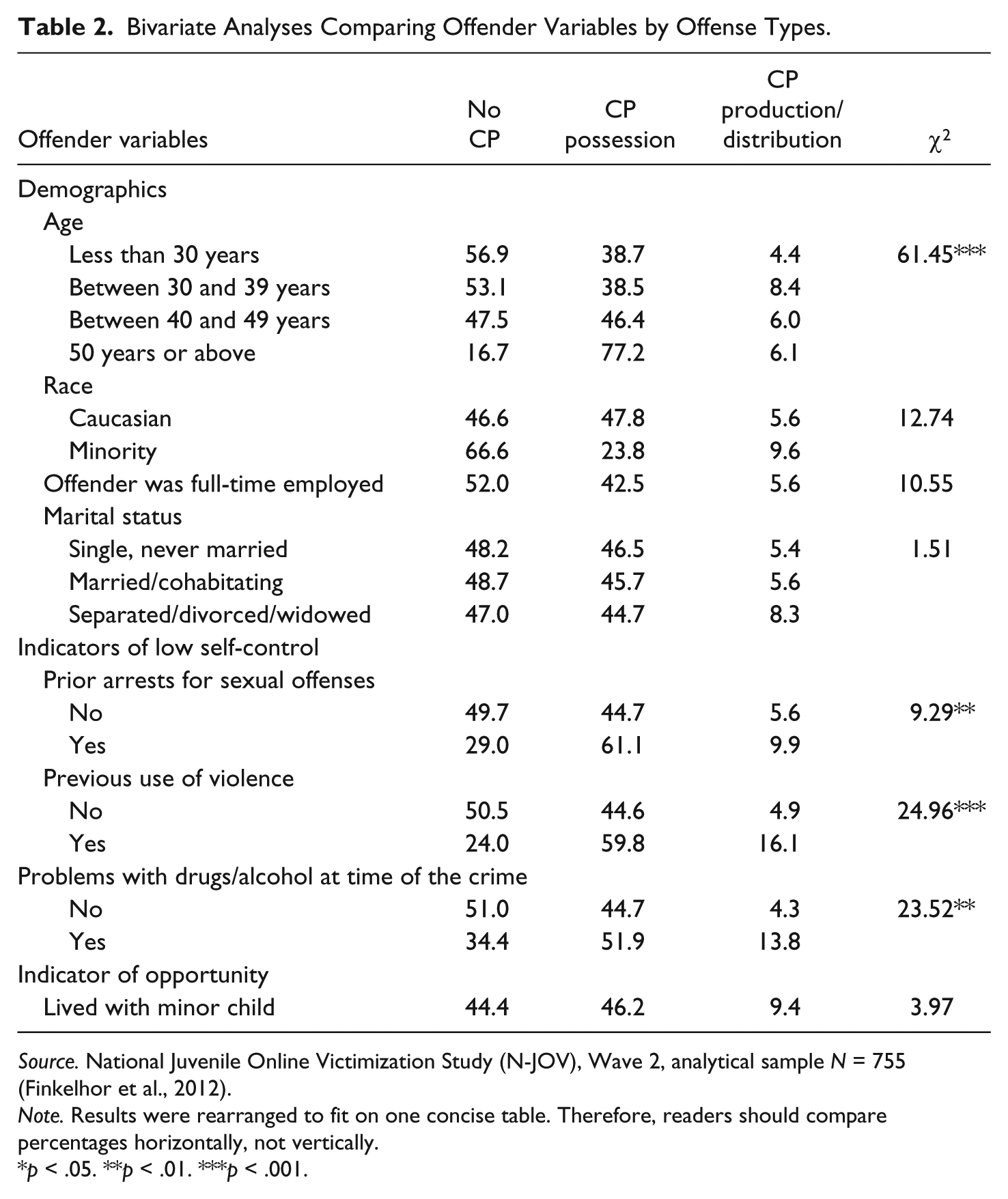
Source. National Juvenile Online Victimization Study (N-JOV), Wave 2, analytical sample N = 755 (Finkelhor et al., 2012).
Note. Results were rearranged to fit on one concise table. Therefore, readers should compare percentages horizontally, not vertically.
p < .05. **p < .01. ***p < .001.
MLR
The MLR model was significant (p < .001) and estimated the relative risk of offense types (CP possession, CP production/distribution, or a SEM offense) using offender demographic and background characteristics as well as three measures of low self-control and one measure of opportunity (see Table 3). For the purposes of interpretation, the reference category was “SEM offense” or offenders arrested for an attempted or completed SEM offense that involved the Internet in some capacity. Because the RRR and corresponding p values are already reported in Table 3, to avoid redundancy in the following section, results will be discussed in terms of effect size to add greater context to these findings—as scholars have advocated researchers to do (McGough & Faraone, 2009).
Multinomial Logistic Regression Assessing RRR of Offense Type Using Offenders’ Demographics, Indicators of Low Self-Control and Opportunity.
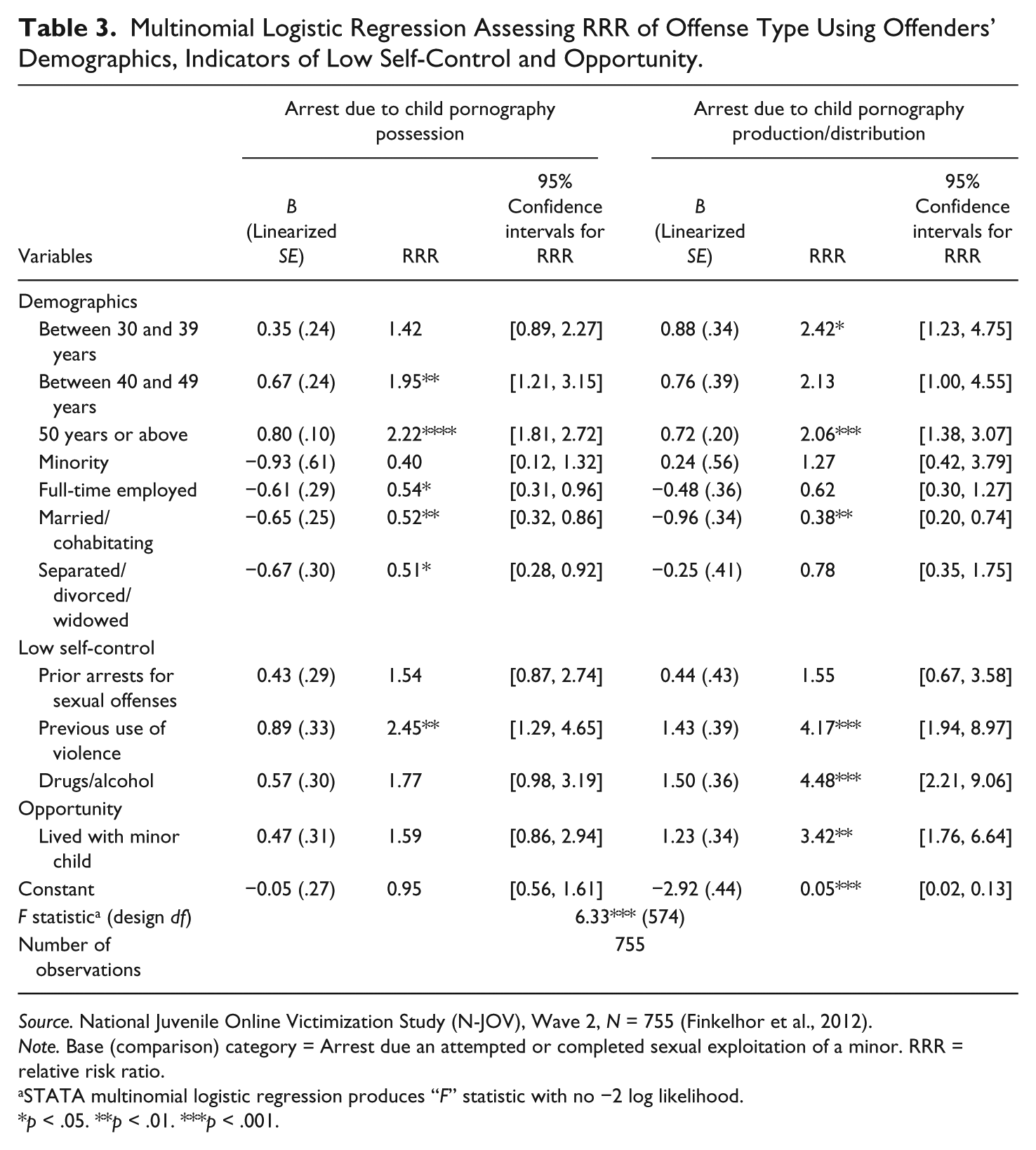
Source. National Juvenile Online Victimization Study (N-JOV), Wave 2, N = 755 (Finkelhor et al., 2012).
Note. Base (comparison) category = Arrest due an attempted or completed sexual exploitation of a minor. RRR = relative risk ratio.
STATA multinomial logistic regression produces “F” statistic with no −2 log likelihood.
p < .05. **p < .01. ***p < .001.
Child pornography possessors
Offender’s age had a medium effect on the relative risk of arrest for CP possession over arrest for a SEM offense. Offenders between 40 and 49 years old and 50 years of age or above had a twofold greater probability of arrest for CP possession over arrest for a SEM offense, compared with offenders less than 30, given the other variables in the model were held constant. Previous use of violence also had a medium effect on the relative risk of arrest for CP possession over arrest for a SEM offense. Offenders who had been previously violent had more than a twofold greater probability of arrest for CP possession over arrest for a SEM offense, given the other variables in the model were held constant. In contrast, there was a modest effect on the relative risk of arrest for CP possession over arrest for a SEM offense in terms of full-time employment and marital status: securing full-time employment or being married or separated (compared with single, never married) decreased the relative risk of arrest for CP possession over arrest for a SEM offense by more than half given the other variables in the model were held constant.
Child pornography producers/distributers
Offender’s age had a medium effect on the relative risk of arrest for CP production/distribution over arrest for a SEM offense. Offenders between 30 and 39 years old and 50 years of age or above had a twofold greater probability of arrest for CP production/distribution over arrest for a SEM offense given all the other variables in the model were held constant. Moreover, living with a minor child, having problems with drugs/alcohol, or previous use of violence all had large effects on the relative risk of arrest for CP production/distribution over arrest for a SEM offense. Specifically, offenders who used drugs/alcohol or had been previously violent had over a fourfold greater probability of arrest for CP production/distribution over arrest for a SEM offense given all the other variables in the model were held constant. In addition, living with a minor child resulted in over a threefold greater probability of arrest for CP production/distribution over arrest for a SEM offense given all the other variables in the model were held constant. In contrast, marital status had a medium effect on the relative risk of arrest for CP production/distribution over arrest for a SEM offense. Specifically, marriage or cohabitation decreased the probability of arrest by more than half given all the other variables in the model were held constant. Finally, there was a large effect on the relative risk of arrest for CP production/distribution when all predictor variables were at zero. The relative risk of arrest for CP production/distribution was less than a quarter of the risk of arrest for a SEM offense if offenders were: younger than 30, Caucasian, not full-time employed, not married/cohabitating or separated/divorced/widowed, with no indicators of low self-control, and who did not live with minor children. All other variables failed to reach statistical significance.
Limitations
Although this analysis produces new information about an elusive group of criminals, several limitations should be noted. First, these data were gathered through a nationally representative sample of law enforcement agencies and are based on information that was reported to the police; therefore, these results may not serve as an adequate representation of all online sexual offenders given the likelihood of underreporting. As a result, these findings should not be interpreted as representing all online sexual offenders, but all crimes of online sexual offenders that ended in arrest. Second, due to the method of data collection utilized (e.g., interviewing law enforcement officers); some information may contain inherent biases and/or be subject to inaccurate recall. Third, as noted by Keane et al. (1993), using imperfect operational definitions are often the costs of secondary data analysis. Due to our utilization of secondary data, we were limited in the measures available to assess low self-control and the statistical procedures that could be conducted. For example, due to the limitations of “survey” commands in STATA, we were unable to produce probability estimates. Finally, due to the small sample size and challenges presented by missing data, generalizations should not be drawn until replication can be conducted with a more robust sample.
Discussion
The main objective of this study was to discover whether indictors of low self-control distinguished CP possessors from CP producers/distributers using those who engaged in a SEM offense as a reference group. Investigation of the aforementioned not only potentially furthers knowledge about online sexual offenders among the academic community but can also assist law enforcement and practitioners in the field. Apart from our primary objective, this research also investigated whether demographic/background characteristics varied between CP possessors, CP producer/distributers, and arrestees who engaged in a SEM offense. Ultimately, the results of the MLR indicate that offenders’ demographic/background characteristics and indicators of low self-control can assist scholars in distinguishing between offense types.
Although there were a few similarities uncovered in our analyses (mainly concerning the role of age in arrest) our findings indicate that online sexual offenders are heterogeneous groupings of individuals as others have found in previous studies (Seto, Wood, Babchishin, & Flynn, 2012). For example, in this study, offenders arrested for CP production/distribution were more likely to have (a) had problems with drugs/alcohol at the time of the crime, (b) been previously violent, and (c) to be living with a minor child compared with those arrested for a SEM offense. These findings suggest that low self-control (problems with drugs/alcohol and previous violence) as well as opportunity (living with a minor child) increases risk of arrest for CP production/distribution. The aforementioned finding also supports previous research that highlights the role of opportunity in mediating low self-control (LaGrange & Silverman, 1999; Smith, 2004).
In contrast to CP production/distribution, the only indicator of low self-control that significantly increased the likelihood of arrest for CP possessors was previous use of violence (compared with those arrested for a SEM offense). Therefore, although arrested CP possessors still exhibited some indication of a lack of self-control, CP producers/distributers exhibited more indicators pointing to a lack of restraint. Moreover, the statistical significance of employment and marriage in reducing the likelihood of arrest for CP possession (compared with those arrested for a SEM offense) further supports the tenets of self-control theory. Individuals who are employed full-time and/or married arguably lead more stable lifestyles based on adequate socialization and higher levels of self-control compared with individuals whose employment and marital histories are unstable. Finally, although the primary purpose of this study was to investigate differences between offenders arrested for CP possession versus production/distribution, perhaps the most surprising results came through when reviewing the risk factors of arrest for offenders who engaged in a SEM offense.
The results of this study indicate that offenders who engaged in a SEM offense were less likely to have previously used violence compared with both CP groups and were also less likely to have had problems with drugs/alcohol at the time of the crime when compared with CP producers/distributers. Thus, the group that seemed to exhibit the greatest number of factors indicating self-control was offenders arrested for a SEM offense. This finding may be the result of the data included in this sample, which includes a nationally representative pool of law enforcement agencies—not all online sexual offenders themselves (Wolak et al., 2012a, 2012b). Another possibility could be that offenders arrested for engagement in an online SEM offense are different from offenders arrested for engagement in an offline SEM offense. For example, Wolak et al. (2009) note that many SEM offenders who used the Internet to solicit and victimize children targeted adolescents, instead of young children, and were honest about their sexual motives. Therefore, these results potentially indicate that the ongoing debate regarding whether there are differences between online and offline sexual offenders should continue and be further researched (Babchishin et al., 2011; Bourke & Hernandez, 2009; Seto et al., 2012).
Taking into account this study results, online sexual offenders may differ not in whether they have low self-control, but rather in the level of self-control they exhibit. We believe our results indicate CP possessors, although still indicating some lack of self-control, exhibit more restraint than those who engage in CP production/distribution. In addition, although these results indicate that the role of age is similar for CP possessors and CP producers/distributers, other demographic/background characteristics (i.e., marital status, employment) are important for further investigation. In addition, given the questions surrounding this study’s findings regarding offenders arrested for engagement in an online SEM offense, additional research focused specifically on this group is warranted. Finally, these results support self-control theory as a viable perspective for framing online sexual offending. However, again, additional investigation is necessary before firm conclusions can be drawn.
Implications and Future Research Directions
This study addressed several outstanding gaps in what is known about online sexual offenders—particularly child pornographers. This research indicates there may be differences in the level of self-control exhibited by online sexual offenders who solely possess CP versus those who produce/distribute the material. Moreover, future research should also consider specifically focusing on arrested offenders who engaged in a SEM offense that involved the Internet in some capacity. Overall, we believe our study supports the further investigation of self-control theory as a viable framework for assessing online sexual offending. Although this research demonstrates some relationship between self-control theory and CP, additional research needs to be conducted with more robust samples. Additional research focusing on the connection between opportunity and low self-control would also be insightful.
From a practical standpoint, the results of this research have preventive implications for law enforcement and practitioners in the field. As results indicate, CP possessors exhibited fewer signs of low self-control than CP producers/distributers. Thus, these results indicate that full-time employment and marital status may be important factors in the likelihood of arrest for CP possession. In contrast, due to the greater level of low self-control exhibited by CP producers/distributers, law enforcement and practitioners may need to utilize different strategies when interacting with this offender type. Indeed, within the CP producer/distributer offender group, full-time employment and marital status were not important factors affecting likelihood of arrest. Therefore, other methods of fostering pro-social behavior, as well as self-control, need to be utilized when attempting to change the behavior of these offenders. Ultimately, CP is a serious crime and both types (CP possessors and CP producers/distributers) contribute to the very actual harm of children. Therefore, additional studies are necessary to continue identifying similarities as well as differences between these groups to empower law enforcement and practitioners with the information necessary to halt abuse.
Footnotes
Authors’ Note
The data used in this publication were made available by the National Data Archive on Child Abuse and Neglect, Cornell University, Ithaca, New York, and have been used with permission. Data from National Juvenile Online Victimization Study (N-JOV2) were originally collected by Crimes Against Children Research Center, University of New Hampshire. The collector(s) of the original data, the funder(s), NDACAN, Cornell University, and their agents or employees bear no responsibility for the analyses or interpretations presented here.
Declaration of Conflicting Interests
The author(s) declared no potential conflicts of interest with respect to the research, authorship, and/or publication of this article.
Funding
The author(s) disclosed receipt of the following financial support for the research, authorship, and/or publication of this article: This study entailed a secondary data analysis. As such, the author(s) did not receive any financial support for the research, authorships, and/or publication of this article. However, the orginal data collectors did receive funding for the project, which was provided by U.S. Department of Justice, Office of Juvenile Justice, and Delinquency Prevention. The collector(s) of the original data, the funder(s), National Data Archive on Child Abuse and Neglect (NDACAN), Cornell University, and their agents or employees bear no responsibility for the analyses or interpretations presented here.