



Abstract
Although executive dysfunctions are commonly hypothesized to contribute to sexual deviance or aggression, evidence of this relationship is scarce and its specificity is unproven, especially among adolescents. The objective of this study was to compare the executive functioning (EF) of adolescents with sexual offense convictions (ASOC) to that of non-sex-delinquents (NSD). A secondary goal was to assess the relationship among specific sexual offense characteristics (i.e., victim age), history of childhood sexual abuse (CSA), and EF. It was hypothesized that as a group, ASOC would present similar EF profiles as NSD. It was further hypothesized that ASOC with child victims would present significantly higher rates of CSA and more severe impairment of EF than ASOC with peer-aged or older victims and NSD. A total of 183 male adolescents (127 ASOC and 56 NSD) were interviewed to collect demographic information, sexual development history, history of CSA, an assessment of living conditions, and history of delinquency and sexual offending. Participants were administered the Delis–Kaplan Executive Functioning System and the Hare Psychopathy Checklist–Youth Version. In accord with the first hypothesis, ASOC and NSD presented similar EF scores, well below normative values. Thus, EF deficits may not characterize the profiles of adolescents with sexual behavior problems. Contrarily to our second hypothesis, however, offending against children and or experiencing CSA were not associated with poorer EF performance. On the contrary, ASOC with child victims obtained significantly higher scores on measures of higher order EF than both ASOC with peer-aged or older victims and NSD. Implications of these results and future directions are discussed.
Introduction
Because sexual deviance and sexual aggression are associated with brain dysfunctions and anomalies, it is commonly hypothesized that individuals with sexual behavior problems should present neuropsychological impairments (Blanchard, Cantor, & Robichaud, 2006; Joyal, Black, & Dassylva, 2007). Leading theories even posit a causal link between neuropsychological deficits and sexual deviance (Ward, Polaschek, & Beech, 2006). A growing number of neuropsychological studies have focused on executive functioning (EF) among individuals convicted for sexual offenses as impairments of capacities such as self-regulation, planning, judgment, and inhibition might contribute to sexual offending (Cohen, Nesci, Steinfeld, Haeri, & Galynker, 2010; Eastvold, Suchy, & Strassberg, 2011; Schiffer & Vonlaufen, 2011; Suchy, Whittaker, Strassberg, & Eastvold, 2009). If replicated, results indicating differences in EF between sex offenders and non-sex-offenders would imply that neuropsychological assessments may be useful in elucidating the cognitive correlates, if not the etiology, of maladaptive sexual behaviors. The specificity and significance of EF impairments among individuals with sexual behavior problems, however, remain unclear for several reasons (Cohen et al., 2002; Pflugradt & Allen, 2010). First, deficits in EF are not found exclusively among those convicted for sexual offenses and are closely associated with general delinquency factors such as impulsivity, risk taking, substance abuse, and violence (Morgan & Lilienfeld, 2000; Ogilvie, Stewart, Chan, & Shum, 2011; Seguin, Boulerice, Harden, Tremblay, & Pihl, 1999). Second, subgroups of sex offenders might show different neuropsychological profiles. For instance, adult sex offenders (ASO) who target adults tend to show executive dysfunction patterns similar to those of non-sex offenders (Joyal, Plante-Beaulieu, & de Chanterac, 2014), whereas adults who sexually offend against children tend to show poorer cognitive profiles than ASO with adult victims (Joyal et al., 2007; Martin, 1999). Thus, examining the neuropsychological correlates of victim age as well as comparing the performance of those convicted for sexual offenses and NSD may be crucial in elucidating the role of cognitive factors in the development of sexual behavior problems.
Among adolescents with sexual offense convictions (ASOC), the paucity of neuropsychological data poses an even bigger challenge to testing an executive dysfunction hypothesis. In fact, Seto and Lalumière (2010) were unable to test hypotheses regarding any cognitive impairment (beyond IQ estimates) in their exhaustive meta-analysis of ASOC due to the lack of available studies. Accordingly, we were able to identify only six studies with neuropsychological evaluations of ASOC (Gillis, 2005; Kelly, Richardson, Hunter, & Knapp, 2002; Salat, 2009; Tarter, Hegedus, Alterman, & Katz-Garris, 1983; Veneziano, Veneziano, LeGrand, & Richards, 2004; Wahlberg, Kennedy, & Simpson, 2003). Although scarce, available data suggest that EF profiles of ASOC may differ from those of adolescents in general (Gillis, 2005). For instance, Kelly et al. (2002) found that ASOC presented deficits in EF when compared with non-offending adolescents, even when matched on socio-economic status. Differences in EF among ASOC and NSD, however, have been found to be small (Veneziano et al., 2004), if any (Gillis, 2005; Tarter et al., 1983). For instance, unpublished data suggest that ASOC present, as a group, similar IQ, impulsivity, and planning capacities as non-sex-delinquents (NSD; Salat, 2009). Another unpublished study reported no significant differences for any subtests of the Delis–Kaplan Executive Function System (D-KEFS) between ASOC and NSD (Gillis, 2005). Thus, to determine whether specific aspects of executive dysfunctions among ASOC are related to sexual offending or sexual deviance, scores on measures of neuropsychological performance of ASOC and NSD must demonstrate some degree of divergence and specificity. If the assessment of EF, however, fails to distinguish ASOC from NSD or between subgroups of ASOC, additional neuropsychological testing would have to be considered to determine the significance of cognitive dysfunctions in adolescent sexual offending.
A first step in elucidating the role of EF characteristics, if any, in the etiology of adolescent sex offending would be to distinguish, at the idiographic level, those who sexually offended in a general antisocial context (the “generalists”), from those who offended for other reasons, such as asocial tendencies (e.g., lack of interpersonal abilities) or specific sexual deviance (i.e., the “specialists”; McCann & Lussier, 2008). Given that impairments of lower executive functions (e.g., impulsivity, attentional deficits, insensitivity for future consequences, deficits in planning; Zelazo, Craik, & Booth, 2004) and verbal capacities are so closely associated with general juvenile delinquency (Moffitt & Silva, 1988; White et al., 1994), this type of neuropsychological assessment should be useful to reveal antisocial profiles in ASOC. In contrast, more severe and widespread EF deficits (i.e., also affecting higher order functions such as concept formation, problem solving, cognitive flexibility), associated with social cognition deficits (e.g., social isolation, social rejection, low capacities for interpersonal interactions) should better characterize the asocial type of ASOC (Joyal et al., 2014).
Another distinction to consider with ASOC is the age of victims, more particularly comparing those who offended against peers or adults with those who offended against children (Leroux, Pullman, Motayne, & Seto, 2014). Given that ASOC with peer-aged or adult victims tend to present antisocial tendencies (e.g., delinquent acquaintances, impulsivity, substance use), whereas ASOC with child victims tend to present asocial characteristic (e.g., social isolation, social rejection; McCann & Lussier, 2008; Seto & Lalumière, 2010), EF profiles should differ between these subgroups. In this case, the assessment of EF might be useful in confirming differential circumstances and pathways of offense for any individual adolescent with sexual offense convictions.
Yet another potentially important factor to consider in the neuropsychology of ASOC is the presence of childhood maltreatment. Childhood maltreatment, especially if sexual and chronic, is closely associated with neurodevelopmental and neuropsychological anomalies (Navalta, Polcari, Webster, Boghossian, & Teicher, 2006; Teicher et al., 2003; Teicher et al., 1997). The fact that the prevalence of childhood sexual abuse (CSA) is higher both in adults (Jespersen, Lalumière, & Seto, 2009) and adolescents (Seto & Lalumière, 2010) who sexually abused children reinforces the hypothesis that ASOC who target children would present more profound and diverse impairments of EF, especially those of higher order (e.g., deductive reasoning, cognitive flexibility, fluid reasoning) than ASOC who target peers or adults who, in turn, would be comparable to NSD in EF profiles (i.e., lower order EF deficits: cognitive impulsivity, motor disinhibition, inattention).
Given the small effect sizes of these differences, comparisons between all ASOC (with child and peer victims) and NSD might have generated null results in previous studies. Another possibility, however, is that cognitive profiles, more than simple mean differences between single tasks, differ significantly between these groups. Multivariate statistical analyses would elucidate this possibility.
The main goal of this study was to compare the EF profiles of ASOC and NSD using validated EF measures and multivariate analyses. It was hypothesized that ASOC and NSD would show, on average, similar patterns of EF and IQ. It was further hypothesized that ASOC who offend against children would present different, more severe impairments in EF than those who offend against similarly aged peers, who were hypothesized to present EF profiles similar to those of NSD. Moreover, based on the extant literature on the effects of victimization on neurodevelopment, it was hypothesized that participants who reported a history of childhood maltreatment, especially CSA, would present with lower scores on EF measures than those without a history of childhood maltreatment.
Method
Participants
Data were collected in a juvenile detention facility from 183 male adolescents, including 127 adjudicated for sexual offenses court-ordered to receive residential psychological treatment and 56 adjudicated for non-sexual offenses. The comprehensive pre-treatment psychological evaluation included a semi-structured interview to collect demographic data, indices of exposure to environmental stressors, social and developmental history, family and criminal history, as well as measures of intelligence, EF, and psychiatric functioning. Participants with sexual offense convictions were informed that although the psychological assessment was a necessary part of their treatment protocol, the inclusion of their data in a research study was completely voluntary. Those with non-sexual offense convictions were not required to complete the psychological assessment, so they voluntarily participated in the research study. All adolescents invited chose to participate. The following describes the number of known victims among ASOC: 81 had a child victim (at least 4 years younger), 29 had a peer or older victim, and 12 had both types of victims. Data regarding victim age were not available for 5 participants who committed non-contact sexual offenses. Most ASOC had a single victim (n = 84), 21 had two victims, 10 had three different victims, and 8 had more than three different victims. The majority of ASOC had a female victim (n = 74), whereas 38 had a male victim and 11 offended against both males and females. Approximately 2 weeks after arriving in the juvenile detention facility, participants were assessed by trained clinicians under the supervision of the last author.
Measures
Semi-structured interview
Clinical data were obtained via a 90-minutes semi-structured interview that included general demographic information (e.g., date of birth, ethnicity), sexual developmental history (e.g., age of first sexual experiences, age of first masturbation), CSA, an assessment of living conditions (e.g., family structure, history of abuse), and a history of delinquency and sexual offending. CSA was operationalized as at least one unwanted sexual experience before the age of 12. Reports of CSA were corroborated with court records, reports from the state’s Department of Human Resources, and previous psychological evaluations.
The D-KEFS
The D-KEFS (Delis, Kaplan, & Kramer, 2001) provides a well-validated battery of tasks used to assess multiple cognitive abilities under the domain of executive functions. The following scaled scores were obtained: Sorting test (free sorting confirmed correct sorts, sorting description score, sort recognition description score); Trail Making test (number-letter switching); Color-Word Interference test (inhibition, inhibition switching); Verbal Fluency test (letter fluency total correct, category fluency total correct, category switching total correct, switching accuracy); Tower test (total achievement score, move accuracy ratio); and Word Context (total consecutively correct). Sorting test is used to assess problem-solving skills and concept formation through a series of tasks in which participants are asked to sort cards based on different categorization rules. The Trail Making test is a visual-motor sequencing task that assesses cognitive flexibility, including multitasking and divided attention. In the Color-Word Interference test, participants complete a cognitive task similar to the Stroop task to assess inhibition and switching performance. Through the Verbal Fluency test, assess fluidity of word generation by presenting participants with a letter or categorical cue and by having participants switch between categories rapidly. The Tower test involves the physical manipulation of discs differing in size from a set position across three pegs in the fewest possible moves with following set rules. Tower test is used to assess numerous executive functions, including: spatial planning, rule learning, impulsivity, and perseverative responding. The Word Context test assesses for skills including deductive reasoning and flexibility of thinking by asking participants to guess the meanings of made-up words in several sentences with clues about the words.
Wechsler Abbreviated Scale of Intelligence (WASI)
The WASI (Wechsler, 1999) is a short form of the Wechsler scales. As an abbreviated measure, the WASI was selected in an attempt to mitigate fatigue during a long, comprehensive assessment. The WASI is comprised of four subtests: Vocabulary, Similarities, Matrix Reasoning, and Block Design. It provides a general measure of intellectual functioning (i.e., Full-Scale IQ), as well as two domain specific indices (i.e., Verbal and Performance IQ). All IQ indices have a mean of 100 and a standard deviation of 15. Subtest scores are presented as standardized T scores, with a mean of 50 and a standard deviation of 10. Split-half reliability coefficients range from .92 to .98 for the IQ indices, and from .84 to .98 for subtest scores. Test-retest reliability coefficients range from .79 to .90 for subtest scores and from .87 to .92 for IQ indices. Correlations between the WASI and the Wechsler Adult Intelligence Scale-III are high, ranging from .66 to .88 for subtest scores and from .84 to .92 for IQ indices.
Hare Psychopathy Checklist–Youth Version (PCL-YV)
The PCL-YV (Forth, Kosson, & Hare, 2003) provides an index of psychopathy in adolescents based on a semi-structured assessment and a review of criminal records. It consists of 20 items with a 3-point scale rating (0 = the item does not apply to the adolescent, 1 = the item applies to a certain extent but not to the degree required for a score of 2, 2 = the item applies to the adolescent and is a reasonably good match in most essential respects). The PCL-YV has been observed to demonstrate convergent validity, r = .30 to .51, with comparable measures of psychopathy (Andershed, Hodgins, & Tengström, 2007). Inter-rater reliability for the PCL-YV has been found to be high (Intra-class correlation = .86; O’Neill, Lidz, & Heilbrun, 2003). The PCL-YV has been widely used in at-risk youth, including samples of incarcerated adolescents (e.g., Neumann, Kosson, Forth, & Hare, 2006).
Statistical Analyses
A post-hoc power analysis was conducted and results indicate that the current design is powered at .62 to detect a small effect (d = .2), and at .99 to detect a medium effect (d = .5) given participants’ scores on D-KEFS subtests. As many cognitive abilities can be classified under the domain of EF, MANOVAs were run to test for multivariate effects (i.e., differences in combinations of D-KEFS scores) in each of the following three hypotheses: Hypothesis 1: ASOC = general delinquent adolescents; Hypothesis 2: ASOC who offend against children < ASOC who offend against peer-aged victims, and NSD; Hypothesis 3: ASOC with a history of childhood maltreatment < ASOC without a history of childhood maltreatment. A separate MANOVA was run to assess for differences between ASOC and NSD in Full-Scale IQ, Verbal IQ, Performance IQ, Similarities, Vocabulary, Matrix Reasoning, and Block Design. Each MANOVA tested the hypothesis that a linear combination of D-KEFS scores differed in each group tested. Discriminant analyses were then run to determine a discriminant function of D-KEFS scores for significant MANOVA results. To determine the utility of these discriminant functions in classifying participants based on D-KEFS scores, Kappa coefficients were calculated.
Ethical Considerations
The current study was approved by the Institutional Review Board of a major university in a Southeastern state in the United States. All participants provided their informed assent for inclusion of data in the study, whereas the legal guardian provided informed consent. Moreover, all participants were informed that they could withdraw their data from the study without penalty at any point.
Results
The average age of participants was 16.2 years (range = 12.56 to 19.24; SD = 1.4 years), with approximately half identified as European American (53%) and half as African American (47%). Important differences, however, were found between groups. First, ASOC were significantly younger, on average (15.7 years ± 1.5), than general delinquents (17.1 years ± 0.8), t(176.6) = 7. 70, p ≤ .001 (Table 1). Therefore age-corrected D-KEFS scaled scores were used to control for this difference. Second, proportionally more individuals in the ASOC group were European American (i.e., 61.4%) than among general delinquents (i.e., 33.9%), χ2(1) = 11.80, p = .001. Significantly higher prevalence of alcohol use, illegal drug use, previous arrests, juvenile delinquent commitments, school suspensions, and higher PCL-YV were found among general delinquents compared with those with sexual offense convictions (Table 1). On the contrary, significantly more adolescents with sexual convictions (i.e., 44.6%) were victims of CSA than general delinquents (i.e., 21.6%), χ2(1) = 11.09, p = 0.01 (Table 1). Mean ages of onset for masturbation and mean frequencies of masturbation did not significantly differ between the groups.
Socio-Demographic and Criminal Comparisons Between Adolescents With Sexual Offense Convictions (ASOC) and Non-Sex Delinquents (NSD).

Note. PCL-YV = Psychopathy Checklist–Youth Version; CSA = childhood sexual abuse; CPA = childhood physical abuse.
Times per week.
Number of juvenile delinquent commitments.
D-KEFS and IQ Scores
Results of the 2 × 13 MANOVA (two groups × 13 D-KEFS scores) suggested no statistically significant multivariate differences between ASOC in general and NSD, Wilks’ Λ = .89, F(13, 159) = 1.45, p = .140 (Table 2). Results of a 3 × 13 MANOVA (three groups × 13 D-KEFS scores), however, revealed significant differences between the two subgroups of ASOC (child victim vs. peer/adult victim, excluding mixed cases) and the NSD group, Wilks’ Λ = .76, F(26, 288) = 1.6, p = .037 (Table 2). Post-hoc pairwise comparisons using Tukey’s Honest Significant Difference test indicated that ASOC with peer-aged or older victims scored significantly higher than NSD on the switching condition of the Trail Making test (M difference = 2.04, p = .033) and that ASOC with child victims scored significantly higher than NSD participants on Sorting test: confirmed correct sorts (M difference = 1.37, p = .014), Sorting test: description score (M difference = 1.34, p = .027), and Word Context: consecutively correct responses (M difference = 1.42, p = .033). Full-Scale IQ, Verbal IQ, Performance IQ, Similarities, Vocabulary, Matrix Reasoning, and Block Design scores were similar between the two groups, Wilks’ Λ = .95, F(7, 170) = 1.22, p = .296 (Table 2).
Scaled D-KEFS and IQ Scores for Adolescents With Sexual Offense Convictions (ASOC) and Non-Sex Delinquents (NSD).

Note. D-KEFS = Delis-Kaplan Executive Function System.
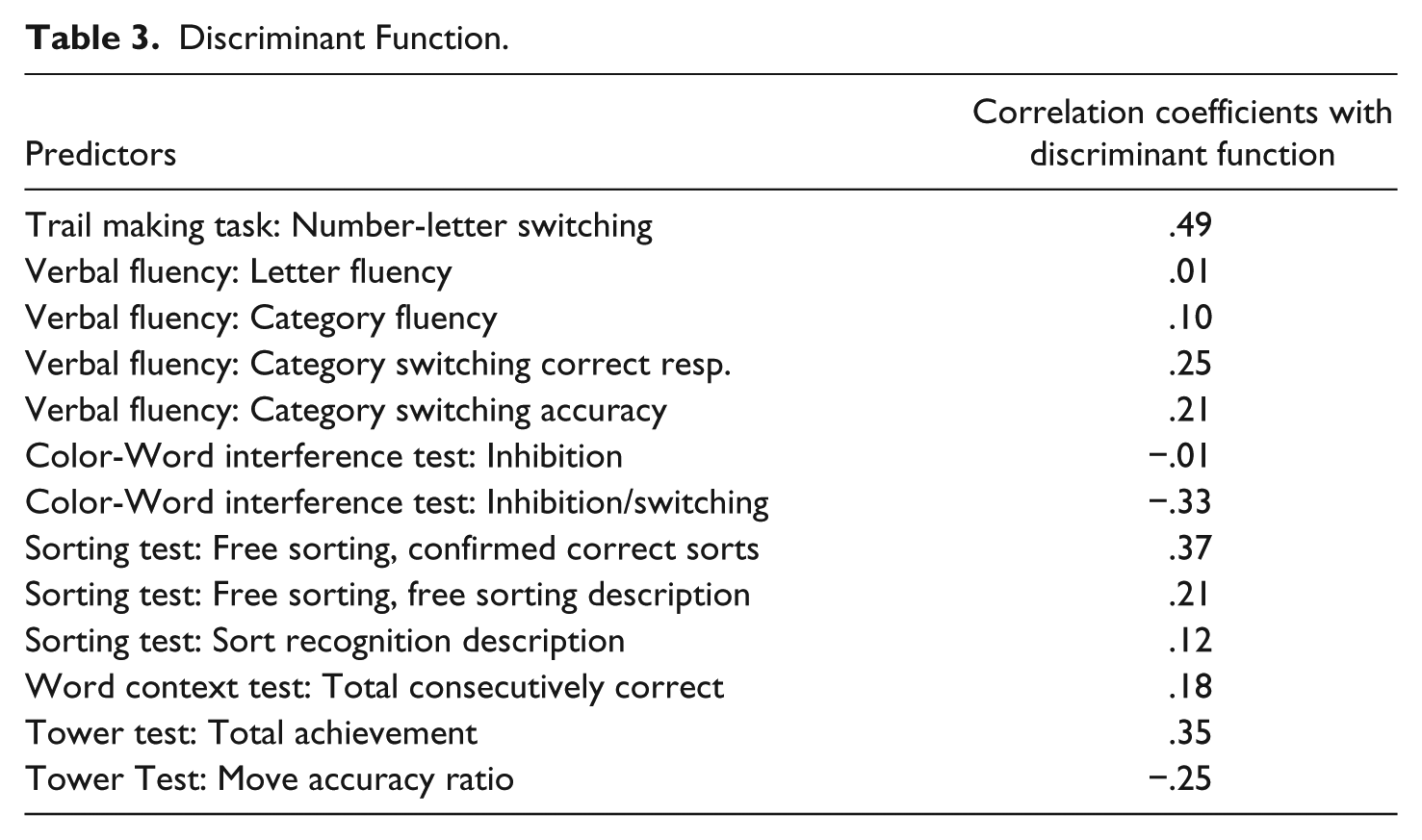
A discriminant analysis was then conducted to determine whether the 13 dependent variables (i.e., D-KEFS scaled scores) could predict group membership (i.e., ASOC with peer-aged or older victims, ASOC with child victims, and NSD). The overall model was significant, Wilks’ Λ = .80, χ 2 (26) = 40.3, p =.037, indicating that the predictors were useful in differentiating among the three group memberships. As the residual model was not significant, Wilks’ Λ = .90, χ2(12) = 16.4, p = .173, only one discriminant function was interpreted. Within-groups correlations between the predictors and the discriminant function are presented in Table 3. Trail Making test number-letter switching and Sorting test scores (i.e., free sorting description and confirmed correct) presented the strongest relationship to the discriminant function. The current discriminant function classifies correctly 58.2% of participants in the analysis. To control for chance agreement, a Kappa coefficient was computed, K = .30, p <.001, which fell in the fair range.
Discriminant Function.
Childhood Maltreatment and EF
The prevalence of CSA was significantly higher in the ASOC group (i.e., 44.6%) than in the NSD group, 21.6%; χ2(1) = 81.2, p = .004. The prevalence of childhood physical abuse (CPA) was also higher among ASOC (i.e., 31.4%) than among general delinquents (i.e., 19.6%), although this difference failed to reach statistical significance, χ 2 (1) = 2.9, p = .089. Similarly, the prevalence of CSA was higher for ASOC with child victims (i.e., 45.5%) than for ASOC with peer-aged or older victims (i.e., 35.7%), although this difference was not significant, χ2(1) = .8, p = .37. Prevalence rates of CPA were similar for ASOC with child victims (i.e., 30.3%) and ASOC with peer-aged or older victims, (i.e., 32.1%), χ2(1) = .03, p = .85. Results of the MANOVAs indicate that neither CSA, Wilks’ Λ = .94, F(13,149) = .8, p = .67, nor CPA, Wilks’ Λ = .95 F (13,149) = 0.6, p = .87, were significantly related to EF scores.
Discussion
The main goal of this study was to determine whether male adolescents convicted for a sexual offense present different profiles or mean scores of executive dysfunctions than convicted male adolescents without a history of sexual offenses. A secondary objective was to compare EF of ASOC with child victims and those with peer-aged or older victims. Confirming the first hypothesis, EF profiles did not differ significantly between participants with sexual offense convictions and NSD. It is important to note that the current results cannot rule out the existence of statistically significant differences in EF between adolescents with sexual convictions and NSD; however, the current design had adequate power to detect a medium effect. Thus, even if statistically significant differences do in fact exist, they are likely to be small and unlikely to be clinically meaningful.
Virtually all D-KEFS scaled scores in both groups were below the median of the general population. Thus, deficits of executive functions do not seem to characterize adolescents who commit sexual offenses. As a group, however, ASOC obtained similar or better results than NSD. These results might be due to poor performance offered from our NSD group (i.e., all detained juvenile NSD) and/or the confounding effect of ethnicity. For multiple different reasons (social, financial, cultural, educational, etc.), ethnic differences are known to affect neuropsychological results (Lezac, Howieson, Bigler, & Tranel, 2012; Saykin et al., 1995). In this study, 61% of ASOC were European American, whereas 66% of NSD were African American. These factors, however, should not have significantly influenced the present results because both groups (those with sexual offenses and NSD) had similar mean IQ and a similar number of years of formal education. In fact, years of formal education, reading ability, and IQ, which are highly inter-correlated, have been shown to attenuate or eliminate differences in neuropsychological performance scores between European Americans and African Americans (Manly, Jacobs, Touradji, Small, & Stern, 2002; Miles, 2002). The lack of significant differences in number of years of education despite a significant age difference is likely a consequence of a significantly greater incidence of conduct problems in school (e.g., suspensions, expulsions) in the NSD group. Still, future studies should include less severe cases of delinquency and consider the potential impact of ethnic differences in the neuropsychological assessment of ASOC.
Interestingly, our second hypothesis was not confirmed, with ASOC with child victims obtaining significantly better (and not poorer) results than NSD. Moreover, these better results concerned the Sorting test and Word Context, two measures of higher executive functions (i.e., problem-solving capacities and concept formation for the Sorting; deductive reasoning and cognitive flexibility for Word Context). Given that higher order executive functions are more impaired in severe conditions associated with asocial traits (e.g., schizophrenia and autism spectra), we hypothesized that ASOC with child victims would show lower scores on these measures than NSD, not the contrary. It is worth noting that our hypothesis was derived from studies in adults (Joyal et al., 2014), which might not apply to adolescents. It is plausible that the majority of ASOC with child victims are more likely to be shy, reclusive individuals with less cognitive impairment than adult asocial persons or deviant recidivists. It is also possible that this group presents social deficits similar to those of ASOC with peer-aged or older victims (Leroux et al., 2014). These possibilities deserve further investigation.
As for the subgroup of participants with sexual offense convictions with peer-aged/older victims, their EF scores were not significantly lower when compared with the scores of NSD on any executive assessment. In fact, they obtained a significantly better score on the switching condition of the Trail Making test, another measure of cognitive flexibility. Again, this result might simply reflect the fact that markers of general delinquency (e.g., alcohol and drug use, previous arrests and juvenile commitments, PCL-YV mean scores), closely associated with poorer EF, were significantly more prevalent among NSD than among those with sexual offense convictions (see also Seto & Lalumière, 2010). Future neuropsychological studies with less severe delinquent populations are warranted to confirm this conclusion.
Finally, the prevalence of CSA was higher among ASOC than among NSD, as expected (Seto & Lalumière, 2010). Contrarily to our hypothesis, however, the presence of CSA had no effect on EF scores. This might be due to the fact that we did not include measures of severity or chronicity of CSA, or else that CSA affects other types of cognitive functions.
Overall, these results suggest that profiles of EF impairment among adolescents convicted of sexual offenses are neither specific nor characteristic of this group. In fact, juvenile NSD might be slightly more impaired than those convicted of sexual offenses on EF, especially those with child victims. Furthermore, it remains possible that ASOC with child victims are less cognitively impaired than adults who sexually abuse children, at least in the EF domain. Future neuropsychological studies of adolescents with sexual offenses should consider assessments outside the realm of EF to determine if a characteristic cognitive profile would emerge, especially between subgroups of participants. For instance, recent studies in adults suggest that preferential child abusers (pedophiles) present fewer or less severe impairment of EF than those who are non-pedophiles (Eastvold et al., 2011; Schiffer & Vonlaufen, 2011). Subgroups of preferential adult child abusers even possess higher IQ and neuropsychological capacities than the general population (Plante, Manuel, & Bryant, 1996). The same distinctions should be made in neuropsychological evaluations of adolescent child molesters.
Footnotes
Declaration of Conflicting Interests
The author(s) declared no potential conflicts of interest with respect to the research, authorship, and/or publication of this article.
Funding
The author(s) received no financial support for the research, authorship, and/or publication of this article.