



Abstract
The extensive and sometimes profoundly damaging effects of sexual violence and large numbers of victims necessitate dedicated attention to primary prevention efforts. Few studies have examined the scope of current prevention activities or their fit with empirical research into effective prevention strategies. The current article presents findings from a survey of primary prevention activities in non-Māori and bicultural communities within Aotearoa New Zealand. Forty-four respondents representing 42 agencies responded to a comprehensive survey that canvased types of sexual violence primary prevention activities undertaken, sexual violence primary prevention programs, and barriers and supports to sexual violence prevention work. Consistent with findings from previous international surveys, the focus of primary prevention work in New Zealand was on sexual violence education and increasing awareness. Findings are discussed in the context of the sexual violence prevention literature and what works in prevention more broadly to help identify promising initiatives as well as gaps in current practices. Recommendations for advancing sexual violence primary prevention research are also provided.
Sexual violence was recently described as a “global public health problem of epidemic proportions” (World Health Organization [WHO], 2013, p. 3). Consistently linked with a host of negative mental health and social outcomes (e.g., Colman & Widom, 2004; Fergusson, Boden, & Horwood, 2008; Roberts, O’Connor, Dunn, & Golding, 2004; Widom, 1999; Widom, Marmorstein, & Raskin White, 2006), sexual violence has been considered the single most preventable contributor to child and adult mental illness (De Bellis, 2001). The extensive and sometimes profoundly damaging effects of sexual violence and large numbers of victims necessitate dedicated attention to primary prevention efforts. Little is known about the scope of current prevention activities in New Zealand or their fit with empirical research into effective sexual violence prevention strategies. The current article presents findings from a survey of primary prevention activities in non-Māori and bicultural (Māori and non-Māori) communities 1 within Aotearoa New Zealand, where rates of sexual violence are comparable to rates found in other developed countries (e.g., see Centers for Disease Control and Prevention, 2013; Felitti et al., 1998). To illustrate, a New Zealand study of 2,855 adult women found that 23.5% of respondents living in an urban region and 28.2% of respondents living in a rural region reported having been sexually touched or coerced into doing something sexual they did not want to do prior to 15 years of age (Fanslow, Robinson, Crengle, & Perese, 2007). Similarly, in the Adverse Childhood Experiences study, data collected from 17,337 adults in the United States revealed that 24.7% of women and 16% of men were sexually abused before 18 years of age (Felitti et al., 1998). Considering sexual violence experienced in adults (since 15 years of age), the World Health Organization estimates that 16.5% of women in Australasia (Australia and New Zealand) and 13% of women in North America experience non-partner sexual violence, and 28.3% and 21.3% of women in Australasia and North America respectively experience intimate partner violence, including sexual violence (WHO, 2013).
Sexual violence has been identified as the most costly crime per incident in New Zealand (Roper & Thompson, 2006); yet, according to a recent government enquiry, specialist sexual violence services are unfunded and struggling to meet demands, with prevention identified as a key issue (Social Services Committee, 2014). In a time of tight budgets and limited resources, findings from the current study will help inform the continued development of sexual violence primary prevention activities in New Zealand and internationally. Before describing the current study, we review the sexual violence primary prevention research and findings from earlier surveys of prevention activities.
Primary Prevention of Sexual Violence: Theory, Practice, and Research
The focus of the current article is on primary prevention, referring to strategies or interventions that aim to stop sexual violence before it occurs (Centers for Disease Control and Prevention, 2004; Ministry of Women’s Affairs, 2013). By contrast, secondary prevention generally refers to immediate responses after sexual violence has occurred to minimize short-term harm while tertiary prevention aims to prevent repeat victimization and perpetration, for example, through offender treatment (Centers for Disease Control and Prevention, 2004; Ministry of Women’s Affairs, 2013).
Theory and Practice
Several theoretical models attempt to explain the causes of sexual violence including biological, psychological, cultural, and feminist models (Centers for Disease Control and Prevention, 2004). Sexual violence has been increasingly recognized as a public health problem that, like other public health problems such as smoking, drink driving, and obesity, require comprehensive population-based approaches to prevention (e.g., Guy, Lee, Mixson, Perry, & Sniffen, 2007; Tabachnick, 2013). Several organizations and researchers have advocated for broad approaches to sexual violence prevention that target individuals at risk of perpetration and victimization, as well as environmental and social conditions that permit sexual violence (e.g., Banyard, Plante, & Moynihan, 2004; Casey & Lindhorst, 2009; DeGue et al., 2012; Fabiano, Perkins, Berkowitz, Linkenbach, & Stark, 2003; Ministry of Women’s Affairs, 2013). The social-ecological model (Krug, Dahlberg, Mercy, Zwi, & Lozano, 2002) delineates four interconnected levels that require targeting for long-term prevention of sexual violence: individuals, relationships, communities, and societies. Individual-level interventions often take the form of educational programs tailored to developmental level that cover topics such as body safety, recognizing and dealing with potentially dangerous situations, and consent in sexual relationships (e.g., the U.S. Child Assault Prevention [CAP] programs; see http://njcap.org/category/programs/). Interventions that target the relationship level recognize that friends of individuals at risk of victimization and perpetration can intervene to prevent sexual violence. Bystander campaigns fit this level of prevention, which aim to broaden the responsibility of sexual violence prevention beyond potential victims and perpetrators (Foubert, Tabachnick, & Schewe, 2010). Examples include “Bringing in the Bystander” (http://cola.unh.edu/prevention-innovations/bringing-bystander%C2%AE) and the Mentors in Violence Prevention program (Katz, 1995). Community-level interventions include developing polices for responding to concerning sexual behavior in child- and youth-serving organizations (e.g., sports teams and schools; see Saul & Audage, 2007), social norms campaigns, and social marketing. Social norms approaches are based on research evidence that individuals misperceive attitudes and behaviors of others (e.g., endorsement of rape myths; Hillenbrand-Gunn, Heppner, Mauch, & Hyun-joo, 2010) and that such misperceptions influence individuals’ own behavior (e.g., willingness to intervene to prevent abuse; for a review of relevant research see Berkowitz, 2010). Social norms approaches to sexual violence prevention aim to correct misperceptions, for example, through media campaigns that present healthy and accurate social norms (e.g., California’s MyStrength campaign; see McGann, 2010). The goal of social marketing approaches to sexual violence prevention is to encourage behavior change through lowering barriers and perceived costs, and increasing the perceived benefits (Tabachnick & Newton-Ward, 2010). Project Dunkelfeld in Germany represents an innovative and promising example that has demonstrated success in recruiting self-identified pedophiles and hebephiles for treatment through a television and print media social marketing campaign (Beier et al., 2009). Interventions targeting the broader society level include government funding for primary prevention activities and legislation requiring organizations to develop and implement child protection policies. Numerous sexual violence prevention initiatives targeting all levels of the social-ecological model have been implemented; however, few have been subjected to rigorous evaluations to determine whether they achieve their aims of preventing sexual violence.
Research Findings
Most published evaluations of primary prevention activities come from the United States and describe short, often single-dose educational interventions designed to improve participants’ knowledge about sexual violence and decrease attitudes and beliefs that support sexual violence. Such interventions are typically evaluated based on pre-/post-change in attitudes, knowledge, and behavioral intentions, and the majority describe interventions targeting college students. Anderson and Whiston (2005) conducted a meta-analysis on 69 studies (combined N = 18,172) to investigate the effectiveness of college-based sexual assault education programs on seven attitudinal, knowledge, and behavioral outcome variables. Changes in the expected directions were found on five of the seven outcome variables: rape knowledge, rape attitudes, behavioral intent, rape-related attitudes, and incidence of sexual assault victimization and perpetration; however, effect sizes were modest. The only pre-/post-intervention change that reached a medium effect size was in rape knowledge. Changes in rape attitudes were associated with a small effect size and changes in behavioral intentions, rape-related attitudes, and incidence of sexual assault, while statistically significant, did not reach Cohen’s (1988) criteria for a small effect size. Thus, although interventions were associated with statistically significant change across several outcome variables, the magnitude of changes was minimal. Findings from moderator analyses suggested that longer interventions were more effective than shorter interventions, professional presenters were more effective than graduate student or peer presenters, and inclusion of specific content (gender-role socialization, provision of general information about rape, discussion of rape myths/facts, and discussion of risk reduction strategies) was more effective than rape empathy programs and interventions with unspecified content. An additional moderating variable was the length of time between the delivery of an intervention and the measurement of outcome variables, such that positive effects diminished over time. Similarly, in an earlier narrative review of campus-based sexual assault prevention programs, Breitenbecher (2000) concluded that attitude change found following prevention interventions was not maintained and returned to pre-intervention levels over time, suggesting that short or single doses were insufficient to produce lasting changes.
Few studies have investigated the effects of prevention initiatives on subsequent perpetration of sexual violence (cf. Foshee et al., 2004; Foubert, Newberry, & Tatum, 2007). Foshee et al. (2004) reported long-term findings from a randomly controlled trial of the Safe Dates Program designed to prevent adolescent dating violence perpetration and victimization. The program consisted of a theater production performed by students, 10 × 45 min educational sessions taught by health and physical education teachers, and a poster contest based on the content of education sessions. Significant differences between adolescents in the Safe Dates Program and a control group in self-reported physical and sexual dating violence perpetration and victimization were found in the expected directions at a 4-year follow-up. A booster component consisting of a newsletter with worksheets and telephone contact with a health educator did not improve the effectiveness of the Safe Dates Program. Foubert et al. (2007) investigated the impact of a single-dose peer-facilitated rape prevention program on sexually coercive behavior and rape myth acceptance in a sample of first-year university students. They found that men who participated in the program and joined fraternities reported fewer sexually coercive acts and showed a decline in rape myth acceptance 7 months following the program compared with a control group of fraternity men who did not participate in the program. Findings were not replicated in men who did not join fraternities, who reported similarly low rates of sexually coercive behavior irrespective of program participation. This finding is consistent with studies documenting a lower prevalence of sexually coercive behavior in non-fraternity men compared with fraternity men (Bleecker & Murnen, 2005; Boeringer, 1999).
Sexual violence prevention interventions targeting younger school children have produced promising results. A meta-analysis of 27 studies (combined N = 8,115) investigating the effectiveness of school-based sexual abuse prevention programs for children aged 3 to 13 years found significant increases in abuse-related knowledge and skills following program participation, with average pre-/post-changes corresponding to a large effect size (Davis & Gidycz, 2000). Significant moderator variables were found including age (younger children showed more learning than older children), number of sessions (but not increased amount of time; presentation of material across four or more sessions was more effective than three or less sessions), participant involvement (physical participation was more effective than verbal or passive participation), and the use of behavioral skills training (e.g., modeling, rehearsal, and reinforcement of new skills). Although there have been no experimental studies investigating the incidence of victimization following participation in child-focused prevention programs, a retrospective survey of female college students found that the prevalence of sexual abuse was nearly twice as high in students who had not participated in a prevention program compared with students who had participated in a program (Gibson & Leitenberg, 2000).
As encapsulated in the meta-analyses described, evaluations of sexual violence prevention programs have focused on enacting individual-level attitude and behavior change, and have produced promising yet modest results. Consideration of the wider environmental context within which targeted interventions operate might help explain why. Several recent cases in New Zealand and internationally have highlighted what many describe as a “rape culture” (e.g., Gavey, 2005) that should be considered in building effective primary prevention efforts, particularly at the societal and community levels of the socioeconomic model. As articulated in a recent report from the Centers for Disease Control and Prevention, enacting individual behavior change within an environmental context that continues to support, facilitate, or encourage those behaviors is challenging, and traditional strategies aimed at changing individual attitudes and behavioral intentions may be insufficient when implemented in isolation (DeGue et al., 2012, p. 2).
Published evaluations of sexual violence prevention initiatives don’t necessarily give an indication for the breadth of prevention activities undertaken, especially when many are initiated by volunteers or community organizations that may not be resourced to conduct outcome evaluations. Surveys of organizations involved in prevention can help inform the continued development of sexual violence prevention initiatives and ensure that limited funding and resources are best allocated.
Findings From Prior Surveys of Primary Prevention Activities
In a recent 3-year project exploring primary prevention efforts in the United States, the National Sexual Violence Resource Center conducted a survey of rape prevention education coordinators (n = 31), state/territory sexual violence coalitions (n = 20), and a randomly selected sample of local rape crisis programs (n = 61) about their primary prevention activities (Townsend, 2012). The most common prevention activity undertaken by rape prevention education coordinators and coalitions was disseminating information about promising practices (90%) and the least frequently endorsed activity was conducting research (5%). The most common activities undertaken by rape crisis programs were social skills training (96%) and awareness education (92%). More than half of the programs surveyed also reported undertaking coalition building (78%), gender issues training (75%), bystander empowerment (71%), training professionals (64%), and community mobilization (56%). Systems/organizational change and shifting social norms were the least frequently endorsed activities (28% each). Seventy-five percent of local rape crisis programs reported undertaking evaluations of their prevention programs, and surveys were the most common method of evaluation. The most common outcome variables were knowledge (83%), participant satisfaction (78%), and attitudes (64%). Behavioral intent and actual behaviors were evaluated to a lesser extent (46% and 22%, respectively). In discussing findings, concern was raised that prevention activities were being promoted without a strong evidence basis and therefore “the field runs the risk of promoting approaches that may not be optimally effective” (Townsend, 2012, p. 22).
To our knowledge, the next most recent published survey of sexual violence prevention programs was conducted more than a decade ago. Through a mixture of open-ended and forced-choice questions, 87 respondents representing 87 child sexual abuse prevention programs across eight states in the United States responded to a postal survey, which built on earlier surveys conducted in 1985 (Plummer & Crisci, 1985; cited in Plummer, 2001) and 1991 (Riestenberg, 1998; cited in Plummer, 2001). Forty-eight percent of respondents worked in sexual assault/domestic violence centers. Programs targeted children in elementary school (84%), junior high (75.3%), high school (66.7%), and preschool (58%). In addition to targeting children and adolescents, programs also targeted parents (71.6%), teachers (64.4%), the public (65.4%), and professionals (59.3%). A smaller percentage of programs surveyed targeted special needs children (33.3%) and specific cultural groups (17.3%). Programs used a variety of materials, and there was a positive correlation between the number of funding sources and the number of materials used. Videos were the most common material used (74%). Of the programs surveyed, 62.7% used self-designed curriculums, 55.4% used specific sexual prevention curriculums available for purchase, and 22.9% used a general curriculum available for purchase that included sexual abuse prevention as part of a broader health and wellness curriculum. The majority of programs were delivered to children/adolescents in one session (62.7%), with 32.5% involving three or more sessions. Parent follow-up materials and/or parent education were included in 47% of programs. Teacher training and peer education were used to a lesser extent. A lack of resources and denial of the problem of sexual abuse were identified as the main challenges to prevention work experienced by respondents. One third of respondents reported that they were evaluating their programs; however, the nature of these evaluations was not examined.
The current article reports on findings from a comprehensive survey of New Zealand agencies to provide a review of prevention activities in non-Māori and bicultural communities. The research was instigated and led by Te Ohaakii A Hine–National Network Ending Sexual Violence Together (TOAH-NNEST), a New Zealand wide network of community sector experts specializing in sexual violence intervention and prevention services. The current article reports on selected findings in line with the following research questions.
Research Questions
Given the exploratory nature of the research, no hypotheses were generated. Findings are discussed in the context of the sexual violence prevention literature and what works in prevention more broadly to help identify promising initiatives as well as gaps in current practices.
Method
Sample
Attempts were made to invite all agencies involved in the delivery of programs or activities targeting the primary prevention of sexual violence in non-Māori and bicultural communities in New Zealand to participate in the current study. Primary prevention of sexual violence was defined as “activities that seek to prevent sexual violence before it occurs by educating people about the issue of sexual violence and by promoting safe and respectful environments, behaviors and social norms.” The survey was distributed via email and social media through the Imagining the Solution 2 newsletter list, the academic and stakeholder advisory groups consulted in the development of the survey, Government ministries working in partnership with TOAH-NNEST, and specialist family and sexual violence networks across New Zealand. In addition, the survey was advertised on the New Zealand Family Violence Clearinghouse and CommunityNet Aotearoa New Zealand websites. The Ministry of Pacific Island Affairs was contacted directly to capture prevention activities taking place within Pasifika communities. An email reminder was sent out 2 weeks prior to the survey closure date, and specific groups known for their primary prevention work were contacted directly for 3 weeks after this date if a response had not been received.
Of the 52 responses received, 8 respondents filled in only demographic information and were therefore removed from the data set. The final sample comprised of 44 respondents from 42 different agencies including community agencies or networks (e.g., specialist sexual violence sector agencies; n = 36), government agencies (n = 4; note that two agencies were represented twice for different aspects of their work), and local government agencies (n = 2). Given that this is the first survey of its kind in New Zealand and it is unknown how many people and agencies are actively involved in primary prevention in New Zealand, a response rate could not be calculated.
Materials
Preventing sexual violence in Aotearoa New Zealand Survey
A survey was developed for the purpose of the current study by the Tauiwi (non-Māori) caucus of TOAH-NNEST using Survey Monkey, an open-access online survey development tool. The U.S. National Sexual Violence Resource Center survey (Townsend, 2010) provided a basis for the survey, which was adapted in consultation with stakeholder and academic advisory groups for use in New Zealand. The stakeholder group comprised of national community and statutory agencies while the academic group comprised of national and international academics and researchers in sexual violence, primary prevention, and program evaluation.
The survey was divided into four sections: background information, prevention practices, prevention programs, and barriers and supports to prevention work. The prevention practices section investigated the range of prevention activities undertaken and included questions about agencies’ involvement in individual- and relationship-level initiatives (e.g., youth sexual violence prevention programs, child sexual abuse prevention programs) as well as community-level (e.g., systems and organizational change activities, social norms campaigns) primary prevention initiatives. The prevention programs section examined the target groups, length, theoretical basis, materials used, and evaluation methods of specific primary prevention programs, and the barriers and supports section examined the extent to which selected materials, skills, and resources were barriers or supports to prevention work. Consistent with the Townsend (2012) survey, the survey used in this study contained a mixture of checklists (all containing “other” options and space for participants to list alternative responses) and open-ended short-answer questions. In line with the research questions, the focus of the current article is on frequency data; illustrative quotes from short-answer questions are available in the TOAH-NNEST report. 3
Procedure
Potential respondents were sent an invitation to participate via email or social media that contained a URL link to the survey. Respondents completed the survey in their chosen location and in their own time, in single or multiple sittings. Respondents were invited to contact the first author for assistance completing the survey; four respondents requested assistance and completed the survey via telephone with the first author. The URL link directed respondents to the survey on Survey Monkey. The first screen contained information about the survey and participants were assured of the complete confidentiality of data collected. Respondents were instructed to answer only those questions relevant to their work. The survey questions appeared on the following screens. Survey completion time depended on the number of programs each respondent described; respondents reporting on one program completed the survey in less than 1 hr while respondents reporting on multiple programs required longer. The survey remained accessible for a 6-week period from May 18, 2012.
Results
What Types of Sexual Violence Primary Prevention Activities Are Happening in New Zealand?
Respondents were asked about their involvement in 10 specific prevention activities in the preceding 12 months. Table 1 lists the activities surveyed, the number of participants who responded for each activity, and the number (and percentage) of respondents engaged in each activity. The most common sexual violence prevention activity was sexual violence education delivered by 81% (n = 29) of respondents. More than 50% of respondents indicated that they undertook public policy advocacy and public sexual violence awareness raising activities (e.g., public meetings, rallies, lectures, community-based discussion groups). The remaining activities surveyed, although less common, were still undertaken by more than 25% of respondents.
Primary Prevention Activities in the Preceding 12 Months.
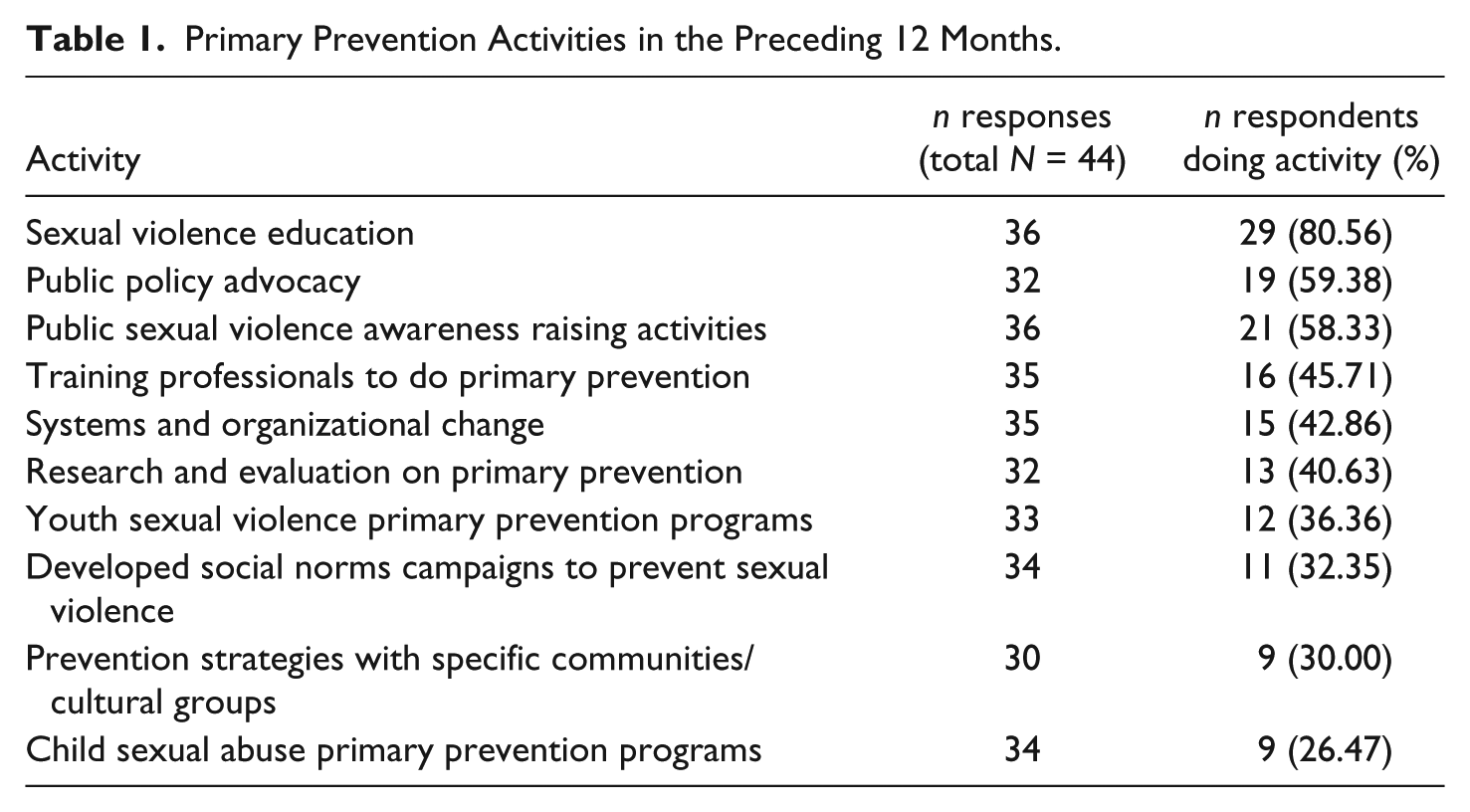
Respondents engaged in sexual violence education (n = 29) were asked to indicate which of six education topics they covered. Education about services available for survivors, individuals with harmful sexual behavior, and families and support people was the most common education topic (79%; n = 23), closely followed by general sexual violence education (i.e., the characteristics, impacts, and prevalence of sexual violence; 76%; n = 22), and dealing with disclosures (76%; n = 22). Rape myths and sexual violence and the law were both covered by 66% (n = 19) of respondents, and issues for particular groups including male, transgender, and disabled survivors were covered by 41% (n = 12) of respondents. Six respondents listed additional education topics including practical self-defense strategies, dealing with harmful sexual behavior, cyber violence, consent, intimacy/relationships skills (e.g., healthy vs. unhealthy relationships, understanding needs of self and partner), and looking out for friends.
Respondents engaged in public awareness raising activities (n = 21) were asked to report on specific activities undertaken. The production and distribution of leaflets and posters was the most prevalent activity (81%; n = 17), followed by community discussion forums (71%; n = 15). Media briefings and organizing lectures and public talks were each undertaken by 67% (n = 14) of respondents, and 24% (n = 5) of respondents reported participating in or helping organize rallies. Three respondents listed additional topics which included hosting events (e.g., a talent quest), developing a website, and producing a booklist.
Of the 16 respondents whose agencies provided training for other professionals in sexual violence prevention, targeted training to the particular needs of an organization was delivered most frequently (50%; n = 8), closely followed by training in gender roles and diversity (44%; n = 7) and bystander interventions (44%; n = 7).
Respondents engaged in systems and organizational change activities (n = 15) were asked to report on different types of activities undertaken to reduce sexual violence occurring in communities, school/education settings, and workplaces. The most common activity was providing support in developing policy guidelines for managing disclosures of sexual violence (80%; n = 12), followed by developing training plans for organization staff on dealing with sexual violence (67%; n = 10). Thirty-three percent of respondents each (n = 5) indicated that their agencies provided input into strategic planning in relation to dealing with sexual violence, and into policies for survivor support. Supporting the development of policies for people with harmful sexual behavior (20%; n = 3), and consulting on policy about sexuality and gender identity were less prevalent (20%; n = 3).
Of the 13 respondents whose agencies had undertaken research in primary prevention in the previous year, five respondents (38%) indicated that research findings were publicly available. The majority were evaluations of various primary prevention programs published in report format by individual agencies. No respondents indicated that findings of their evaluations were published in peer-reviewed journal articles.
Of the 11 respondents whose agencies had undertaken social norms campaigns, respondents indicated that their campaigns tended to challenge multiple social norms that support or enable sexual violence. Common targets of social norms campaigns were on promoting community responsibility to prevent sexual violence (82%; n = 9), broad antiviolence campaigns that included sexual violence (73%; n = 8), and promoting respectful relationships (73%; n = 8).
Who Do Primary Prevention Programs Target, What Is Their Length, What Are Their Theoretical Underpinnings, What Materials Are Used, and How Are Programs Evaluated?
Thirteen agencies delivered a total of 22 primary prevention programs to specific participant groups.
Target groups
Respondents were asked to indicate the target group(s) of their programs, and could select multiple target groups. The majority of programs (82%; n = 18) targeted teenagers and were delivered in secondary schools. Several programs (41%; n = 9) targeted young adults (18-24 years), three programs (14%) targeted elementary school–age children (5-12 years), and three programs (14%) targeted preschool children (< 5 years).
Program length
Programs were most commonly delivered in a single session (36%; n = 8). Three programs were delivered in two sessions (14%), another three programs were delivered in three sessions (14%), seven programs were delivered in five or more sessions (32%), and two programs had an unlimited number of sessions (9%). 4
Theoretical basis and materials
Respondents were asked to identify the theoretical model or models underpinning each of their prevention programs. Ecological models were most common (50%; n = 11), followed by feminist models (41%; n = 9). Other models represented included psychological models (36%; n = 8), cultural models (27%; n = 6), power-based models (23%; n = 5), and biological models (5%; n = 1). The most common materials used were activities (e.g., role plays), discussion/workshops, visual material (all used in 95% of programs; n = 21), and written materials (91%; n = 20). Interactive media (e.g., web pages) and audiovisual materials (e.g., DVDs) were used in approximately half of programs (n = 12; n = 11). Lectures were used infrequently (5% of programs; n = 1).
Program evaluation
5 All programs were subjected to internal and/or external evaluations, of which 40% (n = 10) were externally evaluated by paid researchers. Respondents were asked to indicate which of six methods were used to evaluate their programs, and what outcomes the evaluations sought to measure. The most common form of evaluation was observation (68%; n = 17), followed by pre-/post-program participant surveys (60%; n = 15). Interviews and focus groups were used to evaluate 40% (n = 10) and 32% (n = 8) of programs, respectively. Pre-/post-program surveys including a follow-up were used to evaluate 16% of programs (n = 4), while 12% (n = 3) of programs used post-program surveys only. Success stories were used by 8% of programs (n = 2) and archival data (e.g., Police reports) were used by 4% of programs (n = 1). The most common outcome measure was participant satisfaction, which was evaluated in all programs. In addition, the following outcome measures were used in program evaluations: behavioral intent (60%; n = 15), sexual violence knowledge (56%; n = 14), sexual violence attitudes (44%; n = 11), and actual behaviors (36%; n = 9).
What Are the Barriers and Supports to Sexual Violence Primary Prevention Work?
Barriers and supports to sexual violence primary prevention work were examined across multiple areas including access to materials and resources and general skills of staff. Respondents were asked to identify whether selected materials, resources, and skills were major barriers, minor barriers, neutral (neither a barrier nor a support), minor supports, or major supports to their primary prevention work. Major and minor barriers and major and minor supports were grouped together in the figures that follow.
Figure 1 shows the extent to which selected materials and resources were supports or barriers to primary prevention work. Basic information on sexual violence prevention was most frequently identified as a support, followed by practical ideas on how to do primary prevention and access to research on prevention. More barriers were identified than supports, with adequate funding identified as the most prevalent barrier. The following were also frequently identified as barriers to prevention work: access to materials in languages other than English, prevention materials that are oral or non-literacy-based, prevention materials for specific cultural communities, and prevention materials for queer and transgender communities. Some materials were differentially identified as both resources and supports across respondents. Access to researchers willing to work collaboratively was identified as a support for 8 respondents but a barrier for 11 respondents. Similarly, 13 respondents reported that access to youth-focused prevention materials was a barrier to their work, whereas 9 respondents indicated that access to such materials was a support.
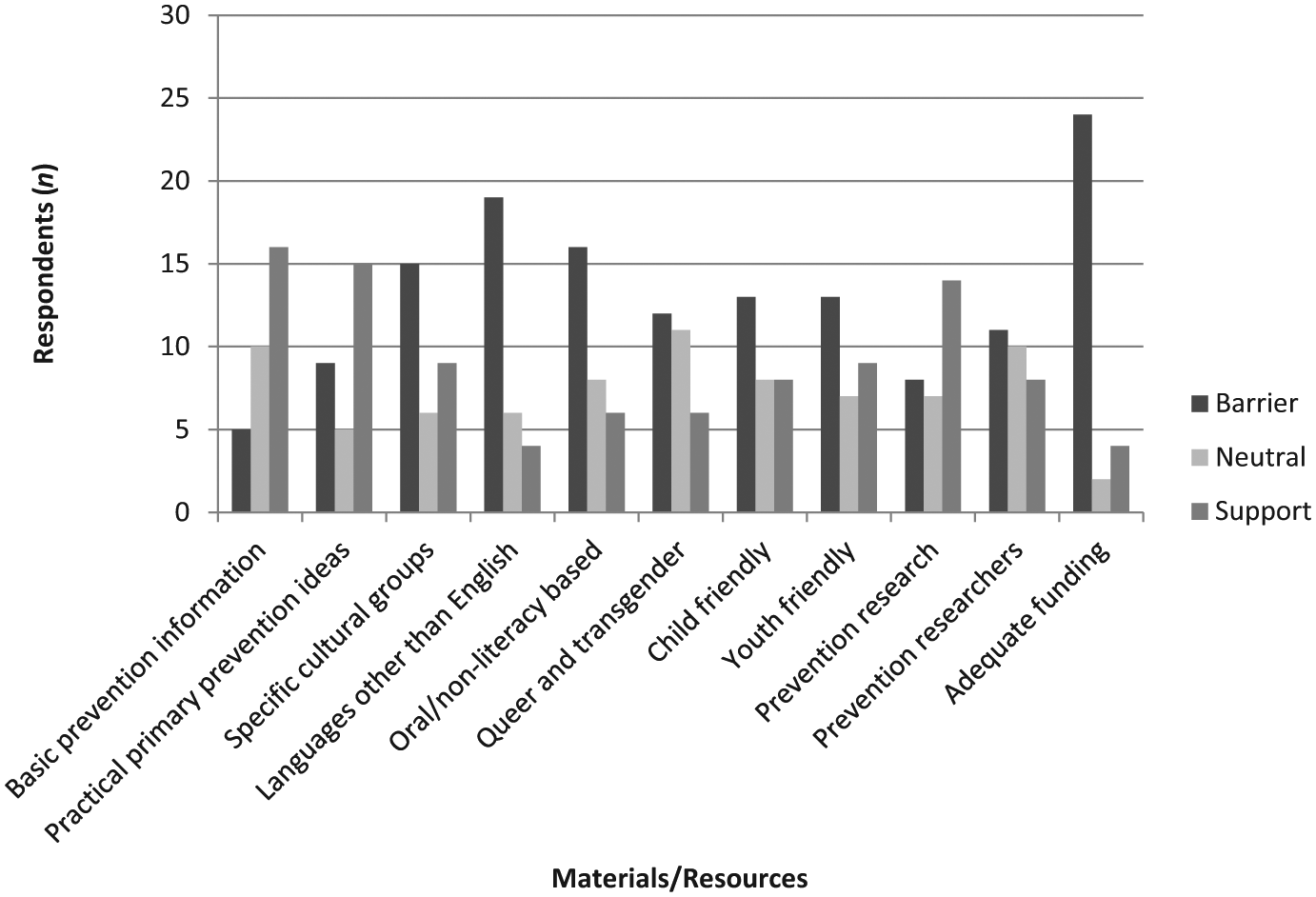
Supports and barriers to prevention work: Materials and resources.
Figure 2 shows the extent to which selected skill sets were supports or barriers to primary prevention work. The following skills were most frequently identified as supports to prevention work: dealing with disclosures of sexual violence, program development, using online technology, and skills to understand and use research. Skills for working with specific groups (including specific cultural groups, individuals with impairments/disabilities, and queer and transgender communities) were most frequently identified as barriers to prevention work, while skills for working with children and young people were differentially reported as barriers and supports across respondents.

Supports and barriers to prevention work: General skills.
Discussion
Findings from the current study illustrate the scope of sexual violence primary prevention activities undertaken in non-Māori and bicultural communities throughout Aotearoa, New Zealand. Findings were somewhat encouraging; however, several gaps in current practices and barriers to effective prevention work were identified.
Findings showed that the main focus of primary prevention work was on sexual violence education. In addition, a majority of agencies represented in the current study were also involved in public policy advocacy and public sexual violence awareness raising activities. However, the overwhelming focus of these activities was on providing information about services available to victims and perpetrators, dealing with disclosures and raising awareness rather than actively promoting attitudinal and behavioral change to prevent sexual violence perpetration and victimization. A similar focus on education and raising awareness was identified in the National Sexual Violence Resource Center’s recent survey of prevention activities in the United States (Townsend, 2012). Such a focus may reflect a low level of knowledge about sexual violence in many communities, and/or a lack of strategic planning and sustained commitment to primary prevention at a broader social and policy level. The majority of primary prevention activities were undertaken by specialist sexual violence sector agencies that operate across the spectrum of prevention (i.e., including secondary and tertiary prevention). Inadequate funding, identified as a significant barrier to primary prevention work, likely impedes specialist agencies’ capacity to do primary prevention in addition to secondary and tertiary prevention activities.
Considering specific primary prevention programs, very few sexual violence primary prevention programs in New Zealand were delivered to elementary school–age children, despite knowledge that sexual violence victimization often starts early in life (e.g., Fanslow et al., 2007) and the documented effectiveness of programs for children (see Davis & Gidycz, 2000). This finding was in contrast to findings from prior surveys conducted in the United States (Plummer, 2001; Townsend, 2012). Possible explanations for a lack of primary prevention programs targeting elementary school–age children in New Zealand include problems accessing child-focused prevention materials (identified as a barrier for several programs) and the absence of sexual violence prevention education from school curricula (G. Preston, personal communication, June 28, 2013), meaning that there is no mandate for schools to deliver prevention programs. Encouragingly, compared with programs described in prior surveys, a higher percentage of programs represented in the current survey were delivered across multiple sessions rather than in a single session. Similarly, more programs were subject to evaluation. However, consistent with prior surveys, participant satisfaction was the most common outcome measure evaluated. Although participant satisfaction likely enhances engagement in programs and can therefore be considered a pre-requisite for program effectiveness, it has little relevance to evaluating the effectiveness of prevention programs in achieving their aims. It was promising that behavioral intent and actual behaviors were evaluated more frequently (in 60% and 36% of programs, respectively) compared with findings from previous surveys. Although encouraging, the survey data do not provide detailed information about how these evaluations were conducted, or their findings. This may reflect limited access to researchers which was identified as a barrier to primary prevention work by several respondents, and highlights an urgent need for greater collaboration between agencies doing prevention work and researchers to ensure that sexual violence prevention programs are appropriately evaluated and developed based on best practice. The same need was identified in the U.S. National Sexual Violence Resource Center survey by Townsend (2012), who reported that while a “substantial commitment to evaluation” was identified, respondents were “struggling to evaluate prevention initiatives in ways that can document whether and how they are effective” (p. 5).
The ecological model was the most commonly endorsed theoretical framework underpinning prevention programs; however, the extent to which programs actually implemented an ecological framework was unclear. The predominant site of program delivery (secondary schools), often limited number of sessions, and focus of program evaluations (i.e., participant satisfaction) suggested that the focus was on the individual (e.g., high school student) with limited attention to ecological factors. There was some evidence for an ecological approach in lower frequency activities undertaken, including incorporation of bystander interventions into training of other professionals and social norms campaigns that target promoting community responsibility.
Several limitations of the current study must be acknowledged. Findings were based on self-report and no formal observations of primary prevention activities were made. Self-report might have led to inflated responses to questions about the skill sets of respondents and their agencies (e.g., in their capacity to develop programs based on best practice). Moreover, there were missing data throughout the survey, possibly attributable to some respondents recognizing that their work focused more on secondary or tertiary prevention, and therefore opting out of selected questions, or due to time limitations to complete the survey. Thus, it is likely that the percentages of agencies engaged in activities with lower response rates were over-inflated. Finally, substantial efforts were made to survey all New Zealand agencies (excluding kaupapa Māori agencies) involved in primary prevention of sexual violence; however, it remains possible that some agencies were missed in the recruitment process. Nevertheless, several patterns were evident in the data that can be used to inform the future direction of programs in New Zealand and internationally. In the remainder of this article, we draw from sexual violence prevention research and prevention literature more broadly to offer recommendations for future directions in primary prevention initiatives.
Primary Prevention of Sexual Violence: Future Directions
As highlighted in the Introduction, despite an urgent need for effective sexual violence primary prevention practices, research has been slow to produce programs with evidence of effectiveness in preventing sexually violent behavior. Contributions to prevention literature from other fields highlight common elements of effective prevention programs and can be used to help inform the future of sexual violence prevention efforts. In a review of the prevention literature in substance abuse, risky sexual behavior (prevention of unwanted pregnancies and HIV/AIDS), school failure, and juvenile delinquency and violence, Nation et al. (2003) identified nine common principles of effective prevention programs. Specifically, effective programs were comprehensive (both in terms of content and engaging multiple systems such as parents, peers, communities), used varied teaching methods (including interactive activities to build skills), were of sufficient dosage, theory driven, provided opportunities for positive relationships, were appropriately timed, socioculturally relevant, included outcome evaluation, and involved well-trained staff. These principles closely map the good practice criteria for school-based violence prevention and respectful relationships education identified by Flood, Fergus, and Heenan (1999): a whole-school approach, a program framework and logic, effective curriculum delivery, relevant, inclusive and culturally sensitive practice, and impact evaluation.
Applying Nation et al.’s (2003) principles to sexual violence prevention, initiatives need to extend beyond focusing on individual potential victims and perpetrators to the broader environment that allows sexual violence to flourish. This message is not new but cannot be emphasized enough. A necessary pre-requisite is to extend responsibility for primary prevention activities beyond the specialist sexual violence sector, primarily tasked with secondary and tertiary prevention, and into relevant social policy (e.g., school curricula). The future of sexual violence prevention requires the provision of adequate funds to facilitate prevention activities and programs in schools, tertiary institutions, sports clubs, and other child and youth-serving organizations, as well as broader community-level interventions such as social norms campaigns, social marketing, and bystander interventions. When targeting youth, it is important that initiatives focus on the development of positive sexuality and mutual, respectful relationships and not solely on the prevention of sexual violence (see Carmody, 2009). It is crucial that sexual violence primary prevention programs are of sufficient dosage to produce lasting change, including in social norms and perceived norms, which cannot occur in a single session (Breitenbecher, 2000). As highlighted earlier, there is a need for greater collaboration between agencies undertaking primary prevention activities and researchers with an interest in primary prevention. Without methodologically sound evaluations including selection of appropriate outcome measures, there is a risk that ineffective programs will be promoted. Program evaluation is a necessary precursor for the growth of best practice in sexual violence prevention in New Zealand and internationally.
Recommendations for advancing primary prevention research
The overwhelming focus of extant evaluations of primary prevention interventions is on proximal indicators of effectiveness, including assessing participant change in sexual violence knowledge, attitudes, and behavioral intentions. Very few evaluations track the incidence of sexual violence following an intervention. Moreover, evaluations typically rely on pre-/post-assessment of problematic and harmful attitudes and behavior (e.g., endorsement of rape myths) as a marker of an intervention’s effectiveness. Such a focus assumes that increased knowledge and a reduction in attitudes that support sexual violence will lead to decreases in the incidence of sexual violence; however, without long-term follow-up data on sexual violence perpetration and victimization, these assumptions are untested and socially desirable responding cannot be ruled out. Moreover, a focus on problematic attitudes and behavior might inhibit detection of positive change. Fostering knowledge and skills to develop healthy, respectful sexual relationships and promoting positive bystander behavior are common components of primary prevention activities and programs, and consistent with effective prevention programs in other fields (Nation et al., 2003). However, skills and strengths to develop respectful relationships and intervene when someone might be at risk are rarely assessed in program evaluation research. Similar problems are inherent in sex offender treatment research. In the same way that an absence of risk factors for reoffending does not necessarily equate to the presence of protective factors supporting desistance from sexual offending (de Vries Robbé, Mann, Maruna, & Thornton, 2015), an absence of attitudes that support sexual violence does not equate to the presence of skills to develop respectful, consenting sexual relationships. Findings from the current study reiterated findings from earlier studies that agencies are poorly resourced to conduct rigorous outcome evaluations. There is an urgent need for increased collaboration between researchers and primary prevention agencies to develop and implement appropriate evaluation frameworks. Randomized controlled trials using schools, sports clubs, or other comparable groups as the unit of randomization are encouraged, with long-term follow-up periods that assess the range of outcomes that interventions target, including incidence of sexual violence victimization and perpetration. In college-age samples, other relevant outcome variables might include dating behavior, the quality of intimate relationships, confidence negotiating consent, and confidence intervening when someone might be at risk of sexual violence perpetration or victimization. Widening the net of evaluations to include desirable as well as undesirable attitudes and behavior might enhance the ability to detect intervention success.
Concluding Comments
Agencies undertaking sexual violence prevention work in New Zealand appear to have heeded research literature to the extent they are able in terms of advocating for best practices despite often having limited capacity to appropriately implement best practices. Improving primary prevention of sexual violence requires collaborative and sustained efforts at a broad community and policy level. The unremitting high prevalence rates of sexual violence underscore an urgent need to prioritize sexual violence prevention in relevant social, health, and educational policy and ensure sufficient funding is allocated to the development and dissemination of effective sexual violence primary prevention activities. The cost of primary prevention is minute relative to the personal, social, and societal costs of sexual violence perpetration.
Footnotes
Declaration of Conflicting Interests
The author(s) declared no potential conflicts of interest with respect to the research, authorship, and/or publication of this article.
Funding
The author(s) received no financial support for the research, authorship, and/or publication of this article.