



Abstract
A history of childhood adversity is associated with high-risk behaviors and criminal activity in both adolescents and adults. Furthermore, individuals with histories of child maltreatment are at higher risk for engaging in risky sexual behavior, experiencing re-victimization, and in some cases, becoming sexual offenders. The purpose of the current study was to examine the prevalence of individual and cumulative adverse childhood experiences (ACEs) reported by 102 offending youth who were arrested for trading sex and 64,227 offending youth who were arrested for various other crimes, using Florida’s Positive Achievement Change Tool. Youth with violations related to sex trafficking had higher rates for each ACE as well as number of ACEs, particularly sexual abuse and physical neglect. These findings have implications for identifying adverse experiences in both maltreated and offending youth as well as tailoring services to prevent re-victimization.
A history of childhood adversity—characterized by maltreatment, parental mental illness, exposure to family violence, and abandonment—is associated with high-risk behaviors and criminal activity in both adolescents and adults (Dube, Felitti, Dong, Chapman, et al., 2003; Dube et al., 2006; V. J. Edwards, Anda, Gu, Dube, & Felitti, 2007; Reavis, Looman, Franco, & Rojas, 2013). Furthermore, individuals with histories of child maltreatment are at higher risk for engaging in risky sexual behavior, experiencing re-victimization, and, in some cases, becoming sexual offenders (Greene, Ennett, & Ringwalt, 1999; Kaestle, 2012; Reid, 2014; Roe-Sepowitz, 2012). Juvenile offenders with histories of childhood adversity are more difficult to rehabilitate and are more likely to re-offend than youth without these histories (Baglivio et al., 2014). Thus, knowledge of a juvenile offender’s history of adverse experiences has important implications both for predicting high-risk sexual or delinquent behavior and for tailoring interventions to prevent their occurrence or, in the case of an offender, re-offense or recidivism.
Currently, the United States is in the midst of a policy and practice shift in the way it conceptualizes juvenile involvement in the sex trade industry (Mitchell, Finkelhor, & Wolak, 2010). Previously known as child prostitution, commercial sexual exploitation of children (CSEC) is now defined by the U.S. Department of Justice as “sexual abuse of a minor for economic gain” and includes “physical abuse, pornography, prostitution, and the smuggling of children for unlawful purposes” (National Institute of Justice [U.S.]. Office of Justice Programs, 2007, p.1). Thus, in its newest definition, CSEC is no longer a form of criminality on the part of the child, but rather child abuse for profit. This important reconceptualization shifts the way unlawful sexual activity of victims of maltreatment is described. These individuals are not committing crimes, per se, but are rather repeatedly victimized.
Although the covert nature of CSEC makes incidence reporting difficult, more than 105,000 children annually are indicated to be sexually abused (Estes & Weiner, 2001). Estes and Weiner define youth at risk of sexual exploitation as children who are runaways, throwaways, victims of physical or sexual abuse, users of psychotropic drugs, members of sexual minority groups, illegally trafficked children, and children who cross international borders in search of cheap drugs and sex. In a meta-analysis of research on prevalence of domestic minor sex trafficking, estimates varied significantly, leading authors to conclude that research methodologies could be improved to reduce this variability to consider any figure reliable (Finkelhor & Stransky, 2008).
Primary risk factors for a youth’s involvement in the sex trade include running away from home or being forced to leave home without safe alternative housing arranged, also known as thrown away (Cobbina & Oselin, 2011; J. M. Edwards, Iritani, & Hallfors, 2006; Estes & Weiner, 2001; Greene et al., 1999). Throwaway and runaway children, homeless children, and youth aging out of foster care may find themselves living on the streets in locales where the adult prostitution market suggests a way for youth to secure their own shelter, food, and clothing (Estes & Weiner, 2001). Children who run away or are thrown away are often victims of physical or sexual maltreatment (Cobbina & Oselin, 2011; Greene et al., 1999; Kaestle, 2012; Reid, 2014; Wilson & Widom, 2008). Predictors less frequently cited in the literature include poverty (Estes & Weiner, 2001; Klatt, Cavner, & Egan, 2014), gang membership (Estes & Weiner, 2001; Institute of Medicine & National Research Council, 2013), involvement of family or friends in the sex trade (Estes & Weiner, 2001; Klatt et al., 2014; Tyler, 2009), and recruitment by organized crime groups (Estes & Weiner, 2001; Institute of Medicine & National Research Council, 2013).
This review of prior research on CSEC risk factors suggests that these youth are more likely to have experienced multiple types of adversity during childhood. Theories of cumulative risk suggest that it is not a single adversity that leads to the worst outcomes for children but instead the accumulation of stressors associated with adversity (Evans, 2004). The Adverse Childhood Experiences (ACEs) study uses the sum of adverse experiences to predict health and developmental outcomes (Anda et al., 2006; Dube, Felitti, Dong, Giles, & Anda, 2003; Felitti et al., 1998). In the original ACE study, researchers measured child maltreatment (physical abuse, emotional abuse, sexual abuse, and physical and emotional neglect) and household dysfunction (criminal history of household members, mental illness of household members, parental separation or divorce, household substance abuse, and violent treatment of mother in the household) as indicators of adverse experiences. These adversities were scored as either present or absent, without regard to the frequency or severity of abuse, and the individual adversities were added together to develop an overall ACE score (Felitti et al., 1998). High-risk ACE scores (sometimes reported as 3 or more, sometimes reported as 4 or more) have repeatedly been linked to increased risk of adverse physical and behavioral health outcomes for both adults and adolescents (Anda et al., 2006; D. W. Brown et al., 2009; Dube et al., 2001; Felitti et al., 1998; Flaherty, 2009; Flaherty et al., 2013; Flaherty et al., 2009; Reavis et al., 2013).
The existing literature on predictors of sexual trafficking is limited by relatively small sample sizes of sexually trafficked youth and a limited focus on family or caregiver characteristics that predict sexual exploitation. In the current study, we aim to address these gaps by using a relatively large and well described sample of youth with violations related to sex trafficking to answer the following question: Is a history of multiple childhood adversities, as modeled by the ACE study, related to an increased risk of juvenile involvement in illegal sexual activity? To address this question, we examine the prevalence of individual and cumulative ACEs reported by youth with violations related to sex trafficking and compare the reported ACEs with a sample of youth with violations not related to sex trafficking. In so doing, we hope to identify risk factors for trafficking so that interventions can be tailored to prevention of the further victimization of at-risk youth.
Method
Sample
The study population consisted of 64,329 youth who have aged out of the juvenile justice system, and were between the ages of 11.4 and 22.5 at the time of their last assessment. All youth were younger than 18 years when they were adjudicated. All youth in this data set were charged with a crime in the state of Florida and were evaluated with the Positive Achievement Change Tool (PACT) full assessment (detailed below) between December 14, 2005, and December 30, 2012. All youth were younger than 18 years at the time of their delinquency referral although some received their last assessment as adults.
A cohort of youth arrested for offenses related to sex trafficking (n = 102) were identified as those taken into custody for violations of Florida Statute 796.07 Sections 2e and 2h, both of which relate to trading sex. Statute 796.07 Section 2e states, “It is unlawful to offer to commit, or to commit, or to engage in, prostitution, lewdness, or assignation.” Section 2h states, “It is unlawful to aid, abet, or participate in any of the acts or things enumerated in this subsection,” where the subsection refers to committing or facilitating prostitution, or to visiting a prostitute. The first and second violations of any of these statutes are misdemeanors, whereas all subsequent violations are felonies (“Prohibiting Prostitution and Related Acts,” 2007). All youth charged with either or both types of violations were included in the cohort of youth arrested for trading sex, regardless of additional charges. Demographic information for the Florida juvenile justice population (N = 64,329) can be found in Baglivio and Epps (2015). The prevalence of race, sex, and age at first offense for the cohorts presented here are summarized in Table 1.
Demographic Characteristics for the Non-Sexually Trafficked (n = 64,227) and Sexually Trafficked Cohorts (n = 102).
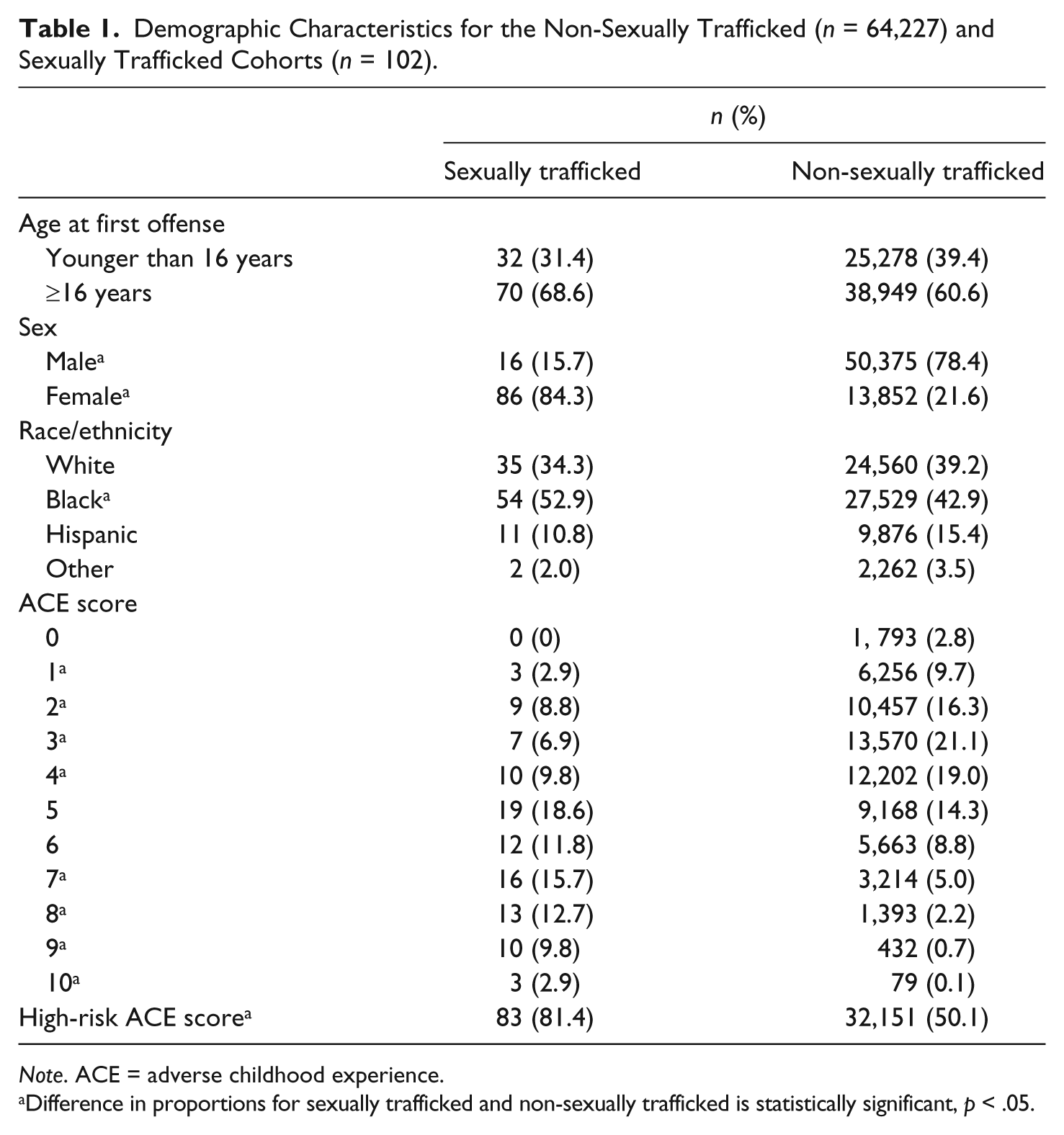
Note. ACE = adverse childhood experience.
Difference in proportions for sexually trafficked and non-sexually trafficked is statistically significant, p < .05.
Measures
The Positive Achievement Change Tool (PACT) is a fourth-generation actuarial risk/needs assessment designed to assess a youth’s overall risk to reoffend and is administered by Florida Department of Juvenile Justice (FDJJ) employees trained in Motivational Interviewing techniques. The assessment process is designed as a semi-structured interview rather than simply reading questions to the youth. The answers to the questions are drawn from one or more meetings and discussions between the youth and DJJ employees. For this data set, which covers the youth’s entire history with the Department, the ACE scores are drawn from any and all PACT screenings the youth may have had while under the Department’s supervision, to both capture ACEs that may have accumulated as the child aged and to allow for a youth’s greater willingness to disclose personal history and circumstances across the time of supervision. The PACT items and responses are not read aloud to the youth. The domains and items are covered throughout the course of the interview. All PACT screeners received a standardized 3-day PACT and case planning training, in addition to a 2-day motivational interviewing training. Information gleaned from the interview, as well as collaborative sources (such as grades from the Dept. of Education databases) are used to select the most appropriate response for each item. The PACT can be administered as a pre-screen or a full-screen questionnaire. The pre-screen is given to all youth arrested in the state of Florida, and the full screen is given to those whose pre-screen score indicates that they are moderate-high to high-risk to reoffend. Either assessment yields the same risk score for recidivism for a given youth.
The PACT assessment has been validated across multiple samples of youth in the FDJJ, and this validation has been published in multiple peer-reviewed journals and independent research agency reports, as well as the National Council on Crime and Delinquency (NCCD; Baglivio, 2009; Baglivio & Jackowski, 2013; Baird et al., 2013; Winokur-Early, Hand, & Blankenship, 2012). These validation studies have shown the PACT overall risk score, criminal history sub-score, and dynamic social history sub-score to be significant predictors of reoffending across gender and racial and ethnic subgroups, and for all disposition placements (probation, diversion, day treatment, etc.). Logistic regression models and overlapping 95% confidence intervals for area under curve (AUC) statistics have all illustrated similar findings. The criminal history items of the PACT are completely automated from the FDJJ information system, and as such are 100% reliable. An independent reliability analysis conducted by NCCD found an intra-class correlation (ICC) for the PACT risk level of .825, and a kappa of .5 (Baird et al., 2013). ICC more than .8 is considered extremely strong, and the kappa value considered moderate. Each measure has strengths and limitations, but the PACT performed relatively well in comparison with other instruments examined in the Baird et al. study.
The ACE scores were not based on single items in the PACT assessment but instead on aggregates of terms derived from multiple validated survey tools. For instance, physical abuse was assessed with two PACT items: history of violence/physical abuse (not a victim of violence/physical abuse; victim of violence/physical abuse at home; victim of violence/physical abuse in a foster/group home; victimized or physically abused by family member; victimized or physically abused by someone outside the family; attacked with a weapon) and level of conflict between parents, between youth, and parents, and among siblings (some conflict that is well managed; verbal intimidation, yelling, heated arguments; threats of physical abuse; domestic violence: physical/sexual abuse). Physical abuse was coded as present if the answer to the former question was anything other than “Not a victim of violence/physical abuse” or if the answer to the latter question was “Domestic violence: physical/sexual abuse” as long as the same juvenile gave a negative answer to later PACT questions about history of sexual abuse or rape. The methods and rationale for this conversion are described in more detail in a previous study (Baglivio et al., 2014). Each ACE was coded as “0” for absent and “1” for present. The individual ACEs were then added together to make a cumulative ACE score ranging from 0 to 10. Because previous studies have indicated that risk of adverse outcomes generally increases with an ACE score of 4 or more, the ACE scores were separated into binary categories of low risk (0-3 ACEs), and high risk (4-10 ACEs).
Analytic Plan
Descriptive statistics were used to examine frequency of each ACE and a cumulative ACE score for both the youth with arrests not related to trafficking (n = 64,227) and the youth with arrests related to trafficking (n = 102). Bivariate analyses were used to compare the proportion of ACEs in both cohorts. Logistic regressions were conducted to predict the likelihood of sexually trafficked versus non-sexually trafficked arrest status based on each ACE and a high-risk ACE score, controlling for risk factors that have been previously established in the literature. 1 Because of the imbalanced sample sizes of youth arrested for sex trafficking versus youth arrested for other violations, a random sample of 102 youth arrested for non-trafficking violations was selected for multivariate analyses. Data were analyzed using SPSS 22 (Armonk, NY 2013).
Results
Descriptive Analyses
Descriptive statistics for the prevalence of each charge, the proportion of females for each charge, and age at time of adjudication (mean and range) for youths arrested for trading sex can be found in Table 2. The majority of youth (72.5%) were arrested on charges of violating 796.07 Subsection 2e only while an additional 11.8% were charged with violating Subsection 2h only and 5.9% were charged with violating both. The remaining 9.8% received one or both of these charges in addition to another charge (see Table 2).
Descriptive Statistics for Types of Charges Among Sexually Trafficked Cohort (n = 102).
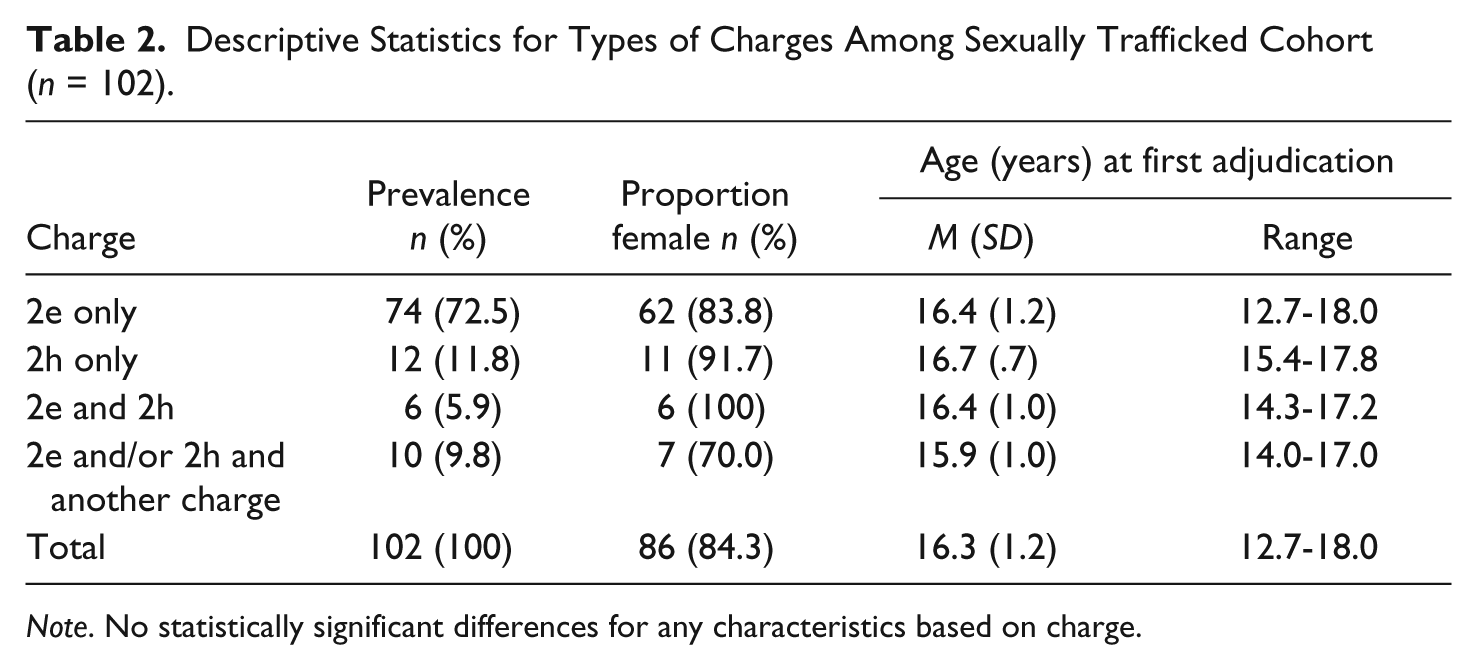
Note. No statistically significant differences for any characteristics based on charge.
For both violations of subsection 2e and 2h, the majority (83%-100%) of youth charged were female. The ages across all three groups of adolescents arrested for trading sex were similar. All adolescents were between 12 and 18 years at the time of adjudication with a mean age of approximately 16 years (Table 2).
For the youth charged with non-trafficking violations, the most prevalent ACE was household violence; for the youth charged with trafficking violations, the most prevalent ACE was parental separation or divorce. The least prevalent ACE for both groups was household mental illness (Figure 1). All youth charged with trafficking violations experienced at least 1 ACE, and 97.1% had more than 1; the vast majority (81.4%) experienced at least 4 ACEs (Figure 2). Among the youth charged with non-trafficking violations, 97.2% experienced at least 1 ACE; approximately half (50.1%) experienced 4 or more. Among the youth charged with non-trafficking violations, the mean ACE score was 3.65 (SD = 1.89); among the youth charged with trafficking violations, the mean ACE score was 5.74 (SD = 2.31). When comparing the youth charged with trafficking violations by charge, there were no significant differences in age at first offense, prevalence of high-risk ACE scores, sex, or race, all p values >.05.
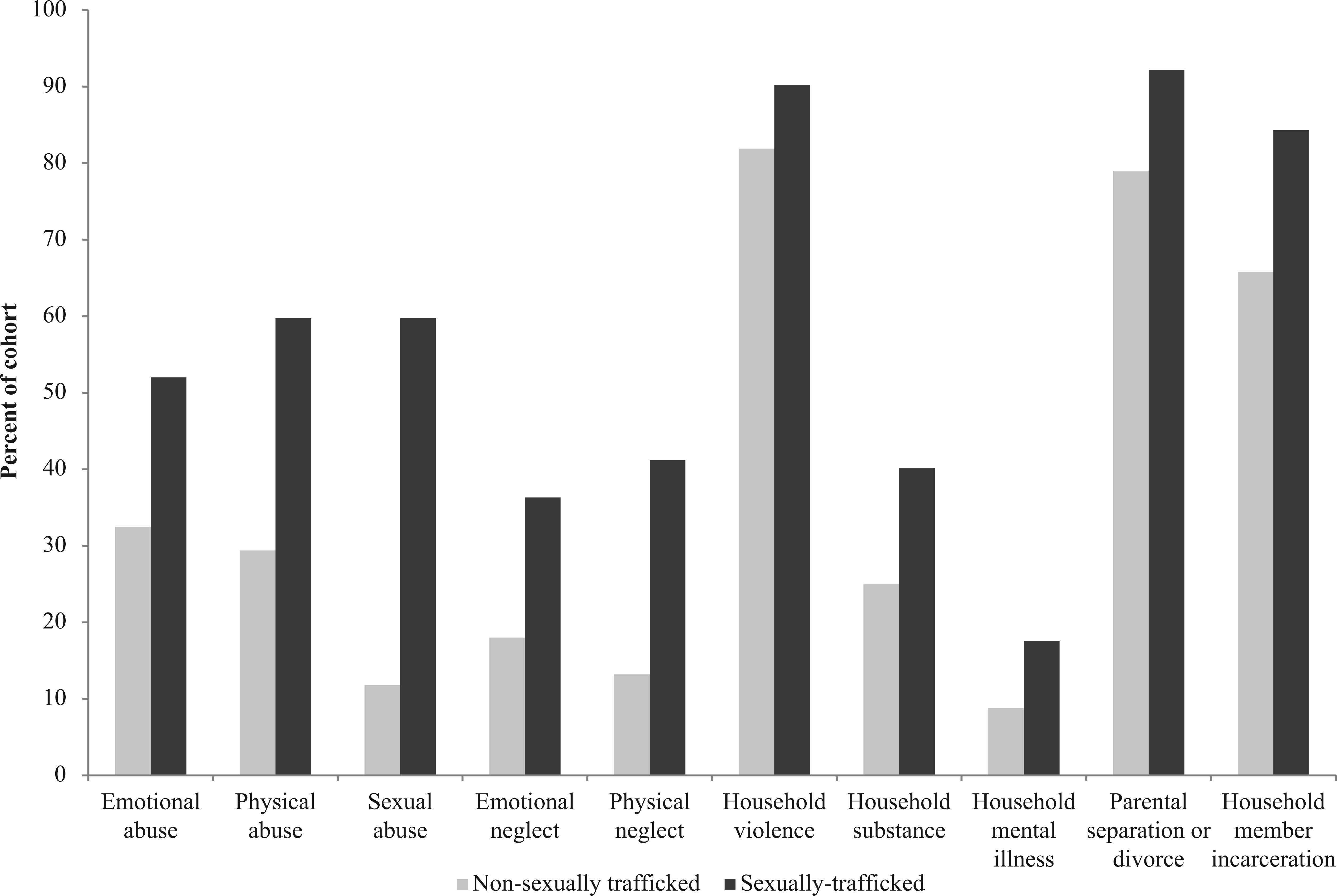
Prevalence of adverse childhood experiences among sexually trafficked and non-sexually trafficked offending juveniles.

Prevalence of ACE scores among sexually trafficked and non-sexually trafficked offending juveniles.
Bivariate Analyses
For all 10 ACEs, the proportion of individuals endorsing any individual ACE was higher for the youth charged with trafficking violations than for the youth charged with non-trafficking violations (all p values < .05; Figure 2). The prevalence of ACE high-risk scores (≥4 ACEs) was significantly higher among the youth charged with trafficking violations (81.4%) than among the youth charged with non-trafficking violations (50.1%; χ2 = 39.94, p < .001, Cramér’s V = .03). 2
Multivariate Analyses
We then conducted logistic regressions predicting likelihood membership in the sex-trafficking violations group using the cohort of youth charged with trafficking violations and an equal, random sample of youth charged with non-trafficking-related violations. The odds of being adjudicated for sex trafficking were 4.09 to 7.53 times higher for youth who experienced sexual abuse, physical neglect, and parental separation than youth who did not experience those events (Table 3). In addition, the odds of being adjudicated for sex trafficking were 3.27 times higher for youth with a high-risk (i.e., greater than 4) ACE score. These associations go beyond the relations between previously established risk factors for sexual exploitation (e.g., gang membership, being a runaway).
Likelihood of Being ST Offending Juveniles Compared With a Random Sample of Non-ST Offending Juveniles Based on ACEs, Total n = 204.

Note. Models were adjusted for sex, race, age at first offense, history of gang affiliation, and being a runaway or thrown out of the home. ST = sexually trafficked; ACE = adverse childhood experience; Adj. OR = Adjusted odds ratio; CI = confidence interval.
Discussion
The state of Florida, particularly the southern region, serves as a major hub for sex trafficking in the United States and is currently ranked third nationally in the number of potential human trafficking calls to the National Human Trafficking Resource Center (Polaris Project, 2013). Previous literature demonstrates that juvenile offenders engaged in the sex trade industry have a high likelihood of a history of maltreatment (Diaz, Clayton, & Simon, 2014; Kaestle, 2012). In the current study, we utilized data from a unique assessment developed by the FDJJ to examine the prevalence of individual and cumulative ACEs reported by adolescents arrested for trading sex and compared these rates with rates for a sample of adolescents arrested for other reasons.
We found a disproportionate number of females and Black youth in the cohort of youth arrested for trading sex relative to the general population of offenders. These findings are consistent with previous literature on gender and racial differences in youth arrests for prostitution (Clawson, Dutch, N., Solomon, A., & Grace, 2009; Flowers, 2001). In addition, each of 10 ACEs was more prevalent among youth charged with trafficking violations when compared with youth charged with non-trafficking violations. In addition, juveniles charged with trafficking violations were more likely to have high-risk ACE scores. These high rates of ACEs among youth charged with trafficking violations are particularly noteworthy because juvenile offenders already tend to have the richest histories of adversity and maltreatment when compared with the general population of youth (Baglivio & Epps, 2015). Youth charged with trafficking violations have the highest rates of adverse experiences above the general populations of youth and other offending youth, making them particularly vulnerable to re-victimization throughout adulthood and in most need of psychosocial services. These consequences are above and beyond the already documented adverse effects of ACEs on health (Flaherty et al., 2013; Flaherty et al., 2009).
The fact that youth charged with trafficking violations were more likely to report nearly every ACE suggests that youth with histories of maltreatment and household dysfunction are extraordinarily vulnerable to sexual predation and re-victimization by traffickers; they are more likely to be re-victimized in this way than the general population of offenders. This finding has important implications for services provided to maltreated youth and juvenile offenders.
Children who suffer physical and emotional abuse and neglect as well as sexual abuse have not successfully had their physiological or safety needs met, which likely affects their ability to develop self-esteem (Miller, 1976; Mullen, Martin, Anderson, Romans, & Herbison, 1996) and a sense of belonging (Maslow, 1943). As a result, these children may run away (Tyler, 2009) and/or seek a sense of belonging from another source to avoid the home environment that permitted or perpetuated these abuses. In addition, child abuse and neglect survivors may seek the approval of gangs (Thompson & Braaten-Antrim, 1998) or predatory adults. Maltreatment victims are prime candidates to be groomed by sex traffickers, as these victims may be in a vulnerable situation (e.g., homeless, living in poverty) that affords control to the trafficker (Hodge & Lietz, 2007), typically have low self-esteem (Mullen et al., 1996), and may already be engaging in risky sexual behavior (see Tyler for a review). Interventions for these children need to assure their consistent contact with caring adults who can create protective environments that meet belonging and self-esteem needs while monitoring the youth peer relationships and social media contacts for possible predators. For maltreated youth, foster parents and caregivers should be made aware of this vulnerability, and informed enough to identify potential predators in their environments and to correctly interpret the signs of sex trafficking.
For social services, including those provided through the juvenile justice system, evidence-based practices should be used to thwart the trajectory toward re-victimization or criminal activity. For juvenile offenders, arrest is still seen as a primary means of offering a protective environment (Musto, 2013). As of 2012, there were only 438 residential beds available in 37 facilities in the United States especially designed for underage victims of sexual exploitation, and 28 states have no beds at all designated exclusively for this group (Reichert & Sylwestrzak, 2013). Current capacity, then, is inadequate to deal effectively with a high number of extraordinarily vulnerable youth (Kotrla, 2010). Because of the inadequacy of the current infrastructure to meet the needs of this unique population, arrest is still seen as a primary means of offering a protective environment (Flock, 2013; Musto, 2013). This is problematic both because the juvenile justice system is not, for the most part, set up to address the complex struggles faced by the population and because many trafficked youth already have a deep-seated mistrust of law enforcement that is counterproductive to their recovery (Musto, 2013). Secure shelters for these youth should therefore be strategically placed so that one is easily geographically accessible to every community.
In practice, juvenile justice systems are encouraged to screen juveniles for ACEs. The PACT assessment, developed by the FDJJ (Baglivio, 2009; Winokur-Early et al., 2012) and modeled after similar assessments in Washington state, measures both risk (i.e., ACEs) and protective factors and is used to identify the juveniles at highest risk for re-offending. When using such an assessment, social workers and correctional officers working with offending youth should be prompted by affirmative responses to take further action. Specific services for these maltreated youth need to be developed, including emphasis on evidence-based psychosocial services targeting sexual victimization.
This study is not without limitations. Although the majority of the 102 youth in the arrest for sex-trafficking violations was charged under subsection 2e of Florida statute 796.07 (i.e., offering to commit, or to commit, or to engage in prostitution, lewdness, or assignation), 16 youth were charged under the more ambiguously worded subsection 2h (e.g., to participate in any of the acts listed in the subsection describing prostitution and related acts). It is possible that these latter participants committed crimes more consistent with criminal activity (e.g., visiting a sex worker, pimping out another youth) than victimization (e.g., being forced into sexual activity by a pimp) and should be conceptualized differently than the other youth arrested for trading sex in this sample. Comparisons of sex, age at first adjudication, race, and ACE scores, however, revealed no statistically significant differences between these groups, suggesting they are likely more similar than not. Second, it is possible that a greater proportion of the offending youth in this sample were sexually trafficked than were identified through adjudication. As previously described, sexual exploitation of children is a relatively well-hidden activity and many instances go unreported. In addition, many children who are victims of sex trafficking are not arrested for it, and there may be substantive differences between those who are adjudicated on charges of prostitution and those who are not. Third, this study relied on a mix of self-reports and caseworker reports of childhood adversity, the self-reports of which may be biased by current experiences or socially desirable reporting. Fourth, given the differences in the effects of ACEs on boys versus girls described elsewhere in the literature (M. J. Brown, Masho, Perera, Mezuk, & Cohen, 2015; Duke, Pettingell, McMorris, & Borowsky, 2010; Isohookana, Riala, Hakko, & Räsänen, 2013), and given the relative paucity of programs targeted toward male sex-trafficking victims (Institute of Medicine & National Research Council, 2013), analysis of any differences between genders of the effect of ACEs on vulnerability to sex trafficking would have been informative. Unfortunately, however, this present sample is underpowered for such an analysis both with respect to ACE score and to individual ACEs.
The findings from this study have important implications for prevention and intervention services provided for both maltreated and offending youth. First, maltreated youth—particularly those with histories of sexual abuse—need consistent, protective environments with adults who can monitor their behavior and be alert to signs of sex trafficking and re-victimization. Second, juvenile justice systems should utilize screening tools similar to Florida’s PACT to identify offending youth with histories of maltreatment. Services for both maltreated and offending youth should be tailored to assist them in first meeting their most basic needs—safety and security—and then identifying appropriate relationships with adults.
Footnotes
Declaration of Conflicting Interests
The author(s) declared no potential conflicts of interest with respect to the research, authorship, and/or publication of this article.
Funding
The author(s) received no financial support for the research, authorship, and/or publication of this article.