



Abstract
Since the advent of the Internet, convictions for the possession, display, trading, and distribution of child sexual exploitation material (CSEM) have risen steadily, but little is known about their appropriate assessment and treatment, especially concerning their risk of reoffending. It has been suggested that a conceptual distinction of fantasy- versus contact-driven CSEM users might be of merit. Sixty-eight offenders recruited from sex offender treatment providers were assessed via an anonymous computer survey including a variety of clinical and risk-related variables; the findings showed differences in the psychological profiles between CSEM users and contact child sex offenders. Numerical and spatial methods of data analysis were used to identify subgroups of CSEM users; these confirmed the twofold distinction of fantasy- versus contact-driven offending. The spatial representation of participants identified three dimensions as crucial in the classification of these subgroups: direct sexual contact with a minor, possession of fantasy-generating material, and social contact with other users with a sexual interest in minors; potentially differentiating distinct offender subgroups with different risks and needs. The current study informed the development of an empirical model of CSEM users that could aid in the assessment of risk of reoffending and cross-over to contact sex offending.
Keywords
Convictions for the possession, exchange, and/or production of child pornography, more accurately referred to as child sexual exploitation material (CSEM), have risen considerably; in the last year alone, the UK Crown Prosecution Service (2014) commenced 20,373 prosecutions for child abuse image offenses. Consequently, police forces, the courts, and prison/probation services are required to manage growing numbers of CSEM users despite little empirical data to aid decision making, particularly in regard to risk prioritization and risk management.
Standardized measures for contact child sex offenders (CSOs) have been developed (e.g., the Static-2002, Hanson & Thornton, 2003; the Risk Matrix 2000, Thornton et al., 2003) that facilitate risk classification according to the statistical likelihood of recidivism. However, these tools have not yet been successfully validated for non-contact CSEM populations and are generally poor predictors of actual recidivism within this group (Henshaw, Ogloff, & Clough, 2017; Middleton, Beech, & Mandeville-Norden, 2005; Middleton, Mandeville-Norden, & Hayes, 2009; Osborn, Elliott, Middleton, & Beech, 2010; Wakeling, Howard, & Barnett, 2011; Webb, Craissati, & Keen, 2007). For example, Osborn et al. (2010) demonstrated that the Risk Matrix 2000 and the Static-99 (Hanson & Thornton, 2000) considerably overestimated the risk of sexual reoffending among a sample of CSEMOs (offenders who use child sexual exploitation material; n = 73); even though none had reoffended within a follow-up period of 1.5 years to 4 years, all the individuals were classified as having elevated risk profiles using these measures. However, when adjustments were made to the scale (e.g., omitting the items stranger victim and non-contact offending), 72.6% were subsequently classified as low risk.
Inappropriate use of such measures thus presents both ethical and economic challenges: For example, professional ethical guidelines for psychologists require the use of “assessment instruments whose validity and reliability have been established for use with members of the population tested” (Section 9.02b; American Psychological Association, 2010). Moreover, risk misclassification can have serious implications for the individual (e.g., sentencing length, parental access), broader society (e.g., evidence-based public protection, social reintegration), and allocation of scarce rehabilitation resources (e.g., treatment provision). Consequently, use of such risk assessment tools with CSEMOs would require for parity between the qualitative and quantitative risk factors of CSOs and CSEMOs to be established.
However, CSEMOs and CSOs have consistently been found to show significant differences across a number of potentially risk-relevant variables; for example, CSEMOs score higher on measures of sexual deviance, report lower endorsement of cognitions relating to children and sex, and are less likely to have a history of offending behavior (Babchishin, Hanson, & Hermann, 2010; Babchishin, Hanson, & VanZuylen, 2015; Elliott, Beech, & Mandeville-Norden, 2012; Elliott, Beech, Mandeville-Norden, & Hayes, 2009; Webb et al., 2007). Indeed, many of the proxy-measures considered informative of risk, such as potentially offense-supportive cognitions, were originally developed for CSOs, and their suitability and risk relevance for CSEMOs has not been established (e.g., Howitt & Sheldon, 2007; Merdian, Curtis, Thakker, Wilson, & Boer, 2014). In addition, a reliance on conventional and established risk assessment tools may neglect key differences between the topography and function of contact versus non-contact offending, and the potential predictive utility of offense characteristics specific to CSEM offenses (such as the content, size, or level of engagement with the CSEM material; Glasgow, 2010; Osborn et al., 2010; Seto & Eke, 2015; Taylor, Holland, & Quayle, 2001). Finally, the primary focus of CSEM risk formulation is arguably not an individual’s risk of reoffending (e.g., committing a similar CSEM offense) but their risk of escalation to a direct contact sexual offense.
The above considerations support the need for accurate and comprehensive risk assessment tools for CSEMOs, based on an empirical understanding of the specific risks and needs of this offender group. Whereas initial developments in this area focused on aiding the police in CSEM case prioritization during the investigatory process (i.e., the Kent Internet Risk Assessment Tool; Long, Alison, & McManus, 2013), more recently, Seto and Eke (2015) published the Child Pornography Offender Risk Tool (C-PORT), a first attempt to develop an actuarial risk assessment tool for the prediction of reoffending among CSEMOs. However, similar to findings derived from existing risk measures, the C-PORT only demonstrated predictive accuracy for those offenders who had CSEM offenses combined with other offenses (including contact sex offenses), but was not able to significantly predict reoffending for exclusive CSEM offenders.
Taken together, these findings confirm the lack of parity between the offending and risk profiles of CSEMOs and CSOs, and, given the poor predictive validity of existing risk measures for this population, challenge the direct relationship between CSEM viewing and committing a contact sex offense against a minor. Indeed, in two comprehensive meta-analyses (Hanson & Babchishin, 2009; Seto, Hanson, & Babchishin, 2011), 12.2% of convicted CSEMOs were found to have a history of contact sex offending (not exclusively child victims), increasing to 17.3% when self-report data were included. 1 Prospectively, CSEMOs have also been shown to be less likely to recidivate with a contact sex offense, with Seto et al. (2011) identifying contact sex offense recidivism rates of 2% (1.5 to 6-year follow-up) among a sample of 2,630 online offenders. In contrast, follow-up studies on CSOs have reported recidivism rates of 11% to 20% (e.g., Hanson & Morton-Bourgon, 2009).
These data therefore suggest a conceptual distinction between at least two types of CSEM users: those whose usage appears to be confined to engagement with the images themselves (e.g., as a facilitator of sexual fantasy or collecting behavior) and those whose CSEM usage is functionally and directly related to contact sex offending (e.g., as a behavioral substitute, facilitatory factor, or product of a contact offense). These groups will subsequently be labeled as contact-driven and fantasy-driven, respectively, utilizing terminology introduced by Merdian, Curtis, Thakker, Wilson, and Boer (2013). In their conceptual model, Merdian et al. suggest these two groups present with distinct offending profiles and motivations, with differential criminogenic and treatment needs, and with the contact-driven subgroup potentially more closely resembling CSO populations. Consequently, established risk assessment and treatment methods may have more applicability for the contact-driven offender subgroup, but are likely to be of limited value for fantasy-driven offenders. However, to date, Merdian et al.’s model, and its implications for risk management, has not been empirically validated. Further research is required both to establish the veracity of the model and to define the nature of the risks and needs presented by the proposed subgroups therein. If confirmed, such a typology may act as a starting point for directing future research into more comprehensive and appropriate risk assessment tools for this heterogeneous population.
The current study represents an important first step by aiming to enhance empirical knowledge of the potentially different CSEM pathways (contact- vs. fantasy-driven). Following the above considerations, the study had two primary research goals: (a) to establish whether the offending profile of CSEMOs is demonstrably distinct to CSOs, and (b) to investigate whether discrete subgroups of CSEM users can be empirically differentiated. In the event that discrete groups could be identified, a secondary research aim was to explore subgroup membership in relation to conventional predictors of (contact) sex offending.
Method
Participants
Participants (adult males) were recruited from both community sex offender treatment centers and prison settings in New Zealand. Participants were eligible to take part in this study if they (a) had a history (conviction) and/or an interest (self-referral to treatment) in either sexual contact with a minor, and/or possession, distribution, or production of CSEM; (b) had a sufficient ability to read and write in English; (c) had no reported intellectual disability or mental health concerns; and (d) provided consent to participate. Participants were initially approached by professionals within their respective organizations; consequently, no information is available on the representativeness of this sample. Overall, 77 individuals participated in this study, nine of whom were removed due to large amounts of incomplete data or responses that indicated nonengagement with the test material. The final sample consisted of 68 participants; participants self-identified as CSEMOs (n = 22), as CSOs (n = 29), or as mixed offenders (MOs, individuals with both offense types; n = 17), based on two screening questions: (a) “As an adult, have you ever had sexual contact with a person younger than 16 years?” and (b) “Have you ever seen pornography that showed children under 18 years?” Demographic and offense characteristics of the study sample are depicted in Table 1; details of this sample have been described elsewhere (Merdian et al., 2014).
Characteristics of the Offender Samples.
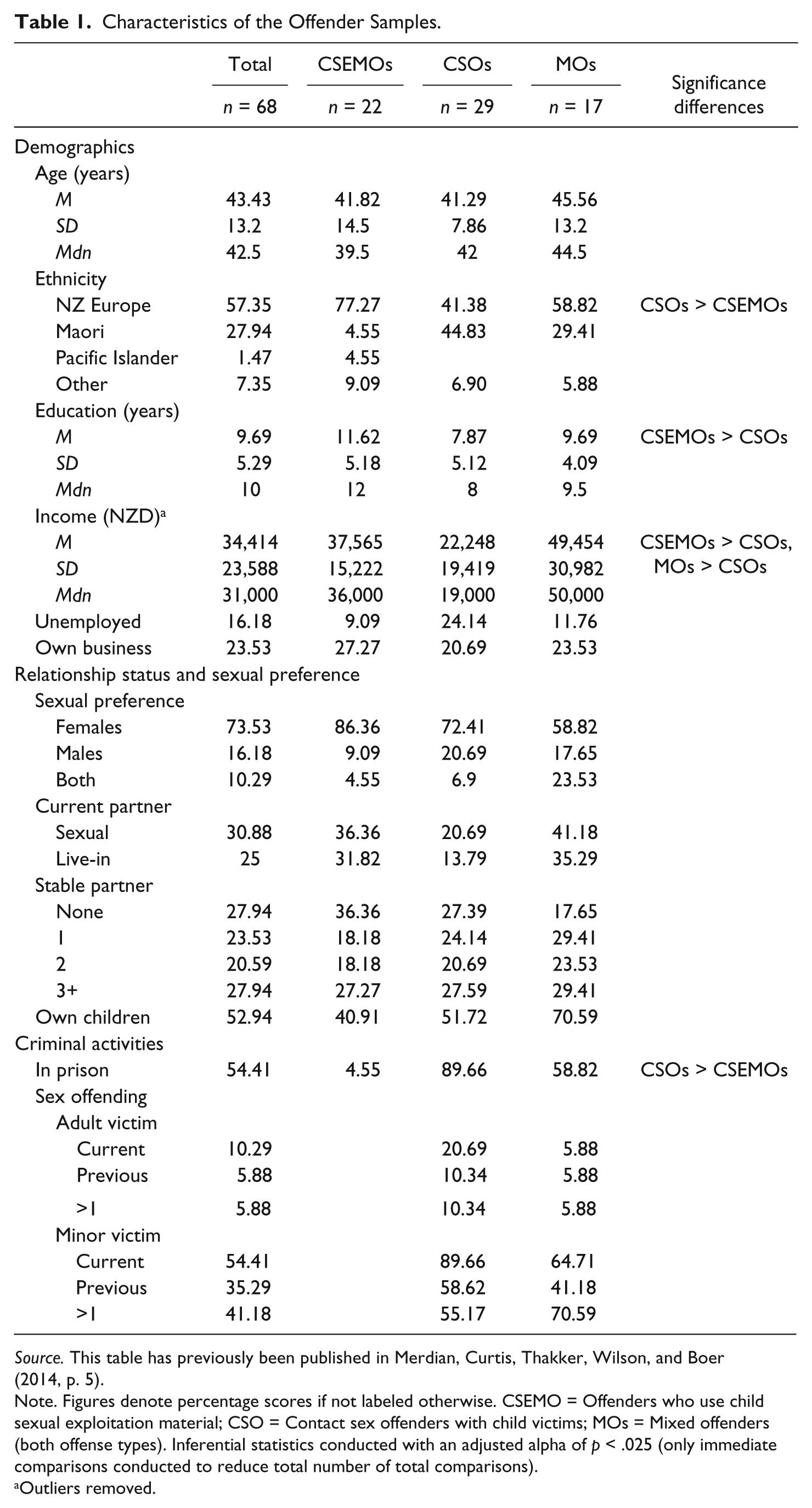
Source. This table has previously been published in Merdian, Curtis, Thakker, Wilson, and Boer (2014, p. 5).
Note. Figures denote percentage scores if not labeled otherwise. CSEMO = Offenders who use child sexual exploitation material; CSO = Contact sex offenders with child victims; MOs = Mixed offenders (both offense types). Inferential statistics conducted with an adjusted alpha of p < .025 (only immediate comparisons conducted to reduce total number of total comparisons).
Outliers removed.
Procedure
An anonymous computer survey was designed for the purpose of this study, assessing different areas of clinical interest and potential risk relevance, such as lifestyle, criminal history, offense details (e.g., victim characteristics), and psychological variables (e.g., impulsivity, thinking styles). The survey items were developed in three stages: (a) item construction based on a systematic review of the literature, (b) expert validation, and (c) a series of pilot studies to finalize the items. The final item pool consisted of 211 items, grouped into seven subsections: (a) personal life, (b) work and spare time activities, (c) Internet behavior, (d) general offending behavior, (e) content of CSEM, (f) engagement with CSEM, and (g) cognitive distortions relating to children and sex. The majority of items were dichotomized with the exception of the cognitive distortions items (n = 39), which were scored on a 5-point Likert-type scale (1= strongly disagree; 5 = strongly agree). The cognitive distortion items consisted of the Abel and Becker Cognition Scale (Abel et al., 1984) and incorporated items from the Children and Sexual Activities Inventory (Howitt & Sheldon, 2007; see Merdian et al., 2014, for more details on these tools).
Each participant completed the survey unaided using a portable computer, with full instructions appearing on screen. Supervisory and/or research staff were unable to observe participant responses but were available to answer questions if requested. Participants completed the study in a private room, either individually or in small groups, dependent on security arrangements.
Results
Differences in Offender Profiles
Analysis
As a large number of variables were tested on a comparably small sample of participants, methods of dimension reduction were used to limit the number of multivariate comparisons between the subgroups, namely, cluster analysis (CA; binary variables) and principal components analysis (PCA; Likert-type scaled variables). Only the items responded to by all participants were included in this analysis (i.e., 70 binary variables, 39 Likert-type scaled variables; excluding items on CSEM usage). The number of binary variables was reduced through a preliminary screening of tetrachoric correlations 2 , thus merging items that were highly inter-correlated (rtets > .70, indicating redundancy) and removing items that were weakly correlated with other items (rtets < .30). This screening process resulted in 25 binary variables remaining and ensured that subsequent CA met conventional recommendations regarding the minimum participant-to-variable ratio (2:1; Formann, 1984). Multinomial regression analysis was used to weight the resulting item clusters in terms of their associations with offender subtypes, and examine their ability to discriminate or account for these subtypes. In the absence of a strong conceptual basis for variable selection and in view of the small sample size available, a stepwise approach was applied to variable selection; although not a preferred option when conducting theory-driven analyses, it was considered useful for preliminary identification of potential discriminating factors (i.e., exploratory analysis) while avoiding model overfitting.
Results
Hierarchical CA (average linkage method) on the tetrachoric correlation matrix for binary variables resulted in six item clusters; this cluster solution was validated by re-clustering three quarters of randomly selected cases (replicating a six-cluster solution, with 68% identical classification of variables) and administering CA with a fixed cluster solution (100% identical classification of variables). The results of the PCA on the cognitive distortion items have been reported in Merdian et al. (2014); in short, PCA revealed six item components and one outlier item. Table 2 shows the resulting item groupings and highlights significant differences between the offender subtypes.
Six-Cluster Solution Resulting From Hierarchical Cluster Analysis on Binary Variables and Significant Differences Between Offender Subtypes.
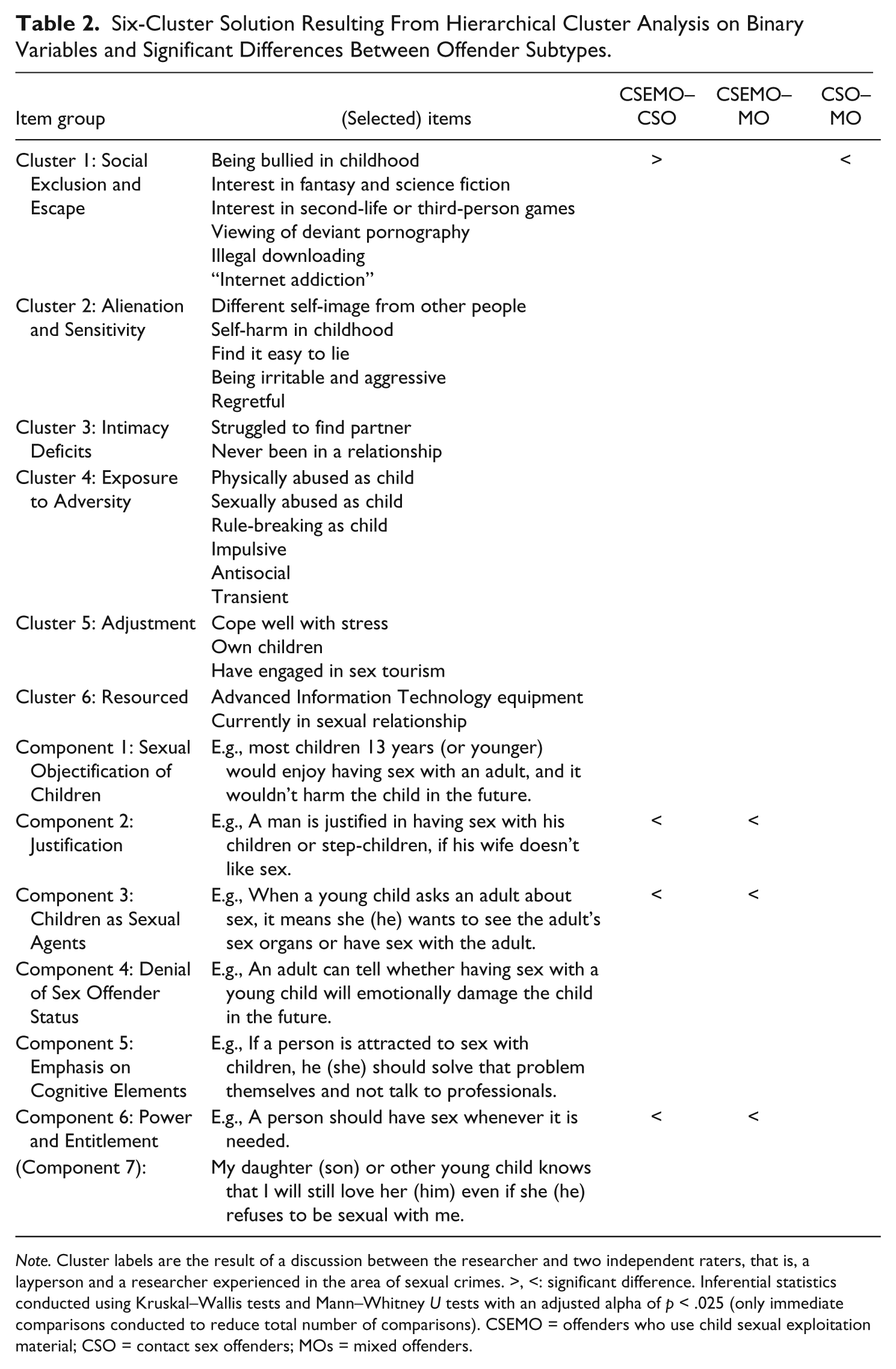
Note. Cluster labels are the result of a discussion between the researcher and two independent raters, that is, a layperson and a researcher experienced in the area of sexual crimes. >, <: significant difference. Inferential statistics conducted using Kruskal–Wallis tests and Mann–Whitney U tests with an adjusted alpha of p < .025 (only immediate comparisons conducted to reduce total number of comparisons). CSEMO = offenders who use child sexual exploitation material; CSO = contact sex offenders; MOs = mixed offenders.
Overall, significant differences between offender types were found on four item groupings: Social Exclusion and Escape (Cluster 1), Justification (Component 2), Children as Sexual Agents (Component 3), and Power and Entitlement (Component 6).
Employing a stepwise model (forward entry) on the main effects of the variable sum scores resulted in successful classification of 66% of participants (68% of CSEMOs, 86% of CSOs, and 29% of MOs correctly classified), based on three predictors: Social Exclusion and Escape (Cluster 1), Exposure to Adversity (Cluster 4), and Justification (Component 2). Notably, Exposure to Adversity emerged in this model despite nonsignificant group comparisons on this variable (p = .056), suggesting that the discriminatory contribution of this variable is more clearly seen when modeled in combination with (as an adjunct to) Social Exclusion and Escape and Justification (i.e., Exposure to Adversity explains significant variability in classification after accounting for contributions of the other explanatory variables). To specify, CSEMOs were more likely than CSOs to report social exclusion and escapism (including immersion in online and fantasy activities), odds ratio (OR) = 2.88, Wald χ2(1) = 14.69, p < .001. Similarly, MOs were also more likely to report Social Exclusion and Escapism than CSOs, OR = 1.62, Wald χ2(1) = 4.63, p = .031; although less likely than CSEMOs, OR = 0.56, Wald χ2(1) = 4.80, p = .029. In comparison with CSEMOs, both CSOs, OR = 1.84, Wald χ2(1) = 6.44, p = .011, and MOs, OR = 1.72, Wald χ2(1) = 4.64, p = .031, were more likely to report exposure to adversity. Finally, MOs were more likely than CSEMOs to justify their sexual behavior, OR = 1.50, Wald χ2(1) = 8.33, p = .004. The model revealed no significant outliers or influential cases and reached large effect sizes, R2 = .45 (Cox & Snell), R2 = .51 (Nagelkerke).
Summary
Group comparisons between offender subtypes resulted in a number of significant differences; online offenders were found to have stronger immersion and emotional significance related to their online activities in comparison with contact sex offenders. Furthermore, CSEMOs appeared to have stronger internal inhibitions toward contact offending: both MOs and CSOs reported significantly higher cognitions relating to (a) justifications of their sexual behaviors, (b) endorsement of children as sexual agents, and (c) sexual entitlement. These results are in line with the findings reported in the analysis. However, only Justification and Social Exclusion and Escape remained as significant predictors of offender subtypes, alongside Exposure to Adversity. In summary, these findings support the first hypothesis that CSEMOs have a psychological profile distinct to CSOs, potentially indicative of differing risk and treatment needs between individuals with and without contact sex offenses. The identified differences between MOs and CSEMOs further highlight the heterogeneity within the group of CSEM users, explored further below.
Classification of CSEM Subgroups
Analysis
It was examined whether different subgroups of CSEM users could be identified beyond the above distinction of individuals with and without contact sex offenses (MOs vs. CSEMOs). A number of additional items regarding details of the participants’ CSEM usage and general online activities were available for this analysis. Overall, 67 binary variables were used after exclusion of items with low levels of endorsement or low inter-correlations (as defined previously). Participants were grouped based on similarities and differences in their responses to these variables, and classification was achieved via a two-step process. In Step 1, Multidimensional Scaling (MDS; using the squared Euclidean distance measure for binary data) was conducted to represent the data in a small number of dimensions, reducing participants’ responses across 67 variables to a set of coordinates that describe the relative distances between participants. These MDS dimensions were further explored following regression-informed analyses proposed by Kruskal and Wish (1978) and Everitt and Rabe-Heskett (1997). In Step 2, hierarchical CA was used to identify groups of participants according to their proximity on the MDS-identified dimensions. Thus, CA was applied to a meaningfully reduced data set (facilitating interpretation of participant groupings) and an adequate participant-to-variable ratio was assured.
Results
MDS pointed to a fair fit of a three-dimensional solution (Stress S = .13248, Stress and squared correlation RSQ = .91838), suggesting that the participants can be validly mapped in a three-dimensional space. To explore the meaning of this space, content-based categories were identified and regressed over the three MDS dimensions, resulting in a best fit of Peer Networking (i.e., social contact with other adults with a sexual interest in minors) for Dimension 1 (β = .905), Contact Offending (i.e., having had or attempted to have sexual contact with a minor) for Dimension 2 (β = −.568), and Fantasy-Based Material (i.e., possession of other child-related material, such as cartoons/narratives describing child sexual contact, pictures from commercial clothing catalogs) for Dimension 3 (β = −.422). The MDS dimension axes lose orthogonality if rotated according to their β-weighting, which indicates inter-correlation between the MDS dimensions and suggests the existence of stronger distinguishers than the suggested item categories. Hierarchical CA (Ward’s method) was subsequently applied to cluster participants according to their profile of scores across the three MDS dimensions. The analysis identified three discrete groups; Figure 2 depicts the position of these participant groupings with respect to the MDS dimension axes.
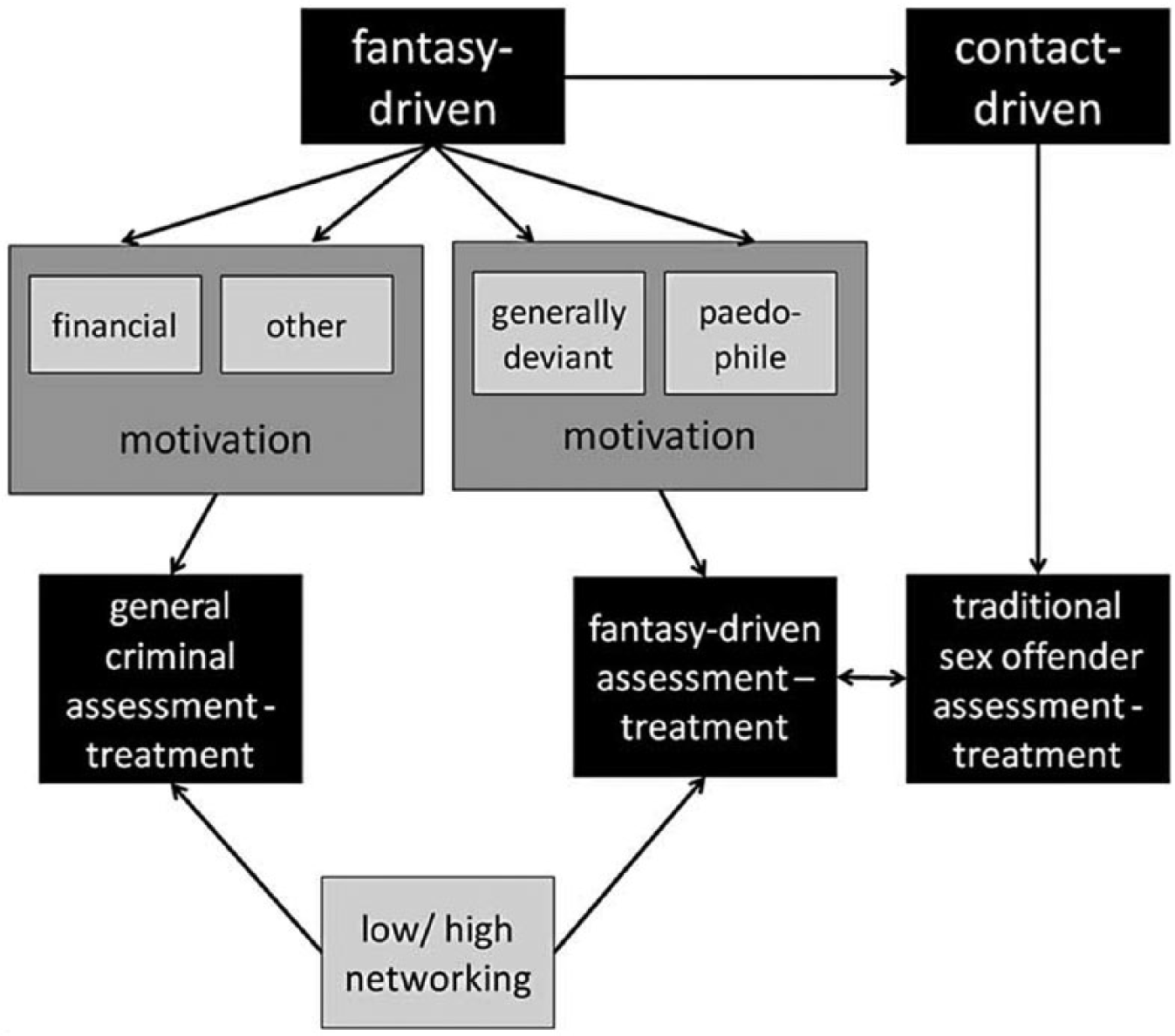
The three dimensions of child pornography offending.
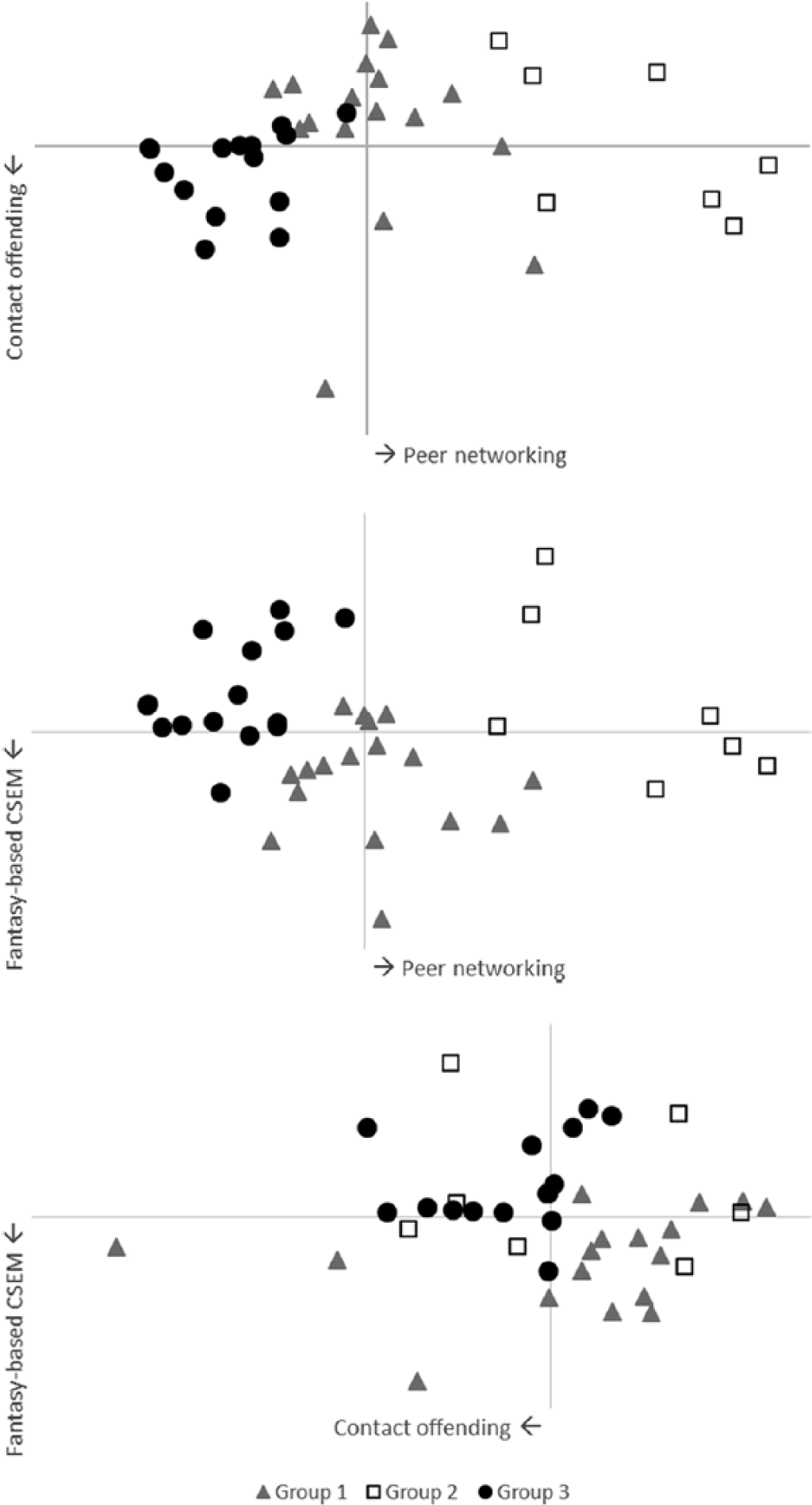
Two-dimensional MDS maps depicting the hierarchical cluster structure of offender classification (Ward’s method).
The two-dimensional map depicting Dimensions 1 and 2 shows that Group 2 is characterized by greater social networking with other CSEM users; Group 2 is clearly separated from Group 3 on this dimension, with Group 1 occupying the interceding space. Group 3 is notably concentrated in a region of Dimension 2, indicating greater propensity toward contact offending. Examining the map depicting Dimensions 1 and 3, the separation of groups becomes most prominent: In addition to aforementioned between-group distances on Dimension 1, Dimension 3 reveals that participants in Group 1 are distinguished by their interest in fantasy-based CSEM.
Table 3 describes the offense profiles of the identified subgroups. Given the high percentage of offenders in Group 3 (n = 15) who engaged in contact sex offending, and given their generally lower level engagement in online CSEM use or networking, this group was labeled contact-driven (see Merdian et al., 2013). Groups 1 (n = 17) and 2 (n = 7) supported the existence of the fantasy-driven offense pathway, given the emphasis the individuals placed on sexual satisfaction derived from CSEM (82.4% vs. 100% reported to find CSEM sexually arousing). In contrast, it appears that Contact-Driven Users used CSEM only as an occasional outlet for sexual interest or exploration (20% reported they found CSEM sexually arousing).
Descriptive Information on CSEM User Subgroups Identified Via Cluster Analysis and Multidimensional Scaling.
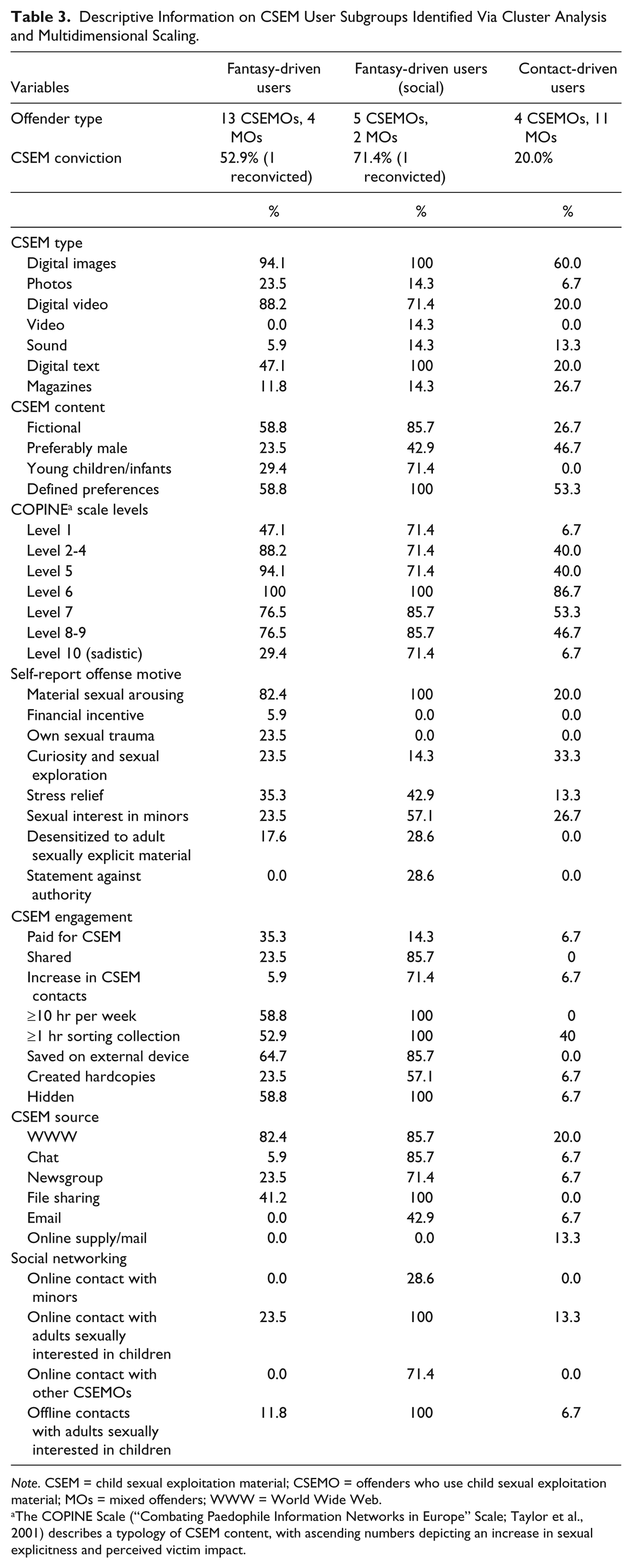
Note. CSEM = child sexual exploitation material; CSEMO = offenders who use child sexual exploitation material; MOs = mixed offenders; WWW = World Wide Web.
The COPINE Scale (“Combating Paedophile Information Networks in Europe” Scale; Taylor et al., 2001) describes a typology of CSEM content, with ascending numbers depicting an increase in sexual explicitness and perceived victim impact.
Fantasy-Driven Users (Groups 1 and 2) described a more frequent and dynamic engagement with CSEM (e.g., searching for and sorting material) and reported sexually explicit material of broader variety and severity, including fantasy-based material such as fictional and narrative CSEM. Group 2 is partly differentiated from Group 1 by gradation; Group 2 reported greater preoccupation with CSEM and use of higher level material but most notably more extensive engagement with other users (embeddedness in peer networks) and minors through online channels.
Summary
Spatial and numerical classification methods led to the identification of three subtypes of CSEM users, with distinct profiles in their CSEM usage and online engagement. Social engagement with other CSEM users, contact sex offending, and usage of fantasy-based material were identified as the drivers of this classification. In summary, these findings evinced the existence of at least two distinct offense pathways, contact-driven and fantasy-driven CSEM users, in line with Merdian et al. (2013). A variant of this latter pathway was also apparent, marked by greater extremity and social embeddedness.
CSEM Subgroup Membership and Predictors of Contact Sex Reoffending
Analysis
An exploratory secondary analysis was conducted to model subgroup membership as a function of historical criminal activity and other conventional predictors of (contact) sex offending. As above, multinomial regression analysis was used to identify the variables that were differentially associated with group membership (i.e., those that have discriminatory and possible explanatory value); given the exploratory nature of the analysis and the small sample size, again a stepwise approach to variable selection was applied. For conventional predictors of contact sex offending, the following variables were deduced from the item pool: age below 25 years, intimacy deficits, criminal/antisocial lifestyle (childhood conduct issues, antisocial personality traits), treatment and supervision failures (sexual reoffending, more than one period of treatment for sexual behaviors), preference for male victims (contact, non-contact), sexual deviancy (deviant pornography other than CSEM, CSEM with extreme content, perception of CSEM as sexually arousing), and cognitive distortions. The breakdown of variables and distribution of scores can be seen in Table 4.
Criminal Activity of Offender Subgroups and Scores on Potential Predictor Variables Related to Contact Sex Offending.

Note. Number of subjects (n) is listed in brackets next to percentage rates. None of the participants reported grooming activities, hence this category was removed. CSEM = child sexual exploitation material.
Sex offending against an adult: No participants scored on “previous convictions” or “more than one victim” and these variables are thus not displayed.
Higher levels of the COPINE scale are weighted more than low levels.
Results
A stepwise model (forward entry) resulted in correct subtype classification of 72% of CSEM users, based on three explanatory variables: sexual deviance, intimacy deficits, and viewing children as sexual agents. In terms of specific contrasts, Fantasy-Driven Users (Groups 1 and 2) were more likely than the Contact-Driven Users (Group 3) to use and report arousal to deviant sexually explicit material—Group 1: OR = 1.41, Wald χ2(1) = 4.88, p = .027; Group 2: OR = 2.19, Wald χ2(1) = 6.51, p = .011. Similarly, Fantasy-Driven Users (Groups 1 and 2) were more likely than Contact-Driven Users (Group 3) to report intimacy deficits—Group 1: OR = 4.51, Wald χ2(1) = 3.98, p = .046; Group 2: OR = 12.28, Wald χ2(1) = 6.85, p = .009. Finally, the Fantasy-Driven Users were less likely than Contact-Driven Users to view children as competent sexual agents—Group 1: OR = 0.76, Wald χ2(1) = 3.98, p = .046; Group 2: OR = 0.45, Wald χ2(1) = 5.43, p = .020. The model was able to successfully distinguish between fantasy-driven (Groups 1 and 2) and contact-driven groupings (Group 3), with 80% correct classifications of participants into Group 3. However, the explanatory variables did not reach significance (independently or in combination) for differentiating between the two fantasy-driven groupings (Group 1 vs. Group 2; ps ≥ .074); this was reflected in the relatively low percentage of correct classifications for participants in Group 2 (57%; with 43% misclassified as members of Group 1). Overall, the model revealed no significant outliers or influential cases and reached large effect sizes, R2 = .58 (Cox & Snell), R2 = .66 (Nagelkerke).
Summary
The above analyses further supported the broad distinction between fantasy-driven and contact-driven users, and suggest that these groups may be distinguished in terms of their scores across multiple conventional risk factors for offending. Contact-Driven Users were more likely to endorse cognitive distortions around the sexual agency of children, suggesting that relative to the other identified (fantasy-driven) subgroups, these users may be more comparable with conventional child sex offenders in their (post hoc) propensity to justify/rationalize child-directed sexual behavior. Fantasy-Driven Users were broadly distinguished from Contact-Driven Users by their relative difficulties in establishing and maintaining interpersonal relationships (intimacy deficits) and the intensity of their use (and arousal by) of deviant sexually explicit material (including use of more extreme CSEM). The two subgroupings of Fantasy-Driven Users were not significantly differentiated by their scores on variables gauging criminal history or conventional risk factors. However, relative to Group 1, Group-2 users seemed to tend toward more extreme scores with regard to their sexual deviance and intimacy deficits. The above analysis indicates that the diverse subgroups of CSEMOs have discriminating clinical (and potential risk) characteristics; however, the relationship between these potential risk predictors and actual recidivism risk could not be established with the data available for this study.
Discussion
The current study highlighted potential markers to differentiate individuals with contact and non-contact sex offenses, confirmed the previously identified heterogeneity in clinical and risk-related characteristics among CSEM users, and provided initial empirical support for Merdian et al.’s (2013) conceptual distinction of fantasy and contact-driven CSEM users.
Differences Between Contact and Non-Contact Sex Offenders
In contrast to contact sex offenders, CSEM users (CSEMOs and MOs) appeared to be more reliant on indirect means for achieving sexual and social stimulation, as indicated by elevated reporting on items related to Cluster 1, Social Exclusion and Escape (e.g., interest in second-life or third-person games, viewing sexually explicit material other than CSEM, excessive and problematic Internet use). In line with previous research (e.g., Seto, Reeves, & Jung, 2010; Taylor & Quayle, 2003), these findings indicate that the online environment appears to serve both appetitive and avoidant functions for CSEM users: facilitating distal social and sexual engagement while also providing a means to avoid the stresses of the offline world. However, whereas in the current study. the items within this cluster were able to differentiate between contact and non-contact sex offenders, it is unclear at present whether this cluster entails specific risk-related propensities or simply reflects traits of excessive (but legal) Internet users.
Interestingly, although offender subgroups initially did not differentiate on items relating to Cluster 4, Exposure to Adversity (e.g., abuse experience as a child), this cluster became a significant predictor of contact sex offending when modeled alongside Cluster 1: Social Exclusion and Escape. Although highly speculative at this stage, it could be hypothesized that, in contrast to exclusive CSEM users who tend to cope with adverse experiences through an avoidant behavioral style (e.g., escape, immersion in online and offline fantasy), contact sex offenders may have a greater tendency to “act out” (e.g., rule-breaking in childhood, impulsive decision making) in response to adverse life events.
The results also highlighted the significant role of cognitive distortions in differentiating between contact and non-contact sex offending. Specifically, exclusive CSEM users were found to report fewer cognitive distortions regarding children and sex, provided less justification for their offending behavior, and demonstrated less sexual entitlement than contact and mixed sex offenders. Notably, items relating to Justification had the strongest discriminatory power in grouping exclusive from mixed CSEM users. The lack of endorsement of these cognitions (or reporting thereof) may thus be indicative of internal inhibitions toward contact sex offending (see also Babchishin et al., 2015). These findings also further challenge the applicability of existing measures of cognitive distortions supportive of child sexual abuse for CSEM users, and highlight a need for the systematic development and validation of CSEM-specific cognitive distortion tools (e.g., Howitt & Sheldon, 2007; O’Brien & Webster, 2007).
Identification and Profile of CSEM Subgroups
In partial support of the conceptual model proposed by Merdian et al. (2013), spatial and numerical classification methods led to the identification of three subtypes of CSEM users. Broadly, the participants split into two subgroups: individuals with a primary interest in direct sexual contact with a minor (Contact-Driven Users; n = 15) and individuals whose offending behavior appeared focused on their CSEM usage (Fantasy-Driven Users; n = 24). However, within the latter, a further subgroup emerged (n = 7) differentiated through the possession of more extreme material (e.g., lower victim age, higher level of sexual explicitness) and higher social involvement with other CSEM users. In line with the profile described above, individuals on the fantasy-driven pathway (both subgroups) demonstrated a preference for indirect means of sexual satisfaction, reporting high levels of intimacy deficits, and more frequent use of sexually deviant materials (CSEM and other). The findings further confirmed the potential function of cognitive distortions to discriminate between contact- and fantasy-driven users, with the former being more likely to report viewing children as sexual agents. While these established predictors of contact sex offending (i.e., intimacy deficits, deviant sexual arousal, and viewing children as sexual agents) had some discriminatory power between contact- and fantasy-driven users, it is noteworthy that the majority of established risk factors assessed within the current study (see Table 4) were not useful for differentiating CSEM users with and without a primary motivation to engage in direct sexual contact with a minor.
While these findings may have important implications for the (risk) assessment and management of CSEM users, it is important to first highlight the influence of methodological and contextual factors on the data collected and the (statistical) interpretation thereof. The study relies on the use of self-report data in regard to both the questionnaires the participants completed and the offending behaviors reported. While there are perennial issues integrating the reliability and veracity of such data, this method of data collection can potentially facilitate the identification of previously undetected offending behaviors, an important consideration given the disparity between official and self-reported crime data reported for this population (e.g., Beier et al., 2014; Beier et al., 2009; Grundmann, Neutze, & Beier, 2010; Neutze et al., 2011; Seto et al., 2011). Furthermore, an anonymized computer survey was used to maximize and facilitate honest responding. Indeed, while CSEMOs are generally found to report a low criminal activity beyond their CSEM offending (e.g., Faust, Bickart, Renaud, & Camp, 2015; Seto & Eke, 2015; Seto et al., 2011), the current sample reported a higher occurrence of direct sexual contact with a minor (43.6%) than identified in other research samples (see Babchishin et al., 2010; Babchishin et al., 2015); however, this number reduced significantly when only official conviction data were considered (2.6%).
The exploratory nature of this study in combination with the very small sample size also limited the choice and applicability of methods of data analysis, and the generalizability of the results. For example, the relatively low level of statistical power led to the removal of a large amount of information due to low inter-correlations between measured variables. However, effects that can be found under these (statistical) circumstances are assumed to be replicated with larger sample sizes. It was thus considered more likely to miss effects with the current study design (Type-2 error) than to identify false effects (Type-1 error).
Contact-Driven and Fantasy-Driven Pathways to CSEM Offending
Despite these caveats, the findings from the current study provide initial empirical evidence for the conceptual distinction between contact-driven and fantasy-driven CSEM users (see Merdian et al., 2013). To clarify, the twofold distinction differentiates users of CSEM based on their main source of sexual satisfaction, namely, direct sexual contact with a minor, or fantasies thereof, with individuals on each pathway being characterized by the specific needs they aim to fulfill with their online offending behavior. The function of the Internet for the individual has previously been identified as a crucial aspect in the assessment of online offenders (see Caple, 2008; Sheldon & Howitt, 2007; Surjadi, Bullens, Van Horn, & Bogaerts, 2010; Taylor & Quayle, 2003), and the current findings further support this notion.
Beyond the exploration of their sexual needs, the Internet appears to have a more elaborate function for individuals on the fantasy-driven pathway, such as satisfying a preference for sexually extreme content and providing a means for establishing social connectedness. The current study identified a number of critical defining variables for this group, most notably high intimacy deficits, sexual deviance, and low endorsement of children as sexual agents. In contrast, individuals on the contact-driven pathway showed some similarity with the conventional profile of sex offenders (e.g., history of confrontational offending, antisociality). In his review on CSEM offenders, Seto (2013) pointed to the importance of antisociality for users with a history of contact sex offending, a finding subsequently confirmed by Babchishin et al. (2015). From the 15 users identified as contact-driven offenders in the current study, four had not engaged in direct sexual contact with a minor. Their placement on the contact-driven pathway could therefore represent a misclassification error, or be a potential indicator of an enhanced risk of cross-over, although this cannot be confirmed with the current data. Of particular note is that no individual within the contact-driven group reported contacting minors online; however, almost half of the fantasy-driven users had engaged in online contact with a minor. While this may indicate that individuals on the contact-driven pathway underreported the use of the Internet to gain access to victims, or that fantasy-driven users underreported the commission of offline offending, this finding could also indicate that online contact-behavior in itself is not strongly related to the commission of an offline contact sex offense, but may have fantasy-facilitative functions (as reported by Briggs, Simon, & Simonson, 2011). Although this may suggest a higher likelihood for offenders on the contact-driven pathway to cross-over or recidivate with a contact sex offense (in line with Seto & Eke, 2015), the current study did now allow for any conclusive statements on risk probability to be made. Nevertheless, while established risk measures have been shown to have some predictive validity for CSEM users with a history of contact sex offenses, the empirical evidence to date indicates that they have limited value for the assessment of exclusive CSEM users (e.g., Osborn et al., 2010; Seto & Eke, 2015; Wakeling et al., 2011). Overall, these apparent differences between contact sex offenders and CSEM users in general, and between the two pathways of CSEM offending specifically, point to a need for a critical review of current clinical and risk assessments for CSEM users, specifically those on the fantasy-driven pathway.
Where to From Here?
The findings presented here provide initial empirical support for the contact-driven versus fantasy-driven distinction of CSEMOs previously outlined by Merdian et al. (2013). While this development is important, it is clear further research on the classification and risk assessment of CSEM offenders is needed. Specifically, contextual aspects of CSEM offending require empirical exploration, such as what actually constitutes “deviant” online sexual behavior, how and why sexual fantasies regarding minors develop, the relationship between online fantasy and behavioral enactment (e.g., see Bartels & Gannon, 2011; Dombert et al., 2015), and how these factors may be assessed and measured (e.g., see Ortigue, Patel, & Bianchi-Demicheli, 2009; Waismann, Fenwick, Wilson, Hewett, & Lumsden, 2003). Furthermore, the interplay between sexual fantasy and social contact with other offenders with a sexual interest in minors in the offending of CSEM users needs to be clarified. Above all, it still remains to be established whether CSEM offending constitutes an inherently different type of offending, or a different dimension of sex offending.
Footnotes
Authors’ Note
Douglas P. Boer is now at the Faculty of Health, University of Canberra, Australia.
Declaration of Conflicting Interests
The author(s) declared no potential conflicts of interest with respect to the research, authorship, and/or publication of this article.
Funding
The author(s) received no financial support for the research, authorship, and/or publication of this article.