




Abstract
Hebephilia refers to sexual interest in pubescent children who are beginning to show early signs of sexual development but are sexually immature. The present study examined the relationship between hebephilia and victim age choice in a sample of 2,238 adult male sexual offenders. On average, offenders were 39 years old at the time of their assessments, and approximately half (48%) were referred by probation or parole offices. Assessment data included self-report, sexual arousal measured by volumetric phallometry, and victims’ ages. Results suggested that, similar to pedophilia, hebephilia had a medium sized association with a greater number of victims under age 11 and a small sized association with a greater number of victims ages 11 to 14. Unlike pedophilia, a small positive association was consistently found between hebephilia and a greater number of victims ages 15 or 16. Furthermore, a small positive association was observed between victim age polymorphism and hebephilia and pedophilia. The present results suggested that hebephilia was associated with a greater number of victims age 14 or younger and had similar victim age correlates to pedophiles.
Hebephilia refers to the sexual interest in pubescent children (Blanchard, 2010; Blanchard et al., 2009; Stephens & Seto, 2015), which is distinct from both pedophilia (i.e., the sexual interest in prepubescent children) and teleiophilia (i.e., the sexual interest in sexually mature adults; Hames & Blanchard, 2012). Hebephilia is often mistaken to be the sexual interest in post-pubescent (adolescent) individuals, which is more properly termed ephebophilia (Hames & Blanchard, 2012). In hebephilia, the sexual interest is toward children who show only some secondary sex characteristic development, whereas in ephebophilia, the focus is on older youth, who appear more sexually mature, even if they are under the legal age of consent. Pedophilia and hebephilia are reproductively (and therefore evolutionarily) disadvantageous, whereas teleiophilia is the species-typical sexual interest (Hames & Blanchard, 2012; Seto, 2002, 2010).
Although the first definition of pedophilia offered by Krafft-Ebing in the 1800s regarded it as the sexual preference for prepubescent children, the age of onset of puberty has decreased substantially since then (e.g., Biro et al., 2010; Herman-Giddens et al., 2012). The International Classification of Diseases (ICD-10) uses language that accounts for variations in pubertal onset, in that its diagnostic criteria specify that sexual interest can be for “prepubertal or early pubertal” children (WHO, 1992, p. 171; italics added). The Diagnostic and Statistical Manual (DSM) system, however, only includes the word “prepubertal,” alongside the outdated description of puberty as “generally age 13 years or younger” (p. 571, Diagnostic and Statistical Manual of Mental Disorders [4th ed., text rev.; DSM-IV-TR; American Psychiatric Association (APA), 2000]; p. 698, Diagnostic and Statistical Manual of Mental Disorders [5th ed.; DSM-5; American Psychiatric Association, 2013]). The panel of experts assembled to revise the paraphilia section for the DSM-5 proposed to explicitly include hebephilia alongside pedophilia. This followed from several factors, including research that men with a sexual interest in pubescent children showed correspondingly greater sexual arousal to them (Blanchard et al., 2009) and exhibited the same neurobiological and psychosocial correlates as pedophilic men (e.g., Beier, Amelung, Kuhle, Grundmann, Scherner, & Neutze, 2015; Cantor & Blanchard, 2012; Greenberg, Bradford, & Curry, 1993). The proposal was widely debated, primarily between scientist-clinicians and forensic consultants (cf. Cantor, 2012; Franklin, 2009, 2010; Ryniker, 2012). Ultimately, the APA Board of Trustees rejected not only the recommendation to include hebephilia explicitly but also the opportunity to exclude hebephilia from Paraphilia Not Otherwise Specified (Blanchard, 2013), thus providing no clear direction within DSM-5.
Regardless of the category or system in which hebephilia is coded, there remains an uncontested need for additional, systematic information regarding the construct, especially its relationship to sexual offending. The present study examined whether hebephilia, as ascertained by self-report and phallometric response pattern, is associated with greater numbers of pubescent victims (herein, ages 11 to 14).
Hebephilia and Sexual Victim Age Choice
There has been less research on the relationship between hebephilia and sexual offending compared with research on pedophilia and sexual offending, especially with regard to victim age choice. For example, approximately 50% to 60% of the offenders against children are pedophilic (e.g., Cantor & McPhail, 2015; Seto, 2008). Pedophilia has several victim characteristic correlates, such as having boy victims, extrafamilial victims, and young child victims (Levenson, Becker, & Morin, 2008; Seto & Lalumière, 2001; Seto, Lalumière, & Kuban, 1999; Seto, Stephens, Lalumière, & Cantor, 2017). Given the paucity of research on hebephilia and victim age choice, there is a need for additional research on this relationship.
A positive association between hebephilia and pubertal victims (typically, ages 11 to 14) in a mixed group of sex offenders would be expected. Given that erotic-age interests refer to sexual maturity rather than age per se, the use of victim age throughout the article is a proxy measure of the Tanner (1978) stages of sexual development. The Tanner stages provide a scale of secondary sex characteristic development across the life span based on development of genitals, pubic hair, and breasts. Tanner Stage 2 or 3 corresponds to pubescence—individuals in this stage are the focus of sexual interest for hebephiles (Stephens & Seto, 2015). In contrast to hebephilia, pedophilia refers to sexual interest in those in Tanner Stage 1, ephebophilia refers to sexual interest in those in Tanner Stage 4, and teleiophilia refers to sexual interest in those in Tanner Stage 5 (Hames & Blanchard, 2012). Tanner stage is rarely recorded in victim information, and, as a result, research on erotic-age interests has relied on victim age as an approximation of Tanner stages.
Hebephilia and Victim Age Polymorphism
Despite the expected association between hebephilia and sexual offending against children ages 11 to 14, hebephiles might have victims in other age ranges (i.e., victim age polymorphism; Guay, Proulx, Cusson, & Ouimet, 2001). Those individuals with hebephilia seem to be less likely than those with pedophilia and teleiophilia to be exclusive in their erotic-age interests, as they were more likely to indicate having sexual interest in other Tanner stages of sexual development (Beier et al., 2009, 2013). In addition, the boundaries of puberty are imprecise (e.g., Herman-Giddens et al., 1997; Herman-Giddens, Wang, & Koch, 2001); older children and younger adolescents can appear pubescent. Thus, an offender with hebephilia might seem to be polymorphic because he offended against a 10-year-old (usually a prepubescent child) and a 13-year-old (usually a pubescent child); however, the 10-year-old might appear pubescent because he or she began puberty earlier than average. These factors would likely contribute to an association between hebephilia and victim age polymorphism.
In the case of hebephilia, victim age polymorphism might also be explained by the sexual response gradient model (Blanchard et al., 2012; Lykins et al., 2010a; Seto et al., 1999). In this model, men exhibit their greatest sexual arousal to their most preferred stimulus category, but nonetheless show some sexual arousal to the next most similar (i.e., their next most preferred) category, followed by the next, and so forth down to the least similar and least arousing category. Accordingly, gynephilic, teleiophilic men (attracted to women) typically have their greatest sexual response to women, followed by older adolescent girls, pubescent girls, and then prepubescent girls (Lykins et al., 2010a). Those with hebephilia could show a bi-directional sexual response gradient, showing some response to prepubescent children and/or to older adolescents, whereas those with pedophilia would show a unidirectional gradient (Blanchard et al., 2012; Seto, 2017).
Present Study
The present study investigated the association between hebephilia and victim age choice. It was hypothesized that hebephilia would be associated with a greater number of victims ages 11 to 14 (typically, Tanner Stage 2 or 3) and that pedophilia would correspond to a greater number of victims under age 11 (typically, Tanner Stage 1). Furthermore, the present study examined the relationship between hebephilia and victim age polymorphism, expecting an association between hebephilia and age polymorphism. If the sexual response gradient hypothesis correctly models human male sexual interest, then those with hebephilia should exhibit relatively greater victim age polymorphism, as they have a greater likelihood of moving up or down their gradient if their preferred victim type is unavailable (Heil, Ahlmeyer, & Simons, 2003).
Method
Sample
This study was conducted with men referred to a large outpatient sexual behavior clinic. The initial sample was comprised of 3,343 men assessed between 1995 and 2011. The majority of individuals committed non-contact and/or contact sexual offenses involving children; most of the rest committed sexual offenses involving adults. In the present study, victim information included contact and certain non-contact offenses, most notably exhibitionism and voyeurism. There were a small proportion of patients who had not committed sexual offenses but were referred due to problematic sexual behavior, such as an excessive use of pornography or non-criminal paraphilic behavior that caused distress or relationship problems (e.g., fetishism).
Individuals were excluded from analyses for the following reasons: no sexual offense victim (n = 582), invalid phallometric data (greater response to a neutral stimulus category or if blood volume change during phallometric testing was less than 1 cc; n = 450), and an assessment prior to age 18 (n = 73). The total sample included 2,238 male offenders who admitted to or were convicted of a sexual offense (see Table 1 for descriptive information about the sample and variables of interest).
Descriptive Information for the Sample.
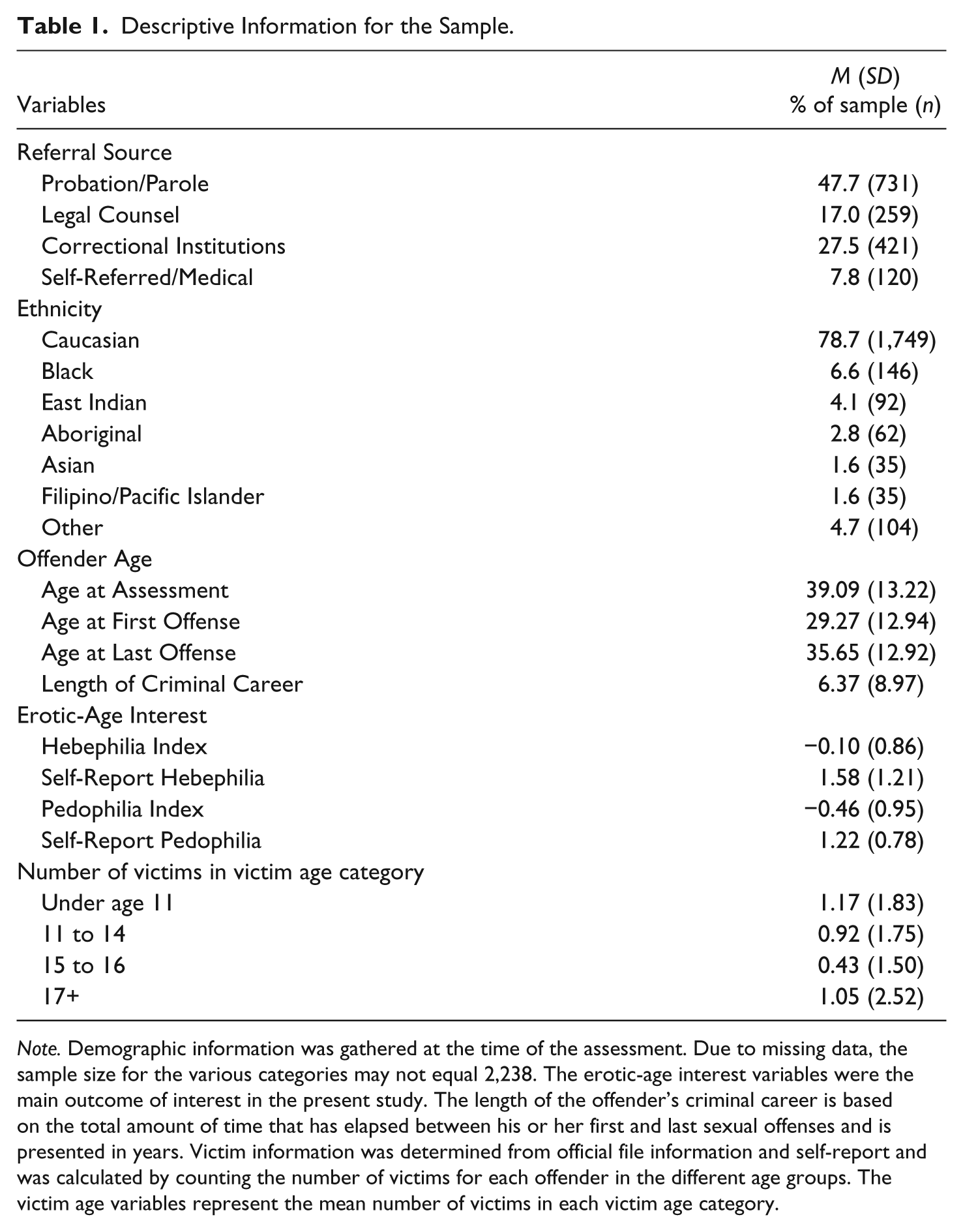
Note. Demographic information was gathered at the time of the assessment. Due to missing data, the sample size for the various categories may not equal 2,238. The erotic-age interest variables were the main outcome of interest in the present study. The length of the offender’s criminal career is based on the total amount of time that has elapsed between his or her first and last sexual offenses and is presented in years. Victim information was determined from official file information and self-report and was calculated by counting the number of victims for each offender in the different age groups. The victim age variables represent the mean number of victims in each victim age category.
The offenders in the present study have been included in previous studies that addressed different research questions. These studies compared offender groups, evaluated the validity of the phallometric procedure, and examined the impact of victim selection on recidivism (Barbaree, Blanchard, & Langton, 2003; Blanchard, 2011; Blanchard & Barbaree, 2005; Blanchard, Klassen, Dickey, Kuban, & Blak, 2001; Blanchard, Kuban, et al., 2006, 2009; Blanchard et al., 2012; Blanchard, Lykins, et al., 2009; Cantor & McPhail, 2015; Lykins et al., 2010a, 2010b; Seto, Cantor, Blanchard, 2006; Seto, Stephens, Lalumière, & Cantor, 2017; Stephens, Seto, Goodwill, & Cantor, 2018). The present study addressed a different question from these previous studies, that is, the relationship between hebephilia and victim age choice, including age polymorphism.
Erotic-Age Interest
Self-report
A detailed and standardized sexual history form was used to guide a clinical interview conducted at the phallometric testing appointment. Clients were asked to rank various age and gender combinations from 1 (no sexual interest) to 5 (strongest sexual interest). They could assign the same value to multiple age and gender categories (i.e., ties scores were permitted). In the present study, these self-reported rankings of sexual interest in pubescent and prepubescent children were treated as continuous measures.
Sexual arousal
Volumetric phallometry involves the measurement of penile blood volume change in response to sexual stimuli. The technician instructed the examinee to place an inflatable cuff at the base of his penis and to then place a glass cylinder over the penis to create an airtight seal. Air displacement was measured during testing, reflecting changes in the volume of blood in the penis. During the procedure, examinees were exposed to audio and photographic stimuli depicting males and females in Tanner Stage 1 (prepubescent children), Tanner Stages 2 and 3 (pubescent children), or Tanner Stage 5 (fully mature adults). Audio stimuli were accompanied by the presentation of slides projected on three screens that included the simultaneous presentation of a close-up view of the genital region, a full frontal view, and a full rear view of a model. A neutral category of landscape images with descriptions of non-sexual activities was included as a reference category. Audio file narratives described sexual interactions that described the physical attributes, in addition to the age, of the target person to ensure no ambiguity in how the offender imagined a child or adult of a specific age. The voice of the reader matched the sex of the person described in the stimulus.
There were a total of four trials per stimulus category, presented in a pseudo-random order. For each trial, the examinee viewed three models for 18 s each (i.e., trial duration was 54 s) while a single audio vignette was played. Overall, examinees were exposed to 12 different models, per stimulus category, for the duration of the test. The examinee’s greatest level of change from the initial value for each trial was calculated from the largest deviation from his baseline level of arousal in the trial and from the area under the response curve, from recording onset to offset. These 28 scores were standardized and averaged within each stimulus category to create seven stimulus category scores. These scores represented the average level of sexual arousal to each stimulus category. An output index was created from the three highest scores, and offenders with scores less than 1 cc (i.e., 1 milliliter change) were excluded from further analysis. Category scores were subsequently ipsatized to optimize the data and ease interpretation (e.g., Harris, Rice, Quinsey, Chaplin, & Earls, 1992). The phallometric procedure in the present study is a standardized procedure and has been extensively researched (for further information, see Blanchard, Klassen, Dickey, Kuban, & Blak, 2001). The sensitivity of the procedure was recently investigated and found to be 70% for hebephilia and 72% for pedophilia; specificity was 91% for hebephilia and 95% for pedophilia in previous analyses (Blanchard et al., 2001; Cantor & McPhail, 2015).
A hebephilia index and a pedophilia index were calculated based on category scores for each of the stimulus categories. For the hebephilia index, the greater score to adult category (male or female) was subtracted from the greater score to pubescent child category (male or female). Analogously, for the pedophilia index, the greater score to either adult category (male or female) was subtracted from the greater score to either prepubescent child category (male or female). Thus, positive index values indicated a greater response to children than to adults, whereas negative scores indicated the reverse.
Victim Age Choice
For each offender, victims were recorded in each of the following age categories: under age 11, ages 11 to 14, ages 15 or 16, and age 17 and older. Consistent with past studies, victim choice variables were treated as continuous in analyses, and victim counts were capped at 10 to minimize the effects of outliers (e.g., Cantor et al., 2004). The assessment of polymorphism was based on the offender having victims who fell into more than one age group. For polymorphism analyses, the 15 or 16 age victims were combined with the age-17 and older victims. This decision was made as sexual interest in older adolescents is not necessarily sexually atypical, although it is often socially sanctioned (Hames & Blanchard, 2012). Moreover, 15- and 16-year-olds more closely resemble adults with regard to their stage of sexual maturity (i.e., Tanner Stage 4, post pubescent).
Data Analysis
In the present study, hebephilia and pedophilia were assessed separately via self-report and phallometry. Although men’s self-reported sexual interests and sexual arousal patterns generally show strong concordance (Chivers, Seto, Lalumière, Laan, & Grimbos, 2010), sexual offenders are often more motivated to deny sexual interest in children. Men who admit to this sexual interest represent a minority of many offender samples (e.g., Laws, Hanson, Osborn, & Greenbaum, 2000; Murphy & Barbaree, 1994).
To test the first hypothesis, linear regressions were conducted to examine the association between continuous victim age counts (predictor variables) and continuous measures of erotic-age interest (outcome variables). In these analyses, the four victim age count variables were entered together in analyses. For analyses pertaining to victim age polymorphism, only those with two or more victims were entered into analyses (n = 1,335). All polymorphism analyses were conducted using linear regressions, with erotic-age interest as the outcome variable. Victim age polymorphism was a dichotomous variable (yes/no) entered in the second step after controlling for opportunity to offend. Opportunity to offend was calculated by examining the total amount of time that elapsed between the first and last sexual offenses. Chi-square analyses were then used to follow up the significant regressions to provide an examination of the pattern of polymorphism for the different offender groups. Measures of effect size using standardized associations (r) were considered. According to Hemphill (2003), a small effect is .20 or less, a medium effect is .20 to .30, and a large effect is .30 or greater. Standardized regression coefficients were interpreted as a measure of effect size for the regression analyses (Hemphill, 2003).
Results
Prior to conducting the analyses, victim age choice was examined by erotic-age interest for the full sample of 2,238 sexual offenders (Figure 1). To include this figure, erotic-age interest indicators were dichotomized and offenders were classified as hebephilic or pedophilic. For sexual arousal indicators, a 0.25 cutoff score was used to indicate the presence of hebephilia or pedophilia, consistent with prior analysis of these data (Blanchard et al., 2001). For self-report, offenders were classified as hebephilic or pedophilic if they self-reported moderate to strong sexual interest in pubescent or prepubescent children, respectively.

The figure examines erotic-age interest by victim age type for the full sample (N = 2,238).
Erotic Age Interest and Sexual Offending Victim Age Choice
To test the hypothesis that those with greater interest in pubescent and prepubescent children had a greater number of victims under age 11 and ages 11 to 14, four linear regressions were conducted (Table 2). Both predictor and outcome variables were continuous for all analyses.
Erotic Age Interest and Sexual Victim Choice.
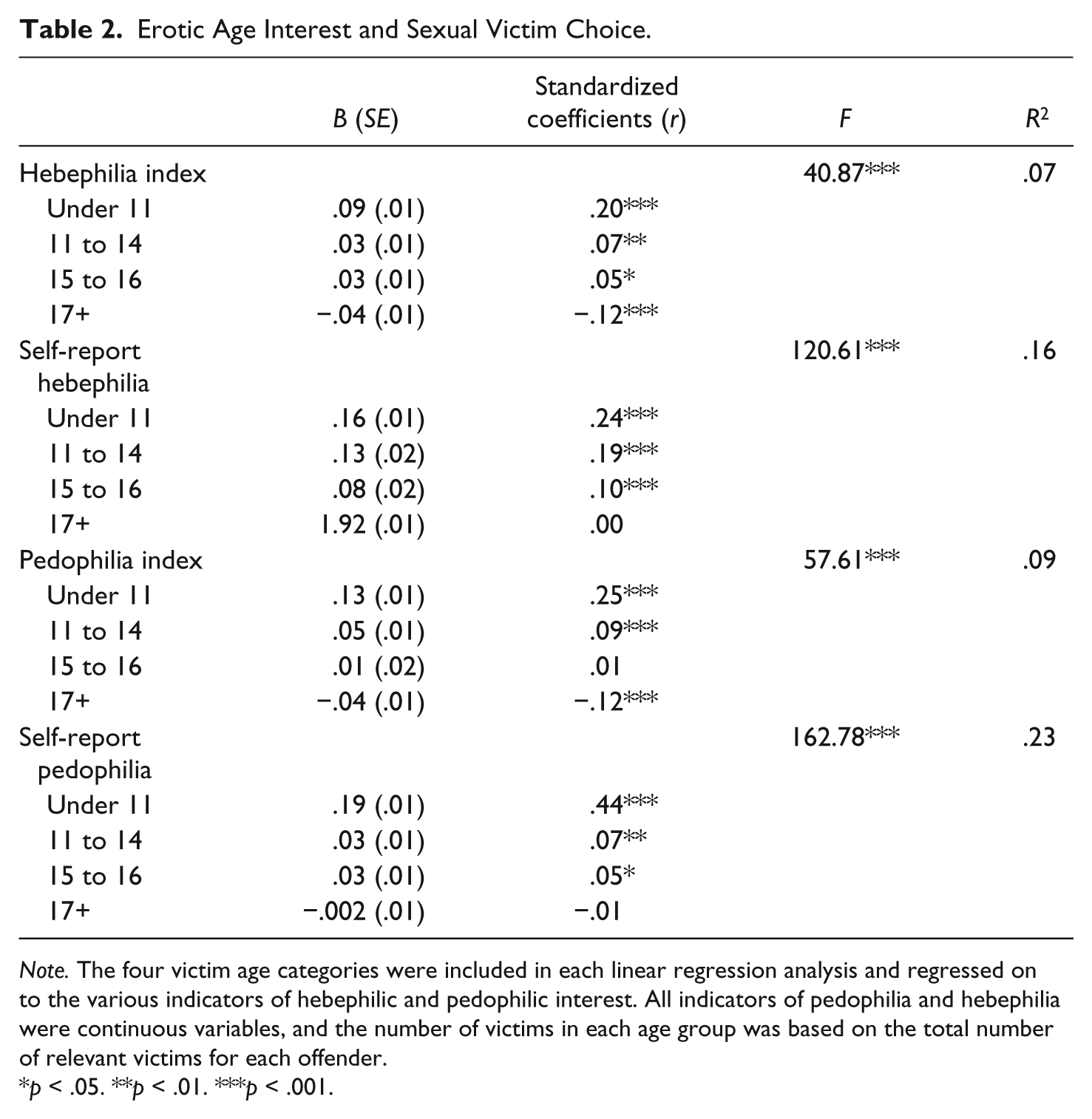
Note. The four victim age categories were included in each linear regression analysis and regressed on to the various indicators of hebephilic and pedophilic interest. All indicators of pedophilia and hebephilia were continuous variables, and the number of victims in each age group was based on the total number of relevant victims for each offender.
p < .05. **p < .01. ***p < .001.
Hebephilia
As hypothesized, there was a small positive association between both indicators of hebephilia and a greater number of victims aged 11 to 14 (see Table 2). There was also a significant medium sized effect for both indicators and the number of victims younger than 11, as well as a small significant effect for the number of victims ages 15 or 16. For a greater number of victims 17 or older, there was no significant association with the self-report indicator and a negative association for the sexual arousal indicator.
Pedophilia
There was an association between both of the indicators of pedophilic interest and a greater number of victims under 11 and of victims ages 11 to 14. Effect sizes for victims under 11 ranged from medium (sexual arousal) to large (self-report), but both were small for victims 11 to 14. Although the relationship between pedophilia and victim age choice was similar to the relationship found for hebephilia, there were two differences. First, both indicators of pedophilia were negatively associated with the number of victims 17 and older, whereas only the sexual arousal indicator for hebephilia showed this negative association. Furthermore, only the self-report indicator of pedophilia had a small significant association with the number of victims 15 or 16, whereas both indicators of hebephilia showed this association.
Victim Age Polymorphism
Of the 1,335 offenders with two or more victims included in polymorphism analyses, 56% of the offenders were polymorphic. In the first step of the linear regressions, it was found that the longer the offender’s opportunity to offend, the greater his interest in prepubescent and pubescent children. This association was found for both indicators. As hypothesized (see Table 3), there was a small significant association between victim age polymorphism and all of the indicators of hebephilic and pedophilic interest, after taking into account opportunity to offend.
Erotic-Age–Gender Interest and Victim Age Polymorphism.
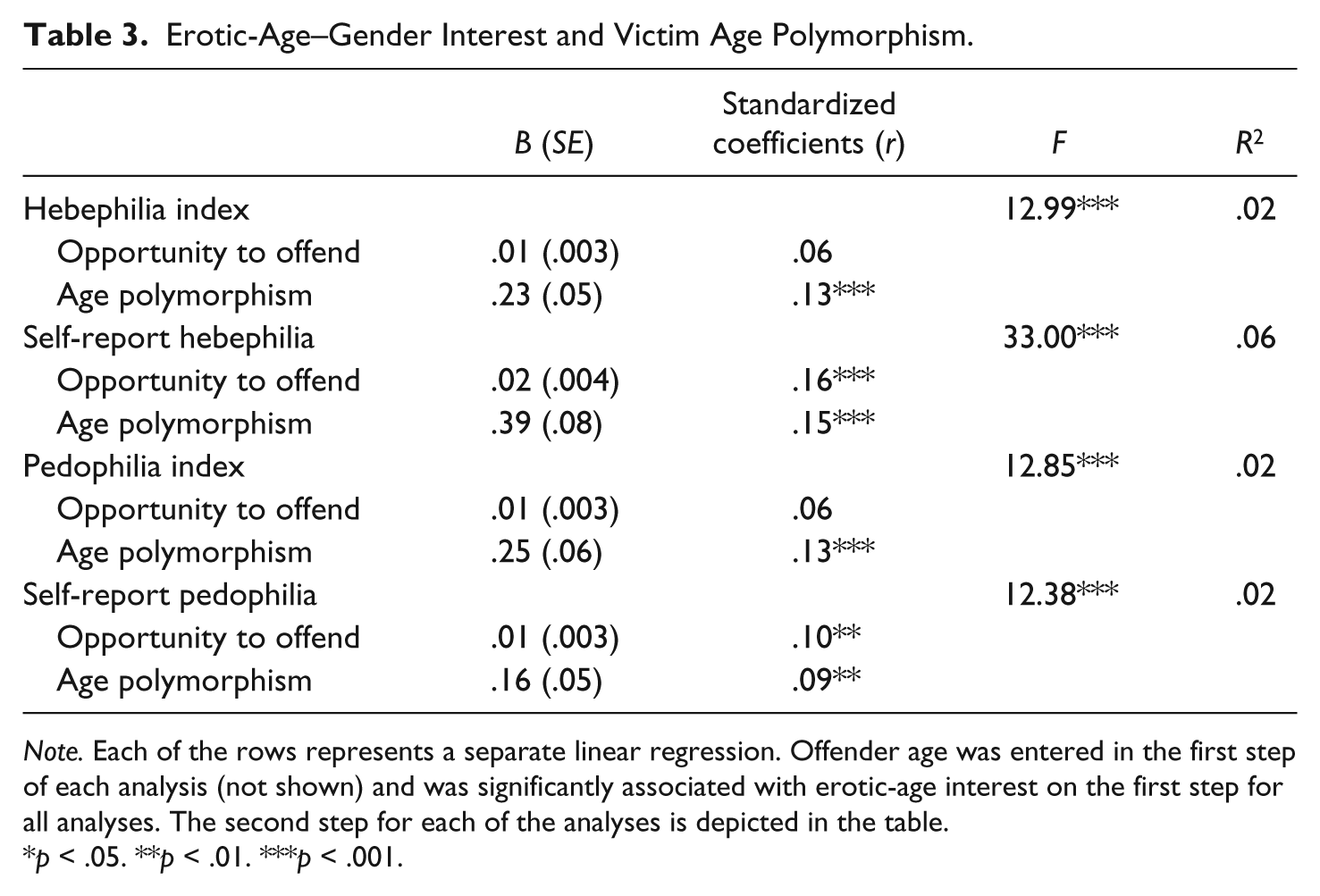
Note. Each of the rows represents a separate linear regression. Offender age was entered in the first step of each analysis (not shown) and was significantly associated with erotic-age interest on the first step for all analyses. The second step for each of the analyses is depicted in the table.
p < .05. **p < .01. ***p < .001.
Significant linear regressions were followed by chi-square analyses for offenders with two or more victims. As previously described, indicators of hebephilia and pedophilia were dichotomized to permit further examination of sexual offender victim type. Standardized residuals were examined to understand what drove the effect in the analyses. For hebephilia, the chi-square results were significant for sexual arousal, χ2(6) = 75.67, p < .001. V = .24, and self-report, χ2(6) = 84.52, p < .001. V = .25, suggesting an association between hebephilia and victim type (see Table 4). A closer examination of the standardized residuals suggested that in contrast with those who were not hebephilic, those with hebephilia were less likely to only have victims 15 or older. They were also more likely to be polymorphic for all three victim age types and for victims under age 11 and ages 11 to 14. The results were consistent for both indicators with one exception. Results were only significant for the association between the hebephilia index and having a greater number of victims under age 11 and ages 11 to 14.
Type of Polymorphism for Offenders by Erotic-Age Interest (n = 1,335).

Note. Each row represents a separate chi-square analysis. Four chi-square analyses were conducted to examine the effect of erotic-age interest on victim age choice. Bolded numbers indicate that the standardized residuals were greater than the absolute value of 1.96; p < .05. If the bolded value is italicized, this indicates cases in which the standardized residual is negative.
Results for pedophilia suggested there was a significant association between victim type and pedophilia: sexual arousal, χ2(6) = 54.14, p < .001, V = .20, and self-report, χ2(6) = 76.90, p < .001, V = .24. The standardized residuals suggested that in comparison with those without pedophilia, those with pedophilia had a lower likelihood of having victims 15 or older and were more likely to be polymorphic. The results were largely consistent for self-report and sexual arousal indicators; however, for pedophilia assessed by self-report, there was less likelihood of only having victims ages 11 to 14 and for having victims in both the 11 to 14 and the 15-or-older categories.
Discussion
Hebephilia and Sexual Offending Victim Age
Erotic-age interest generally mapped onto the victim age category that would most closely fit the corresponding Tanner stage(s). Hebephilia and pedophilia, regardless of indicator type, were associated with a greater number of victims age 14 or younger. This is meaningful, as victims age 14 or younger would roughly fall into Tanner stages 1 through 3. Interestingly, effect sizes were larger when examining the association with the number of victims under 11 compared with victims ages 11 to 14. This suggests non-specificity in victim choice for child victims, whether the focus of sexual interest in children is toward pubescent or prepubescent children. In addition, both pedophilia and hebephilia were negatively associated or unassociated with number of adult victims. Overall, findings suggest an association between hebephilia and a greater number of victims who were sexually immature (i.e., victims 14 or younger).
A small effect was observed between hebephilia and the number of victims who were 15 or 16, which is consistent with the sexual response gradient model (e.g., Blanchard et al., 2012; Lykins et al., 2010; Seto et al., 1999). More specifically, those with sexual interest in pubescent children may move down their gradient to a more mature victim if their preferred victim type is not available. In addition, it is possible victims in the 15 or 16 age band were still in the earlier stages of pubertal development. The association between pedophilic sexual interest and greater number of victims ages 15 to 16 was unexpected, but present only for the self-report indicator.
Victim Age Polymorphism
The victim age polymorphism hypothesis was only partially supported as there was a small, but significant, association with hebephilia and pedophilia, after controlling for opportunity to offend. The opportunity to offend variable reflected the length of time between the offender’s first and last sexual offenses. As such, it suggests that the longer the offender spent committing sexual offenses, the more likely the offender had a sexual interest in children. This finding is not surprising as it is consistent with a strong body of literature that suggests offenders with sexual interest in children are more likely to persist in their sexual offending (e.g., Hanson & Morton-Bourgon, 2005).
Part of the relationship between erotic-age interest and polymorphism was accounted for by the likelihood that both offenders with hebephilia and pedophilia had some victims under age 11 and others ages 11 to 14. This finding is consistent with the sexual response gradient, as those with pedophilia would be expected to potentially move up their gradient to a pubescent victim or those with hebephilia would be expected to potentially move down their gradient to a prepubescent victim. Similarly, it is possible that for those offenders who are hebephilic or pedophilia, the early development of secondary sex characteristics may not be as important in victim selection as the lack of full sexual maturity. This interpretation is similar to the finding that those with pedophilia lack specificity in gender interest, which translates to their offending behavior, in part due to the similar appearance of prepubescent boys and girls (i.e., absence of secondary sex characteristics; for example, Blanchard et al., 2001; Levenson et al., 2008). Nonetheless, the degree of age polymorphism, particularly for victims under age 11 and ages 11 to 14, is not necessarily consistent with the idea that hebephilia and pedophilia are distinct. It is possible that the imprecise proxy measure of victim age influenced the results. To clarify this, future research should examine whether the relationship between sexual interest in children and polymorphism is present when victims are explicitly classified based on Tanner stages.
It is important to note that erotic-age interest and the sexual response gradient do not provide a complete explanation for victim age polymorphism, as demonstrated by the small effect size. It is likely that erotic-age interest is a relatively small component of age polymorphism, and other explanations are more salient. A number of additional factors have been proposed to explain victim age polymorphism (Guay et al., 2001; Lussier, Leclerc, Healey, & Proulx, 2007). For example, polymorphic offenders have been found to be more psychopathic, suggesting that polymorphism may be driven by high sexual sensation seeking (Porter et al., 2000; Skorvan, Huss, & Scalora, 2010). Another possible explanation for the polymorphism is that individuals with indiscriminate arousal patterns, identified in previous phallometric studies (Barbaree & Marshall, 1989), may be more likely to be polymorphic. In support of this hypothesis, Michaud and Proulx (2009) found that indiscriminate sexual arousal patterns during phallometric testing were associated with victim age polymorphism. The reason that some sexual offenders are relatively indiscriminate in their sexual offending is an area that deserves further research attention.
Implications
Clinical sexology
Overall, the present study suggested that hebephilia and pedophilia, whether measured by self-report or sexual arousal patterns, have similar victim age choice correlates. In particular, the findings suggested that those with hebephili or pedophilia do not distinguish as much, as hypothesized, between victims under age 11 (i.e., Tanner Stage 1) and victims ages 11 to 14 (i.e., Tanner Stage 2 or 3). Although the study found small differences between the two in victim age choice (e.g., significant association with victims ages 15 or 16 consistently found for hebephilia, but not pedophilia), there were overwhelming similarities. The similarities between hebephilia and pedophilia in victim choice are consistent with research that suggests that those with hebephilia and pedophilia are similar on other correlates (e.g., Cantor et al., 2008). Taken together, the results suggest that both hebephilia and pedophilia are more similar than they are different. This raises the question of whether hebephilia should be viewed as distinct from pedophilia, or as an extension of pedophilic interest, as it is likely that a substantial proportion of individuals with sexual interest in children have interests in both prepubescent and pubescent children (Beier et al., 2009, 2013; Blanchard et al., 2009). The validity of the distinction between the two constructs should be in future research utilizing appropriate differential data-analytic techniques (e.g., taxometric analysis).
Clinical forensic psychology
The present study has a number of implications for the assessment and treatment of sexual offenders. Most importantly, it is crucial to determine whether hebephilia is present during sexual offender assessments, given its relationship with a greater number of victims under the legal age of consent, particularly victims under age 11. Assessment for sexual interest in both prepubescent and pubescent children should be an important component of all sexual offender assessments, due to the high levels of victim age polymorphism. Support for its presence would be strongest when there is convergence across measures. It is of note that phallometric assessment should only be used in the detection of hebephilia if stimuli specific to Tanner Stage 2 or 3 are included (Harris, Rice, Quinsey, Chaplin, & Earls, 1992). In addition, it would be important to attempt to establish whether a sexual interest in children is specific to prepubescent children, pubescent children, or both. This could have implications for risk management, by providing a more nuanced understanding of the focus of erotic-age interest.
Limitations
In the present study, there are some limitations that merit note. First, victims were categorized based on age, as opposed to developmental status. This may be particularly problematic when examining hebephilia, because preferred victims would likely be between the ages of 11 and 14, where the boundaries of puberty are quite imprecise (e.g., Herman-Giddens et al., 1997; Herman-Giddens et al., 2001). The use of victim age as a proxy of Tanner stages is a more general limitation of research on victim age choice in sexual offending. This suggests that one should be cautious and await further research, before concluding that victim age polymorphism reflects non-exclusivity in sexual interest. A way to address this limitation in future research would be to collect information about the developmental status of victims (e.g., did the 12-year old victim appear prepubescent, pubescent, or post-pubescent). Another possible limitation is that victims of voyeurism and exhibitionism were included in victim counts, which could have reduced the association between sexual interest in children and victim selection. Despite this limitation, there was still a significant relationship between sexual interest in children and victim age choice. An interesting question for future research to explore is whether activity preferences (e.g., an interest in coercive sex) overrides victim selection based on victim characteristics, such as the age of the victim (e.g., Sjostedt, Langstrom, Sturidsson, & Grann, 2004).
Furthermore, the present study used only one objective predictor measure of sexual interest, relying heavily on phallometric assessment. Self-report was possibly limited by social desirability. In a forensic context, men can be motivated to be dishonest about sexual interest in prepubescent and pubescent children. Notwithstanding this limitation, the effect sizes for self-reported sexual interest in children were often larger than the sexual arousal indicator, suggesting that admission of sexual interest in children is a stronger predictor of victim choice. An alternative explanation for the larger effects for self-report could be that for those men, they were also more likely to admit to having additional sexual offenses, as the sexual victim choice variables also included admissions. The limitations of the different assessment methods are partially offset by each other and the general convergence across findings.
Future Research Directions
There are several avenues that should be explored in future research with the main focus on examining differences between hebephilia and pedophilia. First, future research should examine whether hebephilia can be distinguished from pedophilia via different assessment methods, such as viewing time or other cognitive science tasks. For example, there is increased interest in the utility of indirect measures of sexual interest such as the Implicit Association Test in determining sexual interest in children (e.g., Brown, Gray, & Snowden, 2009). A question that remains to be addressed is whether these measures are sensitive enough to distinguish between pedophilia and hebephilia and whether this distinction is valid. Further in understanding the overlap between the two constructs, it would be useful to examine whether pedophilia and hebephilia have a similar etiology or whether there exist differences and whether they are in fact distinct constructs. A second line of research should examine whether the separation of pedophilia and hebephilia has clinical utility. For example, if those with hebephilia are less exclusive in their sexual interest toward pubescent children, as found in previous studies (e.g., Beier et al., 2009), it may be easier to shift their sexual interest to age-appropriate peers, which may in turn reduce rates of recidivism.
Footnotes
Authors’ Note
The present study is part of the first author’s dissertation, and parts of the article are included in the dissertation. Portions of this article were presented at the annual conferences of the Association for Treatment of Sexual Abusers (ATSA) and the American-Psychology and Law Society.
Declaration of Conflicting Interests
The author(s) declared no potential conflicts of interest with respect to the research, authorship, and/or publication of this article
Funding
The author(s) disclosed receipt of the following financial support for the research, authorship, and/or publication of this article: This research was supported by a Predoctoral Research Grant from Association for Treatment of Sexual Abusers (ATSA) and graduate fellowship funding from the Social Sciences and Humanities Research Council.