



Abstract
Given that sex offenders have been found to serve longer prison terms compared with other types of violent criminals, it has been suggested that the influence of imprisonment may impact subsequent reoffending. However, institutional factors are often overlooked in risk assessment studies and very few risk assessment instruments include institutional items within their models. The current study explores prison experience explanations for recidivism among convicted sex offenders and indicates that, with respect to time served, both institutional treatment and institutional infractions demonstrate a significant impact. Findings indicate that misconduct in custody was positively associated with revocation and sexual recidivism. Moreover, longer periods of incarceration significantly increase postrelease reoffending for high-risk sex offenders. Policy implications are made regarding further modifications to risk assessment instruments that will take into account institutional risk factors.
Introduction
Considering the threat of harm posed by sex offenders and the intense media coverage of sex crimes since the 1980s, legislative initiatives have become more severe in terms of punitive sanctions and have mandated a more systemic management of dangerous sex offenders through risk assessment. To address these concerns, various actuarial risk assessment instruments have been developed and widely implemented across jurisdictions, heralded as significant improvements in contemporary penology.
Although risk assessment instruments have evolved over the last three decades to include needs (Andrews & Bonta, 2010) and risk management factors (see Costanzo, Krauss, Schuller, & McLachlan, 2014), researchers continually search for additional measures that aid in the prediction of recidivism in general, and more specifically, sexual reoffending (Duwe & Freske, 2012; Gentry, Dulmus, & Theriot, 2005). However, no single measure or model has been shown to be consistently superior across all outcomes and populations (Hanson & Morton-Bourgon, 2004).
With regard to additional indicators and populations, it has been argued that a number of factors related to the imprisonment experience including the amount of time served in prison (Budd & Desmond, 2014), institutional treatment (Grady, Edwards, & Pettus-Davis, 2017; Grady, Edwards, Pettus-Davis, & Abramson, 2012), and infractions (Tewksbury, Connor, & Denney, 2014) should be taken into account for predicting postrelease offending for sex offenders within risk assessment instruments. The imprisonment experience is an important precursor in shaping individual in-prison behavior, and in turn it impacts recidivism outcomes (Clemmer, 1940; Hochstetler & DeLisi, 2005; Nagin, Cullen, & Jonson, 2009; Sykes, 1958). In addition, sex offenders have also been found to serve longer prison terms than other types of violent criminals (except murder, homicide; Drake & Barnoski, 2006; Walsh, 1984). In this sense, sex offenders are exposed to longer durations of potential negative influences that are characteristic of incarceration (Budd & Desmond, 2014). In fact, negative prison experiences such as institutional misconduct and infractions (Nagin et al., 2009; Trulson, DeLisi, Caudill, Belshaw, & Marquart, 2010; Trulson, DeLisi, & Marquart, 2011) and unsuccessful treatment (Grady et al., 2015; Grady et al., 2012) are noted predictors of subsequent sexual and nonsexual reoffending.
Nevertheless, the imprisonment experience is often overlooked by risk assessment studies. The vast majority of well-known instruments (see the Rapid Risk Assessment for Sexual Offenders [RRASOR], Hanson, 1997; the Static-99, Hanson & Thornton, 1999; the Static-2002, Hanson & Thornton, 2003; the Sex Offender Need Assessment Rating [SONAR], Hanson & Harris, 2000; the Level of Service Inventory–Revised [LSI-R], Andrews & Bonta, 2003; the Violence Risk Appraisal Guide [VRAG], Quinsey, Harris, Rice, & Cormier, 1998; the Sex Offender Risk Appraisal Guide [SORAG], Quinsey et al., 1998; the Minnesota Sex Offender Screening Tool–Revised [MnSOST-R], Epperson, Kaul, & Huot, 1995; and the Minnesota Sex Offender Screening Tool–3 [MnSOST-3], Duwe & Freske, 2012) across development generations, do not include measures of the imprisonment experience and only the MnSOST family of instruments (i.e., MnSOST-R, MnSOST-3) incorporate institutional factors within their risk model scoring. To fill this gap, the current study attempts to explore the influence of incarceration experiences as potential explanatory factors for recidivism. Specifically, the current study examined the relationship between the prison experience (i.e., prison term, in-prison misconduct and prison-based treatment) and postrelease reoffending for sex offenders.
Predicators Utilized in Risk Assessment Instruments
Due to the differential nature of actuarial risk assessment, prediction instruments have adopted a wide range of factors thought to be related to recidivism. The current study selected different models (i.e., RRASOR, Static-99, SORAG, VRAG, SONAR, MnSOST-R, and LSI-R) from among existing risk assessment tools to review. The selection criteria used for including these instruments are (a) widely used in criminal justice institutions (Doren, 2002, 2009), (b) applied to sex offenders for predicting recidivism, and (c) currently available and adopted by experts for civil comment of sex offenders in the courtroom (Doren, 2009; Jackson & Hess, 2007). In addition, the selection process considered popular instruments that adopted factors from static, dynamic (Andrews & Bonta, 2010; Costanzo et al., 2014), and special sexual reoffending domains (Duwe & Freske, 2012; Gentry et al., 2005; Hanson & Harris, 2000) (see Table 1).
Characteristics of Actuarial Risk Assessment Instruments.
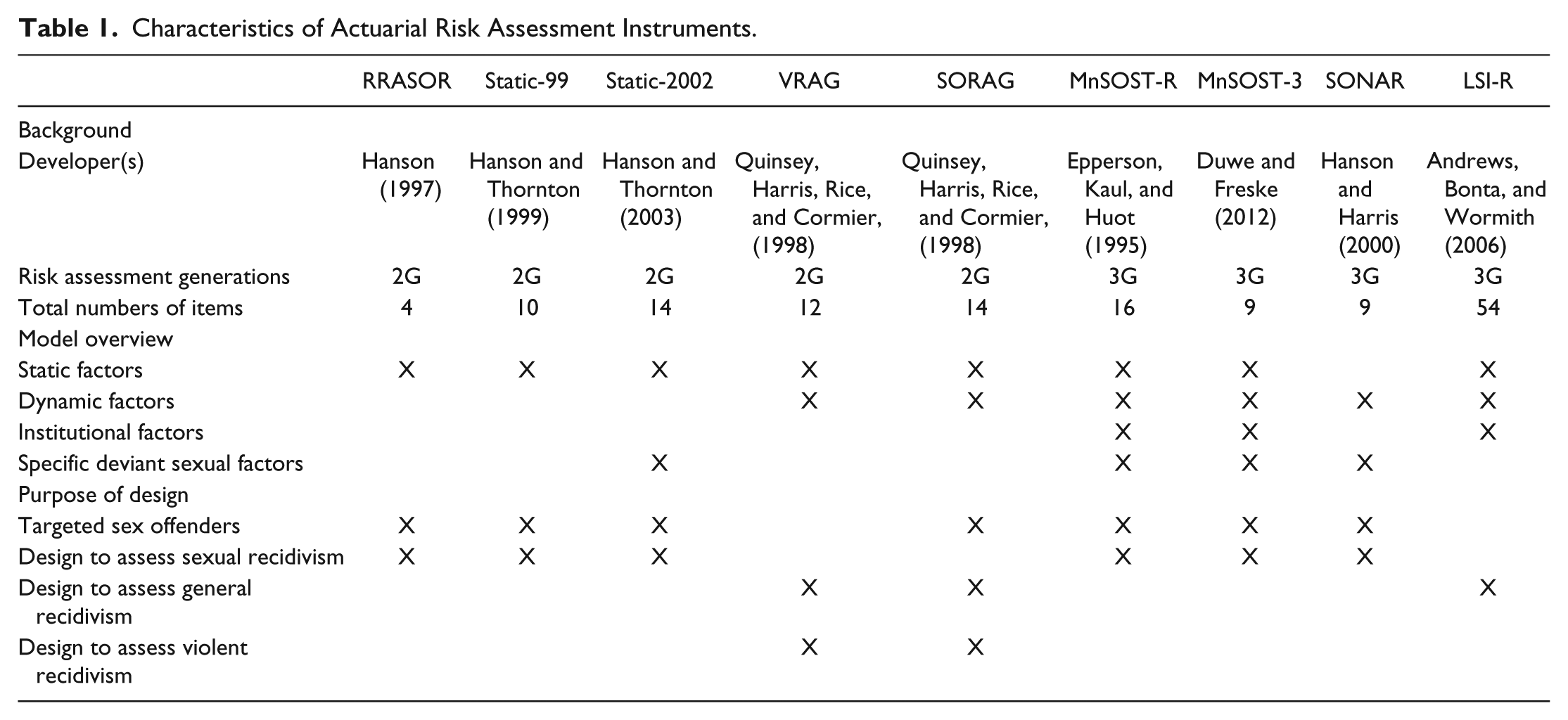
Historical or static factors are commonly utilized in many risk assessment instruments and refer to those items that would not change over time or through interventions. Such factors include one’s criminal record for sexual and nonsexual offenses, juvenile delinquency, the early onset of offending, prior sentencing dates, and victim and offender relationships (Hanson, 1997; Hanson & Bussière, 1996; Hanson & Thornton, 1999). Dynamic factors, in contrast, can fluctuate over time. In accordance with Andrews, Bonta, and Wormith (2006), these include risk and needs factors which are guided by the “Central Eight” domains. Under such a model, antisocial behavior, antisocial personality pattern, antisocial cognition, antisocial associates, family and/or marital, school and/or work, leisure and/or recreation, and substance abuse (Andrews et al., 2006) are common domain themes. In terms of specific sexual reoffending indicators, child molesting attitudes, rape attitudes, sexual entitlement, and sexual preoccupations are included to target the criminogenic needs of sex offenders. Even though these specific factors are dynamic factors, compared with the conventional dynamic factors mentioned above, they are relatively less frequently utilized in off-the-shelf instruments.
To elaborate, it has been argued that institutional factors may impact sex offenders’ subsequent criminal behaviors. Among the instruments highlighted here, the MnSOST family instruments consistently contained institutional factors. 1 For instance, the MnSOST-R contained both institutional misconduct and treatment status within the risk assement instrument for predicting post-release offending for sex offenders. Although the LSI-R also includes an institutional factor related to institutional misconduct records, the LSI-R is not designed to predict sexual reoffending. Nevertheless, LSI-R has been acknowledged as a feasible assessment for sex offenders and it may significantly improve the ability to predict general and violent (including sexual) recidivism (Andrews, Bonta, & Wormith, 2004; Hanson & Morton-Bourgon, 2009; Ragusa-Salerno, Ostermann, & Thomas, 2013).
Because sex offenders commonly serve longer prison terms than other types of violent criminals (except murder, homicide) (Drake & Barnoski, 2006; Walsh, 1984; Washington State Sentencing Guidelines Commission [WASGC], 2004), the influence of imprisonment experience such as time served in prison (Budd & Desmond, 2014), institutional treatment (Grady et al., 2015; Grady et al., 2012), and infractions (Tewksbury et al., 2014) should not be underestimated. In fact, prior studies have indicated that prison experience considerably impacts recidivism outcomes (Budd & Desmond, 2014; Hanson & Bussière, 1996; Nagin et al., 2009).
Prison Experience and Recidivism
Incarceration has been acknowledged as a process that prisonizes inmates and its structural environment exerts significant impact on inmate discipline and postrelease behaviors in the community (Clemmer, 1940). However, “importation” theorists (see Irwin & Cressey, 1962) suggest that the inmate’s lifestyle and demographic characteristics prior to incarceration are contributors that influence prison subculture and individual adjustment. Despite disputes between importation and deprivation explanations (see Sykes, 1958), time spent in prison has been argued as a major factor shaping individual prison behavior and, further, directly impacts success or failure in the community (Hochstetler & DeLisi, 2005; Nagin et al., 2009).
Budd and Desmond (2014) examined the relationship between incarceration and sexual reoffending among 8,461 incarcerated male sex offenders. They found that time served in prison is positively related to reoffending (i.e., rape, sexual assault, child molestation, any sex offense). However, incarceration length was only negatively related in the prediction of child molestation postrelease sex crimes. This differential result between sentence length and time served for child molesters was explained by Budd and Desmond (2014) as the possibility that perpetrators may be more “deterrable” within the prison environment compared with other types of sex offenders and this group possesses a greater likelihood of treatment completion. If offenders receive a positive prison experience, such as institutional treatment (Nagin et al., 2009), then this rehabilitative process may be linked to a more promising outcome.
Some researchers have indicated that the length of stay in prison can be used to predict general and sexual re-arrest for sex offenders, however, with a negative association (Duwe & Goldman, 2009). A common explanation for this negative finding is that time served triggers an “age-out factor” noted by Sampson and Laub (2003) that would reduce the propensity for recidivism at a certain age regardless of crime type. These findings are consistent with Tiedt and Sabol’s (2015) 5-year follow-up study, which indicated that the negative relationship between sentence length and rearrest could be explained by age at release. Offenders who serve longer prison terms will be less likely to reoffend simply because of increased age, rather than the isolated efficacy of incarceration. Helmus, Thornton, Hanson, and Babchishin (2012) revealed that offenders 60 years or older possess a significantly lower rate of recidivism compared with other age groups (e.g., 30, 40, or 50 years old).
Despite the fact that tests of the relationship between time served and reoffending provide mixed results, empirical research appears to support the negative impact of unpleasant and deprived circumstances related to incarceration. Findings suggest that incarcerations affect some types of offenders in terms of postrelease criminal behaviors (Hochstetler & DeLisi, 2005; Nagin et al., 2009; Pratt, Cullen, Blevins, Daigle, & Madensen, 2006). Specifically, sex offenders have been found to spend longer terms of confinement (Drake & Barnoski, 2006; Walsh, 1984), and this disproportionately increases the likelihood of the negative influences of incarceration (Budd & Desmond, 2014). A meta-analysis conducted by Hanson and Bussière (1996, 1998) demonstrated that sentence length is a significant predictor and positively impacts sexual and general recidivism for sex offenders.
Institutional Infractions and Recidivism
As discussed, the prison experience appears to have indirect consequences. Nagin and colleagues (2009) argued that incarceration holds a potential “criminogenic effect of the prison experience on subsequent offending” (p. 178). Specifically, institutional misconduct and infractions have been highlighted by prior studies (Nagin et al., 2009; Trulson et al., 2010; Trulson et al., 2011) as distinct criminogenic derivatives of the prison experience that would impact postrelease criminal behavior.
The research of Trulson and colleagues (2010) reflected increasing support for the recognition that time served behind bars is responsible for institutional misconduct (e.g., staff assaults, ward assaults). Prisoners who have a prior criminal history would be more likely to have major and minor misconduct violations that accumulate over time. Those offenders with an institutional misconduct report, or those who report frequently receiving institutional infractions during incarceration, have an increased likelihood of recidivism upon release.
In line with previous studies, Valentine (2012) determined that misconduct is a positive predictor for recidivism across types of crime while controlling for age. This is especially true for inmates who have engaged in violent or major misconduct, which is strongly correlated with violent reoffending in the community (Valentine, 2012). Heil, Harrison, English, and Ahlmeyer (2009) reported that the prison experience, particularly for prison sexual misconduct, 2 increases community risk of recidivism among sex offenders. Of the sex offenders who committed sexual misconduct during the time they were incarcerated, 80% were rearrested within 5 years. In addition, a sexual recidivism rate and a violent recidivism rate for those sex offenders with a sexual misconduct record in prison were 10% and 52%, respectively. Heil and associates (2009) concluded that “sexual offending behavior in prison is a significant risk indicator for new sexual, violent and other arrests” upon release (p. 902).
Utilizing a propensity score matching (PSM) strategy, Cochran, Mears, Bales, and Stewart (2014) explored the misconduct–recidivism relationship for adult inmates in a large-scale setting. Inmates who had ever engaged in misconduct and those inmates who did not engage in misconduct were matched based on an array of covariances such as demographic background, prior criminal history, time served, as well as sentence length. Using a postmatched sample, the researchers (Cochran et al., 2014) found that inmates with institutional infractions were more likely to recidivate and the misconduct–recidivism relationship was enhanced when inmates posses a major or violent misconduct history.
Prison-Based Treatment and Recidivism
The existing research describe supports the negative impact of the prison experience in terms of the nature of the imprisonment experience and time served (Cochran et al., 2014; Heil et al., 2009; Pratt et al., 2006; Trulson et al., 2011; Trulson et al., 2010; Valentine, 2012). However, if inmates received appropriate prison-based interventions and programming, the prison experience may aid in reducing recidivism. Although incarceration may foster criminogenic effects in offenders, Nagin and colleagues (2009) indicated that imprisonment, combined with appropriate rehabilitation, could result in positive reintegration.
Polizzi, MacKenzie, and Hickman (1999) have observed many institutional treatment programs and conclude that prison-based treatment programs were promising for sex offenders. Moreover, a meta-analysis completed by Hanson et al. (2002) revealed considerable overall treatment effectiveness for sex offenders. The analysis found strong evidence that institutional treatment effectiveness was associated with reductions in both general recidivism (odds ratio [OR] = 0.82) and sexual recidivism (OR = 0.62).
In a quasi-experimental design, Duwe and Goldman (2009) reported a modest prison-based treatment impact on sex offender recidivism in Minnesota. Offenders who received prison-based interventions, in general, were 12%, 18%, and 27% less likely to be associated with general recidivism, violent recidivism, and sexual recidivism, respectively, compared with nonparticipants. Furthermore, they found that dropping out of treatment did not significantly impact recidivism. However, offenders, who successfully completed treatment, possessed the lowest rates of recidivism across all types of offenses.
Grady et al. (2015) reported that sex offenders who participated in a prison-based program did not demonstrate improved recidivism outcomes for either sex crime or violent crime reconviction when matched with and compared with offenders who did not receive a prison-based intervention; however, they were found to do better on non-violent recidivism. Grady and associates (2012) also found that volunteering for prison-based treatment did not impact postrelease recidivistic behavior. The reason for these modest effects, however, may be due to methodological issues that plagued the evaluation (Grady et al., 2015; Grady et al., 2012).
And finally, a meta-analysis conducted by Lösel and Schmucker (2005) revealed sex offenders who received treatment tailored to sex offenses were less likely to commit sexual and general reoffending across three countries (e.g., America, Canada, and Great Britain). The positive effects of sexual offender treatment has been continuously demonstrated in their updated meta-analysis (Schmucker & Lösel, 2015) which also affirmed their prior meta-analysis regarding the impact of treatment effectiveness with sex offenders (Hall, 1995; Hanson et al., 2002).
In summarizing prior findings, it can be said that prison experience is an important factor affecting postrelease effectiveness for sex offenders and it should be taken into account in risk assessment studies (Epperson et al., 1995). For example, (a) prison experience and a longer duration of time served in prison may increase an offender’s propensity for recidivism, (b) sex offenders with disciplinary infractions or sexual misconduct in prison are more likely to recidivate upon release, and (3) completed intuitional treatment serves as a protective factor that can compensate for an individual’s risk and, in turn, reduce the likelihood of recidivism (Costanzo et al., 2014). However, among the seven existing risk assessment instruments described, few include institutional items in their prediction models. The inability to verify the impact of institutional behavior may be tied to the lack of studies examining the effects of the prison experience on recidivism. Furthermore, the existence of a coordinated data system that allows institutional behavior records to follow the offender through community supervision would greatly enhance the testing and incorporation of meaningful risk items. Hence, the current study attempts to identify prison-based explanations and investigate the relationship between the prison experience and postrelease reoffending for convicted sex offenders.
Method
The study’s primary research question concerns the incarceration experience impact on convicted sex offenders’ postrelease criminality or propensity for recidivism. The following hypotheses were tested:
Specifically, offenders who completed sex offender treatment while incarcerated possess a lower propensity for (a) revocation, (b) sexual offending, and (c) prison return, compared with those offenders who did not complete treatment.
Specifically, offenders who have any misconduct records while incarcerated possess a higher propensity for recidivism compared with those offenders without (a) any misconduct records and (b) sexual misconduct behavior.
Specifically, offenders who spend a longer duration of time in prison possess a higher propensity for (a) revocation, (b) sexual offending, and (c) prison return compared with those offenders who spend shorter periods of time in prison.
Data
The current study utilized a subset of data originally collected by Zgoba and colleagues (2012) for their multisite examination of a tier-classification registration system for sex offenders. For the current analyses, records of sex offenders were randomly selected from the Department of Corrections (DOC) in two of the sampled states, New Jersey and Minnesota. The study’s final eligible pool was 671 male convicted sex offenders, who had been sentenced to prison, possessed a risk assessment score using validated risk assessment instruments and were supervised by the DOC. Although each state has a slightly different sample time frame and different statutes governing sex offenders, 3 the minimum recidivism follow-up was 5 years and the sample did not include those who were civilly committed upon release. Recidivism data were collected for all subjects following release, terminating in December 2010.
Measures 4
Dependent variables
Three dichotomous recidivism outcomes were examined. Revocation was defined as a major parole violation (i.e., commit a new crime) and a return to prison. Sexual recidivism was indicated when an offender was rearrested for a subsequent sex crime upon release from incarceration. Any type of prison return was the third outcome measure and represents either revocation or any reincarceration.
Independent variables
There were several independent variables used in this study. First, prison term was used as a continuous measure and indicated the amount of time offenders spent in prison for the instant offense. Second, sexual misconduct measured whether inmates have any sexual misconduct records in custody (yes = 1, no = 0), where sexual misconduct could constitute a contact, a noncontact offense, or a new criminal offense. Any misconduct in prison is defined as any minor or major infraction recorded at any time during one’s prison term and since the instant sex offense (yes = 1, no = 0). Finally, sex offender treatment referred to whether inmates who had ever received sex offender specific treatment had successfully completed it while in prison or were in the program at the time of release (yes = 1, no = 0).
Control variables
In addition to age at release, Hanson and Bussière (1998) also suggested the use of additional predictors, general and sexual criminal history, which are known to have a significant effect on sex offenders’ reoffending. Therefore, the current study includes prior sexual offending history, which distinguished offenders who had a prior sexual offending history greater than 1 year; any prior nonsexual offenses, identified as an offender with any prior nonsexual-related violent offense conviction; and prior juvenile delinquency, indicating whether an offender had been adjudicated for an offense before the age of 18 years. It is also argued here that risk scales are reliable measures by a given risk assessment instrument and should be included in a predictive model (Gendreau, Little, & Goggin, 1996). As such, level of risk was measured by an actuarial risk assessment instrument, Static-2002, and collapsed into three categories (i.e., low, moderate, and high).
Analytic Plan 5
To identify influential factors affecting postrelease reoffending for convicted sex offenders and to examine the sets of hypotheses, binary logistic regression models were computed to assess the relative contribution of overall prison experience and to predict dichotomous study outcomes. However, given possible unobserved heterogeneity between each state, the current study utilized mixed models with random effects to account for between-state variations.
Results
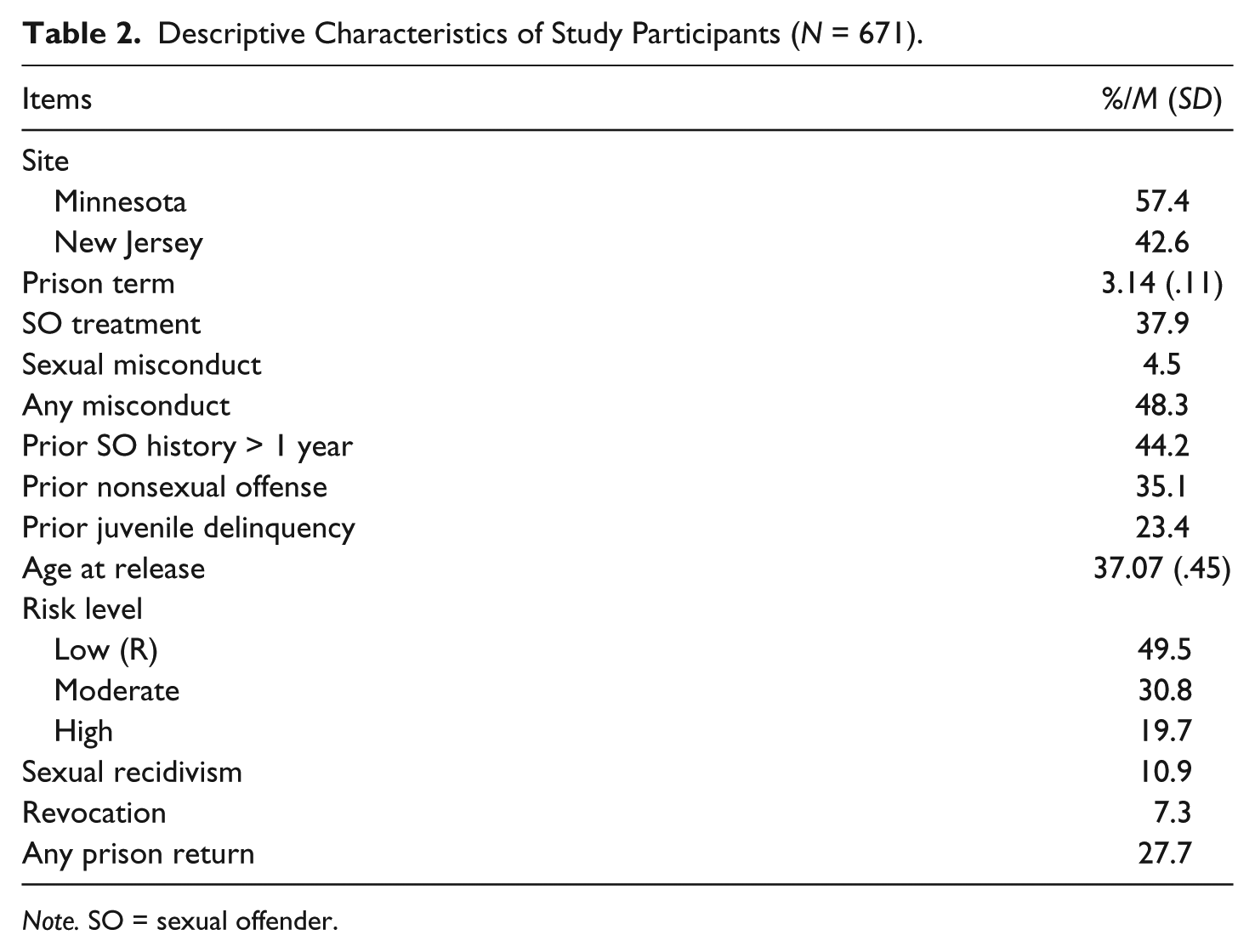
Table 2 provides sample descriptive statistics. About 58% of male sex offenders were convicted in Minnesota and the remained were convicted in New Jersey. On average, subjects were late middle aged. Most were classified as low-risk offenders and about one fifth were classified as high-risk offenders The recidivism rates in the current sample were generally low, as would normally be expected for revocation (7.3%), followed by sexual reoffending (11%) and any prison return (28%). On average, subjects in this study served at least 3 years in prison and 32% were required to register following release. Roughly 38% had completed sex offender treatment while incarcerated. During their time in prison, 4.5% of subjects had institutional infractions for sexual misconduct and 48% had violated institutional regulations. In terms of prior criminal records, 44% of the subjects had a prior sex offense in the previous year, 35% possessed a prior nonsexual violent offense conviction, and 23% had received a criminal sentence before the age of 18 years.
Descriptive Characteristics of Study Participants (N = 671).
Note. SO = sexual offender.
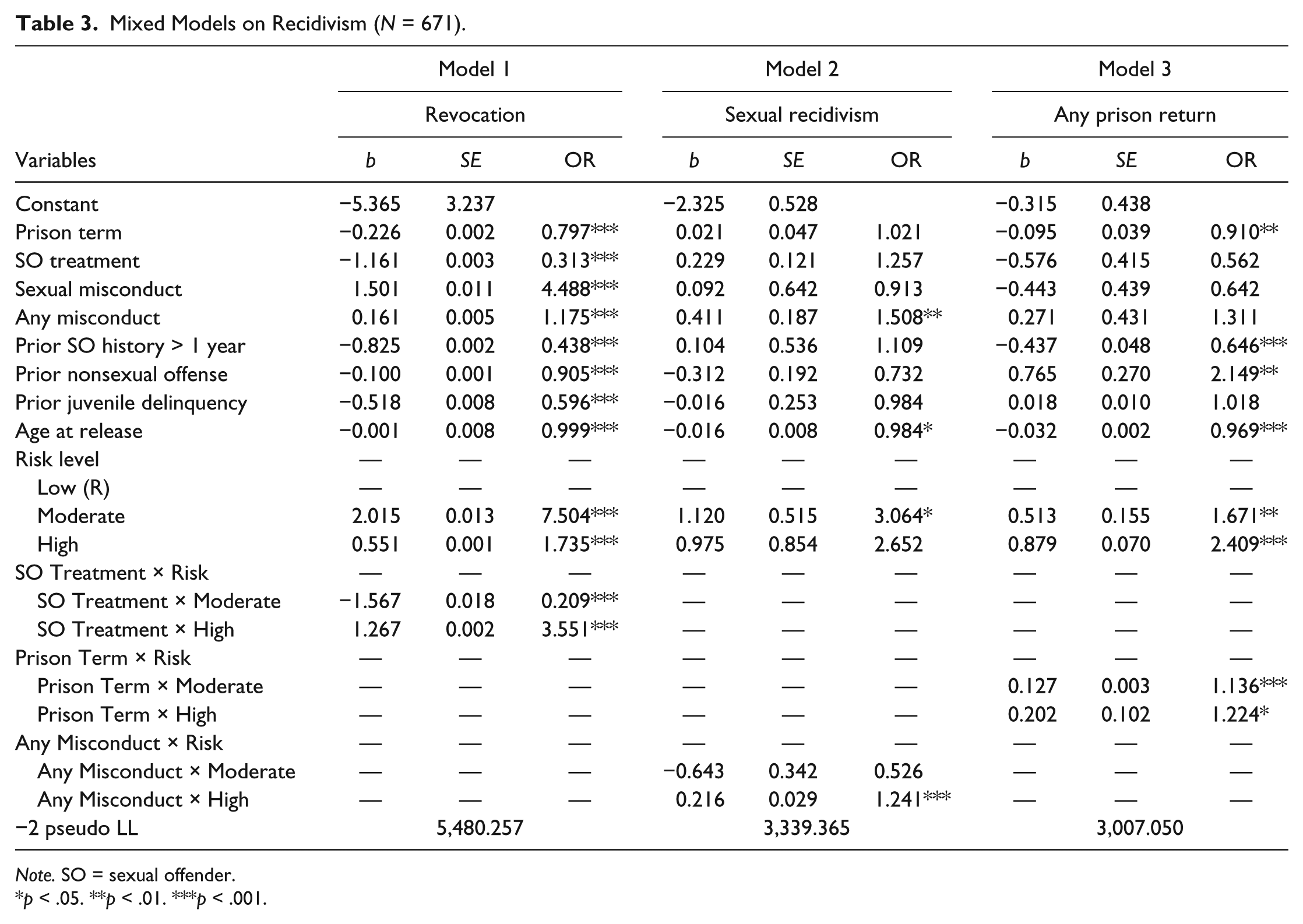
Table 3 represents mixed models with random effects to account for between-state variations on the recidivism outcome. In Model 1, all hypothesized predictors were found to be significant, whereby prison experiences such as prison term, prison-based treatment completion, and institutional misconduct impact revocation. Those sex offenders who served a longer prison term and completed institutional treatment prior to release had decreased (20% and 68%, respectively) odds of revocation for postrelease behavior compared with those who served a shorter period of time in prison and those who failed treatment (OR = 0.797, p < .001; OR = 0.313, p < .001). Those offenders who had been disciplined for sexual misconduct or had any misconduct while incarcerated possessed 4.5 times and 1.2 times greater odds of revocation, respectively, compared with those who were not disciplined (OR = 4.488, p < .001; OR = 1.175, p < .001). In terms of offender characteristics, older offenders, those with a prior sex offense, a prior nonsexual violent offense conviction, and a prior juvenile adjudication, were found to possess lesser odds of revocation compared with their younger counterparts who were less likely to have prior persistent sexual offending, no prior nonsexual violent crime convictions and no prior juvenile delinquency (OR = 0.999, p < .001; OR = 0.447, p < .001; OR = 0.820, p < .001; OR = 0.647, p < .001).
Mixed Models on Recidivism (N = 671).
Note. SO = sexual offender.
p < .05. **p < .01. ***p < .001.
In addition, an individual’s risk level appears to have a considerable impact on recidivism for sex offenders. For instance, high-risk offenders possessed 1.7 times greater odds of being revoked compared with their low-risk counterparts (OR = 1.735, p < .001). In terms of treatment status in conjunction with risk levels, moderate-risk offenders who completed treatment in prison decreased their odds of revocation by 79%, compared with their low-risk counterparts (OR = 0.209, p < .001). High-risk offenders who completed treatment in prison possessed 3.5 times greater odds of revocation, compared with their low-risk counterparts (OR = 3.551, p < .001).
Model 2 displays the regression findings for sexual recidivism. Among all hypothesized predictors, the presence of any misconduct was the only significant factor. The results indicated that those offenders who had any institutional misconduct records were 1.5 times greater odds to engage in sexual reoffending compared with those without misconduct records (OR = 1.508, p = .029). In particular, high-risk offenders with a misconduct record possessed 1.2 times greater odds of committing subsequent sexual crime upon release, compared with their low-risk counterparts (OR = 1.241, p < .001).
Model 3 predicted the odds of returning to prison following release from prison for sex offenders. With respect to the prison experience, prison terms significantly negatively impacted the odds of returning to prison. For instance, those sex offenders incarcerated longer decreased their odds of returning to prison by 9% (OR = 0.910, p = .016). Regardless of time served, high-risk sex offenders were 2.4 times log odds more likely to return to prison compared to their low-risk counterparts (OR = 2.409, p < .001). Interestingly, individual risk level significantly interacts with prison terms; where every additional year an offender served in prison, their odds of returning to prison increased by 10% and 20%, respectively, if they were assessed to be moderate and high risk, respectively, as compared with their low-risk counterparts (OR = 1.136, p < .001; OR = 1.224, p = .048).
In addition, older sex offenders decreased their odds of retuning to prison by 3% compared with younger counterparts at release (OR = 0.969, p < .001). In terms of criminal history, those offenders identified to be a persistent sexual offender, meaning that they had at least 1 or more years of sex offense history, decreased their odds of returning to prison by 35% (OR = 0.646, p < .001) whereas those offenders who had a prior nonsexual violent offense possessed 2.2 times greater odds of returning to prison compared with those who were without prior nonsexual violent crime records (OR = 2.149, p = .005).
Discussion
This study attempted to answer the primary research question—Do incarceration experiences impact the postrelease criminality of convicted sex offenders? Overall, the mixed model findings supported the study hypotheses, prior individual prison experience, such as length of prison terms, treatment completion, and institutional infractions, significantly impacted postrelease recidivism for male sex offenders across the two study states. In addition, it was found that the variation of risk level further interacts with the subject’s incarceration experiences. The current study revealed that incarceration provided a negative impact on recidivism and those offenders who stayed in prison for a longer period of time were more likely to commit a new crime following release, which was particularly the case for high-risk offenders. Inmates who completed treatment while incarcerated were less likely to be revoked on community supervision compared with those who did not complete treatment. Still, offenders who possessed a higher risk score, regardless of institutional treatment status, were more likely to commit a new crime, a sex offense, or be sent back to prison. In terms of institutional discipline, sex offenders who received disciplinary infractions were significantly more likely to exhibit criminal behavior in the community following release.
Our findings have demonstrated that the length of time offenders served in prison did not significantly impact sexual recidivism when the outcome was measured as revocation and any prison return. This mixed finding is consistent with prior studies that have found the length of incarceration to be unrelated to sexual recidivism (Budd & Desmond, 2014; Nunes, Firestone, Wexler, Jensen, & Bradford, 2007), yet would be a significant predictor when recidivism was operationalized simply in terms of prison return or revocation (Budd & Desmond, 2014) or general recidivism (Harris & Hanson, 2004). Some may argue that rearrest is a less-than-optimal recidivism measure compared with reconviction and reflect relatively more engagement with the criminal justice system (Bonta, Rugge, & Dauvergne, 2003). However, given that the sexual recidivism base rate was low for our sample, another explanation might be more appropriate for explaining the current finding. Because sex offenders are less likely to reoffend sexually, it is not surprising that a low base rate of sexual events would be observed compared with other nonsexual offenses in general (Budd & Desmond, 2014; Hanson & Bussière, 1998; Harris & Hanson, 2004). Future research should explore this aspect of recidivism in more detail.
It is important to note that time served in prison was found to significantly interact with an individual’s risk level. Those high-risk sex offenders who served longer periods of time in prison were more likely to recidivate, than lower-risk offenders who received a shorter term of incarceration. This finding is in line with Nunes and colleague’s (2007) study, indicating that incarceration might not reduce recidivism for high-risk sex offenders. These authors further noted that, for a relatively higher risk level of offenders, treatment or alternatives to incarceration might be a more effective approach than traditional (incarceration) approaches. In fact, the current study supported this perspective and revealed that moderate-risk offenders who completed sex offender treatment in prison decreased their odds of revocation by 79%, which should generate more optimism regarding the potential for institutional treatment effectiveness (Hanson et al., 2002).
High-risk sex offenders exposed to longer prison terms would be more likely to experience the negative outcomes that are consistent with the deprivation explanations noted by Sykes (1958) in his discussions of prisonization. This finding was consistent with Nagin and colleague’s (2009) study, as imprisonment did increase the propensity for subsequent recidivism across crime types. However, we do not suggest that incarceration is not an appropriate criminal penalty, or that it fails to serve retributive goals, rather it is offered that prison, in fact, influences an individual’s future criminal involvement both directly and indirectly upon release.
It is true that longer prison sentences serve a potential age-out function (in terms of recidivism) for older inmates and those who have spent a longer period of time in prison (Sampson & Laub, 2003). An age-out thesis, however, is a reactive approach and may have a limited positive outcome for those 60 years of age or older (Helmus et al., 2012). Adopting a proactive strategy and treatment would be more effective for crime control regardless of the duration of a prisoner’s term. The current study found evidence to endorse prison-based rehabilitation and interventions for sex offenders as those who complete treatment would reduce their propensity for subsequent reoffending by 60%. This finding is consistent with prior studies (Duwe & Goldman, 2009; Hanson et al., 2002) indicating that sex offenders would benefit from prison-based interventions and further enhance public safety in the community. Moreover, our findings confirm the protective effects of treatment as emphasized by prior studies (Costanzo et al., 2014; de Vries Robbé, de Vogel, & Douglas, 2013; de Vries Robbé, de Vogel, Koster, & Bogaerts, 2015; de Vries Robbé, de Vogel, & Stam, 2012; de Vries Robbé, Mann, Maruna, & Thornton, 2015) and its use should be taken into account within risk assessment instruments.
In addition, the current study demonstrated that incarceration experiences, specifically for institutional misconduct, further impacts recidivism. Sex offenders with a record of committing disciplinary infractions were more likely to commit a new crime as well as reoffend sexually. In addition, time served in prison has also been found to interact with institutional misconduct among sex offenders. These findings are consistent with Toman, Cochran, Cochran, and Bales’ (2015) study, which indicated that longer prison terms were more likely to result in disciplinary infractions due to the inherent deprivation-oriented prison environment. Despite the fact that the current study did not examine the relationship between deprivation, sex offenders, and institutional misconduct, Tewksbury and colleagues (2014, p. 213) addressed this issue in their work. They explained that sex offenders were more likely to incur disciplinary infractions during incarceration because compared with other types of offenders, sex offenders were in inferior standing and would experience more distinct “pains of imprisonment,” and, as such, would be more likely to be at risk of recidivism.
The results here also indicate that prison misconduct should be taken seriously because sex offenders who had a sexual misconduct record in prison are at greater risk for recidivism following release (Heil et al., 2009). Furthermore, the data here shows that sex offenders very often possess prior sexual related offenses (Trulson et al., 2010), prior violent offenses (Cochran et al., 2014), and prior any convictions (Toman et al., 2015). Their prior criminal history is a significant indicator of both minor and major disciplinary infractions. Cochran and associates (2014) concluded that inmates who had institutional infractions provide greater support for a misconduct–recidivism relationship following release than those who did not. Surprisingly, very few risk assessment instruments include prison misconduct as a predictor and many also lack inclusion of other institutional factors such as the length of terms and institutional treatment. The MnSOST family of tools (i.e., MnSOST-R, MnSOST-3) are the only sex offender specific instruments to adopt institutional factors such as in-prison treatment and infractions as risk factors. Future studies, therefore, should further explore the relationship between prison conduct and risk assessment instrument utility detailing these relationships further.
Although the findings presented here contribute to an understating of the relationship between prison experience and reoffending for sex offenders, we acknowledge that our scope was limited to prison time served, institutional treatment and institutional misconducts as conventional institutional experiences. Admittedly, there are additional prison-based factors that may also have a potential impact on an offender’s violent behavior in prison and postrelease recidivism, such as prison conditions (e.g. prison overcrowding, deaths in prison, degree of isolation) (see Drago, Galbiati, & Vertova, 2011), security levels (Chen & Shapiro, 2007), general strain and officer-inmate relationships (Listwan, Sullivan, Agnew, Cullen, & Colvin, 2013). Future studies should expand the pool of prison experience factors including facility-level factors and individual perception indicators.
Even with the limited scope of the current study, which did not examine the effectiveness of specific rehabilitative models, it is suggested that providing relatively intensive treatment interventions for high-risk sex offenders would offer more promising outcomes than traditional treatments completed in prison (Andrews & Bonta, 2010). Also, given data collection limitations, we were not able to distinguish treatment types in the current study. Even though our study has utilized sex offender treatment completion as a desirable indicator noted by Hanson and Bussière’s (1996, 1998) meta-analysis, Yates (2013) indicated that future research should address treatment styles for sex offenders if guided by any specific intervention such as cognitive-behavioral or the good lives model (see Ward & Brown, 2004). There is considerable potential for intervention models to address some dynamic factors impacting recidivism, and future study should explore this issue. Institutionally structured treatment not only provides a general positive outcome for sex offenders but would also minimize risk of “offenders who continue to violate rules and expectations in prison” and hold convicted sex offenders accountable for postrelease behavior (Heil et al., 2009, p. 902).
As a final comment, the current study suggests that existing risk assessment instruments should consider all three institutional factors—prison terms, institutional misconduct, and institutional treatment—in prediction models for future recalibration efforts, revising and improving incremental predictive utility. Although this exploratory study may have involved only a limited portion of the sex offender’s prison experience, the three institutional factors identified, in fact, could be applied to other general and violent recidivism prediction models. Again, we did not intend to evaluate or overrule the validity and utility of any existing risk assessment tools utilized for sex offenders, rather to simply provide additional evidence to the argument that prison experiences impact offenders’ subsequent behaviors. The need for more sophisticated research is worthy of further consideration in the development of risk assessment instruments in the future.
Footnotes
Declaration of Conflicting Interests
The author(s) declared no potential conflicts of interest with respect to the research, authorship, and/or publication of this article.
Funding
The author(s) received no financial support for the research, authorship, and/or publication of this article.