



Abstract
Adoption of evidence-based approaches by police services offers a practical and scientific solution to ensure public safety and proper allocation of resources. Advances in the field of sexual violence risk prediction have the potential to inform policing practices. The present study examines the validity of existing actuarial measures to predict the future sexual violence behavior of 290 identified male perpetrators of sexual assault against adult victims (ages 16 and older). The Static-99R and Static-2002R were coded from police documentation, and the sample was followed up for at least 1 year with an average of 3.6 years. Both measures showed large effects for predicting any offending, violent offending, and sexual offending in the form of charges and convictions. The findings suggest that existing sex offender research can extend to police practice, and criminogenic factors used to predict recidivism among convicted offenders may apply to assessing the risk posed by perpetrators of police-reported sexual assaults.
Evidence-based policing promotes a more effective and less expensive approach to controlling crime than the traditional response-driven models, as research can help facilitate more efficient use of resources (Sherman, 2013). Although there are many ways to use research to improve policing processes, only recently has attention been drawn to the use of risk assessments in policing (e.g., Ennis, Hargreaves, & Gulayets, 2015; Storey, Gibas, Reeves, & Hart, 2011). The use of evidence-based risk assessments can help guide policing practice in the prioritization of criminal investigation cases and the prevention of further criminal behavior. In the psychological literature, much is known about risk factors predictive of reoffending behavior of known and convicted sex offenders (see Hanson, 1998; Hanson & Bussière, 1998). However, little research has examined preconviction suspects of sexual assault and the determination of risk that a suspect poses if he remains in the community. The current study examines the application of existing research on sexual offenders to police decision-making and policing practices.
In his article, Bueermann (2012) drives at the idea that police agencies should move beyond a reactive, response-driven approach and get smart about crime control. It does not make sense to spend dollars on what does not work merely to remedy issues temporarily. Instead, a better use of limited resources would be to engage in effective approaches supported by empirical research. In the more recent decades, policing has progressed from intuitive policing to more contemporary efforts in intelligent policing that is driven by data and scientific evidence (Bradley & Nixon, 2009). Sherman (2013) emphasizes that the use of quantitative methods, specifically statistical prediction approaches over clinical strategies, would fall under the purview of evidence-based policing practices. As Jones, Harkins, and Beech (2015) highlight, law enforcement is generally the first offender-focused service that will identify a suspect in a sexual assault case, and therefore is in a unique position to coordinate prevention and early intervention responses. According to Jones et al., a risk assessment model, called the Threat Matrix, which was derived from the Risk Matrix-2000, was developed for use by police to identify and assess potential sex offenders from the hundreds of unconvicted suspects and recently was implemented in the United Kingdom. Although the Threat Matrix is currently being examined for its predictive validity, it has shown promising face validity (e.g., produced a data spread across risk categories similar to that seen among convicted sex offenders, showed positive correlation with professional judgment of police officers; Jones et al., 2015). Until the results on the Threat Matrix’s empirical validity is available, it is still unclear how existing research on sexual violence risk assessment may translate in the police context. In the criminal justice psychology literature that has advanced the field of assessment, treatment, and management of convicted sex offenders, there is a plethora of research (e.g., Beech, Fisher, & Thornton, 2003; Hanson, 2009). Generally, published measures of and methods for assessing risk for sexual recidivism are good at predicting sexual reoffending behavior (e.g., area under the ROC (receiver operating characteristic) curve value [AUC] = 0.64 for Static-99, and AUC = 0.71 for Static-2002; Langton, Barbaree, Seto, et al., 2007), and using these protocols is part of existing practice guidelines (Association for the Treatment of Sexual Abusers, 2014). What has yet to be reported is the validity of actuarial or other approaches to risk assessment with preconvicted sexual assault perpetrators.
Examining the risk of offenders and the risk for victimization has the potential to lead preventive efforts that would be guided by research. For example, examining factors that typically reflect serial rapists (Hewitt & Beauregard, 2014) could be helpful in identifying risk variables present in police investigations. Only a few studies have examined the decisions of police, but these endeavors have more particularly examined police decisions to arrest a suspect (e.g., Tasca, Rodriguez, Spohn, & Koss, 2013) or prosecutors’ decisions to charge the suspect (e.g., Kelley & Campbell, 2013; Spohn, Beichner, & Davis-Frenzel, 2001).
The application of psychological risk assessment research to routine police practices can be effectively seen in the field of risk prediction of intimate partner violence. The use of the research-supported actuarial measure, the Ontario Domestic Assault Risk Assessment (ODARA), by frontline users in Ontario, Canada, is an exemplary model of translating research into police practice and demonstrates that frontline professionals can be progressive in their routine work (Hilton, Harris, Rice, Eke, & Lowe-Wetmore, 2007; Hilton et al., 2004). Some might assume that risk assessments can be too complex or time-consuming for frontline officer use, but the implementation of the ODARA in Ontario provides a precedent for its utility and application, showing that the ODARA is simple to learn and to score accurately with minimal training (Hilton et al., 2007). In the police context, Hilton and her colleagues (Hilton, Harris, & Rice, 2010; Hilton et al., 2004) show that collaborative efforts with police can lead to the adoption of actuarial measures by police. Similar efforts are being made in other Canadian jurisdictions (e.g., Edmonton, Alberta; Jung & Buro, 2017). Similar to the ODARA, actuarial measures of sexual violence risk may offer frontline professionals easy-to-use actuarial tools that may show promise as a guide for interventions to reduce repeated sexual assaults by the same perpetrator. However, this has yet to be examined with a sample of nonconvicted perpetrators of sexual crime.
The present study takes on this logical next step. Specifically, this study examines whether two actuarial measures, the Static-99R and Static-2002R, can be reliably coded from police information and whether they can predict risk for further violence and sexual offending with a nonconvicted sample of identified perpetrators who offended against victims ages 16 and older. The Static-99 (Hanson & Thornton, 1999) is the most extensively researched and widely used actuarial risk assessment instrument for sexual offenders (Archer, Buffington-Vollum, Stredny, & Handel, 2006; McGrath, Cumming, Burchard, Zeoli, & Ellerby, 2010). With the goals of improving predictive accuracy, scoring, and construct validity, the Static-2002 was introduced and subsequently revised (Hanson & Thornton, 2003; L. Helmus, Thornton, Hanson, & Babchishin, 2012). The Static-2002 was designed as a brief actuarial measure for the prediction of sexual recidivism based on information that is routinely available in police and criminal justice records. Research has found that the Static-2002/R is equally predictive of sexual, violent, and general recidivism as the Static-99R (Bengtson & Långström, 2007; Hanson, Helmus, & Thornton, 2010; Hanson & Thornton, 2003). Neither of these measures has been validated with a police-reported sample. It is expected that empirically supported measures of sexual recidivism risk would apply to preadjudicated sexual assault perpetrators.
Method
Sample
Three hundred cases of sexual assault were randomly selected for review from a local police service in Alberta, Canada. Cases were extracted from police occurrences over a 4-year period from 2010 to 2013; specifically, a stratified random sample of 75 cases from each year was collected. The sample in this study represented 44.2% of sexual assault cases with an identifiable perpetrator that were reported to the local police service (n = 678). Sexual assault cases only included occurrences that were under the purview of the sexual assault section of the police service (i.e., investigated cases that typically involved complainants who were 16 years or older at the time of report). Sexual assaults that involved child victims up to the age of, but not including, 16 years were investigated by a child protection center, which is associated with the police service. Hence, none of the victims in this sample of sexual assault occurrences were below the age of 16.
Nearly the entire sample comprised of male perpetrators. Factors that were considered in the inclusion of police-referred cases in the sample were files with an adequate amount of file information and identifiable perpetrators. The resulting sample of 290 cases consisted entirely of males who had complete criminal records to code for recidivism outcome. Twelve perpetrators (4.1%) had co-accuseds in carrying out the sexual assault (nine had one co-accused, two had two co-accuseds, one had three co-accuseds), but only individuals identified as the primary perpetrator in the index offense were included in these analyses. The average age of the male perpetrators was 35.33 years (SD = 13.01; range from 18 to 90 years) and most were Caucasian (42.1%; n = 122), followed by Aboriginal or Métis (22.4%; n = 65), Black (10%; n = 29), and South Asian (8.6%; n = 25). The remainder was diverse and prevalent in less than 6% in each Asian (4.8%; n = 14), Hispanic (5.5%; n = 16), and Middle Eastern (5.2%; n = 15) groups, with 1.4% (n = 4) having mixed or unknown descent. Regarding the relationship between the male perpetrators and their victims, 37.6% (n = 109) were strangers, 37.6% (n = 109) were friends or acquaintances, 4.8% (n = 14) were family members, 2.1% (n = 6) were dating (noncohabilitating), and 17.9% (n = 52) were current or ex-cohabitating intimate partners. Of the perpetrators, 53.8% (n = 156) were employed, 77.6% (n = 225) have a permanent address, 64.5% (n = 187) have prior criminal justice involvement, and 53.4% (n = 155) have criminal convictions.
With regard to the victims in these cases, the average age was 27.8 years at the time of the offense (SD = 11.53; range from 16 to 83 years), 95.5% are females (n = 277), and 86.6% have permanent addresses (n = 251). Regarding ethnicity, 57.9% are Caucasian (n = 168) and 28.6% are Aboriginal or Métis (n = 83), while less than 5% are represented by other ethnicities (e.g., Black, Asian, South Asian, and Hispanic).
Measures
A coding form to operationalize offense characteristics, offender features, and victim features was developed (full coding information is available from the author). Items taken from the Static-99R and Static-2002R were included on the form.
Static-99R
The Static-99R (Hanson & Thornton, 1999; Harris, Phenix, Hanson, & Thornton, 2003; L. Helmus et al., 2012) is a 10-item static risk assessment tool used to assess risk of sexual recidivism among adult males who have been charged with a sexual offense. The instrument includes 10 items, and total scores range from −3 to 12. The Static-99/R has demonstrated excellent interrater reliability (intraclass correlation [ICC] = .98 in Rettenberger, Matthes, Boer, & Eher, 2010; ICC = .90 in Barbaree, Seto, Langton, & Peacock, 2001; and ICC = .91 in Langton, Barbaree, Hansen, Harkins, & Peacock, 2007), although one study found markedly lower values in an adversarial field setting (ICC = .64 in Murrie et al., 2009). The Static-99/R also has good predictive validity for sexual, general violent, and general criminal recidivism (AUCs = 0.68, 0.70, and 0.72, respectively; Babchishin, Hanson, & Helmus, 2012).
Given that the study was conducted in a police context, two items were modified. The first item, age at release (Item 1 on the Static-99R), refers to the age when the offender is at exposure to risk (Harris et al., 2003). In the police context, the age item was modified and defined as the age of the perpetrator at the time of arrest. The second item, any convictions for nonsexual violence in the index offense (Item 3 on the Static-99R), was modified to refer to any charges or arrests for nonsexual violence in the index offense, given that the police officer would be placing a charge(s) on the perpetrators at the time he or she is investigating the perpetrator. The remainder of the items was coded as per Static-99/R manuals (Hanson & Thornton, 1999; Harris et al., 2003).
Static-2002R
The Static-2002R contains 14 items grouped into five content areas (age at release, persistence of sexual offending, deviant sexual interests, relationship to victims, and general criminality), and total scores can range from −2 to 13 (L. Helmus et al., 2012; Phenix, Doren, Helmus, Hanson, & Thornton, 2008). Interrater reliability has been shown to be high with an ICC of .98 (L. Helmus & Hanson, 2007); however, the authors noted that this was exceptionally high and should not be considered representative of the typical circumstances in which the Static-2002/R would be used. Modest internal consistency estimates were found for the content area subscales (Cronbach’s αs for subscales ranged from .45 to .74 and for total score, .68; Langton, Barbaree, Hansen, et al., 2007), and the content areas show good construct validity (Jung et al., 2017). The Static-2002/R has been shown to predict sexual, violent, and general recidivism with AUCs ranging from 0.64 to 0.79, and has been cross-validated in several studies, often showing that it can outperform the Static-99 (Bengtson, 2008; Langton, Barbaree, Hansen, et al., 2007; Langton, Barbaree, Seto, et al., 2007; Looman & Abracen, 2010; Stalans, Hacker, & Talbot, 2010).
Similar to the coding of the Static-99R, the age at release item (Item 1) of the Static-2002R refers to the age when the offender is at exposure to risk (Phenix et al., 2008), and this item was modified to the age of the perpetrator at the time of arrest. All of the other items were not modified in the coding procedure.
Sources of Information
An extensive retrospective review of multiple electronic sources was used to conduct the data collection. Three broad groups of variables related to offense, perpetrator, and victim characteristics were coded from these sources. Data were extracted from police file documentation, which almost always included investigator notes (both handwritten and typed), documented evidence, and arrest details. Less consistently available, transcripts of interviews with the offenders, complainants, and witnesses; written victim and witness statements; sexual assault response team kits; correspondence; and other file documents available in the file and relevant to the case were reviewed when they were available. In addition to exhausting these sources, other electronic sources were examined and included information extracted from the federal records obtained through the Canadian Police Information Centre (CPIC), provincial records from the Justice Online Information Network (JOIN), and the local police records from the Niche Records Management System.
Procedure
This research was reviewed by an institutional research ethics board and the research office of the police service. Using the coding form, police file documentation was reviewed by the primary researcher who conducted the coding of the variables for each case. A comprehensive coding form and a single rater of the information sources adhered to this coding form throughout the data collection. Specifically, offense, offender, and victim characteristics; items from the Static-99R and Static-2002R; and sentencing information, if available, were coded from electronic police documents regarding the occurrence and electronic database regarding demographic and contact information on the offender and, if available, the victim. Both federal and provincial criminal records (i.e., CPIC and JOIN) were not reviewed for recidivism information until after the risk measure items were completed. However, given that the local police records (albeit less complete than provincial and federal records) were tied to the information regarding the index sexual assault occurrence, it was difficult to be completely blind to the recidivism outcome if the perpetrator was arrested by local police post-index.
To assess recidivism accurately, offenders were included in the analysis only if the follow-up period was longer than 1 year to allow for a minimal amount of time post-release or post-arrest (if not in custody). Criminal record information was coded, using federal (CPIC), provincial (JOIN), and local (Niche) data. Convictions and charges subsequent to the index occurrence were analyzed to determine whether there were (a) any new convictions and/or charges, (b) any violent convictions or charges (e.g., assault), and (c) any sexual offense convictions and/or charges. The latter could include incidents that were noncontact, but sexual in nature.
The interrater reliability of the Static-99R and Static-2002R items and total scores was assessed on 30 randomly selected cases and evaluated with ICC coefficients. All reported ICCs (average measure) were significant at p < .001. For the Static-99R (ICC = .952), the percentage agreement for the items ranged from 73.3% to 100%. For the Static-2002R (ICC = .938), the percentage agreement for the items ranged from 73.3% to 100%. The second rater had limited access to the electronic police records and complete access to provincial and federal records when coding the items on the risk measures.
Analytical Plan
To evaluate the predictive accuracy of the Static-99R and Static-2002R, two sets of analyses were conducted. First, we examined the bivariate correlations between predictors and the outcome variable. Spearman’s rho rather than Pearson’s r was used to calculate these correlations because the Static-99R and Static-2002R scores were ordinal (i.e., numerical scores that fall on an arbitrary numerical scale and are similar to a ranking over a set of data points, rather than continuous data). Second, predictive accuracy is represented by the AUC (L. Helmus & Bourgon, 2011). AUCs were calculated as they are the most commonly used and recommended effect size statistics for recidivism prediction (L.-M. Helmus & Babchishin, 2017; Rice & Harris, 2005). AUCs are typically preferred to other measures of predictive accuracy because they are not affected by the base rate of recidivism (Rice & Harris, 2005). AUC values between 0.5 and 1 indicate prediction exceeding chance. Rice and Harris (2005) note that AUCs of 0.56 correspond to a small effect, 0.64 reflects a moderate effect, and 0.71 reflects a large effect.
Results
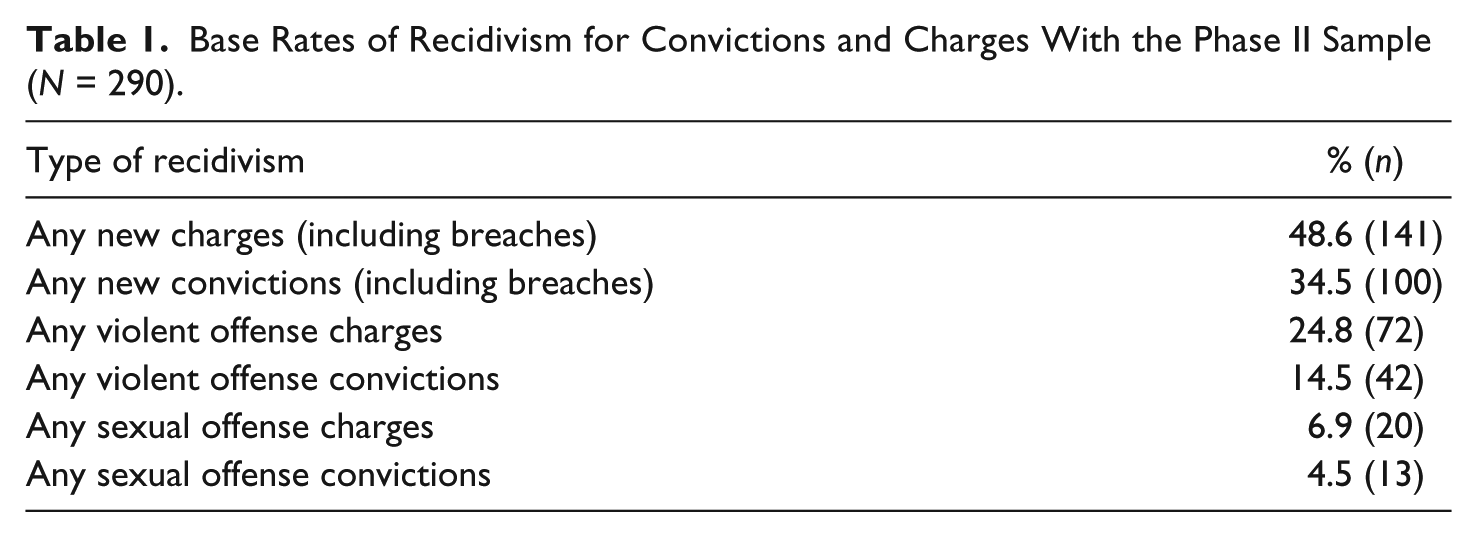
For the present study, only male perpetrators with complete criminal records to code for recidivism outcome (presence or absence of recidivism) were included in the analyses. The average length of follow-up from the report date of the offense was 3.56 years (SD = 1.09) and ranged from 1.62 to 6.30 years. Table 1 lists the overall base rates of recidivism based on convictions and charges for the total sample. For any recidivism, which includes breaches, 48.6% (n = 141/290) of sample received new charges, and 34.5% (n = 100/290) of the sample received new convictions. For any violence recidivism, 24.8% (n = 72/290) of the sample received new violent offense charges and 14.5% (n = 42/290) of the sample received new violent offense convictions. For sexual recidivism, 6.9% (n = 20/290) of the sample received new sexual offense charges, and 4.5% (n = 13/290) of the sample received new sexual offense convictions.
Base Rates of Recidivism for Convictions and Charges With the Phase II Sample (N = 290).
The following results present descriptive and psychometric properties of the Static-99R and Static-2002R used with this police-reported sample, followed by an examination of the accuracy of the measures in the prediction of any, violent, and sexual offense charges and convictions.
Descriptive and Psychometric Properties
The means and standard deviations for the Static-99R and Static-2002R items, content area subscores of the Static-2002R, and total scores for the sample of perpetrators are presented in Table 2. Of the 290 perpetrators, 61.4% (n = 178) had calculable Static-99R total scores with all 10 items completed, and were included in the evaluation of predictive validity. The average Static-99R total score is 3.30 (SD = 2.01, ranging from −2 to 8). The Static-2002R has 14 items, which are broken into age and four subscales (two of which are converted). Of the 290 cases with recidivism data, 92.8% (n = 269) had calculable Static-2002R total scores, while the subscales varied from 95.5% to 100% that were calculable (ns = 277-290). The average total score for the sample was 3.81 (SD = 1.90, ranging from −1 to 10). Descriptive information on the Static-2002R subscores is also listed in Table 2.
Presence of Static-99R and Static-2002R Items for the Sample of Male Perpetrators.
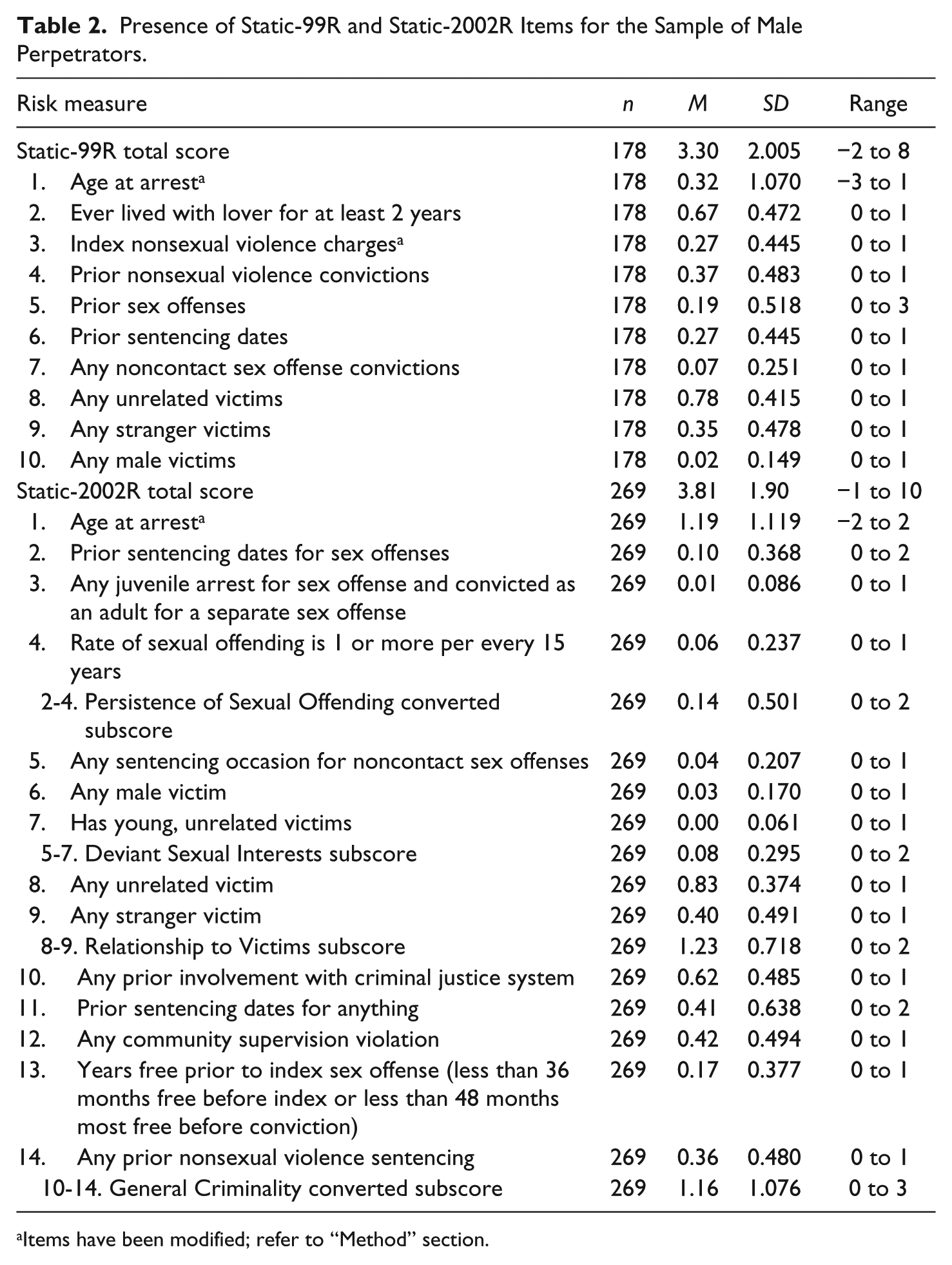
Items have been modified; refer to “Method” section.
Pearson correlation coefficients were calculated among the total scores of both measures and the subscores of the Static-2002R. As expected, given the commonality of items between the two measures, total scores were highly correlated, r(173) = .91, p < .001. Intercorrelations are listed on Table 3. Persistence of Sexual Offending was significantly correlated with the other content areas, except for the age item. Deviant Sexual Interests subscore was correlated with age and general criminality. All other pairings produced nonsignificant correlations.
Correlations Among Static-99R Total, Static-2002R Total, and Static-2002R Content Area Subscores.
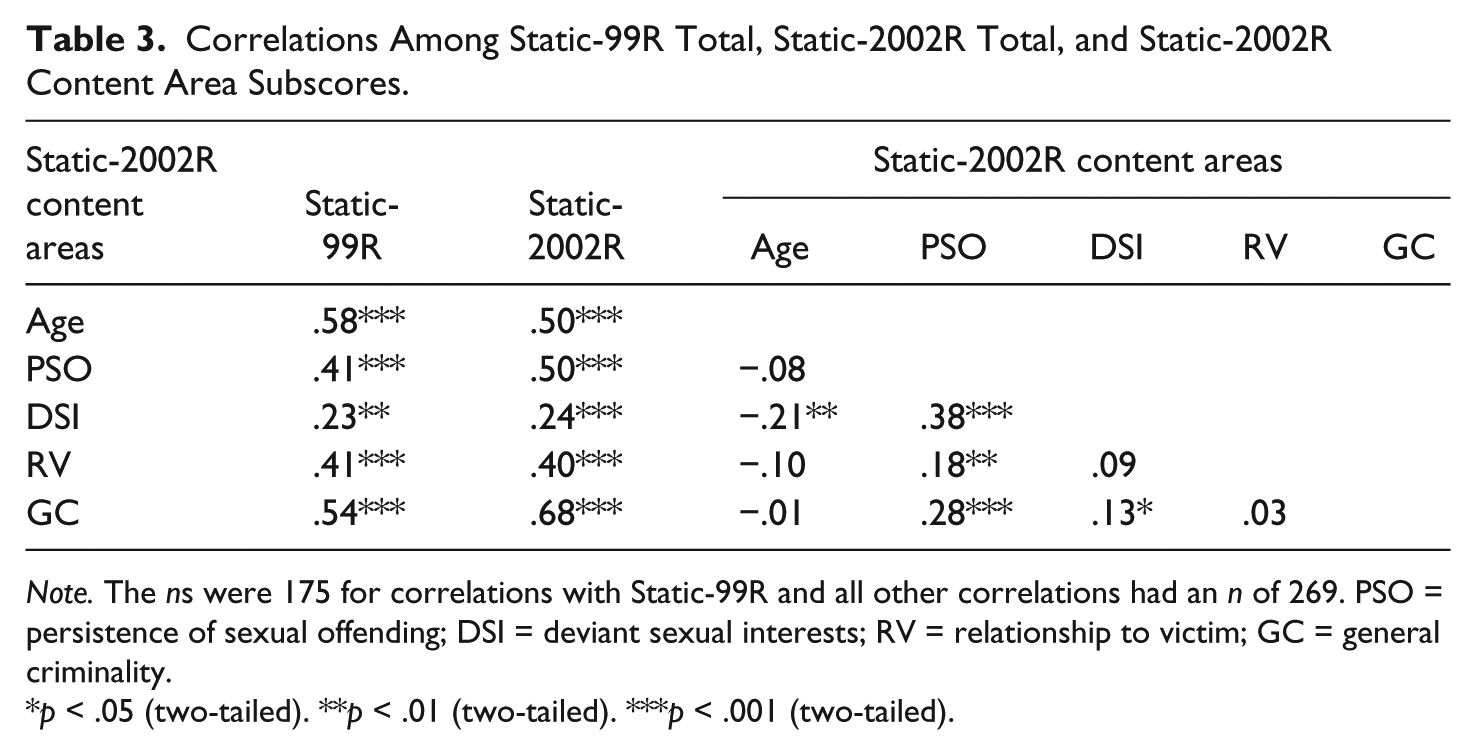
Note. The ns were 175 for correlations with Static-99R and all other correlations had an n of 269. PSO = persistence of sexual offending; DSI = deviant sexual interests; RV = relationship to victim; GC = general criminality.
p < .05 (two-tailed). **p < .01 (two-tailed). ***p < .001 (two-tailed).
Predictive Validity
The predictive validities of the Static-99R and Static-2002R were examined. As seen on Table 4, Spearman’s rho is reported for each correlation between the Static-99R total score and the six recidivism outcomes. The Static-99R was significantly correlated and in the expected positive direction with charges and convictions; that is, higher Static-99R scores were associated with a higher chance of a recidivistic event occurring. In examining the ROC analyses, AUCs were calculated using the Static-99R total score for each of the six recidivism outcomes and these are also reported on Table 4. The Static-99R showed large effect sizes for predicting any new charges and any new convictions (AUCs of 0.74 and 0.74, respectively). Large effect sizes were found for the Static-99R’s ability to predict any new violent charges and any new violent convictions (AUCs of 0.76 and 0.73, respectively). Although the Static-99R score showed large average AUCs for predicting any future sexual charges and convictions and the Spearman’s rho for these outcomes were significant, the confidence intervals (CIs) were wider and closer to chance (e.g., new sexual offense charges; 95% CI = [0.52, 0.87]) than the AUC ranges for predicting general and violent recidivism.
AUCs, Percent Recidivism, and Spearman’s Rho for the Static-99R and Static-2002R on Convictions and Charges for Any, Violent, and Sexual Recidivism.
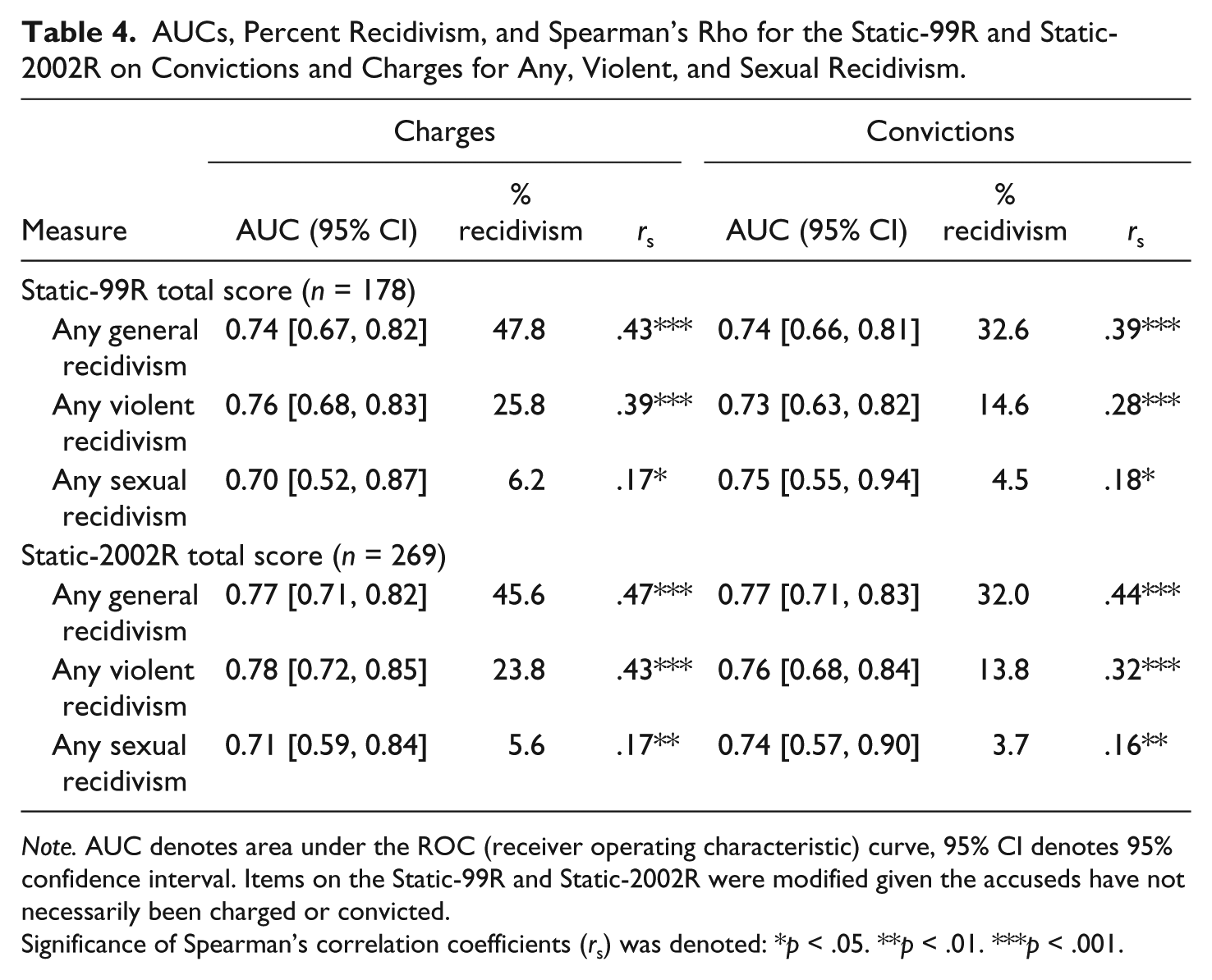
Note. AUC denotes area under the ROC (receiver operating characteristic) curve, 95% CI denotes 95% confidence interval. Items on the Static-99R and Static-2002R were modified given the accuseds have not necessarily been charged or convicted.
Significance of Spearman’s correlation coefficients (rs) was denoted: *p < .05. **p < .01. ***p < .001.
Correlations between the Static-2002R total score and each of the six recidivism outcomes were calculated, and Spearman’s rhos are reported on Table 4. The correlations were positive and significant between the Static-2002R total score and all six outcomes. Analyses involving the predictive accuracy of the Static-2002R to predict any, violent, and sexual recidivism as measured by charges or convictions are also listed on Table 4. AUCs were calculated for the Static-2002R and these AUCs showed large effect sizes. The Static-2002R significantly predicted future charges or convictions for any general, violent, and sexual offending.
Discussion
The objective of this research was to examine the application of the Static-99R (Harris et al., 2003) and Static-2002R (Phenix et al., 2008) in a police context with sexual assault perpetrators who have yet to be convicted. The findings in this study support the use of actuarial measures in a police context. The Static-99R performed well in predicting any recidivism, violent recidivism, and sexual recidivism, although it performed less well in predicting any sexual recidivism. The Static-2002R, on the other hand, performed very well in predicting all recidivism outcomes. In general, these findings provide support for law enforcement to use actuarial risk assessment in cases where they have identified a sexual assault perpetrator.
The research produced accuracy levels that were similar to past research validating the Static-99R and Static-2002R with convicted sex offender samples. For example, AUCs are typically moderate to large (e.g., L. Helmus et al., 2012, reported average weighted AUC of .70 for Static-99R), and the Static-99R and Static-2002R often outperform other measures in their predictive accuracy (e.g., Langton, Barbaree, Seto, et al., 2007). It is notable that, in light of the sample obtained, recidivism rates were lower than those often reported in correctional samples, but commensurate with past findings examining the rearrest rates in a police sample of sex offenders for further sexual crimes (e.g., 6.5% in 5 years; Sample & Bray, 2003).
Although the findings are certainly encouraging, it could be argued that the findings may be an artifact of the coding procedure. It is important to note that the primary researcher is trained on using actuarial risk assessment and the significance of the study’s findings may be due to the experience of the coder in completing these measures. One could surmise that these large effects may not have emerged if assessments were completed by less experienced police officers; however, Hilton et al. (2007) have previously demonstrated that police officers can be effectively trained to score the actuarial risk measure, the ODARA, accurately. Another possible artifact is that there may be some degree of selection bias, in light of the choice of cases that included enough information to complete the risk measures’ items. Would the predictive accuracy be as strong if police inquired about each risk assessment item for each of the cases without sufficient information? Of course, this would need to be queried in future studies. Despite these procedural matters, the findings may truly be a reflection of the utility of these measures, more particularly, the Static-2002R in predicting violence and sexual offending regardless of the criminal justice stage—whether the perpetrator was convicted or not.
This research has heuristic value, and the findings suggest that criminogenic factors may be the same in predicting violent behavior for those who are found to be guilty for their sexual crimes, as well as those whose guilt has yet to be determined. Furthermore, it encourages future research to validate the use of actuarial measures in a police context in other municipalities and regions, as well as examine the utility of these measures in the field itself (e.g., police officer’s active use of a measure and examining their coding in predicting future outcomes). Such research would also be prospective, which is a better methodology to examine predictive accuracy.
These findings also have many implications. At a practical level, there appears to be utility of risk assessments at a frontline level, specifically in a police context, to identify sexual assault perpetrators who may be more likely to offend again, although using existing measures of risk would require some minor modifications. For example, the age items on both the Static-99R and Static-2002R were modified from “age at release” in the original measures to “age at arrest.” Given the likelihood that police would assess a perpetrator at the time of the arrest, rather than some time later in the investigation, this modification makes logical sense. Second, there is utility of risk assessment to prioritize cases. The risk, need, and responsivity principles (Andrews & Bonta, 1994, 2010), which were originally introduced to improve the effectiveness of rehabilitation of offenders, have been demonstrated for use with treating and managing sex offenders (Hanson, Bourgon, Helmus, & Hodgson, 2009). The risk principle, in particular, is of relevance here and specifies that intensity of services should commensurate with the level of risk; for example, higher risk cases should receive greater attention and intensity of treatment services. In a police context, it would make sense to allocate more monitoring services to those perpetrators who are assessed to be at a higher risk to be charged for violent crimes again. A third practical implication is the use of a validated risk assessment tool to make high stakes decisions, such as bail decisions on whether to release an accused back into the community. A caveat would be that court professionals, such as crown prosecutors and the judiciary, would need to be open to such empirically based practices. However, given their accountability to protect the community as well as maintain fairness to the defendant, the use of validated risk measures would offer greater accuracy and defensible decisions to their already established decision-making process. A final implication is the facilitation of police to collect information on empirically validated risk factors, thus encouraging police to collect relevant risk-related information in addition to engaging in standard investigation procedures.
These findings suggest that existing sex offender research can extend to police practice. Beauregard (2010) insists that cultivating collaborations between investigative psychology and sex offender research can lead to greater knowledge and promote informed policing practices. There tends to be a general reluctance by law enforcement to engage in research or include outsiders (e.g., academic researchers) to investigate police practices. Bueermann (2012) highlights that researchers can encourage the adoption of evidence-based approaches by police agencies by producing timely, readable reports of their work. Most researchers author lengthy technical reports that are often wrought with scientific jargon, which is more suited to other academics, rather than for practitioners and policy makers. Bueermann recommends that research should be disseminated through short, readable, and accessible summaries that are effectively marketed and inform decision makers about the best scientific evidence regarding strategies to realize desired outcomes, allowing for refinement and structure in making changes. He further adds that forming partnerships with local universities or colleges to use the services of professors, graduate students or interns can increase institutional knowledge while keeping costs at a minimum. It is hoped that with this research we can begin building bridges between investigative psychology and the research already conducted on sex offenders to facilitate evidence-based policing practices (Beauregard, 2010).
It is important to acknowledge methodological limitations of this study. The archival nature of this study meant that information was not collected for the purpose of completing the Static-99R and Static-2002R, and therefore only data that were available through the varied sources were searched. Another issue, which is a challenge of all studies that examine predictive validity, is the underreporting of criminal behavior and the conservative recording of convictions and charges on official records. As mentioned earlier, the data were coded by a trained researcher rather than by police personnel; therefore, rigor and training may be more extensive than what law enforcement may offer in a practical setting. Hence, further studies should examine the interrater reliability and the real-world predictive ability of police-assessed cases. Given the range of the follow-up period used in this study, a fixed follow-up period was not used and may also be considered a limitation in the analyses. It is also important to observe that there were fewer calculable Static-99R total scores (61.4%) than the Static-2002R total scores (92.8%), and this may have given a slight advantage to the Static-2002R when examining their predictive validities.
Beyond methodological limitations, it is also important to caution that using actuarial risk assessment prior to conviction has its own ethical quandaries. It is important that risk assessment does not influence the police investigation or the initiation of a police investigation. More particularly, it should not influence determination of guilt without following proper police procedures in interviewing the victims, witnesses, and perpetrators; gathering physical and corroborative evidence; and ensuring rigorous adherence to proper legal procedures with appropriate warnings. At a police level, the focus of conducting a risk or threat assessment should be to ensure appropriate allocation of resources and using important information in determining release and bail decisions. Another ethical quandary that is notable in all studies that examine recidivism is the possible underreporting of sexual offenses. Documented charges and convictions do not account for the inevitable underestimation of the actual recidivism rate as many sexual assault incidents are often not reported to the police (e.g., Bachman, 1998). When they are reported, they do not always lead to a formal police charge, and sexual recidivism rates may be conservative when sexually motivated offending results in nonsexual charges and convictions. Although it is still valuable to conduct studies that validate measures of sexual violence risk using recidivism data, it is important to recognize that these statistics are, most likely, underestimates of the true prevalence.
In conclusion, evidence-based policing refers to using police and criminal justice research to help develop, implement, and evaluate proactive crime-fighting strategies (Bueermann, 2012). This study offers evidence that supports the use of actuarial risk measures in the assessment of sexual assault perpetrators to determine their potential risk to commit further violent or sexual crimes. The use of risk assessment may lead to a more efficient use of resources; for example, research can help guide policing practice and prioritizing of cases. Much is known about risk factors predictive of reoffending behavior of known and convicted sex offenders (see Hanson, 1998; Hanson & Bussière, 1998), and the current findings recommend the application of this existing body of research to frontline law enforcement in their decision making.
Footnotes
Acknowledgements
The author expresses tremendous gratitude to the Office of Strategy Management (OSM), the Sexual Assault Section (SAS), the Business Performance Unit, and the Chief’s Committee of the Edmonton Police Service, and specifically to Deputy Chief Brian Roberts, Staff Sergeant Devin Laforce, Staff Sergeant Shawna Grimes, and Lindsay Broderick for their direction in this research. Special thanks to Superintendent Chad Tawfik, Inspector Carlos Cardoso, Staff Sergeant Devin Laforce, and Detective Elaine Jensen for their valuable feedback. This research would not have been completed without the enormous help provided by Wojciech Kujawa, Maxine Tremblay, and Megan White. The author wishes to particularly thank Farron Wielinga for her research assistance as a second rater in this study.
Author’s Note
The points of view expressed in this article do not necessarily represent the views of the Edmonton Police Service.
Declaration of Conflicting Interests
The author(s) declared no potential conflicts of interest with respect to the research, authorship, and/or publication of this article.
Funding
The author(s) received no financial support for the research, authorship, and/or publication of this article.