



Abstract
The current longitudinal study explored the extent to which implicit and explicit evaluations of sexual aggression predict subsequent sexually aggressive behavior. Participants (248 community men recruited online) completed measures of implicit and explicit evaluations and self-reported sexually aggressive behavior at two time points, approximately 4 months apart. Implicit and explicit evaluations of sexual aggression at Wave 1 had small significant and independent predictive relationships with sexually aggressive behavior at Wave 2, while controlling for sexually aggressive behavior at Wave 1. This is the first study to test whether implicit and explicit evaluations predict subsequent sexually aggressive behavior. Our findings are consistent with the possibility that both implicit and explicit evaluations may be relevant for understanding and preventing subsequent sexually aggressive behavior. If these findings can be replicated, evaluations of sexual aggression should be studied with more rigorous methodology (e.g., experimental design) and correctional/forensic populations, and possibly addressed in risk assessment and interventions.
Evaluation refers to an individual’s evaluative thoughts (e.g., good vs. bad; positive vs. negative) about a particular psychological object such as a person, object, or behavior (see Ajzen, 2001; Albarracín, Zanna, Johnson, & Kumkale, 2005; Gawronski & Bodenhausen, 2007). Implicit evaluations are immediately activated evaluations of a psychological object (Gawronski & Bodenhausen, 2006) and are typically assessed using response latency measures (e.g., Implicit Association Test [IAT]; Greenwald, McGhee, & Schwartz, 1998). Explicit evaluations are deliberative evaluations of a psychological object and are typically assessed using self-report measures such as semantic differential scales and feeling thermometers (Gawronski & Bodenhausen, 2006). Theory suggests evaluations are important determinants of future behavior. For example, Ajzen’s (1991, 2001) theory of planned behavior suggests an individual’s evaluations, perceived behavioral control, and perceptions of social norms influence his or her intention to commit a particular behavior, which in turn influences his or her behavior. Consistent with theory, meta-analytic research has found that both types of evaluation provide unique and complementary information that predicts behavior (e.g., Cameron, Brown-Iannuzzi, & Payne, 2012; Glasman & Albarracín, 2006; Greenwald & Farnham, 2000; Kraus, 1995; Nosek & Smyth, 2007).
Sexual coercion and aggression against adult victims encompasses an array of behavior that can vary in sexual act (e.g., sexual touching to intercourse) and tactic used to obtain the sexual activity (e.g., verbal coercion to physical force). Below, the terms sexual aggression and sexually aggressive behavior will be used to refer to the perpetration of any unwanted sexual activity. More specific terms, such as verbal sexual coercion (i.e., verbally coercing someone into unwanted sexual activity) and physical sexual aggression (i.e., physically forcing someone into unwanted sexual activity), will be used when discussing specific types of sexual aggression.
Consistent with the social psychology literature, several recent studies have found evaluations of sexual aggression to be positively associated with sexually aggressive behavior using cross-sectional research designs. Of these studies, some have found that more positive implicit evaluations of rape are associated with sexually aggressive behavior (Nunes, Hermann, & Ratcliffe, 2013; Widman & Olson, 2013), and all have found that more positive explicit evaluations of rape are associated with sexually aggressive behavior (Hermann, Nunes, & Maimone, 2016; Maimone, Hermann, Atlas, Berliant, & Nunes, 2013; Nunes et al., 2013; Nunes, Hermann, White, Pettersen, & Bumby, 2016; Widman & Olson, 2013). For example, Nunes et al. (2013) found implicit and explicit evaluations of rape were positively and independently related to past sexual aggression and proclivity to rape in a sample of male undergraduate students. 1
Hermann and colleagues (2016) also examined the relationship between implicit and explicit evaluations of sexual aggression, self-reported past sexually aggressive behavior, and proclivity for sexual aggression in a sample of 150 male undergraduate students and a sample of 378 community men. In both samples, more positive explicit evaluations of sexual aggression were moderately to strongly, positively associated with self-reported past and proclivity for sexual aggression. The same pattern of results, however, was not found for implicit evaluations of rape. Despite some apparent inconsistencies across studies, these findings encourage further research into the role implicit and explicit evaluations may play in sexual aggression.
Longitudinal Research on Cognitions Regarding Rape
Of particular interest is whether evaluations of sexual aggression predict future sexually aggressive behavior. If evaluations are a causal factor for this type of behavior, then we would expect that they would predict subsequent engagement in sexual aggression. To the best of our knowledge, this question has not yet been explored in the literature. Research has, however, examined the relationship between more general cognitions regarding rape and subsequent sexual aggression.
We use the term cognitions regarding rape (or rape cognition) to encompass the wide range of cognitive constructs referred to in the literature, such as attitudes, beliefs, stereotypes, excuses, justifications, and cognitive distortions about rape, women, and victims of rape (for reviews, see Hermann, Babchishin, Nunes, Leth-Steensen, & Cortoni, 2012; Nunes et al., 2013; Nunes, Hermann, et al., 2016). Past research has typically found a positive relationship between rape cognition and sexually aggressive behavior when using a cross-sectional research design (e.g., Anderson, Cooper, & Okamura, 1997; Murnen, Wright, & Kaluzny, 2002; Suarez & Gadalla, 2010); however, research exploring this relationship longitudinally has demonstrated more mixed results. For example, in a recent meta-analysis, Helmus, Hanson, Babchishin, and Mann (2013) found rape cognition did not significantly predict sexual recidivism among sexual offenders against adults (d = 0.14, 95% confidence interval [CI] = [−.17, .46], k = 4, n = 460). In contrast, longitudinal research with students and community men has found rape cognition predicts subsequent sexually aggressive behavior (e.g., Abbey & McAuslan, 2004; Abbey, Wegner, Pierce, & Jacques-Tiura, 2012). Perhaps the different results reflect different populations (correctional vs. community samples) and/or different outcomes (sexual recidivism vs. initiation of sexual aggression).
Researchers have also found that sex offenders who participate in sex offender treatment demonstrate reduced cognitions about rape (e.g., Beggs & Grace, 2011; Nunes, Babchishin, & Cortoni, 2011; Nunes, Pettersen, Hermann, Looman, & Spape, 2016; Olver, Kingston, Nicholaichuk, & Wong, 2014). For example, Nunes and colleagues (2011) found 214 federally incarcerated sex offenders endorsed significantly less rape cognition posttreatment (d change = 0.75). Although this seems promising, change in rape cognition has been found to be unrelated to sexual recidivism (Beggs & Grace, 2011; Hudson, Wales, Bakker, & Ward, 2002; Nunes, Pettersen, et al., 2016; Olver et al., 2014). For example, Beggs and Grace (2011) found that change in rape cognition was unrelated to sexual recidivism for 202 incarcerated sex offenders. Generally, these results are inconsistent with the notion that rape cognition plays a causal role in sexual recidivism (see Nunes, Pettersen, et al., 2016, for more on this interpretation).
Although there is clear evidence for a relationship between rape cognition and sexually aggressive behavior in cross-sectional research, the evidence is mixed for longitudinal research. One possible explanation for these mixed results is that only certain types of cognitions regarding rape cause sexual aggression (e.g., evaluations, beliefs), whereas other types may be associated with, but not causally related, to this type of behavior (see Maruna & Mann, 2006; Nunes, Hermann, et al., 2016; Ward, Gannon, & Keown, 2006). Despite rape cognition possibly encompassing a number of distinct cognitive constructs (Maruna & Mann, 2006; Nunes et al., 2013; Nunes, Hermann, et al., 2016), it is often measured as a unitary construct (Hermann et al., 2012). If rape cognition is measured as a unitary construct and/or if the different types of cognitive constructs are not consistently represented in the measures used, then this could explain inconsistencies in the observed relationship between rape cognition and sexual aggression (Hermann et al., 2012; Nunes et al., 2013; Nunes, Hermann, et al., 2016). Thus, research isolating individual cognitive constructs regarding rape, such as evaluations, may help to clarify the seemingly inconsistent findings in the literature.
Sampling From the Community
Prior research on sexual aggression against adults has primarily used incarcerated or student samples that may not be fully representative of sexually aggressive men (see Abbey, Parkhill, Clinton-Sherrod, & Zawacki, 2007; Greene & Davis, 2011). Many victims do not report their sexual assaults to the police (e.g., Brennan & Taylor-Butts, 2008), and even when they are reported, many reports do not result in conviction, and even fewer result in prison sentences (Public Safety Canada, 2010). As a result, incarcerated samples may only represent one extreme of sexually aggressive men. Furthermore, although sexual aggression against adults is a well-known problem for college and university campuses (e.g., Abbey, McAuslan, Zawacki, Clinton, & Buck, 2001; Zinzow & Thompson, 2015), the typical characteristics of antisocial men are not conducive to educational aspiration or success (e.g., Andrews & Bonta, 2010). In addition, research suggests community samples are more diverse than traditional student samples (e.g., Behrend, Sharek, Meade, & Wiebe, 2011; Buhrmester, Kwang, & Gosling, 2011; Casler, Bickel, & Hackett, 2013; Paolacci, Chandler, & Ipeirotis, 2010). Sampling from the community may access a missing, and possibly the largest, segment of sexually aggressive men.
Study Purpose
The purpose of the current longitudinal study was to explore the extent to which implicit and explicit evaluations of sexual aggression predict subsequent sexually aggressive behavior in a sample of community men. From the more general social psychology literature and the cross-sectional research on evaluations of sexual aggression already discussed, it was hypothesized that implicit and explicit evaluations of sexual aggression would independently predict subsequent sexually aggressive behavior.
Method
Participants
Wave 1
Participants were 617 community men recruited through Qualtrics from an online panel of male participants 2 living in North America. They received US$2.00 for completing the survey. Participants were excluded if they were female (n = 0), failed the quality control questions (n = 0), did not identify as heterosexual (n = 0), reported they could not understand written English or were missing data on this item (n = 0), or responded too quickly on the IATs (n = 20; that is, if more than 10% of trials are less than 300 ms). This resulted in a final sample size of 597 participants. The median age category for participants was 50 to 59 years (25.6%, n = 153); the majority of participants were identified as White (82.9%, n = 495), had completed a college or university degree (60.0%), and were married (54.4%, n = 324; see Table 1).
Demographic Characteristics of the Sample Who Completed Wave 1 and Who Completed Waves 1 and 2.

Note. Some variables had missing data and as a result differ in sample size.
Wave 2
Participants were 263 community men recruited from the online panel participants who had completed Wave 1. Participants were invited to participate in Wave 2 approximately 4 months after Wave 1, and received US$2.00 for completing this survey. Of the 617 participants in Wave 1, 354 did not fully participate in Wave 2. The 354 participants who did not complete Wave 2 consisted of 81 participants who were excluded for only partially completing the survey and 273 participants who refused to complete the second survey. Differences on Wave 1 data between participants who only completed Wave 1 and those who completed both waves were examined (see Table 2). The groups did not differ in their implicit and explicit evaluations of sexual aggression. Participants who completed both Waves 1 and 2 were older (d = −0.23) and self-reported less past sexually aggressive behavior (d = 0.27).
Group Differences Between Participants Who Only Completed Wave 1 and Those Who Completed Both Waves 1 and 2.

Note. Bold values are d ≥ 0.20. After excluding participants who did not meet the exclusion criteria, there were 588 participants with Wave 1 data (340 participants with no Wave 2 data) and 248 participants with data on Waves 1 and 2. RE-IAT = Rape Evaluation Implicit Association Test; ROE = Rape Outcome Expectancies; SES-TFR = Sexual Experience Survey—Tactics First Revised.
Age was coded as an ordinal variable, the means presented above represent the mean age category of participants. A chi-square test produced the same pattern of results.
RE-IAT = all four of the IAT measures were combined into one variable (RNPN IAT categories = RAPE, NOT RAPE, positive, negative. RCPN IAT categories = RAPE, CONSENTING SEX, positive, negative. RCGB IAT categories = RAPE, CONSENTING SEX, good, bad. RNGB IAT categories = RAPE, NOT RAPE, good, bad).
p < .05.
Wave 2 participants were excluded if they did not identify as male (n = 0), failed the quality control questions (n = 4), did not identify as heterosexual (n = 0), reported they could not understand written English or were missing data on this item (n = 3), or responded too quickly on the IATs 3 (Wave 1 n = 6; Wave 2 n = 7) (i.e., if more than 10% of trials are less than 300ms). The exclusion categories are not mutually exclusive. This resulted in a final Wave 2 sample size of 248 participants. The median age category for these participants was 50 to 59 years (28.6%, n = 71); the majority of participants were identified as White (86.3%, n = 214), had completed a college or university degree (60.9%), and were married (54.4%, n = 135) (see Table 1).
Measures
Demographic questionnaire
Participants were asked questions about their age, sex, race, ability to understand English, employment status, education status, and relationship status. Of note, age was not measured as a continuous variable, it was measured using age categories (e.g., 18-19 years, 20-24 years, etc.).
Rape Evaluation IAT (RE-IAT)
IAT measures are computer-based tasks that use response latencies to measure the implicit associations between two concept (e.g., RAPE and CONSENTING SEX) and two attribute (e.g., positive and negative) categories (see Greenwald et al., 1998). Participants are asked to classify selected stimuli (e.g., words) into their respective concept or attribute categories using two buttons on a computer keyboard (e.g., d and k). The time it takes for participants to classify stimuli correctly is known as the response latency. Blocks of trials differ by the concept and attribute categories that are paired (i.e., share a response key). For some blocks, RAPE and positive share a response key (d) and CONSENTING SEX and negative share a response key (k), whereas for other blocks, RAPE and negative share a response key (d) and CONSENTING SEX and positive share a response key (k). When a concept and attribute category pair is more compatible for a participant (i.e., associated in memory) and they share a response key, the participant should classify the stimulus more quickly and with less error than when a less compatible concept and attribute category pair shares a response key. From average response latencies for each type of block (i.e., RAPE and positive, CONSENTING SEX and negative vs. RAPE and negative, CONSENTING SEX and positive), a difference score can be calculated that allows researchers to make inferences about participants’ implicit evaluations.
Participants were asked to complete one of four versions of the RE-IAT in Wave 1 (RNPN IAT categories: RAPE, NOT RAPE, positive, negative; RCPN IAT categories: RAPE, CONSENTING SEX, positive, negative; RCGB IAT categories: RAPE, CONSENTING SEX, good, bad; RNGB IAT categories: RAPE, NOT RAPE, good, bad). The cross-sectional results revealed that all four measures had adequate internal consistency (range α = .72-.79) and minimal to no cross-sectional relationship with self-reported prior sexual aggression. As a result, all four measures were combined into one RE-IAT variable at Wave 1 to maximize the sample size in the analyses. In Wave 2, all participants were asked to complete only the RCPN IAT (α = .70), as this version of the RE-IAT had the most consistent small positive relationships with sexually aggressive behavior in Wave 1 and these results were interpreted as preliminary evidence of criterion validity (r = .11-.14; see Hermann, 2015).
IAT measures are considered to be reliable and valid measures of implicit evaluations (e.g., Greenwald, Poehlman, Uhlmann, & Banaji, 2009; Hofmann, Gawronski, Gschwendner, Le, & Schmitt, 2005; Lane, Banaji, Nosek, & Greenwald, 2007; Nosek, Greenwald, & Banaji, 2007). More specifically, the IAT has been adapted to assess implicit evaluations of rape in previous research and has been found to have moderate internal consistency (α = .51-.73; Hermann et al., 2013; Hermann et al., 2016; Maimone et al., 2013; Nunes et al., 2013); this degree of internal consistency is consistent with what is typically found in other evaluation research (e.g., Hofmann et al., 2005; Lane et al., 2007). The validity of RE-IAT measures, however, is largely unknown. Some research has found the RE-IAT is positively correlated with measures designed to assess explicit evaluations of outcomes of rape (Rape Outcome Expectancies–Evaluation [ROE-Evaluation] scale, r = .25, p < .05; Maimone et al., 2013). Importantly, much of the evidence for reliability and validity pertains to RE-IAT measures administered in lab; the psychometric properties of RE-IAT measures administered online are currently unknown.
A computer programmer assisted with programming the RE-IAT measures in Qualtrics. A combination of new computer code (JavaScript) and pre-existing Qualtrics’s functions were used to present the blocks and trials, randomize the presentation of stimuli, and record reaction times. The RE-IATs in the current study follow the standard procedure for number of trials, blocks, and order presentation (as outlined in Nosek et al., 2007), and the standard scoring procedure was used (D-score; Lane et al., 2007). The RE-IAT effect was calculated such that positive scores suggest rape is more strongly associated with positive/good than with negative/bad; negative scores suggest the opposite.
Sexual Experience Survey—Tactics First Revised (SES-TFR)
Sexually aggressive behavior was measured using a revised version of the “Tactics First” Sexual Experience Survey (SES-TF) from Abbey, Parkhill, and Koss (2005). The original SES scale was developed by Koss and colleagues (Koss & Gidycz, 1985; Koss, Gidycz, & Wisniewski, 1987; Koss & Oros, 1982), and since then it has been revised numerous times (see Koss et al., 2007). The SES-TF asks participants to self-report whether, since the age of 14 years, they have engaged in any sexual behaviors (e.g., sexual touching, vaginal intercourse) by using any of the following verbally coercive or physically aggressive tactics: (a) arguments and pressure, (b) lies or false promises, (c) guilt or displeasure, (d) giving a woman drugs or alcohol, (e) taking advantage of a woman when she is incapacitated due to drugs or alcohol, and/or (f) physical force. Each item is typically rated on a 4- or 6-point Likert-type scale from never (0) to three/five times or more.
In the current study, the SES was modified in the following ways: First, in Wave 1, participants were asked to recall their behavior since the age of 16 years, instead of 14 years; and in Wave 2, participants were asked to recall their behavior since completing the survey in Wave 1 (approximately 4 months). As well, the Likert-type scale for each item was modified to range from never (0) to nine times or more (9). Clear instructions were also provided that operationalized “woman”: by “woman” we mean a female who at the time of the sexual experience was 18 years or older or, if younger than 18 years, was close to your age (e.g., 16 years) or older at the time of the sexual experience.
Last, the original SES-TF combined “anal sex” and “inserting an object into her” as one type of sexual behavior, whereas in the current study participants were asked about these behaviors separately. These modifications resulted in a total of 36 items. The SES was scored using the weighted scoring method developed by Davis et al. (2014). Davis et al. assigned severity rank scores to the sexual behavior and tactic combinations for each item (e.g., 1 = sexual contact by verbal coercion, 5 = attempted rape by intoxication, 9 = completed rape by physical force); these severity rank scores were multiplied by participants’ responses to each item. A total score was computed by summing the product for each item; scores could range from 0 to 1998.
The SES-TF has demonstrated excellent internal consistency in samples of sex offenders and community men (e.g., α = .92 and α = .91, respectively; Widman, Olson, & Bolen, 2013), and in the current study (Wave 1 α = .94, Wave 2 α = .73). More generally, self-report measures of delinquent and criminal behavior are considered to be reliable and valid (see Piquero, Schubert, & Brame, 2014; Thornberry & Krohn, 2000, for overviews), and self-report measures of sexually aggressive behavior align with independent indicators of such behavior, such as official criminal records (Pham et al., 2015; Weinrott & Saylor, 1991; Woods, Hermann, Nunes, McPhail, & Sewell, 2011).
Evaluations SES-TFR
Explicit evaluations of sexual aggression were measured using a revised version of the Sexual Experience Survey—Tactics First from Abbey et al. (2005). Specifically, the response scale of the SES-TFR was modified to assess evaluations instead of frequency of sexually aggressive behavior (see above for sexual behaviors and tactics). This measure contained 36 items. Each item was rated on a 7-point Likert-type scale from very negative (1) to very positive (7). A total score was computed by taking the average evaluation rating for all of the items; scores can range from 1 to 7. This measure demonstrated excellent internal consistency in the current study (Wave 1, α = .98, Wave 2, α = .98) and past research with students and community men (α = .94, students; α = .97, community men; Hermann et al., 2016).
ROE-Evaluation scale
The ROE-Evaluation scale assesses explicit evaluations of the outcomes of rape (Nunes et al., 2013). Participants are asked to provide three self-generated outcomes of sexual assault and rate the valence of each outcome on a 7-point Likert-type scale from very negative (1) to very positive (7). The ROE-Evaluation scale is the average evaluation rating of the three outcomes. Although this scale has not yet been validated, similar measures have been used in past research to assess outcome expectancies of rape (Bouffard, 2002; O’Donohue, McKay, & Schewe, 1996), and past research has found that the ROE-Evaluation scale was moderately and significantly correlated with other measures designed to assess explicit evaluations of rape (Hermann et al., 2016; Maimone et al., 2013).
Evaluation of Rape Scale
The Evaluation of Rape Scale consists of five semantic differential items that ask participants to evaluate rape on 7-point bipolar scales (e.g., bad to good; very similar to the seven-item Evaluation of Rape Scale developed by Nunes, Hermann, et al., 2016). A total score is calculated by averaging these ratings, with higher scores indicating more positive evaluations of rape. Average scores can range from 1 to 7. Semantic differential scales are commonly used in social psychology research to assess evaluations (e.g., Gawronski & Bodenhausen, 2006), and the Evaluation of Rape Scale has been found to have acceptable reliability in student and community samples (e.g., α = .88 community men, Hermann et al., 2016; α = .90 students, Maimone et al., 2013; α = .79 students, Nunes, Hermann, et al., 2016). In the current study, the internal consistency was excellent (Wave 1 α = .93, Wave 2 α = .87). Although the Evaluation of Rape Scale has not yet been validated, past research has found it is moderately and significantly correlated with other measures designed to assess explicit evaluations of sexual aggression and explicit evaluations of the outcomes of rape (Evaluations SES-TFR r = .46, p < .001 community men, Hermann, 2015; ROE-Evaluation scale, r = .30, p < .05 students, Maimone et al., 2013).
Quality control questions
Participants were asked to complete 10 quality control questions at random points throughout the survey. These were used to screen out participants who were not paying attention to, or did not understand, the survey instructions and items (as indicated by incorrect responses). For example, participants were asked, “Please respond to this question by selecting the number 10.”
Procedure
The same procedure was followed for both Waves 1 and 2. Participants were identified across surveys using a unique identification code, and participants completed all of the measures as an online survey. Participants were first presented with a consent form outlining the study. If participants agreed to participate, they were then asked to read a pre-debriefing form (information about withdrawing from the study and generic resources in case of distress), and complete the demographic questionnaire. Following this, in Wave 1, participants were randomly assigned to complete one of the four RE-IATs. In Wave 2, participants were asked to complete the RCPN RE-IAT (categories: RAPE, CONSENTING SEX, positive, negative). Participants then completed the SES-TFR measures. To lessen fatigue, participants were then randomly assigned to complete either the ROE-Evaluation scale or the Evaluation of Rape Scale. Participants were then asked to complete several measures that did not assess evaluations of sexual aggression and were not included in the current manuscript. Participants completed quality control questions throughout the survey. Finally, participants were presented with a debriefing form.
Cross-Lagged Panel Analyses
A cross-lagged panel path analysis model was used to examine whether the RE-IAT (implicit evaluations of rape) and Evaluations SES-TFR (explicit evaluations of sexual aggression) measured at Wave 1 could predict scores on the SES-TFR (sexually aggressive behavior) at Wave 2, while controlling for sexually aggressive behavior assessed at Wave 1 (see Figure 1). There are two types of relationships in cross-lagged panel models, autoregressive effects and cross-lagged effects. An autoregressive effect is the relationship between the same variable measured at two time points; this relationship represents the stability of the construct over time. Small autoregressive effects indicate that there is substantial change in individuals’ rank on a variable over time. A cross-lagged effect is the relationship between one variable (Time 1) and another variable measured at a later time (Time 2) (Selig & Little, 2012).

Cross-lagged panel model.
Prior to computing the cross-lagged panel model, data were screened for univariate and multivariate outliers, normality, and multicolinearity using SPSS Version 22. The Evaluations SES-TFR and SES-TFR at Waves 1 and 2 were positively skewed. To correct the skewness of the SES-TFR, it was trichotomized, such that a score of 0 represented no subsequent sexual aggression, a score of 1 represented subsequent verbal sexual coercion but no physical sexual aggression, and a score of 2 represented subsequent physical sexual aggression with or without verbal sexual coercion. Furthermore, the cross-lagged panel model was estimated using the robust weighted least squares mean and variance (WLSMV) adjusted estimator. The WLSMV estimator was used because it is robust against violations of normality and is appropriate for use with ordinal dependent variables (Muthén & Muthén, 2012; Wang & Wang, 2012).
The cross-lagged panel model was computed using path analysis in Mplus Version 7.3 (Muthén & Muthén, 2012). When computing path analysis models with both ordinal and continuous dependent variables, and using the WLSMV estimator, the parameter estimates for ordinal dependent variables are probit regression coefficients, and the parameter estimates for continuous dependent variables are linear regression coefficients (Muthén & Muthén, 2012).
Results
When interpreting the results, emphasis was placed on effect size in addition to or instead of significance testing. A large number of significance tests were conducted, increasing the risk of a Type 1 error. This was offset to some extent by the increased likelihood of Type II errors due to the small sample size in some analyses; some participants had missing data and some measures were administered to only a subset of participants. Focusing on effect sizes goes beyond significance testing by describing the magnitude of the relationship observed. For correlations, r of .10 is generally considered small, r of .30 is considered moderate, and r of .50 is considered large (Cohen, 1992). For Cohen’s d, 0.20 is generally considered small, 0.50 is considered moderate, and 0.80 is considered large (Cohen, 1992).
The proportion of participants who self-reported that they had engaged in sexually aggressive behavior is presented in Table 3. At Wave 1, 42% of participants reported committing a sexually aggressive act since the age of 16 years. Participants tended to report that they had engaged in sexual aggression using verbally coercive tactics (arguments or pressure), more so than by using incapacitation due to alcohol or drugs, or by using physical force. At Wave 2, 15.7% of participants reported committing a new sexually aggressive act over the 4-month period since Wave 1. The same pattern was observed in terms of the tactics used to engage in sexual aggression.
Self-Reported Frequency of Sexually Aggressive Behavior by Tactic Used.
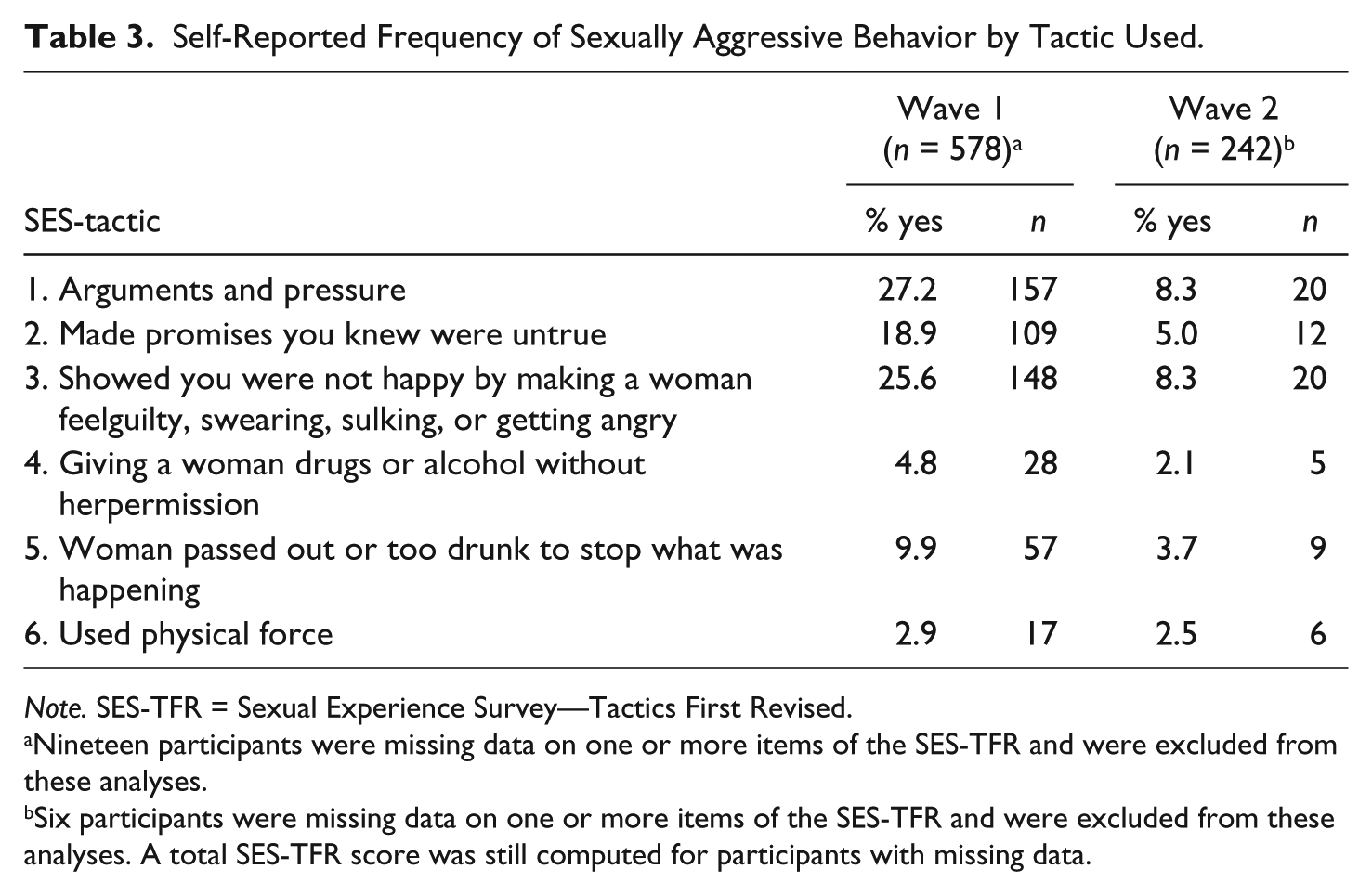
Note. SES-TFR = Sexual Experience Survey—Tactics First Revised.
Nineteen participants were missing data on one or more items of the SES-TFR and were excluded from these analyses.
Six participants were missing data on one or more items of the SES-TFR and were excluded from these analyses. A total SES-TFR score was still computed for participants with missing data.
Participants were divided into three groups based on their self-reported sexual aggression on the SES-TFR at Waves 1 and 2: (a) participants were classified as nonaggressors if they reported no sexually aggressive behavior at Waves 1 and 2 (n = 116); (b) past aggressors if they reported sexually aggressive behavior at Wave 1 but not Wave 2 (n = 82); and (c) current aggressors if they reported sexually aggressive behavior at Wave 2, whether or not they reported sexual aggression a Wave 1 (n = 38). The means and standard deviations for each group and differences between the groups on the measures of implicit and explicit evaluations of sexual aggression are presented in Table 4.
Means, Standard Deviations, and Group Differences Between Nonaggressors, Past Aggressors, and Current Aggressors on Implicit and Explicit Evaluations of Sexual Aggression.

Note. Twelve participants were missing data and as a result were not classified into one of the three groups. RE-IAT = All four IAT measures combined into one variable (see Method section). Bold values are d ≥ 0.20. RE-IAT = Rape Evaluation Implicit Association Test; ROE = Rape Outcome Expectancies; SES-TFR = Sexual Experience Survey—Tactics First Revised.
Cohen’s d computed such that positive d values represent nonaggressors having lower/more negative scores than comparison group, and negative d values represent nonaggressors having higher/more positive scores than comparison group.
Cohen’s d computed such that positive d values represent past aggressors having lower/more negative scores than current aggressors group, and negative d values represent past aggressors having higher/more positive scores than current aggressors group.
p < .05.
Group differences on measures of implicit and explicit evaluations of sexual aggression were examined using Cohen’s d. Current aggressors tended to endorse more positive implicit evaluations of rape on the RE-IAT than past aggressors (d = 0.38) and, to a lesser degree, than nonaggressors (d = 0.17). Past aggressors tended to endorse more negative implicit evaluations of rape on the RE-IAT than nonaggressors (d = −0.22). A somewhat similar pattern of results was found for explicit evaluations of sexual aggression; current aggressors tended to endorse more positive explicit evaluations of sexual aggression on the Evaluations SES-TFR and Evaluation of Rape Scale than nonaggressors (d range = 0.40-1.10) and past aggressors (d range = 0.35-0.94). Past aggressors did not differ from nonaggressors on the ROE-Evaluation scale or the Evaluation of Rape Scale, but did differ on the Evaluations SES-TFR scale such that past aggressors endorsed more positive explicit evaluations of sexual aggression than nonaggressors (d = 0.69).
The results for the cross-lagged model are presented in Table 5. Each of the variables included in the model had 5% or less missing data, and Little’s MCAR (Missing Completely at Random) test was nonsignificant, χ2(8) = 8.73, p = .37, suggesting the data were missing completely at random. As a result, pairwise deletion for missing data was used.
Implicit and Explicit Evaluations of Sexual Aggression Predicting Subsequent Sexually Aggressive Behavior (Wave 2).

Note. RE-IAT = Rape Evaluation Implicit Association Test; a measure of implicit evaluations of rape. Evaluations SES-TFR = measure of explicit evaluations of sexual aggression. SES-TFR = Sexual Experience Survey—Tactics First Revised; a measure of sexually aggressive behavior. 1Measure at Wave 1. 2Measure at Wave 2. Probit regression coefficients are italicized.
p < .05. **p < .01. ***p < .001.
The autoregressive effects for the RE-IAT, Evaluations SES-TFR, and SES-TFR were moderate to large and significant, suggesting adequate stability across waves of data collection. In terms of the cross-lagged effects, the RE-IAT and Evaluations SES-TFR at Wave 1 both had small significant and independent predictive relationships with the SES-TFR at Wave 2 (standardized probit regression coefficient RE-IAT = 0.17, p = .045; standardized probit regression coefficient Evaluations SES-TFR = 0.20, p = .008). The other cross-lagged effects were negligible in size and nonsignificant. A small positive significant relationship was found between the RE-IAT and Evaluations SES-TFR at Wave 1. A moderate positive significant relationship was also found between the Evaluations SES-TFR and SES-TFR at both Waves 1 and 2. This model accounted for a significant amount of variance in the SES-TFR variable at Wave 2 (R2 = .17, p = .012). In sum, more positive implicit and explicit evaluations at Wave 1 independently predicted more self-reported sexually aggressive behavior at Wave 2.
Discussion
We found implicit and explicit evaluations of sexual aggression independently predicted subsequent sexually aggressive behavior in a sample of community men. These results are noteworthy as they provide novel evidence regarding the direction of influence between evaluations and sexually aggressive behavior. Furthermore, our results are consistent with the notion—but of course do not demonstrate—that implicit and explicit evaluations of sexual aggression play a causal role in sexually aggressive behavior. More generally, these results are consistent with the social psychology literature that suggests evaluations can be important determinants of behavior (e.g., Ajzen, 2001; Glasman & Albarracín, 2006).
Finding implicit evaluations of rape predict subsequent sexually aggressive behavior appears at odds with some past research using cross-sectional research designs that found no relationship between implicit evaluations of rape and past sexual aggression (e.g., Hermann et al., 2016). It is possible that conflicting results can be attributed to bidirectional influences, where evaluations of rape may influence sexually aggressive behavior, and the outcomes or consequences of engaging in sexual aggression may then influence evaluations by making them more positive, more negative, or keeping them the same. These updated evaluations may then influence subsequent sexually aggressive behavior. If this were true, then we would expect a relationship between current evaluations of rape and subsequent sexually aggressive behavior, but not necessarily between current evaluations and past sexual aggression. The findings of the current study are consistent with this notion. Participants who reported committing sexually aggressive behavior over the 4-month time period between Waves 1 and 2 (current aggressors) endorsed more positive implicit evaluations of rape than participants who did not commit sexually aggressive behavior over this time period (nonaggressors and past aggressors). Past aggressors, however, had more negative implicit evaluations of rape than current aggressors and nonaggressors. Thus, current implicit evaluations may predict future sexual aggression, but may not be correlated with past sexual aggression.
In the current study, verbal sexual coercion and physical sexual aggression were examined together. It is possible that the relationship between evaluations and verbal sexual coercion differs from the relationship between evaluations and physical sexual aggression. From a theoretical perspective, however, this is unlikely, as theory suggests evaluations of behavior predict subsequent behavior without distinguishing between types of behavior (Ajzen, 1991, 2001). Supportive of this notion, Hermann et al. (2016) found the same pattern of results (large significant differences) for explicit evaluations of sexual aggression when comparing community men who had committed verbal sexual coercion to men with no history of sexual aggression, and when comparing community men who had committed physical sexual aggression to men with no history of sexual aggression.
One moderator of the evaluation–behavior relationship, however, is correspondence between the evaluations being measured and the criterion behavior (Ajzen & Fishbein, 2005; Greenwald et al., 2009; Kraus, 1995). Correspondence (also known as compatibility) refers to how well the evaluation being assessed aligns with the criterion behavior in terms of specificity of the action being performed, the target of the action, the context in which it is being performed, and the point in time at which it is being performed (see Ajzen & Fishbein, 2005). The greater the alignment between evaluation and behavior measures, the stronger the attitude–behavior relationship tends to be (Ajzen & Fishbein, 2005; Greenwald et al., 2009; Kraus, 1995). Thus, it is possible that stronger relationships between evaluations and subsequent sexually aggressive behavior would be observed if the evaluation and behavior measures were focused on only verbal sexual coercion or physical sexual aggression, not both types of behaviors combined.
Limitations
There are several limitations in this study, many of which overlap with those noted in Hermann et al. (2016). The use of self-report measures to assess sexually aggressive behavior is one such limitation. Some researchers have raised concerns about the accuracy of self-reported sexual aggression (e.g., Lalumière, Harris, Quinsey, & Rice, 2005), as it is possible participants may not be able to accurately recall or otherwise choose to misrepresent their sexually aggressive behavior. Although this is a possibility, research generally suggests using self-report methodology to assess engagement in delinquency and crime, including sexual aggression, is reliable and valid (see Piquero et al., 2014; Thornberry & Krohn, 2000, for overviews). Future research can address this limitation by replicating the current findings using additional indicators of sexual aggression, such as official charges and convictions, to supplement self-reports.
There is also little direct evidence regarding the construct validity of the implicit and explicit measures of evaluations of sexual aggression used in the current study. As noted earlier, the methodology used to assess implicit and explicit evaluations of sexual aggression here is commonly used in social psychology research and has demonstrated good reliability and validity. The validity of our specific adaptations of these measures to assess evaluations of sexual aggression, however, has yet to be examined in research. Furthermore, four different versions of the RE-IAT were administered in Wave 1 and combined into one RE-IAT measure. Combining different versions of the RE-IAT may have introduced error or otherwise impacted the results because each measure assessed implicit evaluations of rape slightly differently. It is important that future research thoroughly explore the construct validity of these measures.
As discussed by Hermann et al. (2016), the use of the word “rape” as a category in the implicit measures of evaluations of rape is possibly problematic. The implicit measures rely on immediate associations between RAPE and CONSENTING SEX (or NOT RAPE) and positive/good and negative/bad. Although measures assessing sexually aggressive behavior and sexual victimization often use the word “rape,” this can be problematic as research has demonstrated that both victims and perpetrators of sexual aggression may not define, and thus underreport, their experiences as rape (see Koss, 1993; Koss et al., 2007). It is possible that the concept category RAPE in the implicit measures used in the current study may not be fully representative of the broader range of sexually aggressive behaviors. This limitation can be addressed in future research by exploring the use of alternate implicit measures that do not rely on using the term “rape” to assess implicit attitudes towards sexually aggressive behavior.
Another potential concern in the current study is the administration of response latency paradigms online. There may be concerns about the impact of participants’ computers and computer software (i.e., computer speed, choice of Internet browser, etc.) on the recorded response latencies for the measure of implicit evaluations of rape. This, however, may not be as problematic as one might think because the IAT D-score (total score) is a relative score (average speed of response latencies for one block of trials relative to average speed of response latencies for another block of trials). It is expected that any error introduced into response latencies as a result of individual computer systems would be randomly distributed and/or consistent across an individual participant’s trials, so that idiosyncratic lags do not impact their relative scores. More generally, research has found that administering response latency implicit measures online does not unduly compromise reliability or validity (for a review of this evidence, see Hermann et al., 2016).
Conclusion
To the best of our knowledge, this is the first study to test whether implicit and explicit evaluations of sexual aggression predict subsequent sexually aggressive behavior. Our findings suggest that both implicit and explicit evaluations may be relevant to understanding sexually aggressive behavior. If these findings are replicated, evaluations should be studied with more rigorous methodology (e.g., experimental design) and correctional/forensic populations, and possibly addressed in risk assessment and interventions.
Footnotes
Acknowledgements
The authors would like to thank Stephane Rainville for programming the implicit measures in Qualtrics.
Authors’ Note
The views expressed are those of the authors and not necessarily those of the Ministry of Community Safety and Correctional Services.
Declaration of Conflicting Interests
The author(s) declared no potential conflicts of interest with respect to the research, authorship, and/or publication of this article.
Funding
The author(s) disclosed receipt of the following financial support for the research, authorship, and/or publication of this article: This research was facilitated by funding from the Social Sciences and Humanities Research Council of Canada and by the ATSA (Association for the Treatment of Sexual Abusers) Pre-Doctoral Research Grant.