



Abstract
The most commonly used risk assessment tools for predicting sexual violence focus almost exclusively on static, historical factors. Consequently, they are assumed to be unable to directly inform the selection of treatment targets, or evaluate change. However, researchers using latent variable models have identified three dimensions in static actuarial scales for sexual offenders: Sexual Criminality, General Criminality, and a third dimension centered on young age and aggression to strangers. In the current study, we examined the convergent and predictive validity of these dimensions, using psychological features of the offender (e.g., antisocial traits, hypersexuality) and recidivism outcomes. Results indicated that (a) Sexual Criminality was related to dysregulation of sexuality toward atypical objects, without intent to harm; (b) General Criminality was related to antisocial traits; and (c) Youthful Stranger Aggression was related to a clear intent to harm the victim. All three dimensions predicted sexual recidivism, although only General Criminality and Youthful Stranger Aggression predicted nonsexual recidivism. These results indicate that risk tools for sexual violence are multidimensional, and support a shift from an exclusive focus on total scores to consideration of subscales measuring psychologically meaningful constructs.
Keywords
Empirically derived actuarial scales are commonly used to evaluate the recidivism risk of individuals with a history of sexual crime (McGrath, Cumming, Burchard, Zeoli, & Ellerby, 2010; Neal & Grisso, 2014). Proponents of this approach value the objectivity of actuarial prediction tools (Dawes, Faust, & Meehl, 1989; G. T. Harris, Rice, Quinsey, & Cormier, 2015) and their ability to outperform unstructured professional judgment (Grove, Zald, Lebow, Snitz, & Nelson, 2000; Hanson & Morton-Bourgon, 2009; Meehl, 1954; Mossman, 1994). The Static-99 and Static-2002 (Hanson & Thornton, 2000, 2003) are the most popular actuarial scales for sexual offenders (Jackson & Hess, 2007; McGrath et al., 2010). They are exclusively composed of static risk factors, such as the number of prior sex offenses and sexual victim characteristics.
Although static factors predict recidivism, it is not obvious how evaluators can use static, unchangeable risk factors to inform the selection of treatment targets or to evaluate change. Therefore, recent developments in actuarial assessment for sexual offenders have focused on dynamic risk factors, that is, factors that are changeable through deliberate intervention (Mann, Hanson, & Thornton, 2010; Olver, Beggs Christofferson, Grace, & Wong, 2014). There are two types of dynamic risk factors: stable risk factors (or criminogenic needs; Andrews & Bonta, 2010), which are potentially changeable but tend to endure for months or years, and acute risk factors, which can change over weeks, days, even hours, and signal the timing of new offenses (Hanson & Harris, 2000). Sexual preoccupation, attitudes tolerant of sexual offending, and negative peer associations are examples of stable risk factors, whereas intoxication, victim access, and emotional collapse are examples of acute risk factors.
Even though the static/dynamic dichotomy has been widely adopted, evidence does not suggest that static and stable risk factors are fundamentally different entities: neither change rapidly over time, and both predict recidivism because they are behavioral markers of enduring risk-relevant propensities (Beech & Ward, 2004; Mann et al., 2010). As such, recent developments in sexual offender risk assessment have suggested that the conceptualization of risk factors could be better served by latent variable models (Brouillette-Alarie, Babchishin, Hanson, & Helmus, 2016).
Latent variable models are ubiquitous in psychology, particularly in trait theories of personality (Cattell & Kline, 1977; Widiger & Costa, 2013). This approach assumes that observed patterns of behavior, thought, and emotion are manifestations of latent variables, such as extraversion and neuroticism. Because static and stable risk factors in actuarial scales are mostly behavioral, it should be possible to use them to infer the major psychological constructs responsible for recidivism risk (Brouillette-Alarie et al., 2016). In this framework, items from static risk scales are seen as past manifestations of psychological vulnerabilities, and items from stable risk scales are more direct and current measures of those vulnerabilities (Beech & Ward, 2004). For example, a sexual offender who has boy victims (static risk factor/behavior) and phallometrically measured sexual arousal to children (dynamic risk factor/behavior) can be assumed to have a certain degree of pedophilia, a psychological propensity that is associated with sexual recidivism. These static and dynamic risk factors are predictive of sexual recidivism because they are past or present behavioral manifestations of the same psychological propensity.
Knowing onto which latent construct (or dimension) each risk factor loads has three main advantages. First, it enables static risk factors to become indicators of potentially changeable psychological features, enhancing the relevance of some of the most heavily used risk scales in the field (Brouillette-Alarie & Hanson, 2015). Although static risk factors are not modifiable through intervention (e.g., never lived with a lover for at least 2 years), the latent psychological construct they represent potentially is amenable (e.g., capacity for stable relationships). Evaluations that address psychological features are generally better received by clinicians, practitioners, and decision makers than those that only delineate the level of risk (Mann et al., 2010).
Second, latent variable models offer insight into why certain scales are better at predicting certain outcomes than others. Latent constructs have distinctive predictive validity patterns: items related to sexual criminality exclusively predict sexual recidivism, while items related to general criminality predict all types of recidivism (Brouillette-Alarie et al., 2016). Therefore, actuarial scales centered around sexual criminality (e.g., Rapid Risk Assessment for Sex Offender Recidivism [RRASOR]: Hanson, 1997) have lower performance for the prediction of nonsexual recidivism than actuarial scales centered around general criminality (e.g., Violence Risk Appraisal Guide [VRAG]: Quinsey, Harris, Rice, & Cormier, 2006; Parent, Guay, & Knight, 2011). If it is known that a scale contains items related to both sexual and general criminality (e.g., Static-2002), then it is possible to improve the prediction of nonsexual outcomes by removing the sexual criminality items (Babchishin, Hanson, & Blais, 2016). Similarly, if a scale does not comprise both sexual and general criminality items, adding the missing dimension is likely to improve the prediction of sexual recidivism. Therefore, considering dimensions rather than total scores has not only theoretical implications but also practical applications.
Third, construct-level approaches facilitate the integration of multiple risk scales. Experts tend to use multiple measures to assess their clients because redundancy increases reliability (Neal & Grisso, 2014). However, this course is only valid when both scales measure the same constructs, and with a similar weight in each scale. If not, it is likely to lead to discordant results without increasing reliability (Barbaree, Langton, & Peacock, 2006a). By understanding the constructs assessed by actuarial scales, an evaluator can deduce which measures should be combined, and which should not. Referring to the previous example, one should not expect the RRASOR and the VRAG to produce similar ratings for a same case, because they mostly address different constructs.
Over the last 15 years, many studies have sought to identify the latent constructs in static, actuarial scales for sexual offenders, using factor analysis (e.g., Allen & Pflugradt, 2014; Barbaree, Langton, & Peacock, 2006b; Brouillette-Alarie et al., 2016; Brouillette-Alarie & Proulx, 2013; Janka, Gallasch-Nemitz, & Dahle, 2011; Knight & Thornton, 2007; Olver et al., 2016; Roberts, Doren, & Thornton, 2002; Seto, 2005; Walters, Deming, & Elliott, 2009). The results of these studies, despite their methodological differences, have been surprisingly consistent (Brouillette-Alarie, Hanson, Babchishin, & Benbouriche, 2014). Three constructs are usually found. The first construct is typically defined by items related to sexual criminality, and includes numerous indicators of paraphilic sexuality (e.g., child victims, noncontact sexual offenses). It has mostly been interpreted in terms of deviant sexual interests (Barbaree et al., 2006b; Janka et al., 2011; Roberts et al., 2002; Seto, 2005; Walters et al., 2009). The second construct is constituted of items that reflect the magnitude, violence, and diversity of criminal careers. It has been unanimously interpreted in terms of antisocial traits. The third, less consistent construct, comprises items related to young age, unrelated/unknown sexual victims, and violence in the index offense. Although some authors have interpreted it as emotional detachment (Allen & Pflugradt, 2014; Roberts et al., 2002), others have interpreted it as a statistical artifact devoid of any psychological meaning (Brouillette-Alarie et al., 2016; Knight & Thornton, 2007; Seto, 2005). The first construct is associated with sexual recidivism, while the other two are associated with all types of recidivism (Brouillette-Alarie et al., 2016).
Although the aforementioned studies were helpful in mapping the latent constructs responsible for recidivism risk in sexual offenders, they were not without limitations. One of their most underdeveloped aspects was the interpretation of the extracted constructs. Factor analysis identifies groups of correlated variables that are relatively independent of one another—it does not label them or offer insight on their nature (Tabachnick & Fidell, 2013). To that end, construct validity analyses are required. Most of the above studies exclusively used item content to interpret the factors. Among the few that did construct-validity analyses, only recidivism outcomes were used as criteria. To our knowledge, only one study used psychological correlates to validate the meaning of latent constructs found in actuarial scales for sexual offenders (Brouillette-Alarie & Hanson, 2015).
Brouillette-Alarie and Hanson (2015) re-analyzed the data from the Dynamic Supervision Project, the prospective study that was used to develop the STABLE-2007 and ACUTE-2007 risk tools (Hanson, Harris, Scott, & Helmus, 2007; Hanson, Helmus, & Harris, 2015). They linked dynamic risk factors from the STABLE-2007 to three latent constructs from the Static-99R and Static-2002R: Persistence in Sexual Crimes/Paraphilia, 1 General Criminality, and Youthful Stranger Aggression. The psychological correlates of Persistence/Paraphilia were not only deviant sexual interests, as suggested by earlier studies, but also deficits in sexual self-regulation (sexual preoccupation, sexualized coping) and emotional identification with children. The correlates of General Criminality were, as anticipated, consistent with diagnostic criteria of the antisocial personality disorder (American Psychiatric Association [APA], 2013). Correlates of Youthful Stranger Aggression were, however, not found, suggesting that the construct was either psychologically meaningless or without correlates in the STABLE-2007.
In psychology, there have been increased calls for replication as a foundation for knowledge development (e.g., Koole & Lakens, 2012; Nosek, Spies, & Motyl, 2012). Given the risks created by selective publication of “significant” results, post hoc data mining, and the use of small, nonrepresentative samples, replication is essential before the findings are used in applied decision making. Consequently, it is important to replicate and extend the findings of Brouillette-Alarie and Hanson (2015) on the convergent validity of static risk constructs found in actuarial scales for sexual offenders. Indeed, construct validity cannot be ascertained with a single study.
Study Objectives
The objective of the current study was to explore the convergent validity of the latent constructs of the Static-99R/2002R. To this end, psychological scales expected to correlate with the three main static risk constructs were scored for 613 Canadian sexual offenders. The current study is a conceptual replication of Brouillette-Alarie and Hanson’s (2015) work, with a different sample and a different, but related, set of potential correlates. In addition, predictive validity for recidivism was investigated. By extending our range of variables, we hoped to advance understanding of the Youthful Stranger Aggression factor, for which relevant correlates were not previously found.
We expected Persistence/Paraphilia to correlate with most risk-relevant propensities rooted in sexuality: sexual interests toward children, sexual preoccupation, and other paraphilias. We expected General Criminality to correlate with various aspects of the antisocial personality disorder, namely, impulsivity, hostility, deceitfulness, and lack of empathy. We did not have strong hypotheses concerning the correlates of Youthful Stranger Aggression. However, the items suggested a hostile, aggressive offense pattern that correlated with victim harm, sexual sadism, and overall predatory behavior—variables which were not well measured in the previous study by Brouillette-Alarie and Hanson (2015). We also expected psychological scales to have similar predictive validity patterns to their static correlates, as they both should be manifestations of the same latent construct. Even though dynamic measures are perceived to be less reliable than static measures, meta-analyses indicate that their predictive validity is as good or better than that of static measures (Campbell, French, & Gendreau, 2009; Gendreau, Little, & Goggin, 1996).
Method
Sample
The sample consisted of 613 men who were convicted of at least one contact sexual offense in Quebec between 1995 and 2000 (Proulx, Beauregard, Lussier, & Leclerc, 2014). This sample is a near population, as it includes 93.5% of all offenders who met the above criteria. These participants were all under federal supervision, which meant that they received a sentence of 2 or more years for their index offense. A minority (11.3%) of Canadian sexual offenders receive federal sentences; most receive noncustodial (51.3%) or provincial (37.4%) sentences less than 2 years long (Hanson, Lloyd, Helmus, & Thornton, 2012). Consequently, their risk is assumed to be lower than that of federal offenders. Static-99R scores of our participants (M = 2.4, SD = 2.4) were, however, not much higher than those of more routine (unselected) samples (e.g., the Dynamic Supervision Project; M = 2.1, SD = 2.3; Hanson et al., 2012). Although the difference in risk was significant (t = 2.22, p < .05), its effect size was negligible (d = .13).
The mean age of the participants was 39.5 years (SD = 12.1). More than half (65.8%) were single at the time of their incarceration; 23.1% were in a relationship and 11.2% were married. Most had high school education (89.2%), and a few went to college (4.7%) or university (6.1%). Among the 613 offenders, 355 were child molesters (their victims were all aged 15 or less), 174 were rapists (their victims were all aged 16 or more), 59 were mixed offenders (they had victims of both categories), and 25 were not able to be classified based on victim data. Although descriptive statistics are presented for all groups, intergroup comparisons are beyond the scope of this article.
Data Collection
Data were collected as participants went through their intake assessment period at the Regional Reception Center in Sainte-Anne-des-Plaines (Quebec, Canada), a maximum-security penitentiary of the Correctional Service of Canada. During their 6-week stay at the institution, they were evaluated by a multidisciplinary team of psychologists, psychiatrists, criminologists, sexologists, vocational training professionals, and correctional agents. This evaluation was not only carried out for research purposes, it was also used by the correctional service to determine level of supervision and treatment targets before the offender was transferred to another institution.
Data were collected in a semistructured interview that followed the Computerized Sex Offender Questionnaire (CSOQ; St-Yves, Proulx, & McKibben, 1994). This questionnaire addresses developmental history, criminal career (including recidivism data), personality and mental health characteristics, general and sexual lifestyles (up to 1 year prior to the index offense), precrime factors (up to 48 hr prior to the index offense), and modus operandi (of the index offense). Most of the offenders also underwent phallometric and psychometric testing. When possible, self-disclosed information was compared with official records, the latter being authoritative. Criminal career data were extracted from the national records of the Royal Canadian Mounted Police’s Fingerprint System.
Interrater reliability tests were performed by the data collection team on 92 dichotomous variables. The mean Cohen’s kappa was .86 (SD = .18), indicating almost perfect agreement (Landis & Koch, 1977).
Measures
Static-99R
The Static-99R (Hanson & Thornton, 2000; Helmus, Thornton, Hanson, & Babchishin, 2012) is an empirically derived actuarial risk assessment tool designed to predict sexual recidivism in adult male sexual offenders, using commonly available information (see www.static99.org). It has 10 items related to demographic characteristics (e.g., age), criminal history (e.g., past sexual offenses), and victim choice (e.g., any male victims). Its total score (ranging from −3 to 12) can be used to place offenders in one of five risk categories: very low (−3 to −2), below average (−1 to 0), average (1 to 3), above average (4 to 5), and well above average (6+; Hanson, Babchishin, Helmus, Thornton, & Phenix, 2017). The Static-99R items are identical to those of the Static-99, with the exception of updated age weights.
Static-2002R
Similar to Static-99R, the Static-2002R (Hanson & Thornton, 2003; Helmus et al., 2012) is an empirical actuarial risk assessment tool for adult male sexual offenders (see www.static99.org). It has 14 items grouped into five headings: age at release, persistence of sex offending, sexual deviance, relationship to victims, and general criminality. The total score (ranging from −2 to 13) can be used to place offenders in one of five risk categories: very low (−2 to −1), below average (0 to 1), average (2 to 4), above average (5 to 6), and well above average (7+; Hanson et al., 2017). The Static-2002R items are identical to those of the Static-2002, with the exception of updated age weights. The Static-2002 was developed to improve coding consistency, conceptual clarity, and predictive accuracy compared with the Static-99. Although the Static-2002 was more accurate than the Static-99 (Hanson, Helmus, & Thornton, 2010), revising the Static-99 age weights increased its predictive accuracy such that there was no longer a meaningful difference between Static-99R and Static-2002R (Babchishin, Hanson, & Helmus, 2012). Both scales, however, contribute incrementally to the prediction of sexual recidivism, indicating that they are not entirely redundant (Babchishin et al., 2012; Lehmann, Hanson, et al., 2013).
Latent constructs of the Static-99R and Static-2002R
Static risk constructs were operationalized according to the results of Brouillette-Alarie et al. (2016), who factor analyzed nonredundant items from the Static-99R and Static-2002R, and obtained three constructs that were largely consistent with previous studies of the latent structure of static risk scales: Persistence/Paraphilia (five items), General Criminality (six items), and Youthful Stranger Aggression (six items). This operationalization was favored over others on account of its large development sample (N = 2,569) and methodological validity (use of factor analysis parameters that are tailored for dichotomous and ordinal variables). It was also the only factor analytic study that has been directly replicated (Olver et al., 2016). Nevertheless, to ensure that Brouillette-Alarie et al.’s (2016) factor structure was applicable to our sample, we replicated their exact factor analytic procedures in Mplus 6.12 (Muthén & Muthén, 2010) with the current dataset. The replication can be found in Appendix A. The factor structure held up near perfectly, with one exception: the index nonsexual violence item loaded negatively on Persistence/Paraphilia instead of positively on Youthful Stranger Aggression. Given the similarity of both factor structures, we chose to compute our latent constructs according to the results of Brouillette-Alarie et al. (2016), because they were based on a much bigger (meta-analytic) sample.
Factor scores were computed by summing the items constituting each construct. All variables (including age) were coded according to their original Static-99R/Static-2002R rules (as opposed to factor scores), so that items would make equivalent contributions to raw hazards for recidivism risk. When items had slightly different definitions in the two scales, the 2002R definitions were favored, as they are based on a more mature reflection of the development team. Therefore, Persistence/Paraphilia was equal to the sum of (a) prior sentencing occasions for sexual offenses (Static-2002R), (b) rate of sexual offending (Static-2002R), (c) any sentencing occasion for noncontact sex offenses (Static-2002R), (d) any male victim (Static-2002R), and (e) young, unrelated victims 2 (Static-2002R). The scores on this subscale ranged from 0 to 7, and its internal consistency was acceptable (α = .64) in the current study. Because items in actuarial scales are dichotomous or ordinal, internal consistency was assessed by tetrachoric ordinal alphas using Gadermann, Guhn, and Zumbo’s (2012) procedure in R 3.3.1. General Criminality was the sum of (a) any prior involvement with the criminal justice system (Static-2002R), (b) prior sentencing occasions for anything (Static-2002R), (c) any prior nonsexual violence sentencing occasion (Static-2002R), (d) any community supervision violation (Static-2002R), and (e) years free prior to index sex offense (Static-2002R). It ranged from 0 to 6, and its internal consistency was excellent (α = .90). Youthful Stranger Aggression was the sum of (a) never lived with an intimate partner for 2+ years (Static-99R), (b) age at release (Static-2002R), (c) any unrelated victim (Static-2002R), (d) any stranger victim (Static-2002R), (e) index nonsexual violence (Static-99R), and (f) any juvenile arrest for a sexual offense (Static-2002R). It ranged from −2 to 7, and its reliability was poor (α = .47). A similarly low reliability was found in Brouillette-Alarie et al.’s (2016) study, suggesting that these items could be measuring more than one dimension.
Psychological scales
Convergent validity was tested by correlating the three static constructs with risk-relevant psychological features. These features were mostly drawn from Mann et al.’s (2010) meta-analysis of psychologically meaningful risk factors. When possible, empirically validated scales such as the Minnesota Multiphasic Personality Inventory–2 (MMPI-2; Butcher, Dahlstrom, Graham, Tellegen, & Kaemmer, 1989) were used. When such a scale did not exist in our dataset, a behavioral scale was built by recoding and summing variables that were originally collected in the CSOQ. Because these variables were dichotomous, scales were refined through tetrachoric ordinal alphas. The constituents and reliability of each scale can be found in Appendix B. Reliability coefficients were acceptable to good (.74 to .88). Pearson correlations between psychological scales were computed in SPSS Statistics 23, and can be found in Appendix C.
Features of the fixated child molester
Fixated child molesters are prominently featured in the risk assessment literature, because their psychological characteristics put them at a particularly high risk of sexual recidivism (Hanson, Scott, & Steffy, 1995; Seto, 2008). They are characterized by long-term preferential sexual interests toward children, inadequate social skills, and immaturity. They usually offend against extrafamilial boys, using grooming rather than coercion (e.g., Groth, Hobson, & Gary, 1982; Knight & Prentky, 1990). Two scales were derived from these characteristics: (a) Sexual Interests Toward Prepubescent/Pubescent Children 3 and (b) Noncoercive Offending. Sexual Interests Toward Children comprised variables about male sexual victims aged 15 or less, sexual fantasies toward victims aged 15 or less, and pedophilia/hebephilia diagnoses. Pedophilia refers to sexual attraction toward children younger than 11 years, whereas hebephilia refers to sexual attraction toward children aged 11 to 14 years (Blanchard et al., 2009). The second scale, Noncoercive Offending, comprised variables about grooming strategies and lack of coercion during sexual offenses. The Screening Scale for Pedophilic Interests (SSPI; Helmus, Ó Ciardha, & Seto, 2015; Seto & Lalumière, 2001), a static proxy measure of phallometrically assessed sexual response to children, was used as an additional measure of sexual interests toward children. The SSPI was scored post hoc with existing CSOQ variables.
Multiple paraphilias
Multiple paraphilias refers to having at least two rare, unusual, or socially deviant sexual interests in persons, objects, or activities (e.g., voyeurism and frotteurism; Laws & O’Donohue, 2008). In the current study, paraphilias were assessed using Diagnostic and Statistical Manual of Mental Disorders (4th ed., text rev.; DSM-IV-TR; APA, 2000) diagnoses made by psychologists or psychiatrists. If an offender received two or more different paraphilia diagnoses, he received a positive score on our Multiple Paraphilias scale. To be considered valid, diagnoses had to be given (or restated) 3 months prior to data collection.
Sexual preoccupation
According to Mann et al. (2010), sexual preoccupation involves “an abnormally intense interest in sex that dominates psychological functioning. Sex is engaged in for itself, as a way of defining the self, or as self-medication” (p. 198). It has significant conceptual overlap with sexual compulsion, sexual addiction, and hypersexuality (Kafka & Hennen, 2003; Marshall, Marshall, Moulden, & Serran, 2008). In our study, Sexual Preoccupation was defined by the number of sexual partners, the number of sexual intercourse events per week, pornography consumption, strip club attendance, prostitution service use, sex toy use, pervasive sexual fantasies, and compulsive masturbation.
Antisocial traits
Antisocial personality disorder refers to a pervasive pattern of disregard for the rights of others and laws, which usually correlates with long criminal records (APA, 2013). Three scales were available in our dataset to depict this construct: the MMPI-2 Psychopathic Deviate scale (Butcher et al., 1989), the Millon Clinical Multiaxial Inventory–I Antisocial scale (MCMI; Millon, 1983), and a Behavioral Antisocial scale we created composed of variables pertaining to lying, rebellious attitude, irascibility, conflicts with adults, conflicts with the system, risk taking, substance abuse, and employment problems. Our behavioral scale had significant conceptual overlap with the major domains of the Level of Service/Case Management Inventory (LS/CMI; Andrews, Bonta, & Wormith, 2004).
Hostility toward women
Hostile beliefs about women have frequently been associated with sexual violence, particularly in Malamuth’s confluence model of sexual aggression (Malamuth, Heavey, & Linz, 1993; Malamuth, Sockloskie, Koss, & Tanaka, 1991). They refer to an adversarial and mistrusting perception of women, as well as satisfaction from dominating, humiliating, and controlling women (Ward, Polaschek, & Beech, 2006). In our dataset, Hostility Toward Women was scored positively if the offender reported having regular conflicts with women.
Sexual sadism
Sexual sadism involves sexual fantasies, urges, and/or behaviors that center on the physical or psychological suffering of another person (APA, 2013). It is a form of paraphilia that has been associated with sexual recidivism, although less strongly than sexual interests toward children (Mann et al., 2010). In the current study, sexual sadism was operationalized by the Sexual Sadism Scale (SeSaS; Mokros, Schilling, Eher, & Nitschke, 2012), a dimensional measure of the forensic form of the disorder. It has 11 items that compile characteristics of the offender’s sexual offenses, namely, humiliation, torture, abduction, and evidence of ritualism. The SeSaS was scored post hoc with existing CSOQ variables.
Recidivism data
Recidivism was collected in official national criminal records, and encompassed both charges and convictions. Three recidivism outcomes were examined: sexual (contact and noncontact sexual crimes), nonsexual violent (any violent crime except those sexual in nature), and nonsexual nonviolent (all other crimes). Recidivism data were last collected during the summer of 2007, which led to an average follow-up time of 7.7 years (SD = 2.6).
Analytical Strategy
Convergent validity: Correlations
Convergent validity of static risk constructs and psychological scales was examined using Pearson correlations in SPSS Statistics 23. With the exception of Multiple Paraphilias (scored no/yes), all the other variables were continuous or ordinal, and approximately normally distributed. According to Cohen’s (1988) guidelines, correlations between .10 and .29 are considered small, correlations between .30 and .49 are considered moderate, and correlations higher than .50 are considered strong. The reader is encouraged to keep in mind that the maximum correlation between two measures depends on the reliabilities of the individual variables (correction for attenuation; Spearman, 1904). Because the reliability of static risk constructs was sometimes low, our study may have underestimated the real correlations between the measured concepts.
Predictive validity: Areas under the curve and Harrell’s C
The association between static risk constructs, psychological scales, and recidivism was examined using the area under the curve (AUC) from receiver operating characteristics curve analysis (Ruscio, 2008; Swets, Dawes, & Monahan, 2000) and Harrell’s C (Harrell, Califf, Pryor, Lee, & Rosati, 1982).
Harrell’s C index is similar to the AUC, but takes time into account. More specifically, AUCs refer to the probability that a randomly selected recidivist will have a higher score than a randomly selected nonrecidivist, while Harrell’s Cs estimate the probability that between two randomly chosen offenders, the one with the higher risk score will reoffend before the other. Both are ordinal statistics that can be compared across different scalings of the predictor variable. Their magnitude is interpreted in the same way: .50 means absence of prediction (or prediction that is not better than chance), 1.00 indicates perfect positive prediction, and .00 indicates perfect negative prediction. Rice and Harris’s (2005) guidelines for AUCs were used to assess the effect size of predictors. According to their study, an AUC of .56 (or .44) is equivalent to a small effect, an AUC of .64 (or .36) is equivalent to a moderate effect, and an AUC of .71 (or .29) is equivalent to a strong effect. AUCs and Harrell’s Cs are significant when their 95% confidence interval does not include .50.
AUCs were computed in SPSS Statistics 23, and Harrell’s Cs were computed in R 3.3.1 using Therneau’s (2016) survival package.
Results
Descriptive Statistics
Descriptive statistics of Regional Reception Center participants can be found in Table 1. They are presented for the full sample and subtypes of sexual offenders. ANOVAs and post hoc tests (Scheffe) were performed to identify statistically significant group differences. There were no significant differences between the risks (Static-99R/Static-2002R) of rapists and mixed offenders, but both groups were at higher risk than child molesters. Accordingly, child molesters tended to reoffend in lower proportion than other types of offenders.
Descriptive Statistics.
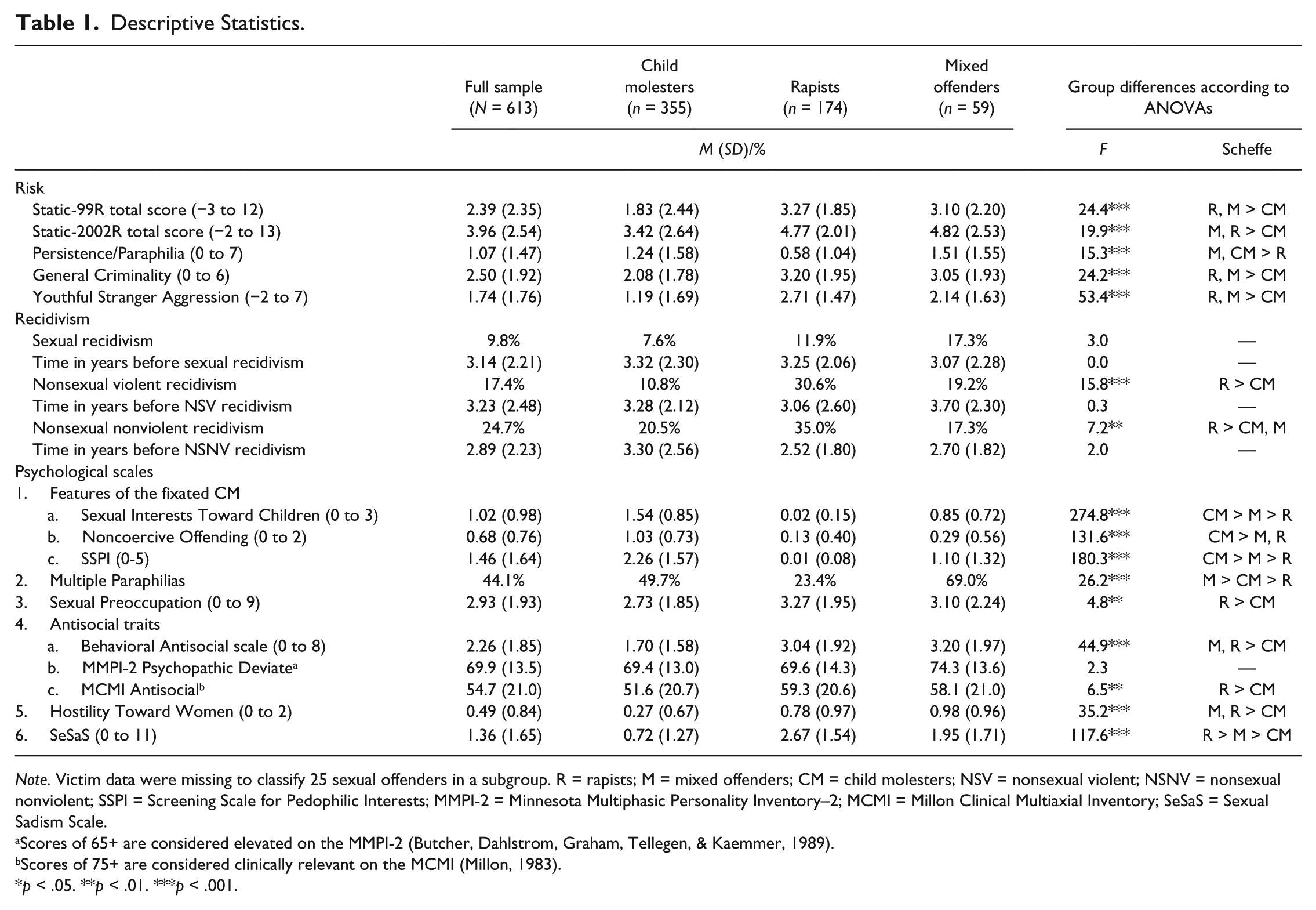
Note. Victim data were missing to classify 25 sexual offenders in a subgroup. R = rapists; M = mixed offenders; CM = child molesters; NSV = nonsexual violent; NSNV = nonsexual nonviolent; SSPI = Screening Scale for Pedophilic Interests; MMPI-2 = Minnesota Multiphasic Personality Inventory–2; MCMI = Millon Clinical Multiaxial Inventory; SeSaS = Sexual Sadism Scale.
Scores of 65+ are considered elevated on the MMPI-2 (Butcher, Dahlstrom, Graham, Tellegen, & Kaemmer, 1989).
Scores of 75+ are considered clinically relevant on the MCMI (Millon, 1983).
p < .05. **p < .01. ***p < .001.
Compared with rapists, child molesters had higher scores on Persistence/Paraphilia and psychological scales related to sexuality, except Sexual Preoccupation, which was more prevalent in rapists than child molesters. However, child molesters had lower scores on General Criminality, Youthful Stranger Aggression, and psychological scales tapping into antisociality and violence (e.g., Behavioral Antisocial scale, Hostility Toward Women, SeSaS), except for the MMPI-2 Psychopathic Deviate scale. Mixed offenders, in turn, had high scores on most static risk constructs and psychological scales. These group differences were in line with the existing literature (Olver, Wong, Nicholaichuk, & Gordon, 2007; Parent et al., 2011).
Convergent Validity Analyses
First, the potential overlap among static risk constructs was investigated. Correlations were found between Persistence/Paraphilia and General Criminality (r = .23, p < .001), and between General Criminality and Youthful Stranger Aggression (r = .27, p < .001), but effect sizes were small. There was no correlation between Persistence/Paraphilia and Youthful Stranger Aggression (r = −.05, p > .05). Overall, the overlap between static risk constructs was low enough to indicate that they were nonredundant entities.
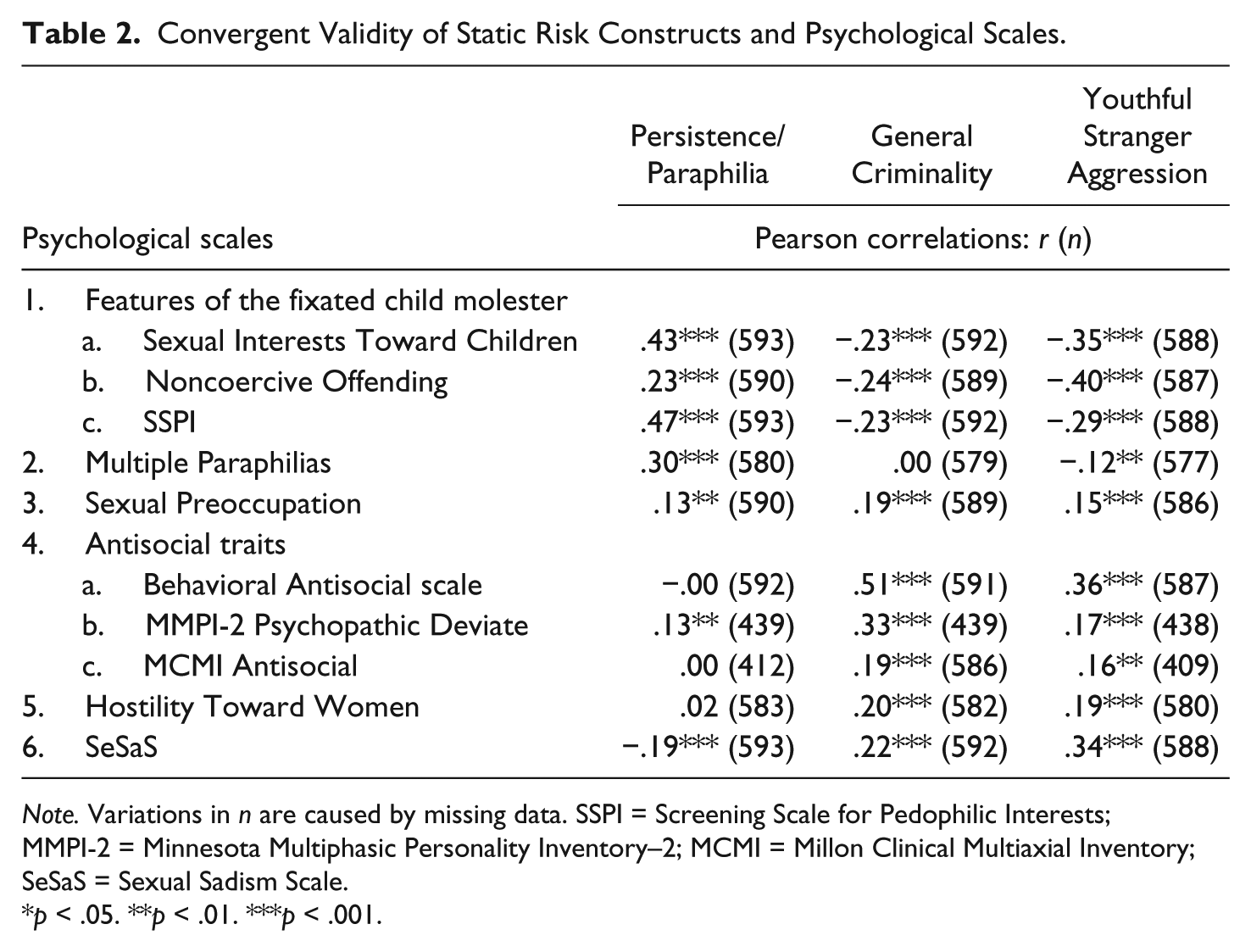
Second, correlations between static risk constructs and psychological scales were calculated, and can be found in Table 2.
Convergent Validity of Static Risk Constructs and Psychological Scales.
Note. Variations in n are caused by missing data. SSPI = Screening Scale for Pedophilic Interests; MMPI-2 = Minnesota Multiphasic Personality Inventory–2; MCMI = Millon Clinical Multiaxial Inventory; SeSaS = Sexual Sadism Scale.
p < .05. **p < .01. ***p < .001.
Persistence/Paraphilia had moderate correlations with the SSPI, Sexual Interests Toward Children, and Multiple Paraphilias. It had small correlations with Noncoercive Offending, Sexual Preoccupation, and the MMPI-2 Psychopathic Deviate scale. Consistent with its correlation with Noncoercive Offending, it had a small negative correlation with the SeSaS.
General Criminality had a strong correlation with the Behavioral Antisocial scale, and a moderate correlation with the MMPI-2 Psychopathic Deviate scale. It had small correlations with the SeSaS, Hostility Toward Women, the MCMI Antisocial scale, and Sexual Preoccupation. It had small, negative correlations with features of the fixated child molester. General Criminality’s correlation pattern was mostly opposed to that of Persistence/Paraphilia.
In contrast to the findings of Brouillette-Alarie and Hanson (2015), theoretically interesting correlations were obtained with Youthful Stranger Aggression. Specifically, it correlated moderately with the Behavioral Antisocial scale and the SeSaS. It also had small correlations with Hostility Toward Women, the MMPI-2 Psychopathic Deviate scale, the MCMI Antisocial scale, and Sexual Preoccupation. It had moderate negative correlations with Noncoercive Offending and Sexual Interests Toward Children, and small negative correlations with the SSPI and Multiple Paraphilias. Although its correlation pattern closely mirrored that of General Criminality, it was differentiated by lower links to antisociality and stronger links with indicators of violence (higher positive correlation with the SeSaS, higher negative correlation with Noncoercive Offending).
Predictive Validity Analyses
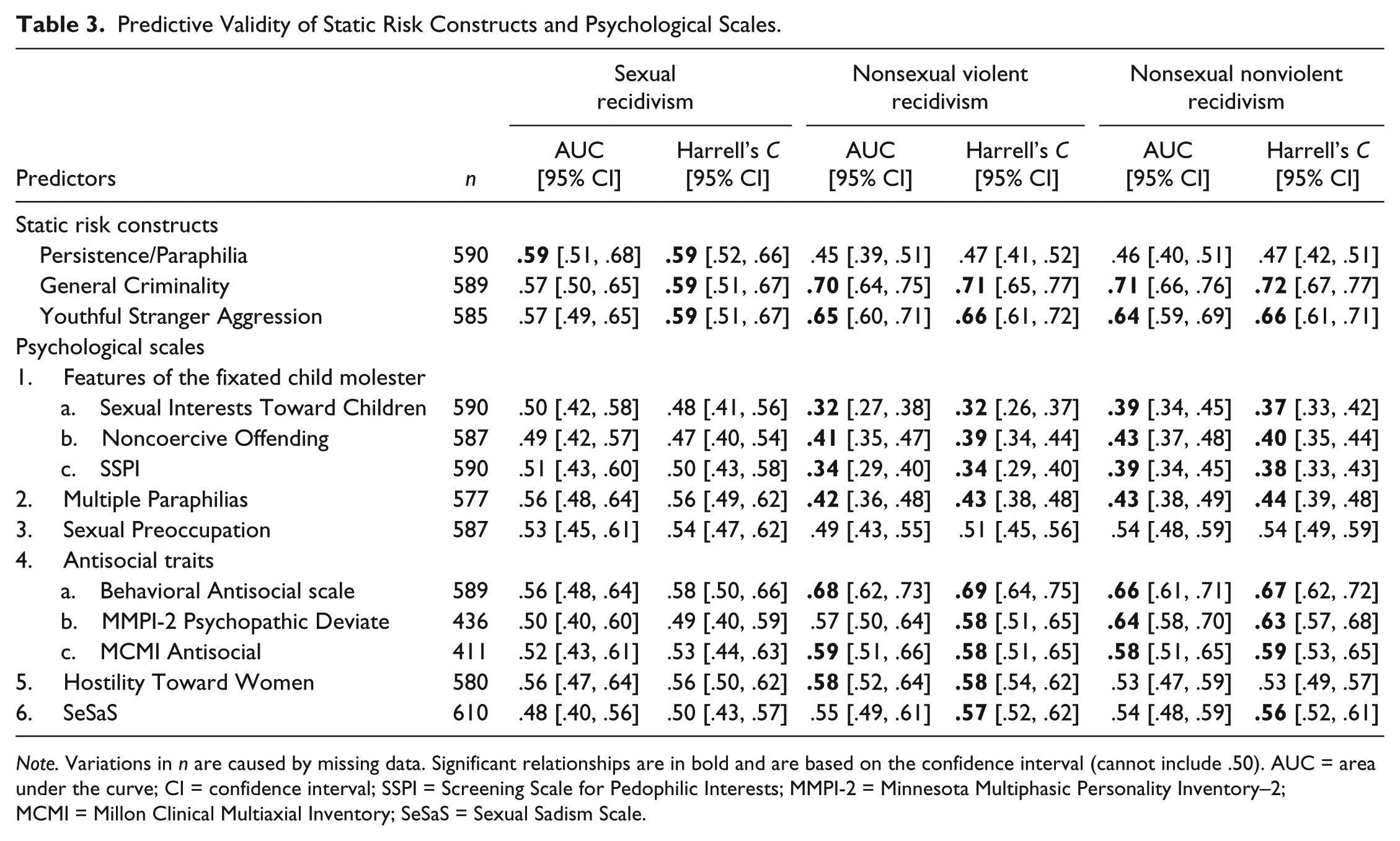
Predictive validity analyses can be found in Table 3. AUC and Harrell’s C values were very similar. However, the measure that took time into account was usually more sensitive, and resulted in better predictive accuracy. Consequently, Harrell’s Cs were given priority when discussing predictive validity results.
Predictive Validity of Static Risk Constructs and Psychological Scales.
Note. Variations in n are caused by missing data. Significant relationships are in bold and are based on the confidence interval (cannot include .50). AUC = area under the curve; CI = confidence interval; SSPI = Screening Scale for Pedophilic Interests; MMPI-2 = Minnesota Multiphasic Personality Inventory–2; MCMI = Millon Clinical Multiaxial Inventory; SeSaS = Sexual Sadism Scale.
Sexual recidivism was predicted by all three static risk constructs, with similar effect sizes. The strength of association was, however, low (Harrell’s C of .59 for each of the constructs). None of the psychological scales predicted sexual recidivism in our sample.
Nonsexual violent recidivism was predicted by General Criminality (large effect size) and Youthful Stranger Aggression (moderate effect size). As in Brouillette-Alarie et al.’s (2016) study, Persistence/Paraphilia was not related to nonsexual violent recidivism. Many of the psychological scales were associated with nonsexual violent recidivism. The Behavioral Antisocial scale had a moderate effect size, and the MMPI-2 Psychopathic Deviate and MCMI Antisocial scales had small effect sizes. Hostility Toward Women and the SeSaS were also predictive of nonsexual violent recidivism, albeit with a small effect size. Surprisingly, the negative association between sexual risk factors and nonsexual violent recidivism tended to be stronger when these factors were operationalized dynamically (Sexual Interests Toward Children, Noncoercive Offending, and Multiple Paraphilias) rather than statically (Persistence/Paraphilia). The SSPI was, however, an exception, reaching moderate predictive validity toward nonsexual violent recidivism in spite of its static nature.
Nonsexual nonviolent recidivism was mostly predicted by the same risk factors as nonsexual violent recidivism. General Criminality had a large effect size; Youthful Stranger Aggression, as well as the Behavioral Antisocial scale, had a moderate one. Psychological scales with a small effect size included the MMPI-2 Psychopathic Deviate scale, the MCMI Antisocial scale, and the SeSaS. As for nonsexual violent recidivism, high score on psychological features related to sexuality (Sexual Interests Toward Children, SSPI, Noncoercive Offending, and Multiple Paraphilias) slightly reduced the risk of nonsexual nonviolent recidivism.
Discussion
The current study explored the convergent and predictive validity of the latent constructs of Static-99R and Static-2002R sexual offender risk tools. Three risk constructs are consistently found in these scales (Brouillette-Alarie et al., 2014): one is centered on paraphilic interests and sexual criminality, one is centered on nonsexual/general criminality, and one is centered on young age and stranger sexual aggression. According to latent variable models, each of these groups of items should be markers for underlying psychological traits or mechanisms. By analyzing their construct validity, we tried to understand their psychological meaning. For Persistence/Paraphilia and General Criminality, results were very similar to those of Brouillette-Alarie and Hanson (2015). For Youthful Stranger Aggression, new correlates were found.
Linking Static Risk Constructs with Their Psychological Correlates
Persistence/Paraphilia, or the sexual criminality construct, is exclusively constituted of variables related to sexual offending, and only predicts sexual recidivism. It evaluates the quantity of sexual offenses and characteristics of victims (noncontact, male, young/unrelated). Victim items suggest that this dimension is rooted in deviant sexual interests—young and male victims refer to pedophilia, and noncontact victims refer to paraphilias like voyeurism and exhibitionism. Accordingly, we expected, and found, correlations between Persistence/Paraphilia, Sexual Interests Toward Children, and the number of sexual paraphilias.
As indicated by the positive association with Noncoercive Offending and the negative association with sexual sadism, Persistence/Paraphilia also characterized offenders without intent to harm their victims. This echoes the offending process of fixated child molesters, where grooming is usually preferred to physical coercion (Groth et al., 1982; Knight & Prentky, 1990; Proulx, Perreault, & Ouimet, 1999). This was congruent with the results of Brouillette-Alarie and Hanson (2015), where Persistence/Paraphilia had a high correlation with emotional identification with children. Although rapists could, in theory, score high on Persistence/Paraphilia because of persistence in sexual crimes alone, convergent validity analyses and descriptive statistics suggested otherwise. In sum, Persistence/Paraphilia seemed to be about dysregulation of sexuality toward atypical objects, either children or other paraphilic interests, without explicit intent to harm.
General Criminality is a construct constituted of items related to the magnitude and violence of criminal careers. It is common to both sexual and nonsexual offenders, and predicts all types of recidivism. Convergent validity analyses done in this study and the Dynamic Supervision Project sample (Brouillette-Alarie & Hanson, 2015) found that this propensity for rules violation and violence was related to features of antisociality, namely, lack of empathy, impulsivity, and irascibility (see Appendix A for constituents of the Behavioral Antisocial scale). These features are extensively studied in criminology, and are all found in commonly used scales for general offenders (e.g., LS/CMI, Psychopathy Checklist–Revised [PCL-R]; Hare, 2003). Sexual Preoccupation and Hostility Toward Women were also correlated with this construct, which echoes Malamuth’s confluence model of sexual coercion toward women (Malamuth et al., 1993; Malamuth et al., 1991). Although Sexual Preoccupation could be expected to be more prevalent in offenders with high scores on Persistence/Paraphilia or Youthful Stranger Aggression, due to the role of overwhelming pedophilic or sadistic sexual fantasies, it is not uncommon to see this variable linked to antisociality. In Malamuth’s model, sexual promiscuity originates from general delinquency, more specifically, from the importance that sex has in the identity construction of delinquent youth. This is also reflected in Hare’s (2003) PCL-R, which comprises a sexual promiscuity item.
Youthful Stranger Aggression is a construct that comprises sexual (unrelated/stranger victim, juvenile sex arrest) and nonsexual (age at release, never lived with an intimate partner for 2+ years, index nonsexual violence) items. Although it could, at first, be interpreted as a construct that is at a crossroad between sexual deviance and antisocial traits, convergent validity analyses revealed that the pull of nonsexual items was stronger than that of the sexual items. The construct was unrelated with Persistence/Paraphilia, negatively related with indicators of sexual deviance and paraphilias, and positively related with General Criminality. Furthermore, it had very similar convergent and predictive validity patterns to General Criminality. Interestingly, its relation with violence was the strongest of all the static risk constructs. We see in this construct a clear intent to harm the victim, which may align with sexual interests for the rape of adult women and/or sexual sadism. However, it could also be related to the general hostility and meanness found in angry rapists (Knight & Prentky, 1990; Proulx & Beauregard, 2014). Indeed, victim harm can be the result of both sadistic and angry motivations to rape. The SeSaS score may even be related to both, as it is heavily dependant on crime scene data. Even with these limitations, our results, nonetheless, link Youthful Stranger Aggression to a general motivation to harm the victim. Disentangling hostility from sexual sadism would require further convergent validity analyses, with variables beyond those of the dataset used in this study.
General Criminality was also related to victim harm, although less strongly than Youthful Stranger Aggression. It is likely that both constructs contribute to violence, albeit in a different way. If General Criminality is a proxy for antisocial traits, we would expect offenders with high scores on this construct to display a more controlled, instrumental level of violence in their sexual offenses (Cornell et al., 1996; Walsh, Swogger, & Kosson, 2009). That would be opposed to the expressive or ritualized violence of hostile and sadistic offenders, which we would expect to have high scores on Youthful Stranger Aggression (Knight & Prentky, 1990).
Finally, by processing the crime scene behaviors of sexual offenders in a multidimensional scaling analysis, Lehmann and his colleagues found a hostility/sexualized aggression dimension (Lehmann, Goodwill, Gallasch-Nemitz, Biedermann, & Dahle, 2013; Lehmann, Goodwill, Hanson, & Dahle, 2014, 2016). Consistent with previous research showing an association between early onset and seriousness of violent offending (Moffitt, 1993; Yessine & Bonta, 2008), this dimension was negatively correlated with age. Similarly, Kaufman et al. (1998) found that younger child molesters, due to lack of experience in sexual offending, tend to use more coercive offense strategies than older offenders. Taken together, these findings support our interpretation of Youthful Stranger Aggression as an indicator of the propensity to intentionally do harm to others—a propensity that seems to be more prevalent in younger sexual offenders.
Predictive Validity of Static Risk Constructs and Psychological Scales
Static risk constructs predicted sexual and nonsexual recidivism as anticipated. However, none of the psychological scales significantly predicted sexual recidivism. This was unexpected, given that the risk relevance of these psychological features is already established with reference to the broader literature (e.g., Hanson & Morton-Bourgon, 2004; Mann et al., 2010). This poses a challenge to our theoretical model; if static items are past manifestations of dynamic psychological features, both should predict the same outcomes with similar accuracy. However, it is not obvious that static measures were substantially better than dynamic ones in the prediction of sexual recidivism. Even though static measures reached statistical significance and dynamic measures did not, both were similarly inefficient (small effect size). For example, the Harrell’s C and confidence interval of the Behavioral Antisocial scale was only .01 behind those of General Criminality when predicting sexual recidivism.
For nonsexual violent recidivism and nonsexual nonviolent recidivism, static and dynamic measures were predictive. Large effects were found for General Criminality, and moderate effects were found for Youthful Stranger Aggression and for the Behavioral Antisocial scale. Overall, the predictive validity of the Behavioral Antisocial scale was superior to its self-report alternatives, the MMPI-2 Psychopathic Deviate and the MCMI Antisocial scales. Similarly, in Hanson and Morton-Bourgon’s (2004) meta-analysis, the MMPI Psychopathic Deviate scale failed to predict nonsexual violent recidivism. At this point, it is hardly a revelation that behavioral measures are superior to personality inventories in the prediction of criminal recidivism.
Hostility Toward Women and sexual sadism were associated with nonsexual violent recidivism. Given that these psychological scales are centered around anger and intent to harm, it is no surprise that they were predictive of violent recidivism. The effect size, however, was small compared to measures of criminal repetition (e.g., General Criminality).
Features of the fixated child molester (Sexual Interests Toward Children, Noncoercive Offending, SSPI) and Multiple Paraphilias were inversely related to nonsexual types of recidivism, with small to moderate effect sizes. This indicates a specialization effect: offenders with high scores on these scales—and, by extension, Persistence/Paraphilia (sexual criminality)—were less likely to commit nonsexual recidivism than offenders with low scores. Although specialization in sexual offending versus general offending is more often myth than reality, it is more likely observed in child molesters (e.g., pedophilic priests) than in other types of offenders (Hanson et al., 1995; D. A. Harris, Knight, Smallbone, & Dennison, 2011; Lussier, 2005; Proulx, Lussier, Ouimet, & Boutin, 2008). This is certainly consistent with the results of this study: child molesters had higher Persistence/Paraphilia and lower General Criminality scores than rapists, and were therefore at higher risk of committing exclusively sexual recidivism, maintaining their involvement in sexual criminality. In turn, mixed offenders had high scores in both types of criminality, so they could not be considered specialists.
Limitations
First, the list of psychological features used to assess the convergent validity of static risk constructs was not exhaustive. For example, we had no measures of sexual coping or implicit theories. This could have limited our ability to disentangle the psychological meaning of static risk constructs—namely, the difference between General Criminality and Youthful Stranger Aggression. Second, our convergent validity criteria were not always optimal. Most of the psychological scales were constructed a posteriori by recoding and summing variables already present in the dataset, and some were based on a scarce number of indicators. For example, Hostility Toward Women was based on two self-reported dichotomous indicators of conflicts with women. A better coverage of these psychological features could have led to different, and possibly stronger, results.
Third, because our sample exclusively comprised federally sentenced sexual offenders, it is not certain that results derived from it are generalizable to other correctional samples. That being said, the average risk of our sample was not much different from that reported by the Dynamic Supervision Project, which comprised both federal and nonfederal offenders (Hanson et al., 2012). Finally, because CSOQ data were not only collected for research purposes but also for correctional decision making, participants could have been encouraged to hide relevant information or try to fake good (Furnham, 1986) during the assessment process. Although data from official records were compared with self-reported measures to identify deceivers, such comparisons were not always possible, or exhaustive.
Conclusion
In the last 15 years, researchers have, with surprising consistency, identified static risk constructs in actuarial scales for individuals with a history of sexual crime (Brouillette-Alarie et al., 2014). Recently, efforts have been made to uncover the psychological properties of these constructs. Taken together, these studies suggest that there are three central dimensions of sexual recidivism risk, each with static and dynamic indicators. The first of these dimensions is defined by sexual interests toward atypical objects, grooming offending strategies, and past sexual criminality. The second dimension is centered on antisocial traits, as well as past criminality (of any type). The third dimension is centered on young age, predatory behavior, and intent to harm. The first dimension exclusively predicts sexual recidivism, and the other two predict all types of recidivism. A graphic summary of these dimensions can be found in Figure 1.

Model of the three central dimensions of recidivism risk in sexual offenders.
The main implication of this model for applied assessment is that actuarial scales should integrate construct scores into their understanding of the risk presented by individuals with a history of sexual crime. Total scores, although simple, limit the predictive utility of risk scales for the specific outcome for which they were developed (usually sexual recidivism). When constructs are known, it is possible to improve the prediction of other outcomes by removing constructs unrelated to each of these new outcomes (e.g., removing sexual criminality items to improve the prediction of nonsexual recidivism; Babchishin et al., 2016). Total scores may also reduce the clinical utility of actuarial scales (especially static ones), because delineating an overall level of risk is not as useful as having scores on multiple dimensions. For example, knowing that an offender scored moderately on the Static-99R is not as useful as knowing that this offender scored highly on Persistence/Paraphilia and low on General Criminality and Youthful Stranger Aggression. For this specific offender, treatment providers might de-emphasize anger management treatment programs and emphasize self-regulation of paraphilic interests.
Our results also suggest that static and dynamic risk factors should not be seen as fundamentally different entities. Static risk constructs significantly correlate with psychological characteristics that are found in dynamic risk scales. Consequently, an interesting avenue for risk tools could be to integrate both static and dynamic risk factors, and sort them by constructs. Such a scale would offer concrete, modifiable treatment targets, while using empirically proven static and dynamic risk factors. Measurement of change in the latent constructs, however, would still need to focus on changeable (i.e., dynamic) indicators.
The way forward for forensic risk assessment involves aggregating items into constructs, and then identifying empirical weights that maximize the relationship between the constructs and the outcomes of interest. This will enable clinicians to deliver more precise assessments, where the risk of sexual recidivism is differentiated from the risk of nonsexual recidivism (or any other desired outcome). Integrating dimensional scores in risk scales is, however, a long-term objective. Actuarial scales are used to make public safety decisions, and, therefore, cannot be modified without an adequate body of research. We hope that researchers will be inspired by the model and methods of the current study to invest in the research necessary to move sexual offender risk assessment forward, thereby providing evaluators with greater understanding of individuals’ risk-relevant propensities than that provided by our current checklists of discrete risk factors.
Footnotes
Appendix
Pearson Correlations Between Psychological Scales.

| 1a | 1b | 1c | 2 | 3 | 4a | 4b | 4c | 5 | 6 | |
|---|---|---|---|---|---|---|---|---|---|---|
| 1a. Sexual Interests Toward Children | — | — | — | — | — | — | — | — | — | — |
| 1b. Noncoercive Offending | .55*** (590) | — | — | — | — | — | — | — | — | — |
| 1c. SSPI | .80*** (593) | .43*** (590) | — | — | — | — | — | — | — | — |
| 2. Multiple Paraphilias | .32*** (580) | .06 (577) | .31*** (580) | — | — | — | — | — | — | — |
| 3. Sexual Preoccupation | −.03 (590) | −.10* (587) | −.07 (590) | .08 (579) | — | — | — | — | — | — |
| 4a. Behavioral Antisocial scale | −.29*** (592) | −.36*** (589) | −.26*** (592) | .03 (580) | .29*** (589) | — | — | — | — | — |
| 4b. MMPI-2 Psychopathic Deviate | .00 (439) | −.03 (437) | .01 (439) | .11* (438) | .14** (438) | .31*** (439) | — | — | — | — |
| 4c. MCMI Antisocial | −.18*** (412) | −.15** (410) | −.14** (412) | −.02 (406) | .12* (412) | .21*** (412) | −.07 (353) | — | — | — |
| 5. Hostility Toward Women | −.23*** (583) | −.25*** (581) | −.24*** (583) | .08 (574) | .15*** (582) | .44*** (583) | .18*** (435) | .08 (410) | — | — |
| 6. SeSaS | −.44*** (593) | −.60*** (590) | −.39*** (593) | .01 (580) | .12* (590) | .35*** (592) | .08 (439) | .09 (412) | .30*** (583) | — |
Note. Variations in n are caused by missing data. Sample size in parentheses. SSPI = Screening Scale for Pedophilic Interests; MMPI-2 = Minnesota Multiphasic Personality Inventory–2; MCMI = Millon Clinical Multiaxial Inventory; SeSaS = Sexual Sadism Scale.
p < .05. **p < .01. ***p < .001.
Acknowledgements
The authors would like to thank Stéphanie Langevin for proofreading the manuscript.
Authors’ Note
The views expressed are those of the authors and not necessarily those of Public Safety Canada.
Declaration of Conflicting Interests
The author(s) declared the following potential conflicts of interest with respect to the research, authorship, and/or publication of this article: R. Karl Hanson is an author of Static-99R and Static-2002R. The copyright for these tools is held by the Government of Canada.
Funding
The author(s) received no financial support for the research, authorship, and/or publication of this article.