



Abstract
Individuals incarcerated in prisons across the United Kingdom and abroad are able to volunteer for a variety of peer-support roles, which are characterized by prisoner-to-prisoner helping. Some research has found that such roles can represent turning points in the lives of those who have offended and encourage movements toward desistance. This proposed redemptive influence is argued to result from the prosocial behaviors that such roles appear to elicit in their holders. The present study aims to explore the mechanics of this claimed influence. While a limited amount of research has attempted this on a general offending population, no research has done so with a sample of sexual offenders. Given the intensive treatment programs involved in such contexts, and the requirements for sexual offenders to demonstrate reduced risk, the authors believe those serving time for sexual offenses represent an important sample on which to explore the potentially redemptive properties of peer-support roles. To this end, 13 peer supporters participated in semistructured interviews. Transcripts were analyzed using a phenomenologically oriented thematic analysis. Results suggest that sexual offenders who adopt peer-support roles are able to live up to desired selves by “doing good” in prison, “giving back,” and consequently resisting negative labels. These benefits have been theoretically linked with better reintegration outcomes for sexual offenders, who are publicly denigrated in the extreme and find it especially difficult to (re)integrate. Suggestions regarding the future utility of such schemes are offered.
Introduction
Research has consistently revealed positive effects (i.e., enhanced community cohesion, reduced feelings of isolation and loneliness, and increased perception of social and emotional support) resulting from peer-support schemes in problem communities (Bean, Shafer, & Glennon, 2013; Field & Schuldberg, 2011; Walker & Bryant, 2013). In more recent years, the presence of peer-support programs in prisons has begun to grow. This growth has emerged from research indicating that peer-support roles/important wing roles can not only help those in need of support but also provide meaning, purpose, and range of skills and attributes for the role holders (see, for example, Stevens, 2012). In general, peer-support in prison operates within a range of different structures and approaches, though all are founded upon values of mutual reciprocity, shared problem solving, and empathy (Devilly, Sorbello, Eccleston, & Ward, 2005). Researchers have argued that this kind of provision may be especially important in rehabilitative contexts, and offer somewhat of a magnified impact (Blagden & Perrin, 2016; Perrin & Blagden, 2014). Early studies find support for this claim, suggesting that upholding a meaningful role characterized by active citizenship while serving time can help offenders build on extant positive traits and also begin to demonstrate new protective states and behaviors (Devilly et al., 2005; Perrin & Blagden, 2016). Previous studies have called for investigations into peer-support roles on a sexual offender sample, given the treatment focus with such samples, and the need for such populations to demonstrate change and reduced risk (Perrin & Blagden, 2016).
While contested, research has demonstrated that sex offender treatment programs (SOTPs) can reduce the number of sex offenders who are reconvicted (Hanson et al., 2002; Lösel & Schmucker, 2005; Schmucker & Lösel, 2015). Specifically, programs that take a risk–need–responsivity approach have been found to be the most successful (Hanson, Bourgon, Helmus, & Hodgson, 2009). There is now a good understanding of the dynamic risk factors associated with sexual offense recidivism and sound evidence for correctional treatment (Mann, Hanson, & Thornton, 2010). Recently, there has been a move within the sex offender literature to not just consider the risk and criminogenic needs of the offender but also to understand the process of sex offender desistance and the need for individuals to address protective factors, for example, positive self-identity (de Vries Robbé, Mann, Maruna, & Thornton, 2015). Protective factors are social, interpersonal, and environmental factors, as well as psychological and behavioral features that are empirically linked to sexual offending (de Vries Robbé et al., 2015).
A central aspect of the desistance process is the transformation and changes in the narrative identity of crime desisters (Maruna, 2001). Most research that has considered sex offenders’ identity has either focused on the shame and stigma associated with sex offender labels and the negotiation of those labels (Blagden, Winder, & Hames, 2014; Blagden, Winder, Thorne, & Gregson, 2011) or on changes in sex offenders’ narrative identities as they negotiate their way through the criminal justice system and associated treatment programs (Hudson, 2013; Ward & Marshall, 2007). Farmer, Beech, and Ward (2011) conducted a qualitative study that compared the narratives of potentially desisting sexual offenders with those considered still potentially active in their offending. They found that desisters had a stronger sense of personal agency, stronger internal locus of control, and described treatment as a turning point. Perhaps even more significant was the finding that desisters felt a sense of belonging and a place in a social group/network, whereas the active offenders described themselves as socially alienated or isolated. Harris (2014) in her study found that sexual offender desisters had gone through a “cognitive transformation,” that is, a process of identity transformation, largely as a consequence of treatment.
The concept of narrative identity is important for sex offender rehabilitation and crime desistance as those lacking a coherent narrative identity are often thought more likely to continue to offend (Ward & Marshall, 2007). In the desistance literature, identity change/transformation has been linked to “redemptive” episodes, whereby the negative past self is reconstrued as positive because it has led to the transformation of that person; the past self is construed as qualitatively different from the changed self (McAdams, 2006). Consequently, shifts in personal identity have been argued as important for sex offender desistance (Göbbels, Ward, & Willis, 2012). Such redemptive narratives can restore moral agency, in turn empowering the narrators to imagine and pursue generative futures. They allow for “real selves” to be emphasized and for negative past incidents to be reconstrued as life experiences that made them stronger, wiser, better prepared for the future, and want to give something back (Stone, 2016). Stone (2016) argues for the importance of identity-repairing narratives in the desistance process and how the internalization of oppressive master narratives may restrict opportunities for desistance. Thus, allowing offenders to enact/portray “good selves” can lead to “living” those roles as people tend to act in line with the stories they present about themselves (Blagden et al., 2014; Friestad, 2012; McAdams, 2013).
However, as desistance is about discovering agency, interventions need to encourage and respect self-determination; this means working with offenders, “not on them” (McCulloch, 2005). The importance of prisoners “owning” their own rehabilitation, being invested in it, or having a stake in it should not be underestimated. This has led some to argue that there is a need for offenders to do desistance and not just talk desistance (Blagden & Perrin, 2016). Peer-support roles have been found to assist with desistance-based narratives and contribute to self-determination and “active citizenship” (Perrin & Blagden, 2014). Indeed, “purposeful activity” in prisons can enable offenders to make positive contributions toward their own rehabilitation (Blagden, Perrin, Smith, Gleeson, & Gillies, 2017). Enacting peer-support roles can increase the supporters’ insight into their own lives and even empower them to change their offending behavior and lifestyles (Maruna, 2001; Parkin & McKeganey, 2000; Sirdifield, 2006; Snow, 2002). Some research has also suggested that prisoners are able to earn trust and find meaning, purpose, and constructive inputs in their lives via peer-support work (Perrin & Blagden, 2014). Indeed, feeling trusted, personal development, and having meaning and purpose are key indicators for measuring a prisoner’s quality of life (Liebling, 2004; Ross, Diamond, Liebling, & Saylor, 2008).
As well as presenting peer-support roles as a source of constructive inputs for incarcerated people, some research has alluded to ways in which peer support can enable offenders to move toward desistance (Blagden & Perrin, 2016). Göbbels et al. (2012) have emphasized the importance of positive practical identities in the desistance process and the importance of “turning points” or constructive outlets that provide the opportunities for the momentum of change in which the self is construed in a positive light. It may be that peer-support roles could provide such possibilities and have the potential to assist with positive identity change within prison. LeBel, Burnett, Maruna, and Bushway (2008) found that self-identification and positive self-image were significant predictors of postprison outcomes. In contrast, feelings of stigmatization predicted recidivism.
This research, in part, aims to answer the call by de Vries Robbé et al. (2015), who emphasized the urgent need for research to study aspects of sex offender desistance. Indeed, although some research on peer support and desistance has been carried out, none of it has focused on a sample of sexual offenders. Early research highlighting the protective factors associated with peer-support roles supports the application of peer-support roles especially in the context of sexual offending. Such offenders are the most highly stigmatized and the role of constructing adaptive narrative identities has been emphasized in sex offender desistance and rehabilitation (Göbbels et al., 2012; Ward & Marshall, 2007).
There is no attempt in this study to link peer-support involvement directly with reduced offending. Rather, the aim of this article is to explore the experience of peer-support role holders who are sexual offenders and understand the impact these roles have of their prison life and ultimately on their sense of self and personal identity. As “human beings derive a sense of self not only from the reflected appraisals of others, but also from the consequences and products of behavior that are attributed to the self as an agent in the environment” (Gecas & Schwalbe, 1983, p. 79), peer-support roles offer an insight into prisoners potentially “doing” desistance-based activity. The ultimate aim of this article, therefore, is to introduce peer support into the field of sexual offending research and to explore the role it can play in sexual offender rehabilitation.
Method
Participants
This research project was approved by the governor at the research site (a U.K. sex offender treatment prison). Data collection was facilitated by the safer custody department, which overlooks all of the peer-support schemes within the prison. To try and minimize selection bias, the researchers actively recruited a mix of offenders and attempted to reach as many prisoners within the prison as possible. Participants (n = 13) were security cleared via resettlement staff and letters outlining the research were dispatched. All participants were required to have relatively substantial experience of their peer-support role (6 months or more) and be active volunteers. They also needed to have served a total of 2 years in prison. These conditions were set so that quality explorations of the effects of upholding a peer-support role in prison could be generated. Participants were offered no benefits in exchange for their involvement and participation was purely voluntary. All participants were convicted sex offenders and their time spent in prison ranged from 2 years and 6 months to more than 27 years. Further demographic information is presented in Table 1.
Participant Information.
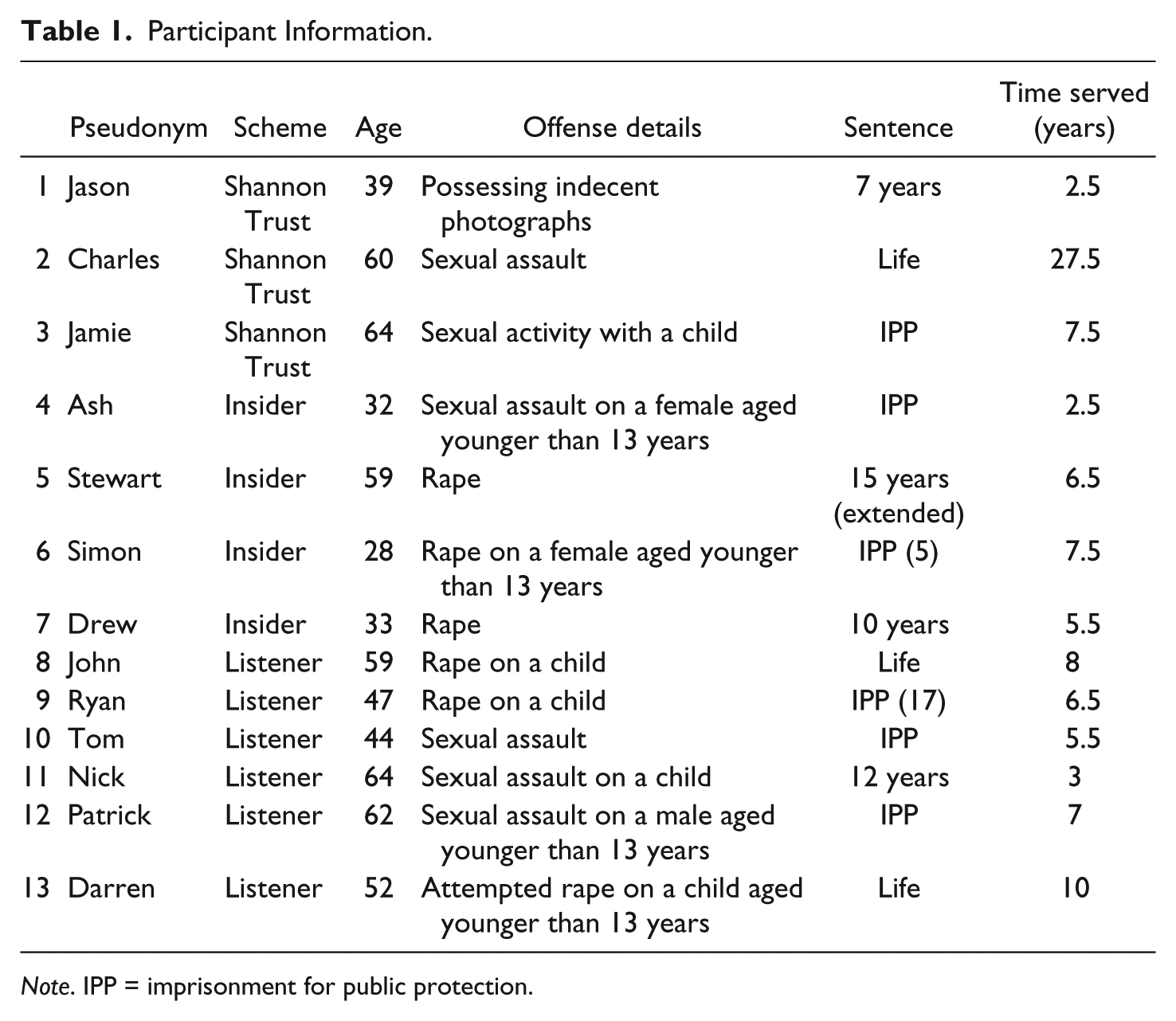
Note. IPP = imprisonment for public protection.
The Peer-Support Roles
This project explored three of the most widespread peer-support schemes in operation across the United Kingdom: The Samaritans’ prison “Listener” scheme (Foster & Magee, 2011), the “Insiders” scheme (Boothby, 2011), and the “Shannon Trust Mentoring” scheme (Shannon Trust, 2005). As such, all participants were either “Listeners,” “Insiders,” or “Shannon Trust Mentors.” Listeners, trained by the external charity Samaritans, provide face-to-face emotional support to prisoners who request help (see Samaritans, 2012, for further information). Insiders provide support mainly to those entering prison for the first time and those who feel they are being bullied or victimized in any way (see Boothby, 2011, for further information). Finally, the Shannon Trust is a U.K. charity that regulates a scheme whereby fluent readers are paired with those less able. Through this setup, Shannon Trust mentors help students through a reading program often over a period of several months (see Shannon Trust, 2005, for further information).
Data Collection
Following ethical clearance, one-to-one semistructured interviews were conducted in a purpose-built interview room at the prison. Interviews were recorded on a passcode-encrypted Dictaphone and lasted an hour on average. The interview schedule was divided into four sections that included a range of introductory questions, questions relating to why participants’ wanted to become peer supporters, what the impact of upholding such roles was, and participants’ perceptions of their futures.
As this research used in-depth interviews, steps were taken to minimize researcher bias. First, questions were open-ended and designed to be nondirective, allowing participants to describe their experiences in their own words without the views of the researcher being imposed on them. In addition, participants’ own words are used to describe the phenomena of this investigation (Phillips & Lindsay, 2011). Once the data were fully transcribed, the lead researcher held a feedback session with all participants at the prison, during which the researchers’ interpretations were discussed and a group analysis of the themes identified within the data conducted. All participants agreed with the themes identified and offered further insight into some of the interpretations made.
Analytic Technique
This study adopted a phenomenologically oriented strand of thematic analysis, as described by Braun and Clarke (2006). Phenomenological analysis is concerned with the meanings that particular experiences, events, and states hold for participants (Smith & Eatough, 2007). To generate a phenomenological understanding of a concept, therefore, researchers must be able to glean insights from the subject expert and seek to illuminate the insider perspective (Larkin, Watts, & Clifton, 2006). Eatough and Smith (2006) argue that to this end, the researcher should immerse himself or herself in the text and begin to capture emerging themes that should be noted down in the right-hand margin of the transcript. It is at this point, through dialectic between the data and theoretical constructs that interpretation of the participants’ phenomenologies begins to occur. Once themes are identified, the researcher begins the process of linking together various subordinate themes into superordinate themes (Smith, 1996, 2004).
This objective is why such analyses require such devoted attention to the data. It is also why phenomenological researchers must maintain awareness of the distinctions between the participant’s account and the researcher’s interpretation (Smith, 2011). To ensure interpretations in this study held validity, the data were subjected to a form of interrater reliability, which involved the analysis being “audited” by the coauthor and an independent researcher (see Armstrong, Gosling, Weinman, & Marteau, 1997).
Analysis and Discussion
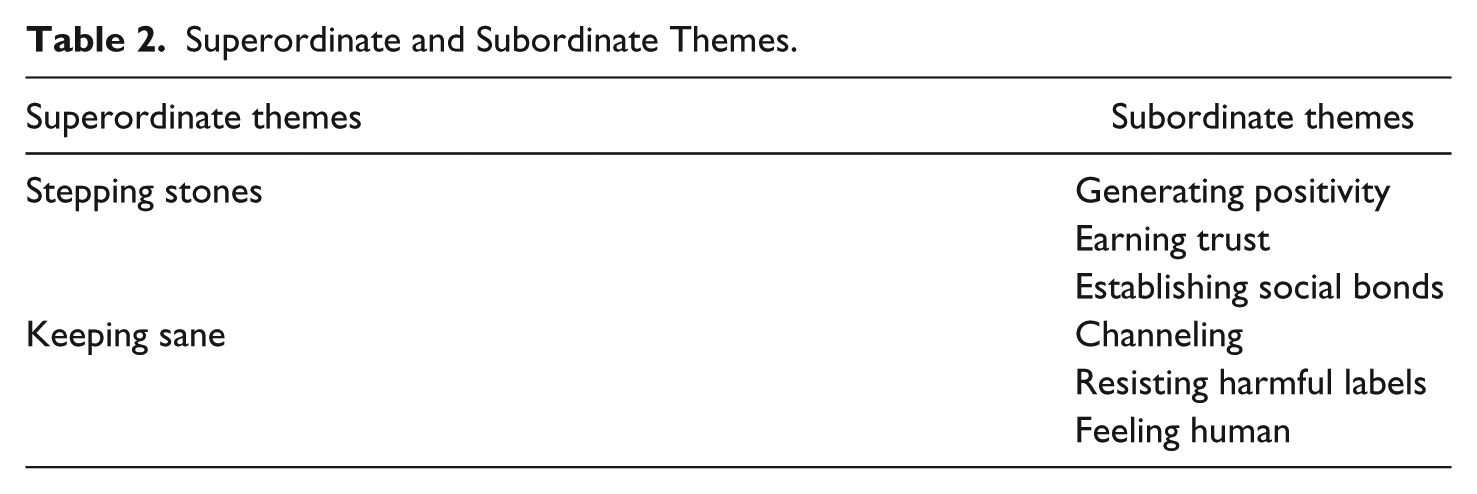
When performing phenomenological analysis, the task is to identify the underlying principles that organize the thinking of the participants, and thus, the structures that influence perceptions, feelings, and behavior (Skrapec, 2001). The principles and structures relating to how participants viewed their peer-support roles in this study are represented in the two superordinate themes and inclusive subordinate themes presented in Table 2.
Superordinate and Subordinate Themes.
Stepping Stones
This theme was characterized by participants feeling that via their peer-support roles, they were moving forward. This forward momentum was important for all participants, and provided hope and positivity for the future. Almost all participants offered metaphors to describe how their roles were helping them to move forward. Such metaphors were typified by the idea that participants were on a journey of self-discovery. Participants made sense of this journey as taking steps, with each step representing another episode of rediscovery. As such, this entire theme really captured the subjective, “insider perspectives” of participants, who were describing very mindful and deeply self-reflective processes resulting from their roles.
Generating positivity
A significant step for participants was to begin generating positivity. This subtheme was characterized by participants allowing themselves to live in the moment, and reflect upon their self in transition. Blagden et al. (2014) have tagged this type of mindfulness “headspace,” and have suggested that it is crucial in enabling offenders to self-evaluate and discover that change is possible and desirable (Blagden et al., 2014). For all participants in this study, peer-support roles appeared to be reducing anxiety and helping volunteers to carve out some headspace.
I see this as, you know, a stepping stone in my life, of . . . how I’ve been in my past, how I am now, and how I want to be in the future . . . and I’m making the right choices now to make that first stepping stone even easier . . . that’s the key thing . . . taking each day as it comes and being able to support people and get support. It’s helped with that stepping stone . . . and given me more positivity in life, more hope . . . and more realistic goals to reach, you know, and making that difference inside here, and making a difference when I get outside, it’s gonna be a big thing. And that’s thanks to the support and the mentoring scheme that we have here. (Simon, Insider)
Simon describes how he views his role as a stepping stone; one that is allowing himself to reflect upon who he used to be, who he is now, and who he wants to be in the future. Simon’s Insider role appears to be prompting self-reflection, and his consideration over his transitioning self is well illuminated in his extract. “Taking each day as it comes” epitomizes what Simon’s role seems to be offering him—a chance to live in the moment, not become so consumed with what is uncontrollable, and instead focus on generating positivity where possible and keep stepping forward. Ultimately, Simon’s extract portrays hope; his role is enabling him to keep “on track.” Hope is heavily discussed in the desistance literature, and is conceptualized as one of many tools that offenders use to adjust to imprisonment, serve sentences constructively, and work on “going straight” (Dhami, Ayton, & Loewenstein, 2007). Being a peer-support mentor also seemed to be facilitating Simon’s construction of a “possible self.” A possible self is a future-orientated construct formulated by an individual in relation to hopes, fears, and aspirations for the future. Possible selves draw on versions of the self in the past and those desired in the future (Markus & Nurius, 1986; Meek, 2007). Here, Simon is articulating how the role is enabling him to think positively about the future, which is making a difference in how he views himself. All participants involved in all schemes described the benefits of their roles in very similar ways.
I can liken it to . . . ascending, erm, a cliff edge . . . scrambling up a side of a mountain. When I go hill walking I struggle with heights, but I like hill walking, so there’s a problem there. So what I used to have to do was rest at the point before the next scramble up so . . . and as long as I sit and I look at it . . . it takes me time to settle and to understand what’s going to have to happen next. So I’m not gonna go back down, I am going to ascend, that’s gonna happen. But you just get to that point there, and I suppose that’s what the Listeners did . . . that purpose in the sense, to rest me in that place. (Tom, Listener)
Tom describes how his role enables him to reach metaphorical safety holds, from which he can gather power and begin to negotiate the next move upward. For Tom, being a peer-support mentor seems to contribute to self-reflection and momentums of change. Göbbels et al. (2012) have argued that increasing an offender’s desire to change can contribute to “decisive momentum”—the openness to take advantage of opportunities to change. This has been described as the first phase of desistance from sexual offending (Göbbels et al., 2012). What is evident here is that Tom appears to be bringing his situation under his control, and making sense of it on his own terms. Low locus of control, described as an inability to effectively manage challenges, internal and external stressors, and deprivation, has been considered a risk factor for sexual offending behavior especially. Indeed, it has been argued that ineffective coping strategies can detrimentally affect levels of awareness and impulse control, which can bring about fear, frustration, anger, and antisocial behavior (Samuelson, Carmody, Kabat-Zinn, & Bratt, 2007). Conversely, individuals who are able to control lifestyle impulsiveness (characterized by low self-control, generalized instability, lack of meaningful daily routines, irresponsible decisions, and limited or unrealistic long-term goals) are more likely to go on to desist from offending (Gottfredson & Hirschi, 1990). The protective factors juxtaposed to high impulsivity include the ability to be able to self-reflect, demonstrate impulse control, and problem solve effectively (Hanson & Morton-Bourgon, 2004). Simon and Tom describe in their extracts how their roles appear to enable them to bring challenges and potential stressors under their control. This is perhaps due to the engrained focus on self-reflection and emotional awareness in Listener and Insider training modules and in the roles themselves (Boothby, 2011; Jaffe, 2011). The processes being described in this theme were typified by participants taking control of the present moment, allowing themselves to think and feel, and consequently experiencing a sense of mastery over their own “journeys” or transformational experiences.
I’ve grown up a lot. I could be quite immature before, I mean I’m thirty-eight and sometimes I’d act like fourteen still . . . Erm but with the responsibilities of . . . sort of having to be . . . not strict but being in a sort of authoritative figure when you’re helping people to read . . . we work to their scale we don’t push them, you have to have certain boundaries, professional boundaries erm with a reader . . . so for me I think it’s made me definitely grow up . . . mainly erm and I look at life differently. In the short time that I’ve been doing it I’ve discovered a lot about myself. I’d say I’m on a journey with it, definitely on a journey. (Jamie, Shannon Trust)
Jamie’s extract exemplifies how peer-support roles can promote self-reflection for volunteers. Jamie is able to verbalize specifically how he thinks he has changed as a product of his role. He talks about growing up and becoming more mature and more responsible. He goes on to say that he now looks at life differently and that he is “on a journey with it.” Jamie’s extract once again illustrates how peer-support roles appear to project participants into a cyclical state of self-revision; peer-support roles appeared to help participants establish a stronger sense of control over the self.
Earning trust
Earning trust in a prison context is important for prisoners and can prompt positive change in offenders and feed into their narratives of desistance (Blagden et al., 2014; Vaughan, 2007). The extracts within this theme display how important it was for participants to build trust and in doing so nourish their transitioning selves.
You kind of get a bit of rapport with the staff . . . because when the staff see that you can do a job and you can do a job well . . . you then, kinda get a bit of trust with them—they trust you to deal with things . . . so the way some wings work . . . you’re not allowed to go to other landings and stuff like that . . ./. . . so if you’ve got a rapport with them and you’re doing your job correctly and efficiently . . . they’ll allow you to go onto the other wings or to the other landings, and talk to people who’ve come on if they’ve got any issues and help . . . so it’s about kind of building up that trust with them so they can see you can do a job, you’re not messing them around and not swapping things or dealing stuff or whatever . . . it’s about taking it seriously. (Stewart, Insider)
Stewart discusses how his role as an Insider has enabled him to build rapport with staff members in the prison and gain trust and freedom. What is being described here is a cycle of positive behavior, reinforcement, and continued positive behavior. It is in Stewart’s best interests to behave well within his role and to follow the prison rules, as he is rewarded for doing so by earning trust and being allowed some freedom. As such, peer-support roles in this context appears to create an environment whereby prisoners can actually “do” trust (not just feel trusted) and enact “good” and “moral” selves. Presser and Kurth (2009) have argued that the presentation of moral and trusted selves allows one to live up to such selves; it also enables a narrative that distances oneself from a past offending identity. In Stewart’s narrative, the trust and the appraisals he receives from others appear to contribute to his self-change process. Receiving trust and appraisals from others in a prison context is considered very important in terms of galvanizing desistance and positive change (Perrin & Blagden, 2014). This was important for all participants in this study.
You get a bit more trust. And I think that trust level that shows that you are improving yourself. Erm and certain things can especially in prison you always get threatened by the staff “if you don’t something wrong you get this, you get that” and it puts the fear into you and you, but when you’re a mentor or you do anything where you’re giving back you would hope that your efforts are looked into and they might balance it up . . . you get that slight better respect and you get that much better rapport with the officers and the staff . . . it makes you feel a bit like a human still. Again it’s all about that rehabilitation, I am a strong believer in that if you’re treated poorly by officers or staff then you can’t really be rehabilitated. (Jamie, Shannon Trust)
Jamie’s extract suggests that earning trust and some recognition for “doing good” equates to a form of validation that he is “improving himself.” Jamie inadvertently describes a process of self-assurance, via which he does good things, earns trust and recognition, and consequently lives up to his objective to change. All of this makes Jamie feel more human and, while he is not looking to log favors, this process of doing good and receiving appraisals appears to be giving him hope that he is changing for the better. The enhanced expectation and trust in Jamie appear akin to the Pygmalion effect (high expectation high outcome) described by Maruna, LeBel, Naples, and Mitchell (2009). Peer supporters seem to become recognized as good people, and this seems to have a self-fulfilling effect. Previous research in this area has also highlighted these types of processes. Stevens (2012), for example, researched “rep jobs” (where offenders primarily residing in therapeutic community prisons are given some responsibility for policies or procedures within the prison) and found that the expectation placed upon participating prisoners often resulted in a range of previously nonexistent prosocial behaviors. Moreover, recent research has demonstrated how important it is for offenders to be given the opportunities to generate positive self-images that sit in contrast to what they might have regarded their “offending self” (Perrin & Blagden, 2014). Internal narratives that desisting offenders build can be positively influenced by the knowledge that “old self” is qualitatively different to “new self” (Vaughan, 2007). For Jamie, his “new self” does good things and is trusted. He internalizes this as “improving,” and this appears to be keeping him moving forward.
Establishing social bonds
In this theme, participants appeared to perceive their peer-support roles as valuable, and as “something to lose.” This notion suggested that prisoners were investing in legitimate and normative behaviors via their roles and indirectly making sure they did not “slip up.” In associating with fellow peer supporters, securing positive relationships with prison staff, and enjoying helping others, participants appeared to be establishing legitimate social bonds.
I wouldn’t have met the people I have . . . so the other Insiders, I wouldn’t have known them like I do . . . the safer custody department . . . I wouldn’t have known them . . . erm . . . as well as kind of higher ranking, if you like, governors and that, when I go to the meetings . . . I know all the governors and they kind of know me and, whenever I see them in the corridor they’ll ask me how I am . . . so to have that kind of rapport in the place is in some ways beneficial . . . erm, not something to be abused . . . but to kind of be proud that I’m, in that kind of position. (Stewart, Insider)
Stewart discusses how his role has enabled him to forge positive relationships with staff. He talks with pride about the fact he knows everyone, and they know him, even the higher ranking staff (governors). Stewart enjoys his status as an Insider, which appears to give him a feeling of being valued and appreciated. He enjoys his role so much that he would never do anything to compromise his position, one which he respects is “not to be abused.” Stewart’s narrative, which sees him describing how he has something good to potentially lose, perfectly exemplifies this theme. Laub and Sampson (2001) have neatly tagged these processes as striving to “acquire a stake in conformity”—a legitimate social bond via which individuals can satisfy basic human needs. Many participants viewed their roles in the same way—They respected their privileged position as peer-support role holders and this was keeping them in line and on track.
Just that being part of something is really important . . . and I suppose erm you don’t realize sometimes, I suppose like if you’re in a football team or something although you might never kick the ball in the game, you’re still part of the team and being on the field maybe is still enough to do the victory erm rather than being totally involved and trying to do too much . . . so you’ve got the different, two different ends of that scale if you want so yeah . . . It’s most probably true like if you’ve got the goal keeper who might never touch the ball but the team’s won hasn’t it? (Drew, Insider)
Drew’s extract highlights the importance of the team element of the Insiders scheme. His football analogy emphasizes how important it is for him to feel a part of something, and again, the narrative here strikes as being about belonging and about appreciating a privileged position. These notions are reminiscent of a broad theoretical body of research surrounding basic human needs, and thus social and emotional well-being. Ullrich and Coid (2011), for example, carried out a study on released offenders and reported that “belonging to a group, club, or organisation,” “closeness to others,” “relationship building,” and “being in work, training, or education” should be considered “protective factors.” It can be argued from the extracts presented here that participants are benefiting from belonging to a group, crafting positive relationships, and consequently procuring something to have pride in, something to lose—a “stake in conformity.”
Keeping Sane
Channeling
This theme related to the notion that peer-support roles were keeping prisoners occupied and focused on something constructive and legitimate. Most participants described how the nature of imprisonment (characterized by loss of liberty, deprivation, and a range of antagonistic conditions; Dye, 2010) can not only cause despair but can also result in destructive behaviors. Indeed, a vast body of research cites the volatility of the prison environment and the heightened presence of social issues such as gang violence, drug use, violent and sexual abuse, bullying, and discrimination (Carpentier, Royuela, Noor, & Hedrich, 2012; Fleisher & Decker, 2001). Prisons overwhelmed by such conditions have been found to increase reoffending (Cullen, Jonson, & Nagin, 2011). In the present theme, participants spoke of a protective element associated with their peer-support roles; their work prevented them from succumbing to the destructive magnetism of imprisonment.
I suppose there’s the possibility that I would’ve been in a lot of trouble . . . because the Shannon Trust has given me the opportunity to seize the amount of patience I have . . . and for me to recognize that that actually affects everything I do . . . without that . . . I’d be an impatience bugger . . . you know . . . if I asked a member of staff for something and I didn’t get it straight away then I would tend to lose my rag . . . you know. (Charles, Shannon Trust)
Charles recognizes in his extract that he may well have found himself getting “into a lot of trouble” had he not been able to seize positive traits via his mentoring role. He goes on to identify that it is his natural impatience that would have led him astray, and that his Shannon Trust role occupies the space in which his destructive traits might have prevailed. Through this role, Charles is actively addressing a behavior that he has recognized as harmful. Through this channeling, Charles is able to let trivial annoyances pass by and avoid getting into trouble. For many participants, this type of investment in peer-support roles kept them focused and enabled them cultivate positive and desired traits. As well as maintaining mental well-being via channeling, some participants alluded to redirecting illegitimate skills and transforming them into socially acceptable ones.
Before, I was an absolute pest, you know my life was all about drugs . . . about the street life. About me and my boys . . . fast life . . . fast money, that was me, for a long long time . . . so, I went from one extreme to the other. But I found that from that life before . . . from the destructive lifestyle that I used to lead . . . into this positive academic driven sort of life . . . I found skills from all that craziness that I brought into . . . like a new sense of maturity I guess . . . But I’d say that . . . I actually got those skills from the darker time of my life really . . . but . . . use them in a positive way. (Ash, Insider)
Here, Ash contrasts his past and present selves. He describes how his old self was characterized by “street life”—obtaining money via illegitimate means and having little interest in anything typically socially acceptable. Ash concedes that this was a destructive and “darker” world. However, he has been able to reevaluate this old world through his role as an Insider, and even reroute some of the skills he developed during “all that craziness” to a more positive direction.
Resisting harmful labels
Many of the themes identified in this study naturally overlap. This theme enveloped repetitive excerpts that highlighted the participants’ desire to remove stigma, and to disassociate themselves with labels such as “prisoner,” “criminal,” and the most-feared—“sex offender.” This theme should be viewed as one of the outcomes participants would experience from upholding a positive role, doing good, and “being” peer-support volunteers.
I know I keep repeating this but it has made me feel better about myself. I know it’s sort of reaffirmed to me that I’m not a monster, I’m not a terrible person. I do have anxieties as I said to you about, about the media and about you know, how people might react to me erm, I try and counter that by saying to myself but the people that matter to you the most are the ones that are still there for you, they’re the ones that are there for you, they’ve supported you, they’ve given you the time. They’ve also said to you, effectively what you’re saying . . . that its great you’re doing this listening role, doesn’t that make you feel better about yourself? (Nick, Listener)
Nick’s extract demonstrates the impact of the labels he had received and how they greatly disturbed his sense of self and brought about despair and hopelessness. Before becoming a Listener, this negativity and isolation locked Nick into a state of hopelessness, which caused anxiety. The extract also points to how, via peer support, Nick was beginning to erode the effects of such labels. Indeed, widespread research has highlighted how sex offenders are publicly denigrated in the extreme and consequently find it more difficult than other types of offenders to reintegrate (Braden et al., 2012; Levenson & Cotter, 2005). Research has also found that public shaming and the subsequent social isolation experienced by sex offenders constitute risk factors in terms of further offending, and this has prompted the emergence of various reintegration initiatives (Braden et al., 2012; Levenson, Brannon, Fortney, & Baker, 2007). Labeling is not only an issue affecting reintegration but also prison life. Schwaebe’s (2005) research highlights how sexual offenders constitute a highly stigmatized and vulnerable group in prison and, as a consequence, need to employ strategies to develop viable identities. Schwaebe tags this dynamic as “learning to pass” (as a nonsexual offender) and describes how doing so is important even in exclusively sex offending populations. While the participants in this study did not express needing to pass as nonsex offenders, they articulated a desire simply to pass as humans.
You do feel more human and I think you know the trouble is, in an establishment like this, in a sex offender prison (let’s not beat about the bush), it’s just, it’s constantly in the media, and we just feel like animals. You know you do feel, I mean it’s bad enough being in prison but . . . forgive me for saying this but you may well have battered some poor old lady around the head and seriously injured her if not killed her to take a few pounds, but that’s a better crime . . . than a sexual offense . . . so you know you do feel like the lowest of the low so to come and just have a normal conversation with the officers, you know . . . it does help. (Nick, Listener)
Nick describes just how damaging the sex offender label is to his identity, so much so that murdering an old lady would have been a “better crime.” This is a common finding across the sex offending research. Research from Blagden et al. (2011) exploring denial, in which a participant discusses how it would have been better if he’d have murdered his victim, emphasizes how crucial it is for such offenders to attain identities that exist outside of the “sex offender” label. The participants in this study were cultivating such identities through practicing “good selves” and seeing them systematically reaffirmed.
Feeling human
The concept of feeling human in this data set was very much connected with the experience of self-esteem being boosted. “Feeling human” appeared to result from participants receiving appraisals from others, developing a sense of achievement, and consequently enhancing their self-esteem. A key factor in feeling human was “doing good.” In demonstrating positive behaviors and helping others, participants appeared able to enact good selves and feel more human, less “prisoner.”
It just brings it back to normality that . . . you’re not a prisoner in a sense, although you are a prisoner . . . to be able to have that trust, it’s something that can only be earned . . . you don’t just get it . . . but it kinda just makes you feel, “OK, I’m not as much of a prisoner,” in a sense . . . and it just it brings you back to the normality of what it’s like outside. (Stewart, Insider)
Here, Stewart neatly describes the interplay between earning trust, using the resources available to him via his Insider role, and in turn feeling human. It is important to Stewart, as it was for all participants, to move away from the isolative label of “prisoner.” Indeed, the experience of stigma, stereotyping, and restriction of personal freedoms is well represented in the literature on imprisonment (see, for example, Dirkzwager & Kruttschnitt, 2012; Gross, 2008). There is also a body of research that reports on problematic relationships between prisoners and staff. Such relationships have often been typified as conflictual, unconstructive, and defined by power imbalances (Hemmens & Marquart, 2000; Morris, Carriaga, Diamond, Piquero, & Piquero, 2012). Such experiences can result in prisoners feeling unhuman, and can bring about what has been termed the “golem effect,” via which low expectation in individuals produces low outcomes (Maruna et al., 2009). However, for the peer-support role holders in his study, prisoners seemed to be able to avoid these types of dynamics and move into a much more constructive environment. Participants attributed this to their ability to “do good,” earn trust with prison officers, and gradually return to a state of “normality.”
It’s quite an honor in a sense . . . it’s nice. Erm, I’ve been here nearly 4.5 years now so, I’m not one of the longest here but I’m kinda getting toward that . . . and I know a lot of the staff, and a lot of the staff know me . . . and I get on with most of them, so to be part of the Insiders scheme, especially being a coordinator, means that I can go round and see the other Insiders . . . it’s kind of a nice feeling. (Stewart, Insider)
A broad body of literature highlights the importance of prisoners being able to distance themselves from simply being a prisoner, as it enables them to build hope and strengthens their ability to change (Maruna et al., 2009; Perrin & Blagden, 2014; Vaughan, 2007). Within this process, “doing good” was fundamental for all participants. There are treatment implications here. More and more research emphasizes the importance of prisoners, especially those who have sexually offended, doing change and actually demonstrating the prosocial behaviors they learn about within treatment programs (Fox, 2016; Langton & Worling, 2015). Upholding a peer-support role represents an opportunity for offenders to show desistance. For example, changes in callousness, a risk factor that has been repeatedly associated with sexual offending, might be monitored through someone’s involvement in a voluntary peer-support role. Callousness is characterized by a lack of concern for others, selfishness, and poor empathy (Mann et al., 2010). The participants in this study were repeatedly demonstrating behaviors opposing callousness and were receiving great satisfaction from doing so.
Most importantly it’s making me feel better about myself, making me know that I am a good person deep down even though I’ve made mistakes. Erm . . . that I still have a life, I can still make choices, whereas if you’re not doing something you . . . your choices dictate you all the time where as if you go that extra mile and do that something independent form the prison regime and it’s for the good you still get that, you’ve still got part of your independence there . . . I do that for Shannon Trust, you do work out how you’re gonna approach every single reader at every single lesson and so you are making decisions which normally are took off you . . . so for me I think that I benefit mostly from that, that I still feel that I’m still human being. It’s one of those sort of positions where you take away your prison number. (Jamie, Shannon Trust)
All prisoner participants spoke of experiencing negative labels prior to becoming peer-support volunteers and how this changed as a product of their roles. Jamie’s extract illuminates how he has been able to maintain an identity as a human being, and how can still “have a life,” “make choices,” and be autonomous. Self-determination theory (Ryan & Deci, 2000) argues that humans intrinsically set out to achieve autonomy, connectedness, and mastery and are designed to have an impact on the environment around them, rather than simply exist within it. These basic needs are to be fulfilled for psychological well-being, and all of the participants in this study appeared to be satisfied in this regard.
Summary and Implications
This research set out with the aim of generating a phenomenological understanding of how prison peer-support volunteers feel about their roles. Refreshingly, participants from three differing peer-support schemes described their experiences in very positive terms, and appeared to be having innermost realizations via their work. As well as cultivating constructive relationships with prison staff and other prisoners, enjoying personal growth from “doing good,” honing positive skills, and keeping busy, participants were also able to have a more positive experience of prison because of their roles. This experience was a product of meaning making, positivity gathering, and the avoidance of harmful labels and destructive stigma. All of these benefits appeared to protect participants against the negativity associated with imprisonment, and enable them to serve their sentences constructively. As such, this study reiterates research findings that suggest the implications of peer support in prisons go beyond basic peer to peer helping (see, for example, Boothby, 2011; Davies, 1994; Perrin & Blagden, 2014).
Ultimately, participants were able to carve out meaningful and purposeful roles for themselves, via which they could feel autonomous, independent, and more human. They were also demonstrating prosocial behaviors within their roles, many of which have been associated with addressing risk and developing protective factors. This was an important finding in this study, and has some implications in terms of sexual offender treatment. Of the “psychologically meaningful” risk and protective factors discussed by Mann et al. (2010, pp. 199-203), poor problem solving, resistance to rules and supervision, grievance/hostile thinking, dysfunctional coping, low self-esteem, and loneliness were identified as empirically supported risk factors, especially for sexual offenders. In addition, there have been calls to provide opportunities for such offenders to “do desistance” (Thornton, 2013) and demonstrate effective risk management methods (Davey, Day, & Balfour, 2015; Olver & Wong, 2013). The peer-support volunteers within this sample appeared to be addressing risk through the enactment of prosocial selves characterized by better coping, effective emotional regulation, empathy, mutual helping, and active citizenship. On these grounds, future research might explore the clinical utility of peer-support roles in the context of sexual offender treatment.
A further implication relates to the gate initiatives and the potential impact peer-support involvement might have on released ex-prisoners. Many participants in this study spoke enthusiastically about wishing to remain involved in volunteer work upon release, and wanting to continue to “make a difference.” Participants wanted the prosocial and positive self-identities they had cultivated within their roles to survive on the outside. These narratives were encouraging and represent an opportunity for reintegration professionals to help such ex-prisoners galvanize their desistance journeys. In exploring the notion of the “professional ex-” or “wounded healer,” LeBel, Richie, and Maruna (2015, p. 109) discuss how ex-offenders commonly express a desire to utilize their experiences of criminality, imprisonment, and desistance to help others. The authors draw on the assertion from Brown (1991) that a desisting ex-offender may “adopt a legitimate career premised upon an identity that embraces one’s deviant history” (p. 220). Maruna (2001) argues that this phenomenon can energize desistance narratives, given that they often involve a reshaping of delinquent histories into a source of wisdom that can be utilized through “wounded healer” (involving using personal experience of trauma to help others) type roles. As LeBel et al. (2015) conclude, helping others appears to have adaptive consequences for prisoners and ex-prisoners, and on these grounds, an argument can be made for increasing opportunities for reintegrating ex-offenders to engage in roles characterized by reciprocal helping. Policies relating to the limitations placed on those holding criminal records could be modified accordingly.
While there are possible selection bias and generalizability issues here, with motivated and able individuals perhaps being more likely to be employed as wounded healers, the utility of peer-support or wounded healer roles warrants further investigation. As it stands presently though, this research furthers existing understandings of how change can occur through peer-support schemes. Such schemes appear undoubtedly to have a positive impact in terms of sexual offenders’ views of themselves, their experiences of prison, and their projections of life beyond prison. While this study does not claim that peer-support roles might reduce reoffending, it is argued that such roles can encourage movements toward desistance by enabling sexual offenders to develop better images of themselves, obtain basic human needs, and to not become “institutionalized” or consumed by harmful labels. Although there remains a gap in knowledge regarding the relationship between positive roles in prison and reoffending, this study represents a stepping stone toward a greater understanding of peer support in prison.
Footnotes
Declaration of Conflicting Interests
The author(s) declared no potential conflicts of interest with respect to the research, authorship, and/or publication of this article.
Funding
The author(s) received no financial support for the research, authorship, and/or publication of this article.