



Abstract
The objective of this study was to develop a questionnaire to assess the online sexual solicitation and interactions of minors with adults in order to document the extent of this problem. The questionnaire was constructed in four phases: (a) a review of the previous literature; (b) interviews with convicted online child-sex offenders; (c) a review of the questionnaire items by experts; and (d) a pilot study of the questionnaire administered to adolescents. The validation sample consisted of 2,731 minors (12-15 years old, 50.6% girls). Exploratory factor analysis revealed a two-factor structure. The first factor, called “sexual solicitation,” included items referring to sexual requests from an adult to a minor. The second factor, termed “sexualized interactions,” included items indicating an adult groomed a minor with the purpose of committing a sexual offense. Of participants, 12.6% reported sexual solicitations, and 7.9% reported sexualized interactions. These findings open possible directions for research on the characteristics and consequences of online sexual solicitation and abusive interactions.
The study of the sexual solicitation and the processes of sexual abuse of minors by adults through information and communication technology (ICT) has increased in recent decades (Kloess, Beech, & Harkins, 2014; Whittle, Hamilton-Giachritsis, Beech, & Collings, 2013; Wolak, Finkelhor, Mitchell, & Ybarra, 2010). Sexual solicitation of a minor is defined as “online requests to engage in sexual activities or sexual talk or give personal sexual information that were unwanted or, whether wanted or not, were made by an adult” (Mitchell, Finkelhor, & Wolak, 2007b, p. 532). In addition to studying solicitations in which a child receives a sexual request from an adult, it is important to examine interactions in which the adult sexually abuses the minor. Contact between adults and minors can progress from sexual requests to overt interactions (e.g., sex through a webcam) to offline encounters (e.g., met offline to have sexual contact; Wachs, Wolf, & Pan, 2012; Whittle et al., 2013; Wolak et al., 2010). Both sexual solicitation and interactions could be part of the process of online grooming. Online child grooming is the process by which an adult, through ICTs, gains access to and the confidence of a child to create and/or maintain some sort of sexual interaction with the minor, either online, offline, or both (Kloess et al., 2014; Smith, Thompson, & Davidson, 2014; Webster et al., 2012). Grooming can last from minutes to months, depending on the dynamic relationships between the offender’s goals and the minor’s reactions or needs (Webster et al., 2012). This study is aimed at measuring both the sexual solicitations and the sexual interactions in which minors become sexually groomed and exploited by adults.
The medium of the Internet can facilitate the perpetration of sexual abuse. Factors such as perceived online anonymity, online disinhibition effects, anywhere-anytime availability, and easy access to children create favorable conditions for abuse (Cooper, Putnam, Planchon, & Boies, 1999; Smith, 2012; Suler, 2004). Adolescence is an especially critical developmental period for most online risk behaviors and problems, including use of the Internet to meet strangers (Gámez-Guadix, Borrajo, & Almendros, 2016), who could be adults seeking sexual interactions with minors (Schulz, Bergen, Schuhmann, Hoyer, & Santtila, 2016). The differences in power and experiences between adults and minors could make minors especially vulnerable (Wolak et al., 2010). Emotional self-regulation among minors is not still developed enough to decide about sexual relationships with adults (McRae et al., 2012). Younger adolescents often have less experience with intimate relationships and less ability to negotiate effectively with partners about sexual activity than do adults (Wolak et al., 2010). Moreover, early sexual relationships (i.e., before age 16 years) with an older partner have been consistently related to many risks such as unprotected sex, coerced sexual relations, and having a teenage birth (Manlove, Terry, Humen, & Ikramullah, 2006). Certain risk factors in adolescents have been found to increase the likelihood of online sexual solicitation and interactions, such as being female, being older, being homosexual, sexting (i.e., sending sexual content over the Internet), using chatrooms, talking with strangers online, and including unknown people on one’s buddy list (e.g., Mitchell, Finkelhor, & Wolak, 2007a; Mitchell et al., 2007b; Mitchell, Wolak, & Finkelhor, 2008; Wolak et al., 2010).
Studies in this area are scarce, but the past-year prevalence of sexual solicitations is estimated to be 5% to 15% among adolescents aged 10 to 17 years in the United States and Europe (see Bergen et al., 2014). Jones, Mitchell, and Finkelhor (2012) found that 9% of youth aged between 10 and 17 years reported some type of unwanted sexual solicitation during the past year. Moreover, estimated arrests for technology-facilitated sex crimes against minors with identified victims increased substantially, from 998 arrests in 2000, to 1,493 in 2006, and to 3,007 arrests in 2009 (including both online predators and family and acquaintance offenders; Wolak, Finkelhor, & Mitchell, 2012).
In addition, findings suggest that there is substantial overlap between offline and online sexual offending. A meta-analysis found that approximately half of the online offenders (including adults that used the Internet for sexual solicitation of minors and child pornography offenders) admitted to an offline sexual offense (Seto, Hanson, & Babchishin, 2011). Babchishin, Hanson, and Hermann (2011), however, found in a meta-analytic review that online sexual offenders of minors were more likely to be Caucasian men, younger and more educated than offline sexual offenders. More recently, Babchishin, Hanson, and VanZuylen (2015) have found, in additional meta-analysis, that online child pornography offenders showed more psychological barriers to sexual offending and less antisocial indicators than offline sex offenders against children and mixed offenders. In addition, differences have been found between online offenders who were arrested for contacting actual children and offenders who contacted undercover investigators. The aggressors who contacted undercover investigators were somewhat older, with higher socioeconomic levels, lower unemployment rates, fewer previous arrests (both for sexual and non-sexual offenses), and less history of violence or deviant sexual behavior (Wolak et al., 2010). In short, although considerable progress has been made in the study of online child sexual offenses from the perspective of the offender, information from the potential victims is scarcer, especially when it involves sexual interactions in addition to sexual solicitation.
Typology and Context of Sexual Solicitation and Interactions
Several studies may explain why some minors report sexual chat or sending images with adults, but no physical contact. For example, Briggs, Simon, and Simonsen (2011) examined men convicted of Internet sex offenses, and found two different subgroups of sex offenders: contact-driven and fantasy-driven. Contact-driven offenders were interested in perpetrating offline abuse, in the form of sexual encounters, while those who were fantasy-driven were interested in maintaining abusive relationships via the Internet through exchanging photos, using webcams, or cybersex. DeHart et al. (2017), analyzing the content of chats of offenders with undercover officers, found a comparable typology with four subtypes. First, cybersex-only offenders are comparable to the fantasy-driven group, with a high exposure of themselves online and frequent exchanges of sexual material with the minor. Cybersex-only offenders spend considerable time chatting with their victims (often for months). Second, cybersex-schedulers also showed behaviors of online sexual interactions, but they were more oriented to organizing sexual encounters. Third, schedulers rarely exposed themselves online and did not invest too much time in the chats (i.e., only about a week before meeting); they were more interested in topics such as the previous sexual experiences of the victim and, later, in organizing a meeting. Finally, buyers usually focused on scheduling, as well as in some negotiation terms (e.g., sex acts and cost).
There are a wide range of behaviors that appear frequently in grooming and sexual solicitation (e.g., Black, Wollis, Woodworth, & Hancock, 2015). These behaviors include specific requests by the offenders for pictures or for sexual images (e.g., via webcam), or offenders asking minors to do something sexual online (Quayle & Newman, 2016); questions to minors about their previous sexual experiences (Van Gijn-Grosvenor & Lamb, 2016); the exhibitionism, both through the webcam and by sending sexually explicit photos of the adult to the minor (Quayle & Newman, 2016); and, finally, behaviors aimed at offline exploitation, such as organizing meetings offline with the minor, some of them within short periods of time (e.g., Van Gijn-Grosvenor & Lamb, 2016; Winters, Kaylor, & Jeglic, 2017).
The Present Study
Despite the importance of this issue, there is no validated questionnaire with appropriate psychometric properties to assess online sexual solicitation and interactions by adults, which significantly limits the study and understanding of this phenomenon. To date, studies have included only a few questions in more general victimization surveys (e.g., Mitchell et al., 2007b; Schulz et al., 2016), and psychometric properties have not been reported. Although these studies have provided valuable information on the prevalence and correlations of online sexual solicitation and interactions, it is necessary to conceptually clarify sexual solicitation and interactions with adults and the processes and outcomes related to this problem. Validated instruments are needed to analyze the relationship with associated variables such as risk and protection factors, the negative consequences of sexual solicitation by adults, and the effects of prevention programs implemented with minors.
The first objective of this study, therefore, was to develop a comprehensive measure of online sexual solicitation and interactions perpetrated by adults with minors. To accomplish this aim, we reviewed the literature on online grooming and sexual solicitation, conducted qualitative interviews with sexual offenders, obtained content analysis by experts, and ran a pilot study with adolescents. The second objective was to analyze the psychometric properties of the questionnaire for assessing sexual solicitation and interactions, including testing the factorial validity, concurrent validity, and reliability with a sample of minors. Regarding concurrent validity, we expected that being female, being older, a nonheterosexual orientation, participation in sexting, use of chatrooms, use of the Internet to meet new people, and inclusion of unknown people in one’s buddy list would be related to a higher probability of sexual solicitation and interactions with adults. The final objective was to describe the prevalence and characteristics of adults’ sexual solicitation and interactions with adolescents.
Method
Participants
The study sample consisted of 2,731 adolescents between 12 and 15 years old (female: 50.6%; male: 48.3%; not reported: 1.1%) with an average age of 14.02 years (SD = 1.08). Eleven schools of the Community of Madrid were randomly selected, including seven public schools and four private schools. The parents of most of the adolescents were married or living together (68.9%), while 11.5% were separated, 6.6% were divorced, 1.4% were single parents, and 1.5% were widowed.
Measures
Questionnaire for Online Sexual Solicitation and Interactions With Adults (QOSSIA)
In this 10-item questionnaire, adolescents were asked to indicate how often they experienced a particular sexual solicitation or interaction with someone 18 years old or older during the past year, using a 4-point Likert scale: 0 (never), 1 (once or twice), 2 (3-5 times), and 3 (6 or more times). We asked about the past year to evict recall biased due to longer periods and because the past year has been used as a time frame in previous surveys (e.g., Youth Internet Safety Survey; Jones et al., 2012), which favors comparisons with previous results. If participants answered they had experienced sexual solicitations more than once or twice, they were asked to indicate with how many adults it had happened, using the following response alternatives: 1 person, 2-3 persons, 4-5 persons, and 5 or more persons. Finally, participants were asked the adults’ ages and sexes, and if they had previously known the adults offline.
The questionnaire was developed in four phases: (a) review of the previous literature; (b) interviews with convicted online child-sex offenders; (c) review of the items by experts; and (d) a pilot study of the questionnaire with adolescents. First, an exhaustive review of the scientific literature was conducted to identify the behaviors of adults’ online solicitations and interactions with minors. Based on this review, we drew a preliminary list of open questions to explore in greater depth with convicted sex offenders.
Next, we searched for adults convicted of online sexual harassment of minors in several regions of central Spain. We contacted 11 prisons and three Social Integration Centers (CIS). CIS house offenders in an advanced process of reintegration and provide probation or alternative measures such as community service. Two of the prisons were for women, nine prisons were for men, and the three CIS housed both men and women. No woman was imprisoned for this type of crime, and nine men convicted of such crimes were identified.
After obtaining permission from penal institutions, we sought the consent of the sexual offenders and ensured them of the confidentiality of the information collected. All nine men gave informed consent to participate in the study. We carried out nine in-depth interviews about the types and context of the offenders’ online sexual solicitation and interactions with minors. The interviews allowed us to obtain further information on the types of abuse and circumstances in which online sexual abuse occurred. For example, we found that in three of the nine cases, the adult previously knew the child offline but carried out the abusive behaviors online. Therefore, we included a section in the questionnaire to determine whether the minor first knew the adult online or offline.
Within the qualitative approach, the information used here is part of a broader qualitative study on the offenders’ perceptions and justifications of the grooming process (De Santisteban & Gámez-Guadix, 2017), in which we used Grounded Theory (Glaser & Strauss, 1967). Grounded Theory was chosen for its development as a simultaneous process of collection, coding, and analysis until saturation of data. We identified different emergent categories, the relationships between them, and content units within each. For the present study, we used only the specific elements of the categories concerning adults’ sexual solicitations, sexual interactions, or attempts thereof with minors.
From the literature review and qualitative analysis of the interviews, we developed a set of 10 items to evaluate online solicitation and abusive interactions by adults. We asked five academics and researchers of online aggression and sexual abuse to review the items (apart from the study authors). These experts reviewed this initial version, assessed the adequacy of each item, and made suggestions for improving the item content and formulation.
Finally, we performed a pilot study of the questionnaire in school classrooms with four groups of 10 to 15 minors between 13 and 15 years old. After they completed the questionnaire, we discussed with them any issues related to the item content, difficulty of understanding, and appropriateness of the language used. This step served to improve additional aspects of the formulation and wording of the items. The full questionnaire is included in the appendix.
Sexting
We used three items from the Sexting Questionnaire (Gámez-Guadix, Almendros, Borrajo, & Calvete, 2015) to measure the frequency with which adolescents sent sexual content online. To differentiate sexting behaviors from sending photos and information following abuse (e.g., after receiving threats), participants were asked how many times they had voluntarily (i.e., because they wanted to) (a) sent written information or text messages with sexual content about themselves; (b) sent pictures with sexual content (e.g., nudity) of themselves; or (c) sent images (e.g., via webcam) or videos with sexual content of themselves. The response scale was 0 = never, 1 = 1-3 times, 2 = 4-10 times, and 3 = more than 10 times. This scale was shown to have adequate construct validity and reliability among Spanish adolescents (Gámez-Guadix, De Santisteban, & Resett, 2017). Internal consistency (Cronbach’s α) in this sample was .69.
Sociodemographic questionnaire and Internet use
We included questions about participants’ age, gender, sexual orientation, and Internet use. We asked how often during the past 12 months adolescents had chatted online, including video chats (e.g., Chatroulette), and whether they had used the Internet to meet new people. The response scale ranged from 0 (never) to 4 (several times a day). We also asked whether there were strangers in the social network they used most often; this item had a dichotomous response format (yes/no).
Procedure
The Autonomous University of Madrid Ethics Committee reviewed and approved the study. Participants’ responses were kept anonymous to promote honesty, and participation was voluntary. Twenty adolescents refused to complete the questionnaire (participation rate = 99.3%). Parents were notified and given the option of not allowing their child to participate in the study, and 75 parents (2.7%) declined. The adolescents completed the questionnaire in their classrooms with a study assistant present. Participants were encouraged to ask questions if they had trouble responding to any of the items. The questionnaire required approximately 30 to 40 min to complete. After completing the questionnaire, participants were given a sheet informing them of related resources in the community and the researchers’ email contacts.
Data Analysis
Construct validity
To analyze the internal structure of the questionnaire, exploratory factor analysis (Principal Axis Extraction) with oblique rotation (Direct Oblimin) was conducted on the 10 items. Given the ordinal nature of our data, we calculated factor analyses using the polichoric correlation matrix (instead of Pearson correlation). Polychoric correlation matrix offers a more accurate reproduction of the original measurement model (Holgado-Tello, Chacón-Moscoso, Barbero-García, & Vila-Abad, 2010). To compute polychoric correlations, the program POLIMAT-C was used (Lorenzo-Seva & Ferrando, 2015). Once polychoric matrix was obtained, it was used as input for the factor analysis in the SPSS program. For factor analyses, .40 was established as the minimum saturation for an item to be considered part of a factor (Stevens, 2002; see also Field, 2009). Parallel analysis and the Velicer’s minimum average partial (MAP) were used to decide the number of factors to retain (O’Connor, 2000). We used the program Factor to compute parallel analysis and MAP (Lorenzo-Seva & Ferrando, 2006).
Finally, several goodness of fit indices were computed to further assess the appropriateness of the model. Goodness of fit was assessed by the nonnormed fit index (NNFI), the comparative fit index (CFI), the root mean square error of approximation (RMSEA), and the standardized root mean square residual (SRMR). NNFI and CFI values exceeding 0.95, RMSEA values less than 0.06, and SRMR values less than 0.08 indicate adequate fit (Hu & Bentler, 1999). The number of participants with missing values on individual items was small (n = 28, 1.02%), and listwise deletion was used to deal with missing values (Allison, 2001).
Concurrent validity
The analysis of the relationship of the QOSSIA with additional variables contributed evidence of the instrument’s concurrent validity. We analyzed the relationship of sexual solicitations and interactions to minor’s sex and age, sexual orientation, participation in sexting, use of chatrooms, use of the Internet to meet new people, and inclusion of unknown people on the minor’s buddy list. For the correlation with age (i.e., a continuous variable) we used Spearman’s correlation. Because the remaining variables are either dichotomous or ordinal, and some of them have a low base rate (e.g., sexting), polychoric correlation coefficients are recommended (e.g., Babchishin & Helmus, 2016).
Results
Descriptive Characteristics
The social networks most commonly used by teenagers were Instagram (64.4%), YouTube (63.5%), WhatsApp (32.3%), Snapchat (17.9%), Twitter (12.6%), and Facebook (10.2%). Regarding sexting, 8.1% of adolescents had sent written information or text messages with sexual content about themselves; 5.8% had sent pictures with sexual content (e.g., nudity) of themselves; and 1.7% had sent images (e.g., via webcam) or videos with sexual content of themselves during the past 12 months. The overall prevalence of sexting was 11.6%. Almost one quarter of adolescents (24.3%) had chatted online, including video chats (e.g., Chatroulette), 48.8% had used the Internet to meet new people, and 23.4% had included strangers in the social network they used most often.
Factorial Validity
Kaiser’s measure of sampling adequacy was .66. Bartlett’s test of sphericity, χ²(45) = 27,977, p < .001, indicated that correlations between items were sufficiently large for factor analyses (Field, 2009). Information provided by Parallel Analysis and MAP suggested that the scale had a two-factor structure. Both factors together explained 75.96% of the variance.
Table 1 shows the factor loadings after rotation. Content analysis of the items that presented factor loadings on the first factor revealed that these items referred to sexual requests of an adolescent by an adult, which positioned the adolescent as a receptor of the adult behaviors (e.g., “An adult has asked to me online to have cybersex, e.g., via a webcam”). This factor was named sexual solicitation. All items had factor loadings greater than .70, and this factor explained 60.86% of the variance. The second factor included items related to intimate or sexual interactions between the adult and the minor (e.g., “We have met offline to have sexual contact;” “I talked about sexual things with an adult through the Internet”), so this factor was called sexualized interactions. All items showed factor loadings greater than .56, and this factor explained 15.10% of the variance. The correlation between sexual solicitation and sexualized interactions was .45 (p < .001). The internal consistencies were α = .87 and .69 for the sexual solicitation subscale and the sexualized interaction subscale, respectively.
Factorial Solution for the Questionnaire for Online Sexual Solicitation and Interactions With Adults (QOSSIA).
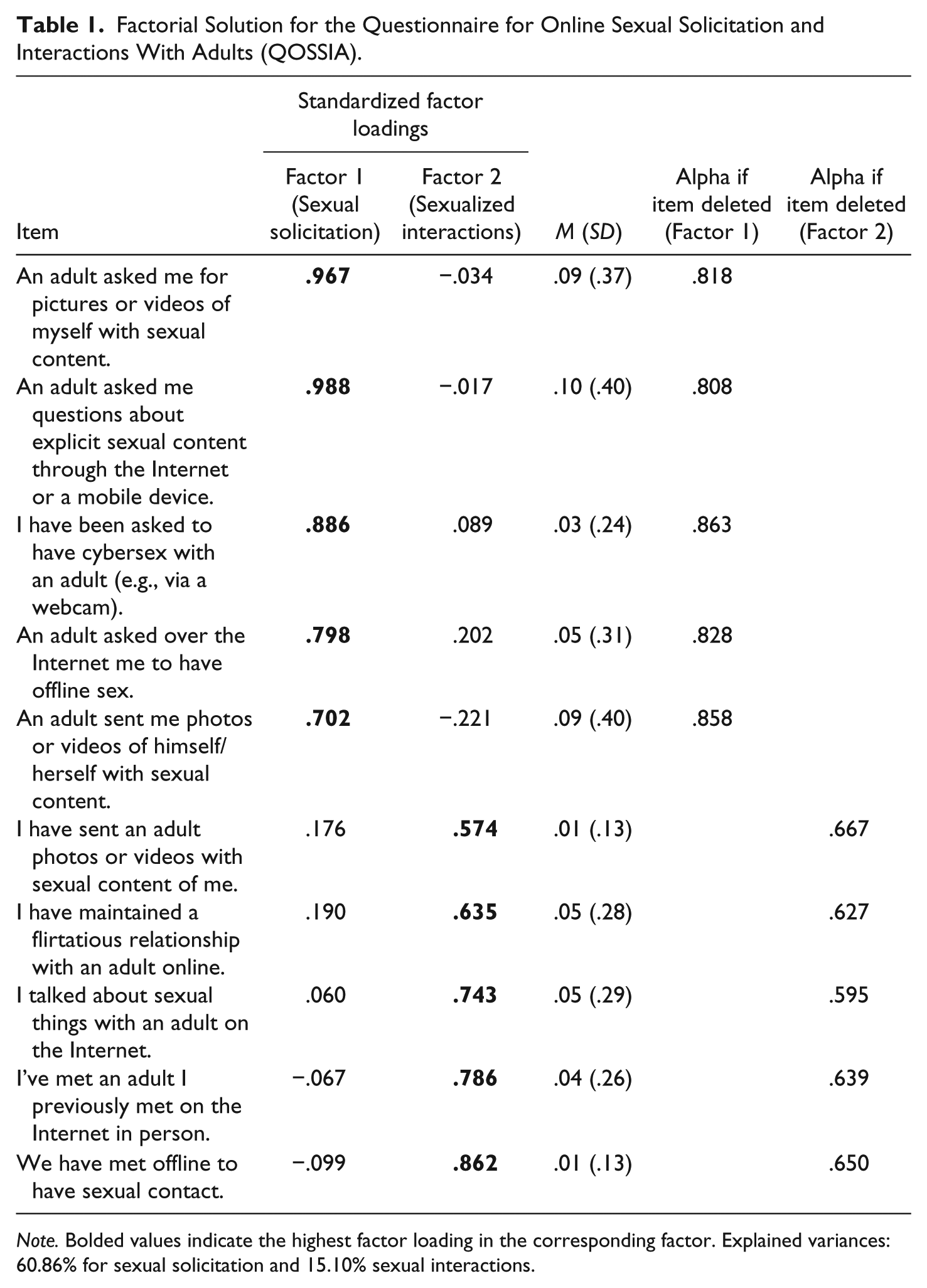
Note. Bolded values indicate the highest factor loading in the corresponding factor. Explained variances: 60.86% for sexual solicitation and 15.10% sexual interactions.
The fit indexes for the two-factor model were satisfactory: NNFI = .98, CFI = .99, RMSEA = .015 (90% confidence interval [CI]: .007, .022), and SRMR = .056. Alpha if item is deleted is presented in the last column of Table 1. As shown, none of the values was higher than the alpha for the whole scale.
Concurrent Validity
The results of concurrent validity of the instrument are presented in Table 2. Cohen (1992) suggested that correlations of .10, .30, and .50 are considered small, medium, and large, respectively. As shown, most of the relationships were significant and in the expected direction, with medium- to large-sized effects, supporting the concurrent validity of the questionnaire. Correlations for sexual solicitation ranged from .29 (using chatrooms) to .52 (for sexual orientation and sexting) (all, p < .001). Significant correlations for sexualized interactions ranged from .20 (with minor’s age) to .46 (for sexual orientation) (both, p < .001). The mean correlation of sexual solicitation and sexualized interactions with criteria variables were .34 and .31, respectively. Being female, reporting being homosexual or bisexual, participating in sexting, using chatrooms, using the Internet to meet strangers, and having strangers on one’s buddy list were significantly associated with both higher sexual solicitation and interactions.
Correlations Between Sexual Solicitation and Interactions and Concurrent Variables.

Note. Spearman’s correlation was used for age and polychoric correlation for the rest of the variables. Sex: 0 = males, 1= females; age: 12-15 years old; sexual orientation: 0 = heterosexual, 1 = non-heterosexual; sexting: from 0 (never) to 3 (more than 10 times); using chatrooms and using the Internet to meet strangers: from 0 (never) to 4 (several times a day); having strangers on one’s buddy list: 0 = no, 1 = yes.
p < .001.
Prevalence of Sexual Solicitation and Sexualized Interactions
Of the participants, 12.6% (n = 345) and 7.9% (n = 215) reported any type of sexual solicitation and sexualized interactions with adults during the past 12 months, respectively. Regarding the characteristics of the adults involved, 56.9% (n = 449) were 18 to 20 years old, 27.9% (n = 220) were 21 to 30 years old, 9% (n = 71) were 31 to 40 years old, and 6.2% (n = 49) were more than 40 years old. Approximately two out of three adults (62.4%, n = 492) first met online, and one out of three (37.6%, n = 297) had met offline before online interactions. Most were male (73.7%, n = 588), while 26.3% (n = 201) were female.
Discussion
The main purpose of this study was to develop and validate a comprehensive instrument to measure the online sexual solicitation and interactions of minors with adults. The results provided empirical support for a solution composed of two factors called “sexual solicitation” and “sexualized interactions.” The alpha coefficients of both factors showed adequate internal consistency. This study highlights the considerable magnitude of these forms of child sexual abuse (e.g., 7.9% of sexualized interactions during the past year).
The component of sexual solicitation referred to deliberate actions by an adult who aimed to obtain sexual information or material (e.g., photos, videos) from youth via electronic media. The component of sexualized interactions referred to sexual interactions between an adult and minor through ICT (e.g., cybersex, meeting in person for sexual contacts). While sexual solicitation did not necessarily mean that the minor agreed to the adult’s desires, sexualized interactions suggested a process of grooming that resulted in the manipulation of the minor. Therefore, it seemed extremely important to differentiate requests by adults from acts in which adults groomed a minor. Although the correlation between these two factors was high (.45), they represented clearly different dimensions. These two dimensions might vary along a continuum of severity, from requests to sexual interactions, and require different intervention strategies. In addition, the consequences of these types and the characteristics of the adolescents involved in each type might vary considerably.
The relationships between sexual solicitation and interactions and additional criteria variables provided data on the concurrent validity of the scale. Aligning with previous studies (e.g., Mitchell et al., 2007a), we found that sexual solicitation and sexualized interactions were related to being female and older, a nonheterosexual orientation, higher participation in sexting, use of chatrooms, inclusion of strangers on one’s list of friends, and meeting new people over the Internet.
In addition, this questionnaire determined that 12.6% of adolescents had experienced some type of sexual solicitation and 7.9% reported sexualized interactions with an adult in the past year. These findings add to the varied data on the sexual solicitations and interactions of minors with adults (see, for example, Whittle et al., 2013). The questionnaire also provided specific information about the characteristics of the adults involved in this behavior. Notably, nearly five out of 10 of the sexual solicitation and interactions involved adults 18 to 20 years old, while one out of six (15.2%) came from adults aged 31 years or older. It should be remarked that it is possible that the adult lied to the child about his or her age, which could have affected the accuracy of these self-reports. We recommend, therefore, caution about assuming these age ranges are true reflections of the offender population. Nonetheless, it is important to analyze the solicitation and interactions involving both adults close in age to the minor (e.g., 18-20 years old) and older adults, because the greater asymmetry in experiences and power could make minors especially vulnerable (e.g., Wolak et al., 2010). This research could lead to investigation of the characteristics and consequences of sexual solicitations and interactions based on the developmental differences between the adult and the child.
Finally, nearly three out of four adults involved were men, while one in four was a woman. This prevalence is similar to that found in other studies with online sexual solicitation reported by adult Internet users (Schulz et al., 2016). In contrast with these findings, when we looked for offenders in penal institutions for the interviews, we found no women convicted of online sexual harassment of minors. One possible explanation for this finding is that male solicitors may be portraying themselves as female. This hypothesis could explain why a high percentage of adults in the study were reported to be women; however, this hypothesis cannot account for the similar results of Schulz et al.’s study in which online sexual solicitations were researched via a survey of adult Internet users themselves. Alternatively, a second explanation is that we could be underprosecuting female solicitation, resulting in fewer cases of women convicted for these crimes. Future studies should explore this question.
The present study has several limitations. First, the analyses provided evidence for several psychometric properties of the instrument (i.e., content validity, factorial validity, concurrent validity, and reliability), but further psychometrics should be analyzed. Future studies should consider test–retest reliability and additional types of validity (e.g., predictive validity). Second, although the sample was large, it was not representative. Future researchers should seek to replicate these findings with additional samples. Moreover, it would be important to compare the perspectives of minors with those perspectives of a sufficiently large sample of offenders. Finally, although surveying adolescents in a classroom environment has several advantages (e.g., a higher response rate and sample size) as compared with other assessment methods (e.g., online surveys, personal interviews), this approach also may have introduced some bias in the report of minors, such as social desirability in responses due to the presence of other classmates. Research should extend the findings with additional assessment methods.
In conclusion, the analysis of the instrument indicates that it is an appropriate tool for investigating a number of sexual solicitations and interactions with adults. It also permits users to register the adult’s age, sex, and whether the adult met the minor for the first time online or offline. As well, the questionnaire could be used to examine the risk and protective factors and consequences associated with each type of sexual request and interaction using a longitudinal design. It would be compelling to use this questionnaire, along with others instruments tapping persuasion and strategies used by offenders, to explore the complex processes behind grooming. Finally, this instrument could be used as a behavioral measure to analyze the effectiveness of prevention programs regarding minors’ online sexual requests and encounters with adults. In short, although the study of cyberbullying has advanced considerably in recent years (e.g., Kowalski, Giumetti, Schroeder, & Lattanner, 2014), it is also necessary to advance the understanding of the characteristics of the processes of the online sexual abuse of minors. In the coming years, this will be among the major challenges in protecting the online safety of minors.
Footnotes
Appendix
Declaration of Conflicting Interests
The author(s) declared no potential conflicts of interest with respect to the research, authorship, and/or publication of this article.
Funding
The author(s) disclosed receipt of the following financial support for the research, authorship, and/or publication of this article: This research was supported by Ministerio de Economía y Competitividad (Spanish Government) Grant PSI2012-31550.

References
Supplementary Material
Please find the following supplemental material available below.
For Open Access articles published under a Creative Commons License, all supplemental material carries the same license as the article it is associated with.
For non-Open Access articles published, all supplemental material carries a non-exclusive license, and permission requests for re-use of supplemental material or any part of supplemental material shall be sent directly to the copyright owner as specified in the copyright notice associated with the article.
