



Abstract
The good lives model proposes at least 10 primary human goods that are thought to be common to all individuals which, when secured, contribute to enhanced well-being and life satisfaction. Prosocial attainment of primary human goods is thought to promote desistance from crime. However, individuals convicted of sexual offenses face significant obstacles upon their reentry into the community that likely undermine their ability to obtain such goods. The current study explored the pursuit and attainment of primary human goods in a U.S. sample of men convicted of sexual offenses. We interviewed 42 men released into the community to examine the extent to which they desired and pursued primary human goods. Results highlighted that participants valued many of the human goods outlined in the good lives model, but their means to achieve them were restricted considerably by their correctional status. “Interpersonal relationships” and “life/survival” emerged most frequently during the interviews and were identified as the two most important goods. We discuss the negative impact of recent policies on participants’ ability to pursue and attain human goods as well as the value of attending regular treatment in obtaining the goods of “knowledge” and “community.” Implications for policy and directions for future research are provided.
Contemporary sex crime policies including residence restrictions, loitering zones, and requirements of probation, parole, and registration focus almost exclusively on what individuals convicted of sexual offenses cannot do. This has left many clients, practitioners, and supervising officers asking the question, “What can they do?” Contemporary policies undermine various approaches to rehabilitation and reintegration that focus on building strengths and promoting desistance from crime such as the good lives model (GLM; Ward & Gannon, 2006; Ward & Stewart, 2003). The GLM of offender rehabilitation emphasizes the importance of building client capacity to obtain primary human goods (PHGs) in personally meaningful and nonharmful ways. PHGs are naturally sought after outcomes and experiences and include relationships, peace of mind, a sense of community/belonging, and mastery in work and/or hobbies. They are attained through establishing and working toward prosocial, approach (vs. Avoidant)-oriented goals. In other words, the GLM is a model of rehabilitation that focuses on what clients can do to attain satisfaction and meaning in their lives, making offending less desirable. In essence, this model acknowledges the importance of risk assessment and risk management, but balances those necessary restrictions with the pursuit of appropriate, prosocial objectives. In extremely restricted environments (like those experienced by our clients), opportunities to seek out primary goods in prosocial ways are seriously compromised. Not surprisingly, sex crime legislation and policy has been identified as a major factor hindering the application of the GLM in sexual offending treatment programs (Harris, 2016; Willis, Ward, & Levenson, 2014). Few studies have investigated the extent to which correctional clients have been able to pursue and attain PHGs postconviction, which is the focus of the current study. Specifically, we address the extent to which PHGs are pursued during the time immediately following community reentry and discuss those findings within a broader framework of desistance. The following sections introduce the phenomenon of desistance from sexual offending, describe the GLM, and illustrate its convergence with the desistance literature. Interrogating and examining the reentry experience through a lens of desistance lends itself quite naturally to the study of PHGs.
Desistance from crime has been defined as the slowing down, de-escalation, or cessation of offending (Harris, 2014; Laws & Ward, 2011; Maruna, 2001). Although the term is relatively new to the field of research on sexual aggression, the phenomenon has been a staple of criminology for more than 200 years (Harris, 2015; Laws & Ward, 2011). Contrary to popular belief, desistance from sexual offending is an empirical reality. That is, the majority of people who commit sexual offenses eventually stop behaving that way. Furthermore, research now demonstrates that they do so with or without the various interventions provided by the criminal justice system or the treatment programs offered by clinicians (Göbbels, Ward, & Willis, 2012; Hanson, Harris, Helmus, & Thornton, 2014; Harris, 2014, 2015; Harris & Cudmore, 2015; Laws & Ward, 2011). We understand comparatively little about the mechanisms of desistance from sexual offending but the recent reframing of sexual offending within the language of desistance is an important development for the field (Farmer, Beech, & Ward, 2011; Göbbels et al., 2012; Harris, 2015, 2016; Laws & Ward, 2011; Willis, Levenson, & Ward, 2010).
The expanding list of publications on this topic paints a fairly consistent picture of the factors associated with desistance from sexual offending. Just like the body of research on individuals who commit sexual offenses, there are many similarities between their desistance trajectories and the trajectories of general, nonsexual criminals. The importance of informal social controls such as finding employment and a meaningful relationship are emphasized. The power of transforming one’s self-narrative (“cognitive transformation”; see Giordano, Cernkovich, & Rudolph, 2002; Maruna, 2001) and the value of sexual offending-specific treatment programs in modifying and managing problematic behavior are also underscored (Farmer et al., 2011; Göbbels et al., 2012; Harris, 2014; Laws & Ward, 2011; Willis et al., 2010).
The GLM
Typically, traditional risk-management-based approaches to sexual offending treatment and management pay minimal attention to factors associated with desistance from crime. The traditional focus has been on identifying and modifying criminogenic needs, or those dynamic factors empirically associated with recidivism that are changeable through intervention. The GLM promotes a dual focus: risk reduction (through identifying and modifying criminogenic needs), and promoting prosocial attainment of PHGs. The GLM emphasizes that all humans are goal-directed and naturally inclined to seek out certain outcomes in life, and that human behavior (including offending) can be understood through the lens of seeking to secure PHGs. In this way, offending can be seen as a distorted and damaging attempt to attain one or more PHGs. Desistance is considered more likely when correctional clients are able to manage their risk and attain PHGs in ways that are prosocial and personally meaningful (vs. risk management alone; Göbbels et al., 2012). Laws and Ward (2011) elucidated the intuitive and empirical overlap between achievement of the PHGs outlined in the GLM and factors associated with desistance from crime, which we summarize below.
The GLM outlines 10 PHGs that represent universally sought and valued outcomes, experiences, and states of mind (Laws & Ward, 2011; Yates, Prescott, & Ward, 2010). Each one is defined and described in Table 1. The GLM proposes that all humans seek out most PHGs to some degree, but that they vary in how they individually prioritize the different goods in their lives. These priorities can change within individuals as a function of their value system, circumstances, and life stage. Secondary or instrumental goods are the concrete means or strategies through which PHGs are sought or what an individual does in pursuit of PHGs. Secondary goods can be prosocial or antisocial/harmful. For example, the PHG of relationships and friendships would typically be met prosocially through forming bonds with similar-aged peers. An individual who feels socially anxious and inept around adults may sexually offend against a child in pursuit of the same PHG because he or she feels less judged or threatened in the presence of children. The GLM PHGs were arrived at through a comprehensive review and synthesis of multidisciplinary research in evolutionary theory, psychology and the social sciences, practical ethics, and philosophical anthropology (see Ward & Stewart, 2003). There is emerging empirical support from studies conducted in the United States, United Kingdom, New Zealand, and Singapore for the construct validity of the PHGs, both as fundamental human needs and as drivers behind sexual offending behavior (Barnett & Wood, 2008; Chu, Koh, Zeng, & Teoh, 2015; Willis & Ward, 2011; Yates, Simons, Kingston, & Tyler, 2009). For example, Chu et al. (2015) examined the primary goods that were associated with sexual offending by youth in Singapore (N = 168). They found that primary goods could be reliably coded from file information, and that pleasure, relatedness, and inner peace were the most commonly sought after primary goods in sexual offending trajectories. In a small sample of adult men who had sexually abused children in New Zealand (N = 16), Willis and Ward (2011) found that that the majority of PHGs were endorsed with high importance.
Primary Human Goods and Secondary Goods.
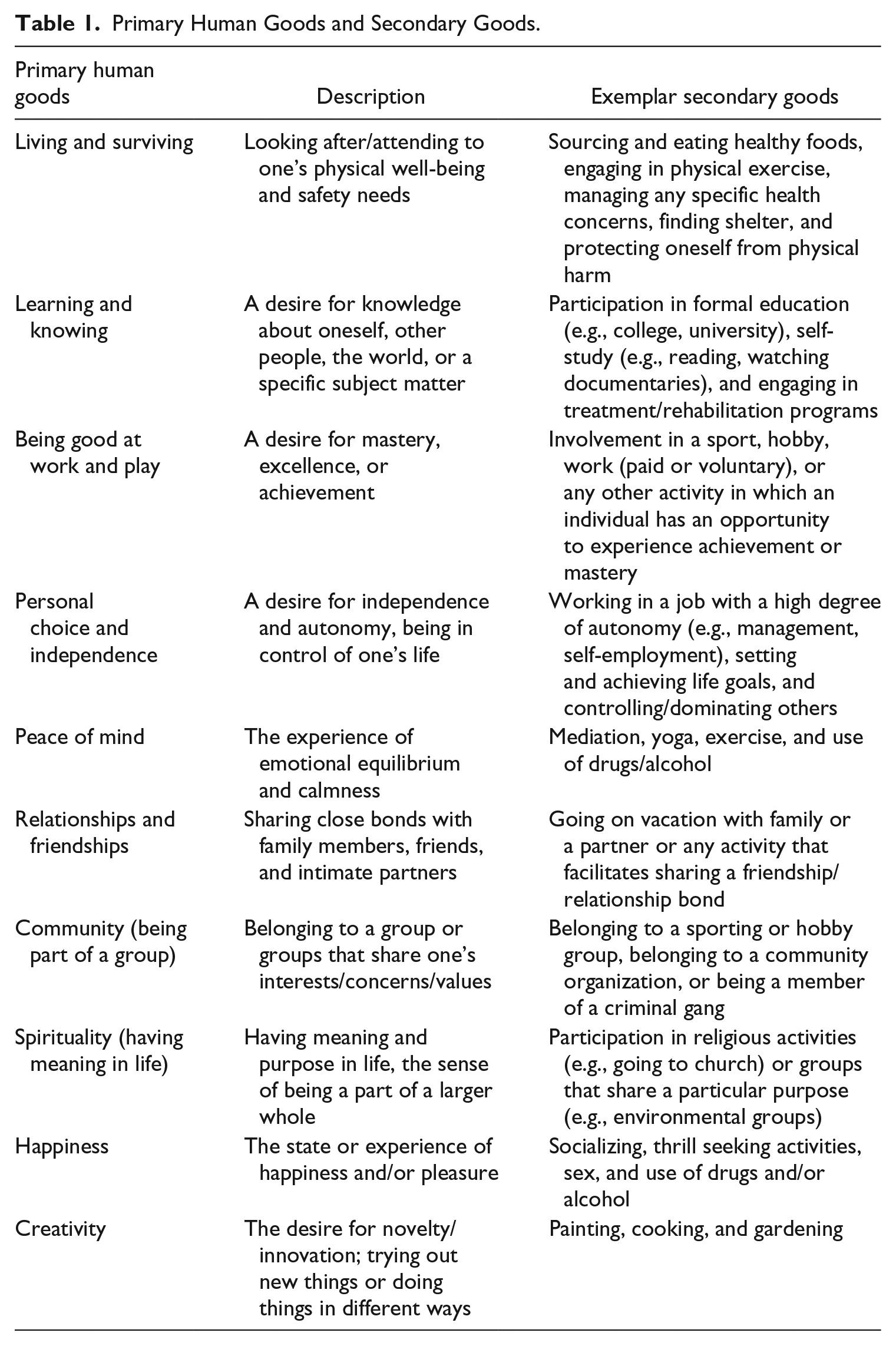
There are many areas of convergence between the PHGs and the factors associated with desistance. Specifically, the achievement of informal social controls (Sampson & Laub, 1993) is reflected in the PHGs of relationships/friendships, community (i.e., belonging to groups that share one’s interests/values) and mastery (i.e., a sense of achievement in work or hobbies). Furthermore, cognitive transformation is recognized in the GLM’s notion that all human beings follow some sort of (often implicit) “good life plan” centered around an individual’s identity or sense of self, including which PHGs they value most (see Laws & Ward, 2011; Willis, Yates, Gannon, & Ward, 2013). According to theories of cognitive transformation, desistance from crime is promoted via a constructive, prosocial shift in one’s identity (e.g., from “gang member” to “family man”; Giordano et al., 2002; Maruna, 2001). Similarly, according to the GLM, desistance is promoted when PHGs are at the center of one’s good life plan and PHGs previously sought through offending are pursued in personally meaningful, prosocial ways. Self-actualization is reflected in the overall attainment of prioritized PHGs, as well as by the pursuit of specific goods including happiness/pleasure, spirituality, peace of mind, and personal choice/autonomy.
The GLM integrates principles of other effective correctional interventions including risk–need–responsivity (RNR), and cognitive-behavioral treatment (CBT). (Interested readers are referred to the following sources for more information: Willis et al., 2013; Yates & Prescott, 2011; Yates et al., 2010.) This represents a popular theoretical framework underpinning sexual offending treatment programs. To illustrate, the Safer Society 2009 North American Survey of sexual offending treatment programs found that the GLM was one of the three main theories informing treatment in one third of U.S. and half of Canadian programs for adult males (McGrath, Cumming, Burchard, Zeoli, & Ellerby, 2010). The GLM has been received favorably by clinicians and clients because it offers an engaging framework for treatment and supervision/management (Harkins, Flak, Beech, & Woodhams, 2012; Willis et al., 2014). However, increasingly restrictive sex offender management policy and legislation have been identified as major barriers to its implementation (Willis et al., 2014). Corrections clients, like all humans, require certain environmental conditions that support their pursuit and attainment of PHGs—described within the GLM as having the external capacity to attain PHGs. Examples of external capacity include stable living environments and opportunities for employment. Few studies have investigated the extent to which individuals with convictions for sexual offenses can actually attain the various PHGs in their lives after release from prison. One small scale study conducted in New Zealand (N = 16) investigated the reentry experiences of men who had sexually abused children and their attainment of PHGs at 1, 3, and 6 months post release (Willis & Ward, 2011). On average, participants reported partial fulfillment across the 10 PHGs, and positive reentry experiences at 1 and 3 months post release (including access to stable housing, employment, and prosocial social support) were positively correlated with goods attainment at 6 months post release.
The Present Study
To our knowledge, the present study is the first to systematically explore the extent to which PHGs are prioritized and attained in a North American sample, where sex offense legislation is especially restrictive. In such challenging times, understanding what individuals convicted of sex offenses can do in their pursuit of PHGs upon release is important to promote desistance from crime, which ultimately translates to improved community safety. The aim of the present study was to examine the narratives of 42 men incarcerated for a sexual offense and now living in the community. The extent to which each man discussed desiring, pursuing, and attaining the specific PHGs in the GLM since the time of their release from custody was explored.
Method
Participants
Forty-two men were interviewed in 2011 and 2012 in the Northeastern United States. All participants had committed a contact sexual offense, had served a custodial sentence, and were participating in outpatient therapy at the time of data collection.
Consistent with much extant research on similar populations, the ethnic diversity of the sample was limited (89% White). Participants were more mature than typical criminological samples with an average age of 49.5 years (range = 24-79 years). Their most recent custodial sentence length averaged more than 7 years (range = 3 months-30 years), and all participants had been living in the community for a mean of 2 years (range = 4 months-15 years) at the time they were interviewed. Most of the men in the sample had committed crimes against children (19 against extrafamilial children, 16 against their own or related children, and five had committed both incest and extrafamilial child molestation). A single participant had committed rape and another was convicted of both child molestation and rape. All participants denied offending sexually since their most recent release, and most were employed (n = 33, 79%) and had families (n = 28, 67%) before they were incarcerated. During informal conversation with some of their outpatient therapists, we learned that the men generally constituted a fairly low-risk sample. Participants are identified throughout this article by a case number to protect their identities.
Ethics
The men agreed to participate on the promise of anonymity, so it was not possible to access their official records to verify their offending histories or to assess their risk of reoffending using extant actuarial assessment. No identifying information or contact details for the men was retained beyond the specific period of data collection. Each interview occurred on a single occasion so participants were not uniformly or consistently granted access to their interview transcripts. The first author’s contact details were provided to each man during the debrief period, along with the university’s relevant institutional review board (IRB) paperwork and a description of the study. So far, only one man has inquired about the status of the research project.
Participants were recruited in one of two ways. During the first wave of data collection, in 2011, outpatient therapists announced the study in their group sessions and the first names and contact phone numbers of interested participants were forwarded to the first author. In 2012, during the second wave of data collection, the first and second authors visited various group therapy sessions themselves, described the study in person, and scheduled interviews on the spot. The recruitment message presented the aim and procedure of the study, and emphasized that participation was voluntary and conducted by researchers who were in no way associated with treatment providers or probation staff. Men were also advised that their participation would have no bearing whatsoever on their correctional status or program progress or completion. The study received the approval of the first author’s IRB and was conducted in accordance with its recommendations and guidelines regarding research ethics and the protection of human subjects.
Interview Protocol
The semistructured interview loosely followed McAdams’ (1993) Life History Interview Protocol (see also Maruna, 2001), which was adapted for use with sex offenders by Laws and Ward (2011). The specific questions included in the interview are provided in the appendix. The interviewees were guided by various prompts and asked to think about their life as a story with a series of different chapters. In this study, we focused specifically on the time since their release from custody.
Procedure
Individual interviews were conducted in the private office of a church, at various probation departments, and in office suites. Each interview lasted approximately 90 min. All participants consented to having their interviews digitally recorded and transcribed. Participants were informed that their involvement in the study would have no bearing on their correctional status and would not affect their progress in outpatient treatment. Participation was voluntary and the men received a US$25 grocery store giftcard for their contribution.
Analytical Strategy
The interviews were transcribed, coded, and analyzed in a two-stage process using content and then thematic analysis. Consistent with previous approaches (Atkinson, 1998; Presser, 2008), the interviews were transcribed verbatim to preserve the participant’s speech (e.g., where appropriate, “gonna” was used instead of “going to”). Significant pauses and relevant nonverbal actions (e.g., pounding on desk for emphasis, wiping away tears) were noted in the transcripts. Unless they were excessive, verbal ticks or speech fillers (such as “um,” “like,” or “y’know”) were retained. Dialect and accent were noted when central to the content of the discussion.
The extent to which PHGs were present was inferred from each interview. This is consistent with recommendations made for the assessment of PHGs by the authors of the GLM (e.g., Willis et al., 2013; Yates et al., 2010). Our interview protocol contained specific questions about three PHGs and the remaining seven were inferred from the narratives, after the fact. As such, the PHGs of community, spirituality, and mastery are hereafter referred to as “probed” PHGs. The individual’s desire to pursue the remaining PHGs (and the extent to which they had attained them or felt restricted from achieving them) was not the subject of any direct questions and was instead inferred by coding the language they used in the interviews. Reference to those seven PHGs is hereafter referred to as “emergent” themes.
Content analysis was used to calculate the number of mentions by participants of the emergent PHGs. Content analysis is an analytic technique that codes textual data in a number of themes or categories and often takes the form of a quantitative description of patterns emerging from the analysis of text (Schwandt, 2007; Weber, 1990). This should not be confused with a desire to quantify qualitative data. This process simply allowed us to evaluate the relative importance of the emergent PHGs. In addition, thematic analysis, a technique that focuses on the interpretation of the meaning of text (Schwandt, 2007), was used to explore whether or not PHGs were pursued or achieved. Attainment was then coded based on reports from participants about how they had fulfilled or achieved PHGs. Unsuccessful pursuit was noted in cases where participants reported obstacles and/or an inability to secure PHGs, in addition to wanting or trying to fulfill those goals. Thematic analysis was performed on both the probed and emergent PHGs. In the case of the “relationships and friendships” PHG, we sometimes observed both attainment and loss in a single participant. For example, someone might no longer be in contact with his family but also mention having a good friend who has stood by him. We also frequently encountered a theme of loss where participants spoke of having a good job (for example) at one time, but being currently under- or unemployed. This is revisited again below.
Interview transcripts were coded by the second author using the NVivo software program (Version 10). Pertinent excerpts from participants’ interviews were coded into the 10 categories of PHGs articulated in the PHG framework described above. The following results are presented in two parts: first, the content analysis regarding importance of PHGs and, second, the thematic analysis that details the attainment of each PHG.
Results
Content Analysis
To identify trends in the prevalence of PHGs for the men upon release, we computed the frequencies of the references made to each PHG in the interviews. We contend that the more prevalent the PHG (the more we see it emerge in the narratives), the more important and/or concerning it is for the participants as they transition back to the community. Table 2 contains the frequencies of the references made to each of the emergent themes.
Achieved and Restricted PHGs Based on Emergent Themes (Ordered by Frequencies).

Note. PHG = primary human good.
For the emergent PHGs (those obtained through indirect questioning), “relationships and friendships” was inferred from 95.2% of the respondents. “Life and survival” and “knowledge” were mentioned by 78.6% and 76.2% of respondents, respectively. Independence, peace of mind, and creativity were inferred in about a third of narratives (38.1%, 33.3%, and 33.3%, respectively). Most of these references mentioned barriers to reaching peace of mind and independence. Finally, happiness was mentioned by just 14.3% of participants.
We do not report frequencies for references of probed PHGs because all participants were questioned directly on those items. However, we analyzed the nature of their references to determine whether participants were able to reach such goals. These results appear in Table 3. Generally, larger proportions of participants reported achieving the goals of community (38.1%), and spirituality (45.2%), than that of mastery (7.1%).
Achieved and Restricted PHGs Based on Probed Themes (Ordered by Frequencies).

Note. PHG = primary human good.
Thematic Analysis
Thematic analyses were conducted to explore the context and nature of all PHGs inferred from the interviewees’ narratives, including references made to secondary goods that were used in the pursuit of primary goods. In the next sections, pertinent excerpts about each PHG are presented, in descending order of prevalence, starting with the one mentioned most frequently.
Relationships and friendships
“Relationships and friendships” was the most prevalent PHG found in the narratives. A common theme across participants was the sense of loss regarding important friendships and relationships as an aftermath to their sexual offending and incarceration.
[My] family just threw me out in the trash when families usually help families, but not with me. (P28) I have met with my family, but eventually, by the time I got out of prison, they all rejected me. And then my wife was gonna come back with me, but they said: “if you do, we’re gonna reject you, too.” So, end of story. (P40)
A second theme concerned the frequency with which participants shared the goal of repairing these broken bonds. Men who lost partners, children, family members, and/or friends talked at length about their desire to reconnect with or, to make new friends. Most participants indicated such a desire strongly, but were ambivalent about their ability to succeed.
I’d like to reestablish contact with some of the friends I had, I’m just not sure how to go about doing it. You know, there’s a part of me that wants to, and there’s a part of me that doesn’t want to because I don’t want to feel the rejection part of it again. (P16) But where does a sex offender go to meet women? You know? They hear you’re a sex offender, and they’re like *gasp*. It’s like “Oh no.” And if I get in a relationship, if she has kids, I can’t be in contact with her kids unless they’re over 18. (P1)
A final theme in relation to friendships and relationships was the positivity surrounding the accounts of participants who reported having meaningful connections in their lives.
Since I was incarcerated, they [my sister and brother] stuck with me through the program. You know, they saw the changes. They just, they were there for me. (P3) One of the ones who has made it easiest to succeed was my mother, the grandmother of my victim. Who basically lived by the philosophy of you can love the criminal but hate the crime. I absolutely devastated her but she stuck by me. My sister, my victim’s mother, has stuck by me. (P39)
In every other PHG, a clear pattern of attainment or nonattainment was observed across the sample. “Relationships and friendships” was the only PHG where participants reported both achievement and failure. Although some participants had meaningful relationships and friendships, others did not. The positive accounts of the former and sense of loss and bitterness in the narratives of the latter emphasize the critical importance of such relationships in the lives of these men. Furthermore, many spoke of having had a supportive family in the past, but now felt restricted from meeting or reconnecting with friends.
Living and surviving
Overall, the pursuit of life and survival was the second most frequent PHG that emerged in the interviews. When asked what about his hopes for the future, Participant 31 said, “Just survive.” The PHG of life was often raised in the context of survival. Two thirds of participants reported having faced barriers in their pursuit of life and survival. First, many men spoke of experiencing difficulties in gaining employment, with only eight participants reporting being employed at the time of their interview. For many interviewees, this lack of paid work created significant financial strain.
When I got out, I was optimistic and idealistic and, oh, um, you know, I’m just going to tell people my situation and they’re going to understand and after about the 50th place I went to for a job, I realized that telling people that I’m a level 3 sex offender isn’t the way to get a job. (P20) Being unemployed for so long, I was like a year and a half of unemployment just scraping by, doing odd jobs. (P37)
For many participants, unemployment and monetary constraints hindered the procurement of basic necessities such as shelter, food, and medication. For example, 23 participants said they faced serious obstacles in getting a place to live and lived in shelters or rooming houses, or had to rely on family members and/or friends for accommodation.
It’s hard to find a place to live down here because you’re a registered sex offender. (P40) I mean, I deserve an apartment just like the next person. (P11) I live in a shelter and I can’t stand it. (P8)
This difficult situation was only exacerbated by the restrictions that are imposed on the location of their residence and work.
Learning and knowing
Knowledge was the only PHG with a clear pattern of attainment. It was mentioned by many participants and most reported that it was achieved specifically through mandatory sex offender treatment. Treatment allowed them to learn more about themselves and what caused them to offend in the first place. Many participants said treatment was instrumental to living offense-free upon release and emerged as a clear source of pride.
Through all the intense therapy I’ve been through I understand my cycle forward and backward and every aspect of my life I live in my cycle, I know what all my risky emotional states are, I know what triggers I have, I know what my core beliefs are, I know what you know seemingly unimportant thoughts and decisions I make are, you know. (P7) If you’re learning about yourself you’re becoming self-aware, then you’re going to, you interrupt any kinds of a lapse or anything, you’re going to have the tools to do it with, and you can’t do anything unless you’re aware of it. (P14)
The language they used regarding their offending cycle, core beliefs, lapses, and triggers indicates a competent grasp of the relapse prevention model they were taught. A small number of participants reported learning through means other than mandatory treatment and on topics other than sexual deviancy. The following excerpts illustrate such learning experiences as the result of incarceration and reading.
[Prison] made me understand who I was, and, it made me open up to who I was. (P9) And I read a lot. I’ve read thousands of books, everything from just regular books to nonfiction, philosophy, religion, just trying to grasp a little of everything. To try and see the picture in a different eye than just one set, you know? (P25)
Only one participant pursued education through a formal institution upon release. Ultimately, his status as a convicted sex offender and the subsequent harassment it caused proved an insurmountable obstacle.
I was at the school for almost 8 months and they called me up to the dean’s student’s office and they said, “We’re going to put your picture up, your poster up, because you’re a level 3.” . . . And it was great. It was fantastic and I was getting straight As. Then they put the picture up and within a week three quarters of people wouldn’t talk to me anymore. The ones that would just wanted to say nasty things. The cops, campus police were chasing me around all the time, harassing me and finally . . . I had 12 more credits to go and I just couldn’t take it. I couldn’t deal with it. So, I left. (P20)
Spirituality
The interview protocol contained a specific question about religion and spirituality and gave the men a chance to comment on how they experienced or practiced these, if at all. Almost half of the interviewees indicated having some spiritual beliefs, with a range of views represented.
To me that’s where God comes from. He comes up from within. It’s this powerful energy. (P20) I’m a recovering Catholic, I say that in jest. I’m spiritual, I just don’t agree with the um, the bureaucracy of my religion. (P14)
Active engagement in religious activities presented specific challenges:
I just started going [to church] again. But I had to go through some stuff to make sure I could go because I can’t be around kids and stuff like that. But I can be with adults, I think. As long as they’re there. As long as I have someone next to me so if they say that I did something, someone can say that I didn’t do it. (P2)
Given these obstacles, some participants identified alternative means to fulfill this PHG:
As a sex offender, a lot of churches probably won’t accept you because of family members with kids. So, we got to take a lot of steps to protect ourselves. I’m kind of holding back off on going back to church, but yes, continue reading my bible and thinking about getting back into that bible study through the mail again. (P38) Some of the churches that I’ve visited umm after being incarcerated seem like they just didn’t fit, . . . , I am my own temple if you will. (P15)
Overall, spirituality was a goal that many interviewees were able to reach, although the more formal practice of their beliefs needed to be adjusted because of their status as registered sexual offenders.
Personal choice and independence
Participant 13’s imagery in his description of himself as a “bird with my wings clipped” is representative of the participants’ narratives on personal choice and independence. Some interviewees mentioned the PHG of independence, and most described experiencing obstacles in their pursuit of this goal. Most participants valued their regained freedom after incarceration but described a variety of restrictions—either formal conditions of probation or self-imposed—as barriers to their goal of independence.
I can’t go to the Y. I can’t go anywhere, you know? Can’t get on “Google” or anything like that. Can’t touch computers. . . . I like my freedom. (P1) Now I’m free, which is, I struggle every day to remain free . . . because it only takes a minute of a thought, I can end up back in prison, and I go through that every day, . . . Because if I don’t, I’m going to go back to prison and it’s a one way trip this way, this time it’s one way, there’s no coming out. (P22)
Although disliking these restrictions to their independence, participants were somewhat philosophical about their circumstances and understood that this was now how their life was.
[Not having so many restrictions] would allow me to be able to go out and thrive in a way that I know I could thrive if I didn’t have this constant impediment. . . . I have to accept now that in light of that [being a registered sex offender] that I’m not going to be able to live the life I want to live. I’m not going to be able to do what I should be able to go out and do. (P20) I’m going to be on parole for the rest of my life, but I know I have to accept it. And either way my life has to continue because, there’s not really very much I can do. (P10)
Many participants appreciated regaining their liberty after incarceration and respected the constraints imposed to maintain their freedom, but their accounts document the multiple restrictions imposed on their independence and personal choice. Overall, their narratives revealed how little agency they felt they had over their own lives.
Peace of mind
Peace of mind emerged in one third of participants’ narratives, and most accounts concerned the difficulty of release and reentry as a registered sexual offender. Many interviewees reported very stressful release conditions that prevented them from experiencing peace of mind. Not surprisingly, these obstacles correlated highly with those that restricted life, survival, employment, and accommodation.
I mean, my first few weeks out were very stressful. My first few months out were stressful. (P36) I’m trying to find a job. . . . I’m just trying to get a job right now. That’s all I’m doing . . . I go to the state library and look for jobs. That’s the major thing I gotta do . . . I want to find a job, that’s all. That’s my major thing, to find a job. (P2)
Only a few participants described some improvement over time, and a sense of attaining peace of mind.
Just got my own place, after being homeless for 2 years . . . I’m at such an incredible peace right now, I was so stressed for the past 2 years. Came out of incarceration, again being traumatized because all this was first for me, I never thought I’d be incarcerated, I never thought I would have lost my family, it was just so traumatic for me . . . (P13) That’s when I first learned to meditate and was able to get some separation from my emotions and get a way to subjectively look at my emotions from outside. . . . And that has just been an incredible journey. . . . So, every day now is about, I think, my life right now. You know? Every moment of my day right now is a high point, no matter what I’m dealing with because I know that it’s me living it now. (P20)
Overall, the goal of peace of mind was a concern for most men. Multiple sources of stress and the difficult living conditions described previously prevented the achievement of this PHG.
Community
Many men were very involved in their treatment groups but were otherwise uninvolved in social, community, or sporting groups. For example, Participant 40 said, “If I wasn’t allowed to have access to convicts or sex offenders in general, then I wouldn’t have anyone.” We limited our interpretation here to the way they answered a specific question about participating in clubs or organizations. Sixteen participants reported being part of a group or organization. Overwhelmingly, participants found a sense of community and belonging in their treatment group, in the company of other men who had served time for a sexual offense:
Being an overall aid and senior member of ah, the core treatment. I was always available to uh any men that were in the early stages of the core treatment program. I was sorta . . . tutor. (P8) I’m active in my sex offender treatment programs, I’m active in my recovery programs . . . It meets once a week, but I’m constantly calling, and talking to other members of the group, I call them, I call them to see how they’re doing, they call me to see how I’m doing. (P9)
Very few participants were involved in other groups or clubs, often citing motives of self-protection as well as protection of the organization’s reputation for their lack of involvement.
No, no I don’t dare [join a club] at this point. Again, that’s part of getting out there. Do I want to go join a bowling league or something? Yeah I might like to, but what if they find out [I’m a sex offender]? (P39)
Although many interviewees did not participate in outside organizations, they were able to gain a sense of community in their treatment groups, in the company of other men who had served time for a sexual offense.
Being good at work and play
Considering the difficult life circumstances many participants reported previously (unemployment, difficulties in securing basic necessities, stress, limited independence and personal choice), it is not surprising that only a small number of them reached mastery-related goals upon release. Many interviewees, however, remembered having experienced mastery in the past.
I can remember the first time I broke a six figure salary, I was, I’ve always been proud of my ability to provide. (P7) I was very good at my job, my career, I was respected, I was well liked in the companies that I worked for, I was liked within my community . . . I was you know, of course given bonuses for my work, . . . I really loved my work. (P9)
We found no indication or mention of experiences of achievement or success in their present careers or working lives. This makes sense given that so many participants were unemployed at the time of the interview. However, one domain in which they did report experiencing mastery was through their participation in treatment.
I kind of excel [at treatment] . . . As I mentioned before there are people who write to me and ask, ask me for suggestions on, on, on a specific problem or something in the treatment program or what I think, I won’t do the work for them, but I’ll give them a different direction, I’ll give them a challenging question, you know. (P9) I do feel really good at managing my deviancy. (P20)
Happiness
Only a small proportion of participants talked about the PHG of happiness. Of those who did report finding it in their present circumstances (as difficult as they were), they had done so by making a very conscious decision to find the good in their lives, and describing how they now look at life as if through a different lens.
I just need enough money to survive today, and to have my place where I can lay my head and live at peace, a place to call my home, and I’m ok today . . . I’m able to refocus and realize that I can be happy with the least in life. Just sufficient. (P13) Very simply I want, I want to enjoy life. (P21) I just wanted to kill myself, I just didn’t wanna go on. Today I wanna live, today I’m a happy person. (P6)
Creativity
Generally, little was said about creativity. Although 14 participants mentioned interest in creative activities at some point during their interviews, only two felt able to pursue those goals upon release.
I’ve done uhh three [stories], I’ve got three of them done on the computer, and sooner or later I want to get them published . . . I want to get something published. (P17) I’ve always had it into my mind that I want to get into uh, pottery, work with clay, ’cause I did something like that in high school . . . I want to find some place here in town that does that class where you can go in and paint and work with clay. (P38)
This disconnect between interest and participation in creative activities can likely be explained by the more pressing urgency of participants’ general life situations.
I don’t have no place to live, I’m working hard on getting that, hobbies is one of the lowest things on my list right now. (P22)
Discussion
The current study is the first qualitative investigation of the pursuit of PHGs by men who have been imprisoned for a sexual offense and subsequently released into the community. As illustrated in their narratives, data were rich and informative about the myriad of challenges these individuals face as they strive to live safe, law-abiding, and fulfilling lives. The importance of PHGs was evident in their dialogue but participants were often restricted from pursuing or achieving them. That PHGs were evident in participants’ narratives supports a fundamental premise of the GLM, specifically that criminal justice system–involved people are “people like us” (Laws & Ward, 2011). Results illustrated the considerable struggle experienced by participants trying to comply with the restrictive conditions of their release (including probation and sex offender registry requirements) as well as the now well-documented difficulties of finding suitable employment and safe and affordable accommodation (Levenson, Ackerman, Socia, & Harris, 2015; Socia, Levenson, Ackerman, & Harris, 2015).
Summary of Findings
Three PHGs were especially strong in the majority of participants’ narratives: “life and survival,” “relationships and friendships,” and “knowledge”; yet only “knowledge” was achieved by a majority of participants. Significant obstacles were experienced in the pursuit of many PHGs including “life and survival,” “independence and personal choice,” “peace of mind,” and “mastery.” Only three PHGs (i.e., knowledge, community, and spirituality) were reported to be attained by a majority of participants, two of which were attained through participation in sexual offender treatment. Treatment participation emerged clearly as an instrumental (i.e., secondary) good in participants’ lives. This result illustrates the difficulties experienced by the men as they pursued PHGs that the rest of us take for granted (e.g., through involvement in interest groups, stable employment, or enrollment in school). Consistent with emergent design in qualitative analysis (Creswell, 2013), most PHGs were inferred from participants’ narratives and not probed about directly.
Findings from the current study were generally consistent with the small but growing body of empirical research exploring assumptions of the GLM with individuals who have sexually offended in terms of primary goods sought (e.g., Barnett & Wood, 2008; Chu et al., 2015; Purvis, 2010; Willis & Ward, 2011) and difficulties attaining goods (Willis & Ward, 2011). These previous studies have been conducted in New Zealand, the United Kingdom, and Singapore, where legislation pertaining to individuals with sex crime convictions is less restrictive than in the United States. It has been well documented that U.S. registration requirements and residence restrictions have been associated with myriad reintegration obstacles including housing instability (Levenson et al., 2015; Socia et al., 2015). Thus, it was not surprising that, inconsistent with prior research, “life and survival” emerged as a particularly important primary good in the current study, which a majority of participants struggled to attain. In addition, in the context of limited opportunities to seek out the range of PHGs, “knowledge” uniquely emerged as an important primary good that all participants had access to via their sexual offending treatment programs. That knowledge emerged as an important primary good for participants in the current study is consistent with the GLM’s premise that prioritized primary goods change as a function of life circumstances (e.g., Laws & Ward, 2011; Ward & Stewart, 2003).
Implications
Findings from the current study have several implications for clinicians, researchers, and the communities to which these men return upon release. In the current climate of restrictive sex offender management legislation, treatment programs provide registered sex offenders in the United States with an opportunity for goods attainment when other sources have been taken away. Modern legislation mandates where they can and cannot live, work, and play and treatment is one of the few activities registered sex offenders can do. It was encouraging that so many participants talked positively about their experiences of treatment, which could have conversely been conceived as yet another obstacle in their pursuit of PHGs. Accordingly, it is important that clinicians recognize the broader value of treatment in their clients’ lives, especially in countries like the United States where sex offender registries, community notification, and residence restrictions are widespread. Framing treatment as an activity that will assist clients to live better lives rather than as an activity that they have to do, and creating safe and supportive environments that facilitate the acquisition of PHGs will undoubtedly maximize the value of treatment.
In line with RNR principles (Andrews & Bonta, 2010), targeted sex offending treatment programs typically focus on eliminating, reducing, or managing criminogenic needs or dynamic risk factors with the aim of reducing one’s risk for recidivism. Accordingly, treatment targets include challenging offense-supportive beliefs and improving general and sexual self-regulation skills. Generalization of newly acquired skills relies on environments that support skill development and rehearsal, and cannot be expected in environments that do not. For example, clients may struggle to adopt healthy sexual attitudes and behavior outside of treatment sessions when they are forced to live on the fringes of society surrounded by antisocial peers. Moreover, when individuals struggle to satisfy basic human needs such as food and shelter, psychological functioning is almost certainly compromised, meaning generalization of new skills is seriously threatened (e.g., Ward & Nee, 2009). In the authors’ opinion, physical well-being and survival needs constitute responsivity factors that clinicians must address in collaboration with other professionals before engaging clients in offense-specific treatment. In other words, it is imperative that clinicians “meet clients where they are.”
Avenues for future study include cross-cultural research to compare rates of sexual violence in different countries as a function of the extent of restrictions imposed on released sex offenders. Given that public support for such legislation is strong (e.g., Levenson, Brannon, Fortney, & Baker, 2007), more convincing data are needed to demonstrate that restrictive policies do not result in reductions in sexual violence. Future research will also benefit from the development and validation of structured ways to assess prosocial and meaningful attainment of PHGs, and investigations into the predictive validity of prosocial goods attainment for reducing recidivism and promoting desistance from crime.
Limitations
Consistent with much of the extant research, we focused on adult men convicted of sexual offenses living in the United States. Thus, we do not expect our results to generalize to female samples or to offenders living in other countries. Furthermore, the limited number of participants of color precludes us from making any specific claims about the relevance of our results to other ethnicities. These areas certainly warrant further study. Also of concern is the inherent bias in sampling only those men who were actively participating in treatment. It is likely that their experiences differed from those men who did not regularly attend their group meetings (and were thus not invited or available to participate). Furthermore, the present sample’s emphasis on “knowledge of self” might not generalize to men who no longer participate in treatment.
Because all the men in the sample had sexual offense convictions, we are unable to completely attribute their difficulties in achieving certain PHGs to the restrictive policies mentioned earlier. As an anonymous reviewer pointed out, it is certainly likely that individuals convicted of nonsexual crimes are similarly restricted in their pursuit of PHGs. Although we acknowledge the limits of the generalizability of our findings, it does not diminish the profound challenges our interviewees have experienced during their community reentry.
Our interview protocol contained specific questions that probed only three PHGs and the remaining seven were inferred from the narratives, after the fact. On one hand, this constitutes a limitation because we are unable to determine whether such goals were in fact attained by participants. On the other hand, it is evident that utilizing indirect questioning as a data gathering technique also yielded a rich discussion of many PHGs that emerged naturally in the interviews. This kind of emergent design (Creswell, 2013) allowed us to comment on whether such experiences were important and vivid enough to be raised by the men without prompting. Furthermore, it is possible that inquiring about some PHGs might have stimulated participants to talk more about their pursuit of that specific good than the others.
Conclusion
There is much we can do to better achieve our goal of risk reduction, offense prevention, and increased public safety, but the most promising recommendations require a significant change in focus. For too long, the field has been consumed with avoiding, reducing, and eliminating risk, relapse, and recidivism. We suggest inverting this paradigm to concentrate instead on promoting rehabilitation, recovery and resilience, and redemption. Such a focus necessarily requires clinicians, policy makers, and communities to acknowledge the humanity and desire to achieve PHGs in men convicted of sexual offenses. Blocking access to PHGs in ways that everyone else takes for granted seems a surefire way to ensure that ex-prisoners remain on the fringes of society whereby offending is perceived as one of the few means available to them to achieve PHGs. Beyond simply relying on treatment as a source of community and knowledge, we encourage the pursuit of mastery by identifying clients’ strengths and ways to spend time productively, and foster intimacy by facilitating the creation or reunification of positive prosocial relationships. An exclusive focus on risk reduction does not align well with theories of desistance from crime, and it is clear that promoting desistance from crime directly translates into enhanced community safety. We therefore advocate for a dual focus on risk reduction and goods promotion to hold promise for facilitating achievement of informal social controls and identity change, bringing us closer to reaching our goal of making society safer.
Footnotes
Appendix
Declaration of Conflicting Interests
The author(s) declared no potential conflicts of interest with respect to the research, authorship, and/or publication of this article.
Funding
The author(s) received no financial support for the research, authorship, and/or publication of this article.