




Abstract
The empirical evidence indicating that sexual offenders against children manipulate their victims to participate in sexual activities dominates the literature on sex offenders and their modus operandi. However, recent evidence suggests that a high proportion of these offenders do not try to persuade their victims for sexual contact in the first place by using coercion or manipulation but simply assault them when an opportunity arises. Using self-reported data from a sample of incarcerated adult sexual offenders against children, we investigate whether sexual offenses against children committed by the use of nonpersuasion are characterized by little planning and by offense features that are indicative of opportunistic offending. We also examine the interaction between the type of offending strategy and the context of abuse. Findings reveal that offenders using nonpersuasion do not seek out potential victims, but rather seize an opportunity to offend. The type of offending strategy also interacts with the context of abuse for most preoffense and offense variables. These interactions are informative of the conditions favoring opportunistic sex offending against children.
Introduction
Empirical studies on offending strategies (often referred as modus operandi) adopted by child sexual offenders have revealed that many engage in manipulation to persuade their victim to take part in sexual activities (e.g., Berliner & Conte, 1990; Budin & Johnson, 1989; Conte, Wolfe, & Smith, 1989; Elliott, Browne, & Kilcoyne, 1995; Kaufman et al., 1998; Lang & Frenzel, 1988; Leclerc, Proulx, & McKibben, 2005). From these studies, it is also evident that the use of violence to persuade the victim to participate in sexual activities is adopted by a relative minority of offenders. However, an abundance of this empirical work does not account for a multitude of other situations under which child sexual offending occurs. More specifically, as it is known in clinical practice, many offenders may obtain sexual contact with children without persuading them to participate in sexual activities through coercion or manipulation. Rather, many of these encounters may emerge as a result of different opportunity structures and circumstances. From a policy perspective, this oversight substantially limits the potential for situational prevention as well as other initiatives designed to reduce or eliminate offending opportunities.
To our knowledge, three empirical studies conducted with different samples of offenders provide support for the situation noted above. Leclerc, Carpentier, and Proulx (2006) found that as many as 47% of a Canadian sample of child sexual offenders initiated sexual contact without any verbal or physical attempt to convince them to comply, a strategy termed “non-persuasive.” Leclerc, Smallbone, and Wortley (2013) observed that 42.7% of child sexual offenders in an Australian sample adopted this approach as well. With a sample of serial stranger sexual offenders including any type of offenders (offenders against women and/or children), Beauregard, Proulx, Rossmo, Leclerc, and Allaire (2007) also identified this particular method along with manipulation and coercion. A nonpersuasive strategy reflects a situation in which an offender not only made a decision at some point to have sexual contact with a child before offending but also chose to not adopt any specific manipulative or coercive strategies to persuade the child to have sexual contact. For example, these may be split-second decisions described by Clarke (2008), and not necessarily planned. Nonetheless, they still reflect decisions in part because a behavior among a range of other potential behaviors is still adopted.
There is a range of situations in which offenders may not actively persuade a child to engage in sexual contact because the child may be sleeping, having a bath, or dressing up for instance, underscoring the role and abundance of offending opportunities with children (Beauregard et al., 2007; Leclerc et al., 2006; Leclerc, Smallbone, & Wortley, 2015). A number of scenarios that may lead to such situations exist. First, some offenders may not plan in advance that they are going to abuse a child but just act spontaneously if an opportunity for sexual contact arises (Leclerc et al., 2006). Second, some offenders may plan to abuse a child but not have any clear idea as to when and how they are going to proceed and simply commit the abuse when they see it as being possible (Beauregard & Leclerc, 2007). Third, other offenders may premeditate the abuse of a particular child at a specific time and location with the intention to use manipulation or coercion, but instead act suddenly on the victim because an early opportunity for sexual contact arose unexpectedly. Although taking these scenarios into account is essential to examining and understanding the opportunistic nature of child sexual offending, this reality is often overlooked in empirical research and not well integrated with current evidence on how offenders proceed to obtain sexual contact with children.
The concept of nonpersuasive strategy may seem superfluous in the first place or even obscure, but the nuance it brings to understanding the nature of child sexual offending behaviors is relevant. It is important to remember that sexual offenders can easily overcome the psychological and physical resistance of children simply because the circumstances under which they offend facilitate offending (e.g., relationship with the victim, individual characteristics that make victims vulnerable, incapacity for the victim to say “no,” incapacity of younger victims to recognize the abusive nature of sexual contacts; Berliner & Conte, 1990). Therefore, one necessity to observe offending strategies as potentially “nonpersuasive” in nature is to fully understand the set of circumstances under which the offense is committed rather than assuming that these offenders automatically adopt manipulation or coercion. It is critical to avoid cognitive biases that may lead us to look for cues that are consistent with the use of manipulation or coercion even though there may be no clear evidence indicating this is in fact the case. The essence of this study is to bring to light a largely neglected offending strategy (i.e., nonpersuasion) in the literature and, at the same time, showcase the power (and relevance) of the situation on sexual offending behaviors. To us, this study is another testament that the situation under which child sexual offending occurs is vital to understand before taking up the task of designing prevention strategies.
Theoretical Background
The powerful role of opportunities on criminal behavior has long been recognized in criminology especially in the area of situational crime prevention (SCP). Opportunity is the key concept linking situational criminological perspectives aimed at understanding and preventing crime events, that is, the rational choice and routine activity perspectives, and crime pattern theory (Felson & Clarke, 1998; Wortley & Mazerolle, 2008). Leading experts on understanding offending opportunities for prevention purposes (e.g., Cohen & Felson, 1979; Felson & Clarke, 1998) best define an offending opportunity as the convergence of a potential offender and victim in time and space in the absence of capable guardians. According to Clarke (2008), criminal opportunity is the most fundamental concept to understand crime events. Clarke argues that individuals without a predisposition to offend are likely to commit crime if exposed to offending opportunities. The role played by opportunities is also captured by Wortley (2001) in his work on situational precipitators, elements of the immediate environment that can prompt, pressure, permit, or provoke any individuals to commit an offense. In this case, the environment generates opportunities for crime by creating or intensifying the motivations to offend. The importance of offending opportunities is well reflected in Cornish and Clarke’s (2003) most recent typology of offenders.
Cornish and Clarke (2003) proposed a typology which clarifies the various ways through which offenders interact with their immediate environment during the offense. The typology consists of three types of offenders: the antisocial predatory offender, the provoked offender, and the mundane offender. The antisocial predatory offender is characterized by a pervasive desire to commit crimes to satisfy various needs. Usually, the criminal activities engaged in by this offender are embedded in his lifestyle. This offender is an active seeker of offending opportunities and selects the most promising situations for offending to maintain his lifestyle. For the provoked offender, the motivation to offend is typically triggered by the situation alone. Before the offense, this offender is unmotivated to commit crime in general. Most specifically, he does not offend unless precipitated in doing so (through social pressures, for instance). Therefore, he does not actively seek out, but rather reacts to, criminal opportunities. The mundane offender, also called the opportunistic offender, is characterized by moral reservations and a conventional lifestyle. As a result, this offender does not create or seek out opportunities to offend but exploits them when his moral reservations are weakened. This theoretical contribution from Cornish and Clarke illustrates how offenders can create, exploit, and react to offending opportunities.
Wortley and Smallbone (2006) adapted Cornish and Clarke’s (2003) typology to sexual offending against children. This typology is based on the strength of the offender’s dispositions to offend and the role that situational factors play in his offending and seeks to explain offender–situation interactions in child sexual offending. It is important to note that a typology aims to classify offenders for clarity purposes. Therefore, one should keep in mind that it remains an attempt to categorize offenders based on their behaviors. Wortley and Smallbone defined the antisocial predator as the predatory offender, the provoked offender as the situational offender, and the mundane offender as the opportunistic offender. According to Wortley and Smallbone, the predatory offender targets mostly male extrafamilial children. This offender is skilled at identifying vulnerable children. He premeditates his offense and possesses the skills and repertoire of strategies to approach and abuse children. This offender is also characterized by a sexual attraction to children. Predatory offenders represent the public perception of the prototypical sexual offender against children. The situational offender typically abuses female intrafamilial children and abuses the same victim over an extended period of time. This offender is likely to offend in reaction to a triggering event involving situational frustrations, irritations, or social pressures. In fact, without triggering event, this offender would not offend. The opportunistic offender often targets female intrafamilial children. This offender does not tend to maintain a relationship with his victim for sexual purposes, which is consistent with the spontaneous nature of his offending. He is also likely to seize opportunities to commit other forms of crime, which is consistent with a generalized failure of self-control and incapacity to resist temptation to satisfy various needs. This offender, according to Wortley and Smallbone, is not embedded in sexual deviance but rather offends simply because he can. He exploits fortuitous offending opportunities.
Aim of the Current Study
Wortley and Smallbone (2006) adapted Cornish and Clarke’s (2003) typology of offenders to sexual offenders to highlight the predominant role of the situation under which child sexual offending occurs and make a good case for opportunistic sex offending against children. However, we are aware of no empirical studies that focus specifically on this typology or opportunistic sexual offenses against children, which is detrimental to understanding the circumstances under which this phenomenon often occurs. The main objective of this study is to examine what may best characterize child sexual offending committed through nonpersuasion. We ask ourselves to what extent this crime is committed through nonpersuasion. We also examine (and make the assumption) whether the use of nonpersuasion takes place within a set of particular circumstances under a specific opportunity structure that actually makes this method possible for offenders. By completing this investigation, we also obviously aim to fill a gap in the empirical literature on offending strategies adopted by child sexual offenders, but the main contribution remains to clarify our understanding of child sexual offending and make a case for the power of the situation to shape child sexual offending behaviors.
Method
Sample
The sample consisted of 346 adult males who had been convicted of a sexual offense against a child younger than 16 years old. These participants underwent a 6-week assessment of risk level and treatment needs at the Regional Reception Centre of Sainte-Anne-des-Plaines, Québec, a maximum-security institution of Correctional Service of Canada, prior to transfer to another institution. During this initial assessment, a semistructured interview was completed with each participant for research purposes. The research protocols were conducted according to the ethical guidelines stipulated by the Research Ethics Board of the Université de Montréal during the time period in which the participants were interviewed. The majority of participants were Caucasian (89.9%) and most had not completed a high school education (86.6%). A minority (37.9%) of participants were single at the time of the crime and only 43.5% were employed. The average age of participants at the time of assessment was 43 years (SD = 12.28).
Procedure
All data used in this study were gathered through a semistructured interview conducted with each participant using the Questionnaire Informatise pour Delinquants Sexuels (QIDS; St-Yves, Proulx, & McKibben, 1994), which is a computerized questionnaire for sexual offenders. All interviewers were licensed forensic psychologists or criminologists. Participants granted access to their correctional files; official sources of information (e.g., police reports, victim statements, etc.) were also used to validate information, when possible, obtained in the interview. In case of disagreement between both sources, official data were prioritized. The quality of data collected from the QIDS was controlled by completing interrater agreement. Interrater agreement was measured on the basis of 16 interviews conducted jointly by two raters (the principal research assistant and the first author coded the variables based on the information obtained during the interview with offenders to ensure that the interpretation would be consistent across different raters). Ratings were performed independently after these interviews, which were conducted by one interviewer in the presence of the other. The mean kappa was .87, which represents strong agreement between the two raters.
The participation in this study was strictly voluntary. Each participant was given an information sheet explaining the research project, its purpose and benefits for research, its potential consequences (e.g., emotional stress) on participants, and the contact details of the chief investigators. Each participant signed a consent form, which stated that the information would be used for research purposes only. No incentives were used, which was made clear to potential participants.
To avoid limitations related to poor memory recall, only the last victim for which participants were convicted was considered. Still, several events may have occurred between an offender and the victim. Child sexual offending often involves a number of incidents over a period of time. Therefore, variables used in this study refer to all events that may have happened with a single victim.
Variables
We first explore the correlates of child sexual offenses committed through nonpersuasion. To this end, we examine the relationship between a set of preoffense variables and the type of strategy adopted to involve the victim in sexual activities. We then repeat this analysis with sexual offense characteristics. Second, we investigate the interaction between the type of strategy and the context of abuse, and compare groups created from this interaction across preoffense and offense variables.
The variable of interest in this study is the main type of strategy adopted to commit the offense coded as follows: 0 = persuasive, 1 = nonpersuasive. This variable was obtained by asking the following question: “What type of strategy would you use most often to sexually abuse the victim, that is, to involve the victim in sexual activity?” Originally, this variable consisted of eight categories, that is, seduction, money and gifts, playing with the victim, trickery, intoxicating the victim with alcohol or drugs, direct action, threats of coercion or violence, and physical force. In the survey, direct action reflected a situation in which an offender not only made a decision at some point to have sexual contact with a child before offending but also chose to not adopt any specific manipulative or coercive strategies to persuade the child to have sexual contact, which has been labeled as nonpersuasion in the literature to date (Beauregard et al., 2007; Leclerc et al., 2006, 2015). All the categories except for nonpersuasion (or direct action) were collapsed together and refer to using a persuasive strategy. A total of 44.8% of offenders adopted nonpersuasion.
For the preoffense variables, offenders were asked whether they had premeditated their offense, selected the victim, targeted a victim from a dysfunctional background, used pornography before the offense, had deviant sexual fantasies toward the victim and/or nonspecific deviant sexual fantasies before the offense, and if they had been sexually excited before the offense. For the offense variables, offenders were asked whether they lived in the same home as the victim, the victim had been in bed at the time of the offense, the offense lasted more than 15 min, whether they performed penile penetration on the victim, and whether they had made the victim perform sexual acts on them. All these variables were dichotomous (0 = absence, 1 = presence). A final set on analyses included the context of abuse (0 = intrafamilial, 1 = extrafamilial). A total of 35.9% of offenders were intrafamilial.
Results
A series of chi-square analyses was performed to determine whether child sexual offenses committed through nonpersuasion are more likely to be characterized by preoffense and offense factors indicating opportunistic offending. As shown in Table 1, a greater proportion of the cases in which nonpersuasion was used did not involve premeditation (χ2 = 7.68, p = .006), victim selection (χ2 = 6.23, p = .013), a victim coming from a dysfunctional background (χ2 = 9.48, p = .002), the use of pornography before the offense (χ2 = 11.91, p = .001), the presence of nonspecific deviant sexual fantasies (χ2 = 6.46, p = .011), or fantasies toward a victim (χ2 = 9.70, p = .002) when compared with cases in which persuasion was adopted by offenders. These findings are consistent with what should be expected and indicate that offenders who used nonpersuasion did not show any obvious signs of careful planning on the spot when offending—On the contrary, these offenders were rather spontaneous in their offending.
Preoffense and Offense Variables by Type of Strategy (n = 346).

p ≤ .10. *p ≤ .05. **p ≤ .01. ***p ≤ .001.
Table 1 presents chi-square tests and odds ratios for each relationship examined. The findings show that a greater proportion of cases in which nonpersuasion was adopted was observed when the offense did not last more than 15 min (χ2 = 18.75, p = .000), and the offender did not make the victim perform sexual acts on him (χ2 = 6.17, p = .013) when compared with cases in which persuasion was used. In addition, a greater proportion of cases involving nonpersuasion was found when the offender was living with the victim (χ2 = 11.57, p = .001) and the victim was in bed at the time of the offense when compared with cases involving persuasion—although the latter relationship was only marginally significant (χ2 = 3.64, p = .06). Penile penetration was not related to the type of strategy.
To examine the interaction between the type of strategy and the context of abuse across preoffense and offense variables, four groups of offending scenarios were created: (a) persuasive strategy/intrafamilial context, (b) persuasive strategy/extrafamilial context, (c) nonpersuasive strategy/intrafamilial context, and (d) nonpersuasive strategy/extrafamilial context. Approximately 64% of all sexual offenses against children were committed within an intrafamilial context (32.1% involved nonpersuasion and 31.8% involved persuasion). The nonpersuasive strategy/extrafamilial context was the least common (12.5%) offending scenario. In the next step, we examined the interaction between the type of strategy and the context of abuse, and compared groups across preoffense and offense variables. Table 2 presents the chi-square values. All preoffense variables, with the exception of sexual excitation, were statistically related to the type of offending scenario involving the type of strategy and context of abuse. For instance, compared with the persuasive/extrafamilial group, the persuasive/intrafamilial group was less likely to be characterized by premeditation and victim selection (23.1% and 3.7%, and 41.3% and 33.8%, respectively, p ≤ .001). Moreover, a severe sexual offense (i.e., the performance of penile penetration by the offender or the performance of sexual acts by the victim) was more likely to occur within an intrafamilial context and less likely to characterize nonpersuasive offending (p ≤ .001).
Statistical Results for the Relationships Between Type of Strategy/Context of Abuse and Preoffense and Offense Variables (n = 346).
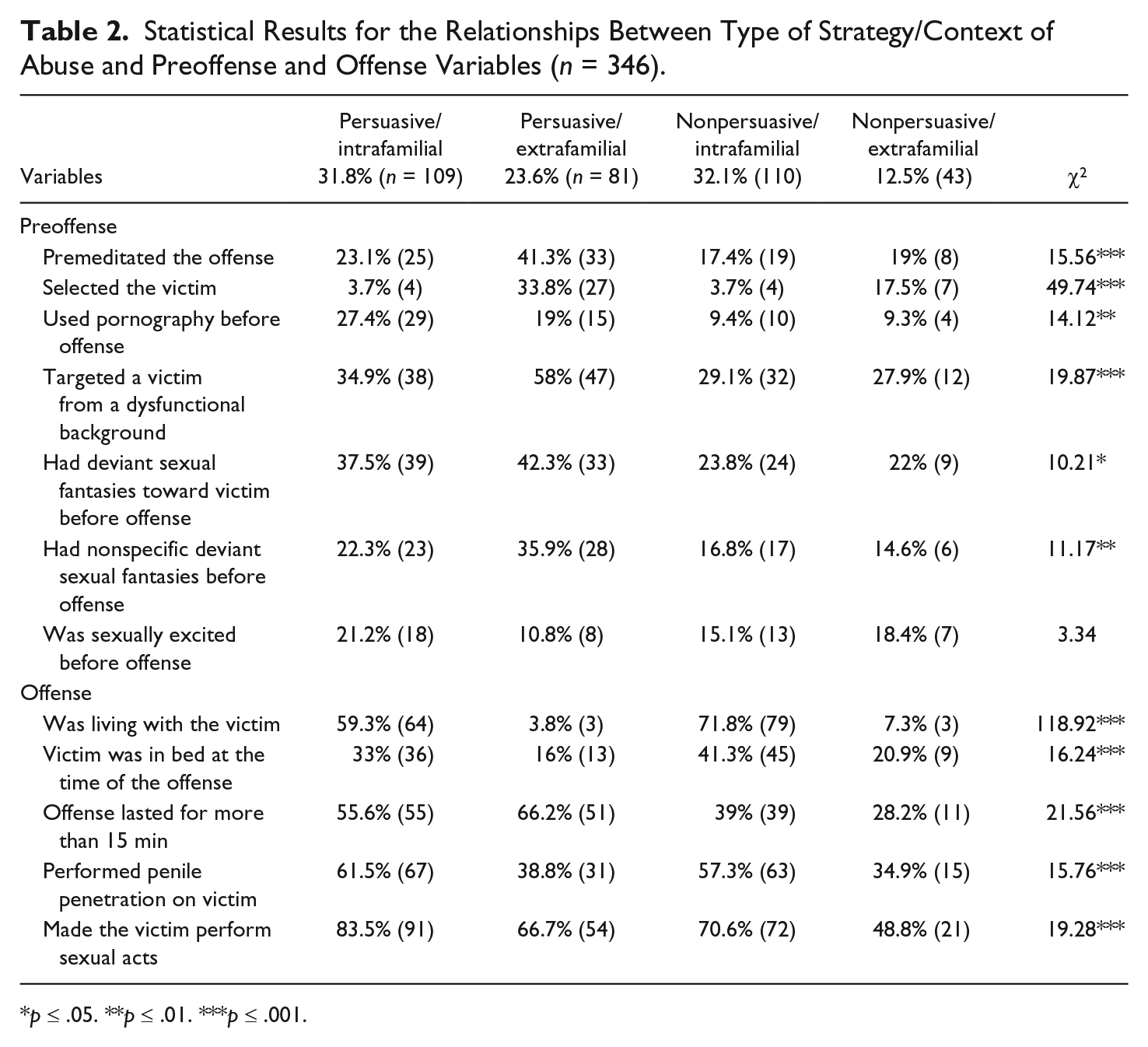
p ≤ .05. **p ≤ .01. ***p ≤ .001.
Discussion
The evidence found strongly suggests that child sexual offending committed through nonpersuasion may be best characterized by opportunistic offending in time and space even though a number of cases may have involved premeditation or victim selection for instance. As we noted in the “Introduction” section with a number of illustrations, an offender may plan to sexually abuse a child at a particular time but abuse that child (or another child) at another time using nonpersuasion as an unexpected opportunity for sexual contact arose. Overall, compared with offenses committed through persuasion, those committed through nonpersuasion are unlikely to be characterized by premeditation, victim selection, the abuse of a victim from a dysfunctional background, the use of pornography before the offense, and the presence of nonspecific or specific deviant sexual fantasies before the offense. Nonpersuasive offenses are also less likely to be characterized by intrusive sexual activities and a long duration of these activities. In addition, these offenses are more likely to involve a victim living with the offender at the time of abuse or be perpetrated when the victim is in bed. All the characteristics related to the type of strategy point to the same conclusion, namely, that opportunistic child sexual offending is likely characterized by the use of nonpersuasion to involve victims in sexual activities. In a nutshell, the use of nonpersuasion to sexually abuse a child may be more likely when unexpected opportunities are encountered.
Based on these findings, and going back to Wortley and Smallbone’s (2006) typology, offenders who adopted nonpersuasion to commit their offense fit nicely with the opportunistic offender. However, in this typology, offenders are not restricted to one type of offense. For instance, predatory offenders, by definition, are also likely to commit opportunistic offenses, which could be the case for some offenders in the current sample. The critical point, as Wortley and Smallbone pointed out, is that opportunistic offending is driven by the offending circumstances even though the offender also plays a role. This suggests that a close examination of the situation is critical to determine what best characterizes opportunistic child sexual offending, which is exactly in line with the work of Kaufman (Kaufman, Mosher, Carter, & Estes, 2006; Kaufman, Tews, Schuett, & Kaufman, 2012) for instance completed to provide guidelines to practitioners and policy makers for situational prevention purposes and the emergent area of situational prevention in child sexual offending (e.g., Leclerc, Chiu, & Cale, 2016).
Examining the interaction between the type of strategy and the context of abuse across preoffense and offense variables has provided insights into opportunistic child sexual offending. For instance, compared with the persuasive/extrafamilial group, the persuasive/intrafamilial group was less likely to be characterized by premeditation and victim selection. Moreover, a severe sexual offense (i.e., the performance of penile penetration by the offender or the performance of sexual acts by the victim) was more likely to occur within an intrafamilial context and less likely to characterize nonpersuasive offending. This result suggests that the context of abuse is also key to capturing under which circumstances nonpersuasion is more likely to be adopted. Overall, the findings of this study also provide evidence that the use of nonpersuasion within an intrafamilial context may best describe opportunistic child sexual offending.
Not only does this study clarify our understanding of child sexual offending but it provides additional evidence for the power of the situation that shapes child sexual offending behaviors. In turn, this study brings the relevance of SCP to light. Child sexual abuse is likely to be committed through nonpersuasion under opportunistic circumstances. Immediately this reality taps into the person–situation interaction principle of SCP and the dynamic nature of situations and opportunities to offend. The role of opportunity is critical as opportunities may encourage individuals to commit an offense even though they had not planned to do so in the first place, or did plan to commit an offense but at a different time and space, or against a different victim, or, in other words, under different circumstances. This reality also implies that an offender does not need to manipulate or coerce a potential victim to obtain sexual contact, that is, a simple criminal opportunity can be sufficient for sexual abuse to occur—Almost half the sample (44.8%) used nonpersuasion to commit their most recent abuse. The situation will thus shape, to some extent, what the offender can or cannot do with a particular child based on the context of abuse. For instance, on one hand, offenders who used nonpersuasion, compared with offenders who adopted persuasion, were those less likely to make the victim perform sexual contacts on them. On the other hand, offenders who used nonpersuasion within an intrafamilial context were more likely to make the victim perform sexual contacts on them than those who adopted nonpersuasion with an extrafamilial victim.
To our knowledge, empirical evidence on which SCP strategies work and which do not for preventing child sexual offending under different contexts is currently inexistent (see Wortley & Smallbone, 2006). However, from a theoretical point of view, this study brings additional evidence that SCP is promising to prevent child sexual abuse—This in itself makes a contribution to the literature as disseminating the potential of SCP to prevent sexual offending is critical. The importance of criminal opportunities, that is, the various circumstances under child sexual abuse can occur, indicates that the five strategies of SCP, that is, increasing the risks, increasing the efforts to commit an offense, reducing the rewards associated with crime, reducing provocations, and removing excuses related to crime, represent potential options for preventing this phenomenon. The first three strategies are aimed at reducing criminal opportunities and the last two strategies focus on controlling factors that may precipitate an individual to commit an offense. These factors may include the use of pornography and sexual arousal. Designing both types of strategies implies targeting both the person and the situation simultaneously, which would represent the ideal context to allow for SCP to best reduce opportunities for child sexual abuse. Cornish and Clarke’s (2003) table of situational prevention techniques offers 25 techniques that may be applicable under different circumstances.
In light of SCP measures that may be applicable to sexual offending against children, Wortley and Smallbone (2006) demonstrated the potential of looking at reducing offending opportunities through Cornish and Clarke’s (2003) table of 25 techniques for preventing this crime (see also Leclerc, Wortley, & Smallbone, 2011). Examples of measures to prevent child sexual offending in youth-oriented organizations provide a good illustration of what could potentially be done (see also Leclerc & Cale, 2015; Leclerc et al., 2005). Training sessions for parents on modus operandi and the context of abuse could be offered. Staff could be involved in designing rules that regulate staff and child interactions. Opportunities for staff/teachers/families to discuss potentially inappropriate behaviors should be put in place in these organizations. Rules that regulate staff and child interactions (e.g., require two staff members to be present in unsupervised areas or to go to an overnight trip with a group of children) should be designed and applied rigorously. The main aspect to recall from the current study from a situational perspective is the high prevalence of nonpersuasion, which is typically adopted under a set of circumstances that arose unexpectedly—This observation taps into the relevance of ensuring a better surveillance of potential victims and victim-rich environments in the first place, redesigning the immediate physical environment to limit offending opportunities, and limiting those same opportunities by controlling crime precipitators.
Some potential limitations can be identified in this study. First, as our sample was composed of incarcerated offenders, our results may not be representative of all sexual offenses against children. For instance, incarcerated offenders who have used nonpersuasion may be more likely to be arrested because of a lack of offending skills. Second, the present study is based on self-reported data, which means that some findings may be biased by offenders’ cognitive distortions or voluntary falsification. Per example, it is possible that some offenders, to present a positive image of themselves, reported that they adopted nonpersuasion to sexually abuse a child when in fact they used persuasive strategies such as manipulation or coercion. Despite these potential issues, the nuance between nonpersuasive and persuasive strategies can arguably be best captured through investigating crime commission with offenders themselves (see Jacques & Bonobo, 2017).
Conclusion
This study on the use of nonpersuasion in child sexual offending and its preoffense and offense correlates addresses a topic rarely investigated with empirical data. At the same time, this study is a preliminary investigation into an area where much remains to be done—Situations in which sexual offending takes place are numerous and pretending to cover all these situations could be a mistake. In light of the findings, we argue that one revealing contribution from this study is the focus on sexual offenses against children committed without the use of manipulation or coercion, that is, through nonpersuasion. One cannot assume that sexual offenders establish a manipulative relationship with children for obtaining sexual contact. The use of nonpersuasion is common and encapsulates situational factors that are best representative of opportunistic offending. Numerous empirical studies indicating that sexual offenders are manipulating their victims for sexual contact have been conducted previously. On the contrary, empirical studies demonstrating the opportunistic nature of this phenomenon are scarce. The lack of empirical research on the latter may lead policy makers to overlook this reality and other potential ways to prevent this phenomenon or inform prevention initiatives. As pointed out in the “Introduction” section, the concept of nonpersuasive strategy may seem superfluous in the first place, vague or abstract, but the nuance it brings to the nature of offending behaviors is relevant to reveal the importance of the situation during which sexual offenses against children occur and tap into the role of offending opportunities.
By providing evidence-based knowledge on the use of nonpersuasion and opportunistic sexual offending against children, this study also brings the potential of SCP to light. From an SCP perspective, future studies should focus on examining the interaction between offender characteristics and the different situations into which these offenses occur much in line with Wortley and Smallbone’s (2006) conceptualization of child sexual offending. This exercise will enrich current evidence now being accumulated in this field for prevention purposes (e.g., Leclerc et al., 2016; Leclerc et al., 2011; Wortley & Smallbone, 2006) and ultimately provide sufficient evidence-based knowledge to develop models of prevention to further guide prevention practices.
Footnotes
Declaration of Conflicting Interests
The author(s) declared no potential conflicts of interest with respect to the research, authorship, and/or publication of this article.
Funding
The author(s) received no financial support for the research, authorship, and/or publication of this article.