



Abstract
Response inhibition is defined as one’s ability to voluntarily override an automatic or already initiated action when that action is inappropriate. Although a core mechanism of self-control, its association with sexual coercion perpetration and the impact of erotic cues on its exertion remain unknown. According to a domain-specific perspective on impulsivity, response inhibition performances should be disproportionately hindered by sexual cues in sexual coercion perpetrators. In total, 94 male college students completed a stop-signal task that included neutral, emotional, and erotic distracters. Results showed that men who reported past use of sexual coercion obtained overall poorer stop-signal task (SST) performances. Highly arousing sexual stimuli equally hindered the performances of perpetrators and non-perpetrators, whereas moderately arousing sexual and nonsexual positive stimuli did not significantly affect performances. Results do not support a domain-specific perspective on the link between response inhibition and sexual coercion, but rather suggest generally poorer inhibitory control among sexual coercion perpetrators.
Introduction
Sexual coercion refers to all types of sexual contact, with or without penetration, that are imposed on a non-consenting partner through the use of physical force, victim intoxication, position of authority, or verbal pressure (DeGue & DiLillo, 2005). Thus, it refers to a wider array of behaviors than sexual offenses alone, including behaviors that would not meet the legal definition of sexual aggression, such as overwhelming a non-consenting partner with arguments until he or she complies (Benbouriche & Parent, 2018). When all types of coercion, including verbal pressure, are considered, rates of sexual coercion perpetration in student samples range from 10% (Kennair & Bendixen, 2012) to 58% (Zawacki, Abbey, Buck, McAuslan, & Clinton-Sherrod, 2003), with higher perpetration rates among men, and higher victimization rates among women (Bergeron et al., 2016). Considering verbal coercion when studying sexual assault in student populations is of particular importance because it is the strategy most often used (Abbey & Jacques-Tiura, 2011).
Identifying the individual characteristics that are related to sexual coercion perpetration in men represents an important step toward the prevention of sexual violence in the general population. Although the present study is interested in sexual coercion, as opposed to sexual crimes, the scientific literature pertaining to sex offenders is relevant to formulate hypotheses about such individual characteristics. Lifestyle impulsivity is a known predictor of sexual reoffending in sex offenders (Hanson & Harris, 2001; Mann, Hanson, & Thornton, 2010). In fact, the general theory of crime asserts that impulsivity is the primary individual characteristic that distinguishes criminals from noncriminals, whether their crimes are sexual in nature or not (Gottfredson & Hirschi, 1990). In addition, the self-regulation model of sexual aggression (Ward, Hudson, & Keenan, 1998) postulates that sexual offenders vary in their level of self-control and in the types of strategies they use to achieve their sexually aggressive goals. For some offenders, the problem would occur in the formulation of goals deemed inacceptable by society—sexual aggression—and for others, the problem would be rooted in self-control deficiencies. Several factors are thought to be implicated in offenders’ lack of self-control, including neuropsychological deficits (Ward & Beech, 2006).
Dual system models of self-control conceptualize impulsivity as an imbalance between bottom-up and top-down processes, namely between the impulse to perform a behavior and the mechanisms that allow the inhibition of that behavior (Hofmann, Friese, & Strack, 2009). Response inhibition refers to the capacity of an individual to voluntarily override an automatic or already initiated action (Bari & Robbins, 2013). Shortcomings in response inhibition are thought to contribute to impulsive and inappropriate behaviors, but this hypothesis has not been extensively tested in the domain of sexuality (Lawyer & Mahoney, 2017; Nydegger, Ames, Stacy, & Grenard, 2014).
Impulsivity, Response Inhibition, and Sexual Coercion
Lifestyle impulsivity (i.e., general manifestations of impulsivity such as job instability and drugs use) is an empirically supported risk factor for sexual offending and reoffending (Hanson & Harris, 2001; Mann et al., 2010). However, merely knowing that men who perpetrate sexual crimes tend to lead a generally unstable lifestyle provides little information about the contexts in which such individuals make impulsive choices nor into their cognitive deficits. Laboratory tasks have the advantage of directly measuring behavior in a controlled setting—thereby minimizing self-presentation and memory biases—and allowing the comparison of performances across different cognitive functions, life domains (e.g., substance use, finances, sexuality), and emotional states (Rochat, Billieux, Gagnon, & Van der Linden, 2018).
One of the neurocognitive mechanisms that enables self-control is response inhibition: the ability to interrupt or delay an automatic action triggered by external or internal stimuli (Verbruggen, Best, Bowditch, Stevens, & McLaren, 2014). This core cognitive function is learned very early in life and consolidates with brain maturation in adolescence and young adulthood (Jones, Rothbart, & Posner, 2003; Luna & Sweeney, 2004). Response inhibition is required in everyday life as it allows individuals to suppress inappropriate responses. Two tasks are specifically designed to measure response inhibition in laboratory settings: the go/no-go task and the stop-signal task. Go/no-go tasks typically involve two categories of stimuli: go stimuli (e.g., a circle), to which participants have to respond in a specific way (e.g., press a response key), and no-go stimuli (e.g., a square), to which participants have to refrain from responding. The stop-signal task could be described as an elaborate version of the go/no-go task that involves stopping the action triggered by the presentation of a go stimulus (e.g., a circle) when a “stop-signal” (e.g., a beep) is presented. Thus, it requires the suppression of an already initiated approach response in favor of a controlled avoidance one. The variable of interest here is the stop-signal reaction time: an index of inhibitory control that can be estimated from mean reaction time on go trials and the percentage of inhibition errors (Verbruggen et al., 2014).
Although several other individual (e.g., psychopathic traits; Abbey & Jacques-Tiura, 2011), social (e.g., gender inequality; Yodanis, 2004), and contextual (e.g., alcohol consumption; Abbey & Jacques-Tiura, 2011) factors are associated with the perpetration of sexual coercion, response inhibition might be important in the process of stopping sexual approach behaviors when faced with a sexual refusal. A meta-analysis by Joyal, Beaulieu-Plante, and de Chanterac (2014) concluded that sex offenders display deficits in executive functioning, including response inhibition. That said, to the best of our knowledge, no study has investigated response inhibition performances in male students who report having used sexual coercion.
Response Inhibition in Sexual Contexts
Individuals who report engaging in risky and out of control sexual behaviors tend to present lower inhibitory control (Leppink, Chamberlain, Redden, & Grant, 2016; Nydegger et al., 2014). These results are somewhat equivocal, as Lawyer and Mahoney (2017) found no association between performances on a standard stop-signal task and sexual risk-taking. It may be that individuals who present problematic sexual behaviors display response inhibition deficits specifically in sexual contexts that are not adequately captured by standard laboratory tasks.
Sexual arousal has been found to increase the likelihood of endorsing risky and morally questionable sexual behaviors (Ariely & Loewenstein, 2006; Imhoff & Schmidt, 2014), of using sexually coercive strategies in a hypothetical scenario (Bouffard & Miller, 2014), and of endorsing attitudes that support violence against women (though only in men low in agreeableness; Hald & Malamuth, 2015). Therefore, sexual arousal may act as a disinhibiting factor promoting immediate gratification despite its incompatibility with distal goals and personal values (e.g., sexual health and mutually satisfying relationships). With regards to response inhibition specifically, when erotic stimuli are presented to male participants before a target stimuli, their performances worsen compared with when neutral stimuli are presented (Yu et al., 2012), which further supports the importance of testing the impact of sexual cues on response inhibition.
Sexual Interference and Domain Specificity
Domain specificity proposes that individuals who engage in problematic behaviors in one domain of their life will be more likely to display impulsive behaviors when confronted with stimuli that evoke the problematic life domain (Mahoney & Lawyer, 2018; Tsukayama, Duckworth, & Kim, 2012). Thus, domain specificity would predict that the deleterious effect of presenting sexual cues before an inhibition task would be particularly pronounced in men who engage in problematic sexual behaviors, such as sexual coercion. A few research findings suggest that this might be the case. For example, sexual offenders tend to have poorer performances than non-offenders and violent nonsexual offenders on a sexual version of a cognitive inhibition task (i.e., Stroop; Smith & Waterman, 2004). Also, Yoon and Knight (2011) explored perceptual biases in the processing of sexual information in 36 non-forensic males, 16 who reported having perpetrated sexual violence and 20 who did not. Their results showed that sexually coercive males displayed longer response latencies in performing a cognitive task when they were required to disengage their visual attention from sexual pictures. Neither Yoon and Knight (2011) nor Yu et al. (2012) used other emotional stimuli in their studies; therefore, it is impossible to determine whether it is the sexual content of the stimuli that interfered with performances or if any emotional stimuli evoking similar valence and arousal would have produced the same effect. Indeed, experimental studies have shown that the presentation of emotional stimuli, both as target stimuli and as distracters, interfere with one’s capacity to withhold automatic responses (Herbert & Sütterlin, 2011; Pessoa, Padmala, Kenzer, & Bauer, 2012; Rebetez, Rochat, Billieux, Gay, & Van der Linden, 2015; Verbruggen & De Houwer, 2007). However, there are inconsistencies concerning the role of emotional valence. Some studies have found that positively valenced stimuli cause weaker interference than negatively valenced ones (Rebetez et al., 2015) whereas others have found the opposite (Herbert & Sütterlin, 2011; Verbruggen & De Houwer, 2007). Pessoa et al. (2012) even found performance enhancement following the presentation of both positive and negative stimuli.
Current Study
The first goal of the current study was to investigate the relationship between response inhibition and sexual coercion perpetration by comparing stop-signal task performances of male college students who reported having used a form of sexual coercion since the age of 14 years with others who did not. The second objective was to test domain specificity assumptions by comparing the impact of erotic stimuli on the stop-signal task performances of both groups. The task used in the present study comprised four different conditions: neutral, positive, erotic with low arousal (EroLow), and erotic with high arousal (EroHigh). The rationale for the inclusion of the positive and low arousal erotic conditions was to control for the effect of valence and intensity to isolate sexual context as a variable. All participants were expected to perform more poorly in the emotional and sexual conditions than in the neutral condition. A purely domain-specific perspective would predict that sexual coercers’ stop-signal reaction times would be longer than non-coercers’ only in the EroLow and EroHigh conditions. A middle ground perspective would predict that sexual coercers would obtain longer stop-signal reaction times in all conditions compared with non-coercers, but that these differences would be larger in the EroLow and EroHigh conditions. Finally, a generalist perspective on response inhibition would predict that sexual coercers would obtain poorer performances in all conditions without any interaction between group and condition.
Method
Participants
In total, 101 male students from three universities in the city of Montreal participated in the study for monetary compensation. They were recruited through online ads and posters displayed on three university campuses to participate in a larger research project on male sexuality. Inclusion criteria were as follows: (a) being between 18 and 35 years of age, (b) being sexually active, (c) identifying as predominantly heterosexual, (d) being able to read French with ease, and (e) having no past history of psychosis or hallucinations. Seven participants were excluded from further analyses: one because of missing data, two because they did not attend the laboratory session, and four due to their high error rate on stop trials of the stop-signal task (more than 3 standard deviations [SDs] from the mean). The final sample consisted of 94 participants aged between 19 and 34 years (M = 22.6 years, SD = 3.2 years). The recommended sample size to detect a small to medium effect size ( = .03) at a .80 statistical power in a 2 x 4 within-between interaction is 70 participants; therefore, the sample of this study was considered adequate (Faul, Erdfelder, Buchner, & Lang, 2009). Overall, 47 participants were currently in a committed romantic relationship, 43 were single, and 4 were married. Participants identified as exclusively heterosexual (95.7%) or predominantly heterosexual (4.3%). The majority identified as being of North American (40.4%) or European origins (38.3%), and the others identified as being of African (4.3%), Asian (2.1%), Arab (2.1%), Latino (5.3%), or Other (7.5%) descent.
Measures
Sexual Experiences Survey (SES)
The SES is a 16 items self-report measure that assesses the use of coercive sexual behavior since the age of 14 years (Brousseau, Bergeron, Hebert, & McDuff, 2011; Koss & Gidycz, 1985). The SES is one of the most widely used self-report measure of sexual coercion (Testa, Hoffman, Lucke, & Pagnan, 2014). The items combine one of three sexual outcomes (i.e., unwanted sexual contacts, attempted penetration, and intercourse) to one of four coercive strategies (i.e., verbal pressure, position of authority, victim’s intoxication, and physical force). As in Brousseau et al. (2011), the item assessing the use of physical force to obtain oral or anal intercourse was separated into two distinct items. Verbal strategies included arguing and pressuring, lying about feelings and threatening to leave one’s partner. For each item, participants indicated whether they had ever engaged in the behavior described to obtain a sexual outcome with a non-consenting partner, generating 16 yes or no answers. In the current study, participants who reported any coercive sexual behavior were categorized as sexual coercion perpetrators (n = 51), whereas participants reporting no use of sexual coercion were categorized as non-perpetrators (n = 43). Among perpetrators, the vast majority reported having used verbal pressure (98.0%), with some also reporting the use of authority (3.9 %), victim intoxication (7.8%), and physical force (9.8%). Perpetrators reported that the contacts obtained included intercourse (64.7%), attempted penetration (7.8%), and sexual contacts (94.2%). Some participants reported more than one strategy and type of contact. The rates found in the present sample fall between those obtained by Brousseau et al. (2011; 40.5% of a student sample) and by Abbey, Parkhill, Clinton-Sherrod, and Zawacki (2007; 64% of a community sample).
Stop-signal task
The stop-signal task that we used was adapted from Verbruggen and De Houwer (2007). It comprised two distinct phases: a training phase and a test phase. The experiment was coded and conducted using E-Prime® 2.0. Stimuli were presented on a 1,920 x 1,080 pixel resolution computer screen placed in front of the participants. Responses were collected using a keyboard placed on the desk within reaching distance. The stimuli of the primary task were “<<” or “>>.” The letter “X” served as fixation sign.
In total, 160 pictures were used to create four sets of 40 stimuli, one per experimental condition: Neutral, Positive, EroLow, and EroHigh. The EroHigh condition was intended to generate higher arousal ratings than the three other sets and higher valence ratings than the Neutral set. When possible, stimuli were pictures retrieved from the International Affective Picture System (IAPS; Lang, Bradley, & Cuthbert, 2008). However, the number of erotic pictures comprised in the IAPS was insufficient to build two different sets of erotic stimuli. Also, the nonsexual positive pictures included in the IAPS were not sufficiently arousing to create a set that could match the arousal generated by the erotic pictures. Therefore, the Neutral set was entirely derived from the IAPS, but the Positive, EroLow, and EroHigh sets were created using, respectively, 34, 23, and 40 free-access pictures retrieved from the web. Prior to this study, we pretested in an online survey a subsample of pictures derived from both the IAPS and the web to determine criteria that would guide the creation of the stimuli sets. It was determined that (a) Neutral stimuli would depict inanimate objects and people with neutral facial expressions, (b) Positive stimuli would depict palatable foods and individuals displaying happy facial expressions or engaging in exciting nonsexual activities (e.g., snow-boarding, skydiving), (c) EroLow stimuli would depict one man and one woman engaging in consensual sexual contacts with no visible genitals, and (d) EroHigh stimuli would depict one man and one woman engaging in consensual sexual contacts with visible genitals. For each picture set, two subsets were created: eight pictures to be presented in the training phase of the stop-signal task (four times each) and 32 to be presented in the test phase (four times each, twice per block).
The training phase included a choice reaction task training of 48 go trials and a stop-signal training of 48 trials (40 go trials, 8 stop trials). Go trials started with a fixation cross presented for 500 ms, followed by the presentation of a picture for 500 ms. Immediately after the picture disappeared, the target stimulus (“<<” or “>>”) appeared on a blank screen. Participants then had to indicate as quickly as possible whether the target stimulus was “<<” or “>>” by pressing the “c” or “n” key, respectively. The procedure of the stop trials was the same as the go trials with one exception: a loud auditory stop-signal was emitted after the presentation of the target stimulus, indicating to participants that they had to refrain from pressing any key. In the stop-signal training phase, the delay between the presentation of the target stimulus and the emission of the stop-signal (i.e., stop-signal delay) was fixed between 150 ms and 250 ms. In total, 24 pictures (eight Neutral, eight Positive, eight EroLow, eight EroHigh) were each presented twice in a random order in both the choice reaction task training and stop-signal training. To ensure that participants understood the task, they were provided with corrective feedback after each mistake during the training phase. At the end of the training phase, a feedback screen displayed the percentage of categorization errors, the percentage of inhibition failures, and the mean reaction time. At that point, the experimenter could verify participants’ performances and emphasize the importance of maintaining both speed and accuracy throughout the task. To discourage the use of waiting strategies, participants were told that a tracking procedure would be used to adjust the stop-signal delay during the test phase, which would continuously adapt to create a 50% inhibition error rate regardless of their performance (Verbruggen & Logan, 2009).
The test phase of the stop-signal task was composed of eight blocks (two per condition) of 64 trials (48 go trials, 16 stop trials). Within a given block, each picture was presented twice in random order. One block from each condition was presented in random order before and after the mid-task break. To limit cognitive fatigue, 30-s breaks were programmed between each block, and a 2-min break was programmed after the first four blocks. The procedure for the go and stop trials was the same as in the training phase, but for staircase tracking procedure that dynamically adjusted the stop-signal delay to the participant’s performance in each block. The delay was initially set at 250 ms. If the participant failed to inhibit his response, the stop-signal delay was reduced by 50 ms in the next stop-trial; if he successfully inhibited his response, the stop-signal delay was augmented by 50 ms. This procedure has been used in previous studies (e.g., Verbruggen & De Houwer, 2007) to obtain a stop-signal delay in which the probability of stopping is 50%. To encourage speed and accuracy, participants received feedback about error rates and reaction time at the end of each block.
The mean reaction time for correct go trials was subjected to a within-participant trimming procedure, eliminating the go reaction times that were longer than 2.5 SDs above the mean (1.52% of all data). Following the recommendations of Verbruggen, Chambers, and Logan (2013), we used a block-based integration method to calculate the stop-signal reaction time: in each block, the mean stop-signal delay was subtracted from the nth reaction time of the go reaction time distribution, with n equal to the percentage of stop trials that were not successfully inhibited. The obtained stop-signal reaction times were then averaged by condition, generating four stop-signal reaction times per participant. Longer stop-signal reaction times indicate poorer response inhibition.
Picture evaluation task
To verify that the sets of stimuli had the desired properties in terms of valence and arousal, participants completed a picture evaluation task at the end of their participation. Each participant was presented with a subset of 40 pictures randomly selected from the 128 pictures used in the test phase of the stop-signal task (10 pictures per category). Using the Self-Assessment Manikin originally used to validate the IAPS (Lang et al., 2008), participants had to evaluate how 1 = unhappy versus 9 = happy and how 1 = calm versus 9 = excited each picture made them feel. For the calm versus excited scale, participants were given a list of synonyms for each word to emphasize that the arousal scale referred to general physiological arousal, not sexual arousal specifically. Each picture was evaluated by at least 19 participants. For each participant, the mean valence rating and mean arousal rating were computed for each condition.
Procedure
The current study was approved by the institutional review board of the University of Montreal. All participants were screened for the inclusion criteria mentioned and were given information about the study’s protocol during a telephone interview. Participants who accepted to participate were given an appointment for the laboratory session and received by email a secure URL link directing them to an online survey that assessed different dimensions of assessed different dimensions of personality and sexuality, including sexual coercion perpetration. The online survey had to be completed before the laboratory session in which participants completed the stop-signal task and then the picture evaluation task. The duration of their participation, including the online questionnaires, was approximately 2 hr. The tasks and questionnaires that are not relevant to the present analyses are not described in this article; data pertaining to these tasks and questionnaires have been published elsewhere (Carrier Emond, Gagnon, Nolet, Cyr, & Rouleau, 2018). Participants received a CAD35 compensation for their participation.
Results
Stop-Signal Task
Mean scores and SDs for the stop-signal task variables among each group are presented in Table 1.
Descriptive Statistics for the Stop-Signal Task.
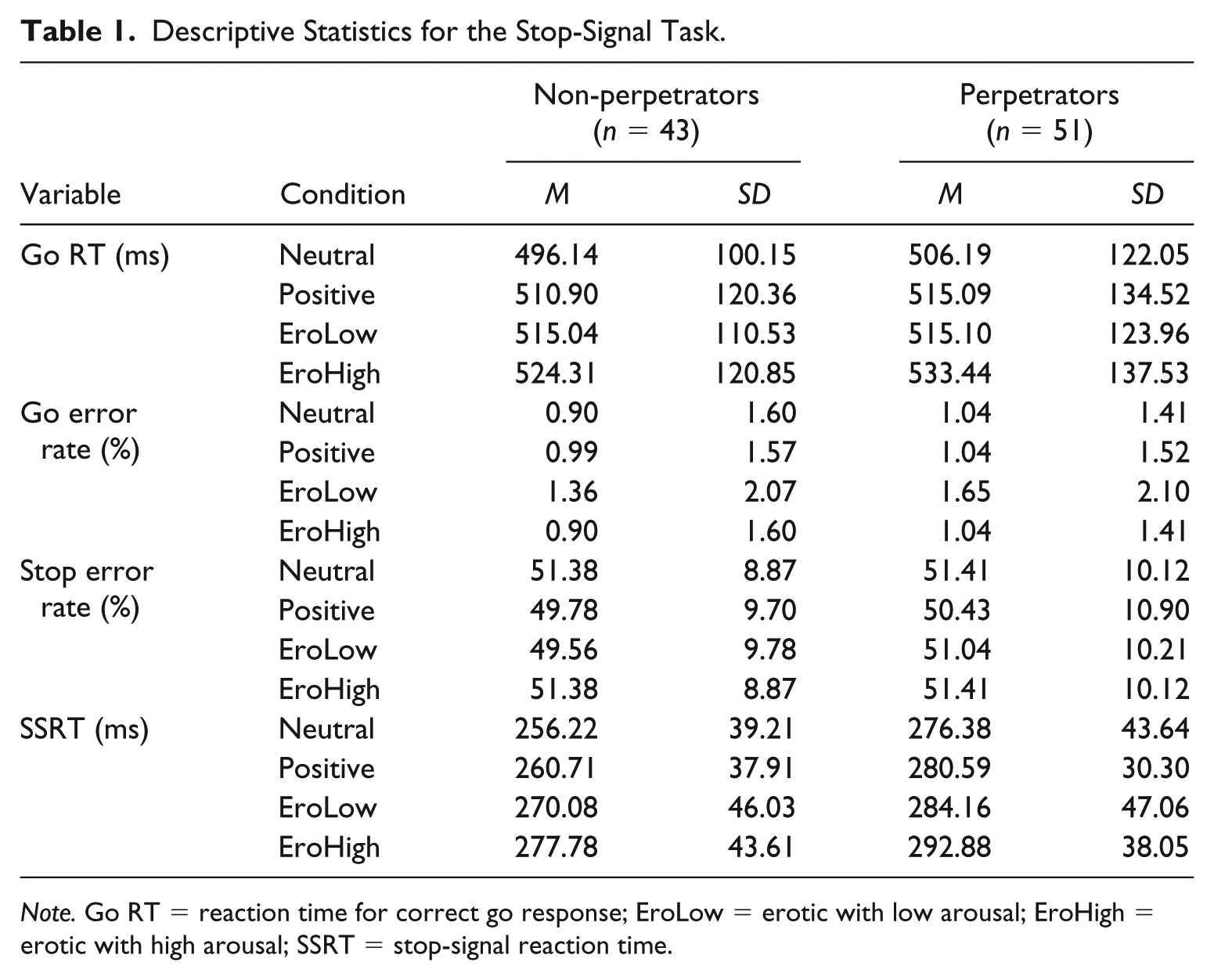
Note. Go RT = reaction time for correct go response; EroLow = erotic with low arousal; EroHigh = erotic with high arousal; SSRT = stop-signal reaction time.
Go trial reaction time
Mean reaction time on go trials is an indicator of how fast participants responded to the choice reaction task (i.e., pressing the right or left key) when inhibitory skills were not solicited. Go trials reaction times were compared using mixed-design ANOVAs with stop-signal task condition (Neutral, Positive, EroLow, EroHigh) as the within-subject factor and group (perpetrators, non-perpetrators) as the between-subject factor. This analysis was performed to ensure that perpetrators and non-perpetrators had similar processing speed, and that emotional and erotic stimuli had the desired impact on participants’ attentional processing. The analysis revealed a significant main effect of condition, F(3, 276) = 10.80, p = <.001, = .105, indicating that participants performance in the categorization task was indeed affected by the visual stimuli. Post hoc analyses with Bonferroni corrections indicated that reaction times were longer in the EroHigh (M = 529.26, SD = 129.56) condition than in the Neutral condition (M = 501.59, SD = 112.09), p < .001, Positive condition (M = 513.17, SD = 127.58), p = .005, and EroLow condition (M = 515.07, SD = 117.39), p = .02. All other paired comparisons were nonsignificant (all ps > .05). We found neither a main effect of group nor interaction between group and condition, indicating that perpetrators of sexual coercion and non-perpetrators had similar performances, that is, similar processing speed, on the choice reaction task.
Stop-signal reaction time
Turning to the analysis of inhibitory functioning, mean stop-signal reaction times were compared using mixed-design ANOVAs with stop-signal task condition (Neutral, Positive, EroLow, EroHigh) as the within-subject factor and group (perpetrators, non-perpetrators) as the between-subject factor. We found a significant group effect, F(1, 92) = 6.36, p = .013, = .07, with perpetrators of sexual coercion performing more poorly (M = 283.50, SD = 39.76) than non-perpetrators (M = 266.20, SD = 41.69). The analysis also revealed a significant main effect of condition, F(3, 276) = 8.26, p = <.001, = .082 (see Figure 1). Post hoc analyses with Bonferroni correction indicated that stop-signal reaction times were longer (poorer) in the EroHigh (M = 285.33, SD = 40.83) condition than in the Neutral condition (M = 266.30, SD = 41.43), p < .001, and Positive condition (M = 270.65, SD = 34.11), p = .002. All other paired comparisons were not significant (all ps > .05). The interaction between group and condition was not significant, F(3, 276) = 0.30, p = .824, indicating that the effect of the conditions was equal across the two groups . This last finding contradicts the domain-specific hypothesis that men who have engaged in sexual coercion would be more affected by the presentation of erotic cues than men who have not.

Mean SSRT for whole sample across SST experimental conditions.
Picture Evaluation Task
Valence and arousal ratings were compared through mixed-design ANOVAs with condition as the within-subject factor and group as the between-subject factor (see Table 2). The main purpose of these analyses was to verify that the stimuli used in the stop-signal task had the desired properties and to test if perpetrators and non-perpetrators had different subjective reactions to the stimuli. Mauchly’s Test of Sphericity was significant for both valence χ2(5) = 83.336, p < .001 and arousal ratings χ2(5) = 39.984, p < .001. A Greenhouse-Geisser correction was therefore used to adjust degrees of freedom.
Descriptive Statistics for the Picture Evaluation Task.
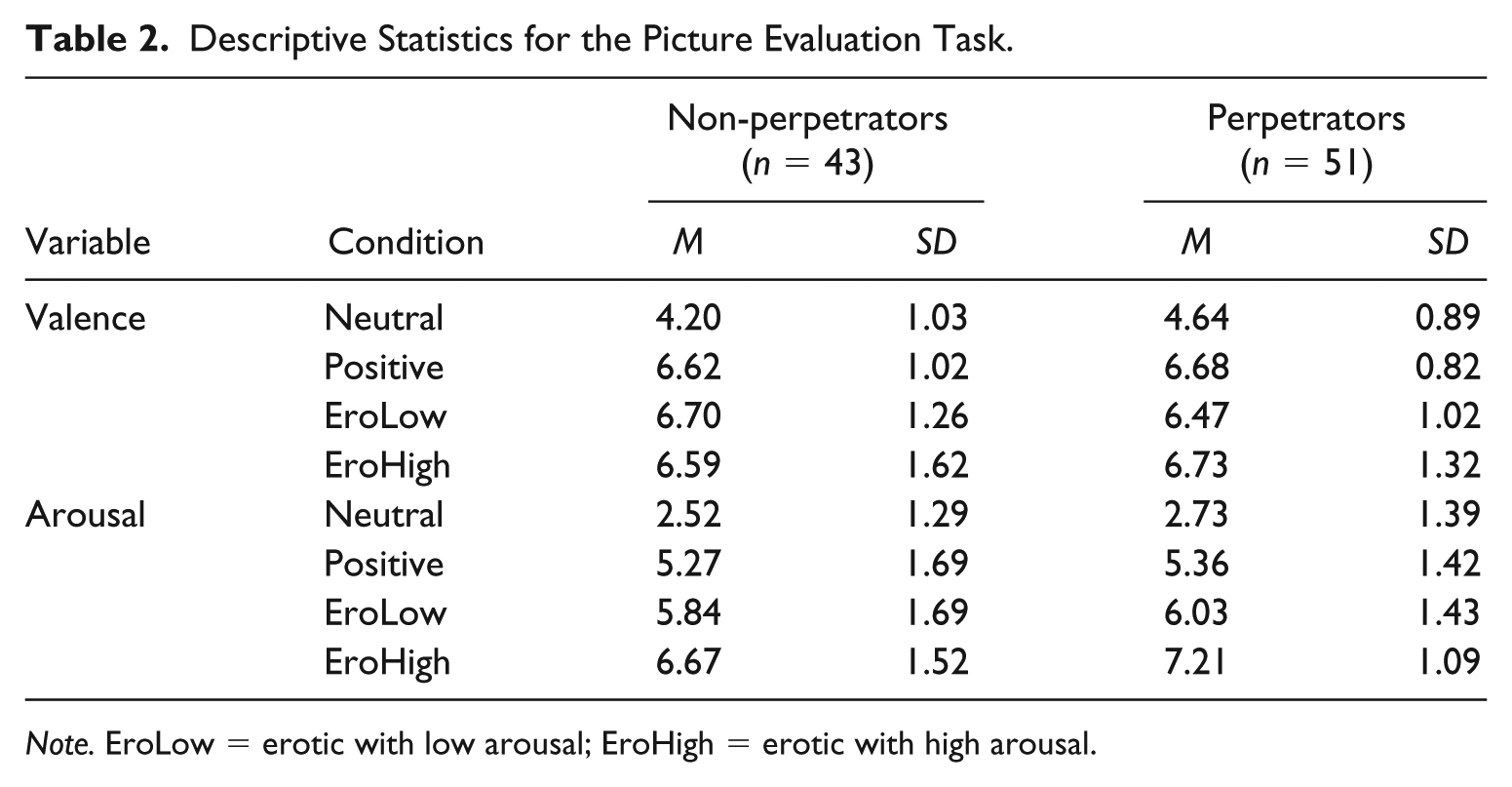
Note. EroLow = erotic with low arousal; EroHigh = erotic with high arousal.
Analyses revealed a significant effect of condition on valence, F(2.01, 185.29) = 113.597, p < .001, and arousal ratings, F(2.43, 223.65) = 260.75, p < .001. Post hoc analyses with Bonferroni corrections showed that Positive, EroLow, and EroHigh stimuli received equal valence ratings (all ps > .05), and all received higher valence ratings than Neutral ones (all ps < .001). Regarding arousal, EroHigh stimuli received the highest ratings, followed by EroLow, Positive, and Neutral stimuli (all differences were significant). Thus, we were only partially successful in creating two equivalent sets in terms of valence and arousal (i.e., Positive and EroLow). Perpetrators and non-perpetrators of sexual coercion neither differed in valence nor arousal ratings as indicated by the nonsignificant main effect of group and nonsignificant interaction between group and condition.
Relationships Between Stop-Signal Reaction Time and Picture Evaluation
Bivariate correlations between stop-signal reaction times, valence and arousal ratings for each condition were performed to test if participants who found visual stimuli more pleasant or more arousing also displayed poorer performances in emotional and erotic conditions of the stop-signal task. This was not the case as all relevant correlations were nonsignificant (all ps > .05).
Discussion
The objectives of this study were to compare the inhibitory skills of self-reported perpetrators of sexual coercion to those of non-perpetrators in a student sample using a stop-signal task, and to determine whether their performance would be specifically worse when presented with sexual stimuli. Our main finding was that perpetrators of sexual coercion performed more poorly than non-perpetrators regardless of the condition. The presentation of sexual content did impede on their performance, but not more than non-perpetrators. Follow-up analyses on the main effect of condition showed that only highly arousing sexual stimuli significantly impaired response inhibition in our sample.
Regarding the main effect of group, our results suggest that male college students who declared having used sexual coercion in the past displayed poorer response inhibition performances than non-coercers, whether they were presented with erotic images or not. Furthermore, we found that coercers could not be distinguished from non-coercers on the basis of their performance on the decision task (go trials) or their appraisal of sexual stimuli: they solely performed more poorly on stop trials. A similar group effect was obtained by Pawliczek et al. (2013) who found that aggressive men achieved slower stop-signal reaction times than nonaggressive men, whether the target of the decision task involved angry or neutral faces. Thus, poor response inhibition may be a common feature of both aggressive and sexually coercive behaviors.
While our group effect was analogous to Pawliczek et al.’s (2013), sexual stimuli hindered response inhibition in ours whereas anger cues enhanced it in theirs. It is possible that erotic stimuli evoke stronger approach motivation which could challenge inhibitory skills, whereas angry faces might prompt a freezing response, which could facilitate inhibition (Algom, Chajut, & Lev, 2004; Chajut, Mama, Levy, & Algom, 2010). Although theoretically appealing, the freezing hypothesis has been contradicted by several studies demonstrating impaired inhibition after the presentation of angry faces and threat-relevant stimuli such as snakes (e.g., Lindstrom & Bohlin, 2012; Rebetez et al., 2015). Alternatively, differences in stop-signal task methodologies could explain these conflicting results. In the present study, erotic stimuli used as distracters were presented 2,000 ms before the target of the task, whereas Pawliczek et al. (2013) used angry faces as the target of their task (i.e., a yellow frame surrounding the neutral or angry faces). Electrophysiological studies have shown that the processing of emotional content unfolds in different stages over time (see Schupp, Flaisch, Stockburger, & Junghöfer, 2006, for a review) and that the impact of emotional stimuli may only become deleterious after a certain delay (Herbert & Sütterlin, 2011). This might explain why studies presenting emotional stimuli before target stimuli systematically find slowing effects (De Houwer & Tibboel, 2010; Kalanthroff, Cohen, & Henik, 2013; Patterson et al., 2016; Verbruggen & De Houwer, 2007; Yu et al., 2012) and why studies with emotional targets produce mixed results (Herbert & Sütterlin, 2011; Lindstrom & Bohlin, 2012; Pawliczek et al., 2013; Pessoa et al., 2012; Rebetez et al., 2015; Schulz et al., 2007; Song et al., 2016).
Contrarily to hypotheses derived from domain-specific perspectives on impulsivity, the impact of sexual stimuli did not differ between sexual coercion perpetrators and non-perpetrators. This finding is in contrast with studies reporting sexually specific phenomena using a delay discounting task (Carrier Emond et al., 2018), a Stroop task (Smith & Waterman, 2004), and a cognitive interference task (Yoon & Knight, 2011). It may suggest that only some cognitive functions are specifically influenced by sexual content in sexually coercive men and that response inhibition is not one of them. This does not necessarily mean that sexual content does not increase the risk of inhibition failures in everyday life; perpetrators performances were no more affected by the presentation of sexual stimuli than those of non-perpetrators, but in their case, the slowing was combined to an already poorer stop-signal reaction time at baseline (in the neutral condition). The clinical threshold at which slower inhibition becomes a risk factor for the enactment of problematic behaviors is unknown. If stop-signal task procedures were standardized and normative data were available, we might better understand the implications of the present results by identifying which participants in which conditions performed below a validated clinical threshold.
Given that we used a repeated-measure design, it is possible that some participants were less sensitive to the impact of the moderately arousing stimuli (i.e., Positive and EroLow) after seeing the highly arousing erotic pictures. If sexual coercion perpetrators were more sensitive to such carryover effects, then their performances might have been disproportionately impacted in all conditions, thereby producing a group effect and masking any interaction between group and condition. Therefore, the interplay between sexual stimuli and response inhibition in sexual coercion perpetrators should be replicated in an independent sample design where participants would only be exposed to one condition.
Finally, we found that only the highly arousing sexual stimuli generated a significant decrease in inhibitory performances compared with the neutral stimuli. Whether this impairment was caused by the sexual content of the stimuli or by the stronger physiological arousal generated by those stimuli is unclear. On one hand, we found no significant difference between the EroLow and Positive conditions, even if EroLow stimuli were perceived as slightly more arousing than the Positive stimuli. This result suggests that sexual content did not impair performances beyond mere physiological arousal. This interpretation would be consistent with other studies having found that highly arousing visual distracters, regardless of their valence, produced slower stop-signal reaction times compared with less arousing distracters (De Houwer & Tibboel, 2010; Verbruggen & De Houwer, 2007). On the other hand, stop-signal reaction times in the EroHigh condition did not differ from those in the EroLow condition—but did differ from stop-signal reaction times in the Positive condition—suggesting that response inhibition performances were similar following the presentation of erotic cues despite differences in the arousal generated by the two conditions. The lack of significant correlations between arousal ratings and stop-signal reaction times could be seen as evidence that physiological arousal did not explain variations in response inhibition performances at the group level. However, this does not rule out the possibility of a relationship between arousal and stopping latencies at the individual level, meaning that each individual’s performances may have been more impacted by images he found more arousing. It should also be noted that the statistical power of paired comparisons in our study was low due to sample size, thus our interpretations of nonsignificant comparisons are tentative.
Limitations
The first limitation that should be considered is that our design was quasi-experimental, which implies that the links between response inhibition and sexual coercion perpetration are not causal readers should nonetheless be careful about causal assumptions. Second, most of the sexual coercers in the present sample reported having used verbal coercion, including lies and pressures, to obtain unwanted sexual contacts. There is a debate regarding several aspects of sexual coercion measurement, including whether or not verbal coercion lies on a continuum toward more severe sexual violence. In fact, studies have indicated that verbal sexual coercers share some characteristics with physical sexual coercers while also differing on other variables (Abbey et al., 2007; Camilleri, Quinsey, & Tapscott, 2009; DeGue, DiLillo, & Scalora, 2010; Zinzow & Thompson, 2015). Because all participants reporting past use of sexual coercion were collapsed into one single group, we cannot draw conclusions about the relationship between response inhibition and severity of coercive strategies. Thus, our results may be less generalizable to men who use more severe forms of sexual coercion such as physical violence and threats of harm. Replicating our study with larger samples would likely permit the creation of subgroups, including participants reporting more severe coercive strategies, which would enable more sophisticated analyses. Also, measuring the perpetration of sexual coercion since the age of 14 years may have generated noise in our data because some men may have reported acts that occurred years ago whereas others reported recent occurrences. In addition, executive functions as well as dating scripts continue to develop in early adulthood (Luna & Sweeney, 2004; White, 2009), and it is possible that different mechanisms are linked to coercive behaviors committed in adolescence compared with adulthood. Another limitation is that participants were recruited through adds specifying that the study involved exposure to erotica, therefore possibly causing sampling biases (Dawson et al., 2017). Finally, the stop-signal task used in the current study did not include a highly arousing nonsexual condition. The lack of such a condition limits the conclusions we can draw about the impact of sexual content per se. Disentangling the effect of general arousal and sexual content is challenging because positively valenced nonsexual images generate insufficient arousal to act as an effective control for highly arousing sexual images. Future studies including a highly arousing negatively valenced condition could successfully control for arousal, although reintroducing a confounding variable: valence.
Conclusion
The results of the present study suggest generally slower response inhibition performances, rather than a disproportionate interference of sexual stimuli, in male college students who reported having used sexual coercion. Although our results need to be replicated in other samples to ensure their reliability, they extend the realm of problematic sexual behaviors associated with poorer response inhibition on standard stop-signal tasks (Leppink et al., 2016; Nydegger et al., 2014).
Footnotes
Acknowledgements
The authors take responsibility for the integrity of the data, the accuracy of the data analyses, and have made every effort to avoid inflating statistically significant results. This article was prepared while the first author was supported by a doctoral scholarship from the Social Sciences and Humanities Research Council of Canada (SSHRC). The software and the participants’ compensation were funded through a service contract by the Canadian Justice Department allocated to the fourth author. We are grateful to Gaëlle Cyr, who assisted with data collection, and Alexa Larouche Wilson who provided helpful feedback on the manuscript.
Declaration of Conflicting Interests
The author(s) declared no potential conflicts of interest with respect to the research, authorship, and/or publication of this article.
Funding
The author(s) received no financial support for the research, authorship, and/or publication of this article.