




Abstract
Understanding how individuals with sexual convictions experience prison and its environment is important because such experiences can affect rehabilitation outcomes. This is the first qualitative longitudinal investigation that explores the experiences of prisoners in a prison exclusively for individuals with sexual convictions over time. The purpose of this research was to explore the rehabilitative and therapeutic climate of a recently re-rolled prison (a general prison turned into a prison only for individuals who have sexually offended) at two time points (T1 at re-roll and T2 a year later). The study focuses on prisoners’ perspectives of the purpose of the prison, experience of prison life, relationships in the prison, and the prison regime over time. Twenty interviews were conducted across the time points and revealed two main superordinate themes: “‘Being’ in a prison for individuals with sexual convictions” and “obstructions to change.” This research adds to the emerging body of knowledge surrounding the importance of the wider prison environment on the rehabilitation of individuals with sexual convictions and on the benefits and risks of co-locating men who have committed sexual offenses in the same prison site. It also has implications wider than rehabilitation of those convicted of sexual offenses and has insights for the types of environment and prisoner–staff relationships that are conducive to rehabilitation.
Introduction
The use of rehabilitative interventions for criminal offenders has expanded over the decades and with it so has evidence exploring their effectiveness in reducing recidivism (Lipton, Pearson, Cleland, & Yee, 2002). For example, although contested, research has demonstrated that through targeting specific risk factors, sex offender treatment programs (SOTPs) can reduce the number of individuals who are reconvicted for a sexual offense (Hanson et al., 2002; Lösel & Schmucker, 2005; Schmucker & Lösel, 2015). Specifically, programs which take a risk-need-responsivity approach have been found to be the most successful (Hanson, Bourgon, Helmus, & Hodgson, 2009). However, although there is much research into the risk factors of offenders and the specific changes offenders may demonstrate throughout their treatment, there is much less examining the context or situation within which treatment takes place. The prison climate (whether therapeutic or not) and the attitudes of staff in that prison play a pivotal role in successful treatment and rehabilitation of offenders. Birgden (2004) has argued that such issues constitute an aspect of responsivity, which is both underdeveloped and seldom researched. Indeed, there are growing concerns that rehabilitative programs and practices are being compromised by ineffective correctional environments (Day, Casey, Vess, & Huisy, 2012; P. Smith, Cullen, & Latessa, 2009).
At present, little is known about prison climate and its relationship with treatment processes, especially treatment gains. Conversely, a number of features in correctional facilities have been found detrimental to therapy (Woessner & Schwedler, 2014). The context within which treatment happens has been found to be more influential than actual treatment procedures (W. L. Marshall & Marshall, 2010; Schmucker & Lösel, 2015). Indeed, the empirical evidence suggests that good prison social climate, other factors being equal, likely improves the outcomes achievable through evidence-based, “What Works” rehabilitation programs (Harding, 2014). In Schmucker and Lösel’s (2015) meta-analysis on the effectiveness of sex offender treatment, there was a significant effect for community and forensic hospitals, but not for prison. This is likely due to iatrogenic “contamination effects” in the prison subculture, for example, a deferred transfer of learned contents to the world outside, difficulties during resettlement, or the experience of the prison’s climate (Schmucker & Lösel, 2015). Understanding how men who have committed sexual offenses experience prison and its environment is important because such experiences can affect rehabilitation outcomes (Blagden, Perrin, Smith, Gleeson, & Gillies, 2017; Blagden, Winder, & Hames, 2016). Evidence from the therapeutic community (TC) literature highlights the importance of context and the environment for offender rehabilitation (see, for example, Jensen & Kane, 2012; P. Marshall, 1997). Jensen and Kane (2012) found that completing a sentence in a TC had a significant effect on reducing the likelihood of rearrest for prisoners. P. Marshall (1997) conducted a large-scale evaluation of the effectiveness of TCs for men who have committed sexual offenses. In his 4-year follow-up, he found that 18% of treated offenders (with two or more previous convictions for sexual offenses) were reconvicted, compared with 43% of untreated individuals with sexual convictions. This has led some to argue that TCs, or at least environments that have an explicit therapeutic focus, are ideal for treating men who have sexually offended (Akerman, 2010; Ware, Frost, & Hoy, 2010).
A key component for any prison climate would appear to be prisoner–staff interactions. Prisoner–staff relationships matter in complex ways in prison (Liebling, Price, & Elliott, 1999). Such relationships mediate “what goes on,” and they matter to the “feel” of the prison. A positive prison climate will also promote and facilitate other opportunities to change outside of programs (Day et al., 2012). For example, peer-support roles in prison have been found to assist with desistance-based narratives and contribute to self-determination and “active citizenship” (Perrin & Blagden, 2014). Indeed, “purposeful activity” in prisons can enable offenders to make positive contributions toward their own rehabilitation (Blagden et al., 2017). Enacting peer-support roles can increase the supporters’ ability to reflect on their own circumstances and change their offending behavior and lifestyles (Parkin & McKeganey, 2000; Sirdifield, 2006; Snow, 2002). It has been argued that positive attitudes and beliefs about change in prison and prisoners are vital for fostering effective offender rehabilitation and promoting change in offending behavior (see, for example, Hogue, 1993; Kjelsberg & Loos, 2008; Lea, Auburn, & Kibblewhite, 1999). Thus, it is important for prison staff to have positive attitudes toward offenders, and this has also been found to facilitate and motivate offenders onto treatment (Lea et al., 1999). Lea et al. (1999) also found that professional attitudes were, at times, conflicted with those that worked with men convicted of sexual offenses. They highlighted the personal–professional dialectic in which conflict existed between officers feeling pressured to form relationships with “sex offenders” because of their professional duty and their personal “disgust” and “disapproval” of the offender’s crime. This they argued lead to a strong desire to avoid developing a more genuine relationship with such clients. Perhaps more alarmingly, Spencer and Ricciardelli (2017) found that Canadian correctional officers had dispositionally negative attitudes toward individuals with sexual convictions, with such individuals perceived as “disgusting” and “unworthy” of even poor conditions of confinement.
Although the broader treatment environment has received comparatively little attention, there has been some work that has focused on group or within-treatment climate. It has been argued that the location of the therapeutic intervention is a relevant issue for treatment readiness and is an aspect of external readiness in the multifactor offender readiness model (MORM; Ward, Day, Howells, & Birgden, 2004). Ward et al. (2004) argue that a pertinent location factor is whether therapy is delivered in the community or in prison. This is an example of external responsivity which is focused on the setting of treatment and staff characteristics. Staff characteristics include therapeutic alliance and other therapeutic variables that have been linked to behavior change, for example, empathy, warmth, genuineness, respect, support, therapist’s style, and self-disclosure (Serran, Fernandez, Marshall, & Mann, 2003). In short, getting the treatment setting and staff characteristics right seems crucial for establishing a climate conducive to rehabilitation (Birgden, 2004). Beech and Hamilton-Giachritsis (2005) found therapeutic climate to relate to treatment outcome and that staff attitudes and goals have an impact on treatment effectiveness. Similarly, Beech and Scott-Fordham (1997) found that the atmosphere of the treatment group had an important effect on treatment change.
Treatment satisfaction has also been considered by other researchers as a component of the group environment (Holdsworth, Bowen, Brown, & Howat, 2014), an aspect of treatment suitability (an internal determinant of treatment motivation according to Drieschner, Lammers, & van der Staak, 2004), related to engagement (Levenson, Macgowan, Morin, & Cotter, 2009). Research has found a relationship between customer satisfaction in the treatment of individuals with sexual convictions, engagement in therapy, and investment in treatment goals. Offenders in treatment value the role of group therapy and find a compassionate therapeutic style by facilitators and “good lives” concepts helpful in managing their behavior (Levenson et al., 2009).
Given the potential impact that climate and context could have on rehabilitation, there is surprisingly little research on the experiences of such individuals in prison and how they perceive their environment (Ievins & Crewe, 2015). Indeed, very little is known about the experience of individuals with sexual convictions within specialist prisons and whether these prisons are effective in producing an environment conducive to change (Woessner & Schwedler, 2014). To the authors’ knowledge, there has also been no qualitative longitudinal study that has investigated the rehabilitative climate of a prison for individuals with sexual convictions (or any) over time. This study aims to explore the qualitative changes in the rehabilitative climate of a re-rolled prison (in this case, a general prison turned into a prison only for individuals who have sexually offended) from just after the re-roll to a year later. The research will focus on the participants’ experiences of the prison, that is, its regime and climate, prisoner–staff relationships, opportunities for personal growth and development, and crucially whether these perceptions have changed over time as the prison became more established as a specialist site. Understanding such perceptions will add to current knowledge surrounding the risks and benefits associated with co-locating men who have committed sexual offenses and will illuminate the type of prison climate most conducive for the rehabilitation of men who have offended sexually. Indeed, there have been very few empirical investigations focusing on prisons that only house individuals with sexual convictions and only anecdotal evidence as to the risks of housing individuals with sexual convictions together (e.g., collusion, increased sexual deviancy). This research has a number of overarching research questions and objectives:
To understand how individuals with sexual convictions experience a prison for only that client group, the challenges they face, and the opportunities to change and whether such experiences change over time.
To investigate the perspectives of prisoners on the purpose of the prison, its regime, and climate and whether this changes over time.
Method
Participants, Recruitment, and Sampling
A qualitative longitudinal design is utilized to explore concepts of time and change within this research (McCoy, 2017). A total of 12 prisoners took part in 20 interviews using a qualitative longitudinal design (Erikson, Park, & Tham, 2010). Participant information is detailed in Table 1, including the time point they were interviewed. The age of participants in Time Point 1 ranged from 22 to 73 (M = 42.22, SD = 14.39) and in Time Point 2 ranged from 22 to 68 (M = 41.37, SD = 13.56); the ages differed very slightly due to slightly different samples in each time point.
Participant, Time Point and Treatment Information.
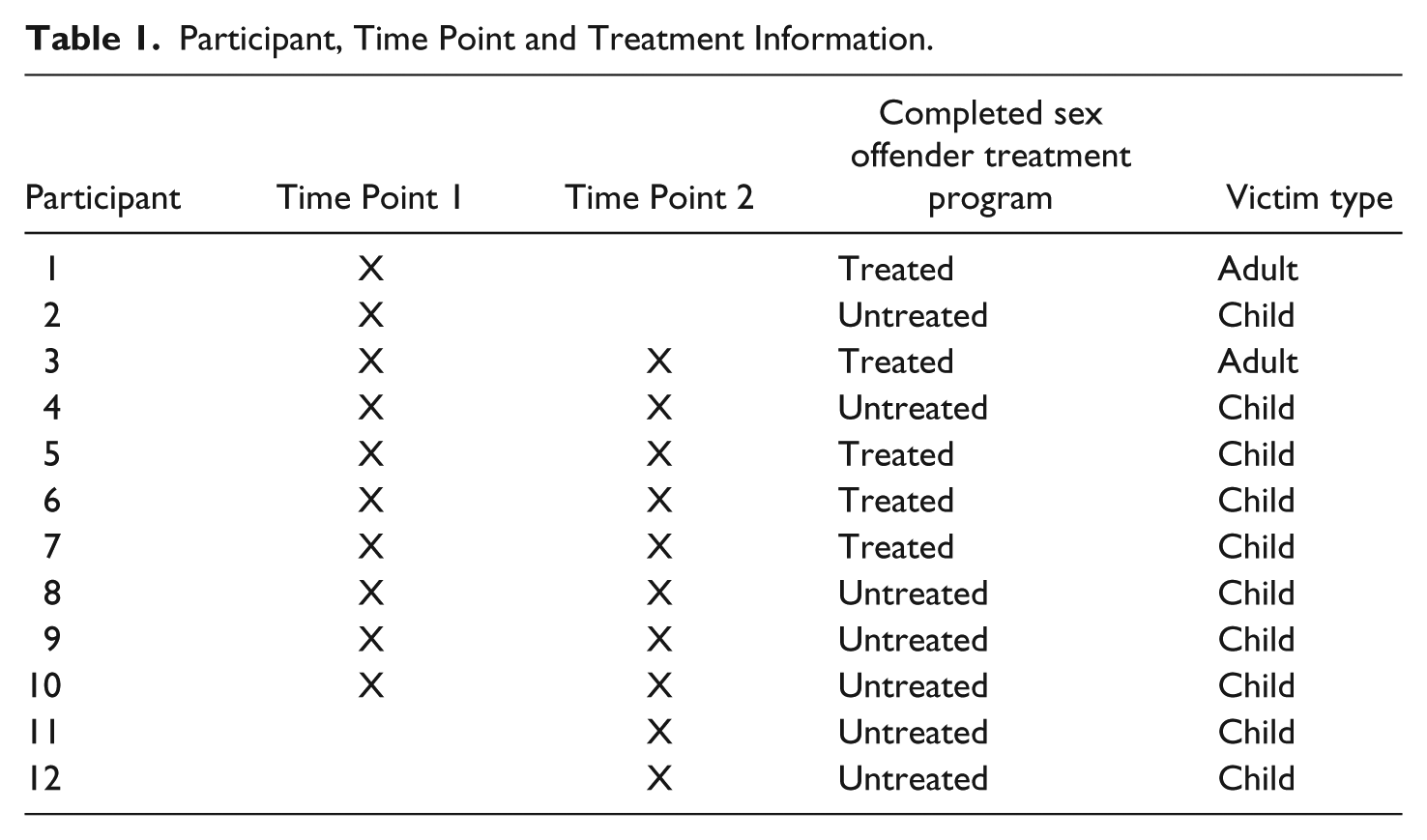
Time Point 1 was 6 months into the re-roll and Time Point 2 was approximately a year later and just over 18 months after the re-roll. Time Point 1 was chosen because although 6 months into the re-roll is early in the prison change process, it allowed enough time for the initial disruption to have settled. Time Point 2 is a year later and 18 months into the process, hence allowing enough time for systems and regimes to have become routine. Not all participants were able to participate in both phases due to the participants being transferred to other establishments or being released back into the community. Table 1 shows the participant, the time point they were interviewed, treatment status, and victim type. In total, eight participants were interviewed in both phases of the research, with an additional two participants in both Time Point 1 and Time Point 2.
As can be noted, five participants had completed the SOTP Core version, which was a prison-based cognitive-behavioral program for medium-to-high-risk individuals with sexual convictions (see Beech, Oliver, Fisher, & Beckett, 2005). However, no further program information was available to the authors at the time of data collection, and so it is possible the “untreated” individuals had done nonoffense-specific interventions. The sample was predominately child offenders, who typically occupy the lowest rung of the prison hierarchy and are the most denigrated group (Schwaebe, 2005).
The chosen site for the longitudinal research was a medium-secure prison which had re-rolled into a prison which was exclusively for individuals with sexual convictions, although the security category of the prison remained unchanged. When a prison re-rolls, it effectively becomes a clean slate for establishing a new prison regime and so makes it an ideal site to understand and track changes in a prison’s climate. The re-roll prison is operationally no different from other medium-secure prisons; the only difference is that it is now exclusively for individuals with sexual convictions. The staff received minimal extra training, but were given the option to move prisons if they did not want to work with the client group. A small percentage of staff left, and so some of the findings presented here may be explained by the self-selecting staff members who stayed.
It should be noted that a qualitative study comprising 20 interviews is considered large in qualitative research (Willig, 2008). All interviews in this research were semi-structured and lasted between 60 and 90 min. Semi-structured interviews allowed participants to discuss issues of central concern to both themselves and the research topic. This interviewing style is flexible and allows participants the freedom to elaborate on personally important issues. To facilitate discussion, all questions were kept open (Knight, Wykes, & Hayward, 2003). This style of interviewing also enables “rapport to be developed; allows participants to think, speak and be heard; and are well suited to in-depth and personal discussion” (Reid, Flowers, & Larkin, 2005, p. 22). As this research used in-depth interviews at two different time points, steps were taken to minimize researcher bias. First, questions were designed to be nondirective, allowing participants to describe their experience in their own words without the views of the researcher imposed on them. In addition, participants’ own words are used to describe the phenomena of this investigation (Phillips & Lindsay, 2011).
The interviews focused on the following areas and were broadly similar for both time points;
Purpose of the prison, experience of prison life, relationships in the prison, and the regime;
Rehabilitative ideals/orientation of the prison;
Opportunities for personal development and access to constructive outlets for prisoners.
Qualitative Data Analysis
The data were analyzed using a phenomenologically oriented strand of thematic analysis, as described by Braun and Clarke (2006). Thematic analysis has been described as a “contextualist method,” sitting between the two poles of constructionism and realism. This position thus acknowledges the ways in which individuals make meaning of their experience and, in turn, the ways in which the broader social context impinges on those meanings. As such, thematic analyses are seen as reflecting “reality” (Braun & Clarke, 2006). The phenomenological focus of this thematic analysis means that it is concerned with the meanings that particular experiences, events, and states hold for participants (J. A. Smith & Eatough, 2007).
The analysis adhered to the principles of qualitative thematic analysis as outlined by Miles and Huberman (1994). Data analysis commenced with detailed readings of all the transcripts and then initial coding of emergent themes. A process of sorting initial patterns then took place, and this was followed by the identification and the interpretation of meaningful patterns in the data (Miles & Huberman, 1994). Data were coded in three stages: Data from Time Point 1 were coded first, then data from Time Point 2, followed by a process of coding across the two time points (McCoy, 2017). The data were organized systematically across the two time points, and themes were identified and reviewed. The final themes were representative of the sample as a whole across Time Point 1 and Time Point 2. A form of interrater reliability was performed on the data, which involved the analysis being “audited” by the co-author as well as an independent researcher. This process ensured that the interpretations had validity. This process involves checking the interpretations of the data by consulting other colleagues/researchers (Willig, 2008). The authors and a researcher, not involved in the project, independently analyzed sections of transcripts and then shared coding and themes in data analysis sessions with all members present to ensure that similar codes and themes were emerging from the data. McCoy (2017) argues that a longitudinal design aligns well with the epistemological and ontological foundations of qualitative methods such as thematic analysis and interpretive phenomenological analysis (IPA). The main distinguishing feature of a qualitative longitudinal approach is that temporality is embedded into the research process, making change a central focus of analytical attention (Thomson & Holland, 2003).
Analysis and Discussion
When performing qualitative analysis, particularly in-depth analysis focusing on participant experiences, the task is to identify the underlying principles that organize the thinking of the participants, and thus the structures that influence perceptions, feelings, and behavior (Skrapec, 2001). The experiences and structures relating to how participants perceived the prison’s climate over time in this study are represented in the two superordinate themes and inclusive subordinate themes presented in Table 2.
Superordinate and Subordinate Themes.

Here, the superordinate and subordinate themes will be unpacked, analyzed, and discussed.
Superordinate Theme 1: “Being” in a Prison for Individuals With Sexual Convictions
The crux of this superordinate theme is the experience of a prison that only caters for individuals with sexual convictions and how experiencing this environment was unlike any other prison. For some it was described as “a different world.” Participants spoke of greater headspace and reduction in anxiety and fear (Blagden et al., 2016). The reduction in anxiety and greater headspace appeared to promote individuals in thinking about personal change and development, and these appeared to be facilitated by the prison. Related to this was how the participants were construing staff relationships that, while not without issue, appeared more constructive (from both prisoner and staff perspective). Thus, the two subordinate themes within this theme that will be unpacked are “facilitates ‘space’ to change” and “Constructive, meaningful and reciprocal relationships.”
Subordinate Theme 1: Facilitates “Space” to Change
This notion of “space” recurs frequently throughout interviews within both time points. The emotional geography of an environment dictates the level of acceptance of behaviors and emotions expressed by those within it, influencing how individuals exist within that space. Conventional prison environments require masculine “fronts” to be employed as a strategy of survival, with expression of emotions not typical of “masculinity” being a show of weakness (Crewe et al., 2014). Throughout the interviews, prisoners spoke about how “space” is construed in a prison for individuals with sexual convictions and what this means for the participants: Extract 1, T2, Participant 5 The purpose of this place I would say is rehabilitation, it gave me that space to show it . . . here gives you that space to work on it. I was like full 100% denial and in that environment, I completely shut down and I think I’ve come here and in the space of roughly 10 months I went from being in denial to changing my perspective and saying yes to programs . . . there’s the space to have that internal reflection to go, wow what is going on? What am I doing? There was that space where I could speak to my mum and say listen this is where I’m at, this is what I’m thinking, this is the truth, I’ve done this. . . And to have that space where, when you’re relaxed it’s just a whole different world. I am not under stress in terms of general stress, just background stress, everyday dealing with stuff, that has been brought down and as a result, I’m able to move forward.
Here, the participant articulates how the environment created space for internal reflection, and it was through this reflection that personal change began to occur. Although all participants were clear that the purpose of the prison was for “rehabilitation,” it was the “space” it created which helped facilitate reflection. Participants were clear in all time points that being in an exclusively male sex offenders prison meant they were no longer in survival mode, fending off physical and psychological assaults. Blagden et al. (2016) have tagged this type of internal reflection “headspace” and have suggested that it is crucial in enabling offenders to self-evaluate and discover that change is possible and desirable. Previous research has found that feeling safe and having anxieties reduced allow for “headspace” to think and reflect on the self and the self in transition (self in relation to past and future selves) and the changes individuals want to make.
As can be noted, facilitating “space” to change is conducive to creating an environment where prisoners feel safe and less anxious. In their study, Ricciardelli and Moir (2013) reported that in mainstream prisons individuals with sexual convictions often feel unsafe and under constant threat from other prisoners. In Extract 2, the participant describes feeling safer than in previous prisons and goes on to state that the new environment has enabled him to contemplate change: Extract 2, T2, Participant 12 Feeling safe has helped me to want to better myself. In the last prison I was frightened to come out my cell or when I did . . . I got attacked . . . I feel really safe in this environment.
Feeling relaxed and at ease appears to be an important element for a rehabilitative climate for prisons that house individuals with sexual convictions, and this is in line with Woessner and Schwedler’s (2014) study that concluded that effective treatment can only occur in an environment where inmates feel safe and supported. Ugelvik (2012) emphasizes the importance of the prison as a rehabilitative environment, as this affects the prisoners’ ability to “reconstruct themselves as moral subjects” (Ugelvik, 2012, p. 217): Extract 3, T1, Participant 6 Yeah you sort of erm, you forget your crime basically, in a way, you don’t get reminded of it all the time and think, you don’t feel like, you haven’t got the people shouting at you all the time. No one talks about their offenses on the wing its just you don’t have to listen to the [other] prisoners basically, shouting the things they’d shout. Extract 4, T2, Participant 6 There’s a sorta fight club rule, you know, . . . you don’t talk about it . . . it’s sorta an unwritten rule you don’t go into detail about offenses, you won’t see guys or at least I haven’t seen it, who play pool and are talking about offenses . . . you’re not having to hide from anyone or getting stuff said to you. It’s just like chatting, chatting about stuff . . . really err normal stuff.
Participant 6’s temporal consistency highlights how all prisoners are, in the main, seen equally and that the division of the prisoner hierarchy is not a prominent feature of the prison. There is a sense of relief in Extracts 3 and 4 where participants experience less anxiety through not having to hide aspects of their offense and engage in normal social interaction without fear of reprisal, and through this process, it allows them to distance themselves from their crimes and the label “sex offender.” In the traditional prison (where individuals with sexual convictions and all other types of offenders are housed together), the insults of other prisoners are a constant reminder to individuals with sexual convictions of their label, and with it the stigmatization (Ievins & Crewe, 2015). The looking-glass self postulates that how people define themselves is a reflection and reaction to how others perceive them and is highly relevant to the prison environment. This is particularly potent for individuals with sexual convictions where reflections from others can be mediated by their own preexisting self-views (Cioffi, 2003), which are often characterized by feelings of worthlessness and low self-esteem. As Cioffi (2003) argues, “the looking-glass stands not before a single social reflection, but in a veritable hall of mirrors” (p. 211). Through being labeled a “sex offender,” they are not only condemned for their acts, but are given an aberrant identity, where their offense is viewed as a central part of who they are (Digard, 2010; Goffman, 1963). For prisoners, the deprivation of moral status can be more painful than the other pains and deficits of incarceration (Ievins & Crewe, 2015). Therefore, through feelings of safety created by the prison environment, the participant is able to begin, or at least contemplate, more positive self-identities.
It may seem ironic that while surrounded by prisoners with sexual convictions, one can construct a self that can disassociate from the dispreferred identity. However, it appears that the very nature of being surrounded by other individuals with sexual convictions facilitates this process. There is a recognition that everyone is the “same” ; there is an almost unwritten rule that you do not speak about your offenses unless necessary. This can result in high instances of denial, which in turn can make prisoners less likely to discuss their offense while actively dissociating from sex offender identities/labels. While some may argue that the presence of denial or normalized social interaction is inherently negative or is an illusion, such a position negates the positives that denial and distance from sex offender labels can bring. Denial in individuals with sexual convictions is not related to recidivism, but instead to the ability to facilitate the enactment of the positive self. Adversely, the acceptance and internalization of sexual offender labels can lead to an impairment in the self-change process (Blagden, Winder, Gregson, & Thorne, 2014; Maruna, et al., 2009; Ware & Mann, 2012).
Subordinate Theme 2: Constructive, Meaningful, and Reciprocal Relationships
Across both time points, there was consensus among the participants that the relationships between prisoners and staff were largely constructive and that they allowed for a unique living experience. A seemingly key component in a prison’s climate is the relationship between prisoner and staff (Blagden et al., 2016; Schalast, Redies, Collins, Stacey, & Howells, 2008). Previous studies have reported strained relationships between individuals with sexual convictions and staff members, with stigmatization by staff resulting in negative treatment (Schwaebe, 2005; Spencer, 2009). However, this was largely unfounded in the two time points, and it appeared that reductions in anxiety and wider prison disturbance (acts of violence etc.) were having benefits for both prisoners and staff: Extract 5, T1, Participant 5 Have I really come from that world to this? It really is a different world to what I’ve experienced before. Extract 6, T1, Prisoner Participant 4 Then when you came on the wing. Yer they’re all helping ya this that and the other. And then I was sat down at one of the tables, just on me own, and an officer came and sat at the other side of the table and said “how you doing Mr (name removed), everything alright?” And I’s just like blown away, because err you didn’t get that at [xxx], that were no, they’d treat you like shit.
Staff associating with prisoners, addressing prisoners by first name, and exchanging pleasantries were perceived as unusual. Extract 6 illustrates the surprise at being treated in a decent manner and being “blown away” at how qualitatively different this experience was from previous establishments. Many participants made comparisons to life in previous prisons to highlight how different staff–prisoner relations are in this prison: Extract 7, T1, Prisoner Participant 2 I was asked quite politely “Would you like?” and that was the big thing “Would I like?” erm it gives me the decision to make y’know without any pressure or nothing “Would you like?” and because of that I believe that made me more prone to want to engage.
Extract 7 highlights how prisoner and staff interactions were qualitatively different from previous experiences exemplified in this case by being given a choice, some degree of autonomy and control: Extract 8, T1, Participant 7 I just went wow . . . you’re talking to me like I was just a normal person, not a prisoner . . . and that helps, made me feel a bit better. It were weird [sic] just being treated normal.
Again in Time Point 1, just after re-roll, the majority of participants felt that prisoner and staff relationships were positive and the environment was unlike any they had experienced previously. Participants’ narratives across both time points provide evidence of staff–prisoner interactions that are not just superficial, but that there is scope for real transformative interactions: Extract 9, T2, Participant 7 I think the staff and prisoner relationship, yeah, is for me personally one of the reasons I was able to do programs. There’s been times when I’ve been able to just open up, in a way I would never have been able to thought possible when I was at (non-specialist prison), you know talking about how I feel inside, my emotions, these are like, councillor little types of conversation we’re having so, it’s a positive.
Participant 7, who in Time Point 1 had described being treated “normally” by prison staff, had maintained a consistent view of prisoner–staff relationships through his interactions with staff. Here, Participant 7 is attributing his ability to successfully complete his programs as due, in part, to being able to “open up” with officers, which allowed for “councillor type conversations.” This staff–prisoner dynamic facilitated a constructive and meaningful interaction that was able to serve a much wider purpose. For this individual, the experience of feeling able to speak openly and honestly to an officer, expressing his thoughts and feelings, and receiving feedback contributed to his readiness to compete with programs. In this way, this deeper level of interaction appears to act as a safety valve, allowing prisoners a safe and supportive outlet for their thoughts and feelings within the wider prison environment. This type of meaningful interaction between officer and prisoner is akin to the aims of “Five minute intervention” (Tate, Blagden, & Mann, 2017) in which officers are encouraged to make even brief day-to-day interactions with prisoners constructive and meaningful. In line with this intervention, it appears officers are being construed by the participants as “rehabilitative officers” (Kenny & Webster, 2015). This is an encouraging and also extremely important finding as prison staff who have positive attitudes toward offenders have been found to facilitate and motivate offenders onto treatment (Lea et al., 1999), as the data support in this theme. Furthermore, the data here are important for understanding the mechanisms of a positive rehabilitative climate, as staff drift or ambivalence may interfere with rehabilitative goals (Schalast et al., 2008). This is again exemplified in Extract 10 at Time Point 2: Extract 10, T2, Participant 4 One of the most important times for me in prison was about 2 months after programs, an officer who had known me since I came here and had seen me go through all these changes and she just said to me completely out of the blue, “so . . . did you do it” and it was like a train had hit me, because somebody I had trusted, we had joked we had laughed and it had come to this crunch point where she knows I have done programs and I could either hide or actually try and implement the things I’ve learnt so I took a breath and said yeah I have done it, this is what I’ve done. It was a prison officer on my wing and to have that, that was like wow, it was amazing because after that she said “you know what, I respect you more” and having that feedback like I say, I can’t put a price on it.
Participant 4, who in Time Point 1 had been “blown away” by how he had been treated by staff, discusses a posttreatment interaction with another officer on his wing, demonstrating further the depth of rehabilitative potential within staff–prisoner interactions. The participant singles this out as “one of the most important moments” during his sentence in that a conversation with an officer allowed him to implement an aspect he had worked on during program completion. Having this reflected back and validated by an officer whom the participant trusted had a profound effect on the participant and again is evidence of staff–prisoner interactions fulfilling a much more constructive purpose in terms of offender rehabilitation. This is not to say that all staff engaged in this way, nor that all relationships were changed, but rather to highlight the transformative potential such interactions can have on prisoners. Indeed, this kind of relationship has been found to be important in the desistance process where establishing social relationships is seen as vital to the triggering, enabling, and sustaining of change (Weaver, 2015). This process of positive feedback and validation is an important aspect of the desistance literature in that high expectations of an individual produce higher outcomes known as the Pygmalion effect (LeBel, Burnett, Maruna, & Bushway, 2008; Maruna et al., 2009).
Superordinate Theme 2: Obstructions to Change
Although the previous superordinate theme highlighted how the environment and how housing individuals with sexual convictions had some inherent positives in terms of reducing anxiety and helping to focus on change, the second superordinate theme highlights some of the obstructions or impediments to change. Although there has only been anecdotal evidence that housing individuals with sexual convictions will promote deviancy, it was a theme, albeit minor, within the data. It also highlights how relational ambivalence, the professional–personal disjunction that staff may be experiencing, affects broader prisoner–staff relationships. Finally, a further key aspect of this superordinate theme is how blocks and strictness within the prison regime can contribute to the negative experience of the prison environment.
Subordinate Theme 3: Relational Ambivalence
Interestingly, although the majority of participants were positive regarding staff and prisoner relationships, with the last theme highlighting instances of authenticity in these relationships, this was not wholly uniform and aspects of prisoner–staff relationships were still contested: Extract 11, T1, Participant 9 it’s just the staff just need to be themselves and if you can give it, be ready to take it, that’s all but don’t make somebody feel bad about themselves by pretending that you’re there for them but you’re not . . . sometimes it feels like they are just putting on a front putting on a show. Extract 12, T1, Participant 3 But since we re-rolled, things have gone downhill, like officers don’t want to work with us, you understand don’t you, they’ve got families themselves and then they’re coming in here listening to stories of this that and the other . . . I don’t know how much you know but, when the prison re-rolled 47 prison officers left instantly, they went don’t want sex offenders and they left, and then people were recruited.
In the above extracts, the participants suspected that staff were only acting decent to put on a front and portray the prison in a positive light to the outside world. One prisoner (Prisoner Participant 9) described this as staff “putting on a show.” The authenticity of prisoner–staff relations has been discussed in previous research, and it is acknowledged that both prisoners and staff may forge artificial relationships out of self-interest (Crewe, 2011). Similarly, for prisoners who are used to a more hostile climate, as was the case for many of the prisoner participants in this study, it can be harder to overcome the levels of mistrust they developed in those environments (Crewe, 2011). A study from Lea et al. (1999) found that prison professionals’ attitudes were, at times, in conflict and were labeled the professional–personal dialectical. This conflict stemmed from prison officers feeling pressured to form a bond with men who had committed sexual offenses as part of their professional duties, despite suffering internal conflict due to personal “disgust” and “disapproval” of their crimes: Extract 13, T2, Participant 3 But I would say 98% of the staff are great here and I’m amazed how good they are bearing in mind some of our crimes. Erm because I had the same opinion about sex offenders before I became one. Erm so I’m definitely on the other side of the fence now and err I’m amazed how many women are here because again before I came into prison I just presumed it was all blokes . . . I’ve just started doing a little bit of algebra with my maths teacher, I mean the education staff are fantastic.
However, the relational ambivalence was not necessarily consistent. Here, Participant 3’s data demonstrate a shift in stance from Time Point 1 where relationships were “going downhill” in the re-roll, but a more positive outlook in Time Point 2. The theme of relational ambivalence in a sexual offender’s prison demonstrates the complexity of relationships within such prisons: Extract 14, T2, Participant 9 But yeah you know what I mean, yeah some seem to take that care about you like and wonder how you get on but some of them just go about their daily job and that’s it like, banging you up, sorting your enquiries out and that like and then that’s basically it, you know what I mean.
In Time Point 2, there were fewer data on relational ambivalence, that is, officers not wanting to interact with individuals due to them being “sexual offenders.” This seemed more salient for Time Point 1, perhaps understandably during the re-roll of prison and the exiting of a large proportion of prison staff. However, as Extract 14 highlights, some prisoner officers were construed as just “doing a job” or doing it to “pay their mortgage,” and this gave rise to constructions of some officers as “procedural,” they “do a job,” but who are not invested in wider rehabilitative goals.
Subordinate Theme 4: Deviant Undercurrent
One of the potential risks of co-locating individuals with sexual convictions is creating an environment in which sexually atypical behavior becomes normalized through aberrant peer reinforcement and shared experiences. As the previous themes have uncovered, there was minimal discussion of offenses, at least overtly; however, the data pointed toward a minority of prisoners engaging in overtly atypical sexual discussions, particularly at Time Point 1: Extract 15, T1, Participant 1 It’s openly talking on the unit . . . but just say you were a prisoner, we’re talking in the unit, “yeah when I dragged her in the bush, whipped them trousers down, give it to her,” and you’re like “yeah, yeah I was the same, but I knocked her head first.” That’s an open discussion on the unit, in the dinner queue; the officers don’t do nothing . . . [prisoners] they’re getting off on it. Extract 16, T1 There’s a bit sexualized atmosphere, some guys talking shit about their offenses, there’s guys having sex, grooming, it goes on, you know when we walked past them [on way to interview], I know they were thinking if he was in here he’d be a target, he’d do well [reference made to male interviewer].
Extracts 15 and 16 describe experiences in Time Point 1 of a more sexualized environment where details of offenses are shared for sexual gratification and where instances of grooming occur. This points to a more subversive side of housing all individuals with sexual convictions together, which is facilitated by the lack of violence and aggression in prisons for individuals with sexual convictions as compared with general prisons (Ievins & Crewe, 2015). In such environments, staff members may become more complacent in their role, as the dangers from this client group are less overt. Being in such an environment also seemed to magnify certain interactions: Extract 17, T2, Participant 11 What really gets annoying is, for me, I made that change from “old” to “new” me and then to still have to listen to really negative connotations about a female officer and you think to yourself like, that’s somebody’s sister or somebody’s daughter. You wouldn’t want yours spoken about that way and erm, which is annoying and kind of makes you think, for me it just makes me think I don’t ever want to end up like that again so it’s a stark reminder.
This extract reveals a tension between wanting to enact a new self, while the surrounding environment acts to remind him of the old self. Here the derogatory comments made about a female member of staff act as a “stark reminder” of the contrast between the “old me” and the “new me.” The “reminder” is a motivational one as it highlights the “feared self” and a desire to not want to revert to their old self (Paternoster & Bushway, 2008):
However, this deviant undercurrent seemed to have largely disappeared by Time Point 2 and was only explicitly mentioned in one interview (see Extract 17): Extract 18, T2, Participant 6 If it does happen it’s not in your face, you don’t see it, I’ve not experienced it to be honest . . . Extract 19, T2, Participant 12 People don’t really talk about it, don’t really want to talk about it, because you don’t want to be judged, you know what I mean, so people generally don’t talk about it.
Extracts 18 and 19 highlight how a deviant undercurrent/environment is not widely experienced by participants, particularly in Time Point 2. While there appeared to be an issue of sexualizing the environment, this was perhaps unexpectedly minor given the client group, and Time Point 2 did not appear from the data to be a problematic feature of the prison. It has been suggested that when individuals with sexual convictions are separated from mainstream prisoners, they resort to the “pluralistic ignorance of each other’s misdeeds” (Priestley, 1980, p. 67). However, the data here do not support such an argument as prisoners were not ignorant of each other’s behavior, but chose not to discuss it to create a more normalized prison environment where everyone knew what each other was in for and so it did not need articulating. As with previous analysis of “space” and hierarchy, this may be a positive feature as it mitigates against an overly sexualized environment and allows people to move away from sexual offender labels, which can deleteriously effect self-identity.
Subordinate Theme 5: Regime Impediments
While the environment was construed by participants as safe and secure and by some as an environment that can assist with facilitating change, there did appear to be features of the prison regime that could be construed as interfering with this process. The data highlighted that there were impediments to the change process, which largely focused around the regime”: Extract 20, T1, Participant 3 It’s got a lot stricter since the re-roll, they keep changing their minds too, one minute you can have something and then you can’t. Extract 21, T2, Participant 9 Over a period since re-rolling now it’s been like tens upon tens of these rules and it really gets tiresome because it’s not things that you’re asking a lot for, you’re asking for a pair of shoes you’re not asking for a day out and then that’s where I think they’ve gotten it wrong. This is what we don’t understand like, when the staff were being spat upon, assaulted, swore at, they [previous prisoners] treated them better than now. They hardly get any [disturbance] and they treat us worse. It’s the policies that show more than anything, the distinction between how a sex offender is treated and a mains [prisoner is treated]. They could bring in almost any rules in because the guys are either in my position, reliant upon parole, so you’re between a rock and a hard place. It is annoying, it’s one of those things that you have to deal with because it comes from the stigma of being a sex offender or being in a VP (vulnerable prisoner) prison, these things are going to happen.
The grievances articulated in Extracts 20 and 21 regarding rule changes and strict rules remained fairly consistent between the two time points. Participants in both time points felt the rules of the prison were stricter and in some senses more unpredictable due to it being a prison for individuals with sexual convictions. Several participants articulated the sentiments put forward in Extracts 20 and 21, that the rules are put in because they are a passive population and unlikely to revolt against any decisions and how they were viewed in comparison with a “mains” prisoner (a non–sex offending prisoner). This belief was, or had the potential, to undermine some of the positive effects that the prison was creating: Extract 22, T2, Participant 3 There’s all these rules, one minute we’re allowed something, then we’re not, security seems much tighter and it takes ages to get stuff . . . I’d like to see some of the rules changed, just little things . . . we’re not allowed pegs on the walls that hang clothes and things up. Just little things like that I think I’d changed cus’ I don’t see the point of it . . . you do think is it because we’re sex offenders.
This extract again exemplifies the construal of the regime as a possible impediment to change for some participants. It may be that the rule changes, for example, “allowing pegs,” are legitimate rules, but they are clearly not being effectively communicated and this is causing some to question whether it due to them being “sex offenders.”
Summary
This study is the first qualitative longitudinal study which has explored the rehabilitative climate of a sexual offender’s prison. Time Point 1 was just as the re-roll of the prison had finished and is an ideal marker for longitudinal study. Time Point 2 was approximately a year into the re-roll. The aim of this study was to investigate the rehabilitative climate of a prison for individuals with sexual convictions over time and to explore prisoners’ perceptions of the environment, the prison regime, prisoner–staff relationships, opportunities for change and personal growth, and how the prison may facilitate this process. There were strong themes of experiencing a positive prison climate where prisoners felt safe and secure as well as experiencing positive and meaningful prisoner–staff relationships. However, not all aspects of the prison were experienced uniformly as positive, and they included some aspects of the regime, a deviant undercurrent and relational ambivalence which threatened to impede personal change.
In traditional prison settings, individuals with sexual convictions are often isolated on “VP” (vulnerable prisoner) wings for their own protection, which leads to anxiety-provoking feelings, as often they feel unsafe and constantly victimized in traditional prison settings (Ricciardelli & Moir, 2013). However, the qualitative longitudinal exploration of a re-roll prison has found that such fears largely do not exist in all male sexual offender prisons. All participants expressed that they were experiencing this prison as a “different world,” one in which they were less anxious and less fearful of being identified as a “sexual offender,” and this was consistent between the time points. Consequently, they felt safer in their prison environment. This was an important finding, as research has found that prisoners who feel safe are more likely to secure meaningful roles throughout incarceration and more likely to engage in treatment and other prosocial activity (Blagden & Perrin, 2016; Perrin & Blagden, 2014). The new environment also appeared to facilitate headspace, a form of self-reflection that enabled prisoners to process where they are and where they want to go. This seems crucial as often individuals with sexual convictions feel threatened, anxious, and have to adapt their identities to survive prison and consequently do not engage in this reflective process (Schwaebe, 2005). These findings sit in contrast to a broad body of research exploring traditional correctional settings where those who have committed sexual offenses live under constant fear of attack and are often unable to address their offending behavior in a safe and constructive environment (Blagden & Perrin, 2016; Schwaebe, 2005). This feeling of experiencing a different environment appears to be especially important for men who have committed sexual offenses, who often experience multiple stigmas that inhibit their personal change processes (and can lead to treatment refusal; Mann, Webster, Wakeling, & Keylock, 2013).
The prison environment is often described by offenders as “fake” and the relationship between the offender and prison officer as “artificial” (Liebling, 2011a). This raises the question of whether relationships on prison wings can ever be authentic (Crewe, 2011). While this study would not entirely disagree with such arguments, the study does provide evidence of reciprocal exchanges and instances that could be characterized as genuine. These meaningful instances appear to have the potential for massive transformative effects. The relational dynamics between prisoners and staff are likely important in the desistance process as they can allow for recognition, validation, and reflection of personal change and establish the importance of such social relationships in triggering, enabling, and sustaining change (Weaver, 2013). There was a largely positive construal of prisoner–staff relationships, and this is important as prison officers who are detached hold more punitive attitudes toward prisoners (Dirkzwager & Kruttschnitt, 2012). While there were aspects of relational ambivalence, participants were largely positive of such relationships. Such relationships could be considered “light” (as opposed to “heavy” or oppressive) and are characterized by prisoners feeling they are respected and that prison staff are approachable, relaxed, and cooperative (Crewe, 2011). The expectations and beliefs of prison staff about prisoners are important. There is consistent research on the Pygmalion effects and interpersonal expectancy effects on prisoner outcome (LeBel et al., 2008). Maruna et al. (2009) argued that the Pygmalion effect (high expectation produces higher outcome) is important for offender rehabilitation: specifically that self-change occurs not only through self-appraisals and attributions but also from the reactions and reflected appraisals of others.
The notion of “good” prisoner–staff relationships is a seemingly fluid concept, and the relational boundaries need to be constantly checked. For example “going native” or being “too soft” (or even perceived to be too soft) runs the risk of not being in control (Crawley & Crawley, 2008), and for many prison officers, a good relationship remains one of control, security, and maintaining order (Crawley, 2004; Ricciardelli, 2014). However, “good” or perhaps rather “meaningful” relationships have been found within prisons (see Blagden et al., 2016; Liebling, 2011b), and this study provides further evidence of this possibility. The notion of meaningful relationships, or at the very least meaningful exchanges, is a clear theme in this current research. While these seem to be characterized by some aspect of reciprocity, it appears that the prison environment is a vital component in whether these relationships can be fostered. In harsh prison environments, with high degrees of violence and disturbance, and suspicion in prisoner–staff relationships, such relationships are unlikely to flourish.
There are challenges to housing individuals with sexual convictions in prison and these have relational and practical considerations. One aspect appears to be the potential for a deviant undercurrent or subcommunity. There was evidence for this in Time Point 1, although it appeared to have reduced at Time Point 2. Such an undercurrent has the potential to interfere with positive personal growth and undermine the rehabilitative climate of the prison. The other challenge is perceived prison impediments. Some participants construed the regime in the prison as unnecessarily restrictive due to it being a prison for individuals with sexual convictions. Whether this is accurate or not, clearer and more effective communication in prison rules (or changes to them) may mitigate against possible unrest.
Conclusion
A prison’s climate is a potentially vital “responsivity” factor for an offender’s rehabilitation, and so getting the treatment setting and staff characteristics right is crucial for establishing an effective rehabilitative environment (Birgden, 2004). This links with the “person, program, and context” factors of responsivity in the MORM, specifically regarding the important of the setting of treatment and staff characteristics (Ward et al., 2004). This research has added to the emerging body of knowledge surrounding the importance of the wider prison environment on sexual offender rehabilitation and on the benefits and risks of co-locating men who have committed sexual offenses in the same prison site. It also has implications wider than sexual offender prisons and has insights for the types of environment that are conducive to rehabilitation. It may be that environments such as this prison where individuals with sexual convictions are co-located are the most conducive to treatment engagement (see Ward et al., 2004; Ware et al., 2010), although further research is needed to investigate this assertion.
Supplemental Material
Interview_Schedule-_Prisoners_questions_(2) – Supplemental material for “We’re All the Same Here”—Investigating the Rehabilitative Climate of a Re-Rolled Sexual Offender Prison: A Qualitative Longitudinal Study
Supplemental material, Interview_Schedule-_Prisoners_questions_(2) for “We’re All the Same Here”—Investigating the Rehabilitative Climate of a Re-Rolled Sexual Offender Prison: A Qualitative Longitudinal Study by Nicholas Blagden and Kirsten Wilson in Sexual Abuse: A Journal of Research and Treatment
Footnotes
Declaration of Conflicting Interests
The author(s) declared no potential conflicts of interest with respect to the research, authorship, and/or publication of this article.
Funding
The author(s) received no financial support for the research, authorship, and/or publication of this article.
Supplemental Material
Supplemental material for this article is available online.
References
Supplementary Material
Please find the following supplemental material available below.
For Open Access articles published under a Creative Commons License, all supplemental material carries the same license as the article it is associated with.
For non-Open Access articles published, all supplemental material carries a non-exclusive license, and permission requests for re-use of supplemental material or any part of supplemental material shall be sent directly to the copyright owner as specified in the copyright notice associated with the article.
