



Abstract
Although psychopathy is a well-established risk factor for recidivism among those who have committed sexual offenses, there are nonetheless some individuals with sexual offense histories who are high in psychopathy but do not recidivate. This population—nonrecidivating psychopathic sex offenders (NRP-SOs)—was the focus of the current investigation. Data from 111 individuals with sexual offense histories who received a Hare Psychopathy Checklist–Revised (PCL-R) rating of at least 25 (suggesting the presence of psychopathy) were analyzed. With recidivism operationalized as the accrual of any new serious—that is, violent or sexual—charges, 39 recidivated (RP-SOs), whereas 72 did not (NRP-SOs). A logistic regression was conducted to assess whether NRP-SOs could be differentiated from RP-SOs. Being older at the time of release, a lesser criminal history, and being married predicted nonrecidivism. PCL-R factor scores and sexual deviance were not predictive. These findings highlight the heterogeneity that exists, even among those high in psychopathy.
Introduction
The construct of psychopathy has undeniable presence and influence in the criminal justice system. Initial conceptualizations of psychopathy depicted individuals with significant maladjustments in the domains of emotionality and personality, as observed in individuals who were manipulative, callous, and superficial in their relationships (Cleckley, 1941). Accepted definitions and understandings of the construct have since evolved to culminate in several models including the Comprehensive Assessment of Psychopathic Personality (CAPP; Cooke, Hart, Logan, & Michie, 2012) and the Triarchic Model of Psychopathy (Patrick, Fowles, & Krueger, 2009). However, arguably the most widely used model is that of Hare (1991). Hare’s model of psychopathy incorporates personality and affective components (e.g., callousness, limited emotionality), as well as aspects of lifestyle and behavior (e.g., impulsivity, delinquency), and has been succinctly captured in the Hare Psychopathy Checklist–Revised (PCL-R; Hare, 1991, 2003) Psychometric evaluation of the PCL-R has typically produced two factors, each comprising two facets (Hare, 1991, 2003): Factor 1 comprises the Interpersonal (e.g., grandiosity, superficiality) and Affective (e.g., callousness, shallow affect) facets of psychopathy, whereas Factor 2 comprises the Lifestyle (e.g., impulsivity, parasitic orientation) and Antisocial (e.g., poor behavioral controls, early behavior problems) facets. Although this four-facet model has not been without criticism (i.e., Skeem & Cooke, 2010), it nonetheless sees widespread use today in psychopathy research and across forensic settings.
Psychopathy and Risk Assessment
Psychopathy has well-established utility in forensic risk assessments. An offender presenting with a high degree of psychopathic traits is more likely to have a lengthier criminal career than an offender presenting with a low degree of such traits (Hare, McPherson, & Forth, 1988; Porter, Birt, & Boer, 2001). Accordingly, the PCL-R (Hare, 1991, 2003) has been the subject of much research investigating its utility as a risk assessment tool. This research has revealed that PCL-R scores are indeed predictive of a host of antisocial behaviors including violence (Grann, Långström, Tengström, & Kullgren, 1999; Hare, Clark, Grann, & Thornton, 2000), sexual offending (Hanson & Harris, 2000; Seto & Barbaree, 1999), prison misconduct (Guy, Edens, Anthony, & Douglas, 2005), and recidivism (P. B. Harris, Boccaccini, & Rice, 2017; Olver & Wong, 2015). Despite this, it should be acknowledged that there are limits to the predictive ability of the PCL-R. Relative to other risk assessment tools, the PCL-R presented with comparably weaker predictive value (Singh, Grann, & Fazel, 2011) and clinicians have thus been advised to ensure that assessments of risk are not predicated on the PCL-R alone. Moreover, in several investigations, the predictive value of the PCL-R appeared to be driven largely by Factor 2—and Facet 4—of the instrument (Hawes, Boccaccini, & Murrie, 2013; Kennealy, Skeem, Walters, & Camp, 2010). Nonetheless, despite these important considerations, the PCL-R remains useful in forensic settings.
However, although there is utility in conceptualizing individuals with psychopathic traits to be at high risk of reoffending, such a conceptualization is not without exceptions. Indeed, even among a group of individuals high in psychopathy, recidivism rates can vary (Burt, Olver, & Wong, 2016; Wong & Burt, 2007). It thus becomes prudent to acknowledge a smaller, but nonetheless present, subgroup: individuals who are high in psychopathy but do not recidivate. Research has consistently demonstrated the presence of this subgroup. In their review of the literature, Wong and Burt (2007) found that across various investigations of psychopathy and recidivism, there remained a significant minority (i.e., 20%-30%) of individuals with offense histories who were high in psychopathy but did not recidivate, even 8 years post release.
This group of individuals—those who have committed crimes, who are high in psychopathy, and who do not recidivate—has been severely understudied. The recent work of Burt et al. (2016) marks one of the initial efforts to better understand this group. They investigated the characteristics of nonrecidivating psychopathic offenders (coined NRPs) that set them apart from violent recidivating psychopathic offenders (RPs). First and foremost, it was revealed that relative to RPs, NRPs were significantly older at the time of release, with average ages of NRPs and RPs being 33 and 29 years, respectively. Such a finding is consistent with the “burnout” effect, wherein age is negatively correlated with criminal conduct (Hoffman & Beck, 1984; Sampson & Laub, 2003). Second, NRPs obtained lower scores than RPs on the Violence Risk Scale (VRS; Wong & Gordon, 1999-2003). Third, relative to RPs, NRPs were found to have higher community support and were better able to integrate themselves into the community following release (e.g., find employment, maintain close relationships). Finally, despite having comparable total PCL-R scores, NRPs were rated as having higher Factor 1 (Interpersonal/Affective) scores and lower Factor 2 (Lifestyle/Antisocial) scores than RPs, with higher scores indicative of a more psychopathic presentation than lower scores. In explaining this finding, the authors reasoned that for individuals presenting with the interpersonal and affective styles of psychopathy (i.e., callousness, manipulativeness), antisocial acts may be instrumental. That is, they engage in crime as a means to an end, with little concern for harm caused along the way. Highlighting noncriminal ways in which to obtain goals may thus be effective in reducing recidivism among those with higher Factor 1 scores. In contrast, individuals who instead present with a high degree of social deviance (i.e., higher Factor 2 scores) are characterized by poor behavioral control and aggression. These tendencies may arguably be more difficult to modify. In concordance with the authors’ proposed explanation, their post hoc analyses revealed that NRPs were more likely to have engaged in robberies than assault, whereas RPs were more likely to have engaged in assault than robberies. Although both offenses involve violence, the authors reasoned that in the case of robbery, the violence is instrumental; it is used to obtain a material good. In contrast, an assault is in and of itself the violent act.
Individuals with Sexual Versus General Offense Histories
In speaking to individuals who perpetrate sexual—as opposed to violent—offenses, the construct of psychopathy remains pertinent. Indeed, psychopathy has predicted recidivism among those who commit sex crimes (Hildebrand, De Ruiter, & De Vogel, 2004; Looman, Abracen, Serin, & Marquis, 2005; Porter, ten Brinke, & Wilson, 2009). Seto and Barbaree (1999) found that among those perpetrating sexual offenses, higher PCL-R scores interacted with treatment behavior (i.e., attendance, participation, etc.) to predict serious recidivism, which was operationalized as any new violent or sexual offenses. Specifically, higher levels of psychopathy and better treatment behavior related to more recidivism. Looman and colleagues (2005) observed a similar interaction among a group of sex offenders deemed to be high-risk and high-need. However, it is worth noting that the interaction between psychopathy and treatment behavior described above has been contested. Reinvestigation—with data originating from the same program as the one sampled by Seto and Barbaree (1999) but with a larger sample size, lengthier follow-up, and a more stringent criteria for psychopathy—uncovered an interaction occurring in the opposite fashion: Langton, Barbaree, Harkins, and Peacock (2006) found that high levels of psychopathy interacted with negative treatment responses to predict sexual recidivism, whereas nonsexual recidivism was predicted only by a main effect of psychopathy. Similarly, high levels of psychopathy have been related to poor treatment outcome and treatment dropout (Olver & Wong, 2011). Nonetheless, despite the mixed and sometimes contradictory findings concerning the interplay between psychopathy and treatment, all studies highlight psychopathy’s utility in predicting recidivism among individuals with sexual offense histories. In speaking specifically to sexual recidivism, Hildebrand and colleagues (2004) uncovered an interaction between psychopathy and deviant sexual interests (i.e., sexual attraction to content that are illegal, highly unusual, or harmful), wherein those high in psychopathy who also endorsed deviant sexual interests were most likely to recidivate. A subsequent meta-analysis by Hawes et al. (2013) consolidated such a result. These studies demonstrate that even among individuals with sexual offense histories who are high in psychopathy, heterogeneity in recidivism exists. However, exploration of this heterogeneity remains a fledgling area of research. It is thus important to extend our knowledge of the NRP by investigating a specific type of NRP: the NRP who has committed sexual, and not just general or violent, offenses. Indeed, given that individuals with sexual offense histories are unique in a few notable respects in contrast to those with nonsexual offense histories, the characteristics that differentiate the NRP from the RP (Burt et al., 2016) may also differ.
Individuals who have sexual offense histories have been viewed as “specialists” in the sense that crimes can be limited to sex-specific acts (Lussier, 2005; Lussier, Bouchard, & Beauregard, 2011). This is not to say that “generalist” offenders who commit and participate in various types of crimes, including sex crimes, do not exist. However, research has demonstrated that individuals with sexual offense histories recidivate with a sexual crime more often than would those with only general (i.e., nonsex) offense histories (Hanson, Scott, & Steffy, 1995; Soothill, Francis, Sanderson, & Ackerley, 2000). To be sure, this does not suggest that all individuals with sexual offense histories recidivate with a sexual offense—indeed, research suggests that a large portion do not (Hanson & Bussière, 1998; Hanson & Morton-Bourgon, 2005). However, individuals with sexual offense histories nonetheless comprise a large proportion of those who recidivate sexually (Hanson et al., 1995). Given the specificity of their criminal acts, it thus stands to reason that they might also present with specific risk factors. For example, deviant sexual interests have a demonstrated and consistent association with recidivism among those with sex offense histories (Hanson & Morton-Bourgon, 2005; Serin, Mailloux, & Malcolm, 2001; Seto, 2001; Seto & Barbaree, 1999). This is not to say that the risk factors for those with sexual offense histories do not overlap with those with general offense histories. Indeed, there is a great degree of overlap—criminal history, psychopathy, and social support for crime (to name a few) are risk factors for both sexual and nonsexual recidivism (Hanson & Bussière, 1998). Moreover, one may reason that individuals high in psychopathy would be more criminally versatile given that some of the characteristic traits of psychopathy lend themselves well to a pattern of indiscriminate offending. However, to the extent that individuals with sexual offense histories may indeed present with unique risk factors, then investigation of this specific population becomes prudent. Distinguishing individuals with sexual offense histories who recidivate from those who do not will inform and further refine existing risk assessment protocols, as well as provide insight as to how to better reduce recidivism risk among individuals high in psychopathy.
The Present Study
The present study seeks to further explore the heterogeneity that exists among individuals with sexual offense histories who also present with psychopathy. Specifically, we sought to explore differences between those high in psychopathy who recidivate following release, with those who do not. To be consistent with prior work (i.e., Burt et al., 2016), NRP sex offenders will be referred to as NRP-SOs, whereas RP sex offenders will be referred to as RP-SOs. 1 A focus on the NRP-SO will extend current knowledge of the NRP, and a better understanding of this subgroup will undoubtedly inform both assessment and risk management strategies. Guided by literature, we hypothesized that the NRP-SO can be differentiated from the RP-SO through several factors: age, deviant sexual interests, marital status, and psychopathy factor scores. These are discussed below.
Age
There is a large body of literature establishing the relationship between age and general criminal behavior, which has since been coined the “burnout” effect. Increasing age is associated with declines in recidivism, even after controlling for other risk factors for recidivism such as criminal history (Glaser, 1964; Gottfredson & Hirschi, 1990; Hoffman & Beck, 1984; Lloyd, Mair, & Hough, 1994). Individuals with sexual offense histories are no exception. Studies have demonstrated that, despite some slight differences that arise as a function of index offense committed (i.e., rape, child molestation, etc.), the overall trend remains clear: risk of sexual recidivism declines as a function of age (Hanson, 2002; Prentky & Lee, 2007). This may, in part, be attributed to the fact that sexual drives, too, have been shown to decline over time (DeLamater & Still, 2005; Panser et al., 1995). To be sure, not all sexual offenses are motivated by sexual desires or interest (described more below). However, it may be possible that, with regard to sexual recidivism, the influence of age becomes compounded in later years: If individuals with sexual offense histories are susceptible to both the burnout effect (i.e., lower antisocial behavior overall) and declining sexual drive, it should follow that older individuals will be much less likely to recidivate relative to younger individuals.
In speaking to individuals with sexual offense histories who are also high in psychopathy, we hypothesized that age would continue to predict recidivism. Although psychopathy—given a definition intricately linked with personality—is typically conceptualized as a static construct, there is evidence to suggest that the burnout effect remains pertinent among those high in psychopathy (Burt et al., 2016; Olver & Wong, 2015). Moreover, research indicates that some aspects of psychopathy fluctuate over the lifespan. Specifically, Factor 2 scores (i.e., social deviance, impulsivity) have been shown to decline with age, whereas Factor 1 scores (i.e., affective and interpersonal aspects of psychopathy) remain consistent (Harpur & Hare, 1994). Given that Factor 2 describes the behaviors associated with an antisocial lifestyle, that this factor declines over time would be consistent with the age burnout effect. As such, we hypothesized that the NRP-SO will be older in age than the RP-SO.
Deviant Sexual Interests
Deviant sexual interests have consistently been linked to sexual recidivism (Hanson & Morton-Bourgon, 2005; Hawes et al., 2013; Hildebrand et al., 2004; Olver & Wong, 2006). The term “sexual deviance” is understood to encompass sexual acts that are illegal, highly unusual, or capable of causing harm (Hanson & Morton-Bourgon, 2005; Seto, 2001). It is a heterogeneous category for a number of sexual interests including nonconsensual sex, exhibitionism, sexual acts with children, fetishism, and so on. In the current study, we hypothesized that the RP-SO would present with more deviant sexual interests than the NRP-SO.
Beyond the presence of deviant sexual interests, the specific type of interest and the behaviors they may spur should also be considered. The term “sex offender” is a designation encompassing a heterogeneous group of individuals. For example, this designation includes both those who perpetrate child molestation and those who perpetrate rape. Whereas the former relates to sexual offenses against individuals below the age of consent, the latter relates to sexual assaults against individuals above the age of consent (Bloom & Schneider, 2006). Literature suggests that differences exist between those who commit these two offense types with regard to endorsed schemas (Sigre-Leirós, Carvalho, & Nobre, 2015) and personality traits (Gudjonsson & Sigurdsson, 2000; Kalichman, 1991). Recidivism has also been shown to differ between the two groups, with those who have committed child molestation demonstrated to have a trajectory of sexual recidivism with a slower rate of reduction (Hanson, 2001; Rice & Harris, 1997).
To be sure, not all individuals with sexual offense histories endorse deviant sexual interests. For example, individuals who have sexually assaulted children may not necessarily endorse sexual interests in children; a subset of individuals with child sexual offense histories can be classified as “situational offenders” as they do not specifically target children, but instead target victims who are easily accessible (Robertiello & Terry, 2007). Regardless, to the extent that the presence of deviant sexual interests is predictive of recidivism (e.g., Hanson & Morton-Bourgon, 2005), the current investigation should take such interests into consideration.
Marital Status
Whether an individual has ever been involved in a significant romantic relationship consistently relates to illegal behavior and recidivism risk. In contrast to men who have never been married, married men have been shown to be less likely to have a criminal record—above and beyond the influence of age (G. T. Harris, Rice, & Quinsey, 1993; Theobald & Farrington, 2009). Moreover, even among those who have previously engaged in criminal conduct, marriage predicts desistance in crime (Craig, Diamond, & Piquero, 2014; Laub & Sampson, 2001). Although psychopathy has generally been linked with lower relationship satisfaction (Ali & Chamorro-Premuzic, 2010; Weiss, Lavner, & Miller, 2018), this does not preclude individuals with psychopathic traits from engaging in long-term intimate relationships or getting married. To this end, then, there is nothing to suggest that the above-described mechanisms relating marital status to recidivism would not also pertain to individuals with psychopathy. With regard to those with sexual offense histories, the predictive utility of marital status remains. Men who have been married have been found to be more likely to complete treatment programs (Miner & Dwyer, 1995) and be less likely to recidivate sexually (Hanson, 2000). This holds true despite the heterogeneity among those with sexual offense histories, and the many different types of sexual offenses (Hanson, Steffy, & Gauthier, 1993; Hildebrand et al., 2004). We thus hypothesized that among individuals with sexual offense histories, being married would predict nonrecidivism, whereas never having been married would predict recidivism. Being divorced may speak to an intermediate between the two marital statuses. Someone who is divorced has indeed been exposed to social control and has perhaps demonstrated sufficient maturity to commit to a long-term relationship; however, the quality of said relationship may have been lacking. Moreover, unlike married individuals, those divorced at intake would presumably have no access to an active and supportive partner post release.
PCL-R Factor Scores
Although psychopathy as an overall construct has, as discussed above, been helpful in predicting sexual recidivism (i.e., Hanson & Harris, 2000; Hanson & Morton-Bourgon, 2005), there is demonstrated utility in further parsing the construct. A body of literature suggests that among those with general offense histories, the two factors of the PCL-R differ in their predictive validity, with Factor 2 (Lifestyle/Antisocial) scores better able to predict antisocial conduct and recidivism than Factor 1 (Interpersonal/Affective) scores (Grann et al., 1999; Leistico, Salekin, DeCoster, & Rogers, 2008). Literature suggests that this holds true for those with sexual offense histories: The predictive value of the PCL-R in predicting recidivism among this population appears to be driven primarily by Factor 2 scores (Olver & Wong, 2006; Serin et al., 2001). It should be noted, however, that Factor 2 is most successful at predicting violent and general, as opposed to sexual, recidivism (Olver & Wong, 2006; Serin et al., 2001). Nonetheless, to the extent that those with sexual offense histories are capable of recidivating with nonsex offenses, these factors should be considered in our current investigation. As such, we hypothesized that lower PCL-R Factor 2 scores would predict classification as an NRP-SO, as opposed to an RP-SO. Moreover, despite the fact that in contrast to Factor 2, Factor 1 has been demonstrated to be less predictive of overall and general recidivism among those with sexual offense histories, the initial investigation of NRPs by Burt and colleagues (2016) found Factor 1 scores to be an important consideration among individuals high in psychopathy, as these scores differentiated NRPs from RPs. Specifically, NRPs presented with higher Factor 1 scores than RPs. Given that we, too, are interested in examining individuals high in psychopathy, it is worth assessing whether Factor 1 scores differ between NRP-SOs and RP-SOs in the same way.
Criminal History
Among individuals who have perpetrated nonsexual offenses, having a criminal history has been identified as being among the top 4 predictors for future criminal behavior (Andrews & Bonta, 2010). Those with sexual offense histories are no exception. In a meta-analysis of recidivism among individuals with sexual offense histories, prior sexual offenses and prior violent offenses, respectively, predicted sexual and violent offense recidivism (Hanson & Bussière, 1998). To this end, actuarial risk assessment tools designed to assess risk of sexual recidivism—such as the Static-99R (Hanson & Thornton, 1999; A. Harris, Phenix, Thornton & Hanson, 2003)—place much weight on criminal history. Five of the 10 items of the Static-99R pertain to prior offenses and convictions, and an additional three items delve into victim characteristics of prior sexual offenses (A. Harris et al., 2003). In the current investigation, we hypothesized that the RP-SO will present with a higher degree of static/historical risk factors (such as prior offenses, as captured by the Static-99R) than the NRP-SO.
Method
Sample and Procedure
For this study, archival data collected at the High Intensity Sexual Offender Treatment Program of the Regional Treatment Center (RTC) between 1993 and 2006 were examined. Admission into the RTC is limited to individuals with sexual offense histories who are initially assessed at a maximum-security correctional institution in Southeastern Ontario and found to be at high risk of reoffending and present with high treatment needs. Archival data were deemed optimal because of this study’s focus on a very specific sample (i.e., those with sexual offense histories who are also high in psychopathy). Given the relative infrequency with which these individuals are encountered, using data accrued over many years was necessary to have a sufficiently large sample. The data set comprised information from 613 male individuals routinely collected at the RTC; these men completed a consent form authorizing use of their data for research that had been granted ethical clearance from a local university. Of the 613 men providing consent, 240 were rated as having a total PCL-R score of 25 or above (out of 40) and thus determined to sufficiently demonstrate psychopathic tendencies for inclusion into the study. Listwise deletion was employed to manage missing data. Of note, a sizeable portion of missing data stemmed from release status—of the 240 individuals, 29 had not yet been released prior to the end of data collection, 21 had been deported, and four deceased. After accounting for the missing data among the variables chosen a priori, a sample of 111 individuals remained and were used in subsequent analyses.
The ages of these individuals at time of release from the institution ranged from 21.67 to 69.62 years (M = 39.37, SD = 10.67). Most of the individuals had adult victims (n = 76; 68%), followed by prepubertal child victims (n = 16; 14%), pubertal victims (n = 12; 11%), other sex-related crimes (n = 2; 2%), and incest offenses (n = 2; 2%). Three individuals (3%) committed some combination of the above-listed offense types. With respect to marital status, 42 (38%) were identified to have never been married at the time of intake, with 33 of these individuals identifying as being exclusively opposite-sex attracted and eight identifying as being attracted to both males and females. An additional 37 (33%) individuals had been married or been involved in a common-law relationship, with 35 of these individuals reporting opposite-sex attraction and two reporting attraction to both males and females. Finally, 32 (29%) offenders had been divorced or separated; of these, 29 identified as opposite-sex attracted, one identified as same-sex attracted, and two as being attracted to both males and females. No participants were identified as having been widowed. Regarding ethnicity, 82 (74%) of the offenders in our sample identified as Caucasian, 13 (12%) as Aboriginal, 11 (10%) as Black, and 2 (2%) as “other.” Three respondents declined to respond. Of note, the relative ethnicity proportions appear comparable with a nation-wide survey of individuals with sexual offense histories, among which 68% were Caucasian, 23% Aboriginal, 6% Black, and 3% “other” (Axford, 2011).
For all individuals in the data set, offenses committed and charges accrued following release from the RTC were tracked for a period of up to 7 years. This information was gathered by accessing the Canadian Police Information Centre (CPIC), a centralized database of charges and convictions. We used this information to determine recidivism status. Of note, very few participants recidivated with only a sexual offense (i.e., 14 out of 111). With the rationale that this would not provide sufficient power for planned analysis, we broadened our operationalization of recidivism to mean the presence of any new sexual and/or violent offenses. Such an operationalization excludes those who committed general—that is, nonsexual and nonviolent—offenses (e.g., theft, drug offenses, fraud).
Materials
PCL-R
The PCL-R, second edition (Hare, 2003) is a tool designed to assess the degree to which an individual presents with psychopathic traits. This tool comprises 20 items, each encompassing a trait or behavior characteristic of psychopathy. For each item, an individual is rated on a scale of 0 to 2, where 0 suggests the absence of said trait, and 2 suggests that the trait is definitively present. The maximum total score on the PCL-R is 40, with higher scores indicative of a more psychopathic presentation. The PCL-R scores utilized in the current analyses were derived using both interviews and file review. The latter entailed access to comprehensive case files owned by the Correctional Service of Canada that included detailed criminal histories and police reports, previous psychological/psychiatric assessments, presentence reports, reports concerning performance in previous programming, and reports regarding institutional behavior.
We employed a cutoff of 25 out of 40 to determine inclusion into the study. Although a cutoff of 30 has traditionally been used in clinical settings to diagnose psychopathy (Hare, 1991), some have advocated for use of a lowered cutoff (i.e., 25) for research purposes (Quinsey, Harris, Rice, & Cormier, 1998; Wong, 1988). Moreover, using a cutoff of 30 on the current data set would produce a sample size much too small to conduct meaningful statistical analyses. Finally, in the initial investigation of NRPs (Burt et al., 2016)—a study the current one seeks to serve as a follow-up to—a cutoff of 25 was used. As mentioned above, 111 of the individuals in the database for whom there was no missing data met these cutoff criteria. The PCL-R has demonstrated good internal consistency with Cronbach’s alpha of .88 (Hare, Harpur, Hakstian, Forth, & Hart, 1990). Inter-rater reliability for the PCL-R has also been demonstrated to be good, with an intraclass correlation coefficient (ICC) of .90 for a sample of men assessed at the Millhaven Assessment Unit and again at the RTC 3 years later (Ismail & Looman, 2016). As earlier discussed, the overall PCL-R score can be broken down into two factors, each of which constitutes two facets. Factor 1 comprises the Interpersonal and Affective facets, whereas Factor 2 comprises the Lifestyle and Antisocial facets.
Multiphasic Sex Inventory (MSI)
The MSI (Nichols & Molinder, 1984) is a 300 true/false item inventory designed for use with persons with sexual offense histories. It measures sexual preferences and tendencies. The inventory comprises 20 scales, of which three—Child Molest, Rape, and Exhibitionism—are the core sexual deviance scales. Higher scores on a given scale are indicative of higher endorsement of the sexual interest in question. Other scales include atypical sexual outlets, sexual dysfunction, validity, knowledge and beliefs, treatment attitudes, and sexual history (Nichols & Molinder, 1984). However, because our sample comprised individuals whose index offenses were rape or child molestation (as per RTC admission requirements), we were only interested in the Child Molest and Rape scales. Moreover, in the literature, sexual deviance is often operationalized as arousal to sexual relations with children or to nonconsensual sexual activity (e.g., Quinsey, Rice, & Harris, 1995; Serin et al., 2001). Even when the operationalization has been broadened to incorporate other unusual interests, sexual interest in children remained the strongest predictor of sexual recidivism (Hanson & Bussière, 1998). For these reasons, only the Child Molest and Rape scales were utilized in analyses. These two MSI subscales have demonstrated good internal consistency, with α = .90 for the Child Molest scale and α = .87 for the Rape scale (Kalichman, Henderson, Shealy, & Dwyer, 1992).
Static-99R
The Static-99R (Hanson & Thornton, 1999; Helmus, Thornton, Hanson, & Babchishin, 2012) is a 10-item actuarial instrument created to measure an adult’s risk for sexual recidivism. The Static-99R places heavy emphasis on criminal history and historical variables related to the index offense (A. Harris et al., 2003). Scores range from −3 to 12, with higher scores related to higher risk of recidivism. The Static-99R has demonstrated good reliability, producing an ICC = .89 (McGrath, Lasher, & Cumming, 2012). It has also demonstrated moderate predictive validity with an area under the curve (AUC) of approximately .69 on its own (Helmus, Hanson, Thornton, Babchishin, & Harris, 2012), and AUC = .80 when incorporated as part of a battery including standardized instruments measuring dynamic risk factors (Hanson, Helmus, & Harris, 2015).
Data Analytic Plan
Each of the 111 participants in the data set was classified as either an RP-SO or NRP-SO based on recidivism status (wherein individuals classified as the former had recidivated sexually or violently up to 7 years following release, whereas those classified as the latter had not). This classification then served as the outcome variable in a binomial logistic regression analysis. Six continuous predictor variables (i.e., age at time of release, Static-99R scores, PCL-R Factor 1 scores, PCL-R Factor 2 scores, MSI Child Molest scale score, and MSI Rape scale score) and one categorical predictor variable (marital status: never married, married, or divorced/separated) were assessed on their effectiveness in differentiating an RP-SO from an NRP-SO.
Results
Descriptive Statistics and Preliminary Analysis
Of the 111 participants in the sample, 39 (35%) were classified as RP-SOs and 72 (65%) as NRP-SOs. The mean total PCL-R score was 29.14 (SD = 3.11), and scores ranged from 25 to 37. The two groups did not differ by total PCL-R score, t(109) = −1.20, p = .24, d = 0.23. Descriptive statistics have been split by group and are presented in Table 1. Bivariate correlations between predictor variables (collapsed across group) are presented in Table 2. In addition, because the RP-SO category comprises both sexual and violent reoffending (as opposed to just sexual reoffending, as would be ideal), descriptive information sorted by offense type has been provided in Table 3. Although the sample sizes were not sufficient to conduct inferential statistics based on offense type, a preliminary examination of descriptive information may elucidate trends that could inform future studies on RP-SOs.
Descriptive Statistics for RP-SOs and NRP-SOs.

Note. RP-SO = recidivating psychopathic sex offenders; NRP-SO = non-recidivating psychopathic sex offenders; PCL-R = Hare Psychopathy Checklist–Revised; MSI = Multiphasic Sex Inventory.
p < .05. **p < .01.
Bivariate Correlations Between Predictor Variables (N = 111).

Note. PCL-R = Hare Psychopathy Checklist–Revised; MSI = Multiphasic Sex Inventory.
p < .05. **p < .01.
Descriptive Statistics Comparing Types of Recidivists.

Note. PCL-R = Hare Psychopathy Checklist–Revised; MSI = Multiphasic Sex Inventory.
Exploratory analyses were first conducted to glean insight into the relationships we might expect to see between the outcome variable and each of the predictor variables. First, independent t tests were conducted to explore whether RP-SOs differed from NRP-SOs on continuous predictor variables. Relative to NRP-SOs, RP-SOs were found to be younger in age at time of release, t(109) = 3.32, p = .001, d = 0.69, and have a higher Static-99R score, t(109) = −2.98, p = .004, d = 0.59. However, the scores of RP-SOs did not differ from that of NRP-SOs on PCL-R Factor 1, t(109) = −0.01, p = .993, d = 0.001; PCL-R Factor 2, t(109) = −1.07, p = .289, d = 0.22; the MSI Child Molest scale, t(109) = 0.81, p = .419, d = 0.18; or the MSI Rape scale, t(109) = 0.28, p = .783, d = 0.06. A chi-square test was conducted to discern whether there might be a relationship between recidivism status and marital status. The results of the test suggested there to be no relation between these two categorical variables, χ2(2, N = 111) = 3.38, p = .185.
Binary Logistic Regression
We conducted a binary logistic regression analysis to evaluate the extent to which the specified predictor variables could distinguish an NRP-SO from an RP-SO. Data were first screened to ensure that assumptions necessary for logistic regression were met. Notably, there was linearity between all continuous predictor variables and Logit, as evidenced by nonsignificant interactions between a given continuous predictor and the log of said predictor. In addition, minimal multicollinearity was present (variance inflation factor [VIF] = 1.23 for age, 1.37 for Static-99R score, 1.13 for PCL-R Factor 1 score, 1.19 for PCL-R Factor 2 score, 1.05 for MSI Child Molest score, and 1.09 for MSI Rape score).
The results of the binary logistic regression are presented in Table 4. Overall, the specified combination of predictor variables was found to be significant, χ2(8) = 23.51, p = .003, Nagelkerke R2 = .26. This model correctly classified 73.0% of the cases; this is in contrast to 64.9% with the null model.
Results of Logistic Regression Analysis.

Note. CI = confidence interval; PCL-R = Hare Psychopathy Checklist–Revised; MSI = Multiphasic Sex Inventory.
p < .05. **p < .01.
The predictive power of this model was driven by only three variables: age at release, Static-99R score, and marital status. Each year increase in age related to a 7% decrease in the likelihood of being classified as an RP-SO as opposed to an NRP-SO, B = −0.07, Wald’s χ2(1) = 6.94, p = .008, eB = 0.93. In contrast, each unit increase in Static-99R score related to a 28% increase in the likelihood that a given participant would be classified as an RP-SO as opposed to an NRP-SO, B = 0.24, Wald’s χ2(1) = 3.92, p = .048, eB = 1.28. Finally, marital status also emerged as a significant predictor of recidivism status, Wald’s χ2(2) = 6.34, p = .042. Specifically, in comparison with participants who were married, participants who had never been married were 4.13 times more likely to be classified as an RP-SO than an NRP-SO, B = 1.40, Wald’s χ2(1) = 6.18, p = .013, eB = 4.13. Although the contrast between participants who had been divorced and those who had never been married did not reach statistical significance, tentative interpretation appears to suggest a pattern in which the latter group was more likely than the former to be categorized as an RP-SO, B = 1.02, Wald’s χ2(1) = 2.76, p = .096, eB = 2.83. However, caution must of course be exercised in interpreting a nonsignificant result.
Post Hoc Analysis
Because of the unexpected finding that neither of the PCL-R Factor scores predicted group status, post hoc analysis was conducted by further breaking the PCL-R Factor scores into their constituent facets. Factor 1 composed the Interpersonal and Affective facets, whereas Factor 2 composed the Lifestyle and Antisocial facets. We reasoned that it may be possible that within a given Factor, the two facets may differentially relate to recidivism—if so, this would attenuate any Factor-level effects observed. Indeed, there is evidence in the NRP literature to suggest that facet scores do differ in their predictive utility; for example, Burt et al. (2016) observed that the effect of Factor 1 was driven primarily by the Interpersonal facet, whereas the Affective facet did little to distinguish between RPs and NRPs. Accordingly, we reconducted the binary logistic regression with the four-facet scores, instead of the two Factor scores, specified as predictors. Age at time of release, Static-99R score, marital status, MSI Child Molest score, and MSI Rape score were also included in the model as predictors, whereas group membership as an RP-SO or NRP-SO served as the outcome variable.
The results of the binary logistic regression are presented in Table 5. Overall, the specified combination of predictor variables was significant, χ2(10) = 28.17, p = .002, Nagelkerke R2 = .32. This model correctly classified 76.6% of the cases; this is in contrast to 65.4% with the null model.
Results of Post Hoc Logistic Regression Analysis, Using PCL-R Facet Scores.
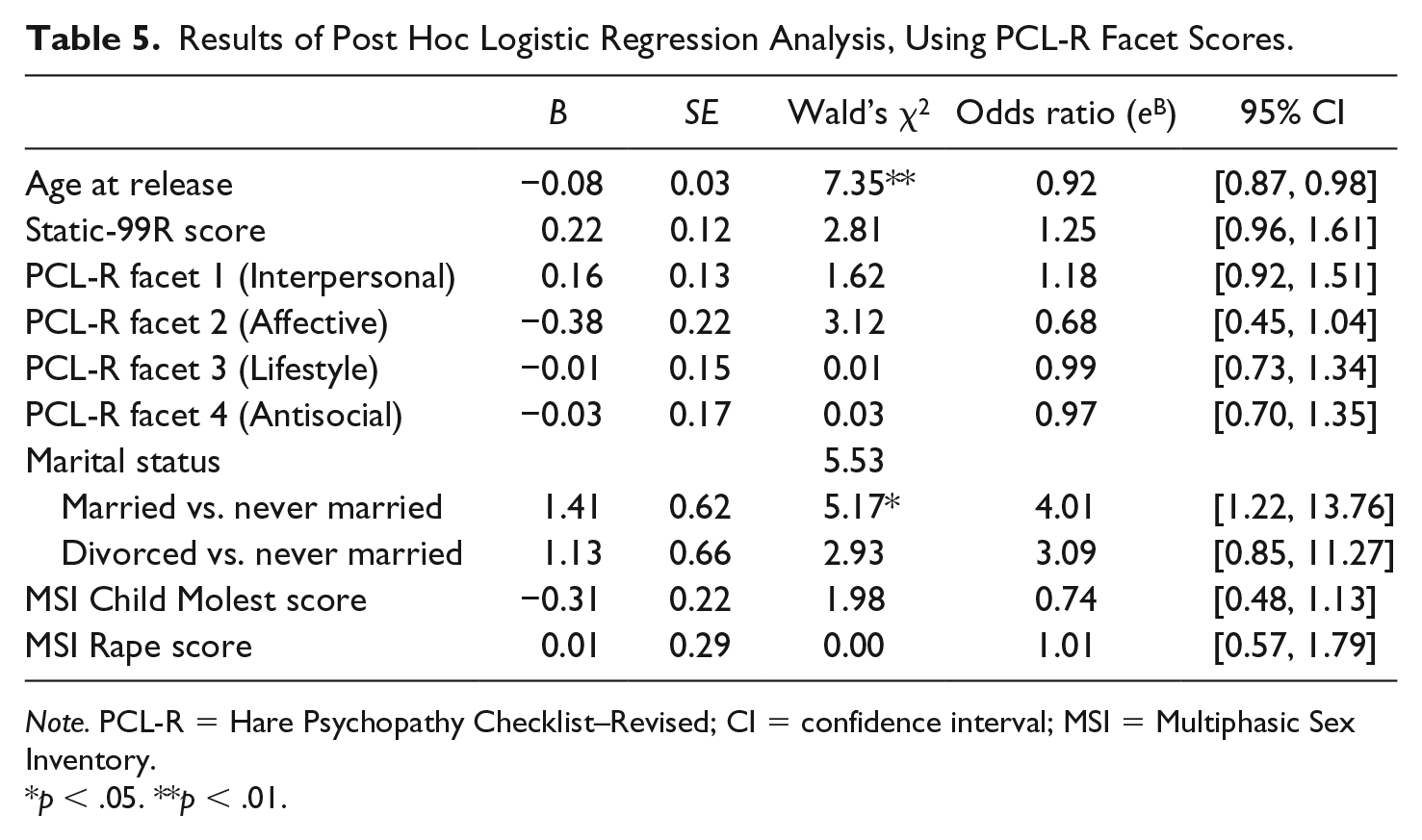
Note. PCL-R = Hare Psychopathy Checklist–Revised; CI = confidence interval; MSI = Multiphasic Sex Inventory.
p < .05. **p < .01.
However, as with the primary analysis, the predictive power of the model was driven by only some of the variables. As before, MSI scores did not emerge as significant. An individual’s age at time of release remained a significant predictor: each year increase in age at release related to an 8% decrease in the likelihood of being classified as an RP-SO as opposed to an NRP-SO, B = −0.08, Wald’s χ2(1) = 7.35, p = .007, eB = 0.92. However, Static-99R scores no longer reached statistical significance, B = 0.22, Wald’s χ2(1) = 2.81, p = .094, eB = 1.25. Similarly, marital status was close to reaching, but did not meet, statistical significance, Wald’s χ2(2) = 5.53, p = .063. Cautious interpretation of this suggests there to be a difference between those who had been married and those who had never been married, B = 1.41, Wald’s χ2(1) = 5.17, p = .023, eB = 4.09. None of the four PCL-R facets significantly predicted whether an individual was classified as an RP-SO or NRP-SO.
Discussion
The present study extends the work of Burt et al. (2016) by further highlighting the heterogeneity among individuals with criminal histories and psychopathic features, and acknowledging that there exists a subset of these individuals who do not recidivate—despite psychopathy’s well-established status as a risk factor for recidivism. We investigated variables that might help distinguish individuals with sexual offense histories and high psychopathic traits who recidivate with a serious offense (i.e., sexual or violent) within 7 years (RP-SO) from those who do not (NRP-SO). Of note, 35% of the sample were categorized as RP-SOs. This is similar to the overall recidivism rate observed in a meta-analysis of individuals with sexual offense histories (36.2%; Hanson & Morton-Bourgon, 2005).
Variables Differentiating NRP-SOs From RP-SOs
Our investigation revealed that there are indeed some factors that differ between RP-SOs and NRP-SOs. One is age: being younger at the time of release emerged as a positive predictor for recidivism. This is consistent with the findings of Burt et al. (2016), who found that age differed between recidivating and nonrecidivating general offenders with psychopathy. Together, such results counter espoused notions that individuals high in psychopathy are immune to the burnout effect. To some degree, this finding may also support the idea that psychopathy is not static (particularly as it pertains to Factor 2, antisocial behaviors and lifestyle), and decreases as a function of age (Harpur & Hare, 1994). Indeed, decreased engagement in antisocial acts should, theoretically, reflect in lower Factor 2 scores. However, as we currently only have access to PCL-R scores at intake, future investigation is warranted.
Scores on the Static-99R (A. Harris et al., 2003) were also found to have predictive utility in differentiating an RP-SO from an NRP-SO. Given that the Static-99R was created and validated for the purposes of sexual recidivism risk assessment (Barbaree, Seto, Langton, & Peacock, 2001; Helmus et al., 2012), this is not surprising. Nonetheless, the importance of considering static and historical variables such as criminal history is highlighted. It appears that such factors have predictive validity even among those high in psychopathy.
Marital status was the third variable that emerged as significant. Those who had never been married were more likely to recidivate following release than those who had been married at the time of intake. The difference between those who had never been married and those who were divorced was nonsignificant, but hinted at a pattern in which those who had never been married were more likely to recidivate. This is consistent with the prior research identifying marital status as predictive of recidivism (G. T. Harris et al., 1993; Theobald & Farrington, 2009). The literature offers a number of possible explanations for the protective benefit of marriage, including the introduction of social control and routine (Sampson & Laub, 1993), decreasing time spent with antisocial peers (Warr, 1998), and prompting one to be become more future-oriented and exercise self-control (Forrest & Hay, 2011; Gottfredson & Hirschi, 1990). The current findings add to the literature by suggesting that the protective quality of marriage does not operate in an all or none fashion; it appears that those who were divorced reaped some protective benefit against recidivism, albeit not as much as those still married at the time of intake. Moreover, to the extent that the longevity of one’s marriage reflects relationship strength, this supports Laub, Nagin, and Sampson’s (1998) theory that the quality of the marital bond matters. However, given that the contrast between the divorced and never married groups did not reach statistical significance, more investigation is needed. Such investigation would benefit from a more explicit measure of relationship quality. This may involve querying commitment or relationship satisfaction, marriage length, and the number of extramarital affairs or divorces.
It is worth noting that the Static-99R, too, includes a single item that speaks to the stability of an individual’s relationship—specifically, it takes into account whether one has lived with a partner for a period of at least 2 years (A. Harris et al., 2003). That the marital status variable remained significant even with Static-99R scores in the model speaks to the importance of said variable. This may also suggest that beyond merely cohabiting with a partner, the act of legally binding oneself to another (i.e., through marriage) may be an important distinction, as it perhaps speaks to a more stable or better quality relationship.
It is also noteworthy that marital status emerged as a predictor of recidivism among a sample comprised exclusively of individuals with high PCL-R scores. Research has linked higher levels of psychopathy with poor relationship satisfaction and outcome (Ali & Chamorro-Premuzic, 2010). Despite this, there was variability in our sample with regard to the ability to maintain stable interpersonal relationships, with the individuals who had never married being the least able to do so, the married individuals best able to do so, and the divorced individuals in between. This suggests that, despite related, the presence of psychopathy does not necessarily equate to an inability to maintain relationships. Moreover, it appears that the presence of stable relationships in an individual’s life—even if said individual presents with psychopathy—may be protective against recidivism. We postulate that the protective nature of being in a stable romantic relationship may partly be because it allows access to a sexual partner, thereby allowing for opportunities to satisfy sexual drives in a legal manner (albeit only for those with sexual interests pertaining to individuals above the age of consent). However, that psychopathic traits are, as discussed above, related to poor relationship outcomes might suggest that those high in psychopathy may have difficulty maintaining meaningful relationships. To this end, we cannot yet discern whether it is the longevity/stability or meaningfulness of a relationship that is protective. Nonetheless, the current results highlight marital status as a useful predictor of recidivism and suggest that the domain of relationships may merit some focus in treatment.
Variables Not Differentiating NRP-SOs From RP-SOs
Although age at release, Static-99R scores, and marital status emerged as significant predictors of recidivism among RP-SOs, it is worth addressing the variables that did not—namely, PCL-R Factor 1 and Factor 2 scores (as well as the constituent facet scores) and sexual deviance (as measured by the MSI). As our predictor variables were chosen based on the recidivism literature, it is surprising that they did not distinguish between NRP-SOs and RP-SOs, especially in light of the fact that both PCL-R Factor scores were previously found to differ between NRPs and RPs (Burt et al., 2016). In offering potential explanations for the lack of predictive utility, consider that recidivism was operationalized as both sexual and violent recidivism. Literature suggests that although PCL-R Factor 2 scores are indeed predictive of recidivism among those with sexual offense histories, they are best able to predict general and violent recidivism, whereas predictive utility for sexual recidivism was noted to be weak at best (Olver & Wong, 2006; Serin et al., 2001). In contrast, research pinpoints deviant sexual interests and sexual deviance to be strong predictors of sexual, but not nonsexual, recidivism (Hanson & Morton-Bourgon, 2005). Taken together, our inclusion of both sexual and violent recidivism may have attenuated the predictive power of both the PCL-R Factor 2 score and sexual deviance. In turning to the descriptive statistics distinguishing between the two types of serious recidivism, we find some indication that this hypothesis may be worth further exploring. Notably, measures of sexual deviance are higher among RP-SOs exclusively recidivating with sexual offenses, in contrast to RP-SOs perpetrating only violent offenses. However, there does not appear to be any differences with regard to PCL-R Factor 2 scores. Nonetheless, such findings should of course be interpreted with great caution given the limited sample sizes.
It is possible that further attenuating the predictive validity of sexual deviance is the unique characteristic of the current data set. The sample comprises individuals who took part in the High Intensity Sex Offender Program, for which sexual deviance was an eligibility criteria. If all individuals in the data set present with deviance, there may be a restriction of range, in turn limiting the variable’s predictive validity. This was, in fact, suspected to be the case in previous investigations using data from the RTC. Specifically, it was found that sexual deviance—operationalized as phallometric test results—surprisingly did not improve the prediction of recidivism above and beyond Static-99R scores in sample of high-risk individuals with sexual offense histories (Looman, Morphett, & Abracen, 2013). Similarly, there may have been restriction of range with regard to PCL-R scores among those in our high-risk sample. This may have also attenuated the predictive power of PCL-R Factor scores.
With regard to PCL-R Factor 1 specifically, the nonsignificance of this variable is consistent with literature suggesting that Factor 2 is more predictive of recidivism than Factor 1 (i.e., Serin et al., 2001). However, this is inconsistent with Burt et al.’s (2016) finding that NRPs had higher Factor 1 scores than RPs. In reconciling the above information, it could very well be that Factor 1 scores may be predictive of general NRPs, but not sexual NRPs (i.e., NRP-SOs). Although Burt et al. (2016) reasoned that those with high Factor 1 scores may be committing crimes as a means to an end, consider that sexual offenses appear to be less instrumental than other types of crimes. For example, although one might commit robbery to attain material goods, a sexual offense in and of itself—by satisfying a deviant sexual interest—may be the goal. Granted, there are indeed some scenarios in which sexual offenses can be instrumental: In a qualitative study investigating motivations behind sexual offending, 12% of the sample indicated that they perpetrated the offense to exert control or demand respect (Mann & Hollin, 2007). However, in the same study, a greater proportion (35%) of individuals cited sexual pleasure or gratification as a motivator for their offense (Mann & Hollin, 2007). Of note, this was the reasoning with the greatest endorsement in the study. If it truly is the case that sexual offenses are less likely to be perpetrated for an instrumental purpose, then it follows that PCL-R Factor 1 scores should not be predictive of recidivism for our sample. This finding is noteworthy as it suggests that NRP-SOs, although similar to NRPs, may also be distinct.
Limitations and Future Directions
This study is not without its limitations. Indeed, our operationalizations of several variables are worth discussing. First, we defined psychopathy with a lowered PCL-R cutoff score of 25 to be in keeping with existing literature on the NRP (i.e., Burt et al., 2016) and due to the limits of the current data set. Although such a practice is not uncommon (i.e., Burt et al., 2016; Looman et al., 2005) and sees support from various proponents (Quinsey et al., 1998; Wong, 1988), others have argued that when possible, a cutoff of 30 should be used to minimize false positives (Grann, Långström, Tengström, & Stålenheim, 1998). The latter possibility should at least be acknowledged: our lowered psychopathy cutoff, if indeed it introduces false positives (i.e., individuals who were not truly psychopathic), may limit the validity of our findings. On a related note, there is research to suggest that psychopathy severity plays into presentation. For example, individuals with moderate levels of psychopathy (i.e., PCL-R scores between 20 and 30) could be differentiated from those with high levels of psychopathy (i.e., PCL-R scores above 30) with regard to emotional processing (Patrick, Bradley, & Lang, 1993). If moderate scorers are indeed distinguishable from high scorers, there may be utility in assessing whether high and moderate scorers differentially recidivate.
Furthermore, as already noted, that our operationalization of recidivism included both sexual and violent recidivism is not ideal. This is problematic for the reasons discussed above (i.e., attenuating predictive validity). Moreover, in a sample comprised exclusively of individuals with sexual offense histories, it would be useful to be able to specifically predict sexual recidivism—especially in light of literature suggesting that sexual recidivism is most commonly perpetrated by offenders whose initial offenses were also sex-related (i.e., Hanson et al., 1995). However, we wish to highlight that with regard to real-world applicability, it would be most useful for the courts and decision makers to be able to predict all serious recidivism, whether sexual or nonsexual. Nonetheless, future investigation of the NRP-SO, once a larger sample of individuals who have engaged in sexual recidivism becomes available, may be prudent.
Another limitation relates to potential data inaccuracy. Our analysis was predicated on correct NRP-SO/RP-SO classification; however, it is possible that a subset of the NRP-SOs in our sample may be incorrectly classified. Indeed, our recidivism information relies on officially recorded police information, yet some recidivism goes undetected either through lack of reporting or failure to identify a suspect. In addition, it is possible that some of the NRP-SOs are in actuality RP-SOs who are simply able to refrain from recidivating for long periods of time (i.e., 7 years or more). That said, however, research regarding the recidivism patterns of individuals high in psychopathy suggests that they tend to reoffend quickly (Porter et al., 2009). Moreover, the likelihood of sexual recidivism has been shown to decrease as the duration of time in the community recidivism-free increases (Hanson, Harris, Letourneau, Helmus, & Thornton, 2018), and indeed 7 years constitutes a significant duration of time. That risk decreases substantially over time may partly explain why, among a group of 111 individuals high in psychopathy, only 39 (i.e., 35%) recidivated. Although this is similar to the overall recidivism rate observed among individuals with sexual offense histories (Hanson & Morton-Bourgon, 2005), one would expect recidivism to be elevated among a sample high in psychopathy. As such, other factors may also be involved in the lower than expected recidivism rate. For example, all individuals in the current sample participated in a comprehensive sexual offender treatment program (Looman & Abracen, 2002); the current results may thus reflect a treatment effect.
Finally, the small size of our data set is limiting. That the NRP-SO and RP-SO groups are uneven in size (and moreover, that the latter is notably small) limits analytical power and compounds or contributes to the limitations noted above. However, a smaller sample size was a trade-off for a prolonged follow-up period. Future investigation with a larger data set may, nonetheless, be fruitful. In addition, it may be worth exploring whether the current results apply to women—indeed, research on female individuals high in psychopathy is presently sparse.
Conclusion
In sum, the present study found that even among individuals with sexual offense histories who present with high levels of psychopathy, there remains sufficient heterogeneity to differentiate individuals who will recidivate from those who will not. Specifically, age, historical factors (i.e., criminal history), and marital status were identified as variables that predict recidivism among those high in psychopathy. This study contributes to the fledging—but much-needed—body of literature on the NRP-SO (falling under the larger category of the NRP). Indeed, there is much left to learn about the NRP, with the hopes of helping us better understand and reduce recidivism risk among those presenting with psychopathy.
Footnotes
Acknowledgements
The authors take responsibility for the integrity of the data and its analysis and have made every effort to avoid inflating statistically significant results.
Declaration of Conflicting Interests
The author(s) declared no potential conflicts of interest with respect to the research, authorship, and/or publication of this article.
Funding
The author(s) received no financial support for the research, authorship, and/or publication of this article.
