




Abstract
A key goal of sex offender registration is to assist law enforcement in sexual assault investigations; to identify potential suspects when the perpetrator’s identity is unknown. To date, however, no research has assessed the utility of sex offender registries in closing cases of sexual assault when the incident involved stranger perpetrators. Addressing this gap, the study drew on the National Incident-Based Reporting System (1992–2001) to test the effect of registry implementation on closure of stranger-involved sex crimes across six states. Comparing closure speeds from before and after registration began in each state, multivariate survival models showed incidents of stranger-perpetrated sexual assault were cleared 23% to 28% faster post-registration implementation. Incidents with juvenile victims and incidents with additional crimes beyond the sexual assault also closed significantly faster (regardless of whether a registry existed).
Sex offender registries are databases created by law enforcement, containing information about individuals convicted of sexual crimes, available to law enforcement officers for criminal justice purposes. Registration has become a ubiquitous mechanism in the United States used by law enforcement to monitor compliance with registration law and as a tool to assist in criminal investigations (Meloy et al., 2007). Registration has grown over more than 90 years from relatively sparse and localized lists into a national structure in which all localities in the United States have a registry database available for local police to access for criminal justice purposes. With the passage of the Adam Walsh Act (AWA) in 2006, these registry databases evolved into a single national, current, law enforcement data system referred to as the National Sex Offender Registry (NSOR).
Registration is distinct from public notification. Public notification refers to laws, policies, and technologies that display some details about some registrants to the public. Notification most commonly occurs via websites, such as the National Sex Offender Public Website (NSOPW). Some, although not all, notification websites use law enforcement registries to populate information for public display. Importantly, notification websites contain fewer than half of the registrants, and among registrants who are included, fewer details are available on the public website relative to the same individual’s record within law enforcement registry databases (Bierie et al., 2016; Harlow, 2016). Another fundamental difference between registration and notification is the core intent of the systems. A primary focus of public notification has been crime prevention; a presumption that opportunities for registrants to commit new sex crimes could be reduced by enhancing surveillance, monitoring, and intervention by the public. In contrast, a fundamental premise of registration databases is that police will be able to respond more effectively to sex crime investigations.
Nearly all research to date on those registered for sexual offenses has focused on public notification. Studies have examined the impact of public notification on deterrence and recidivism (e.g., Prescott & Rockoff, 2011; Sandler et al., 2008; Tewksbury & Jennings, 2010; Zgoba et al., 2010), public use and support of notification websites (e.g., Anderson & Sample, 2008; Brannon et al., 2007; Lieb & Nunlist, 2008; Zevitz & Farkas, 2000), collateral harms of public notification for registrants and their families (Craun & Bierie, 2014; Kras et al., 2018), as well as public and law enforcement perceptions of notification websites (Harris et al., 2018; Walfield et al., 2017; Yeh, 2015). However, we know little about the presumed benefit of registration databases to assist law enforcement when investigating sexual assault cases. As such, the current study focuses on registration databases in the context of closing sexual assaults reported to police.
The primary avenue by which registration is presumed to assist with investigations is by allowing police to quickly generate a comprehensive and relevant list of suspects. It is important to note that registration, then, is not likely to be useful in many sexual assault investigations. Most sexual assaults reported to police involve a known offender such as a relative, acquaintance, neighbor, or other named individual (Budd et al., 2017; Prescott & Rockoff, 2011; Snyder, 2000; Williams & Bierie, 2015). The registry is not generally necessary for suspect identification in these cases. Rather, this particular benefit applies to the relatively small portion of sexual assault cases in which the offender’s identity is not known.
Whereas stranger-perpetrated sexual assaults are atypical, the number of these cases and the harm they invoke for victims and their communities is far from trivial. National statistics show approximately 139,000 incidents of forcible sexual assault reported to police in the United States during 2018 (Federal Bureau of Investigation, 2019). Research focused on these types of crimes finds approximately 13% involve strangers (ranging from 8% to 15% depending on the year studied; see Prescott & Rockoff, 2011; Snyder, 2000; Williams & Bierie, 2015). This translates into just more than 18,000 incidents involving strangers reported to police in 2018. The tangible and intangible losses to victims, communities, and first responders average approximately $216,000 per forcible sexual assault incident in 2019 dollars (Miller et al., 2017); that is, just more than $3.88 billion annually for stranger-perpetrated sexual assaults reported to police. Given these losses, in conjunction with the high level of public concern about stranger-perpetrated sex crimes (see, for example, Craun & Theriot, 2009; Kernsmith et al., 2016; Quinn et al., 2004; Wright, 2003), it is particularly relevant to investigate whether registration assists law enforcement agencies (LEAs) in closing these kinds of cases.
The Sex Offender Registry and Policing
In 1938, the Los Angeles Police Department created the Bureau of Sex Offenses and started an in-house registry that collected and maintained fingerprints, photographs, and other records of individuals convicted of sex crimes (Grimes, 2012). This is generally considered the first sex offender registry. In 1947, this concept of registration expanded, leading to the implementation of Section 290 in the California Penal Code, which required anyone convicted of a sex crime to register with police. Here, the first state-level sex offender registry was born, and other states soon followed; for example, Arizona (1951), Nevada (1961), and Ohio (1963). By the early 1990s, 12 states had implemented their own state-level sex offender registries (Grimes, 2012).
The federalization of sex offender registration began in the mid-1990s with legislation mandating each state register individuals convicted of sexual offenses and, later, that portions of this information be accessible to the public (e.g., perpetrator’s address). These laws were intended to increase enforcement of registration laws, enhance penalties for noncompliance, and also increase uniformity in definitions, database structures, and policies across the United States (Bierie, 2016). This included ensuring more accurate reporting of information, such as addresses, physical features of registrants (e.g., scars, marks, and tattoos), streamlining collection and access to prior booking photos, and inclusion of personal identifiers that facilitate matching to other law enforcement databases should an investigation require such action. This law also required the creation of the NSOR, a single law enforcement database composed of routine uploads of all localized registries, which are then appended and housed by the Federal Bureau of Investigation (AWA, 2006).
In general, registration might help with the investigation and closure of stranger-involved sex crimes in two key ways. First, in the event the perpetrator is a registrant, the database may help police identify him or her. The vast majority of those who sexually offend against strangers target victims near an area the offender is familiar with; near where they currently live or work (Beauregard et al., 2007; Deslauriers-Varin & Beauregard, 2010), or an area in which they used to live or work (Bernasco, 2010). With some physical descriptors (e.g., a victim reports her attacker was White, perhaps 30, and had a tattoo of an anchor on his wrist), police could query the registry to quickly generate a list of registrants in the area who met those criteria. With the advent of a national database, police could expand the search to neighboring jurisdictions, as well as registrants who met the conditions and had ever been associated with that geographic area (regardless of where they currently live). To the degree the perpetrator of the sexual assault is in that pool of “leads,” registration may help police close that case faster than if the tool did not exist.
A second benefit of the registry in these types of investigations is ruling out registrants as the sexual assault perpetrator. This is likely the more common way registration helps police, as research shows around 5% of sexual assaults are committed by registrants (Craun et al., 2011; Sandler et al., 2008). If the actual offender did not have a prior sexual conviction, registries could allow detectives to more quickly rule out those with prior sexual assault convictions, then shift more speedily to other investigative techniques.
Both of these potential benefits presume police generally begin these types of investigations by creating a list of persons with sexual assault convictions associated with the area of the crime as potential leads to investigate. Research suggests this is the case. For example, 96% of the nation’s sex crimes investigators surveyed by Harris et al. (2015) perceived registries as a tool for sex crime investigations, and 86% found it useful in these applications. Their use of registry databases makes sense, in part, because having a history of sexual assault is one of the larger observable risk factors for committing a new sexual assault. Specifically, Bierie (2016) shows that although registrants only commit 5% of sexual assaults each year, this still represents between 7 and 30 times greater risk of committing a new sex crime than the general public. It also makes sense because police could be perceived as negligent in the eyes of the public and the press had they not identified and investigated persons with sex crime convictions in the area.
Whether those with sexual assault convictions were eventually ruled in or out, it would likely take far more time to reach that conclusion without a registry database. It is also important to note that the quality of that underlying list would likely be inferior if generated manually and on an ad hoc basis. Absent a centralized and structured system of recordkeeping, police would likely have to engage in a variety of manual searches and improvised inquiries to generate a list of prior offenders to investigate. It is unlikely an informal and manual process could generate as comprehensive or reliable a list as registry databases do.
Does the Registry Help Police?
There is good reason to presume sex offender registration databases help investigators complete an important and otherwise taxing task more quickly: generating a list of prior offenders meeting the suspect criteria. It may be that generating this kind of list faster and more reliably leads to a greater and/or faster closure rate. As noted above, the majority of sex crimes investigators assert this is the case (Harris et al., 2015). However, empirical evidence validating those perceptions is difficult to come by.
Prescott and Rockoff (2011) offer the only empirical analyses to date of closure rates as a function of registry databases designed for police use. Drawing on the National Incident-Based Reporting System (NIBRS), they found sexual offenses appeared slightly more likely to result in arrest after a registry began, and that the average days to arrest decreased. However, neither effect was statistically significant. Their work shows no evidence that registration assists law enforcement in responding to sexual assault cases.
Although Prescott and Rockoff (2011) made important advances in testing the impact of registration, their study contained a significant limitation with respect to the specific question of registration and case closure as measured by the time it took LEAs to make an arrest. The study examined the impact of registration on the closure of all sexual crimes reported to police, including those involving a known offender such as a relative, neighbor, or acquaintance. As noted above, incidents that are reported with a known offender would not likely need the registry to identify the assailant or otherwise close a case. 1 As such, the Prescott and Rockoff (2011) study averages the registry effect for stranger-involved sex crimes incidents in which registration may be helpful (i.e., 8% of their data) with the majority in which we would not expect significant impact of registration (i.e., 92% of the data). It is difficult to interpret their test, then, of registration effectiveness with respect to closing stranger-involved sex crimes.
Current Study
A key premise of sex offender registration is that these databases, both local and national, will assist LEAs in the closure of sexual crimes perpetrated by strangers. Although sex crime investigators report that registration is helpful with this goal (Harris et al., 2015, 2018), there is little empirical research to date that tests whether law enforcement registry databases are associated with case closure. To address this gap in the literature, we examine closure speeds of forcible sexual assault cases reported to police and involving stranger perpetrators. To do so, we draw on the NIBRS, the largest data system in the United States containing information on stranger-involved sex crimes reported to police. We also draw on survey data obtained from each state registry in the United States detailing the specific date their law enforcement registry data system began accumulating registrants. As such, we compare closure speed in the 2 years prior and after each locality became operational with respect to their law enforcement registry to assess the following specific research question:
Method
Data
This analysis used two sources of data. First, we drew on a survey of administrators of state sex offender registries we conducted during 2012. To conduct this survey, we contacted the individual in each U.S. state responsible for maintenance and policy surrounding sex offender registration. A number of questions were posed via a structured phone interview, including the specific date their registry database began populating with actual registrants. We refer to the date at which sex offender information first began entering each state’s database as the “implementation” date. The survey had a 100% response rate, and the calls took an average of 45 min to complete. 2
Second, we drew on the NIBRS, a data set that records information on the 54 most serious crime types reported to police from participating jurisdictions and includes the ability to isolate stranger-involved incidents of sexual assault. 3 As such, the measures within the data system reflect police officer assessments of the facts of a case, obtained from typical investigative actions (e.g., interviewing witnesses, cross-referencing reports with forensic evidence, assessment of official administrative records). Although more than 6,000 police departments from 39 states currently report to NIBRS, this was not always the case. The system began with only a handful of states reporting in the early 1990s and grew slowly each year since that time. For this research, we only included states if they had 2 years of data prior to the implementation of their registry and 2 years of data post-implementation of the registry. In all, this left a total of six states in the analysis because most states began their registry in the 1990s, which was prior to the date they started reporting to NIBRS (i.e., most began NIBRS in the 2000s). The six states included in this analysis were Colorado, Idaho, Iowa, Massachusetts, Michigan, and South Carolina. As these registries all began in the 1990s, the pre/post-registry data ranged from 1992 to 2001 (depending on the state).
We subset the data to only include incidents in which all offenders were listed as “strangers.” 4 Of note, 9% of incidents with any stranger involved also had a named offender involved. These mixed-relationship cases were excluded because we assumed the registry would likely not be needed to determine the identity of the stranger or otherwise close the case. That is, police could close the case with an arrest of the known offender, and they could also pursue the stranger’s identity through investigation of the named offender. The data set contained a total of 4,417 stranger-only perpetrated, forcible sexual assaults reported to police. 5
All measures were aggregated to the incident level. That is, the NIBRS is constructed as a series of relational tables in which each table may be recorded at a different unit of analysis. All information about victims was coded at the victim level (i.e., a row for each victim within an incident) but were collapsed to the incident level prior to use in these analyses. The same was true of offender information. In most incidents, there was a single victim and a single offender. However, collapsing over multiple victims or offenders occurred in approximately 7% of the incidents.
Variables
Dependent variable
The outcome for this analysis was the “days to closure.” This approach to case closure presumes both the event and speed of case closures are relevant indicators of the success of the investigation (i.e., utility of registration). The outcome was computed as the count of days between the incident and closure of the case. The term closure here refers to all incidents in which there was a positive identification of the perpetrator responsible for the sexual assault, including arrest, death of offender, extradition denied, and juvenile detained. 6 In all, approximately 30% of incidents resulted in one of these kinds of closures. If the case never closed, the censor date was substituted as the end date (i.e., 2 years after the date the registry loaded its first registrant). As typical in survival analyses, we retained this count of days as well as the binary indicator of that count as referring to a closure (1) versus the censor date (0).
Independent variables
The key independent variable in these analyses was a binary indicator of the incident as having occurred prior to the start of the registry database in that jurisdiction (0) or after the start of the registry (1). The year of the incident was also retained, ranging from 1992 to 2011. This was used to control for differences in overall clearance rates, as there is clear evidence that closures have declined steadily over this time period (Federal Bureau of Investigation, 2011; Riedel & Jarvis, 1999; Scott et al., 2019).
The odds of police closing serious violent crime cases hinge on a variety of factors. Some of the most important include the capacity of police to respond to the specific crime (e.g., are police trained and resourced to respond), the level of effort dedicated to the investigation (e.g., judgments about the level and type of resources the case should receive), and the difficulty of the case itself to be solved (e.g., presence of crime scene evidence, witnesses, or cooperative victim). Consistent with these themes, the literature has shown cases close more quickly when there are more witnesses available, more evidence left at the scene (Regoeczi et al., 2008; Wellford et al., 2019), when the offender and victim are known to each other (Roberts, 2007; Wellford et al., 2019), when there is a greater amount of injury to victims, when the victims are younger (Roberts, 2008), and as a function of other aspects of victims such as the “quality” of their sexual assault (Spohn & Tellis, 2010). 7 With these general themes in mind, several covariates were extracted from NIBRS to control for differences in cases, which may have occurred from pre- to post-implementation.
We measured several aspects of the assault itself. First, we measured the specific type of sexual offense within the incident as a series of binary variables, to include rape, sodomy, object penetration, and forcible fondling. Note that the first three actions are consistent with the federal definition of rape, as revised in 2013 (see Bierie & Davis-Seigel, 2015). The latter action is a form of sexual assault that is not included in the revised federal definition (e.g., forcible sexual acts involving a victim or offender’s penis, but without penetration). Finally, note that the categories were not mutually exclusive within incidents. An incident could have all or just one of these acts occurring. We also measured the total number of distinct offenses occurring (sexual or nonsexual). In addition, we recorded whether the incident involved use of a firearm. We presumed that, all else constant, incidents in which a firearm was used may receive more police resources and, therefore, a faster case resolution on average (Craun & Tiedt, 2017). This occurred in 6% of incidents. Third, we measured the number of injuries to victim(s) in the incident, which was a summed measure of internal injuries, major lacerations, broken bones, broken teeth, and minor injuries.
We also measured several factors about the offenders in the case. This included the count of offenders, whether the incident involved male (1/0), female (1/0), or both genders present (1/0). The majority of incidents involved male offenders (99%). Race of offender(s) was coded into the categories of White or Hispanic, Black, or Other. Importantly, NIBRS did not distinguish between White race and Hispanic ethnicity in the years used in this analysis. This error occurs at the file level and cannot be corrected. A final category of “multiple race groups present” was created for the rare case in which this occurred. Overall, 44% of offenders were Black, 54% were White or Hispanic, and all other race groups collectively comprised just over 1% of offenders.
Victim attributes were coded similarly to that of offenders. Incidents ranged from one to nine victims, although 90% had only one victim. Victim gender was coded into mutually exclusive binary indicators of female (1/0), male (1/0), or both genders (1/0) present. The majority of incidents involved female victims (93%). Race was again coded into mutually exclusive categories. However, in the case of victims, NIBRS did distinguish between White and Hispanic. Thus, the mutually exclusive binary variables for victim race were White (1/0), Hispanic (1/0), Black (1/0), Other (1/0), or Multiple (1/0) racial categories present. Note that Hispanic is coded as a mutually exclusive category with other race categorizations in the underlying data rather than a distinct ethnicity. Approximately 70% of victims were designated as White, 26% as Black, 2.4% Hispanic, and all remaining race groups collectively represented 1% of victims. Finally, we measured the age of victim in the incident, and also created a binary indicator of the presence of any juvenile victim (1/0). Sample characteristics can be found in Table 1.
Descriptive Statistics for Sample.
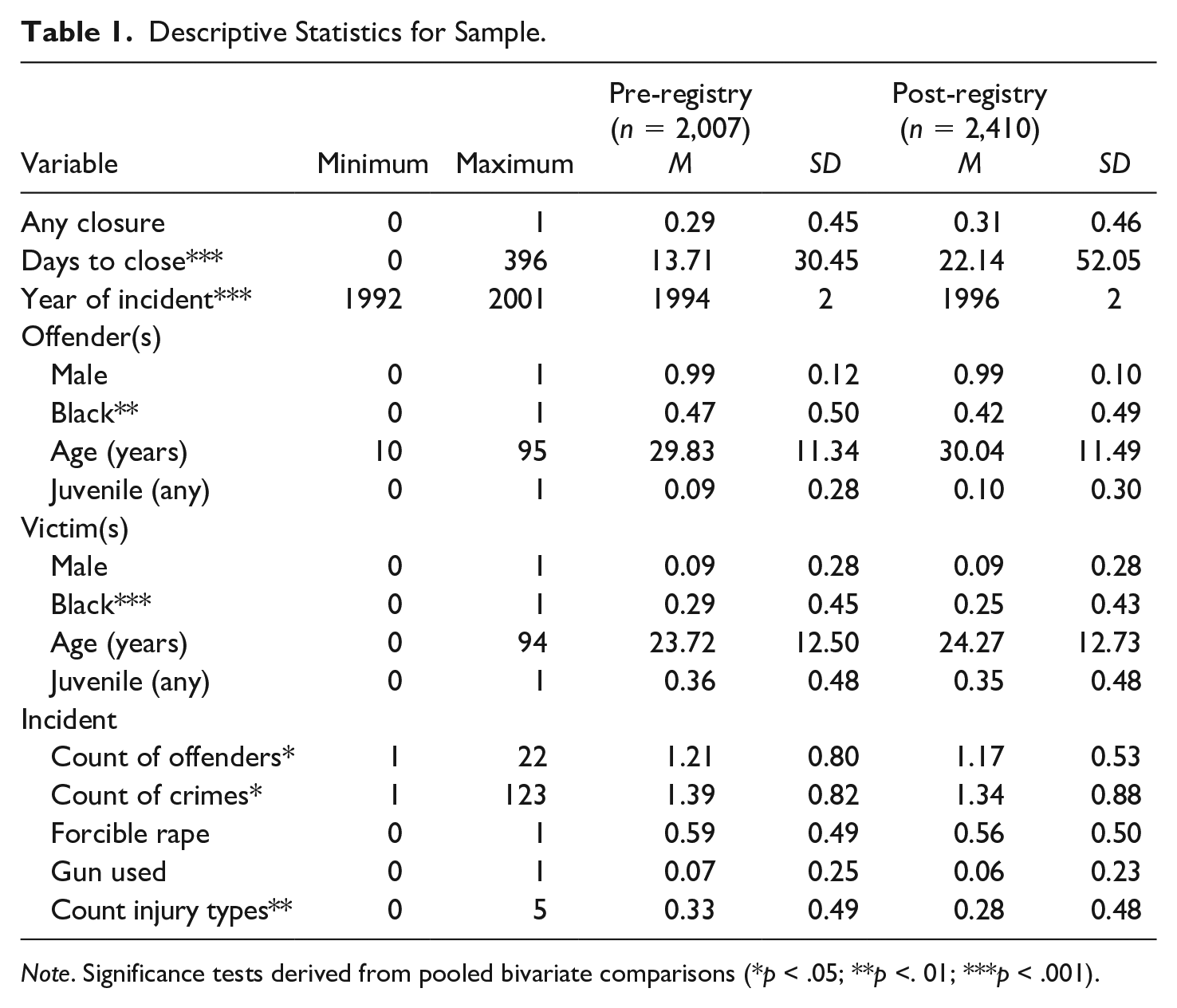
Note. Significance tests derived from pooled bivariate comparisons (*p < .05; **p <. 01; ***p < .001).
Analytic Strategy
The analysis proceeds by computing the time to closure for incidents within each jurisdiction before and after the registry began in each state. To control for differences in technology, resources, or other aspects of investigations that may change over time, we added covariates as described above. In addition, we limited consideration to a 2-year period before, and 2 years after, the crime event. This was intended to create as tight a temporal time frame as possible to reduce the level of aggregate-level factors that may eventually change over time (e.g., changes in police budgets, department size, training). In most jurisdictions, this is the smallest amount of time that generates a stable estimate of closure speeds; anything shorter would generate too small a sample size within some jurisdictions to generate a reliable estimate. The 2-year window was also selected because we were concerned about the posttest period, in particular, suffering from a low dosage effect in the early months of a registry. That is, we expect that registries began with a relatively small number of offenders at the outset and then steadily grew over time either because new offenders were being released and registered over time, or because the database would begin to backfill older cases over time. Thus, we had reason to believe the initial months of the registry might be a diluted measure of the potential utility of registration. Averaging the registry effect against these start-up months and the later months of the 2-year period when the registry was likely becoming more functional helps ensure the test of registry impact remains a conservative one.
Importantly, the closure rate for sexual assault has steadily declined over the prior 20 years. Thus, any comparison of clearance rates or speeds within any given jurisdiction would likely mask a benefit of a registry should it exist. However, because states differed significantly in the year the registry began, we controlled for this temporal effect by including the incident-year as a covariate. Thus, we can examine the relative change due to the registry enactment independent of the specific closure rate and speed of that particular year in general.
The registry effect was estimated within a survival analysis framework. This framework presumes that adding information about the timing of events increases the accuracy of comparisons above and beyond a mere comparison of rates. Not only are the statistical properties of the survival model more accurate than a logit approach, it has substantive meaning in the context of police investigations. Faster clearance can translate into greater satisfaction for victims, and at times, fewer crimes while on the run (if the individual is a serial offender or otherwise offending while at large).
We then conducted a series of sensitivity analyses. That is, we explored alterations to the model to observe whether findings changed in magnitude or direction. This included running the model separately for different subgroups of offenders or victims (e.g., female victims, juvenile victims). We also reestimated coefficients and significance tests across a broad array of survival functions (e.g., Cox, Weibull, and Lognormal). Although the choice of functional form is generally an empirical decision within survival analysis, each model makes slightly different assumptions about the nature of risk changing over time (Cleves et al., 2008). It was, therefore, important to understand whether any patterns in the data were sensitive to the choice of distribution.
Results
As shown in Table 1, for reported sexual assault incidents involving a stranger perpetrator, the sample was generally similar in offender, victim, and incident characteristics from the pre- to post-registry implementation time periods. Approximately 57% of the incidents involved rape, followed by forcible fondling (35%), sexual assault with an object (35%), and sodomy (7%). The vast majority of offenders were male (99%) and most often, offending alone. Pertaining to victims, the vast majority of victims were White females. Juveniles were victimized in 35% of the incidents. Roughly 6% of the incidents involved a gun.
To test whether the registry influenced the speed of case closure for sexual assault incidents involving strangers, we estimated a series of multivariate survival models. The four models in Table 2 differ in the functional form of the hazard distribution invoked for hypothesis testing, ranging from the simplest (Cox) to the most complex (Lognormal). The findings are consistent regardless of model, with each showing that registration was associated with a statistically significant improvement in case closure for stranger-involved incidents of sexual assault.
Time to Arrest: Multivariate Hazard Modeling (n = 3,247).
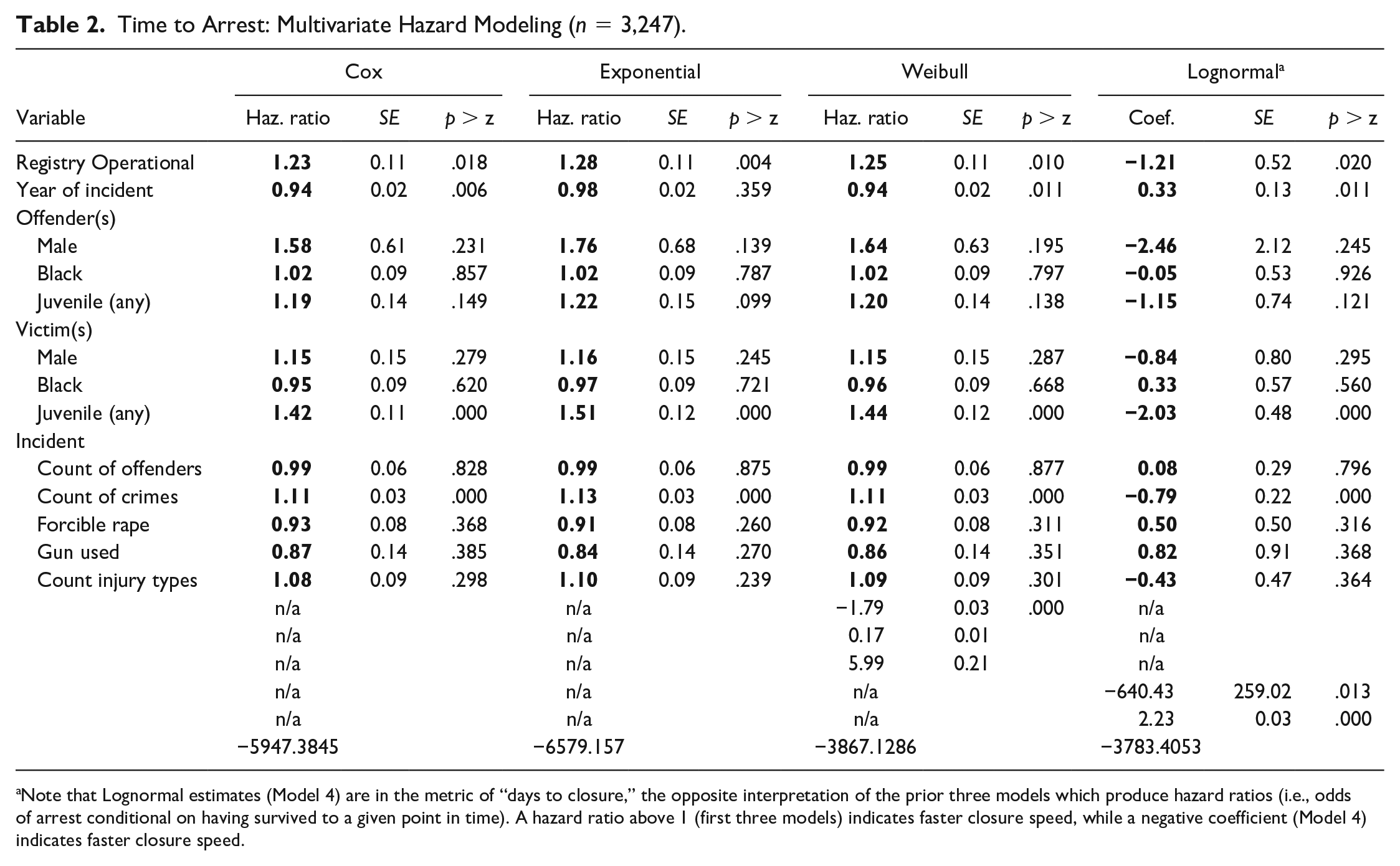
Note that Lognormal estimates (Model 4) are in the metric of “days to closure,” the opposite interpretation of the prior three models which produce hazard ratios (i.e., odds of arrest conditional on having survived to a given point in time). A hazard ratio above 1 (first three models) indicates faster closure speed, while a negative coefficient (Model 4) indicates faster closure speed.
The first three models generated hazard ratios, a metric reflecting the speed by which a case ends. These hazard ratios ranged from 1.23 to 1.28 dependent on model specification (range: p ≤ .01 to p ≤ .05). Taken together, results indicated cases were closing 23–28% faster post-registry implementation. The final model, Model 4, expressed estimates in the form of a days-to-closure metric. In this case, the coefficient of −1.21 indicated that stranger-involved sexual assault incidents closed an average of 1.21 days faster after registries went into effect, all other variables held constant (p ≤ .05).
The data also showed that the year of an incident predicted closure speeds (bounded by 1992–2001). Overall, incidents involving stranger perpetrators closed slower over the course of this time period (denoted by a hazard ratio less than 1). The Lognormal Model indicates the impact of a single year was fairly small: approximately one-third day slower per year (.33; p ≤ .01). 8 However, when interpreted as a polar shift across the range of years examined (e.g., 10 years), the cumulative shift was relatively large.
Only two remaining covariates predicted closure. First, if the incident involved a juvenile victim, the speed of closure was 42–51% faster (p ≤ .001). Expressed differently, using the Lognormal Model, stranger-perpetrated incidents with juvenile victims were closed approximately 2 days faster compared with those without a juvenile victim. Second, for each additional (nonsexual) criminal act suffered by the victim, the closures were 11–13% faster at any point in time (p ≤ .001). 9 This translated into almost a day faster per additional incident (–.79; p ≤ .001).
Discussion
The majority of police report sex offender registration databases are helpful when investigating sexual crimes (Harris et al., 2015). In the case of sexual assaults by a stranger, registry databases allow police to quickly generate a list of individuals with prior convictions for sexual assault who meet case and/or geographic criteria relevant to a particular investigation. This type of list allows police to identify offenders in some cases, and rule them out in others. In fact, given that research shows around 5% of sexual assault offenders are registrants, it is likely that the latter scenario is the most common path by which registries assist police in these types of investigations. Absent a registry database, it is likely police would still have to engage in the same investigative task, but that list would be significantly slower to generate, and it would likely be less reliable or useful.
Although police perceive registries as useful, little research has tested whether this translates into improved case closure. The one study to date that attempted to do so concluded registration had no significant benefit (Prescott & Rockoff, 2011). However, those findings were limited because they derived from an examination of all sex crimes reported to police, of which more than 90% contained a named offender. Averaging the impact of registration on closure among these incidents with the fraction involving stranger-offenders likely diluted their estimate of a potential registry benefit.
We attempted to address this limitation by analyzing the same national data source as the prior study, but restricted comparisons to incidents of stranger-perpetrated sexual assaults. We found that stranger-perpetrated sexual assaults closed significantly faster post-registry implementation. The findings were robust to model specifications (i.e., the type of survival model used). The effect was not only statistically significant, but also substantively large (e.g., 23–28% improvement). Moreover, the magnitude of the registry effect increased once offender, victim, and incident characteristics were added to the models. However, it should be noted that this relatively large improvement in closure speed translates into a substantively small effect in any given case (i.e., a little over 1 day faster), because stranger-involved sexual assault cases in general either closed very quickly or not at all.
The analysis also produced some findings that may help inform broader crime-clearance literature. Most research to date has found serious crime incidents involving juvenile victims close faster than those involving adult victims (Regoeczi et al., 2008), a pattern we observed as well. However, our findings were not consistent with some other patterns more typically found. Most research to date has found serious violent crime closes more often or faster when female victims are present and less often or slower when involving firearms (Alderden & Lavery, 2007; see Regoeczi et al., 2008 for exceptions). In our analysis, neither victim sex nor presence of a firearm predicted closure speed. In part, these differences may speak to a point raised by Regoeczi and colleagues (2008) in their review: Correlates likely vary based on the underlying crime and context. For example, they suggest the reason firearms are often associated with lower closure rates is that there is less transmission of forensic evidence if a firearm, rather than a knife or other weapon, is used to facilitate a crime (e.g., a homicide). In the incidents of sexual assault we studied, there was contact and for that reason, any association of weapons with forensic evidence was likely moot. Likewise, Regoeczi and colleagues (2008) argue that female victims are far more likely to know their assailant than male victims, and that many studies finding female-victim cases close faster may simply be picking up gender as a proxy for known versus stranger offenders. In our study, all victims were strangers and so any spuriousness of gender and relationship type was, again, moot.
That being said, cases involving a juvenile victim did signal a significant improvement in closure speed (approximately 40%). This was true regardless of other controls or the presence of a registry. It could be that this characteristic led police to dedicate more resources to the crime, or it could be these incidents were distinct in some way that facilitated investigations. Future research should explore this pattern.
Finally, our analyses uncovered a strong temporal pattern regarding case closure. These data showed closures rates have declined over time, consistent with findings from others who study serious violent crime (e.g., Scott et al., 2019). Slower closure speeds are counterintuitive as police technology has increased substantially over this time, be it the emergence of DNA databases, the ability to detect and track electronic signals (e.g., cell phones), the increase of information available to police via social media, and the advent of sex offender registries. On the surface, it seems obvious that these improvements should lead to more and faster case closure. Our study did not contain information designed to understand this pattern or test between propositions that may explain it. However, the underlying logic of our findings may offer a useful direction for future research into this seeming paradox. That underlying logic is the observation that a core goal of good policing is to rule out innocent suspects. Our findings are likely driven by the impact of registry databases in helping police achieve this goal more quickly with respect to those with a prior history of sexual offenses. Similarly, perhaps other improvements to policing over time have helped improve the ability of police to detect innocence. If, in the past, police tended to have weaker forensic capacity, they may have had a harder time overruling circumstantial or soft evidence of guilt, and for that reason, made more false arrests. Although we do not know whether this is part of the temporal pattern, framing scholarship surrounding policing technology or change over time in terms of innocence-detection may prove a useful paradigm.
Limitations
A major limitation with this study is that there were only six states available to analyze. Certainly, this represents more states than most research investigating registry impacts (i.e., most research to date uses a single county, or perhaps a single state). However, it is still difficult to know whether findings in these specific localities are similar to what would have been observed in other states. Second, we do not have information on the quality of registry “data use” by law enforcement. The mere presence of a registry does not mean that local sex crimes detectives would have been aware of its existence, how to use it to generate leads, or otherwise exploit the technology. It is likely that this is especially true of the time surrounding implementation of a registry. This may have led to an underestimate of the impact of registration in this study. Similarly, given that many of these cases emerged in the mid- and late 1990s, it is likely that the quality of the registry data and capacity of law enforcement to access and use that data was substantially inferior to what exists today. This, again, likely leads to an underestimate of the benefits of the registry in the current analysis. Finally, it is important to note that substantial change can occur in sex crime investigations policy/technology all at the same time (Bierie, 2016). It may be that there were other innovations also occurring over this time period overlapping with the registry effect but not measured in the NIBRS data (e.g., perhaps the advent of a registry corresponded with the creation of a specialized sex crimes unit to aid in investigation and arrest).
Future Research
A key implication of this study is that the field would benefit from further exploration of this question of closure rates/speeds in other states. Researchers could likely obtain historic local crime data from omitted states, link these to registration start dates, and test whether the results are similar to those observed here. Not only would this build a far broader understanding of how often registries demonstrated this benefit with stranger-involved sex crimes, it would set the stage for understanding why registries have this benefit with this subset of cases.
Related, it would be useful to study this question in light of law enforcement practices with their registry. According to Harris et al. (2015), approximately 19% of law enforcement use or access the registry daily or almost daily whereas 17% access it frequently, 41% occasionally, and 24% rarely or never. It may be important to reestimate these results with those facts in mind—to model the impact of registry use on closure rates, rather than average across all investigators as in the models estimated here.
To that end, the field needs to better understand when and how the registry is useful for LEAs. For example, it may be reasonable to test whether there is a dosage effect with respect to the size of the registry. As a registry comes on line, it may have too small a pool of registrants in the database to be of much use or viewed as relevant by local law enforcement. It may be that the value and use of the registry only emerges after a specific threshold is passed in terms of size. Researchers could likely work with local registries to measure growth of the registry over time and test whether the closure speeds of stranger-involved sex crimes changed as a function of that dosage. In testing this possibility, researchers would be smart to look for nonlinear effects.
Finally, it may be important to expand the current research design to assess whether the registry is useful in other kinds of sexual assault cases. As noted above, the core premise of our test is that one does not need to discover an offender’s identity if that person is already known to the victim. Although generally true, there are exceptions. If the offender and victim are acquaintances who only know each other through nicknames, a registry may be useful. If a victim is both sexually assaulted and murdered, then police likely will not have information on the identity of the offender regardless of whether that offender was known to the victim or not. Kidnapping cases provide another example. Even if the offender is known to the victim, police may not know that person’s identity until the victim is rescued. In each of these scenarios, registration may prove an important tool to police who may be pressed for time and resources as they attempt to identify potential leads in a case.
Conclusion
Notwithstanding the limitations of the current study, these analyses offer some guidance to policymakers and others with an interest in better understanding sex offender registration. First, these analyses show an association between registration databases and significant improvement in closure of stranger-involved sex crimes. These models showed registration reduced closure times by around 24%, or 1.21 days. In any single case, this may translate into little additional public safety (reduced odds of a new offense), benefits for prior victims (e.g., reduced worry), or other benefits such as preserving scarce policing resources. However, it may be useful to interpret the registry impact at a national and annual scale to better understand the implications of this improvement.
As noted above, prior research indicates just over 18,000 stranger-involved sex crimes reported to police each year in the United States. If around 30% of these are closed, as found in this data set (i.e., around 6,000 incidents), closing cases an average of 1.21 days faster translates to 7,260 fewer days of sexual predators at large in the United States each year. At the aggregate, then, this likely indicates a preservation of scarce policing resources. It also likely indicates a meaningful reduction in the amount of time victims and others remained in fear of a predator at large. It is unclear whether the improvement resulted in fewer new crimes by this aggregate of offenders, as such an interpretation assumes some of these offenders would go on to offend again. Although we do not have the ability to assess that assumption in these data, research indicates this is likely. As one example, Campbell, Pierce, et al. (2018) examined more than 7,000 DNA kits taken from stranger-perpetrated sexual assaults, finding more than 30% of offenders (i.e., unique DNA profiles) were linked to additional sexual assaults committed between the initial assault and prior to arrest in that primary case (see Campbell, Feeney, et al., 2018). It is plausible, then, that faster closure speeds associated with registration may prevent some additional sexual assaults each year.
Second, the study draws attention to the importance of distinguishing between registration policies when assessing the evidence for costs, benefits, or underlying logic of potential policy change. As one example, there is a wealth of scientific research focused on articulating the potential collateral harms of ‘registration.’ These studies have focused primarily on public notification websites and to a lesser extent, residency restrictions. In these cases, the harms identified are tightly linked to shame, strain, and limiting social opportunity. These mechanisms are not likely to derive from law enforcement registry systems, which are restricted from public view and only accessible to law enforcement for use in criminal justice purposes. There are still costs to registry data systems, such as the challenge of budgeting for maintenance, training, and auditing. However, it would be problematic to presume that collateral harms associated with other kinds of registration practices are equally applicable to the specific type of policy examined here.
As another example, myriad scholars have suggested registration should be limited to those with the highest risk of sexual recidivism. The underlying premise is that these policies have diminishing value for crime prevention as the riskiness of the registrant declines. In contrast, it is likely that the ability of a registry to help police would diminish significantly as the inclusion rules became more restrictive. This is expected because it is likely that the dominant benefit registries provide police is in helping them rule out those with prior convictions for sexual assault. If police only had access to a restricted list of “exceptionally dangerous” registrants, they would likely use that tool and find it leads to successful arrests some of the time (and probably about as often as using registries as exist today because both would contain those extra-risky people). However, the majority of investigations would still remain open after using an exceptionally risky registry, just as they do today. The problem, then, would be that police would likely have to create a second list of suspects to assess—all others with a history of sexual assault meeting the criteria of the case. Again, we should expect this, in part, because even lower-risk individuals with a history of sexual assault are likely more risky than the general public with no history (Bierie, 2016). But we should also expect this because it is hard to imagine a scenario in which a case of sexual assault by a stranger remains open yet victims, the public, the press, elected officials, and police themselves do not believe it reasonable to check on those with a prior sexual assault history, associated with the area, matching the description of the offender. Thus, police would once again have to engage in this process manually sans a comprehensive and broad inclusion criteria for regisration. In short, the logic and evidence for deciding who should appear on public websites may be very different than found in the context of police data systems. In a similar way, it is likely that other aspects of scholarship and evidence may move in very distinct directions depending on whether addressing police data systems versus other kinds of registration policy.
Footnotes
Acknowledgements
We would like to thank Dr. Andrew Tiedt and Dr. Melanie Malterer for comments and suggestions on the project.
Authors’ Note
The views and opinions of this research do not necessarily represent those of the U.S. Department of Justice nor any component therein.
Declaration of Conflicting Interests
The author(s) declared no potential conflicts of interest with respect to the research, authorship, and/or publication of this article.
Funding
The author(s) received no financial support for the research, authorship, and/or publication of this article.
