




Abstract
This study explores the moralization of purity and perceptions of harm as constraints on sex buying among men. Purchasing sex has long been considered an offense against public morality. While personal morality provides a powerful constraint on offending, and people may vary in the extent to which they experience moral intuitions about bodily and spiritual purity, research has so far neglected the role of purity moralization in understanding sex buying behavior. We hypothesize specifically that moral intuitions about purity constrain sex buying by leading people to perceive it as inherently wrong and by eliciting perceptions that sex buying is harmful to prostitutes. We test these hypotheses in a nationally representative survey of U.S. men (N = 2,525). Results indicate that purity moralization is associated with reduced sex buying, and that this relationship is mediated fully by perceptions of sex buying as harming prostitutes.
Prostitution is prevalent in the United States, but most of those who purchase sex are men (Roe-Sepowitz et al., 2019). National surveys reveal that approximately 14% of men purchase sex at some point during their lifetime (Monto & Milrod, 2014) and that approximately 2% to 4% (or up to four million U.S. men) have purchased sex in the past 3 years (Roe-Sepowitz et al., 2019). Understanding why men purchase sex is important because the male clients of prostitutes 1 are integral to the nature and existence of sex work, and to the exploitation and abuse of workers, more broadly (Della Giusta et al., 2017b; Durant & Couch, 2019; Farley et al., 2017).
Although the clandestine nature of sex trafficking (i.e., involuntary prostitution) makes it difficult to estimate the total number of trafficking victims, the number of cases known to officials suggests that sex trafficking is not rare in the United States (Bishop-Royse et al., 2021; Fedina et al., 2019; Weitzer, 2011). For example, the National Human Trafficking Hotline, which provides trafficking data to most U.S. states (Farrell & Reichert, 2017), identified more than 34,000 likely cases of sex trafficking between 2015 and 2019, with data from 2019 indicating that a majority (79%) of trafficked individuals had entered into prostitution as minors (National Human Trafficking Hotline, 2020a, 2020b) More generally, people who engage in sex work often suffer from physical, mental, and behavioral health problems; social consequences (e.g., stigma, troubled romantic relationships); and criminal victimization (Bellhouse et al., 2015; Benoit et al., 2018; Bishop-Royse et al., 2021; Fedina et al., 2019; Miller & Schwartz, 1995). Thus, although prostitution can be freely entered into and involve an exchange between mutually consenting adults, an unknown proportion of sex workers are exploited or abused. Given that the client of a prostitute does not know the circumstances surrounding the exchange, every decision to buy sex requires that the purchaser accept the risk that he may, even unknowingly, contribute to the exploitation or abuse of the person from whom he buys sex.
Although studies have documented characteristics of sex buyers, only a few have explored theoretical mechanisms underlying men’s choice to buy sex (Birch, 2015), and most of those studies rely on convenience samples. The implication is that the findings may not apply to the general population of American men. As important, researchers to date have largely neglected the potential role of moral concerns in prostitution offending. This is particularly surprising because there is evidence that morality is a powerful constraint on other types of crime (Antonaccio & Tittle, 2008; Pauwels et al., 2018; J. R. Silver & Silver, 2020), and because sex purchasing has long been characterized as an offense against traditional sexual morality (Cao & Maguire, 2013).
Moral psychology indicates that people’s moral judgments are intuitive, meaning they are experienced as powerful “gut feelings” about right and wrong, and that people may perceive moral violations across a variety of substantive domains, such as care, fairness, loyalty, authority, and purity (Haidt, 2012; Schein & Gray, 2018b). One perspective—the theory of dyadic morality (TDM; Schein & Gray, 2018b)—argues that because perceptions of harm are central to a cognitive template of morality, initial intuitions about immorality within each domain may be amplified into perceptions of personal harm through a process referred to as “harmification,” even when individual victims are not immediately apparent (Schein & Gray, 2016, 2018a). One moral domain that may be relevant to understanding sex buying is purity (Haidt, 2012). Indeed, the moralization of purity is associated with disapproval of various forms of sexual behavior, including prostitution (J. R. Silver, 2017), as well as with beliefs that “impure” behaviors—even those that are typically viewed as “victimless”—are harmful (Rottman et al., 2014; J. R. Silver, 2020). Thus, research suggests people may differ in the extent to which they intuit it is inherently wrong, as well as harmful, to violate norms of bodily or spiritual purity—by, for example, buying sex. This possibility has implications for understanding why men choose to buy sex or to refrain from doing so.
The current study advances the literature on prostitution offending by drawing on theory and research from moral psychology to propose and test a novel theoretical framework for understanding offending that is rooted in perceived violations of traditional sexual morality. We argue that the moralization of purity may constrain sex purchasing directly by eliciting perceptions that purchasing sex is inherently wrong and indirectly by fostering beliefs that it is harmful to sex workers. That is, men who perceive purity as morally important may refrain from sex buying because they believe it is a moral violation in its own right, or because they believe that buying sex is harmful to sex workers (and unacceptable on those grounds). To test these hypotheses, we use data from a nationally representative sample of adult U.S. men (N = 2,525). The results of this study show that purity moralization is indirectly associated with men’s sex-purchasing decisions through their beliefs about prostitution’s social and psychological consequences for prostitutes and about the dangerousness of sex work.
Why Men Buy Sex
Prostitution and related activities are illegal in all U.S. states except in a few counties in Nevada. Whereas numerous criminological studies have described the experiences of sex workers, little is known about the people—primarily men—who buy sex (Durant & Couch, 2019; Earle & Sharp, 2013). Moreover, research on sex buying (unlike research on sex work more broadly) has primarily focused on a few avenues. Some studies describe the characteristics and motivations of sex buyers, indicating that sex buying is generally most prevalent among men who are White, middle-aged or older, unmarried or unhappily married, and who hold liberal sexual attitudes and have had a greater number of unpaid sexual partners (Della Giusta et al., 2017a; Kotsadam & Jakobsson, 2011; Milrod & Monto, 2017; Monto, 2000; Monto & McRee, 2005; Monto & Milrod, 2014; Ompad et al., 2013; Pitts et al., 2004; Rissel et al., 2017; Ward et al., 2005). Common reasons given for sex buying include satisfying sexual desires or fantasies, thrill-seeking, avoiding the “trouble” of romantic attachments, viewing sex as a commodity to be bought and sold like any other, or searching for a “girlfriend experience” (Huff, 2011; Milrod & Monto, 2012; Milrod & Weitzer, 2012; Pitts et al., 2004; Sanders, 2008; Weitzer, 2009b). Patterns of sex buying behavior also differ across contexts, especially indoor vs. outdoor sex markets (Sanders, 2008; Weitzer, 2009b).
Other research focuses on the gendered nature of sex buying. Some, but not all, research in this vein argues that sex buying is inherently a form of violence toward women (e.g., Coy et al., 2019; Farley et al., 2011, 2017; Raymond, 2004). Along these lines, research documents that sexual violence, rape myth acceptance, and hostility toward women are associated with increased sex buying, and that these views may be rooted in early life experiences (Busch et al., 2002; Diamond-Welch & Kosloski, 2020). Research also suggests that negative attitudes toward female sex workers may be expressed even in settings where sex work is legitimized through legality or decriminalization (Jovanovski & Tyler, 2018). Research also examines how sex buying allows men to enact masculine identities, including “fragile” or “consumer” masculinities (Joseph & Black, 2012; see also Hammond & van Hooff, 2020; Shumka et al., 2017; Xantidis & McCabe, 2000), and suggests that sex buying may have an evolutionary component linked to male reproductive strategies (Shutt et al., 2011). However, other research indicates that men who buy sex may have more egalitarian views about gender than do men in the general population (Brents et al., 2020).
Although existing literature provides a nuanced examination of gender-related factors as a source of sex buying, knowledge about other factors that may influence sex buying remains limited. This may be important insofar as a significant number of male sex buyers (about one in five) report having purchased sex from a male or transgender sex worker rather than a female sex worker (Roe-Sepowitz et al., 2019), suggesting that more generalized explanations for sex buying are needed. In addition, extant research does not expand the scope of theorizing about sex buying to include variables identified as important in other criminological research, which is important given that—like other forms of offending—sex buying involves the breach of both formal laws and informal norms. Notably, research has yet to approach sex buying from a perspective that takes into account individual morality as a constraint on sex buying behavior.
Given that sex buying has long been considered a prototypical offense against morality (Cao & Maguire, 2013; Chon, 2015; Kotsadam & Jakobsson, 2011), and individual morality is a powerful predictor of offending, with effects that are comparable to self-control (J. R. Silver & Silver, 2020), the lack of attention to moral constraints on sex buying is notable. Neglecting morality in studies of sex buying is an important oversight for a few reasons. First, insofar as morality is a potentially powerful constraint on sex buying, the theoretical models described in prior sex buying research may be incomplete. Second, research documents that moral beliefs differ across social and demographic groups (Graham et al., 2009, 2011; Miles, 2014), and are associated with attitudes regarding sexual permissiveness (Haidt & Hersh, 2001), rape myth acceptance (Barnett & Hilz, 2018; Gable et al., 2017), sexism (Vecina & Piñuela, 2017), and adherence to traditional gender roles (Graham et al., 2011). Thus, empirically, prior research focusing solely on demographic or gender-based explanations for sex buying may suffer from omitted variable bias and either overstate or understate the relationships between sex buying and other theoretically relevant variables.
Moral Dyad Theory and the “Harmification” of Sex Buying
To understand how morality may affect sex buying among men, we turn to moral psychology, and specifically to the theory of dyadic morality (TDM; Gray et al., 2012; Schein & Gray, 2018b). TDM argues that moral judgments occur automatically (i.e., intuitively) and are based on “a template of perceived intentional moral agent and a suffering moral patient,” such that “acts committed by agents with greater intent and that result in more suffering should be judged as more immoral” (Gray et al., 2012, p. 106; see also Schein & Gray, 2018b). Within this framework, a moral agent is defined as any entity that is perceived as having agency, or the ability to think and act intentionally (“a thinking doer”), while a moral patient is defined as any entity that is perceived as being able to experience suffering (“a vulnerable feeler”) (Schein & Gray, 2018b). Thus, a moral dyad refers to a prototypical mental template for a moral violation: an intentional agent who harms a vulnerable patient. 2
Importantly, within TDM, moral agency and moral patiency derive from perceptions that an entity possesses agency or experiences suffering, rather than from an actual capacity to inflict or experience suffering. As a result, people may perceive abstract or non-human moral agents (e.g., God, Google) as well as abstract or non-human moral patients (e.g., the self, society, or future generations) (DeScioli et al., 2012; Gray & Wegner, 2010; Schein & Gray, 2018b). Thus, insofar as a “moral patient” can be any entity who is perceived to be harmed by violations of norms or laws, the moral dyad can encompass perceived moral violations that are considered by others to be “victimless” because they lack a personal victim (Schein & Gray, 2018b). Regardless, the essential theoretical argument is that initial but more general moral intuitions can shape perceptions of how specific acts by moral agents harm moral patients, in turn fostering (or strengthening) moral disapproval of those specific acts.
Research suggests that the more closely an act resembles the moral dyad described by TDM (a moral agent intentionally harming a vulnerable moral patient), the more immoral it is perceived to be (Schein & Gray, 2018b; Schein et al., 2016). For instance, violence against an innocent person—in which a perpetrator (moral agent) physically harms a vulnerable victim (moral patient)—fits neatly into the moral dyad and is widely considered a serious moral violation. However, across cultures and social groups, actions in which the moral agent, moral patient, or harm caused are less clear may still come to be defined as wrong, a process referred to as “moralization” (Schein & Gray, 2018a, 2018b). Moralization occurs when people come to perceive the existence of a moral agent and moral patient, often by filling in an abstract or non-human entity for the moral agent or moral patient. For example, through moralization, consensual sex buying could come to be defined as wrong to the extent that people perceive a sex buyer (a moral agent) as causing harm—such as moral or family breakdown—to society (a moral patient) by violating traditional norms of sexual conduct.
Empirically, the moralization of different types of actions is reflected in the existence of diverse domains in which people may perceive moral violations (Schein & Gray, 2016, 2018b; Schein et al., 2016). In this way, TDM is compatible with pluralistic perspectives in moral psychology, such as Moral Foundations Theory (MFT; Haidt, 2012), which describes care, fairness, authority, loyalty, and purity as important domains of moral judgment. Although TDM and MFT disagree over the source of moral intuitions, 3 TDM “acknowledges the practical utility of different taxonomies,” including the domains described by MFT (Schein et al., 2016, p. 864). Moreover, scholars within TDM note that MFT “nicely highlights cultural pluralism and the moral condemnation of acts which seem—at least to Western eyes—rather harmless” (Schein and Gray, 2018a, p. 366). Thus, MFT provides a particularly useful basis for understanding moral judgments about so-called victimless offenses (J. R. Silver, 2017). Although we do not directly test MFT in the current study, we draw on its taxonomy of moral domains as a basis for understanding variation in sex buying.
One domain of moralization that may be especially relevant to sex buying is purity (Haidt, 2012). Research suggests that many people moralize acts that violate traditions or norms about bodily or spiritual purity (Graham et al., 2018; Haidt, 2012; Horberg et al., 2009). Consistent with TDM’s harm-based cognitive template, intuitions of wrongness resulting from purity violations appear to reflect perceptions that impure acts are inherently harmful (Rottman et al., 2014; Royzman et al., 2015; Schein et al., 2016). Moreover, the extent to which people moralize purity—that is, the extent to which they see violations of norms governing bodily or spiritual purity as wrong—varies across cultures, subcultures, and social groups (Graham et al., 2011; Haidt, 2012). In the United States, for example, purity moralization tends to be more prevalent among conservatives, Christians, older people, and women, as compared to liberals, non-Christians, younger people, and men (Graham et al., 2011; Miles, 2014).
Purity moralization may also influence the magnitude of the harm perceived when norms regarding spiritual or bodily purity are violated. TDM describes a process referred to as “harmification” by which initial intuitions of wrongness in any moralized domain may elicit perceptions of harm to personal victims (Schein & Gray, 2016, 2018a) In other words, “perceptions align to make acts consistent with the dyadic template—that is, to more clearly involve an intentional agent causing damage to a suffering patient” (Schein & Gray, 2018a, p. 364) and even an “initially weak judgment of immorality will then spur on an automatic search for more harm,” (Schein & Gray, 2016, p. 62). This means that any initial intuition of wrongness may amplify perceptions of harm, especially to “moral patients” who fit the description of suffering victims (Gray et al., 2014; Schein & Gray, 2016, 2018a, 2018b) Research suggests that the specific nature of the moral patients perceived may be influenced by others’ testimony or prominent cultural narratives (Schein & Gray, 2016, 2018b; J. R. Silver, 2020). Notably, Schein and Gray (2016) used this framework to explain the once-popular belief that pornography (a form of sex work) causes rape, an account that is supported by empirical research linking the moralization of purity to beliefs about the harmfulness of pornography (J. R. Silver, 2020).
Insofar as traditional norms of sexual morality in the United States condemn prostitution and sex buying (Cao et al., 2015; Cao & Maguire, 2013), and characterize sex sellers and sex buyers alike as wanton and impure (Hammond, 2015; Hubbard & Colosi, 2015; Sanders et al., 2017; Weitzer, 2007), the moralization of purity may be especially likely to produce intuitions that sex buying is wrong, and in turn, perceptions that sex buying is harmful to suffering victims. Consistent with this possibility, research indicates that the moralization of purity is associated with less acceptance of prostitution (J. R. Silver, 2017) as well as other practices that violate norms of traditional sexual morality (Haidt, 2012; Horberg et al., 2009; Koleva et al., 2012; J. R. Silver, 2020). Thus, we focus on the moralization of purity, and the harmification of purity violations, as constraints on men’s sex buying behavior.
Moral Constraints on Sex Buying
That individuals may vary in the extent to which they perceive sex buying as wrong or harmful may have important implications for understanding men’s sex buying behavior. Specifically, numerous studies link moral disapproval of offending to reduced involvement in offending, especially for personal and property crime (e.g., Antonaccio & Tittle, 2008; Brauer & Tittle, 2017). However, a major weakness of criminological research in this area is that morality is typically conceptualized and measured narrowly as the disapproval of specific acts of offending (Agnew, 2014; Gottfredson & Hirschi, 2020, p. 121; J. R. Silver & Silver, 2020). Little research has explored how different types of moral concerns (e.g., purity) may differentially constrain offending, particularly for crimes that primarily violate traditional norms of sexual morality (as opposed to crimes committed directly against persons or property). With regard to sex buying, TDM suggests that constraints on offending may arise from the moralization of purity, and further through “harmification,” by which initial intuitions of wrongness may elicit beliefs that sex buying is harmful to vulnerable individuals (especially prostitutes).
First, individuals who moralize purity (i.e., who perceive bodily or spiritual impurity as inherently harmful) may find the idea of sex buying inherently unappealing, as it involves a violation of traditional norms of sexual purity. Research across disciplines suggests that people avoid engaging in behaviors that violate their sense of personal morality (e.g., Greene, 2013; Haidt, 2012; Pauwels et al., 2018; E. Silver & Abell, 2016; J. R. Silver & Silver, 2020). Thus, men who experience intuitions that impure acts are wrong may be less likely to consider sex buying a viable action. Indeed, some research suggests that in criminogenic situations, individuals will not consciously perceive courses of action that violate their personal sense of morality (Brauer & Tittle, 2017; see also Phillips & Cushman, 2017), meaning that men who more strongly moralize purity may not consider sex buying as an option if presented with the opportunity. Wikström (2014) calls this effect “the moral filter” (p. 78). It is the basis for our first hypothesis:
Second, intuitions that sex buying is wrong may also spur a process of harmification, leading to perceptions that sex buying causes suffering to vulnerable victims (i.e., prototypical “moral patients”). Insofar as opponents of prostitution primarily highlight concerns about human trafficking and violence experienced by prostitutes (Farley et al., 2017; Jackson et al., 2017; Weitzer, 2009a, 2009b), harmification may elicit increased perceptions of sex buying as harming prostitutes. 4 In turn, sex buying may appear to involve a more serious moral violation (i.e., a moral violation in which there is a clear perpetrator and victim). In contrast, individuals who do not moralize purity may be unlikely to perceive sex buying as wrong or especially harmful (Schein & Gray, 2018b). Purity moralization may thus indirectly reduce sex buying by promoting perceptions that sex buying causes vulnerable victims to suffer. In the current study, we focus on two concerns about sex workers that are often raised in discourse about prostitution, and which research suggests are legitimate concerns. One is that prostitution leads to negative social and psychological consequences for sex workers, including stigma, relationship problems, and poor mental and physical health (Bellhouse et al., 2015; Benoit et al., 2018). Another is that prostitutes are frequently criminally victimized (Miller & Schwartz, 1995; O’Doherty, 2011). As such, perceptions of sex buying as harming prostitutes—whether through social/psychological consequences or criminal victimization—may mediate the effects of purity moralization on sex buying. This leads to our second hypothesis:
The Current Study
Although prostitution is often viewed as an offense against morality (Cao & Maguire, 2013), research on sex buying to date has largely neglected individual morality as an explanation for sex buying behavior. This is an important oversight given evidence suggesting that personal morality serves as a powerful constraint on offending (Pauwels et al., 2018) and that individuals vary in the extent to which they moralize purity (Haidt, 2012). The current study addresses this gap in the research. In doing so, we aim to shed light not only on motivations for sex buying, but also to provide a basis for better understanding the role of pluralistic moral concerns in constraining different types of offending, particularly for offenses that violate norms or traditions but which lack an undisputed personal victim. Specifically, we use a national probability sample of U.S. men (N=2,525) to test the following hypotheses: (a) purity moralization is associated with reduced sex buying; (b) purity moralization is associated with increased perceptions of sex buying as harmful to prostitutes; and (c) perceptions of sex buying as harmful to prostitutes mediate the relationship between purity moralization and sex buying.
Data and Methods
The data are from a nationally representative survey of 2,525 adult (18 and over) men living in the United States, which was fielded by the GfK Group (formerly Knowledge Networks) in 2017 (see Mancini et al., 2020; Roe-Sepowitz et al., 2019). This is the same professional research firm used in the past by the American National Election Studies and by the Time-Sharing Experiments in the Social Sciences (Mutz, 2011). All of the men in our sample were recruited randomly using address-based sampling (ABS) and completed self-administered surveys on computers—either their own, or ones provided by the GfK Group—in the privacy of their own homes. 5 The use of ABS means the sampling frame covered 97% of US households, even those without telephones. Research demonstrates that this survey methodology—the combination of probability sampling with computer-assisted self-interviewing—yields especially high quality data and more accurate self-reports than interviewer-administered surveys (Chang & Krosnick, 2009; MacInnis et al., 2018), especially for sensitive topics like sexual behavior (Tourangeau & Yan, 2007). The GfK Group invited 5,000 men to participate in our specific survey, of whom 50.5% (2,525/5,000) completed the questionnaire. To adjust for nonresponse, we applied post-stratification weights in the analysis, which match the sample geodemographic distributions to those of the population of male adults in the United States. Institutional research ethics review of this project was conducted, and approval obtained, prior to data collection.
Dependent Variable
The dependent variable was Sex Purchasing, and we measured it with the following question: “In the past 3 years, how many different times have you PAID for sex from a prostitute?” The original response options ranged from 1 = none to 5 = 6 or more times. However, given the low frequency of responses, we collapsed the responses into a binary indicator (0 = none, 1 = at least once) in the analysis. 6 Table 1 provides the descriptive statistics for this measure and for the others used in the analysis. The self-report data indicated that in our sample, 3.7% of respondents—or about one out of every 27—purchased sex from a prostitute in the past three years (95% CI: [2.9%, 4.6%]).
Descriptive Statistics.
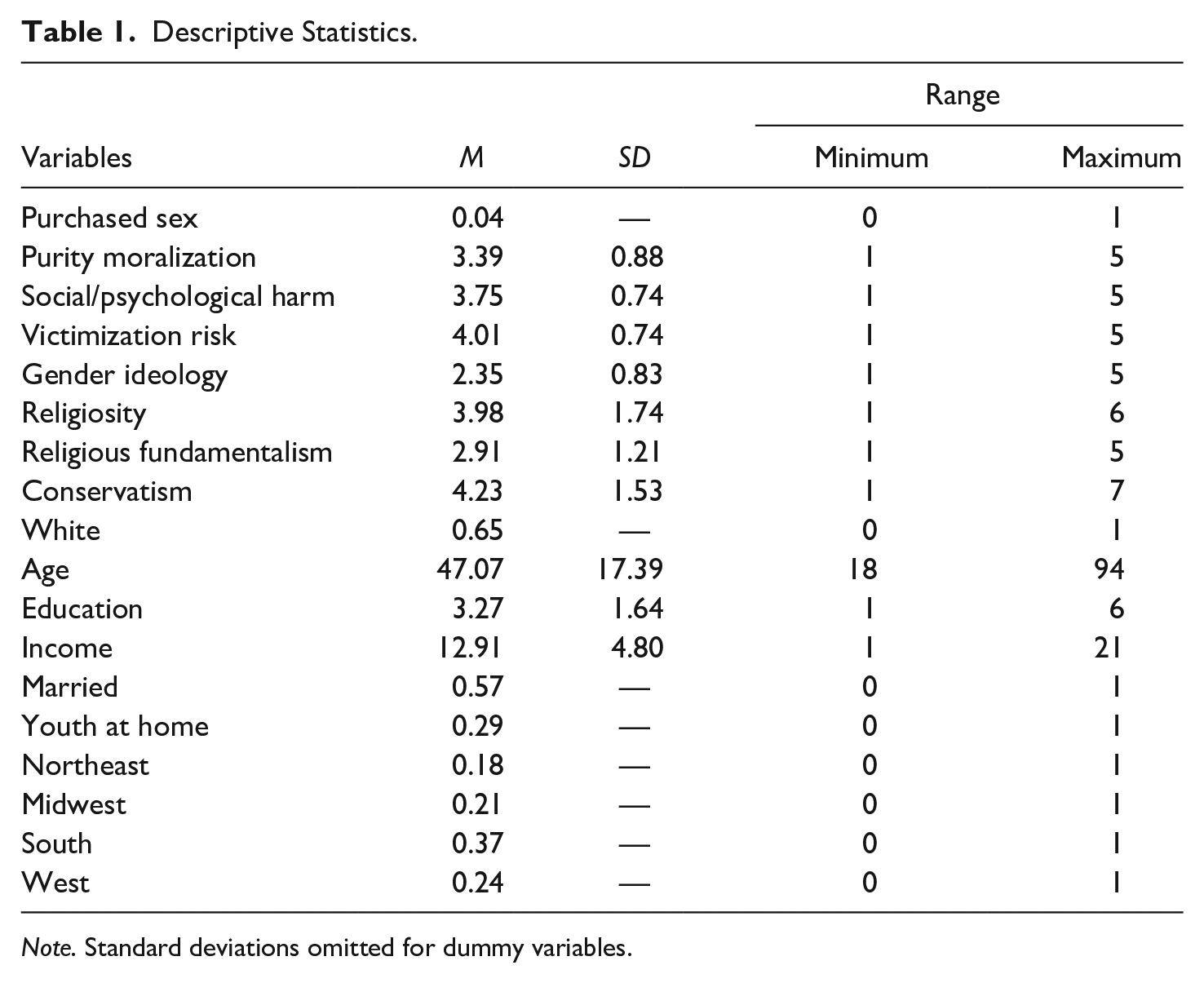
Note. Standard deviations omitted for dummy variables.
Independent Variable
The moralization of purity is the focal independent variable in the analysis. We measured it with the following five items (1 = strongly disagree, 5 = strongly agree), which we adapted from the Moral Foundations Questionnaire, an instrument measuring pluralistic moral concerns (Graham et al., 2011): (a) “People should not do things that are disgusting, even if no one is harmed”; (b) “Some acts are wrong simply because they are disgusting”; (c) “I would call some acts wrong on the grounds that they are unnatural”; (d) “Some acts are wrong simply because they violate the standards of purity and decency”; and (e) “A person’s body is a temple and should be honored as such.” Responses to the items loaded on a single factor (with loadings from .61 to .82) and had high reliability (α = .89). The Purity Moralization index measures how a respondent answered these items, on average.
Mediating Variables
We included two theoretical mediators in the analysis: one that measures beliefs about the social and psychological harms of prostitution and another that measures perceptions of the physical dangers facing prostitutes. As noted previously, both measures were informed by theory and prior research linking prostitution to social, psychological, and physical injuries. The first captured beliefs about the broad social and psychological consequences of selling sex. Respondents indicated their level of agreement (1 = strongly disagree, 5 = strongly agree) with five items: (a) “Prostitution often leads to serious health problems”; (b) “Prostitutes are less likely than other people to ever have a happy marriage”; (c) “Prostitution tends to cause or worsen drug addiction problems”; (d) “Prostitution often leads to mental illness”; and (e) “Prostitution ruins most prostitutes’ lives.” The Social/Psychological Harm index is equal to a respondent’s average response across the items (factor loadings: .65 to .82; α = .86).
The second mediator measured perceptions of prostitutes’ risk of falling victim to crime (1 = very unlikely, 5 = very likely). The survey question was “How likely or unlikely do you think it is that any given prostitute in the United States will experience the following types of victimization in the next year: (a) Have money or property stolen; (b) Be beaten up on the street; (c) Be robbed with a weapon; (d) Be raped; and (e) Be murdered?” Responses to the five items loaded on a single factor (with loadings from .69 to .86) and have high reliability (α = .90). The Victimization Risk index is the average estimated risk across the five crimes.
Control Variables
Existing scholarship links, either theoretically or empirically, many other factors to sex purchasing behavior and beliefs about prostitution, and our analysis controlled for them to minimize the risk of confounding bias. The first was Gender Ideology, which research links to both sex buying behaviors (e.g., Brents et al., 2020) and moral views (e.g., Vecina & Piñuela, 2017). Gender ideology was measured as respondents’ average level of agreement (1 = strongly disagree, 5 = strongly agree) with five items (factor loadings: .71 to .83; α = .87) endorsing traditional gender roles. The items are (a) “A woman’s place is in the home, not at work”; (b) “A husband should earn higher pay than his wife”; (c) “A university education is more important for a boy than for a girl”; (d) “Women are much happier if they stay at home and take care of their children”; and (e) “The employment of mothers leads to more juvenile delinquency.” All of these items have been used in previous research on gender ideology (Davis & Greenstein, 2009).
Second, we controlled for both Religiosity and Religious Fundamentalism. Religious beliefs are associated with both attitudes toward prostitution offending (e.g., Stack et al., 2010) and moral views, including purity moralization (e.g., Haidt, 2012). The former was a self-reported indicator of how important religion is in respondents’ lives (1 = very unimportant, 6 = very important). The latter measured respondents’ average level of agreement (1 = strongly disagree, 5 = strongly agree) with four items endorsing fundamentalist religious beliefs: (a) “There is one single book of religious teachings that contains all the intrinsic, fundamental truths about life”; (b) “The basic cause of evil in this world is Satan, who is still constantly and ferociously fighting against God”; (c) “To lead the most meaningful life, a person must belong to the one fundamentally true religion”; (d) God has given humanity a complete, unfailing guide to happiness and salvation, which must be totally followed.” These items were adapted from Altemeyer and Hunsberger’s (2004) revised religious fundamentalism scale. Responses loaded on a single factor (loadings from .85 to .91) and had high reliability (α = .93).
The analysis also controlled for respondents’ political ideology (Conservativism: 1 = extremely liberal, 7 = extremely conservative), which is associated with both attitudes toward prostitution (Chon, 2015) and purity moralization (Haidt, 2012; Haidt & Hersh, 2001). We also measure demographic characteristics and region of residence. This is important given that both prostitution-related attitudes and behaviors (e.g., Monto & Milrod, 2014) and purity moralization (e.g., Graham et al., 2011; Miles, 2014) both vary across demographic characteristics. We included six demographic controls, coded as follows: White (0 = other, 1 = non-Hispanic White), Age (in years), Education (1 = no high school, 6 = graduate degree), Income (1 = less than $5,000, 21 = $250,000 or more), Married (0 = other, 1 = currently married), and Youth at Home (0 = no, 1 = youth under 18 in household). Finally, given that acceptance of prostitution (e.g., May, 1999) and purity moralization (e.g., Miles, 2014) vary across geographic context within the United States, we controlled for region with binary variables for Midwest, South, and West (coded 1), setting Northeast as the reference (coded 0).
Analysis Plan
Our analysis plan involved four steps. The first step was to examine how the Purity Moralization variable was related to the mediators, net of the controls, by OLS regression. The second step was to analyze the associations between the controls and the Sex Purchasing dependent variable. In the third step, we assessed whether the Purity Moralization variable was associated with Sex Purchasing, after adjusting for the influence of the controls. Fourth, we analyzed whether theoretical mediators were associated with Sex Purchasing and whether they mediated the effect of Purity Moralization. 7
The Sex Purchasing outcome is a binary variable, so we estimated all relationships by logistic regression. We also replicated the analysis for Sex Purchasing using rare events logistic regression (King & Zeng, 2001). The substantive findings were unchanged. Because the outcome is binary, we used the KHB method to test for mediation (Karlson et al., 2012; Kohler et al., 2011), which accounts for coefficient rescaling due to differences in residual variability across nested models. The KHB method also provides information about the relative contributions of multiple mediators operating simultaneously. Because of item nonresponse on the variables used in the analysis, the analytic sample was 2,438 after list-wise deletion. No other cases were excluded from the analysis.
Results
We began by first regressing each mediator, Social/Psychological Harm and Victimization Risk, on the Purity Moralization index and the sociodemographic controls (see Table 2). Model 1 and Model 3 predict the two respective outcomes from the controls, while Model 2 and Model 4 introduce the Purity Moralization index as a predictor. Among the control variables, both Victimization Risk (Model 1) and Social/Psychological Harm (Model 3) were positively and significantly associated with religiosity and religious fundamentalism. Perceptions of Victimization Risk were also significantly lower among individuals who scored higher on the traditional gender ideology scale and who had lower levels of education. Alternately, perceptions of social/psychological harm were higher among political conservatives, lower among older respondents, and lower among Southerners.
OLS Regressions of the Perceived Consequences of Prostitution on Purity Moralization and the Controls (N = 2,438).
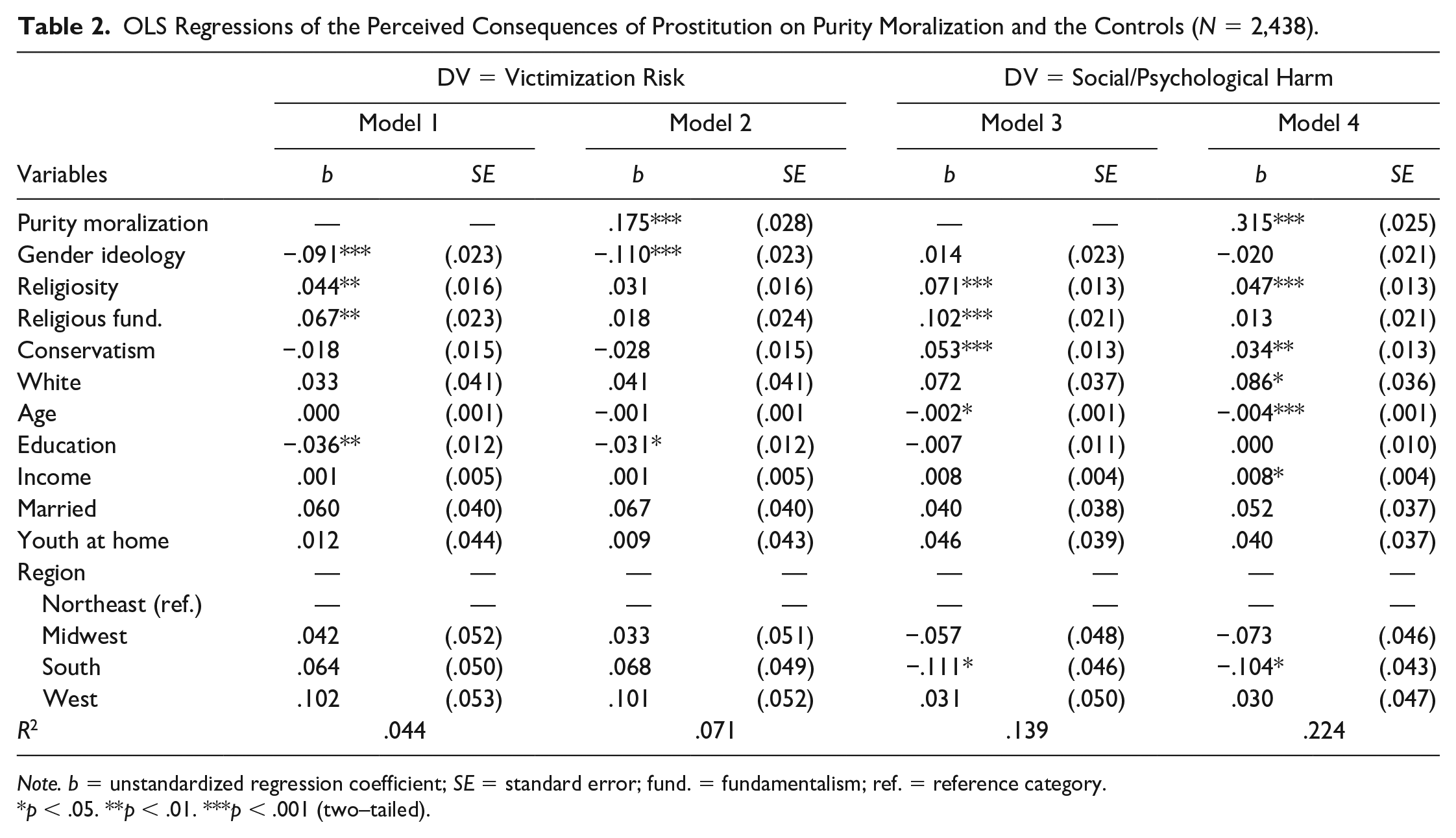
Note. b = unstandardized regression coefficient; SE = standard error; fund. = fundamentalism; ref. = reference category.
p < .05. **p < .01. ***p < .001 (two–tailed).
Model 2 and Model 4 introduce the Purity Moralization measure as a covariate. For both Victimization Risk (Model 2) and Social/Psychological Harm (Model 4), there was a statistically significant association between purity moralization and the focal mediator. And in both cases, the coefficient for Purity Moralization was sizable and in the hypothesized direction (Victimization Risk [b = .175, SE = .028, p < .001; 95% CI = [0.120, 0.229]] and Social/Psychological Harm [b = .315, SE = .025, p < .001; 95% CI = [0.267, 0.363]]). In fact, Purity Moralization was the strongest predictor in both models—its standardized coefficient was nearly twice as large as that of any other variable. The takeaway is that men who more strongly moralized bodily and spiritual purity were much more likely to believe that prostitution is harmful to prostitutes, both directly and from an increased risk of criminal victimization.
Figure 1 presents the adjusted predictions, by Purity Moralization, for each mediator. The figure shows that—especially for social/psychological harm—the effects were substantial: as values on the Purity Moralization variable increased, so too did perceptions of social/psychological harm and perceptions of prostitutes’ risk of victimization. Indeed, at the lowest level of purity moralization (strongly disagree), the predicted score on the social/psychological harm index was 3.00 (95% CI = 2.87 to 3.12), whereas at the highest level of purity moralization (strongly agree), the predicted score was 4.25 (95% CI = 4.18 to 4.33). A similar, but less dramatic pattern, was also observed for victimization risk: at the lowest level of purity moralization (strongly disagree), the predicted score on the victimization risk index was 3.60 (95% CI = [3.46, 3.74]), whereas at the highest level of purity moralization (strongly agree), the predicted score was 4.30 (95% CI = [4.21, 4.39]).
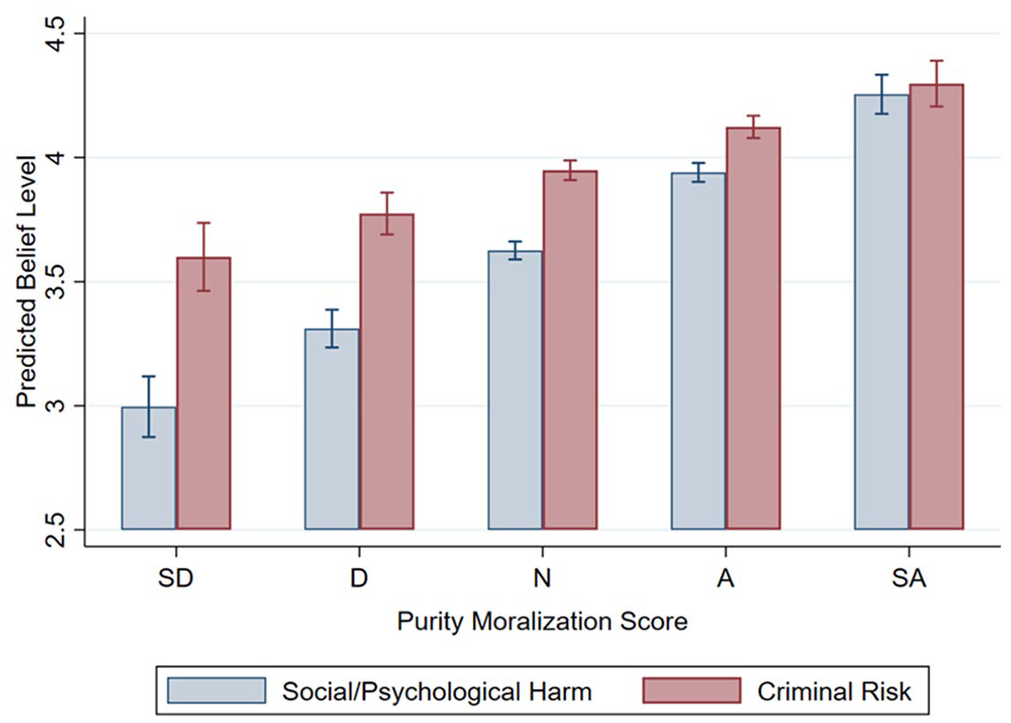
Adjusted predictions for mediators, by purity moralization.
What factors influence American men’s decision to purchase sex? The focus of the analysis now turns to answering this question. Table 3 presents results from logistic regression models predicting sex purchasing. There are three models in the table. The first is the baseline model, and includes only the control variables, four of which are statistically significant predictors of sex purchasing. Men who were White, married, and living in the Midwest were significantly less likely to purchase sex from a prostitute, while those with higher incomes were significantly more likely to do so. Specifically, the odds of purchasing sex were 61% lower for White men than non-White men, 68% lower for married men than unmarried men, and 70% lower for men residing in Midwestern states than men living in the Northeast. By contrast, a unit increase in income increased the odds of purchasing sex by roughly 10%.
Logistic Regression of Sex Purchasing on Purity Moralization, Perceptions of Harm, and Controls (N = 2,438).
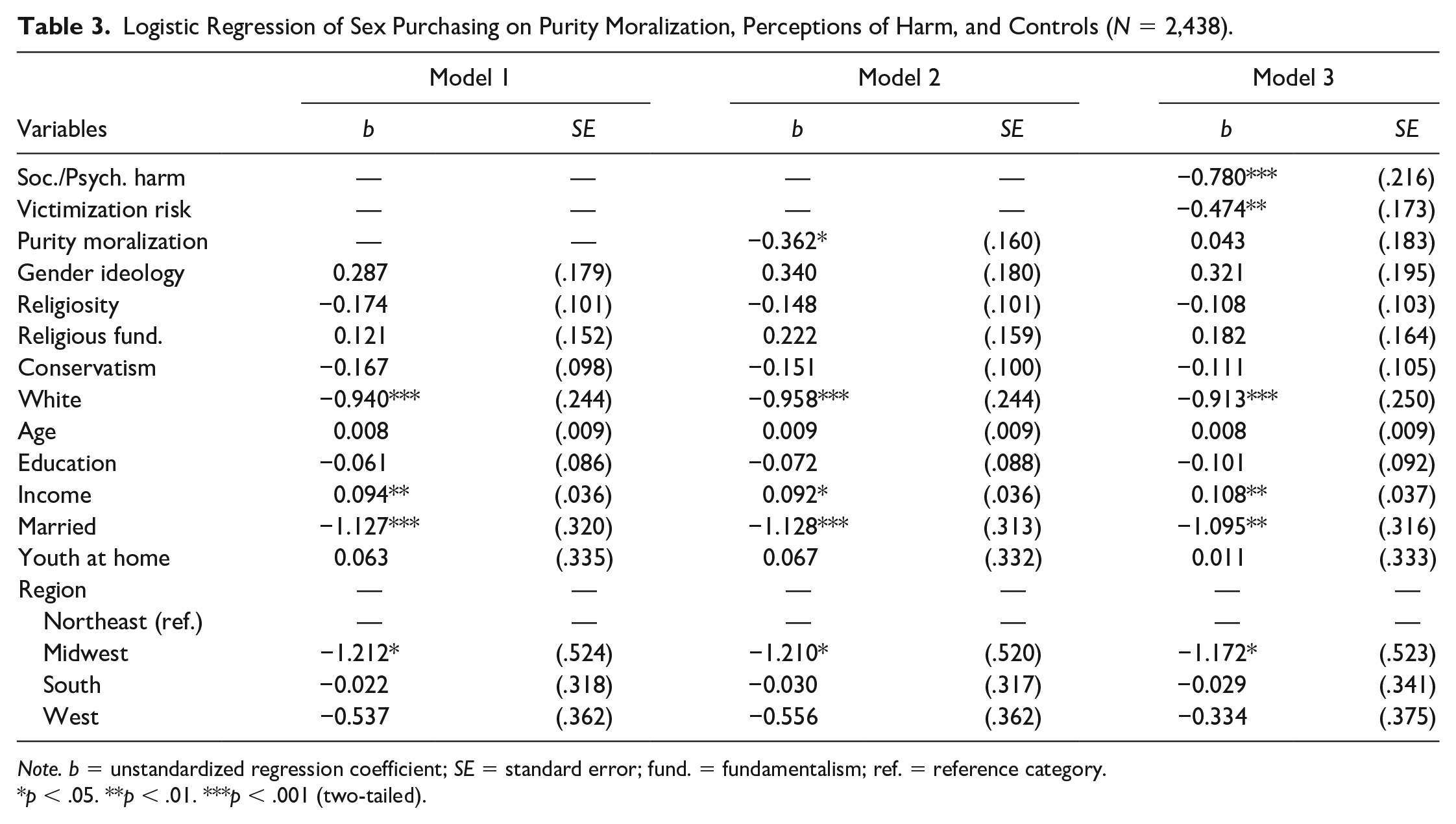
Note. b = unstandardized regression coefficient; SE = standard error; fund. = fundamentalism; ref. = reference category.
p < .05. **p < .01. ***p < .001 (two-tailed).
Model 2 in Table 3 includes the index of Purity Moralization, and Model 3 adds the two mediators, Social/Psychological Harm and Victimization Risk. In Model 2, we see that as hypothesized, the coefficient for Purity Moralization was negative (b = −.362, SE = .160) and statistically significant (p = .024; 95% CI = [−0.675, −0.048]), indicating that men who perceived bodily and spiritual purity as morally important were less likely to purchase sex from a prostitute. The estimated odds of purchasing sex declined by 30% with a unit increase in Purity Moralization. This effect disappeared entirely—indeed, the coefficient for Purity Moralization became positive—in the third model, which includes the two theoretical mediators. Both mediators had significant relationships with sex purchasing, and both were in the hypothesized direction: men who believed prostitution is harmful to prostitutes and dangerous were less likely to purchase sex.
This pattern of findings—the reduction of the Purity Moralization coefficient upon inclusion of the mediators—is consistent with the hypothesis that beliefs about the moral importance of bodily purity amplify perceptions of the harmfulness of sex buying to individuals (i.e., prostitutes). This interpretation was supported when we conducted a formal KHB test for mediation. The results reveal that the effect of Purity Moralization on sex purchasing was, in fact, mediated by both Social/Psychological Harm (b = −.245, SE = .071, p < .001) and Victimization Risk (b = −.083, SE = .033, p < .05). However, most (75%) of the indirect effect operated through Social/Psychological Harm. Thus, it appears that the moralization of purity influenced men’s sex-purchasing decisions primarily by affecting their perceptions of the social and psychological consequences of prostitution for prostitutes.
Discussion
The current study explored the moralization of purity and perceptions of harm to prostitutes as constraints on men’s sex buying behaviors. Drawing on the theory of dyadic morality, we tested three specific hypotheses: that purity moralization is associated with perceptions of sex buying as harmful to prostitutes; that purity moralization is associated with reduced sex buying; and that perceptions of sex buying as harmful to prostitutes mediate the effects of purity moralization on sex buying. Overall, the results were consistent with our theoretical model. Men’s moralization of bodily and spiritual purity was associated with two measures of perceived harm to prostitutes (social/psychological harm and victimization risk) as well as with prior sex buying behavior. Perceptions of harm—especially social/psychological harm—fully mediated the effects of purity moralization on sex buying, suggesting that initial intuitions of wrongness may constrain prostitution offending by enhancing perceptions of its harmfulness.
Although our main hypotheses were supported, a few of our results warrant further consideration. First, although our theoretical model did not specify either social/psychological harm or harm from victimization as being more important, we found that purity moralization was most strongly related to perceptions of social/psychological harm, and that perceived social/psychological harm mostly mediated the relationship between purity endorsement and sex buying. A potential explanation for this finding relates to the immediacy of the harm relative to the act of selling sex. Specifically, the idea that sex buying harms prostitutes by impacting their psychological and social well-being suggests that selling sex is inherently harmful, regardless of the circumstances in which it occurs. Harm from criminal victimization, however, is more removed from the sex act and means that prostitutes are harmed when sex transactions go wrong or put a sex worker in a position where she or he is vulnerable to criminal victimization. Relatedly, while criminal victimization is a common risk for some forms of sex work (especially street prostitution), it is less common in other settings (e.g., indoor sex work or escort services) (Weitzer, 2009b). In contrast, social and psychological consequences may be perceived to be more universal. In addition, and consistent with the notion that harmification-based beliefs often reflect common cultural narratives, rhetoric about criminal victimization by third parties appears to be less common in popular anti-prostitution narratives than the assertion that prostitution is inherently degrading or harmful to people who engage in it (Weitzer, 2009b).
Second, it is worth noting that purity moralization did not have a statistically significant direct association with sex buying when the perceived harm measures were included in the model. This finding is consistent with moral dyad theory’s conceptualization of purity-related moral judgments as domain-specific perceptions of harm, and “harmification” as a process that amplifies those concerns by leading people to perceive a suffering victim. In other words, purity moralization was expected to activate perceptions of sex buying as harmful to prostitutes, which is a more serious moral violation due to its closer alignment with the prototypical moral dyad, and which may in turn provide a more powerful constraint on offending. However, future research might explore alternate explanations, such as the possibility that sex buying—which requires planning—is less likely to be inhibited by “gut feeling” intuitions about purity, which are thought to inhibit behavior in the presence of purity-related stimuli (Haidt, 2012). That is, it may be that the only individuals who come close enough to buying sex to experience moral intuitions about the impurity of it are those who have already made the decision to offend (and for whom the moral filtering of action alternatives may not occur). In contrast, consciously held beliefs about the harmfulness of sex buying resulting from harmification may be more likely to stop men from seeking out situations criminogenic to sex buying in the first place.
Taken together, our results suggest that current theoretical accounts of sex purchasing are incomplete, insofar as perceptions of harm rooted in purity moralization explain variation in sex buying net of demographics and gender ideology. The results thus point to the utility of considering morality—measured and conceptualized separately from the approval or disapproval of offending—as a constraint on offending. Indeed, the current study adds to a small but growing body of literature suggesting that there is utility in drawing on pluralistic ideas about morality in offending research (Durrant, 2020; E. Silver & Abell, 2016; J. R. Silver & Silver, 2020), and provides novel evidence regarding the usefulness of a “harmification” framework in understanding involvement in what is often considered a victimless form of offending. More broadly, the study suggests that offending research may benefit from greater attention to moral psychological accounts of perception and decision-making.
Similarly, the results suggest that the moral pluralism and harmification perspectives might be fruitfully integrated with extant theoretical perspectives on sex buying. Broadly, sex buying research should include measures of morality, particularly purity moralization, to avoid omitted variable bias. In addition, as was noted previously, research documents a link between purity moralization and key variables in existing explanations for sex buying, such as sexist ideology and attitudes about rape and sexual assault (Barnett & Hilz, 2018; Gable et al., 2017; Vecina & Piñuela, 2017). Interestingly, however, our findings suggest a more complicated relationship among these concepts than prior sex buying research has explored so far, insofar as purity moralization may be associated with greater acceptance of sexual violence (Barnett & Hilz, 2018; Gable et al., 2017) but reduced involvement in sex buying, which has been described by some scholars as a form of sexual violence in itself (Farley et al., 2017).
The current study may also have implications for understanding debates regarding the legal status of prostitution and sex buying. Research suggests that as purity moralization has declined in Western society, restrictive sexual laws and norms have also eased (Pinker, 2011; Schnabel & Sevell, 2017; J. R. Silver, 2020). This observation is consistent with research suggesting that laws must conform to public “intuitions of justice” to remain relevant (Robinson, 2013), and with evidence that purity moralization and harmification may shape support for laws that regulate purity-based ideals (J. R. Silver, 2020). It is also consistent with research suggesting that public opinion strongly influences criminal justice policy (Pickett, 2019). Moreover, through the harmification of purity violations, opponents of prostitution—even those whose objections are rooted in conventional sexual morality—may continue to be successful at encouraging regulation by framing their opposition to prostitution in terms of harm, and especially by emphasizing harm to innocents such as victims of human trafficking (e.g., Weitzer, 2007, 2009a).
There may be a link between the prevalence of purity moralization across cultures and laws and behaviors surrounding prostitution. Indeed, both the moralization of purity (Graham et al., 2011; Haidt, 2012) and the perceived moral acceptability and legality of prostitution (Cao et al., 2015; Jonsson & Jakobsson, 2017) vary across cultural settings and contexts. Thus, future research might consider the extent to which purity moralization may evoke perceptions of harm to prostitutes or constrain prostitution offending in other cultural settings. For example, an intriguing finding is that perceptions of the moral acceptability of prostitution decreased in Norwegian cities after it was criminalized (Kotsadam & Jakobsson, 2011), suggesting that the legal status of prostitution may contribute to its moralization, and perhaps to constraints on offending as well. However, future research is needed to explore these possibilities, and more generally, to ascertain the extent to which the findings of the current study generalize outside of the United States.
The current study has a few limitations that may be addressed by future research. One is that, although the survey is nationally representative, it is cross sectional, and we must rely on the theoretical assumption that purity moralization is relatively stable over the prior three years (i.e., the time frame covered by the self-report measure). Whereas some research supports the notion of the stability of moral concerns as measured by the MFQ (Graham et al., 2011), other research does not (Smith et al., 2017). A key step forward in future research, then, will be to engage in longitudinal research that will allow for the time ordering of effects and testing for reverse causality. Another limitation is that, whereas most research using the Graham et al. (2011) 6 scale measures five different domains of moral judgment, we only examine one (i.e., purity). This is a potential issue insofar as sex buying may be considered a moral violation in other domains as well (e.g., as a violation of tradition or religious authority). However, given that our goal in the current study was to understand the role of purity moralization in eliciting perceptions of harm, as in prior research documenting a link between purity violations and perceived harm (e.g., Schein et al., 2016), we leave it to future research to explore the effects of a more extensive taxonomy of moral concerns on sex buying. Finally, the current study focused on harm to prostitutes as the result of “harmification.” However, harms to other parties are also possible, as in the contention that sex buying threatens the marriages and families of sex buyers by encouraging extra-marital liaisons (Weitzer, 2009a). In addition, we did not ask respondents about their perceptions of sex trafficking, although this is a widely cited concern that is distinct from social/psychological harms or criminal victimization. Future research might thus consider a wider array of harms and moral patients that may be invoked through harmification.
Despite these limitations, the current study provides novel empirical evidence regarding the role of purity moralization in sex buying among a national sample of American men. The findings indicate that purity moralization inhibits sex buying behavior in men primarily by eliciting judgments that sex buying is harmful to the social and psychological wellbeing of prostitutes. These results suggest the importance of considering morality as a constraint on sex buying behavior, and also suggest directions for theoretical development and future research.
Footnotes
Declaration of Conflicting Interests
The author(s) declared no potential conflicts of interest with respect to the research, authorship, and/or publication of this article.
Funding
The author(s) disclosed receipt of the following financial support for the research, authorship, and/or publication of this article: Funding for the data used in this manuscript was obtained through Hunt Alternative’s Demand Abolition Division via a competitive grant process. The funder had no role in the research or preparation of this manuscript.
Research Ethics Approval
Institutional research ethics review was conducted, and approval obtained, for this project.
Statistical Significant Statement
The authors take responsibility for the integrity of the data, the accuracy of the data analyses, and have made every effort to avoid inflating statistically significant results.
