



Abstract
In the past decade, there has been an increase in child sexual exploitation material (CSEM) offenses and convictions. Although research shows that individuals with CSEM offence histories generally are at low risk of reoffending, certain factors do increase in CSEM convictions, in order to assist with case prioritization, management and supervision, risk assessment is helpful across agencies. The Child Pornography Offender Risk Tool (CPORT) was created specifically for this population and shows significant predictive validity for various outcomes. This study aimed to validate the use of the CPORT in a Scottish sample of 141 adult males who were convicted of CSEM offenses. Receiver Operating Characteristic (ROC) and logistic regression analyses indicated that the CPORT significantly predicted any recidivism (Area Under the Curve = .81), any sexual recidivism (AUC = .78) and CSEM recidivism (AUC = .74), suggesting that it is a valid risk assessment tool for Scottish populations. Recommendations for further research and clinical implications are discussed.
Introduction
Over the past two decades, advances in information and communication technologies such as the easy availability of smart phones and social media platforms have had an impact on sexual offending. Developments such as encrypted internet activity (e.g. dark web) and virtual or digital currency options (e.g. bitcoin) increase access to and distribution of illegal material while making detection by law enforcement more difficult (Dalins et al., 2018). A recent review of the use of these technological developments can be found in Steel et al. (2020). As the technology evolves, not only does it increase the number of people, including children, who have access to the internet and potentially to illegal material, but it also provides opportunities for individuals to download, distribute and produce child sexual exploitation material (CSEM) online (May-Chahal et al., 2018; Quayle & Cooper, 2015; Wager et al., 2018). A recent rapid review by Wager et al. (2018) suggested that in both the US and the UK there have been increases in the numbers of arrests for possession of CSEM (often referred to as child pornography both legally and in some research, see Greijer & Doek, 2016). 1 However, much of this base rate data is quite old, may be influenced through targeted and coordinated activities by law enforcement or resourcing challenges in the detection and recording of cases, and is likely to reflect an underestimate of these crimes (e.g. Bentley et al., 2020; Scurich & John, 2019). When individuals are arrested for their offending, a key concern is how many will continue to offend.
Recidivism by Individuals Convicted of CSEM Offenses
Seto et al. (2011) conducted two separate meta-analyses to examine the contact sexual offense histories of individuals who were convicted of CSEM offenses (both CSEM offenses and mixed offenses) and recidivism rates from follow-up studies of persons with CSEM offense histories. They found that approximately one in eight individuals had a recorded contact sexual offense history at the time of their index offense. In six studies where self-report data were used, one in two admitted committing a contact sexual offense. In the second meta-analysis, 4.6% of individuals with CSEM offense histories committed a new sexual offense during a 1.5 to 6-year follow-up. Two percent committed a contact sexual offense and 3.4% committed a new CSEM offense. This can be compared with an earlier meta-analysis of 61 recidivism studies involving almost 24,000 individuals whose index offense involved a sexual offense which found that 13.4% committed a new sexual offense within 4 to 5 years (Hanson & Bussière, 1998). Seto et al. (2011) concluded that there may be a distinct subgroup of individuals committing online-only offenses who pose relatively low risk of committing contact sexual offenses in the future.
More recent research provides additional rates of known recidivism. Seto and Eke (2015) examined the rate of reoffending of individuals convicted of CSEM offenses within a 5-year follow-up period. Of 266 adult males, 11% were known to have committed a new sexual offense, 3% a new sexual offense against a child and 9% a new CSEM offense (Seto & Eke, 2015). Elliott et al. (2019) examined the reoffending rates of 584 CSEM-only offenses (84.6%) and 106 mixed CSEM and contact offenses (15.4%) groups from a UK community intervention program. After an average 13-year follow-up, official reoffending rates were 24.8% for any reconviction and 12.6% for sexual reconvictions. However, the mixed group was more likely to receive a sexual reconviction (mixed = 26.4% and CSEM = 10.1%). Only 2.6% of the CSEM group was convicted of a subsequent contact sexual offense as opposed to 9.4% of the mixed group. When looking at a fixed 5-year follow-up period, the ratios stayed relatively the same. The mixed group had a greater likelihood than CSEM-only group of any sexual reconviction (mixed = 14.2% and CSEM = 2.7%) (Elliott et al., 2019). These results corroborate previous findings indicating that individuals with CSEM offense histories have lower rates of reoffending than individuals who committed contact sexual offenses or mixed offenses (Seto et al., 2011; Wakeling et al., 2011).
Assessing Risk of Recidivism among individuals with CSEM offense histories
With an increase in access to the technology used to produce, view and distribute CSEM and an increase in CSEM convictions, risk assessment is helpful across agencies in order to assist with case prioritization, management and supervision. The Risk Matrix 2000 (RM2000, Thornton et al., 2003) has been used to estimate the risk of reoffending of individuals convicted of sexual offenses, including CSEM offenses (Barnett et al., 2010; Grubin, 2011; Hirschtritt et al., 2019; Wakeling et al., 2011). This actuarial tool is used in Scotland in conjunction with STABLE and ACUTE 2007 (Hanson 2007) to assess and inform the management of those convicted of sexual offenses (Risk Management Authority (RMA) Scotland, 2018). The sexual recidivism scale of RM2000 has seven factors. The four following aggravating factors are assessed in step 2 of the scoring scale: stranger victim, male victim, no current or past intimate relationship of 2 years or more and non-contact sexual offense. The presence of two or three of these factors increases risk by one level; the presence of all four factors elevates risk by two levels. In the updated coding manual of the RM2000 (Thornton, 2010), more specification is provided on how to score the two following aggravating factors, stranger victim and non-contact offense, to avoid the overestimation of risk for individuals who committed CSEM offenses. This was a major concern as these crimes may fall within the category of non-contact offenses due to the images involving stranger victims (Barnett et al., 2010; Garrington et al., 2018; RMA Scotland, 2018). Elliott et al. (2019) in their study found poor predictive validity for the RM2000/S for either any or sexual reconvictions with confidence interval for Area Under the Curve (AUC) values between .52 and –.64 for their whole sample and values between .43 and .62 for individuals with CSEM offense histories only.
A review of risk assessment tools demonstrated that most actuarial tools designed to predict the risk of reoffending among individuals who have been adjudicated for contact sexual offenses overestimated their level of risk among individuals with CSEM offense histories, rating them as moderate-high and high risk (Garrington et al., 2018). A more recent meta-analysis by Brankley et al. (2019) examined the predictive validity of the STABLE-2007 in individuals convicted of sexual offenses, including CSEM offenses. STABLE-2007 significantly predicted any type of reoffending (i.e. sexual, violent-non-sexual, violent-sexual and any crime) across all studies. Although only one study had a sample of individuals who have been adjudicated for CSEM-only offenses, four other studies included this population in their samples and the results remained significant. These are promising findings regarding the use of the STABLE-2007, an actuarial tool looking at dynamic factors, in this population.
To date, two risk assessment tools have been developed specifically for use with the CSEM population. The Kent Internet Risk Assessment Tool – Version 2 (KIRAT-2; Long et al., 2016) and the Child Pornography Offender Risk Tool (CPORT; Seto & Eke, 2015). The KIRAT-2 allows police to prioritize investigations into the most dangerous individuals (i.e. those most likely to also have already committed contact sexual offenses against children); however, it does not purport to predict risk of reoffending (Garrington et al., 2018; Long et al., 2016). The CPORT (Seto & Eke, 2015) was found to be a useful structured risk checklist to predict any recidivism and any sexual recidivism among adult males with a conviction for CSEM offenses (Eke et al., 2019). Although these two tools were specifically developed to be used with individuals with CSEM offense histories, the research to date has involved relatively small samples, used official records only and required access to the content of the CSEM in order to score some of their items; information which might be difficult to access by criminal justice and mental health professionals (Hirschtritt et al., 2019). Overall, the CPORT remains the only tool developed specifically to predict the risk of reoffending of CSEM populations and is argued to be preferred to unstructured risk judgment (Elliott et al., 2019).
CPORT Post-Development Research
The CPORT was developed from a dataset created for the purpose of examining risk factors for recidivism among 286 Canadian individuals with CSEM offense histories; using a 5-year fixed follow-up period (N = 266). They examined an array of information from arrest reports, police interviews, CSEM collections and information obtained by police investigators such as interviews with family members and other assessment reports and came up with seven factors associated with the risk of reoffending in this population (see Measure section for more detail).
The authors used receiver-operating characteristic (ROC) to evaluate item and total score accuracy in predicting recidivism in CSEM populations. Their sample included individuals who had no history of contact sexual offenses and individuals with a history of mixed offenses (i.e. CSEM offenses and contact sexual offenses in their criminal history or as their index offense). Their recidivism information was collected using official records and included any new offenses (based on charges) committed after the index and through to the end of the follow-up. When examining recidivism, they excluded new charges for historical offenses (Eke et al., 2018). In the development study, they looked at the CPORT’s predictive validity for any recidivism (AUC = .66, 95% confidence interval [.59, .73]), but in their validation study they focused only on any sexual recidivism, which included contact sexual recidivism and CSEM-only recidivism. The validation study combined the development study’s sample (n = 266) with a new validation sample (n = 80) using non-overlapping Canadian police services data which increased statistical power. Analyses were conducted to test differences between the AUCs between the two samples for both sexual and CSEM recidivism and found no significant differences in predictive accuracy (Eke et al., 2019). Despite its small sample size, findings from the validation sample were consistent with the development sample and within expected sampling error. The authors also used the Correlates of Admission of Sexual Interest in Children (CASIC) in 25 cases (7%) where CPORT item 5’s (i.e. indication of pedophilic/hebephilic interests) information was missing. The CASIC was developed by Seto and Eke (2017) to be used as a potential substitute to the CPORT item 5 after realizing this item was the most common missing item and that self-report lacked corroboration (Eke et al., 2019). The CASIC’s items correlate with CPORT item 5 and are comprised of six items (see Measure section for more details).
The CPORT authors report that, in the combined sample, results from ROC analyses indicated that all CPORT items and total scores significantly predicted any sexual and specifically CSEM recidivism, except for item 1 (below 35 years at the time of the index investigation) with an AUC of .57. The authors argued that this effect size could still be considered meaningful in magnitude. Large effect sizes were found for the CPORT total score with and without missing information (AUC = .72–.74 and AUC = .75–.77, respectively). The authors also divided the sample between individuals with only CSEM offense histories (i.e. Child Pornography/No Contact = CP/NC) and individuals who had also been adjudicated for contact offenses (Child Pornography + Contact offenses = CP+C). They repeated the analyses within the subsamples and found that the effect sizes were higher for the CP+C for 9 of the 12 performed analyses with the CPORT total score obtaining a large effect size of .72 for the CP+C group compared to .66 for the CP/NC group (Eke et al., 2019). Eke et al. (2018) also examined the possibility of omitting CPORT items 5 and 7 due to the assumption that the information on these items (i.e. admission/diagnosis of sexual interest in children and content of images of children other than CSEM) is more likely to be missing in clinical and criminal justice records. They found that, by using what they called this compact version, the predictive accuracy of CPORT total score had large effect sizes (AUCs = .73, 95% CI [.63, .83]) despite omitting two items (Seto & Eke, 2015).
Two post-graduate theses (Black, 2018; Pilon, 2016) focused on modified versions of the CPORT scale. Pilon (2016) used a Canadian sample of 279 individuals with CSEM offense histories over a 3-year follow-up period and, among the changes made, omitted the two child-content questions (6 and 7) and changed the scoring of other items. Using this modified CPORT scale showed moderate predictive accuracy of any criminal recidivism (AUC = .680, 95% CI (.56, .81)) but did not significantly predict sexual recidivism (AUC = .56, 95% CI (.32, .79)). Pilon’s study results may also have been due to a small base rate of re-offense. Black's (2018) study from New Zealand (N = 547) had a follow-up period which ranged from 2 yrs 7 months to 19 years 2 months and used a 4-item version of CPORT, excluding the last three items. They reported significant AUCs for the shortened scale. They ranged between small effect sizes (AUC = .60), with some of large effect sizes being found in the CSEM recidivism category (AUC ≥ .71). Soldino et al. (2020) is the most recently published validation study of the CPORT. With a sample of 304 men arrested in Spain for CSEM offenses (CSEM only, n = 225 and CSEM with other criminal involvement, n = 49), they used the complete CPORT scale and also the CASIC in a 5-year follow-up analysis. Only seven of the sample had a pre-index or index contact sexual offense. They observed a 2.3% sexual recidivism rate for the whole sample (2.0% new CSEM offenses, 0.3% new contact sexual offenses). ROC analyses detected some relative predictive ability of the CPORT for CSEM recidivism outcomes when the CASIC was used to replace missing CPORT Item 5. The authors also concluded based on additional findings that both CPORT and CASIC total scores independently could help predict new CSEM offending among individuals who have been adjudicated exclusively with CSEM offenses (AUC = .57 and .70, respectively). However, their calibration analyses found that the observed recidivism rates were much lower than the expected recidivism rates presented by the tool developers and suggested a need for caution over the use of these norms for applied risk assessment.
Present Study
A major limitation of previous external validation research of the CPORT was substantial missing information or modification of the scoring. Replication studies using the scale as intended are sorely needed. Thus, the aim of the present study is to replicate the Eke et al. (2019) study, adhering closely to the original research method and coding in order to investigate the CPORT predictive validity in a Scottish sample of 176 individuals convicted of CSEM offenses. The current study replicated Eke et al.’s (2019) methodology such as the CSEM material was not directly accessed by the researchers, the scoring of CPORT followed all scoring rules and included CASIC as a substitution for CPORT item 5 and in the analyses, the sample was further divided into groups with and without contact sexual offenses.
Scottish Context
In Scotland, individuals with CSEM offense histories are sentenced under section 52 of the Civic Government Scotland Act 1982. There are three main offenses: (1) possession (CSEM is recovered on the individual’s device, including thumbnail format and deleted browser history); (2) create/make (taking indecent images of children through grooming or contact offending, but also includes non-contact offending such as downloading images and moving them to another location) and (3) distribution (sharing CSEM with other individuals or moving images from one device to an external drive, for instance).
Method
In this section, we report how we determined our sample size, all data exclusions, all manipulations and all measures in the study.
Sample
The sample was obtained through a collaboration with Police Scotland. Ethical approval for this study was obtained from the authors’ University Research Ethics Committee (reference number: CLIN552). Police Scotland provided the anonymized data which was extracted from the Police systems in collaboration with a member of their cyber-security team who worked closely with the first author. For reasons related to data access, data collection was limited to individuals located only on the east coast of Scotland. A total of 176 cases were originally obtained from police. To replicate the Eke et al. (2019) research, the cases had to meet the following criteria for inclusion: (1) a male aged 18 or older, (2) convicted of a CSEM offense as their index and (3) with a release date or community sentence start date that was prior to April 2014 to support a fixed 5-year follow-up research design. Based on this third criteria, 35 cases (19.9%) were excluded from the sample, leaving a total of 141 cases for analysis with conviction dates ranging from February 2010 to December 2013.
The majority of the sample 64% (n = 90) lived in urban locations with the remaining 36% (n = 51) living in rural areas. At the time of data collection, (after the 5-year follow-up period), most of the individuals were living in the community being compliant with their orders (n = 59, 42%) or being monitored by Criminal Justice Social Workers (n = 16, 11.3%). Three (2.1%) were in custody and for 63 (44.7%) of the cases the information on their current status was not provided. The majority of the sample (n = 101, 71.6%) came to the attention of the police through police enquiry into their online activity, whereas 37 (26.2%) were detected through concerns from members of the public (e.g. disclosed chatroom content or found CSEM material) and three (2.1%) through self-disclosure.
Similar to the CPORT samples (2015 & 2019), the material in the current sample included images and videos that offenders accessed by using the internet (online) but also material that was considered offline such as DVDs or hard copies of images which they could have made themselves or purchased. However, information about the provenance of the offline material was not provided. Over 86% of the sample (n = 122) committed their CSEM offenses using online technologies only, 11 (7.8%) used both online and offline material (including DVDs) and eight (5.7%) used offline material only. The format of the material varied between images and videos (n = 77, 54.6%), images only (n = 57, 40.4%), videos only (n = 5, 3.5%), images, videos and chatlogs (n = 1, 0.7%) and images and cartoon videos (n = 1, 0.7%).
Like the validation sample from Eke et al. (2019), the majority of the sample had possession convictions (61%, n = 86), over half had convictions of taking (making) or permit to take (make) CSEM (54.6% n = 77) and 13.5% (n = 19) had distribution convictions. It is important to note that in Scotland taking (making) or permit to take (make) CSEM convictions do not necessarily mean the production of first-generation images (likely to involve contact offending) as explained earlier in this paper. In the current sample (n = 141), no individual had convictions or charges of sexual contact offending behavior as part of taking (making) or permit to take (make) CSEM charges in their index offense such as filming or taking indecent images of the child in their presence, according to the information provided by Police Scotland. Therefore, it was confirmed that all convictions of taking (making) or permit to take (make) CSEM in this sample did not involve direct contact offending. In addition, several individuals had more than one CSEM conviction (e.g. possession and distribution): 41.8% (n = 59) had possession convictions only; 32.6% (n = 46) had only taking or permit to take (make) convictions; 12.1% (n = 17) had convictions of possession and taking or permit to take (make); 5.7% (n = 8) had taking or permit to take (make) and distribution convictions; 4.3% (n = 6) had convictions including the three offenses and only one individual (0.7%) had a conviction of distribution only.
A total of 23 individuals (16.3%) had previous criminal histories, from which four (2.8%) had previous convictions for CSEM offenses, 12 (8.5%) had previous convictions for contact sexual offenses and 14 (9.9%) had non-sexual criminal convictions including theft, assault, fire raising, possession of a weapon and drug offenses. Over 86% of the sample’s offenses comprised non-contact sexual offenses only (n = 122), with 19 (13.5%) individuals having a combination of CSEM and contact sexual offenses (not related to the CSEM offenses) as part of their index offense or criminal history (i.e. allegations and/or convictions). These included the 12 individuals who already had previous contact sexual offenses. These two groups were defined as CSEM/Non-Contact group (CSEM/NC, n = 122) and the dual group as CSEM + Contact (CSEM+C; n = 19).
Measure
Child Pornography Offender Risk Tool
Child Pornography Offender Risk Tool (CPORT) comprises the seven following items: (1) age at time of index investigation; (2) criminal history; (3) failure on conditional release; (4) contact sexual offense; (5) indication of paedophilic/hebephilic interest; (6) more than 50% of boy to girl content in CSEM and (7) more than 50% of boy to girl content in other material. In the present study, these items were coded according to the authors’ scoring guidance (Eke et al., 2018).
Frequencies of the Presence of Risk Factors for the Seven CPORT Items.

Note. IO = index offense; CSEM = child sexual exploitation material; Data for the combined sample presented in Eke et al. (2019) were obtained in Scoring Guide for the Child Pornography Offender Risk Tool (CPORT): Version 2 (Eke et al., 2018). In addition, information about missing cases for CPORT items were obtained by contacting one of the CPORT’s co-developers.
an = 141.
bn = 346.
Regarding CPORT item 5 (indication of pedophilic/hebephilic interest), none of the individuals had a formal diagnosis. The provided data indicated whether individuals had admitted to sexual interest in children or whether they denied using the CSEM for sexual gratification. However, in 19 cases it was reported by police data as ‘no admission made’ without any specification of the individual denying sexual interest in children. The primary data was checked and confirmed that these cases had no information regarding admission or denial of sexual interest in children during police interview. Consequently, these cases were coded as missing (i.e. left blank) but use of the CASIC was considered for further evaluation. The mean total CPORT score for the whole sample, regardless of missing data, was 1.82 (SD = 1.39, range 0–6). The mean total CPORT score with up to one missing item, in most cases CPORT item 7 (not including cases where CASIC was used to substitute missing data on CPORT 5) was 1.91 (SD = 1.29, range 0–5).
Correlates of Admission of Sexual Interest in Children
Frequencies for the Six CASIC Items.

Note. CSEM = child sexual exploitation material; Data for the combined sample presented in Eke et al. (2019) were obtained in Scoring Guide for the Child Pornography Offender Risk Tool (CPORT): Version 2 (Eke et al., 2018).
an = 141.
bn = 346.
Procedure
The anonymized data were obtained from Police Scotland in close collaboration with the first author. The data contained the available information related to the CSEM offenses and demographic data on the offenders such as age at index investigation and conviction, marital status, criminal history, collection details and CSEM collecting behavior, as well as information required to code CPORT and CASIC items. We did not have access to the seized CSEM; therefore, the data required for CPORT items 6 and 7 were viewed by the police analyst and specified if the content comprised mostly of girl images, boy images, both (equal number of boys and girls) or if the information was missing. The information was then reorganized and coded by the lead author following the guidelines from the CPORT developers (Eke et al., 2018).
Follow-Up Period and Recidivism Coding
The follow-up period was calculated by deducting the date of first release (e.g. bail, at conviction or after custody), following the index CSEM charge(s), from the date when data collection was performed (April 2019). In line with Eke et al. (2019), time in custody (when applicable) was deducted so the follow-up period was comprised of time spent in the community where the individual had an opportunity to reoffend. The follow-up period was fixed to 5 years following release into the community; 141 of 176 cases met that criterion (M = 6.5 years, SD = 0.99 year; range = 5.00–9.08 years). Of those cases, 82 (58.1%) obtained sentences to serve in the community such as Community Payback Order, 54 (38.3%) had custodial sentences and five (3.5%) were admonished, which in Scotland means that the offender is given a warning, without any other form of punishment, but that the offense is still recorded on a criminal record.
Recidivism was coded as present if the individual committed another offense which led to criminal charges or convictions within the 5-year follow-up period, discarding any new offenses committed after that period. In addition, a second researcher, who was blind to the original data coding, chose 32 random cases (18% of the whole sample; n = 176) and coded the follow-up time (in years) and recidivism data (yes or no) as well as the CPORT and CASIC items and total scores.
Interrater Reliability
To assess interrater reliability of the variables mentioned above, intraclass correlation coefficient (ICC) and kappa coefficient were used on the 32 randomly chosen cases. Any disagreements in coding were settled using the consensus method where the two coders agreed to the same coding. ICC (two-way random model, absolute agreement) was used to look at the interrater reliability of the fixed 5-year follow-up period variable and CPORT and CASIC total scores and kappa coefficients were used on the categorical variables which were the CPORT and CASIC items (present or absent) and recidivism (yes or no). To interpret the ICC, this study used the guidelines provided by Cicchetti (1994) to report varying levels of agreement using the following range of values: .40 as fair agreement, .60 as good agreement and .75 as excellent agreement. The ICC for the fixed 5-year follow-up variable was .976, suggesting an excellent agreement between the two raters. As to the total score on the CPORT and the CASIC, the raters also obtained excellent agreement for both scales with ICC = .842 and ICC = .858, respectively. For the categorical variables, the following guidelines were used with range of values for level of agreement: ‘Almost Perfect’ = .81–1.00; ‘Substantial’ = .61–.80; ‘Moderate’ = .41–.60; ‘Fair’ = .21–.40 and ‘Slight’ = .00–.20 (Landis & Koch, 1977). Kappa coefficients for the CPORT individual items were between .64 and .91 (substantial to almost perfect agreement) except for CPORT item 6 which obtained the lowest kappa coefficient with .54 (moderate agreement). The latter could be explained by one of the raters scoring items where the material had an equal amount of boy and girl content as missing data rather than absent, which increased the discrepancies between the scores. This was resolved and agreed by both raters. Similar levels of agreement were found for the CASIC individual items with kappas ranging from .65 to 1.00. Finally, the recidivism variable obtained a kappa coefficient of .78, suggesting a substantial agreement.
Overview of Analyses
The area under the curve (AUC) from receiver-operating characteristic (ROC) analyses were used to assess the relative predictive accuracy of the CPORT items and total scores. The use of the AUC values is the preferred measure of predictive or diagnostic accuracy over the Cohen’s d and the Pearson’s r (Rice & Harris, 2005). It ranges between 0 and 1, with a score nearer 1, suggesting better positive predictive accuracy. AUCs of .56, .64 and .71 were considered small, moderate and large effect sizes, respectively (Rice & Harris, 2005).
To examine the predicted recidivism rates for CPORT scores, logistic regressions were conducted. To explore any potential differences between observed and estimated rates of recidivism, analyses were performed on the whole sample but also on the two offense type groups (i.e. CSEM/NC and CSEM+C). Like Soldino et al. (2020), these analyses were also used to compare the estimated rates provided by the CPORT’s authors of any sexual recidivism and CSEM recidivism to the observed rates of recidivism from the whole sample. As suggested in Soldino et al. (2020), to obtain the number of expected recidivists for each CPORT score from Eke et al.’s (2019) study, we multiplied the reported sample size for each risk score with the provided proportion of CSEM recidivism estimates derived from logistic regression for the combined sample. An expected/observed index (i.e. ratio of expected number of recidivists to the observed number of recidivist; Hanson, 2017) was calculated for each CPORT score and confidence intervals (CI 95%) were calculated using the SPSS syntax provided in Hanson (2017) to assess the CPORT’s calibration. Most analyses were performed using Statistical Package for the Social Sciences-24 version (SPSS-24; Corp, 2016) and another online calculator (Software) was used to perform other analyses (i.e. Cohen’s d and CI).
Results
Due to small sample sizes, some of the analyses had low statistical power. For instance, for the CSEM+C group, the number of recidivists varied between 1 and 8, all of which are sufficiently low powered that significant results (even for large effect sizes) would not be expected, or if they were found, would likely be unstable (e.g. a change in recidivism status for a single case could dramatically alter the effect size magnitude). Consequently, results for this group should be considered extremely exploratory and as a possible data point for future aggregation. For this reason, the presentation of the results focused on the effect size rather than level of significance.
Recidivism Rates
Fixed 5-year Recidivism Rates.
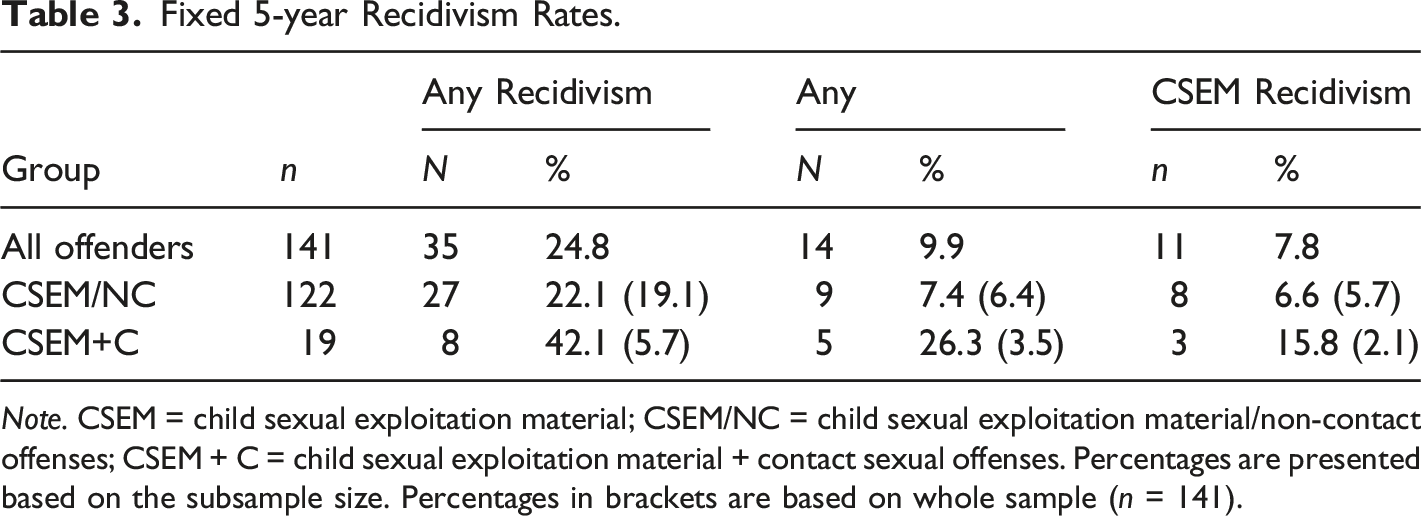
Note. CSEM = child sexual exploitation material; CSEM/NC = child sexual exploitation material/non-contact offenses; CSEM + C = child sexual exploitation material + contact sexual offenses. Percentages are presented based on the subsample size. Percentages in brackets are based on whole sample (n = 141).
Difference in CPORT Scores Between Offender Types
Differences in CPORT Scores Based on Offense Type.
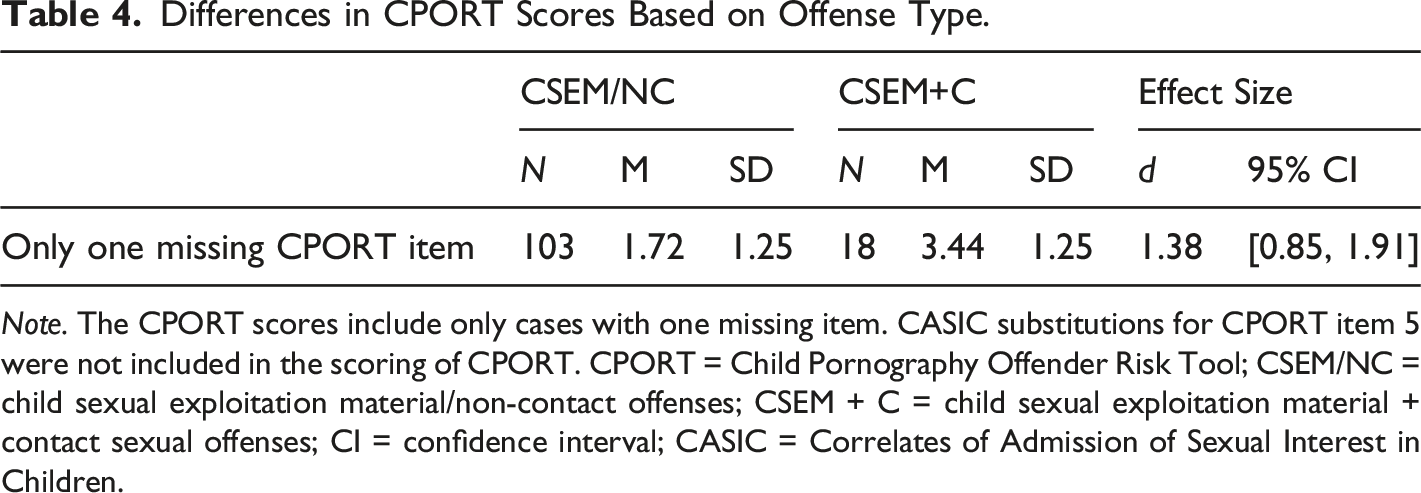
Note. The CPORT scores include only cases with one missing item. CASIC substitutions for CPORT item 5 were not included in the scoring of CPORT. CPORT = Child Pornography Offender Risk Tool; CSEM/NC = child sexual exploitation material/non-contact offenses; CSEM + C = child sexual exploitation material + contact sexual offenses; CI = confidence interval; CASIC = Correlates of Admission of Sexual Interest in Children.
Relative Predictive Accuracy of CPORT Scores
Predictive Accuracy (5-Year Follow-Up) of CPORT Total Scores – Any Recidivism, Any Sexual Recidivism or CSEM Recidivism.

Note. CASIC substitutions for CPORT Item 5 were not included in the scoring of the CPORT unless specified. Compact version = omitting CPORT items 5 and 7. CPORT = Child Pornography Offender Risk Tool; CSEM/NC = child sexual exploitation material/non-contact offenses; CSEM + C = child sexual exploitation material + contact sexual offenses; n recid = number of recidivists in the sample; AUC = area under the curve; CI = confidence interval; CASIC = Correlates of Admission of Sexual Interest in Children. An AUC value is significantly different from chance and is bolded when the 95% CI does not include 0.5.
Offense Type Subsamples
ROC analyses were performed on both offense type subsamples. It is important to note that regarding information coded as missing (i.e. CPORT item 7), the distribution of the missing information differed significantly between the two groups. The great majority of the CSEM/NC sample (90.2%, n = 110) had no available information for CPORT item 7 compared to 42.1% (n = 8) of the CSEM+C sample. Contrary to Eke et al. (2019), when separating the analyses in the current work by offender type, AUCs for CPORT total scores (with or without missing information and compact version) were higher for the CSEM/NC sample compared with the CSEM+C sample.
Including all cases (with missing information), AUCs for CPORT total scores were between .77 and .81 for the CSEM/NC group compared with .50 and .68 for the CSEM+C group for all types of recidivism. Large effect sizes were also found for the CSEM/NC group for all types of recidivism when using the compact version (i.e. omitting CPORT items 5 and 7), but the CSEM+C group only had a large effect size for any recidivism, having a moderate effect size for any sexual recidivism and a small effect size for CSEM recidivism. When looking at samples with no missing data, only the CSEM+C group had large effect sizes for all types of recidivism. The CSME/NC group had a large effect size for any recidivism but small effect sizes for the two other types of recidivism.
Correlates of Admission of Sexual Interest in Children Substitution
Table 5 also presents the AUCs for the whole sample (fixed 5-year follow-up) for CPORT total scores where CPORT item 5 was substituted by the CASIC scores of 3 or higher, on all cases (regardless of missing information), when only one CPORT item was missing and with no missing information. Results show similar effect sizes for all types of recidivism for all cases and when only one item was missing. For samples with no missing data, the whole sample had a large effect size for any recidivism, but small effect sizes for any sexual and CSEM recidivism. When looking at the subsamples, the CSEM/NC group had similar effect sizes to the ones without the CASIC substitution for all types of recidivism, with or without missing information. For the CSEM+C group, large effect sizes were found only when there was no missing information.
The CASIC substitution presented in Table 5 was only used on the seven cases where CPORT 5 could not be coded due to missing information. Analyses were also conducted including the 13 individuals who denied sexual interest in children but obtained a score of 3 or higher on the CASIC, bringing the number of cases where CASIC substitution was used to 20 (see Online Supplement A). Again, very similar results were found. Large effect sizes were found for the whole sample for all types of recidivism regardless of missing information (AUCs between .71 and .79), when only one CPORT item was missing (AUCs between .71 and .79) and for any recidivism when no data were missing (AUC = .72). When looking at offense type groups, large effect sizes were found for all types of recidivism in the CSEM/NC group, regardless of missing information and when only one CPORT item was missing (AUCs between .71 and .79). Only small and moderate effect sizes were found when no data were missing. The opposite results were found for the CSEM+C group, with large effect sizes on all types of recidivism only when no data were missing.
CPORT Items’ Predictive Accuracy
ROC analyses were conducted on each individual CPORT item across all samples to explore their predictive validity (Online Supplement B). In regard to the whole sample, large effect sizes were found for CPORT 1 (35 or younger at investigation) for CPORT 2 (previous criminal history) and for CPORT 3 (failure on conditional release). CPORT item 5 (indication of sexual interest in children) was found to have a moderate effect size and the remaining CPORT items (4: presence of sexual offense in index or offending history; 6: more than 50% boy content in CSEM and 7: more than 50% boy content in other material) were found to have small effect sizes. For the CSEM/NC group, only CPORT 2 and CPORT 3 were found to have large effect sizes, the remaining CPORT items had small effect sizes. As for the CSEM+C group, large effect sizes were found for CPORT items 1, 2 and 3. CPORT item 5 had a moderate effect size and the remaining CPORT items (i.e. 4, 6 and 7) had small effect sizes.
Logistic Regressions
Logistic Regressions Results for CPORT Scores.
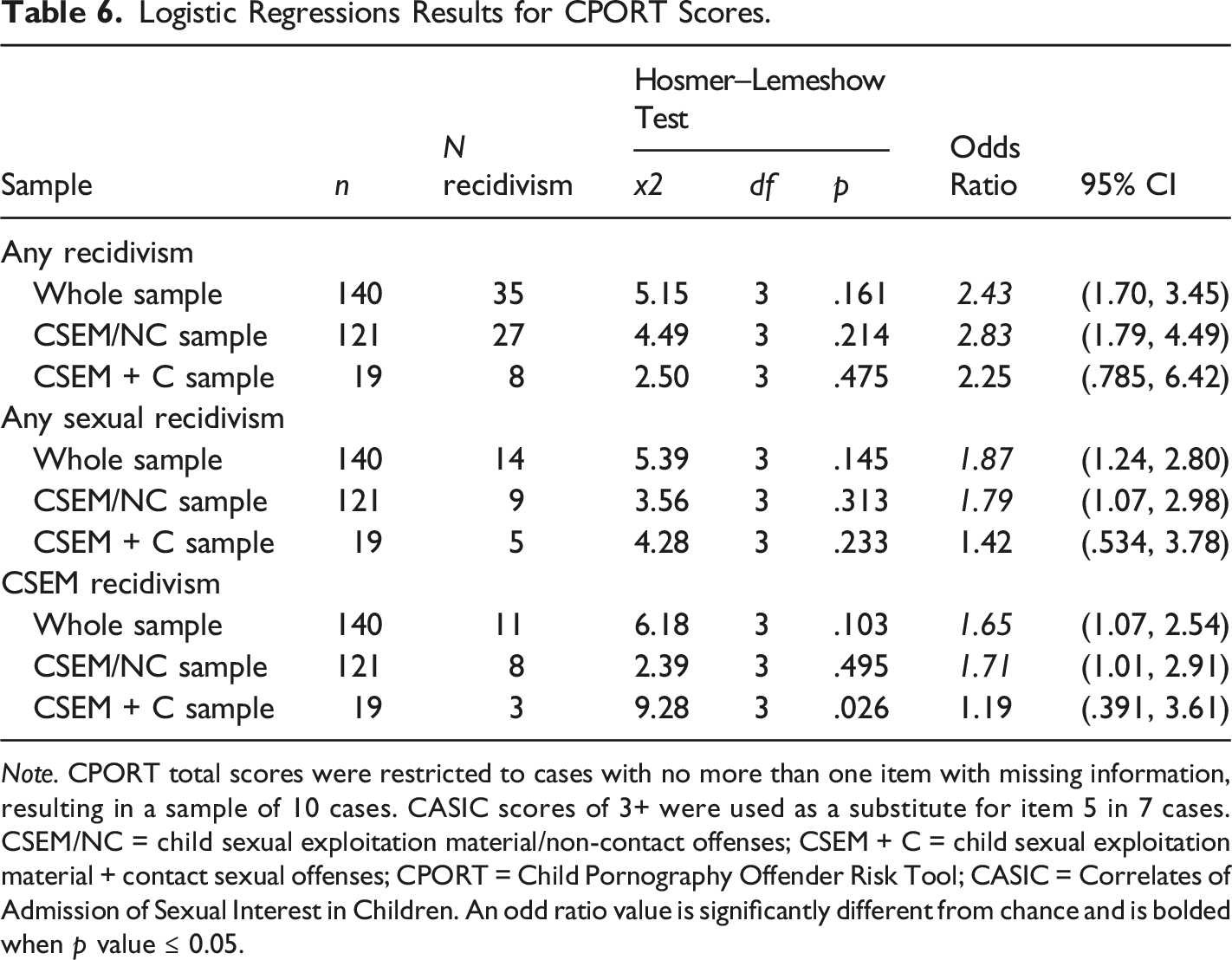
Note. CPORT total scores were restricted to cases with no more than one item with missing information, resulting in a sample of 10 cases. CASIC scores of 3+ were used as a substitute for item 5 in 7 cases. CSEM/NC = child sexual exploitation material/non-contact offenses; CSEM + C = child sexual exploitation material + contact sexual offenses; CPORT = Child Pornography Offender Risk Tool; CASIC = Correlates of Admission of Sexual Interest in Children. An odd ratio value is significantly different from chance and is bolded when p value ≤ 0.05.
The analyses were also conducted using the CASIC to replace CPORT 5 for the 13 individuals who denied pedophilic/hebephilic interests but obtained a score of 3 or higher on the CASIC. The results are presented in Online Supplement C. Overall, results were similar for any recidivism. Odd ratios varied between 1.19 and 2.56 with a median of 1.65.
Observed and Estimated 5-year Any Sexual and CSEM Recidivism for CPORT Scores.

Note. CPORT = Child Pornography Offender Risk Tool; CSEM = child sexual exploitation material; E/O = expected/observed; E/O index cannot be calculated with zero expected or observed recidivists. E/O is significantly different from chance and is bolded when CI 95% does not overlap with 1.
E/O index was calculated, based on Hanson’s (2017) guide, for CPORT scores ranging from 1 to 5+ as individuals who scored 0 did not end up committing a new sexual or CSEM offense. According to the E/O indices, the tool appeared to have good calibration with most of indices being near 1, either slightly under or over. The exceptions are the E/O index for any sexual recidivism for individuals who scored 1 and 5+ (E/O = 2.7; 2.0) and for CSEM recidivism for individuals who scored 4 (E/O = 3.2) where the CPORT appeared to have overpredicted recidivism. However, when looking at the total recidivism (n = 14), the CPORT nearly obtained a perfect calibration with E/O index of 1.16 which suggests that the CPORT predicted the total number of recidivists almost accurately. Only the total number of CSEM recidivism obtained a significant difference between the observed and the expected recidivists and the remaining differences were non-significant, which likely reflects the low power of these analyses.
Discussion
The primary aim of this study was to investigate the predictive accuracy of the CPORT within a Scottish sample of individuals convicted of a CSEM offense. To do so, this study replicated the most recent CPORT validation study using its original version conducted by Eke et al. (2019) as opposed to a compact or translated version. Overall, the sample from this study was similar to Eke et al.’s (2019) sample in terms of demographic variables (e.g. method of detection, contact versus non-contact offense type groups, CSEM material format). In addition, the mean CPORT total scores in the current sample (1.82, SD = 1.39) was similar to those reported by Eke et al. (2019) for their development and combined samples (1.77, SD = 1.50 and 1.99, SD = 1.58; respectively). The current study however differed slightly from Eke et al.’s (2019) sample in terms of types of CSEM offense due to differences in legislation, with no offenders having charges of production in this sample. There were also more individuals from rural areas. The main difference from Eke et al.’s (2019) sample was the significant amount of data which was coded as missing information for CPORT item 7, again possibly due to differences in procedure when recording the content of seized material. It was also highlighted how the missing information was unequally distributed between the offense type groups. It is possible that due to their history of sexual contact offending, the investigation into the individuals comprising the CSEM+C sample led to more thorough examination of other child-related material compared to individuals without history of sexual contact offending.
With a 5-year fixed follow-up sample of 141 men convicted of CSEM offenses, this study supports findings from the validation study. A total of 35 (24.3%) of the sample reoffended, with 14 (9.9%) of them being further sexual offenses and 11 of those (7.7%) were new CSEM offenses. When looking at the offense type subsamples, 22.3% of the CSEM/NC subsample had reoffended compared to 38.1% of the CSEM+C subsample, 7.4% of the CSEM/NC group committed a new sexual offense (23.8% for those in the CSEM+C group) and 6.6% committed a new CSEM offense (14.3% for of those in the CSEM+C group). The recidivism rates obtained in this study support previous findings from the validation studies (Eke et al., 2019; Soldino et al., 2020) but also recent results from Elliott et al.’s (2019) study. However, unlike Soldino et al.’s (2020) findings, observed recidivism rates for any sexual and CSEM recidivism were very similar to expected recidivism rates, suggesting good calibration.
Our findings demonstrated that the CPORT predicted any reoffending, including any sexual and CSEM recidivism, with large effect sizes even when using a sample with only one piece of missing information (n = 121), resulting also in large effect sizes. However, when excluding any missing information and when looking at the subsamples, that is, CSEM/NC and CSEM+C, effect sizes varied greatly. This is likely explained by their considerably smaller sample sizes which also led to the analyses being underpowered. The issue of missing data was highlighted by Eke et al. (2019) who stressed the likelihood of having unavailable information when using risk assessment tools. In terms of CPORT item 7 (boy versus girl content in other material, excluding CSEM material), it is possible that in Scottish investigations of CSEM offenses this type of information is not currently collected due to differences in definition and legislation around CSEM offenses in this country. However, when following the scoring guidelines (Eke et al., 2018) by omitting only one CPORT item and allowing for the substitution of the Correlates of Admission of Sexual Interest in Children (CASIC) total score of three or higher for missing CPORT item 5 (indication of pedophilic interests), the CPORT total scores also predicted any recidivism, any sexual recidivism as well as CSEM recidivism, all with large effect sizes. In this study, the CASIC was also used to substitute CPORT 5 for 13 individuals who denied pedophilic/hebephilic interests but scored three or higher on the CASIC. The results are presented in Online Supplement A showing similar results than when used only with missing information, with large effect sizes for all types of recidivism.
Similar results were found for the CSEM/NC group (i.e. individuals who did not have any history of contact sexual offending) when conducting the analyses on the offense type subsamples. As to the CSEM+C (i.e. with history of contact sexual offending), again, results were likely affected by the small size of the sample and low statistical power and they should be interpreted with caution.
The predictive validity of the CPORT for recidivism was also calculated for all individuals with only one item of missing information and CASIC substitution, as well as for each subsample, using logistic regressions. Results show significant odd ratios for all types of recidivism when looking at the whole sample. In terms of offense type subsamples, the CSEM/NC obtained similar results, but the analyses were statistically underpowered for the CSEM+C sample which explained why it did not obtain significant results.
In addition, comparison was made between the observed number of recidivists per CPORT score and the expected number of recidivists provided by the original validation study (Eke et al., 2019). Overall, results suggest that the tool has good calibration and could generally predict the number of recidivists accurately, with only three exceptions where the CPORT overpredicted the number of recidivists for those specific scores. However, due to the low level of general recidivism in the whole sample (n = 35) and even lower in the subsamples (CSEM/NC = 27, CSEM+C = 8), the results from the analyses must be interpreted with caution and might be considered as unstable. As mentioned by Eke et al. (2019), research recommends that a minimum of 100 recidivists would be essential to consider the logistic regression models as stable (Vergouwe et al., 2005).
Overall, the current findings corroborate the results from the most recent validation study of the CPORT. The results from this study suggest that the CPORT has good predictive validity in a Scottish sample. It also supports previous research suggesting possible differences between CSEM offenders with and without contact sexual offenses (Babchishin et al., 2015; Eke et al., 2019).
Limitations
Although this study has attempted to replicate the CPORT validation study by Eke et al. (2019) with what could be considered a reasonable sample size for ROC analysis, when excluding cases with missing information or dividing the sample within offense types, this resulted in much smaller sample sizes which led to lower statistical power. Therefore, some of the results should be interpreted with caution. The low number of recidivists in the current sample corroborate with previous findings, indicating that CSEM offenders show low rates of reoffending (e.g. Eke et al., 2011; Endrass et al., 2009; Wakeling et al., 2011). This is a reality that future research on this topic will experience and therefore it might be difficult to obtain a sample with the appropriate number of recidivists for the analysis. In addition, two of the 14 individuals comprising the sexual recidivists’ sample were included following breach of their Sexual Offences Prevention Order. As explained earlier in this paper, those offenses are considered sexual offenses in Scotland which is the reason why those individuals were included in that sample. However, it is debatable that their offenses did not directly involve sexual behaviors and therefore should have been excluded from the sexual recidivists’ sample, bringing the total of sexual recidivists to 12. This once more highlights the differences in legislation between Scotland and Canada which could possibly become an issue in future studies from other countries looking at validating the CPORT in their population.
Due to data access restrictions, the variables for this study were collected and coded in collaboration with the lead investigator. Consequently, it was not possible to assess, for example, the content of the CSEM. Additionally, the large number of cases which were coded as missing information for CPORT item 7, boy versus girl content in other material (not CSEM) also suggests the unavailability of some essential information in order to accurately validate and use the CPORT in Scotland. This issue could be resolved by using the compact version of the CPORT (i.e. omitting CPORT items 5 and 7) as the results showed that the CPORT was still significantly predicting risk of any recidivism and any sexual and CSEM recidivism, with large effect sizes. However, the CPORT’s authors strongly discourage its use to predict recidivism when more than one item is missing (Eke et al., 2018) until more research is carried out. Another limitation associated with the data collection of this study is possibility that the content items were coded based on a sample of the seized material rather than all material. It is likely that the description of the material seized fit the charges that would likely lead to a conviction but is not necessarily an accurate representation of the totality of material possessed. Again, the restriction in access to the actual seized material makes it impossible to verify its accuracy. Also, to obtain a fixed 5-year follow-up period, some of the data dated as early as 2010. With the advancement in technology and changes in police investigations in the past few years, cases dating earlier than 2014 might not have as much detailed information as more recent ones in relation to content variables.
Like the validation study, the current work only separated individuals according to their history of contact sexual offenses/charges and did not examine differences between CSEM offenders with no criminal history or those with other criminal history such as fraud or violent offenses (non-sexual). Eke et al. (2019) indicated that including individuals convicted of CSEM offenses with non-sexual criminal history with those with no criminal history retained variability in general criminal history as risk factor for recidivism. However, research suggests that in some cases non-sexually violent charges against individuals convicted of sexual offenses were found to actually be sexually motivated when thoroughly analyzed (Rice et al., 2006). Future research on this topic might reveal greater differences between those two groups which could be relevant to their risk assessment.
Finally, the data collection was limited to the east coast of Scotland rather than nationwide. It is unlikely that there are regional variations with such cases, but it is not possible to conclude that this sample accurately represents all Scottish individuals with CSEM offense histories.
Conclusion and Future Research
Despite its limitations, this study supports the current empirical evidence for use of the CPORT as a valid assessment tool in the prediction of any recidivism, sexual recidivism and CSEM recidivism in an English speaking non-Canadian population. The findings support the use of the CPORT in a Scottish sample in relation to identifying potential risk factors and assessing level of risk, therefore aiding case prioritization. Results also increase empirical support in the use of the CASIC as a substitute to CPORT item 5 (indication of sexual interest in children) when this item is missing, but also found significant results and large effect sizes when used with individuals who denied pedophilic/hebephilic interests but scored three or higher on the CASIC. As the information to code CPORT 5 highly relates on the honesty of the individual at the time of investigation, it is possible that social desirability would influence some individuals in their decision to admit to this sexual interest or not. Although the CPORT/CASIC authors recommend the use of the CASIC only when CPORT 5’s information is missing, the results from this study open new avenues for further research exploring its use with deniers.
Another important finding from this study was the predictive validity of the CPORT despite the substantial amount of missing information for CPORT 7. This study obtained significant results by using a sample with one missing CPORT item and by using the compact version (i.e. omitting CPORT items 5 and 7). Although this procedure was already tested and accepted by the CPORT’s authors (Seto & Eke, 2015), this lack of information, particularly in relation to the content of the seized material, indicates a potential difficulty that criminal justice agencies in Scotland and other countries might face when using the CPORT in future. Currently, it appears that some of the information needed to complete the CPORT, for instance, the ratio of boy versus girl in the content of other material, is not routinely recorded by police forces for reasons such as the legality of the material (e.g. images of children in swimming suits) or possibly considered not essential to the investigation. Although these types of images may be considered legal in most jurisdictions, research indicates that these images may be used to relieve sexual arousal and be indicative of sexual interest in children (e.g. Taylor et al., 2001). For the seven items of the CPORT to be used routinely as a risk assessment tool in Scotland, changes to the data collection procedure would have to be made in order to gather crucial information for its completion. This also involves changes in communication and data accessibility for other agencies involved in the criminal justice system in Scotland. As it stands, it seems unlikely that agencies in Scotland other than the Police Force would have access to all relevant information needed, particularly detailed reports of the content of the CSEM. If the use of the CPORT is made available to other agencies such as Criminal Justice Social Workers, it could support them in case prioritization and management as well as informing intervention. However, as an alternative, our results suggest that the CPORT could still significantly predict risk of reoffending in CSEM individuals when only one CPORT item is missing or when using the compact version.
Although results corroborate previous findings and suggest that the CPORT significantly predicts risk of any recidivism, sexual and CSEM recidivism within this population, further research is needed to look at its validity in other populations (Babchishin et al., 2018). As risk assessment tools specific to CSEM offenders are greatly needed, this study provides very promising outcomes on the use of this actuarial risk assessment tool to predict risk of reoffending in this population and support relevant authorities in the supervision and management of those cases. Although numerous studies have found actuarial risk assessment tools to be statistically robust and inform decision making regarding the management of individuals who have been adjudicated for sexual offenses, they do not provide information on the dynamic and protective risk factors which should also be considered when assessing the management and treatment of these individuals (Barnett et al., 2010; Brankley et al., 2019; Garrington et al., 2018).
Supplemental Material
sj-pdf-1-sax-10.1177_10790632211047190 – Supplemental Material for Predicting Risk of Reoffending in Persons with Child Sexual Exploitation Material Offense Histories: The Use of Child Pornography Offender Risk Tool in a Scottish Population
Supplemental Material, sj-pdf-1-sax-10.1177_10790632211047190 for Predicting Risk of Reoffending in Persons with Child Sexual Exploitation Material Offense Histories: The Use of Child Pornography Offender Risk Tool in a Scottish Population by Valérie Savoie, Ethel Quayle, Elizabeth Flynn and Suzanne O’Rourke in Sexual Abuse: A Journal of Research and Treatment
Footnotes
Acknowledgments
The authors would like to thank Police Scotland, particularly Detective Superintendent Gail Johnston and Detective Constable Angela Connor for their invaluable help and support in undertaking this study. The authors take responsibility for the integrity of the data, the accuracy of the data analyses, and have made every effort to avoid inflating statistically significant results.
Declaration of Conflicting Interests
The author(s) declared no potential conflicts of interest with respect to the research, authorship, and/or publication of this article.
Funding
The author(s) received no financial support for the research, authorship, and/or publication of this article.

Supplemental Material
Supplemental material for this article is available online.
Notes
References
Supplementary Material
Please find the following supplemental material available below.
For Open Access articles published under a Creative Commons License, all supplemental material carries the same license as the article it is associated with.
For non-Open Access articles published, all supplemental material carries a non-exclusive license, and permission requests for re-use of supplemental material or any part of supplemental material shall be sent directly to the copyright owner as specified in the copyright notice associated with the article.
