



Abstract
Purpose:
Over the past decades, the prevalence of ocular allergies has increased worldwide. Molecular hydrogen is the lightest chemical element, and in recent years, there have been multiple reports on its therapeutic effects. Animal studies have also reported the effects of hydrogen gas on various models of inflammation and circulatory disorders.
Methods:
In this study, we investigated the effects of hydrogen gas inhalation in a mouse model of allergic conjunctivitis. Mice were sensitized by intraperitoneal injection of ovalbumin. Local sensitization was performed once daily by instilling ovalbumin in both eyes. Conjunctivitis model mice were challenged with antigens, and eye-scratching behavior induced by antigen stimulation was evaluated. The hydrogen gas exposure group was exposed to hydrogen gas after the antigen challenge. In addition, the same mice were exposed to hydrogen gas after antigen challenge, and the number of eosinophils in the tears was evaluated.
Results:
An increase in eye-scratching behavior induced by antigen was observed. Hydrogen gas suppressed the increase in eye-scratching behavior. Moreover, hydrogen gas inhibited the increase in eosinophil count in tears.
Conclusions:
Active oxygen has a profound effect on itching and eosinophilic function. Therefore, it is thought that inhalation of hydrogen gas suppresses itching of the eye and the migration of eosinophils into the tissue by removing reactive oxygen species. Inhalation of hydrogen gas suppressed the symptoms of allergic conjunctivitis.
Introduction
Allergic conjunctivitis is an inflammatory disease that can result from an immunoglobulin E (IgE)-mediated hypersensitivity reaction caused by direct contact between an allergen and the conjunctiva. 1 Therefore, allergic conjunctivitis, whose main symptoms are redness and itching, requires special treatment because it significantly reduces the patient’s quality of life. The immunological response to ocular allergy can be broken down into three phases: sensitization, the early, and the late-phase. 2 Once an allergen is re-presented to sensitized mast cells, an allergic reaction is initiated. It is typically mediated by allergen-induced crosslinking of IgE attached to receptors on primed conjunctival mast cells, which results in mast cell degranulation and histamine release, as well as the release of lipid mediators, cytokines, and chemokines. 2 The clinical result is conjunctival hyperemia, tearing, intense itching, and chemosis. This marks the initiation of the early-phase of allergic conjunctivitis. The presenting signs and symptoms include itching, hyperemia, and chemosis. The late-phase of the allergic response typically occurs about 6–12 h after the initial exposure. The release of chemokine factors from the early-phase is responsible for the recruitment and infiltration of eosinophils, basophils, neutrophils, Th2 lymphocytes, and monocytes into the conjunctiva.3,4 Activated eosinophils produce several mediators including eosinophil cationic protein (ECP), which is toxic to the ocular surface.5,6 Patients are commonly prescribed a local anti-allergy treatment that includes mast cell stabilizers and histamine H1-receptor antagonists eye drops. 7 Molecular hydrogen is the lightest chemical element in the earth’s atmosphere, and hydrogen gas is the most miniature electrically neutral molecular gas. Production and excretion of hydrogen gas in humans have been reported since then; it has been regarded as a nontoxic molecule. 8 Because hydrogen gas can permeate cell membranes, it can quickly diffuse not only into the systemic circulation but also into cells. 9 The hydrogen molecules selectively scavenge hydroxyl radicals, one of the powerful reactive oxygen species (ROS). 10 Based on this discovery, the effects of hydrogen on various diseases associated with active oxygen have been studied. Many studies using cellular, animal, and clinical experiments in various biomedical fields have explored the therapeutic and preventive effects of H2. These results indicate that H2 is an essential physiological regulatory factor with antioxidant, anti-inflammatory, and antiapoptotic effects on cells and organs.11–13 It is so convenient that H2 can be easily administered in various ways, including inhalation, injection of H2-rich saline (HRS), drinking H2-rich water, and using HRS eye drops. Unlike hydrogen water, hydrogen gas can be administered continuously via inhalation; therefore, it maintains high blood and tissue concentrations. 14 Therefore, the most common method of hydrogen therapy administration is inhaling hydrogen gas. They can be inhaled through nasal cannulae, ventilators, facemasks, or gas chambers and have no peculiar odor. 15 The animal experiments showed that hydrogen gas directly reduces ROS, including hydroxyl radicals and peroxynitrite. Several recent studies have indicated that molecular hydrogen induces beneficial effects in numerous oxidative stress-associated diseases. Clinically, it has been demonstrated that oxidative stress contributes to allergic inflammation, including asthma and allergic rhinitis.16,17 Inflammatory cells, including eosinophils, neutrophils, and lymphocytes from the airway/blood, have been demonstrated to produce oxidants in response to various stimuli.18,19 Inhalation of 67% H2 markedly improved lung function and protected airway inflammation in an asthmatic murine model. 20 Effects of hydrogen gas on allergic rhinitis in mice have also been reported. 21 Among these, the following have been suggested: Hydrogen exerts anti-allergic effects by removing ROS. However, the effect of hydrogen gas on allergic conjunctivitis has yet to be clarified. This study clarified the inhibitory effect of hydrogen gas on the increase in tear eosinophil counts and enhanced ocular itching in allergic conjunctivitis, including the effective concentration of hydrogen gas.
That 3% or less hydrogen gas does not affect the physiological parameters and does not exhibit adverse effects. 22 In a previous study, the effect of hydrogen gas at a concentration of 1.3% in a rat model of hypertension was reported. 23 The safety of hydrogen gas therapy has been established in clinical practice, and its administration method and concentration have been clarified. Hydrogen gas therapy has been suggested to have many advantages from the perspective of compliance, and it is expected to contribute to the treatment of various diseases in the future. In this study, we investigated the effects of hydrogen gas inhalation on eye itching and eosinophils in tears in allergic conjunctivitis model mice.
Methods
Ethics statement
All experiments were performed in accordance with the Association for Research in Vision and Ophthalmology Statement for the Use of Animals in Ophthalmic and Vision Research. The protocol was approved by the University Committee on Use and Care of Animals of the University of Michigan (Protocol No.: PRO00006215). This study was approved by the Animal Experiments at Okayama University Advanced Science Research Center (Permission number: OKU-2023485) and carried out according to the guidelines of the Animal Research Control Committee of Okayama University.
Animals and housing conditions
Five-week-old female ICR mice were obtained from Japan SLC, Inc. (Shizuoka, Japan). Mice were housed under the same environment and conditions as previously described in detail. 24
Reagents
The following reagents were used: ovalbumin (OVA, grade V; crystallized and lyophilized, essentially salt-free; Sigma-Aldrich Japan, Tokyo, Japan), aluminum hydroxide hydrate gel (alum; LSL, Tokyo, Japan).
Sensitization
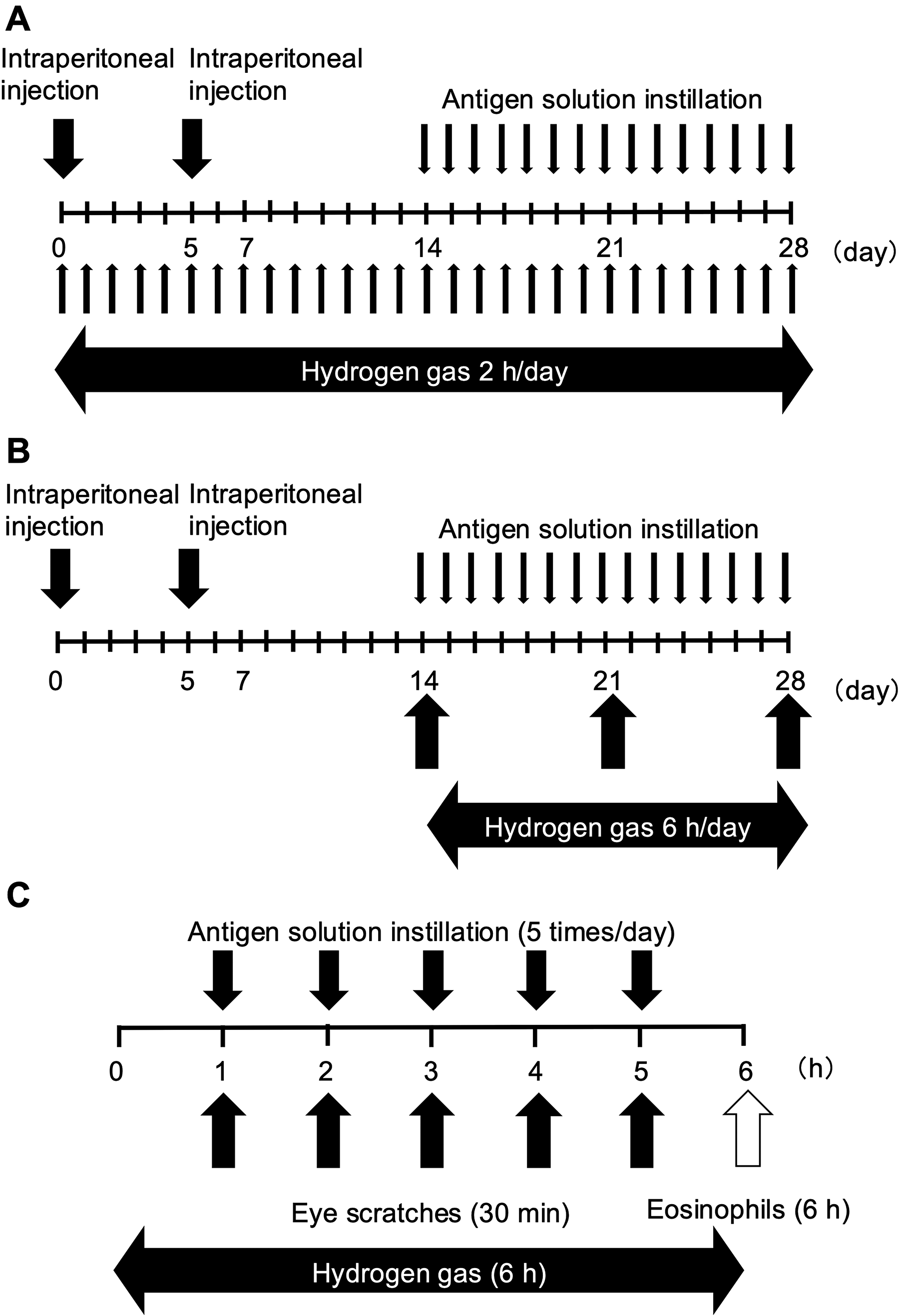
The mice were sensitized essentially as described in detail previously. 24 A schematic diagram for establishing allergic conjunctivitis mice is shown in Figure 1A and B. On days 14, 21, and 28, mice with conjunctivitis were challenged with the antigen five times every hour, and five eye-scratching behaviors were evaluated for 30 min after the antigen challenge.
Hydrogen exposure
A mouse was placed in an observation chamber (MK-ICM; 25 cm × 15 cm × 20 cm; Muromachi Kikai, Osaka, Japan). The observation chamber was connected, and a hydrogen gas generator (OHG-PRO; Ops, Tokyo, Japan) was activated to generate hydrogen gas. This hydrogen gas generator electrolyzed water to generate a mixture of 66.6% hydrogen gas and 33.3% oxygen. Next, hydrogen gas exposure was performed while confirming that the hydrogen gas concentration in the observation chamber was 1%, 2%, and 3%, using a hydrogen gas detector (XP-3310, New Cosmos Electric Co., Ltd., Osaka). To measure eye-scratching behavior and the number of eosinophils in tears, mice were exposed to hydrogen gas in an observation chamber for 6 h. The intervention protocol for hydrogen gas inhalation is shown in Figure 1A and B.
Evaluation of eye-scratching behavior induced by antigen
Eye-scratching behavior was performed essentially as previously described in detail. 24 All behavioral experiments were performed between 10:00 and 16:00. The measurements were performed by the same researcher with no knowledge of the experimental group to which the animal belonged. The intervention protocol for eye-scratching behavior is shown in Figure 1C.
Evaluation of eosinophils in tears induced by antigen
Eosinophils in tears were assessed using the following method: After 6 h of the antigen challenge, tear samples of 6 h were collected by placing Zone-Quick® (phenol red threads, AYUMI Pharmaceutical, Tokyo, Japan) in the right eye of mice for 20 s. The length of the color change was measured after the phenol red threads were air-dried. One millimeter of color change was converted to 0.05 µL of tears. The phenol red threads with a color change were cut, placed in a microtube, and rinsed with 20 µL of PBS at 4°C for 10 min to complete the tear sample elution. The sample was stirred slowly using a pipette, and 10 µL of the sample was placed on a glass slide and air-dried. The sample was then stained with Eosinostain-Torii® and distilled water for 1 min. The glass slides were then washed with distilled water and dehydrated with ethanol. All eosinophils on the glass slides were determined microscopically. Twenty-four mice were randomly divided into four groups: (1) control (n = 15), (2) 1% hydrogen gas-treated (n = 13), (3) 2% hydrogen gas-treated (n = 18), and (4) 3% hydrogen gas-treated (n = 17). The intervention protocol for assessing tear eosinophils is shown in Figure 1C.
Statistical analysis
The values are expressed as the mean ± SEM. Student’s t-test was used to compare variables between the two groups. The level of statistical significance was set at P < 0.01.
Results
Changes in concentration of hydrogen gas in cage for mice
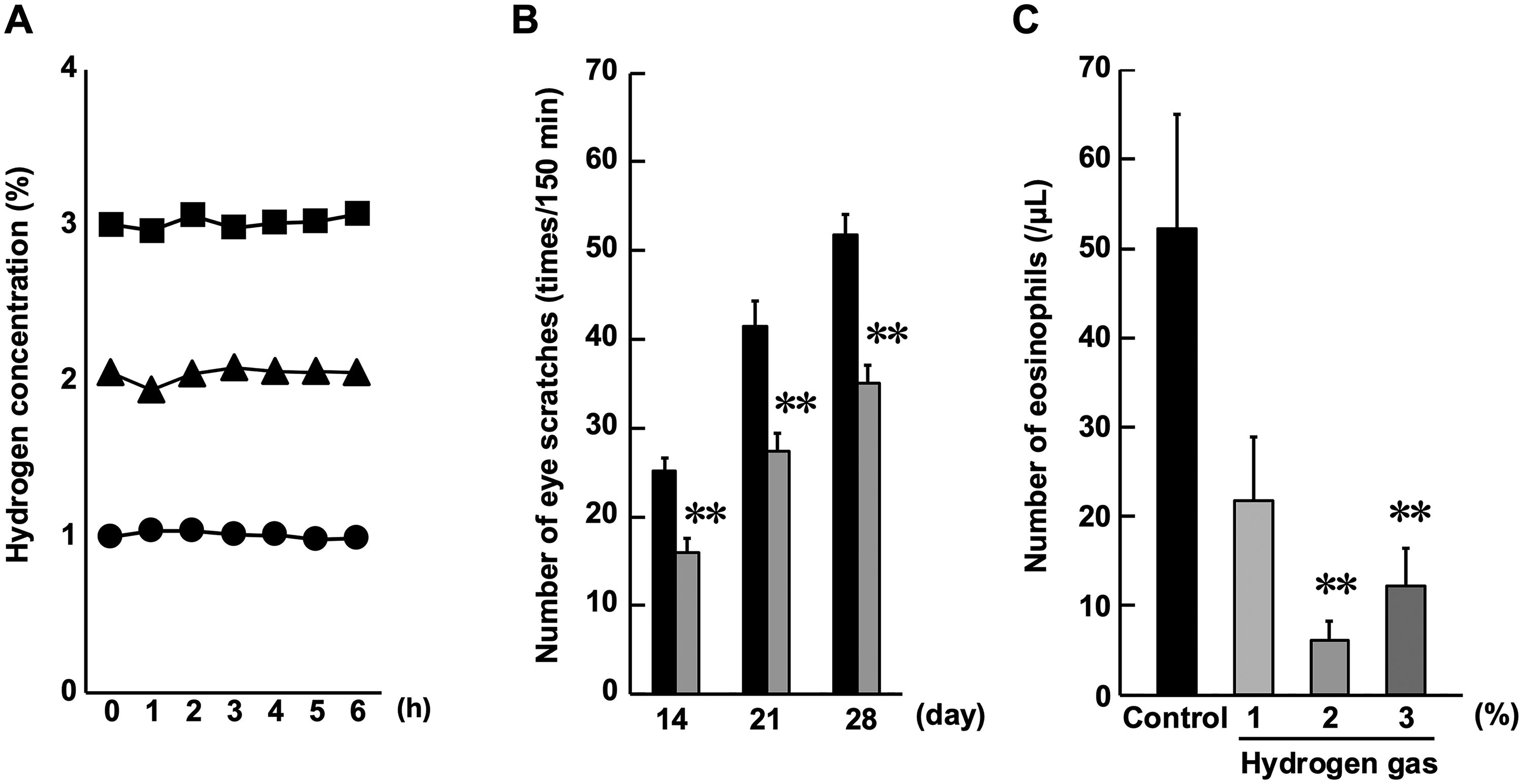
In this study, the conditions for hydrogen gas exposure were set to examine the effects of hydrogen gas on a mouse model of allergic conjunctivitis. Figure 2A shows that the hydrogen gas concentration in the observation box, measured using the hydrogen gas detector, was maintained at 1%, 2%, and 3% for 6 h. We confirmed that hydrogen concentrations of 1%, 2%, and 3% in the observation box could be maintained for 6 h. Using this method, antigen-induced allergic conjunctivitis model mice were exposed to hydrogen, and the effect was investigated.
Effect of 2% hydrogen gas on tear volume induced by antigen
First, we investigated the effect of 2% hydrogen gas for 2 h once a day for 28 days on tear volume, the number of eosinophils in tears, clinical score of allergic conjunctivitis, and eye-scratching behavior induced by antigens in sensitized mice. As a result, the increase in tear volume, the number of eosinophils in tear, clinical score of allergic conjunctivitis, and eye-scratching behavior after the antigen challenge did not suppress by inhalation of 2% hydrogen gas for 2 h a day (data not shown). Furthermore, repeated 2% hydrogen gas for 2 h once a day for 28 days had no significant effect on the production of antigen-specific IgE (data not shown). The increase in tear volume induced by antigen solution instillation peaked 10 min after onset and then rapidly declined. Eye-scratching behavior induced by antigen solution instillation also gradually declined over 30 min. As these reactions disappear quickly, they reflect the degree of acute-phase reactions in allergic conjunctivitis. These results indicate that the inhalation of hydrogen gas had no significant inhibitory effect on the acute-phase reaction in allergic conjunctivitis.
Effect of 2% hydrogen gas inhalation for 6 h on eye scratching behavior induced by antigen
Next, we examined the effect of 2% hydrogen gas inhalation for 6 h on eye scratching behavior in a mouse model of repeated antigen-induced conjunctivitis on days 14, 21, and 28 after sensitization. In allergic conjunctivitis model mice, eye-scratching behaviors were observed up to 6 h after instillation of an antigen five times at hourly intervals, so the mice were allowed to inhale hydrogen gas for 6 h. In the results, eye scratching behavior per 150 min after antigen instillation was significantly suppressed by inhalation of 2% hydrogen gas for 6 h on days 14, 21, and 28 of sensitization compared with that after PBS instillation (Fig. 2B). In a previous study, eye-scratching behaviors increased with repeated antigen instillation and markedly increased on day 28. Hydrogen gas significantly inhibited eye-scratching behavior in mice with conjunctivitis on days 14, 21, and 28. Furthermore, inhalation of 2% hydrogen gas for 6 h on days 14, 21, and 28 after sensitization was the most effective in reducing antigen-induced eye scratching behavior compared witho inhalation of 1% or 3% hydrogen gas (data not shown).
Effect of hydrogen gas on number of eosinophils in tears induced by antigen
Third, we conducted the effect of 6 h hydrogen gas inhalation on the increase in lacrimal eosinophils induced by antigen in allergic conjunctivitis model mice. Previous studies have shown that the lacrimal eosinophils in antigens-induced allergic conjunctivitis model indicate a marked increase 6 h after antigen instillation on day 28 after sensitization. 24 Based on this study, the mice were inhaled with hydrogen gas for 6 h on day 28 of antigen sensitization. Figures 2C show the effect of 6 h hydrogen gas inhalation on the number of eosinophils in tears of antigen-induced allergic conjunctivitis. The values are expressed as the mean ± standard error of the mean. Statistical analysis of the data was performed using Dunnett’s test for multiple comparisons. The level of statistical significance was set at P < 0.01. Exposure to 1% hydrogen gas for 6 h suppressed the increase in tear eosinophil count; however, the suppression effect was not significant. In contrast, 2% and 3%. Hydrogen gas showed a significant inhibitory effect, and the inhibitory effect was stronger with 2% than with 3%. Previous studies have shown that the lacrimal eosinophils in antigens-induced allergic conjunctivitis model indicate a marked increase 6 h after antigen instillation on day 28 after sensitization. 24
Discussion
In the first study, short-term inhalation of hydrogen gas did not suppress the symptoms of allergic conjunctivitis, including the production of antigen-specific IgE antibodies. However, when symptoms of allergic conjunctivitis were persistently induced (eosinophil infiltration into tears and itchy eyes), continuous inhalation of hydrogen gas suppressed these reactions. Therefore, continuous hydrogen gas inhalation is thought to be effective in suppressing the symptoms of induced allergic conjunctivitis. In patients with allergic conjunctivitis, it has been reported that the concentration of eosinophil-produced ECP in tears increased 6 h after the challenge.25,26 These findings suggest that tear eosinophils reflect the degree of late-phase reaction in allergic conjunctivitis. Therefore, hydrogen gas was considered effective in suppressing the delayed phase reaction in allergic conjunctivitis. It is known that eosinophils are deeply involved in allergic inflammatory diseases, and their interactions with cell-cell adhesion molecules, such as secretin, platelet-activating factor (PAF)-derived cell activation, and the CD18 family, are well known.27,28 Diseases involving eosinophils include eosinophilic chronic rhinosinusitis, eosinophilic otitis media, and eosinophilic asthma, and their clinical intractability has become a problem. Recently, recombinant human monoclonal antibodies have been developed that inhibit IL-4 and IL-13 signal transduction by specifically binding to the α subunit of the IL-4 receptor. It has been reported that Dupilumab. Targets IL-4 and IL-13, the major cytokines involved in type 2 inflammatory reactions. It is effective against the above diseases by inhibiting IL-4 and IL-13 signal transduction. 29 In contrast, eosinophil suppression by hydrogen gas is considered to be a new beneficial method that suppresses eosinophilic allergic symptoms through a different mechanism of action. Various immune reactions are intricately involved in the translocation mechanism in the conjunctival tissue, and one of these reactions is the induction of cell adhesion molecules by active oxygen.
Hydrogen peroxide has been reported to act on endothelial cells to induce PAF synthesis and induce PAF-dependent neutrophil-endothelial adhesion, which acts on neutrophils to induce CD11b/CD18 on the cell surface.30,31 Furthermore, ROS are known to be released by eosinophils. 32 Our findings suggest the following: ROS profoundly affect the migration of eosinophils into tissues. However, little is known about the effect of hydrogen gas on eosinophils. Zhang et al. conducted an experiment in which asthma model mice inhaled high-concentration hydrogen gas (67%) for 60 min once a day for seven consecutive days after the OVA challenge. As a result, it has been reported that the number of eosinophils increased in the BALF of allergic asthmatic mice. However, eosinophils decreased when inhaled hydrogen gas. 20 Hydrogen has been confirmed to have an active oxygen-scavenging effect by selectively capturing hydroxyl radicals, and it has been reported that hydrogen can easily diffuse not only into the systemic circulation but also into cells because it can permeate cell membranes.11,12 Therefore, it is thought that hydrogen gas inhibited the migration of eosinophils into tissues by removing ROS, resulting in a decrease in the number of eosinophils in tears. Several studies have reported the medical effects of hydrogen. However, there are few studies on the dose-response relationship of hydrogen. A previous study reported that rats were treated with gas mixtures at three concentrations: 1% hydrogen and 99% air, 2% hydrogen and 98% air, and 4% hydrogen and 96% air. 33 It has been reported that following the inhalation of hydrogen gas, the hydrogen concentration significantly increased at 30 min and was maintained at the same level thereafter. Recently, hydrogen concentrations have been monitored in different rat tissues after inhalation of different concentrations of hydrogen (4%, 42%, and 67%). The hydrogen concentration in the same tissue showed a dose-dependent response. The administration of 2.4% hydrogen gas by inhalation for 72 h has been reported to be generally benign in healthy rodents, with no evidence of serological or histological damage to major organs or blood components. 34 In this study, 2% hydrogen gas had a stronger inhibitory effect on eosinophil tears than 3% hydrogen gas. It has been reported that 1%, 2%, and 4% hydrogen gas shows dose-dependent inhibitory effects on liver tissue protection and serum ALT levels in a rat ischemia-reperfusion model. 35 However, it has been reported that hydrogen gas does not exhibit a dose-dependent inhibitory effect on malondialdehyde. It has been reported that 0.5%–2% hydrogen gas dose-dependently suppressed the infarction rate in a rat ischemia-reperfusion model, whereas 4% hydrogen gas did not. 36 These results suggested that the effects of hydrogen gas can be attenuated at doses greater than 2%. However, the efficacy of a high concentration (67%) of hydrogen gas in improving short-term neurological deficit scores and cognitive outcomes in whole-brain hypoxia-ischemia induced by asphyxia-induced cardiac arrest in rats has been suggested.37,38
In the future, it will be necessary to determine the effective concentrations of hydrogen gas under various pathological conditions.
In conclusion, 2% and 3% hydrogen gas reduced the tear eosinophil count in mice with conjunctivitis. Reactive oxygen species affect the migration of eosinophils into tissues. Therefore, it is thought that hydrogen gas suppresses the migration of eosinophils into the tissue by removing ROS and, as a result, suppresses eosinophils in tears. Therefore, it is necessary to clarify the mechanism by which hydrogen gas inhibits eosinophil migration. In the future, by clarifying the clinical effects of hydrogen gas inhalation on allergic conjunctivitis symptoms, the development of new treatment methods for allergic conjunctivitis is expected.
Authors’ Contributions
H.S.: Conceptualization, methodology, and writing—reviewing and editing. S.K.: Conceptualization and writing—reviewing and editing. H.K.: Experimentation, data curation, and writing—original draft preparation. N.H.: Animal experimentation and data acquisition. H.M.: Article preparation and data interpretation. S.T.: Article preparation. S.S.: Article preparation. Y.S.: Conceptualization and writing—reviewing and editing.
Footnotes
Author Disclosure Statement
The authors declare no conflict of interest.
Funding Information
The authors have no funding to disclose.
Disclaimer
During the preparation of this article, all content was carefully reviewed and edited by the authors to ensure accuracy, clarity, and originality. The authors take full responsibility for the content of the published article.
Data Availability
Data will be made available on request.
Ethical Approval
All applicable international, national, and/or institutional guidelines for the care and use of animals were followed. This article does not contain any studies involving human participants performed by any of the authors.