




Abstract
The authors analyze environmental philanthropy as a form of environmental behavior that has received scant attention in the literature. Environmental philanthropy refers to the giving of time and money in support of environmental issues through environmental nongovernmental organizations. The authors examine the way values, knowledge, political orientation, and a variety of sociodemographic variables are associated with environmental philanthropy and compare it with several other forms of environmental behaviors. Results from analysis of a sample of 1,565 American students indicate that environmental philanthropy is not shaped by the typical set of variables influencing environmental behavior that are reported in the literature. They conclude that the personal traits that shape environmental philanthropy should be theorized differently than other environmental behaviors.
Introduction
Scholarship on the determinants of environmental behavior has provided significant insights about the characteristics of individuals who are inclined to engage in such behaviors (Chawla & Cushing, 2007; Dietz, Stern, & Gaugnano, 1998; Mobley, Vagias, & DeWard, 2010). Initially, much of the research on this topic accepted environmental behavior as unitary or undifferentiated (Stern, 2000), but more recent works identified several distinct types of environmental behavior and further elaborated on their various determinants (Stern, 2000; Stern, Dietz, Abel, Guagnano, & Kalof, 1999). Indeed, Stern (2000) noted that “different kinds of environmentally significant behavior have different causes; because the important causal factors may vary greatly across behaviors and individuals, each target behavior should be theorized separately” (p. 421).
In line with this assertion, we focus on two measures that have not been sufficiently addressed before in the context of environmental behavior: the giving of time and money—or volunteering and donating—in support of environmental issues through nongovernmental organizations (ENGOs). We refer to these measures as environmental philanthropy. Surprisingly, these behaviors have received scant attention in the literature because they have either been left out in past analysis or, if included, have been aggregated with other forms of “environmental citizenship” or “environmental activism” such as signing petitions, voting, or demonstrating in support of environmental causes (Dietz et al., 1998; Lubell, 2002; Oreg & Katz-Gerro, 2006; Schultz et al., 2005; Stern et al., 1999).
We maintain that environmental philanthropy is more than just another indicator of environmental behavior; therefore, it merits separate analysis. We support this assertion by scholarship from the fields of nonprofit research and philanthropic studies, where donating and volunteering are generally studied as distinct modes of voluntary action (K. S. Jones, 2006).
The contribution we offer in this article is twofold. First, we treat environmental philanthropy as a distinct type of environmental behavior, and we ask whether it is shaped by the same sociodemographic, attitudinal, and knowledge factors that have been shown to affect other measures of environmental behavior. Our measures of environmental philanthropy are diverse and multifaceted and refer not only to the proclivity, or inclination, to engage in volunteering and donating, but also to the intensity, the motivations, and the geographic focus of these behaviors. Second, to put our findings in theoretical context, we combine insights from the literature on environmental behavior and the literature on philanthropy. Our data, which are rich in measures of environmental philanthropy, allow us to extend the literature on environmental behavior by considering explanations from research on nonprofit organizations that bear on the types of environmental behavior introduced here. Since philanthropy is a ubiquitous behavior in the United States, and environmental organizations significantly depend on this resource for survival, it is important for social scientists and practitioners to understand the underlying factors that drive this behavior.
Background Information
Data about participation in environmental groups indicate that ENGOs receive a significant share of their revenues (46%) from individual and foundation donors (Straughan & Pollak, 2008) and that volunteers make up a significant portion of ENGOs’ labor force, with many small ENGOs completely reliant on volunteer labor (Independent Sector, 2002). Furthermore, although total estimated charitable contributions to U.S. nonprofits dropped in 2009 by 3.6%, donations to ENGOs rose by 2.3%, adding up to about $6.15 billion (Giving USA, 2011). Data from the survey “Giving and Volunteering in the United States” revealed that 21.5% of American households donated an average of $195 to ENGOs (Independent Sector, 2002; Israel, 2007).
In terms of volunteer time, ENGOs attract only a small percentage (2.4%) of American volunteers (Bureau of Labor Statistics, 2011). However, environmental volunteers are more committed than the “typical” volunteer, in that their average contribution of time is nearly 26 hours per month, which is higher than the average volunteer hours in most other types of nonprofits, including religious organizations (Independent Sector, 2002). Gardner, Sherlock, and Hunter (2003) found that, other than funding, volunteers were the single most important factor allowing environmental nonprofits to effectively achieve their missions.
Given the inclination and intensity of environmental philanthropy, and the scant research on philanthropy as a form of environmental behavior, our main research questions are the following:
Research Question 1: What are the individual-level correlates of environmental philanthropy (volunteering and donating to ENGOs)?
Research Question 2: Are these correlates different from those of other types of environmental behavior?
In answering these questions, we wish to contribute to the understanding of both the characteristics of individuals who give to environmental organizations and the distinct contours of different types of environmental behaviors.
Following Wilson (2000), we define environmental volunteering as any activity in which time is given freely to benefit another person, group, or cause related to the environment. We define environmental donating as any monetary gift to benefit an environmental organization or an environmental cause. We use data from a sample of 1,565 university students in the United States to analyze various dimensions of volunteering and donating behaviors: the proclivity and motivations to engage in these behaviors, the intensity of engagement, and the geographical focus of benefiting organizations. By examining the same set of correlates over different types of environmental behaviors, we contribute to knowledge on the factors that shape environmental philanthropy, as well as the differences between types of environmental behaviors. The convergence or divergence of the correlates of different types of environmental behaviors is important as it relates to the efforts of organizations and educators to create a social context that is more conducive to environmental action and philanthropy.
This article begins with a review of different types of environmental behaviors, including the measures of environmental philanthropy. We examine the existing correlates of the environmental behaviors in the literature. Next, we describe the study data and methods used to generate a sample. We then report our findings with respect to our research questions and finally conclude with a discussion of the results and their implications.
Types of Environmental Behavior
Since we are interested in volunteering and donating as novel measures of environmental behavior, we review relevant studies from both the literature on environmental behavior and the literature on philanthropic behavior. We examine below the theoretical underpinning of different types of environmental behaviors and the factors that shape them.
Environmental behavior may be defined as “the propensity to take actions with pro-environmental intent” (Stern, 2000, p. 411). Stern and his colleagues (Stern, 2000; Stern et al., 1999) identified four types of “environmentally significant behaviors.”
Environmental activism is the active involvement of committed activists in environmental organizations and demonstrations, as found in social movement literature.
Nonactivist behavior in the public sphere involves pro-environmental activities such as signing petitions or voting for a green party that demonstrate individuals’ civic engagement but are “less public or present less risk than engaged activism” (Stern et al., 1999, p. 82). Volunteering for and donating to ENGOs lie within this type of environmental behavior.
Private-sphere environmentalism focuses on personal behaviors undertaken with consideration for the environment in the daily decisions to purchase, consume, and dispose of products (Stern, 2000).
Other environmentally significant behaviors are those behaviors influencing the actions of organizations to which individuals belong, for example, introducing workplace recycling (Stern, 2000).
We adapt Stern’s typology to identify three types of behaviors: (a) private-sphere behavior (Stern’s third type), (b) institutionally initiated behavior (Stern’s fourth type, which we rename here), and (c) environmental philanthropy, which we regard as a nonactivist behavior in the public sphere (Stern’s second type). Environmental philanthropy, consisting of volunteering and donating to ENGOs, demonstrates the willingness to incur personal costs to promote environmental quality, which is a clear signal of pro-environmental behavior. 1
Measures of Volunteering and Donating
Most studies measure proclivity to donate and volunteer as a yes/no response to the question “have you donated to/volunteered for an ENGO” (Cnaan, Jones, Dickin, & Salomon, 2011; Handy et al., 2000; Rooney, Steinberg, & Schervish, 2004). To this basic dimension, we add the intensity of volunteering and donating, the geographic focus of the recipient ENGO, and motivations to volunteer and donate as additional dimensions of environmental philanthropy. We add intensity because it signals the level of commitment of individuals to the recipient ENGO. Intensity is captured by measuring the percentage of a person’s time and/or money given to an ENGO out of his or her total giving and volunteering.
We add geographic focus of the ENGOs to which respondents donate, to indicate whether the commitment and concern of the donor is local or global and thus is to the “here and now” or to the “faraway and in the future.” An example of the “here and now” dimension would be a case where the donor gives to a local ENGO that opposes a proposal for establishing a nearby polluting factory. This is NIMBY-type (not in my backyard) environmental behavior, and the donor is likely to be motivated by egoistic concerns such as health or the value of his or her property. In contrast, a donation made to an ENGO protecting the natural habitat for polar bears would indicate a “faraway and in the future” environmental benefit on the scale of distance and time. Support for such concerns is more likely to have altruistic motivations as compared with very specific local concerns for NIMBY causes (Handy, 1995).
We include motivations to donate and volunteer for ENGOs as intentions of pro-environmental behavioral. The well-established theory of planned behavior (Ajzen, 1991; Ajzen & Fishbein, 1980), which aims to explain the link between attitudes and behavior, has suggested a causal path that includes values and beliefs that influence norms (or concerns), which in turn determine intentions, and consequently behavior. In the context of environmental philanthropy, we argue that giving and volunteering behaviors are influenced by a set of motivations, which can be regarded as intentions to behave (Mitchell, 1973). Motivations express an individual’s intentions to perform, produce, sustain, and direct activity, and depend on other predicting variables, primarily concerns and attitudes. Thus, we analyze the motivations to donate and volunteer as dependent variables in order to determine whether they have similar correlates as other environmental behaviors.
Correlates of Environmental Behaviors and Intentions to Behave
Common individual-level predictors of environmental behavior identified in the literature mainly include sociopsychological factors, environmental knowledge, political orientation, and sociodemographic factors.
Sociopsychological factors
Sociopsychological factors associated with environmental behavior, such as values and beliefs, have been widely discussed in the literature (De Groot & Steg, 2008; Dietz et al., 1998; Schultz, 2001; Schultz & Zelezny, 1999; Stern, 2000; Stern, & Dietz, 1994; Stern et al., 1999; Stern, Dietz, Kalof, & Guagnano, 1995). 2 Theorization of value orientations is at the core of the value-basis theory. This theory conceptualizes three discrete value orientations—egoistic, social–altruistic, and biospheric, all of which underlie concerns for the environment and may facilitate pro-environmental behavior (Stern & Dietz, 1994; Stern, Dietz, & Kalof, 1993). People with higher egoistic values are motivated by self-interest and will protect the environment depending on the costs and benefits that accrue to their behavior. Those with higher social–altruistic values care about the environment because it affects the community-at-large, including future generations. For those with biospheric values, the concern is for the environment including all its components, and they consider the costs and benefits of their behavior vis-à-vis ecosystems, living species, and nature. These values, however, are not mutually exclusive and can coexist at varying levels within an individual value system.
Schultz and his colleagues (Schultz, 2000, 2001; Schultz & Zelezny, 1999) empirically confirmed the three value-bases for environmental concerns and found that measures of egoistic values have been negatively correlated with indicators of environmental behavior, whereas social–altruistic and biospheric values are stronger among individuals who engage in certain environmental behaviors (see also Cordano, Welcomer, Scherer, Pradenas, & Parada, 2011; Dietz et al., 1998; Mobley et al., 2010; Stern, 2000; Stern & Dietz, 1994; Stern et al., 1995; Turaga, Howarth, & Borsuk, 2010). While Stern et al. (1999) show the importance of values in the causal chain of variables that shape environmental behavior, others suggest that values have only indirect links to environmental behaviors (e.g., Dietz, Fitzgerald, & Shwom, 2005). Nevertheless, most findings suggest that egoistic concerns will have a negative influence, whereas social–altruistic and biospheric values will be positively associated with environmental behavior.
Environmental knowledge
An increased knowledge about environmental issues influences environmental attitudes, concerns, and hence behavior (Arcury, 1990; Hausbeck, Milbrath, & Enright, 1992; Mobley et al., 2010; Olli, Grendstad, & Wollebaek, 2001). Knowledge and expertise were found to have a positive impact on volunteers in environmental stewardship programs (Ryan, Kaplan, & Grese, 2001). Still, other studies found limited or no significant correlation between environmental knowledge and environmental behavior (Davidson & Freudenburg, 1996; DeChano, 2006; Kollmuss & Agyeman, 2002). Lane (2000) suggested that although there is a positive relationship between environmental knowledge and attitudes and behaviors, the relationship is not strong. Owens (2000) proposed that barriers to action do not lie in a lack of knowledge or information but with “the framing of problems, social and political context, and personal and institutional constraints” (p. 1143). Evidence about the impact of knowledge on environmental behavior is mixed, and therefore, we hypothesize that environmental knowledge may have limited to no influence across our measures of environmental behaviors.
Political orientation
Two arguments have been made regarding the relationship between political orientation and environmental behavior, both supporting the hypothesis that liberal views and environmental behavior are positively correlated. First, it has been argued that liberals are less integrated into the dominant social paradigm in the United States and therefore may be expected to be more willing to support an agenda-seeking social and environmental change and to behave in a more environmentally friendly way (Buttel & Flinn, 1978; Dietz et al., 1998; Lowe & Rüdig, 1986; Olli et al., 2001). Second, environmental concern often arises from an egalitarian bias for social justice (Ellis & Thompson, 1997; Grendstad & Selle, 1999). In the U.S. context, liberal political orientation is consistently found to be more likely correlated with behaviors in support of the environment than are conservative views (e.g., Dietz et al., 1998). Thus, we expect that in our sample, those identifying themselves as liberal would be more likely to demonstrate environmental behavior.
Sociodemographic factors
The sample of a young and homogeneous student population is a limiting factor in our ability to effectively control for age and level of education. Multicollinearity was detected between age and academic status; hence, only academic status is included in our analysis, because we think that in the context of a students’ sample, it is a more revealing characteristic than age. 3 Several studies report that the principal influence on environmental attitudes and behavior is education (Dietz et al., 1998; R. E. Jones & Dunlap, 1992; Morrison & Dunlap, 1986). Better-educated people usually have wider knowledge of science in general and of the environment in particular; they are aware of the causes and consequences of environmental issues and tend to develop political awareness and critical thought. We differentiate between undergraduate and graduate students and assume that the latter, with greater years of education, will be more engaged in environmental behavior. 4 Following the literatures on volunteering and donating to environmental causes, we control for gender, ethnicity, and income (Israel, 2007; Musick & Wilson, 2008).
Most of the scholarship that examines gender differences in the motivations to volunteer finds, at least in North America, that women have a greater sense of moral obligation toward many people, not just friends and family—a “prosocial motivation” (Einolf, 2010). Prosocial motivation was found to be positively correlated with “benevolent action” in the giving and volunteering domains (Einolf, 2010; Rossi, 2001). Others have found that women are more likely to declare higher altruistic and caring motivators for their charitable behavior (Clary & Snyder, 1991; Clary et al., 1998; Wilson, 2000; Wilson & Musick, 1997; Wuthnow, 1991).
Much of this motivational research comes from large surveys, and the results do not disentangle motivations by domain of volunteering. This raises the question whether in some domains, depending on the nature of the volunteering, women may be motivated by reasons of empathy (e.g., in human service organizations), whereas in the other domains they may be motivated by a desire to get the job done (e.g., in membership organizations). Indeed, a recent review of psychological research suggests that though men and women are equally likely to engage in prosocial behavior, women’s prosocial behaviors are more likely to be communal and relational whereas that of men are more instrumental and organizationally focused (Eagly, 2009). Thus, disentangling the domain and type of volunteering is particularly intriguing because it steps beyond the issue of the differences of motives attached to men and women.
Few studies explore the motivations to volunteer for environmental causes; however, they do not explore differences in gender or other sociodemographic variables (Bruyere & Rappe, 2007; Guiney & Oberhauser, 2009). However, gender differences are found in the domain of environmental concerns. Women are more likely to be concerned with safety and health whereas men focus on economic realities that are fundamentally opposed to the protection of the environment (Dietz et al., 1998; Olli et al., 2001; Stern et al., 1993). Men are also more likely than women to internalize a perception of the environment as a resource to be used with the help of science and technology (Van Liere & Dunlap, 1980). However, a meta-analysis by Hines, Hungerford, and Tomera (1987) found that gender was unrelated to environmental behavior and a subsequent meta-analysis did not explore gender (Bamburg & Moser, 1997).
In light of these mixed findings, we expect men and women to express differences in their motivation for environmental philanthropy. In the public sphere of volunteering and donating, women will emphasize altruistic motives more than men do. In the private sphere, where environmental action is similar for men and women and it is more protective in nature, we expect women to be more engaged and more likely to declare altruistic motives.
In summary, based on the discussion above, our study aims to compare a set of correlates for three types of environmental behaviors: private sphere behavior, institutionally initiated behavior, and environmental philanthropy. Accordingly, we investigate (a) What are the correlates of environmental philanthropy (volunteering and donating in ENGOs) and (b) Do these correlates differ from the ones that shape other types of environmental behavior?
Method
Sampling, Recruitment, and Eligibility Criteria
An online self-reported anonymous survey was administered to students at a large urban private university in Northeastern United States (the sampling frame—i.e., the student population—was just more than 24,000, with approximately 50% undergraduate students and 50% graduate). 5 A stratified sample of 5,000 students was drawn from the entire student population with two exclusionary criteria: (a) freshmen who, at the time of the survey (summer 2008), were admitted but had not yet arrived on campus to start their studies, and (b) international students, approximately 25% of the student population, whose perspectives on giving and volunteering may differ from those of American students. The setting is one of convenience chosen for its accessibility and cost. Since our goal is not to generalize results to the broader population but to assess whether the predictors have different associations with diverse types of environmental behaviors, this is a suitable setting.
The 5,000 selected students received an email invitation to participate in the study. The survey website was open for 6 weeks altogether. To increase the response rate, two reminder emails were sent in Weeks 2 and 4 of the survey, and a discount coupon for green products in a local bookstore was offered. Partnership with university administration was also gained for the purposes of accessing student accounts, securing legitimacy, and hence increasing the response rate.
A total of 1,605 individuals responded to our survey. This is a 32% response rate, a typical rate for web-based surveys (Couper, 2000; Czaja & Blair, 2005). Forty cases were omitted for missing data, yielding a final sample size of N = 1,565. The sample was 59% female, 71% self-identified as White/Caucasian, and 54% indicated that they were graduate students (see Table 1).
Descriptive Statistics

Note: ENGO = environmental nongovernmental organizations.
The survey tool used was based on existing instruments measuring environmental values (Schultz, 2001; Stern & Dietz, 1994), environmental knowledge (Coyle, 2005; Environmental Protection Agency [EPA], 2001), sociodemographic variables, and various types of environmental behaviors, including motivations for volunteering (Clary, Snyder, & Stukas, 1996) and donating to ENGOs. To increase reliability, the survey tool was pilot-tested with randomly chosen student respondents, and their comments were incorporated into the final version.
Dependent Variables
Private-sphere environmentalism
Participants were asked to indicate how often they engaged in eight self-reported daily behaviors: turn appliances and lights off, carry a reusable water bottle, recycle at home, recycle at the university, take public transit, walk and/or bike instead of using a car, use energy efficient light bulbs, and reuse shopping bags. Likert-type-scale response options were 0 (never), 1 (occasionally), 2 (frequently), and 3 (always). A “not applicable” option was coded missing in the analysis. We operationalized this variable by averaging scores to all eight behaviors. Item reliability α coefficient was .68.
Institutionally initiated behavior
This variable was operationalized based on the mean score of six questions about students’ participation or intention to participate in university-based environmental activities: attend a seminar or lecture, join an on-campus environmental group, register for a course, listen to a podcast, sign up for a listserv, and watch a web presentation. Response options ranged from 1 (not likely) to 3 (likely) and an option was also included for 4 (already have). Reliability α coefficient was .825, and factor analysis confirmed the loading of all six items on one factor.
Volunteering
Volunteering was measured by a yes/no response to the question, “In the past two years, have you volunteered in any environmental organization?” We also measured the intensity of volunteering as a percentage of total volunteer time made to environmental organizations. Donating was measured by a yes/no response to the question, “In the past two years, have you donated money to any environmental organization?” We also measured the intensity of donating as a percentage of total charitable donations made to environmental organizations. The variables about the geographic focus of ENGO in which respondent donated/volunteered had four response options: Local (in the neighborhood, town, or city where you reside), Regional (e.g., the Northeast or the Southwest), National, or International. The distribution of the variable “geographic focus of ENGO where volunteered” was highly skewed as expected: 78% volunteered locally, 9% in regional ENGOs, and 6% in both national and international. Hence, the variable was dichotomized—local versus all other geographic focus. The distribution of the geographic variable for donations was treated as categorical with the following categories: local, 26.0%; regional, 18.1%; national, 32.0%; and international, 23.8%.
Analyzing the motivations to volunteer and donate as intentions of environmental behavior is exploratory in nature. An exploratory strategy was chosen rather than confirmatory modeling because motivations to donate and volunteer have normally been used as predictors rather than dependent variables. Motivation to volunteer was measured using nine items adopted from Clary et al.’s (1996) measurement—the Volunteer Functions Inventory. Factor analysis yielded a two-dimensional model, which we identify as egoistic and altruistic motivations (see Appendix A, Table A1). Motivation to donate was measured using 10 items adapted from the Canadian National Survey of Giving, Volunteering and Participating (Hall, Lasby, Ayer, & Gibbons, 2009). Factor analysis of these items yielded two factors pertaining to altruistic (5 items) and egoistic (4 items) motivations. One item (“I was asked to donate”) did not load on any of the two factors and was not included in the analysis (see Appendix A, Table A2).
Independent Variables
Value orientations
This variable was measured using a scale adopted from Schultz (2001). Confirmatory factor analysis produced three factors as theorized in previous studies: egoistic, social–altruistic, and biospheric concerns (Schultz, 2001; Stern & Dietz, 1994). The reliability α coefficients of the measures were .91, .87, and .89, respectively. Cumulative total variance explained in the factor analysis was 80.6 (See Appendix A, Table A3).
Environmental knowledge
This was measured using a composite score of six knowledge questions about environmental issues. The questions were part of a short quiz published by the EPA (2001), and adapted by the National Environmental Education and Training Foundation (Coyle, 2005). Each question had multiple answer choices, which were recoded “1” for correct answers, and “0” for incorrect answers. The six dichotomous items were summed into a knowledge score with a range between 0 (no correct answers) to 6 (6 out of 6 correct).
Sociodemographic characteristics
Gender is a dummy coded 1 for male. Ethnic origin is a dummy coded 0 if White and 1 if minority. Income is a logarithmic conversion of a continuous variable created using the following categories: $24,999 (for less than $24,999), $37,500 (for $25,000-49,999), $62,500 (for $50,000-74,999), $87,500 (for $75,000-99,999), and $99,999 (for $100,000 or more). Political orientation is a 5-point scale of self-reported political ideology ranging from 1 (very conservative) to 5 (very liberal). Academic status is a dummy coded 0 for undergraduates and 1 for graduate students. The age variable is omitted in our analysis due to high correlation (r = .705, p < .001) with academic status and to avoid multicollinearity in the analysis.
Data Analysis
In the first phase, we examine the three types of environmental behaviors—private sphere, institutionally initiated, and volunteering and donating—using ordinary least squares (OLS) multiple regression and logistic regression. In the second phase, we delve into an exploratory analysis of the various dimensions of volunteering and donating—intensity, geographical focus of beneficiaries, and motivations to volunteer and donate—using OLS, logistic, and multinomial regression models.
Results
Environmental Behaviors
Descriptive statistics of the variables used in the analysis are presented in Table 1. The data show that 20% of the total student sample donated, 22% volunteered, and 6% (N = 94) gave both time and money to ENGOs. These figures indicate that more than one fifth of the students in the sample are engaged in some environmental activity in the public sphere, an important finding and well over the U.S. national average, confirming findings that students are more active than the general population (Hall et al., 2009).
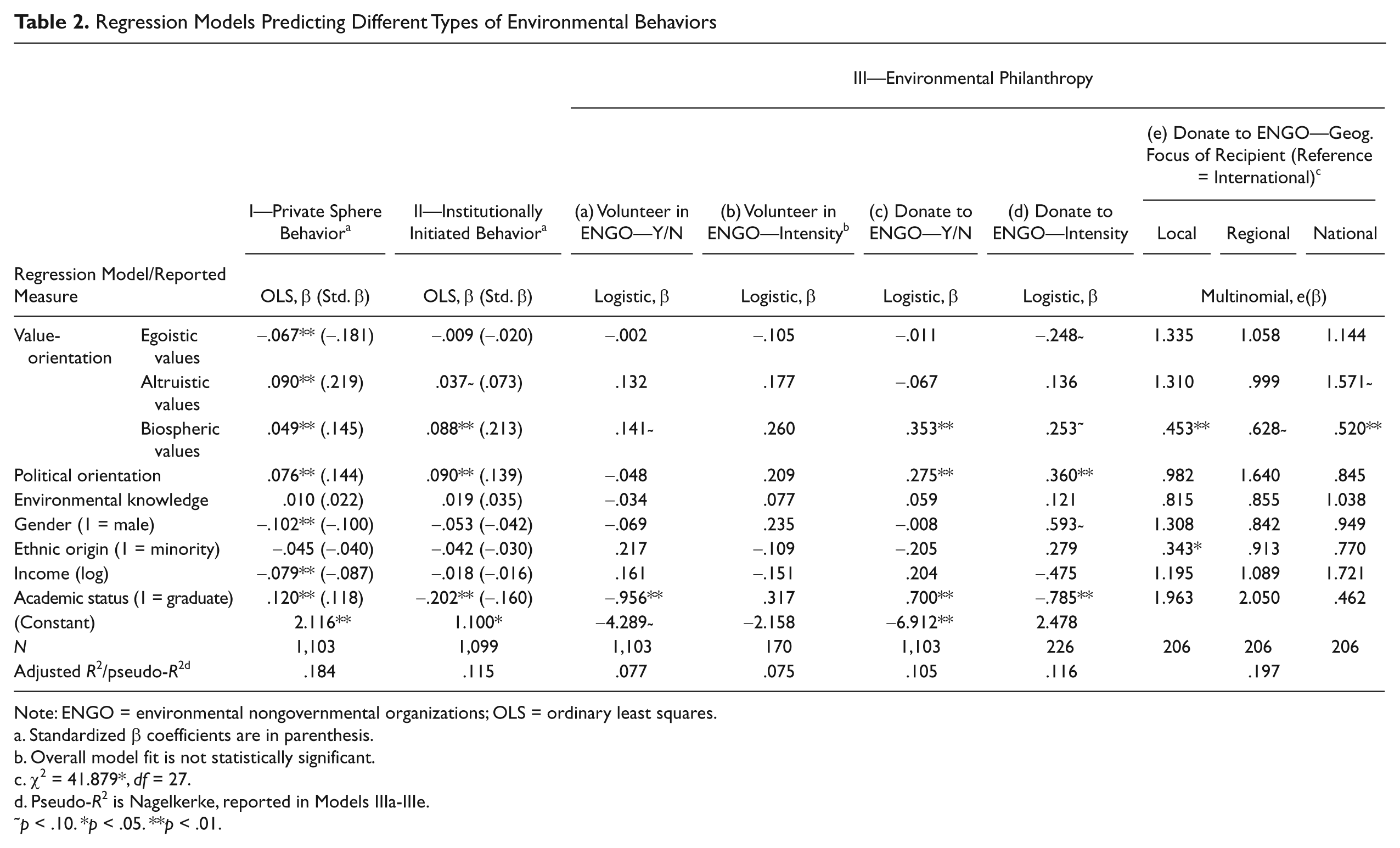
Table 2 presents seven regression models, each representing different environmental behavior. OLS regressions were used to analyze private-sphere behavior (Model I) and institutionally initiated behavior (Model II). Logistic regressions were used in Models IIIa-d for the proclivity and intensity of environmental philanthropy, and a multinomial regression was used in Model IIIe, where donations to local, regional, and national ENGOs are compared with donations made to international ENGOs (the reference group). We first examine the results for each model, and then the overall research question: whether there are differences in the correlates for different kinds of environmental behaviors across all models.
Regression Models Predicting Different Types of Environmental Behaviors
Note: ENGO = environmental nongovernmental organizations; OLS = ordinary least squares.
Standardized β coefficients are in parenthesis.
Overall model fit is not statistically significant.
χ2 = 41.879*, df = 27.
Pseudo-R2 is Nagelkerke, reported in Models IIIa-IIIe.
p < .10. *p < .05. **p < .01.
Model I
The results for Model I about private-sphere behavior mostly conform to reports in the literature. The effects are in the expected directions whereby altruistic and biospheric values, liberal political orientation inclination, women, and graduate status are positively associated with private-sphere behavior and egoistic values are negatively associated with this behavior. Furthermore, the variable that does not have a significant effect is environmental knowledge, which is also in accordance with our review of the literature.
Model II
Institutionally initiated behavior correlates significantly with biospheric values and is marginally significant with altruistic values. Both value constructs have a positive effect on this type of behavior, as well as liberal political orientation. Graduate students tend to be less engaged in environmental behavior on campus, perhaps because they spend less time regularly on the university facilities.
Models III
Turning to the environmental philanthropy models, we present results of models pertaining to the proclivity for volunteering (IIIa), intensity of volunteering (IIIb), the proclivity for donating (IIIc), intensity of donating (IIId), and geographic focus of the ENGO receiving donation (IIIe). In Models IIIa and IIIb, the proclivity or intensity of volunteering in ENGO’s exhibits no significant correlations with any of our main independent variables (biospheric values are positive and significant at p < .10). Moreover, the overall fit of Model IIIb, the intensity of volunteering, is in fact not significant and is presented for comparative purposes only. From these results we conclude that the correlates of environmental behavior, measured as volunteering for environmental issues, may be driven by factors that are different from the ones that drive other types of environmental behavior.
Examining donating behavior in Models IIIc and IIId, we find that egoistic values have a border significance negative effect and biospheric values have a border significance positive effect, as well as political orientation with a positive effect, and gender with a border significance positive effect, all in the expected direction.
Finally, Model IIIe examines donations to ENGOs based on the geographical focus of the recipient organization. Results from a multinomial logistic regression compare the probability that an individual will donate to an environmental organization that has a local, regional, or national focus compared with an organization that has an international focus (the reference group). We find that individuals with biospheric values are significantly more likely to give to international ENGOs as compared with local or national ENGOs. A one unit increase in biospheric values will decrease the likelihood of donating to local ENGOs, relative to international ENGOs, by a factor of .453, and likewise will decrease the likelihood of contributing to regional and national ENGOs relative to international ENGOs by a factor of .520 and .628, respectively.
Examining the correlates of different types of environmental behavior across Models I to IIIe, we find that private-sphere behavior is better predicted by the traditional correlates of environmental behavior as compared with any other type that we included in our analyses. Donating behavior and institutionally initiated behavior exhibit one of the value orientation correlates: biospheric values, which consistently predicts institutionally initiated behavior, as well as all the manifestations of donating behavior, as expected. Political orientation is a correlate of institutionally initiated behavior, as well as the proclivity and intensity to donate, which further suggests that the traditional factors that shape different types of environmental behavior need to be expanded on and reconsidered. And, treating volunteering and donating as similar indicators of environmental philanthropy is also not recommended, because we see that they are associated with different factors. Hence, research into the personal characteristics that condition environmental philanthropy should be sensitive to different indicators of such behavior.
Interestingly, across five of our seven models, the academic status of students (graduate vs. undergraduate) is a significant correlate, although not always in the same direction. Graduate students tend to engage in private-sphere and donating behavior, whereas undergraduates tend to respond to institutionally initiated behavior and volunteering, and when they do donate, they are more likely to give more of their donations to ENGOs. Also, when undergraduates volunteer, they are more likely to donate to the organization as these are complementary behaviors. As expected, undergraduates are more likely to respond to institutional calls to engage in environmental behavior because they want to conform to the authoritative expectations of the institution. Compared with graduate students, undergraduate students are more likely to spend time on campus and to have free time to participate in volunteering activities on and off campus.
Intentions to Behave
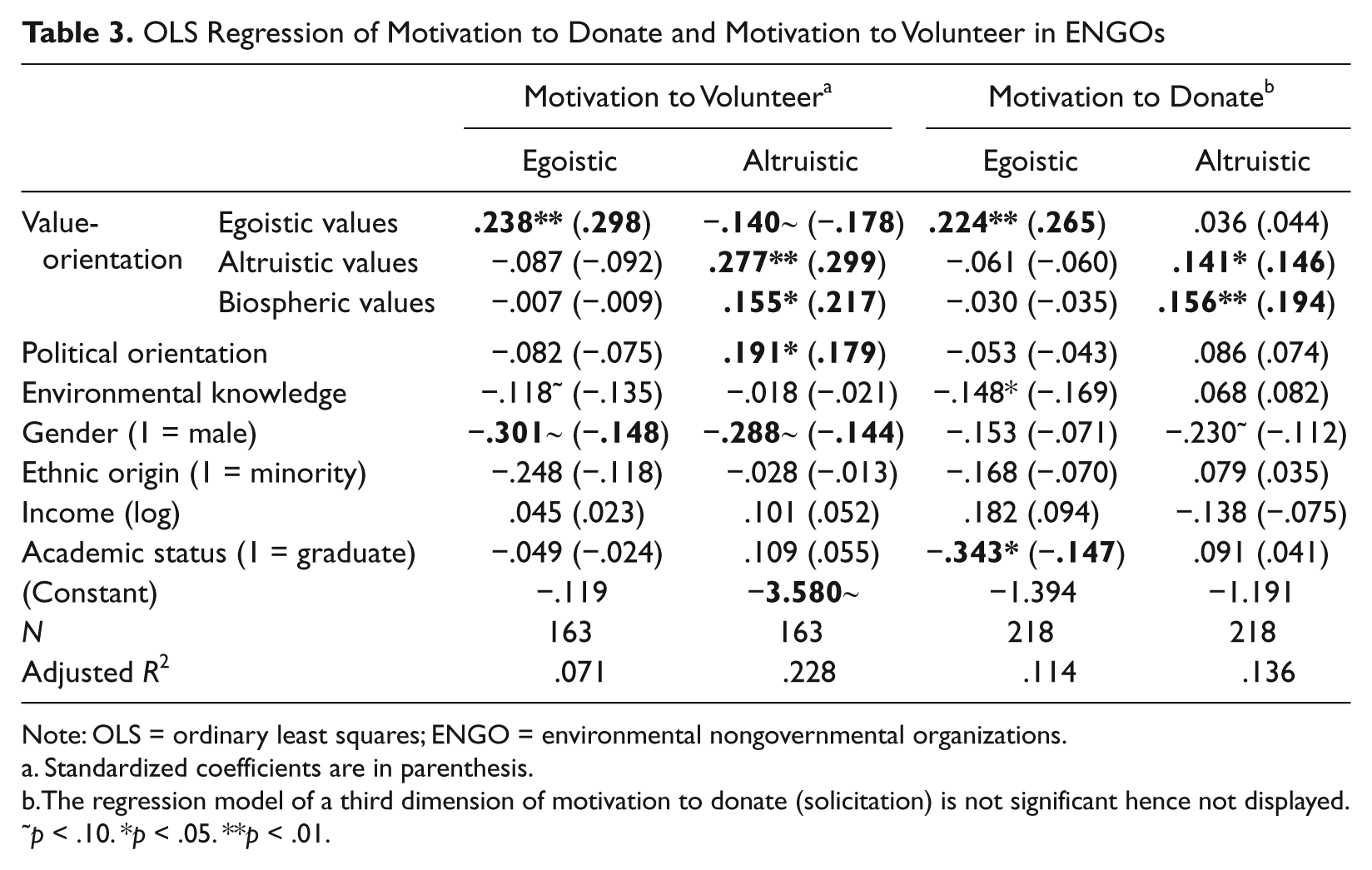
Table 3 presents four regression models, pertaining to two types of behavioral intentions: motivations to volunteer and motivation to donate. The models suggest that egoistic values are significantly associated with egoistic motivations to donate and volunteer in the expected direction, and altruistic and biospheric values are significantly associated with altruistic motivations to donate and volunteer in ENGOs, again, in the expected direction. In other words, we find an interesting correspondence between measures of value orientations and motivations to volunteer and donate that suggests relationships between egoistic values with egoistic motivations, and altruistic and biospheric values with altruistic motivations. This correspondence between the values and motivations is significant given that the measures of values come from an environmental context and the motivation scales come from the literature on philanthropy. It suggests that the context of where philanthropy is measured may not matter as it relates to individual values, but there may be some universal correspondences that exist between values and philanthropy.
OLS Regression of Motivation to Donate and Motivation to Volunteer in ENGOs
Note: OLS = ordinary least squares; ENGO = environmental nongovernmental organizations.
Standardized coefficients are in parenthesis.
The regression model of a third dimension of motivation to donate (solicitation) is not significant hence not displayed.
p < .10. *p < .05. **p < .01.
In terms of motivations to donate, we also find similar effects of egoistic, altruistic, and biospheric values on egoistic and altruistic motivations to donate. In all four models, the effects of the value constructs are much stronger than any of the other measured variables. The other variables show less consistent patterns, whereby liberal political orientation is associated with altruistic motivation to volunteer, knowledge is negatively associated with egoistic motivation to donate, and graduate students are less inclined to donate for egoistic reasons. The difference between men and women is at border significance; however, it is consistent and in the same direction across the four motivation variables: men are less inclined than women to report egoistic or altruistic motivations to volunteer and altruistic motivations to donate.
Discussion
In this article, we analyzed environmental philanthropy as a form of environmental behavior and compared its correlates with those of other types of environmental behavior. Environmental philanthropy has received scant examination in the literature on environmental behavior but is becoming increasingly important, especially among the youth (Handy et al., 2010; McDougle, Greenspan, & Handy, 2011). By expanding the repertoire of environmental behaviors, we are able to revisit the relevance of the factors that are commonly understood to be the main determinants of such behavior and also understand what kind of individuals are more prone to adopt environmental philanthropy and what kind of action can motivate different individuals to engage in this behavior.
Turning first to the effects of value orientations, biospheric values seem to be relatively consistent in having a positive and significant association with all kinds of environmental behavior. In addition, as expected, students with a liberal political orientation are more likely to engage in private sphere behaviors, institutionally initiated behaviors, and giving behaviors for environmental causes. Political orientation on the other hand has no explanatory power for volunteer behavior or for explaining the geographical focus of recipient organizations. Other independent variables, too, have limited effects on the various volunteering and donating measures. Consistent with other studies, environmental knowledge seems to have no effect on our measures of environmental behaviors, including environmental philanthropy. Assuming that students are usually better informed about environmental issues compared with an average individual, it is not knowledge about the environment that guides students’ environmental behaviors, so further educating them on environmental issues will probably not promote greater environmental action in the public or private spheres. Gender and income, which feature largely in studies on environmental behavior, were found to affect private sphere behavior in the expected directions, but are conspicuously insignificant when it comes to environmental philanthropy.
Interestingly, the motivational factors (Table 3) are significantly shaped by the value orientation factors, indicating that it would be advisable in the future to estimate a structural model in which motivation mediates the effect of values and sociodemographic variables on environmental philanthropy, perhaps something along the lines drawn in the value-belief-norm theory (Stern et al., 1999) or the theory of planned behavior (Ajzen, 1991). Table 3 also reveals that women, more than men, report egoistic and altruistic motivations to volunteer and altruistic motivations to donate. We interpret this finding as an expression of the fact that men are less likely to attribute behavior to any motivations in general. This is in line with reports in the literature discussed above on women’s tendency to prosocial motivation and more frequent engagement in environmental behavior. This notwithstanding, the significance level of the gender coefficients is not very strong, and overall we can assert that, like the other sociodemographic variables, gender is not the best predictor of environmental philanthropy.
Our findings suggest that the theories that have pointed to the typical individual-level characteristics that shape environmental behavior do not necessarily apply to environmental philanthropy. Although the value orientation variables were found to have statistically significant effects on private sphere behavior and partially significant effects on institutionally initiated behavior, they were less successful in predicting environmental philanthropy, the focus of our study. Although Stern et al. (1999) already pointed to the power of attitudinal variables in explaining the behaviors of nonactivists, these variables have limited power in explaining environmental philanthropy, which is also a nonactivist behavior.
The findings further suggest that environmentalism is not a unified category of behavior, even within nonactivist behavior. Different theoretical frameworks may be needed to expand the way we think about the factors that condition environmental philanthropy and to better understand the correlates of philanthropy in general. Since economic, sociodemographic, and value orientations seem to have limited relevance, perhaps different kinds of conditioning factors should be considered, such as opportunity structure, accessibility of venues for donating and volunteering, the importance of solicitation, or additional personal characteristics such as religiosity. Another direction for future research has to do with the realization that the volunteering and donating questions we used in this study may not entirely capture the complexity and heterogeneity of these behaviors. For example, individuals may volunteer occasionally or regularly, as protesters or as assistants in the office of an ENGO, and their motivations to do so may differ. Likewise, donations can be made occasionally or on a regular basis, and some respondents might include in their reporting membership fees while others do not. Furthermore, ENGOs use of communication technology can further their reach among members and the public (Dreiling, Lougee, Jonna, & Nakamura, 2008), which could affect the ability of ENGOs to recruit volunteers and donations, and with the advent of social media, this presents a fertile area for further research.
Our study contributes to the relatively scant research on environmental behavior among young individuals. This group in the population is particularly interesting because the youth are active agents in protecting the environment, and their attitudes and behavior are indicators of the future characteristics of environmental action (Wray-Lake, Flanagan, & Osgood, 2010). Moreover, although several earlier studies explored issues of environmental volunteering, the analysis was done within a particular environmental organization or initiative (e.g., Bruyere & Rappe, 2007; Martinez & McMullin, 2004; Ryan et al., 2001; Still & Gerhold, 1997). This may indicate that explanations of behavior lie in the characteristics of the situation rather than of the individual. Our study differs from earlier works by targeting a general population of students who reported their donating and volunteering experiences in different environmental organizations. This method introduces less bias in reporting similar motivations by individuals clustered in the same organization. Connecting our focus on students to the wider discussion on organized environmentalism, we can argue that among a young generation of students, environmentalism is quite widespread, as seen in the percentage of students in the sample who participate in one of the two environmental philanthropy measures, or in both.
To sum, our article contributes to both the literature on environmental behavior and the literature on philanthropy by analyzing the correlates of different measures of environmental philanthropy and comparing them with the correlates of other environmental behaviors. By identifying a specific set of indicators of environmental behavior related to the sphere of giving and donating, we emphasize the importance of theorizing and analyzing different types of environmental behavior as not necessarily similar. Our results show that an understanding of the characteristics and motivations of environmental activists should be behavior specific and can benefit from combining insights from both the environmentalism and philanthropy literatures. Our main finding is that the typical set of sociodemographic and attitudinal variables that features in the analyses of environmental behavior is not very useful for understanding environmental philanthropy—a significant prosocial behavior. Further research is needed to identify potential environmental philanthropists and potential means of motivating them.
Footnotes
Appendix A
Factor Loadings of Value Orientations (N = 1,508)
| Environmental Concern for | Egoistic | Altruistic | Biospheric | Reliability (Cronbach) |
|---|---|---|---|---|
| Me/myself | .862 | α = .911 | ||
| My current health | .852 | |||
| My lifestyle | .840 | |||
| My future well-being | .793 | |||
| People in my community | .577 | .526 | α = .868 | |
| Future generations | .830 | |||
| My children | .819 | |||
| All human beings | .728 | |||
| Plants | .886 | α = .894 | ||
| Animals | .874 |

Extraction method: Principal component with varimax rotation.
Acknowledgements
We thank the two anonymous reviewers for their helpful comments, and especially to Cassondra Giombetti and Anthony P. Sorrentino for their role in the early phases of the project and data collection. We thank Lindsey McDougle, Micheal Shier, and Marlene Walk for their insightful comments on an earlier version of this article presented at Association for Research on Nonprofit Organizations and Voluntary Action (ARNOVA) conference in 2009.
Declaration of Conflicting Interests
The author(s) declared no potential conflicts of interest with respect to the research, authorship, and/or publication of this article.
Funding
The author(s) disclosed receipt of the following financial support for the research, authorship, and/or publication of this article:
Initial funding for this project was received from the University of Pennsylvania’s GAPSA/Provost Award for Interdisciplinary Innovation by the first author.
