



Abstract
This essay examines links, similarities, and dissimilarities between stakeholder theory and sustainability management. Based on the analysis a conceptual framework is developed to increase the applicability and the application of stakeholder theory in sustainability management. Concluding from the analysis, we identify three challenges of managing stakeholder relationships for sustainability: strengthening the particular sustainability interests of stakeholders, creating mutual sustainability interests based on these particular interest, and empowering stakeholders to act as intermediaries for nature and sustainable development. To address these challenges three interrelated mechanisms are suggested: education, regulation, and sustainability-based value creation for stakeholders.
Keywords
Introduction
Stakeholder theory is one of the major, if not the most frequently used, approach in social, environmental, and sustainability management research (Frynas & Yamahaki, 2013; Montiel & Delgado-Ceballos, 2014). References to ‘stakeholders’ and stakeholder theory provide a starting point for analyses in a huge number of publications on corporate sustainability and sustainability management, no matter whether they are textbooks, research papers, or policy publications (e.g., Darnall et al., 2010; Doh & Guay, 2006; Husted & Allen, 2011; Kolk & Pinkse, 2007; Lee, 2011; Perez-Batres, Doh, Miller, & Pisani, 2012; Sarkis, Gonzalez-Torre, & Adenso-Diaz, 2010). Taking a closer look at the use of stakeholder theory in sustainability publications shows that many rather vaguely refer to stakeholders or even misinterpret the approach (cf. Elms, Johnson-Cramer, & Berman, 2011; Freeman, Harrison, Wicks, Parmar, & de Colle, 2010; Phillips, Freeman, & Wicks, 2003).
In line with this analysis, Starik and Kanashiro (2013) have recently started an important debate on the use of theories in sustainability management by highlighting the necessity to pay more attention to sustainability challenges and the role theories play in addressing these challenges. They “define sustainability management as the formulation, implementation, and evaluation of both environmental and socioeconomic sustainability-related decisions and actions” (Starik & Kanashiro, 2013, p. 12), with reference to former work by Bell and Morse (2008), Dunphy, Benveniste, Griffiths, and Sutton, (2000), Elkington (1998), Laszlo (2003), and Stead and Stead (2004). Besides setting up a framework for a distinct sustainability management theory, Starik and Kanashiro (2013, p. 11) identify fruitful fields for future research as they encourage sustainability scholars “to continue to explore how traditional theories can be used to examine and advance sustainability management (Starik, Marcus, & Illitch, 2000).” Garvare and Johannson (2010, p. 741) recognize a similar research gap, as they state that the “relation between sustainability, stakeholder theory and quality management can still be developed.”
This essay addresses the aforementioned research gap. It aims at linking the debates on stakeholder theory and sustainability management, arguing that stakeholder theory can be usefully applied in sustainability management. Additionally, this essay develops a framework of how these two concepts can inform each other. To this end, we first review the literature relevant for our approach and identify links, similarities, and dissimilarities between sustainability management and stakeholder theory. Building on former research and empirical examples, the next section provides a conceptual framework of how the applicability and the application of stakeholder theory in the context of sustainability management can be increased. Finally, we draw conclusions and offer different ideas to reinforce the application of existing theories in the context of sustainability management. In so doing, we aim at stimulating the important debate initiated by Starik and Kanashiro (2013) in this journal.
The Fit Between Stakeholder Theory and Sustainability Management
Core Elements of Stakeholder Theory
To examine the fit between stakeholder theory and sustainability management, it is necessary to recall the core elements of stakeholder theory. This requires as a first step to briefly define the term stakeholder. 1 One of the most common and general definitions is provided by Freeman (1984, p. 25; see also Freeman et al., 2010, p. 9), who describes stakeholders as “those groups and individuals who can affect or be affected” by the actions connected to value creation and trade. Rhenman (quoted in Näsi, 1995, p. 22) defines stakeholders in a similar but more narrow sense as “the individuals and groups who are depending on the firm in order to achieve their personal goals and on whom the firm is depending for its existence.”
While the above-mentioned definitions are necessary to explain the concept of stakeholders, the role definitions play should not be overemphasized. Whereas endeavors to find a single definition that fits all possible situations are most likely to fail, it is more important to discuss the actual use of stakeholder theory. In this context, it is essential to note that the unit of analysis for stakeholder theory is not the company itself but the relationships between an organization and its stakeholders (Freeman et al., 2010).
A review of the stakeholder literature from the past decades reveals that many different versions of stakeholder theory have been developed. Donaldson and Preston (1995) label these different versions as descriptive/empirical stakeholder theory, instrumental stakeholder theory, and normative stakeholder theory (Table 1). Although we acknowledge the value of these advancements and parallel developments, in this essay, we focus on the original version of stakeholder theory put forward by Freeman and colleagues (e.g., Freeman, 1984; Freeman et al., 2010), which aims at integrating descriptive, empirical, and normative aspects but is sometimes also referred to as ‘normative stakeholder theory’.
Different Types of Stakeholder Theory (Based on and extending Donaldson & Preston, 1995).
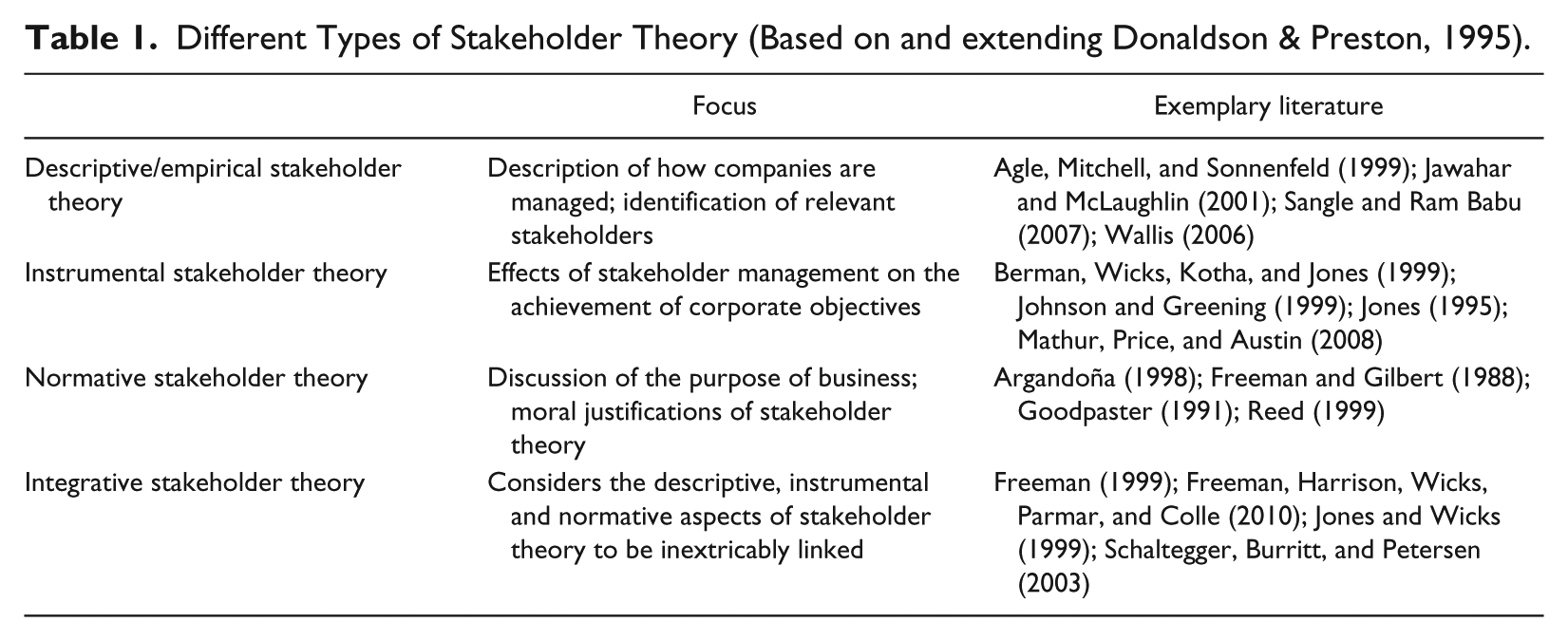
Many researchers investigated descriptive and empirical aspects of stakeholder theory, which helps describe how companies are actually managed or more specifically to identify relevant stakeholders and their expectations related to sustainability (e.g., Agle, Mitchell, & Sonnenfeld, 1999; Jawahar & McLaughlin, 2001; Sangle & Ram Babu, 2007; Wallis, 2006). Further research addressed the instrumental aspect of stakeholder management building on such empirical work. This body of literature (e.g., Berman, Wicks, Kotha, & Jones 1999; Johnson & Greening, 1999; Jones, 1995; Mathur, Price, & Austin, 2008) analyzes the effects of stakeholder management on the achievement of traditional corporate objectives (e.g., revenue increase) or additional, related aims (e.g., building social capital, capturing knowledge). As noted above, our essay pursues an integrative version of stakeholder theory, which considers these descriptive and instrumental aspects to be inextricably linked with the normative cores of stakeholder theory (Freeman et al., 2010; Jones & Wicks, 1999). This is reflected in the assumption that defining corporate objectives, such as revenue increase or the establishment of social capital, itself embodies normative decisions. According to Freeman (1994) as well as Freeman et al. (2010), stakeholder theory can entail numerous different normative cores, which range from feminist theory (e.g., Burton & Dunn, 1996; Wicks, Gilbert, & Freeman, 1994) to libertarian (e.g., Freeman & Phillips, 2002) or socioeconomic balance justifications (Schaltegger, Beckmann, & Hansen, 2003).
Whatever normative core is used, it is important to keep in mind that the version of stakeholder theory we are referring to focuses on ‘managing stakeholder relationships’ as a difference to ‘stakeholder management’ that would imply the illusion of manipulating others (stakeholders). Focusing on the relationship between stakeholders creates a completely different framing of management foci and range of considered decisions than focusing on how to influence others. This focus on ‘managing stakeholder relationships’ is sometimes criticized for being a prescription to treat all stakeholders equally (Gioia, 1999; Marcoux, 2000). However, ‘managing stakeholder relationships’ does by no means imply that all stakeholders must be treated equally, regardless of the specific circumstances (Phillips et al., 2003). In contrast, top management is challenged to identify which stakeholders are actually involved in a certain business activity since by definition, the success of a business depends on their input and top management has a commitment to their well-being.
This relates to another core element of stakeholder theory, which is generating mutual interests between different stakeholders rather as focusing on trade-offs. Based on these mutual interests stakeholder theory aims at creating value for all stakeholders involved (Freeman et al., 2010). Key (1999) as well as Jensen (2000, 2002) criticize this view by arguing that trade-offs always exist, and it is thus impossible to systematically overcome them. Although we acknowledge to not live in an ideal world without trade-offs, we argue that at least in the context of sustainability management, it is the more purposeful and challenging task for management to search for means to overcome trade-offs. The gravity of sustainability-related problems, such as climate change, suggests that simply acknowledging the (systematic) existence of numerous trade-offs is unlikely to solve the most relevant challenges of sustainability management. In this sense, our understanding of stakeholder theory substantially differs from purely instrumental interpretations that test the existence of an empirical link between differing stakeholder interests (e.g., stakeholder involvement and corporate financial performance), as we aim to explore opportunities for installing positive links between stakeholder interests.
Although we acknowledge that different interpretations of the stakeholder approach exist, we believe that for the purpose of proposing a stakeholder framework for sustainability management, the integrative version of stakeholder theory brought forward by Freeman and colleagues is a highly promising approach as it provides several links to sustainability management. These links are discussed in more detail in the following section.
Sustainability Management and Stakeholder Theory: What Belongs Together Grows Together
The fit between sustainability management and stakeholder theory as described above is reflected by numerous general similarities (Table 2).
Similarities and Dissimilarities Between (Integrative) Stakeholder Theory and Sustainability Management.
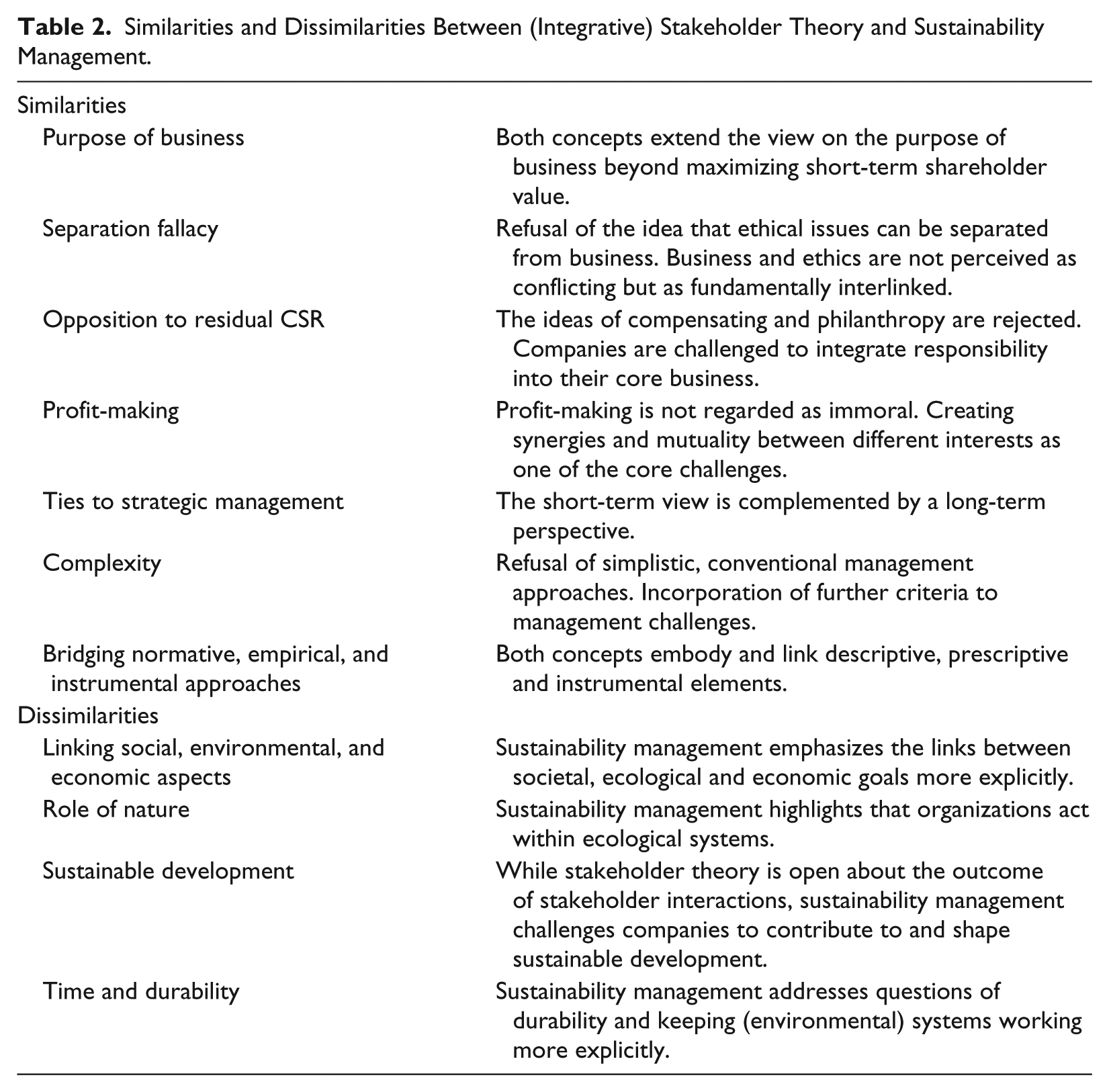
First, and maybe most fundamentally, both concepts expand the conversation about business by asking similar questions such as what the purpose and scope of business really is (Pedersen, Henriksen, Frier, Søby, & Jennings, 2013). The terminology used by stakeholder theory and sustainability scholars may differ, but the core of the answers to this question is pretty similar. Stakeholder theory enlarges the scope to a broader societal embeddedness of organizations and its interdependencies with the societal environment. It postulates that the purpose of business is to create value for all stakeholders (Freeman et al., 2010). Similarly, corporate sustainability scholars emphasize the societal and ecological environment and the interdependencies between the organization and its societal and natural environment. Consequently, the concept of sustainability management demands companies to provide “an important contribution toward sustainable development of the economy and society” (Schaltegger & Burritt, 2005, p. 195). Thus, both concepts extend the view beyond maximizing short-term shareholder value or accounting-based profits and share a broader understanding of the embeddedness, dependencies, obligations, abilities, and possibilities of companies.
Based on common aspects of understanding what the purpose(s) of business may be, stakeholder theory and sustainability management refuse the idea of separating ethical issues from business, since they do not perceive business and ethics as conflicting but as fundamentally interlinked. Instead of separating these issues, to create real value for stakeholders, or in sustainability management terms to contribute to a sustainable development, social and environmental issues have to be linked to the core business of a company (Freeman et al., 2010; Kolk & Pinkse, 2007; Loorbach & Wijsman, 2013). As a consequence, both concepts reject the ideas of compensation and philanthropy, arguing that companies should not reimburse doing bad by redistributing value that has been created by irresponsible practices. Instead, as Székely and Knirsch’s (2005) highlight, both concepts argue that business has to be reconceptualized, so value creation itself is done in a responsible, sustainable manner. Due to the strong focus on integrating responsibility into daily business, sustainability management and stakeholder theory oppose the concept of (residual or add-on) CSR (corporate social responsibility). In contrast to stakeholder theory and sustainability management, residual CSR, which is found to be the dominant CSR approach in U.S. corporate practice, does not solve the problem of ‘value creation and trade’ formulated in stakeholder literature. Similarly, it does not address the ‘separation fallacy’, which arises from the artificial separation of ethical and business decisions (cf. Freeman et al., 2010; Matten & Moon, 2008).
Furthermore, both concepts share a common understanding of morality and profit making. They explicitly oppose to the traditional arguments by Aristotle and Thomas Aquinas who regarded profit making as immoral. Various sustainability management scholars (cf. Carroll & Shabana, 2010; Schaltegger & Synnestvedt, 2002) emphasize that principally refusing the ideas of profit making and business cases as immoral means to support the separation of the core business from the consideration of social and ecological issues. Instead, creating synergies and mutuality between different interests is seen as one of the core challenges by stakeholder theory and sustainability management. Although stakeholder theorists stress that “behind every stakeholder concern is a potential market place, if approached with the innovation mind-set” (Freeman, Pierce, & Dodd 2000, p. 53), sustainability management scholars regard social and environmental concerns not as necessarily conflicting to financial ones and frequently address the possibilities to create business cases for sustainability (e.g., Salzmann, Ionescu-Somers, & Steger, 2005; Schaltegger, Lüdeke-Freund, & Hansen, 2012). Therefore, the two approaches both claim to be by no means in conflict with profit making, but to support the search for (long term) value maximization for society, sustainable development, and companies as part of both. Taken a step further, and as a difference to profit seeking that is focused on how to economically exploit others and nature, both approaches promote a specific kind of profit seeking that is based on creating synergies and mutual benefits for all stakeholders and nature.
The fact that sustainability management and stakeholder theory both add a long-term perspective to the debate can also be explained by its common ties to strategic management (Figge, Hahn, Schaltegger, & Wagner, 2002; Freeman, 1984). The notion of a long-term perspective, however, does by no means say that the short-term view is simply replaced by a long-term perspective. Instead, following the logic of the ‘bifocal vision’ introduced by Albrecht (1994) and Harari (1997), the long-term view needs to be considered as an additional perspective, not as a replacement of the short-term view. In the context of sustainability management, this seems to be of growing importance as the time pressure of many environmental and social problems such as climate change and related social consequences (e.g., floods impacting lives) is rising, thus demanding activities now and for the long term. Therefore, it is important to realize that a theory of sustainability management has to be capable of addressing short-term as well as long-term problems and to offer companies short-term as well as long-term potentials and opportunities. Examples like Bionade and Voelkel, German companies producing organic soft drinks and juices, or dm drogeriemarkt, a drugstore chain operating in multiple European countries and market leader in Germany, demonstrate that sustainability oriented business solutions and innovations are able to create value even in the short term and not only in the long term (cf. Landi, 2008; von Kimakowitz, Pirson, Spitzeck, Dierksmeier, & Amann, 2011).
One reason why the debate on stakeholder theory emerged in the 1970s and 1980s was the lack of complexity in the dominant management theories of this time (Emshoff & Freeman, 1978; Freeman, 1984). Stakeholder theory showed that management cannot be made as simple as it is done by concepts such as the shareholder view (Freeman, 1984). The corporate sustainability debate drew the attention to additional ecological and social criteria (e.g., climate change, the development of slums, desertification, income distribution, overfishing of seas, and diversity) and thus adds further complexity. As a consequence, corporate sustainability as a vision and sustainability management as the general approach striving for corporate sustainability challenge companies to engage with stakeholders on a multitude of contemporary social and ecological topics. For example, it demands companies to increase awareness among employees for energy efficiency and cleaner production, to provide customers with less unsustainable (or more sustainable) products, and to improve supply chains (see, e.g., Schaltegger & Burritt, 2005; van Marrewijk, 2003).
Last, sustainability management and stakeholder theory as discussed in the section ‘Core Elements of Stakeholder Theory’ are similar in their general purpose because they embody descriptive, prescriptive, and instrumental elements at the same time. They describe what companies actually do, suggest options how to solve business problems, and add to value creation and always entail a prescriptive element since they are both based on normative cores (cf. Freeman et al., 2010; Starik & Kanashiro, 2013). In so doing, they serve as bridges between normative analyses and ethical assumptions on the one hand and empirical and instrumental investigations on the other.
In their recent article, Starik and Kanashiro (2013) set up a range of criteria for a potential theory of sustainability management. Further criteria can be found in earlier works (e.g., Gladwin, Kennelly, & Krause, 1995), and some of the criteria developed for theories in the field of CSR are also relevant in the context of sustainability management (Aguinis & Glavas, 2012; Frynas & Yamahaki, 2013; Garriga & Melé, 2004; Lee, 2008). Due to the general similarities between stakeholder theory and sustainability management described above, it does not surprise that stakeholder theory fulfills many (but not all) these more specific criteria.
First, Starik and Kanashiro (2013, p. 19) demand that “theories of sustainability management probably would not include an obsession with . . . neoclassical economic values” but “would likely also need to account for a wide range of quality of life phenomena.” Stakeholder theory clearly shares this broad understanding of value as it explicitly goes beyond interpreting value in a purely monetary sense. This becomes maybe most evident in the approach of ‘stakeholder happiness enhancement’ Jones, Felps, and Arnold (2013) develop based on normative elements of stakeholder theory.
Second, Frynas and Yamahaki (2013) express the need for a new theory that explains how companies can obtain business opportunities through voluntary social and environmental activities. More comprehensively, Starik and Kanashiro (2013, p. 14) illustrate that paradoxical demands arise from diverse stakeholders with conflicting demands. For example, firm maximization of profits for shareholders is said to often conflict with its social and ethical responsibilities (Husted & Allen, 2011). A theory of sustainability management could potentially address such a paradox by examining how individuals, organizations, and societies could environmentally and socioeconomically thrive in the long term, while allowing shareholders to also thrive by ensuring that their respective organizations’ sustainability management programs reduce firm costs, increase firm revenues, add value to firm assets, or reduce firm risks and liabilities (Fisk, 2010).
The necessity to overcome trade-offs and conflicts is exactly what stakeholder theory is about in the social context of a business, that is, addressing (potential) conflicts of money making and ethical responsibilities by creating mutual interests among the demands of all relevant stakeholders (Freeman et al., 2010).
Third, according to Starik and Kanashiro (2013, p. 20), “sustainability management seems best conceptualized as a systematic approach to long-term quality of life improvement (Starik & Rands, 1995).” Similarly, Gladwin et al. (1995) emphasize the need to develop new concepts in the context of sustainability management, which increase quality of life. This view is matched by stakeholder theory that is rather concerned about quality of life than about purely financial values (cf. Freeman et al., 2010; Jones et al., 2013). As noted above, in following Albrecht’s (1994) and Harari’s (1997) notion of the bifocal vision, stakeholder theory furthermore adds a long-term perspective to the dominant short-term view. Through changing the unit of analysis to stakeholder relationships rather than focusing only on the company, it allows creating value for stakeholders now, without compromising the possibility to create value for stakeholders in the long term.
Fourth, with its general character, stakeholder theory provides a framework for developing and implementing broad strategic solutions. This was already reflected in the title of Freeman’s book in 1984, Strategic Management: A Stakeholder Approach. Similarly, a sustainability management theory “would likely not include efforts to micromanage solutions to these catastrophes [i.e., climate disruption, biodiversity extinction . . . ], it would likely provide a framework for developing and implementing broad sustainability solutions” (Starik & Kanashiro, 2013, p. 17).
Fifth, “another distinguishing feature of theories of sustainability management would likely be the exploration and development of sustainability solutions that are multilevel, systematically integrated (including their inputs, processes, outputs, and feedbacks), and multi-stakeholder-oriented" (Starik & Kanashiro, 2013, p. 17), and one may add transdisciplinary (Gladwin et al., 1995; Schaltegger et al., 2013), “rather than incremental, single media-focused, and narrowly (human) elite-dominated” (Starik & Kanashiro, 2013, p. 17). Similarly, Aguinis and Glavas (2012) as well as Frynas and Yamahaki (2013) emphasize the importance of multilevel and multistakeholder perspectives, and Lee (2008, pp. 69-70) stresses the need for “a broader perspective that examines not just corporations’ social responsibility, but also society’s responsibility in keeping corporations accountable.” This criterion most evidently has been strongly influenced by stakeholder theory that as a concept by definition takes a broad, multistakeholder, multilevel, and integrated perspective.
Sixth, various scholars emphasize the need for an ethical foundation of a theory on sustainability management (Garriga & Melé, 2004; Gomis, Alexis, Gullén Parra, Hoffmann, & McNulty, 2011). Stakeholder theory serves this demand as it has various possible normative cores (e.g., environmentalism, fairness, feminism, political liberalism, and pragmatism) that serve as an ethical foundation (Freeman, 1994; Freeman et al., 2004).
Last, Garriga and Melé (2004) identify four dimensions in existing theories of CSR, which can also be applied in the field of sustainability management: profits, political performance, social demands, and ethical values. They emphasize “the necessity to develop a new theory on the business and society relationship, which should integrate these four dimensions” (Garriga & Melé, 2004, p. 51). Likewise, Frynas and Yamahaki (2013, p. 11) stress that any new theory will face the task to combine relational elements (i.e., taking into account the embeddedness of companies in a wider environment) with instrumental ones (i.e., “focus on managerial and economic aspects of value creation”). Due to its integrative character, stakeholder theory indeed provides a theoretical framework that incorporates these different elements, as it simultaneously considers value creation and profits, political performance, social demands, and environmental embeddedness as well as ethical values (Freeman et al., 2010).
As noted above, stakeholder theory, like any other theory, does not meet all the criteria Starik and Kanashiro (2013) and others set up for a potential theory of sustainability management. The following section highlights the most important differences between both concepts and tries to demonstrate what one can add to the other.
Dissimilarities Between Sustainability Management and Stakeholder Theory: What One Can Learn From the Other
Despite the aforementioned similarities, stakeholder theory and sustainability management are by no means interchangeable concepts. First and foremost, the stakeholder concept is a theoretical framework grounded in practice, which can be applied to numerous different fields of interest. Sustainability management, in contrast, is not only a concept but also a field of interest itself encompassing various approaches. It thus seems logical to systematically explore the applicability of the theoretical framework of the stakeholder concept to sustainability management as a field of interest (cf. Garvare & Johannson, 2010).
With regard to the content-related focus of both approaches, the following differences between sustainability management and stakeholder theory can be identified (Table 2):
The explicit search for links between social, environmental, and economic perspectives: Maybe the most prominent difference between sustainability management and stakeholder theory is the emphasis of sustainability management on the balance between social, natural, and economic challenges. Although the stakeholder approach aims at creating mutual interests and value for all stakeholders, sustainability management emphasizes the links between societal, ecological, and economic goals more explicitly. It thus takes a different angle to analyze business habits or proposals for new products, processes, and organizations.
Role of nature: Sustainability management more strongly emphasizes the role of nature and ecosystems, as it explicitly highlights that organizations act within ecological systems. Accordingly, the importance of ecosystem functions and services has been explicitly addressed in sustainability management. For example, Boons (2013) stresses the necessity of managing organizations within dynamic ecosystems.
Contribution to sustainable development: Somewhat related to the first differences, progressive forms of sustainability management and sustainable entrepreneurship emphasize the role of companies to contribute to and shape sustainable development of markets, the economy and society (e.g., Schaltegger & Wagner, 2011). In contrast, stakeholder theory is open about the outcome of stakeholder interactions and thus does not require a pursuit of this normative goal per se. Saying this, it would be irrational if considering the whole range of societal stakeholders did not lead to striving for sustainable development. Thus, if the range of considered stakeholders is not taken too narrowly, the goal of contributing to sustainable development will be a necessary logical conclusion from applying stakeholder theory.
Time and durability: As another distinction, sustainability management adds time to the stakeholder approach, and thus questions of durability as an additional dimension. Even though research on stakeholder management has dealt with intergenerational issues as well (e.g., Anderson, Teisl, & Noblet, 2012), the sustainability debate addresses the questions of durability and keeping (environmental) systems working in the long run more explicitly (Starik & Kanashiro, 2013).
How Can Stakeholder Theory Contribute to Sustainability Management?
Two different general approaches to apply stakeholder theory in the context of sustainability can be identified in the literature: considering nature as a stakeholder (e.g., Starik, 1995; Stead & Stead, 1996; Waddock, 2011) or alternatively considering human beings, groups, and organizations as stakeholders who analyze and interpret developments in nature (e.g., Freeman et al., 2000; Phillips et al., 2003; Phillips & Reichart, 2000; Schaltegger et al., 2003). Although this essay leaves a detailed discussion on the distinction between these two versions to the existing works, the conceptual framework we suggest builds on the second approach where sustainability interests are represented by human stakeholders.
Freeman et al. (2000) emphasize that in capitalism stakeholders do not act in a moral vacuum but cooperate around values. Based on these values, stakeholders have to negotiate to create mutual interests. Applying this to the context of sustainability management requires sustainability to be one of these values (maybe even the most important value) around which stakeholders cooperate.
This embodies three core challenges:
Anchoring sustainability in the mindset of all stakeholders
Creating mutual sustainability interests based on the particular sustainability interests of single stakeholders
As nature is often not considered adequately by the most powerful immediate stakeholders (Starik, 1995) sustainability management is challenged to create approaches that empower societal stakeholders or more broadly civil society to act as intermediaries between nature and the company and to consider expected long-term challenges
Concerning the first challenge, Stead and Stead (1996, p. 153) recognize “a large cadre of stakeholders” with environmental interests and discuss their specific interests and powers. Among the stakeholders they identify are consumers (including other businesses), financiers, employees, environmental interest groups, regulators, lenders, and insurers as well as standard setters (including business associations). Today, nearly two decades later, there are good reasons to argue that these interests have become even more powerful and more widespread. Although Stead and Stead (1996) referred to ‘green consumers’, today further sustainability oriented life and consumption styles, such as ‘conventional’ customers considering sustainability issues in some parts of their life, or specific types of sustainability oriented consumers such as LOHAS (Lifestyle of Health and Sustainability), need to be taken into account (Cohen, 2007). In the United States, consumers who subscribe to LOHAS have been reported to spend more than $300 billion annually and make up approximately 30% of the end-consumer market (Cohen, 2007). Furthermore, eco- and fair-trade labels have been developed and standardized which Stead and Stead (1996) assess as crucial to support the positive influence of consumers. Regarding financiers, with Islamic Banking and Sustainable and Responsible Investment (SRI) new trends emerged (Iqbal & Molyneux, 2005; Ito, Managi, & Matsuda, 2013). Eurosif (2012) identifies a sharp increase of sustainability oriented investment in Europe. Some types of sustainability oriented portfolios experienced an increase in money invested of more than 50%. In France, for example, €1.88 trillion were managed in SRI assets in 2011.
Further examples for an increasing awareness for sustainability can be found for these as well as the other stakeholders Stead and Stead (1996) mention (see, e.g., Dolezal, 2010; International Labour Organization, 2011).
Although the above numbers concerning LOHAS and SRI document that sustainability orientation among stakeholders is not (yet) the standard case, these examples suggests that there is a fruitful foundation on which sustainability can be established in the mindsets of all stakeholders.
The second challenge is to not only anchor sustainability in the mindsets of all stakeholders but also to create mutual sustainability interests based on the particular sustainability interests of single stakeholders. Although all stakeholders are likely to have particular sustainability interests, these might still be different or even conflicting. To create sustainable development, it is essential to clarify that the underlying value behind these interests is sustainability and to create mutual sustainability interests based on the particular sustainability interests of each stakeholder. Stead and Stead (1996) provide further reasoning for the necessity to create mutual sustainability interests as they highlight that the representatives of nature have greatest power if they use their particular powers collectively. Or to adapt their words, sustainability challenges might be most likely addressed successfully if they are addressed collectively, based on common values. According to Lélé (1991), this is well possible since the paradigm of sustainability offers a great potential for consensus. He argues that this potential could be used to integrate even such diverse interests as environmental concerns, long-term self-interests, inter- and intragenerational equity and poverty alleviation as well as the call for more participation. However, an examination of real-world problems related to sustainability demonstrates that in some cases different stakeholders follow differing sustainability interests. In the context of national energy transitions, for example, environmental organizations frequently support the installation of new renewable energy power plants to combat climate change. In contrast, parts of the community oppose these projects to preserve the local nature and landscape (Hindmarsh, 2010). The second challenge thus does not hypothesize that no conflicts between different stakeholders exist, but emphasizes the necessity to reveal that sustainability is a common and potentially unifying value behind these differing interests, and that an essential challenge of sustainability management is to strive for overcoming these trade-offs.
With regard to the third challenge, Starik (1995) highlights that as the state of nature is deteriorating, societal stakeholders currently do not adequately consider nature. Especially if nature itself is not regarded a stakeholder, it is of crucial importance to guarantee that the interests of nature are not overlooked but represented by intermediaries. The description of the first challenge demonstrated that numerous societal stakeholders exist, which are able to function as such intermediaries.
Figure 1 suggests three interrelated mechanisms (labeled as education, regulation, and value creation) to address the above challenges. These mechanisms aim (1) to strengthen the sustainability mindsets of stakeholders, (2) to create mutual sustainability interests based on particular sustainability interests, and (3) to empower societal stakeholders to act as intermediaries on behalf of nature.

A conceptual framework for strengthening the sustainability mindset, creating mutual sustainability interests, and empowering stakeholders.
First, increased efforts in education for sustainability are necessary, as existing research suggests knowledge to be a key to more sustainable business practices (e.g., Hesselbarth & Schaltegger, 2014; Hörisch et al., 2014). This will not only help provide stakeholders and corporate managers alike with the necessary knowledge and practical skills but also increase their awareness for pressing sustainability issues and the potential benefits linked to them. The UN Decade of Education for Sustainable Development and the introduction of academic programs dedicated to integrating sustainability in all courses (e.g., Collins & Gannon, 2014; Hesselbarth & Schaltegger, 2014; Starik & Turcotte, 2014) provide good examples for related measures, even though the actual effects of the UN Decade still need to be assessed (Liimatainen, 2013). Keeping the third challenge in mind, it is important to note that education not only helps raise the awareness of stakeholders, but is also an essential step toward their empowerment (Shriberg, Schwimmer, & MacDonald, 2013; Siebenhüner, 2004). Thus, education is likely to not only strengthen the sustainability mindsets of particular stakeholders but also to empower stakeholders to act as intermediaries on behalf of nature.
Second, regulators and standard setters have to create a framework with strong incentives that encourage stakeholders to cooperate on advancing sustainability. Instead of one size fits all command and control mechanisms, in the context of corporate sustainability, governments should facilitate value creation. In a similar context, Stead and Stead (1996) emphasize the importance not (only) of strictness but (also) of the structure of regulation. They favor regulation which promotes innovation and collaboration between different stakeholders instead of purely relying on punishment. Accordingly, the Eco-Management and Audit Scheme (EMAS) developed by the European Commission, as well as the various ISO standards (e.g., ISO 14.001, ISO 14.030, ISO 14.040, ISO 26.000), on the one hand assist companies to improve their sustainability management, and on the other hand also help and motivate to involve with stakeholders. EMAS additionally tried to set incentives to increase stakeholder cooperation for sustainability with the EU EMAS Award 2011. This award, like a large number of further awards for corporate sustainability, encourage businesses and stakeholders to jointly find innovative approaches to sustainability challenges (European Commission, 2013). As another example, the GRI reporting guidelines connect sustainability reporting to stakeholder engagement. They set incentives to not only inform stakeholders about the company’s sustainability performance but also to increase the exchange between stakeholders and thus provide an opportunity to create mutual interests (Global Reporting Initiative, 2013). These examples suggest that regulation, awards, setting standards, and incentives can indeed help increase awareness among businesses people and stakeholders to shape sustainability oriented mindsets and to create mutual interests. Furthermore, they show that setting standards can encourage societal stakeholders to act as intermediaries between companies and nature if the standards provide incentives to consider environmental concerns.
Third, to systematically strengthen the sustainability mindsets of stakeholders and to set incentives for stakeholders to act as intermediaries on behalf of nature, it is of crucial importance to create new and reveal existing possibilities for sustainability-based value creation for stakeholders. These sustainability-based value creations for stakeholders not only create monetary value for companies but also realize quality of life improvements for each stakeholder. The approach emphasizes that in a not purely monetary sense, it has to pay off for stakeholders to cooperate based on sustainability. The idea of pollution permit trading schemes provides a good example of how mutual interests can be created for different stakeholders based on the idea of sustainability-based value creation for stakeholders (even though the actual implementation of the most prominent example, the European Union’s Emissions Trading Scheme, embodies numerous shortcomings). In general, companies benefit from the introduction of a pollution trading scheme, as it avoids pollution at the least possible costs and creates business opportunities for companies that abate most efficiently. Therefore, it is unsurprising that many companies that realized these potentials even lobbied for the introduction of the Emission Trading Scheme in the European Union (Sæverud & Skjærseth, 2007; Hörisch, 2013). Environmental organizations favor pollution permit trading schemes because of their effectiveness, governments profit from the income trading schemes generate, and the community as well as future generations benefit due to the reduced levels of pollution.
The idea of creating value for stakeholders based on sustainability is inspired by both stakeholder theory and sustainability management. First, it shares the most important feature of the business case for sustainability, which is characterized by creating economic success through voluntary corporate environmental or social activities (Schaltegger et al., 2012). Analogously, sustainability-based value creation for stakeholders creates economic value through contributing to sustainability. Additionally, it requires to not only create value for the company or its shareholders but also for the companies’ other stakeholders.
Second, sustainability-based value creation for stakeholders directly relates to stakeholder theory, which argues that creating value for stakeholders and linking these benefits of different stakeholders is of central importance (Freeman et al., 2010). A frequent example of such interconnected value creation for stakeholders in the literature on stakeholder theory is that creating value for customers, by producing high-quality goods customers want to purchase, also creates value for other stakeholders as it enables the company to create jobs, pay taxes to the government, and obviously generates profits for financiers. This idea also applies in the context of sustainability. Producing organic products for consumers implies that employees can be proud to work for this company. This will facilitate the company to find motivated and qualified workforce and the local community benefits by reduced amounts of pollution. Employees, financiers, as well as suppliers profit from the income the organic products generate and the economic stability the new product chain creates. Again, the three processes proposed in Figure 1 can help establish such a project based on mutual interest. First, a form of cooperation between the stakeholders needs to be found that creates value for all relevant stakeholders so each stakeholder will voluntarily contribute to the success of the project. Second, an awarding regulation can set incentives for organic production (e.g., by establishing official labels). Last, educating stakeholders so they become aware of their potential benefits connected with organic production is a prerequisite for creating mutual interests.
From a sustainability management perspective, the conceptual framework we propose offers a range of benefits. First, it enables the value of sustainability to become a source of mutual interest for all stakeholders. Second, through applying this approach sustainability management can learn which actors are crucial to promote corporate sustainability and thus have to get involved in a specific business context. Third, it provides insights on mechanisms that can help get these actors involved. And last, the above examples demonstrate that all stakeholders can fulfill a certain function in cooperating around the value of sustainability and arguably that all stakeholders can benefit from this cooperation if the more sustainable solutions are designed well. For external, market-oriented stakeholders, new business segments become available based on the interaction around the value of sustainability: Suppliers need to adapt to the circumstances and demands of new sustainable business segments but can also benefit from the new market opportunities and gain first mover advantages if they promptly adapt to the new circumstances. For customers their demand for sustainable products and services is served, which are frequently found to entail user benefits.
The local community profits from reduced pollution by a flourishing company (which creates jobs and generates taxes) but in some cases also needs to overcome ‘not in my backyard’ mentalities, when it comes to the installation of new plants.
Among the internal stakeholders, employees obviously profit if new business segments are established. Additionally, prior investigations revealed that sustainability management may also improve a company’s health and safety standards and employees prefer working for a company that engages for sustainability (cf. Müller, Hattrup, Spiess, & Lin, 2012; Stites & Michael, 2011). Financiers are challenged to facilitate these new forms of value creation through their investment decision. In doing so, they are able to benefit from the income new sustainable business segments generate and sometimes gain new, more secure investment opportunities (cf. Ito et al., 2013).
To enable each stakeholder group to fulfill their function in sustainability-based value creations, managers are challenged to balance the interests of different stakeholders. This balancing of interest is of utmost importance, as power is most likely not distributed equally among different stakeholders (cf. Mitchell, Agle, & Wood, 1997). If managers fail to assess and successfully address power imbalances, it is likely that mutual sustainability interests cannot be created because more powerful stakeholders might maximize their benefits on the costs of others that will endanger the business to thrive in the long term. In this context, political and societal institutions as well as sustainability management of companies are challenged to create and support business conditions that facilitate a deliberate democratic exchange between stakeholders.
Conclusion
In the previous sections, we argue that stakeholder theory and sustainability management share a lot of ideas and thus stakeholder theory can be purposefully applied in the context of sustainability management. In so doing, stakeholder theory helps position sustainability management in a bigger picture and sustainability enters the debate on “values based capitalism” (Freeman et al., 2000, p. 23). In this debate, Freeman et al. (2000, p. 32) “understand capitalism as a system of cooperation among stakeholders around important values.” We argue that sustainability has to be one of these “important values” to comprehensively include durability and environmental concerns in stakeholder theory.
Maybe our approach sounds optimistic. However, as shown in the previous section, a series of examples exist, which are very close to the conceptual framework we suggest. By analyzing these empirical examples, we intended to provide academics and practitioners with guidelines and ideas how sustainability management can be approached with a stakeholder mindset, to highlight the possible benefits this approach entails and to inform further corporate sustainability research. The approach does not guarantee a certain or the most sustainable result but it encourages to explore paths leading toward sustainable development. Obviously, the framework presented is no ‘one size fits all strategy’ but needs to be adjusted to specific contexts. For some businesses, for instance, specific secondary stakeholders will be of crucial importance and thus have to be addressed more explicitly. Furthermore, we are aware that there will not always be an easy way (or even no way) to create mutual interests and benefits for all stakeholders. However, we believe that the framework presented can still be of help to address these problems and to create mutual interests in many cases.
Further research may address how the examples we described can be expanded to further empirical domains. To this end, future endeavors might investigate the specific role of education, regulation and value creation, as well as their interaction, in supporting sustainability-based value creation for stakeholders and in the formation of mutual interests. Here, empirical domains where stakeholders currently articulate differing sustainability interests are of special interest for case studies. Possibilities to overcome current trade-offs could be investigated by comparing these cases to empirical domains where mutual sustainability interests between different stakeholders could already be created.
One deficiency Starik and Kanashiro (2013, p. 10) identify among most of the existing management theories is that they “do not focus on sustainability and, therefore, do not systematically address pressing sustainability issues.” On the one hand, this does not apply to stakeholder theory, as sustainability is one of the core problems it addresses: Stakeholder theory has evolved to address the problems of (i) value creation and trade . . . (ii) putting together thinking about questions of ethics, responsibility, and sustainability with the usual economic view of capitalism (the problem of ethics of capitalism); and (iii) the problem of managerial mindset. (Freeman et al., 2010, p. 29)
On the other hand, we believe that the task of a theory is to be usefully applicable in the context of interest, not to explicitly address a specific issue of interest itself. In that sense, a theory that does not refer to sustainability at all could even be the one that fits best to a specific sustainability issue, if it is applicable in the context of sustainability.
In contrast to Starik and Kanashiro’s (2013) proto-theory of sustainability management, our approach applies and advances an existing management theory in the context of sustainability. We believe that sustainability management research which builds on conventional management theories is necessary to integrate sustainability to mainstream business studies discussions. Our concern is that solely focusing on a distinct sustainability management theory might separate sustainability management from conventional management studies. However, the conversation with mainstream business scholars and practitioners is of crucial importance in order to influence management decisions and to support transitions toward corporate sustainability.
This demonstrates an important difference between Starik and Kanashiro’s (2013) proto-theory and our approach. Setting up a distinct theory of sustainability management means that we as sustainability scholars want conventional businessmen and businesswomen to learn our language. In contrast, building on existing approaches that are also applicable in other fields of interest reflects the position that we need to learn the language of conventional business studies to promote sustainability management. Both approaches are certainly justified and most likely both approaches are necessary.
Footnotes
Declaration of Conflicting Interests
The authors declared no potential conflicts of interest with respect to the research, authorship, and/or publication of this article.
Funding
The authors received no financial support for the research, authorship, and/or publication of this article.