




Abstract
Corporate sustainability has become mainstream; reaching into all areas of business management. Yet despite this progress, large-scale social and ecological issues continue to worsen. In this article, we examine how corporate sustainability has been enacted as a concept that supports the dominant beliefs of strategic management rather than challenging them to shift business beyond the unsustainable status quo. Against this backdrop, we consider how hybrid organizations (organizations at the interface between for-profit and nonprofit sectors that address social and ecological issues) are operating at odds with beliefs embedded in strategic management and corporate sustainability literatures. We offer six propositions that define hybrid organizations based on challenges they present to the beliefs embedded in these literatures and position them as new heretics of strategic management and corporate sustainability orthodoxy. We conclude with the implications of this heretical force for theory and suggest directions for future research.
Corporate sustainability has become mainstream. Firms develop sustainability strategies, create sustainable products and operations (Unruh & Ettenson, 2010), produce sustainability reports (Global Reporting Initiative, 2013), and appoint Chief Sustainability Officers who tout sustainability to be part of their core mission (Elkington & Love, 2011). Additionally, business school deans promote sustainability as core to their curricula and scholars pursue sustainability as their research domain. Indeed, corporate sustainability (a term we use here to describe the various strategies and initiatives firms use to engage with nature and society) has reached into all areas of business management and scholarship. Where corporate sustainability was once considered “heresy”—an idea at variance with the dominant orthodoxy of business—it has now become “dogma”—accepted, legitimate, and even required (Hoffman, 2001). Many good things have come from this increased pursuit of sustainability, such as reduced pollution and waste, environmental management initiatives, and a greater focus on corporate citizenship and social responsibility.
However, social inequities and the erosion of many ecological systems continue to worsen despite progress made. There is a growing argument that sustainability has been subverted by corporate interests, such that it has become merely a label for strategies actually driven by standard economic and institutional mechanisms (Jacobs, 1993). As a result, sustainability is everywhere but exists as a demoted and diluted notion within the realms of business practice (Colby, 1991) and business research (Gladwin, 2011).
As a concept, sustainability has taken many forms and is still evolving (Montiel & Delgado-Ceballos, 2014). The definition we employ in this article highlights the extent to which the mainstreaming of sustainability has left it unfulfilled. Ehrenfeld (2008, p. 6) describes sustainability as “the possibility that humans and other life will flourish on Earth forever” and redirects proponents away from being “less unsustainable” toward becoming “more sustainable.” This is at once a simple shift in thinking and a magnificent leap forward in practice that corporate sustainability practice and scholarship has thus far failed to grasp. In this article, we describe how hybrid organizations are striving to make that leap, and in the process are becoming a new brand of heretics challenging the status quo, as pollution prevention advocates challenged the status quo in the 1970s and 1980s (Hoffman, 1999).
We use the term hybrid organization or hybrid to mean organizations that combine elements of for-profit and nonprofit domains; maintaining a mixture of market- and mission-oriented practices, beliefs, and rationale (Battilana & Dorado, 2010; Smallbone, Evans, Ekanem, & Butters, 2001) to address social and ecological issues. Hybrids have also been called social enterprises or environmental enterprises (Holt, 2011) and may be legally structured as for-profit or nonprofit, while some use both.
The academic literature studying hybrid organizations approaches them from different viewpoints and frameworks. One body of work exists within the institutional literature, which focuses on hybrids’ embeddedness within multiple fields with competing logics (Battilana & Dorado, 2010; Jay, 2013; Mars & Lounsbury, 2009; Murray, 2010; Powell, 1987; Tracey, Philips, & Jarvis, 2010). Smith, Gonin, and Besharov (2013) articulated four main types of tensions arising out of this situation: Performing Tensions, Organizing Tensions, Belonging Tensions, and Learning Tensions; each of which has implications for how hybrid organizations operate and carry out their missions. Another body of work on hybrids exists within the social entrepreneurship literature and focuses on the emergence of social enterprises, the identification of opportunities for social entrepreneurs and scholars studying them (Corner & Ho, 2010; Dacin, Dacin, & Matear, 2010; Mort, Weerawardena, & Carnegie, 2003; Perrini, Vurro, & Costanzo, 2010), and the ability of hybrid organizations to solve societal issues (Fowler, 2000; Smith, Barr, Barbosa, & Kickul, 2008; Sud, VanSandt, & Baugous, 2009; VanSandt, Sud, & Marmé, 2009).
Further work critically examines the limitations of hybrid organizations. For instance, nonprofit enterprises that hybridize have been criticized for becoming managerialist (Bull, 2008) and generating earned income has been argued to distract hybrid organizations (particularly nonprofits) from their mission (Weerawardena, McDonald, & Mort, 2010). Indeed, high levels of market-based activity have been found to decrease survival rates among hybrids; though low to moderate levels increase the likelihood of survival (Gras & Mendoza-Abarca, 2014). Others find that if balance between mission and commercial logics is not achieved, it may result in mission drift and internal conflict (Battilana & Dorado, 2010; Pache & Santos, 2010). Such balance has also been found difficult to achieve in practice despite the attempts of organizational leadership (Pache & Santos, 2013). Further questions arise if hybrids are unable to address more than the symptoms of their focal issue rather than disrupting the institutional or economic systems causing such issues (Westley & Antadze, 2010). Related to this, while hybrids aim to create value for themselves and communities they serve (Santos, 2012), they can struggle when trying to measure their impact (Kickul & Lyons, 2012; Ormiston & Seymour, 2011) and even determining whether outcomes represent failure or success (Jay, 2013). The need and pressure to measure this value is growing (Clark & Brennan, 2012; Lynch-Cerullo & Cooney, 2011); however, while the nonprofit literature provides guidance about measuring nonprofit value creation (e.g., Alexander, Brundey, & Yang, 2010; Carman, 2010), guidance for hybrid organizations is just beginning to emerge (e.g., Bloom & Chatterji, 2009; Colby, Stone, & Carttar, 2004; Millar & Hall, 2013). Furthermore, new measurement systems are often resource-intensive and costly for a start-up hybrid and have methodological limitations, which can result in hybrids concentrating on measuring impacts in primarily qualitative terms (Luke, Barraket, & Eversole, 2013) and a potentially large gap between aspired and real impacts. In short, we are not advocating hybrids as a perfect solution to the mainstreaming of corporate sustainability, but see them as the next important step in the right direction.
In this article, we delve into the strategic management and corporate sustainability literatures and define hybrid organizations in relation to them. We set out ways in which hybrids challenge prevailing norms about economic growth, profit, nature, and society. We see hybrids as potential sources of vitality in both conceptualizing and operationalizing corporate sustainability beyond its present focus on doing “less bad” (reducing negative environmental and social impacts) to incorporating a focus on doing “more good” (increasing positive environmental and social impacts). We begin with a critique of corporate sustainability as it is currently conceived.
Mainstream Corporate Sustainability
Since the Brundtland Commission Report popularized the term sustainable development (Brundtland & WCED, 1987), the concept of sustainability has been socially constructed and reconstructed through social, political, and economic processes involving a range of constituents (Hoffman, 1999). The business community has constructed sustainability in ways that have led to significant improvements in how businesses engage with ecological and societal issues and in the understanding of relationships between business, nature, and society (Aragon-Correa, 2013). Research has found that pursuing sustainability enables firms to reduce their water and energy use (Johnson, 2012), reduce pollution by refocusing on pollution prevention rather than end-of-pipe solutions (Berrone & Gomez-Mejia, 2009), and reduce carbon emissions (Carbon Disclosure Project, 2014; Sangwon, Shivira, Leighton, & Kneifel, 2014).
However, the influence of business on how sustainability has been socially constructed has also led people to feel that economic concerns are still treated as singularly important in decision-making frameworks, such as triple bottom line reasoning (Milne & Gray, 2013; Norman & MacDonald, 2004), and that social and ecological concerns remain a much lower priority (Banerjee, 2011). More diplomatically, Tregidga, Kearins, and Milne (2013, p. 102) stated that “organizational construction of sustainable development ‘accommodates’ current organizations and systems of organizing.” Research on corporate sustainability has shown deference to business orthodoxy as scholars strive to prove the business case for sustainability, and in doing so fit it into the dominant beliefs embedded within business literature. For instance, environmental management (Albertini, 2013; Horváthová, 2010; Menguc & Ozanne, 2005; Russo & Fouts, 1997), corporate social responsibility (CSR), and corporate citizenship (Margolis & Walsh, 2003; Orlitzky, Schmidt, & Rynes, 2003) have all been justified to the extent they are of strategic or economic benefit to the firm. Some have gone as far as to argue that corporate sustainability may have become a mere witness to ongoing ecological and social problems without the ability to address the deeply held beliefs accompanying them (Bazerman & Hoffman, 1999; Schnaiberg & Gould, 2000). These arguments are underscored by the persistence (and in many cases worsening condition) of environmental and social issues around the world.
A growing collection of systemic failures provide a compelling backdrop to our argument as mainstream conceptions of corporate sustainability fail to address them (Walsh et al., 2010). These failures include, The BP oil spill in the Gulf of Mexico (Hoffman & Jennings, 2011);Royal Dutch Shell’s dealings with the repressive Nigerian regime (Wheeler, Rechtman, Fabig, & Boele, 2001); Nike’s subcontractor labor practices that approach slavery (Saporito, 1998); Wal-Mart’s sexual discrimination, low wages, damage to local economies, and inadequate health care (Besen & Kimmel, 2006; Hemphill, 2005); Coca-Cola’s overuse and contamination of water in India (Ghoshray, 2007); and corporate governance failures at WorldCom, Arthur Andersen, Enron, and banks at the center of the 2008 financial crisis (Boerner, 2011). This sobering situation led Gladwin (2011) to posit that The past half-century has been marked by an exponential explosion of environmental knowledge, technology, regulation, education, awareness, and organizations. But none of this has served to diminish the flow of terrifying scientific warnings about the fate of the planet. (p. 657)
In the face of this growing list of problems, many people are advocating the need for business to become more sustainable, and worldwide protests (such as the Occupy movement and World Trade Organization protests) can be seen as a manifestation of societal frustration with the status quo (Bapuji & Riaz, 2011). Advocates include scholars who have argued the limitations of mainstream corporate sustainability and have called for reform in leadership, governance, and forms of organizing (e.g., Cohen & Winn, 2007; Ehrenfeld, 2008; Gladwin, 2011). Business leaders have also recognized the need for reform, including CEOs of well-known firms who have stated that their companies need a broader sense of value creation, yet believe they cannot embed sustainability into their business models because of prevailing economic and competitive models and their underlying assumptions that limit their latitude for deviation (Accenture & UNGC, 2010). These results accompany other research finding that, while their rhetoric states otherwise, concern for sustainability is not a top issue for most CEOs, and that 70% of large companies are not actively pursuing it (Elkington & Love, 2011).
The need for reform points to opportunities to reconceptualize firms and their objectives and to create business models that actively address ecological and social issues while remaining economically viable (Harding, 2004; Thompson & Doherty, 2006). These models have been termed blended value (Miller, Dawans, & Alter, 2009) or shared value and seek to create “economic value in a way that also creates value for society by addressing its needs and challenges” (Porter & Kramer, 2011: 4). Work in this area identifies hybrid organizations as creating theadjustments necessary to address sustainability issues at firm and industry levels (Haigh & Hoffman, 2012). Below, we describe hybrid organizations in detail and identify ways they challenge existing beliefs and norms within strategic management and corporate sustainability literatures.
Defining Hybrid Organizations in Relation to Corporate Sustainability and Strategic Management
Hybrid organizations often generate income in ways that are consistent with for-profit models, but abide by substantial social and ecological missions, which have traditionally been more aligned with nonprofit models (Smallbone et al., 2001). Their business models have been termed sustainability-driven (Hoffman, Badiane, & Haigh, 2012) because they design their business to address a particular sustainability issue (Nielsen & Samia, 2008). One example of a hybrid organization is Kiva,a nonprofit operating under the U.S. IRS’ nonprofit 501(c)(3) category that is alleviating poverty by facilitating microfinance for people in developing countries who wish to start or grow a business. The organization uses a crowd-sourcing model, where anyone can visit kiva.org and loan money to people seeking small loans. Kiva also seeks grants, philanthropic funds, and corporate sponsorship to fund its activities and by the end of 2013 had distributed $408 million in loans (Waghorn, 2013). A for-profit example is United Kingdom–based benevola (2014)—a company that matches people to volunteering opportunities appropriate to their skills and talents. Ben Aymé founded benevola after working as a professional recruiter and headhunter. After a career of matching peoples’ talents and skills to those required by corporations and feeling that large corporates were steering people to become “overspecialized” in their skill sets, Ben set out to create meaningful volunteer experiences by matching the skills of professionals to those required by other hybrid organizations. In an interview with one of the authors, Ben explained how the idea for benevola formed, . . . my experience was in headhunting—so matching people with organizations . . . and I started talking to NGOs all over the world and I realized that there was a need on their side to have access to great people.
Knowing that many NGOs do not have the resources to hire people (hence needing volunteers) and not wanting to charge people for their volunteering position as others do, benevola earns its income through a subscription model, where volunteers subscribe (approximately USD$8.50/year) to access the database of positions available.
The growing prominence of hybrid organizations is supported by an increasing number of U.S. states (26 at the time of writing) that have altered their business registration categories to include structures that can protect hybrids from shareholder litigation demanding the prioritization of profit over mission (B-Lab, 2013; Collins, 2008; Tozzi, 2010). Hybrids have also helped develop (and are buoyed by) the growing demographic recognized as Lifestyles of Health and Sustainability consumers that pay attention to sustainability characteristics of products and services when making purchase decisions (The Natural Marketing Institute, 2008). From this support base and in concurrence with sustainability management theory (Starik & Kanashiro, 2013), hybrids have been successful at having the issues on which they focus addressed at multiple levels by relevant industry and market institutions (Westley & Antadze, 2010).
By challenging the notion of trade-offs between economic, ecological, and social systems and instead developing business models that develop synergies between them, hybrids allow for-profit activities to be undertaken in ways that address sustainability issues. Below, we develop six propositions to inform future research that define hybrid organizations based on the ways they challenge deeply held assumptions embedded within the strategic management and corporate sustainability literatures. These propositions fall into three categories: (1) challenges to beliefs about social, ecological, and economic systems; (2) challenges to competitive practices; and (3) challenges to how sustainability is enacted. In aggregate, these propositions identify ways in which hybrids are currently distinct from companies practicing mainstream corporate sustainability practices and point to how hybrids may influence these practices.
Challenging Beliefs About Economic, Social, and Ecological Systems
Hybrids challenge four beliefs embedded within strategic management and corporate sustainability literatures that set them apart from companies practicing mainstream corporate sustainability.
Challenging the Assumed Need for Exponential Economic Growth
The assumed need for perpetual economic growth is entrenched in early strategic management literature where competitive advantage is based on ever-increasing market share (Penrose, 1959; Porter, 1979). Since then, strategy studies have remained focused on growth and its enabling factors (e.g., Leavy, 2010; O’Regan, Ghobadian, & Gallear, 2006; Zander & Zander, 2005). Importantly, recent strategic management literature shows some evolution, as Porter and Kramer (2011, p. 7) call for companies to create shared societal and firm value; though one argument on which the call rests is that it creates growth by “open[ing] up many ways to serve new needs, gain efficiency, create differentiation, and expand markets.”
One implication of holding both mission and commercial logics (Battilana & Dorado, 2010; Pache & Santos, 2010) is that hybrids deviate from the norm of perpetual growth. Hybrids do not avoid growth—a level of growth is needed to achieve economic viability—but they “experience less than maximum speed of growth because of self-imposed mission constraints” (Boyd, Henning, Reyna, Wang, & Welch, 2009, p. 3). Hybrid organizations have a long-term focus on survival and “steady sustainable growth” up to a given point rather than on rapid unrestrained growth (Lumpkin, Moss, Gras, Kato, & Amezcua, 2013; Weerawardena & Mort, 2006, p. 30). For instance, 72% of hybrids studied by Boyd et al. (2009; N = 47) had sought either “patient capital” or “below market-rate” financing to facilitate slower development. One example of such a hybrid is Los Andes, studied by Battilana and Dorado (2010, p. 1429), which was “willing to sacrifice part of the growth because of its commitment to its philosophy of hiring junior workers and managers.” The line of reasoning in this literature leads us to our first proposition:
Subordinating Profit
The essence of the landmark Dodge v. Ford case, which determined that the primary purpose of a firm is to create profit for shareholders (Dodge v. Ford Motor Company, 1919), has remained ingrained in strategic management logic, as has Friedman’s (1970) well-publicized argument that a firm’s social responsibility is to increase its profits. Both look to government to solve societal problems. Even though society’s norms have changed since 1919 and 1970 and shareholder activism on sustainability issues is rising (Esty, 2007; Wood, 2007), profit maximization continues to be the dominant performance indicator advocated and tracked by strategists. The focus on profit maximization is evident in both early studies of corporate success metrics (Chandler, 1962; Grinyer, Yasai-Ardekani, & Al-Bazzaz, 1980; Hill & Pickering, 1986; Teece, 1981) and more recent studies (Lenox, Rockart, & Lewin, 2010; McGahan & Porter, 2003; Silverman, Nickerson, & Freeman, 1997; Teece, Pisano, & Shuen, 1997). A strong focus on profit also exists within the corporate sustainability literature, despite the development of social and environmental metrics within Elkington’s (1997) triple bottom line. This is observable in the continued drive to prove the business case for sustainability where corporate sustainability practices are measured by the degree to which they facilitate profitability and competitive advantage (e.g., Branco & Rodrigues, 2006; Lagoarde-Segot, 2011; Porter & Kramer, 2006).
Hybrid organizations strive to show that businesses are capable of doing more than just generating profit and drive their missions to that effect (Ridley-Duff, 2007; Thompson & Doherty, 2006). Nielsen and Sarnia (2008, p. 447) noted that . . . profits are not the only objective; human capability building, empowerment of disenfranchised people, and/or improvement of the quality of people’s lives accounts for a double- or even triple-bottom line.
This may take the form of voluntarily limiting the distribution of profits to shareholders in favor of reinvesting them to address focal social or environmental issues (Allen, 2005; Alter, 2007; Defourny, 2001), paying less attention to financial measures beyond that required to access financial resources to act on environmental or social goals (Luke et al., 2013) or foregoing profit. For example, through its Common Threads initiative, Patagonia (2011) encourages customers to buy secondhand Patagonia clothing via eBay rather than buying new items from Patagonia stores and donates at least 1% of its gross sales revenue ($5.5 million in 2013 and over $55 million to date) to initiatives that restore and protect local habitat. Not all hybrids choose to manage their profits in such ways, and many have no formal constraints on the distribution of profits (Teasdale, Lyon, & Baldock, 2013); however, there are a growing number of these kinds of practices, which stand in contrast to the traditional assumption that profit maximization is the top priority, and thus we propose the following:
Internalizing Social and Ecological Systems
Firms have traditionally externalized social and ecological systems. Strategy literature in particular has a history of framing natural and social systems as domains from which firms operate separately. For instance, Miles (1982) framed growing scientific knowledge and societal experience regarding the health effects of smoking as an “externally imposed stress and crisis” caused by “those who believed that the smoking habit contributes to the ill health of the ultimate consumer” (p. viii). Language in recent work is more tempered than this historical example; however, strategic management literature remains focused on conceptualizing an internal–external dichotomy to examine ways in which firms relate to the systems within which they exist (e.g., Chattopadhyay, Glick, & Huber, 2001; Porter & van der Linde, 1995). Similarly, corporate sustainability scholars have (perhaps to appeal to strategists) referred to “external stakeholders” (Unruh & Ettenson, 2010) and instructed managers to look “inside out” and “outside in” to remain competitive while managing sustainability issues (Porter & Reinhardt, 2007; Winn & Kirchgeorg, 2005). Other sustainability scholars have asserted ways in which organizations are connected with natural and social systems in which they operate and have raised concerns about firms becoming disassociated from them (Gladwin, Kennelly, & Krause, 1995; Hart, 2007).
Hybrid organizations challenge the assumption of separation from social and ecological systems, since addressing particular issues within these systems is often core to their raison d’être. Hybrids commonly have participatory ownership structures (Allen, 2005; Mamao, 2011) and are “seen as accountable to both its members and a wider community” (Thompson & Doherty, 2006, p. 362). Additionally, Shaw (2004) found that 84% of social entrepreneurs interviewed (N = 80) lived in the area in which the issues they sought to address were located. These results suggest that hybrid organizations are predisposed to becoming “indigenous” (Hart, 2007) to environment and/or social systems have traditionally been seen as external contexts.
For instance, rather than sourcing from suppliers based on price alone and maintaining a strictly transactional relationship, hybrids often internalize relationships with suppliers and their communities and invest in a deep understanding of local systems. Ubuntu Bikes (2014) of Cape Town is one example, and its website articulates its understanding this way: Our view is that the world we live in and the people in it are connected. Everything we do has an effect felt elsewhere and so we try and offer products which result in a positive feedback for everyone concerned.
Ubuntu Bikes has both for-profit and nonprofit entities that support local causes through its bicycle restoration and customization business. The for-profit Ubuntu Bikes (2014) develops close relationships with its suppliers (a range of local nonprofits focusing on cycling, blindness, and HIV/AIDS) and pays them fair market rates for their products (bicycles, artwork, and bike accessories). The nonprofit Ubuntu Trust has a 20% shareholding in Ubuntu Bikes, which it uses to support local community organizations in the Cape Town area, with a focus on education and skill development of South African youth. Hybrids such as Ubuntu Bikes and examples in literature cited above develop business models that consciously internalize elements of the social and/or natural systems in which they exist; thus, we propose that
Considering Nature’s Intrinsic Value
An extension of internalizing social and ecological systems is a consideration that nature provides more than “natural resources,” defined as “materials or substances such as minerals, forests, water, and fertile land that occur in nature and can be used for economic gain” (Oxford Dictionary, 2014). Strategic management literature depicts nature in ways that infer it has little value beyond its utility value, as it explains how firms generate economic rents using such resources (Amit & Schoemaker, 1993; Sirmon, Gove, & Hitt, 2008); the attainment and scarcity of which can be addressed for a price through factor markets (Barney, 1986). In particular, scarcity is viewed as a valuable resource attribute that competitors may overcome through acquisition, substitution, or imitation (Barney, 1991). The possible exhaustion of natural resources is beginning to arise as a topic in the supply chain risk management literature (Bell, Autry, Mollenkopf, & Thornton, 2012; Bell, Mollenkopf, & Stolze, 2013), and perhaps this is because it is the home of research relating to the management of production inputs. However, the concept of exhausting natural resources does not appear within the strategy literature, even within the body of work citing Hart’s (1995) natural resource-based view of the firm, which focused on biophysical constraints. 1 As a result, nature is depicted as a limitless source of natural resources and a bottomless sink to absorb waste (Cohen & Winn, 2007; Hart, 1995).
Hybrids addressing ecological issues strive for a more holistic understanding of nature’s value beyond providing extractable resources and assimilating waste, and seek to understand their relationship with nature both as steward and as student. Some seek “biologically inspired” products and business models that actively use an understanding of nature to leverage its efficiencies for their business (Lovins, Lovins, & Hawken, 1999; Waddock & McIntosh, 2011). Gary Hirshberg, the CEO of organic dairy company Stonyfield Farm (later acquired by Danone), stated that: Our planet is a wondrous system of interdependent processes that nourish themselves . . . the more any business emulates this model, the more it can generate true wealth for its owners, customers, and all humans. (Hirshberg, 2008, p. 1)
One example of a company following this rationale is Fluid Earth, which uses “biomimicry” (Benyus, 2002) and ecologically friendly materials to manufacture performance surfboards. Fluid Earth uses the design and function of the humpback whale fin, which has tubercles (or bumps) on the leading edge, to develop surfboards that are more maneuverable and perform better than boards made using traditional designs (Fluid Earth, 2013). This feature of humpback whale fins increases lift and decreases drag and has also proven valuable in the design of fans, turbines, and pumps (AskNature, 2013). To be sure, nonhybrid companies have also used biomimicry, and not all hybrids use it, but biomimicry represents an example of how an appreciation of nature’s intrinsic value can manifest. Another manifestation would include Patagonia’s grant scheme supporting the restoration and protection of local habitat mentioned above. Following these observations, we propose that
Challenging Competitive Practices
The ways in which hybrid organizations operate also challenge competition orthodoxy. For instance, strategists assume a need to maintain control over resources that are valuable, rare, inimitable, and nonsubstitutable (Barney, 1991; Haynie, Shepherd, & McMullen, 2009), and to ensure causal ambiguity in the firm’s competencies and value creation (Hansen, McDonald, & Mitchell, 2013; Lippman & Rumelt, 1982; Ryall, 2009) to prevent competitors from imitating products, processes, and methods, and to gain or protect a competitive advantage (King, 2007; Reed & DeFillippi, 1990).
In contrast, hybrid organizations maintain relatively high levels of transparency and have even sought to diffuse their practices to others in their industry (Hoffman et al., 2012). This transparency goes beyond reporting sustainability practices through annual reports and forums such as to the Global Reporting Initiative, which are common among firms practicing corporate sustainability, and extend to sharing information that firms would normally consider intellectual property. One (perhaps surprising) example is Mozilla Foundation (2013)—a nonprofit with forprofit subsidiaries that has a goal of ensuring the Internet “remains a shared public resource.” One of its most popular products is the Firefox browser, which is free and has 24% of the browser market (Wong, 2010). Mozilla has an open-source approach, meaning that anyone (including competitors) can run, study, and distribute copies of the Firefox program, and its source code is continuously improved by a global community of volunteer contributors who access it and share their work (Mozilla Foundation, 2013). Mozilla defies the idea of control over resources and causal ambiguity and supports Lumpkin et al.’s (2013) finding that social mission drives resource allocation and competitive dynamics within hybrids.
Rather than competing by controlling resources and shrouding the value creation process in secrecy, hybrids such as Mozilla compete on the basis of their values (Mamao, 2011) and impact (Miller et al., 2009). In doing so, hybrids develop “new game strategies to build and establish themselves in novel market segments” (Boyd et al., 2009, p. 3). Despite their divergence from mainstream competitive practices, hybrids such as Mozilla can remain economically self-sufficient and some sustain healthy competitive advantages in their respective industries by being more transparent, leading us to propose that:
Enacting a Progressive Meaning of Sustainability
Corporate sustainability scholars have historically studied ways in which firms reduce their impact on social and ecological systems through eco-efficiency initiatives like recycling, reducing carbon and other emissions (Christmann, 2000; Okereke, 2007), energy efficiency, waste management (Akiyama, 2010; Sharma & Henriques, 2005), and through redesigning products and processes (Bansal, 2005; Sharma & Vredenburg, 1998; Unruh & Ettenson, 2010), purchasing carbon offsets (Jones & Levy, 2007; Kolk & Pinkse, 2004), and using the ISO 14001 standard (Darnall, 2006; Delmas & Montes-Sancho, 2011). In this literature, proactive sustainability strategies are defined as those that consistently enable firms to go beyond what is required to meet regulatory requirements and industry norms (Buysse & Verbeke, 2003; Maxwell, Rothenberg, Briscoe, & Marcus, 1997; Sharma & Sharma, 2011; Sharma & Vredenburg, 1998).
While hybrids have been criticized for becoming too managerialist for the social sector (Bull, 2008), when viewed through a management lens, they appear to enact a conception of sustainability that goes beyond reducing negative impacts when required by regulatory, competitive, or normative forces. They may have a “commitment to market-driven [rainforest] restoration” (Boyd et al., 2009, p. 65) or “an explicit aim to benefit the community” (Kerlin, 2006: 249), but whatever the specific goal, the creation of positive impacts is a matter of organizational purpose (Kerlin, 2010; Shaw, 2004; Smallbone et al., 2001; Thompson & Doherty, 2006). Hybrids show what may lay beyond current mainstream conceptions of corporate sustainability and provide new points of reference that can move corporate sustainability toward the “more sustainable” side of Ehrenfeld’s (2008) distinction between being “less unsustainable” and “more sustainable.”
To illustrate this enactment, we draw on a final example in Boston-based urban agriculture for-profit City Growers (http://citygrowers.wordpress.com/), which restores abandoned plots of inner-city land to produce locally grown food using environmentally sustainable methods. Companies like City Growers address food security issues through affordable, local, nutritious produce. City Growers partners with local markets and restaurants to sell some produce at a premium, which supports selling to local residents at discounted rates. City Growers also liaises with neighborhood associations and community groups to access abandoned land and identify local residents to be employed and trained in biodiversity and farming techniques such as crop rotation, composting, and building soil health.
Much of the power to address social and environmental issues possessed by hybrids lies in their drive to engage directly with suppliers, customers, and natural systems (Nielsen & Samia, 2008). Rather than focusing on regulatory compliance, philanthropy, or corporate social responsibility, many hybrids engage with ecological and social issues on an intimate level and configure their business to address them in precise ways. Initiatives such as employing and training local people (especially those who may be otherwise disenfranchised), addressing health issues, facilitating reforestation, and paying living wages are factored into their business dealings (Miller & Dawans, 2009). These organizations strive to generate positive social and ecological change through their commercial transactions rather than as an outcome of profits generated by them. This leads us to propose that
Figure 1 summarizes our main points.
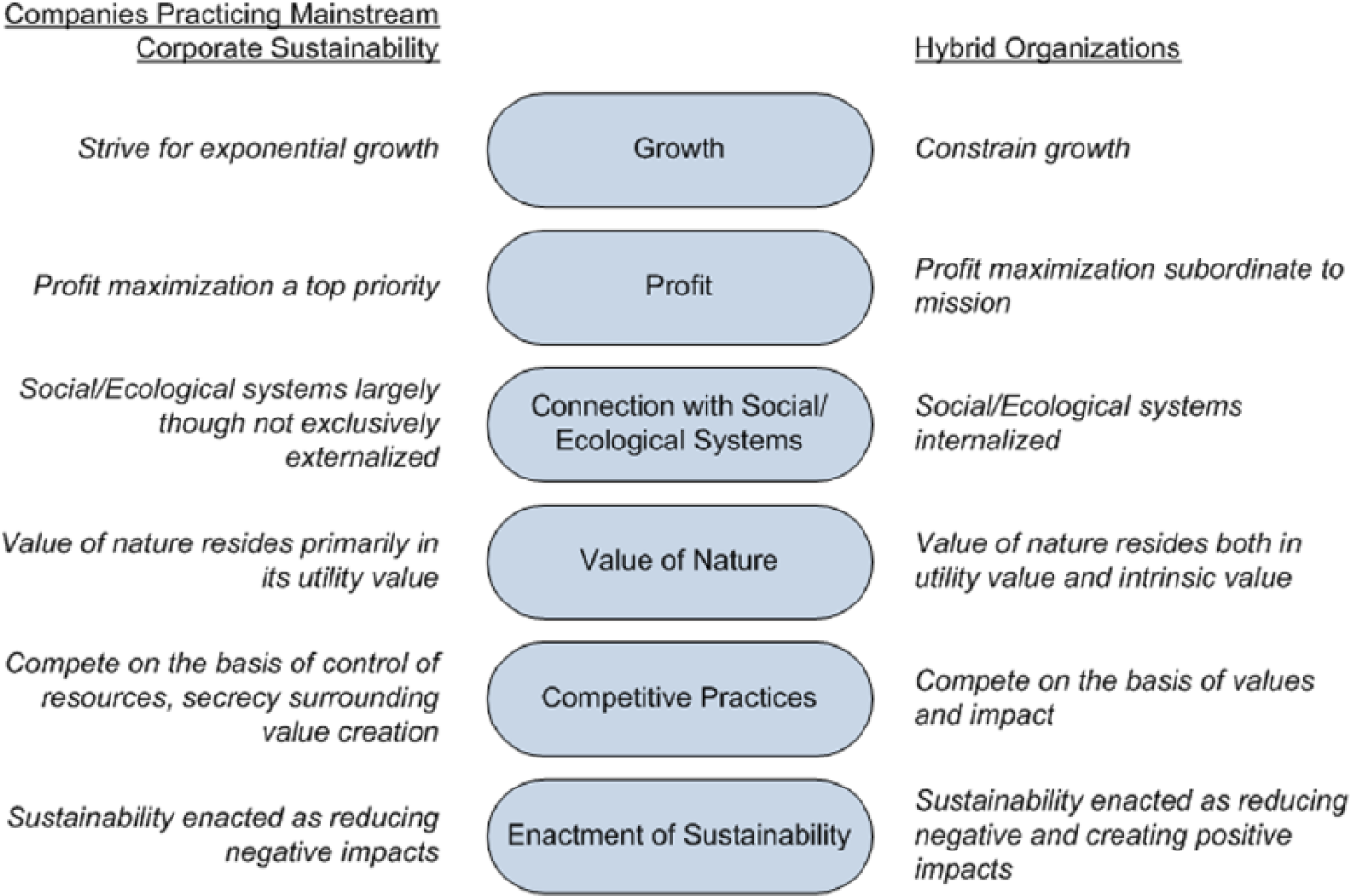
Hybrid challenges to mainstream corporate sustainability.
Discussion
Hybrid organizations are both the result of and are protagonists for the evolving purpose, form, and role of business in relation to ecological and social systems. They are emerging at a time when the rise in alternative actors (e.g., nongovernment organizations, trade unions) are assuming a larger role in the governance of environmental and social issues, while the state’s role is declining (Bernstein & Cashore, 2007; Bull, 2008; Lemos & Agrawal, 2006). Within this context, hybrids exemplify models that support the development of “‘native’ capabilities that emphasize deep dialogue and local codevelopment” (Hart, 2007, p. 23). The ways in which they conceive of and enact sustainability, and challenge the beliefs embedded within strategic management literatures, suggest several implications for scholarly research.
Theoretical Implications
Aside from showing a potentially broader side to corporate sustainability, the shared value (Porter & Kramer, 2011) or blended value (Miller et al., 2009) business models developed by hybrids suggest the need for other changes in the ways that firms and corporate sustainability are conceived. We articulate three of these below.
Addressing the Internal–External Dichotomy
By personalizing and internalizing their relationships with environment and society, hybrids offer new avenues for expanding management theory. Treating nature and society as integral to their ability to create value (such as Fluid Earth’s biomimicry) and drawing traditionally external elements into their value creation systems (such as Mozilla’s use of volunteer programmers) challenges the internal–external dichotomy present throughout management literature. In this case, hybrids provide cause to reconsider theoretical notions of the “value chain” including only internal activities (Porter, 1985) and that resources and capabilities need to be under a firm’s control or otherwise be firm-specific to be defined as valuable (Amit & Schoemaker, 1993; Barney, 1991).
A Broader Definition of Stakeholders
Hybrids enact a broader definition of stakeholders that includes traditional stakeholders like investors, customers, and communities, and “fringe” (Hart & Sharma, 2004) nonhuman stakeholders, such as ecological and biophysical phenomena. There has been a protracted debate about the stakeholder status of the natural environment; at the heart of which is whether Freeman’s (1984) definition of stakeholders should be interpreted narrowly or broadly (Driscoll & Starik, 2004; Haigh & Griffiths, 2009; Orts & Strudler, 2002; Phillips & Reichart, 2000). Hybrid organizations substantiate this theoretical debate with their deep involvement with the social and natural systems in which they operate, which shows a broad interpretation of stakeholder.
Creating a More Comprehensive Language for Studying Corporate Sustainability
Finally, the language for organizations operating in ways that are “more sustainable” is still missing within corporate sustainability literature after decades of honing a vocabulary around being “less unsustainable.” In this respect, Positive Organizational Scholarship (POS) may offer sustainability scholars a conceptual basis by which to study, understand, and explain the creation of positive sustainability phenomena. Sustainability and POS are both fundamentally grounded in the concept of flourishing (Hoffman & Haigh, 2011). POS is concerned with explaining especially positive (or “positively deviant”) contexts, systems, practices, and outcomes that promote flourishing (Dutton & Glynn, 2008). This fits well with Ehrenfeld’s (2008) notion of sustainability of being focused on life flourishing on the planet forever (Ehrenfeld, 2008).
Directions for Future Research
Fitting corporate sustainability into (rather than challenging) strategy orthodoxy has assisted its emergence as a legitimized field of inquiry. However, scholars who continue to fit their work into dominant frameworks risk removing its most distinctive elements. In addition to advocating an opportunity to test the propositions we develop here from prevailing literature, our arguments also raise other potential directions for future inquiry. For instance, we argue that hybrid organizations enact a broader meaning of sustainability than mainstream corporate sustainability practices. Research is needed to understand what might drive companies practicing mainstream sustainability to move in this direction (or to resist it), and how such a move might be undertaken. Further, are the drivers and challenges of hybridizing the same as those experienced by companies when adopting corporate sustainability, or different? Similarly, hybrids such as Mozilla compete directly with mainstream companies, and future research could shed light on how competitors view and responded to them. For instance, what impact (if any) does competing with a hybrid organization have on corporate sustainability practices? This also raises questions about what it means to for-profit companies to be competing with nonprofit hybrids such as Mozilla. Do they compete differently against nonprofits than they might traditional for-profit competitors? Inquiry into these topics is important for building theory that will expand our understanding of how sustainability is conceived by companies practicing mainstream sustainability, how conceptions change over time, and the responses that hybrid organizations evoke in the market as they continue to emerge as a trend.
Concluding Remarks
Questions surrounding the ability of firms to address ecological and social issues are particularly salient today given the increasing problems we highlighted earlier. Additionally, the growing distrust of corporations and accusations of corporate greenwash (Lyon & Maxwell, 2011) call for a reexamination of corporate sustainability concepts and practices. Hybrid organizations are emerging as a model of unorthodox business values and practices that challenge beliefs embedded within strategic management and corporate sustainability literatures, namely favoring economic stability and slow growth over increasing economic growth; prioritizing social and environmental missions over or on par with profit, internalizing social and ecological systems, valuing nature beyond its resource value, competing on the basis of values, and creating positive impacts to social and ecological systems. As such, hybrid organizations offer stimulating insights into how the role of organizations in society and the natural environment might be redefined toward producing positive social and ecological change.
Footnotes
Declaration of Conflicting Interests
The authors declared no potential conflicts of interest with respect to the research, authorship, and/or publication of this article.
Funding
The authors received no financial support for the research, authorship, and/or publication of this article.