



Abstract
The disruptive nature of many sustainability solutions may be the main barrier to their implementation and dispersal: adopting a business model perspective may help address this problem. Previous literature has explored how organizations can convert their supply chains and customer interfaces toward a sustainability focus, but has generally not considered links to other business model elements—such as value propositions and financial models—in exploring business model transitions. Moreover, the implementation of sustainable solutions often relies on projects being implemented and managed collectively, so that organizations need to adapt their business models to deliver value propositions collectively, a phenomenon that research on business models for sustainability should address. This article addresses these issues by exploring changes in business model elements in detail via an in-depth qualitative study of two French sustainable urban projects—Caserne de Bonne and IssyGrid®. Our results show, first, that it is worth considering the role played by business model elements (the value proposition and the financial model) that literature does not usually discuss in enabling the management of or transition to business models for sustainability. Second, considering all four business model elements allows us to develop a typology of their transformations in organizations working toward sustainable solutions. Third, introducing the necessary collective dimension of sustainable solutions highlights the role of agency in facilitating their development and adoption.
Keywords
Introduction
The most recent report of the Intergovernmental Panel on Climate Change emphasized that the need for sustainable solutions is crucial (Intergovernmental Panel on Climate Change, 2014). Spending on sustainable technologies in industrialized nations is growing due to investment by venture capitalists in clean-tech companies (Johnson & Suskewicz, 2009; United Nations, 2012). Globally, businesses have begun to add more sustainability dimensions to their economic activities, and increasing numbers of firms now publish sustainability indicators (Callado & Fensterseifer, 2011). However, the diffusion and actual adoption of sustainable solutions—for example, those that are energy efficient, that tackle climate change and natural resource depletion, and so on—remain only minor compared to the overall needs.
At the same time, literature shows that adopting a business model (BM) perspective may be a way to facilitate the diffusion of sustainable solutions (Bocken, Short, Rana, & Evans, 2014; Boons & Lüdeke-Freund, 2013). But the route toward sustainability (cf. Jackson, 2009) may require fundamental shifts in the purpose of business and in many aspects of how it is conducted (Bocken et al., 2014). BM innovation offers a potential approach to deliver the required changes through reconceptualizing organizations’ purposes and the value creation logics they follow (Porter & Kramer, 2011; Stubbs & Cocklin, 2008). Some scholars who have investigated this field have developed integrated business cases for sustainability (Schaltegger, Ludeke-Freund, & Hansen, 2012, illustrated in Lüdeke-Freund, 2013), conceptual models such as the sustainability business model (Stubbs & Cocklin, 2008), or business models for sustainable innovation (Boons & Lüdeke-Freund, 2013; Bocken et al., 2014). Others have analyzed changes in certain BM elements—for example, how supply chains can be reorganized to make them more sustainable (e.g., Boons & Mendoza, 2010; Seuring & Müller, 2008; Vermeulen & Seuring, 2009). The most recently published research agenda in this field (Boons & Lüdeke-Freund, 2013) lists a number of questions to be addressed. One, in particular, aims at broadening the scope of the BM literature by incorporating BM elements other than the supply chain, such as the value proposition and the financial model—a theoretical question that this article addresses. The agenda also calls for empirical research. This article explores business models for sustainability (BMfS) in two—very different—French ecological urban districts, in particular the BMs designed to develop energy efficient solutions in both districts. The literature also suggests that sustainable value may no longer be created by firms acting autonomously (Beattie & Smith, 2013; Johnson & Suskewicz, 2009; Lowitt, 2013) but by organizations working collectively to accomplish its delivery (Rohrbeck, Konnertz, & Knab, 2013). This article attempts to consider this specific dimension, by integrating two levels of analysis: organizations’ individual BMs and collectively delivered sustainability projects.
The article is divided into five parts. The first reviews the literature to present our theoretical basis and specifies our research question about the transformation of BM elements in collectively delivered sustainability projects. The second details the methods we adopted to gather data and to make sense of our two case studies. The third part presents our results, which are discussed in the fourth. The conclusion summarizes our contributions to understanding BMfS and their role in diffusing sustainable solutions.
Literature Review and Research Questions
The literature argues that the disruptive nature of sustainable solutions (Christensen, 1997) may be the main barrier to their development (Jacobsson & Bergek, 2004; Johnson & Suskewicz, 2009). Exploring the fossil-fuel industries, Ihlen and Roper (2014) show that, even if incumbents agree that sustainability should be a key part of their business, they are usually content to let smaller firms and new entrants be the ones who develop such solutions. In their study on the energy sector’s transition toward more renewable energy sources, Jacobsson and Bergek (2004) list a set of challenges that need to be addressed, in particular direct and indirect subsidies for established technologies, and policy changes. Johnson and Suskewicz (2009) observe that investors favor incumbents “using conventional BMs in an effort to fit clean technologies into existing systems” (p. 53), and argue that such incumbents generally lack BM innovation. Boons, Montalvo, Quist, and Wagner (2013) add that the holistic framework provided by the BM notion can help the envisioning and implementation of sustainable solutions, and Bocken et al. (2014) reinforce this idea, arguing for the adoption of a system-wide perspective. Tripsas and Gavetti (2000) analyze the history of the Polaroid company to show that established BMs can hinder innovation, despite the existence of novel technological capacities, a phenomenon Baden-Fuller and Mangematin (2013) refer to as the “cognitive blindness” of established firms, noting that “relatively little work has been done to isolate and examine particular instances of business model change” (p. 424).
Many scholars (e.g., Bohnsack, Pinkse, & Kolk, 2014; Boons & Lüdeke-Freund, 2013; Charter, Gray, Clark, & Woolman, 2008; Schaltegger et al., 2012; Tukker & Tischner, 2006; Wells, 2008) follow Johnson and Suskewicz’s (2009) assertion that the BM issue deserves more attention in the field of sustainable solutions. Schaltegger et al. (2012) state that “the business case for sustainability has to be created (and managed)—it does not just happen” (p. 99), and present a framework for BM innovation as a means to achieve these ends. In this article, we follow this line by investigating the following research question:
In addressing this question, our study explores how organizations transform elements of their BM to enable a transition toward BMfS.
The literature has provided many definitions of BMs (e.g., Baden-Fuller & Mangematin, 2013; Doganova & Eyquem-Renault, 2009; Osterwalder, 2004). In this study, we combine the definitions of Osterwalder (2004) and Doganova and Eyquem-Renault (2009), as cited by Boons and Lüdeke-Freund (2013, p. 10). In this definition, the generic BM elements are the Value proposition (the value that is embedded in the supply), the Supply chain (the structure and management of upstream relationships with suppliers), the Customer interface (the structure and management of downstream relationships with customers), and the Financial model (the costs and benefits of the other three elements, and their distribution across the value chain).
This article deliberately explores the transformation of each element of the BMs of organizations participating in sustainability projects. A comparison of the literatures on BMs and on sustainable solutions shows that these four elements have not received equal levels of attention (Boons & Lüdeke-Freund, 2013). For instance, Bohnsack et al. (2014) recently studied the impact of path dependencies on BM evolution in the case of electric vehicles but without considering the customer interface. Substantial literature has shown how supply chains and customer interfaces have been modified to increase sustainability (Boons & Mendoza, 2010; Matos & Silvestre, 2013; Seuring & Müller, 2008; Vermeulen & Seuring, 2009) but the state-of-the-art article of Boons and Lüdeke-Freund (2013) states its failure to link these elements to the two other BM elements—the value proposition and the financial model. Both of these elements have been studied from a sustainability perspective in other fields such as sustainability marketing (Hult, 2011) but without the holistic framework used here.
Moreover, both Genus and Coles (2008) and Boons and Lüdeke-Freund (2013) state that there has been a lack of consideration of agency in existing studies of BMfS. In order to deliver value with sustainability dimensions, it often requires that a concern for sustainability has become institutionalized in society (Stubbs & Cocklin, 2008) and that “multiple organizations work together and pool complementary assets” (Rohrbeck et al., 2013, p. 3). The creation of such “sustainable value” may rely on collective projects driven by leaders—and will thus involve issues of agency. Although sustainable value can be created by individual organizations, partners can also work together to deliver collective value via sustainable solutions (Beattie & Smith, 2013; Lowitt, 2013; Rohrbeck et al., 2013). In terms of BM elements, it is relevant to consider both the individual organization and the collaborative project levels. This article focuses on this latter issue, so we refine our research question to the following:
To address this question, this article analyzes two collective projects designed to deliver sustainable urban districts—that is, urban districts designed so as to take their environmental impact into consideration—to investigate BM innovation for energy efficiency in the construction sector. We present an in-depth analysis of the changes in each element of the BMs of organizations involved in collaborative projects in sustainable urban districts, and discuss the results. In doing so, this article also responds to Boons and Lüdeke-Freund’s (2013) call for “Empirical research, e.g., following a case-study approach . . . to shed some light on the state of the art of corporate sustainability management, sustainable organizational development and sustainable innovation in daily business” (p. 17). In short, this article contributes to the literature on BMfS, both theoretically and empirically.
Methodology
Research Design
Business models are difficult to observe, and studying them requires in-depth data collection. To examine how organizations transform their BMs in order to take part in collective sustainability projects, we require data about how individual organizations’ BMs transition toward BMfS. The case-study method enables this kind of exploration of a “contemporary phenomenon within its real-life context” (Yin, 2003, p. 13), as well as providing individual and global data to facilitate the investigation of collective sustainability projects.
We explore two contrasting cases to “give greater certainty” (Yin, 2003, p. 8) about possible organizational patterns, help build theory, and facilitate the design of case typologies. The choice of contrasting cases is inspired by Glaser and Strauss (1967), and allows us to try to cover a maximum range of BM changes, which should help us develop hypotheses and theories about the necessary conditions for developing BMfS. The cases review the processes by which organizations involved in two sustainable urban projects—Caserne de Bonne and IssyGrid®—changed their BMs and connected the value proposition, supply chain, customer interface, and financial model elements in new ways to develop and/or implement collective energy-efficient solutions.
Case Selection
Given that the construction sector has great potential to make significant improvements in the energy efficiency of buildings—which account for more than 40% of total global energy consumption (United Nations Environment Programme, 2015)—the spread of sustainable solutions has been rather slow, well below its potential (Pinkse & Dommisse, 2009). The European Commission has targeted a 20% decrease in energy consumption between 2008 and 2020—but governments regularly revise this aim downwards, recently to between 17% and 15%.
France has adopted an energy policy designed to balance the production of sustainable energy with energy affordability and energy industry competitiveness. France ranks third in the top 10 performers (just after Norway and New Zealand) on the global Energy Architecture Performance Index (World Economic Forum, 2013), showing that the development of sustainable energy solutions is relatively important in France. In 2009, the average energy consumption of a French building was more than 200 kWh/m2: The government’s aim for 2020 is a 38% reduction in primary energy consumption of existing buildings (compared with 2013 figures) and a maximum primary energy consumption of 50 kWh/m2 for new buildings (Odyssee-Mure, 2012).
In the context of the rapid growth of urban populations worldwide and increasing per capita resource consumption, the challenge of making urban living more sustainable has become urgent, particularly in terms of energy efficiency. Recent sustainable urban district projects offer great opportunities for scholars to explore BM changes, due to their defined boundaries in time and space, and the clear identification of the organizations involved.
We selected 2 of the 16 French sustainable urban districts as settings for this study: Caserne de Bonne, which has been operational since 2009, and was named France’s “Best Sustainable District” in 2009; and IssyGrid (operational since 2012), France’s first example of a district-level “smart grid.” Both districts have mixed housing, office, and shopping areas, and were chosen from among the most recently operational sustainable urban projects to facilitate data collection and understand the state of the art of organizational patterns in this fast-changing environment. The governance structure of both selected districts differs: While Caserne de Bonne is characterized by a hierarchical structure,
The Caserne de Bonne Case
The 21-acre Caserne de Bonne zone is located in downtown Grenoble, a city of 160,000 within an urban area of 400,000 inhabitants (South-East France). The project’s aim was to transform a disused army barracks into an exemplar development featuring urban density, diversity, accessibility, and energy efficiency. The project—led by town planners and partially funded by the European Union Concerto Initiative “DG Energy” (www.concerto.eu/concerto—see Appendix B)—was awarded the “Grand prix national d’écoquartier” in 2009, and the “Label national d’écoquartier” in 2013 (http://www.la-caserne-de-bonne.com).
The IssyGrid Case
The 39.5-acre IssyGrid zone is located in Issy-les-Moulineaux, a city of 65,000 located in the Paris urban area of 10 million inhabitants. The project’s main priority was the optimization of energy use at the district level. It is led by Bouygues (via its subsidiaries Bouygues Immobilier, Bouygues Energies & Services, and Bouygues Telecom), assisted by a diverse range of organizations providing all the strategic and technical skills required to implement a smart grid: Alstom, Bouygues Energies & Services, Bouygues Telecom, EDF, ERDF, Microsoft, Schneider Electric, Steria, and Total (see http://www.issy.com/en/home/issy-a-smart-city/issygrid).
In 2013, several office buildings, a hundred homes, and part of the district’s street lighting were connected to a “smart grid.” The project’s information system can analyze energy production and consumption, and so advise and encourage consumers, in partnership with the electricity distribution network, to consume at “the right time,” so helping reduce peak demand. Among more recent steps proposed are the installation of a smart electric distribution station that—using data supplied by the information system—will balance energy consumption, production, and storage: An achievement considered as a “world first.”
Data Collection and Analysis
Besides analyzing extant documentation (official websites, press articles, governmental reports), we conducted in-depth interviews with the most significant actors in each project (23 for the Caserne de Bonne case, 7 for the IssyGrid case) between October 2012 and July 2013—limiting the number to seven in the latter case due to data saturation (Bowen, 2008). In each case, we interviewed the actors responsible for making each organization’s decisions to build the energy-efficient solutions that were implemented in the two communities, that is, local regulators, architects, real estate agents, energy suppliers, and so on. (The treatment of data in this research considers individual actors speak for their organization.) The first author conducted individual semistructured, semidirected interviews with each informant (see the interview guide in Appendix A), which were recorded and transcribed. The data were then coded (using NVivo) and submitted to a classic thematic analysis (Guest, MacQueen, & Namey, 2011) looking mainly for BM elements in the verbatim—the value proposition, supply chain, customer interface, and financial model—as well as for changes in and interconnections among these elements. Analysis included careful reading and re-reading of the data, identifying initial keywords for each of the BM elements; for example, supply, product, or service for value proposition; partners, suppliers, or distributors for supply chain. After this interpretive analysis BMs were grouped by type, depending on which elements were changed to deliver sustainable solutions.
Results
Transformation of BM Elements by Organizations in the Caserne de Bonne Project
The Caserne de Bonne project was led and mainly funded by the public sector, and the sustainable solutions that were to be adopted were decided top-down and in advance. So the private organizations collaborating in this project had very few options regarding the BMs they adopted: In particular, the value proposition was decided exogenously by the lead public sector agency (in this case, the local town authority).
The governance structure of this project (which was mainly funded by the European Concerto initiative) led to top-down decisions about the energy solutions that were to be adopted (see Figure 1). The project leaders were the town’s deputy mayor (who was also the CEO of an urban development company) and his business partner, the CEO of an energy engineering company. To win the innovation-oriented Concerto funding, they launched a call for tender with ambitious, but feasible technical specifications, and selected a company that proposed innovative mini-cogeneration units in each building rather than one offering a connection to an existing urban heating network. This upfront choice was then imposed to all subsequent project organizations: architects, builders, real estate developers, and so on, for the area funded by Concerto (see how these organizations have transformed (or not) their BM elements to deliver the project in Table 1). (In the area of the project not funded by Concerto, the organizations could make their own choices regarding energy supply, and opted to join an urban heating network.)
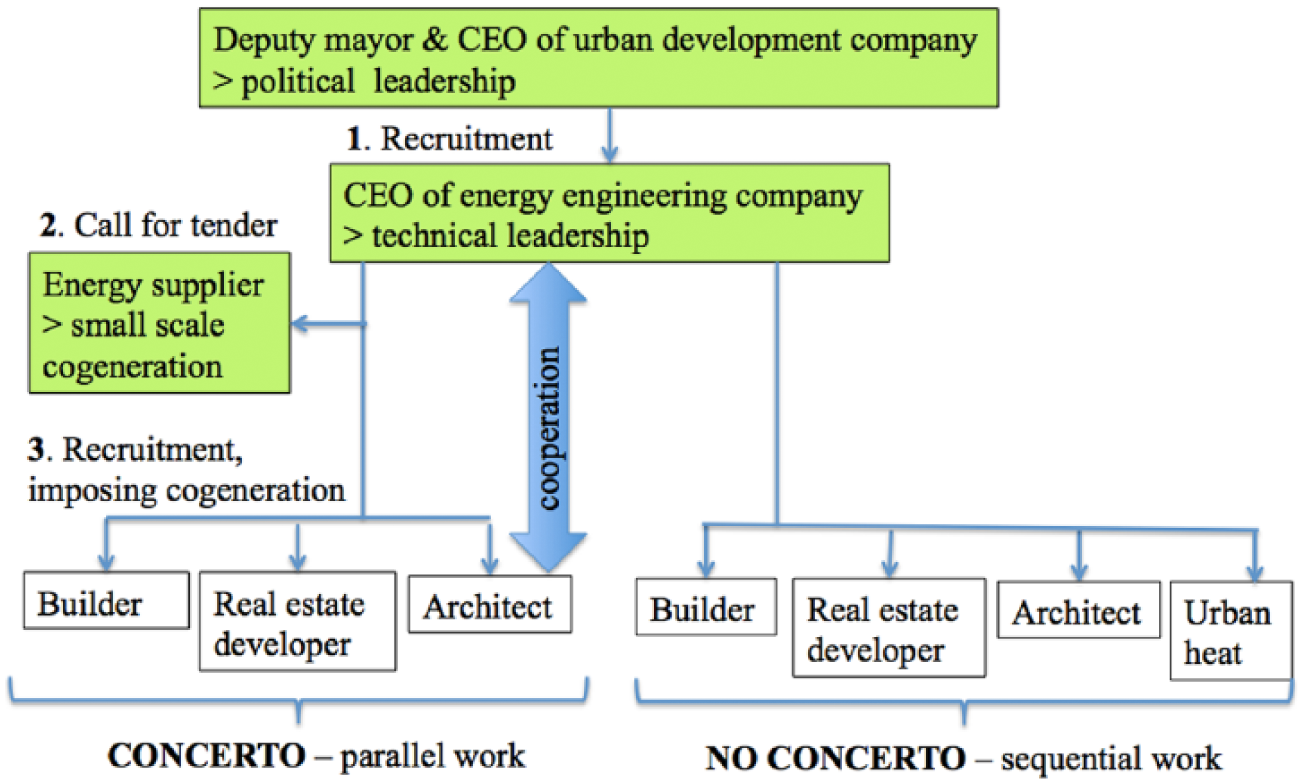
Relationship between organizations in the Caserne de Bonne case.
Individual Organizations’ Business Model Element Transformation to Deliver the Caserne de Bonne Project.
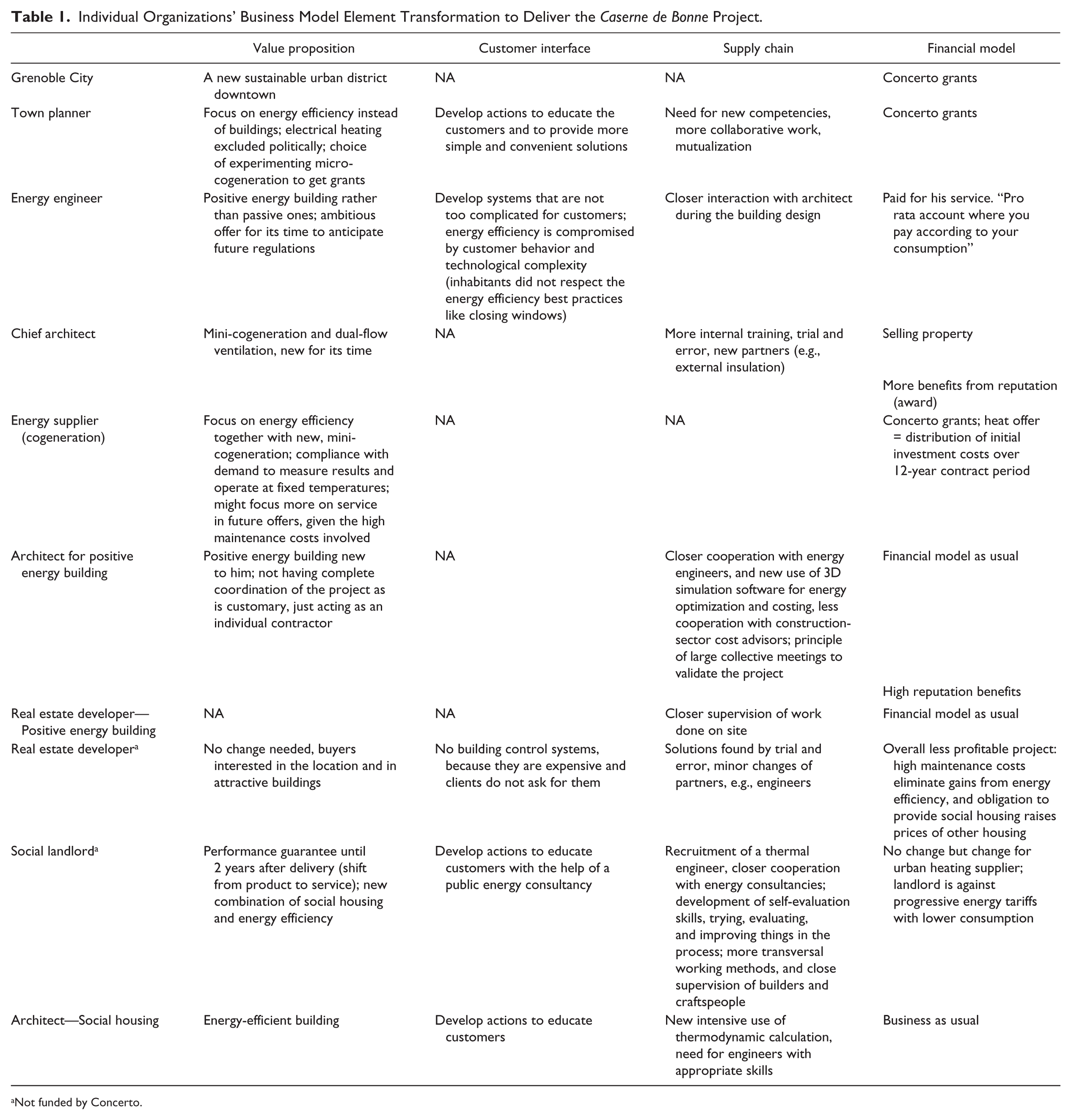
Not funded by Concerto.
Thus, the collective value proposition was decided up-front, and organizations participating in this project had then to adapt their individual value propositions to this collective sustainable solution.
An architectural organization proposed a new value proposition based on a positive energy building, which would include many technical and usage innovations; for example, a thermal cap to close the windows at night and during cold days, with a single big key—which was both symbolic and real—to open the windows, the system only allowing one window to be open at a time. Beyond this transformation of its value proposition, this organization completely changed its supply chain, making a new partnership with a 3D simulation office offering energy efficiency services. This energy consultant influenced the final form of the building, because it turns out that compact buildings are more energy efficient. A social landlord organization insisted on the need to change the customer interface, as well as making strong efforts to educate the district’s inhabitants. This organization also included a new partner—a thermal engineer—in its supply chain. But the real estate developers collaborating on this project did not generally change their BMs, just adding some new buildings to their portfolios.
Those organizations that operated outside the constraints of the Concerto-funded sector were able to adapt their value propositions to public demand changing only marginally other elements of their BMs. But those operating within the Concerto-funded sector had to find ways to be competitive that aligned with its ambitious energy-efficiency objectives. They changed their value propositions and supply chains and cooperated with new kinds of partners to develop new solutions—like the architect of the positive energy building.
Transformation of BM Elements by Organizations in IssyGrid
The IssyGrid project was led by private organizations, and the sustainable solutions that were implemented were chosen more collectively. This different governance model had a strong impact on the organizations’ BM elements and those elements’ dynamics.
The private IssyGrid initiative was coordinated by the Bouygues industrial group (see Figure 2). Unlike the Caserne de Bonne project, participants in the IssyGrid project constituted a very dense and homogeneous network. The main organizations—the architectural agency, the energy supplier, the electric device supplier, and the big data companies—collaborated to define their optimal individual value propositions. The goal of the smart grid project was to enable the project zone’s inhabitants to save significant amounts of money by pooling complementary needs and resources for offices, homes, and businesses, and by leveling energy consumption peaks.
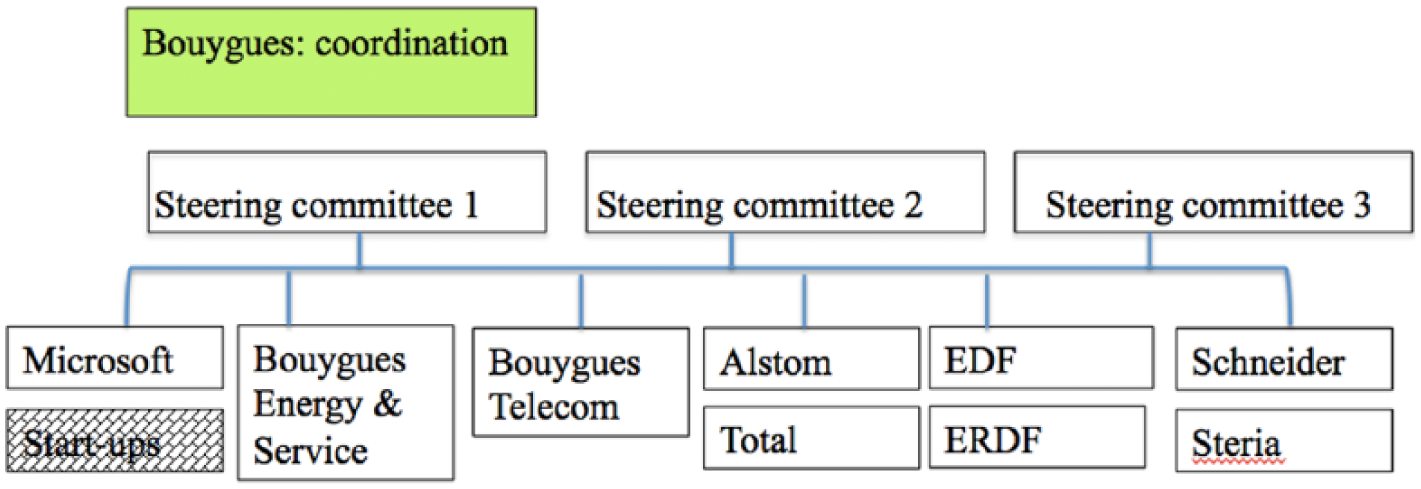
IssyGrid organization.
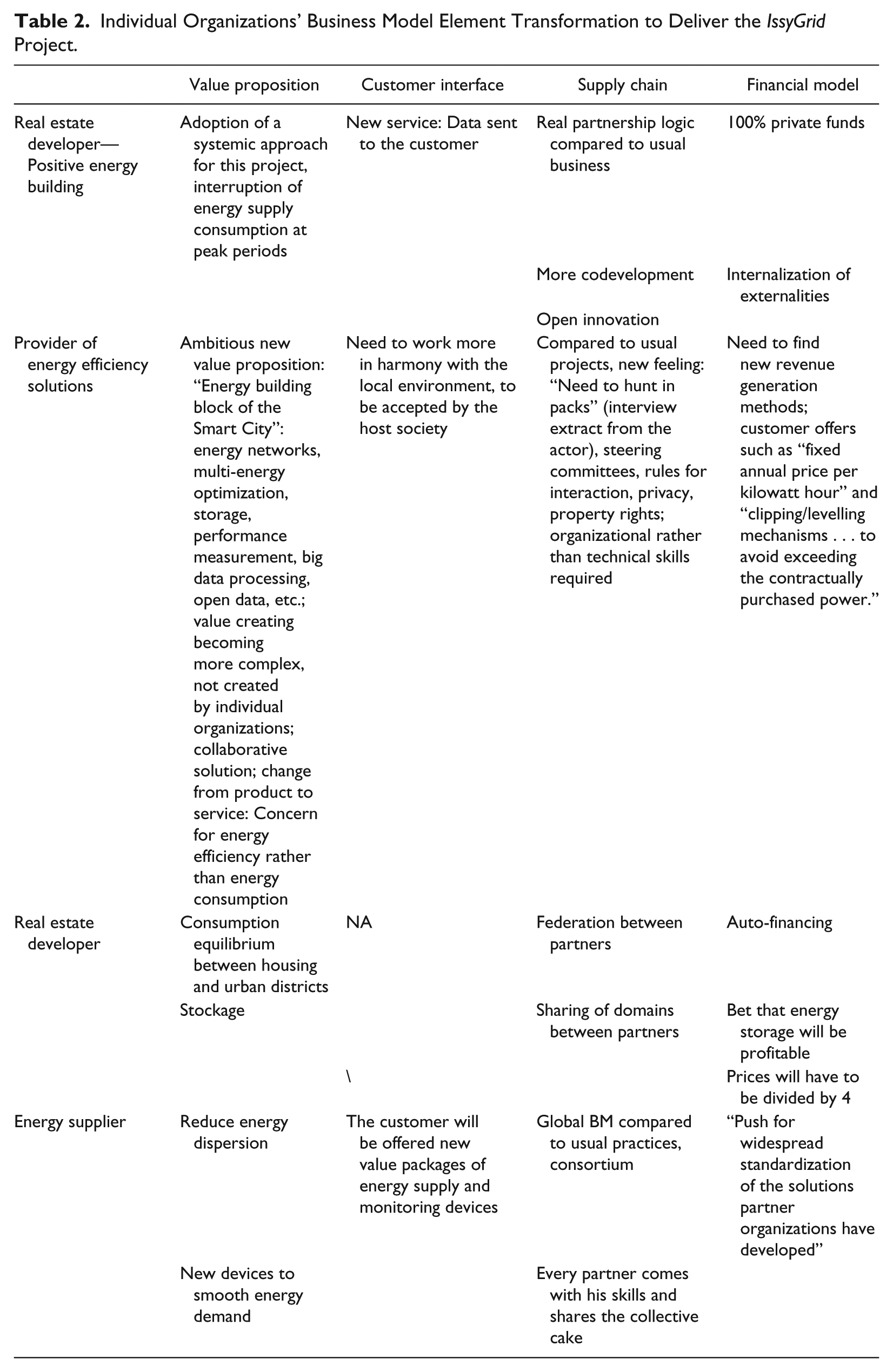
Finally, the organizations in IssyGrid did not react to a specific demand; rather, they proactively created a new sustainability offer (a smart grid system) that could only be delivered collectively, by drawing on the competencies of all the organizations involved: “every partner comes with his skills and shares the collective cake.” An organization providing energy-efficient solutions considered that it was now delivering the “energy building block of the smart city.” The financial model changed radically for organizations like the big data manager, who now buys energy consumption data from the electronic device provider, analyzes it, and sells it to the energy provider organization, which then optimizes its energy supply and storage to smooth out demand peaks. The communication company that facilitates the collection and transfer of this consumption data also adapted its financial model to capture part of the value it helped to create. However, most organizations involved in the IssyGrid project did not expect to get short-term returns on their investments, betting more on long-term profits, and seeking noneconomic benefits, such as reputation, image, and first mover effects, or future rents that would come when they could push such standards onto the market.
Table 2 illustrates the transformations of the BM elements of the main organizations participating in the collective IssyGrid project.
Individual Organizations’ Business Model Element Transformation to Deliver the IssyGrid Project.
Different Types of Business Model Transformations
Some of the organizations that participated in these two projects only changed one or two elements of their usual BMs: others—more radically—changed all four elements. We can broadly distinguish four cases (see Table 3).
BM Elements Transformation by Organizations Involved in Case Projects.
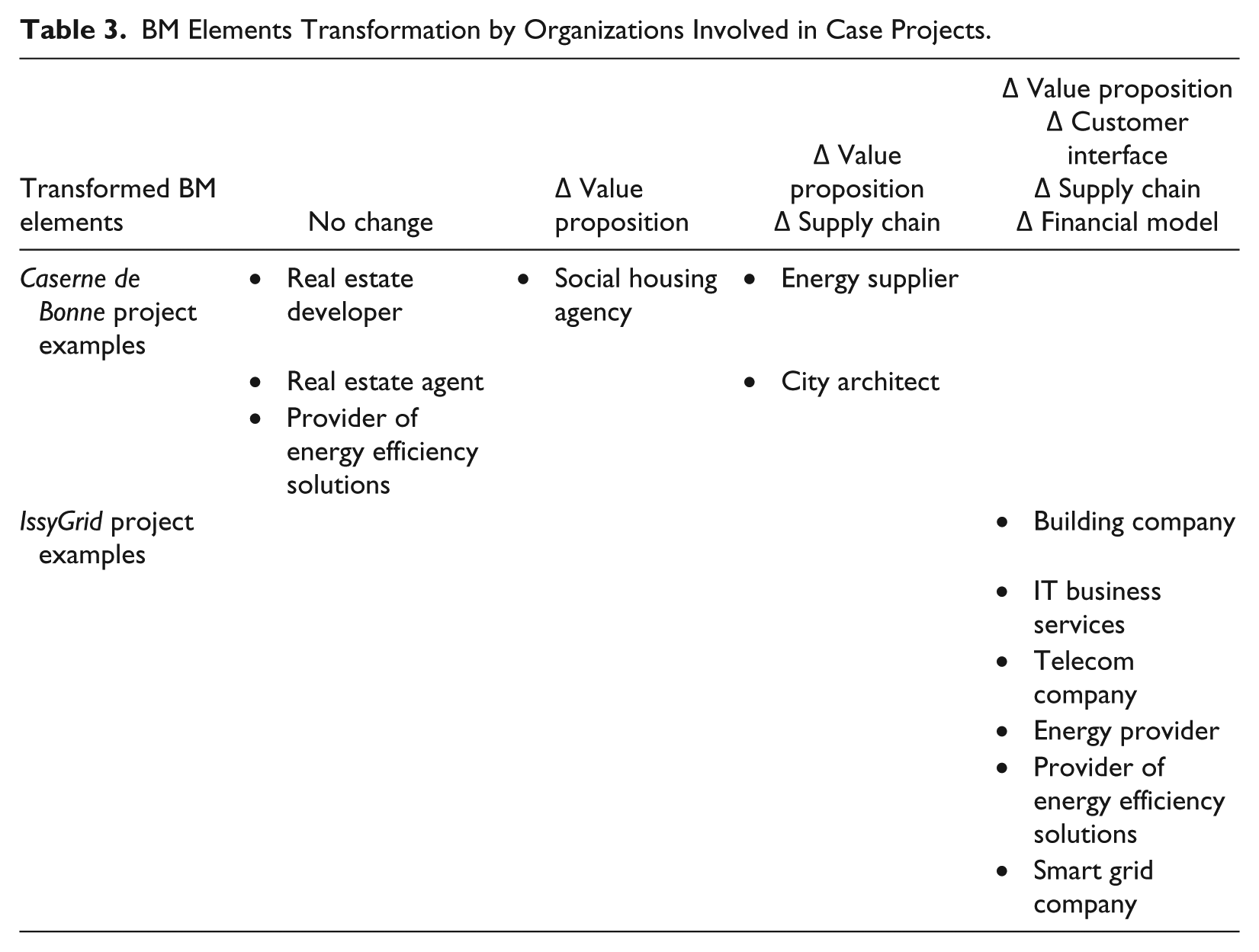
We notice that the organizations participating in the IssyGrid project transformed more of their BM elements than did those involved in the Caserne de Bonne project. In particular, the energy efficiency solutions provider company—which participated in both projects—changed more of its BM elements for the IssyGrid project. We discuss the four types in more detail below.
No Changes in BM Elements
Solutions of this type, where organizations stayed with their conventional BMs, imply that energy efficiency was not at the heart of the value they created in the urban district projects. For example, a Caserne de Bonne real estate agent explained that people who bought a property on the project site did so because of the site’s proximity to the city center (“the land had value”), not because of the property’s energy performance. The consumer segment targeted was consistent with what would be expected for that type of property, whether it was in a sustainable urban district or not. Social landlords also recognized that users sometimes saw energy performance targets as threatening to constrain their consumption. For the consumer, this BM does not give rise to a change in perceived value compared with other generally existing offers. Finally, the supply in those service providers’ portfolios—whether they were a real estate agent, a landlord, or a training organization—was considered conventional. One Caserne de Bonne interviewee highlighted the limits of the ability of this type of BM to achieve the desired energy performance, arguing the need to establish “more incentive-based business models.”
Regarding the supply-chain, the incumbent organizations generally reported that, essentially, they carried on using their existing skills, or acquired skills via trial and error, developing expertise that was transferable to other projects. Nor did these sustainable urban district projects require organizations to source new material resources, except some that were necessary to implement energy saving solutions (exterior insulation materials, double flow ventilation, solar collectors, etc.): but their acquisition was described as just a conventional process, in which energy efficiency was the priority. Such firms did not change their usual business partner portfolios, beyond the obvious practice of using those who were particularly interested and expert in this type of project (“The companies favored for external insulation are specialized compared to other more generalist ones in Rhône-Alpes”). In neither project did the value chains set up by this type of real estate developer differ from those they usually operated.
The financial models also remained unchanged, with the distribution of value across organizations in the chain, and the levels of costs and revenues generated closely resembling existing practices. But one actor put his finger on the fact that decreasing energy expenditures were likely to be offset by higher maintenance costs of the energy solutions that project partners adopted.
Marginal Changes in BM Elements
Adjusted BMs in this category only differed marginally from those the organizations concerned adopted in other projects, and while the solutions they deployed involved changes in their value propositions, they did not entail fundamental changes in the structure of their value networks, customer interfaces, or financial models. Their BM changes tended to follow continuous incremental logics. Organizations in this category offered users benefits in terms of savings, as well as other advantages—for example, one actor appreciated participating in the first “low-consumption social building” enterprise. The value propositions advanced by these organizations were enriched by the combination of two supply characteristics—social and low-consumption building—a situation which was unusual but which, given the institutional pressures involved, could gradually be systematized.
These organizations also benefited from other intangible value creation elements relating to the reputation and image of these novel initiatives, which complement the usual economic value that flows from such projects. So it seems that the financial model extends beyond the conventional economic approach (the financial profitability of the solution) and may contain diverse dimensions such as social benefits (housing development or social mix), reputation (increased awareness, recognition of expertise), electoral and environmental advantages (use of renewable energy, etc.). On the other hand, their profit models may also be affected by the involvement of European subsidies, which reduce the costs of investing in such building developments.
With the exception of one example (of an office space), the supply chains of organizations in this category remained relatively unchanged but nevertheless enhanced their growing public role as organizations involved in innovatory projects. These models were associated more with increases in local authorities’ power than with the implementation of energy solutions.
Substantial Changes in BM Elements
Organizations in this category transformed their BMs more significantly in their efforts to capture the opportunities presented by the growing demand for energy efficiency, but without disrupting their basic existing BM structures. They took into account the likely emergence of an alternate future environment of sustainable urban districts (driven by subsidies for pilot experiments), of new ways of assessing building and energy costs (accounting for the total cost of ownership, for instance), of new types of ownership, of the maturing of new energy-efficient solutions and the demand for their implementation in future city developments, and see themselves as part of the evolving ecosystems of sustainable urban districts. To this end, these organizations invested heavily in acquiring new skills, and were able to question and reorganize their networks of partners to create the value they aimed to generate.
Changes to the value propositions of organizations in this category were often radical, for example, “We were builders, not energy solutions providers,” with energy efficiency as the main component of the value they created. They cited the need to “anticipate the tightening of forthcoming regulations on energy performance,” and foresaw the advent of “positive energy” that was going to require creating a new style of energy efficient services that could help customers reduce their energy consumption dramatically, which would challenge energy suppliers’ interests, and which would also require changes in their customer interfaces.
These BMs require organizations to reorganize their work, and recognize that it “ . . . is a collaborative work . . . [a] first attempt at sharing.” They therefore looked for external skills, as in the case of a Caserne de Bonne architect who changed his practices and his value network, positioning a thermodynamics engineering simulation as a central element in his project design chain. Unlike the practices already in place—which were more trial and error—using simulation software takes decisions further upstream in terms of materials planning and consultations with traditional players. For these organizations, this new kind of distribution of value creation can even become an end in itself.
Radical Changes in BM Elements
Organizations in this category proposed the most innovative BMs of the projects studied, with all their elements differing from those in the industry’s dominant BM types. The links between those elements were also refined, sometimes connecting the BMs of different entities in new ways. Some organizations developed their models more toward offering services than products, which makes sense given the greater maintenance issues involved in energy efficiency solutions. They foresaw that future customers would be more likely to buy (or rent) buildings or properties together with contracts for maintenance and for optimizing energy consumption—so transforming the customer interface.
Other organizations went even further. Bouygues adopted a proactive strategy for IssyGrid by creating a common platform for discussing partners’ expertise and complementary markets, some elements of which were already known but some new, and some involving major factors, and some details. The idea was to build a completely new BM type for such sustainable urban districts and energy solutions, becoming a prescriber rather than a supplier for communities, developing whole integrated solutions for the sustainable building market. They sought collaborators who might be long-term associates, or new partners who could explore different innovation avenues. Actors from these organizations mentioned terms such as “open innovation” and “logical laboratory,” and considered that they were building “the energy building block of the smart city” together, based on energy line networks that involved multi-level energy optimization, together with analysis, storage, big data processing, and so on. The value created by these new models was radically different—“they are just Blue Ocean thinking as they say, to create the value, which is a more complex value choice because it is more specific in each area of activity, but lies on the borders between these areas.” The actors who implemented these new models did not hesitate to seek inspiration from the wider field, beyond well-known European projects—interviewees also cited projects developed in Japan.
These innovative BMs required organizations to change their skill-sets to create value from energy efficiency, by forming teams or hiring outside expertise—having an expert thermal engineer work with a social landlord, for example. One actor referred to the “change of a key skill for the success of this type of solution,” and that the skills that needed to be developed might sometimes be more managerial than technical, for example, “[the] technologies are ready, and do not matter as much as ‘how we organize ourselves.’” Unlike other approaches to developing smart grids, organizations in the IssyGrid project reported preferring the territory rather than the technology as a starting point for their thinking, which aligns with the development of managerial skills.
These new BMs required modifying the organization of supply chain partnerships to achieve more effective collaborations to develop sustainable solutions. A social landlord set up procedures to facilitate networking among energy players, offered some local facilities to improve energy performance, and changed the distribution of responsibilities by altering the terms of its warranty conditions. Firms’ resource portfolios might also need to be changed to reallocate their resources, or add new ones (“Need to get new human resources with a good understanding of the need to work on the goal of energy efficiency”), such as thermal simulation software to predict performance more accurately.
Such transformations often disrupted established partner networks, bringing in new groups of organizations, and creating new connections with greater emphasis on energy efficiency. Developing solutions became more a collaborative effort—“IssyGrid is at the crossroads between the city, energy and digital, so no actors are able to obtain this value on their own.” The financial model may also be heavily affected, with new value proposals for users, such as “a price per kilowatt/hour fixed for the whole year . . . and a permanent subscription system and the ability to master the delta on subscription.”
Discussion
In answer to the research question: How do organizations engaged in a collective sustainability project transform their business models? We first discuss the relevance of linking the customer interface and the supply chain with the two other BM elements: the value proposition and the financial model. We then propose a typology of the BM transformations revealed in this study, and, finally, discuss the importance of directing attention to the collective dimension of sustainability-focused projects.
Linking the Customer Interface and the Supply Chain With the Value Proposition Element to Increase Sustainability
We learned from the cases that we studied that many organizations changed their value propositions, either because the context imposed suppliers–which affected the supply chain—and new propositions (Caserne de Bonne), or as a result of self-determined searches for new markets (IssyGrid)—that comes with the will to define a new kind of interface with the customer. In the Caserne de Bonne case, some organizations found new ways to deliver sustainable value, such as the architect designing the positive energy building. In the IssyGrid case, partner organizations had even more space to develop and implement disruptive innovations—with radical transformations of the BM elements, as the collective value proposition goal had not been specified top-down.
Linking the Customer Interface and the Supply Chain With the Financial Model Element to Increase Sustainability
This study shows that organizations adapted their financial models in joining these collective projects. Various organizations participated in the IssyGrid project, covering all the different skill areas required to implement smart solutions—solutions with dynamic decision systems based on data control—such as (in this case) smart grids. Given the complementarity of the skills the partners contributed, each had a clear interest in participating in this collective experience of designing France’s first urban district to be equipped with a smart grid. Only a part of the returns they anticipated was economic. The partner organizations were more motivated by the opportunity to identify new sources of future revenue, build reputation, compete worldwide, and to contact communities as prescribers rather than as suppliers, becoming not just energy providers but service providers, giving advice on reducing energy costs, and selling energy-efficient solutions. They aimed to get ahead of the smart grid market, to define the rules of the game before anyone else could, and so impose new standards in the medium term, giving them the chance to become established as leading players in the longer term. This illustrates what Markides and Sosa (2013) term the importance of adopting the BM perspective to gain first mover advantages. But their expected return was also noneconomic from another perspective, especially for the not-for-profit organizations involved, like the social landlord or the social housing organizations. Some organizations joined these collective sustainability projects to gain positive reputational effects, and some aimed to be “first movers” in the regulatory game for building “bricks of smart cities” of the future.
This study also completes Schaltegger et al.’s (2012) findings by introducing public grants and political value into the integrated framework of the business case for sustainability. In particular, we found that—in the Caserne de Bonne case—the drivers Schaltegger et al. (2012) described—such as cost reduction, sales and profit margins, risk reduction, and attractiveness as an employer—can be completed by than gaining political reputation.
These factors suggest that the links between supply chain, customer interface, and the financial model element have to be considered in BMfS frameworks. Our study also reveals that such frameworks should not only be studied from the perspective of for-private companies but also of public and not-for-profit organizations, which are economic actors benefitting from public funds and building their own BMs in the markets. This echoes Dahan, Doh, Oetzel, and Yaziji’s (2010) work on the co-creation of BMs by nongovernmental organizations’ partners.
Given that sustainable solutions are often driven by complex environments, which include public incentives and political pressures, a rethink about the links with value propositions and financial models may be useful in such cases. Value propositions will be designed not just to benefit primary consumers but also to please voters and public institutional customers, so that the monetization of the BM may not only be economic but also electoral or reputational. In real-life cases, there may be more drivers of BM transformations than simple financial profits.
Each of the four BM elements deserves attention to facilitate the implementation of sustainable solutions: In particular, changes in the value proposition element appear to be key to developing disruptive solutions.
Typology of BMs Changes Toward Sustainability
In both the project cases we studied, the design and adoption of sustainable collective solutions led to marginal to radical BM changes, and so to the emergence of four types of BM transformations that can be characterized as follows:
Business model as usual refers to the case where organizations participating in delivering collective sustainable value made no transformations to their BM elements.
Business model adjustment refers to cases where organizations made marginal modifications to one element of their BMs, mainly to be able to participate in the collective projects we studied. In this type, organizations added this new value proposition to their existing portfolio of supplies but without making major changes in the whole value delivery system.
Business model innovation refers to major BM transformations implemented by organizations aware of the strong potential of new value propositions and supply chain modifications.
Business model redesign refers to a complete rethinking of organizations’ BM elements to bring radically new value propositions to the market.
The four types of BM changes that have emerged from our study align with Schaltegger et al.’s (2012) “AAIR-scale” of BM innovation intensities as adjustment, adoption, improvement, and redesign.
Using Schaltegger et al.’s (2012) terminology, we find that most organizations involved in the Caserne de Bonne project adopted BM adjustment or adoption strategies, whereas those in the IssyGrid case generally adopted improvement or redesign strategies, which meant they developed more radical solutions toward sustainability. This result questions previous findings about incumbents’ relative inertia (Johnson & Suskewicz, 2009) or blindness (Baden-Fuller & Mangematin, 2013) toward radically redesigning their BMs, and suggests their capacity to innovate their BMs is greater than these authors argued. In the cases we studied, changes to organizations’ supply chains induced dynamics of innovation, in particular in terms of high levels of collaborative efforts between actors.
Since they had to fit in with previously taken decisions about the solutions to be implemented, and as public grants helped reduce costs, the organizations in the Caserne de Bonne case, in effect, used the project as a laboratory for experimentation and incremental BM innovations. They adopted defensive, accommodative, and reactive strategies according to the “RDAP-scale” proposed by Henriques and Sadorsky (1999). In comparison, the organizations in the IssyGrid case adopted proactive strategies, as those authors specified.
The Collective Dimension of Sustainability-Focused Projects
In the Caserne de Bonne case, major transformations of BM model elements were more significant in the sector of the project that was funded by public grants, which involved more ambitious energy efficiency goals than elsewhere in the project area, where some organizations (such as the real estate developer) made no changes at all to their BMs. In this case, it seems that more ambitious political alterations led to BM transformations, while less ambitious moves did not. Following Porter and van der Linde’s (1995) hypothesis, we can argue that incumbents’ inertia toward sustainability might be countered by regulatory measures. So—as Genus and Coles (2008) suggest—agency can be seen as quite important in this case, as having the power to facilitate the diffusion of eco-innovations in society.
The IssyGrid project led to more disruptive innovations, thanks to the proactive strategies of the organizations involved, and so to more radical transformations in their BMs. Interestingly, the main innovations were not technical, but organizational, and clear rules about intellectual property, revenue sharing, and horizontal rather than vertical cooperation were important in these transformations. Encouraged by Bouygues’s business development department, the organizations involved agreed to completely rethink their supply chains and cooperate in previously unfamiliar areas. As Stubbs and Cocklin (2008) found, “visionary CEOs” were able to push the sustainability agenda throughout their organizations, and develop internal structural and cultural capabilities to achieve their desired ends. While this echoes previous findings that sustainability BMs require participation from some stakeholders (Rowley, 1997; Sama, Welcomer, & Gerde, 2004; Windsor, 2004), our findings corroborate those of Stubbs and Cocklin (2008) that an efficient team needs to gain the support of its primary stakeholders.
We found that different governance modes affected how organizations transformed their BMs. Following Lowndes and Skelcher’s (1998) categorization, we found the dominant mode in the Caserne de Bonne case was hierarchical, whereas a network structure predominated in the IssyGrid case. The degree of flexibility was comparatively low in Caserne de Bonne, and the amount of commitment among the parties only medium, whereas there was more reciprocity in the IssyGrid case, and a stronger commitment to seeking open-ended mutual benefits.
We noted that organizations connected the four elements of their BMs to their attempts to achieve sustainable innovation in different ways. This finding enlarges the literature on sustainable innovation at the organizational level, which has previously focused primarily on individual firms and their innovative capabilities (Boons & Lüdeke-Freund, 2013). The building of radical sustainable solutions by IssyGrid organizations was mainly supported by the collaborative work of their supply chain partners, confirming Ashford and Hall’s (2011) arguments that collective decision-making structures—which they call co-optimization—seem to be a more important condition for the emergence of BMfS than the actual nature of the project. This also echoes the Collaborative Business Modelling approach developed by Rohrbeck et al. (2013) even if the process of the three collaborative steps from idea generation to prioritization and validation that led to a development of joint BMs to deliver “the technological brick of the smart city” is not formalized here.
Conclusions
This research starts from the justified assumptions that adopting a BM perspective could facilitate understanding the diffusion of sustainable solutions, by making value propositions go further in that direction, and looks at the transformation of the BM elements of individual organizations participating in collective sustainability projects.
Our study shows that most BM elements are likely to be affected by the search for the design and adoption of such solutions, whether the transformations involved are minor or significant, whether the solutions adopted are disruptive or not, and whether the strategies are defensive, accommodative, reactive, or proactive. So it is worth first considering the links missing from most discussions about BMs, that is, the links between supply chain and customer interface with value proposition and financial model—and considering how changes in these linked elements might enable the management of or transition to a BMfS. Second, giving full consideration to the four BM elements allows us to develop a typology of these transformations in organizations’ routes toward developing sustainable solutions. Third, introducing the necessary collective dimension of sustainable solutions shines a light on the role of agency in facilitating their development and adoption.
Moreover, it appears that some organizations participate in collective projects to gain rewards that are not just economic, suggesting that the BM concept should be enlarged beyond simply being concerned about financial model elements. This study shows that noneconomic benefits—such as a gaining a better reputation or more votes in an upcoming election—may explain the reasons behind certain BM changes in some organizations. So the drivers of BM renewal deserve more nuanced consideration.
BMfS literature also needs to consider BM configurations not just for private business organizations but also for public and not-for-profit organizations, which may also need to change the four elements of their BMs if they are to act to address sustainability challenges effectively. Besides this, leadership and inter-cooperation between organizations—via network governance modes—appear to be enabling factors for the transition to BMfS. Defining the rules of governance is a key managerial issue for collective projects wishing to embrace BMfS and diffuse sustainable solutions: Thus future research should analyze in more detail which factors favor the emergence of cooperation.
Further research should explore more cases to broaden our results. Systemic analysis of the connections between BM elements would also be justified to favor innovation in wider sociotechnical systems (e.g., Charter et al., 2008; Johnson & Suskewicz, 2009). Finally, another issue that needs greater understanding is the extent to which BM transformations can be integrated into, and become dominant within, actors’ organizations, displacing established BM and modifying decision-making processes and management behaviors. This is probably a prerequisite for the diffusion of innovative solutions at larger and global scales, leading to the establishment of new dominant designs that are recognized as necessary underpinnings for value creation and sustainable profits based on innovation. The ability of organizations to profit both collectively and separately from their joint early experimentation would also be an interesting topic for deeper research.
Footnotes
Appendix A
Appendix B
Acknowledgements
The authors would like to thank the participants of the NEXUS project led by Gilles Debizet and the participants of the MOTI seminar at Grenoble Ecole de Management. We are grateful to Jon Morgan for his editing of the article and Alexandra Gerbasi for her comments
Declaration of Conflicting Interests
The author(s) declared no potential conflicts of interest with respect to the research, authorship, and/or publication of this article.
Funding
The author(s) disclosed receipt of the following financial support for the research of this article: We acknowledge the financial support of ADEME (11 10 C 0065).