




Abstract
Scholars increasingly recognise that business contributions to sustainable development are founded in new business models. However, most research in this field remains conceptual and offers a rather static view of a complex and dynamic reality. This article contributes to understanding how new business models for sustainability are fashioned through the interactions between individuals and groups inside and outside companies. Based on two case studies, our findings show that three elements contributed to the path of transformation toward business models for sustainability: building networks and collaborative practices for learning and action around a new vision, the deployment of new concepts drawn from outside the company, and elaborating an implementation structure within a reconfigured network. Our findings reveal the complexity of the process, which went through four subprocesses: identifying, translating, embedding, and sharing. Our results also highlight the importance of considering value destruction as well as new ways to create and capture value.
Introduction
Business models for sustainability (BMfS) have received increasing attention (for a literature review see, Bocken, Short, Rana, & Evans, 2014; Boons & Lüdeke-Freund, 2013). For some time the early focus on green product development, “eco-efficiency,” and so-called win-win solutions (Hall & Clarck, 2003; Schaltegger & Sturm, 1998; Schmidheiny, 1992; von Weizsäcker, Hargroves, Smith, Desha, & Stasinopoulos, 2009) has not been seen as sufficient to meet the challenges of sustainable development (Roome, 1998). Rather, sustainable development is understood to necessitate a search for opportunities followed by innovations that are driven by the challenges that provoke calls for sustainable development (Hall & Vredenburg, 2003; Hart & Milstein, 2003; Louche, Idowu, & Filho, 2010; Roome, 1998). Recently, some scholars have argued that if companies are to contribute to sustainable development, they will need to rethink their business models (Bocken et al., 2014; Hart & Milstein, 2003; Lovins, Lovins, & Hawken, 1999; Lüdeke-Freund, 2010; Schaltegger, Lüdeke-Freund, & Hansen, 2012; Stubbs & Cocklin, 2008; Wells, 2008). Moreover, some companies such as Interface (DuBose, 2000) have already undertaken transformations that have led to change in their business model.
However, the existing literature on business models for sustainable development remains in large part conceptual: While it provides insight into some of these new business models (e.g., Jones & Levy, 2007; Schaltegger et al., 2012), it does not address the question of the processes through which these new business models are developed by businesses and their managers. With this article, we want to address this gap and investigate how companies revise and transform their business model in order to contribute to sustainable development.
The article is based on two in-depth cases of companies that changed their business models as they embarked on whole company transformations. These transformations arose from the need to retain competitiveness while contributing to sustainable development. The purpose of the article is to open up the “black box” through which the managers of these companies transformed the company and developed new BMfS. We are not interested here in “what” questions, that have provided the focus of most of the literature on BMfS: questions such as what do BMfS look like? Instead, the article focuses on “how” questions—digging into the issue of how managers went about producing the change that was required for their company to contribute to sustainability. The article aims to contribute to our understanding of how organisations contribute to sustainable development through innovation and change by revealing and conceptualising the managerial, organisational, and interorganisational processes that take place.
An inductive approach is used to propose a process model of change for sustainability that leads to a new business model. The process model consists of four phases or subprocesses: “identifying,” which refers to the process by which managers recognise the need to change and learn; “translating,” which describes how the company adapts new concept(s) to the organisation; “embedding,” which focuses on the way the company adopts the new adapted concept(s) and develops new internal routines; and “sharing,” which details how the learning process goes beyond the organisation’s boundaries to reach other organisations/actors, especially clients of the company.
Several important insights emerge from our study. First, the empirical evidence corroborates a number of elements of current theory, while other propositions from the literature are less well supported. Second, the empirical evidence indicates a more complex and emergent process of organisational transformation and business model development than our current, rather fragmented body of theory would suggest. Third, while theory might propose alternative ways of learning, or argue that the commitment of employees is critical to the success of any new business model, the cases indicate that many forms of learning contribute to the process at different moments and the cases indicate a number of ways in which commitment is engendered.
The article is divided into five further sections. Section 1 sets out the theoretical background of the study. This is followed by a section that outlines the methods used in the empirical research on the two companies—Rohner and Carillion. Section 3 provides a synoptic description of what happened at each of the companies even though they adopted different approaches to their contribution to sustainable development. The evidence from the companies is then drawn together in Section 4. Section 5 discusses the links between the cases and current theory and offers new insights based on a conceptual model of the generic aspects of the processes at play as the companies transformed and fashioned new business models. The article ends with key conclusions and main implications.
Theoretical Background
Sustainability: A Call for New Business Models
Sustainable development calls for the integration of environmental and social issues into the decisions that shape economic and social development whether they are made by the public or private sector (Brundtland Commission, 1987). Despite the clarity of this idea, the Brundtland Report is often misunderstood with sustainable development envisioned more narrowly as a particular form of economic development—whereas in essence it concerns how the advancement of wealth and provisions for the health and education and other measures of social well-being can be accomplished in ways that can be sustained within the resource endowments and systems of the planet. That said, even the more limited notion of moving toward a sustainable economy is held to require a significant shift in the purpose of business (Bocken et al., 2014). This has led some authors to argue that business model innovation is probably the most substantive route to bring about the change required to reconceptualise the purpose of the firm and the means to value creation (Bocken et al., 2014; Hart & Milstein, 2003; Lovins et al., 1999; Lüdeke-Freund, 2010; Schaltegger et al., 2012; Stubbs & Cocklin, 2008; Wells, 2008). Lovins et al. (1999) claim that new business models are a cornerstone of the change toward sustainability. That said, the literature on sustainability and corporate responsibility remains vague and fuzzy when it comes to what constitutes a “sustainable business model” (Boons & Lüdeke-Freund, 2013). However, the literature to date highlights two key aspects. First, the process of value creation is central to any business model and provides a direct link to the firm’s value proposition. In the case of business models for sustainable development it is also necessary to take account of the question of value destruction avoided by the new business model, especially as it has been argued that many traditional business approaches create value for economic actors while at the same time destroying value for other actors now or in the future (Hawken, Lovins, & Lovins, 1999). Consequently, a business model that contributes to sustainable development might realistically be expected to mitigate the destruction of value in and on society and its environment that accompanies much conventional economic activity. Consequently, knowing what value is being destroyed and taking steps to reduce or mitigate those impacts is as important to a business model for sustainability as the creation of value for the firm and society. Value destruction is especially important to companies in economies based on resource-intensive, high-volume, or through-put industries where economic performance and value to the firm frequently stem from the scale or the volume of the products manufactured and sold.
Second, definitions of sustainable development, which consider companies as actors in connection and interrelation with other actors in economic and social systems, rather than independent entities, necessitate a broader understanding of “value” than usual (Stubbs & Cocklin, 2008). Moreover, although economic value is recognised as the principal value concern to business, it is only one of a number of possible value regimes. Taken together these ideas call for both a system and firm-level perspective on value creation (and the avoidance of value destruction) and the ability to think of value in a broader sense than is captured by conventional metrics.
This proposition has direct implications when considering business models that contribute to sustainable development. A focus on eco-efficiency and eco-design (Bocken et al., 2014; Lovins et al., 1999) as well as products and services innovation (Amit & Zott, 2012; Johnson & Suskewicz, 2009) is important, but it is not sufficient. While these approaches may help reduce the use of energy or other resources in the short term, they may also cause a rebound effect that increases the consumption of products and services by making them more affordable and accessible (Bocken et al., 2014). As a result, companies are increasingly looking at the socio-economic-technical-ecological systems in which they operate rather than thinking of themselves merely as the providers of products such as cars or food or the providers of greener products. Second, BMfS must be designed so as to allow the firm to envision and capture the notion of value for the company itself and for society (Schaltegger et al., 2012). Third, this requires new arrangements between companies and other social actors to identify the ecosystem limits for a chosen socio-economic-technical system and to support the changes that are required when environmental and social problems arise. This process involves engagement with a wider set of actors (Clarke & Roome, 1995) and necessitates a broader value network perspective (Bocken et al., 2014; Breuer & Lüdeke-Freund, 2014; Zott, Amit, & Massa, 2011) leading to new forms of collaboration and new arrangements for learning often involving action-learning networks (Clarke & Roome, 1995, 1999). Fourth, seeking to deliver value (and to avoid value destruction) in the way described demands new skills, competencies, and institutional arrangements (van Kleef & Roome, 2007)—in other words new know-how to create, capture, and distribute value in novel ways.
While conventional business models provide the architecture through which the company, its customers, and those in the value chain interact in the creation and capture of economic value (Teece, 2010), the business model for sustainable development has a larger number of facets and complexities. In the same way sustainable development provokes business to consider creating value in different ways, with new partners (Stubbs & Cocklin, 2008), so does the business model for sustainable development.
The Concept of Business Model
Despite the increasing number of articles published on business models, the concept remains ill defined (DaSilva & Trkman, 2013; Shafer, Smith, & Linder, 2005; Zott et al., 2011). Some scholars have argued that business models are tools used as market devices (Doganova & Eyquem-Renault, 2009), managerial instruments (Osterwalder & Pigneur, 2005), or “recipes” (Baden-Fuller & Morgan, 2010; Sabatier, Mangematin, & Rousselle, 2010).
Generally, business models refer to the way firms do business, creating and capturing value within a value network (Shafer et al., 2005). As Baden-Fuller and Mangematin (2013) argue, the business model links the workings inside the firm to outside elements including the customer side and how value is then captured and monetised.
Despite this ambiguity, four core characteristics of business models emerge from the literature (Bocken et al., 2014; Boons & Lüdeke-Freund, 2013; Doganova & Eyquem-Renault, 2009; Osterwalder & Pigneur, 2005; Shafer et al., 2005): value proposition, referring to the value embedded in the product/service offered by the firm; value network, referring to the relationships with the network including customers, suppliers, and other actors; value capture, referring to costs and revenues streams; and value creation and delivery, referring to the key activities, resources, channels, technology, and patterns that create value and the way value is then (re)distributed.
Recent literature has paid particular attention to the concepts of configuration (Baden-Fuller & Mangematin, 2013), purposes (Baden-Fuller & Morgan, 2010), customer value creation and value capture (Amit & Zott, 2001; Teece, 2010), design (Zott & Amit, 2007, 2010), and interaction with technology (Baden-Fuller & Haefliger, 2013; Chesbrough, 2007; Chesbrough & Rosenbloom, 2002).
Yet how companies change and develop their business model is still poorly understood (Achtenhagen, Melin, & Naldi, 2013). Recently, some scholars have sought to understand the evolution and dynamism underscoring new business models (Achtenhagen et al., 2013; Cavalcante, Kesting, & Ulhøi, 2011; Demil & Lecocq, 2010; Sabatier et al., 2010), but this remains an underresearched area. The transformational approach considers the business model as a concept or tool that is used to address change with a focus on innovation (Demil & Lecocq, 2010). However, this misses the process through which business models come into being and/or get abandoned, which helps understand the ways in which businesses and their models evolve toward substantive contributions to sustainable development.
Where change processes are addressed in the literature on BMfS the focus has been on the role of the business model in business transformation (Schaltegger et al., 2012) rather than trying to understand the process of change as a whole. In recent empirically based work, Sommer (2012) proposes a green business model transformation based on two dimensions: the business logic and content of what needs to be changed, and the more hidden aspects of change processes including people’s mental model, emotions, and actual behaviour. This model is helpful in understanding how a new business model is set up and where the idea for the new model is relatively clear and the desired result is well defined; it tells us less about how the practice of a new business model emerges in the context of a whole-company transformation when the end result is not well known at the beginning of the process. Moreover Sommer’s model does not consider the emergence of the business model in interaction with the different systems—social, economic, environmental, and national—within which the company is embedded and interdependent.
Transformation, Change Processes (and Business Models)
It is argued that business transformation is about moving an organisation from an existing condition to a future state, in line with a targeted strategic ideal (Hoyte & Greenwood, 2007). Following this perspective, process research focuses on evolving phenomena, taking account of the importance of time and the nature of the process(es) of change (Langley, Smallman, Tsoukas, & Van De Ven, 2013). From this perspective, we hold that it is important to consider the practices and outcomes that underscore any BMfS; it is crucial to understand and theorise the dynamics of transformation and change by which BMfS are formed and how they are connected to business transformation and then to sustainable development. This is important because BMfS that are to contribute substantively to sustainable development would by definition involve a continuous adaption to the interplay between the socio-economic-technical system of which the company’s activities are part and the conditions of the ecological contexts within which that system operates. The literature on business models and BMfS has often invoked a stable model once it is developed rather than envisioning the adaption of a business model to different circumstances or the continuous change required by changing circumstances that is associated with the adaptive transformations that characterise sustainable development. In terms of change in business models, Cavalcante et al. (2011) suggest four archetypes. Business models can be created where none existed before; business models can be extended where companies retain their existing model(s) while developing a new approach to complement it (them); business model revision implies replacing an existing model; and business model termination means abandoning an existing approach. The decision to terminate a business model constitutes a highly strategic choice in a company as it will affect what the company does and will change the position of managers in the company who are associated with the terminated model. Business model revision is by definition always accompanied by termination. This article focuses on business model revision—where an existing business model is replaced by a new model—and we study that in the context of businesses that have undertaken significant, strategic whole-company transformational changes that seek to bring together economic performance with a contribution to sustainable development where previously that did not exist. Business model revision requires fundamental changes and is likely to confront major challenges arising from uncertainty and ambiguity, as well as a lack of knowledge and skills (Cavalcante et al., 2011). Revision is invariably associated with the risks and uncertainties arising from more radical change.
Change is frequently triggered by an event or a problem—which is often different from previous norms. The event(s) lead(s) to a “problemistic” search for a solution (Cyert & March, 1963). According to Cyert and March (1963), problemistic search is triggered when organisations fail to attain their aspiration(s). However, problemistic search may be regarded as biased, motivated, and simpleminded, because it arises in reaction to a specific problem, is guided by experience, and looks for solutions that are believed to be close at hand (Bresman, 2013). However, it would seem that problemistic search can also be stimulated by aspirational change, and this is likely to generate solutions that are rather more fundamental. Furthermore, changing business models comes about through learning (Achtenhagen et al., 2013), which can be defined as a regular shift in behaviour or knowledge informed by prior action (Cyert & March, 1963; Levitt & March, 1988; Miner, Bassoff, & Moorman, 2001). Organisational theorists suggest different ways of learning in organisations such as trial-and-error learning, experimental learning, improvisational learning, and vicarious learning (Argyris & Schön, 1978; Bingham & Davis, 2012; Huber, 1991; Levitt & March, 1988; Srinivasan, Haunschild, & Grewal, 2007). These have been classified in two categories: direct learning processes that come from inside the organisation (from drawing on managers’ own experiences) and indirect learning processes, coming from outside the organisation (drawing from the experience of others). Of course, it is possible for both to take place sequentially or at the same time.
Achtenhagen et al. (2013) have identified three critical capabilities that underpin the development and maintenance of business models: an orientation toward experimenting with and exploiting business opportunities, a balanced use of resources, and coherence between leadership, culture, and employee commitment. These capabilities are among those that have been seen to underpin organisational leadership for sustainable development (D’Amato & Roome, 2009).
Method
Research Design
We used a multiple case research design to explore how two companies revised their business model(s) in light of transformation inspired by sustainable development. Our research is inductive, and the conceptual model of the process(es) that emerged from the data “is situated in and developed by recognising patterns of relationships among constructs within and across cases and their underlying logical arguments” (Eisenhardt & Graebner, 2007, p. 25). We started from the general description of cases and processes, looked for and identified patterns, and then developed theoretical dimensions.
The case study approach was chosen as it is especially well suited to investigate phenomenon in their real-life context, where the boundaries between the phenomenon and its context are blurred (Hartley, 2004; Yin, 2003). This perspective is important as sustainable development is understood as a context-dependent phenomenon. Moreover, cases offer in-depth data from which to generate novel insights and rich (potentially more comprehensive) descriptions that derive from a variety of data sources (Eisenhardt & Graebner, 2007; Yin, 2003). Comparing cases enables a replication logic that is central to theory building (Eisenhardt, 1989; Yin, 2003) and increases the reliability of insights by examining not only one process story but two or more. This enables theoretical ideas to emerge (Langley et al., 2013).
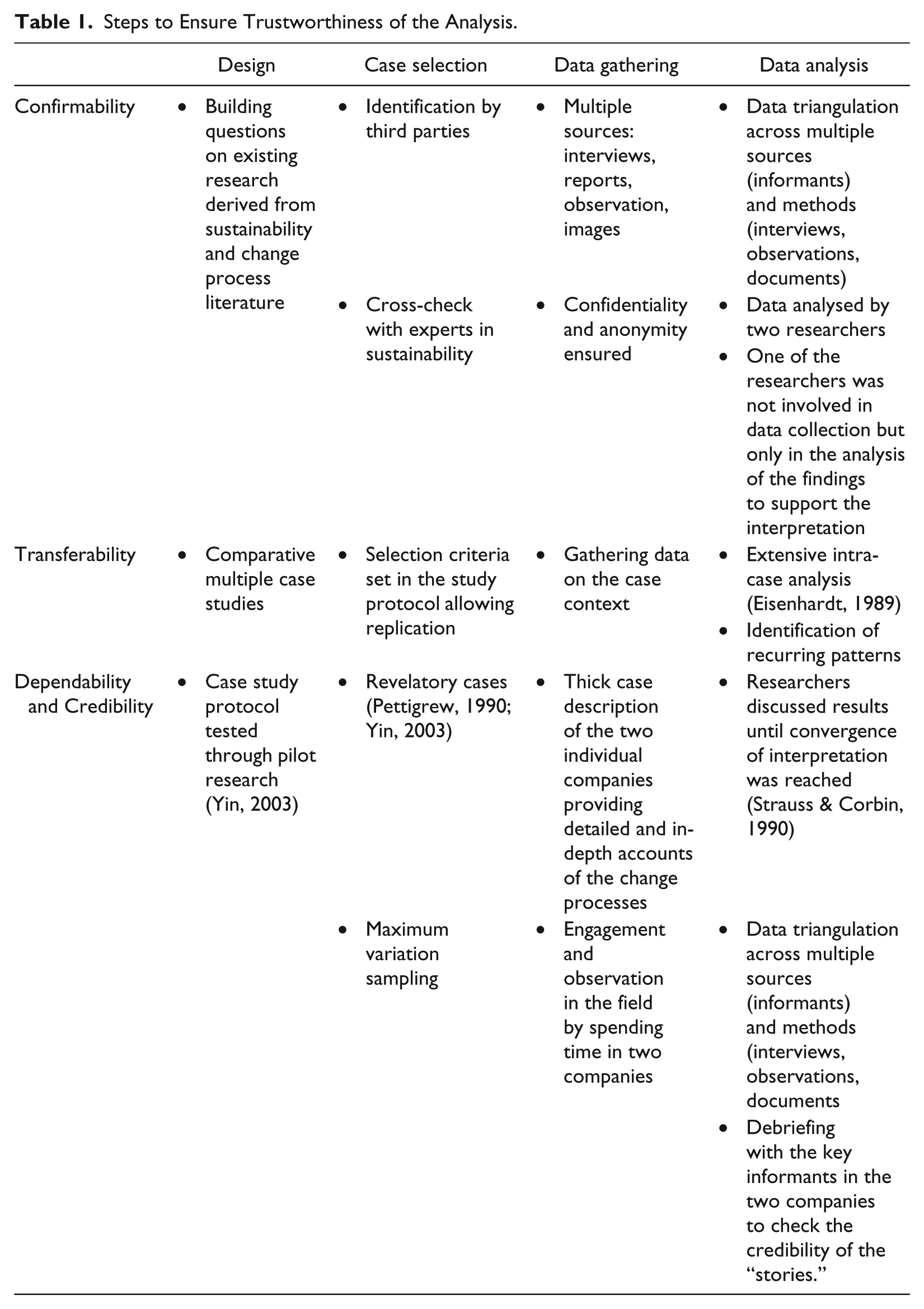
Following Yin (2003) and Lincoln and Guba (1985) we used several research management measures to ensure confirmability, transferability, dependability, and credibility throughout the research process. An overview of those measures is provided in Table 1.
Steps to Ensure Trustworthiness of the Analysis.
Case Selection
The case companies—Rohner and Carillion—were chosen for many reasons. The foremost among these was that the companies were pioneers in integrating sustainability into their organisational practices. They engaged in profound transformational change and revision in their business model. Rohner transformed from selling textile products that resulted in a high risk of pollution and generated waste to adopt a closed-loop production–consumption (or circular economy) approach to textiles. Carillion moved from selling construction products to providing construction services. Both companies were regarded by third parties as leading in their contribution to sustainable development as a result of these transformations. The companies were identified using networks of European academics active in sustainability research who were asked to nominate companies they regarded as having established credentials as leaders in the business contribution to sustainable development. The cases were seen as “unusually revelatory” (Yin, 2003) or “extreme” (Pettigrew, 1990). Pettigrew argues that the dynamic aspects of organisations tend to be more visible in extreme cases. The companies undertook transformation and business model revision as described by Cavalcante et al. (2011), and this revision caused the abandonment of the company’s existing business model(s). Finally, both companies provided high-quality access essential to study change processes (Van De Ven, 1992).
We should be clear, the purpose of this article is not to examine the validity of the claims for sustainability made for the closed-loop, circular economy approach adopted at Rohner or the product to product service approach adopted by Carillion; rather, the purpose is to examine the processes by which these companies revised their business models as part of the transformation they undertook.
Data Sources
Each case involved similar types of data collection. Cases were developed from primary and secondary sources. Multiple data collection methods allow for triangulation (Eisenhardt, 1989). Primary data involved company visits of approximately 4 to 5 days in each company. These visits served three main purposes: (1) field observation, where detailed notes were taken, (2) interviews with key personnel, and (3) collection of examples of written material and images used by the managers of each company to explain what the company was doing as it embarked on change. In total 17 interviews were conducted and transcribed (6 at Rohner and 11 at Carillion). Interviews included not only representatives of top and senior management who dealt with strategic issues but also those dealing with operational issues—see Table 2. Secondary data included the company’s websites, reports, and other publicly available information. These were collected and analysed before the time spent with the company. Interviews were conducted between February and May 2004. Follow-up interviews with key informants in each of the companies were done in 2011 to discuss any major changes that had taken place between 2004 and 2011. The follow-up interviews confirmed that the companies were still operating the business model and principles that had been put in place in 2004, despite some important changes in governance systems and ownership. For the purpose of this study, it was crucial to capture the changes that happened during the transformation process, that is, between the late 1980s to early 2000s, as it represented the period of revision and embedding of the BMfS. The period after 2004 merely involved the consolidation of this transformation and the routinisation of the revised business model. While the cases may not seem current, the companies remain leaders in their fields and have stayed with their business models.
List of Interviews.

Data collection progressed as follows. Once the companies were identified and agreed to participate, desk -research was undertaken on the secondary sources and materials published by the companies. This was used to gain insight into the companies and their context before going to the field. A case study protocol was developed and tested through pilot research on some multinationals not included in the main study. This was designed to make sure the same data collection process was conducted in the cases. Site visits were arranged. These visits combined interviews with key informants with nonparticipant observation of the company. Real-time data were gathered to contextualise and deepen understanding of the cases. Finally, a case study narrative was written for each company describing the process of change. This was then sent to the interviewees for cross-checking data accuracy. The case narratives included the ideas and images the managers told us they used to explain the transformation process to others inside and outside each company.
Data Analysis
We used Eisenhardt’s (1989) within and cross-case analysis methods to analyse the cases. First, we analysed each case to identify and corroborate the evidence on the process. This was then used to gain a deeper understanding of the managerial processes the firm went through to end up with a revised business model that addressed sustainability. We used a narrative strategy (Langley, 1999) to capture the main elements of the change process by unravelling the changing pattern of responsibilities and relationships between the managers of the company and other actors in its business and social context and its value chain and network. We considered how sustainability affected the companies in three broad but distinct spheres: (1) context: seen as the factors that the company recognised as giving rise to the historical development of their strategic response that involved sustainability, (2) concepts: the conceptual idea(s) used to formulate and implement (shape) the company’s strategic approach to sustainability, and (3) content: the operational outcomes or means by which the company’s strategic approach to sustainability and the concepts it used were put into practice. The case analysis was based on the thick description of the case narratives.
We then did a within-case analysis to search for patterns across the cases. We looked for similarities and differences to gain a greater understanding of the processes. Given the focus on process, we tracked the sequence of events in these two cases and other cases not reported here. The empirical data for each case narrative were collected by the same two researchers who discussed the findings with senior researchers before the case narrative was produced for confirmation by each company. Only after the individual case narratives were written and confirmed were they subject to cross-case analysis. This involved two senior researchers—one who had been involved in the whole project to that point and the other who was there to review and contribute to the analysis of the evidence in the case narratives from a more neutral position at arm’s length from data collection and narrative production. The data were classified into tables as a way to analyse and comprehend the data and the processes involved. The tables helped us identify patterns within the data. Those patterns were intensively discussed between the two researchers to check reliability and ensure consistency.
The iteration between data and theory improved the constructs coming out of the data. The data were independently analysed by the two researchers before discussing the results. Discussion between the researchers continued until agreement was reached.
The Cases
This section provides a condensed description of the cases, Rohner and Carillion. Table 3 provides some key data on the two companies.
Key Data on the Two Cases.
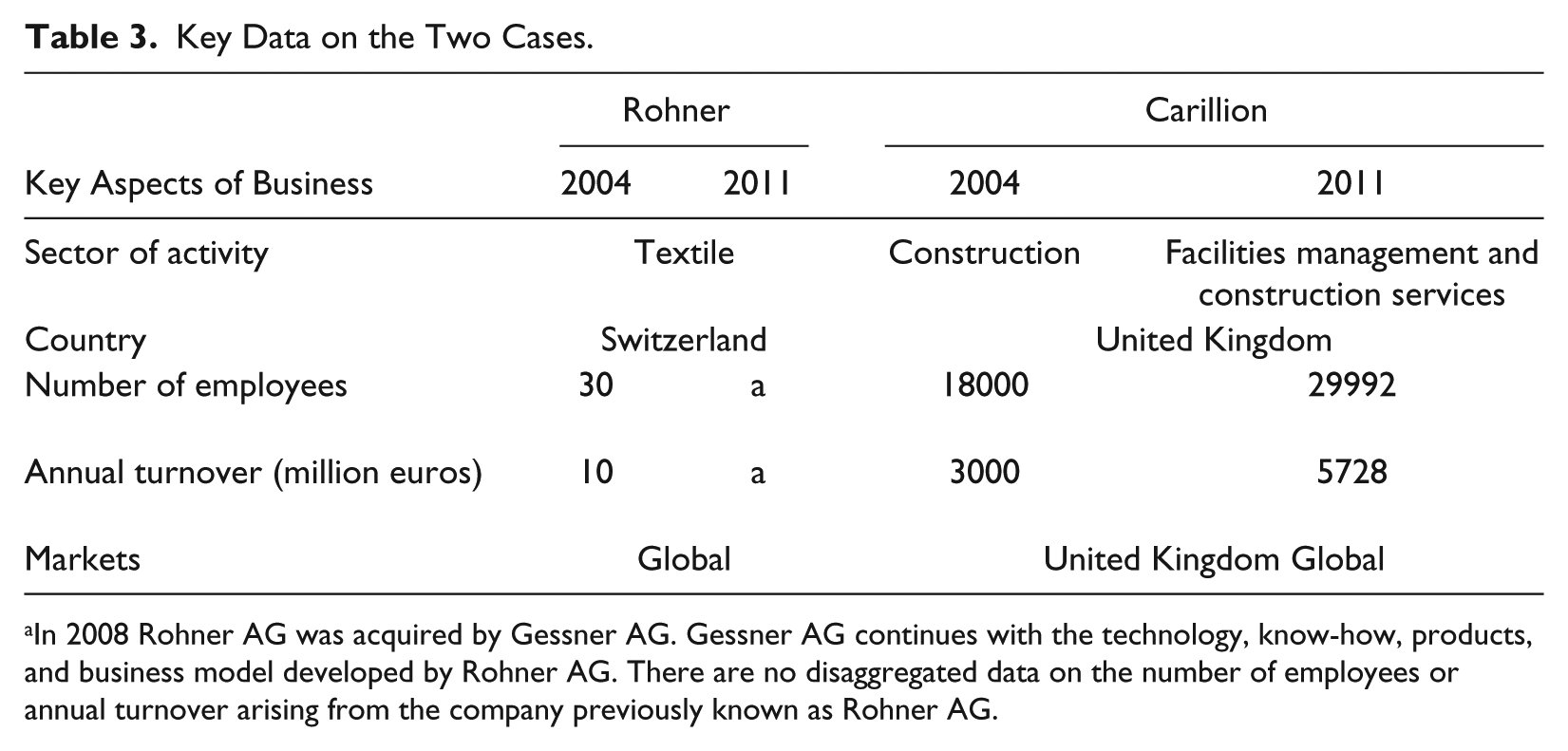
In 2008 Rohner AG was acquired by Gessner AG. Gessner AG continues with the technology, know-how, products, and business model developed by Rohner AG. There are no disaggregated data on the number of employees or annual turnover arising from the company previously known as Rohner AG.
Note that a more detailed description of each of the cases is available in previous publications (Roome & Louche, 2011, 2012).
Rohner
In 2004, Rohner Textile AG was a very successful manufacturer of high-end upholstery fabrics. Based in Balgach (St. Gallen, Switzerland), the company was founded in 1947. Rohner’s success in 2004 was the result of a long process of change that lasted 23 years.
Between 1981 and 2004, the company transformed from selling textile products to advance a closed-loop production–consumption model.
Four main periods marked this development. During the first period from 1981 to 1992, Rohner faced important economic and environmental challenges, including fierce competition in the textile sector from non-European textile manufactures and regulations on environmental issues—water use and pollution—and raised social expectations. This was made more critical as the company operated on a constrained site located close to the source of the Rhine river system and Lake Constance. At this stage the CEO saw that the company could compete only if it aimed for high-quality, well-designed products, and it could survive only if it took a number of “clean-up” measures in the short term. He was particularly aware of the major pollution of the Rhine in 1986 caused by Sandoz chemical plant. The CEO invested heavily in technological innovations that were developing in the textile sector to reduce pollution.
However, the CEO soon realised that these end-of-pipe solutions were not sufficient. The problems Rohner faced in terms of the destruction of value were associated with the way they created value, which meant that the risks they faced arose from the product and the production system itself. He therefore embarked on a process of deep reflection that marked the start of the second period in 1992. This led to the conclusion that the only way out of the company’s dilemmas was to conceive a new approach to textiles. The CEO began to develop a vision for the company based on high-quality, well-designed products and manufacturing processes that included the highest levels of environmental and social responsibility that avoided the risk arising from their potential to destroy value. He sought approval and commitment from the board for this approach. This began a third proactive period from 1995 to 1999 that led to a radical redesign of the company, its products, and its productions processes based on ecological principles. During this period the CEO met Michael Braungart, a chemical engineer and founder of the German Greenpeace Chemical division, and the American architect William McDonough. They were both known for their work on the cradle-to-cradle concept. Their interaction led to the concept of “waste equals food” (McDonough & Braungart, 2002) being discussed. This concept provided the CEO with a way to make his vision for the company more of a reality, although how this concept would be translated into operational practices was not then clear.
Together Rohner, through the CEO and other senior managers, worked with Braungart on an innovative route toward sustainable fabric design and manufacture. This led to a similarly intensive period where the CEO and senior managers worked with employees inside the company and with the company’s suppliers to develop and test ideas that would make the concept of waste equals food an operational reality. It involved a particularly long and difficult cooperation with suppliers of raw materials especially dyestuffs, but in 1995 Rohner launched the first of a range of new products, Climatex Lifecycle, or what they called an “Environmentally Intelligent Textile.”
If the first period was about process improvements in the textile mill, the second period was about product innovation and product–process redesign. The third period was about the formalisation and embedding of the new key concept within the company. It involved the development of new managerial systems and tools that would support managers and employees by providing performance guidelines and information that would reinforce commitment to the new products produced by these new processes. This was accompanied by changes in the company’s governance system to ensure greater openness and transparency between all levels. This phase of organisational development involved intense face-to-face collaboration between management and employees to support the changes in routines that were required. The fourth and last period, from 1999 to 2004, was characterised by the company’s efforts to push the limits of their approach even further by involving and innovating with customers and regulatory bodies. This also involved knowledge transfer to sectors such as agriculture that provided the wool used in the company’s textiles and knowledge diffusion through collaborations with universities. This was a period of intensive sharing of the knowledge that had been accumulated and the ideas built within the company. In a sense Rohner had become a living laboratory for the circular economy concept. At this time the company also set about developing its business by licensing and selling its know-how of textile design and production methods for use by other companies serving new markets with new textile products.
Rohner radically changed the way it thought about its products and production processes as well as its business model. This included deep change in the way it was governed, organised, and managed. A number of critical loops shaped the process. The ideas generated for change were dependent on, and framed by, the novel concepts introduced to the company by the outside person, Braungart, and were given direction by the new vision of what the CEO wanted the company to be. Together these were critical in shaping the direction of learning and action that shaped the many smaller, practical ideas for innovation and change in practices and routines that followed. This was supported by an open and collaborative approach between the company’s employees, its managers, the CEO, and some key external actors who played an essential role in making the change process possible. This provided for the alignment and commitment of people and their actions. At its heart this influenced the way individuals in the company worked together.
Carillion
In 2004, Carillion was a London stock listed company and one of the United Kingdom’s leading providers of construction services. Between 1994 and 2004, the company went through a major transformation and revised its business model. It shifted from building housing and infrastructure to the design, maintenance, and servicing of construction projects. This shift demanded profound change in terms of its business, its relationship with its environment, and the skills, capabilities, and mental models held by its employees and managers.
Carillion was created in 1999 as the result of a demerger from the construction arm of the United Kingdom’s leading supplier of building materials Tarmac. Carillion’s roots were in civil engineering, with a strong emphasis on technological innovation.
In 1994, Carillion, at that time Tarmac, faced vigorous opposition from environmental campaigners over two of its construction projects (one concerned a road project and the other an airport runway). Carillion’s response at first was to defend its position, putting in place an environmental policy. However, these external pressures made the company’s senior managers more aware of its environmental impacts and growing public support for environmental concerns. In the next few years board members and senior management saw that the company’s license to operate was at risk unless it took deeper action than reactive measures.
In 1997, the company began to develop an environmental management system to support its environmental policy. At this time it looked for ideas and inspiration in places unusual for the time, drawing on the knowledge of WWF and the Natural Step United Kingdom rather than professional consultants. As a result, the company’s rather static environmental policy developed into an environmental strategy based on tools that enabled it to begin to consider more fully the strategic significance for its business of the new and relatively unknown arena of environment and sustainability. Through this process Carillion began to develop a more forward looking view of how the context in which it was operating was changing and to anticipate how the company would need to change—in particular it foresaw the combined influence of new sustainability demands coupled with increased competitive pressures.
The company’s CEO played a central role in this awareness. He had developed a personal conviction that environment and environmental sustainability were set to become increasingly critical business concerns, and he supported the notion that companies should be closely related to their local communities. This developing trend mattered for a company that provided constructions projects that took shape in communities and had a life span of 50 years or more. There was a growing view that the old assumptions of the business would not enable it to meet the demands of the new millennium.
The turning point for the company was in 1999, when Carillion’s senior management entered into a collaboration with Jonathon Porritt, previously director of United Kingdom’s Friends of the Earth and closely involved with The Natural Step United Kingdom and the United Kingdom’s Forum for the Future. Mr. Porritt brought into the company the strategic idea of projecting a future vision for sustainability as a way for the company to engage in a process of learning and change. This brought a major shift in the company’s perspective from a short-term orientation on profits based on hard, legal-based relationships around project contracts to envision long-term cooperative relationships with customers and suppliers as a way to provide integrated solutions to needs served by construction projects.
The new approach was supported by a very open, participative process through which all employees could learn with one another about what the vision of a more sustainability-oriented Carillion would mean for them and the company.
This represented a new way of thinking, and the process it inspired led to broad change in Carillion’s organisational culture, routines, and approach to business, especially its approach toward other actors in its value chain. New competences and capabilities were developed with a focus on organisational learning, coupled to a search for innovations in technological and managerial terms supported by a commitment to embrace and contribute to new forms of organisational collaboration. In the early 2000s, a second charismatic person was brought into the frame of the company’s thinking: Mr. Cowans, previously chief executive of Places for People. He was brought in to help the company respond to the social relations of a business that constructed buildings that were closely connected to existing communities, community services, and how neighbourhoods and their members interacted.
During the period from 1994 to 2004, Carillion changed from a reactive approach to a position of leadership in relation to environmental and social aspects of business. At this time Carillion’s stated vision was, Carillion provides sustainable solutions for the way we live. The “solutions” part reflected the (new) broader business proposition the company had adopted in providing added value through the provision of services rather than providing only construction projects.
A core part of the development of a culture of learning at Carillion was found in the link between the company’s vision and its practice. Carillion used a sustainability strategy framework to provide a strategic management process at the company. The framework was developed through the back-casting method advocated by The Natural Step. Strategic management was then focused on key areas of implementation, which represented selected elements of its 10-year sustainability strategy. Yearly strategies were managed through sustainability action plans, which are supported through measurement of the company’s key performance indicators. In this way, the sustainability strategy framework provided guidance on how the measures identified in the sustainability action plans and key performance indicators were managed and how they helped guide the organisation to deliver its 2010 business and sustainability objectives, through yearly targets and performance.
This represented leading practice that enabled the company to use processes to affect organisational change while developing new capabilities in responding to contract specifications, embedding environmental and social considerations in its activities and in working with other actors—particularly clients, suppliers, and local communities. The ability to do this supported, and was supported by, new work practices and mind-sets. It provided new ways to create and capture value. The environmental and social aspects of providing building services rather than selling buildings enabled Carillion to compete in a highly effective way in its home market where the public sector was moving from commissioning and buying buildings to a model based on buildings that remained the property of constructors, who then maintained and operated those buildings in return for an annual management fee. The business model that emerged meant that instead of designing and building construction projects at the lowest costs and then leaving operations and maintenance to a third party, Carillion provided inclusive solutions to meet clients’ needs. Developing a competence in adding sustainability values to construction projects and their use by clients meant a competitive advantage in the market.
Carillion alone did not establish the conditions of public finance that enabled this business model to flourish, but Carillion’s new way of working enabled it to adapt extremely quickly to the change in context. And its proactive stance to the environmental aspects of build design, building maintenance, and community relations enabled it to produce durable, low-maintenance buildings with high levels of social acceptance.
Inside the Black Box of Transformation
Comparing the “Abandoned” and the Revised “Sustainable” Business Models
We use the main four elements found in the literature on business models (Bocken et al., 2014; Boons & Lüdeke-Freund, 2013; Doganova & Eyquem-Renault, 2009; Osterwalder & Pigneur, 2005; Shafer et al., 2005) to analyse the business models that arose in our two cases. These are as follows: value proposition, value network, value capture, and value creation and delivery. Table 4 uses this framework to compare the characteristics of the “abandoned” business model with the new (revised) business model for sustainability that replaced it. However, we add a fifth element to this framework—value destruction—because we argue earlier that any business model for sustainable development also needs to take into account the need to reduce or avoid the value destruction associated with any abandoned business model. It should be noted that Table 4 provides a static picture of the key elements of these models that allows us to see the change, however, it does not help to understand the process of transformation leading from the old to the new business model nor does it show the larger processes around that change.
Comparing the BMfS to the Abandoned Business Model.

Note. BMfS = Business models for sustainability.
Identifying Patterns in the Process of BMfS Development
The purpose of this section is to examine the process of transformation and provide insights into the business model revision that took place in the companies. Figure 1 provides an overview of the factors that contributed to the transformation and specifically the processes and network structure that played a role in the change process that led to the BMfS.
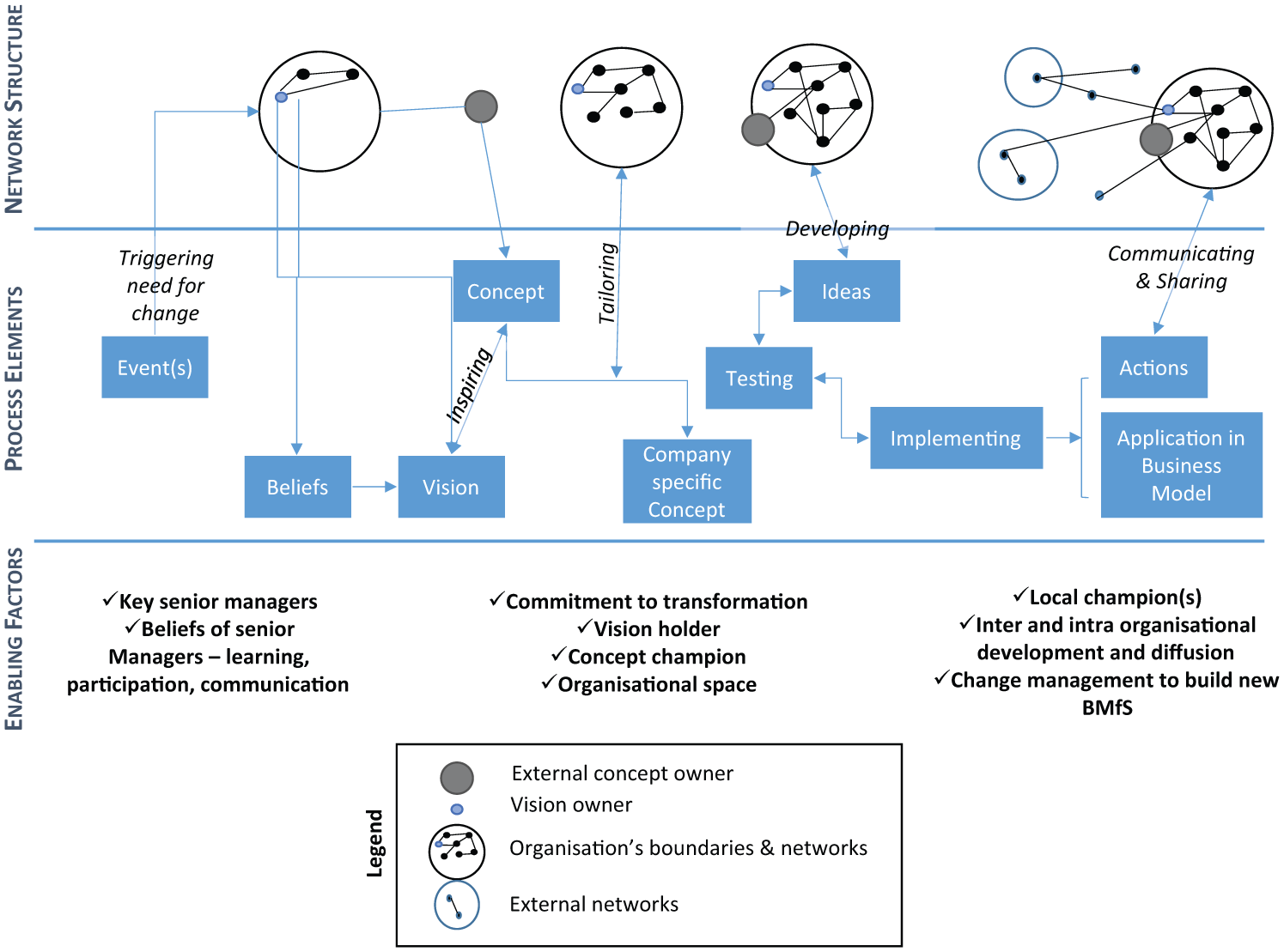
Transformation process toward new business model for sustainability.
Senior management in both case companies had no clear idea at the beginning of the process of what the transformation process would bring or what outcome would result, other than it would be different from the company’s then current position. However, at this stage there was recognition that they had to develop a new approach to business in order to respond to social, environmental, and market changes. Recognition of this need was often triggered by some event or combination of circumstances that affected the company. These event(s) promoted the idea that there ought to be new opportunities to be found as a way out of tightening market conditions and increasingly limited room for manoeuver on environmental or social issues.
Both companies came to recognise that their products and services were embedded in wider and more complex systems than they previously imagined and that increasing attention needed to be given to the relationship between social and economic systems, economic opportunities, technology, and know-how and social and environmental conditions. Senior managers came to recognise that contributing to sustainable development was a strategic and complex project. This meant confronting existing ways of working as well as requiring new mind-sets matched to new competences. It would possibly lead to collaboration with some different actors than were usual for the company to work with.
Both companies therefore embarked on a journey of learning, experimentation, and innovation that would shape their strategic outlook and operational practices into the future. Senior management engaged with many actors in the company, their supply chains, and/or their client base. They sought out less conventional ideas and encouraged the deployment of new know-how among their value network. This involved many of these actors in joint learning that encouraged them to build the changes that were needed in their practices.
These practices were provided direction by the promotion of a new vision for the company. This new vision was articulated and championed from the top. Senior manager(s) who held and/or developed the vision were able to obtain the resources needed for the vision so that it could gain ground in the company. Once the vision was developed, both companies worked around concepts new to them—“waste equals food” and going from “products to services.” There was consistent top-level support for these new concepts although they were brought into the company from outside. Much work was involved in tailoring the concepts to the existing know-how found inside the company. The concepts were adapted to the companies leading to second-generation company-specific concepts that were owned by the company’s employees and championed by senior management.
This was not a trivial issue, as the vision and concepts that developed were often a radical departure from existing thinking and practice. It meant the new concepts had to be understood, refined, and translated into a form that could be communicated to other members of the company and beyond and put into practice. The implications for the value chain also had to be understood and made clear. The advancement of these concepts was often supported by new approaches to relationships in the companies or with other actors (supply chain members, customers, or the institutional context).
Both companies did detailed testing of new ideas that would contribute to the operationalisation of the new concepts, but they rarely seemed to need to justify what they were doing through the development of a business case for the transformation they were undertaking. This is possibly because the revision of the business model was not well supported by established knowledge that derived from the routines or understandings in the company that were being replaced. Indeed, the revised business models that emerged can be understood as evolutionary outcomes of the new vision and the concepts used by the companies rather than being the starting point for change. In that sense the revised business model derived from the transformation and the acquisition of new knowledge rather than the other way around.
These processes were facilitated by some key “beliefs” held by (some) senior managers: the idea that learning had value and that everyone in the company could contribute to the change needed to translate new visions and concepts into operational reality, a willingness to experiment with ideas and to build new practices, and an ability to connect and communicate seemingly paradoxical ideas—such as linking competitive success to contributions to sustainable development.
In the same way both companies had management teams that carried out a series of linked roles that supported the transformation process. These included a key senior manager, with the ability to construct an initial vision for the company that connected the creation of value to some form of environmental responsibility—a vision built on nontraditional business values, which then formed a key element of the new business model that emerged as well as governing the company’s developing relationships.
The promotion of a learning approach was matched by the development of management systems and structures that would reinforce the direction of organisational development and change. These management systems were based on new routines and structures for performance and control. They involved the development of systems for recording and tracking performance and promoting accountability as a key part of these new routines for control. The control through written and documented systems provided a structure for the company’s new approach to business, but this came after the development of the companies’ learning culture and after the embedding of the new vision and concepts.
Both companies placed a high premium on person-to-person communication. The commitment of the board of both companies to the overall process of transformation was critical—with sufficient time and resources (what we might term organisational space) being made available to senior management and others so they could participate as needed in the critical transformation. It was also supported by the commitment of employees to the implementation of the vision and the development of its supporting concept(s)—employees contributed ideas that after testing and development would make the concepts an operational reality.
Moreover, the visual symbols and diagrams used by the companies to communicate what they were doing often involved images that showed the relationships between parts of the companies’ new systems and approach so they were clear to all. Out of this process came the revised business models that created, captured, and shared value.
The overall approach was revisionary and highly innovative. And when the process was over the companies held to the view that what they had accomplished had contributed to a much clearer identity, better relationships with internal and external actors as well as their revised business model.
Discussion
In this part of the article, we discuss the current theory and existing studies on BMfS and then introduce a conceptual model of the transformation process emerging from our findings.
Theory suggests that sustainability calls for new business models (Lovins et al., 1999) that take place within a reconfigured business purpose (Bocken et al., 2014; Hart & Milstein, 2003; Lovins et al., 1999; Lüdeke-Freund, 2010; Schaltegger et al., 2012; Stubbs & Cocklin, 2008; Wells, 2008), together with broader, new understandings of value.
Our empirical study supports this view but with some nuanced positions. The companies saw themselves as having economic purpose, but the question for them was how to create economic value in different ways. They then set about transformational change to provide for economic success while at the same time contributing to sustainable development, often by reducing the damage on resources arising from their activities. This thinking preceded any revision of their business model. The revised business models were therefore an outcome of the process, not its beginning. This is somewhat different from the evidence from Sommer (2012) that suggests the development of a new business model leads to transformation. That outcome is probably due to the fact that Sommer studied companies that were developing extended business models in the categorisation provided by Cavalcante et al. (2011).
These differences are plausible given that what constitutes a “sustainable business model” is ambiguous and elusive (Boons & Lüdeke-Freund, 2013). What we know is that our companies came to their business models as a result of a deep review of their activities and the partners they worked with. They also began to adopt broader definitions of value (Stubbs & Cocklin, 2008), and their approach and subsequent business models allowed the firms to deal with the idea of value for the company and for society (Schaltegger et al., 2012). That is quite far away from the more incremental, experimental change required in business model extension.
Through this transformation the companies in our study moved from a focus on products to a higher level focus on the system of which they were a part. They sought to create new arrangements with other social and economic actors to identify new approaches to business that addressed environmental and social issues. This involved engagement with knowledgeable actors who introduced concepts new to the company. As those concepts developed so did the company’s engagement with an even wider set of actors. This created and reinforced a broader value network perspective (Bocken et al., 2014; Breuer & Lüdeke-Freund, 2014; Zott et al., 2011). These multiactor approaches involved new forms of learning and in some cases new forms of collaboration (Clarke & Roome, 1995, 1999). This provided links from inside the firm to outside actors that contributed to and reinforced the revised business model (Baden-Fuller & Mangematin, 2013).
The overall process was based on new and complex skills and competencies and required novel institutional arrangements (van Kleef & Roome, 2007). In other words, progress toward sustainable development required new know-how (Stubbs & Cocklin, 2008). While the companies talked about their business model, they understood this in simple descriptive terms. What was clearer at the end of the transformation was their new vision; the concepts they began to tailor to the company; the commitments to learning, innovation, and change; and a series of beliefs about questioning assumptions and mental models, opportunity seeking, empowerment, participation, listening, transparency, strong business values, and accountability. These beliefs found form in a company culture that developed around teamwork and organisational learning supported by management systems and structures that reinforced accountability.
It is in the combination of a culture of questioning, learning, testing, and innovating linked to strong support for empowerment of employees that the transformative process unfolded. This process was inherently uncertain, ambiguous, and potentially uncomfortable (Cavalcante et al., 2011), especially because the companies did not follow a blueprint for their business models (Demil & Lecocq, 2010). In our cases it was the commitment to the new vision and concept that provided a focus for transformation rather than a business model that supported change and focused innovation. While change took time and effort, standing still was not an option. So the companies were involved in “problemistic” search for solutions to a number of problems at the same time as their aspirations were changing (Cyert & March, 1963).
In terms of the learning, the literature highlights different types of learning that can take place in business model development these include trial-and-error, experiments, improvisation, and vicarious learning (Argyris & Schön, 1978; Bingham & Davis, 2012; Huber, 1991; Levitt & March, 1988; Srinivasan et al., 2007). This learning can happen with those within and those outside the organisation. Our cases suggest that all these types of learning took place at different moments in the transformation process. But the transformation process was based on the notion that people across the company first had to learn how to learn with and from one another but also with and from outsiders, and at the same time to learn how to contribute to sustainable development as well as traditional business performance.
With this in mind a conceptual model of the process characterising what took place inside the “black box” of our companies can be advanced. This is shown in Figure 2. The model involves four connected sub-phases: identifying, translating, embedding, and sharing. In practice the sub-phases and the borders of these phases are less firm than might be indicated in Figure 2 and involved a spiral-like rather than linear evolution.
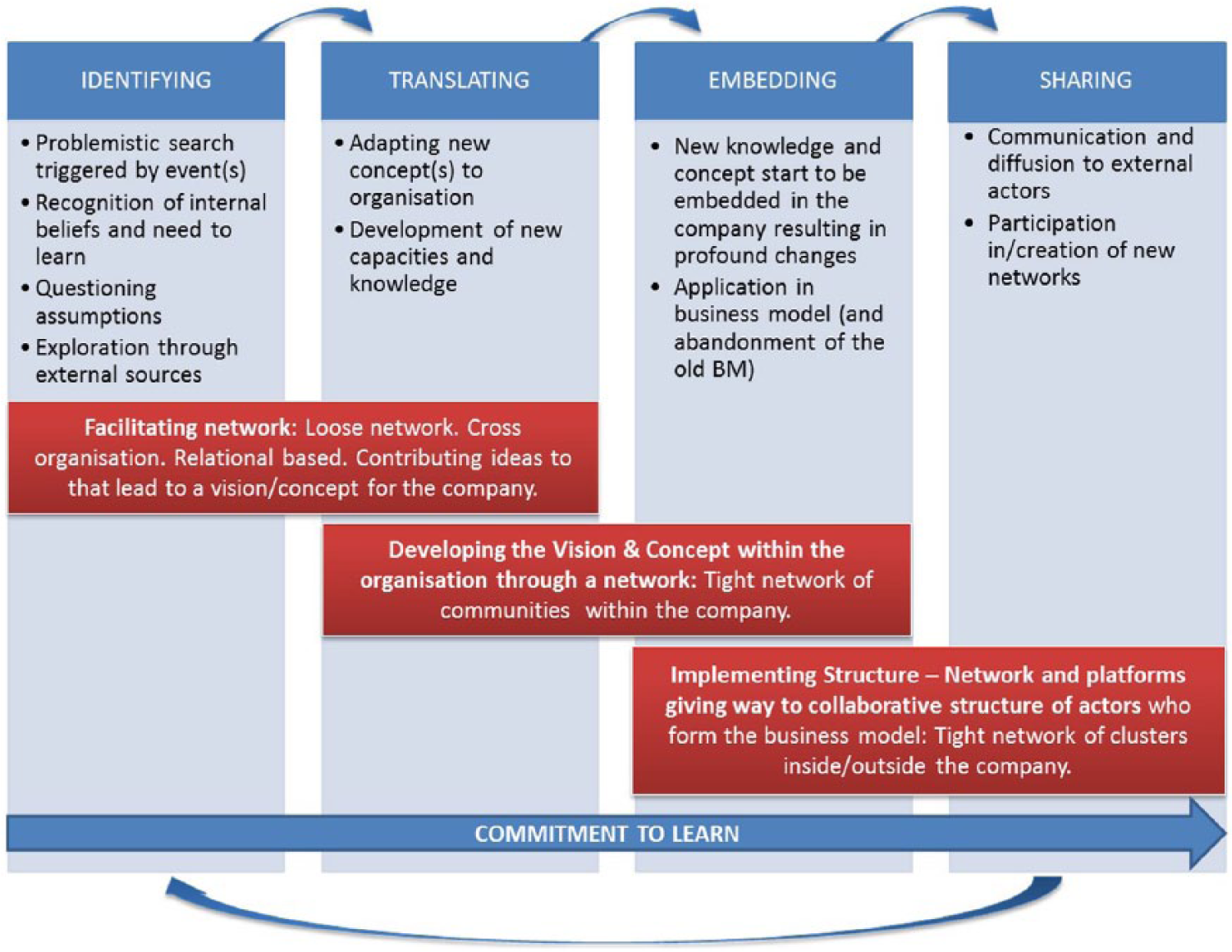
A process model of business model change for sustainability.
“Identifying” is based on event-driven problemistic search, recognition, and surfacing of core beliefs, combined with an ability to question assumptions and then to explore external ideas at the conceptual level. This phase requires a mechanism based on a relatively tight network of actors inside the company that connects with issues and challenges from outside. This leads to the need for a new vision for the company to develop. And this emerging vision attracts new concepts that are again found and provided from outside the company.
During the second phase—translating—a tightly coupled network of communities inside the company set about to develop that concept into an operational reality after adapting it to the company setting. This is fostered by some clear principles about openness and participation, but the development of the concept and the generation of ideas to bring the concept into operational reality set the ground for the future development of a more collaborative structure of actors and communities, who provided the basis for the future business model.
In the third phase—embedding—the new knowledge and relationships then being developed begin to take form in terms of the revised business model that helps create and capture value. It seems this process cannot easily be designed although it is based on beliefs or approaches that can be designed for—these include an open, participative culture driven by the adoption of strongly innovative concept(s). It cannot readily be designed because the process requires that managers in the company have first learned how to learn with and from others. At the same time the revised model is developed and ready to be rolled out, so the old business model is ready to be abandoned.
The final phase—sharing—involves the consolidation of the business model network into a collaborative structure as well as the communication of the company’s new approach and revised business model to a wider internal and external audience, including current and future customers. The transformation process is then consolidated through a tailored management performance system.
Conclusions
Prior research has identified the central role that business models play in the move toward sustainability. That research offers theoretical insights into the characteristics of those business models. Yet the way business models are developed, and the question of how change occurs, has not been examined in great empirical depth. We have drawn on the cases of two companies that went through profound change to embrace sustainable development: transformation that led to revisions in their business models. Analysis of what took place in these companies provides the basis for advancing a process model of how managers transformed each company and revised their company’s business model. A key observation of the research is that the new business models were not the beginning of the transformation processes that took place but arose as emergent outcomes of that process. The article provides an account of how this happened, while highlighting the elements of the processes and the network structure and other enabling factors that supported the transformative change.
The article proposes a four-phase model of the transformation process that resulted in these new business models. Those phases are termed—identifying, translating, embedding, and sharing. At the beginning of their process our companies came to understand (identified) that they faced a new, complex, and changing economic, social, and environmental context, which placed demands on them that their traditional approach to business could not resolve. There was a growing awareness that their existing approach to business destroyed environmental value and/or human relationships—and that these presented nontrivial risks to the companies concerned. When taken together with economic imperatives, this gave rise to the need for transformational change with the companies addressing their contribution to sustainable development in rather radical ways by developing more comprehensive connections between their business proposition and performance and the environmental and social aspects of sustainability. This need for change was translated into responses that were then embedded in the company and shared both internally and with others in the company’s value chain.
The article illustrates that the four phases of the model were interwoven by some key elements or practices. The phases of the overall process of transformation were based on learning, innovation and change that involved the following: the development of a new vision for the company, the adoption and development of new concept(s), followed by organisational innovations that included the testing of new practices, organisational development, and the implementation and the formation of the new business model. These practices all centred on a strong commitment among senior management to participation and communication across networks. Indeed the new business model created value through the combination of ideas and changed practices involving many actors across the organisation and its supply chain. It was founded on new ways to create, capture, and share value while seeking to avoid the value destruction and risks associated with previous business models.
This process was supported by managers and employees adopting mutually supportive roles: vision holder and concept champion, ideas providers, networkers, local champions, and implementers. The process and its elements led to new business relationships and involved more actors than in the company’s previous business model. Consequently, the revised business model for sustainability was more socially complex than the model it replaced. In the same way the process leading to the new business model was more complex, dynamic, and time-consuming than what it replaced. The article suggests that the process itself reinforces the more complex nature of the business model for sustainability that then emerged.
The article implies we need more detailed research looking inside this particularly complex process as a way to refute, corroborate, or modify what is suggested here. Further research is also critical because of the limits of the cases. For example, we have used two cases of companies that took rather extreme positions on the business contribution to sustainable development. However, the approaches or concepts they developed were rather different from one another even though the transformations that led to their revised business models were quite similar. The ideas advanced in this article therefore need to be considered in light of evidence from other cases, some using similar sustainable development-linked concepts to the ones included in our study, as well as cases based on other concepts not discussed here.
There is also the question of whether the processes that occurred in these companies are also to be found in companies that have been successful with the development of completely new business models or have accomplished extensions to their existing business model(s). That is particularly important because Sommer (2012) appears to have found a more deliberate and planned process of business model change in his empirical work arising from cases of business model extension. Do these forms of business model development have similar or different characteristics to what is proposed here? It is also possible to study companies that have been less successful in developing BMfS to see whether there are process issues around those failures. What is clear is that more research on these processes, their antecedents, and their constituent parts is needed.
Finally, the examples presented in this article appear to endorse the view that if sustainable development is understood as a “wicked-problem” (Rittel & Webber, 1973) or “meta-problem” (Chevalier & Cartwright, 1966), then by definition a business contribution to sustainable development has to develop through the type of socially complex process demanded by this class of problem. Yet the implications of wicked-problems for business management, strategy or human resource development policy and business models do not seem to be widely discussed in the business literature or in management education. Rather, this has been an area for discussion in the arena of public policy more than business.
Underscoring the article is the idea that until we understand these processes better and know more clearly how they are negotiated by managers, it is unlikely that they can be effectively replicated. And unless replication happens it would seem that progress toward more sustainable business models will be slow and patchy. It will also be difficult to teach managers and business leaders of the future how to advance BMfS if we do not know better what is inside this particular “black box” and what managerial beliefs and mind-sets are needed to support the development of such models.
Footnotes
Acknowledgements
The original empirical research on the two cases reported in this paper was supported by a grant from the Dutch Ministry of Economic Affairs and NWO.
Declaration of Conflicting Interests
The author(s) declared no potential conflicts of interest with respect to the research, authorship, and/or publication of this article.
Funding
The author(s) received no financial support for the research, authorship, and/or publication of this article.