



Abstract
The relevance of business models for corporate performance in general and corporate sustainability in particular has been widely acknowledged in the literature while sustainable entrepreneurship research has started to explore contributions to the sustainability transformation of markets and society. Particularities of the business models of sustainable niche market pioneers have been identified in earlier research, but little is known about the dynamic role of business models for sustainable entrepreneurship processes aiming at upscaling ecologically and socially beneficial niche models or sustainability upgrading of conventional mass market players. Informed by evolutionary economics, we develop a theoretical framework to analyze co-evolutionary business model development for sustainable niche pioneers and conventional mass market players aiming at the sustainability transformation of markets. Core evolutionary processes of business model variation, selection and retention, and evolutionary pathways are identified to support structured analyses of the dynamics between business model innovation and sustainability transformation of markets.
Keywords
Introduction
The relevance of business models for corporate performance in general and corporate sustainability in particular has been widely acknowledged in the literature. On the one hand, academic research and corporate practice are increasingly addressing the business model as a unit of analysis “offering a systemic perspective on how to ‘do business’” (Zott, Amit, & Massa, 2011, p. 1038), mainly with the aim of understanding how to improve the ability of companies to create financial value (e.g., Chesbrough, 2010; Teece, 2010; Wirtz et al., 2015). On the other hand, there is a growing body of literature on business models that provides a range of approaches to characterize their different roles for achieving corporate sustainability (Boons & Lüdeke-Freund, 2013; Hansen, Große-Dunker, & Reichwald, 2009; Schaltegger, Lüdeke-Freund, & Hansen, 2012).
This emerging stream of research also tries to distinguish business model elements and functions, group “archetypes” or patterns (Abdelkafi, Makhotin, & Patzelt, 2013; Bocken, Short, Rana, & Evans, 2014), investigate business models of small and medium-sized enterprises (Jolink & Niesten, 2015; Parrish, 2010) and hybrid organizations for environmental leadership (Boyd, Henning, Reyna, Wang, & Welch, 2009), link business models with corporate sustainability strategies (Schaltegger et al., 2012), and distinguish themes and orientations for business model innovation (Bocken et al., 2014). The dynamic role of companies in transforming markets to become more sustainable, as discussed in parts of the sustainable entrepreneurship literature (e.g., Dean & McMullen, 2007; Hockerts & Wüstenhagen, 2010; Schaltegger & Wagner, 2011), has however so far not been examined in depth from a business model perspective.
While we acknowledge that different views on corporate sustainability—and thus sustainability-oriented business models—exist and that specific definitions matching the development, awareness, and ambition levels of organizations can be observed (e.g., Montiel, 2008; van Marrewijk, 2003), international developments to achieve a widely acknowledged understanding of sustainable development as process and sustainability as outcome exist. A widely accepted definition of sustainable development was put forward by the World Commission on Environmental Development (1987): “Development that meets the needs of the present without compromising the ability of future generations to meet their own needs” (p. 41). All these definitions and views largely refer to the need to overcome a range of substantial ecological, social, and economic challenges, particularly with regard to respecting the ecological limits of planetary boundaries and the needs of future generations, as, for example, addressed in the United Nations Sustainable Development Goals (United Nations, General Assembly, 2015). The notion of sustainability used in this article refers to a normatively defined state of the world that is to be achieved via a sustainable development of the natural environment, society, and economy. Scientific reports (e.g., Rockström et al., 2009) unveil that to become more sustainable it is necessary to apply the principles of strong sustainability (e.g., Whiteman, Walker & Perego, 2013) on a large scale and not just in niches, for example, of political and economic activities. With regard to the latter, sustainable development requires that mass markets become more sustainable (e.g., Hockerts & Wüstenhagen, 2010; Schaltegger, 2002). The term mass market describes the entirety of a market (i.e., all transactions in a given market) contrary to a niche in a market (i.e., only a small part of all transactions). Companies play a crucial role in transforming markets and society (Geels & Schot, 2007), and sustainable entrepreneurship as a mission-driven process (e.g., Dean & McMullen, 2007) aiming at a sustainability transformation of markets and society can be pursued by either small pioneers or large incumbents (Hockerts & Wüstenhagen, 2010).
Many sustainability pioneers are niche market players who integrate sustainability principles as a core aspect into their business model (e.g., Hall, Daneke, & Lenox, 2010; Jolink & Niesten, 2015). However, as their range of influence is limited, they are challenged to grow, to multiply (e.g., Hockerts & Wüstenhagen, 2010), or to successfully influence others (e.g., Gattiker & Carter, 2010) in order to contribute to market transformations (e.g., Schaltegger, 2002; Schaltegger & Wagner, 2011). On the other hand, mass market incumbents are often seen to give sustainability a (marginally) low priority but have large market shares (e.g., Hockerts & Wüstenhagen, 2010). They are thus challenged to revise their products and services in order to contribute to a sustainable development of the whole market. Both types of organizations, niche market players and mass market incumbents, have different business models and, from a sustainable entrepreneurship perspective, different challenges in developing and establishing them.
To analyze their specific and interrelated paths towards more sustainable mass markets, this article links the business model perspective with sustainable entrepreneurship theory. It examines business model innovations undertaken by companies contributing to a sustainability transformation of markets. Informed by evolutionary economics, we develop a theoretical framework to analyze co-evolutionary business model development for niche pioneers and incumbents. We argue that bringing together research on business model development (e.g., Abdelkafi et al., 2013; Chesbrough, 2010; Saebi, 2015), business models for sustainability (Bocken et al., 2014; Boons & Lüdeke-Freund, 2013; Hansen et al., 2009; Schaltegger et al., 2012; Stubbs & Cocklin, 2008), and sustainable entrepreneurship and market transformation (e.g., Hockerts & Wüstenhagen, 2010; Schaltegger & Wagner, 2011) helps shed some light on these complex, dynamic, and evolutionary processes.
We offer a new perspective on the issue of sustainability transformations of markets: First, we argue that the usual “small versus big” dichotomy to characterize niche and mass market players with regard to sustainability contributions limits the analysis as big players can also engage in sustainability-oriented market transformations. Furthermore, even if small sustainability pioneers in the niche do not gain large market shares they can exert substantial (indirect) transformative influence on mass markets through particular mechanisms such as business model replication or mimicry by other players in the market. Therefore, and second, we argue that paying attention to particular characteristics of business models and their co-evolutionary interplay is needed and promising to better understand the possibilities and limitations of sustainability transformations of markets. The theoretical framework presented in this article introduces three evolutionary processes (variation, selection, and retention) and four pathways (growth, replication, merger and acquisition [M&A], and mimicry) for the diffusion of sustainable business models in the mass market. These are illustrated with a number of real cases.
This article is organized as follows: The next section reviews the literature on business models and sustainability. This section also summarizes sustainable entrepreneurship approaches for companies wanting to contribute to a sustainable development of mass markets. The third section of the article develops an analytical framework and discusses sustainable entrepreneurship from an evolutionary economics perspective by analyzing dynamic processes of corporate change and changing market structures. The fourth section brings together sustainability-oriented business model development, innovation, and transformation approaches for niche and mass market players as well as for newly founded companies or business units entering the market. Furthermore, the framework is enriched with illustrative cases. The final section draws conclusions for research and corporate practice.
Literature Review
Business activities are the root cause of many environmental and social problems and thus a major source of sustainability concerns. At the same time, some leading companies are core drivers of sustainable development. Pioneers in niche markets for organic food, for example, are able to avoid the “disvalue” of externalities associated with conventional agriculture and offer additional value to environmentally and socially concerned customers (e.g., Jolink & Niesten, 2015). Innovative sustainable entrepreneurs are influencing or even shaping markets and society, in some cases even more than regulators and nongovernmental organizations, and often in collaboration or exchange with them (Geels & Schot, 2007). Relevant contributions to sustainable development require companies to achieve environmental and social goals with superior processes, products or services that are successful in the marketplace with mainstream customers (Schaltegger & Wagner, 2011). To be effective in creating such contributions requires that the core of business, and thus the underlying business model, is sustainability-oriented.
Business Models and Sustainability
The Business Model Concept
A business model can be defined as a concept describing what value a company proposes to existing and potential customers (value proposition), how the business is organized to create the value (value creation), with which resources and infrastructure (value creation infrastructure), under which circumstances (value creation conditions), and how financial value is retained for the company (value capture; e.g., Mäkinen & Seppänen, 2007; Johnson, 2010; Osterwalder & Pigneur, 2010; Osterwalder, Pigneur, & Tucci, 2005; Teece, 2010; Zott et al., 2011). Early business model concepts emerged at the end of the 20th century, motivated by the need to describe and analyze new forms of business, such as e-businesses or virtual organizations (e.g., Mahadevan, 2000; Timmers, 1998).
The notion received attention as a general management concept (e.g., Chesbrough & Rosenbloom, 2002; Magretta, 2002), by linking it to strategy and innovation. Since then, business model research has produced various approaches with financial value creation for the company as primary goal, such as in Teece’s (2010, p. 179) definition: A business model describes the design or architecture of the value creation, delivery and capture mechanisms [italics added] employed. The essence of a business model is that it crystallizes customer needs and ability to pay, defines the manner by which the business enterprise responds to and delivers value to customers, entices customers to pay for value, and converts those payments to profit through the proper design and operation of the various elements of the value chain.
Such approaches, however, do not factor in the resulting complexities when companies deliberately aim for ecological and social value creation beyond financial profits.
Towards Business Models for Sustainability
Scholars and practitioners (e.g., Kiron, Kruschwitz, Reeves, & Goh, 2013) are therefore increasingly exploring if and how modified and completely new business models can help achieve economic prosperity by either radically reducing negative external effects or creating positive external effects for the natural environment and society (e.g., Boons Montalvo, Quist, & Wagner, 2013). Early work on “business models for sustainability” (BMfS), also referred to as “sustainable business models” or “sustainability business models,” deals with the general organizational foundations of corporate sustainability (see Stubbs & Cocklin, 2008) or with the role of business models (and product-service systems) as means for rethinking products based on the consideration of the full or even multiple life-cycle(s) (Hansen, Große-Dunker, & Reichwald, 2009; Große-Dunker & Hansen, 2013). More recent studies are dedicated to specific technologies (Abdelkafi et al., 2013), industries (Jupesta, Harayama, & Parayil, 2011; Loock, 2012), low-income markets (Sánchez & Ricart, 2010; Yunus, Moingeon, & Lehmann-Ortega, 2010) or detailed analyses of the particularities of the business models of small and medium-sized enterprise ecopreneurs and sustainable entrepreneurs (e.g., Jolink & Niesten, 2015; Parrish, 2010).
Besides this rather empirical, case-based stream of BMfS research, a theoretical debate is emerging with regard to appropriate general principles for the development of BMfS, where some authors, for example, propose a more radical orientation towards strong sustainability. Boons and Lüdeke-Freund (2013), based on a literature review on the interrelations between business models and sustainability innovation, propose basic normative requirements for each of the constitutive elements of a business model: The value proposition must provide both ecological and social and economic value through offering products and services; the business infrastructure must be rooted in principles of sustainable supply chain management; the customer interface must enable close relationships with customers and other stakeholders to be able to take responsibility for production and consumption systems (instead of “selling stuff”); and the financial model should distribute economic costs and benefits equitably among actors involved.
What the above-mentioned research streams and considerations on the nature of BMfS have in common is their focus on organizational value creation, which has been deliberately extended towards creating social and ecological value. It is the extension and the emphasis given to organizational, market, and societal transformations that distinguish the recently emerging BMfS discourse from its conventional antecedent, which focuses mainly on financial value appropriation (that is, one-dimensional profit maximization) without considering the consequences for the wider ecological and social contexts. Based on the above review and considerations, we propose a general definition of a BMfS that builds on, but deliberately extends, the conventional perspective (Schaltegger et al., 2016, p.4): A business model for sustainability helps describing, analyzing, managing and communicating (i) a company’s sustainable value proposition to its customers and all other stakeholders, (ii) how it creates and delivers this value, (iii) and how it captures economic value while maintaining or regenerating natural, social and economic capital beyond its organizational boundaries.
In summary, the extant literature on business models and sustainability provides a growing number of cases and approaches to characterize BMfS. What is, however, missing is a general understanding and framework that explain the dynamic role of business model innovations for sustainable entrepreneurship in transforming markets and society. Therefore, a framework of sustainable entrepreneurship processes is introduced. It builds on the fact that sustainable niche market players and conventional mass market incumbents start from very different positions when they try to engage in sustainability transformations of markets. These different positions in turn have important implications for the development and establishment of BMfS. The framework presented below offers a new perspective in that it overcomes the usual “small versus big” dichotomy (section “Beyond the ‘Small Versus Big’ Dichotomy”) by focusing on particular business model characteristics such as scalability and replicability (section “Evolutionary Pathways for the Diffusion of Sustainable Business Models”), which, from a theoretical co-evolutionary perspective (section “Business Model Co-Evolution”), are at least as important as other characteristics of companies, such as their industry, age, or size.
Sustainability Transformation of Markets Through Entrepreneurship
Market innovations driving sustainable development do not occur by accident but have to be created by leaders who put them at the core of their business models. Sustainable entrepreneurs are individuals and companies that enable environmental and social progress through their core business (Hall et al., 2010; Schaltegger & Wagner, 2011; York & Venkataraman, 2010). In a process of Schumpeterian (Schumpeter, 1934) creative destruction, sustainable entrepreneurship disrupts (purposefully or coincidently) conventional production methods, products, market structures, and consumption patterns by replacing them with superior, more sustainable (or substantially less unsustainable) products and services. Sustainable entrepreneurship thus combines its mission of contributing to sustainable development (e.g., Parrish, 2010) with the entrepreneurial process of discovering, evaluating, and exploiting economic opportunities (e.g., Dean & McMullen, 2007). From this perspective, sustainable entrepreneurship is a sustainability mission-driven process of solving environmental and social problems of unsustainability by means of the exploration and exploitation of market opportunities created with innovative business models.
Figure 1 depicts a theoretical market with the dimensions market share and sustainability quality (adapted from Hockerts & Wüstenhagen, 2010; Schaltegger, 2002; Schaltegger & Wagner, 2011; Wüstenhagen, 1998). Companies contribute most to sustainable development if their core businesses provide effective solutions to environmental and social problems (vertical axis displaying sustainability quality in Figure 1) and if they successfully sell environmentally and socially superior products in the mass market (horizontal axis indicating market share). As a general term, sustainability quality describes substantially lower negative social and environmental impacts or higher contributions of a product or service to solving sustainability problems.
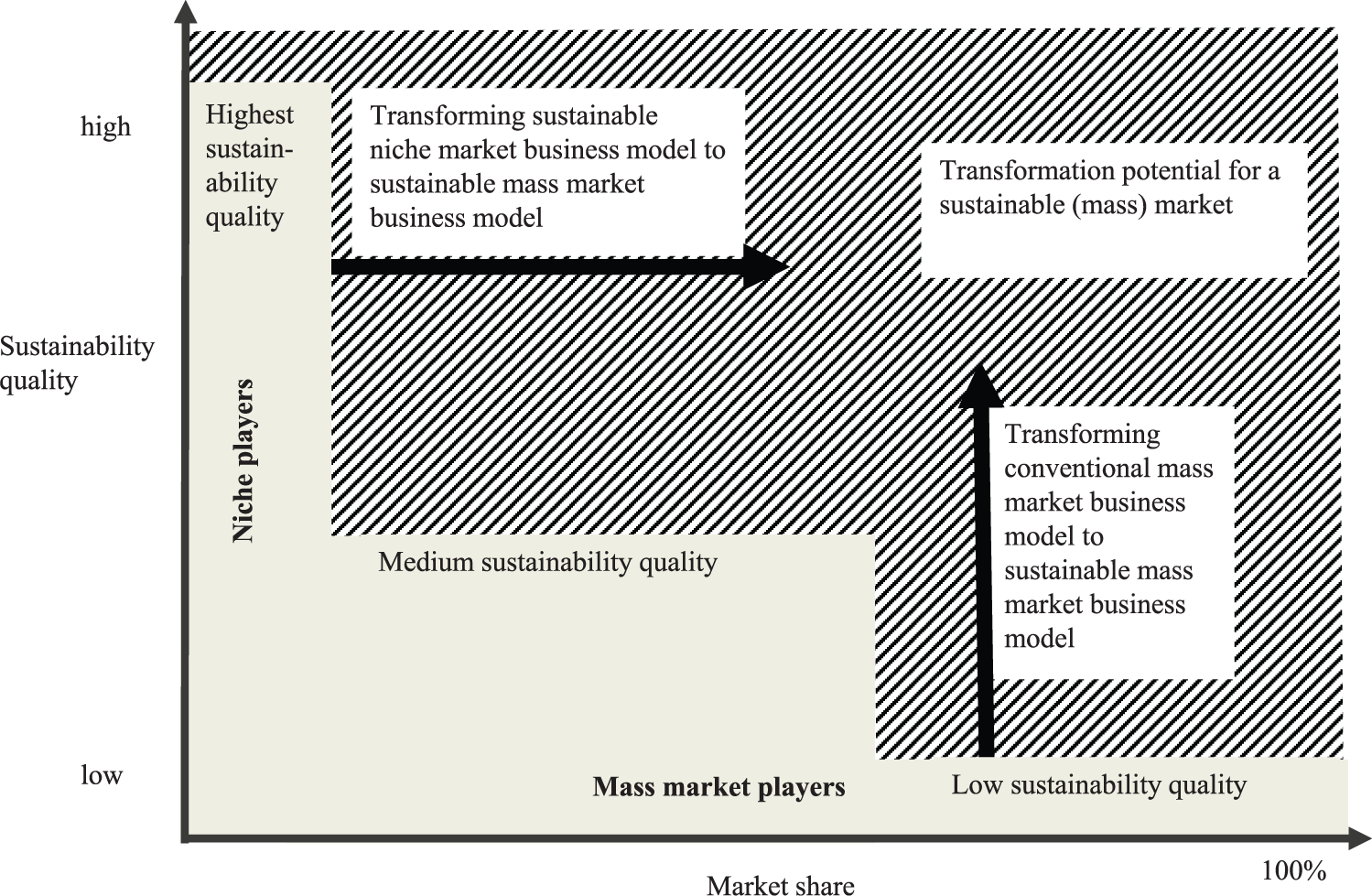
Sustainability transformation potential for sustainable entrepreneurship (adapted from Hockerts & Wüstenhagen, 2010; Wüstenhagen, 1998) and necessary direction of business model innovation.
According to this model, markets are typically characterized by a few small companies offering products and services with high sustainability quality in a small niche only (tall, narrow column to the left in Figure 1), whereas large companies, or a majority of the competitors with large market shares, provide only medium or low sustainability quality (two wider low rectangles at the bottom of Figure 1).
Many company cases of ecopreneurship and sustainable entrepreneurship have been described as actors in an alternative scene characterized by striving for autonomy (e.g., Schaltegger, 2002) or being perfectly happy with a niche market position without wanting to grow (e.g., Parrish, 2010; Jolink & Niesten, 2015). However, sustainable development of the economy and society can be achieved only if the entirety of markets and society, or at least very large parts, become more sustainable. To achieve a mass market with high sustainability quality requires the sustainability improvement of a large share of the market, which constitutes the theoretical transformation potential for a sustainable market (hatched area in the upper right of Figure 1).
Niche players (on the left in Figure 1) and mass market companies (at the bottom right in Figure 1) have a different starting point for sustainability transformations and usually have clearly different business models. Whereas sustainability pioneers in the niche are challenged to grow and take market shares from large conventional companies while keeping up their high sustainability quality (arrow showing to the right in Figure 1), large conventional companies are challenged to achieve a “sustainability upgrade” of their products, processes, and organizations while not losing market shares (arrow pointing upwards). Companies positioned in the middle may face both challenges at the same time.
Given its substantial ambition, sustainable entrepreneurship requires business model innovations spurring the development of new products, services, techniques, or organizational modes that substantially reduce environmental impacts and increase the quality of life (Boons & Lüdeke-Freund, 2013; Lüdeke-Freund, 2013). These innovations can introduce either completely new business models or transformations of existing business models (Schaltegger et al., 2012; Sommer, 2012), leading to BMfS with a fundamentally new logic of doing business on the basis of solving environmental and social sustainability problems. Depending on a company’s market position, different business model innovations are required to create a sustainability transformation of the mass market.
Beyond the “Small Versus Big” Dichotomy
As can be seen from this review of the literature, there is an—at least implicit—assumption that new and sustainability-enhancing solutions are mainly developed by small entrepreneurial businesses and that large, conventional corporations tend to be sustainability laggards. This theoretical assumption underpins large parts of today’s sustainable entrepreneurship and innovation debate; for example, Hockerts and Wüstenhagen’s (2010) “emerging Davids” and “greening Goliaths”; Schaltegger and Wagner’s (2011) distinction between green or social niche players and mass market incumbents; Hannon, Foxon, and Gale’s (2013) conceptualization of pioneer and incumbent business models; as well as the major framework of sustainable transition theory that sees sustainable solutions as emerging in small niches and struggling their way through socio-technical “regimes” towards larger societal “landscapes” (e.g., Geels & Schot, 2007).
While examples of small companies growing into the mass market exist (e.g., Whole Foods Market), other developments are possible, too. First, empirical analyses of ecopreneurs and small sustainability pioneers show that they often have a largely different rationale of managing their business than large companies (e.g., Parrish, 2010). It is thus not astonishing that the enlargement of a small sustainability pioneer or the transfer of principles of a successful sustainable niche market pioneer to an incumbent may not be straightforward.
Second, while many (or perhaps even the majority of) practical cases show that small innovators in their garages or labs are the starting point for sustainability-driven market changes that sooner or later reach incumbents (e.g., solar energy technologies), the opposite can also be true. Conventional incumbents can also create radical, market-changing sustainability innovations that are later taken up and locally adapted by small businesses. Sustainability innovations by large companies may start with incremental steps and accelerate to more radical changes, or they may be more radical for some parts of the organization right from the beginning, for example, with organizational transformations, new business units, or spin-offs initiated by the incumbent. Incumbents can then also bring about niche innovations through forms of “sustainable intrapreneurship” (cf. Hostager, Neil, Decker, & Lorentz, 1998). Examples include Toyota’s hybrid vehicle Prius, BMW’s i-series, and SAP’s sustainability performance management solutions, with the latter being a source of inspiration for a growing number of small-scale software solutions addressing different and more nuanced user needs (including the German software start-up WeSustain founded by an ex-SAP senior vice president).
The process of sustainable upgrading of large conventional companies is illustrated by the upward right arrow in Figure 1 and shows that the sustainability quality of these solutions may in many cases still be far away from the highest imaginable quality level. The fact that a lot of sustainability improvement potential still exists, however, should first not be mixed up with the question of who is taking the lead in changing existing structures, products, and services towards sustainability. Second, this movement should not be generally considered irrelevant, greenwashing, or negligible as the overall impact of a relatively small improvement for a large amount of products sold in the mass market may in various cases be even bigger than that of a large improvement of a small number of products sold in the niche. While this must of course not be an excuse to not improve further a market transformation, analysis needs to consider the overall effects, particularly in the interplay of pioneers and followers.
The remainder of this article takes a perspective that aims to supersede the prevailing “small versus big” dichotomy. The following analysis posits that small and big companies alike can engage in both niche and mass market development, without assigning the one exclusively to the other. We hope to offer a framework that allows for a better analysis of the complex reality of sustainable entrepreneurship and business model innovation. Instead of assigning niche or mass market qualities and their accompanying transformation effects to particular forms of entrepreneurship, our framework focuses on distinguishing business model characteristics that allow for sustainable market transformations, and that these characteristics can be found with both small niche market players and big mass market incumbents (see Section “Bringing Together Business Model Evolution”). These business model characteristics, such as scalability or replicability, should hold regardless of who is developing or operating the business model in question.
Before these characteristics are explained, the next section introduces a theoretical framework that connects sustainable entrepreneurship and business models in an evolutionary perspective.
Theoretical Framework
The analysis of how sustainable entrepreneurs and their business models can trigger market transformation requires further theoretical framing. While the business model literature provides some frameworks and theories of business model innovation (for overviews, see Schneider & Spieth, 2013; Zott et al., 2011), with few exceptions (Bidmon & Knab, 2014; Hannon, 2012; Hannon et al., 2013), no consistent theoretical framework is available that connects business models with the dynamics of markets, industries, or society and that helps understand the dynamic role of business model innovation for sustainability transformations of markets. To address this gap we propose using evolutionary economics. Evolutionary economics emphasizes dynamics, processes of entrepreneurial change and changing company and market structures (e.g., Nelson & Winter, 1982). This article particularly applies the idea of co-evolution as a theoretical framework to define core analytical categories and for analyzing the role of business model innovation by sustainable entrepreneurs. From this perspective, sustainable entrepreneurs are market cocreators and transformers whose business models are subject to the evolutionary processes of variation, selection, and retention (e.g., Volberda & Lewin, 2003). Among other things, this approach builds on the discussion of co-evolutionary dynamics between niche players and incumbents by Hockerts and Wüstenhagen (2010) as well as the interrelations between sustainable entrepreneurship and sustainability innovation outlined by Schaltegger and Wagner (2011).
Sustainable Entrepreneurship From an Evolutionary Economics Perspective
Following Arthur (1999), markets are seen as complex adaptive systems that differ from standard neoclassical models in many ways, making them susceptible to changes driven by single agents such as entrepreneurs. Evolutionary economics “portrays the economy not as deterministic, predictable, and mechanistic, but as process dependent, organic, and always evolving” (p. 107). The notion of “market maker” (e.g., Schweizer, 2005) describes the ability of entrepreneurs to substantially influence existing and create entirely new markets. For example, some organic food pioneers with new business models prepared the ground for the diffusion of green supermarkets. From an evolutionary economics perspective (e.g., Volberda & Lewin, 2003, for an overview), markets are not only preexisting business environments that determine the development of, and interactions among, business agents and then “decide” their success or failure. Markets are also deliberately and actively created and chosen by entrepreneurs. Arthur (1999) concludes that “the elements adapt to the world—the aggregate pattern—they co-create” (p. 107). This means, in our case, that sustainable entrepreneurs (“elements”) cocreate and adapt to the markets they engage in (“aggregate patterns”). They are active and adaptive market cocreators whose business model innovations are part of the organizational transformations underlying market transformation effects.
Sustainable entrepreneurs often start in niches or with small projects inside large companies, which serve as more or less protected learning environments. Adaptation comes into play once these pioneers leave their learning environments—in some cases protected by public policy, technical barriers to copying and mass production by competitors, or other forms of shielding—and enter and possibly change competitive mainstream markets. Foxon (2011) discusses this emergence of macro patterns developing from micro behaviors, as well as their interactions and evolution, as an underlying process that creates novelty, increasing order and complexity over time. These emerging and evolving patterns are nondeterministic, nonmechanistic, and thus nonpredictable. From Arthur’s (1999) observations, it follows that under these circumstances there are usually a multitude of actors and potential outcomes: Neither current market position nor economic efficiency is a reliable predictor of success and a company’s future. Today’s niche pioneers might become future mass market players, and vice versa, today’s mass market players may become future sustainability pioneers.
Thus, the potential of co-evolving macro patterns to transform markets through the micro behaviors of entrepreneurs developing BMfS offers a promising theoretical perspective for understanding the business model and market transformation nexus of sustainable entrepreneurship. The next part of the article thus discusses business model co-evolution in the light of major evolutionary processes.
Business Model Co-Evolution as a Driver of Sustainability Transformations of Markets
Business Model Co-Evolution
The co-evolution of BMfS results from the interaction between sustainability-driven niche players (also referred to as sustainable pioneers, “bioneers,” or “social bricoleurs”) and conventional incumbents (also referred to as mass market players or large conventional companies; cf. Hockerts & Wüstenhagen, 2010; Schaltegger & Wagner, 2011), and is further influenced by political and societal actors who co-shape the market and societal conditions in which companies interact with their suppliers and customers (cf. Foxon, 2011; Hannon, 2012; Hannon et al., 2013). With regard to the analysis of sustainability processes transforming markets, we follow Hannon (2012) who argues that the division between niche players and mass market players “is important because it enables us to explore how the evolution of non-incumbent firms implementing novel business models is causally influenced by incumbent firms operating with traditional models and vice versa” (p. 95, italics removed). Here, again, it is important to consider that “novel” does not necessarily imply small market actors and that “incumbent” is not only to be associated with large corporations (“Beyond the ‘Small Versus Big’ Dichotomy”).
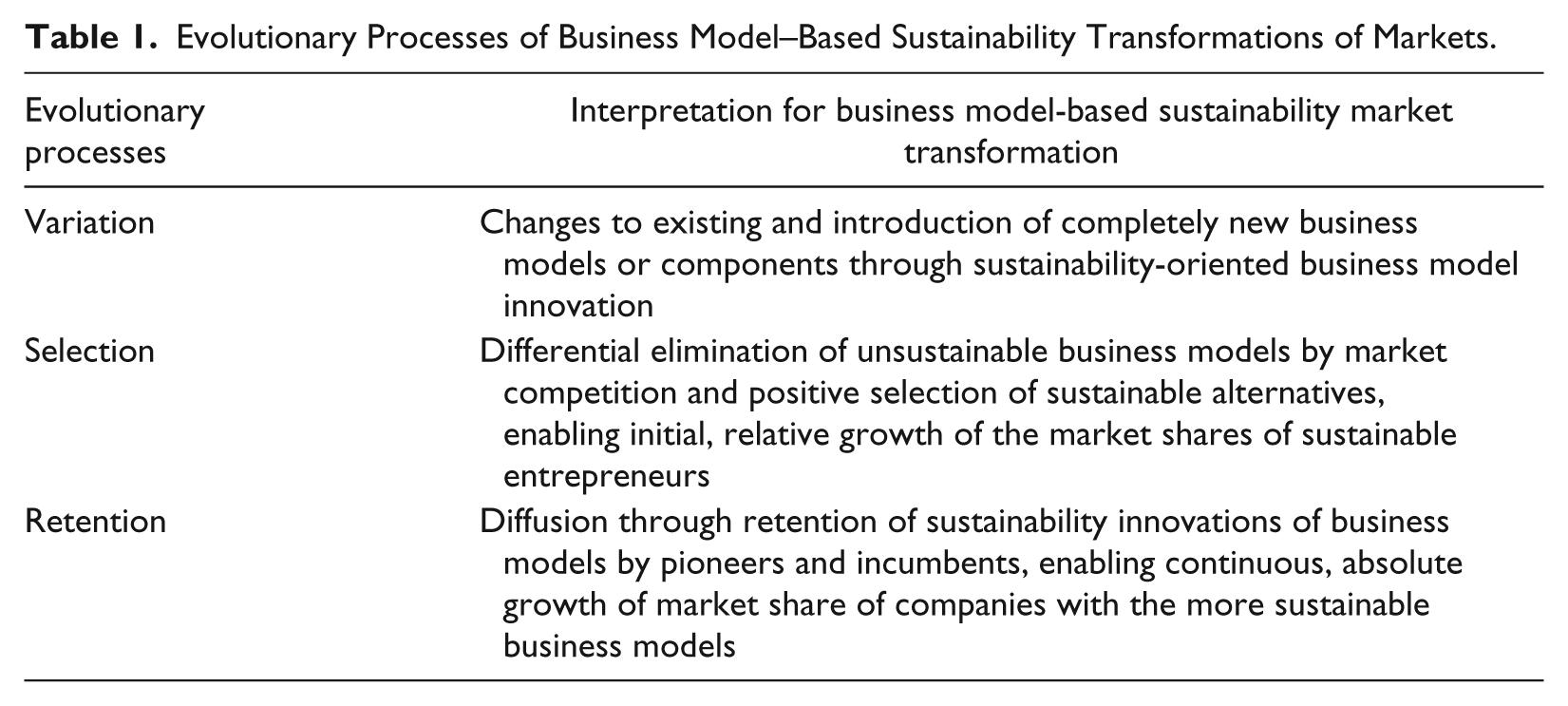
To better understand business model interactions and influences, we build on the notions of evolution and co-evolution as developed in evolutionary economics and organizational theory, respectively (e.g., Aldrich, 2007; Norgaard, 1994). Interpretations of these processes are provided in Table 1. Aldrich and Ruef (2006) posit that if “processes generating variation and retention are present in a system, and that system is subject to selection processes, evolution will occur” (p. 16). Understanding co-evolution is thus a key to understanding changing markets in general (cf. Foxon, 2011; Norgaard, 1994) and the sustainability transformation of markets driven by business model innovations in particular. Co-evolution occurs when different entities influence each other’s evolution in specific, reciprocal, and simultaneous interactions that impact the ability of these entities to persist (Foxon, 2011; Murmann, 2003). Examples include technologies that shape, and are shaped by, user practices; legal frameworks that are designed to constrain particular business strategies; and isomorphism between organizations, that is, homogenization effects due to coercive, mimetic, or normative pressures (DiMaggio & Powell, 1983; Lewin & Volberda, 2003).
Evolutionary Processes of Business Model–Based Sustainability Transformations of Markets.
Major Evolutionary Processes: Business Model Variation, Selection, and Retention
Three evolutionary processes, which apply not only to biological but also to social systems, are variation (changes in routines, capabilities, and organizational forms), selection (differential elimination of particular variations and positive selection of others), and retention (reproduction of selected variations through preservation or duplication; cf. Aldrich, 2007; Aldrich & Ruef, 2006; Volberda & Lewin, 2003). A summary of our interpretation of the evolutionary processes of the sustainability transformation of a market is shown in Table 1.
Variation refers to sustainable business model innovation (cf. Bocken et al., 2014; Boons & Lüdeke-Freund, 2013; Schaltegger et al., 2012). Applying the general distinctions of Aldrich and Ruef (2006) to a sustainability perspective, variation occurs, for example, through the search for solutions to the increasing pressure created by competitors offering more sustainable products and services, inefficient routines related to waste of energy and physical resources, or the founding of new businesses within or between companies, but also due to mistakes and coincidences. Entrepreneurship can be a crucial driver of variations in business model innovation (cf. Schneider & Spieth, 2013) and sustainability-oriented business model innovation (e.g., Bocken et al., 2014; Hansen et al., 2009; section “Business Models and Sustainability”). As incumbent, market-dominating companies are mostly focused on the exploitation of existing production processes, distribution channels, market segments, and so forth, they often neglect exploration, that is, the search for new approaches and market potential (cf. Chesbrough, 2010; Smith, Binns, & Tushman, 2010). Variation for incumbents thus often means incremental innovations, for example, with regard to identifying and exploiting potentials for increasing energy and material efficiency. Sustainability-driven variations of the business model are from this perspective more likely to be focused on changes to the business infrastructure rather than on the value proposition. Pioneering niche companies, however, often identify market potentials with their explorative approaches to creating new sustainability-oriented products and services. Variation is thus more likely to address sustainability issues in the value propositions of these pioneers. Even though this line of argumentation is supported in many cases, counterexamples can also be identified, such as Toyota introducing hybrid technology or the DM drugstore chain in Germany realizing higher sustainability standards in its product range than most of its smaller competitors.
Selection of variations refers to the elimination of unsustainable business models by market forces or political and societal interventions, as forms of negative selection, as well as the positive selection of sustainable alternatives. Negative selection of unsustainable models enables relative growth of the market share of sustainable entrepreneurs. As an example of negative selection, Chesbrough (2010) identifies a company’s dominant logic as a potential trap leading to inadequate performance—and thus negative selection. A dominant logic provides orientation and efficiency in fast-moving or even chaotic environments. But this orientation, by being dominant, might also constrain established companies from identifying new, superior, and sustainable business models. The lock-in of a dominant logic might thus lead to business failure, for example, through the withdrawal of resources like financial capital or employees, or a loss of legitimacy. Austin and Leonard (2008) provide an overview of different general trajectories that can be observed to lead to the failure of established and even market-dominating companies. Positive selection, in turn, supports those BMfS that are most successful in the market as well as in the political and societal business environment, laying the ground for the initial growth of their market share.
Retention of selected variations means that some BMfS, or parts thereof, are passed on over time. We argue that retention leads to the continuous and absolute growth of the market share of sustainable entrepreneurs and thus effectively spurs a sustainability transformation of a market. Variation and selection alone are insufficient to transform markets as a whole. Only the continuation and diffusion of positively selected BMfS hold the potential for market transformation. Whereas business model innovation is often seen as merely creating new variations or selecting those business models that may be most appealing to some customers, retention emphasizes the need for stamina of a new business model over time.
Bringing Together Business Model Evolution, Sustainable Entrepreneurship, and Market Transformation: An Analytical Framework
The following segments introduce a generic framework to describe and analyze different pathways of the business model-based sustainability transformation of a market. To begin with, four major types of business models and accompanying evolutionary retention processes are defined. Next, we discuss how niche-based transformations can affect the mass market, and the section “From Mass Market Offers to Sustainable Mass Markets” takes existing mass markets as a starting point for transformation. Finally, we illustrate how the proposed framework can help in understanding more complex evolutionary pathways towards sustainability transformation of markets.
Evolutionary Pathways for the Diffusion of Sustainable Business Models
The three evolutionary processes of variation, selection, and retention (section “Business Model Co-Evolution,” Table 1) can be used to describe the sustainable entrepreneurship process from business model innovation (variation) to survival (selection) and broader diffusion in the mass market (retention).
Retention is decisive for sustainability oriented transformations of given markets as it supports the diffusion of new innovative BMfS created in variation and affirmed in selection processes. According to evolutionary economics (cf. Aldrich, 2007; Aldrich & Ruef, 2006; Volberda & Lewin, 2003) retention can be achieved through growth, replication, mimicry, and/or mergence (in an economic context, mergence takes place through M&A; see also Hockerts & Wüstenhagen, 2010).
Figure 2 shows an analytical framework that combines the three evolutionary processes (variation, selection, and retention) with the four core distinctions of business model retention (right column in Figure 2: growth, replication, M&A, and mimicry) as derived from the evolutionary economics literature.

Analytical framework to describe the sustainable entrepreneurship process from business model innovation to diffusion of sustainability-oriented business models in the mass market.
These four forms of retention tie back into the processes of variation and selection. To achieve retention through growth, replication, mimicry, or mergence therefore requires certain business model qualities to not only result from variation through scalability, replicability, integrability, and imitability (left column in Figure 2) but also survive selection processes (middle column in Figure 2). Business models with one or several of these qualities, developed through variation and affirmed through selection, are likely to be retained in the market.
These generic business model qualities are of universal nature. The quality of scalability, for example, should hold for some, or possibly most, business model types described in the literature (e.g., closed-loop or social models; see, e.g., Beltramello, Haie-Fayle, & Pilat, 2013, Bisgaard, Henriksen, & Bjerre, 2012; Bocken et al., 2014). Like most natural organisms, social organizations can and sometimes must grow to survive. Thus, the retention of a business model may also (but does not have to) depend on its ability to grow, that is, scale up. The generic qualities we propose therefore do not characterize particular business model types but illustrate business model features that different models may share.
Applying the evolutionary processes variation, selection, and retention to business model development leads to different interpretations for companies employing niche and mass market business models (see “Sustainability Transformation of Markets Through Entrepreneurship”). In order to contribute substantially to a sustainability transformations of the market, sustainability pioneers in the niche are challenged to “conquer” larger shares of the market without (much) compromising of their sustainability quality. This can be achieved by growing the new business model and/or its replication in joint efforts or by others. The core challenge for organizations with hitherto conventional mass market business models, that is, to achieve sustainability upgrading while not losing market share, can be achieved with mimicry (thus copying pioneers) and/or M&As.
Growth of BMfS
Growth of sustainable entrepreneurs is the straightest form of contributing to a sustainability transformation of the market where favorable characteristics are retained and scaled within a single organization. While economic growth of conventional businesses is often in contrast to sustainable development, it is necessary to keep in mind that growth of sustainable companies is not the same as growth of the whole market. Growth of a sustainable company at the cost of unsustainable companies in a consolidated market (i.e., no market growth) leads to a structural change of the market towards sustainability. Development towards sustainability (or less unsustainability) is caused by replacing unsustainable offers and organizations by more sustainable offers and companies. It includes growth of the more sustainable companies causing degrowth of the unsustainable companies and decrease in sales of unsustainable products. Hockerts and Wüstenhagen (2010) argue that growth is an option for (business model) pioneers as long as (other) incumbents overlook, ignore, or simply are unable to cope with sustainability-related market opportunities and leave their exploitation to niche players (we should note that incumbents could themselves act as pioneers and experiment with new niche market business models). Whereas some sustainable entrepreneurs may want to keep their business models in the niche, high-growth niche players combine radical sustainability innovations with professional management techniques and business processes providing the ground for scalable business models. An example for this pathway is Whole Foods Market, a retailer with an exclusive focus on organic food. Today’s largest organic food company in the United States, the company grew continuously but still has a relatively small share of the total food retail market.
Replication of BMfS
In cases where growth is not an option, replication offers an alternative form of diffusion of the business model into the market. Positively selected characteristics are transferred to, and retained in, multiple organizations. Once pioneers set up their sustainability-oriented business models, further niche players might be motivated to follow and replicate the pioneering models (described as “multiplying Davids” by Wüstenhagen, 2003). An example for an intended replication strategy is Tesla. In 2014, Tesla opened its patents (“All our patents are ‘belong to you’”) to offer access to its superior electro-mobility technology to anybody who wants to copy it (www.teslamotors.com). A replication of the technology would help diffuse electric vehicles beyond the high-price niche of luxury automobiles Tesla is currently serving and would also accelerate the development of the necessary loading infrastructure.
Combining growth and replication, that is, growth through joint replication, is based on the understanding that growth can also be spurred by partnerships supporting replication. The German organic food retailer Alnatura is an example for this pathway. For the past decade Alnatura grew through various partnerships, particularly with DM, today’s largest drugstore chain in Germany, and more recently through collaboration with Migros, the largest food retailer in Switzerland.
Mimicry of BMfS
Mimicry is an approach by which (niche) business models or business model characteristics (whether introduced by small or large companies) are copied and modified by mass market players. Conventional incumbents are subject to different forms of pressure (e.g. Windolph, Harms, & Schaltegger, 2014), especially in phases while growing or replicating niche players win larger market shares. This could provide motivation to copy, or mimic, the business models of sustainability pioneers, mostly within the constraints of their own existing business models. Premium brands as well as mass market brands can engage in mimicry, both to cope with the threat of growing and replicating niche players and to exploit increasingly lucrative market opportunities. Mimicry involves more and less ambitious copies, where product may just look similar in order to be preferred to another or could be distinguished less well from the original innovation. Examples of a mimicry strategy in the German market for organic soft drinks involve the pioneers Bionade and Voelkel being copied by mass market producers and discounters introducing products, even copying innovative tastes, such as rhubarb or elderberry, originally introduced by the pioneers. These copies are no replications but mimicry as they appear very similar, in spite of being produced quite differently. Whereas Bionade is a nonalcoholic brewed drink and produced with a newly invented brewing technology that did not exist before, all copies are just mixed juices and not brewed. Given that the same and similar tastes are offered in organic quality, they, however, appear the same.
M&A of BMfS
If incumbents lack the respective capabilities, they may try to answer increasing competition by means of M&As, that is, the legal, organizational and/or financial integration of sustainable niche players but also small-scale inventors into their own organizations. Incumbents might thus try to acquire promising niche players, by means of both friendly and hostile takeovers, or set up joint ventures. Illustrative examples for this strategy are L’Oreal, which took over Bodyshop, and Unilever’s takeover of Ben & Jerry’s. These two cases show that the sustainability transformation effects of mergence can differ substantially. We could not identify any signs of a sustainability transformation of L’Oreal as an organization after the acquisition. Bodyshop seems to be positioned as a distinct brand and does not have any visible influence on L’Oreal’s other brands and core business. A positive interpretation is that the survival of sustainable business model has been secured (thus retention of its business model was achieved also after the death of Bodyshop founder Anita Roddick) through the acquisition by an incumbent. A critical interpretation would emphasize that the acquisition prevents this sustainability pioneer in the cosmetics industry to create larger sustainability transformation effects in the market. Austin and Leonard (2008) come to the conclusion that in general large companies seem to have more influence over pioneers than the other way round, thus leading to an overall reduction of competition and innovation. Applied to sustainable entrepreneurship, this means that a sustainability transformation of the market is being prevented.
By contrast, there are cases where incumbents have helped through acquisitions of small pioneers to hugely scale up the market impact of their sustainable business models. For example, Unilever has integrated Ben & Jerry’s into a company-wide sustainability strategy (Unilever’s “Sustainable Living Plan”), increased the distribution range and channels of Ben & Jerry’s products (addressing the customer interface element in the business model), and increased its market share and sales substantially on a global scale.
Combining mimicry with M&A, that is, diffusion through acquisition and mimicry, is a strategy or pathway based on the understanding that mimicry often requires specialized capabilities that can be obtained by acquiring the expertise of organizations or people (e.g., experienced pioneers and innovators), and thus supporting the retention of a sustainable business model in the mass market. The U.K. organic drink producer Innocent, acquired by Coca Cola in 2013, is an example for this pathway. Innocent grew after its acquisition by Coca Cola by accessing its global distribution channels, while the founder still supports his with specialized knowledge about organic smoothies.
The Diversity of BMfS Co-Evolution
In sum, niche players can transform the market by growing, through the replication by other niche players (movement from left to right in Figure 1), through replication in collaboration with mass market players (combined movement from left to right and from bottom to top in Figure 1), while mass market players can additionally try to merge and mimic more sustainable models (movement from bottom to top). As emphasized by evolutionary economics, niche and mass market players do not act in isolation but will unavoidably interact with each other, either by reacting to pressure created by the other or by collaborating or merging (cf. Hockerts & Wüstenhagen, 2010). To further understand the entrepreneurial process of mass market transformation, the next section discusses the particular business model challenges facing sustainable entrepreneurs in the niche and mass market.
From Sustainable Niches to Sustainable Mass Market Influence
Pioneering business models operating in a niche (by both new ventures and incumbents) can spread, as discussed above, either by growth of the pioneer’s business model or by replication of the business model by others, or by a combination of both. Evolutionary processes of sustainable entrepreneurship, however, may require changes or a transformation of the business model itself (e.g., Sommer, 2012) with the application of new design principles and changes of components and architecture and. Table 2 displays some basic characteristics typically associated with niche market business models and shows how business model development may support growth or replication to contribute to a sustainability transformation of the market. These characteristics are sketched for the three main aspects of the business: value proposition, value creation and delivery, and value capture.
Sustainable Niche Market Business Model and Challenges for a Transformation to a Sustainable Mass Market.
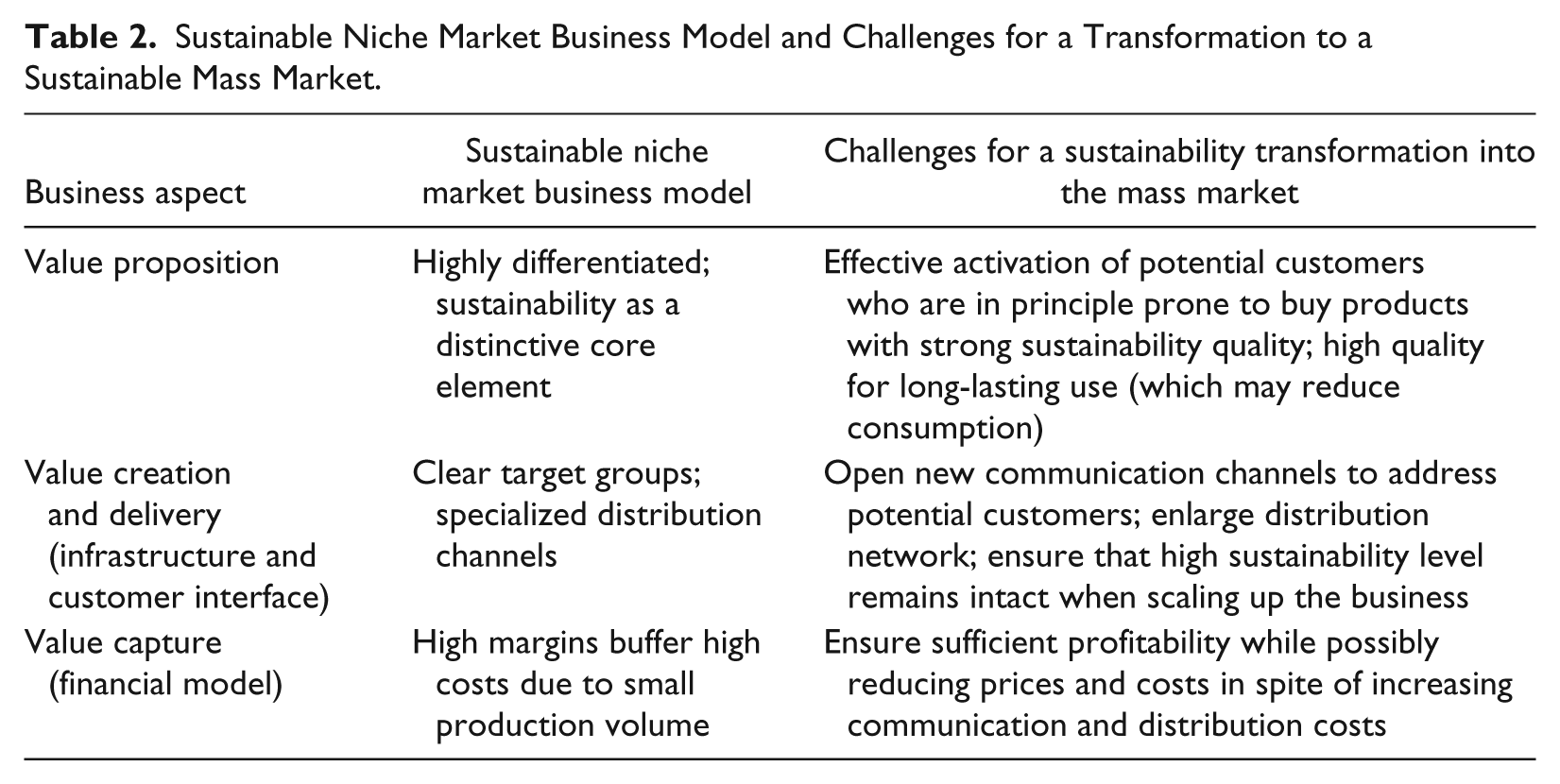
With regard to variation, the first step in our analytical framework, several authors have analyzed the specific strategies and characteristics of the business models of sustainable entrepreneurs in niche markets, often taking a new venture perspective. For ecopreneurs in the Dutch organic food market, for example, Jolink and Niesten (2015) identify the transformation of the “disvalue” of externalities of conventional products into value for environmentally and socially concerned customers as a key variation of business models of sustainability pioneers. Parrish (2010) finds five principles of organizational design which diverge from conventional principles of entrepreneurship. The “skillful use of perpetual reasoning” (p. 511) includes resource perpetuation instead of resource exploitation, achieving synergies through balancing benefits for various stakeholders instead of economizing for least costs, strategic satisficing to balance competing objectives instead of one-sided financial maximizing, qualitative instead of quantitative management, and allocating benefits on the principle of worthy contributions instead of power. Many of these variations cannot be transferred unaltered to the mass market, and some sustainable entrepreneurs may (have to) stay small. However, when growth is not an option, replication and mimicry by others are further evolutionary possibilities to influence the mass market. The overall challenge is to address new customer groups while making sure that no mission drift occurs, that is, the sustainability standards are not reduced.
The transformation of the business models of sustainability pioneers offers various opportunities and challenges. In a first step such a growth strategy faces the challenge of activating potential customers who are in principle prone to sustainability products. From a customer interface perspective this requires a good understanding of why these potentially interested customer groups have not been able or willing to actually express their preferences in real purchasing activities. Depending on the findings of such market research, the sustainability pioneer’s growth strategy may require an improvement of core product characteristics (value proposition), an enlargement of the distribution channels (customer interface), or the creation of events that activate a change of customer habits (customer interface). Collaboration with NGOs, retailers with strong distribution channels, or other relevant stakeholder groups may support such a strategy and lead to combined growth through a joint replication pathway. Changes to the company’s value proposition and value creation in line with pursuing growth and replication will have consequences for the financial model and thus need to be assessed before the pathway is pursued further. Particularly the sustainability effects of growth need to be carefully evaluated. Approaches that are sustainable on a small scale may lead to a reduction of sustainability or even lead to negative overall effects for society on a larger scale (e.g., Sommer, 2012). Biofuels of the first generation provide a case in point. Whereas bioethanol produced from the organic waste of a sugar factory can be considered a sustainable substitute for petrol-based fuels, the enlargement of bioethanol production to large-scale production requires the planting of biofuel crops in agricultural mass production systems that often create substantial sustainability problems with regard to biodiversity, water, and soil degradation. This leads to an undesired change of the value proposition. The question whether a sustainability pioneer should pursue a growth or replication strategy to contribute to a sustainability transformation of the market must therefore also be assessed on the basis of how scaling influences sustainability performance (see Sommer, 2012).
From Mass Market Offers to Sustainable Mass Markets
If pioneering business models are successful and can be scaled or replicated (moving from left to right in Figure 1), large companies with high market shares of their conventional business models are challenged to upgrade their products and services by effectively implementing higher sustainability standards (moving upwards from the bottom right side in Figure 1). Sustainable upgrading of an incumbent’s conventional mass market business model, organization, or products can be a response to challenges by (small) pioneers, due to the intrinsic motivation of managers and intrapreneurial initiatives, political push by regulators, or societal pressure to consider sustainability more seriously. Any movement upwards in Figure 1 requires real sustainability improvements and will thus affect the business model, particularly value proposition and creation, but most likely all three elements. Alternatively, improvement may be achieved with an intentional innovation of the business model. Table 3 displays characteristics typically associated with mass market business models and shows how business model innovation may support a sustainability transformation of the mass market.
Mass Market Business Models and Challenges for a Transformation Towards a Sustainable Mass Market.

Sustainability upgrading strategies offer various opportunities and challenges. Among the opportunities are, on one hand, risk management advantages through the reduction of the sustainability risks of conventional products and production processes (e.g., legal disputes or negative media coverage) and, on the other hand, the creation of higher value for mass market customers through upgrading with sustainability aspects. Core challenges are to ensure that the sustainability upgrading is understood and accepted by customers who have not so far considered sustainability aspects and the management of costs. For incumbents a sustainability transformation can be achieved by convincing existing mass market customers to accept or even desire higher sustainability quality, for example, by effectively combining sustainability aspects with the core purchasing characteristics of existing products. Particular challenges include ensuring that real and substantial sustainability improvements are achieved while costs and prices are kept under control. This may also go along with perception challenges that higher sustainability quality is wrongly expected by some mass market customers to have negative impacts on conventional technical, taste, and design qualities or price. Business models spurring sustainability transformations of mass markets thus require approaches to ensure that sustainability upgrading does not negatively influence the positioning and perception of mass market customers.
Realized Pathways of Co-Evolutionary Business Model Development
Generally speaking, if we consider the combination of the four generic business model qualities (scalability, replicability, integrability, and imitability) and the related evolutionary processes (growth, replication, M&A, and mimicry), there is a virtually uncountable number of possible pathways over time in specific markets (see “Evolutionary Pathways for the Diffusion of Sustainable Business Models”). The evolutionary processes of variation, selection, and retention may furthermore occur in sequences and repetitively with the result of different “generations” of business models. Whether some pathways are more common in practice than others has not been examined so far.
We use four illustrative cases from Germany to represent the emergence of BMfS in major industries that satisfy core human needs: Entega and Lichtblick as cases from the energy industry, Bionade representing the food industry, and Stattauto Berlin as a mobility case. These cases were chosen because of their obvious business model features that are useful to illustrate the analytical categories of our theoretical framework. We start from the initial occurrence of these companies’ business models (first iteration or generation), identifying their most important business model quality in this phase (e.g., scalability for Bionade), and then take a look at their further variation and co-evolution with other companies (second iteration or generation), identifying changes in their qualities (e.g., integrability o Bionade) and the qualities of co-evolving companies. Especially the second iteration contains cases of co-evolving niche and mass market players. The following two segments distinguish pioneer- and incumbent-dominated retention and co-evolution.
Figure 3 shows some pathways illustrated in the next two segments with cases using the framework developed above.
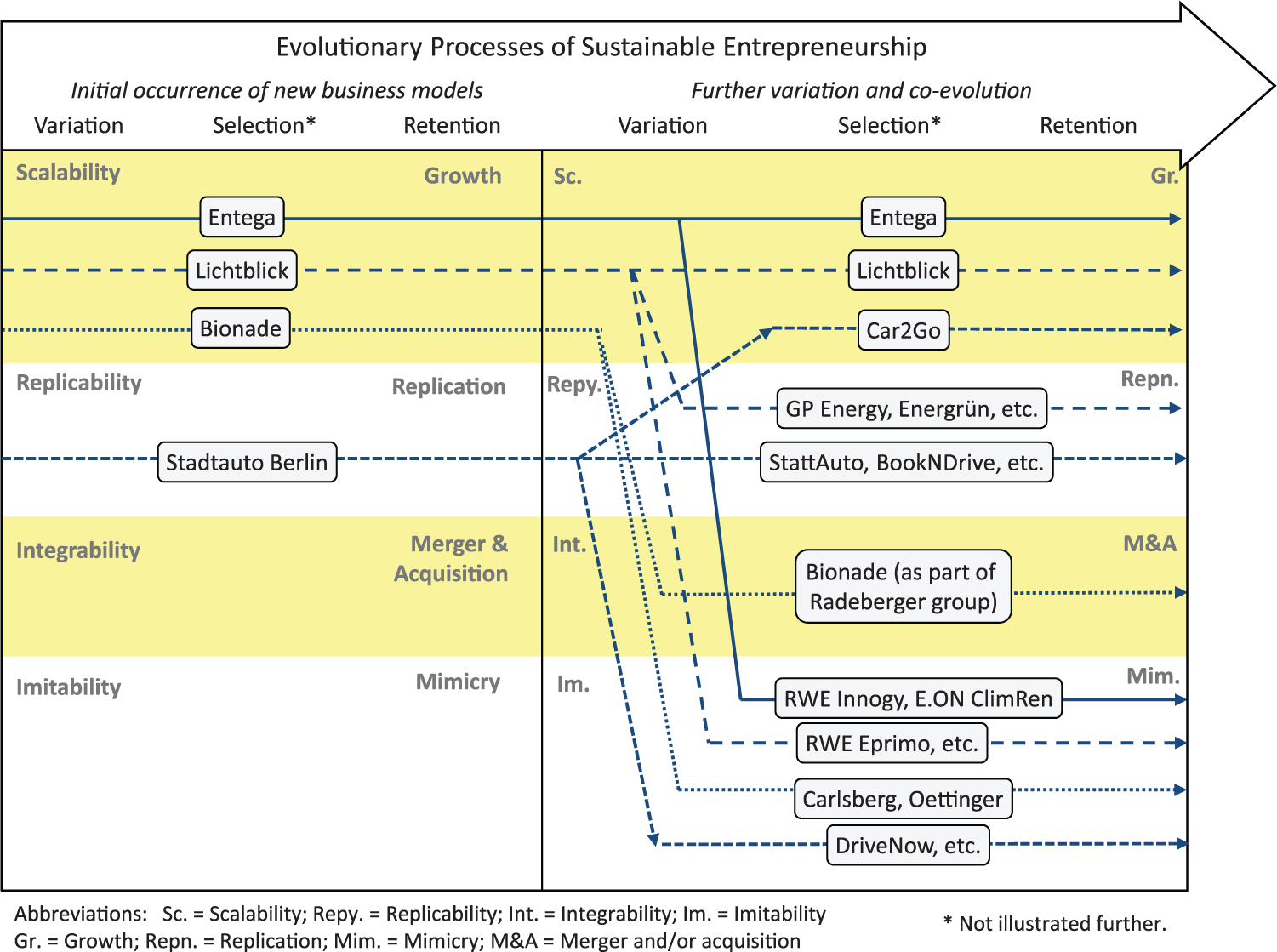
Case examples of evolutionary pathways of sustainable entrepreneurship and business model developments.
Examples of New Venture–Dominated Retention and Co-Evolution
Probably the simplest pathway and possibly the one most strongly desired by many new sustainability ventures is growth based on scalable and replicable business models. A case in point is Lichtblick and the German retail electricity market. Founded in 1999 with a new business model based on green energy contracts, the company focuses exclusively on renewable energy (green value proposition) and clearly differentiates itself from conventional energy utilities mainly using coal and nuclear power (Entega, 2011) as well as from the first pioneer in renewable energy sales (EWS Schönau) that generated its own power. The company did not own electricity generation facilities in the beginning but focused on the retail sale of imported hydroelectricity from neighboring countries (using existing infrastructure in Austria and Norway). Green electricity has been offered very competitively at prices below those of many conventional electricity utilities (value proposition). As a pioneer, Lichtblick developed a business model for renewable energy retail in Germany and introduced a new variation into the mass market (Schaltegger & Hansen, 2013). Lichtblick created a scalable business model based on a green, standardized, and competitive commodity with a good fit to the liberalized German power market, its high price sensitivity, and the increasing environmental awareness among consumers. Regarding retention, the company followed a steep growth pattern and grew in a few years to more than 600,000 customers and the fifth largest electricity provider in Germany (Energie & Management [E&M], 2014). Lichtblick also engaged in legal action by suing large conventional electricity providers that attempted to obstruct the entry of sustainability pioneers by manipulating the price for electricity transmission. The entry of Lichtblick into the mass market together with its noticeable high growth rates was favorably commented on by the mass media and initiated significant shifts in the German electricity market. At the beginning Lichtblick was accompanied by other entrepreneurial ventures with similar business models focused on renewables (e.g., Greenpeace Energy, Energrün), representing replication processes in the industry partly with similar growth ambitions. In addition, established utilities facing large-scale customer losses engaged in mimicry processes by founding new subsidiaries, new companies (e.g., Eprimo by RWE), or new internal business unit extensions to their conventional business model. Together this led to a co-evolution of initially small ventures and large incumbents, where the growth-oriented business model of a small sustainability pioneer dictated the pace and induced replication by other small early adopters and mimicry by incumbents. Today, more than 22% of households in Germany use green power (Agentur für Erneuerbare Energien, 2013).
Examples of Incumbent-Dominated Retention and Co-Evolution
While it is often suggested that new ventures are best at introducing variation into markets, new (niche) business models can also be pioneered by incumbents (“Beyond the ‘Small Versus Big’ Dichotomy”). Consider the example of the German energy utility Entega. Though new ventures introduced new business models at an earlier point of time (e.g., Lichtblick as mentioned above), Entega was the first conventional energy utility in Germany to turn towards a new business model of “climate neutrality,” moving away from the traditional approach of high-volume sales to become a service provider offering the combined delivery of renewable energies, energy-saving services, and carbon offsetting (Entega, 2011, p. 14). This fundamental redesign of the value proposition, value creation, and value capture is particularly intriguing as Entega discontinued its old business model and fully engaged in a radical business model transformation. By contrast, incumbents have introduced new business models as add-ons to their mainstream business models. An example of an ambidextrous organization is RWE, a large conventional energy business that set up RWE Innogy as a subsidiary with a separate brand to market green electricity. Entega invested into a growth process on a national level, making it the third largest green power provider in Germany according to the number of private customers (E&M, 2014). The combination of sustainability upgrading and market expansion at the same time is a business model transformation with “two frontiers.” Entega’s business model transformation can be seen in Figure 1 as a large upward shift of sustainability quality by a medium-sized player combined with a growth movement to the right. Incumbents such as E.ON and RWE are increasingly engaging in renewable energies, efficiency services, and other alternative business fields. However, these companies have not chosen to replicate the radical business model transformation pioneered by Entega and have instead founded subsidiaries (E.ON Climate & Renewables, RWE Innogy) for renewable energies. Thus, they rather imitate the innovations of Entega and other pioneers, leading to market transformation through mimicry.
An example for a combination of a diversified replication-, scalability-, and mimicry-characterized market development is carsharing. Carsharing is based on offering temporary access to cars rather than selling them (deliver functionality rather than ownership according to Bocken et al., 2014) and thereby provides a radically different value proposition with specific requirements for value creation and capture. Emerging from hitchhiking-like student organizations that brought people traveling to the same place together, pioneer organizations like Stattauto Berlin in Germany (1988; since 2006 with the name “Greenwheels”) developed a station-based carsharing business model that can be easily replicated at many locations. The basic business model of carsharing was introduced by local entrepreneurs, often nonprofit initiatives, and was diffused through regional replication (StattAuto, BookNDrive, etc.). The number of car sharing providers in Germany has grown to 148 in 2013 (Bundesverband CarSharing, 2013). Once the market for carsharing was established, a conventional carmaker, Daimler, developed a substantially different carsharing model and founded Car2Go together with the car rental company Europcar in 2009, with investments in large-scale growth and internationalization. Whereas station-based carsharing had already been introduced by small niche pioneers many years ago, Daimler’s Car2Go offers a free-floating carsharing system allowing cars to be picked up and dropped at any place in a defined urban region (value proposition and delivery). Scalability is achieved through a facilitated pickup of cars with smart phone apps for Car2Go members and payments are electronically organized without specific transaction procedures (no forms to be filled out) for the customers (value proposition and delivery). In contrast to regional providers, Car2Go is financed with substantial funds from the parent company and therefore able to quickly roll out a national and even international infrastructure. First introduced in Germany and then transferred to the United States and various other major automotive markets (Firnkorn & Müller, 2011), Car2Go grew quickly to serve more than 1 million customers, making it one of the two major carsharing providers in the market (according to the number of customers) and giving it a leading role in the diffusion of the carsharing business model. The free-floating system has since also been imitated by DriveNow, BMW’s carsharing business, and other car manufacturers. DriveNow is based on the same business model as Car2Go and has the same fundamental features (e.g., the free-floating approach, app- and Web platform–supported customer channels, pricing models, urban region focus, etc.). The basic business model innovation, individual mobility based on carsharing, was first replicated by local entrepreneurs (e.g., StattAuto, BookNDrive), then further developed by Daimler into the more scalable free-floating based business model of Car2Go, and finally imitated by Daimler’s direct competitor BMW with DriveNow.
Sustainable entrepreneurship pathways of large incumbents are sometimes also dominated by M&As. Rather than engaging in mimicry processes, incumbents can also takeover pioneers with innovative business models through M&As (either friendly or hostile takeovers) and investments. The M&A-driven sustainability transformation of a market can be illustrated with the case of Bionade soft drinks in Germany. Bionade was established by a small family brewery, creating an entirely new market with a new business model rooted in sustainability (e.g., Tischner, 2007). They blend concern for the environment with stylish product design (value proposition), they produce a soft drink in a traditional local brewery using only certified organic ingredients (value creation), and their price includes a significant green premium covering the higher production costs and securing revenues (value capture). By positioning their new soft drink as a healthier, trendy alternative to mainstream “artificial” soft drinks with exceedingly high sugar content offered by large multinational beverage companies, they quickly won large market shares in major cities in Germany (first phase indicated in Figure 3), starting with 200,000 bottles in 2002 and reaching a sales peak of 200 million bottles in 2007, representing a very steep growth curve (Wirtschaftswoche Online, 2012). However, the rapid growth required large investments in the production capacity, which Bionade intended to finance with a substantial price increase. The price increase, however, was not accepted by Bionade customers. As a consequence, sales dropped in the following years and the company faced a financial crisis. After a rejected takeover offer by Coca Cola in 2009 they were first partly and then fully acquired by a large German brewery group (Radeberger Group, belonging to Oetker Holding). Although the new owner has so far not been successful in further developing the business model and sales have leveled, new product variations have been continuously introduced, showing the ambition for further growth. Moreover, Bionade’s value proposition based on a brewed, nonalcoholic organic soft drink has been imitated with nonbrewed organic lemonades (soft drink mixtures) by several beverage companies trying to capture a share of this new market. Examples are Carlsberg’s “Beo” lemonade and “Glorietta Elderberry” by Oettinger.
Overall, these examples show that different co-evolutionary sustainable entrepreneurship pathways can contribute to a sustainability transformation of the mass market. As was shown, such pathways can be identified in current business practice in diverse industries. However, further research and systematic analyses of empirical cases based on the framework proposed in this article are needed to better understand and support company efforts to create new markets and transform existing ones.
Discussion and Conclusion
Summary
Research over the past decade into sustainable entrepreneurship has focused on its contribution to the sustainability transformation of markets and society. Particularities of the business models of sustainable niche market pioneers have been identified in earlier research (e.g., Jolink & Niesten, 2015; Parrish, 2010), but there is a lack of knowledge about the dynamic role of business models and their innovation as well as the challenges of business model innovation for incumbents who aim at upgrading the sustainability of their conventional business models. Informed by evolutionary economics (cf. Aldrich, 2007; Aldrich & Ruef, 2006; Volberda & Lewin, 2003), we develop a framework (see “Evolutionary Pathways for the Diffusion of Sustainable Business Models” and Figure 2) to analyze co-evolutionary business model development for sustainable niche pioneers and conventional mass market players within a sustainable entrepreneurship process aiming at the sustainability transformation of mass markets. Three core evolutionary processes (variation, selection, and retention) and four pathways (growth, replication, M&A, and mimicry) with three combination pathways (growth through joint replication, replication with collaborations and M&A, diffusion through acquisition and mimicry) for the diffusion of sustainable business models in the mass market are identified. The framework aims to support a structured analysis of the dynamics between the business models of both niche players and incumbents aiming at sustainable entrepreneurship. It also offers a view on innovation approaches to support the diffusion of sustainable business models into the mass market.
Limitations and Future Research
The proposed framework is a first attempt of applying evolutionary economics to develop a theoretically grounded foundation of business model evolution in a sustainable entrepreneurship process. While the framework helps conceptualize and analyze business model innovation in the context of sustainable entrepreneurship and sustainability-oriented market transformation, this research approach also faces limitations in that the evolutionary framework does not differentiate between intentional and blind variations (see Aldrich & Ruef, 2006). Further extensions of our framework should thus add more details to variation and selection processes to provide a more thorough theory of business model co-evolution. By explicitly focusing on market dynamics and business model co-evolution, and as a difference to other co-evolutionary frameworks (e.g., Foxon, 2011; Hannon et al., 2013), we have not further investigated the role of the wider socio-technical system. This focused perspective may underemphasize the influence of contingencies from the business environment and further social institutions, such as public politics, technological developments, NPOs, and media, and thus requires further research to embed our framework for sustainability transformations of markets within the wider socio-technical business environment.
Looking at the challenges to business model innovation and the possible sustainability transformation pathways of small and large entrepreneurs reveals that more studies of co-evolution are needed. Further empirical and conceptual research investigating the interplay of sustainability pioneers and incumbents, the related transformation of their business models, and their contribution to a sustainability transformation of the market is also necessary. This research is highly important because sustainable development requires a sustainability transformation of mass markets and the large-scale effects of sustainability pioneers on the mass market may be limited either because they stay in their niche or because they are not able to successfully grow or replicate and are thus taken over or driven out of the market by competitors using a mimicry strategy.
Taking a co-evolutionary view offers a research perspective on business models and sustainability by putting it into the context of sustainable entrepreneurship, business model innovation, and their dynamic linkages to the sustainability transformation of mass markets. The cases used to illustrate the variety of co-evolutionary developments reveal that particularly empirical research is necessary and should investigate the different pathways in more detail, including their challenges and opportunities. For example, will Entega’s courageous two-frontier business model transformation combining sustainability upgrading and market expansion at the same time be successful or is it too risky? Is it a model for other sustainable entrepreneurs? Is it possible to pursue upgrading and growth strategies at the same time or will the demands placed on different kinds of resources overtax the organization (as in the case of Bionade)? Will a company positioned “in the middle” lack credibility for strongly sustainability-oriented customers compared with providers that have positioned themselves with the highest sustainability standards right from the beginning. How do niche market customers respond to a value proposition below 100, when customers in the mass market may be difficult to convince with a strong sustainability value proposition far above the mass market’s status quo? Are opportunities for a simultaneous transformation in two directions linked to early mover advantages in the mass market as well as supportive contingencies (e.g., the high preference for renewable energy expressed by a vast majority of customers in Germany; E&M, 2014) and political policy changes (to phase out atomic power and cut back coal power)? The question of how to deal with these challenges and to capitalize on opportunities not only depends on how well the business model transformation is managed but also may be influenced by the strategies and actions of niche pioneers and incumbents as well as by contingencies in the wider business environment. An in-depth analysis therefore needs to go beyond single case studies and needs to investigate the different pathways taken by all relevant actors in the market and how they perform in the context of co-evolutionary processes of market development.
Footnotes
Declaration of Conflicting Interests
The author(s) declared no potential conflicts of interest with respect to the research, authorship, and/or publication of this article.
Funding
The author(s) received no financial support for the research, authorship, and/or publication of this article.
Author Biographies
