



Abstract
The base of the pyramid (BOP) approach suggests that business with low-income consumers or producers can simultaneously foster well-being, environmental sustainability, and profits. A central tenet of the BOP approach is cocreation between companies, low-income communities, and other actors. However, recent research has strongly questioned the necessity and feasibility of such cocreation. This article undertakes a systematic review of BOP research on cocreation and finds a considerable range in the proposed participants and purpose of cocreation: Cocreation can refer to a deep process of social transformation or, at the other extreme, arms-length cooperation that merely legitimizes a corporation as a development agent. Drawing on development studies, this review proposes a framework for organizing the diverse conceptualizations, and shows how the framework facilitates elaboration on the necessity and feasibility of cocreation at the BOP.
Keywords
Introduction
In his formative book, Prahalad (2004, p. 2) declared that the base of the pyramid (BOP)
vision . . . is the co-creation of a solution to the problem of poverty. The opportunities at the BOP cannot be unlocked if large and small firms, governments, civil society organizations, development agencies, and the poor themselves do not work together with a shared agenda.
Since then, cocreation has attracted increasing attention as a means for companies to develop business models that create value for local communities at the BOP (Khalid et al., 2015; Kolk, Rivera-Santos, & Rufin, 2014; London & Hart, 2004; Nakata, 2012; Seelos & Mair, 2007). Cocreation has become a central tenet of “second generation” BOP strategies that seek to create a fortune with rather than at the BOP (London & Anupindi, 2012; Simanis & Hart, 2009). Some authors even consider cocreation pivotal in distinguishing BOP initiatives from multinational enterprises’ other operations that have sometimes caused rather than alleviated poverty and environmental problems (e.g., Hart, 2006; London, 2008).
However, other authors question the necessity for cocreation. Reviewing the BOP literature up to 2009, Kolk et al. (2014) suggest that cocreation has taken on excessive emphasis as a “one-size-fits-all” recommendation, but is actually rare and not worthwhile in all industries, business environments, or societies (see P. Sánchez & Ricart, 2010, and Siim, Zeromskis, & Hsuan, 2013, for similar conclusions).
Furthermore, the feasibility of cocreative partnerships has been doubted in the research on both BOP initiatives (Arora & Romijn, 2012; Blowfield & Dolan, 2014; S. Chatterjee, 2014; Schwittay, 2009) and other corporate responsibility initiatives in low-income contexts (Frynas, 2005; Idemudia, 2009; Newell, 2005): “[N]otions of partnership and the equity between stakeholders they imply make little sense [in low-income settings],” suggests Newell (2005, p. 556). Many celebrated BOP ventures from the i-community initiatives of Hewlett-Packard (McFalls, 2007; Schwittay, 2011) to the Shakti distribution program of Unilever in India (Simanis & Hart, 2009) have indeed been troubled by top-down management and difficulties in listening to local communities.
These tensions make cocreation at the BOP an interesting and important research topic. The idea of cocreation is rooted in a lengthy tradition of innovation research on customer participation. Since the late 1970s, rising numbers of corporations have sought to access external knowledge by engaging their customers in innovation (Sanders & Stappers, 2008), and scholars have seen such engagement as a potential source of new product performance, customer satisfaction, productivity, and competitiveness (Baker & Sinkula, 1999; Bendapudi & Leone, 2003; Hart & Sharma, 2004; Joshi & Sharma, 2004; Lee, Olson, & Trimi, 2012). The concept of cocreation was first defined and discussed by Prahalad and Ramaswamy (2000, 2004), who saw that “[i]nformed, networked, empowered and active consumers are increasingly co-creating value with the firm” (2004. p. 5). Several related concepts have also emerged, including lead-user innovation (Von Hippel, 1986), open innovation (Chesbrough, 2003), and crowdsourcing (Howe, 2006). The “co-creation paradigm” (Cova, Dalli, & Zwick, 2011) has expanded rapidly: EBSCOhost alone identifies 366 unique peer-reviewed journal articles with cocreation in the title.
Cocreation is studied in many fields of business research including strategy, innovation, and marketing. Scholars share an understanding of cocreation as interaction that fosters the integration of resources and capabilities (Grönroos, 2011; Lusch & Vargo, 2006; Mahr, Lievens, & Blazevic, 2014; Prahalad & Ramaswamy, 2004), reflecting and engendering a new balance of power (Cova et al., 2011; Potts et al., 2008; Ramaswamy, 2009). Some even suggest that cocreation casts consumers and companies as equals (Fisher & Smith, 2011; Payne, Storbacka, & Frow, 2008; Prahalad & Ramaswamy, 2004; Sanders & Stappers, 2008). While some marketing scholars focus on the cocreation of value(-in-use) by companies and customers during consumption (Grönroos & Voima, 2013; Lusch, Vargo, & O’Brien, 2007), many others find cocreation increasingly common among a wide variety of stakeholders (Fyrberg Yngfalk, 2013; Sanders & Stappers, 2008; Ramaswamy & Gouillart, 2010) and throughout strategy, innovation and marketing processes (Hoyer, Chandy, Dorotic, Krafft, & Singh, 2010; Payne et al., 2008; Prahalad & Ramaswamy, 2004).
This study analyzes the concept of cocreation in BOP contexts. I undertake a systematic review of the BOP literature, identifying and analyzing 196 articles relevant to the topic. Furthermore, I incorporate insights from development studies on different types of participation, multiple dimensions of poverty, and the feasibility of engaging poor people.
I find that BOP research echoes other literatures in defining cocreation as interaction that integrates different partners’ knowledge and capabilities. However, BOP research displays considerable diversity in the proposed participants and purpose of cocreation, attaching varying importance to consumer participation and equality. I propose a framework to organize this diversity, differentiating between the width of participation and the depth of purpose assigned to cocreation. The framework facilitates the accumulation of knowledge and nuanced discussion on the necessity and feasibility of cocreation at the BOP. I argue that wide and deep cocreation is not always necessary to bring affordable and necessary products or services to the poor, but it is crucial—though demanding—for BOP initiatives to address the root causes of poverty.
The next section discusses my methodology. That is followed by a review of the BOP literature, presentation of the organizing framework, and an examination of how the framework facilitates further understanding on cocreation at the BOP. The final section proposes a definition for wide and deep cocreation at the BOP and highlights further research implications.
Method
This systematic literature review builds on the methodological discussions of Cook, Greengold, Ellrodt, and Weingarten (1997), Denyer and Neely (2004), and Tranfield, Denyer, and Smart (2003). Specifically, it follows five methodological steps: (1) identifying objectives, (2) systematically selecting the materials, (3) analyzing individual studies, (4) presenting the findings, and (5) discussing the findings.
The objective of this review is to clarify the concept of cocreation in BOP markets. In order to avoid randomness in the selection of materials, a systematic multistage procedure was followed. First, potential BOP articles were identified using the keywords base of the pyramid and bottom of the pyramid in EBSCOhost and ProQuest, the two major online databases of published articles in business-related disciplines. The search was restricted to peer-reviewed journals, but an exception was made for Harvard Business Review, which is highly relevant for the BOP debate. The search was last performed on April 1, 2016, when it returned 376 hits in EBSCOhost and 1,384 hits in ProQuest. Second, duplicates, book reviews, and articles unrelated to the BOP approach were discarded. The latter included articles on chemistry, nutrition, education, and development needs, as well as general trends in corporate responsibility, social entrepreneurship, and international business. In the clearest cases, omissions were based on the title, in vaguer cases on the abstract and findings.
This resulted in a set of 463 articles that study the BOP approach. Figure 1 shows that the attention given to the BOP approach has risen rapidly. On average, the number of BOP articles more than doubled in every 2-year period from 2002-2003 to 2012-2013. In 2014-2015 the rate of expansion declined somewhat, but picked up again in 2016. Third, all 463 abstracts were read twice, coding the potential relevance of each article. A total of 224 articles on business models, strategy, the innovation process, partnerships, case studies, and criticism of the BOP approach were found potentially relevant. Excluded studies include many articles on BOP market characteristics, social and environmental impacts, and general introductions to new academic audiences. Potentially relevant articles were then read in full, discarding articles that did not, after all, include cocreation-related points. In the final stage, the 196 relevant articles were analyzed. Due to length constraints, the list of these articles is available on request.
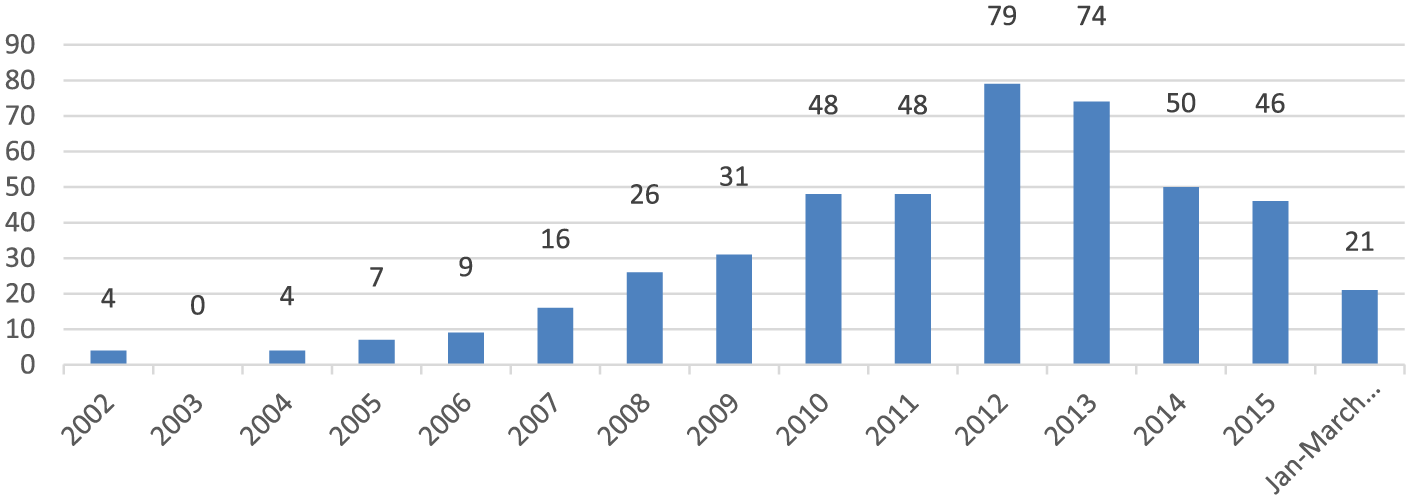
The number of published base of the pyramid (BOP) articles.
The Concept of Cocreation in the BOP Literature
The BOP context poses particular challenges for cocreation (Adekambi, Ingenbleek, & van Trijp, 2015; Saxena, 2015; Sutter, Kistruck, & Morris, 2014; Venn & Berg, 2014); participants come not only from different organizations and sectors but also from different cultures, institutional contexts, educational conditions, and material circumstances. Such disparities in power and practices render cocreation difficult (Kowalkowski, Persson Ridell, Röndell, & Sörhammar, 2012; Ramaswamy, 2009). Even so, only a handful of scholars discuss the defining characteristics of cocreation at the BOP.
The definitions in Table 1 show that the BOP literature echoes other literatures in defining cocreation as interaction that integrates different partners’ knowledge and capabilities, but places added emphasis on iteration. For interaction and cocreation, the BOP literature suggests a two-fold link. First, cocreation comprises interaction (e.g., Arora & Romijn, 2012; Simanis et al., 2008, in Table 1). As noted by Simanis and Hart (2009, p. 83), “innovation isn’t enabled by new relationships, it is the relationship.” Second, interaction builds personal relationships, holding together cocreative partnerships that tend to employ few formal governance mechanisms, especially at the BOP (Calton, Werhane, Hartman, & Bevan, 2013; R. Hahn & Gold, 2014; Rivera-Santos & Rufin, 2010b; P. Sánchez & Ricart, 2010).
Definitions of Cocreation in the Base of the Pyramid (BOP) Literature.

The gist of cocreation is the exploration and integration of the knowledge and capabilities of the partnering organizations and individuals (e.g., London, 2008; Simanis et al., 2008; Sridharan & Viswanathan, 2008, in Table 1). This requires the capability to recognize, appreciate, reconcile, and integrate the knowledge and capabilities of different partners (Hart & Sharma, 2004) or, more generally, market and learning orientation (Baker & Sinkula, 1999). At the BOP, company contributions typically include know-how related to business, technology, and scaling up, while local actors bring knowledge and capabilities related to the local context, needs, and networks.
The BOP research places exceptional emphasis on iteration as a key characteristic of cocreation, for two reasons. First, it takes iteration to combine knowledge and change understandings (Murphy, Perrot, & Rivera-Santos, 2012, in Table 1), especially between actors as unfamiliar to each other as Western company representatives and local actors in BOP contexts (Cholez, Trompette, Vinck, & Reverdy, 2012; Cross, 2013; Prahalad, 2012; Sridharan & Viswanathan, 2008). Second, at the BOP, many markets and business ecosystems need to be built via an iterative process (London & Anupindi, 2012; Ramani, SadreGhazi, & Duysters, 2012; Webb, Kistruck, Ireland, & Ketchen, 2010). One central step is piloting (Gardetti & D’Andrea, 2006; Goyal, Sergi, & Kapoor, 2014; Viswanathan & Sridharan, 2012; Williams, Omar, & Rajadhyaksha, 2012), which is popular among aspiring BOP entrants from small enterprises (Brinkerhoff, 2008; Cross, 2013) to large corporations such as Allianz, Vodaphone (Schuster & Holtbrügge, 2012), British Petroleum (Prahalad, 2012) and SC Johnson (Johnson, 2007).
However, the definitions in Table 1 show great diversity in terms of the proposed participants and purpose of cocreation at the BOP. I conceptualize these primary points of contention as the width and depth of cocreation.
The Width of Cocreation
The BOP approach is built on the view that companies need cocreation with a wide group of partners: “No firm can do this [entry to BOP markets] alone. Multiple players must be involved, including local governmental authorities, nongovernmental organizations (NGOs), communities, financial institutions and other companies” declared Prahalad and Hart (2002, p. 6) in their seminal article (see also, Prahalad & Hammond, 2002). The inclusion of communities echoes other literatures, where consumers are seen as key cocreators (Lusch & Vargo, 2006; Prahalad & Ramaswamy, 2004; Sanders & Stappers, 2008).
Accordingly, many BOP authors emphasize cocreation with low-income consumers or producers, highlighting them as experts in their own needs and capabilities, as well as masters in maneuvering their operating environment (Follman, 2012; Halme et al., 2016; Murphy & Arenas, 2010; Simanis & Hart, 2009; Sridharan & Viswanathan, 2008; Weidner, Rosa, & Viswanathan, 2010). In the words of Julia Elyachar (2012), the poor can contribute social capital, “capability of connectivity” and “skill in solving infrastructural problems.” Empirical studies confirm that successful BOP ventures do indeed tend to include communities (London & Hart, 2004; Wheeler et al., 2005). Moreover, community engagement may be gaining depth: While many studies refer to low-income people merely as distributors (Altman, Rego, & Ross, 2009; Chikweche & Fletcher, 2012; Gollakota, Gupta, & Bork, 2010) or suppliers (e.g., Payaud, 2014; Pervez, Maritz, & De Waal, 2013), some recent studies show them engaging in several stages of business model development (Lassaga & Lanfranchi, 2012; Ramachandran, Pant, & Pani, 2012; Ramani et al., 2012). Indeed, Kolk et al. (2014) suggest that cocreation at the BOP should, by definition, involve low-income communities.
However, many others find cocreation with NGOs sufficient to develop business models suited to BOP contexts, either on its own (e.g., Dahan, Doh, Oetzel, & Yaziji, 2010; R. Hahn & Gold, 2014; Murphy et al., 2012) or complemented by ethnography among the poor (Anderson, Kupp, & Vandermerwe, 2010; Cholez et al., 2012; Prahalad, 2012). These authors highlight NGOs as a source of market expertise (R. Hahn & Gold, 2014; Perez-Aleman & Sandilands, 2008; Schuster & Holtbrugge, 2012, 2014; Webb et al., 2010), capabilities in business model development (Chesbrough, Ahern, Finn, & Guerraz, 2006; Seelos & Mair, 2007), distribution (Dahan et al., 2010; P. Sánchez, Ricart, & Rodríguez, 2005), marketing (Schuster & Holtbrugge, 2012; Van den waeyenberg & Hens, 2012), or training (Gradl, Krämer, & Amadigi, 2010; Reficco & Marquez, 2012), and access to such tangible resources as public development funding (Seelos & Mair, 2007).
Yet other scholars highlight that cocreation with research institutions and business partners has been sufficient to develop many business models suited to BOP contexts (Akhtar, 2013; Brinkerhoff, 2008; Chakma, Masum, Perampaladas, Heys, & Singer, 2010; S. Ray & Ray, 2011; C. M. Sánchez & Schmid, 2013). Some even recommend that large companies focus on engaging their own staff (Gardetti & D’Andrea, 2006), especially staff members from the target country (Berger, Choi, & Kim, 2011; P. K. Ray & Ray, 2010). In sum, views on the appropriate width of a cocreation group vary greatly: Some would rely on company staff, others gather a diverse group of stakeholders including low-income communities.
The Depth of Cocreation
The second contention in BOP research pertains to power relations between companies and their partners. While some authors consider it cocreation when partners are involved in a single value chain activity (e.g., Dahan et al., 2010; Seelos & Mair, 2007), others call for deep participation in business model and ecosystem planning (e.g., Prahalad, 2004; Simanis & Hart, 2009; Sridharan & Viswanathan, 2008, in Table 1), echoing other cocreation research in the pursuit of equality (e.g., Payne et al., 2008; Potts et al., 2008; Prahalad & Ramaswamy, 2004). This diversity of views manifests clearly when scholars discuss the purposes of cocreation at the BOP. Four different purposes can be identified: boosting corporate legitimacy and networks, building business models and ecosystems, ensuring social and environmental value, and empowering poor communities.
Boosting Corporate Legitimacy and Networks
Many authors view cocreation as a tool for companies to gain access to social networks at the BOP (e.g., Johnson, 2007; Rivera-Santos, Rufin, & Kolk, 2012). Access to social networks is important in BOP contexts, because such formal institutions as property rights, contracts, and labor markets are weak (North, 1990), and business is typically based on personal contacts (Khanna & Palepu, 1997; Mair & Marti, 2009; C. M. Sánchez & Schmid, 2013). As a key entry mechanism to social networks is introduction by a trusted network member (Uzzi, 1996), relationships with well-connected BOP actors are essential for newcomers. Furthermore, reputable allies may help companies build legitimacy and market their products or services (Dahan, Doh, & Teegen, 2009; Santos & Laczniak, 2015; Rivera-Santos & Rufín, 2010a; Van den Waeyenberg & Hens, 2012). Many poor communities view large foreign corporations with distrust due to colonial struggles, or later sweatshops, harsh competition with local companies, and environmental disregard (Blowfield & Dolan, 2014; London, Anupindi, & Sheth, 2010).
Building Business Models and Ecosystems
Most commonly, scholars see cocreation as a means to imagine and realize new business models at the BOP (e.g., Dahan et al., 2010; Radjou & Prabhu, 2012; Seelos & Mair, 2007; Vachani & Smith, 2008; Webb et al., 2010). Specifically, cocreation can help companies gain knowledge of the novel business context (Anderson et al., 2010; R. Hahn & Gold, 2014; Schuster & Holtbrügge, 2014, 2012) and consumer needs (Nakata & Weidner, 2012; P. K. Ray & Ray, 2010; Viswanathan & Sridharan, 2012). Such knowledge cannot be accessed easily via traditional market surveys or observation, because people’s views are molded by the prevailing practices and awareness (Maunder, Marsden, Gruijters, & Blake, 2007; Ramani et al., 2012). Hence, companies need to engage with local communities in “ongoing exploration, engagement and experimentation” (Simanis & Hart, 2009, p. 83).
Companies and local actors can also cocreate entire business ecosystems, for instance by raising customers’ awareness, establishing support organizations, and advocating for new policies (Reficco & Márquez, 2012; Reiner, Gold, & Hahn, 2015; P. Sánchez & Ricart, 2010; Schuster & Holtbrügge, 2012). Compared to paid subcontracting, cocreative partnerships may be more acceptable to NGOs and other partners who are averse to corporate cooptation (Rivera-Santos & Rufin, 2010b), and easier to govern because cocreative interaction and information exchange generate trust (Venn & Berg, 2014). Companies that have reportedly engaged in ecosystem development include Allianz in India (Schuster & Holtbrugge, 2012), Amanco in Guatemala (P. Sánchez & Ricart, 2010), Danone in West Africa (Auriac, 2010), Irupana in Bolivia (Reficco & Márquez, 2012), and Tetra Pak in Africa (P. Sánchez et al., 2005).
Ensuring Social and Environmental Value
Some scholars emphasize cocreation as a means to secure value for low-income communities (Ben Letaifa & Reynoso, 2015; Gupta & Khilji, 2013; Kleine, 2011; Mehta & Mehta, 2011; Simanis & Hart, 2009). There are several grounds for suggesting this. First, business does not automatically confer substantial societal value. As noted by Kuriyan, Ray, and Kammen (2008, p. 73), “the path from affordable products and services to social development is neither short nor direct” (see also, Errington, Fujikura, & Gewertz, 2012; Kuriyan, Ray, & Toyama, 2008; Schwittay, 2011). The same applies to unskilled employment (Blowfield & Dolan, 2010; Gupta & Khilji, 2013). Second, BOP ventures—like other development initiatives—often have multifarious unexpected impacts (Bhatia & Ritchie, 2016; Davidson, 2009; London & Esper, 2014). Even income growth can reduce rather than enhance well-being, if it disrupts the social environment (Ansari, Munir, & Gregg, 2012; Gascón, 2015; Hill, 2016). In the worst cases, well-meaning BOP initiatives have strengthened unequal norms and power structures, further marginalizing the poor (Karnani 2007; Kuriyan, Ray, & Kammen, 2008; Varman, Skålén, & Belk, 2012). Cocreation with local communities and experts can help in mapping these impacts (Esteves, Franks, & Vanclay, 2012).
Third, the value-in-use of a product, service, or entrepreneurial opportunity is always in the eye of the beholder, as highlighted in the cocreation-related marketing research (Grönroos & Voima, 2013; Vargo, Maglio, & Akaka, 2008). Companies may find it difficult to predict value-in-use (Calvano, 2008; Dey, Binsardi, Prendergast, & Saren, 2013; Dey, Pandit, Saren, Bhowmick, & Woodruffe-Burton, 2016), especially as poor people may assign little value to savings in time or effort (Sridharan & Viswanathan, 2008) and Western entrepreneurial models (Cholez et al., 2012). Fourth, cocreation may yield solutions to wicked social or environmental problems, which none of the participants could imagine or realize on their own (De-Burgos-Jiménez, Vazquez-Brust, & Plaza-Úbeda, 2011).
Empowering Poor Communities
A few scholars suggest a yet more fundamental link between cocreation and poverty reduction: If poverty is seen as a lack of capabilities (Sen, 1989), cocreation that encourages poor people to build their own confidence, skills, voice, and agency is at the core of poverty reduction (Ansari et al., 2012; Kolk, Dolen, & Vock, 2010: Simanis & Hart, 2009). Such cocreation can empower poor communities to defy existing power relations, challenge the structural drivers of poverty, and spur social change. It is then not the products or services, but the cocreative process itself that may bring lasting value to poor communities. One BOP initiative that has reportedly empowered a poor community is the partnership of Gas Natural and a local NGO in Argentina, which supported communities in organizing, pooling their resources, and negotiating with utilities companies (Lassaga & Lanfranchi, 2012; Reficco & Márquez, 2012).
In the BOP literature, the concept of empowerment is still fluid (Ansari et al., 2012; Dolan, Johnstone-Louis, & Scott, 2012; Rohatynskyj, 2011), and some authors view empowerment as entrepreneurial opportunities (London & Hart, 2004; Sridharan & Viswanathan, 2008) or even as increased consumption (Arnold & Valentin, 2013; Craig & Douglas, 2011; London et al., 2010). Others, however, emphasize people’s capacity to claim their rights, challenge unequal societal norms, and seek social change (Ansari et al., 2012; Dolan & Rajak, 2016; Hill, 2010; Lindeman, 2012; Reficco & Márquez, 2012).
An Organizing Framework for Cocreation at the BOP
I propose that the diverse conceptualizations of cocreation at the BOP can be presented in a simple organizing framework shown in Figure 2. In this framework, the x-axis depicts the width of cocreation from focused to inclusive, while the y-axis depicts the depth of cocreation from business-driven to empowerment-driven. At the business-driven end of the scale, the company engages in cocreation in order to gain access to and legitimacy in social networks. Efficiency seeking cocreation aims to develop business models suited to BOP contexts, sustainability seeking to ensure social and environmental value, and empowerment seeking to empower low-income communities.
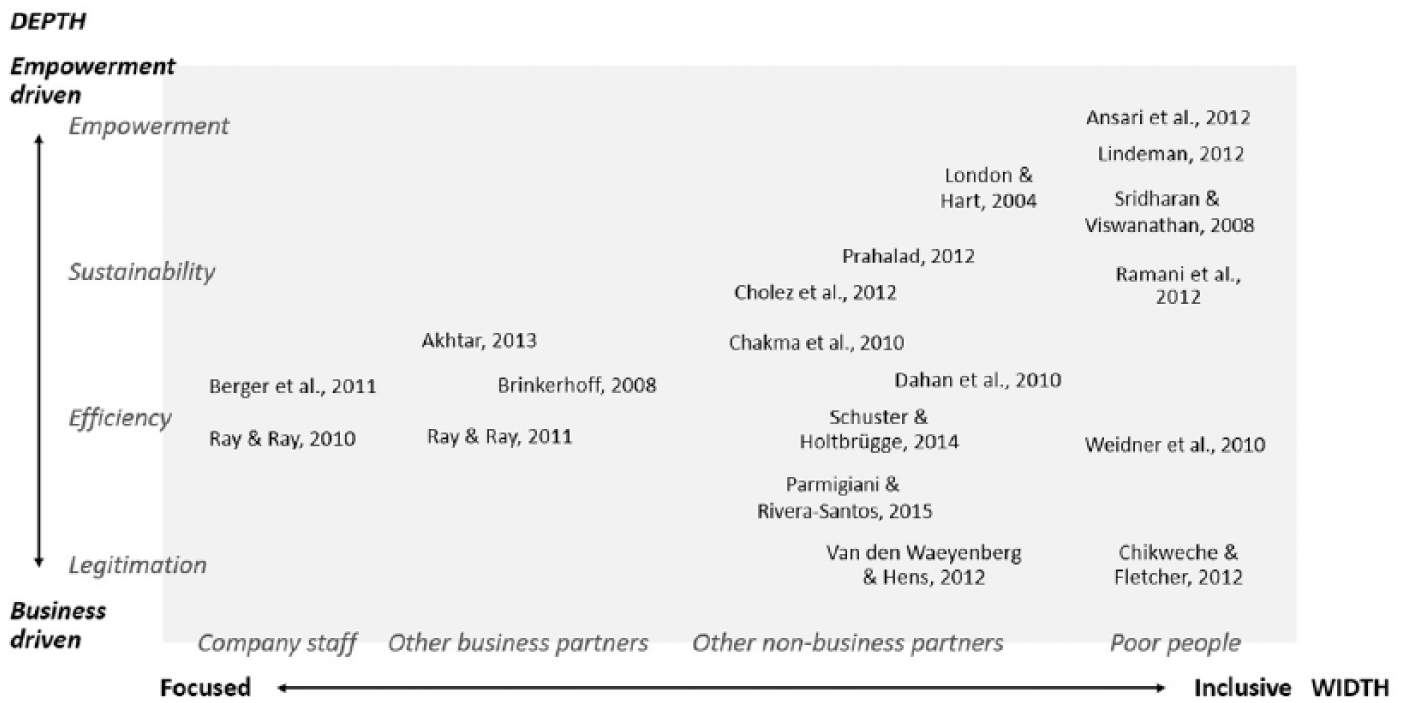
Different conceptualizations of cocreation in the base of the pyramid (BOP) literature.
This framework draws on development studies, where a related discussion on poor people’s participation started in the 1970s. Propelled by Gandhian notions of village self-reliance (Gandhi, 1962) and Freirean thinking on learning and social transformation (Freire, 1970), participation became one of the most widely used concepts in the development debates of the 1980s and 1990s (Chambers, 1983; Pretty, 1995), partially because it tied in with both the neoliberal call to complement market deregulation with institutional and social development and the post-Marxist call for the empowerment and mobilization of marginalized groups (Mohan & Stokke, 2000). In the 1990s, the discussion widened from the right to participate in development projects to participation in public decision-making (Cornwall, 2000).
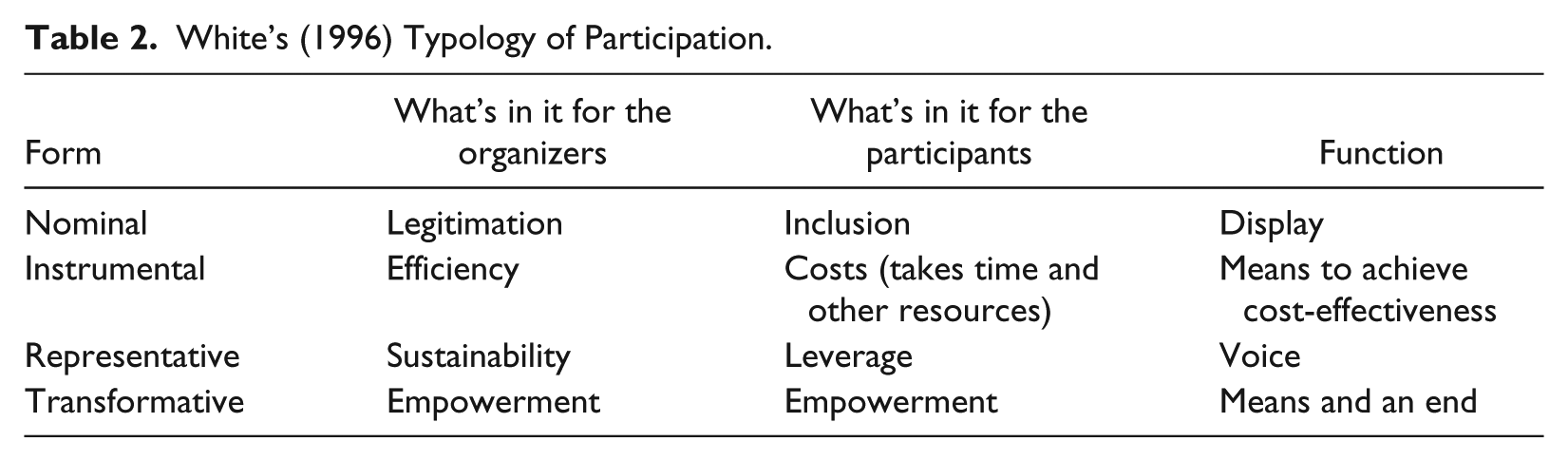
Participation in development initiatives has come to carry multiple meanings. Broadly speaking, development scholars distinguish between “information gathering” and “rapport-building” (Mosse, 1994) or “efficiency seeking” and “transformative” participation (Cooke & Kothari, 2001). For example, in a widely cited book titled Participation: The New Tyranny, Cooke and Kothari (2001) present multiple initiatives where participation has merely served to boost efficiency, and its potential for social transformation has been lost. In response, Participation: From Tyranny to Transformation by Hickey and Mohan (2004), presents cases where participation has been more transformative. Other scholars have classified different types of participation (e.g., Arnstein, 1969; Cohen & Uphoff, 1980; Deshler & Sock, 1985). This review borrows labels for the depth of cocreation from the classification of White (1996; Table 2).
White’s (1996) Typology of Participation.
Suggesting that cocreation may be business- or empowerment-driven does not mean to imply that BOP initiatives could not strive for both profitability and development—usually they do. But BOP initiatives tend to be built on several types of cocreative relationships, events, and phases. Some cocreative relationships and events discussed in the BOP literature address broad challenges via equal, rapport-building, and empowering interaction, while others focus tightly on company offerings. A suitable balance between different types of cocreation allows a BOP initiative to generate both profits and well-being. When no balance is found, a BOP initiative may be excessively driven by either objective. Short-term profit objectives have prevented many multinational enterprises from launching or sustaining BOP initiatives (Halme, Lindeman, & Linna, 2012; McFalls, 2007; Olsen & Boxenbaum, 2009; Schwittay, 2009), and scholars have recommended postponing profit objectives (Elaydi & McLaughlin, 2012; London & Anupindi, 2012; Reficco & Márquez, 2012; Simanis et al., 2008; Webb et al., 2010), or even lowering them (Kistruck, Beamish, Qureshi, & Sutter, 2013). In the words of Prahalad (2004, p. 9), “profit creation and poverty alleviation do not mix easily.”
In sum, there is a variety of views amongst BOP authors on the width and depth of cocreation that is needed for inclusive business development at the BOP. This variety is depicted in the exemplary references presented in Figure 2.
Furthermore, some BOP authors use other concepts instead of or interchangeably with cocreation (e.g., codevelopment in Rivera-Santos & Rufin 2010b; P. Sánchez & Ricart, 2010; Simanis et al., 2008; coproduction in Cross, 2013; Rangan, Chu, & Petkoski, 2011; Weidner et al., 2010; and coinvention in Gardetti & D’Andrea, 2006; Kolk et al., 2014; London & Hart, 2004). Each of these concepts not only relates to stakeholder engagement but also has its own scholarly history and connotations. In other fields of business research, codevelopment typically refers to business-to-business collaboration in product development (Chesbrough & Schwartz, 2007; Fliess & Becker, 2006), while coproduction implies consumer participation in production—for instance, by serving himself/herself at a petrol station—with less emphasis on value sharing (Etgar, 2008; Lusch & Vargo, 2006). Coinvention typically refers to joint inventions patented by two or more actors (Balconi, Breschi, & Lissoni, 2004; Meyer & Bhattacharya, 2004).
I present the organizing framework in the hope that it will encourage BOP authors to define more accurately what they imply by cocreation. Up to now, most BOP studies that refer to cocreation reveal little about the width or depth of interaction—Has the engagement been an arms-length business relationship, also entailed joint planning, or even encouraged poor communities to build their own voice and agency? This diversity and lack of transparency hinders the accumulation of knowledge.
The Necessity and Feasibility of Cocreation at the BOP
The organizing framework facilitates a nuanced discussion on the necessity and feasibility of cocreation at the BOP, especially if it is coupled with development scholars’ understanding on the multiple dimensions of poverty and the challenges of engaging the poor.
In particular, the organizing framework prompts the question “necessary for what”? Cocreation takes on different levels of necessity, depending on whether we focus on business development or societal value. In terms of business development, a few authors have adeptly initiated a discussion on whether (deep and wide) cocreation is equally important in all circumstances, industries, and business environments (Kolk et al., 2014; P. Sánchez & Ricart, 2010; Seelos & Mair, 2007; Siim et al., 2013). Notably, Seelos and Mair (2007) suggest that companies can evade cocreation with low-income communities by joining businesses already established at the BOP by social entrepreneurs or NGOs. Moreover, P. Sánchez and Ricart (2010) note that companies with affordable and simple products may be able to enter the BOP, especially the most resource-rich and least dynamic BOP markets, without substantially tailoring their business model. Furthermore, relatively focused cocreation with business partners and research institutions has been found sufficient to develop BOP business in the medical industry (Chakma et al., 2010). The same has been claimed but also disputed with regard to the household appliance (Prahalad, 2012; C. M. Sánchez & Schmid, 2013; Tasavori, Zaefarian, & Ghauri, 2015) and automobile industries (Akhtar, 2013; S. Ray & Ray, 2011; Singh & Srivastava, 2012).
In terms of poverty reduction, the research shows that deep and wide cocreation is not always necessary to bring affordable products or services—which may be as valuable as medicines (Chakma et al., 2010)—to the poor. Even complex problems such as waste management in megacities may be alleviated through cocreation between competent partner organizations, without engaging low-income communities (Seelos & Mair, 2007).
Nevertheless, it can be questioned whether BOP initiatives can reach their full potential in poverty alleviation without wide and deep cocreation. The answer depends on your conception of poverty. In many BOP articles, poverty is viewed predominantly through an economic lens, seeing low purchasing power as the essence of poverty and cheaper goods and services as a potent response. Schwittay (2011, p. S73) refers to this as “marketization of poverty” and an “instrument-effect”: Poverty has been conceptualized as a problem that can be solved by market mechanisms (see also, Blowfield & Dolan, 2014; Schwittay, 2014). In development studies, this unidimensional view faded in the 1990s, questioned, for example, by Amartya Sen’s work (1989) on poverty as a lack of capabilities (Nandy & Pomati, 2015; Ferreira & Lugo, 2013). Since then, development scholars have emphasized the importance of empowering poor communities to seek social change (Fukuda-Parr, 2003; U.N. Development Programme, 1999). In the same vein, some BOP authors have called for companies to empower their partners (De-Burgos-Jiménez et al., 2011; Faulconbridge, 2013; R. Hahn & Gold, 2014; Hart, 2006), low-income entrepreneurs (Arora & Romijn, 2012; Rivera-Santos & Rufín, 2010a), or low-income communities as a whole (S. R. Chatterjee, 2009; Corus & Ozanne, 2012; Murphy & Arenas, 2010). Such empowerment requires wide and deep participation (Hickey & Mohan, 2004; Mohan & Stokke, 2000; White, 1996). Therefore, if we embrace the capability view of poverty, wide and deep cocreation is crucial for BOP initiatives to contribute to poverty alleviation.
Regarding feasibility, research suggests that the challenges and depth of cocreation grow hand in hand: It is easiest for companies to reach cocreation that brings them access and legitimacy in social networks. Even legitimacy seeking cocreation, nevertheless, has its challenges: Integration into social networks is slow, because BOP markets are characterized by frequent interaction between small firms and their regular customers, and economic and social relationships are tightly intertwined (Weidner et al., 2010).
Efficiency seeking cocreation, which focuses on business model development, requires deeper integration of partners’ knowledge and capabilities. Such integration is difficult, due to differences in dominant logics (Murphy et al., 2012), practices (Kowalkowski et al., 2012), and types of knowledge (Agrawal, 1995; Gardetti, 2005). Another challenge is selecting competent partners (Gradl et al., 2010; R. Hahn & Gold, 2014; Schuster & Holtbrugge, 2014), and motivating them. Development scholars suggest that partners’ interest in cocreation may be checked by bad experiences and a high number of development initiatives (Michener, 1998; Mosse, 1994), while innovation research recommends different incentives for reward-oriented, curiosity-driven, and need-driven partners (Füller, 2010; Nambisan & Baron, 2009).
In sustainability seeking cocreation, to map the societal impacts of a BOP initiative, a company needs to hear varied groups of people (Arora & Romijn, 2009). As elsewhere, individuals have different opportunities to participate and benefit, because differences in wealth, gender, and ethnicity, for instance, render communities at the BOP heterogeneous and conflictual (Das & Takahashi, 2014; Rivera-Santos & Rufin, 2010a; Varman et al., 2012). Development scholars have discovered, for instance, that poor women seldom participate in development initiatives (Mayoux, 1995); participatory workshops are typically swayed by individuals whose status and abilities enable them to cloak their opinions in general terms (Mosse, 1994), and elite capture of decision making is common (Jeffrey, Jeffery, & Jeffery, 2008). NGOs may or may not be helpful guides in hearing the poorest people, as they have different degrees of connections with communities and sensitivity to social inequalities (Blowfield & Frynas, 2005; Nyamugasira, 1998; Rein & Stott, 2009).
Empowerment seeking cocreation is particularly challenging, because it requires companies to share decision-making power with communities. BOP research notes that such a stride toward equality takes exceptional mind-sets (Calton et al., 2013; Murphy & Arenas, 2010; Simanis et al., 2008), and a decentralized corporation (McFalls, 2007; Ramachandran et al., 2012; Sridharan & Viswanathan, 2008). A few BOP studies report successes in relinquishing a degree of operational control (Ramachandran et al., 2012; Reficco & Márquez, 2012; P. Sánchez & Ricart, 2010), while others note that significant inequalities tend to persist (Arora & Romijn, 2012; Schwittay, 2009). Nonprofit development projects have faced similar difficulties (Mosse, 1994). As White (1996) puts it, “top-down commitment to others’ empowerment is highly contradictory” (p. 13). Critical marketing scholars have also debated whether cocreation can empower people or merely trap them into producing for firms (Cova et al., 2011; Zwick, Bonsu, & Darmody, 2008).
In sum, the framework helps in organizing the previous research on the necessity and feasibility of cocreation at the BOP. If we embrace the multidimensional view of poverty, wide and deep cocreation is necessary for BOP initiatives to contribute to poverty alleviation—but such cocreation is demanding. Unfortunately, there are to date no empirical BOP studies that focus on cocreation, and we know little about the processes or methods of cocreation at the BOP.
Conclusions
Cocreation is a popular concept in the base of the pyramid approach, but very few BOP studies scrutinize or even define it. This article analyzes the concept of cocreation in BOP contexts, reviewing 196 BOP articles relevant for this topic. Following the call for more cross-fertilization between BOP and other literatures (Hansen & Schaumburg-müller, 2010; Kolk et al., 2014), lessons have also been drawn from the closely related but often neglected field of development studies.
I find that BOP research shows a considerable range of views on the appropriate participants and purpose of cocreation. Building on development research, I propose a framework that organizes this diversity as the width and depth of cocreation. In terms of the width of participation, some BOP scholars would narrowly rely on local company staff while others emphasize the benefits of engaging a wide group of cocreators including low-income communities. In terms of the depth, the framework distinguishes between legitimacy-, efficiency-, sustainability-, and empowerment-seeking cocreation: Cocreation can refer to arms-length cooperation that merely raises the legitimacy of a company in BOP markets or, at the other extreme, equal interaction that empowers poor communities and fosters social change.
Based on my review, the development studies literature and the organizing framework, I suggest that wide and deep cocreation at the BOP can be defined as iterative interaction that empowers poor communities and integrates their knowledge and capabilities with those of a company and other actors throughout the process of planning and realizing novel business models and ecosystems.
This literature review was motivated by two tensions: Recent research has questioned whether cocreation is necessary for inclusive business development or even feasible in BOP contexts. I argue that wide and deep cocreation is not always necessary to bring affordable and necessary products and services to the poor, but it is crucial for BOP initiatives to address the structural drivers of poverty. However, the challenges and depth of cocreation rise hand in hand; it is very difficult for companies to engage in cocreation that empowers poor communities.
Further research is needed to better understand the potential of cocreation at the BOP. In general, future BOP research should be more accurate in defining cocreation and more eager to take advantage of insights from closely related research, including research on transformative cross-sector partnerships (e.g., Crane & Seitanidi, 2013; T. Hahn & Pinkse, 2014; Ritvala, Salmi, & Andersson, 2014; Wassmer, Paquin, & Sharma, 2014). Moreover, studies that focus on cocreation at the BOP are needed in particular to (1) understand how different cocreation processes evolve, (2) identify factors and practices that facilitate deep and wide cocreation, and (3) analyze the methods of cocreation at the BOP. Studies on the process and facilitators of cocreation would benefit from rich and longitudinal empirical material that documents both the interactions between and the perceptions of cocreating partners, capturing their subjective assessments of the gained value. Studies on cocreation methods, on the other hand, can greatly benefit from the findings of participatory rural appraisal (Chambers, 1983, 2004) and participatory design (Mattelmäki, Brandt, & Vaajakallio, 2011; Sanders & Stappers, 2008). Until we know more about the prevalence of wide and deep cocreation in BOP initiatives, we can say little about the poverty reduction potential of the BOP approach.
Footnotes
Acknowledgements
The author would like to thank Tuomas Ylä-Anttila, Arno Kourula, Victoria Lowerson, Kristiina Mäkelä, Tiina Ritvala and members of the Sustainability in Business research group at Aalto University School of Business for their comments and support. I also thank the editor of Organization and Environment, the special issue editors and anonymous reviewers for their constructive and inspiring suggestions for strengthening this paper.
Declaration of Conflicting Interests
The author declared no potential conflicts of interest with respect to the research, authorship, and/or publication of this article.
Funding
The author disclosed receipt of the following financial support for the research, authorship, and/or publication of this article: This research was partially funded by the Foundation for Economic Education (Liikesivistysrahasto) in Finland and Tekes – the Finnish Funding Agency for Innovation (Project 1526/31/2012).