




Abstract
This article aims to encourage research into how organizations can manage their resilience in response to adverse conditions stemming from the natural environment (ecological adversity). While firms may have a general ability to cope with unfavorable operating environments, adaptation to ecological adversity in particular may actually face serious limitations. Using an interdisciplinary approach that draws from resilience theory in socioecology, this article develops several lines of inquiry. First, we identify the mechanisms by which organizational resilience may fluctuate as firms adapt to changing levels of ecological adversity. Second, we suggest that the existing conceptualization of organizational resilience could be expanded to include transformative change, which may allow firms to mitigate the operational impacts of reaching adaptation limits. Finally, we consider the resilience implications of the interdependency between firms and the broader ecosystems in which they operate. We conclude with potential avenues for future research in this area.
Keywords
Organizational scholars have long been interested in firms’ ability to cope with adverse conditions in their operating environments. Previous research has considered both internal adversity, such as structural and leadership changes, or performance shortfalls, and external adversity, such as competition, stakeholder demands, or other aspects of firms’ regulatory and institutional environments (Linnenluecke, Griffiths, & Winn, 2013; Sutcliffe & Vogus, 2003). The concept of organizational resilience has been used more recently to describe firms’ ability to maintain or regain functioning despite a major mishap or in the presence of continuous stress (Hollnagel, 2006; Sutcliffe & Vogus, 2003). Firms may build resilience through adaptation, defined by Levinthal (1994) as a “change in a significant organizational attribute, such as a basic business strategy or organizational structure in response to environmental change” (p. 171).
Despite these foundations, there are still unanswered questions regarding how the nature and magnitude of adversity experienced by firms may affect their ability to adapt and thereby maintain resilience. In particular, adaptation to adversity stemming from the natural environment, including from climate change, land use and land cover change, or shifts in hydrological cycles, may actually face serious limitations (Adger & Barnett, 2009; Intergovernmental Panel on Climate Change [IPCC], 2014a; Risky Business Project, 2014). We use the term ecological adversity to describe the intensity of unfavorable changes in natural environment conditions that can hinder firm operations. While firms may be able to cope with low to moderate levels of ecological adversity, their adaptive actions may become unfeasible and/or ineffective at higher levels of adversity. Firms may thus reach an adaptation limit (Dow et al., 2013), or a point at which available adaptation may no longer be sufficient to maintain their core business. Firms may therefore need to undertake more in-depth or transformative change (Kates, Travis, & Wilbanks, 2012; Linnenluecke & Griffiths, 2010), or else risk jeopardizing long-term survival. Yet the mechanisms by which firms may reach adaptation limits and undergo potential transformation have not yet been adequately described in the organizational context (Beermann, 2010).
There are also unanswered questions regarding how the interplay between adaptation and firms’ wider resource contexts may affect resilience. In particular, we do not yet have a good understanding of the potential interdependencies between firm adaptation and the ecological context in which actions are implemented (Starik & Kanashiro, 2013; Winn & Pogutz, 2013). Yet the effectiveness of firm adaptation may hinge on the impacts that these very actions may be having on resources within local ecosystems (ecosystem services), as firms may in turn rely on these resources for adaptation (Nelson, Adger, & Brown, 2007; Starik & Rands, 1995).
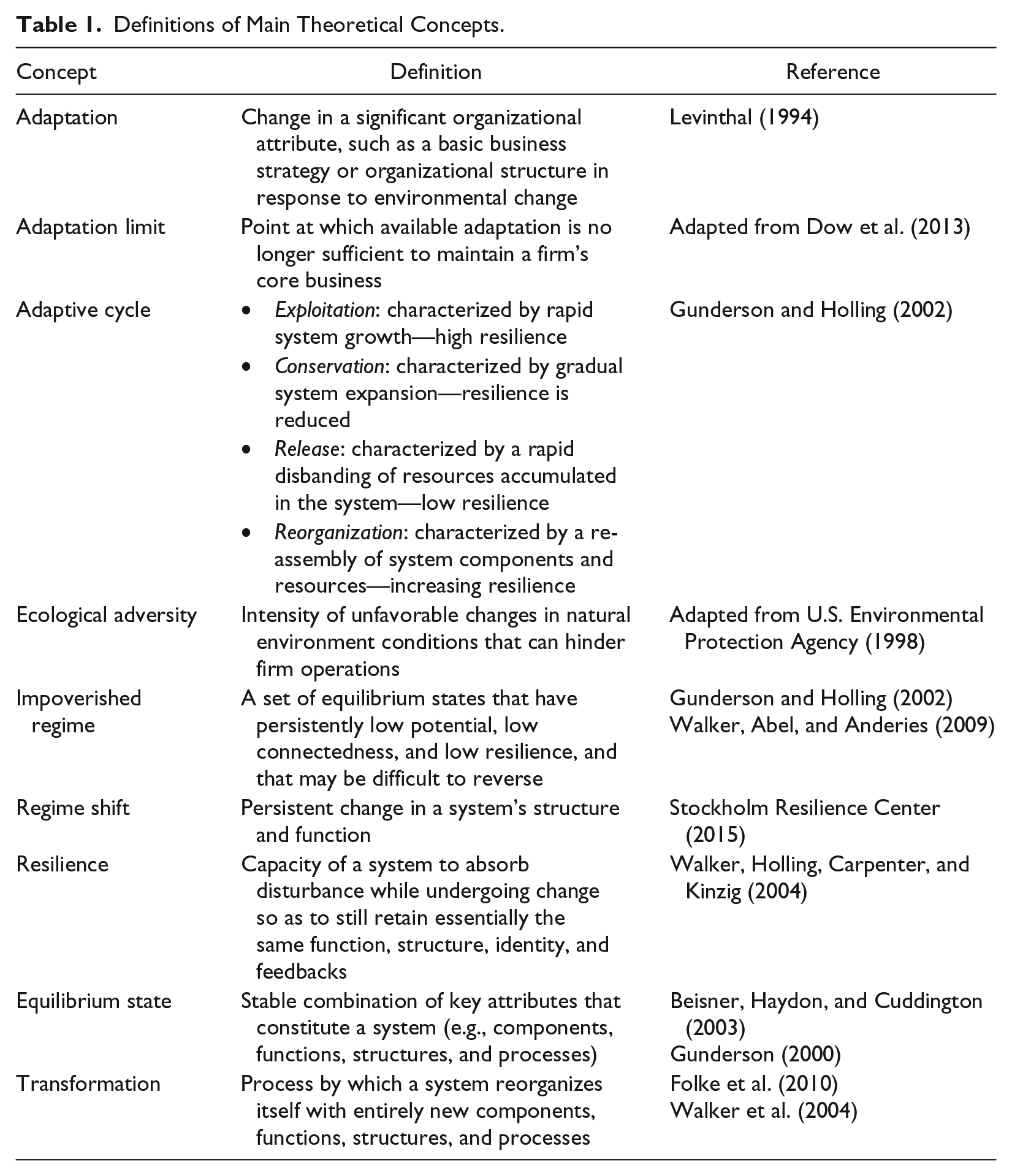
In examining these questions, we draw on resilience theory from socioecology and develop several lines of inquiry. We first apply the theory’s conceptualization of adaptation as a cyclical process that is regulated by external disturbances to consider how ecological adversity may drive firms to reach adaptation limits in different phases of their adaptive cycle. Ecological adversity at low to moderate levels may at first drive firms to adapt through actions that attempt to sustain their core business. However, firms may find that their ability to do so eventually becomes constrained as higher levels of adversity start to undermine the viability of their adaptive actions. We then consider how firms may have the opportunity to undertake more transformative change on reaching adaptation limits. Through such change, firms may be able to maintain and renew resilience despite heightened ecological adversity by adopting organizational forms that reduce vulnerability to adversity. Finally, we also seek to shed light on the potential interdependencies between firms and their local ecosystems. Organizational resilience may be contingent on how firms manage the broader ecosystems in which they operate because of the impacts that firm actions can have on those systems. This may be the case in particular for firms that heavily depend on ecosystem services for their core business or for adaptation. We develop propositions for each of our main lines of inquiry. Our article then concludes with potential avenues for future research. Table 1 provides summary definitions of the article’s main theoretical concepts.
Definitions of Main Theoretical Concepts.
We therefore propose to extend the budding literature on organizational resilience to ecological adversity by incorporating key concepts from resilience theory in socioecology. First, we identify the mechanisms by which organizational resilience may fluctuate as firms adapt to changing levels of ecological adversity. Second, we suggest that the existing conceptualization of organizational resilience could be expanded to include transformative change, which may allow firms to mitigate the operational impacts of reaching adaptation limits. Finally, we explicitly draw out the relationship of “mutual impact and dependence” (Winn & Pogutz, 2013, p. 220) that firms may share with their broader ecosystems and consider the implications that this interdependency might have for both organizational and ecosystem resilience.
Introducing Resilience Theory
Resilience and the Adaptive Cycle
While resilience is still a relatively new concept in the organizational literature, it has been explored in a number of other fields (Lengnick-Hall & Beck, 2005; Linnenluecke & Griffiths, 2013; Vogus & Sutcliffe, 2007; Yang, Bansal, & DesJardine, 2014;). These include disaster risk and emergency management (Bruneau et al., 2003; Rose & Liao, 2005), supply chains (Fiksel, 2003), psychology (Luthar, Cicchetti, & Becker, 2000), and socioeconomic systems (Levin et al., 1998; O’Brien, Sygna, & Haugen, 2004) among others.
In the organizational literature, scholars have mainly examined resilience in the context of high-reliability organizations (Weick & Sutcliffe, 2001) or in the context of firm responses to extreme weather events (Linnenluecke & Griffiths, 2012). As defined above, organizational resilience represents firms’ ability to maintain or recover (and even improve) functioning despite the presence of adverse conditions (Sutcliffe & Vogus, 2003; Weick & Sutcliffe, 2001). Resilience is therefore conceptualized as a relatively stable quality that is put to the test once a discontinuity occurs and a firm adapts to return to its original equilibrium.
This contrasts with the most recent developments on resilience theory in socioecology, 1 which is distinct in its assumption that a given system may actually exist in multiple possible equilibriums (Gunderson, 2000). In resilience theory, adaptation is conceptualized as a process or adaptive cycle along which a system progresses through different equilibrium states. Equilibrium states are stable combinations of the key attributes that constitute a system (e.g., components, functions, structures, and processes; Beisner, Haydon, & Cuddington, 2003; Gunderson, 2000). In contrast to the current conceptualization of organizational resilience, a system’s resilience in socioecology is therefore more dynamic: It is determined by the type and level of adaptation that the system is undergoing during a given phase of the adaptive cycle. Resilience in socioecology can formally be defined as “the capacity of a system to absorb disturbance while undergoing change so as to still retain essentially the same function, structure, identity, and feedbacks” (Walker, Holling, Carpenter, & Kinzig, 2004).
A system’s adaptive cycle is structured along four main phases: exploitation, conservation, release, and reorganization (Gunderson & Holling, 2002). The ecological example of mixed spruce and fir tree forests in the eastern United States can serve to illustrate the different phases of the adaptive cycle (Holling, 2001). In these forests, long periods of growth and maturation are followed by rapid periods of destruction triggered by intense disturbances, which then lead to periods of revival and back to forest regrowth (Holling, 2001). In this example, fire and insect outbreaks play the role of disturbance agents (Holling, 2001). The dynamics in these ecosystems constitute a natural phenomenon that is an important part of forest renewal and regeneration (Holling, 2001).
The exploitation phase of the adaptive cycle is characterized by rapid growth (Allen, Angeler, Garmestani, Gunderson, & Holling, 2014). In this initial phase, a system is highly influenced by external disturbances since it initially has low interconnectedness between its different components (Gunderson & Holling, 2002). Progressively, the system becomes dominated by components that have high adaptability to these disturbances (Gunderson & Holling, 2002). These components in turn collectively and rapidly expand the system by securing resources critical to system functioning (Allen et al., 2014). Resilience is high in this phase of the cycle thanks to the system’s high adaptability and capacity to maintain functioning (Gunderson & Holling, 2002). During the exploitation phase in the forest example, the landscape is initially sparse and exposed. The ecosystem then progressively becomes colonized by highly adaptable species such as grasses and shrubs, which eventually pave the way for young growing trees.
The conservation phase of the adaptive cycle is characterized by a more gradual expansion of the system (Allen et al., 2014). As interconnectedness within the system grows, functions and processes become more established and those components that have greater adaptive efficiency are retained (Gunderson & Holling, 2002). The system as a whole is thus able to bring external disturbances under control and to gradually continue accumulating resources (Gunderson & Holling, 2002). During the conservation phase in the forest example, the ecosystem evolves toward a denser mature forest (Holling, 2001). At first, the slow maturation rate of trees helps control the amount of foliage in the forest (Holling, 2001). This reduces the amount of fuel available for fire in the forest. This also allows insectivorous birds to prey on insects, reducing their populations (Holling, 2001). As a system continues along this trajectory however, it may also become less flexible, thus reexposing potential vulnerabilities to external disturbances (Holling, 2001). Resilience can be reduced in this phase, as the system may lose its ability to withstand new waves of increasing disturbances. In the forest example, this rigidity becomes progressively manifest as the increasing density of the forest structure reduces the effectiveness of insect predation by birds and increases the fuel available for fire (Holling, 2001). As a result, the forest may no longer be able to suppress insect or fire outbreaks as effectively.
The release phase of the adaptive cycle is characterized by the rapid disbanding of resources accumulated in the system (Allen et al., 2014). This phase is triggered when external disturbances reach a high point of magnitude that overwhelms the system’s capacity to maintain functioning (Holling, 2001). In other words, external disturbances cross a threshold that induces the system to reach an adaptation limit. During the release phase, adaptability collapses, functions and processes break down, and the system reaches its lowest level of resilience. In the forest example, the ecosystem eventually becomes limited in its ability to control insect populations and the potential fuel for fire (Holling, 2001). A release phase is triggered when a significant insect outbreak or fire occurs, decimating the forest (Holling, 2001).
Finally, the reorganization phase of the adaptive cycle is characterized by a reassembly of system components and resources (Allen et al., 2014). Existing resources left over from previous exploitation and conservation phases consolidate, allowing the system to reset and transition to another exploitation phase, as it closes the previous adaptive cycle (Allen et al., 2014; Holling, 2001). Resilience increases again in this phase, as the system is once again highly influenced by external disturbances, favoring high adaptability (Gunderson & Holling, 2002). In the forest example, reorganization leads to renewal and regrowth as the ecosystem enters a new cycle, with banks of residual seeds eventually enabling the regeneration of young growing trees.
Resilience and Transformation
Rather than just resetting a system, however, the reorganization phase of the adaptive cycle may also involve the association of entirely novel components and resources (Gunderson & Holling, 2002). A system may thus experience a regime shift, which fundamentally alters its nature (Walker et al., 2004). The transformation of a system in this way can be defined as the process by which a system reorganizes itself with entirely new components, functions, structures, and processes (Adger, 2009; Folke et al., 2010; Walker et al., 2004). A system may be driven to undergo transformation particularly if external disturbances render a return to its original regime untenable (Walker et al., 2004). As the system enters the exploitation phase of a new adaptive cycle, it may therefore begin building resilience to an entirely different set of external conditions.
Such transformations have been identified in a number of socioecological systems, where strategic investments, divestments, and structural changes have been implemented in order to transition a system toward a new regime (Walker et al., 2004; Walker et al., 2009). For example, Cumming (1999) describes how changes in land use during the 1990s transformed the region of southeastern Zimbabwe from an economy focused primarily on agriculture to one primarily focused on wildlife. Extensive livestock production from both cattle ranching and subsistence agriculture, complemented by marginal dryland crop production, originally constituted the predominant form of land use in the region. From 1992 to 1994, an extended drought decimated livestock and crop production. From there, many large commercial ranches removed both remaining livestock and internal fences to transform themselves into joint wildlife conservancies (Cumming, 1999). Some subsistence farmers subsequently negotiated to join their land to these conservancies (Cumming, 1999). As a result, multiple uses of biodiversity, including safari hunting, game cropping, and ecotourism replaced livestock production as the principal livelihood activity (Cumming, 1999).
Problems may arise, however, when external disturbances trigger a release phase, but the system does not possess adequate residual resilience to reorganize itself. The transition between the conservation and release phases or the point at which a system reaches an adaptation limit therefore represents a critical juncture. This is because a system’s level of resilience at this point may determine the nature of the regime into which it can reorganize itself. In other words, if the system possesses adequate residual resilience, it may transition back into its original regime or into a novel one and begin rebuilding resilience. If not, the system risks losing its key attributes, collapsing its adaptive cycle, and potentially flipping into an impoverished regime. An impoverished regime can be defined as a set of equilibrium states that have persistently low potential, low connectedness, and low resilience, and that may be difficult to reverse (Gunderson & Holling, 2002; Walker et al., 2009).
Catastrophic shifts in certain ecosystems, for example coral reefs, illustrate this type of transformation (Scheffer, Carpenter, Foley, Folke, & Walker, 2001). Coral reefs are characterized by their abundant biodiversity (Scheffer et al., 2001). However, these are vulnerable to irreversible shifts into impoverished algae-dominated ecosystems due to a combination of different disturbance factors (Scheffer et al., 2001). These include warming ocean temperatures and increasing acidity, hurricanes, nutrient runoff from land use change, and overfishing (Nyström & Folke, 2001, Scheffer et al., 2001). Such shifts have already been documented for coral reefs in parts of the Caribbean and elsewhere (Nyström & Folke, 2001; Scheffer et al., 2001).
Ecological Adversity as a Driver of Organizational Adaptation Limits
Having introduced the main dimensions of resilience theory in socioecology, we now turn to a discussion of how firms may be driven to reach potential adaptation limits, particularly when faced with growing ecological adversity.
Prior work in the organizational literature has considered firms to be complex, open, and adaptive systems (Frederick, 1998; Maguire, McKelvey, Mirabeau, & Öztas, 2006; Morel & Ramanujam, 1999; Valente, 2010). It is therefore plausible that firms may also progress through the different stages of their own adaptive cycles as they attempt to cope with changes in their operating environments. Linnenluecke and Griffiths (2010) in particular apply the adaptive cycle in the context of firm adaptation to extreme weather events. Under stable predisturbance conditions, a firm may go through exploitation and conservation phases, thus growing, expanding, and accumulating resources and capabilities geared toward achieving a certain level of core business performance (Linnenluecke & Griffiths, 2010). However, the firm may become exposed to sudden and high-impact extreme weather events such as storms, droughts, or floods (Linnenluecke & Griffiths, 2010). Such events may overwhelm the firm’s coping capabilities by damaging physical capital, disrupting processes or supply chains, inducing hefty recovery costs, and creating a general climate of uncertainty. The firm may thus experience a sudden decline in performance, akin to a rapid release phase (Linnenluecke & Griffiths, 2010). If resilience is high enough, the firm may nonetheless restore performance to predisturbance levels through reorganization (Linnenluecke & Griffiths, 2010). As the firm starts to reaccumulate resources and reestablish functions and structures, it may close its previous adaptive cycle and enter subsequent exploitation and conservation phases. In this example, external disturbance, in the form of a sudden crisis event, such as a natural disaster or economic meltdown, represents a punctuated and delimited moment in time. Firms build requisite coping capabilities in the absence of or before the disturbance event. Firm resilience is then put to the test in the aftermath of adverse events in enabling (or not) a return to initial equilibrium.
However, the mechanism by which firms may be driven to reach adaptation limits may be different when considering external disturbances in the form of continuous stress. Indeed, ecological adversity can also be characterized by gradual changes in natural environment conditions that are both exogenous and unfavorable to the firm. For example, ecological adversity in the agriculture sector may take on the form of changes in temperature and precipitation patterns (Risky Business Project, 2014). In the case of coastal industries, sea-level rise may constitute a salient indicator of ecological adversity (Risky Business Project, 2014). Ecological adversity may therefore be persistent and potentially affect firm performance at every stage of the adaptive cycle, while also being out of firms’ immediate control. Managers may therefore need to adapt continuously to these conditions, without necessarily being certain that their efforts will be viable or yield requisite adaptive benefits at all levels of ecological adversity.
Low to moderate ecological adversity may at first drive firms during the exploitation and conservation phases to select and then reinforce adaptation that attempts to sustain their core business. Such protective adaptation may enable firms to continue pursuing their core business at the same or even extended levels (Busch, 2011; Hoffmann, Sprengel, Ziegler, Kolb, & Abegg, 2009), thus, allowing them to grow and expand. Protective adaptation may also have the benefit of leveraging existing or familiar competencies. Adaptation can therefore rapidly become routine, allowing firms to be more effective in countering ecological adversity at low to moderate levels.
These arguments are consistent with prior research on organizational adaptation to climate change, which is one of the few areas where scholars have specifically considered how firms cope with natural environment dynamics. Prior work suggests that the need for protective adaptation may be stimulated when firms face increasingly unfavorable climate conditions (Berrang-Ford, Ford, & Paterson, 2011; Haigh & Griffiths, 2012). This may especially be the case if firms have a high dependency on their core business, have previously experienced unfavorable climate conditions, and are relatively certain of being exposed to such conditions in the future (Busch, 2011; Hoffmann et al., 2009). In particular, if the reliability of ecological resources that may be critical for firms’ core business is being threatened, then firms may focus protective adaptation on better securing access to these resources (Tashman & Rivera, 2015).
A good example of this adaptive strategy can be found in the ski industry, where variability in natural snowfall is affecting the length of the ski season (Hoffmann et al., 2009). Ski resorts adapt to the unreliability of this key resource by implementing artificial snowmaking, which can supplement and even replace natural snow cover, or developing ski runs into more climatically favorable areas, where resorts can capitalize on longer lasting snow cover (Scott & McBoyle, 2007; Tashman & Rivera, 2015).
We therefore put forward the following proposition:
However, as the intensity of ecological adversity reaches a certain threshold, firms’ ability to continue pursuing protective adaptation may start to reach its limits. Critical core business resources may continue to be further threatened, but now the viability of the adaptation itself in terms of feasibility and effectiveness may start to be compromised as well. Rather than enabling firms to negate or avoid the threats of ecological adversity altogether (Busch, 2011; Weinhofer & Busch, 2013), protective adaptation may therefore only shield them temporarily from these threats.
In addition, there may be fundamental uncertainties associated with the identification and interpretation of ecological adversity thresholds that may induce adaptation limits (Dow et al., 2013). Indeed, ecological adversity may exhibit variability in intensity, particularly at a local scale, that is difficult to predict (Linnenluecke & Griffiths, 2012; Winn, Kirchgeorg, Griffiths, Linnenluecke, & Gunther, 2011). Ecological adversity may also interact with other biophysical, socioeconomic, and technological constraints to shape the point at which adaptation limits are reached (IPCC, 2014a, 2014b). Therefore, identifying a given adaptation as effective for a given level of ecological adversity may be contingent upon a variety of different factors. Managers may thus find it difficult to perceive and anticipate corresponding adversity thresholds until the moment when these are actually crossed (Brozovic & Schlenker, 2010; Nelson et al., 2007).
As the intensity of ecological adversity increases beyond this threshold, or from moderate to high levels, firms may find that their ability to adapt is more severely constrained, as protective adaptation reaches physical limits and starts to fail. Since protective adaptation may have become routine, managers may also lack the flexibility or ability to implement the more in-depth adaptive changes needed to fit the level of adversity being experienced. For these reasons, managers may be unable to effectively achieve adequate adaptive benefits at more intense levels of ecological adversity, and may be compelled to forgo protective adaptation.
An example of adaptation limits can be found in the impacts of the recent drought on agriculture firms in California’s Central Valley. Agriculture firms in this area have traditionally coped with recurrent drought by using irrigation that relies on a complex network of reservoirs, canals, and aqueducts that store spring snowmelt from high in the Sierra Nevada and Cascade mountain ranges and release it when needed most during the summer months (Nijhuis, 2014). However, recent historic levels of drought intensity and prolongation coupled with shrinking snowpacks and earlier snowmelts due to warmer winters have decimated water reserves and crippled the irrigation efforts used by these firms to adapt (Nijhuis, 2014).
We therefore put forward the following proposition:
We emphasize here that Propositions 1A and 1B can also be considered together as part of an expanded relationship between ecological adversity and protective adaptation that would follow an inverted U-shape. Specifically, moderate levels of ecological adversity may make adaptation more likely, while low levels of adversity may make adaptation unnecessary and high levels may constrain it. Such a relationship would read as follows:
Ecological Adversity and the Potential for Organizational Transformation
As a firm reaches potential adaptation limits and forgoes protective adaptation, a release phase may be triggered in the adaptive cycle. As adaptation fails, the firm may start to lose resources, processes, and functions, affecting core business performance. At this point, the firm’s level of residual resilience may determine how quickly it will be able to transition into a reorganization phase, as well as the outcome of that phase.
Specifically, a firm may face three broad potential trajectories. Along the first, if residual resilience is high enough, the firm may recover and resume business as usual under its original operational regime. As it reenters the exploitation phase, however, now aware of the heightened risks posed by ecological adversity, it may need to modify selected adaptation strategies so as to build adequate resilience to this altered operating environment. Along the second potential trajectory, residual resilience may be so low or ecological adversity may be so severe so as to preclude recovery to the firm’s original operational regime. As a result, the firm may shift to a more impoverished operational regime that may be difficult to reverse or, alternatively, cease operations altogether.
Going back to the California drought example, with the failure of irrigation resources and systems as a result of prolonged and more intense drought, some agriculture firms have been turning to alternative adaptation. These include supplementing water resources with groundwater, investing in water efficiency, or transitioning to more drought-resistant crops (Fishman, 2015). For others, however, this failure has meant leaving fields fallow, on the order of 430,000 acres in 2014 (Nijhuis, 2014), or going out of business altogether (Sahagun, 2015).
Along the third potential trajectory, a firm may undertake transformative change and shift to an entirely new operational regime. Such a transformation may enable the firm to avoid the threats of future ecological adversity altogether. The firm would then reenter the exploitation phase under a new regime in which it may start to build resilience to an entirely different set of external challenges. It is possible that these new conditions may eventually push the firm to transform yet again, thus allowing for repeated and successive cycles of innovation and renewal.
Anecdotal evidence suggests that some firms in certain industries may follow this third trajectory. In the ski industry for example, some resorts are redirecting their efforts toward rebranding themselves as year-round tourism destinations or investing in real estate development (Branch, 2014; Scott & McBoyle, 2007). In the wine industry, which is dealing with drought and warmer temperatures in certain regions, some vintners are relocating to more northern latitudes or expanding their businesses into hoteling (Finz, 2013; Hannah et al., 2013). Finally, small farms being affected by adverse climate conditions are diversifying their revenue streams into agro-tourism and farm stay businesses.
The potential for firm transformation is where the application of resilience theory to organizational systems differs from its application to purely natural systems. In contrast to natural systems, organizations and other social systems possess intentionality, foresight, the capacity to learn, and the ability to be governed by rules that are self-evolved (Holling, 2001; Lansing, 2003; Maguire et al., 2006; Valente, 2010). This means that firms may be able to actively shape the outcomes of their reorganization phase, namely through transformation. A key point of tension is whether transformation happens predominantly in a reactive manner after adaptation limits are reached, or potentially in a proactive manner in anticipation of approaching limits.
The organizational literature supports both possibilities. Under the punctuated equilibrium model for instance, organizational transformation happens in short, discontinuous bursts as a result of significant changes in operating conditions or major declines in performance (Romanelli & Tushman, 1994; Tushman & O’Reilly, 1996). Rindova and Kotha (2001) show for example how Internet search engine firms were able to regenerate competitive advantage in response to changing market conditions over different periods by morphing their organizational forms. It is possible that firms may only undertake transformation once they experience the need to do so. This is because transformation may involve complex and cascading changes that may be inherently difficult to implement, while also violating elements of organizational identity, which may engender internal resistance (Gavetti, 2012).
Another school of thought views organizations as potentially able to undertake transformative change in an anticipatory manner (Folke et al., 2010; Rickards, 2013). In particular, Tushman and O’Reilly (1996) define the idea of ambidexterity as “the ability to simultaneously pursue both incremental and discontinuous innovation and change” (p. 24). This means that firms may be able to better fit with their operating environments in the short run, while also retaining the capacity to completely reevaluate and reinvent that alignment in the long run as needed (Tushman & O’Reilly, 1996).
In response to growing ecological adversity, ambidextrous firms may be able to leverage existing processes and resources to adapt in the shorter term, while also developing capabilities to innovate and transform toward potentially completely novel ones in the longer term. For instance, managers can encourage the creation of entirely new business lines and diversify away from the core business being affected (Hoffmann et al., 2009). This may be more favorable than persisting in attempts to protect core business activities for which viability limits may be approaching. Ambidextrous firms may therefore have the ability to actively manage their adaptive cycles. If firms can anticipate approaching adaptation limits and initiate transformation before these are reached, then firms may not need to actually experience a release phase triggered by ecological adversity at all. Instead, they may be able to manage the transition directly from the conservation phase to the reorganization phase. Then through transformation, firms may enter a new exploitation phase using a novel set of resources and capabilities without having undergone major declines in performance. Such firms may retain high resilience throughout their adaptive cycles.
We therefore put forward the following proposition:
Interdependencies Between Organizational and Ecosystem Resilience
Having discussed the processes by which firms may maintain or renew their resilience in response to ecological adversity, we now consider how firms’ embeddedness in their wider ecosystems may affect their resilience. This interconnectedness may be particularly salient for firms that have a high dependence on ecosystem services for their core business or for adaptation. Ecosystem services can be formally defined as the provisioning (e.g., water resources), regulating (e.g., climate regulation, water quality), cultural (e.g., aesthetic), and supporting (e.g., soil formation) benefits that people obtain from ecosystems (Millennium Ecosystem Assessment, 2005).
Generally, not only may firms rely on ecosystem services, but firms may also affect the provisioning of these services (Nelson et al., 2007; Starik & Rands, 1995). In particular, as mentioned above, when the reliability of critical ecological resources becomes compromised, firms may respond by seeking to maintain or augment their usage of these resources (Hoffmann et al., 2009, Tashman & Rivera, 2015). Firms may find this a cost-effective and expedient strategy, especially if they are able to externalize the costs of consuming these resources (Tashman & Rivera, 2015). This may be the case in particular if firms own or control their surrounding ecosystems or if ecosystem services are treated and regulated as public goods (Ostrom, 2010; Tashman & Rivera, 2015).
However, at least since Hardin’s (1968) Tragedy of the Commons, scholars have argued that ecosystem services are rarely infinite. Ecosystem services can be diminished by overexploitation, particularly when access and use by multiple users is difficult or costly to restrict (Ostrom, 2010). Therefore, while ecosystems may possess a certain capacity to sustain services, overconsumption by one or multiple users may eventually lead to deteriorating productivity and function (Folke et al., 2010; Nelson et al., 2007).
It follows that firms may not be able to carry out adaptation that increases their usage of ecosystem services ad infinitum without having potential spillover effects on the provisioning of these services. Firms responding to pressures from ecological adversity may therefore end up utilizing ecosystem services in a way that exceeds ecosystems’ capacity to sustain them. More specifically, as firms draw on local ecosystems during the exploitation and conservation phases of their adaptive cycle, they may be progressively depleting the potential being stored up in these ecosystems.
However, due to the ambiguous nature of ecosystem change, managers may not be able to immediately perceive the deleterious changes occurring in ecosystems (Bansal & Knox-Hayes, 2013; Linnenluecke & Griffiths, 2013). Some ecosystems may change in a smooth continuous manner, while others may remain unchanged until impacts reach a critical threshold, while still others may exhibit abrupt shifts from one state of functioning to another (Scheffer et al., 2001). Observable ecosystem change may thus be nonlinear or delayed and managers may find it difficult to make sense of the link between their actions, ecosystem service impacts, and how these impacts may in turn feedback to affect them (Holling, 2001; Whiteman & Cooper, 2011; Winn et al., 2011).
In addition, even if managers are able to perceive the deleterious impacts of their actions, they may still be prone to short-termism (Bansal & DesJardine, 2014). Managers may preferentially focus on short-run adaptive gains, over more long-term and uncertain impacts on ecosystems. Managers may therefore more easily misinterpret or ignore threats to or declines in ecosystem services and persist in their adaptive efforts (Bansal & Knox-Hayes, 2013; Starik & Rands, 1995).
We therefore put forward the following proposition:
However, a persistent degradation of local ecosystem services may in turn feedback to affect firm resilience in later phases of the adaptive cycle. When firm impacts are compounded by other types of stress, ecosystem service provisioning may completely collapse. Now unable to continue drawing on ecosystem services for adaptation, firms may more rapidly reach adaptation limits and enter a release phase. Furthermore, if a firm is unequipped to cope with such severe or rapid ecosystem service collapse, its residual resilience may be too low on entering the reorganization phase. As a result, the firm may be precluded from returning to its original operational regime or from opting for more transformative change, with potential survival consequences. For firms with a high dependence on ecosystem services, adaptation that may appear successful in building resilience in the short term may therefore actually prove to be maladaptive in the long run by unintentionally sabotaging future resilience pathways.
Cascading breakdowns have been described for a number of socioecological systems, including in agriculture, forestry, and fisheries. In all of these, managers fail to take into account the dynamics of adaptive cycles at the ecosystem level, resulting in maladaptive management decisions, and the collapse of the socioecological system (Barnett & O’Neill, 2010; Gunderson & Holling, 2002; Walker & Abel, 2002). The example of arid rangelands that are threatened by drought and overgrazing in many parts of the world can serve to illustrate how such collapses may potentially occur (Scheffer et al., 2001). Rangeland managers may at first respond to drought conditions by increasing the grazing of grasslands in order to maintain livestock numbers (Walker & Abel, 2002). However, grasslands may become progressively impoverished, less productive, and more eroded as a result of the compounded impacts of drought and overgrazing (Walker & Abel, 2002). If drought conditions and overgrazing become prolonged, resilience in grassland ecosystems may become so deteriorated as to induce a complete collapse in livestock production (Walker & Abel, 2002). If residual resilience has become too degraded, then the entire rangeland system may be unable to regenerate and shift into an impoverished regime of desertification (Holling, 2001).
We therefore put forward the following proposition:
Avenues for Future Research
In light of the discussion in this article, we propose that future research could be organized around the following lines of inquiry.
How Do Firms Adapt to Ecological Adversity?
One future research stream could focus on identifying the dimensions of ecological adversity that have the potential to affect firms’ core business. Conceptually, this may mean teasing out the nature, timing, and intensity or magnitude of ecological adversity (U.S. Environmental Protection Agency, 1998). Other aspects of adversity may also be salient, such as its unpredictability and frequency (Wholey & Brittain, 1989). Empirically, this may mean establishing indicators of ecological adversity that are both context- and locally specific as well as traceable over time in industries that are or may become vulnerable. Comparative studies could also be undertaken across sectors and geographic regions, with different biophysical and socioeconomic conditions. Current frontline industries that heavily depend on natural systems, either directly or indirectly through their supply chains, include agriculture, forestry, tourism, coastal industries, energy, or food and beverage industries, among others (Risky Business Project, 2014). Salient ecological adversity indicators in these contexts can include changes in temperature, rainfall, or snowfall patterns, as well as changes in sea level, for example. In complement, future research could also track the incidence and severity of sudden extreme events such as droughts, heat waves, floods, storms, and wildfires among others, to consider how the combination of gradual and sudden changes in firms’ natural environment may affect adaptation.
Once relevant dimensions of ecological adversity have been outlined, the adaptations that are selected and implemented by firms during the exploitation and conservation phases of their adaptive cycles could be identified. Well-developed typologies of adaptation already exist in organizational research, particularly in the stream of literature addressing firm adaptation to climate change. Classifications vary according to the timing of actions relative to impacts (Smit, Burton, Klein, & Wandel, 2000), the stages these represent in decision-making processes (Berkhout, Hertin, & Gann, 2006; Weinhofer & Busch, 2013), as well as the nature of these actions (commercial, technological, financial, etc.; Berkhout et al., 2006; Yohe & Tol, 2002). Especially useful for our discussion, is the consideration of strategic objectives that adaptations aim to fulfill (Hoffmann et al., 2009). In particular, what adaptations do firms undertake as they attempt to protect their core business? As mentioned above, prior research has shown that firms may prioritize securing access to critical core business resources. Firms may increase inventories of these resources, ensure that viable substitutes are at hand, or diversify their sources (Tashman & Rivera, 2015). From an empirical standpoint, future research could identify actions that match up with different adaptation objectives in order to understand the portfolio of adaptations that firms may use.
Future research could then model how this adaptation portfolio may evolve in response to changing ecological adversity. In particular, scholars could examine whether engagement in adaptation is undertaken commensurately at low to moderate levels of ecological adversity, but then is abandoned at higher levels of adversity. Scholars could identify potential turning points in specific industry and regional studies, that is, the ecological adversity threshold after which adaptation becomes constrained. Such thresholds could have practical implications, as these would be indicative of existing or approaching adaptation limits in different study contexts.
How Do Firms Undertake Transformative Change?
In our discussion, we outlined three potential trajectories for firms emerging from a reorganization phase. Along one trajectory, a firm may be unable to recover and cease operations completely. Future research could track this trajectory by identifying firms in different study contexts that fail altogether or that register significant and persistent declines in performance on reaching an adaptation limit.
Along another trajectory, a firm may recover and resume business as usual under its original operational regime. Now aware of the heightened risks posed by ecological adversity, however, the firm may select different adaptive actions. Such actions should be better suited to the firm’s new awareness of its altered operating environment. Future research could therefore track the extent to which a firm continues to be dependent on its original core-affected business, and whether its adaptation portfolio changes after reaching an adaptation limit. For instance, one could still expect to see the firm engage with protective adaptation, but through actions that have now built in a certain degree of resistance to ecological adversity. In other words, new adaptation may still seek to secure critical resources, but may now to do so in a way that is less vulnerable to adversity. One could also expect to see an emergence of complementary actions aimed at further reinforcing resilience. These may include spreading risk, namely financial risk (Hoffmann et al., 2009), developing partnerships and collaborations (Berkhout et al., 2006; Hertin, Berkhout, Gann, & Barlow, 2003), or enhancing knowledge (Berrang-Ford et al., 2011).
The final trajectory focuses on transformation, during which a firm may shift to an entirely new operational regime. The first potential question for future research that emerges here is: What would organizational transformation consist of? While well-defined typologies have been developed for organizational adaptation, this is not yet the case for transformation. Transformation may involve a reassessment of organizational goals or a strategic reorientation; the development of entirely new resources, processes, capabilities, and products; the emergence of new networks and patterns of interaction; geographic relocation; or a transition toward more radical changes in organizational structure, size, and operations among other possibilities (Berkhout, 2011; Folke et al., 2010; IPCC, 2014b; Kates et al., 2012; Linnenluecke & Griffiths, 2010; Newman, 2000; Yang et al., 2014). As a starting point, future research could consider how transformative change may be categorized. One possible classification could be organized along a low-to-high hanging fruit spectrum based on level of investment relative to expected returns in the form of increased resilience.
A second emerging question pertains to the relationship between adaptation and transformation. Specifically, is transformation mainly reactive after an adaptation limit is reached or can it also be undertaken in an anticipatory manner before an approaching limit? Future research could examine which of the two may be more likely. If the former is more likely, from an empirical standpoint, one would expect to see an increased engagement in transformative actions only after a firm has started to forgo protective adaptation under high levels of ecological adversity. If the latter is more likely, one would expect to see increased engagement in transformative actions simultaneously with protective adaptation at low to moderate levels of adversity. Future research could also consider the extent to which the type, level, and timing of previous investments in adaptation may enhance or narrow potential transformation options down the line.
A third emerging question pertains to the conditions under which firms may undertake transformation as opposed to returning to business as usual or alternatively collapsing. This would mean identifying potential enablers of transformation, particularly those that would allow a firm to be ambidextrous. How does a firm strike the balance between building capacity for a potentially complete reorganization while simultaneously protecting its core business by leveraging existing competencies? The literatures on loose coupling (Weick, 1976) and organizations managing at the edge of chaos (Brown & Eisenhardt, 1998) constitute extensive resources on which to draw from to describe these enablers of transformation. In particular, extant research suggests that the ability to transform may be centered on a capacity for continued novelty and diversity in organizational capital and functions (Kemp, Loorbach, & Rotmans, 2007; Nyström & Folke, 2001). Attributes of such a capacity might include active and continual learning and experimentation (Loorbach, 2010; Vogus & Sutcliffe, 2007), future search and monitoring (Linnenluecke & Griffiths, 2010; Loorbach, 2010), strong leadership (Kates et al., 2012), and flexibility in organizational form (Loorbach, 2010). Future research could seek to operationalize these attributes, identify potential others, and relate them to different typologies of transformation.
Finally, future research could also ask whether transformation actually results in a more favorable operational regime. For instance, do firms that undertake transformation perform better in the long run compared to firms that return to business as usual? Are they more resilient to subsequent ecological adversity?
How Can the Interdependence Between Organizational and Ecosystem Resilience Be Better Understood?
In conceptualizing firms and ecosystems as components of broader socioecological systems, we reiterate that resilience should be examined not just at the firm level but also in relation to the broader ecosystem in which a firm operates. This is especially the case if the firm is heavily dependent on ecosystem services for its core business or for adaptation. Such an avenue of inquiry would make resilience research a truly interdisciplinary field. Organization and natural environment scholars have a real opportunity to build bridges with the environmental, ecological, geographic, and climate sciences in order to develop a better understanding of resilience-building processes within socioecological systems.
Future research could model the relationship between the level of protective adaptation undertaken by firms and its effects on local ecosystems. From an empirical standpoint, direct observation of shifts in ecosystem function is inherently difficult, due to the larger spatial and longer time scales at which ecosystems operate. Carpenter, Westley, and Turner (2005) thus warrant the use of “surrogates,” through which changes in key variables are tracked as signals of such ecosystem shifts. Ecosystem service provisioning variables, in terms of quantity, quality, and derived measures such as rate of change could be used as surrogates. Examples of ecosystem services include water resources, soil composition, biodiversity, and vegetative cover, among others (Millennium Ecosystem Assessment, 2005). Future research could also model potential feedback relationships, for example, the extent to which changes in the level of ecosystem provisioning constrains or enables firm adaptation or, alternatively, firm transformation. Finally, future research could also consider how the effects in both of these relationships may be compounded by other factors, including other indicators of ecological adversity or the presence of other potentially competing users.
Rather than asking how adaptation can lead to vicious cycles of resilience deterioration in both firms and ecosystems, future research could also ask the opposite question. Specifically, how can adaptation and transformation strategies at the firm level actually contribute to enhancing ecosystem service provisioning? In a case study on two different urban woodland parks that have undergone both climate and human-related disturbances, Carreiro and Zipperer (2011) examine how policy-making processes at the municipal and national levels have enhanced or inhibited adaptation and induced transformations within these park systems. This type of study could be undertaken in the organizational context, paying particular attention to the extent to which firms are able to make sense of and account for the dynamics of adaptive cycles at the ecosystem level.
Finally, future research could also ask whether a firm may enable virtuous feedback cycles that eventually strengthen and sustain resilience for its socioecological system as a whole. If so, does this have to do with the type of adaptation or transformation undertaken by the firm? Prior work on transformation notably in the area of policy and governance suggests that this may be the case. Kemp et al. (2007) argue that achieving sustainable development goals may require a proactive transformation of entire socioeconomic systems. They suggest that such a transition should be managed so as to emphasize a reflexive and iterative approach combining short-term actions and flexible long-term perspectives (Loorbach, 2010). In the organizational context, future research could consider whether ambidextrous firms may be able to more holistically consider their interdependencies over the long term with the broader systems of resources in which they operate, and plan accordingly.
What Other Cross-Level Factors May Influence Organizational Resilience?
While we have emphasized firm–ecosystem linkages in our discussion, future research could also consider how firms’ embeddedness within communities of institutions, competitors, collaborators, civil society actors, and other stakeholders could complete the socioecological system view outlined in this article. The extant organizational literature suggests that networks of various types of actors and their differentiated roles may help foster or alternatively restrict firms in their ability to undertake processes of change (Adger, 2009; Folke, Hahn, Olsson, & Norberg, 2005; Kemp et al., 2007; Kraatz; 1998; Linnenluecke & Griffiths, 2013).
For instance, Alexandrescu, Martinát, Klusácek, and Bartke (2014) examine the role of government actors in encouraging or delaying change in the context of firm environmental management initiatives. In another example, Hahn and Pinske (2014) emphasize how dynamics of competition between firm and nongovernmental organization actors involved in cross-sector partnerships may affect the effectiveness of these partnerships in dealing with environmental issues. This recent work highlights the need for further research to unpack specific firm relationships within different types of networks and their potential effects on firm adaptation and transformation.
To this end, future research could operationalize different types of networks, comprised of different actors, particularly in terms of structure (e.g., cohesive, sparse, or hybrid networks) and content (e.g., range, node diversity, or types of actors), and examine how these may affect firm resilience. Are firms in certain types of networks better able to anticipate potential adaptation limits? Are they more likely to undertake transformation? Does this translate to better firm performance even under conditions of ecological adversity? Do certain types of networks lead to firm adaptation and transformation that sustain local ecosystems?
Conclusion
From an organizational perspective, certain industries, especially those that directly depend on natural systems, appear to already be at the forefront of the resilience challenges posed by ecological adversity. Organization and natural environment scholars are therefore perfectly positioned to tackle and anticipate future research avenues in this area and their potential implications for strategy and management.
In this article, we offer our view of one way in which research on firms and their natural environment can address these challenges: by building interdisciplinary bridges and expanding a research agenda on organizational resilience. Specifically, we have sought to propose an extension to the previous literature by encouraging scholars to continue to think about organizational resilience as a dynamic firm property that integrates processes of both adaptation and transformation and that is longer term and intersystemic in nature. By explicitly considering firms, the ecosystems in which they operate, and their networks as mutually dependent, future research can also explore how building resilience pathways can be aligned with broader sustainable development goals in a more holistic manner. Such an approach can enable us to widen our research scope from one focusing on how organizations can preserve what they have or recover what they were (Folke et al., 2010), to one that seeks to envision what organizations can become.
Footnotes
Declaration of Conflicting Interests
The author(s) declared no potential conflicts of interest with respect to the research, authorship, and/or publication of this article.
Funding
The author(s) received no financial support for the research, authorship, and/or publication of this article.