



Abstract
Knowledge spillovers play a potentially important role for innovation and competitive dynamics in mass-produced environmental technologies. Currently, however, we lack research that studies knowledge spillovers in such technologies at the firm level. To address this shortcoming, in this article we investigate the drivers of technological innovation in the solar photovoltaic industry. We find clear evidence for the existence of interfirm knowledge spillovers and show that besides investments in R&D, investments in manufacturing equipment have served as a channel of knowledge absorption. Our findings shed new light on the narrative linking environmental innovation and competitive advantage. Moreover, by pointing to the role of process technology as a means of assimilating and exploiting external knowledge, we highlight an important but frequently neglected channel of absorptive capacity.
Keywords
Introduction
Pressing societal issues, such as climate change and resource depletion, call for an increased use of environmental technologies (Del Río González, 2005; Howard-Grenville, Buckle, Hoskins, & George, 2014), which Shrivastava (1995) defined as “production equipment, methods and procedures, product designs, and product delivery mechanisms that conserve energy and natural resources, minimize environmental load of human activities, and protect the natural environment” (p.185). A particularly promising group of technologies that may help steer economic activities onto more sustainable pathways are mass-produced environmental technologies, such as photovoltaics, battery technologies, fuel cells, smart meters, or electric vehicles. Mass-produced environmental technologies are characterized by a high degree of standardization, a strong focus on cost as a competitive dimension, and innovation patterns that emphasize process innovation (Huenteler, Schmidt, Ossenbrink, & Hoffmann, 2015). The possibility to produce these technologies at a mass scale offers considerable potential for widespread use and cost reductions.
Despite the important role that mass-produced environmental technologies may play in promoting sustainability, we currently lack a sufficient understanding of what drives innovation in these technologies. In particular, previous research shows that innovation may be influenced by so-called knowledge spillovers, defined as involuntary leakages of knowledge between firms. Knowledge spillovers may both facilitate and hinder innovation. On the one hand, they provide firms with novel pieces of knowledge, which enables and accelerates the development of new products and processes. On the other hand, if knowledge spills over to other firms, this may reduce firms’ ability to appropriate the returns from their own investment in innovation. This undermines any potential competitive advantage a firm may be able to achieve through innovation in environmental technologies and provides a disincentive to invest in innovation in the first place (McEvily & Chakravarthy, 2002; Wernerfelt, 1984). Indeed, while several scholars suggest that environmental innovation should lead to a competitive advantage (Buysse & Verbeke, 2003; Porter & van der Linde, 1995; Shrivastava, 1995), empirical evidence remains mixed (Aguilera-Caracuel & Ortiz-de-Mandojana, 2013; Ambec, Cohen, Elgie, & Lanoie, 2013; Forsman, 2013; Martinez-del-Rio, Antolin-Lopez, & Cespedes-Lorente, 2015). A potential reason for this might lie in the presence of interfirm knowledge spillovers.
Initial empirical studies have shown knowledge spillovers related to environmental technologies at industry and country level to be stronger than in other sectors (e.g., Bosetti, Carraro, Massetti, & Tavoni, 2008; Nemet, 2012). However, despite their central role for innovation and firms’ competitive advantage, we currently lack empirical evidence on the impact and channels of knowledge spillovers for mass-produced environmental technologies at the firm level. Recent work suggests that spillovers may differ depending on the characteristics of technology. This raises the question of which mechanisms serve as channels for knowledge spillovers in the case of mass-produced environmental technologies. While the literature on absorptive capacity has emphasized the firm’s own prior research and development (R&D) investments as an important facilitator of knowledge absorption (Cohen & Levinthal, 1990), knowledge may also be transferred through the exchange of people or technological artifacts.
Responding to the lack of research, in this article, we address the question of what role do interfirm knowledge spillovers play for innovation in mass-produced environmental technologies. To this end, we draw on the case of solar photovoltaic (PV) technology as a key environmental technology, and use panel-data regression to investigate the drivers of technological innovation for 23 publicly listed firms producing wafer-based crystalline silicon PV cells from 2000 to 2011. We find strong evidence that improvements in the cost-to-performance ratio of PV technologies are driven by interfirm knowledge spillovers. According to our results, these spillovers are facilitated not only by firms’ investments in R&D but also by investments in standardized manufacturing equipment.
Our findings have major implications for the literature on environmental innovation, which needs to refine its propositions to consider the prevalence, origins, and effects of knowledge spillovers. In addition, our work contributes to a better understanding of the mechanisms that enable firms to capture and exploit external knowledge. We highlight standardized manufacturing equipment as an important channel of knowledge absorption that has received limited attention in the literature on absorptive capacity. Since standardized manufacturing equipment is used in a steadily rising number of industries, we call for a closer investigation of this channel of absorptive capacity in future research.
Literature Review and Hypotheses
Knowledge Spillovers as a Driver of Technological Innovation
Knowledge constitutes an important economic resource that is at the heart of firms and their ability to excel in competitive markets (Grant, 1996). To generate new knowledge, firms engage in innovation, which has been defined as the effort to combine existing knowledge in a way that increases its utility for the innovator (Kogut & Zander, 1992; Schumpeter, 1942). While the firm’s internally held knowledge is an important source when developing new products, firms increasingly draw on knowledge from external sources, such as competitors, suppliers, universities, or public research institutes (Powell, Koput, & Smith-Doerr, 1996).
To tap into external knowledge sources, firms form alliances (Mowery, Oxley, & Silverman, 1996), make acquisitions (Ranft & Lord, 2002), and engage in patent licensing (Pitkethly, 2001). However, in addition to these deliberate means of sharing knowledge, firms also suffer unintentional leakages of knowledge: so-called “knowledge spillovers” (Griliches, 1992). For example, knowledge codified in the form of public-domain documents—such as patents, manuals, or scientific journals—can be easily accessed and exploited by others (Appleyard, 1996). Similarly, knowledge may spill over through personal interaction between employees of different companies, personnel transfer, or the exchange of technological artifacts (Teece, 1998; Tzabbar, Aharonson, & Amburgey, 2013).
In line with the many channels through which knowledge can flow, literature has found strong evidence for an effect of interfirm knowledge spillovers on firm-level technological innovation (Henderson & Cockburn, 1996). Studies, however, indicate that the degree and channels of spillovers depend on sector and technology characteristics. Pavitt (1984), for example, shows that there are big differences in how firms in different sectors appropriate knowledge, implying significant differences in the channels of knowledge spillovers. Similarly, Brouwer and Kleinknecht (1999) demonstrate that firms in different sectors exhibit heterogeneous propensity to file patents, which suggests that spillovers from codified knowledge might be more or less prevalent. To account for these differences, in the following we derive hypotheses on the role of interfirm knowledge spillovers related to one specific type of technologies—mass-produced environmental technologies.
The Role of Knowledge Spillovers in Mass-Produced Environmental Technologies
According to Huenteler et al. (2015), environmental technologies can be broadly categorized into mass-produced and complex technologies. Complex environmental technologies, such as wind power plants or solar thermal power plants, are characterized by a complex product architecture consisting of a large number of components. Because of their large size and high complexity, such technologies are usually manufactured at small scale using labor-intensive manufacturing processes. Moreover, the technologies are often customized to evolving user needs, with innovation focusing on product R&D and learning-by-using. In contrast, mass-produced environmental technologies, such as solar PV panels or batteries, are smaller in size and have a simpler product architecture with fewer components. They are usually manufactured at a much larger scale using special-purpose equipment. Due to a much higher level of automation and standardization compared with complex technologies, the focus of innovation with mass-produced technologies is on process R&D and learning-by-doing, particularly in later stages of the technology life-cycle.
We argue that the specific features of environmental technologies in general—and mass-produced environmental technologies in particular—lead to a high level of interfirm spillovers for two main reasons. First, environmental technologies in general may exhibit a higher degree of knowledge spillovers since they are more strongly supported through public R&D (e.g., Bosetti et al., 2008; Dechezleprêtre, Martin, & Mohnen, 2014; Nemet, 2012). Economists have argued that environmental degradation resulting from economic activity is generally underrepresented in market prices (Jaffe, Newell, & Stavins, 2005). In response, governments around the world have invested considerable public funds to spur the development and diffusion of environmental technologies. To justify the use of public funds and enhance the efficiency of policy interventions, the knowledge generated in these projects is usually made at least partially available to the public, thereby contributing to knowledge spillovers (Kemp & Pontoglio, 2011).
Second, mass-produced environmental technologies may show a particularly high degree of knowledge spillovers since, by definition, the technologies are more standardized and less complex. This lower degree of complexity enhances the possibility of codifying knowledge, which makes it easier for other firms to decode and absorb it. In fact, designing and manufacturing complex products often includes a high degree of tacit knowledge, which has been shown to be more difficult to transfer (Polanyi, 1962). In contrast, in the case of mass-manufactured technologies the knowledge tends to be standardized and patented. Although patents aim to prevent direct imitation of innovations, they also facilitate knowledge transfer since they require firms to codify and publish innovation-related knowledge (Kaiser, 2002).
Watanabe, Griffy-Brown, Zhu, and Nagamatsu (2002) provided initial evidence that knowledge spillovers may play an important role for mass-produced environmental technologies. Drawing on data from eight Japanese firms in the PV industry, the authors found that firm-external knowledge stocks significantly affected firm-level patent applications, production volume, solar-cell prices, and learning. However, their analysis is limited to Japan, and does not consider the possibility that innovation in the Japanese PV industry may be driven by knowledge from other countries.
In this article, we build upon and extend the analysis of Watanabe and colleagues. In line with the abundant evidence in the literature, we expect knowledge originating in other firms to have a significant effect on innovation in a firm’s own environmental technologies. Yet given cognitive factors such as employees’ higher awareness of internal than external knowledge (Hall, Jaffe, & Trajtenberg, 2001) and the “not invented here” syndrome (Katz & Allen, 1982), we would also expect a firm’s knowledge from in-house R&D to play a more important role in advancing its technology than knowledge developed outside the firm. Moreover, if the knowledge gained from knowledge spillovers is to be useful, we presume that there must be a minimum proximity between the two firms’ technologies (Lane & Lubatkin, 1998). For this reason, and since we aim to derive implications for competitive dynamics, we focus on interfirm knowledge spillovers within a single industry. Hence, we formulate our first two hypotheses:
Absorptive Capacity as a Moderator on the Effect of Knowledge Spillovers
Our Hypotheses 1a and 1b suggest that firms developing mass-produced environmental technologies benefit from knowledge spillovers from other firms. However, as previous research has pointed out, such benefits are not bestowed on firms like manna from heaven, but require a concerted effort to identify, integrate, and use the external knowledge (Cohen & Levinthal, 1990). The “set of organizational routines and processes by which firms acquire, assimilate, transform and exploit knowledge” (Zahra & George, 2002, p. 186) has been summarized under the term absorptive capacity. The exact effect of a firm’s absorptive capacity has been found to depend on its organizational structure (Jansen, Van Den Bosch, & Volberda, 2005), the source of the knowledge absorbed (Schmidt, 2010), and the proximity between firm-internal and firm-external knowledge (Nooteboom, Van Haverbeke, Duysters, Gilsing, & Van Den Oord, 2007). However, empirical studies have consistently shown that a firm’s level of absorptive capacity is strongly related to its prior investments in knowledge through R&D (Cohen & Levinthal, 1990). The more internal, complementary knowledge a firm has developed through R&D, the better it is at appropriating knowledge from other firms (Lane, Koka, & Pathak, 2006).
We argue that in the case of mass-produced environmental technologies a firm’s absorptive capacity is not determined by its investments in R&D alone. Rather, we posit that investments in manufacturing equipment serve as an additional, important channel of knowledge absorption. In fact, recent work suggests that the nature of absorptive capacity may differ depending on the firm’s industry (Arbussa & Coenders, 2007) and the level of maturity of the technology (Lim, 2009). Lim (2009) proposes that over the course of the technology life cycle, the type of knowledge that firms acquire shifts from general scientific knowledge to knowledge embedded in tools and processes. He concludes that, therefore, in later stages of the life-cycle, the main task of R&D is integrating knowledge from suppliers that possess the relevant knowledge embedded in machinery, for example, through research collaborations or licensing. We go beyond his proposition and argue that if industry knowledge is embedded in machinery, as in the case of mass-produced environmental technologies, this might in fact open up investment in manufacturing equipment as a separate channel of absorptive capacity that is relatively independent of investments in R&D. If manufacturing equipment is sufficiently standardized, available for purchase on the market, and easy to operate, then firms without a large stock of R&D knowledge might be able to quickly enter the market and produce at low cost (Zander & Kogut, 1995). In doing so, these firms capture the knowledge of a potentially large number of firms that have previously invested in developing products and processes. Investment in manufacturing equipment may therefore serve as an important channel of knowledge absorption for mass-produced environmental technologies that allows late movers to leapfrog technology investments made by early movers.
In sum, we would expect a firm’s absorptive capacity to moderate the degree to which external knowledge affects its innovation in mass-produced environmental technologies. We therefore formulate two additional hypotheses that propose prior firm-internal knowledge and investments in manufacturing equipment as factors moderating the effect of interfirm knowledge spillovers. Figure 1 summarizes the hypotheses underlying our analysis:
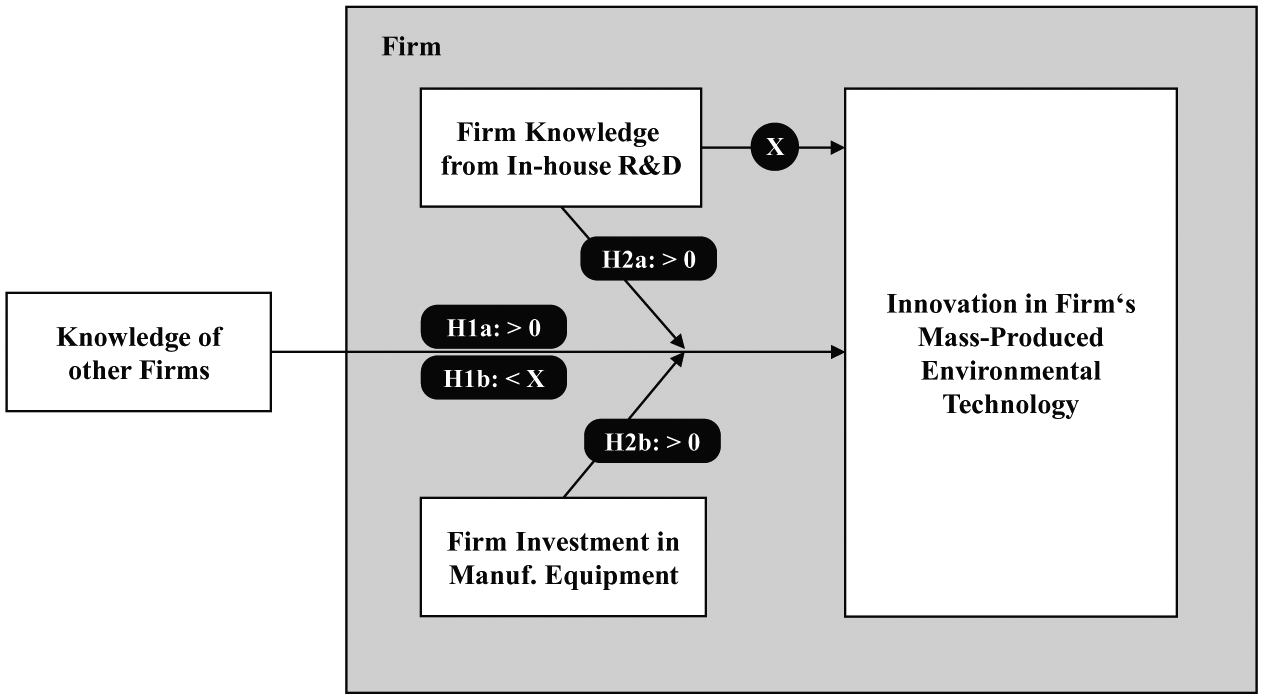
Hypotheses.
Data and Method
Research Setting
We chose the PV industry as the research setting for our analysis. PV is an important mass-produced environmental technology that offers considerable potential for mitigating the adverse impacts of the energy sector on the global climate system (Kapoor & Furr, 2015). Based on semiconductor technology, PV converts sunlight into electric power, thereby causing fewer emissions over the electricity-generation life-cycle than methods based on the combustion of fossil fuels, such as coal or gas. The young PV industry has grown at an astonishing 40% per year on average since 2000 (European Photovoltaic Industry Association, 2012); by 2011 it was already generating global revenues of more than US$90 billion (Solarbuzz, 2012). Within this market, several PV technologies compete for market share; the current leader is wafer-based crystalline (c-Si) PV, followed by thin-film PV technologies made from materials such as cadmium telluride (CdTe) or copper indium gallium selenide (CIGS). As PV is not yet cost-competitive with conventional means of electricity generation, most of its market growth has been triggered by policy support on both the supply and demand side. Besides environmental considerations, a key motivation for government intervention has been the hope of increasing economic competitiveness and creating domestic jobs in a dynamic high-tech industry.
Despite these high hopes, PV companies have had a hard time maintaining their competitive advantage. Figure 2 shows that within just 11 years two new entrants producing wafer-based crystalline PV cells (the main component of conventional PV modules) have become the market leaders. At the same time, Chinese firms have been able to increase their share of PV cell production from only 4% in 2004 to almost 70% in 2011 (Photon, 2012).
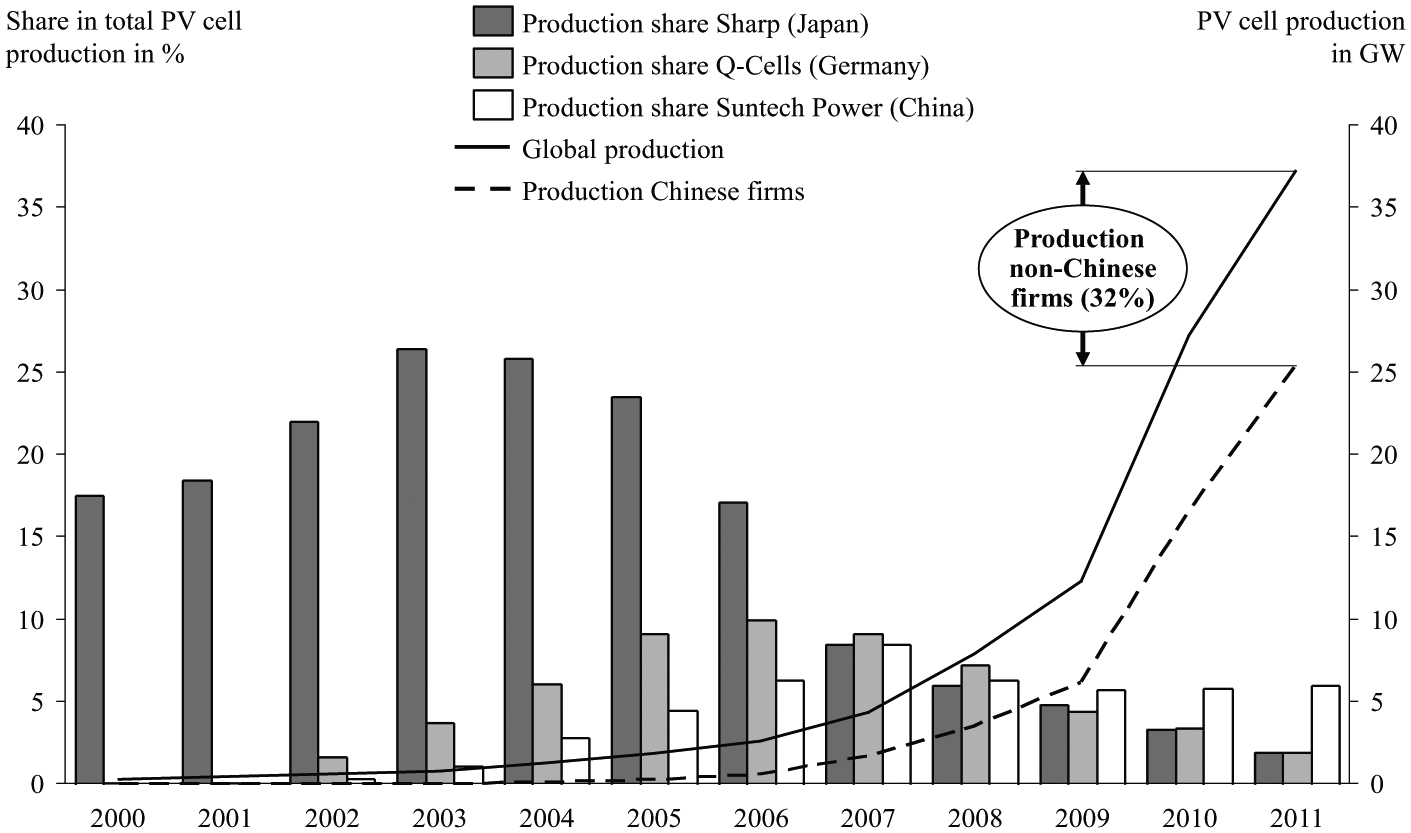
Development of cell production and shares of leading photovoltaic (PV) cell producers (data from Photon, 2012).
Together these developments raise the question of the role that knowledge spillovers might have played in solar PV market dynamics. Recent anecdotal evidence suggests that Chinese manufacturers of PV cells may have benefited significantly from the emergence of an industry that develops and sells standardized PV manufacturing equipment (de la Tour, Glachant, & Ménière, 2011). From 2004 to 2011, the global market for specialized PV equipment grew from US$ 400 million to US$ 8.7 billion, with German and U.S. companies assuming the largest share (VSLI Research, 2011). To develop their equipment, equipment manufacturers collaborated closely with PV manufacturers in their home countries, and used the resulting knowledge in their products. Later, the production equipment was sold to companies that had not been involved in its development, in particular Asian producers of PV cells that quickly ramped up their production. According to de la Tour et al. (2011), these deals usually included training Chinese employees in how to operate the equipment. As a result, the export of manufacturing equipment might have indirectly given Chinese producers access to the knowledge of German and U.S. manufacturers, and could even have enabled them to produce at a lower cost than the incumbent firms. A report by the German Commission of Experts for Research and Innovation (2012) concludes that [i]n the area of development and supply of production plants, Germany has benefitted from the worldwide growth of the photovoltaics industry. A large proportion of major, technologically relevant components from China’s current production lines were supplied by German mechanical engineering companies. At the same time, the export of turnkey production facilities and plant building served as the prime source of gain in know-how for Chinese companies in the photovoltaics industry. (p. 106).
The Commission added that “the total revenue of German machine and plant manufacturers in the photovoltaic sector amounted to EUR2.5 billion in 2010. The export ratio was 85 percent, while 74 percent of exports went to Asia alone” (Commission of Experts for Research and Innovation, p. 207).
Table 1 provides further qualitative evidence that manufacturing equipment might have played an important role in driving knowledge spillovers in the PV industry. We collected this evidence from 11 industry representatives as part of a larger study on the drivers of innovation in the solar PV industry. Interviewees were selected so they possessed considerable expertise and represented different perspectives within the industry, and include scientists, cell and module producers, equipment manufacturers, editors of industry magazines, and policy makers. After contacting the interview partners via e-mail, interviews were conducted in person or via telephone, and typically lasted between 60 and 90 minutes.
Evidence for Manufacturing Equipment as a Driver of Knowledge-Spillovers in the PV Industry.

Sample
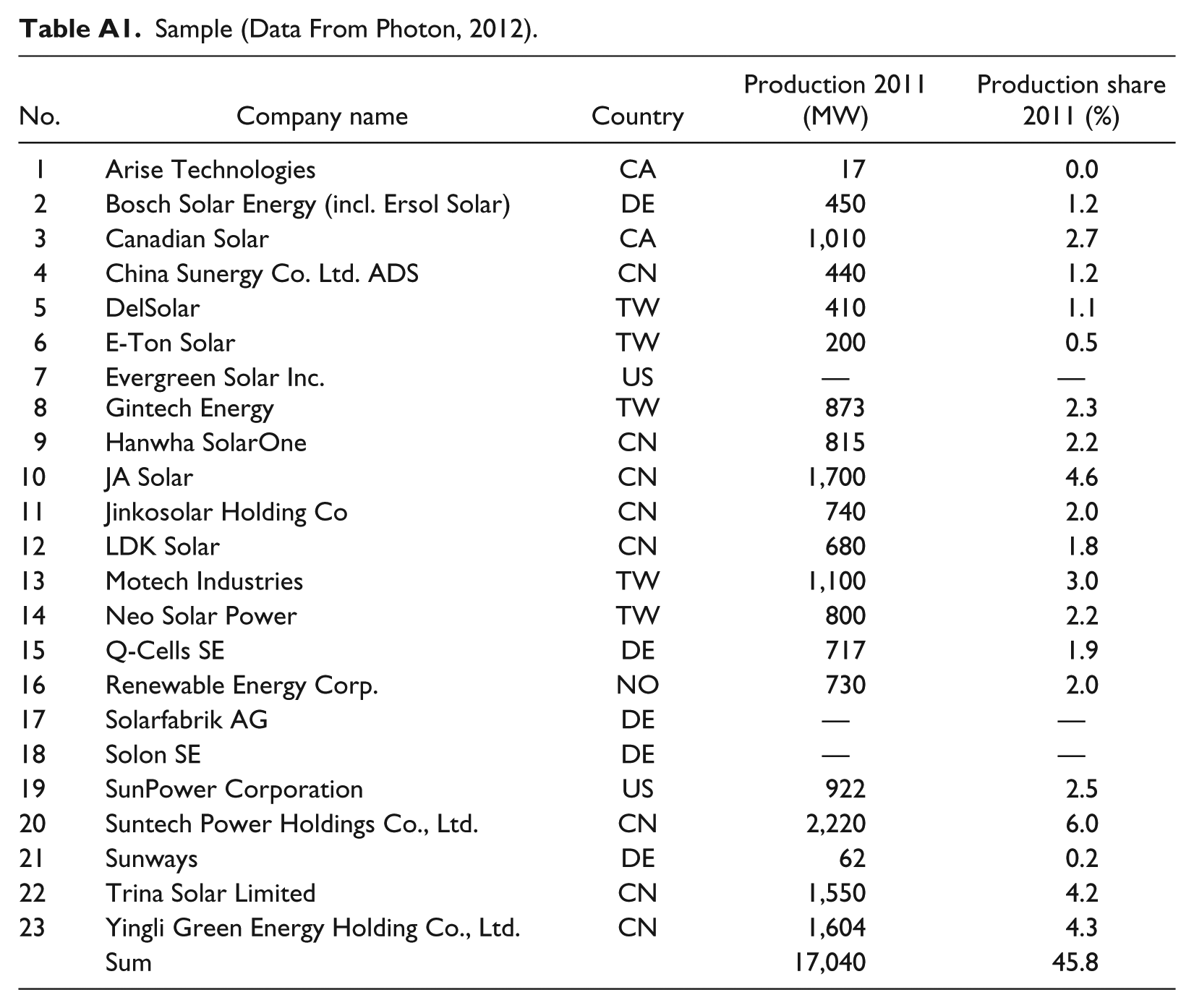
To test our hypotheses, we analyzed data for 23 publicly listed producers of wafer-based c-Si PV cells for the period 2000-2011. Based on Breyer, Birkner, Meiss, Goldschmidt, and Riede (2013) and Photon (2012), we first compiled a list of publicly listed companies active in different parts of the PV value chain. This list was then narrowed down to firms pursuing wafer-based c-Si PV technology, since our analysis of knowledge spillovers required a minimum technological proximity between firms. With a market share of more than 87% in 2011, wafer-based c-Si PV is also the technology currently pursued by most firms in the industry (Photon, 2012). PV modules from c-Si PV are manufactured using a multistage process in which silicon is cast into ingots, cut into wafers, further processed into cells, and finally assembled into modules. Of these steps, the transformation from wafers to cells is generally considered one of the most technologically challenging, with significant potential for innovation. Since we are interested in observing innovation among firms in the PV industry, we therefore further limited our analysis to firms that covered this value-chain step as a minimum. Moreover, since conglomerates generally do not report the data required for our analysis on a sufficiently disaggregated level, we included only pure-play firms in our sample. A list of these companies with their country of origin, production, and share of global production is provided in Table A1 in the appendix. Overall, the companies in our sample produced 17.04 gigawatt (GW) of PV cells in 2011, which corresponds to a share of 45.8% in the global PV market, or 52.1% of the market for c-Si PV cells.
Variables
Our hypotheses suggest linkages between four key variables: innovation in a firm’s mass-produced environmental technology as the dependent variable, and knowledge of other firms in the industry, firm knowledge from in-house R&D, and firm investments in manufacturing equipment as independent variables. Below, we explain how we operationalized each of these variables and discuss the controls we included in our model.
Dependent Variable
Innovation in a firm’s mass-produced environmental technology was measured as a change in the ratio between the firm’s product costs and product performance. As discussed above, the patterns and drivers of innovation differ considerably depending on the sector and technology. Whereas for complex products innovation focuses on developing customized, differentiated products according to customer needs, in the case of mass-produced technologies, products are often highly commoditized, such that innovation focuses on reducing costs, rather than maximizing product performance or quality. This is especially true for more mature technologies, that is, during later stages of the industry life-cycle, once a dominant design has been established (Huenteler et al., 2015; Utterback & Abernathy, 1975). 1 Accordingly, in the PV industry, the most widely used measure to describe technology innovation by firms, policy makers, and research institutes is the cost-to-performance ratio of PV cells, which is calculated by dividing a cell’s nominal power capacity in Watt peak (Wp) by its product cost, usually in US$ (Suntech Power Holdings Co., 2012). In simple terms, this measure expresses the costs associated with a product that allows a customer to generate a particular amount of electricity in a given location.
We calculated cell product costs by collecting data on “customer price per Watt peak” and multiplying this measure by “1—the firms’ gross profit margin, i.e. gross profit per sales” to translate prices into costs. According to the firm representatives we consulted, this formula yields a good approximation for the cost-to-performance ratio in US$ per watt, and is also commonly used in the PV industry itself. Data on customers’ price per watt peak is often directly reported by companies in their annual reports and filings for the Securities and Exchange Commission (SEC); alternatively, it can be calculated by dividing a company’s sales in US$ by its sales volume in Wp. While we could extract prices for PV cells for companies that only produced such cells, companies that further process their cells into modules (by assembling them in an aluminum frame) often only report prices for finished modules. Therefore, for the latter companies, we used module instead of cell prices. We felt this was appropriate since we look at intrafirm changes over time—that is, price differences between firms due to additional processing have no effect on our model outcome.
Independent Variables
As is common in the literature, the measures for knowledge of other firms in the industry and firm knowledge from in-house R&D were constructed as stock variables based on publicly available data on annual R&D investments (Kaiser, 2002). Data on firms’ R&D expenditures used to build the variable firm knowledge from in-house R&D was obtained from annual reports and SEC filings. These data were then added up over the years to build a knowledge stock variable. 2
The variable knowledge of other firms in the industry was calculated by subtracting the firm knowledge from in-house R&D from the overall industry knowledge stock. When constructing a stock variable for knowledge of other firms in the industry, we could not rely on R&D expenditures from annual reports, since most firms in the PV industry are not publicly listed, and knowledge may spill over from firms that do not produce PV cells. We therefore drew on data from Breyer et al. (2013), who calculate annual private R&D expenditures in the PV industry over time based on patent data.
Two important factors to be taken into account when creating knowledge stocks from R&D data are the assumed knowledge-depreciation rate and the time lag between R&D investments and the improvement of a firm’s technology (Esposti & Pierani, 2003). As the basis for our study, we relied on findings by Watanabe et al. (2002), who surveyed 19 Japanese PV firms to identify the aforementioned factors. Drawing on their results, we set the knowledge depreciation rate at 20%, the time lag for firm-internal R&D at 3 years, and the lag for firm-external R&D at 5 years. To account for uncertainty and the possibility that factors might have changed since the study by Watanabe et al. (2002), for each of our three independent variables we also constructed and tested knowledge stocks with depreciation rates of 0%, 10%, 30%, and 40%, and time lags of 1, 2, 4, and 5 years for firm-internal knowledge and 3, 4, 7, and 8 years for firm-external knowledge, respectively.
Finally, like firm R&D data, data on firm investments in manufacturing equipment were obtained from annual reports and SEC filings. For each firm, we used the value of plants and manufacturing equipment at cost levels to determine annual changes in the equipment owned by the company. We use investments in equipment, that is, a flow variable, rather than the absolute amount of equipment, that is, a stock variable, since our theory suggests that new knowledge enters the firm whenever a firm invests in additional equipment. According to expert interviews, ramping up production for PV takes around a year, so we use a 1-year time lag for this variable.
Controls
Controls were chosen such that they covered all the important factors that affect firm-level changes in the cost and performance of PV cells. Based on a literature review and views solicited from industry experts, we identified knowledge from public R&D, economies of scale, learning-by-doing, raw material costs, and a firm’s vertical integration as crucial components (Nemet, 2006). Data on knowledge from public R&D were obtained from the International Energy Agency’s Energy Technology Research and Development database, which contains data on public R&D investments in PV for 15 OECD countries since 1975, and covers 80% to 90% of global public R&D investments in recent years (Breyer et al., 2013). In a similar manner to private R&D, annual values for public R&D investments were cumulated to build knowledge stocks under the assumption of depreciation rates ranging from 0% to 40% and time lags of 3 to 8 years. To measure economies of scale, we used annual data on the firm’s cell-production capacity in megawatt (MW; Stigler, 1958). Learning-by-doing was operationalized using cumulative cell production in MW over time (Arrow, 1962). Data for both cell production and cell production capacity were obtained from firms’ annual reports as well as from the PV industry magazine Photon, which conducts an annual survey of production data. As with knowledge stocks from R&D, to measure learning-by-doing, we built several production stocks for each firm with rates of depreciation ranging from 0% to 40%. Both cell production and cell-production capacity were included in the model using a time lag of 1 year. We chose this time lag based on a closer review of production data, which indicated that once production equipment is installed, it takes around a year for a company to operate it at maximum capacity.
The most important raw material that serves as an input into PV cells is crystalline silicon. Silicon prices have fluctuated widely over the past few years, which has had a considerable effect on the cost of PV cells (Hoppmann, Peters, Schneider, & Hoffmann, 2013). As a control in our model, we therefore included data on silicon prices obtained from Bloomberg. Companies purchase silicon both through longer term contracts and via the spot market. Since the exact ratio between these two sources is unknown for individual companies, we assumed a ratio of 1:1 across the board—a reasonable assumption according to industry experts. Like costs of PV cells and R&D, silicon prices were sampled at 2008 levels.
In addition to the aforementioned factors, we controlled for the firms’ vertical integration by including dummies for value-chain steps other than cell production—that is, silicon production, ingot production, wafer production, and module production—over time. These data were extracted from annual reports and SEC filings. Since our calculations are made in US$ but almost all of the firms are located outside the United States, costs are also influenced by the US$ exchange rate. We control for this factor by including average annual exchange rates over time obtained from OANDA (2012). To account for unobserved, time-specific factors, such as economic conditions, we also tried including time dummies. However, they were neither individually nor jointly significant, and several of our main variables (e.g., firm-external knowledge) are strongly time dependent. Therefore, we subsequently dropped them to not bias our results. Instead, to ensure that our results did not merely reflect time trends, we included a year trend as a robustness check, which did not significantly alter the results obtained.
Finally, costs in PV cells might also be driven by advances in other industries or input from users (Von Hippel, 2009). In fact, wafer-based crystalline PV benefited a great deal from the semiconductor industry in the 1970s and 1980s (Nemet, 2006). However, our study is limited to the years 2000-2011, during which a strong PV industry with relatively mature products had emerged, which mainly develops and draws on its own knowledge. For example, Braun, Schmidt-Ehmcke, and Zloczysti (2010) assess cross-industry knowledge flows in the PV industry and find no significant effect. Similarly, while plant operators have played an important role in advancing other environmental technologies, such as wind power (Garud & Karnøe, 2003), they have been shown to play only a minor role in PV (Nemet, 2006). To avoid overspecifying our model, we therefore forego including controls for interindustry knowledge flows and product use.
Estimation Procedure
To estimate our model, we used panel data regression analysis. A Hausman test rejected the null hypothesis of random effects. Consequently, we used a model including firm-fixed effects that capture firm and country differences that are constant over time. We started with a model that regressed our dependent variable on the controls and firm knowledge from in-house R&D (Model 1) and subsequently added the independent variable knowledge of other firms (Model 2). To test Hypotheses 2a and 2b, we included interaction terms of knowledge of other firms with firm knowledge from in-house R&D and firm investment in manufacturing equipment (Model 3).
Since the controls learning-by-doing and economies of scale turned out to be highly correlated (r = 0.92; see Table 2), we tested two different model specifications, one including only the former (Models 1-3) and one only the latter variable (Models 4-6). This procedure is common in the literature, where scholars have argued that economies of scale and learning-by-doing are strongly related, and some have even subsumed the latter effect under the former (Scherer, 1996). Moreover, the stock of knowledge from public R&D shows a rather high correlation with the stock of knowledge of other firms in the industry (r = 0.76). In addition to a model that included knowledge from public R&D, we therefore also tested one without this control variable (Models 7-9). To account for diminishing returns (Griliches, 1998), all variables, except for the dummies, are included in logarithmic form. Moreover, throughout our model we used autocorrelation- and heteroscedasticity-robust estimation techniques.
Descriptive Statistics.
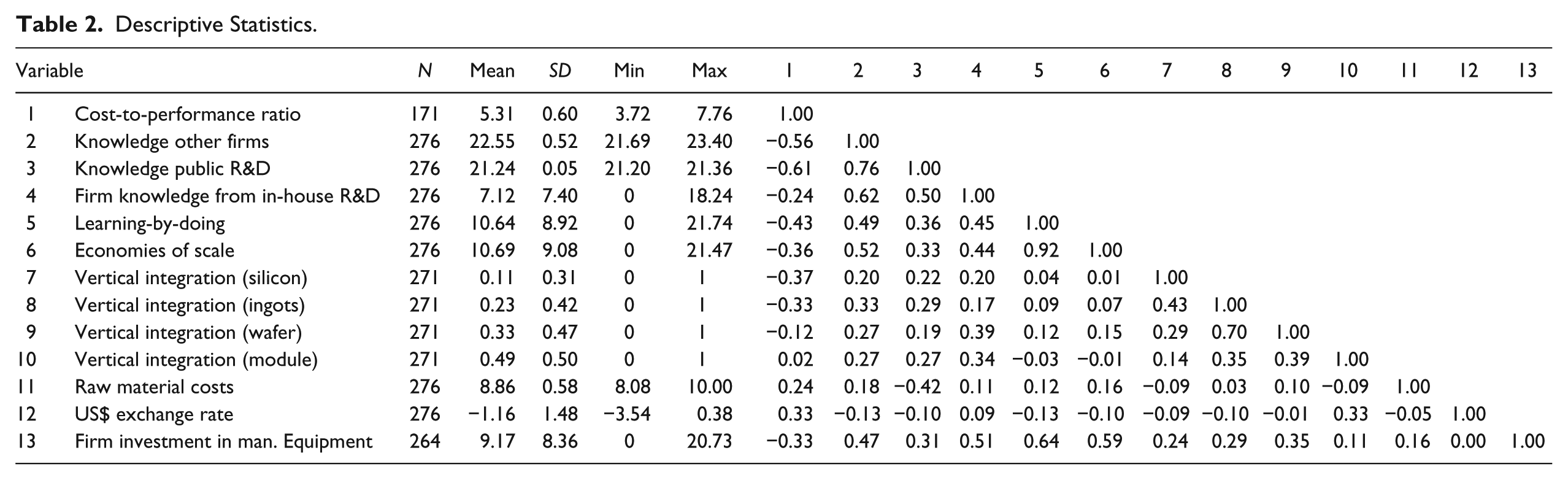
A common problem encountered in regression analyses is that of endogeneity. In our model the concern for reverse causality is alleviated by the fact that we make use of time lags for all variables except dummies, silicon prices, and the US$ exchange rate. Still, firms’ R&D investments might be influenced by expectations regarding the future development of the cost-to-performance ratio, thereby causing standard errors to be biased. While this effect is likely to be observed in many industries, there is strong evidence that it is very small in the PV industry, since the development of both revenues (as one of the main determinants of R&D investments) and performance-to-cost ratios has been extremely volatile and uncertain (Hoppmann et al., 2013). This uncertainty is mainly because of the fact that the industry is strongly driven by policy support, which influences demand in an unpredictable way. Given this deep uncertainty and the relatively long time lags we use, we have good reason to assume that the actual cost-to-performance ratio observed is unlikely to have a significant effect on R&D investments 3 years earlier.
Results
Models 1 to 3 in Table 3 present the results of our panel data regression analysis in which we include learning-by-doing and knowledge from public R&D as controls. Models 4 to 6 control for economies of scale instead of learning-by-doing, while Models 7 to 9 show the results when not controlling for knowledge from public R&D. Below we discuss the results in relation to the hypotheses derived in the “Literature Review and Hypotheses” section. Since Models 1 to 3 provide the best fit with our data, we use these as the starting point for our discussion and subsequently draw on the findings from Models 4 to 9 to examine the robustness of our results.
Results of Regression Analyses (Dependent Variable: Cost-to-Performance Ratio of Product).

p < .1. **p < .05. ***p < .01.
Hypothesis 1a suggested that knowledge developed by other firms in an industry is positively related to innovation in a firm’s mass-produced environmental technology. Model 2 provides clear support for this hypothesis. The coefficient describing the effect of knowledge of other firms on the cost-to-performance ratio is negative and significant (β = −1.0686, p < .001). This implies that a rise in other firms’ knowledge contributes to lowering the costs and/or raising the performance of a focal firm’s products, that is, induces innovation. At the same time, Model 2a does not provide support for Hypothesis 1b, which asserted that the marginal impact of knowledge of other firms in an industry should be smaller than the effect of the knowledge developed by the firm itself. The coefficient for the variable firm knowledge from in-house R&D in Model 2 is smaller than that for knowledge of other firms and insignificant (β = .0020), indicating that knowledge developed by other companies in the industry plays a more important role for a focal firm’s innovation than internally developed knowledge.
Finally, Model 3 tests our Hypotheses 2a and 2b, which state that a firm’s own knowledge and investments in manufacturing equipment should positively moderate the degree to which firm-external knowledge from other firms affects the cost-to-performance ratio of its own products. Interaction terms for both firm knowledge from in-house R&D (β = −0.0432, p < .05) and investments in manufacturing equipment (β = −0.0005, p < .05) are negative and significant, implying that, in fact, firm-internal knowledge and investments in manufacturing equipment positively moderate the absorption of knowledge from other firms in the industry.
At first glance, the coefficients of knowledge of other firms in the industry and knowledge from public R&D in Models 2 and 3 may appear rather large, and those of the interaction terms very small. However, it should be kept in mind that all the variables in our model, except for dummies, are in logarithmic form. The coefficients of knowledge of other firms and knowledge from public R&D can thus be roughly interpreted as the percentage change in the cost-to-performance ratio of the firm’s product as a result of increasing these knowledge stocks by 1%. Since knowledge stocks were large during the time of investigation, lowering the cost-to-performance ratio through external R&D would require considerable investments. For example, in 2011, firms’ average cell cost amounted to US$1.04/Wp. According to our model results, lowering this by US$0.01/Wp in 2011 would have required other firms to make knowledge investments of US$469 million. The coefficients of the interaction terms reflect the extent to which the marginal effect of external knowledge spillovers on the cost-to-performance ratio of the firm’s product changes if the firm raises its firm-internal knowledge stock or investments in manufacturing equipment by 1%. While the interaction term for investments in manufacturing equipment appears low, it should be kept in mind that, in contrast to the knowledge stock, investments in manufacturing are measured as an annual flow variable. As a result, raising this variable by 1% will be much easier for a firm to accomplish than raising the existing knowledge stock from R&D by the same amount.
All results obtained in Models 1 to 3 hold when substituting learning-by-doing as a control with economies of scale (see Models 4 to 6). When knowledge from public R&D is dropped as a control, however, the interaction between firm knowledge from in-house R&D and knowledge of other firms loses its significance (see Model 9). Moreover, the results are fairly robust against changes in knowledge depreciation and lags. Except for low assumed depreciation of knowledge from public R&D, the coefficient for knowledge of other firms remains significant in all cases. Similarly, the interaction term for knowledge of other firms and investments in manufacturing equipment shows strong robustness against changes in knowledge depreciation and lags. Findings for the term describing the interaction between knowledge of other firms and firm knowledge from in-house R&D are less robust. The effect for this term becomes insignificant for lower assumed depreciation rates and higher lags of knowledge of other firms, as well as lower assumed depreciation rates and smaller lags of knowledge from public R&D.
Discussion
R&D and Knowledge Spillovers in the PV Industry
From our hypothesis tests presented in the “Results” section, two major questions arise that require further discussion. First, why does knowledge developed from firm-internal R&D significantly affect a firm’s cost-to-performance ratio only indirectly through knowledge absorption? And second, why do investments in manufacturing equipment facilitate knowledge spillovers from other firms producing wafer-based c-Si PV cells?
We offer three possible explanations for why we do not find that knowledge developed through firm-internal R&D directly affects the cost-to-performance ratio of a firm’s PV cells. First, we cannot exclude the possibility that this finding is because of our sample size. Second, a plausible explanation lies in the fact that we measure the innovative outcome of R&D with regard to c-Si PV, that is, one specific PV technology. While all companies in our sample strongly focus on producing this technology, the R&D data we use to build the knowledge stock include expenses for the exploration of alternative PV technologies, which do not have a direct effect on the cost-to-performance ratio of wafer-based c-Si. Third, and most important, R&D investments in the PV industry may function primarily as an absorption mechanism. As discussed in the “Data and Method” section, the PV industry is growing at an explosive pace, resulting in the rapid proliferation of knowledge on c-Si PV. In such a situation, it seems plausible that firms might focus their R&D on integrating external knowledge rather than leveraging their own knowledge sources. This might explain why we find R&D to be important in facilitating external knowledge while not having a direct, significant effect on the cost-to-performance ratio of a firm’s own PV cells.
The finding that investments in manufacturing equipment positively moderate the knowledge spillovers from other firms lends support to our hypothesis that, in the PV industry, equipment manufacturers have played an important role in enabling knowledge transfer between firms. As discussed in the “Data and Method” section, previous studies provide anecdotal evidence that equipment manufacturers in the PV industry have integrated knowledge into their products that has been gained through collaboration with German and American manufacturers of PV cells. By purchasing equipment from manufacturers, Chinese and Taiwanese companies in particular have been able to draw on this knowledge and manufacture high-quality, low-cost goods. Overall, investment in equipment manufacturing appears to have served as a channel of knowledge absorption in parallel to investments in R&D.
Implications for the Literature
By investigating the role of knowledge spillovers in the PV industry, our study makes contributions to the literature on environmental innovation and absorptive capacity. As pointed out in the introduction, at present the literature often explicitly or implicitly assumes that proactively investing in innovation for environmental technology will enhance the competitiveness of companies. Moreover, there is a long line of literature that suggests that policy makers can foster the competitiveness of domestic industries by supporting environmental innovation. For example, the literature on lead markets and the Porter hypothesis suggests that policy makers can create markets for PV, which allow domestic firms to develop, produce, and eventually export environmental technologies. In fact, many countries such as Germany aimed to create a domestic high-tech industry when implementing PV support policies, such as feed-in tariffs (Hoppmann, Huenteler, & Girod, 2014; Quitzow, 2015). We provide evidence that, in line with Watanabe et al.’s (2002) finding for Japan, innovation in the PV industry at a global level is strongly driven by knowledge spillovers. In the presence of extensive knowledge spillovers, a competitive advantage generated through innovation is likely to be very quickly eroded. As a result, the question of whether environmental innovation and corresponding policies lead to competitive advantages for firms is contingent on the presence of knowledge spillovers, which determine whether such advantages can be maintained over the long term.
The idea that resources underlying corporate strategies must be inimitable to generate a lasting competitive advantage has long been pointed out in literature on proactive environmental strategies (Aragón-Correa, 1998; Aragón-Correa & Sharma, 2003). Yet so far the role of knowledge spillovers has received limited attention when studying environmental innovations. We therefore argue that the literature on environmental innovation can benefit significantly from closer integration with parallel research streams, such as the knowledge- or resource-based views of the firm, to study the channels through which firms absorb and disseminate knowledge, as well as the mechanisms they use to protect their intellectual property.
As a second contribution, our study highlights investments in production equipment as an important channel of absorptive capacity. The current literature predominantly suggests that firms need to conduct R&D to identify, decode, and exploit external knowledge. This view is based on the observation that knowledge is often highly contextual, requiring technological expertise and financial investments for a firm to benefit from it. Not surprisingly, many studies have therefore focused on processes within R&D departments, R&D collaborations, and turnover of research personnel when studying a firm’s absorptive capacity. Our findings suggest that studies focusing solely on R&D may draw an incomplete picture of a firm’s absorptive capacity. As described in the previous section, in the case of the PV industry, one important channel of knowledge transfer has been investment in standardized production equipment. When developing machinery, equipment manufacturers identify the relevant knowledge within the production process, decode it, and integrate it into their products. As a result, firms buying production equipment can reap many of the benefits of external knowledge embodied in equipment without having to make large investments in R&D.
We argue that this channel of absorptive capacity plays a particularly important role for mass-produced technologies during later stages of the industry life cycle. In fact, it has been shown that particularly as markets for technologies grow and patterns of technological change become more predictable, firms tend to increasingly outsource the development of process technology (Cesaroni, 2004). Given that turnkey manufacturing equipment constitutes a powerful mechanism for quickly integrating large amounts of external knowledge, competitive dynamics are likely to look very different in a market that predominantly operates on this mechanism of knowledge absorption. Therefore, taking a closer look at the role of production equipment has the potential to generate interesting new insights that complement our existing knowledge about the effects of absorptive capacity on competitive advantage and firm performance.
Implications for Practitioners
In addition to contributing to the literature on environmental innovation and absorptive capacity, our research has important implications for practitioners. First, our results suggest that managers interested in generating a longer term competitive advantage are well advised to think systematically about knowledge spillovers. The literature on “open innovation” generally stresses the benefits for firms when entering into research collaborations. Our findings indicate that such collaborations, while often useful, also bring great risks. If not sufficiently protected, proprietary knowledge shared with partners can flow to (future) competitors in a variety of ways. Managers might therefore consider systematically and strategically mapping the channels through which knowledge flows out of their firm, for example, already when planning their technology portfolio. Moreover, our findings point to a potentially important role of manufacturing equipment in designing firm strategies. The example of the PV industry shows that the timing and speed of investment in equipment can significantly influence firm performance. While early investments in equipment may be useful to capture market share and generate revenues, postponing investments allows firms to leapfrog the knowledge advantages of competitors.
Second, our finding that knowledge spillovers may importantly influence firm-level innovation implies that policy makers face a tradeoff between most effectively advancing environmental innovation and inducing growth in domestic industries. On the positive side, strong knowledge spillovers enhance the effectiveness of policy interventions, since any policy measure that induces innovation does so in a larger number of companies simultaneously. On the negative side, however, knowledge spillovers also lower the possibility that fostering innovation in a particular technology will only benefit domestic firms. Policy makers interested in boosting their own country’s competitiveness might therefore design policy interventions in such a way that knowledge spillovers are confined to domestic companies—for example, by encouraging firms to protect their intellectual property or supporting technologies that involve more tacit knowledge. In the field of PV, for example, Germany and the United States have been able to maintain a competitive advantage in manufacturing equipment, which, in contrast to PV cells and modules, is a complex technology that is not mass manufactured and is more difficult to imitate (Hoppmann et al., 2014).
Limitations and Future Research
Our study has several limitations, which present themselves as avenues for future research. First, an important question to ask is what role knowledge spillovers play for environmental technologies other than PV as a mass-produced environmental technology. While we would generally expect spillovers to also occur for complex environmental technologies, such as wind power, differences in technology characteristics may influence the degree and specific channels of interfirm knowledge transfer (Teece, 1998). Future studies might therefore take a closer look at differences in knowledge spillovers between different environmental technologies and investigate how they relate to competitive dynamics.
Second, while it has been pointed out in the literature that knowledge spillovers depend on geographic proximity (Audretsch & Feldman, 1996), we could not control for this factor in our analysis, as we lacked data on public R&D for several countries included in our analysis (e.g., China) and a breakdown of industry R&D investments according to geography was not available. Given that PV is a global industry and the main mechanisms driving spillovers—such as sales of turnkey manufacturing equipment—act on an international level, we believe our findings paint an accurate picture of spillovers for PV. Yet especially when extending our analysis to other environmental technologies, spillovers may be more localized, requiring researchers to use spatially disaggregated measures of geographic proximity, for example, by drawing on patents rather than R&D investments as a proxy for knowledge.
Conclusion
In this article, we investigated the role of knowledge spillovers for firm-level innovation in mass-produced environmental technologies. Drawing on panel data from 23 publicly listed pure-play manufacturers of wafer-based crystalline PV cells, we find evidence that innovation is driven by knowledge spillovers from other firms in the industry. In line with the literature on absorptive capacity, we find that knowledge spillovers are positively moderated by the firm’s own prior knowledge. More intriguingly, however, we also provide evidence that investments in manufacturing equipment have facilitated knowledge spillovers. When developing turnkey production equipment, manufacturers draw on knowledge from producers, integrate it into their products, and sell these to competitors, who can therefore quickly absorb considerable knowledge without making large investments in R&D. We argue that a better understanding of the channels through which knowledge is transferred between companies is crucial if we are to understand the relationship between environmental innovation and competitive advantage. Furthermore, by pointing to investments in manufacturing equipment as a facilitator of knowledge transfer, our study highlights a potentially important channel of absorptive capacity, which so far has received little attention in the literature. We argue that corporate managers have much to gain by systematically mapping and considering knowledge spillovers when devising technology strategies. For policy makers, fostering environmental technologies involves a trade-off between encouraging knowledge spillovers to raise the overall effectiveness of policy interventions and limiting them to support the development of domestic industries.
Footnotes
Appendix
Sample (Data From Photon, 2012).
| No. | Company name | Country | Production 2011 (MW) | Production share 2011 (%) |
|---|---|---|---|---|
| 1 | Arise Technologies | CA | 17 | 0.0 |
| 2 | Bosch Solar Energy (incl. Ersol Solar) | DE | 450 | 1.2 |
| 3 | Canadian Solar | CA | 1,010 | 2.7 |
| 4 | China Sunergy Co. Ltd. ADS | CN | 440 | 1.2 |
| 5 | DelSolar | TW | 410 | 1.1 |
| 6 | E-Ton Solar | TW | 200 | 0.5 |
| 7 | Evergreen Solar Inc. | US | — | — |
| 8 | Gintech Energy | TW | 873 | 2.3 |
| 9 | Hanwha SolarOne | CN | 815 | 2.2 |
| 10 | JA Solar | CN | 1,700 | 4.6 |
| 11 | Jinkosolar Holding Co | CN | 740 | 2.0 |
| 12 | LDK Solar | CN | 680 | 1.8 |
| 13 | Motech Industries | TW | 1,100 | 3.0 |
| 14 | Neo Solar Power | TW | 800 | 2.2 |
| 15 | Q-Cells SE | DE | 717 | 1.9 |
| 16 | Renewable Energy Corp. | NO | 730 | 2.0 |
| 17 | Solarfabrik AG | DE | — | — |
| 18 | Solon SE | DE | — | — |
| 19 | SunPower Corporation | US | 922 | 2.5 |
| 20 | Suntech Power Holdings Co., Ltd. | CN | 2,220 | 6.0 |
| 21 | Sunways | DE | 62 | 0.2 |
| 22 | Trina Solar Limited | CN | 1,550 | 4.2 |
| 23 | Yingli Green Energy Holding Co., Ltd. | CN | 1,604 | 4.3 |
| Sum | 17,040 | 45.8 |
Acknowledgements
The author would like to acknowledge valuable comments by Catharina Bening, Nicola Blum, Stefano Brusoni, Laura Diaz Anadon, Lars Frederiksen, Volker Hoffmann, Johannes Meuer, Annegret Stephan, and Ann-Kristin Zobel on earlier drafts of this article. Particular thanks go to Severin Hegelbach who contributed to the development of the core idea. Previous versions of the article were presented at the Academy of Management Annual Meeting 2013 in Orlando, the SKEMA Paper Development Workshop 2013 in Sophia-Antipolis, and the Research Seminar of the Science, Technology and Public Policy (STPP) Program at Harvard University. I am grateful for the feedback received by the conference, seminar, and workshop participants. Moreover, I would like to acknowledge the highly constructive comments I received from two anonymous reviewers.
Declaration of Conflicting Interests
The author declared no potential conflicts of interest with respect to the research, authorship, and/or publication of this article.
Funding
The author received no financial support for the research, authorship, and/or publication of this article.