




Abstract
The institutional perspective is becoming an increasingly important approach for explaining sustainability behavior in an international context. Drawing on insights from institutional theory and natural environment literature, we propose that the utilization of international firms’ technological intensity to generate green innovations is conditioned by their home-country institutional profile. This article analyzes a panel of 5,024 environmental patents belonging to 80 international firms during the period 2005 to 2009. The results show that firms from countries with environmental institutional weakness reinforce their utilization of technological capabilities to generate environmental innovations in international contexts. Our results support the previous literature regarding the influence of technological intensity on the development of innovations, and we add new evidence that considers the moderating impact of the home-country institutional profile.
Introduction
Previous literature has shown the existence of a positive relationship between the development of green innovations and the use of firms’ resources and capabilities (e.g., Aragón-Correa & Sharma, 2003; Berchicci & King, 2007; Hart, 1995; Hart & Dowell, 2011; Porter & van der Linde, 1995; Russo & Fouts, 1997). In particular, the empirical literature has supported the idea that green innovation is associated with the technological intensity of a firm (e.g., del Río González, 2009; Horbach, 2008; Horbach, Rammer, & Rennings, 2012; Leyva-de la Hiz, Ferron-Vilchez, & Aragón-Correa, 2018; Rehfeld, Rennings, & Ziegler, 2007). Although this assumption may be generally accepted, it is still not known why organizations exhibit different levels of green innovation development.
In this article, we analyze this issue within the context of international organizations. This context is relevant because of the remarkable increase in social, legal, and economic pressures to adopt environmentally sustainable strategies for products and services in international environments (Campbell, 2007; Melville, 2010). Institutional pressures from different actors, such as governments, activists, local communities, trade associations, investors, and customers, are influencing organizations in the adoption of proactive environmental behavior. Thus, institutional theory has been extensively used in environmental management (e.g., Bansal, 2005; Berrone, Fosfuri, Gelabert, & Gomez-Mejia, 2013; Delmas, 2002; del Río, Peñasco, & Romero-Jordán, 2015; Hoffman, 2000) because it is particularly suitable for explaining firms’ environmental behaviors, as “green investments” often cannot be financially justified, at least in the short term (Llach, Alonso-Almeida, García-Castellví, & Bagur-Femenias, 2015; Marin, 2014; Shevchenko, Lévesque, & Pagell, 2016). Additionally, the literature on the natural environment and international management has focused on the potential benefits to firms of being environmentally proactive in their international activities (Christmann, 2004; Delmas & Montes-Sancho, 2011). Given the increased social awareness of organizational wrongdoing and explicit environmental demands, institutional theory predicts that firms will seek to gain legitimacy by reducing their impact on the environment and by exhibiting good environmental performance (Bansal, 2005; Bansal & Clelland, 2004). In an international context, this seeking of legitimacy is the consequence of the complexity of firms’ environments (Kostova & Zaheer, 1999). Accordingly, this complexity may be reflected in (1) the institutional distance between home and host environments, (2) the multiple domains of a given institutional environment (regulatory, cognitive, and normative), and (3) the multiplicity of institutional environments.
The institutional perspective is gaining importance in explaining sustainability behavior in an international context. A number of studies have analyzed the influence of institutional distance, considering multiple domains of a given institutional environment (e.g., Aguilera-Caracuel, Hurtado-Torres, Aragón-Correa, & Rugman, 2013; Van Hoorn & Maselad, 2016). Other works have analyzed the influence of the multiplicity of institutional environments (Berrone et al., 2013). For example, Berrone et al. (2013) have studied the influence of global regulatory and normative pressures on environmental issues on firms’ research and development (R&D) efforts. This study focused on the global pressures faced by companies in international markets, using an aggregated index that compiled all the different pressures exhibited in the markets in which they operate.
Nevertheless, previous studies have paid limited attention to the influence of the home-country institutional profile. In our study, we focused on the third aforementioned reason, that is, the complexity of the environment faced by firms in international contexts as a consequence of a multiplicity of institutional environments. Kostova & Zaheer (1999) showed how firms try to attain legitimacy in order to meet the social expectations of a range of stakeholders (e.g., shareholders, customers, governments, and public interest groups) located across the multiple countries in which they operate. In this context, the home-country institutional profile of firms can play a critical role in the adoption of a specific strategy to meet legitimacy requirements in an international context characterized by a multiplicity of institutional environments. Hence, drawing on insights from institutional theory and natural environment literature, we propose that the utilization of international firms’ technological intensity to generate green innovations is moderated by their home-country institutional profile.
This perspective offers an opportunity to advance our understanding of how a home-country institutional profile influences firms’ strategic responses in international contexts (Doh, Rodrigues, Saka-Helmhout, & Makhija, 2017). We argue that firms from a home country characterized by institutional weaknesses face an unfavorable perception from stakeholders based on negative stereotypes about that country (Kostova & Zaheer, 1999). To overcome these disadvantages, firms may adopt strategies to mitigate the negative effect of illegitimacy spillovers due to home-country institutional weaknesses. In this regard, our article analyzes how the home-country institutional profile is a possible driver for firms in adopting globally legitimate practices, especially in the field of green innovation. In this vein, green innovation might be a source of competitive advantage in an international context because it can be seen positively by a firm’s consumers and other major stakeholders (Sharma & Vredenburg, 1998).
To analyze how the home-country institutional profile influences the relationship between technological intensity and green innovation behavior, we draw on two dimensions of the home-country institutional profile: the environmental institutional profile and the innovation institutional profile. The environmental institutional profile of the home country refers to the regulatory dimension and the country’s capacity to tolerate, dilute, absorb, or ignore pollution, as well as differences in economic and environmental priorities (Christmann & Taylor, 2006). The national innovation institutional profile of the home country refers to configurations of institutions that foster the development of technology and innovation (Nelson & Rosenberg, 1993).
Our empirical analysis is based on a panel of 5,024 international environmental patents belonging to 80 firms in the period from 2005 to 2009. Our sample consists of firms from 13 different countries worldwide—including Japan and the United States—that file environmental patents in the international arena.
This study makes several contributions to the literature on the natural environment and international management. First, although extensive research has shown that firms with greater technological intensity tend to develop greener innovation behavior, we complement this view by considering the moderating impact of the home-country institutional profile by analyzing it through an internationalization lens. Our results show that greater development of the home-country environmental institutional profile negatively moderates the relationship between technological intensity and green innovation behavior. Specifically, firms with greater technological intensity exhibit a higher level of green innovation behavior when they come from countries with a less developed environmental institutional profile. Adopting such practices helps these firms detach themselves from the stereotypes about their home countries in an attempt to overcome their liability of origin. Conversely, firms with greater technological intensity exhibit a lower level of green innovation behavior when they come from countries with a more developed environmental institutional profile. Our results are relevant because they can shed light on the ongoing discussion regarding the impact of home-country institutional profiles on the development of firms’ corporate social responsibility in international contexts (Marano, Tashman, & Kostova, 2017). Second, our work shows how complex embeddedness in international contexts can motivate firms to adopt behaviors that, while atypical at home, can be considered strategies for meeting legitimacy requirements in global meta-institutional fields (Kostova, Roth, & Dacin, 2008; Marano et al., 2017). Our article contributes to the natural environment literature by providing a better understanding of why some firms are more likely to pursue a greener innovation orientation than others in international contexts. Third, our results address the challenge posed in institutional theory of using different dimensions and measures of the home-country institutional profile for analyzing companies’ strategic approaches (Berry, Guillen, & Zhou, 2010).
Theoretical Background and Hypotheses
Firms’ Technological Intensity and Green Innovation
Green innovation is “the development of products, processes, and services aimed at reducing environmental harm by using new methods for treating emissions, recycling or reusing waste, finding cleaner energy sources, etc.” (Berrone et al., 2013, p. 891). The natural resource–based view (Hart, 1995) has insisted that a firm’s specific internal resources and capabilities are particularly useful in generating unique, preventive, and voluntary environmental actions to reduce firms’ environmental impacts. In this vein, empirical research has shown the existence of a positive relationship between firms’ resources and capabilities and their green innovation (e.g., Aragón-Correa & Sharma, 2003; Berchicci & King, 2007; Hart, 1995; Leyva-de la Hiz, et al., 2018; Porter & van der Linde, 1995; Russo & Fouts, 1997). Hart’s (1995) seminal work provided the general framework for the natural resource–based literature, highlighting the importance of a shared vision, continuous learning, and stakeholder management. Triguero, Moreno-Mondéjar, and Davia (2013) argued that the tangible and intangible assets of a firm, such as skills, knowledge, and links with other firms, play an important role in green innovation. Additionally, the dynamic capability perspective has extended the analysis of the importance of internal resources in generating green innovations. Aragón-Correa and Sharma (2003) proposed that a proactive strategy to manage the interface between a business and its natural environment has the dynamic capability to enable an organization to align itself with changes in its general business environment.
In particular, the empirical literature has supported the idea that the technological intensity of a firm is positively associated with green innovation (e.g., del Río González, 2009; Doran & Ryan, 2012; Horbach, 2008; Horbach et al., 2012; Rehfeld et al., 2007). Technological intensity captures a firm’s commitment to R&D activities given its endowment of resources, and it has been argued that it is a “response to the threats and opportunities posed by environmental changes” (Chen & Miller, 2007, p. 369). Technological intensity eases information flows within an organization, which has been shown to have a positive effect on the development of green innovation (del Río González, 2009). For example, Horbach et al.’s (2012) analysis of German manufacturing firms showed that high levels of technological intensity are important drivers of green innovation. This might be because the “availability of greater technical knowledge within a firm moderates its vulnerability in the face of the demands of new environmental regulations” (Cañón-de-Francia, Garcés-Ayerbe, & Ramírez-Alesón, 2007, p. 307). In this vein, Horbach (2008) also showed that the improvement of technological knowledge capabilities by R&D (technological intensity) triggers green innovation. Additionally, the author reported that, although firms need internal knowledge capability (e.g., technological intensity) to foster green innovation, sometimes this is not enough because of the complexity of green innovation. Doran and Ryan’s (2012) study of European firms also found a clear direct relationship between technological intensity and green innovation, and they argued that “since innovation breeds innovation, firms that invest in R&D and build technological and organizational capabilities are likely to induce further innovation” (p. 425). Thus, our baseline hypothesis, on which we will build our contributions regarding the factors that could moderate this relationship, is as follows:
Green Innovation and the Home-Country Institutional Profile
Previous studies have relied on institutional theory for analyzing why firms behave in an environmentally responsible way, because this strategic decision does not correspond to efficiency objectives, at least in the short term (Bansal, 2005; Llach et al., 2015; Marin, 2014; Montiel & Delgado-Ceballos, 2014). The research on corporate environmental management has mainly stressed the potential benefits to firms from being environmentally proactive in their international activities (e.g., Christmann, 2004; Delmas & Montes-Sancho, 2011). Given the increased social awareness of organizational wrongdoing and the growth of more explicit environmental demands, institutional theory predicts that firms face legitimacy requirements to reduce their impact on the environment and exhibit good environmental performance (e.g., Bansal, 2005; Bansal & Clelland, 2004).
Although the institutional perspective is gaining importance in explaining green innovation, previous studies have paid limited attention to the influence of the home-country institutional profile. For example, Berrone et al. (2013) have studied the influence of global normative and regulatory pressures on firms’ R&D efforts but have not studied the influence of the home-country institutional profile. In this regard, institutional theory states that firms from different countries differ in their behavior and strategic decision making, such as organizational practices, corporate diversification strategies, entry strategies, and internationalization performance (e.g., Harzing, 2002; Noorderhaven & Harzing, 2003; Rosenzweig & Singh, 1991; Wan & Hoskisson, 2003). This is because each country has its own unique set of institutions that form the basis of its society and constrain its behavior (North, 1990). Two theoretical perspectives have explained how the home-country institutional profile can influence firms’ behavior and strategic decisions in relation to international markets. On the one hand, Porter (1990) and Rugman and Verbeke (1993) stressed that a firm’s ability to compete in the international arena is mainly based on an interrelated set of location advantages in its home country. Well-developed home-country institutions positively affect firms’ domestic and global performance because the “presence or absence of specific inputs outside the firm induces it to develop distinct resources that either rely on the availability of particular external inputs or compensate for the lack of certain external inputs” (Cuervo-Cazurra, 2011, p. 383). On the other hand, another research stream stresses that home countries’ different levels of institutional development may explain their strategic decisions in the international arena (e.g., Doh et al., 2017; Ghoul, Guedhami, & Kim, 2017; Li & Yue, 2008; Luo & Tung, 2007; Marano et al., 2017; Meyer & Peng, 2016). Previous literature has analyzed how home-country institutional weaknesses, especially in emerging countries, may “follow” these firms to a new context as they internationalize, as a form of liability of origin (Marano et al., 2017). There is evidence that firms from home countries characterized by institutional weaknesses invest abroad to escape the voids in their home country and hence enhance their international reputation (Cuervo-Cazurra, Inkpen, Musacchio, & Ramaswamy, 2014; Luo & Tung, 2007; Wang, Luo, Lu, Sun, & Maksimov, 2013). Domestic institutional weaknesses push firms to invest in more efficient and transparent institutional environments in which they can concentrate on generating new knowledge and developing their competitive advantages (Witt & Lewin, 2007).
In summary, home-country institutions can play a critical role in firms adopting a strategy that meets the legitimacy requirements of an international context by enabling or constraining the acquisition and deployment of strategic resources and capabilities. According to institutional theory, firms belonging to different home countries differ in their liability of origin and in the strategies or mechanisms they employ to meet the legitimacy requirements in international markets. Liability of origin can be understood as preconceptions about the home country in relation to a lower level of institutional development. The legitimacy of firms in an international context refers to their ability to meet the social expectations of a range of stakeholders (e.g., shareholders, customers, governments, and public interest groups) located across the multiple countries in which they operate (Kostova & Zaheer, 1999). Consequently, firms from institutionally weak countries face the challenge of overcoming their liability of origin by adjusting to a more institutionally demanding international context. In such contexts, for example, these firms seek to avoid the negative preconceptions of international stakeholders through adopting a legitimacy strategy such as higher green orientation levels of innovation. Thus, we propose that home-country institutional profiles play a moderating role in the relationship between firms’ technological intensity and their green innovation. In particular, we focused our study on two dimensions of the home-country institutional profile that can potentially influence green innovation behavior: the promotion of innovation developments (innovation institutional profile) and the protection of the natural environment (environmental institutional profile).
Regarding home-country innovation institutional profiles, it is important to highlight that countries will exhibit differences in science, technology, regulations, and local cultures that foster or hinder the development of technology and innovation within their national firms. In general, in countries with institutions that promote innovation (i.e., innovation institutional profile strength), firms engage more in home-based innovative activities and generate a greater number of innovations (Fabrizio, Poczter, & Zelner, 2017). In international markets, a firm’s survival and success depend on its ability to exploit its innovations in multiple international markets (Lu & Beamish, 2004). Additionally, in these markets, the visibility of international firms attracts attention from well-organized stakeholder groups (Aragón-Correa, Marcus, & Hurtado-Torres, 2016). In this context, we propose that the utilization of international firms’ technological intensity to generate green innovations is conditioned by the home-country innovation institutional profile. Hence, firms from institutionally weak countries adjust to a more institutionally demanding international context through a higher green orientation in their innovation because these firms face greater liability of origin. Thus, we propose that firms with a high level of technological intensity from countries with weaker innovation institutional profiles are more motivated to adopt greener innovation behavior in international markets than firms that also have a high level of technological intensity but come from countries with stronger innovation institutional profiles:
As regards environmental institutional profile, the country of origin is a significant predictor of stakeholders’ perceptions of the firm in an international context. International stakeholders may develop unfavorable attitudes toward the strategies of firms from countries with domestic environmental institutional weaknesses (Chen, 2011; Verlegh, Steenkamp, & Meulenberg, 2005), and they may spread a negative opinion about the firms’ reputation and corporate social performance (Gardberg & Schepers, 2008; Kang & Yang, 2010). These negative stakeholder perceptions illustrate the legitimacy challenges faced by these firms across their international operations (Kostova & Zaheer, 1999). Given these challenges, firms may use “alternative legitimating mechanisms” (Kostova et al., 2008, p. 1001) to mitigate possible illegitimacy spillovers due to home-country environmental institutional weaknesses. For example, firms can benefit from signaling their legitimacy by increasing their transparency and unifying their management conduct (Kostova et al., 2008; Kostova & Zaheer, 1999) through corporate social responsibility activities (Marano et al., 2017) or by being environmentally proactive in their international activities (Babiak & Trendafilova, 2011; Bansal & Hunter, 2003; Christmann, 2004; Delmas & Montes-Sancho, 2011). In this vein, green innovation behavior in an international context may be a suitable legitimacy strategy to help firms overcome the liability of origin associated with their home country’s environmental institutional weaknesses. Adopting such practices helps these firms distance themselves from the stereotypes about their home countries to overcome their liability of origin. The lower the level of development in the home-country environmental institutional profile, the greater are the incentives for international firms to use their technological intensity to generate green innovations. Thus, we propose that home-country environmental institutional profiles have a moderating role in the relationship between firms’ technological intensity and their green innovation. Therefore, we predict the following:
Method
Sample
We tested our hypotheses in the context of international firms that belonged to the “Electrical Components & Equipment” (E&E) industry (Code 6190) during the period from 2005 to 2009. A two-step process was adopted to determine our final sample. First, we identified 85 firms with minimum net sales of US$1 million in 2005 (the first year of our analysis) from the COMPUSTAT database. This threshold is in line with previous studies on innovation behavior (e.g., Peeters & de la Potterie, 2006). Given that COMPUSTAT lacked market information for some of them, the initial sample of 85 firms resulted in an unbalanced panel of 80 firms. Additionally, we checked the firms’ activities to confirm their level of international activity. 1 We went through the firms’ websites, and we confirmed that all of them, without exception, conducted operations in countries different from their headquarters and that most of them had operations in Europe, North America, and Asia.
Second, to identify green innovation behavior for this study, we searched for these 80 firms in the Global Patent Index (GPI) of the European Patent Office (EPO) database. The GPI is one of the biggest international patent databases worldwide because it includes patent applications filed by firms from all over the world. Patents filed at the EPO represent firms’ innovations protected at a European level. Another feature of the GPI database is the classification of environmental patents. The EPO database includes the traditional technological codes employed by different patent databases (e.g., the International Patent Classification code), and in addition, it includes specific codes for environmental patents (Bermúdez-Edo, Hurtado, Noguera, & Hurtado-Torres, 2015; EPO, 2010).
The process of combining the data from COMPUSTAT and GPI resulted in 5,024 international environmental patents from the 80 firms worldwide. Because not all the firms filed patents in every year of our 5-year period of analysis (2005-2009), our sample resulted in only 372 observations. 2 Our sample contains firms from the following countries (the number of firms is in brackets): Austria (1), Canada (3), Denmark (1), France (4), Germany (5), Italy (2), Japan (34), Korea (2), the Netherlands (1), Singapore (1), Switzerland (2), Taiwan (9), and the United States of America (15).
We focused on a single sector so that we might better control for the firms’ technological characteristics, thus enabling and easing comparability (Cohen, Nelson, & Walsh, 2000). Specifically, we focused on the E&E industry because it is one of the most suitable for studying green innovation—measured as environmental patents filed—and international processes. Several reasons justified this: (1) this industry is very active in patenting its innovations; (2) the mass production of these components and equipment has made this sector highly international; and (3) its negative externalities (e.g., electronic waste) have driven firms to innovate to reduce them. As regards patenting activity, this industry is considered to be the one with the highest number of patents filed under the Patent Cooperation Treaty (Gurry, Fink, Khan, Bergquist, Lamb Feuvre, Le, & Hao, 2012). Given the number of patents filed, firms within this industry negotiate based on the number of patents per technology and not based on single quality patents (Hytönen, Jarimo, Salo, & Yli-Juuti, 2011); hence, the number of patents signals the strength of a particular firm in a specific technology, a feature that is regarded in current patent literature as the “patent portfolio race” (Hall & Ziedonis, 2001). In relation to its international orientation, the E&E industry has embraced the globalization era by applying and selling standardized innovations worldwide, which has caused a massive expansion of the global market. This international expansion has led to international awareness of the increase in electronic waste, which leads us to our third reason (negative externalities), as evidenced by the European Directive on the “Restriction of the Use of Certain Hazardous Substances in Electrical and Electronic Equipment (RoHS) and Waste of Electrical and Electronic Equipment (WEEE).” This directive came into force in 2003 and has among its primary objectives an increase in the recycling and/or reuse of electronic waste, requiring heavy metals such as lead, mercury, and cadmium to be replaced with safer alternatives and obliging member states to collect at least “65% of the average weight of electrical and electronic equipment placed on the market over the two previous years” (European Commission, 2012, p. 40). Furthermore, the directive highlights the international nature of this industry by explicitly prosecuting the “illegal trade of electrical and electronic waste to non-EU countries,” ensuring strict compliance with the legislation that continues to be developed (European Commission, 2012). Accordingly, environmental innovations are becoming a particularly relevant tool for achieving these goals.
Measurements
Green Innovation Behavior in International Contexts (Dependent Variable)
This variable measures the percentage of international environmental patents within a firm’s total portfolio of international patents. By measuring the weight of international environmental patents in the firm’s international patent portfolio, we can assess the relevance of green innovations to the international strategy of the firm. Although there are different approaches to measuring the relevance of patents (e.g., Berrone et al., 2013), we employed a variable based on the number of patents because “raw patent counts are generally accepted as one of the most appropriate indicators that enable researchers to compare the inventive or innovative performance of companies” (Hagedoorn & Cloodt, 2003, p. 1368). Also, we employed patents rather than other measures (e.g., surveys and reports) because patent data provide standardized information about inventions, ideas, and new developments, so patents are considered to be a reliable indicator of firm innovation (e.g., Bermúdez-Edo, Hurtado-Torres, & Ortiz-de-Mandojana, 2017; Frietsch & Grupp, 2006; Grindley & Teece, 1997; Patel & Ward, 2011).
As we stated above, patents registered in the EPO are international patents because they are protected at the European level. This process of patent filing at the EPO is on average three to four times more expensive than filing a patent in one single country (EPO, 2010). Let us take the example of a German firm, Siemens. When Siemens files a patent at the EPO, its invention is protected at the European level. Should Siemens be interested in protecting its invention in Germany only, it will file a patent at the national level, which is a faster and cheaper process. In our study, we employed the EPO classification of environmental patents to identify green innovations, that is, those “technologies or applications for mitigation or adaptation against climate change” (Veefkind, Hurtado-Albir, Angelucci, Karachalios, & Thumm, 2012, p. 107). By using this feature, we made sure that we selected environmental patents using a process that is more accurate than those used in previous studies, such as the abstract-based keyword search (Anastas & Warner, 1998; Lee, Veloso, & Hounshell, 2011; Nameroff, Garant, & Albert, 2004). Additionally, we filtered them by patent families to avoid any duplicates.
Technological Intensity
This variable is calculated as the ratio of R&D expenses to sales. Technological intensity is a widely employed variable in the innovation literature (e.g., Clarkson & Toh, 2010; Delios & Henisz, 2000) because it constitutes a relative measure of the resources deployed by an organization to increase its innovativeness. Therefore, higher R&D/sales values mean greater technological intensity (Chen & Miller, 2007; Fransman, 2002).
Home-Country Innovation Institutional Profile
To operationalize this variable, we used information from the World Bank database, which relies on the World Intellectual Property Organization. It measures, at the country level, the number of patents per million inhabitants, and it is employed to assess countries’ innovation institutional profiles (e.g., Berry et al., 2010; Furman, Porter, & Stern, 2002). For instance, Berry et al.’s (2010) work on the choice of foreign market entry by U.S. firms employed this variable as a proxy for the country’s level of innovation. Likewise, Furman et al. (2002) in their empirical work on 17 countries employed patents per capita (in millions) for their analysis and found this variable to have a “robust and relatively precise” relationship with countries’ national innovation policy, that is, “the level of public support for basic research or legal protection for intellectual property” (p. 925). Figure 1 shows in greater detail the values of this variable. Here, we can observe that there are institutional differences between the countries in our sample; thus, our sample is suitable to test our second hypothesis. We can see that the top positions, apart from Korea, are occupied by Japan (33.4 patents per million inhabitants in 2008) and Singapore (20.8 patents per million inhabitants in 2009). Among the lower performers, apart from Italy, we find Taiwan (0.7 patents per million inhabitants in 2005) and the Netherlands (1.6 patents per million inhabitants in 2009). As regards trends, Figure 1 shows that most of the countries (with the exception of Korea) have a relatively stable tendency.
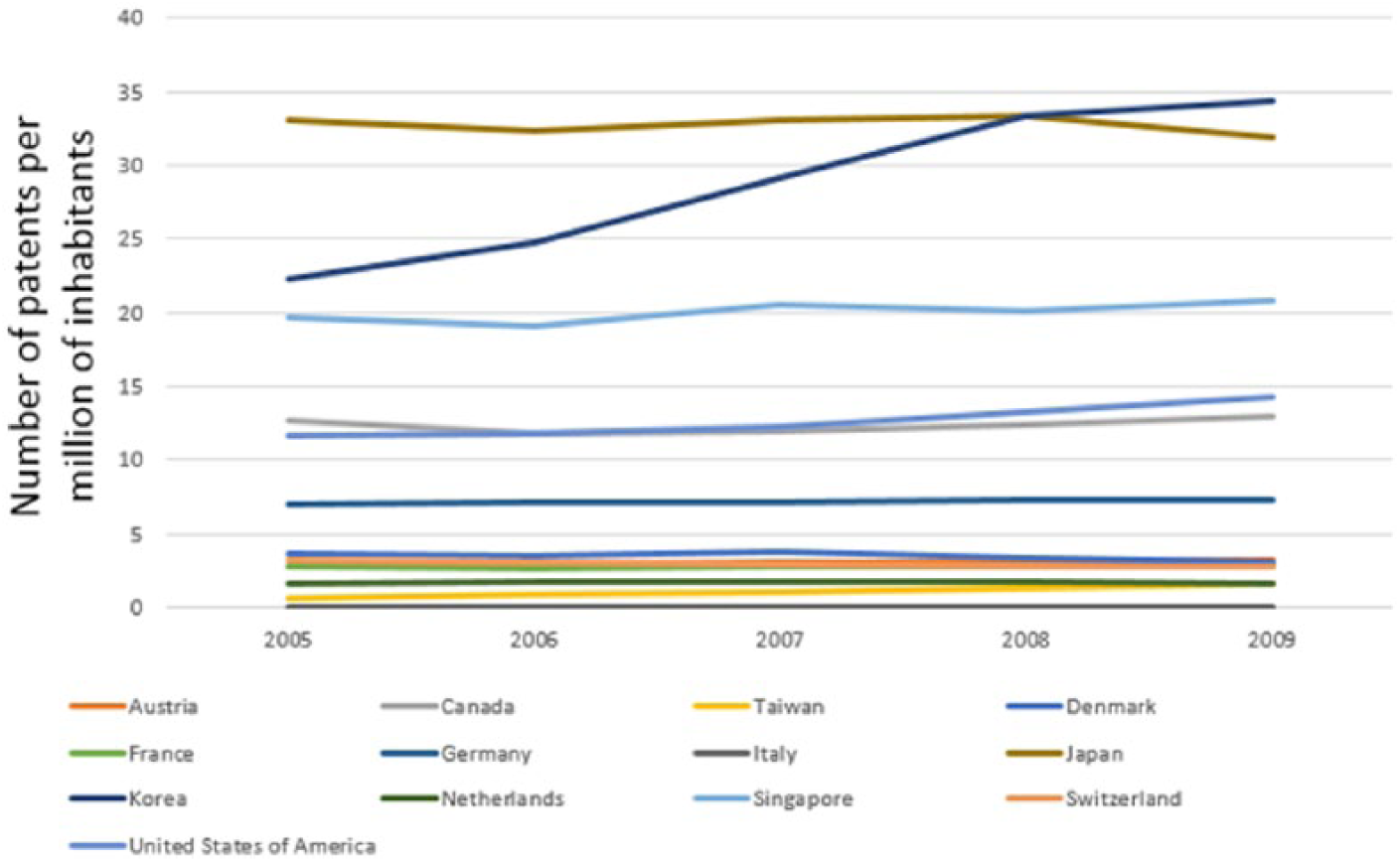
Home-country innovation institutional profile.
Because in our work we employed this variable as a moderator, we centered it to avoid multicollinearity (Cohen & Cohen, 1983). Without centering, the value of our sample varies from 0 patent per million inhabitants in Italy in 2005 to 34.4 in the case of Korea in 2009.
Home-Country Environmental Institutional Profile
To operationalize this variable, we used information from the Environmental Performance Index (EPI), which is jointly collected by the Yale Center for Environmental Law and Policy at Yale University and the Center for International Earth Science Information Network at Columbia University (Esty et al., 2006). It is a suitable proxy for the home-country environmental institutional profile because it rates countries’ environmental regulations and behavior. This calculation is based on a “proximity-to-target” methodology: specifically, it compares countries’ approaches against the top performance benchmark, which is defined by international goals and established scientific thresholds. This variable provides an objective and quantifiable measure, and it is based on a set of environmental issues (Esty et al., 2006). More particularly, it integrates 76 data sets—past and present pollution levels, environmental health, agricultural subsidies and pesticide regulation, evolution of carbon and water intensity, environmental management effort, capacity to meet environmental targets, and so on—into 21 indicators and five dimensions reflecting their environmental performance. Figure 2 shows in greater detail the values of this variable. As in the case of the home-country innovation institutional profile (Figure 1), in Figure 2 we can observe that the values of the home-country environmental profile reveal institutional differences between the countries in our sample. We can see that the top positions are occupied by Italy, which occupies the second-best position after Switzerland (with an EPI score of 69.1 in 2009), and France (with an EPI score of 68.3 in 2009). Among the lower-ranked performers, apart from Taiwan, we find Korea (with an EPI score of 53.1 in 2005) and the United States (with an EPI score of 54.8 in 2005). As in the case of the variable shown in Figure 1, this variable has a relatively stable tendency for all the countries in our sample.

Home-country environmental institutional profile.
In the same way as the home-country innovation institutional profile, this variable is employed as a moderator, so it is centered to avoid multicollinearity (Cohen & Cohen, 1983). Without centering, the value of our sample varies from 41.9 for the lowest-ranked performer (Taiwan in 2009) to 77.3 for the highest-ranked performer (Switzerland in 2008).
In addition, we included the following control variables.
Firm Age
Drawn from the Bloomberg and JP Morgan databases, this variable reflects a firm’s foundation year. It measures a firm’s level of experience, a characteristic that has been considered to influence its technological choices (Hegde, Mowery, & Graham, 2009).
Firm Performance
Performance is measured by Tobin’s Q, defined as the ratio of the market value to the replacement cost of assets. Taken from the COMPUSTAT database, Tobin’s Q is preferred to other performance measures because it also considers the market value of the firm and hence includes the value of intangible assets, a measure that is not fully captured by traditional account-based variables (Chung & Pruitt, 1994; Ernst, 2001). The use of Tobin’s Q is particularly relevant in our sample because in the case of technological firms the replacement cost of the value of intangible assets may be higher than that of tangible assets (Bharadwaj, Bharadwaj, & Konsynski, 1999).
Firm Size
Taken from the COMPUSTAT database, this variable measures the total assets possessed by an organization, which is regarded in the innovation literature as being positively associated with a higher level of innovation behavior (e.g., Damanpour, 1991).
Results
We tested our hypotheses with STATA software. We performed the Hausman test (Hausman, 1978), which endorses the suitability of a fixed-effect model. Fixed-effect models are preferred to random-effect models because they provide greater reliability in the parameter estimations, as they eliminate the unobservable variables in conventional ordinary least squares regression estimations (Ernst, 2001). In addition, we utilized robust standard errors to avoid serial correlation and heteroskedasticity, and we controlled for the variability of the intercept over time by using year-specific dummies. Because the company is our unit of analysis, we employed robust standard errors clustered at the company level, as this specification offers higher reliability than nonclustered robust standard errors (Petersen, 2008). Table 1 includes the descriptive statistics of our variables. The correlations between the variables do not suggest any potential for serious multicollinearity in the regression analysis, and the variance inflation factors are completely acceptable, ranging from 1.05 to 1.20, with a mean of 1.10.
Descriptive Statistics and Correlations.
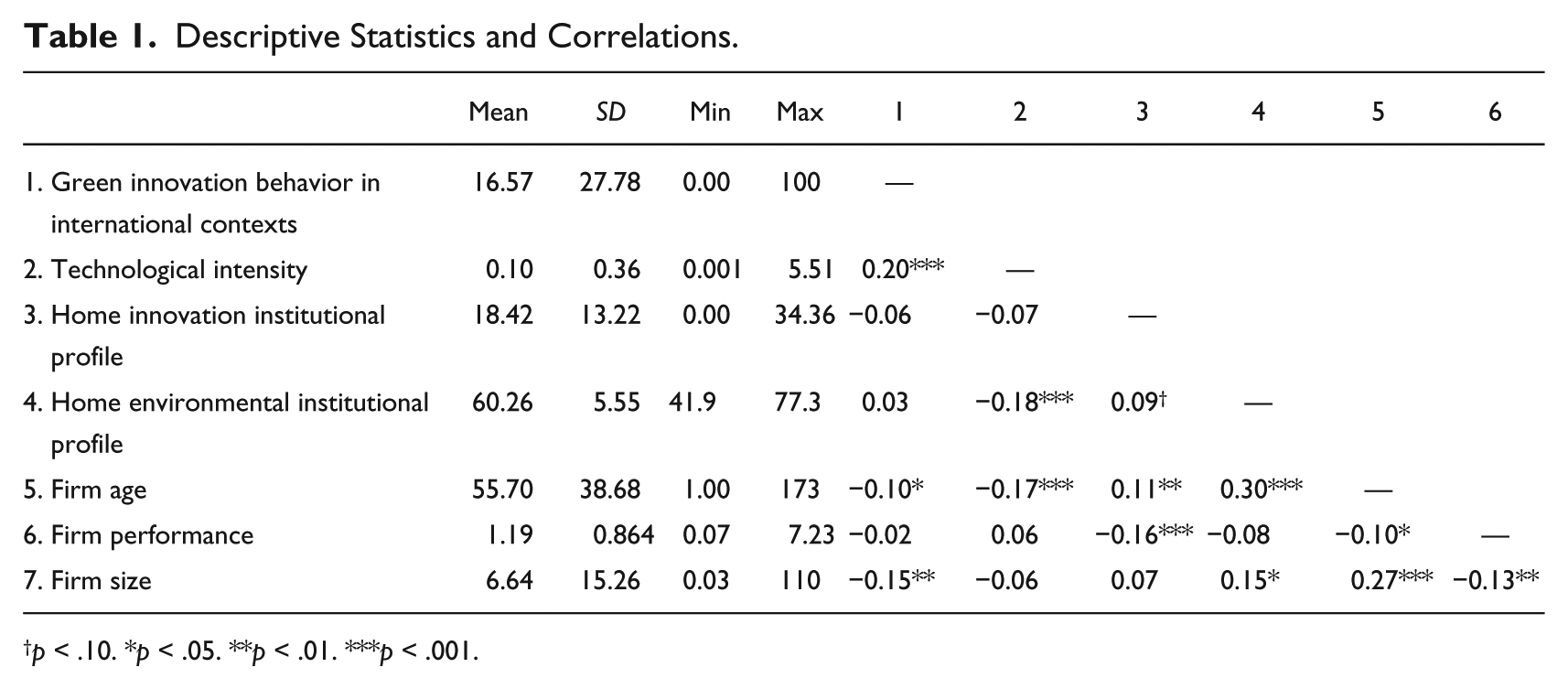
p < .10. *p < .05. **p < .01. ***p < .001.
Table 2 presents the results of the regression, into which the variables reflecting the hypothesized effects were entered individually. Model 1, the base model, includes only the control variables when green innovation behavior in international contexts is the dependent variable. Model 2 includes the first hypothesized effect variable, that is, the relationship between the dependent variable and the firm’s technological intensity. Model 3 includes the relationship between the dependent variable and the firm’s home-country innovation institutional profile and the firm’s home-country environmental institutional profile. Model 4 includes the moderating effect of these two variables and closes the regression. The R2 statistics indicate that every additional variable improved the model fit.
Result of the Regression Analysis.
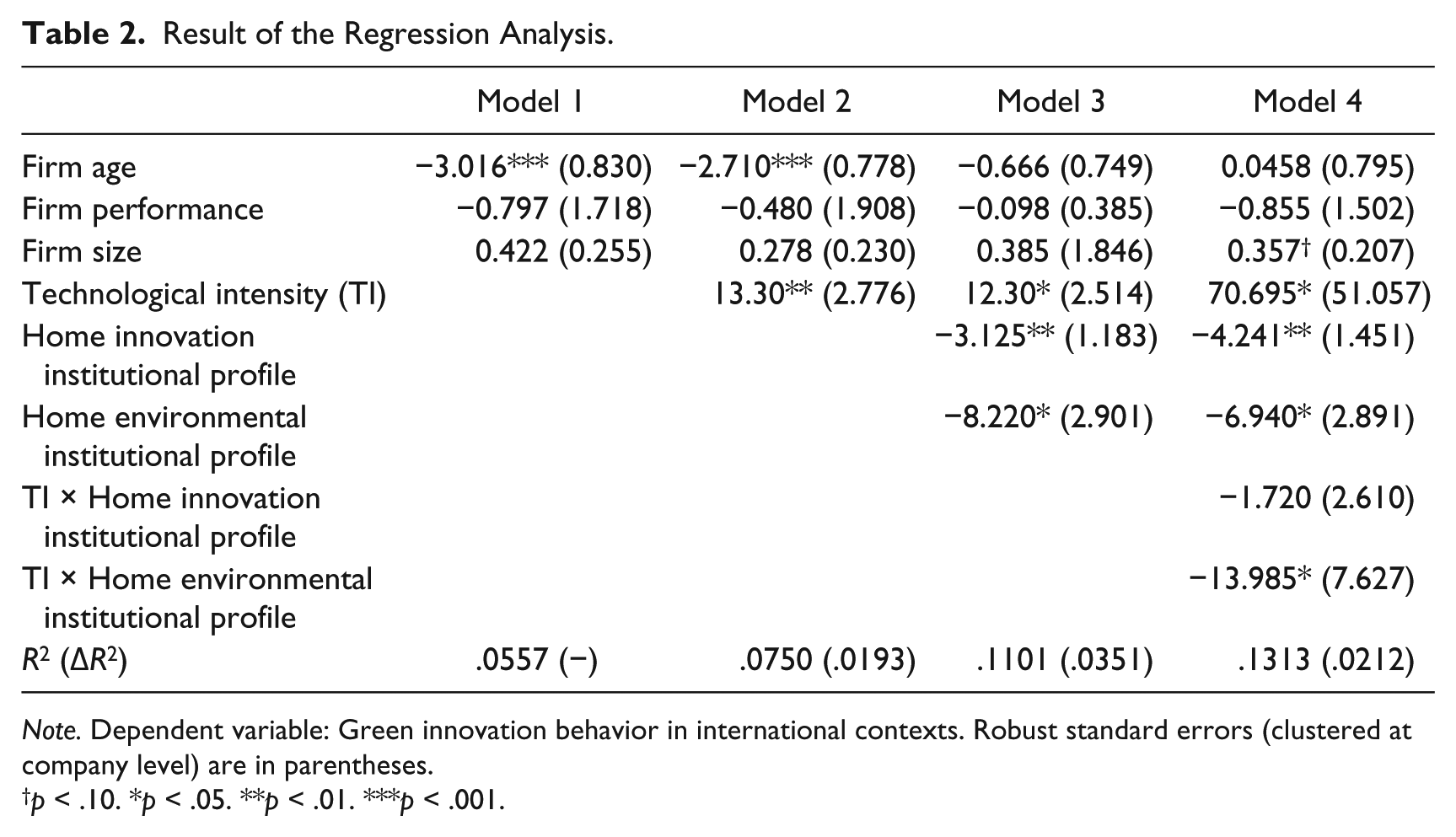
Note. Dependent variable: Green innovation behavior in international contexts. Robust standard errors (clustered at company level) are in parentheses.
p < .10. *p < .05. **p < .01. ***p < .001.
Hypothesis 1 predicts a positive direct relationship between a firm’s technological intensity and its green innovation behavior in international contexts. Model 2 of the regression shows a positive and significant coefficient of the firm’s technological intensity (β = 13.30, p < .01). However, when we include the variables of the home-country innovation and environmental institutional profiles, the coefficient of the firm’s technological intensity has reduced significance (p < .05 for Models 3 and 4).
Model 4 predicts a negative relationship between the level of development of the home-country innovation institutional profile and green innovation behavior in international contexts. The coefficient (β = −4.24, p < .01) is negative and significant. In respect of the relationship between the level of development of the home-country environmental institutional profile and green innovation behavior in international contexts, the coefficient (β = −6.94, p < .05) is negative and significant, suggesting that firms from institutionally weak countries adopt a higher green orientation level for their international innovation portfolio. Hypothesis 2a predicts a negative moderating effect of the home-country innovation institutional profile on the relationship between a firm’s technological intensity and its green innovation behavior in international contexts. The coefficient is negative but not significant; hence, we cannot confirm Hypothesis 2a. Hypothesis 2b predicts a negative moderating effect of the home-country environmental institutional profile on the relationship between a firm’s technological intensity and its green innovation behavior in international contexts. The coefficient for this moderation (β = −13.98, p < .05) is negative and significant, thus supporting Hypothesis 2b. Figure 3 plots this interaction effect using the procedures outlined by Venkatraman (1989) to delimit the specific influence of this moderating effect.
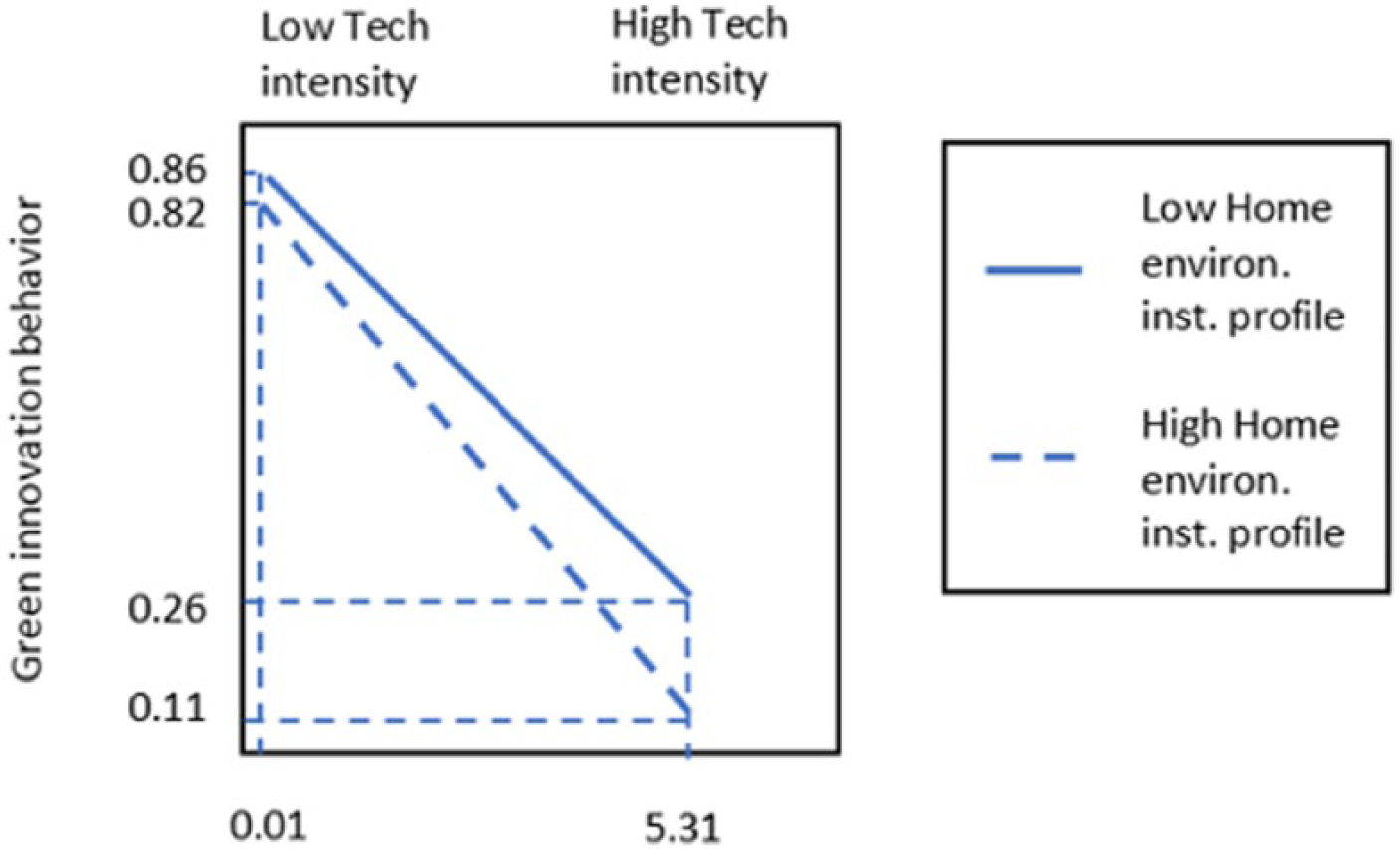
Moderating effect of the home-country environmental institutional profile on the firm’s technological intensity.
Figure 3 shows that both slopes of the home-country environmental institutional profile (i.e., low and high levels of development) have a descending trend; although this trend is the same, when we look at the values of Figure 3, we can observe some differences between the low and high levels of home-country environmental institutional profiles. That is, when an organization has low levels of technological intensity, both high and low levels of home-country environmental institutional profiles show very similar green innovation behavior (0.82 and 0.86, respectively). This means that in the presence of lower levels of technological intensity, the moderating effect is low.
However, as technological intensity increases, the moderating effect also increases to the point that firms with a high home-country environmental institutional profile show a green innovation behavior of 0.11, whereas firms with a lower home-country environmental institutional profile show a green innovation behavior of 0.26, that is, more than twice that of firms with higher home-country environmental institutional profiles. As shown in Figure 3, when we consider a firm’s home-country environmental institutional profile, in the first case (i.e., low technological intensity), there is a shift from 0.82 to 0.86 (Δ4.8%), whereas when there is high technological intensity, there is a shift from 0.11 to 0.26 (Δ136.4%).
Therefore, our results show that as a firm increases its technological intensity it tends to allocate less weight to its international environmental portfolio (i.e., it exhibits lower green innovation behavior); this descending trend is more pronounced when the firm belongs to a country with a high environmental institutional profile. As for the control variables, only the firm size shows a significant relationship with green innovation behavior in international contexts (β = 0.357, p < .10).
Discussion and Conclusion
Our study was based on the previous literature on the influence of technological intensity on the development of green innovations (e.g., Doran & Ryan, 2012; Horbach, 2008), and we complemented it by considering the moderating impact of the home-country institutional profile. In particular, our study focused on home-country institutional weaknesses, and it stresses how innovation and environmental institutional features affect firms’ engagement with green orientation behavior in international contexts. Specifically, we examined how these weaknesses moderate the relationship between technological intensity and green innovation. Firms from a home country characterized by institutional weaknesses (i.e., weak home-country institutional profiles) are perceived unfavorably by international stakeholders (i.e., liability of origin) (Kostova & Zaheer, 1999). Firms may, therefore, adopt further strategies, such as increasing their green orientation behavior, to meet legitimacy requirements in international contexts. Our interest in this question is relevant because it can shed light on the ongoing discussion regarding the impact of the home-country institutional profile on the development of firms’ corporate social responsibility in international contexts (Marano et al., 2017).
First, our results support the previous literature regarding the influence of technological intensity on development innovations (e.g., Doran & Ryan, 2012; Horbach, 2008), and we add new evidence to this previous literature by considering the moderating impact of the home-country institutional profile on the relationship between technological intensity and the development of firms’ green innovation behavior in international contexts. Our results indicate that greater development of the home-country environmental institutional profile negatively moderates the existing positive relationship between technological intensity and green innovation behavior. With respect to the home-country innovation institutional profile, although our results also show a negative moderation by this variable of the relationship between technological intensity and green innovation behavior, as hypothesized, these results are not significant, hence opening a window for future research that could deepen our understanding of the home-country innovation institutional profile and determine which specific aspects of it may have a significant influence.
Second, our results show that both environmental and innovation home-country institutional profiles have a direct negative influence on green innovation orientation in international contexts. As mentioned previously, firms from institutionally weak countries may face the challenge of overcoming liability of origin by developing legitimacy strategies in international contexts. Adopting a higher green orientation level in their international innovation portfolio can be considered a strategy to meet legitimacy requirements in international contexts. The previous literature has noted that firms can use different legitimacy strategies in international contexts, such as increasing their transparency, unifying their management conduct (Kostova et al., 2008; Kostova and Zaheer, 1999), or being environmentally proactive in their international activities (Christmann, 2004; Delmas & Montes-Sancho, 2011). Our results add new evidence showing that the need to respond to the negative perceptions of international stakeholders based on specific home-country institutional weaknesses can also help explain why these firms’ international innovation portfolios have a higher green orientation. Hence, our article offers the opportunity to advance our knowledge regarding which factors influence the heterogeneity of firms’ strategic responses in international contexts.
Our work has some limitations that present additional opportunities for future research. We analyzed which characteristics foster the adoption of green innovation as a legitimacy strategy, but we did not study the level of legitimacy that these firms achieved in international contexts. Hence, future works can explore whether the results achieved by such firms endorse the effectiveness of green innovation behavior as a legitimacy strategy. In addition, finding an alternative way of capturing the degree of development of the institutional profile, as in the case of the home-country innovation institutional profile mentioned previously, or including other types of institutional dimensions could validate our findings on the importance of the moderating effect of the home institutional profile on the relationship between technological intensity and green innovation.
Furthermore, in this study we used patents as the only measure of innovation. Whereas some authors have advocated the use of patent data (Helm & Kloyer, 2004; Reitzig, 2003), and some have even stated that we are witnessing a notable increase in patenting worldwide (e.g., Hall & Ziedonis, 2001), other scholars have stated that firms rely on other ways of protecting their inventions, such as secrecy (Blind, Cremers, and Mueller, 2009). Additionally, our study focused on the E&E industry because it is considered to be very active in patenting (EPO, 2010). Future works should study other sectors that are less prone to filing patents and analyze different environmental dimensions (e.g., environmental practices, sustainability reports) to assess the influence of home-country institutional weaknesses on greener behaviors in international contexts. Another fruitful avenue for research could be to analyze sectors with different levels of internationalization and their heterogeneous responses to home-country institutional weaknesses. A further line of continuation of our work would be to interview firms about our results to check whether they are surprised by them or to ask whether they have suggestions for how we might further evaluate or refine our research. Furthermore, we plan to compare green innovation patents with the overall patent portfolio: Showing how these two sets of activities respond differently to the home-country institutional variables would provide some interesting results.
Our article has several theoretical and practical implications. First, our work contributes to natural environment literature by emphasizing the importance of considering both internal and external factors to understand why some firms are more likely to adopt green innovation behavior than others. Second, our work combines natural environment literature with institutional theory through an international lens by analyzing how the home-country institutional profile moderates a firm’s environmental management. The home country’s environmental institutional weaknesses can help explain this heterogeneity of green innovation orientation in international contexts. Third, although recent research has begun to pay growing attention to how liabilities of origin affect firms in international contexts, it has mostly been based on emerging countries (e.g., Cuervo-Cazurra & Ramamurti, 2014; Lu, Lio, Wright, & Filatotchev, 2014; Luo & Tung, 2007; Wang, Hong, Kafouros, & Wright, 2012) but not on developed countries, as we address in our analysis. This literature explains how companies from emerging countries face negative preconceptions from international stakeholders as a result of their institutional weaknesses. However, although emerging countries exhibit low levels of institutional development compared with developed countries, the institutional strength of developed countries is far from being homogeneous. Consequently, this difference in institutional strength between developed countries may lead to negative preconceptions from international stakeholders toward developed countries with weaker institutions. Hence, our study analyzed the effect of weaker institutions in both emerging and developed countries.
Our findings have implications for practitioners and policymakers because they emphasize the relevance of considering the home-country institutional profile to predict green innovation behavior in international contexts. Firms from countries that are institutionally weak in their environmental dimension may face the challenge of overcoming preconceptions about their home country’s environmental reputation and thus may feel more pressured to adjust to more institutionally demanding foreign countries. Governments of institutionally weak countries should adopt environmental policies that reduce the liability of origin faced by their companies. These policies will generate spillovers that will further enhance the reputation of a given country and pave the way for the internationalization of its firms, so that these firms will not need to put extra effort into gaining international legitimacy.
Footnotes
Declaration of Conflicting Interests
The author(s) declared no potential conflicts of interest with respect to the research, authorship, and/or publication of this article.
Funding
The author(s) disclosed receipt of the following financial support for the research, authorship, and/or publication of this article: The authors are grateful to the competitive research grant ECO2016-75909-P for funding a portion of this research.