



Abstract
A sustainability service industry has emerged that promotes the adoption of management tools, mechanisms, and procedures. This emergence took place despite a knowledge gap of how sustainability performance occurs in businesses. To understand practices amid the knowledge gap, this article explores through problematization how the performance orientations of practitioners and researchers relate to each other in the business sustainability field. The article unearths that like the sustainability service industry in practice, scholarship implicitly accepts assumptions of contingency in research designs. Because these implicit assumptions are unattended, it seems, to date, not possible for researchers to provide evidence-based guidance to practitioners on how to address business unsustainability. In addition, basic concepts of contingency are not yet established in this field to explain performance, rendering the acceptance of corresponding assumptions unfounded. The article concludes with research suggestions for the development of theory of sustainability performance in businesses.
Keywords
Introduction
A total of 15,364 researchers signed the Union of Concerned Scientists’ second warning to humanity about how accumulated effects of human behavior will diminish life support functions of planet Earth (Ripple et al., 2017). In reflection of its first warning in 1992, the Union declared that human societies have as yet failed to initiate a reverse trend on all but one of the emphasized sustainability challenges. That humanity is on an unsustainable path that transgresses planetary boundaries has also been acknowledged in business management and organization studies (Whiteman, Walker, & Perego, 2013). Businesses, which are the main organizations by which modern societies acquire and convert natural resources into products of wealth, are at the center of discourses about unsustainable developments.
Business sustainability research, which has been flourishing in the past four decades (Linnenluecke & Griffiths, 2013), is under pressure due to its limited ability to provide guidance for transitions to sustainable societies. Critical scholars excoriate the field’s achievements and the value added by its predominant concepts of business engagement (Crane, Palazzo, Spence, & Matten, 2014; Fleming & Jones, 2013). Others bemoan the field’s overreliance on the quest for a financial business case that leaves the impacts on conditions of livelihood unexplored (Margolis & Walsh, 2003). A recent contribution by Halme, Rintamäki, Knudsen, Lankoski, and Kuisma (2020) points to an even broader knowledge gap within this field, claiming that no empirical evidence would yet exist that captures how management approaches lead businesses to perform on sustainability objectives. The article at hand expands on these critiques by adding a new viewpoint to their underpinnings. I will argue here that a broad range of practitioners remains, to date, uninformed about how to enable effective changes in real-world business practices because scholarship is not yet in a position to explain how sustainability performance occurs in businesses. Following Halme et al., I define sustainability performance in businesses as the link between business-internal practices and their sustainability outcomes and impacts.
To connect business sustainability scholarship with its real-world context, I introduce the sustainability service industry as a central audience for research findings (Hoffman, 2016). The sustainability service industry comprises all actors who reside outside the businesses that they address through service practices. Their service practices are considered to enable sustainability performance in businesses. In other words, it is the sustainability service industry that functions in real-world practices as agents of change regarding the business community (Greenwood, Jennings, & Hinings, 2015). However, considering that scholarship has overseen the need to clarify the link between management approaches and their contributions to sustainability objectives (Halme et al., 2020), it is not clear how the sustainability service industry orients toward performance in its approaches to enact changes in business operations. By connecting real world with research practices, this article aims to demonstrate how the performance orientation of the sustainability service industry relates to the performance orientation in business sustainability research.
I chose problematization as the methodological approach to demonstrate how the performance orientations of practitioners and researchers relate to one another. Problematization is a methodology to challenge assumptions held in research designs and to make them subject of inquiry (Alvesson & Sandberg, 2011; Sandberg & Alvesson, 2011). Through problematization, this article unearths how both practitioners and researchers in the business sustainability field implicitly follow assumptions of contingency. The corresponding assumptions are, for practitioners, that there is no one best way to develop and deploy management approaches for the achievement of sustainability objectives, and, for researchers, that studied management approaches will be contingently effective. Neither practitioners nor researchers articulate these assumptions of contingency, nor are they likely to know about their assumptions, nor do researchers inquire into them. As a consequence, these implicit assumptions of contingency leave the field wide open for understanding how sustainability performance occurs in businesses.
The contributions to the literature are twofold. First, the article unearths field assumptions in the business sustainability field by relating the performance orientations of practitioners and researchers to each other. Field assumptions of contingency connect practitioners and researchers in the business sustainability field and refrain scholarship from creating evidence-based guidance on how the sustainability service industry could improve its practices for more effective changes to business operations. Second, through the elaboration of a research agenda, the article makes these field assumptions subject of inquiry. The research agenda aims for the development of theory of sustainability performance in businesses that should, in the long run, contribute to the creation of more evidence-based guidance for practitioners.
Before going into the argumentation, I explicate the methodology of problematization, its adoption in this study, and how it influences the structure of the article.
Problematization as a Methodological Approach to Clarify Assumptions in the Business Sustainability Field
Problematization is a methodology to generate research questions (Alvesson & Sandberg, 2011). Alvesson and Sandberg have brought forward problematization as an alternative to a prevalent and incremental “gap-spotting habitus” in business management and organization studies (Alvesson & Sandberg, 2013, p. 136). These authors added to previous discussions about the need for the development of more interesting research (Bartunek, Rynes, & Ireland, 2006; Davis, 1971) by suggesting that research can move beyond incrementalism when identifying and challenging assumptions held in research designs. The novelty in the approach by Alvesson and Sandberg (2011) lies in the systematic guidance provided to researchers to engage in a problematization process as well as in a typology of assumptions to be challenged with an augmenting interestingness of contributions to theory (see Table 1).
The Methodology of Problematization.

Source. Alvesson and Sandberg (2011, p. 260).
This study not only follows the methodology of problematization as laid out by Alvesson and Sandberg (2011) but also deviates from their guidance. Table 1 illustrates the six steps these scholars suggest for a problematization process. As this article follows an agenda of connecting research to its real-world implications, the first step I undertook for this study was (1) the identification of a real-world problem that warrants improved understanding. I identified the initial problem statement in a report on the effectiveness of sustainability certification schemes: After a 2-year investigation, Barry et al. (2012) could not clarify whether management approaches to sustainability are an effective means to enable changes in business operations. Subsequently, my own review set out with searches into the practices of a variety of actors that promote management approaches in the business sustainability context. After (2) an initial identification of assumptions held by practitioners, (3) I expanded the review to incorporate literature on the internal determinants of business sustainability. I chose this second domain to capture how sustainability performance is understood by scholars to occur in businesses. (4) I related the findings from the review of practices and research to each other and identified their assumptions to resonate with contingency theory. (5) I evaluated assumptions of contingency in light of their appropriateness by the current state of knowledge, as well as by their implications on how scholarship informs practitioners on the effectiveness of management approaches to business sustainability. Finally, instead of “challenging” assumptions of contingency in the business sustainability field, (6) I opt for their clarification in the form of a research agenda.
The result of engaging with the literature in a process of problematization is a comprehensive and compelling argumentation about the existence of field assumptions in the business sustainability field. “Field assumptions are difficult to identify because ‘everybody’ shares them, and, thus, they are rarely thematized in research texts” (Alvesson & Sandberg, 2011, p. 257). The present study identifies implicit assumptions of contingency as field assumptions in the business sustainability field by looking across communities of practices for assumptive relations. The assumptions of contingency this study unearths are field assumptions, as they hold true irrespective of actors, their practices, and their practice-inherent theoretical schools. Table 2 summarizes the following argumentation about the existence of implicit assumptions of contingency in both real-world practices and academia and offers guidance to readers to track this argumentation throughout the article.
The Argumentation in This Article for the Existence of Field Assumptions of Contingency in the Business Sustainability Field.

The remainder of this article is structured in accordance with the argumentation leading to the unearthing of the field assumptions, as well as with the steps outline for the problematization process. The first argumentation leads to the assertion of assumptions of contingency among practitioners of the sustainability service industry. The second argumentation leads to a similar assertion regarding relevant scholarship. This is followed by an evaluation of assumptions of contingency for both research and practices. The article concludes with the research agenda.
The Sustainability Service Industry and Its Performance Orientation
In recent decades, the world has seen an unprecedented rise of actors who aim to fortify the pursuance of social and environmental objectives by businesses. The magnitude, diversity, and interdependence of these actors have been described before from a perspective of changes in global governance (Gilbert, Rasche, & Waddock, 2011; Leipziger, 2016; Reed, Utting, & Mukherjee-Reed, 2012; Visser, Matten, Pohl, & Tolhurst, 2007; Vogel, 2008; Waddock, 2008). These actors comprise international, national, and industry sustainability initiatives; sustainability standard setters; business consultancies; rating agencies; to a lesser extent, academics and nongovernmental organizations; as well as sustainable supply chain managers within corporations, among others. Two defining criteria capture what makes this group of actors homogenously distinct, despite their heterogeneous appearance. First, these actors all reside outside the businesses that they address. Second, these actors provide services that ought to enable sustainability performance in addressed businesses. In describing these actors as one homogenous group of practitioners, the phenomenon highlighted here is the enabling character of their service practices for the achievement of business sustainability. With an interest in elucidating real-world practices, I introduce the “sustainability service industry” as a label for actors who seek effective approaches to manage businesses’ contributions to objectives that are set by a global agenda.
Another observation is that the sustainability service industry promotes the adoption of management tools, mechanisms, and procedures that its actors perceive enable sustainability performance in businesses. Promoted tools are, for instance, sustainability strategies or sustainability-related policies that ought to guide management in effective decision making; mechanisms are broader concepts of recursive processes like management systems and due diligence, which rely on documentation and prescribe ongoing orientations to problem finding and solving; procedures are commensurate considered action processes such as the Plan-Do-Check-Act cycle of management systems, or the procedure to define corrective actions after an audit, as well as to re-audit once the corrective actions are implemented.
To provide an example of the sustainability service industry, how it promotes the adoption of management approaches, and the interdependency among its actors, I refer here to the promotion of due diligence as a mechanism to mitigate risks of human rights abuses in supply chains. The Organisation for Economic Co-operation and Development, 1 a multilateral political forum, developed due diligence as a management mechanism to address issues of conflict minerals in supply chains. Lawmakers, first in the United States, 2 then in the European Union, 3 established requirements for larger companies to conduct due diligence on conflict minerals. Business-led initiatives, such as Drive Sustainability by CSR Europe, 4 now promote due diligence practices for more than a dozen resources. Ernst & Young, 5 or smaller boutique consultancies such as RCS Global, 6 assist companies in adopting and implementing these due diligence practices. Nongovernmental organizations, such as the Enough Project, 7 push companies through advocacy work to adopt due diligence as a management approach to conflict minerals. Staff in corporations working on sustainable supply chain management, for instance, at Apple Inc, 8 or the General Motors Company, 9 pass these requirements down to their business partners. Certainly, a range of auditing firms 10 benefit from the new demand for third-party assurance services of supply chain due diligence practices.
The creation and promotion of new approaches to address severe concerns about unsustainable business practices is generally a commendable development. However, as this article elaborates, the promotion of management approaches that ought to enable sustainability performance in businesses, is, according to the current state of knowledge, problematic. Two reasons epitomize why these practices require problematization in research.
First, all management approaches promoted by the sustainability service industry have been developed without empirical evidence of whether these will effectively address issues of business unsustainability. The contribution by Halme et al. (2020) suggests that knowledge of which management approaches would lead to specific performance outcomes and impacts for sustainability is, to date, missing. As empirical evidence on sustainability performance in businesses is in its infancy, the sustainability service industry must draw from professionally accepted means that are considered legitimate by a business community under pressure (DiMaggio & Powell, 1983). The example of due diligence for sustainable supply chain management makes this dilemma explicit: The concept of due diligence stems from the finance sector, hence from a sustainability-unrelated field. Additionally, the idea of scrutinizing suppliers has its origins in the defense industry (Swift, Humphrey, & Gor, 2000). A similarly dubious legacy without proven issue-adequate effectiveness can be suggested for audits and assurance practices (Boiral & Gendron, 2011), sustainability reporting (Etzion & Ferraro, 2010), codes of conduct (Bondy, Matten, & Moon, 2007), and environmental management systems (Delmas & Montes-Sancho, 2011; Orsato, 2006). What these management approaches have in common is that they were all previously applied in sustainability-unrelated fields and subsequently considered to also contribute to the achievement of sustainability objectives.
Second, and as a consequence, evidence suggests that the management approaches promoted by the sustainability service industry lead to unsystematic contributions to sustainability objectives. I stay with the above example of due diligence in sustainable supply chain management to illustrate the extent of this argument. IPIS and ULULA (2019) have undertaken an impact assessment of due diligence programs in the eastern Democratic Republic of Congo, that is, the region with international attention due to the production of conflict minerals. The impact assessors find that in mining zones with operating due diligence programs, there is less armed group involvement, less illegal taxation, and less corruption. However, there also remains a significant presence of the very same concerns in mine sites with due diligence programs. Furthermore, the following of due diligence practices does not show significant differences for issues of low-income payments, child labor usage, experiences of violence, and environmental degradation. Despite an interest in understanding how impacts result from due diligence practices, the study by IPIS and ULULA (2019) does not clarify the nature of this link. Other research suggests that the majority of companies are incapable of determining whether they are sourcing conflict minerals (Kim & Davis, 2016) and that the related law enforcement in the United States has led to increasing conflict in the Democratic Republic of Congo and its neighboring countries (Parker & Vadheim, 2017; Stoop, Verpoorten, & van der Windt, 2018). It appears thus, in this example, that the link between management approaches and issues of business unsustainability has not yet been established.
A fallacy about the effectiveness of concurrent management approaches to business sustainability does not rest on due diligence practices alone but also involves other tools and mechanisms promoted by the sustainability service industry. For instance, it remains to date unclear to what extent sustainable supply chain management programs are conducive to achieve sustainability objectives (Pagell & Shevchenko, 2014; Sheffi & Blanco, 2018; Villena & Gioia, 2018). That there can be a focus on following perceived good practices, rather than on addressing issues of concern, has also been long maintained for sustainability reporting (Belkhir, Bernard, & Abdelgadir, 2017; Cho & Patten, 2007; Delmas & Montes-Sancho, 2010; Diouf & Boiral, 2017; Patten, 2002). In the case of environmental management systems, there is an open debate about whether these mechanisms lead businesses to improve their environmental performance (Graafland, 2018; Graafland & Smid, 2016; Khanna & Brouhle, 2009) or whether they are insignificant (Baek, 2018; Boiral, 2007; Zobel, 2018). Also, for the reduction of greenhouse gas (GHG) emissions, researchers find that management practices promoted in international guidelines can be insignificant (Doda, Gennaioli, Gouldson, Grover, & Sullivan, 2016; see also D. Wang, 2018). Research into the effectiveness of other sustainability management approaches and practices (including policies, reporting, accounting, life cycle assessments, carbon footprint assessments, etc.) suggest further that companies are biased toward the reaping of financial benefits in their deployments (Hörisch, Ortas, Schaltegger, & Álvarez, 2015; Stevens, Steensma, Harrison, & Cochran, 2005). In another review of a range of tools designed to integrate environmental objectives into organizational practices, among others, Runhaar (2016) concludes that they can be useful to promote policies and practices, but that “their performance usually is modest” (p. 7).
The Implicit Assumption of Contingency in Practices of the Sustainability Service Industry
Resulting from unclear performance expectations of widespread practices, there is confusion about what management approaches to promote when addressing a sustainability issue of concern. Mori Junior, Sturman, and Imbrogiano (2017) illustrate in a comparative content analysis of 18 sustainability schemes in the mining industry that diverse approaches get interchangeably applied. Management tools and mechanisms like “policy,” “due diligence,” “risk assessment,” “management system,” or an even less specific appearance—“a system in place”—are requested in standard provisions across initiatives and for various issues of public concern. This interchangeable promotion of management approaches is also the case in more traditional core concerns to businesses, as in occupational health and safety, despite a management system approach being promoted internationally as good practice. It is not clear why actors promote a certain management approach to address a specific issue, what the assumed connotations are, and the performance rationales for the respective choices.
The promotion of diverse management approaches due to unclear performance expectations infers that the sustainability service industry operates at the macro level with the assumption that there is no one best way to organize for sustainability performance in businesses. While an individual actor of the sustainability service industry can endeavor to prescribe effective approaches to businesses, other actors can promote diverging approaches for the same reason of perceived effectiveness. Thus, different actors promote different management approaches that are assumed to be similarly effective.
The assumption of the existence of a variety of best options is a key pillar of contingency theory (Lawrence & Lorsch, 1969). Contingency scholars propose that to achieve optimal organizational performance, managers need to deploy structures and practices that depend on the contingent variables of the organizational environment. In the context of the sustainability service industry, this means that managers deploy diverse tools, mechanisms, and procedures, depending on the sustainability issue needing to be addressed and according to its environmental characteristics. Thereby, the organization will achieve optimal sustainability performance in the areas addressed.
The assertion that all practitioners, who promote management approaches to sustainability issues, operate at the macro level with assumptions of contingency and limited performance expectations warrants explanation. Hence, the following section aims to clarify how the contingency-based performance orientation of the sustainability service industry relates to the knowledge produced by researchers about the internal determinants of businesses and their linkages to sustainability performance.
What Do We Really Know So Far? Research on Internal Determinants of Business Sustainability and Its Performance Orientation
This section aims to decipher the performance orientation scholarship takes when researching phenomena of business sustainability. To grasp this performance orientation, I expanded the literature review to encompass the academic knowledge to date on internal determinants of business sustainability. I chose this literature on the premise that the inside of businesses is the primary location where their sustainability performance occurs. A first extensive reading of the literature led to the identification of seven contributions in which scholars had searched before, systematically and unsystematically, for internal determinants of business sustainability phenomena (Adams, 2002; Aguinis & Glavas, 2012; Delgado-Ceballos, Aragón-Correa, Ortiz-de-Mandojana, & Rueda-Manzanares, 2012; Engert, Rauter, & Baumgartner, 2016; Hoejmose & Adrien-Kirby, 2012; Morioka & de Carvalho, 2016; Thijssens, Bollen, & Hassink, 2016). Following the rhetoric of scholars who presented an overview about “what we know and don’t know” (Aguinis & Glavas, 2012), the interest in sustainability performance requires questioning what it is that we really know about the effects of business-internal determinants. Consequently, I started reanalyzing the literature used in those seven contributions and focused on references that would (1) aim to explain potential improvements in social and/or environmental dimensions of sustainability, (2) elaborate on internal determinants in contexts of for-profit organizations, and (3) use primary data in providing empirical insights or which are conceptual in nature. Thereby, I selected a first set of 80 peer-reviewed articles that encompass publications from 1975 to 2016.
To provide a more up-to-date account of this scholarship, I selected a range of journals in business management and organization studies (i.e., Academy of Management Journal; Academy of Management Review; Accounting, Auditing & Accountability Journal; Journal of Management Studies; Strategic Management Journal) as well as field-specific journals (i.e., Accounting, Organizations & Society; Business Ethics: A European Review; Business & Society; Business Strategy and the Environment; Corporate Social Responsibility and Environmental Management; Journal of Business Ethics; Journal of Cleaner Production; 11 Management of Environmental Quality: An International Journal; Organization & Environment) in which the first set of 80 articles are predominantly published. I manually searched for respective contributions in these journals through cautious reading of titles and abstracts in the volumes of the past 3 years (2016-2018). By applying to this literature the same three selection criteria named above, I collocated a second set of 330 papers, leading to a total sample of 410 peer-reviewed articles.
In analyzing this body of work to understand the performance orientation of its scholarship, two questions were of central interest: (1) What is explained in research encompassing internal determinants of business sustainability? (2) By what data sources are these explanations reached? In a first screening of the articles, I extracted information in correspondence to these two questions and grouped contributions into emerging patterns. In a second screening, I consolidated the literature by its prevalent patterns to provide a consistent and faithful interpretation of this body of work. Tables 3 and 4 summarize the information gained on these two points of interest. Full lists with references can be requested from the corresponding author. The following analysis of the performance orientation of business sustainability scholarship expands selected issues of validity in contributions on the internal determinants of business sustainability.
Researched Phenomena in the Literature on Internal Determinants of Business Sustainability.

The table contains multiple entries for studies to which more than one category applies.
Data Sources in the Literature on Internal Determinants of Business Sustainability.
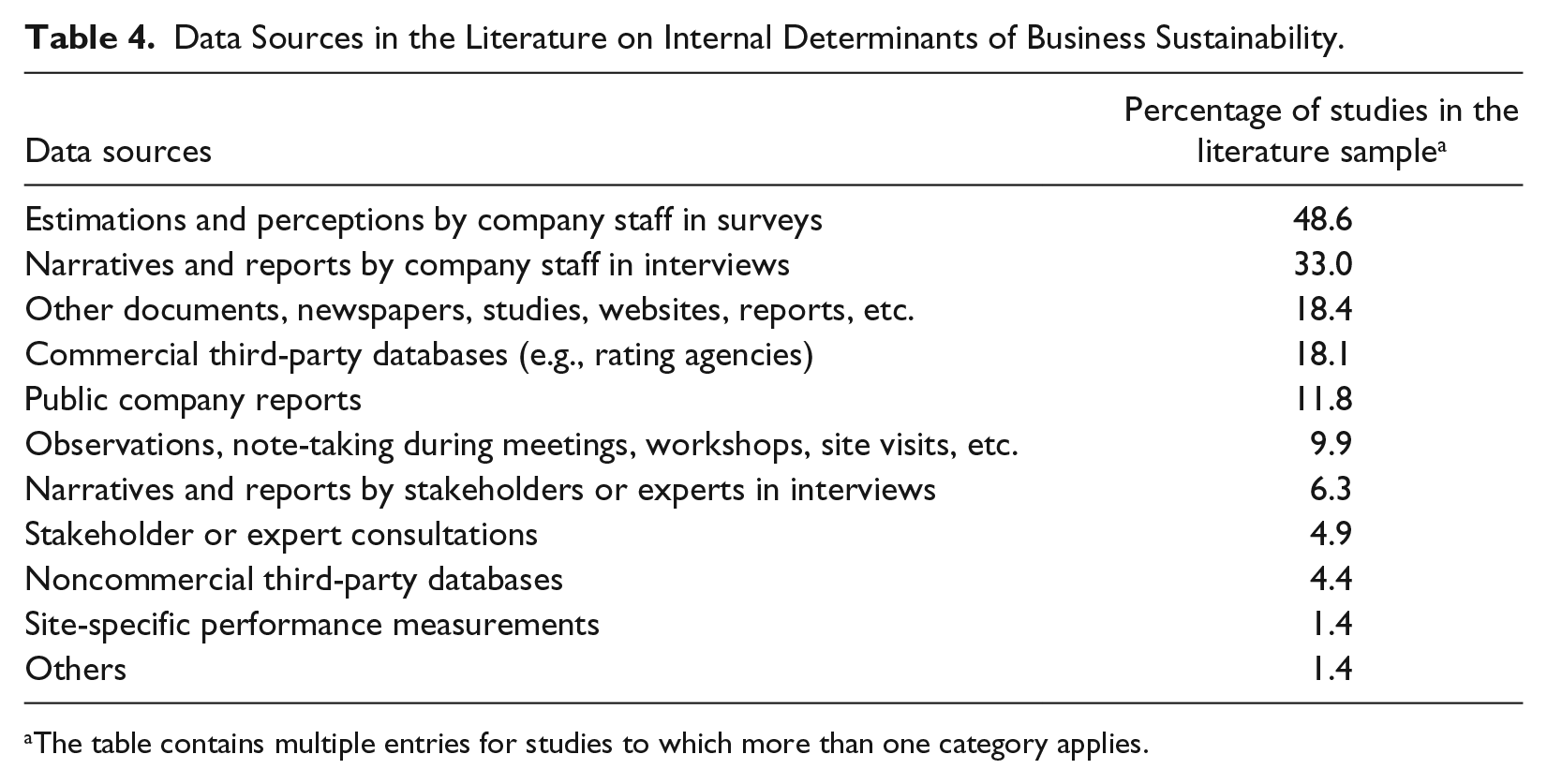
The table contains multiple entries for studies to which more than one category applies.
Limitations of Validity in Research on Internal Determinants of Business Sustainability
Nearly 50% of business sustainability research with an interest in internal determinants explains phenomena of perceived engagement, willingness of engagement, and the adoption or application of management tools, mechanisms, and procedures. The explanation of the adoption or application of management approaches is the largest group within this research body, accounting for more than a quarter of these studies. In this kind of research, scholars explain sustainability management phenomena by other management phenomena and organizational characteristics. Thus, scholars in this field tend to explain what is done or intended by businesses (output level) without elaborating on how this translates into organizational performance (outcome level) or feeds into societal or global sustainability objectives (impact level). While this body of work contributes to the advancement of concepts and theories in the business sustainability field, it does risk promoting management approaches that have unclarified means–ends relations (Bromley & Powell, 2012).
A variety of quantitative researchers take a more outcome-oriented stance. Yet generalizations of results are overstated if data are limited to a few sustainability issues only that are further obfuscated by aggregations in variable constructs (H. H. Wang, Tong, Takeuchi, & George, 2016). This is particularly the case for the use of commercially motivated databases, like the Kinder,Lydenberg, and Domini database. There are various limitations of the validity of Kinder, Lydenberg, and Domini database if understood to measure businesses’ contributions to sustainable development, as previously indicated by a range of scholars (Chatterji, Levine, & Toffel, 2009; Entine, 2003; Rowley & Berman, 2000; Wood & Jones, 1995).
A central issue of commercially motivated third-party databases is, however, that the rating agencies collecting this data are also affected by a lack of access to comprehensive performance measures. Facing constraints in obtaining comprehensive performance data, rating agencies compensate this lack by a codification of how businesses adopt management tools, mechanisms, and procedures (Delmas, Etzion, & Nairn-Birch, 2013). An insight into these practices give the contributions by Labelle, Hafsi, Francoeur, and Amar. (2018) as well as Rodríguez-Ariza, Cuadrado-Ballesteros, Martínez-Ferrero, and García-Sánchez (2017), which include some details of the SiriPro and EIRIS databases, respectively. It is evident that these rating agencies put a strong emphasis on the availability of policies, statements, programs, systems, reports, and other management tools, which are then combined with other performance data into constructs. Yet researchers who draw their conclusions by interpreting these aggregated constructs do not (or cannot) differentiate between the extents of actual performance on sustainability issues of concern or the generic adoption of management approaches by businesses (Schneider & Meins, 2012). Therefore, despite their merits in advancing the use of sustainability performance measures, rating agencies are at the forefront of what I term to be a sustainability service industry that creates impressions of performance.
In the reviewed body of work, researchers surveying organizational members on their achievements also create impressions of sustainability performance. This is particularly the case when researchers use positively formulated questions to assess progresses of resource efficiency, yet without aiming for an adequate insight into the variety of resources utilized in businesses (e.g., Delmas & Pekovic, 2018; Paulraj, Chen, & Blome, 2017; Phan, Baird, & Su, 2018; Testa, Iraldo, & Daddi, 2018; Zhu, Sarkis, & Lai, 2007). The resulting performance data should cover, for instance, not only in which cases emissions have decreased but also in which they increased or remained stable. By the current practice of keeping performance on aggregated levels, researchers omit eventual simultaneous underperformance of businesses on other categories. Readers also do not get to know how study participants draw boundaries when answering these questions. For example, if asked about environmental accidents in business operations (Paulraj et al., 2017; Zhu et al., 2007), what do survey participants consider an environmental accident to be? And what is otherwise a nonaccidentally occurring, thus socially accepted environmental degradation? Due to such limitations, research on internal determinants through survey instruments appears to equally create impressions of performance.
A further issue of impression creation is prevalent in research on internal determinants of ethical and organizational citizenship behavior. Ethics are generally perceived to be part of sustainability discourses (see, e.g., Shevchenko, Lévesque, & Pagell, 2016). Notwithstanding, research on ethics and organizational citizenship behavior has difficulty in translating its conceptual meanings into concerns of business sustainability (see also Fernández & Camacho, 2016). Within research on business ethics, scholars have recognized the need to build a bridge between, for instance, ethical behavior and the environment (Ciocirlan, 2017; Tosti-Kharas, Lamm, & Thomas, 2017). However, also in this literature, data gathering does not go beyond generalized measures of good intentions. In fact, if an employee responds in a survey to a question about whether he or she would internally make suggestions on how to improve the organization’s environmental performance (e.g., Boiral, Raineri, & Talbot, 2018; De Roeck & Farooq, 2018; Graves & Sarkis, 2018; Tosti-Kharas et al., 2017), researchers and readers do not get to know what that employee is actually thinking about. One does not get to know whether he or she thinks about asking another colleague to turn off the coffeemaker after use, or whether he or she is planning to launch an internal campaign to save a pristine forest that its company is planning to cut down for access to resources. In particular, one neither gets to know what respondents think the environment is, nor what preconception of human–nature interactions their good intentions contain, nor how their good intentions will actually feed into the sustainability performance of the business.
Hence, there are also various limitations resulting from conventional forms of surveying techniques in assessing sustainability performance in businesses. Table 4 suggests that more than 80% of the research on internal determinants of business sustainability is based on self-referential narratives, reports, personal perceptions, and estimations of performance. This figure does not yet take into account the degree to which commercial and noncommercial databases rely on self-reported data of companies, too, or the body of work gathering its data through public company reports. Many of the qualitative studies analyzed here not only make use of data sources other than self-referential narratives of company staff but only a few include stakeholders or experts to capture a range of different perspectives. The inclusion of stakeholder opinions is not, however, a panacea for company-focused performance estimations and narratives. The findings of Westphal and Zajac (1998), as well as Fiss and Zajac (2006), suggest that external stakeholders can react positively to formally adopted policies and strategies of companies, irrespective of whether these get implemented. Researchers should generally be more cautious when drawing conclusions about sustainability performance based on perceptions data. To exert cautiousness in sustainability research would also mean to demonstrate profound awareness and reflection on the concepts assessed considering the challenges for long-term livelihood on this planet.
There are a few works within the literature that are outstanding by offering more precision in the effects of business-internal determinants. Among the 410 articles reviewed, only one empirical study assessed whether the deployment of a particular management approach influences performance on a specific sustainability issue. Dahlmann, Branicki, and Brammer (2017) used data on GHG emissions in their research on the effectiveness of performance management. Whereas climate change through an augmentation of GHG emissions is a major issue addressed in sustainability discourses, the reduction of these emissions also has a direct beneficial effect on businesses’ balance sheets (Hörisch et al., 2015; Orsato, 2006). Therefore, another reading of these results by Dahlmann et al. (2017) is that performance management can drive the reduction of costs in businesses. The study does not explain what these findings imply for environmental issues of concern that do not neatly suit an interest in cost reduction by businesses, for instance, waste to landfill, land use, or the accumulated impact of operations on biodiversity. Another issue of research that solely focuses on measures of resource efficiency is that it does not consider that cost reduction in businesses faces limitations vis-à-vis the prerogative of producing goods and services to meet customer demand (Coles, Dinan, & Warren, 2016).
Contributions that allow for more differentiation and specification of performance effects of internal determinants are rare in business sustainability research. Exemptions are, for instance, the conceptual work by Schaltegger and Burritt (2018), which suggests that different internal orientations in businesses will also lead to different types of activities of sustainability engagement. Also, Ardito and Dangelico (2018) assessed how different internal orientations affect the productivity of energy, carbon, waste, and water, while keeping these variables separate in the analysis. Yet these contributions also offer only vague indications about resulting effects, as Schaltegger and Burritt (2018) only perceive that there are different levels of sustainability performance, while Ardito and Dangelico (2018) calculate relative as opposed to absolute reductions of resource use (see also Bjørn & Hauschild, 2013; Hörisch et al., 2015). Nevertheless, these works showcase that there is greater realm for specification and differentiation of performance that business sustainability scholarship has yet to embrace.
The Implicit Assumption of Contingency in Practices of Business Sustainability Scholarship
There is a tendency among business sustainability researchers to explain the adoption of management tools, mechanisms, and procedures as promoted by the sustainability service industry. Comprehensive explanations of sustainability performance in businesses that would allow for a distinction between performance and underperformance, as well as implications on the impact level, are absent in the reviewed literature. Furthermore, Table 3 indicates that the explanation of issue-specific sustainability performance makes up a dwarfed minority of this scholarship.
While accepting that the diverse internal determinants, as well as the management approaches researched, can have a positive effect on business sustainability, researchers leave unacknowledged when this positive effect applies. What they implicitly accept by working with these management approaches is that they will get effectively deployed when it makes sense for a business to act sustainably and to an extent appropriately with regard to the issues addressed. In other words, business sustainability scholarship implicitly accepts that the phenomena researched will get contingently deployed by businesses, whereby businesses will achieve optimal sustainability performance. This assumption in the business sustainability field is problematic, as it masks the current constrained capability of scholars to explain sustainability performance in businesses. The following section argues that if this scholarship aims to explain performance, the acceptance of assumptions of contingency is unfounded by the current state of knowledge.
Evaluating Assumptions of Contingency in Business Sustainability Research
Contingency theory builds on the relationships between three concepts: management approaches, particularly in the form of structures and practices; the organizational environment; and organizational performance measures. Its primary tenet is that there is no one best way to deploy structures and practices to achieve optimal performance of businesses (Donaldson, 2011; Lawrence & Lorsch, 1969). The best way to organize internally for effective task completion depends on factors emanating from the organizational environment to which businesses must adapt (Donaldson, 2011; Lawrence & Lorsch, 1969). The universalists’ notion to find “the best way” is rejected by contingency theorists and replaced by a configurational “it depends” (see, e.g., Aragón-Correa & Sharma, 2003; Husted, 2000; Maletič, Maletič, & Gomišček, 2018; Schmitz, Baum, Huett, & Kabst, 2019). Variance of optimal choices is further reflected in the idea of equifinality, meaning that there are many ways managers can choose to achieve organizational goals (Gresov & Drazin, 1997; van de Ven & Drazin, 1985). The influence of the organizational environment on companies follows thus an open system logic (Schreyögg, 1980).
Four conceptual and paradigmatic unclarities highlight why the implicit acceptance of assumptions of contingency impedes, to date, theory development on sustainability performance in businesses. First, researchers in this space overlook in their research designs how the studied management approaches get deployed to address sustainability issues. Research on management tools, mechanisms, and procedures indicates that there are tremendous differences across businesses as to how they deploy these means, and the performance generated (Boiral, 2007; Stevens et al., 2005; Yin & Schmeidler, 2009). However, we do not know how managers and staff deploy such management approaches in addressing sustainability issues or how contexts affect this deployment and variations thereof. In other words, we do not know what works best, what works less well, what does not work at all, or to what extent the promoted management approaches do play a role in generating performance for sustainability objectives.
Second, the organizational environment in which businesses are to contingently deploy management approaches is not yet established in the business sustainability field. Research on sustainability from an institutionalist point of view equals the organizational environment with stakeholders (Delmas & Toffel, 2004; Greening & Gray, 1994). Stakeholders have diverse characteristics that are relevant for managerial perception (Darnall, Henriques, & Sadorsky, 2010; Mitchell, Agle, & Wood, 1997), different roles in relation to markets (Baron, 1995; D’Aunno, Succi, & Alexander, 2000), different positions in networks (Rowley, 1997), and different capabilities in influencing technical aspects (Crilly, Hansen, & Zollo, 2016; Hall, Bachor, & Matos, 2014). A sustainability issue may also possess its own characteristics that need to be understood in order to grasp its implications for management (Bansal, 2003; Husted, 2000; Sharma, 2000), as well as the initiative in which it is embedded (Zollo, Cennamo, & Neumann, 2013). These peculiarities, perhaps constituting the organizational environment in a contingent approach to sustainability performance in businesses, are very different to aspects of markets and technologies in classical contingency theory. This means that the external conditions for economic performance that are subject to contingency theory are very different to the external conditions for sustainability performance in businesses.
Third, scholarship has to further conceptualize and operationalize what sustainability performance in businesses is. In previous works using contingency theory in the business sustainability context, explained phenomena are aspects of stakeholders (Husted, 2000), issue responsiveness (Bansal & Roth, 2000; Greening & Gray, 1994), the adoption of management tools (Aragón-Correa & Sharma, 2003), strategic orientation (Schmitz et al., 2019), or economic performance (Aragón-Correa & Sharma, 2003; Maletič et al., 2018). These previously explained phenomena do not relate to business internal performance on sustainability objectives. What adequate sustainability objectives are for businesses is itself highly contested (Montiel & Delgado-Ceballos, 2014). Business sustainability scholarship, which investigates internal determinants, needs to acknowledge its according limitations and move beyond vague and ambiguous sustainability concepts as well as operationalizations based on management practices. In the long run, the collection and availability of sustainability performance data of businesses and access to the internal workings of businesses are critical to move beyond the current state of knowledge (see also Dyllick & Muff, 2016; Montiel & Delgado-Ceballos, 2014). This is again a very different challenge compared with classical contingency theory and its focus on economic indicators, of which the data generation is part of core business activities (Nason, Bacq, & Gras, 2018).
Fourth, contingency theory builds on a paradigm that disaccords with the notion of business unsustainability. Specifically, a difference exists in related research streams as to what extent businesses are regarded as open systems. Contingency theory rests on a functionalist viewpoint and suggests that organizational members act rationally when designing and deploying organizational structures to adapt to the organizational environment. The organization in contingency theory is regarded as an open system only to the extent that organizations receive signals from the environment to which they need to react (Schreyögg, 1980). Beyond being able and forced to react to signals for organizational survival, the external environment is understood as given by higher laws of social order and nature. In their influential work, Lawrence and Lorsch (1969) suggest that organizations can even choose between organizational environments.
In contrast to the assertion that businesses can choose their externally given environments, concurrent sustainability discourses show that organizations are affected by the societies in which they operate. The signals businesses receive about (un)sustainable practices are an effect of their own operations (Devinney, 2009; Lange & Washburn, 2012; Wood & Jones, 1995). Strategic management of stakeholders takes also as a point of departure that organizations stand with other actors in relationships of mutual influence (Freeman, 1984). Institutionalists argue that organizations are also active influencers of stakeholders’ issue interpretation and issue governance (Battilana, Leca, & Boxenbaum, 2009). Furthermore, sustainability research needs to take into account that organizational members are at the same time members of the society in which businesses operate (Milliken, Schipani, Bishara, & Prado, 2015) and that engagement for sustainable causes may not be independent from social desirability biases (Stevens et al., 2005) or societal pressures (DiMaggio & Powell, 1983).
These four unclarities, marking the three major concepts and paradigmatic foundation of contingency theory, add up to an incomplete application of its assumptions in business sustainability research. The implicit acceptance of assumptions of contingency in business sustainability research ensues, despite concepts of contingency and their relation to each other not being established for the topic area if aiming to explain performance. Assumptions of contingency are nevertheless implicitly accepted and lead to inconclusive research: To date, business sustainability scholarship cannot explain how sustainability performance occurs in businesses.
Summing Up the Problem Caused in Real-World Practices by Implicit Assumptions of Contingency in Business Sustainability Research
Because of business sustainability scholarship implicitly accepting assumptions of contingency in research designs, the sustainability service industry cannot draw on evidence-based guidance on how to address business unsustainability. The extent of this argument is understandable, if one considers academia to be the primary sector within modern-day societies in which knowledge about real-world practices gets revised and improved (Hoffman, 2016). As business sustainability scholarship leans on assumptions of contingency while neglecting to advance inquiries into sustainability performance, there is also no substantial research output that would reflect and enhance this knowledge.
To sum up these concerns, I refer to a major point of criticism that was previously raised by Margolis and Walsh (2003) and regarding which this problematization shows another deeper facet: By carrying implicit assumptions of contingency to sustainability performance, “organization theory and research handicaps itself in yet another way. It leaves organizations that seek to respond to these calls for [business] involvement bereft of prescriptive guidance for how to do so” (p. 282). The acknowledgement of this disconnect is a necessary step forward to create more practice-relevant theory (Corley & Gioia, 2011) that would lead to a better understanding how future generations can live with businesses (Walsh, Meyer, & Schoonhoven, 2006). The following research agenda marks a way forward to this end.
A First Research Agenda to Address the Impasse
A major outright challenge for any endeavor studying a contingency approach to business sustainability performance is the current state of possibilities to comprehensively measure outcomes and impacts of business operations (Montiel & Delgado-Ceballos, 2014). On one hand, the disconnect between what sustainability objectives are on the global level to maintain life-support functions of ecosystems (Ripple et al., 2017), and what sustainability objectives are at the company level still needs to be resolved (Dyllick & Muff, 2016; Whiteman et al., 2013). On the other hand, scholarship needs to find feasible solutions for how to integrate indirect and accumulated impacts of business operations into measurements of sustainability performance. Given the interrelatedness of all life and matter in nature (Gladwin, Kennelly, & Krause, 1995; Purser, Park, & Montuori, 1995; Shrivastava, 1995; Starik & Rands, 1995), the impact of a business cannot be wrested from its value chain (Sheffi & Blanco, 2018) or from social and environmental legacies of materials and products (Bjørn & Hauschild, 2013; Graedel, 2019). Without these concerns being addressed, attempts to quantitatively measure the sustainability performance of businesses are bound to create impressions that obscure the differentiation between performance and underperformance. There are, therefore, for research on sustainability performance in businesses, caveats to common quantitative means of inquiring into the contingent effectiveness of management approaches.
Alleviating the Caveat of Assessing Business Sustainability Performance
Researchers who aim to maintain quantitative modeling approaches to apprehend contingent effectiveness of business-internal determinants will have to demonstrate how they discern sustainability performance from underperformance. To allow for this distinction, researchers should specify and differentiate the performance outcomes and impacts they assess. Specification means here to abstain from the use of aggregated constructs and to measure performance instead on items that researchers can evidently suggest businesses address with a distinct performance rationale (e.g., the reduction of operational costs for cost-intensive resources being one performance rationale). Differentiation, in turn, needs to be horizontal as well as vertical. Horizontal differentiation means to measure sustainability performance on items that researchers can evidently suggest being addressed in businesses with different performance rationales, while aiming to include, through the items measured, the plethora of performance rationales that potentially exist in businesses. Vertical differentiation means to measure sustainability performance on items that go beyond the direct impact sphere of an organization, to incorporate indirect impacts (e.g., through businesses in the value chain) and accumulated impacts of industrial activities. These strategies together will not replace the need for scholarship to develop means to assess business sustainability performance comprehensively but could push the field toward better understanding of sustainability performance in businesses.
Qualitative research is not a final solution to the existing problems in assessing sustainability performance, but it offers scholarship an as yet underengaged means, as well as several advantages to comprehend sustainability performance in businesses. First, qualitative research would not have to rely on inaccessible, nonexisting, or incomparable performance data (see, e.g., Barry et al., 2012; Boiral & Henri, 2017; Entine, 2003). Second, qualitative research is suitable for the unveiling of social phenomena we do not know about yet, or which we cannot fully apprehend by quantitative means (Silverman, 2006). Third, qualitative research would enable scholars to include the sustainability service industry in studies, which does often not capture performance data of its interventions (Barry et al., 2012; Hoejmose & Adrien-Kirby, 2012; Khanna & Brouhle, 2009). Notwithstanding, in aiming to clarify assumptions of contingent effectiveness of management approaches, qualitative research will not be able to replace ideas of positivist modeling and assessments. Rather, the idea presented in the following research agenda is for scholarship to tackle the fundaments of contingency theory in order to flesh out new concepts that help us explain sustainability performance in businesses. In adhering to this agenda, researchers should also resort to mixed methods approaches whenever quantitative data can be included that allow for specification and differentiation of sustainability performance in businesses.
Answering the Overarching Question: How Does Sustainability Performance Occur in Businesses?
A point to start out with is the overarching question of how sustainability performance occurs in businesses. This open approach should direct researchers to capture the diversity of the phenomenon as it exists in contemporary business practices. A qualitative research design that aims to capture diversity in how a phenomenon is experienced is, for instance, phenomenography. A phenomenographic research design of sustainability performance in businesses would seek to maximize variation in a selection of at least 20 firms and take as a point of departure the experiences of organizational members of how they understand and enact sustainability performance. Theory-informed multiple case studies could likewise deliver novel insights into how we can understand this diversity. A range of researchers in the field praise institutional theory for framing challenges of business sustainability (e.g., Campbell, 2007; Jennings & Zandbergen, 1995). In looking through an institutionalist lens, one could aim to delineate what options for sustainability performance in businesses exist and select appropriate cases for in-depth analysis.
When, Why and How Do Businesses Deploy Management Approaches to Generate Sustainability Performance?
Scholars also need to better understand how management tools, mechanism, and procedures get deployed in businesses and how these deployments contribute to the achievement of sustainability objectives. To collect data on the deployment of management approaches, ethnographic, or ethnomethodological research designs are promising. In particular, future research should aim to observe when, why, and how organizational members make use of management approaches, and when they would not make use of them, or otherwise alter their behavior in their deployment. As before, the aim of these studies should also be to bring to light the diversity of internal performance and to combine these findings with performance outcomes wherever possible. Another point of interest concerning the sustainability service industry is how its staff, and particularly auditors, make sense of the deployment of diverse management tools, mechanisms, and procedures for the achievement of sustainability objectives. In either case, observational studies aiming to capture diversity in various contexts would be very time intensive. Scholars interested in answering these questions may consider applying these methodologies in more terse versions and combining them with multiple case study designs (see, e.g., Halme et al., 2016).
What Is the Organizational Environment When Businesses Experience Sustainability Performance?
There is also additional work needed on clarifying what the organizational environment is in the context of sustainability performance in businesses. More specifically, the roles of stakeholders, particularities about the pressures they exert, and the way businesses conceive of a sustainability issue raised by stakeholders, need to be analyzed in contexts of specified and diversified performance. On one hand, this is a rather general task that studies on sustainability performance should aim to include as feasible. Scholars should refrain from asking organizational members decontextualized questions, for instance, whether they consider stakeholder “A” or stakeholder “B” more important. To assess categories that define the organizational environment in contexts of performance would mean to have organizational members elaborate their own narratives of performance and to develop and extract from these narratives details about the organizational environment as part of experienced reality.
On the other hand, there is a range of direct inquiries into the organizational environment that future scholars can undertake. Revelatory insights could result from discourse analysis of how a diversity of stakeholders, and particularly actors of the sustainability service industry, construct understandings of sustainability performance in businesses. It would further be interesting to reveal how actors of the sustainability service industry develop and make decisions on promoted management approaches in light of uncertainty about their effectiveness. Last, but not least, it is not evident yet whether the sustainability service industry forms part of the organizational environment to which businesses react, or whether it takes a mediating role between businesses and the organizational environment in contexts of performance. These inquiries could elucidate under what conditions of the organizational environment (and its mediation) businesses achieve higher and/or optimal sustainability performance.
What Are Alternatives to Conceptualize and Operationalize Sustainability Performance in Businesses?
Considering the conceptualization and operationalization of performance in qualitative research, scholarship could engage in developing alternatives to comprehensive assessments of sustainability performance. One way could be to reconceptualize how learning and change for sustainability is taking place in businesses. Previous studies have already taken up the notion that learning and change are prerequisites of business engagement for sustainable development (Benn, Dunphy, & Griffiths, 2014; Siebenhüner & Arnold, 2007; Zollo et al., 2013). But, as with other internal determinants, these insights need to be set up in actual performance contexts that allow for specification and differentiation. Another way to look at learning and change is through how meaning structures (Zilber, 2008) are inert or malleable in organizations in the context of sustainability performance. Also, from this perspective, it would be of interest to know how actors in the organizational environment, like the sustainability service industry, affect learning and change of meanings inside organizations.
Another alternative to apprehend sustainability performance in businesses is to use developments on assessed performance outcomes and/or impacts and to inquire into their business internal workings. Changes in performance outcomes are, among others, ascertainable in consecutive audit or impact assessment reports. Depending on the assessed guidelines, audit reports could be encumbered with management practices. Impact assessments, in turn, are in many nations a regulatory requirement for the approval of large-scale industrial projects and usually follow the guidelines of the IFC Performance Standards. To apprehend changes over time of sustainability performance, a combination of ex ante and ex post project approval, or multiple ex post impact assessments would be required. Impact assessment reports would have the advantage that they disclose individual performance developments within an extended context of performance. An obstacle to this idea for a new source of performance data could be the confidentiality of ex post impact assessments. However, shrewd researchers could attempt to exchange confidentiality for anonymity (Gioia, Corley, & Hamilton, 2013) to endow the field with new opportunities to understand sustainability performance in businesses.
What Are Adequate Research Paradigms to Comprehend Sustainability Performance in Businesses?
Scholars will also have to stress traditional sociological research paradigms when inquiring into sustainability performance in businesses (Matthews, Power, Touboulic, & Marques, 2016). Research on this topic will ultimately have to deal with a paradigmatic clash between the societal embeddedness of businesses and positivist ideas of performance. Can, for instance, a contingency theory of sustainability performance in businesses account for businesses being part of society and nature? Or what will it otherwise mean for the field if scholarship “has to” find a way to assess sustainability performance while considering businesses to be extricable from the natural environment?
A clue about how scholarship can ontologically conceive of sustainability performance could be in the argument that anthropocentric beliefs are the main cause of unsustainable development (Evernden, 1993; Gray & Milne, 2018; Purser et al., 1995). Compared with other more business-centric contributions to the development of business sustainability scholarship in the decisive 20th volume of the Academy of Management Review, the contribution by Purser et al. (1995) on anthropocentricism has found little attention. Given that the human lifeworld is core to sociology, it is also fundamental to business management and organization studies. Business sustainability scholars, who made suggestions on new paradigms, presented these as add-ons to contemporary sociology (Gladwin et al., 1995; Matthews et al., 2016; Purser et al., 1995; Shrivastava, 1995). Few works exist yet that challenge anthropocentric beliefs in the evolution of sociological philosophy itself (e.g., Derrida, 2008). Thus, scholarly work is yet missing that deconstructs the meta-theoretical foundations of contemporary sociology to make suggestions for a desanthropocentricized conception of the world (Gray & Milne, 2018). Any paradigmatic view altered on these lines should inform scholarship about whether businesses, as we know them, could still operate in sustainable societies, and consequently, what it would mean to organize for human purposes while aiming for continuous optimal sustainability performance.
Bringing Findings Together and Making Use of Them
Future research will have to collate the findings in contributions that followed this research agenda and related inquiries. Bringing these findings together will be crucial to update the field on what we really know and do not know, as well as for the building of theory of sustainability performance in businesses. Considering also the here emphasized potential for real-world implications of this line of inquiry, future researchers should aim to develop forums to discuss results and their limitations with practitioners as well as scientists of the environment. So far, business sustainability scholars, actors of the sustainability service industry, ecologists, societal decision makers, as well as the business community, barely interact to enable changes in business practices (see also Whiteman et al., 2013; Zollo et al., 2013). Business sustainability scholarship should therefore demonstrate more its relevancy by developing research findings and future research agendas, which facilitate informing practitioners who aim for effective changes in businesses (see also Hoffman, 2016).
Conclusion
In this article, I introduced the sustainability service industry as a range of actors that aim to enable sustainability performance in businesses. The problematization of this industry’s performance orientation and of the knowledge to date about the internal determinants of business sustainability unearthed that both practitioners and academics rely in their work on implicit assumptions of contingency. Scholarship does so far not attend to these assumptions. In following the outlined research agenda, researchers can tackle the implicit acceptance of assumptions of contingency that would, in the long run, result in more evidence-based guidance for practitioners about how to effectively address business unsustainability.
This article problematizes developments in practices and research that stand in reciprocal relation to each other and face a situation of impasse. The study did, however, not aim to reveal the direction of this reciprocity. Thus, this study reinforces the by Montiel and Delgado-Ceballos (2014) identified need to better understand whether practices inform research, or vice versa, in the business sustainability field. Inquiries into the direction of the relationship between practices and research could uncover further needs for a change in scholarship to enable future transitions toward more sustainable societies. Furthermore, while I also encourage other researchers to engage in a more systematic review than attempted here, I do not expect others to come to a different conclusion about the problem this article surfaces. Rather, attempts to expand this problematization could show more features and facets of the literature that were not of interest for this undertaking.
In concluding, I would like to pay tribute to the actors of the sustainability service industry aiming for substantive changes in business practices. While this article may be read by some as being about an overall negligence of changes effected in businesses by their work, my experience in working with actors of the sustainability service industry and my view of them does not suppress developments around the world and the positive contributions made to date. What I broach in this article is that these changes are unsystematic and not merely due to the management provisions applied widespread in practice. My hope is that this article will encourage scholars to join the endeavor to develop innovative and practical means for use by the sustainability service industry that will result in more leverage in businesses for contributions to sustainability objectives.
Footnotes
Declaration of Conflicting Interests
The author declared no potential conflicts of interest with respect to the research, authorship, and/or publication of this article.
Funding
The author disclosed receipt of the following financial support for the research, authorship, and/or publication of this article: This research was financially supported by The University of Queensland and by the German Academic Exchange Service (DAAD).
